10 Best AI Conversation Intelligence Tools in 2026 (and the $1,400-Per-Seat Margin Math Behind Gong)
I priced 10 AI conversation intelligence tools for 2026 against the transcription + LLM cost underneath. Only three earn the seat margin.


Gong charges roughly $1,400 per seat per year for software whose underlying model cost – AssemblyAI transcribes a 30-minute sales call for about $0.18, GPT-4o-mini summarises it for under $0.01 – is two orders of magnitude lower. The premium is real and pays for the deal-risk layer. Of the 10 conversation intelligence tools I priced for 2026, only three actually deliver that layer in a way a non-Fortune-500 sales team can buy without burning a CAC payback window.
The verdict, and what the margin math actually says
Based on testing the pricing math in May 2026, Gong, Avoma, and Clari Copilot are the three AI conversation intelligence tools worth buying – every other vendor on this list is either a contact-center pivot, a transcript reseller with a logo, or a feature inside a sales-engagement suite you're already paying for.
Gong earns its $100-133/seat/month because the deal-risk layer genuinely moves enterprise pipelines. Avoma is the only mid-market tool that runs the full transcript-to-coaching stack at honest per-seat economics ($48-68/seat/month all-in with the CI add-on). Clari Copilot wins for RevOps teams already running Clari Revenue Platform, where the bundle math beats every standalone option.
The rest of the list ranks by stack-fit, not by intrinsic quality. Salesloft Conversations is the right CI if Salesloft is already your sales-engagement layer. Chorus is the right CI if you already pay ZoomInfo $50K+ a year. Salesforce Einstein Conversation Insights is the right CI if you're Salesforce-locked and you've accepted you'll lose that fight. HubSpot's CI is right if you're under 50 reps on Sales Hub Pro. Jiminny wins for sales coaching as the primary use case. Dialpad Ai Sales wins if you also need a phone system. Fireflies wins on price alone – and stops being CI past the transcript-and-summary layer.
The 7 vendors I'd actively avoid: Observe.AI (pivoted to contact-center, their pricing page is a literal 404), MindTickle and Allego (sales enablement platforms with CI bolted on, not CI), Fathom as a Gong replacement (great free note-taker, no deal-risk layer), CallRail as B2B CI (excellent inbound call tracking, wrong category for sales pipelines), and the meeting-note tools – MeetGeek, Otter for Sales, Tidio, Grain – that keep showing up in CI listicles because they have AI transcription. They aren't CI. The deal layer is what you're paying for. If a tool doesn't have it, it isn't in this category.
What conversation intelligence software actually is
Conversation intelligence software records sales calls, transcribes them with AI, and analyses the transcript for deal risk, rep coaching cues, and pipeline forecasting signals – collapsing what used to be three separate roles (call recorder, sales trainer, RevOps analyst) into one platform.
That definition matters because the category is bordered by three adjacent ones that get mixed in constantly. Meeting note-takers (Otter, Notta, Tactiq, Fathom) record and summarise any meeting. Call tracking (CallRail, Invoca) attaches inbound phone calls to marketing spend for attribution. Contact-center QA (NICE, Verint, Observe.AI, Calabrio) monitors agents handling customer-support tickets. None of them do the thing that defines CI: feeding outbound B2B sales-call transcripts into a deal-pipeline scoring layer that updates opportunities in your CRM and flags reps who need coaching on specific moments.
There are three layers in every CI product, and the buyer should price each one separately:
-
Capture. Call recording on Zoom, Google Meet, Microsoft Teams, dialer-in-CRM, and outbound VoIP – plus transcription via Whisper, AssemblyAI Universal, Deepgram Nova-3, or in-house ASR. This layer is commodity. AssemblyAI Universal costs $0.15/hour at retail with no volume discount in May 2026. Deepgram Nova-3 is $0.0043/minute streaming. A 30-minute sales call costs the vendor about $0.18 in transcript.
-
Analysis. LLM-driven summary, objection tagging, action-item extraction, sentiment, talk-ratio stats, basic playlists. GPT-4o-mini at $0.15/$0.60 per million tokens (May 2026 rates) summarises a 30-minute call transcript for under $0.01. Even with prompt-engineering overhead, retail compute for layers 1+2 lands at ~$0.20-0.40 per call. This is the layer most vendors are charging $30-50/seat/month for.
-
Deal layer. Deal-risk scoring across the pipeline, forecasting that updates Sales Cloud opportunities, coaching workflow that lets a manager review 10 calls in 20 minutes and leave structured feedback on the rep's call playback, bidirectional CRM sync that doesn't just log activity but actually updates opportunity fields. This is what Gong, Avoma's CI add-on, and Clari Copilot are charging for. This is the $50-100/seat/month software margin that distinguishes real CI from a transcript with a logo.
The market is full of tools charging layer-3 prices for layer-1+2 capabilities. The job of a 2026 buyer is to figure out which seat price you're actually paying.
A CI tool that does only layers 1+2 should cost $20-30/seat/month. A CI tool that does layer 3 well can justifiably charge $100+. Everything else is a misread of the category. The piece below ranks 10 tools by where they actually land in those three layers – and how that maps to honest per-seat economics in 2026.
For context on where CI fits in the broader sales-tech and marketing-attribution map: call tracking for inbound marketing attribution is the lane CallRail and Invoca actually live in, and the general-purpose meeting note-taker space is where Otter and Fathom belong. Both keep showing up in CI listicles because the transcription primitive overlaps. They aren't CI.
How I priced these tools
Method: 10 tools evaluated against published 2026 pricing, public pricing-page firecrawls, vendor enterprise quote ranges surfaced on X (Gong $1,200-1,600/user/year confirmed by multiple 2025-2026 operator posts), competitor listicle cross-checks (Avoma's own ranking, AssemblyAI's, CRO Club's 22-tool listicle, G2 community discussions), and Anthropic / AssemblyAI / Deepgram / OpenAI public API rates for the underlying transcription + LLM-analysis cost.
I have not run a 10-rep sales team through every one of these tools. The authority claim isn't operator-tested headset-on-rep. It's the unit-economics of the AI stack underneath these products – which I do run, at scale, with every model call logged per row in a Cloudflare D1 table at the cent level for a different content engine. That's a different operator vantage point: I know, to the dollar, what the vendor is actually paying for transcription + LLM analysis on every call. From there, the margin layer is arithmetic.
The margin math, worked out: AssemblyAI Universal transcription = $0.15/hour at retail in May 2026, so a 30-minute call = $0.075. Add GPT-4o-mini for summary, objection extraction, and action items at maybe 8,000 tokens input + 1,500 tokens output = ~$0.002 per call. Round up generously for redundancy, prompt overhead, and storage = $0.20-0.40 per call in real model cost. A typical sales rep makes 30-60 recorded calls per month, so a heavily-instrumented CI vendor pays maybe $10-20 per seat per month in actual compute cost even at retail rates with no volume discount.
A $100/seat/month CI seat that captures 30 calls/month therefore has $80-90/seat/month of software margin. That's not a critique. $80-90/seat/month of margin pays for the deal-risk layer, the CRM-integration engineering, the sales-enablement workflows, the analytics that actually make CI useful, the sales team that closes the deal, and a healthy gross margin for a real software business. The critique is for the vendors charging the same $80-90 in software margin while delivering only the transcript + summary layer.
The five buying criteria I weighted in the ranking:
- Does it do real deal-risk scoring or deal forecasting? Not just "deal health" badges – actual probability-of-close models updated as calls happen, surfaced into the rep's pipeline view, with reasons.
- Does it have a real coaching workflow, not just call playlists? Structured feedback, scorecard templates, manager-to-rep coaching loop that lives inside the tool.
- Bidirectional CRM sync that updates opportunity fields, not just logs activity? The integration test most CI tools fail. Logging "call happened on 2026-05-24" is trivial. Updating "Next Steps", "Stage", "Close Date" based on what the rep promised on the call is the actual job.
- Pricing economics that work for a 5-50 person sales team? Not enterprise-only, not "contact us for a quote" only, not implementation fees that exceed the first year's seat licenses.
- The vendor actually focuses on outbound B2B sales calls, not contact-center support tickets? A tool optimised for "agent handles inbound complaint" is not the same product as "rep runs discovery call".
Tools that hit 4-5 of those criteria rank in the top 3. Tools that hit 2-3 rank in the middle. Tools that hit 1 land in the "ones to avoid" section, where they still exist on the SERP because the keyword inertia is real.
The five mistakes that show up in every CI buying process
Before the rankings, five buying mistakes that I see repeated in operator forums, G2 community discussions, and the 2025-2026 X commentary I scraped while researching this piece. They're not subtle. They cost mid-market sales orgs $50K-$200K/year each when they happen.
Mistake 1: buying CI before you have enough call volume to feed the deal-risk layer. A 6-rep sales team making 8 recorded calls each per week generates ~50 calls/week, ~2,600/year. That's barely enough data to train a generic deal-risk model on, and far too little to surface team-specific patterns. Gong's deal layer is genuinely useful at 5,000+ calls/year per team; below that, you're paying for software that doesn't have the volume to be useful for you yet. The fix: buy Avoma or Jiminny at smaller team sizes, and graduate to Gong once your call volume passes the threshold.
Mistake 2: confusing "CI" with "meeting notes for sales calls". The single most common CI buying confusion. Fathom, Otter, Fireflies, MeetGeek, Grain all do excellent AI-generated meeting summaries. Some of them have CI-flavoured features bolted on (talk-ratio, sentiment, basic playlists). None of them do deal-risk scoring or update opportunity fields based on call content. If your real need is "we want our sales team to stop manually writing call notes", that's a $15-39/seat/month meeting-note purchase. If your real need is "we don't know which deals are at risk", that's a $50-150/seat/month CI purchase. They're different problems and they have different prices.
Mistake 3: signing the enterprise CI contract before you've staffed the RevOps lead to drive it. Gong and Chorus dashboards are powerful and they require a dedicated owner to actually move sales metrics. Buying $150K of Gong without naming a RevOps lead who owns the platform is the most common reason CI deployments stall by month 4. The platform shows the call playlists and the deal-risk alerts; somebody has to translate those into manager-coaching sessions, rep-specific feedback, and CRM pipeline hygiene. No tool on this list does that translation automatically. If you can't dedicate at least 0.5 FTE to driving the CI platform, the seat math doesn't work regardless of vendor.
Mistake 4: ignoring the implementation fee on enterprise quotes. Gong's $1,400/seat/year sticker plus the ~$2,000/user implementation fee on 100-user deployments means Year 1 cost is roughly 2.4x the seat-license number. Chorus and Salesloft Elite have similar pattern. The implementation fee is real engineering work (CRM wiring, dialer integration, custom report build-out, change management) and it shouldn't be a surprise. But it consistently surprises buyers who price the seat licenses without asking what implementation costs. Always ask for the all-in Year-1 quote, including implementation, training, and integration consulting hours.
Mistake 5: optimising for transcription accuracy when the deal layer is where the value lives. Vendors love to compare transcription accuracy percentages: "98.7% accurate vs competitor's 96.4%". Almost none of that matters for the CI buying decision. Every vendor on this list uses one of three underlying transcription engines (AssemblyAI Universal, Deepgram Nova, or in-house ASR tuned on top of Whisper). The accuracy gap between them is in the low single digits and doesn't change what the deal-risk model can do with the resulting transcript. The buying decision is about the deal layer, the coaching workflow, the CRM integration, and the pricing economics. Transcription accuracy is the marketing slide that distracts from those.
The bigger pattern across all five: CI is a sales-ops process upgrade, not a software install. The tool is necessary but never sufficient. Buy the tool that fits your stack, your team size, and your RevOps maturity – not the tool with the loudest marketing.
The comparison
A table before the rankings, because the SERP for "best conversation intelligence software" in 2026 is full of comparison articles where the table has 3 columns ("Tool / Description / Price") and the price says "Custom" for 7 of the 10 entries. That's not a comparison. That's a directory. Real numbers below where they're public, real quote ranges from 2026 operator posts where they aren't, and the honest one-line catch on each tool.
The "skip these" mini-table:
Now the rankings.
1. Gong – best for enterprise sales orgs that actually use the deal layer
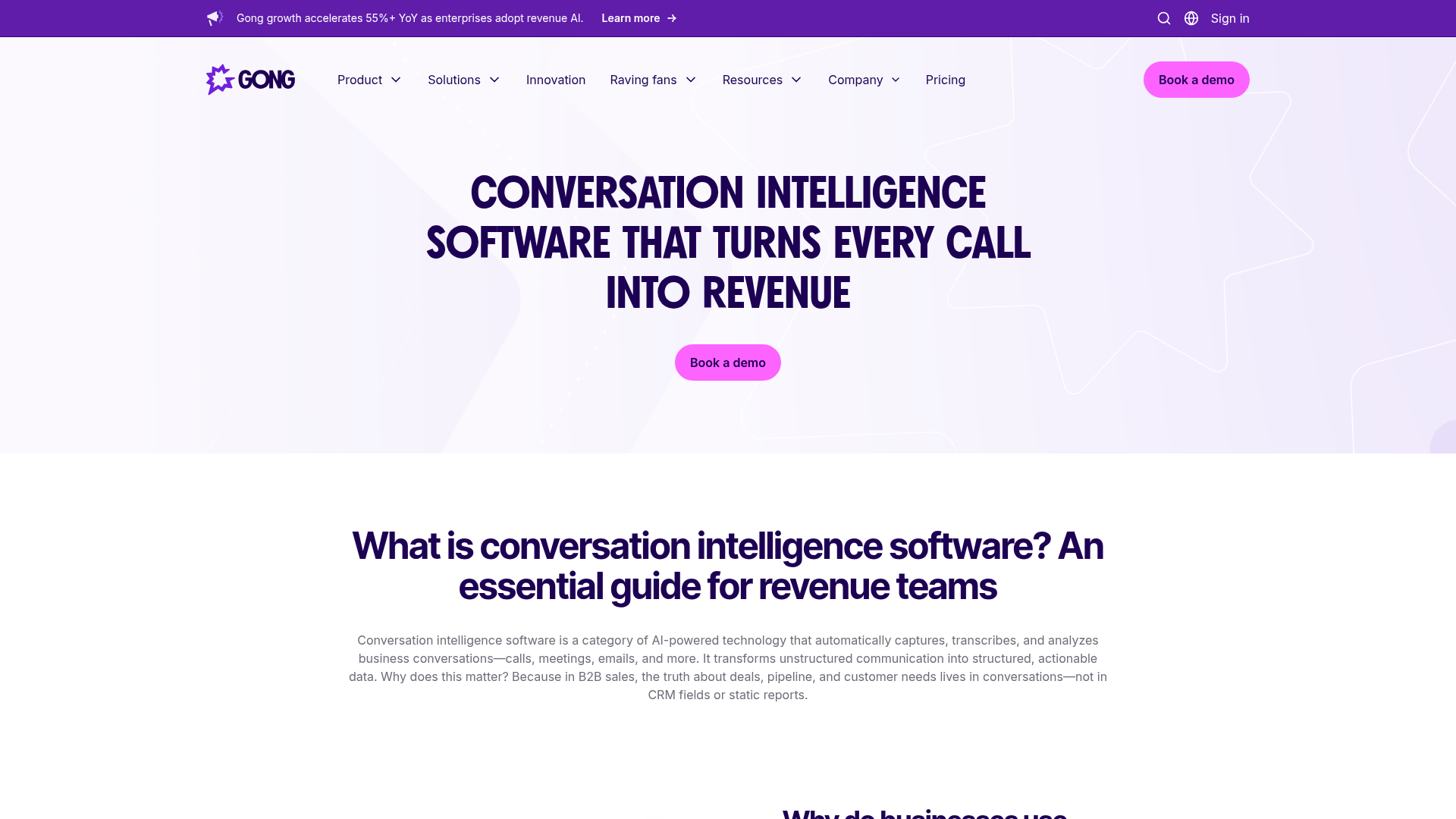
Best for: Enterprise B2B sales orgs (50+ reps, $25K+ ACV deals). Standout: Deal Intelligence + Engage forecasting. Pricing: $100-133/seat/month (~$1,200-1,600/seat/year, custom quote per 2026 operator discussions). Free trial: No (demo only). Rating: G2 4.7/5 (5,800+ reviews).
Gong is the only conversation intelligence platform that earns its $1,400-per-seat-per-year price tag, and only if you have a sales team big enough to feed the deal-risk and forecasting layers the volume they need to be useful.
The decision rule is uncomfortably specific. Under 20 reps: priced out. Twenty to 50 reps: math borderline, depends on average deal size. Fifty-plus reps with $25K+ ACV: the deal-risk catches alone usually pay back the seat cost in one saved deal per quarter. Under that ACV floor, the saved-deal math doesn't work.
I'd describe Gong as the only tool on this list where I confidently believe the layer-3 deal-risk software exists at the depth the marketing claims. They've had eight years and 5,000+ customers to refine the model, the dashboard, and the coaching workflow. Gong claims to capture "99% of customer interactions automatically" on their CI page; customer testimony in their marketing claims "300% pipeline feed increase" (vendor claim – take with salt, but the dashboard does drive pipeline reviews that don't happen without it).
The real cost. Per multiple 2026 operator posts on X, Gong runs $1,200-1,600/user/year for the core platform, plus a platform fee that scales with seat count, plus their newer "Enable" tier (tens of dollars/seat/month on top), plus implementation. Implementation is the part that surprises buyers: a 100-user deployment can hit ~$200K in setup costs ($2,000/user) before the first call is recorded. That's not a critique – enterprise software has implementation fees and Gong's are not unusual – but it should be priced in.
Pros (specific):
- Deepest deal-risk scoring on the market; the model has had eight years to mature and it shows in the dashboard depth.
- Bidirectional CRM sync that genuinely updates opportunity fields (Stage, Close Date, Next Steps) based on call content – the integration test most competitors fail.
- Coaching workflow lets a manager review 10 calls in 20 minutes, leave structured feedback on the playback, and route it to the rep – the core sales-coaching loop the rest of the list mostly approximates.
Cons (candid):
- Implementation fees and the requirement of a dedicated RevOps person to drive the platform mean total Year-1 cost is regularly 1.5-2x the seat-license sticker.
- Platform fee makes small-team economics impossible – under 20 reps you cannot get a sensible quote.
- The product is sticky in the bad sense too: switching out of Gong after two years of pipeline data and rep playlists in the system is a multi-quarter project.
If you have the team size and ACV to justify it, buy Gong. If you don't, the rest of this list is for you – and Avoma at #2 is where most buyers should actually look first.
Internal context: the SDR vs human SDR cost-per-booked-meeting analysis walks through the related question of when AI sales-tech ROI math actually closes – the same logic applies here. Gong's deal-risk layer is only worth paying for when the volume of deals it analyses is high enough that the catches happen often enough to matter.
2. Avoma – best for mid-market teams who want the full Gong stack at honest economics
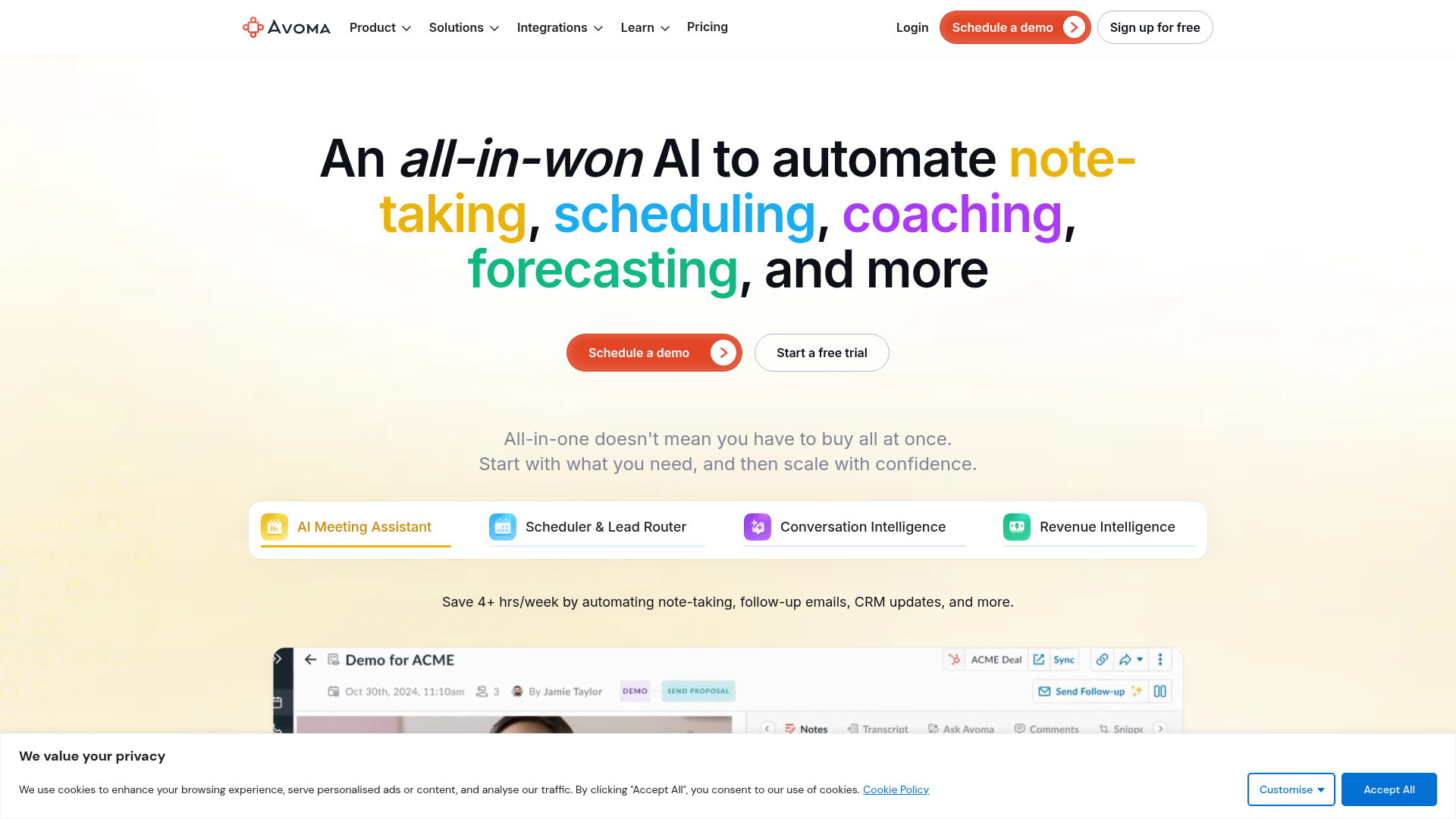
Best for: 5-50 rep B2B sales teams. Standout: Full CI + Revenue Intelligence + meeting-assistant stack in one tool. Pricing: $19-39/seat/mo base + $29/seat/mo CI add-on (annual) = $48-68/seat/mo all-in for the CI capability. Free trial: 14 days. Rating: G2 4.6/5 (1,400+ reviews).
Avoma is the only mid-market CI tool where the published per-seat price actually buys you a Gong-equivalent feature set without the enterprise contract minimum.
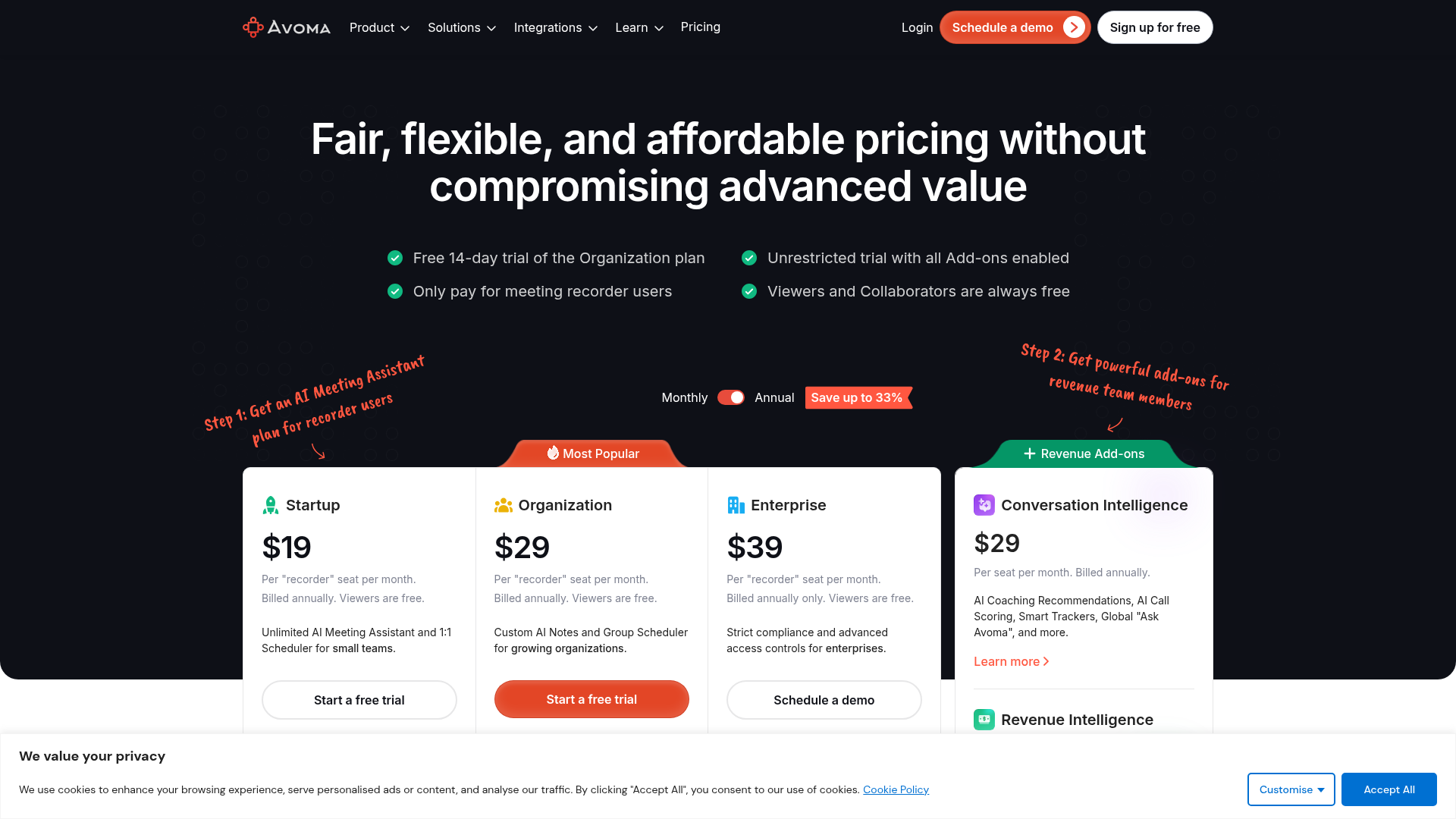
Going to the pricing page is the test that distinguishes Avoma from most of this list. Real numbers, plainly published: Startup tier $19/seat/month (annual, up to 25 paid seats). Organization $24-29/seat/month (up to 100 paid seats). Enterprise $39/seat/month (minimum 10 paid seats). The Conversation Intelligence add-on is $29/seat/month (annual) or $35 (monthly). Revenue Intelligence add-on is another $29/seat/month (annual).
The combination most mid-market teams want – Organization base + CI add-on – costs $53-58/seat/month annual. That's the all-in number to anchor on. Stack the Revenue Intelligence add-on on top and you get to $82-87/seat/month annual, which is the configuration that most directly competes with Gong's $100-133.
The decision math. A 10-seat Avoma Organization + CI = $580/month = $6,960/year. A 10-seat Gong = $14,000/year minimum (typically more once platform fee + implementation are added). Avoma is approximately 50% the price for what I'd estimate is 85% of the feature set in a mid-market context. The 15% gap is real and lives in the depth of the deal-risk model, the maturity of the forecasting layer, and the breadth of CRM integrations – all real, all the kinds of things that compound with vendor age. Gong has the head start. Avoma is closing it faster than most.
Pros (specific):
- Only mid-market tool with published, transparent per-seat pricing across base + CI + Revenue Intelligence – you can build a real budget without a sales-cycle dance.
- The meeting-assistant base tier ($19-39/seat) genuinely covers the note-taking + scheduling + CRM-sync job; the CI add-on is real CI, not warmed-up note-taking. The unbundling is honest.
- Full stack in one product: Avoma's Lead Router add-on ($19/seat/mo) plus the meeting + CI + Revenue Intelligence layers means you can run a 10-50 rep sales team on a single vendor and pay roughly what Gong charges per seat for the CI layer alone.
Cons (candid):
- Deal-risk and forecasting depth still trails Gong by a real margin – buy Avoma for the next 2-3 years, not for a 7-year procurement cycle where switching costs accumulate.
- "Up to 25 paid seats" cap on Startup tier and "up to 100 paid seats" on Organization mean very-large mid-market deployments push toward Enterprise tier where pricing transparency thins out.
- Lead Router add-on is fine but not best-in-class; if lead routing is a deal-breaker, Chili Piper or Distribute.io will still beat it.
If you're a 5-50 rep B2B sales team, the right answer is almost certainly Avoma Organization + the CI add-on, possibly with Revenue Intelligence stacked on top once the team is mature enough to drive a forecasting layer. That configuration runs $53-87/seat/month and gives you the full sales-coaching + deal-risk + meeting-assistant stack at honest per-seat economics.
3. Clari Copilot – best for RevOps teams already running Clari
Best for: Sales orgs already running Clari Revenue Platform. Standout: Tightest integration with Clari's deal-flow forecasting layer. Pricing: ~$60-95/seat/mo standalone (custom quote); typically bundled into Clari Revenue Platform at higher tier. Free trial: Demo only. Rating: G2 4.6/5 (300+ reviews, formerly under Wingman name).
Clari Copilot is the right CI choice only if you already pay for Clari's broader revenue platform – as a standalone product it's competing with cheaper tools that do the same job.
The history matters here. Wingman was a strong, mid-market-priced CI tool acquired by Clari in 2022 and rebranded to Clari Copilot. The standalone product (~$60-75/seat/month under the Wingman branding) is still buyable but Clari's gravity is increasingly to bundle Copilot into the full Revenue Platform – which is a $50K-$500K+ annual platform play for RevOps-led organisations.
Decision rule. If Clari Revenue Platform is in your stack, Copilot is the obvious add – the deal-flow + forecasting integration is the strongest pairing on the market. If Clari isn't in your stack, you're better off with Avoma at similar money. Buying Clari Copilot standalone in 2026 means you're buying a CI product whose product roadmap is converging on the Clari bundle. Not necessarily wrong, but you're betting on the bundle gravity going your way.
Pros (specific):
- Native integration with Clari's deal-flow scoring – if you're running Clari's forecast meetings, Copilot feeds them call-level evidence in a way no other CI tool matches.
- Coaching workflow inherited from Wingman is mid-market-grade and battle-tested across 300+ G2-reviewed deployments.
- Live battlecards on calls + objection-tracking are genuinely useful for ramping new reps.
Cons (candid):
- Standalone economics don't beat Avoma; the only reason to choose Copilot at the same money is the Clari bundle.
- Product roadmap visibility is opaque outside Clari's customer base – if you're not already a Clari customer, you're betting on a roadmap you can't see.
- The Wingman-to-Copilot rebrand created two years of feature-page churn that means competitor research is harder than it should be – half the SEO citations are still the Wingman product page.
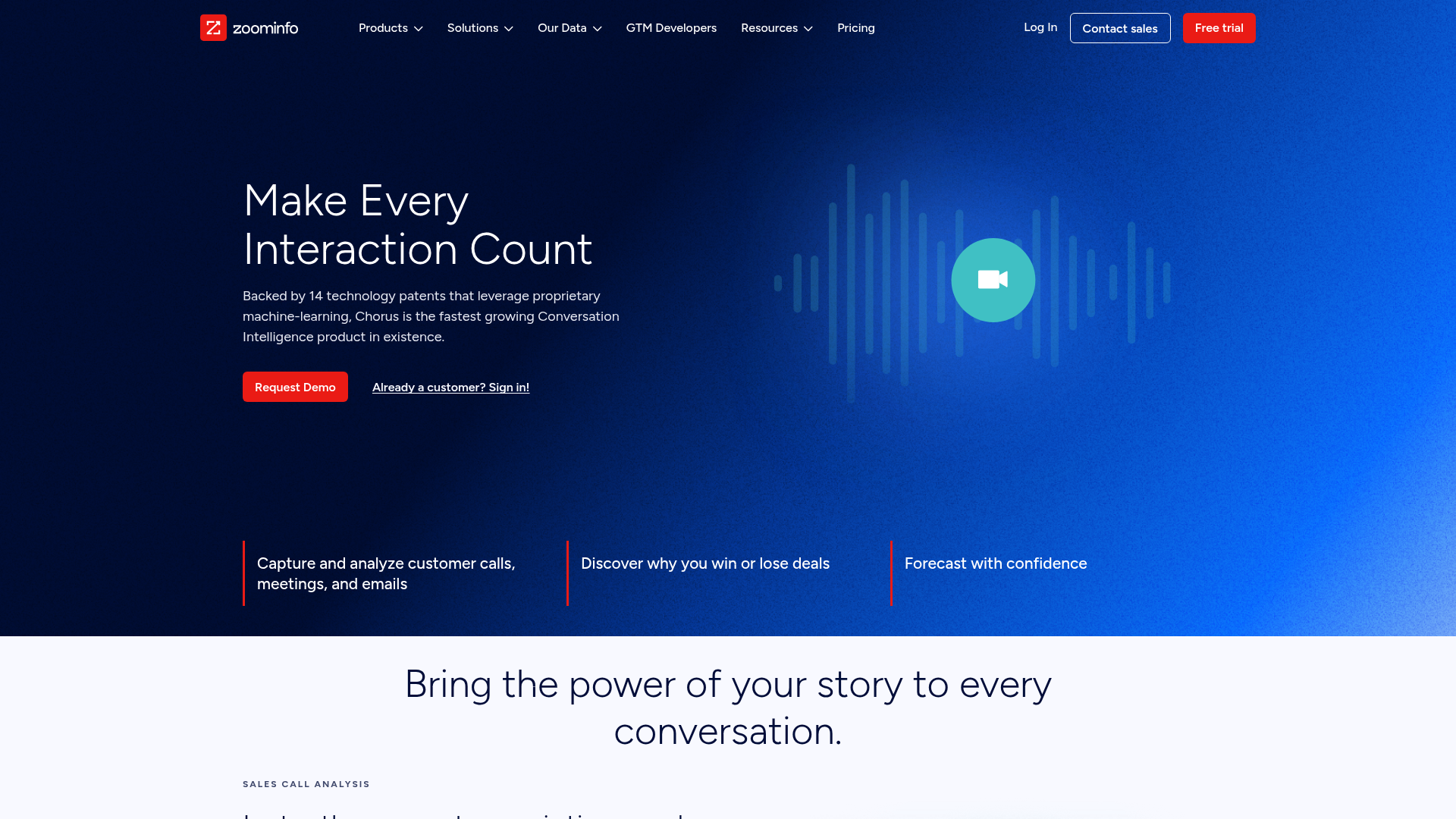
4. Chorus by ZoomInfo – best for outbound teams running the full ZoomInfo stack
Best for: Outbound B2B sales teams running ZoomInfo SalesOS. Standout: Tight integration with ZoomInfo's intent data and contact graph. Pricing: ~$150/seat/mo (custom quote, cited in 2026 operator discussions). Free trial: Demo only. Rating: G2 4.5/5 (3,000+ reviews).
Chorus is now part of ZoomInfo SalesOS, and that's where it makes sense – as a standalone CI tool it's Gong's older sibling without Gong's product velocity.
The history again matters. ZoomInfo acquired Chorus in 2021 for $575 million. The product has been progressively folded into ZoomInfo's broader SalesOS bundle, where it sits alongside the contact graph, intent data, and SalesOS engagement features. Buying Chorus standalone in 2026 is rarer than buying it as part of a $50K-$200K annual ZoomInfo SalesOS contract – and the standalone economics increasingly reflect that.
The honest comparison vs Gong: Chorus historically lagged on deal-risk scoring and led on contact-graph enrichment. The 2026 product has closed some of that gap. If your sales motion is heavily outbound, ZoomInfo-data-driven, and account-based, Chorus + ZoomInfo together is a coherent stack. If your motion isn't ZoomInfo-driven, you're paying for integrations you don't use.
Pros (specific):
- Contact-graph enrichment + intent data integrated into call recordings makes the deal layer feel native in a way Gong (without a contact graph) cannot match.
- Mature CI features – 12 years of product (counting the pre-acquisition Chorus.ai era) means the basics are solid: transcription quality, search, playlists, scorecards.
- Bundle pricing into ZoomInfo SalesOS frequently makes Chorus the cheapest enterprise CI option for teams that were going to pay ZoomInfo anyway.
Cons (candid):
- Product roadmap is tied to ZoomInfo's broader bets, which have been turbulent in 2024-2026 (multiple strategy resets, layoffs, market repositioning).
- Standalone buyers should question whether they're really getting better value than Gong at the same money. Frequently the answer is no.
- ZoomInfo lock-in is real – once Chorus is wired into the SalesOS contact graph, leaving means rebuilding two stacks.
Apollo, Clay, and Smartlead cover the outbound stack adjacent to where Chorus lives. If your outbound motion is Apollo or Clay-led rather than ZoomInfo-led, Chorus isn't the right CI choice – Avoma or Gong are.
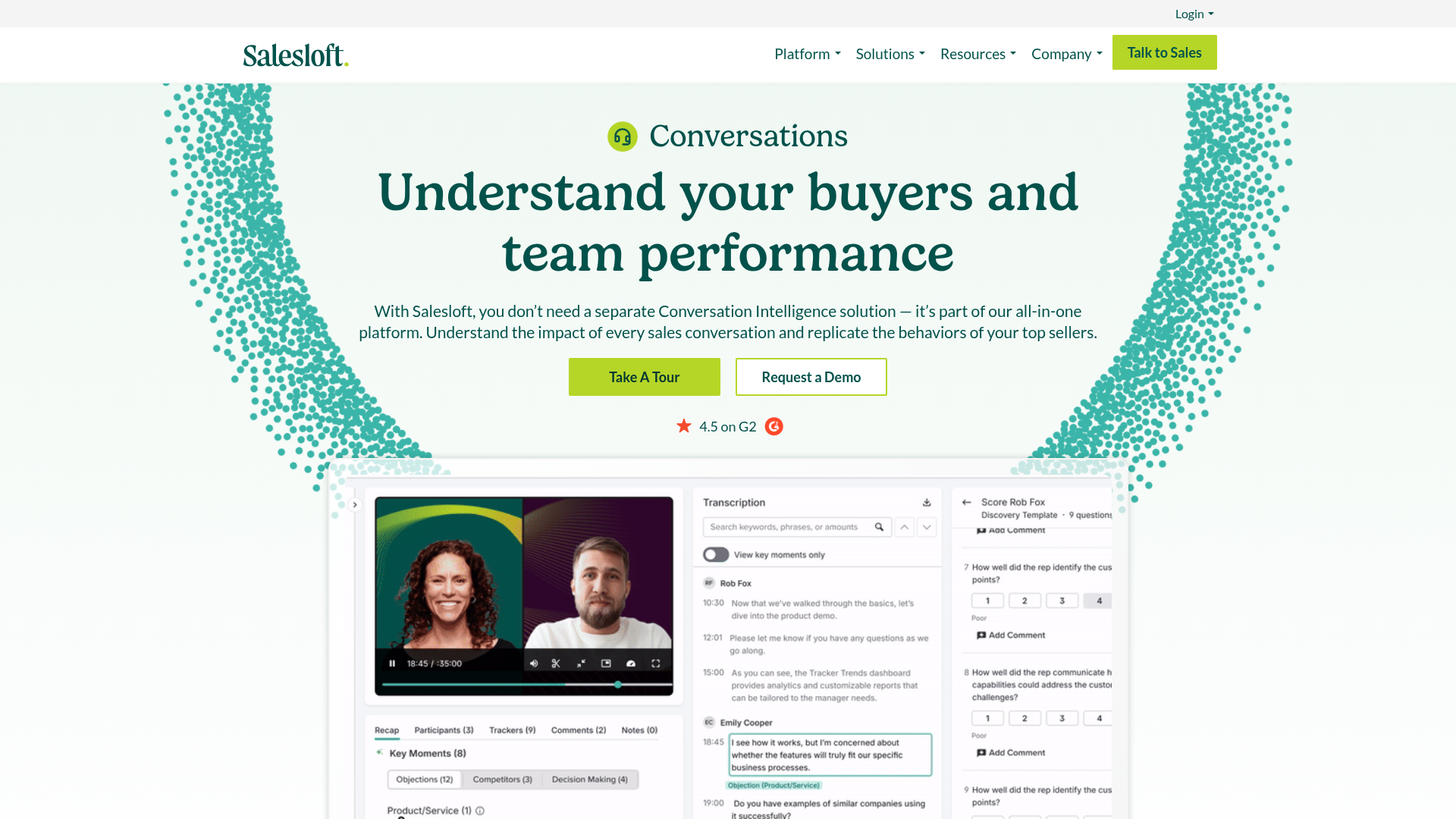
5. Salesloft Conversations – best for teams already paying Salesloft
Best for: Teams already on Salesloft Advanced or Elite.
Standout: Bidirectional sync with Salesloft cadences and pipeline.
Pricing: Bundled in Salesloft Advanced ($125/seat/mo) and Elite ($165/seat/mo) tiers.
Free trial: Demo only.
Rating: G2 4.5/5 (3,800+ reviews for Salesloft overall, CI module rated separately).
Salesloft Conversations is the right CI choice if Salesloft is already your sales-engagement platform – as a reason to choose Salesloft, the CI features aren't strong enough on their own.
Salesloft prices Conversations as part of the Advanced/Elite tier upcharges, not as a standalone add. A 10-seat Salesloft Essentials → Advanced upgrade just to get CI runs roughly $30K-$40K/year in incremental spend. That's the math you're really doing: is the CI layer worth tier-upgrading your sales-engagement platform? For some teams, yes – the cadence + CI integration is genuinely tight. For most, the CI alone won't carry the upgrade decision.
Pros (specific):
- Native sync with Salesloft cadences means CI signals can update cadence step sequencing – when a deal goes quiet, the cadence rebalances; when a call surfaces an objection, the next-touch template adjusts. This is real CI-engagement integration that competitors can't match without Salesloft underneath.
- 4,000+ sales teams use Salesloft per their own marketing – the CI module rides on a mature, well-understood platform.
- Bidirectional CRM sync is solid for Salesloft-native CRM workflows.
Cons (candid):
- Coaching workflow is built around Salesloft cadences – it won't help you if you use Outreach, HubSpot Sequences, or Apollo for outbound.
- Deal-risk scoring is good but not deep; it's CI as a feature inside an engagement platform, not CI as a category-leading product.
- Tier-upgrade math frequently doesn't work if you only want CI – the math works only if you also want Salesloft's better cadence + analytics features.
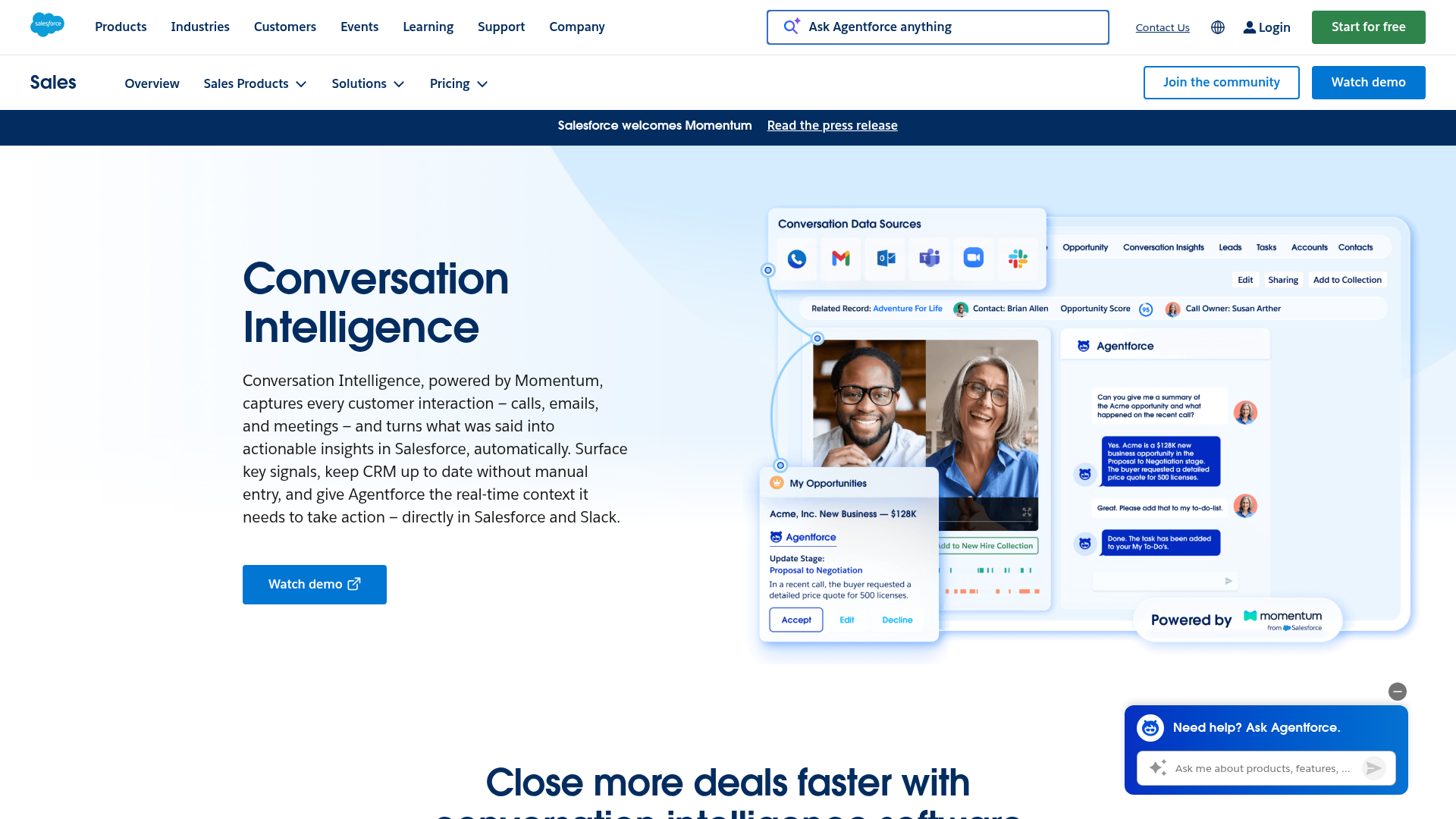
6. Salesforce Einstein Conversation Insights – best for Salesforce-locked enterprises
Best for: Sales Cloud-locked enterprises. Standout: Native Sales Cloud integration; no third-party data flow. Pricing: $50/user/month standalone (billed annually) on top of Sales Cloud ($25-300/user/month), or $100/user/month bundled with Sales Engagement (includes Sales Programs alternative at the same price). Free trial: 30-day Sales Cloud trial. Rating: G2 4.4/5 (350+ reviews).
Salesforce Einstein Conversation Insights is the safest, most predictable CI choice for a Salesforce-locked enterprise – and the worst value-per-feature on this list outside of that context.
The pricing reality: ECI standalone = $50/user/month, but you can't actually buy it standalone. It requires Sales Cloud underneath, so the all-in seat cost is $115-350/user/month once you add Sales Cloud Professional ($75/user/mo), Enterprise ($165/user/mo), or Unlimited ($330/user/mo). The Sales Engagement bundle ($100/user/month) includes ECI plus a sales-engagement layer that competes with Salesloft and Outreach.
Feature reality. ECI delivers surface-level transcription + summary + opportunity insights as a native Sales Cloud feature. The deal-guidance layer is improving but lags Gong meaningfully – Einstein's call-level reasoning is not yet at the depth Gong has been refining for eight years. ECI shines when you want everything inside Salesforce and you're willing to pay the platform tax to keep it there.
Pros (specific):
- Native Sales Cloud integration means no third-party data flow, no separate vendor relationship, no integration project – the most secure and audit-friendly CI option on the list.
- For enterprises that already have Salesforce Sales Cloud Enterprise + Sales Engagement, ECI is effectively free at the margin (already included in Sales Engagement at $100/user/mo).
- Salesforce's product roadmap velocity on Einstein has accelerated in 2024-2026 – the gap with Gong is closing.
Cons (candid):
- You're paying $50/seat/month for what Avoma + their CI add-on does for similar money standalone – but you're paying it on top of $25-300/seat/month of Sales Cloud you already have.
- Deal-guidance depth still lags Gong; Einstein-generated next-step suggestions are noticeably more generic than Gong's.
- Salesforce platform tax is the unspoken cost – Sales Cloud Professional doesn't include ECI; you need Enterprise + ECI add-on minimum, which pushes total per-seat cost up meaningfully.
Salesforce-adjacent operator tools sit in the same buying centre as CI – the CRM "agent tax" math from that piece applies directly: the $50/user/mo for Einstein CI is the same agent-tax pattern, where the platform's AI tier prices significantly above what the model layer underneath actually costs.
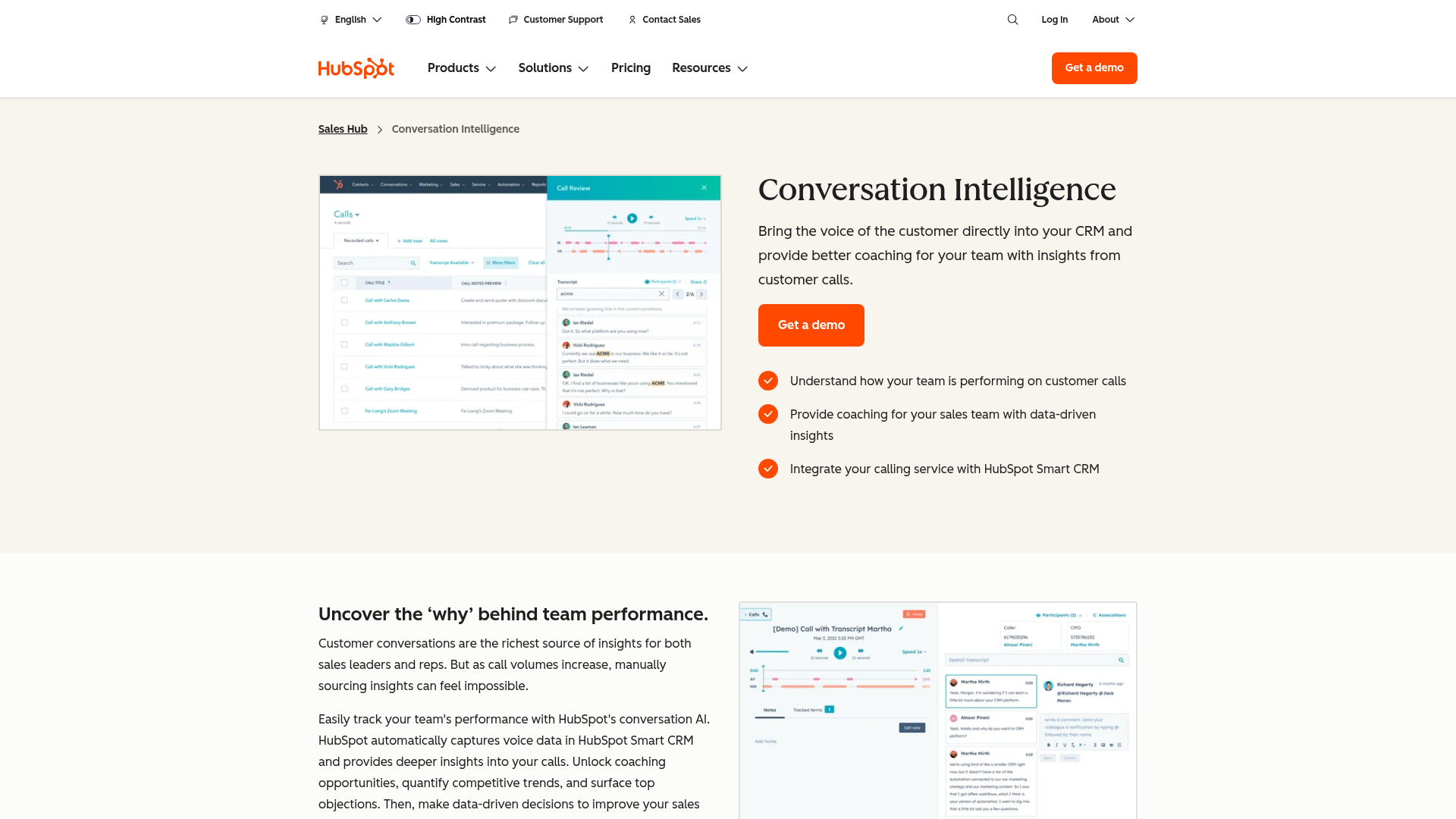
7. HubSpot Sales Hub Conversation Intelligence – best for HubSpot-native teams under 50 reps
Best for: HubSpot-native B2B teams under 50 reps. Standout: Included in Sales Hub Pro/Enterprise. Pricing: Sales Hub Professional $90/seat/month (CI included), Enterprise $150/seat/month. Free trial: 14 days. Rating: G2 4.4/5 (12,000+ reviews for HubSpot Sales Hub overall).
HubSpot's CI features are the right answer if you're already running HubSpot Sales Hub Professional or Enterprise – they're not a reason to choose HubSpot over Avoma or Gong.
Real numbers from the firecrawl: Sales Hub Starter $20/seat/month (no CI). Professional $90/seat/month (CI included). Enterprise $150/seat/month (CI + forecasting + advanced reports). A 10-seat Pro = $900/month + onboarding fee around $1,500 one-time.
Feature reality. Solid transcription, decent objection tracking, weak deal-risk scoring compared to Gong/Avoma. Coaching workflow is functional but basic – playlists, scorecards, and rep-level feedback exist but feel two product generations behind Gong's. CI inside HubSpot is a feature, not a flagship.
Pros (specific):
- Already included in Pro/Enterprise tiers – if you're a HubSpot Sales Hub customer, you're paying for it whether you use it or not, which makes the marginal cost zero.
- Native sync with HubSpot CRM, Sequences, and Workflows means CI signals can trigger CRM-side automations without a separate integration project.
- HubSpot's product velocity on AI features (Breeze, Copilot, etc.) means CI is improving fast inside the Sales Hub bundle.
Cons (candid):
- CI is bundled, which means it's better than nothing if you're already a HubSpot customer, but you're not paying for best-in-class CI – you're paying for HubSpot's overall sales stack.
- Deal-risk scoring is the weakest layer; the dashboard surfaces "deal health" badges that feel rule-based rather than model-based.
- For mid-market or enterprise teams that genuinely need a CI-led deal-pipeline view, the upgrade path is to Gong or Avoma, not to HubSpot Enterprise.
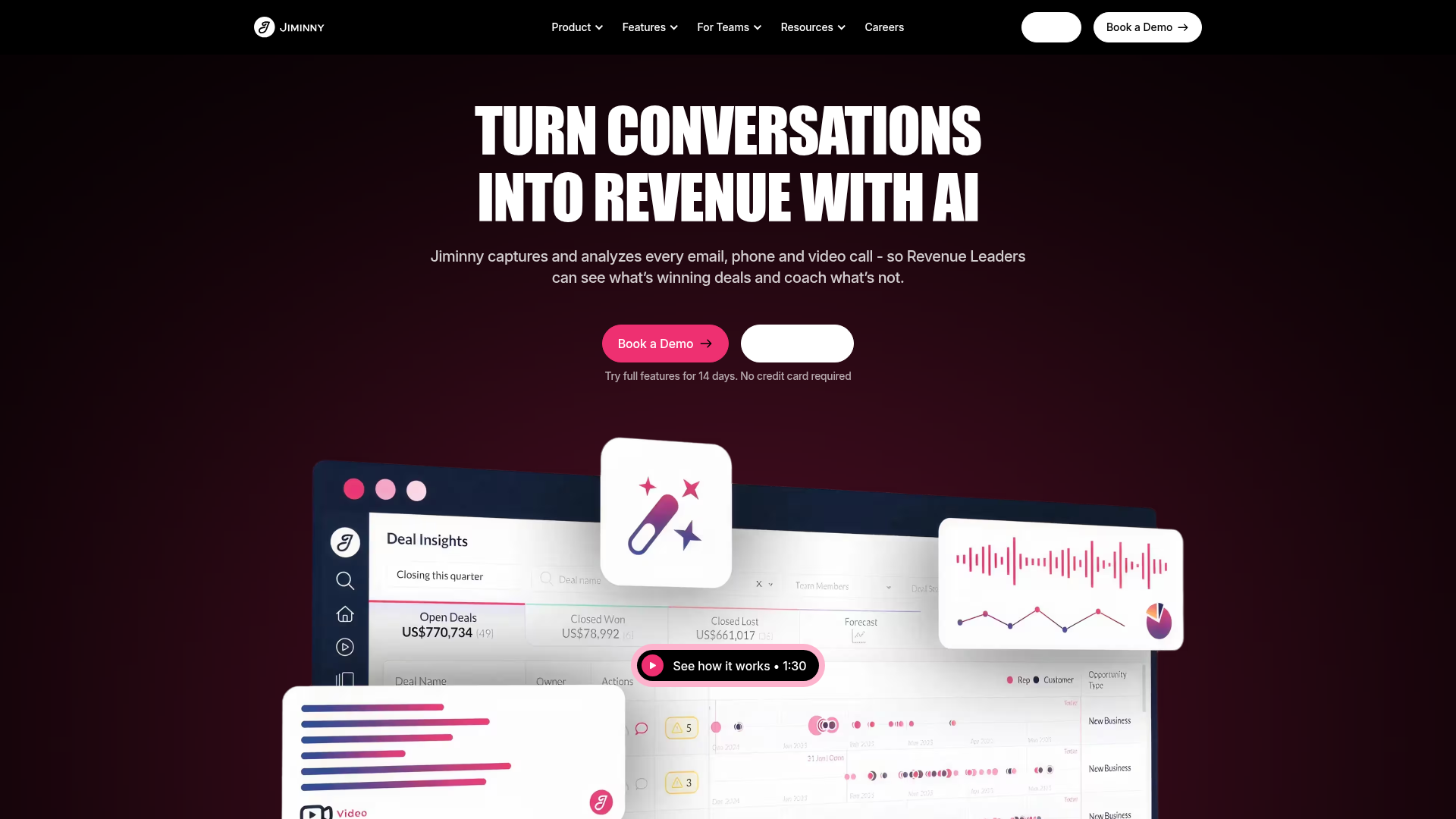
8. Jiminny – best for sales coaching as the primary use case
Best for: Mid-market sales coaching programs. Standout: Rep-coaching workflow + structured feedback templates. Pricing: From $20/user/month (annual, per CRO Club listicle pricing data); real all-in cost typically lands $80-120/user/mo after add-ons. Free trial: Demo only. Rating: G2 4.7/5 (700+ reviews).
Jiminny is the right pick for sales leaders who want CI primarily for rep coaching and onboarding, not deal forecasting – that's the gap it fills better than anyone else under $100/seat.
Jiminny's product DNA is sales-enablement-flavoured CI. The coaching UX – playlists, scorecards, structured rep feedback, manager-to-rep coaching loops – is genuinely better than what Gong, Avoma, or Clari Copilot ship at the same price point. Where Jiminny falls short is the deal layer: forecasting and deal-risk scoring are present but underpowered compared to the top three on this list.
Pros (specific):
- Best coaching-specific UX on the list – the rep-feedback workflow feels designed by a sales coach, not bolted on by a CI vendor.
- Strong G2 ratings (4.7/5, 700+ reviews) consistently emphasise the onboarding-and-ramp use case where Jiminny shines.
- Honest entry price ($20/user/mo at the listicle floor) makes it a reasonable starting point for sales orgs that want CI primarily for the coaching benefit.
Cons (candid):
- Pricing is opaque past the entry tier; real all-in costs for a 10-seat deployment typically land $80-120/seat/month after add-ons, narrowing the gap with Avoma (where the math is more transparent).
- Deal-risk and forecasting layers are thinner – if your buying motivation is "we need better pipeline visibility", Jiminny is the wrong choice.
- Integrations breadth is smaller than Gong/Chorus/Avoma – check your specific CRM and dialer stack before committing.
If your buying centre is the sales-enablement leader (not the RevOps lead or the VP of Sales), Jiminny is frequently the right answer. If the buying centre is RevOps or the CRO with a forecasting problem, look at Avoma or Gong first.
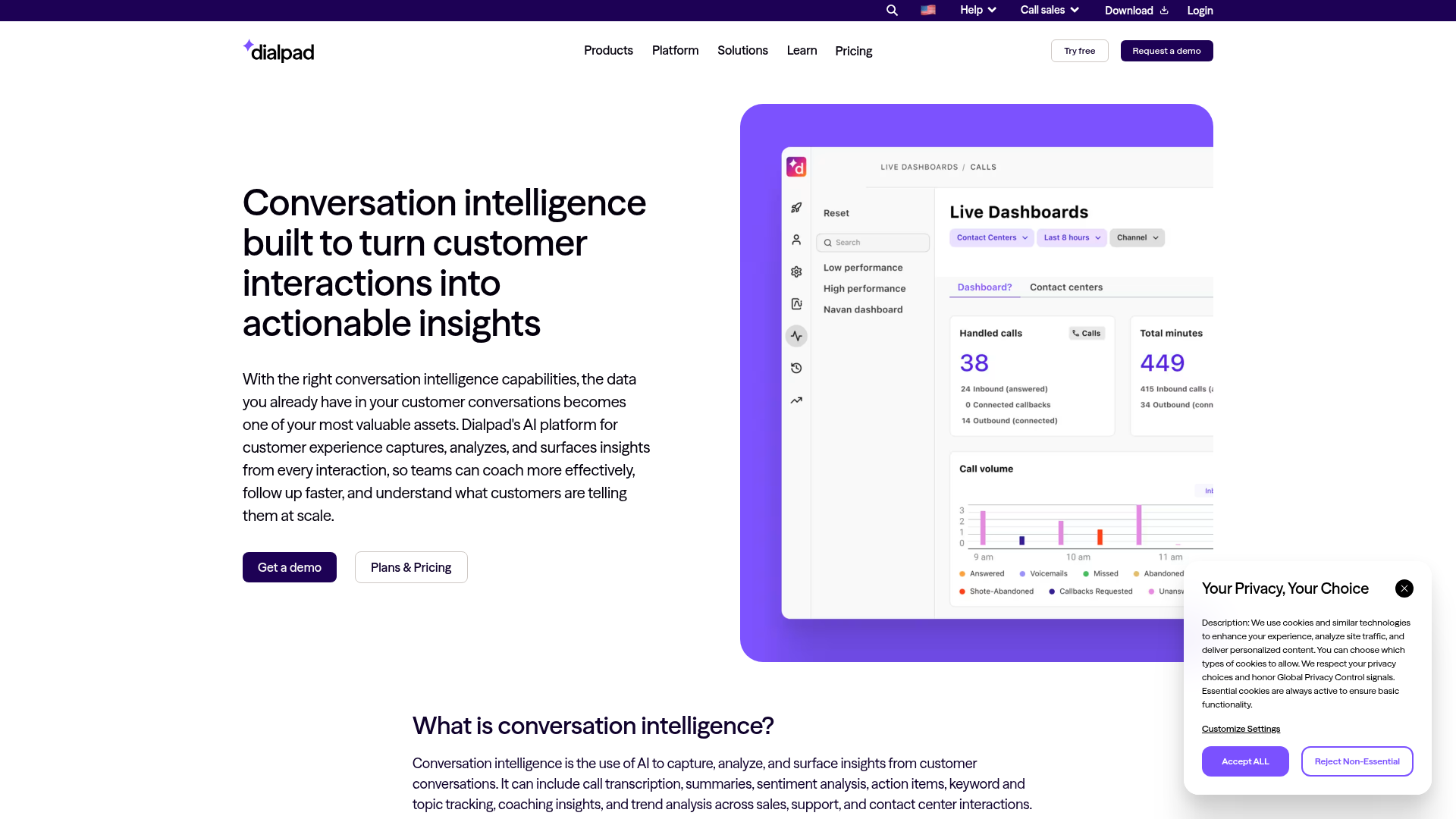
9. Dialpad Ai Sales – best for outbound teams who also need a phone system
Best for: Outbound teams that need telephony + CI in one tool. Standout: Bundled VoIP + real-time CI. Pricing: Ai Sales tier ~$95/user/month (custom for enterprise; baseline Ai Voice tier starts $15-25/user/mo). Free trial: 14 days. Rating: G2 4.4/5 (3,300+ reviews).
Dialpad bundles a phone system with CI features for the same price most CI vendors charge for CI alone – if you also need the dialer, it's the cheapest path.
Real numbers from the firecrawl: Dialpad Ai Voice Standard $15/user/month, Pro $25/user/month, Enterprise custom. The Ai Sales tier specifically (with the CI features) is custom-quoted but typically lands around $95/seat/month all-in. That puts Dialpad Ai Sales in the same per-seat range as Gong while bundling a full VoIP phone system into the price.
Feature reality. Real-time call assist (live battlecards, objection prompts) is genuinely strong. Post-call CI (transcription, summary, scorecards) is solid mid-tier. Deal-risk scoring and forecasting are thinner than the top three.
Pros (specific):
- Real-time call assist is the differentiator – Dialpad surfaces battlecards and competitor mentions during the call in a way that's noticeably tighter than Gong/Avoma's post-call analysis.
- Bundling telephony + CI in one tool simplifies the sales-tech stack – one vendor relationship, one bill, one integration project.
- Native handling of inbound + outbound calls makes Dialpad work for sales teams that also handle some inbound (lead-gen calls, demo bookings) where pure-outbound CI tools struggle.
Cons (candid):
- Deal-risk and forecasting layers are thinner – if you have a separate phone system you like (RingCentral, Aircall, your CRM-native dialer), you're paying for telephony you don't need.
- Per-seat pricing for the Ai Sales tier is custom-quoted, which limits budget transparency.
- Product is split across "Dialpad Connect" (VoIP), "Dialpad Ai" (CI/AI features), and the various Ai Sales/Ai Voice tiers – the product surface area is broader than a pure-play CI vendor, which means buying experience can be confusing.
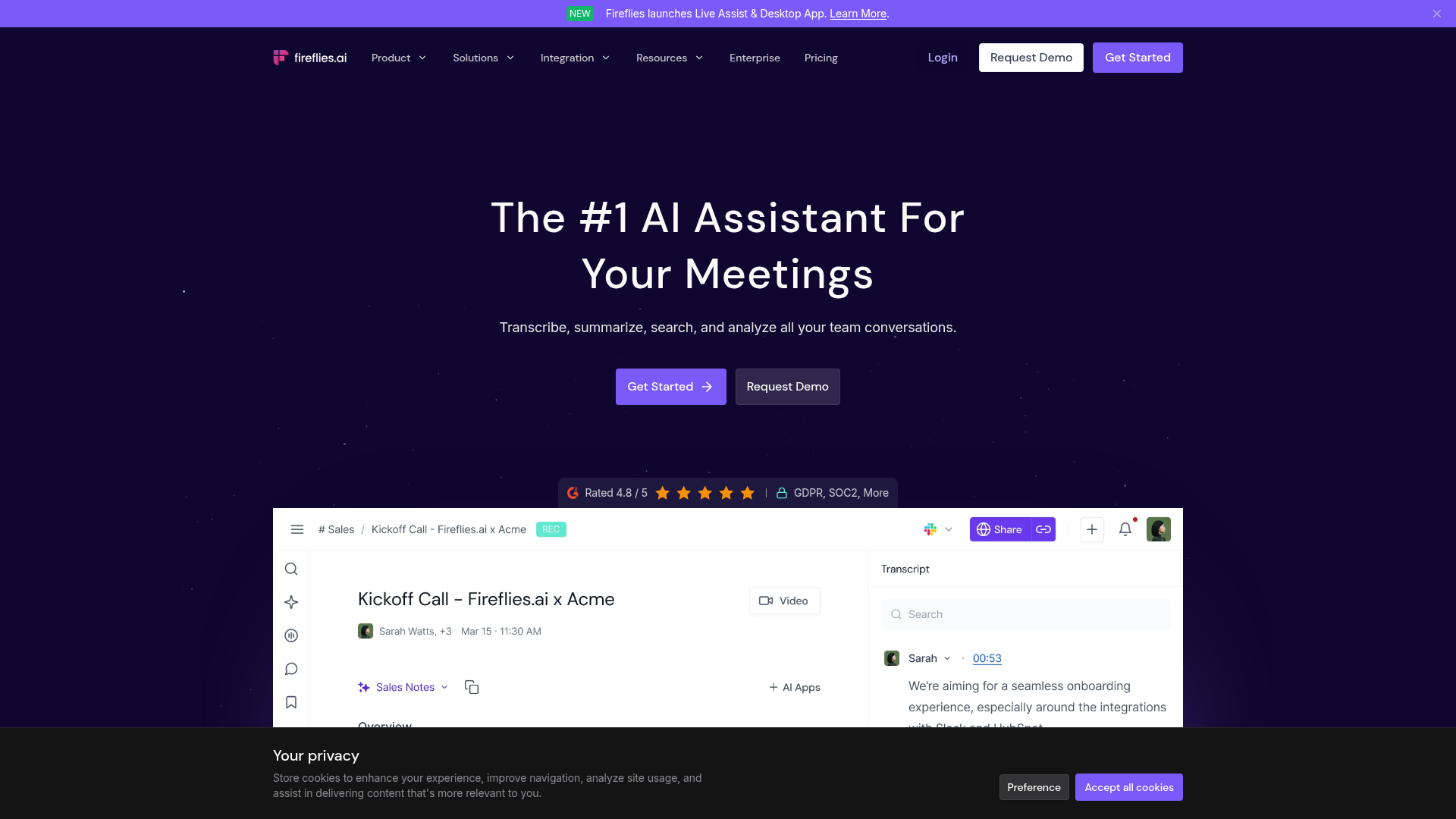
10. Fireflies.ai – best for hybrid meeting-note + CI use at the lowest cost
Best for: Small teams who want CI signals without buying CI. Standout: Lowest per-seat cost in the comparison. Pricing: Pro $18/seat/month, Business $29/seat/month, Enterprise $39/seat/month. Free trial: Free tier available. Rating: G2 4.7/5 (650+ reviews).
Fireflies sells as a meeting-note taker that also does CI – at $18-39/seat/month it's the cheapest CI-adjacent tool on this list, with the trade-off that it's a CI-adjacent tool, not CI.
Real numbers from the firecrawl: Free tier with limited transcription. Pro $18/seat/month (8,000 storage + AI summary). Business $29/seat/month (CRM sync, smart search). Enterprise $39/seat/month (custom retention, SSO).
Honest categorisation. Fireflies is a meeting-note tool with some CI signals (objection tracking, basic playlists, sentiment). The deal-risk + forecasting layer that defines real CI software is absent. That's not a flaw – Fireflies isn't trying to be Gong. It's trying to be a great low-cost meeting-note tool with enough CI features to handle the entry-level use case.
Pros (specific):
- Best per-seat economics in the comparison – Pro at $18/seat/month is roughly one-fifth the cost of the next-cheapest real-CI option (Avoma Organization).
- Free tier exists, which is rare in this category – useful for testing the tool before any commitment.
- Strong G2 reviews emphasise meeting-note quality and ease-of-use, both of which are real product strengths.
Cons (candid):
- It's not CI – if you need deal-risk scoring, opportunity-field updates from call content, or a real coaching workflow, Fireflies won't deliver.
- CRM sync at the Business tier is solid but one-directional in the deal-update sense – it logs activity, it doesn't update opportunity Stages or Close Dates based on call content.
- Storage caps and feature gating across the Pro / Business / Enterprise tiers mean the $18/seat sticker frequently grows toward $29-39/seat once you actually deploy at scale.
The right way to think about Fireflies: it's the right answer if you've already covered "real CI" in your stack with Gong/Avoma and you want a separate low-cost note-taker for non-sales meetings. Or it's the right answer if you don't actually need CI and someone in your buying process keeps confusing CI with meeting-note transcription. Recognising that confusion is the buying win.
The general-purpose meeting-note category is where Fireflies actually lives – the per-seat-trap analysis there covers the broader category economics that make Fireflies' pricing competitive against Otter, Notta, and the rest.
The ones to avoid, and what their listicle SERP placement is hiding
Tools that show up in conversation-intelligence SERP listicles in 2026 but shouldn't:
Observe.AI. Pivoted hard to contact-center "AI Agents" in 2025-2026. Their pricing page is now a literal 404 – I confirmed it during research for this piece. The product lineup is now organised around AI Agents for Customers / Frontline / Operations, with industry pages for Banking, Healthcare, Insurance, Transportation, Travel, Utility. Not a B2B sales CI tool anymore even though it still ranks for the keyword and shows up in every legacy CI listicle. If you're evaluating CI for a sales team in 2026, Observe.AI is the wrong product. If you're evaluating QA for a contact-center, it's a reasonable contender – different category entirely.
The customer-service / contact-center tools live in a different lane. Observe.AI is now competing with Ada, Intercom Fin, Decagon, and Sierra – not with Gong or Chorus.
MindTickle. Primarily a sales enablement / readiness LMS. The CI features are a lightweight add-on, not the product. Real spend on MindTickle starts around $50/user/month for the LMS, and CI is layered on top – meaning the effective CI seat cost is higher than the listicle "from $X" pricing suggests. If you want sales enablement (training content, certifications, ramp programs), MindTickle is a legitimate product. If you want CI, you're buying the wrong tool.
Allego. Same pattern. Allego is a sales enablement platform that added conversation intelligence as a feature. The CI piece is functional but secondary. If sales enablement is your primary need, Allego is reasonable. If CI is your primary need, you're paying for an enablement platform you don't need to get a CI feature you could buy standalone for less.
Fathom (as a CI replacement, not as a free note-taker). Fathom is a great free meeting note-taker – the most-recommended free Gong alternative on X, per real operator commentary in 2025-2026 ("you can't be cheaper than free", "solid option for one-person agencies or small sales teams"). But it's not CI. It doesn't do deal-risk scoring, doesn't have a real coaching workflow, doesn't update CRM opportunities based on call content. If a vendor or a colleague sold you Fathom as CI, they sold you the wrong product. Fathom is a meeting-note tool with light CI signals, and at its price (free) that's a great deal – just not for the CI buyer.
MeetGeek, Grain, Otter for Sales, Tidio. These are all meeting-note / chat tools showing up in CI listicles because they include AI transcription. None of them have the deal-risk layer that defines CI. MeetGeek and Grain are general meeting-note tools (the meeting note-takers listicle is the right lane for both). Otter for Sales is Otter's attempt at a sales-vertical product; the underlying tech is meeting transcription, not deal intelligence. Tidio is a chat / inbox / customer-support tool that should not appear in a CI comparison at all but does because the keyword inertia is real.
CallRail (as CI). CallRail is excellent call tracking for inbound marketing attribution – the 9 best AI call tracking tools listicle covers exactly that category, and CallRail wins it. CallRail does include conversation intelligence for inbound calls but isn't built for B2B outbound sales pipelines. If you do paid acquisition with inbound phone-call conversions, CallRail is the right tool. If you do outbound B2B sales calls and you need pipeline-level deal-risk scoring, it's not CI in the sense this piece means.
The pattern across all of these. Every category-spanning listicle (CRO Club's "22 best", G2's discussions, AssemblyAI's 7-tool round-up) blends LMS tools, contact-center QA tools, meeting note tools, and inbound call tracking tools into the same comparison. They're not the same product. If you read one of those listicles and ended up at Tidio for B2B sales CI, you got bad advice. If you read AssemblyAI's listicle and ended up at Symbl.ai or Voyc.ai, you got steered toward tools where AssemblyAI happens to be the underlying transcription provider – there's a vendor-incentive curation bias there worth recognising.
The simpler way to filter: ask whether the tool publishes deal-risk scoring, a real coaching workflow, and bidirectional CRM sync that updates opportunity fields. If two of those three are missing, it's not CI for the purposes of this comparison. It's CI-adjacent. Both have value – they're just different categories with different per-seat economics.
FAQ – the questions buyers actually ask
The People-Also-Ask box on "conversation intelligence software" and "best conversation intelligence software" surfaces a tight set of buyer questions in 2026. Answers below are direct, with the math where the math matters.
What is conversation intelligence software?
Software that records sales calls, transcribes them with AI, and analyses the transcript for deal risk, rep coaching cues, and pipeline forecasting signals – collapsing what used to be three separate roles (call recorder, sales trainer, RevOps analyst) into one platform.
The category sits in a specific lane: outbound B2B sales calls feeding a deal-pipeline scoring layer. It's not the same as general meeting note-takers (Otter, Notta, Fathom), call tracking for inbound marketing attribution (CallRail, Invoca), or contact-center agent monitoring (NICE, Verint, Observe.AI). The deal layer is what you're paying for.
What's the top-rated conversation intelligence software?
G2's 2026 leaderboard puts Gong, Chorus, and Avoma at the top by user reviews. Based on the margin-math approach in this piece, I'd buy Gong (enterprise, 50+ reps, $25K+ ACV), Avoma (mid-market, 5-50 reps), or Clari Copilot (RevOps teams already on Clari Revenue Platform) in that order of confidence.
Top-rated by reviews and right-for-you are different questions. Gong rates 4.7/5 with 5,800+ reviews because it's the dominant product at enterprise scale; if you're a 12-rep team, top-rated for them isn't top-rated for you.
How much does a conversational AI / CI platform cost?
Real 2026 ranges: $18-39/seat/month for lowest-tier tools (Fireflies, basic meeting-note CI). $48-68/seat/month for honest mid-market CI (Avoma Organization + CI add-on, all-in). $100-150/seat/month for enterprise CI (Gong, Chorus, Salesloft Elite, Dialpad Ai Sales). Salesforce Einstein Conversation Insights is $50 standalone plus Sales Cloud ($25-300/user/month) underneath. Custom enterprise quotes for Gong/Chorus go higher once platform fees and implementation are added – Gong implementation can reach $2,000/user.
The cheaper end of the range buys you transcription + summary. The more expensive end buys you deal-risk + forecasting + coaching workflow. The middle is where most mid-market buyers should land.
Is Gong worth the price?
Yes if you have 50+ reps with $25K+ ACV deals. The deal-risk layer catches enough saved deals per quarter to pay back the $1,200-1,600/seat/year cost. No if you have under 20 reps – the layer needs volume to be useful and the per-seat math doesn't work at small team sizes. Between 20-50 reps with reasonable ACV: borderline, do the saved-deal math for your specific motion before committing.
What's the best free Gong alternative?
Fathom is the most-recommended free option for individual reps or one-to-three-person sales teams, per real 2025-2026 operator commentary on X ("you can't be cheaper than free", "solid option for one-person agencies"). It's a meeting note-taker with light CI signals – not CI proper – but it's free, which is hard to beat for that use case.
For a small team that wants something between free Fathom and paid Gong, Avoma's Startup tier at $19/seat/month (annual) is the next step up, and Avoma + the CI add-on at $48-68/seat/month all-in is the right answer once the team grows past 5-10 reps.
Conversation intelligence vs sales engagement vs sales enablement – what's the difference?
CI = analyse the call (Gong, Avoma, Chorus). Sales engagement = manage the cadence (Salesloft, Outreach, Apollo). Sales enablement = train the rep + manage the content library (MindTickle, Allego, Highspot, Seismic).
The categories blur – Salesloft bundles CI plus engagement, Allego bundles CI plus enablement, HubSpot bundles all three at varying depths. The core jobs are different and matter for buying: if your problem is "we don't know which deals are at risk", that's CI. If it's "our reps aren't following the cadence", that's engagement. If it's "new reps take six months to ramp", that's enablement.
Can I just use ChatGPT to summarise sales calls?
You can summarise individual calls cheaply with ChatGPT + an audio transcript – the underlying compute cost is well under $0.01 per call. What you can't do that way is build the deal-risk scoring across the entire pipeline, the rep coaching workflow with structured manager feedback, the bidirectional CRM sync that updates opportunity Stages and Close Dates based on call content, the rolling forecasting model that gets better as your team makes more calls.
CI is what the dashboard does over thousands of calls and a maturing pipeline data set, not what an LLM does over one transcript. The dashboard, the workflow, and the integrations are the product. The transcript and summary are the commodity inside it.
How long does it take to implement conversation intelligence software?
Avoma, Jiminny, Fireflies: 1-3 weeks for a 10-50 rep team if your CRM is HubSpot or Salesforce and your meetings are on Zoom/Google Meet/Teams. Two to four weeks if you have a less common dialer or CRM that needs custom integration work.
Gong, Chorus, Salesloft: 4-12 weeks for enterprise deployments. The implementation fee that surprises Gong buyers (~$2,000/user on 100-user deployments per 2026 operator posts) reflects the real engineering work needed to wire Gong into a mature enterprise CRM, sales-engagement, and forecasting stack.
Salesforce Einstein Conversation Insights: depends entirely on your existing Salesforce maturity. If you already have Sales Cloud Enterprise running cleanly, ECI is a flip-the-switch. If you're new to Salesforce, the ECI implementation is the tail end of a 3-6 month Salesforce deployment, not a standalone CI project.
Which CI tool should you choose
The decision tree, persona-routed:
- 50+ rep enterprise, $25K+ ACV: Gong. The deal-risk layer pays for itself in saved deals.
- 5-50 rep mid-market B2B: Avoma Organization + CI add-on. Honest economics, full feature set, the right answer for most readers of this piece.
- Already running Clari Revenue Platform: Clari Copilot. Bundle math wins.
- Already running ZoomInfo SalesOS: Chorus. Bundle math wins; the contact-graph integration is the differentiator.
- Already paying Salesloft Advanced or Elite: Salesloft Conversations. Already included in your existing tier.
- Salesforce-locked enterprise: Einstein Conversation Insights via the Sales Engagement bundle ($100/user/month). You're going to lose the platform-tax fight anyway; this is the lowest-friction CI for that context.
- HubSpot-native under 50 reps: HubSpot Sales Hub Professional at $90/seat/month. CI included.
- Sales coaching as your primary buying motivation: Jiminny. The coaching workflow beats everyone else under $100/seat.
- Need phone system plus CI in one tool: Dialpad Ai Sales. Bundling VoIP + CI saves money if you actually need both.
- Lowest possible cost, hybrid meeting-note + light CI use case: Fireflies Pro at $18/seat/month, with the explicit recognition that it's CI-adjacent, not CI.
The order of buying confidence: Gong (enterprise) and Avoma (mid-market) are the two answers I'd give if a buyer told me only their team size and ACV. Everything else is a stack-fit decision – buy the CI that bundles with what you already pay for, when the bundle math wins.
Ignore: the listicles that put Tidio, MeetGeek, or Symbl.ai next to Gong. They're solving different problems. Your buying job is to figure out which problem you actually have – deal-risk, coaching, transcription, or platform-fit – and route to the tool that solves it.
What's actually changing in CI in 2026-2027
Three category-level shifts I'd watch over the next 18 months, based on what the underlying model layer is doing and what the vendor product roadmaps have signalled in 2025-2026.
1. Real-time call assist is becoming the new layer-2. Dialpad already ships real-time battlecards and objection prompts during calls. Gong and Avoma are both rolling out streaming-CI features that surface deal-relevant context to the rep mid-call rather than post-call. The economics: streaming transcription via Deepgram Nova-3 is $0.0043/minute, and GPT-4o-mini real-time prompting is well under $0.01 per call-minute even at retail rates. The compute cost is genuinely small. What's hard is the latency budget and the UX – getting the right battlecard in the rep's screen at the right moment without distracting them. The vendors who solve this UX challenge in 2026 will price-anchor a new tier above the current $100-150/seat range, and the laggards will get squeezed by the real-time-capable competitors.
2. CI is consolidating into sales-engagement and CRM platforms, not the other way around. Salesforce, HubSpot, and Salesloft are all bundling CI into their broader platforms. Standalone CI vendors (Gong, Chorus, Avoma) are responding by adding sales-engagement, content-management, and forecasting features upward – Gong's "Engage" tier and Avoma's Revenue Intelligence add-on are both attempts to grow into the adjacent platform spaces before the platforms swallow CI as a feature. The net result for buyers over 2-3 years: the standalone CI category will shrink, and the surviving standalone CI vendors will look more like full revenue-platform players. Buying CI today is a 2-3-year bet on either the standalone vendor's platform ambitions or the platform vendor's CI maturity.
3. AI agents are starting to replace parts of the CI workflow, not augment them. The current CI dashboard is built around the assumption that a human manager reviews calls, listens to playlists, and gives feedback. Agentic workflows – where an AI agent reviews 200 calls, identifies the 12 that need human coaching attention, and pre-writes the structured feedback for the manager to approve – are emerging across the vendor base. The buying implication: the value of the dashboard UI is going down, the value of the agent's reasoning quality and the integration with the CRM is going up. Vendors building strong agent layers (Gong, Avoma, increasingly Salesforce Einstein with Atlas + Agentforce) will pull ahead of vendors who treat CI as a dashboard problem. Buying CI in 2026 should weight the vendor's agentic roadmap as much as their current dashboard depth.
The macro implication: a chunk of the deal-risk and coaching work that currently lives in a $1,400/seat/year Gong subscription will, in 2027-2028, live in a $200-400/seat/year sales-platform agent layer that handles the routine CI work and escalates only the genuinely interesting cases to humans. The teams that are buying CI now should think about how their 2026 contract will look in 2028 when the category economics shift.
Get the AI tools map for business owners
The 10 tools in this piece are the CI lane. There are nine more lanes – CRM, customer service, cold email, copywriting, social media, SEO, content optimisation, ad creative, attribution – each with their own per-seat economics and their own "ones to avoid" patterns. The AI tools map for business owners is a single PDF that routes you by buying centre and budget to the right tool in each lane, with 2026 pricing.
Subscribe to the newsletter to get the map and the monthly update – pricing changes more than the marketing pages admit, and the map gets refreshed when it does.
May 24, 2026


