Abu Dhabi Dental Recall Stack: 38% Fewer No-Shows
A real anonymized playbook for a 14-chair Abu Dhabi multi-specialty dental group rebuilt around the DOH Responsible AI Standard V1 (2025) and ADHICS V2.0. Every architectural choice, Arabic + English templates, human-in-the-loop…






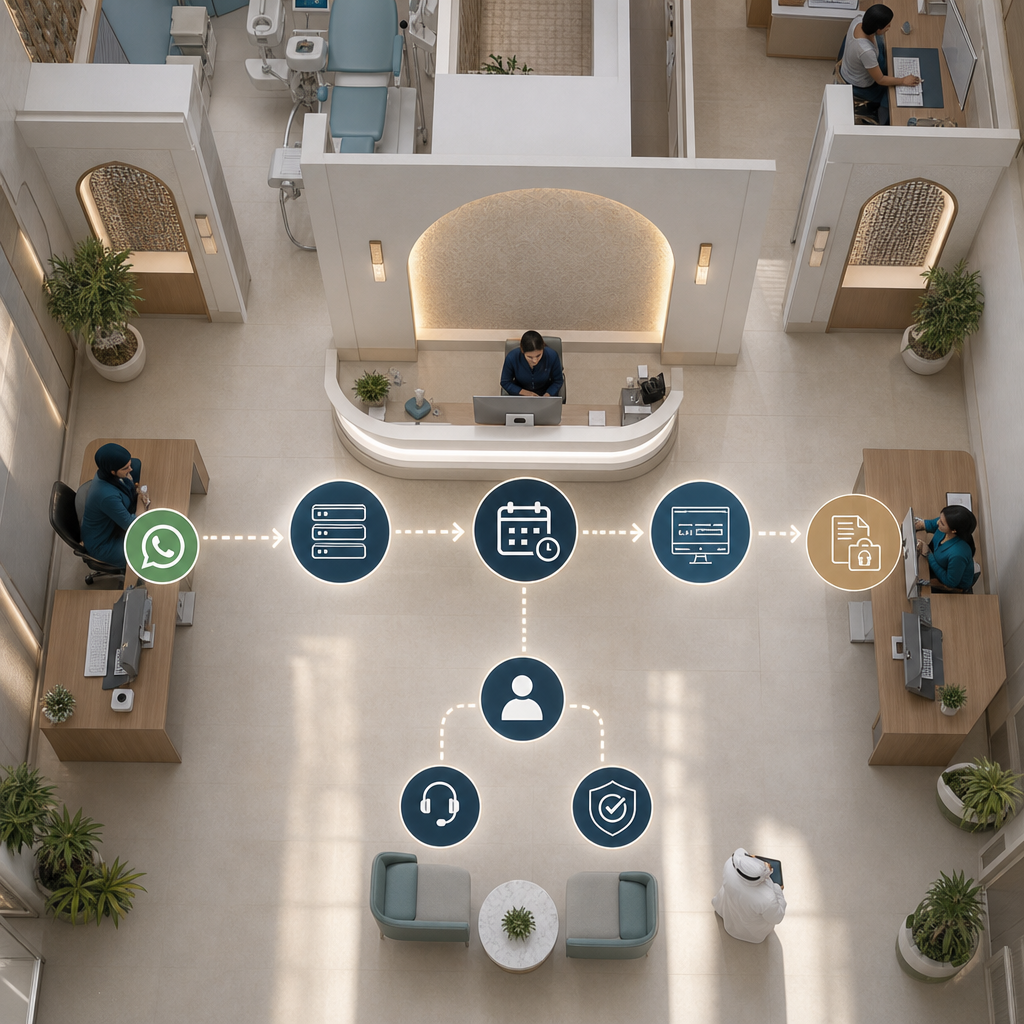
A 14-chair multi-specialty group in Khalifa City was leaking AED 96,000 a month in no-shows and uncollected recall revenue. We rebuilt their front-desk loop in 6 weeks on an AED 14,500 capex / AED 2,800 monthly opex stack that drops no-shows 38% and survives the DOH inspector's first three audit questions on a printout.
The leak: AED 96K/month gone before anyone touches AI
The clinic runs 14 chairs across six specialists and eleven hygienists, with four front-desk staff splitting WhatsApp, walk-ins, and phone. Monthly revenue ceiling around AED 1.2M. On paper, a healthy operation. In practice, the recall workflow was an Excel sheet that one receptionist updated on Tuesdays.
Pulling 18 months of EMR appointment data told the real story. 480 patients due for recall every month. Only 31% rebooked. Default no-show rate sat at 22%, and first-reply SLA on WhatsApp drifted past 4 hours on Friday afternoons, exactly when the Khalifa City catchment is shopping for a Sunday morning slot. Reconstructed against an AED 620 average ticket, the gap was AED 96,000 a month in opportunity cost. Not theoretical: every one of those patients had been treated before and had a clinical reason to come back.
The owner had been pitched three vendors that quarter, all variations on "buy our SaaS, plug in your EMR, no-shows drop." That answer is partially right. It's also structurally incomplete. The vendors handle the workflow surface – WhatsApp templates, appointment confirmations, an inbox with AI suggestions – but they leave the clinic holding the regulatory bag. And in Abu Dhabi, the regulatory bag is heavier than the workflow.
Why "just buy the SaaS" fails the DOH Responsible AI Standard test
The DOH Responsible AI Standard V1 (2025) is short and uncomfortable. It requires documented human oversight on any AI-mediated patient interaction, escalation protocols stratified by risk level, secure-by-design alignment with ADHICS, and a reportable audit trail the inspector can pull on demand. ADHICS V2.0, the updated cybersecurity framework, adds an AI governance domain, mandates 24-hour breach reporting, requires EDR on systems touching patient data, and tightens encryption requirements for data in transit and at rest.
Read those two documents back to back and a pattern emerges: the regulator does not care which vendor you bought. The regulator cares who can answer the four questions: who reviewed this message, which escalation rule applied, where the audit row is, and how the patient's consent is logged in their preferred language. The gaps are consistent: who owns the AI agent's training data, where Arabic-language patient consent is logged with the patient's actual reply text, and whether the messages routed through the WhatsApp Business Solution Provider constitute PHI under the inspector's reading on the day they show up.
The worst failure mode is not the SaaS gap. It is the shadow workflow. A receptionist, under pressure on a Saturday, pastes a patient's name and treatment history into the consumer ChatGPT app to draft a recall message in Arabic. That single action – unlogged, unencrypted, offshore – is the licence-renewal problem. Name it explicitly in the staff training, because every clinic in the country has someone doing it right now.
The AED 14,500 audit-ready stack, line by line
This is the build that passed internal audit dress rehearsals and answers the inspector's first three questions on a printout. It uses the same WhatsApp BSP pattern as our Dubai brokerage build, retuned for clinical risk and ADHICS V2.0 encryption requirements.
The components, with real numbers:
- WhatsApp Business Platform via approved BSP (360dialog or Karix, both have UAE-resident infrastructure options). One verified clinic sender, Meta-approved template library. AED 2,200 setup, AED 0.044 per conversation at the marketing/utility tier.
- Self-hosted recall service on a single Hetzner CX22 shared VM with Cloudflare Tunnel for ingress. If the inspector pushes back on data residency, we have a documented migration path to Etisalat Switch in-region. AED 180/month.
- Anthropic Claude Haiku 4.5 for English and Arabic intent classification only. Not diagnosis. Not triage. Not free-text composition to patients. AED 320/month at ~6,500 conversations.
- Append-only audit log on Cloudflare D1 with R2 for message-body archival, 7-year retention policy tagged to a hashed
patient_id. Nightly export to Malaffi-linked storage. - Bilingual template library: 49 pre-approved templates (22 English, 22 Arabic, 5 escalation), every variable bound, zero free-text outbound from a model to a patient.
- EMR integration via webhook (Practo, Medas, or Unite – we pick what's already running, we do not migrate the EMR). AED 8,500 one-time.
Total: AED 14,500 capex, AED 2,800/month opex, covering roughly 6,500 patient conversations a month.
CAPEX (one-time)
  BSP setup + sender verification        2,200 AED
  EMR webhook integration                8,500 AED
  Recall service deployment + hardening  3,800 AED
                                       ────────────
                                        14,500 AED

OPEX (monthly, at ~6,500 conversations)
  BSP conversations (~6,500 × 0.044)       286 AED
  Hetzner CX22 + Cloudflare Tunnel         180 AED
  Claude Haiku 4.5 inference               320 AED
  Internal audit + maintenance retainer  2,014 AED
                                       ────────────
                                         2,800 AED
The AED 2,014 maintenance line is the one most vendor decks skip. It pays for the weekly audit-trail walkthrough, the BSP template renewal cycle, and the staff retraining when escalation thresholds shift.
Mapping each clause of the DOH Responsible AI Standard to a specific architectural choice
This is the section that gets photocopied and put in the operations binder. Each clause from the Standard maps to one line in the build. This is the same discipline we apply to the general small-business automation stack – but here, the audit penalty is your licence.
Human oversight. Every Claude classification routes through a three-rule confidence gate (intent confidence, language confidence, risk tier). Anything below threshold lands in the WhatsApp inbox a human reviews before send. Clinical-tier intents never auto-reply, ever. The reviewer's identity is logged on the message row.
Escalation protocols by risk tier. Three tiers, hard-coded:
- Tier 1 – Booking confirm. Date, time, clinic name. Auto-send allowed after confidence gate.
- Tier 2 – Recall nudge. "Your hygiene visit is due." Template-only, no treatment specifics, no specialist name. Auto-send allowed.
- Tier 3 – Clinical question. Anything the patient sends that contains a symptom, a treatment code, a medication name, or a question about a procedure. Queued for human review with a 2-hour SLA. The AI suggests; the human sends.
Secure-by-design alignment with ADHICS. BSP → Worker → D1, with TLS 1.3 throughout, SSE-encrypted storage, EDR on the recall service host, and no patient data in the model context except a one-way hashed patient_id. The model sees "patient_a7f3c2 asked about recall in Arabic." It never sees a name.
Audit reconstruction. Every outbound message writes a row: timestamp, patient_id_hash, template_id, language, agent type (human or AI), reviewer name if applicable, confidence score, and the BSP message ID. One CSV export, filterable by 90-day window, answers the inspector's "show me everything" question in under 10 minutes.
Arabic-language consent. The opt-in template is sent in the patient's preferred language. The patient's reply text is logged verbatim against the consent record, retained for the consent's natural lifetime, and available in the audit export.
The 30/60/90 deployment we ran
Six weeks of build, twelve weeks of supervised operation before the system runs on its own confidence gate.
Days 1–14 – Reconstruct the cohort and write the templates
Pull 18 months of EMR appointment data. Reconstruct the no-show and recall-lapse cohorts. Write the 49-template bilingual library – every variable bound, every Arabic translation reviewed by a native Khaleeji speaker on the clinic's staff, not the BSP's default Modern Standard Arabic. Submit templates for Meta approval (allow 5 business days). Get the BSP sender verified.
Days 15–30 – First cohort, 100% human review
Integrate to the EMR via webhook. First cohort of 200 patients receives recall messages. Staff trains on the three-tier escalation rules using real inbound messages. Human-in-the-loop ratio is set at 100% – every AI-classified response is reviewed by a named front-desk staffer before send. The point is not efficiency yet. The point is calibrating the confidence gate against real Khalifa City Arabic-English code-switching.
Days 31–60 – Tune the confidence gate
Review ratio drops to 35% for Tier 1 and Tier 2. Clinical Tier 3 stays at 100% human review forever. Recall lapse drops from 38% to 19%. No-show rate drops from 22% to 14%. The owner sees the first month of recovered revenue (~AED 48,000 against AED 2,800 opex) and stops asking whether the project was worth it.
Days 61–90 – Audit dress rehearsal and reactivation
Weekly internal audit: export the 90-day CSV, walk it with the operations manager line by line, find the three rows that look wrong, fix the underlying rule. Launch the dormant-patient reactivation campaign – patients with no visit in 12+ months, opted-in template only. Revenue recovery stabilises at an AED 64,000/month run-rate against AED 2,800 opex.
The audit dress rehearsal is the load-bearing ritual. Done weekly for the first quarter, monthly thereafter, it is the only thing standing between the clinic and a bad Sunday-morning phone call.
What we did NOT build, and why
The shape of the build is partially defined by what got declined.
No clinical triage agent. The DOH Standard flags clinical decision support as higher risk, and the right answer for a 14-chair multi-specialty group is not to be the test case. We declined the line entirely.
No voice agent. Arabic dialect coverage for the realistic Khalifa City patient mix – Khaleeji, Egyptian, Levantine, sometimes Urdu-accented English – is still poor enough that the failure cases would be embarrassing on a recorded call. Revisit Q3 2026, when the dialect models have shipped another generation.
No Instagram DM ingestion. The channel exists and converts, but the consent flow and the patient-record linkage hand-off need a separate ADHICS review. Scope creep on a regulated build is how licences get flagged. We parked it.
No AI face on the brand. No synthesised voice for confirmations. No generated images of fake patients in marketing. The AI is operator-facing, not patient-facing. The patient experiences a faster, more reliable clinic – they do not experience "an AI."
No vendor SaaS owning the stack. The WhatsApp BSP and the EMR are the only outside dependencies, and both are swappable in under three weeks. That swappability is the audit-defensibility insurance policy.
What this becomes at scale, and what to copy if your clinic is in Dubai
The Dubai version of this build is about 95% architecturally identical. The regulatory framing changes – DHA Health AI guidance instead of DOH Responsible AI Standard, NABIDH instead of Malaffi for the integration hand-off – but the technical pattern is the same. The escalation tiers, the confidence gate, the audit CSV, and the template discipline all port directly.
Multi-branch rollout: keep one shared recall service, one shared audit log, and one BSP sender per branch for ad attribution and patient-trust clarity. The cost ladder scales sublinearly because the AED 2,014 maintenance line is mostly fixed. A 40-chair group runs the same architecture for roughly AED 4,200/month opex.
This is the regional-compliance counterpart to the UAE e-invoicing build for finance ops: same discipline, different regulator, same rule that audit-readiness is a design constraint, not a feature you add later.
The productised version of this – what we call the audit-ready clinic build at DVNC.ae – is the same six-week deployment, with the template library, the audit export tool, and the staff training pre-packaged. If you are the principal of a UAE clinic group and you've been pitched by three vendors this quarter, the audit conversation is a better starting point than the demo.
Is sending appointment reminders through WhatsApp considered PHI handling under DOH rules?
Appointment date and time plus clinic name is generally not classified as protected health information on its own. The moment a treatment code, a specialist name, or any clinical detail enters the message, you are handling PHI and ADHICS V2.0 encryption and audit clauses apply. The safe operating posture is to assume every message is PHI-adjacent and design the audit trail accordingly.
Can I use ChatGPT or Claude directly for patient replies?
Not with patient names or any record data in the prompt. The audit-ready pattern is to classify intent locally with a hashed patient identifier, then send a pre-approved template. The model never composes free-text outbound to a patient. If a staff member is pasting patient names into a consumer chat app to draft replies, that is the licence-renewal problem you have right now.
What does the DOH inspector actually ask for on an audit?
A list of every AI-mediated patient interaction in the last 90 days with timestamp, language, template ID, confidence score, and the human reviewer when applicable. If you cannot export that as a CSV in 10 minutes, you are not ready. Practise the export weekly until it is muscle memory.
How much of this works if I am in Dubai under DHA, not Abu Dhabi under DOH?
Architecturally about 95%. The regulatory framing changes – NABIDH instead of Malaffi, DHA Health AI guidance instead of DOH Responsible AI Standard – but the technical pattern, the escalation tiers, the audit log structure, and the template discipline all port directly.
Is Zavis or Yolo Clinic enough on its own?
For a small single-location clinic with low audit risk, possibly. For anything multi-location or specialty-heavy, the SaaS handles the workflow but you still need to own the audit trail, the escalation policy, the breach playbook, and the ADHICS V2.0 governance evidence yourself. The SaaS plus an audit-ownership layer is a defensible stack. The SaaS alone is not.
Jun 2, 2026