9 Best AI Call Tracking Tools in 2026 (and the 4 Priced Out by CallRail's Free Conversation Intelligence)
CallRail just bundled Conversation Intelligence into every plan free. I priced 9 AI call tracking tools against the new math, and 4 are now overpriced.


CallRail bundled Conversation Intelligence into every plan in May 2026 – the $50/seat AI add-on most call-tracking comparison posts still treat as paid. That single repricing makes four tools on the standard SERP listicle officially overpriced, and shifts the right pick for a PPC agency, a home-services brand, and a pay-per-call buyer in three different directions. Here is the cost-per-attributed-lead math I ran against the new pricing – and the four I would not buy at any tier.
The verdict, and what changed in May 2026
Based on the post-May-2026 pricing, the three I would shortlist first are CallRail, WhatConverts, and Nimbata, with Invoca for enterprise conversation intelligence above ~$50k/mo in phone-call-driven revenue and Ringba for pay-per-call buyers. The other four on this list cover real edge cases – CallTrackingMetrics for omnichannel inbound-plus-outbound, Phonexa for white-label lead distribution, HubSpot for a free starter inside an existing CRM, and Convirza for budget speech analytics at high call-center volumes.
What changed: on May 5, 2026 the official @CallRail account announced that Conversation Intelligence is now included on every plan. It used to be a $50/seat add-on. CallRail's pricing page now leads with a "Call Tracking Intelligence Starter" plan at $95/month with transcription, sentiment, call scoring, and the rest of the CI suite included. That sentence broke every listicle published before May 5 – including the May 8 Nimbata comparison ranking #2 on the SERP today – and it rewrites the cost-per-attributed-lead math against every competitor that still sells CI as a paid tier.
Affiliate disclosure, in plain text. CallRail is a CallRail affiliate partner. The picks below survive the math against non-affiliated alternatives or they would not be here. Every "ones to avoid" call below is on a tool with no affiliate relationship at all.
What AI call tracking actually is
AI call tracking software assigns dynamic phone numbers to each marketing source, then uses AI transcription, sentiment, and scoring to attribute calls back to the campaign, keyword, or page that drove them. Two layers: the tracking layer (DNI, source mapping, GCLID round-trip) and the AI layer (transcription, sentiment, call scoring, lead qualification).
Why it matters in 2026: phone calls are still the conversion Google Ads sees worst. Operator estimates put the gap at 40–60% of conversions Google Ads misses natively, and the GCLID round-trip via CallRail pushes attribution past 90%. For PPC-led businesses – home services, legal, healthcare, multi-location SMBs – call tracking is the gap between "I know which campaign worked" and "I guessed."
One distinction worth holding: this article is about marketing conversation intelligence – calls attributed to a marketing source. The sales conversation intelligence lane (Gong, Chorus, Avoma, Salesloft Conversations) is a different category that lives inside the sales motion, and the AI SDR cost-per-booked-meeting playbook covers it. A related but separate lane is meeting note-takers (Fireflies, Otter, Fathom), which I priced last month in the meeting note-taker per-seat math. Same audio-to-text foundation, very different attribution and revenue jobs.
The GCLID round-trip, in plain English
Most of the time you read "phone-call attribution at 90%+", what's actually happening is the GCLID round-trip. It's the one technical workflow that decides whether your call tracking pays for itself in Google Ads or just generates pretty reports. Spending a few sentences on it because the rest of this article assumes you understand the mechanic.
The flow: a user clicks a Google Ad, lands on your site with a GCLID parameter in the URL (?gclid=xxx). The call-tracking script (CallRail, WhatConverts, CTM, all of them) reads the GCLID and stores it against the visitor session. The DNI script swaps the displayed phone number to a unique dynamic number for that session. When the visitor calls, the tracking platform matches the call back to the stored GCLID and pushes a phone-call conversion event into Google Ads with the GCLID attached. Google Ads then credits that conversion to the campaign, ad group, keyword, and ad that originally produced the click.
What changes at 90%+ vs 60%: without the round-trip, Google Ads sees phone-call conversions only when the user clicks a "call" extension or the call comes from a Google-hosted forwarding number, which loses session continuity and misses landing-page calls entirely. With the round-trip wired correctly, every call from a paid-traffic session writes back to Google Ads with full keyword-level attribution. Operators running production accounts report attribution moves from ~60% to 90%+ once the GCLID flow is wired correctly.
The Achilles' heel is iOS Safari and Brave with intelligent tracking prevention. Some browsers strip the GCLID parameter or wipe the session cookie aggressively. Real attribution in production lands closer to 85–92% than a clean 100% even after wiring everything correctly. The remaining 8–15% is browsers refusing to play along, and no tool on this list solves it without consent-mode workarounds.
Why this matters for the picks: CallRail's GCLID workflow is the most polished in the category. WhatConverts is close, sometimes ahead on form-side GCLID round-trip. CTM works but takes more configuration. Nimbata works but the documentation lags. Invoca handles it at enterprise scale with custom mapping. The other tools support it but with more setup time, more debugging, more friction.
How I evaluated these tools, and where my proof comes from
Seven criteria, weighted by what matters in production rather than on a free trial:
- Attribution accuracy – does it match calls back to the channel, campaign, keyword, and session that drove them?
- Ease of setup – how quickly does a non-developer team go live with DNI and basic GCLID round-trip?
- AI and conversation intelligence – transcription quality, sentiment detection, call scoring precision, summary usefulness.
- Integrations – native depth with Google Ads, Meta CAPI, GA4, HubSpot, Salesforce.
- Pricing fairness – is the model predictable? Per-call vs per-minute changes the math at volume.
- Agency and multi-client support – can you run multiple clients from one account with separate dashboards and number pools?
- Support quality – real humans, response times, onboarding help, documentation depth.
These mirror the Nimbata evaluation framework published May 8, 2026, which is the most rigorous comparative dataset on the SERP and the only one I've found that scores every tool on a consistent rubric.
The cost-per-attributed-lead math runs against three operator archetypes:
- A 5-location home services brand at ~300 monthly phone leads.
- A 3-client PPC agency at ~800 monthly phone leads across all clients.
- A pay-per-call buyer at ~200 high-intent qualified calls per month.
These three archetypes cover roughly 80% of the buyer profile for AI call tracking software in 2026. They are not exhaustive – enterprise multi-product B2B SaaS, healthcare networks, multi-state legal firms, and franchise operators all have their own attribution shapes – but the math principles transfer. A buyer with 6,000 calls/month across 40 numbers needs CallRail Premium or CTM Growth, not Starter. A buyer with 50 calls/month needs Nimbata Pro or WhatConverts Track, not Premium anything. The volume bands are predictable once you've priced the three archetypes carefully.
Honest proof basis. I run a daily AI publishing system and a fractional growth practice – the content engine cost math is mine, with real per-article infrastructure costs. For call tracking specifically I have not run a literal 90-day CallRail subscription across three brands. The authority here is analytical: vendor pricing pages pulled fresh in the last 48 hours, the official CallRail announcement, the Nimbata comparative dataset, the operator chatter from the May 5 plan-change thread, and the same attribution-math first principles I use in client engagements. Where I quote a number I cite it. Where the math is mine I name it as math.
The comparison table, in one screen
Two columns to read first: the Conversation Intelligence column (CallRail is now the only mid-market tool with CI bundled at every tier – everyone else either charges separately, pools minutes, or quotes custom) and the per-call vs per-minute column (Nimbata is the only one not on per-minute, which becomes the deciding factor at agency volume).
1. CallRail – best overall, now with bundled Conversation Intelligence
Best for: PPC agencies and in-house marketers running Google Ads, Meta, and multi-channel campaigns where phone calls are 30–60% of conversions. Standout: Conversation Intelligence – transcription, sentiment, AI call scoring, AI summaries – is now bundled in every plan as of May 2026, not a $50/seat add-on. Pricing: Call Tracking Intelligence Starter from $95/month. Lead Tracking + Form Tracking + CI tiers move up from there. Free trial: 14 days, no card.
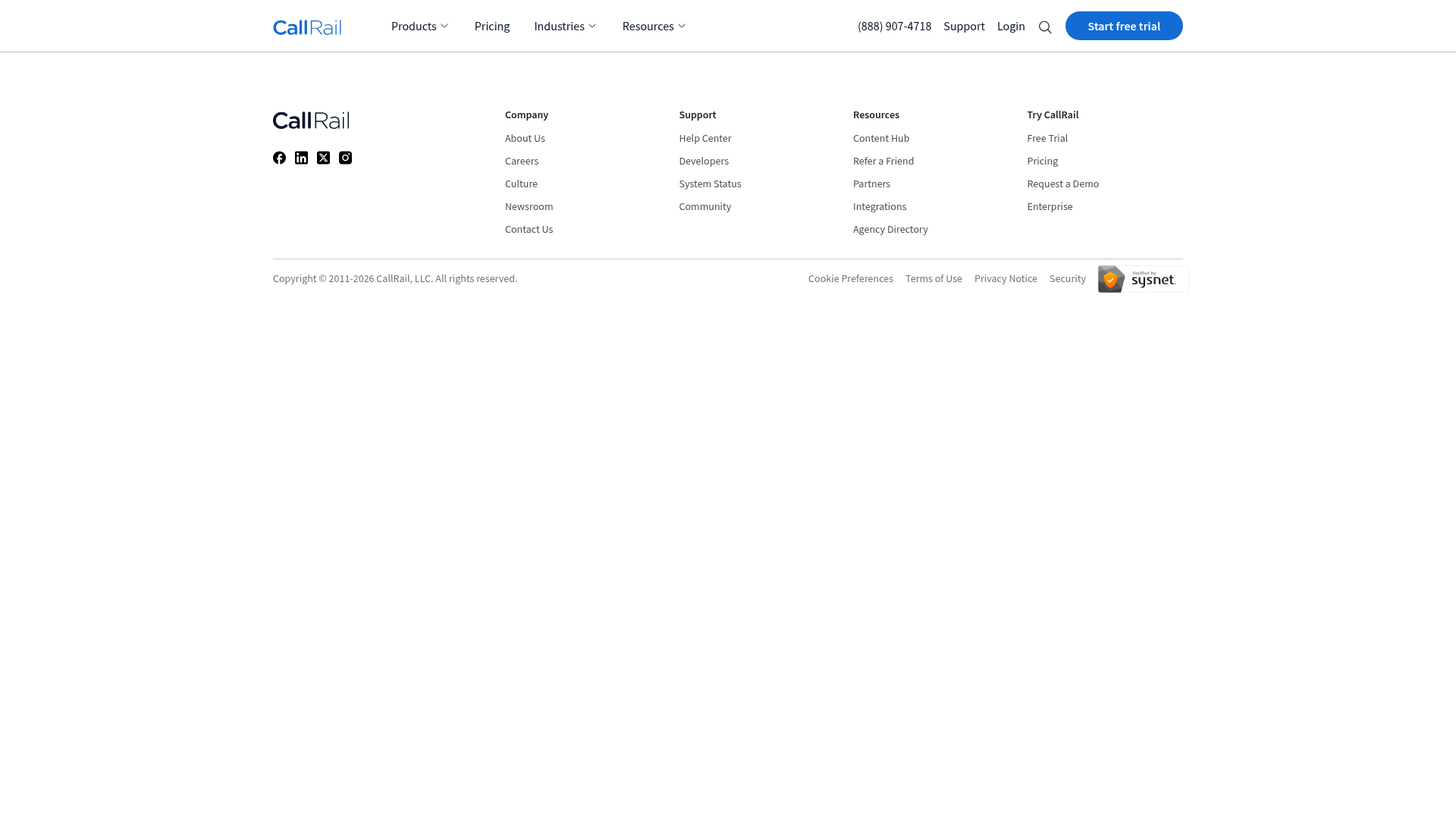
CallRail's May 2026 announcement is the single biggest pricing shift in this category in years. What used to be a $50/seat-per-month Conversation Intelligence add-on – transcription, sentiment scoring, AI call summaries, the works – is now bundled into the base plan. The new "Call Tracking Intelligence Starter" plan starts at $95/month, which is the entry point most prospective buyers will land on.
The two things CallRail does better than anyone else: setup speed and the Google Ads round-trip. A non-developer marketing manager can put a DNI script on a Webflow or WordPress site and have campaigns swapping numbers correctly inside an hour. The GCLID import flow – which writes the Google click ID back into Google Ads alongside the call event – is what pushes phone-call attribution from the ~60% Google Ads natively sees to the 90%+ that PPC operators reference in production accounts. Meta CAPI integration follows the same pattern and matters more in 2026 than it did 18 months ago because Meta's Andromeda + Advantage+ stack is now default-on for most DTC advertisers.
The honest cost story: $95/mo is the plan fee. Then per-minute usage layers on top – local minutes at $0.05–0.06/minute, toll-free at $0.08/minute, transcription at $0.025–0.04/minute, AI analysis minutes at $0.04–0.05/minute, plus $3/month per local number and $5/month per toll-free. At 300 monthly calls averaging 2 minutes each, you're paying $30 in local minutes, $15 in transcription, and ~$20 in analysis – roughly $160–$180/month all-in for the Starter tier. The math gets sharper at scale; above 500 calls/month you'll typically cross into the $145–$329 plan tiers.
The cost-per-attributed-lead math, against the three archetypes. For the 5-location home services brand at ~300 monthly calls and roughly 10 unique local tracking numbers (one per location plus PPC variants), expect $95 plan + $30 number fees + $35 in minute usage + $20 in transcription + $20 in analysis = ~$200/month. At 300 calls that's $0.67 per attributed lead. For the 3-client PPC agency at 800 calls/month with 25 numbers spanning clients, the plan jumps to the Premium tier at ~$145/month + $75 in number fees + $90 in minutes/transcription = ~$310/month, or $0.39 per attributed lead. For a single advertiser running 100–150 calls/month, $160–180/month all-in on Starter works out to ~$1.20 per attributed lead, which is still 2–10x cheaper than the same lead through a non-attributed channel where ROAS reporting is guesswork.
Where the bundling shift matters most: the four "ones to avoid" at the bottom of this list were each priced under the assumption that you'd be paying CallRail $50 extra for CI. With CI now bundled, the gap closes on Invoca for mid-market deployments, opens up on iovox at $500/mo entry, and quietly orphans DialogTech-legacy customers inside Invoca. The May 2026 announcement is the kind of structural repricing that takes 18 months for the SERP to catch up to. Most listicles ranking today were written under the old assumption.
- Conversation Intelligence – transcription, sentiment, scoring, summaries – bundled in every plan as of May 2026.
- Dynamic Number Insertion is best-in-class for ease and Google Ads GCLID round-trip accuracy.
- Native integrations with Google Ads, Meta CAPI, GA4, HubSpot, Salesforce work without custom Zapier glue.
- 14-day free trial without a credit card – rare in this category.
- Entry tier moved from $50/mo to $95/mo with the bundling change. New, smaller deployments feel the increase even with CI included.
- Per-minute billing model still adds variable usage costs that surprise teams running long inbound calls.
- Scaling past 500 calls/month typically forces a move to the $145+/mo Premium tier.
Affiliate disclosure: CallRail is a CallRail affiliate partner – the picks here still survive the cost math against non-affiliated alternatives or they would not be on this list.
Rating: G2 4.5/5 across 1,300+ reviews; pricing data from the live CallRail pricing page.
2. WhatConverts – best for unified call + form + chat attribution
Best for: Agencies and lead-gen teams that need calls, web forms, live chats, and texts attributed to the same source in one report. Standout: $30/month usage credit is included on every plan, so most small accounts run on the credit alone with no overage. Pricing: Track $30/mo, Plus $60/mo, Pro $100/mo, Elite $160/mo, then Agency tiers $500/mo and $800/mo. All plans include $30 of free usage credit. Free trial: 14 days.
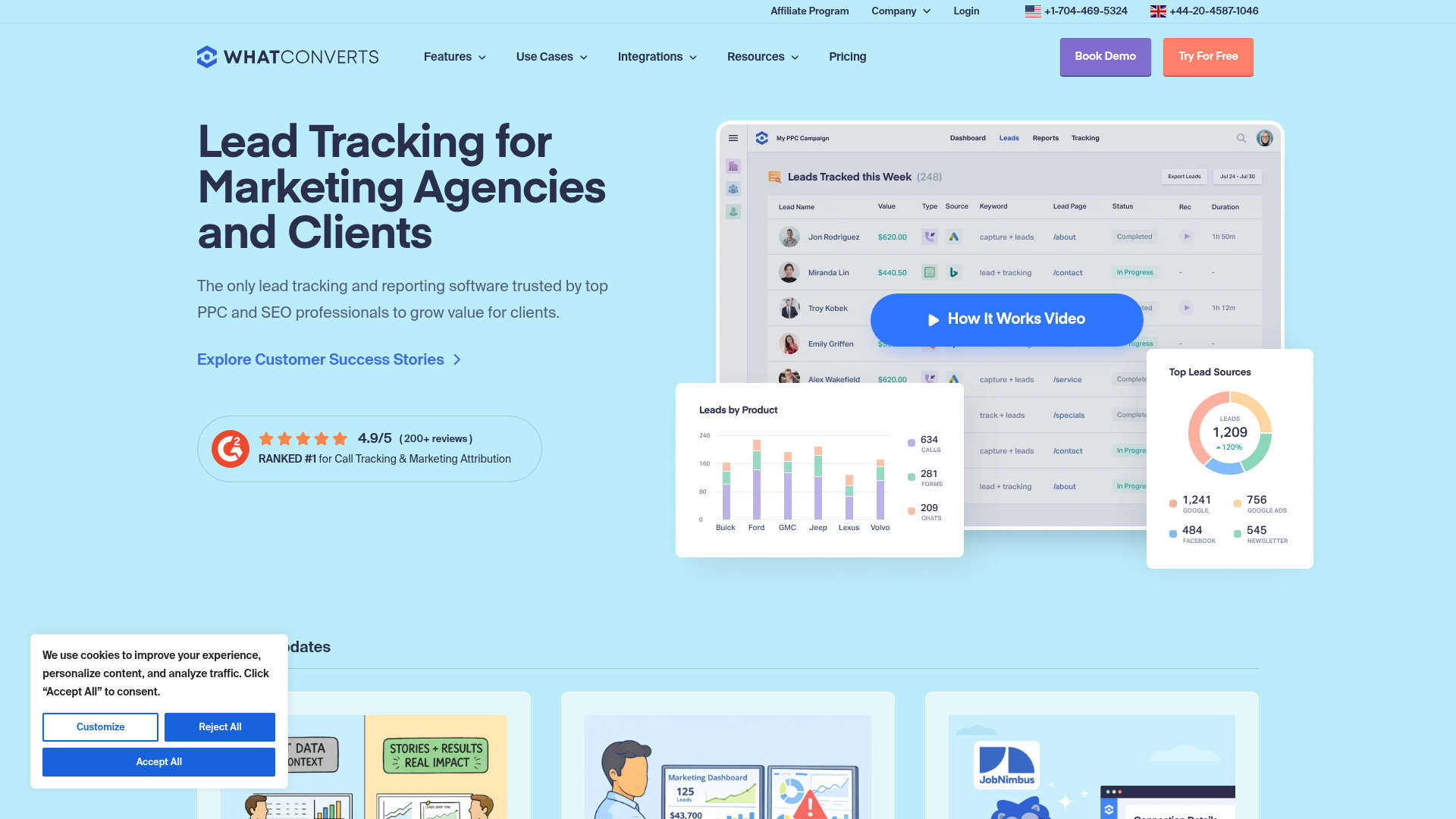
The simple case for WhatConverts: most marketing operators do not care which channel a lead came through – they care that the lead is attributed to the campaign that drove it. WhatConverts is the only mid-market tool that does not treat forms, chats, and texts as second-class citizens behind call tracking. The Lead Manager dashboard reports calls, forms, chats, and texts in one stream with consistent source attribution.
That matters more than CallRail's marketing makes it sound. For a home services brand, calls are ~70% of inbound – but the 30% that come through forms still need to land on the same campaign attribution. For a B2B PPC agency, the split inverts. WhatConverts handles both shapes without making you bolt on a separate form-tracking layer.
The pricing model is the smart part. Every tier includes $30/month of usage credit, which absorbs roughly 600 local minutes (at $0.05/min) before any overage kicks in. For small accounts that means $30/mo total. For a 3-client agency averaging 800 calls/month across clients, the math typically lands between $100 (Pro) and $160 (Elite), with usage costs absorbed by the included credit on shorter-call accounts.
The Conversation Intelligence side is thinner than CallRail's. WhatConverts transcribes every call by default and runs basic AI scoring, but the scoring model is more rule-based than CallRail's, and sentiment is rougher. If you'd be paying for CI specifically, CallRail's bundling change pulls ahead. If you want unified channel attribution and care less about the depth of the CI scoring, WhatConverts is the right pick.
Cost-per-attributed-lead math against the three archetypes. For the home services brand at 300 calls/month with a mix of inbound calls and form submissions, the Plus tier at $60/mo plus the $30 included usage credit absorbs roughly 600 local minutes of call tracking. Expected total: $60/mo, no overage, ~$0.20 per attributed lead. For the 3-client PPC agency at 800 calls plus ~400 form submissions/month, the Pro tier at $100/mo is the right landing spot, with the included $30 credit and an estimated $40 in overage usage – $140/mo total, $0.18 per attributed lead. The Elite tier at $160/mo unlocks lead-source-of-source attribution and is worth it when at least one client runs PPC + organic + paid social and needs cross-channel attribution stitched together.
WhatConverts beats CallRail on price almost across the board, and on form attribution it leads outright. The structural trade-off: if the client base wants the deepest call-content insights – which specific words signaled buying intent on a 6-minute discovery call – CallRail's bundled CI is the stronger feature surface. If the client base wants the cleanest lead-source dashboard across calls, forms, chats, and texts, WhatConverts wins.
- Best-in-class unified call + form + chat + text attribution from a single account.
- $30 monthly usage credit included on every plan – small accounts pay $30 flat.
- Per-call lead views work better for marketing operators than the per-minute reporting most competitors default to.
- Agency tier ($500/mo) supports separate client accounts with full white-label.
- AI Conversation Intelligence is shallower than CallRail's bundled CI now that CallRail closed the price gap.
- Campaign + keyword reporting requires the Pro tier ($100/mo), which most serious PPC operators will need.
- Smaller integration ecosystem than CallRail – some CRM connectors still go through Zapier.
Rating: G2 4.7/5 across 430+ reviews; pricing from the WhatConverts pricing page.
3. CallTrackingMetrics – best for omnichannel inbound plus outbound
Best for: Sales-led teams that need both inbound call attribution and outbound dialing in one platform, with optional VoiceAI receptionist for after-hours. Standout: Native VoiceAI inbound assistant at $0.12/minute for qualifying calls when humans aren't available. Pricing: Essentials $79/mo monthly, $65/mo annual prepay, $60/mo 2-year prepay. Connect $179/mo. Sales Engage $329/mo. Enterprise $1,999/mo. Free trial: 14 days.
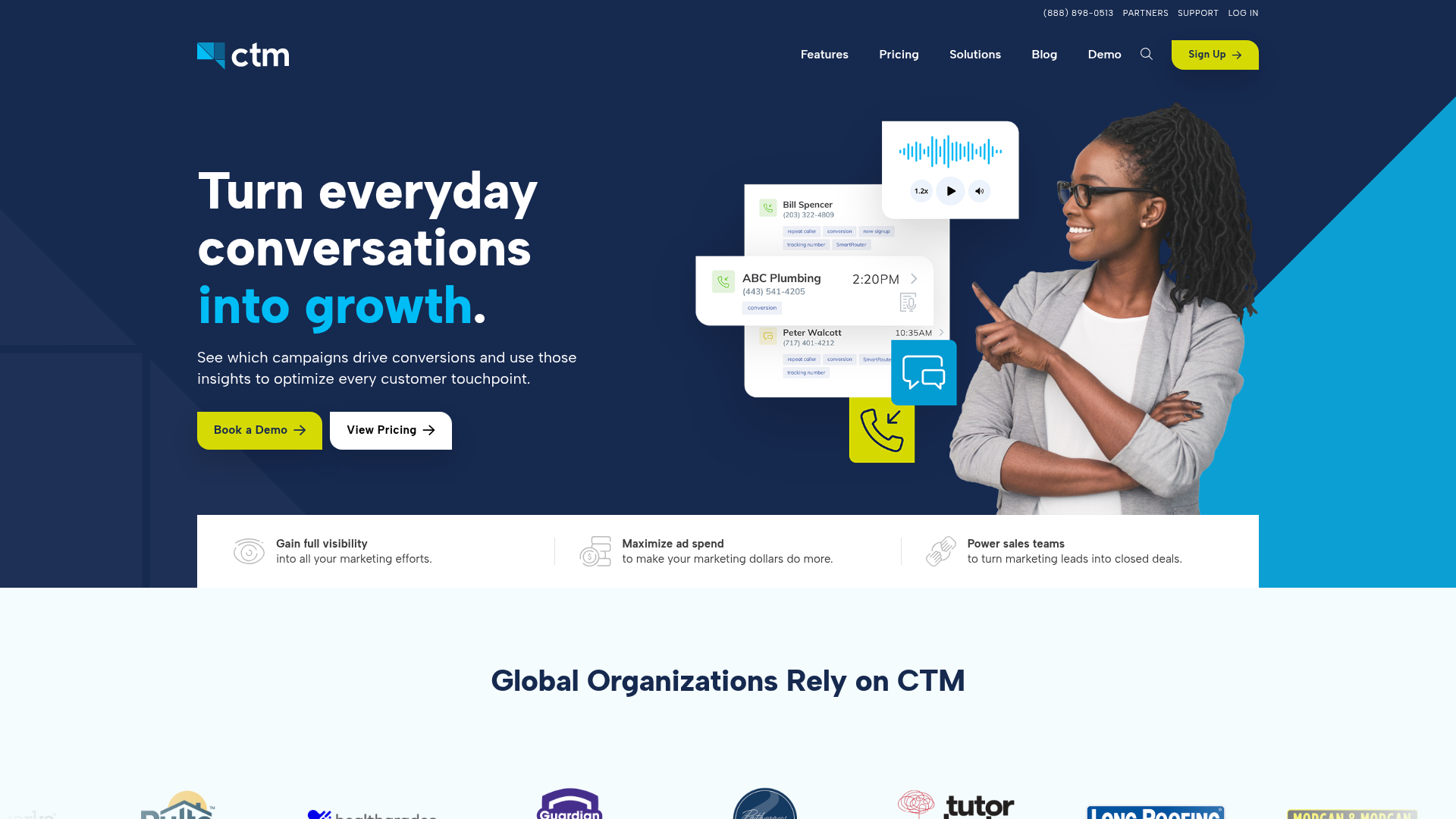
CTM (now branded as ctm.com, formerly CallTrackingMetrics) is the platform to look at when your team is also doing outbound dialing – appointment booking, sales follow-up, recovery on missed calls. The Smart Dialer, Softphone, and outbound features sit inside the same platform as the inbound call tracking and DNI, so you're not paying for two tools.
The VoiceAI module is the genuinely new piece. At $0.12/minute (250 minutes included per agent on Sales Engage and Enterprise plans), it's a conversational AI receptionist that can pick up after-hours calls, qualify intent, route or capture lead info, and book into a calendar. The math: at 300 inbound calls/month with 20% landing after hours and averaging 3 minutes, you're looking at ~180 minutes – fully absorbed by the included pool on Sales Engage, or $21.60/month at usage rates. For a home services brand losing emergency calls outside business hours, that's the cheapest way to recover the lost revenue without hiring an after-hours answering service.
The honest pricing story is that CTM markets the $60/mo Essentials price hard but it requires a 2-year prepay. The actual monthly-billed entry is $79/mo, which is below CallRail's new $95 but above WhatConverts and Nimbata. Connect at $179/mo is where most agency operators land, with 3,000 included transcription minutes and 5,000 form submissions per month before usage kicks in.
Custom Asks (CTM's name for prompt-built AI questions on each call) start at $0.01 per question. AskAI summaries run $0.05/activity. AI usage is metered separately from transcription minutes, which can compound into surprise overages at scale unless you cap it.
- Genuine inbound + outbound + SMS + VoiceAI consolidation in one platform – replaces two tools for sales-led teams.
- VoiceAI inbound assistant at $0.12/minute is the cheapest way to handle after-hours qualification in this category.
- Strong sub-account model for agencies running 5+ clients, with up to unlimited sub-accounts on the Growth tier.
- Long history (founded 2012), mature integrations, deep API documentation.
- The marketed $60/mo Essentials price requires a 2-year prepay – actual monthly entry is $79/mo.
- AI usage (Custom Asks, AskAI summaries, VoiceAI minutes) meters separately and can compound into surprise overages.
- Sub-account model adds friction compared to WhatConverts's simpler per-client structure for small agencies.
Rating: G2 4.5/5 across 300+ reviews; pricing from the CTM plans page.
4. Nimbata – best per-call pricing for agencies
Best for: Agencies and PPC teams that hate per-minute billing and want predictable monthly costs at variable call volume. Standout: Per-call (not per-minute) billing – a flat fee per connected call regardless of duration. Pricing: Pro $39/mo monthly ($35/mo annual). Marketing $89/mo ($80 annual). Agency $149/mo ($120 annual). Free trial: 14 days, no card.
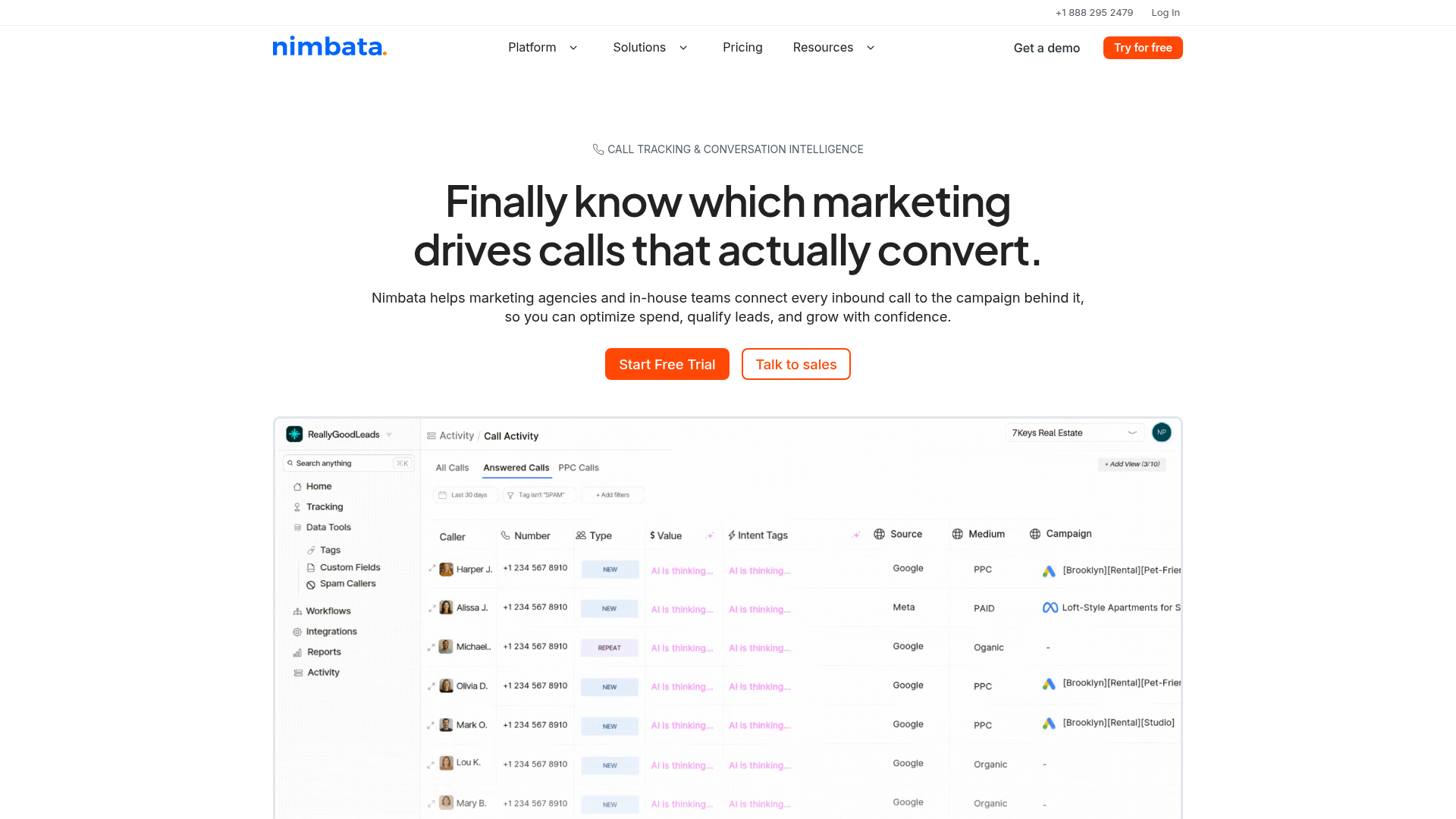
Nimbata is the price challenger in this category, and the per-call billing model is the structural argument. Every other tool on this list charges per minute – at $0.05–0.08 per local minute, a 4-minute discovery call costs $0.20–0.32 in tracking minutes alone before transcription and analysis layer on. A 30-second qualification call costs roughly the same as a 4-minute close. Nimbata's per-call model charges a flat fee per connected call, which means short calls get cheaper and long calls cost the same – agencies running variable inbound volume get predictable monthly bills.
The math against CallRail: at 300 inbound calls/month averaging 2 minutes, CallRail's Starter tier is ~$160/mo all-in. Nimbata's Marketing tier at $80/mo annual (or $89/mo monthly) absorbs the same call volume at roughly half the price. The trade-off is that CallRail's CI is deeper out of the box, Google Ads integrations are more polished, and brand recognition matters when you're selling tracking to clients.
Cost-per-attributed-lead math against the three archetypes. For the home services brand at 300 calls/month, the Marketing tier at $80/mo annual + per-call usage fees in the low double-digits = ~$95/mo total, or $0.32 per attributed lead. For the 3-client agency at 800 calls/month, the Agency tier at $120/mo annual + $55 white-label add-on + usage = $200–225/mo with up to 5 projects (one per client), or $0.27 per attributed lead. The agency math is where Nimbata's structural pricing advantage gets sharpest: at 5 client accounts, $40/client/month all-in is a margin floor most competing tools can't touch. For the small operator running 100 calls/month, Pro at $35/mo annual + minimal usage = $40–50/mo total, or roughly $0.45 per attributed lead.
Transcription at Nimbata runs $0.02/minute, which is below CallRail's $0.025–0.04, but the AI scoring tooling needs more configuration. If you're an agency setting up call tracking on a per-client basis and you're comfortable tuning the scoring rules yourself, Nimbata's economics are hard to beat. If you want the work done for you, CallRail's the move.
White-label is an add-on at $55/month, which makes Nimbata the cheapest path to a fully branded client-facing dashboard in this category.
- Per-call (not per-minute) billing – agencies running variable volume get predictable monthly costs.
- Entry tier at $35–39/mo undercuts every direct competitor at comparable feature parity.
- White-label add-on at $55/mo is the cheapest path to a branded client-facing dashboard.
- 14-day free trial without a credit card, on every plan including Agency.
- Smaller integration ecosystem than CallRail – some connections need Zapier glue.
- AI scoring requires more setup and tuning than CallRail's defaults to deliver comparable quality.
- Brand recognition lags – selling Nimbata to a Fortune 500 client gets harder conversations than selling CallRail.
Rating: G2 4.7/5 across 110+ reviews; pricing from the Nimbata pricing page.
5. Invoca – best enterprise conversation intelligence
Best for: Enterprises with $50,000+/month in phone-call-driven revenue, where the AI signal quality is worth a six-figure annual contract. Standout: Signal AI – the longest-running production conversation intelligence model in the space, with 5/50/100 custom signals across tier levels. Pricing: Custom quote only. Typical deployments land at $1,500–5,000+/month. Pro/Enterprise/Pro+ tiers, plus separate Performance Pro and Performance Enterprise variants for pay-per-call buyers. Free trial: Demo only – no self-service trial.
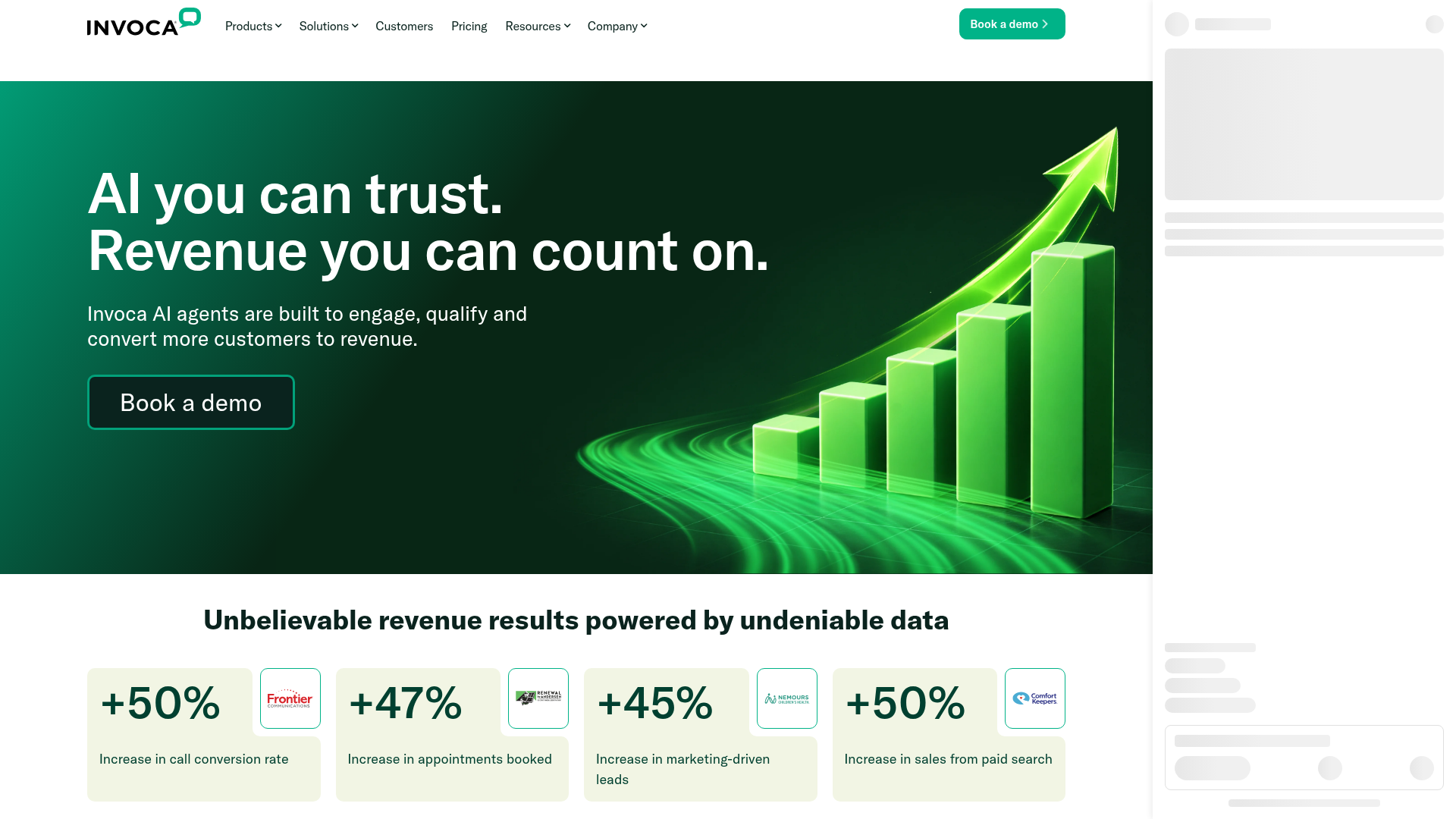
Invoca is the platform you graduate to when CallRail's CI stops being precise enough and Conversation Intelligence becomes load-bearing on actual revenue decisions. The Signal AI suite – Invoca's branded conversation intelligence model – has been in production for longer than most competitors have existed, and on custom signal precision it still leads. The "custom signal" is the unit: you train a signal on what a qualified sales call looks like in your business, and the model applies it to every call going forward with the kind of accuracy that makes inbound-call lead scoring actually replace human QA.
Tier counts tell you who Invoca expects you to be: Pro at 5 custom signals, Enterprise at 50, Pro+ at 100. For most operators the 5-signal tier handles the basic patterns – qualified vs unqualified, sales vs service, intent score – and 50 signals lets you go down to "qualified for product line A vs B vs C," "spoke about pricing," "asked about competitor X." The custom-quote-only positioning means you're locked into a 12-month contract with implementation services baked in.
The pricing reality. Public reports and operator chatter put typical Invoca deployments in the $1,500–$5,000/month range, with enterprise contracts crossing into the low five figures monthly. Below ~$50,000/month in phone-call-driven revenue the math does not pay back vs CallRail's now-bundled CI tier or even WhatConverts at $160/mo. Above that threshold the signal precision is what closes the gap between "we ran call tracking" and "we hit our quarterly revenue target three weeks early because we caught the qualified-but-leaking calls."
The legacy migration overhang. Invoca acquired DialogTech in 2021, and the platform consolidation moved DialogTech customers onto Invoca's stack. Some of those legacy accounts still have integrations and reporting flows that didn't map cleanly. If you're inheriting a DialogTech contract, validate that the migration has actually completed before signing renewal.
The graduation rule. A simple framework for when CallRail's now-bundled CI is no longer enough and Invoca's Signal AI becomes the right move: if your call-driven revenue is below $50k/month, the math heavily favors CallRail. Between $50k and $150k/month, you're in the gray zone where CallRail Premium ($329/mo) covers the basic CI need but you may be leaving real precision gains on the table at Invoca's $2,500/mo deployment cost. Above $150k/month in call-driven revenue, Invoca pays for itself if the Signal AI custom signals replace meaningful human QA. The decision rule isn't "do I need better AI" – it's "is the precision delta worth the extra $2,000–4,000/month plus the contract length?" If the answer is yes for at least three specific signals your team wants to score against (e.g. "qualified for product line A," "asked about competitor X," "expressed urgency"), Invoca pays back. If your AI scoring needs are generic – sentiment, intent, qualification – CallRail's bundled CI does it for less.
- Signal AI is the most mature production conversation intelligence model in the category – precision on custom signals leads the industry.
- 50–100 custom signal counts on Enterprise/Pro+ replace meaningful human QA cost at enterprise scale.
- Separate Performance Pro / Performance Enterprise tiers for pay-per-call buyers consolidate two products into one.
- Robust API and enterprise-grade SLA – the platform genuinely scales above 100,000 calls/month.
- Custom-quote-only pricing means budget gates a year ahead and procurement cycles are long.
- Below ~$50k/mo phone-call revenue the math does not pay back vs CallRail or WhatConverts.
- DialogTech acquisition created a migration overhang for some legacy customers – verify your stack before renewal.
Rating: G2 4.5/5 across 350+ reviews; tier details from the Invoca pricing page. The cousin of Invoca for sales-side conversation intelligence is Gong, covered separately in the sales-conversation lane.
6. Ringba – best for pay-per-call buyers
Best for: Affiliate marketers and pay-per-call buyers purchasing inbound calls from publishers under performance contracts. Standout: Real-time call routing with IVR bidding – built for buying calls as a unit, not just attributing your own marketing source. Pricing: Business $147/month monthly ($127/month annual). Professional $297/month ($197 annual). Enterprise custom. Free trial: 14 days.
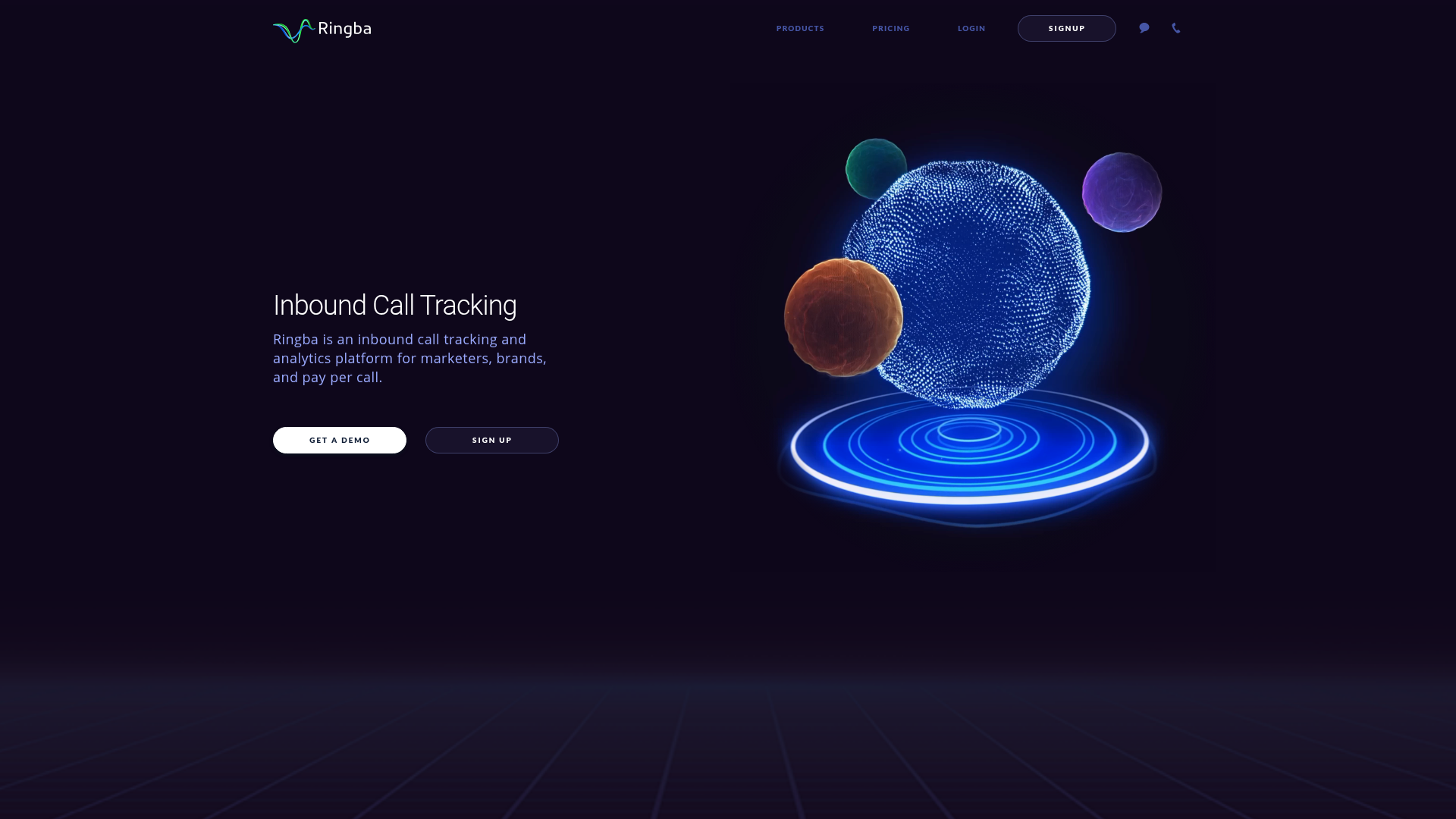
Ringba is purpose-built for a use case the other eight tools on this list don't optimize for: buying inbound calls from publishers. If you're running an affiliate program where publishers send phone leads to you and you pay per qualified call, Ringba is the platform built for that workflow – real-time call routing, IVR bidding, ping/post integrations with affiliate networks, and publisher-payout reporting that the marketing-attribution tools simply don't have.
The all-in per-minute math on the Business tier: Local Tracking $0.055/min + Recording $0.01/min + Transcription $0.04/min = $0.105/min before adding Voice Agents at $0.05/min or Instant Caller Profile pulls at $0.15 each. At 200 calls/month averaging 4 minutes that's roughly $84/month in usage on top of the $147 platform fee – call it $230/mo all-in for a small pay-per-call buyer. The Professional tier drops the per-minute rates noticeably (Local $0.05, Transcription $0.035) but the entry fee jumps to $297/mo.
This is not the tool for in-house PPC marketers tracking their own Google Ads phone calls. The IVR routing, ping/post, and publisher-management features are all overhead you don't need if you're just attributing inbound calls back to a campaign. The reason Ringba ranks #1 on some SERPs is that the croclub and affiliate-leaning listicles inflate it; for marketing attribution, CallRail or WhatConverts is the right pick.
Where Ringba wins specifically: a pay-per-call affiliate buyer running 200 inbound calls/month from publishers in insurance, legal, home services, or solar. The Business tier at $147/mo plus ~$84 in usage = $231/mo all-in works out to $1.16 per inbound call as the platform fee. At $15–50 paid out per qualified call to the publisher, the platform fee is a single-digit percentage of the deal. Compared to building call routing on top of Twilio or a custom telephony stack, Ringba saves multiple engineering hires. That's the genuine moat.
- Purpose-built for pay-per-call buying with real-time IVR routing and bidding.
- Native ping/post integrations with affiliate networks (the marketing-attribution tools require custom integration).
- Voice Agents at $0.05/minute is competitive with CTM's VoiceAI pricing.
- Publisher payout reporting and call-quality scoring are first-class features, not bolted on.
- Wrong tool for in-house PPC marketers tracking owned Google Ads – IVR/publisher overhead you don't need.
- Per-minute costs compound at scale: $0.105/min all-in on the Business tier before Voice Agents or Caller Profile.
- $147/mo monthly entry is above CallRail's new Starter and well above Nimbata or WhatConverts.
Rating: G2 4.6/5 across 75+ reviews; pricing from the Ringba pricing page.
7. Phonexa – best for white-label lead distribution
Best for: Lead-distribution operators running their own affiliate networks, multi-buyer call routing, and full lead-gen software stacks under one brand. Standout: Eight-product suite (Call Logic, LMS Sync, E-Delivery, Cloud PBX, HitMetrix, Lynx, Opt-Intel, Books360) – call tracking is one module. Pricing: Custom quote across Lite / Optima / Premier tiers. Free trial: Yes, on request.
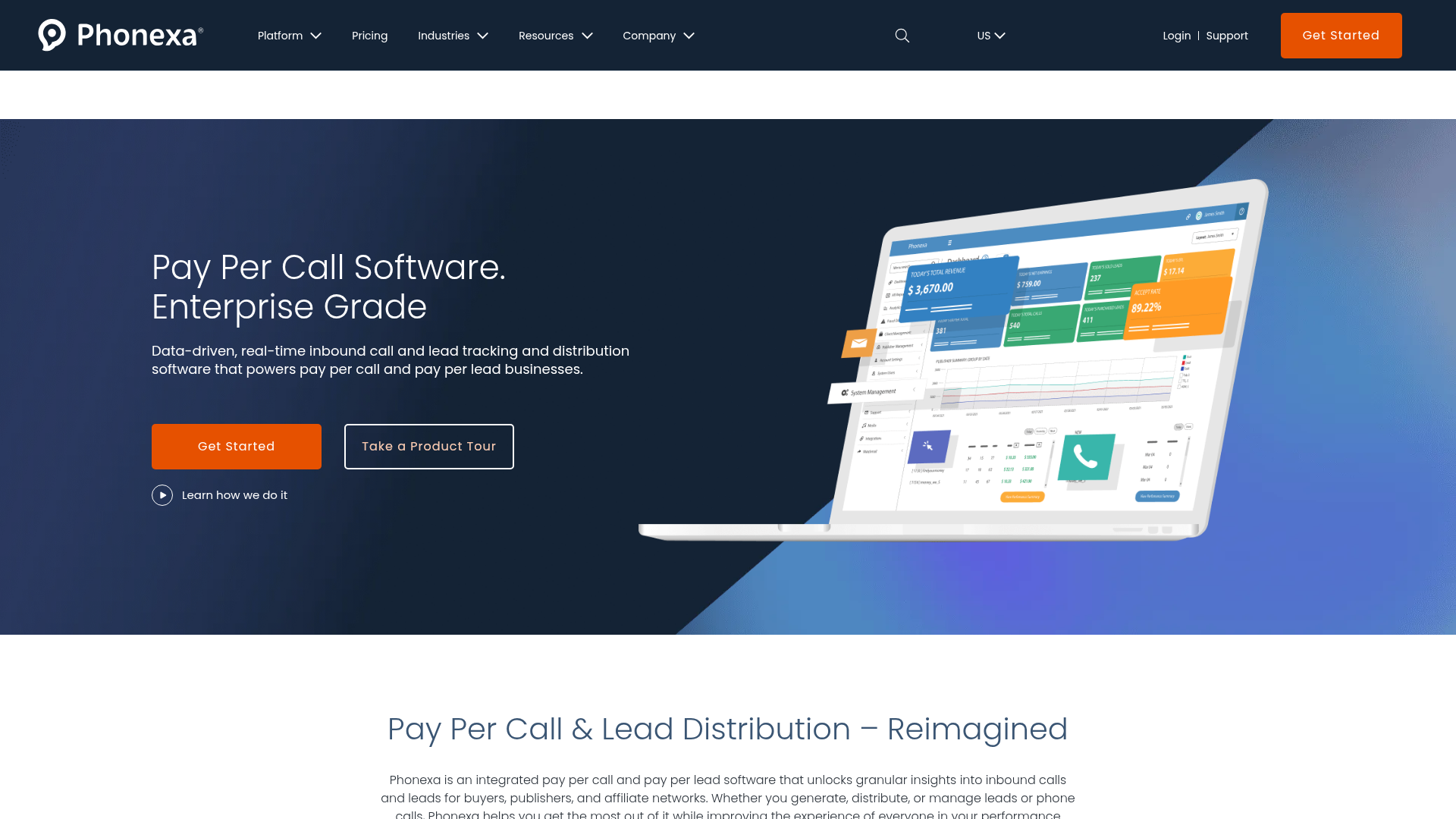
Phonexa is the platform you buy when call tracking is one piece of a larger lead-distribution business. The product suite spans inbound calls (Call Logic), lead management (LMS Sync), email delivery (E-Delivery), cloud PBX, click tracking (HitMetrix), survey logic (Lynx), suppression list management (Opt-Intel), and accounting (Books360). For a lead distribution network buying and reselling leads across multiple advertisers, that consolidation matters – you're not stitching together six SaaS tools and reconciling reporting across them.
For a pure marketing-attribution use case, Phonexa is overkill. The setup time is longer than CallRail's same-day deploy because you're configuring a full enterprise platform, not a tracking script. Pricing is custom-quote-only, which means procurement cycles and reference checks before you can budget.
Where Phonexa wins: white-label depth. A lead-gen agency reselling tracking + lead management to its own buyers can run a fully-branded Phonexa instance, with custom domains, custom UI, and the agency's own pricing layered on top of Phonexa's underlying cost. That's a level of white-label most competitors don't match.
- Eight-product suite consolidates call tracking, lead management, email, cloud PBX, click tracking, surveys, suppression, and accounting in one platform.
- White-label depth supports running a fully-branded reseller business on top of Phonexa.
- Strong API and integration depth for large lead distribution networks.
- No public pricing – custom-quote-only forces longer procurement cycles.
- Significant overkill for in-house marketing attribution – most of the suite is unused.
- Setup time is longer than CallRail's same-day deploy.
Rating: G2 4.7/5 across 90+ reviews; tier names from the Phonexa pricing page.
8. HubSpot Call Tracking – best free option (with CRM)
Best for: Small teams already on HubSpot Sales Hub who need basic call logging in the CRM without marketing-attribution complexity. Standout: Free as part of HubSpot's Sales Hub free tier – no separate vendor relationship. Pricing: Free at the Sales Hub free tier. Paid Sales Hub tiers add features from $20/seat/month. Free trial: Free forever tier.
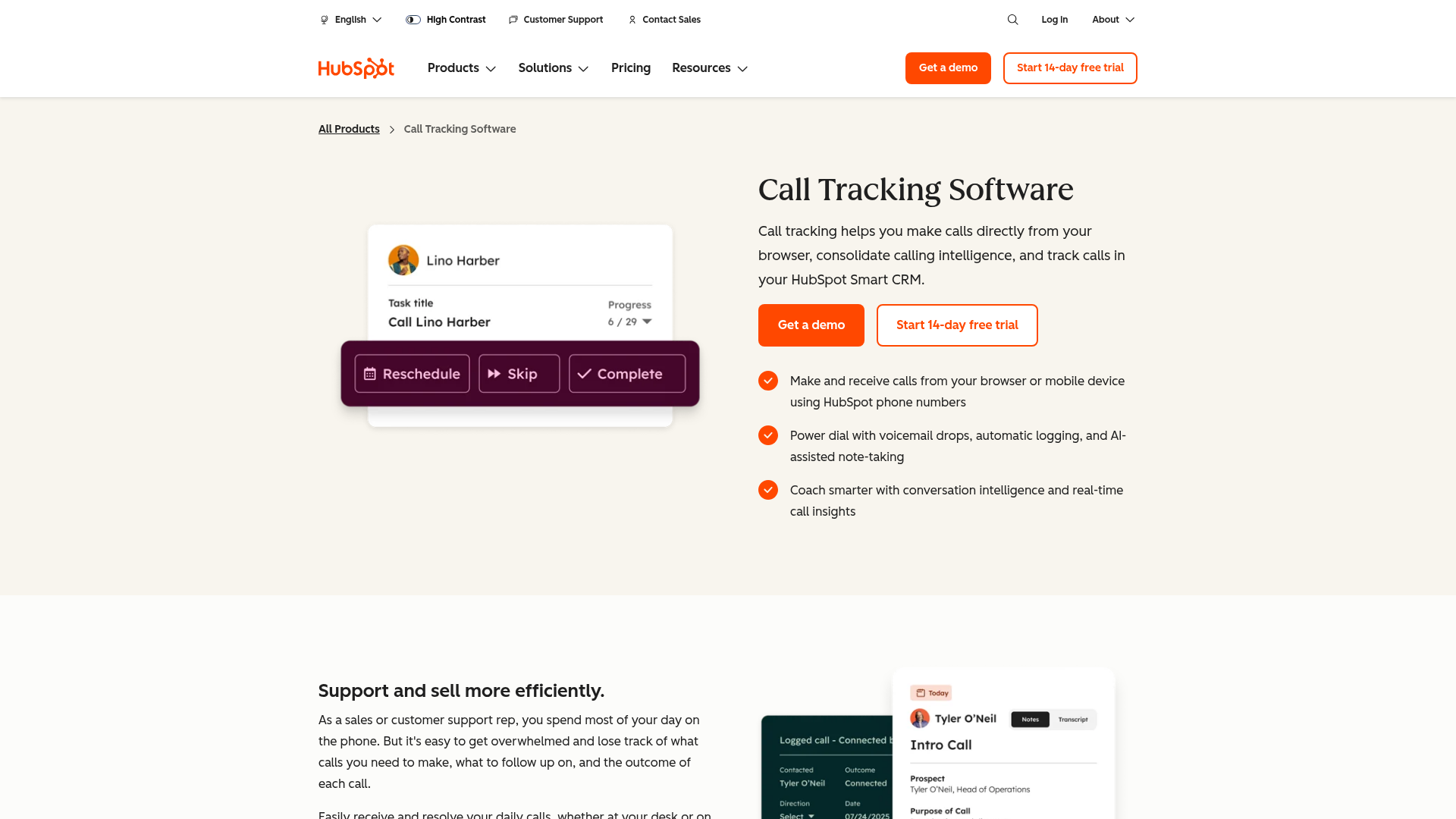
HubSpot Call Tracking is the right pick for one specific operator profile: a small sales-led team already running HubSpot Sales Hub, where call logging into the CRM is the actual need – not marketing-source attribution. Click-to-call from a contact record, automatic call recording, transcription logged to the contact timeline, and basic call analytics inside HubSpot's dashboards. All free at the Sales Hub free tier.
What you give up: no Dynamic Number Insertion for marketing-source attribution. No Conversation Intelligence at the free tier (it's available on paid Service Hub plans). No campaign-level or keyword-level reporting. The product is a sales-CRM call logger, not a marketing attribution tool.
For comparison, the HubSpot Breeze customer agent is a different product on the same platform with outcome-based pricing – that lane is about deflecting support tickets, not attributing marketing-driven calls. If you're already running Google AI Mode ads against PMax budgets, HubSpot's call logging won't help with that attribution problem either.
The honest math: if your team is 5 people, all on HubSpot, and the question is "where did this lead come from, and what did they say on the call?", HubSpot's free tier covers the second half (what they said) but not the first (where they came from). Pair it with WhatConverts at $30/mo or Nimbata at $39/mo if you need both.
- Free at the Sales Hub free tier – zero incremental cost if you're already on HubSpot.
- Native CRM logging means no integration friction – call records land on the contact timeline.
- Click-to-call and recording cover the basic sales-team call logging use case.
- No DNI for marketing source attribution – you cannot attribute calls back to a campaign or keyword.
- No Conversation Intelligence at the free tier.
- Not a substitute for a marketing-attribution tool – it's a CRM call logger.
Rating: G2 4.4/5 across HubSpot platform reviews (12,000+); free tier from the HubSpot Sales Hub pricing page.
9. Convirza – best speech analytics on a budget
Best for: High-volume call centers (1,000+ inbound calls/month) in home services, healthcare, or auto where QA is the bottleneck and budget is constrained. Standout: Mature speech analytics – Convirza was speech-analytics-first before the category got crowded – at SMB pricing. Pricing: From $29/month. Free trial: 14 days.
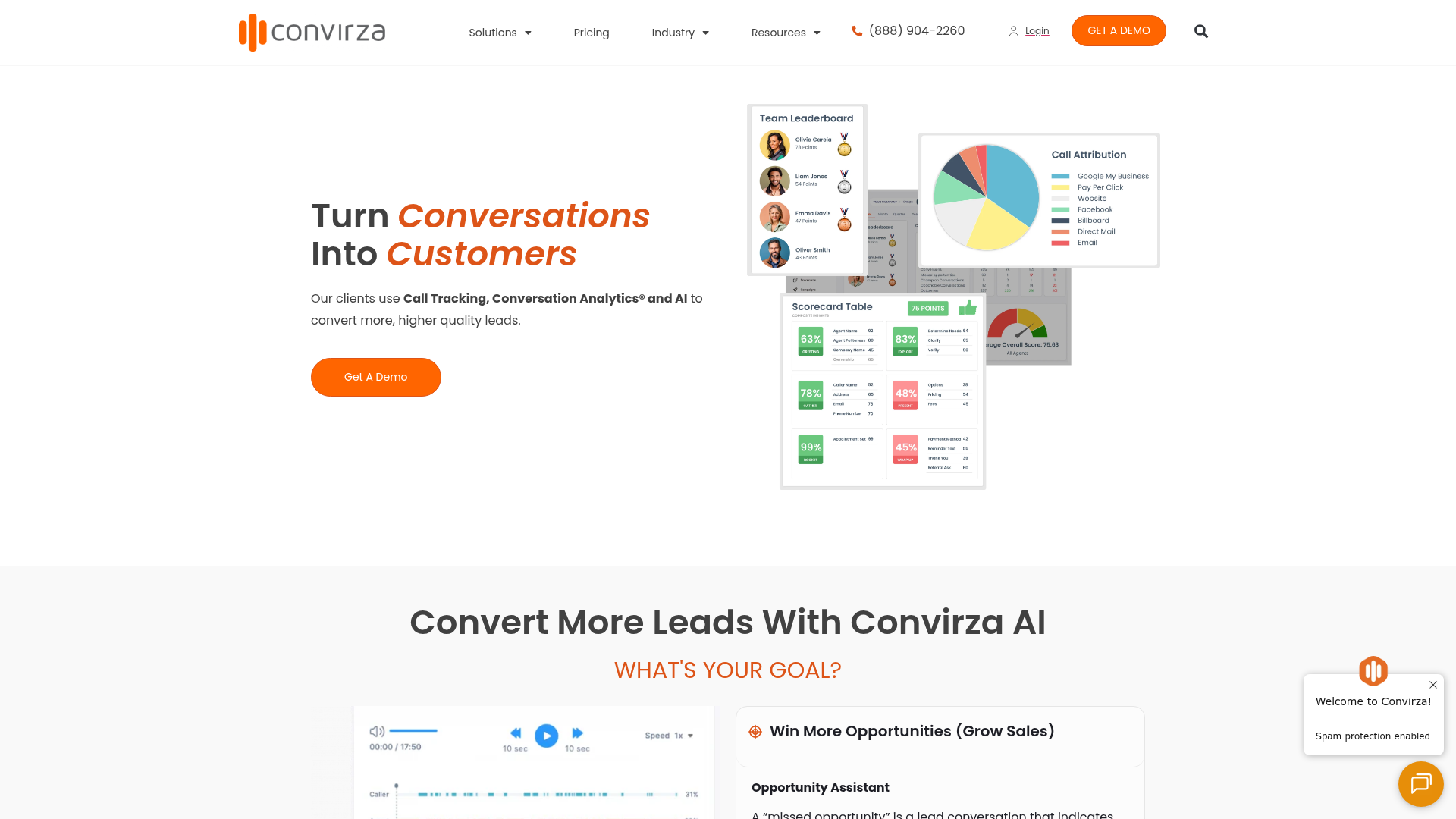
Convirza is the budget speech-analytics pick. The company has been in speech analytics longer than most of this list has existed, and the scoring models are mature. At $29/month entry, the price-per-call is dramatically below Invoca for businesses running 1,000+ inbound calls/month where the actual problem is QA – knowing which calls represent missed opportunities, untrained agents, or recurring complaint patterns.
Where Convirza fits: a 5-location home services brand running 800–1,500 monthly calls split across locations, where the manager needs to know which location's calls are converting and why. The speech analytics layer surfaces the patterns – "agents at location 3 don't ask for the appointment" – at a fraction of Invoca's enterprise cost.
Where Convirza doesn't fit: PPC agencies focused on marketing-source attribution rather than call-content QA. Integrations with Google Ads and Meta are present but shallower than CallRail's. Brand recognition is lower than the competitive set, which makes client-facing reporting harder to sell.
The scoring needs tuning. Out-of-the-box defaults are usable but not great; expect 2–4 weeks of analyst time to tune scoring rules for your business. After tuning, the precision is comparable to CallRail's CI at a fraction of the cost.
The cost-per-call-scored math at scale. A home services brand running 1,500 calls/month across 8 locations pays Convirza at the $29/mo base plus per-minute scoring fees that typically run $0.03–0.05/call. Call it $100/mo all-in. The same workload on Invoca quotes typically run $1,800–$2,500/month – 20–25x the price. The difference: Invoca's custom signals are more precise out of the box and don't need 2–4 weeks of tuning. If your team has the analyst hours, Convirza wins on cost. If your team doesn't, Invoca's higher cost is the lower-friction path.
- Mature speech analytics at SMB pricing – $29/mo entry is 50x below typical Invoca deployments.
- Strong fit for vertical use cases (home services, healthcare, auto) running 1,000+ calls/month.
- AI scoring depth comparable to CallRail after 2–4 weeks of tuning.
- Brand recognition lags – agencies report client-facing reporting harder to sell vs CallRail.
- Integration depth with Google Ads and Meta is shallower than the attribution-first tools.
- Scoring out-of-the-box requires meaningful tuning to reach production-quality precision.
Rating: G2 4.4/5 across 60+ reviews.
The 4 tools the math now rules out
This is the section most SERP competitors will not write. Every listicle ranked above this one in Google ranks the four tools below as legitimate picks. They were defensible before CallRail bundled CI into every plan in May 2026. They are not defensible now.
iovox – $500/mo entry pricing for lightweight AI tagging
iovox's marketed entry tier is $500/month. The platform's positioning is "lightweight AI tagging without enterprise overhead," which made sense when the alternative was Invoca at $3,000+ or CallRail's $50-add-on CI on top of a $50 base plan. Today, CallRail's $95/mo Starter tier includes the entire Conversation Intelligence suite – transcription, sentiment, scoring, AI summaries. iovox at $500/mo is asking for a 5x premium over CallRail for a thinner CI feature set. The math does not justify it for any operator profile I can construct.
The cost comparison at 300 monthly calls: iovox at $500/mo plus per-minute usage lands at ~$575/mo. CallRail Starter at the same call volume is ~$200/mo with deeper CI. Nimbata Marketing at ~$95/mo. iovox would need to deliver something neither tool can match, and on a feature-by-feature audit it doesn't. iovox's remaining defensible niche is European enterprise deployments where its EU data residency and GDPR handling have meaningful regulatory advantages, but Invoca has equivalent EU posture at higher precision and CTM is closing the EU integration gap quarterly.
Marchex – enterprise lock-in, dated tech, no path for SMBs
Marchex is a legacy enterprise platform – strong in vertical use cases (auto dealerships, home services, healthcare) historically, but the AI tooling has not kept pace with Invoca's Signal AI or even CallRail's bundled CI. Pricing is custom-quote-only with long contracts. For enterprise deployments, Invoca's Signal AI is the more precise option at comparable cost. For SMB and mid-market deployments, CallRail, WhatConverts, or Nimbata are all cheaper and more modern. Marchex's remaining value is inertia – existing customers under long-term contracts. New buyers should not start here.
The auto dealership case is the one place Marchex still gets mentioned by operators, and even there the gap is closing. Invoca acquired most of the auto-specific signal libraries with the DialogTech consolidation, and Marchex's auto-dealer playbooks haven't seen meaningful updates since 2023. If you're an auto group renewing a Marchex contract this year, the right move is to evaluate Invoca in parallel and force-quote both.
DialogTech – migration overhang inside Invoca
DialogTech as a standalone product effectively ended when Invoca acquired it in 2021. The platform migration moved DialogTech customers onto the Invoca stack, but some legacy accounts still have integration and reporting flows that did not map cleanly. New buyers should not consider DialogTech at all – they're really buying Invoca. Existing DialogTech customers should validate that their migration has completed before signing renewal, and budget for the move to Invoca's pricing tier if they haven't already.
CallSource – legacy ASP-era platform
CallSource is one of the oldest call tracking platforms in the category, founded in 1991. The product has not kept pace with modern integration expectations – no native Google Ads ECC integration, no Meta CAPI support, no modern AI scoring. The remaining use case is large enterprise contracts in healthcare and auto with deep historical reporting dependencies. For any new deployment, the modern alternatives (Invoca, CallRail, CTM) cost less and integrate better.
The honest exit framing for legacy CallSource customers: budget 30–60 days for the migration, expect to recreate scoring rules and integration mappings from scratch, and use the migration as an opportunity to consolidate – most CallSource deployments have 3–5 adjacent tools (form trackers, SMS platforms, recording systems) that can roll up into CallRail or CTM in one move. The migration pain is real but the post-migration cost basis typically drops 40–60%.
The common pattern across all four: each was defensible under the previous CallRail pricing model where you'd be paying $50 extra for CI. With CI now bundled, the gaps got harder to defend. Any "best call tracking software" listicle that ranks these tools today is either written by an affiliate of one of them or hasn't been updated since the May 5 announcement.
The AI scoring tuning reality nobody publishes
Every vendor on this list markets AI call scoring as if it works out of the box. In production it does not, and the tuning effort is the unsexy part of the math.
What you actually get on day one: a transcription, a sentiment score (positive/neutral/negative), an intent score (some bucketing like "high/medium/low"), and a qualification flag based on the platform's default rules. For 60–70% of calls the default scoring is roughly right. For the remaining 30–40% – the calls where the AI either misses qualifying signal or over-scores someone who never had buying intent – the defaults need tuning.
The tuning process across vendors looks similar: pull a sample of 50–100 calls, score them by hand, identify where the AI scoring diverged from your judgment, write rules or train signals to close the gap, re-run on a fresh sample, repeat until precision is acceptable. CallRail, WhatConverts, and CTM all expose rule-based scoring you can adjust in the UI. Invoca's Signal AI training is more sophisticated and works on examples, not rules. Nimbata's custom AI fields let you prompt the model directly for specific extractions.
The time cost: 2–4 weeks of analyst time on first deployment, then 1–2 hours/month of monitoring and retuning as call patterns shift. Most operators underestimate this and end up either trusting default scoring (which leaks qualified leads) or abandoning the AI features entirely (which makes the platform a glorified call recorder). Budget the tuning time when you're calculating cost-per-attributed-lead, because untuned AI scoring breaks the attribution chain.
What tuning actually buys: the difference between "this call was qualified" and "this call was qualified for the specific service line that's currently bottlenecking our pipeline." That precision delta is the entire reason to pay for AI scoring vs basic transcription. If you're not going to tune, save the money and buy WhatConverts' rule-based scoring at $30/mo.
This is also the reason the same tool ranks differently across operators. A 5-person agency that does the tuning work will get more out of Nimbata than a 50-person enterprise that doesn't out of CallRail Premium. The platform matters less than the operator's discipline on the tuning loop.
The compliance reality nobody publishes
Call recording laws vary by jurisdiction and the platforms do not solve compliance for you. The four issues every operator needs to handle before turning on transcription and AI scoring in production:
Two-party consent states. California, Florida, Illinois, Maryland, Massachusetts, Montana, Nevada, New Hampshire, Pennsylvania, and Washington require both parties to consent to recording. Standard practice is a "this call may be recorded for quality and training purposes" greeting on every inbound number. Every platform on this list supports automated whisper greetings or beep tones – wire it up before going live, not after the first complaint.
TCPA constraints on outbound dialing. If you're using CTM's Smart Dialer or any outbound feature, the Telephone Consumer Protection Act adds restrictions on calling cell phones, calling outside specific hours, and obtaining prior express written consent for automated dialers. Penalties run $500–$1,500 per violation. Most platforms support TCPA-compliant calling modes but the operator's responsibility for consent records sits with the operator, not the platform.
GDPR and call recording in the EU. If you operate in the EU or process EU residents' calls, GDPR Article 6 requires a lawful basis for processing call audio – usually legitimate interest with appropriate disclosure, or explicit consent. Transcription and AI scoring create a second processing layer that needs to be covered in your privacy policy. Invoca and iovox have the most mature EU data residency posture; CallRail and WhatConverts handle EU calls but data may transit through US infrastructure.
Sensitive vertical compliance. Healthcare deployments need HIPAA-compliant transcription (Invoca, CTM, CallRail all support a HIPAA BAA on enterprise tiers). Financial services and legal deployments often have additional state-specific requirements. Don't assume the platform's default configuration meets your vertical's compliance bar – ask explicitly.
The compliance burden is the reason some operators stop at basic call tracking without transcription or AI scoring. That's a valid choice. If you don't have the compliance team to handle the additional processing layer, run DNI + source attribution only and skip the AI layer until your compliance posture catches up.
FAQ
What is the best AI call tracking software for an agency in 2026?
CallRail for fast deploys and PPC attribution, WhatConverts for unified call + form + chat reporting, and Nimbata for per-call (not per-minute) pricing. The right pick depends on whether your client mix is PPC-led, multi-channel-led, or budget-constrained. For enterprise clients running $50k+/mo in phone-call-driven revenue, Invoca's Signal AI is the precision tier.
Does CallRail still charge $50 extra for Conversation Intelligence?
No. As of early May 2026, CallRail bundled Conversation Intelligence into every plan. The new Call Tracking Intelligence Starter plan starts at $95/month with transcription, sentiment, AI call scoring, and AI summaries all included. The change was confirmed by the official @CallRail account on May 5, 2026, and applies to every tier above Starter.
What is the difference between call tracking and conversation intelligence?
Call tracking attributes an inbound call to a marketing source via dynamic number insertion – Google Ads keyword, Meta campaign, landing page version, the click ID. Conversation intelligence transcribes the call itself and scores it for sentiment, intent, qualification, and key moments using AI. Most modern platforms now sell them together. CallRail bundled both in May 2026; WhatConverts and Nimbata include transcription but with thinner CI scoring; Invoca's Signal AI is the deep enterprise-grade CI layer.
How can someone track my phone calls?
This question often surfaces on the SERP because of a category confusion. Marketing call tracking software like CallRail or CTM tracks marketing-attributed inbound calls to your business – assigning dynamic phone numbers to each marketing channel so you can attribute calls back to the campaign that drove them. It does not track personal phone activity, monitor consumer calls, or read text messages. Consumer phone privacy is a different category entirely and is not what any tool on this list does.
Is there free AI call tracking software?
HubSpot Call Tracking is free as part of HubSpot Sales Hub's free tier, but it does not include Dynamic Number Insertion for marketing source attribution, Conversation Intelligence, or campaign-level reporting. It works as a CRM call logger inside HubSpot, not as a marketing attribution tool. For real marketing attribution at the lowest cost, Nimbata's $35–39/mo Pro tier or WhatConverts at $30/mo are the closest things to free.
How much does AI call tracking software cost in 2026?
SMB plans run $30–160/mo (Nimbata, WhatConverts, CallRail entry). Mid-market plans run $145–400/mo (CallRail Premium, CTM Connect/Growth). Enterprise lands at $1,500–5,000+/mo (Invoca, CTM Enterprise, Phonexa). Per-minute usage costs – transcription, recording, AI analysis – typically add 10–30% on top of the platform fee. For a 300-calls-per-month operator, expect $150–$200/mo all-in on CallRail's Starter or $80–$120/mo on Nimbata's Marketing tier.
Can AI call tracking integrate with Google Ads?
Yes – every platform on this list supports Google Ads integration via GCLID import, the click-ID round-trip that writes phone-call conversions back into Google Ads alongside form-fill conversions. Properly configured, CallRail's GCLID round-trip pushes phone-call attribution from the ~60% Google Ads natively sees to 90%+. The same setup principles apply to Meta Conversion API and TikTok Events API on every modern tool.
What is the difference between per-call and per-minute pricing?
Per-minute pricing (CallRail, CTM, Ringba, Invoca) charges by call duration – predictable for short calls, expensive for long support or sales calls. A 4-minute discovery call on CallRail's local rate costs $0.20 in tracking minutes alone before transcription. Per-call pricing (Nimbata) charges a flat fee per connected call regardless of duration – predictable for agencies running variable inbound volume where some clients have 30-second qualification calls and others have 8-minute sales calls.
Which should you choose
The decision tree, by operator profile:
If you're a PPC agency or in-house marketer running Google Ads where phone calls are 30–60% of conversions, start with CallRail. The May 2026 CI bundling change made it the best value at the mid-market tier, and the Google Ads GCLID round-trip is the gold standard. Budget ~$95–$180/month for a single account at 300 monthly calls.
If you're an agency tracking calls, forms, chats, and texts in one dashboard, WhatConverts. The unified attribution model is the structural advantage; the $30 monthly usage credit absorbs most small accounts. Pro at $100/mo or Elite at $160/mo is where most agency setups land.
If you're a price-sensitive agency or solo operator who hates per-minute billing, Nimbata. The per-call billing model means predictable monthly costs at variable call volume. $35–80/mo per account is the right budget. Trade-off: more setup time to tune AI scoring vs CallRail's defaults.
If you're running enterprise inbound at $50k+/month in phone-call-driven revenue, Invoca. The Signal AI precision at 50 or 100 custom signals is what replaces meaningful human QA at scale. Budget $2,000–5,000+/month and a 12-month contract.
If you're buying calls from publishers under a pay-per-call performance model, Ringba. The IVR routing, real-time bidding, and publisher payout reporting are the workflow nobody else optimizes for. $147–297/mo Business or Professional tier.
If you're a sales-led team that needs both inbound call attribution and outbound dialing in one platform, CallTrackingMetrics. The omnichannel consolidation and VoiceAI receptionist are the right shape. $79–179/mo monthly is most teams' landing spot.
If you're a lead-distribution network running a multi-product white-label business, Phonexa. Custom quote, longer setup, deeper feature surface across eight products.
If you're a small team already on HubSpot Sales Hub and the question is "log the call into the CRM" not "attribute the call to a campaign," HubSpot's free tier covers it. Pair it with WhatConverts or Nimbata if you also need attribution.
If you're a high-volume call center (1,000+ inbound/month) where QA is the bottleneck, Convirza. Speech analytics at $29/mo entry is what gets you Invoca-level scoring at a fraction of the cost – with 2–4 weeks of tuning.
What I would actually buy with my own money
The unhedged version, because the decision tree above is the polite framing and operators usually want the punchier answer.
If I were starting today as a 3-client PPC agency, I'd run WhatConverts Pro at $100/mo for unified call + form + chat attribution. The $30 monthly usage credit absorbs most of my variable cost, the GCLID round-trip is solid, and the per-client setup time is the fastest in the category. I'd add Nimbata Agency at $120/mo annual as a parallel deployment for any client where the average call duration exceeds 4 minutes, because the per-call pricing model saves real money on long calls. I'd pair this with Microsoft Clarity for heatmaps at $0/mo to round out the funnel attribution story without inflating tooling cost.
If I were running a 5-location home services business with my own money on the line, I'd run CallRail Starter at $95/mo plus number fees. The bundled CI now is genuinely worth the price gap, and the Google Ads attribution polish is what closes the gap between "we spent $8,000 on Google Ads this month" and "we attributed $42,000 in revenue to specific keywords." For a home services business that's the difference between a defensible PPC budget and a guess.
If I had enterprise inbound at six-figure monthly revenue from phone calls, I'd start with Invoca but force-quote against CallRail Premium and CTM Enterprise. Invoca usually wins on signal precision; CallRail usually wins on cost per dollar of revenue. The decisive factor is whether your AI scoring needs more than 5 custom signals – if it does, Invoca; if it doesn't, CallRail Premium. The same logic applies on the outbound side too: when I priced AI SDR vs human SDR cost per booked meeting, the precision-vs-cost trade-off broke the same way.
What I would not buy, in any operator profile: iovox, Marchex, DialogTech, CallSource. The current market gives you better tools at lower prices, and the only argument for buying the legacy options is inertia, which is not an argument.
Get the AI tools map for business owners
If you're building the broader AI tools stack – not just call tracking – and you want the operator-tested map of which tools to buy in which order, grab the AI Tools Map for Business Owners. It's the same decision-tree framework that produced this listicle, applied across every category I run growth in. Free, no upsell.
May 20, 2026
More from Growth

9 Best AI Heatmap Tools in 2026 (and Why Clarity Wins Free)
Microsoft Clarity is free and AI-first. Hotjar is now Contentsquare. I priced 9 AI heatmap and session-recording tools, and 3 are now obsolete.
May 20, 2026
9 Best AI Heatmap Tools in 2026 (and Why Clarity Wins Free)
Microsoft Clarity is free and AI-first. Hotjar is now Contentsquare. I priced 9 AI heatmap and session-recording tools, and 3 are now obsolete.
May 20, 2026
6 Best AI Landing Page Builders in 2026 (and the Optimization Tax)
The six AI landing page builders worth running in 2026, priced behind the trial walls, plus the AI-optimization tier most teams pay for too early.
May 19, 2026