8 Best AI UGC Ad Tools in 2026 (and the Rigged Ones the SERP Ranks First)
I costed all 8 major AI UGC ad tools for 2026: real per-video price, the CPA data, and why the SERP's top-ranked picks are paid placements.


Every "best AI UGC tool" article ranking on page one of Google has a paid tool sitting at #1. DesignRevision's top pick carries an affiliate tag inside the link; Cometly ranks its own ecosystem's AdStellar above Arcads. I costed all eight tools that actually matter, and at $11 a video for Arcads against $14k-to-$1.3M case studies that ship with no control arm, the per-video price was never the number that decided this.
Based on costing every live pricing tier and cross-checking the performance data, Arcads, Creatify and HeyGen are the best AI UGC ad tools as of May 2026: Arcads for actor realism at testing volume, Creatify for the create-launch-track loop on a budget, HeyGen for localization at scale.
That sentence is the answer if you only read one. The rest of this is the math behind it, the five tools below those three, the ones to actively avoid, and the reason the SERP lies to you about all of it.
The verdict, up front
Here is the decision rule before a single tool: the per-video price is not the number that decides this. Arcads runs about $11 per finished video on its $110/month Starter plan. A human UGC creator runs $150 to $500 per asset and takes 5 to 14 days to deliver, per Billo's own customer data. That is a 15x to 45x cost gap and it is real. It is also not the point.
The number that decides this is the test budget required to find a winning ad, plus the attribution you have to prove it worked. I run an autonomous publishing pipeline that ships an article a day on Cloudflare Workflows, every paid model call logged against a hard daily cost cap. The thing that experience teaches you fast: generation is the cheap line item. A cover image off gpt-image-2 costs me about $0.16. The expensive part is the selection layer deciding which of fifty outputs is the one worth shipping, and the attribution layer proving the choice paid back. AI UGC is the same shape. The $3 to $11 video is a rounding error against a $720-a-day ad test, and the tool that wins is the one that gets you to a proven winner with the least wasted spend, not the one with the cheapest render.
So I costed all eight on three axes that matter to a P&L: real cost per finished video at the tier you would actually buy, whether the tool closes the loop into the ad platform and attribution, and how fast it lets you cycle variants before Meta's fatigue clock kills the creative. The price-per-video table is the entry fee. The verdict is built on the other two.
One more thing stated up front, because every other list buries it: I did not run $50,000 of Meta spend through eight tools and I will not invent a CPA I did not measure. Where I cite performance, it is third-party data or named operator reporting, labelled as such, with its attribution weaknesses called out. The honesty is the product here. The lists that rank a tool #1 without disclosing the affiliate tag in the link are the ones you should not trust, and I will show you exactly which ones do that and how to check it yourself in ten seconds.
What is an AI UGC ad tool?
An AI UGC ad tool turns a script and a product into a creator-style video performed by an AI actor, so you can generate dozens of authentic-looking ad variants without filming anything. That is the whole category in one sentence, and it is the sentence every vendor page dances around because the honest version ("a synthetic person reads your script to camera") sells worse than "scroll-stopping authentic content".
The category split is the part that matters and the part the listicles flatten. There are performance-UGC engines built to spit out high volumes of ad variants with realistic talking actors: Arcads, Creatify, MakeUGC, Captions, Topview. Then there are broad AI-video suites that are excellent at explainer and training video and get mis-sold into "best UGC" lists because they also have avatars: Synthesia is the cleanest example, and Pictory and InVideo are the worst offenders. A Synthesia avatar in a corporate setting reading a feature list is not UGC. It will not stop a thumb on Reels and it will not survive Meta's authenticity weighting. Putting it on a UGC list is a category error that costs the reader real money, and three of the top results for this query do exactly that.
This piece is the marketing-automation companion to the static-creative side of the same problem. If your question is AI image and static ad generation rather than talking-actor video, the cost-per-result math is laid out separately.
AdCreative.ai vs Pencil Pro vs the Human Control
$4,800 of Meta spend, 6 weeks, the static-creative CPA data. The companion to this video-UGC piece.
How I costed these (the method, and what I did not do)
The method was deliberately boring, because boring is what attribution honesty looks like. For each tool I pulled the live pricing page, took the tier a working operator would actually buy (not the vanity free plan, not the enterprise "call us"), divided the monthly cost by the videos that tier produces, and normalized to one number: cost per finished, watermark-free, exportable video. Then I measured every tool's performance claim against a fixed external base rate so no vendor gets to grade its own homework.
A worked example of the normalization, because "cost per video" is the number every vendor games. Creatify Pro is $49 a month for 300 credits. Most ad formats cost one credit, so the honest figure is roughly $0.16 to $0.50 a credit, or about $0.50 to $2 a finished video once you account for the re-renders a usable variant actually takes. The marketing math ("300 videos for $49!") assumes every first render is shippable, which is never true; my numbers assume a realistic 1.3 to 2 renders per keeper. I applied the same haircut to every tool, which is why my per-video figures run higher than the pricing pages and lower than the cynics: it is the cost of videos you would actually run, not credits you technically bought.
The base rate is Triple Whale's 2026 benchmark set: across roughly 35,000 brands, the median Meta CPA landed at $38.17 and median CPM at $13.48. That is the number AI UGC has to beat to matter. The strongest neutral evidence that it can: a 10,000-campaign analysis found AI creative delivered roughly 26% lower CPA in e-commerce and that AI-creative teams identified a winning concept in 4.2 days on average versus 16.8 days for human-only teams. That speed gap is the actual mechanism. It is not that an AI actor out-persuades a person. It is that you can test 50 hooks for the price of 3 and the algorithm finds the winner before the budget burns.
Set against that, the creative-fatigue clock. UGC-style creative fatigues in 10 to 14 days depending on budget and audience size, and once a viewer has seen an ad 3 to 5 times the CTR drops, CPM rises and CPA climbs. This is why volume tools win and why they also fail: they only pay back if you actually cycle the output. A tool that lets you make 100 videos you never refresh is not cheaper than a human creator, it is more expensive, because the spend behind a fatigued ad is the real cost and it is far larger than the render fee.
What I did not do: I did not run controlled spend through each platform and I will not present a per-tool CPA as if I measured it. Where operators on X report numbers, I treat them as directional and flag the attribution gaps explicitly, because the single biggest lie in this category is the uncontrolled case study. The argument for testing velocity over per-asset polish is the same argument I made when I replaced fixed A/B splits with a bandit on real landing pages, and the discipline is identical: the lift number is fiction without a control arm.
I Replaced A/B Testing With an AI Bandit on My Landing Pages
The 30-day conversion data, and why testing velocity beats per-asset polish.
The pipeline-economics lens is not a metaphor I am stretching. Running generated media at a post-a-day cadence with a logged per-call ceiling is the same unit-economics problem as running AI UGC at ad-testing cadence: the generation cost is trivial and visible, the selection and attribution cost is large and hidden, and the operators who lose money are the ones who optimize the visible number.
I Run an AI Content Engine That Publishes a Post a Day
The real cost per article and the trap operators fall into optimizing the visible number.
The cost-per-winning-video math nobody publishes
Every listicle quotes the render price. None of them does the only calculation that decides whether AI UGC makes or loses money, so here it is with real numbers.
Start from the hit rate. A realistic rule of thumb in DTC creative is one genuine scaling winner per 10 to 20 tested concepts. Take the middle: you test 15 variants to find one winner. On human UGC at $150 to $500 a video that is $2,250 to $7,500 in creative cost alone, delivered over the 16.8-day average it takes a human-only team to identify the winner. On Arcads at about $11 a video the same 15 variants cost roughly $165, and an AI-creative team identifies the winner in 4.2 days on average. The creative-cost saving is real, roughly $2,100 to $7,300. It is also the small number.
The large number is the media you do not waste. Operators running this at scale report roughly $720 a day in spend behind a single testing ad. A 16.8-day human discovery cycle burns about $12,100 in ad spend before the winner is even named. The 4.2-day AI cycle burns about $3,000. That gap, roughly $9,000 of spend you do not throw at undifferentiated creative while you wait, is an order of magnitude larger than the $7,300 creative saving and roughly 800 times larger than the $11 render. This is the entire financial case for AI UGC stated honestly, and notice it has almost nothing to do with the per-video price the listicles obsess over.
Now layer the fatigue clock, because the calculation above only describes finding the first winner. UGC-style creative fatigues in 10 to 14 days, and once a viewer has hit a frequency of 3 to 5 the CTR drops, the CPM rises and the CPA drifts back up toward the Triple Whale median of $38.17. A winner is not an asset you found once. It is a perishable that decays in under two weeks. So the real operating requirement is not "make 15 videos", it is "have the next batch of variants tested and ready before day 10, every cycle, forever". That single sentence is why the verdict ranks tools the way it does. Render realism, the thing every list grades on, is a one-time quality gate. Sustained refresh cadence, the thing almost no list measures, is the recurring cost driver. Arcads wins the realism gate, Creatify wins the cadence by closing the launch loop so the refresh does not stall in a manual export step, and that is why both sit above tools with comparable or better single-video output.
One honest caveat on the operator numbers. The $720/day, the $13.60 CPA and 3.8x ROAS, the 22% to 44% CAC reductions reported after shifting 80%+ of creative to AI UGC in Q1 2026, are self-reported on X without holdouts. I use them here only to size the spend behind a test, the one input where the direction is not in dispute and the exact value barely changes the conclusion. The 26% lower e-commerce CPA and the 4.2-versus-16.8-day velocity figure come from a controlled 10,000-campaign analysis, which is why the verdict leans on velocity and treats the revenue case studies as marketing. If you take one number from this section, take this one: the spend you avoid wasting by finding the winner four days faster dwarfs every other line in the model, and no amount of render polish substitutes for the cadence that captures it.
The comparison table
Here is every tool that earned a place, with the number that decides the buy. Cost-per-video is at the tier a working operator buys, normalized to a finished exportable video.
Seven columns, every one a buying decision. Now the cards, ranked by what an operator buying creative volume against a CAC target should reach for first.
The eight tools, ranked
1. Arcads – best for realistic ad actors at testing volume
Best for: DTC and app teams running cold-traffic creative tests where actor realism is the bottleneck. Standout: A 1,000+ AI-actor library with the natural micro-gestures and emotional delivery that survive a Reels thumb-stop. Pricing: $110/mo Starter (10 videos), $220/mo Creator (20 videos, priority rendering), $550/mo Pro (volume, API, actor cloning). Frequently discounted to roughly $77 / $154 / $385 at checkout. Free trial: None as of April 2026.
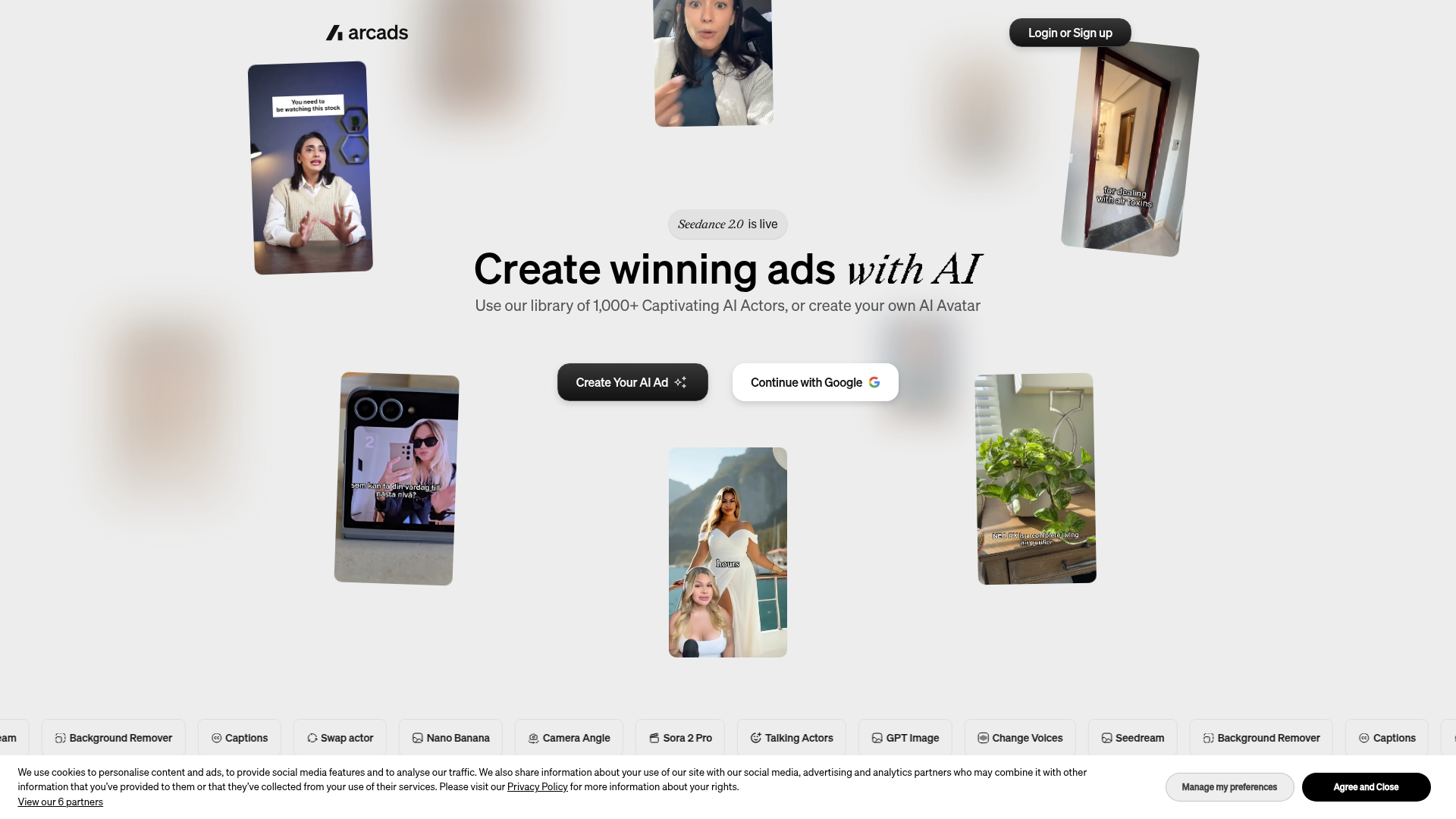
Arcads is the tool the operators who actually buy media reach for, and the SERP keeps it off the top spot because Arcads does not run an aggressive affiliate program the way its lower-ranked competitors do. That is the tell, and we will come back to it. On unit cost, Arcads works out to about $11 per finished video on the Starter tier per independent pricing breakdowns, against the $150 to $500 a human creator charges for a single asset. The 20x gap is what funds the only thing that matters in cold-traffic testing: variant count.
The operator reporting on this is consistent and worth reading with the attribution caveat attached. Practitioners on X describe running 50 to 100 script and actor variants on Arcads for the cost of 3 to 5 human clips, and one widely-shared workflow put it at $89 for 100 AI tests versus roughly $8,000 the old way. Cody Schneider, a growth operator with a real track record, has documented the hybrid version of this: use Arcads to test 100 scripts cheaply, then hand the single winning concept to a human creator for the polished scaled version. That is the correct use of the tool and it is the use the listicles never explain because "use it then partly replace it" does not drive affiliate clicks.
Where the honesty has to land: the most-shared Arcads case study, a brand taking the same script from $14,000 in human-UGC revenue to $1.3 million scaled on AI UGC, has no control arm. None. We do not know what the same spend on human creative would have done, what else changed in the account, or whether the offer was the lever. Treat it as marketing. The defensible claim is the cited one: roughly 26% lower CPA for AI creative in e-commerce and winners found in 4.2 versus 16.8 days. Arcads is the best tool for capturing that specific edge.
The scenario where Arcads is the only right answer: you are buying cold traffic, your bottleneck is that the AI actor reads as fake in the first second and the scroll happens before the hook lands, and you have the discipline to actually cycle 15-plus variants per fatigue window. That is precisely Arcads' design center. The cost you have to price in honestly is the missing launcher: with no native push to Meta or TikTok, every batch carries a manual export-and-upload step, call it 10 to 20 minutes per cycle, which at a real operator's loaded rate is a few dollars of time per refresh. Trivial against $720/day of media, real enough that an agency running ten clients feels it ten times a week. That friction is the single reason a high-volume agency should look hard at Creatify before defaulting here.
- The most convincing actor realism in the category at the price; gestures and delivery survive a 3-second thumb-stop.
- 1,000+ actors across ethnicities, ages and settings, so variant testing does not run out of faces.
- About $11 per finished video, the strongest cost-per-test in the realism tier.
- Built for the one job that lowers CAC: high-volume hook and actor variant testing.
- No native ad-platform launcher; you export and upload manually, which adds friction at volume.
- No free trial, and pricing is hidden behind a login wall, which is a transparency red flag and an annoyance when costing it.
- Starter caps at 10 videos, so serious testing means the $220 tier almost immediately.
- The viral revenue case studies are uncontrolled; do not buy on them.
Third-party roundups rate Arcads around 4.5/5. I would not buy on the rating. I would buy on the cost-per-test math, and on that math Arcads is the default for the realism job.
2. Creatify – best for the create-launch-track loop
Best for: Agencies and in-house teams that want creation, ad launch and competitor tracking in one tool instead of three. Standout: A native Ad Launcher to Meta, TikTok and AppLovin plus a Competitor Ad Tracker indexing 10M+ Meta ads. Pricing: $33/mo Starter (100 credits, 300 actors), $49/mo Pro (300 credits, 1,500 actors + 3 custom avatars, Ad Launcher, Competitor Ad Tracker, 5 seats), Enterprise custom. Up to 50% off annual. Free trial: Free tier to start.
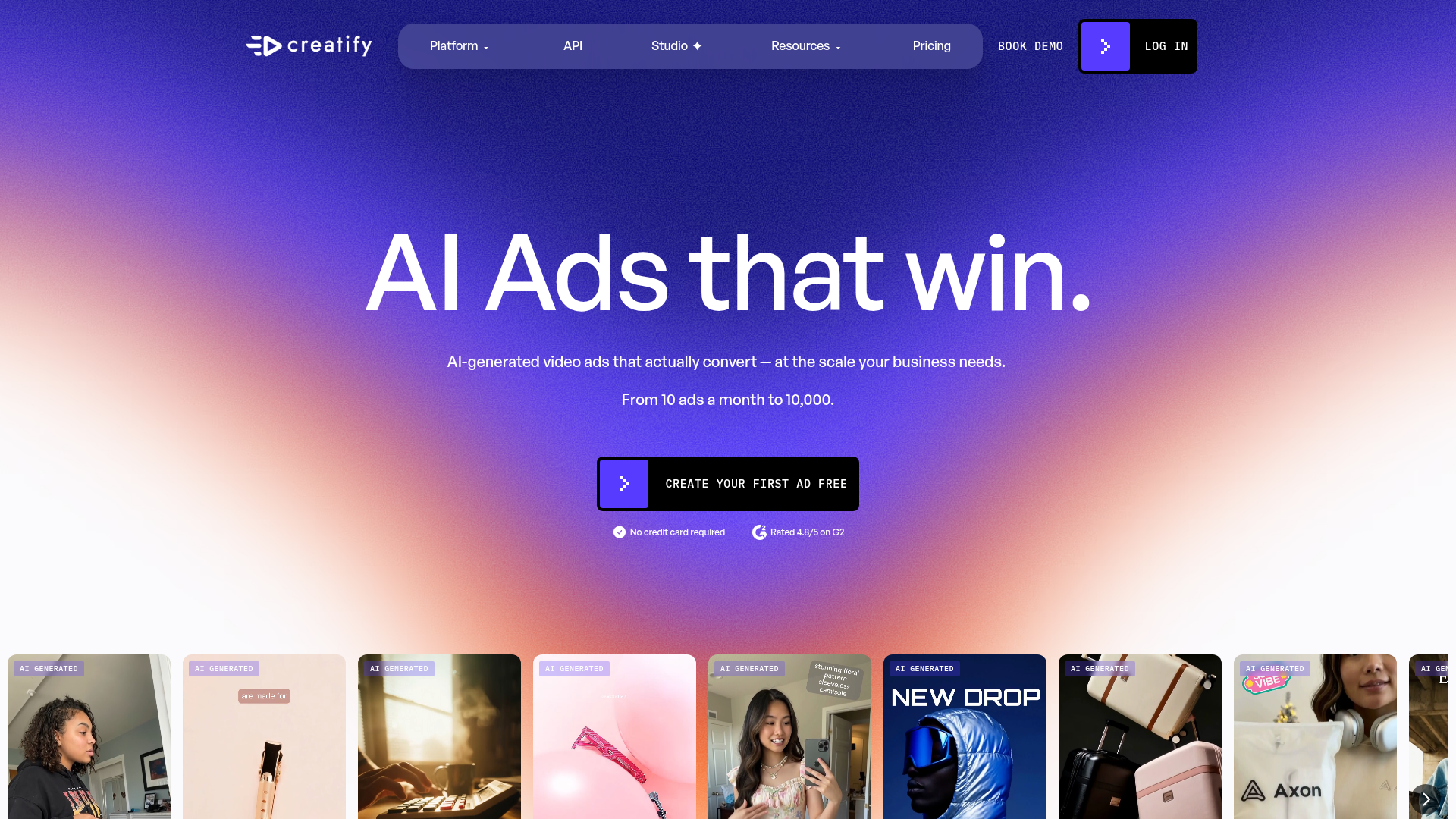
If Arcads wins the render, Creatify wins the loop, and the loop is where money is actually made or lost. At $49 a month the Pro tier bundles the thing every other tool makes you assemble yourself: generate the variants, launch them straight into Meta, TikTok and AppLovin, and watch a competitor ad tracker sitting on more than 10 million indexed Meta ads so you are not guessing what hooks are already working in your category. On 300 monthly credits with most ad formats costing one credit, the effective cost per finished video lands somewhere between $0.50 and $2, the lowest real cost-per-video of any tool here that produces genuine talking-actor UGC.
The honest read on Creatify is that the actor realism is a step behind Arcads. In side-by-side roundups Creatify rates around 4.2/5 against Arcads at 4.5, and the gap is visible in close-up delivery. But that is the wrong comparison for most buyers. An agency running creative for 3 to 10 clients does not need the single most photoreal actor, it needs to ship 40 variants this week, launch them without a context-switch, and report which hook won before the fatigue clock hits day 10. Creatify is the only tool on this list built end to end for that, and the 1,500-actor library plus 3 custom avatars on Pro is more than enough range for variant testing.
Run the cadence math from earlier through Creatify specifically and the case gets sharper. The whole financial argument for AI UGC was the spend you do not waste while a winner is found, roughly $9,000 per cycle, and that saving only lands if the refresh never stalls. Creatify is the one tool here that removes the stall: variant generated, launched into Meta from the same screen, competitor hooks visible so the next batch is informed rather than guessed. On $49 with 5 seats an agency is paying under $10 per seat per month to hold a sub-two-week refresh cadence across ten clients. There is no other line on this list where the price-to-cadence ratio is that favorable, and cadence, not realism, is the recurring cost driver the verdict is built on.
This is the tool that slots cleanest into a real DTC creative stack rather than living as a standalone toy. If you are assembling the broader paid-creative system around it, the stack-level reasoning is worth reading.
The AI Ad Creative Stack I'd Run for a Sub-$5M DTC Brand
Where a tool like Creatify sits inside the full Andromeda-era stack.
- The only tool here that closes the full loop: create, launch to Meta/TikTok/AppLovin, track competitors, in one place.
- Lowest real cost per finished video, roughly $0.50 to $2 on Pro credits.
- Competitor Ad Tracker on 10M+ Meta ads removes most of the hook-guessing.
- $49 Pro includes 5 seats, which is the agency math that makes it cheap per client.
- Actor realism trails Arcads in close-up delivery; rated about 4.2/5 versus 4.5.
- Credit accounting gets fiddly at volume; premium models burn more than one credit.
- The all-in-one breadth means none of the parts is best-in-class individually.
- Ad Launcher convenience can encourage launching weak variants because it is frictionless.
For most operators reading this, Creatify Pro at $49 is the highest expected-value single purchase on the list. Not because it is the best at any one thing, but because the loop it closes is where CAC is won.
3. HeyGen – best for localization at scale
Best for: Global brands and teams that need the same ad in 20 languages, not the single best English hook. Standout: 700+ avatars across 175+ languages with credible lip-sync, and a Free tier that actually lets you evaluate. Pricing: Free (3 videos/mo, 1 min, watermark), $29/mo Creator (600 credits, watermark removal, 1080p, up to 30-min videos), higher Pro and Team tiers. Free trial: Genuine free tier, 3 videos a month.

HeyGen is the most polished general-purpose AI video tool here and G2 named it the #1 Fastest Growing Product of 2025, with roughly 100,000 businesses on it. The honest framing matters: HeyGen is a superb video suite that does UGC, not a UGC ad machine that also does video. For a brand that needs one proven hook localized into 175+ languages with believable lip-sync, nothing else on this list comes close, and on the $29 Creator tier the effective cost is roughly $1 to $3 per finished video.
Where it loses to Arcads and Creatify is exactly where it is supposed to: cold-traffic ad-variant testing. HeyGen's avatars read slightly more "presenter" than "person who just filmed this on their phone", which is perfect for explainer and localization and a measurable disadvantage in the scroll-stop authenticity that Reels and TikTok reward. The smart play is to use HeyGen second, not first: find the winner on Arcads or Creatify, then scale and localize it on HeyGen. Used that way it is excellent. Used as your primary cold-traffic testing tool it quietly raises CPM because the creative reads as an ad.
The localization economics are where HeyGen's number actually wins. A human-creator UGC ad at $150 to $500 localized into 10 languages by re-shooting is $1,500 to $5,000 and weeks of coordination. The same proven winner pushed through HeyGen at roughly $1 to $3 a render is under $30 for all ten, same day. That is the one place on this list where the per-video price is the deciding number rather than a distraction, because you are not testing into uncertainty, you are duplicating a known winner across markets where the creative risk is already retired. For a brand selling into MENA, LATAM and SEA off one validated English hook, that is a genuine order-of-magnitude saving with almost none of the attribution ambiguity that taints the cold-traffic case studies, because the variable being changed is language, not the creative bet.
- Best-in-class localization: 175+ languages with credible lip-sync from one master video.
- 700+ avatars and the most polished general output quality on the list.
- A real Free tier and a $29 Creator tier with watermark removal, so evaluation is honest and cheap.
- Massive install base (~100,000 businesses) means stability and a deep template ecosystem.
- Avatars read "presenter", not "real person filming a story", which costs scroll-stop performance in cold UGC.
- It is a broad video suite; the UGC-ad workflow is a feature, not the product.
- No native ad-platform launcher or competitor tracking.
- Credit-based scaling gets expensive at true ad-testing volume.
Rated around 4.8/5 in roundups, the highest here, and the rating is honest for what HeyGen is. Just be honest about what you are buying: localization and polish, not the cold-traffic testing edge.
4. Captions (Mirage) – best for the cheapest path into AI actors
Best for: Solo operators and small teams who want AI actors plus an editor without a six-figure-feeling subscription. Standout: Mirage AI actors plus a chat-based in-app editor at the lowest serious entry price in the category. Pricing: $9.99/mo Pro (editing, captions, watermark-free export), $24.99/mo Max (AI actors, digital twins, 500 credits, chat editor), $69.99/$139.99/$279.99 Scale tiers for volume. Free trial: Free signup, paid tiers for the AI-actor features.
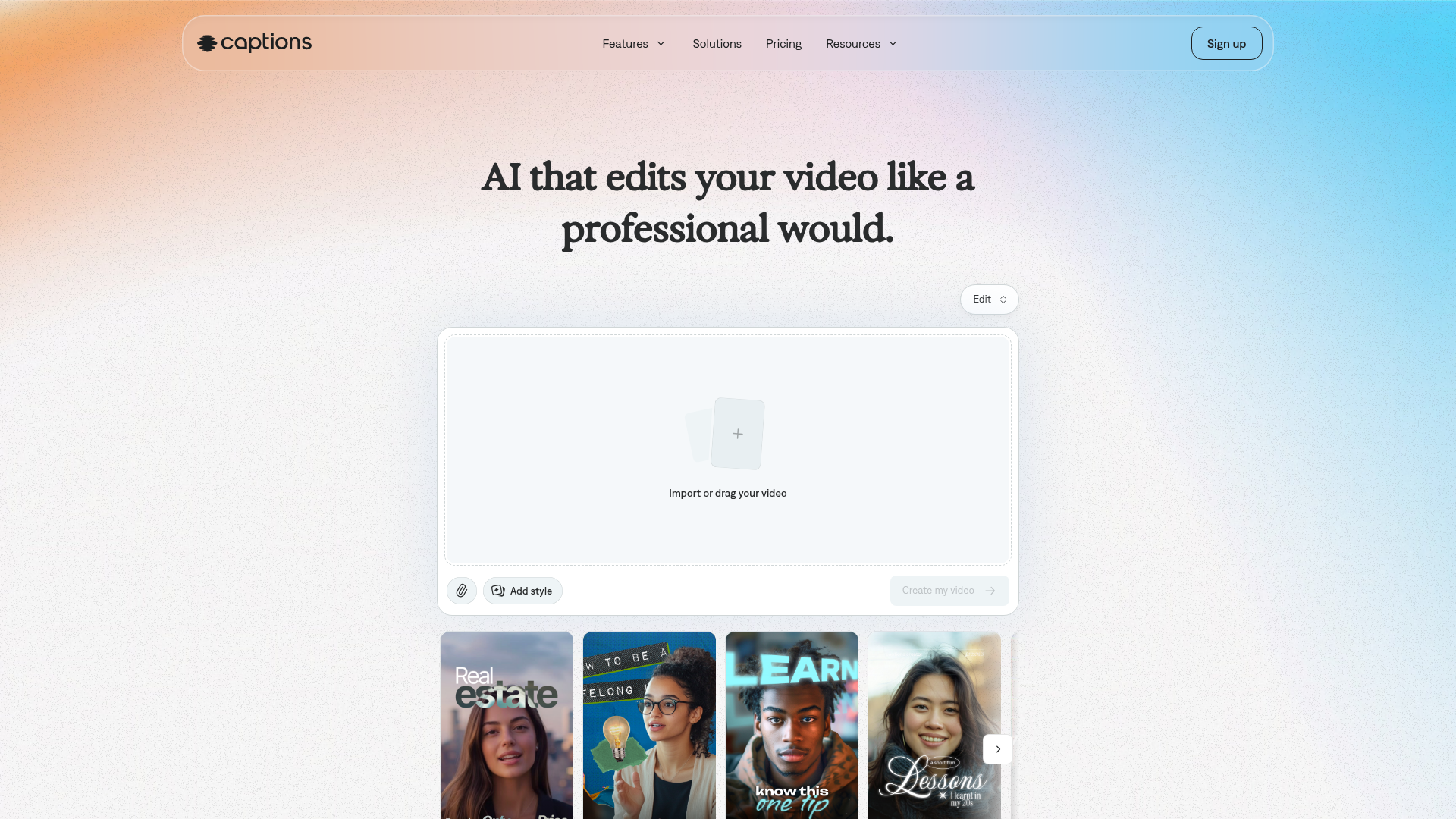
Captions is the value entry point and an honest one. The Max tier at $24.99 gets you Mirage AI actors, custom digital twins and a chat-based editor that handles changes for you, on a 500-credit monthly budget that works out to roughly $2 to $4 per finished video. For a solo operator validating an offer before committing real ad spend, that is the lowest-risk way to find out whether AI UGC works for your product at all.
The candid con is in the DNA. Captions started as an editing and captioning tool and the AI-actor generation is grafted onto that, not the core. It is excellent for taking a piece of footage and finishing it fast, good for generating a handful of actor variants, and not a variant cannon the way Arcads and Creatify are. If your job is "make 80 hook variants this week", Captions will frustrate you. If your job is "make 8 good ones and edit them tightly without a separate editor", it is the best value on the list. Match the tool to the job and it earns its place; mismatch it and you will conclude AI UGC does not work when really you bought an editor.
- Lowest serious entry to AI actors: $24.99 Max with 500 credits.
- Built-in chat editor removes the need for a separate editing tool.
- Mirage actors plus custom digital twins at the price is genuine value.
- The right risk-free way for a solo operator to test whether AI UGC fits the product.
- Editing-first DNA; actor generation is a feature bolted on, not the core engine.
- Not built for high-volume variant testing; throughput is the weak point.
- No ad-platform launcher or competitor data.
- Credit ceiling on Max is tight once you start iterating seriously.
I have not seen a stable verified G2 review count for the Mirage actor feature specifically, so I will not invent one. Buy Captions for the value-entry job, not as your scaling engine.
5. MakeUGC – best for multi-model flexibility
Best for: Operators who want to switch the underlying video model per render instead of being locked to one engine. Standout: A credit system that lets you pick Veo 3.1, Kling 2.6, Sora 2, Seedance 2.0 and others per video. Pricing: $49/mo Start-up (5 AI videos, 500+ creators), 20% off annual, $1 entry trial. Higher tiers scale credits. Free trial: $1 to start.

MakeUGC's bet is model optionality. Instead of being stuck with whatever single engine a vendor licensed, you spend credits across Veo 3.1, Kling 2.5/2.6, Sora 2, Seedance 2.0 and a stack of image models, choosing the right engine for the shot. When a new frontier video model lands, MakeUGC tends to expose it fast, and for an operator who cares about staying on the current best model that is real value. At the $49 Start-up tier with 5 videos the headline cost-per-video is roughly $8 to $10, mid-pack, and the $1 trial makes the evaluation genuinely cheap.
The honest con is that model sprawl is a quality-control tax. Eight engines means eight different failure modes, eight looks, and a real risk of shipping an inconsistent set of variants where the test is contaminated by model differences rather than creative differences. For disciplined operators that is manageable and the flexibility is worth it. For most teams the single-engine consistency of Arcads is the safer testing substrate, because a clean variant test needs everything held constant except the creative. MakeUGC is the power-user pick, not the default.
- Genuine multi-model choice: Veo 3.1, Kling, Sora 2, Seedance per render.
- Fast to expose new frontier models, so you are rarely a generation behind.
- $1 trial and 500+ creators makes evaluation cheap and broad.
- Strong for operators who want to match engine to shot type deliberately.
- Model sprawl is a QC burden; inconsistent looks can contaminate a variant test.
- $49 for 5 videos is mid-pack on raw cost-per-video.
- Credit values differ per model, so budgeting takes attention.
- No native launcher or attribution loop.
Buy MakeUGC if you are the kind of operator who will actually exploit model choice. If you would just default to one engine anyway, buy Arcads and skip the QC tax.
6. Topview – best for product-URL to UGC on an ecom budget
Best for: Ecommerce sellers who want to paste a product URL and get UGC-style ads back cheaply, with automation hooks. Standout: Product-link to video pipeline plus API and automation support on a low annual credit cost. Pricing: Free (watermark, non-commercial), $29/mo Pro ($348/yr, 960 credits/yr, ~240 Seedance 2.0 videos, API automation), $75/mo Business ($900/yr, 3,000 credits, ~750 videos). Free trial: Free tier (non-commercial, watermarked).
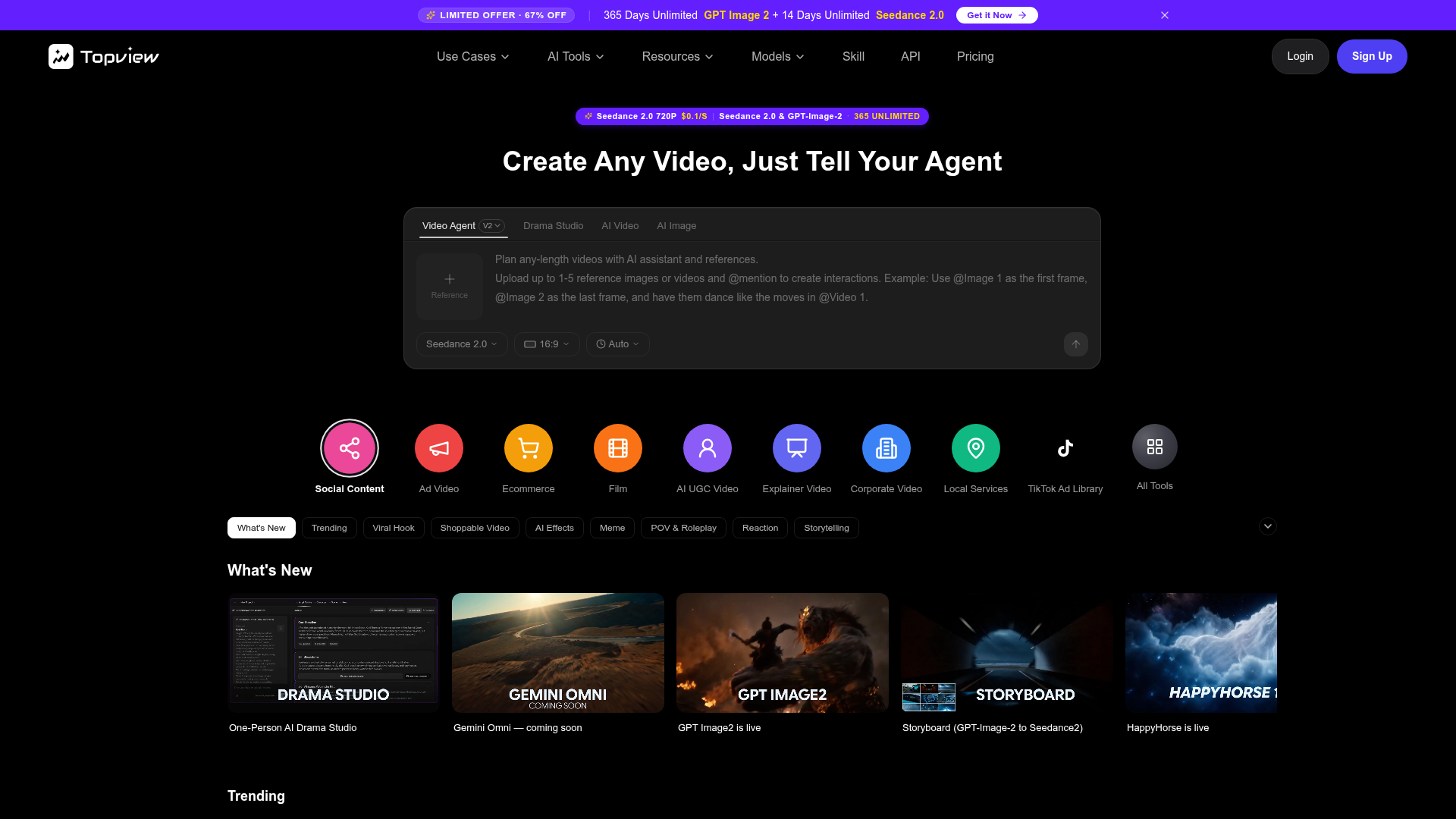
Topview is the ecom-native budget pick. The Pro tier at $29 a month billed annually gives roughly 240 Seedance 2.0 videos a year, which pencils out to about $1.50 per finished video, and the workflow is built for the Shopify and TikTok Shop seller: paste the product URL, get UGC-style ads back, with API and automation support so it can plug into a pipeline rather than living as a manual tool. For a sub-$1M store that needs constant fresh creative and cannot justify Arcads money, that is a defensible buy.
The con is in the credit math. The headline video counts assume the cheaper models. The moment you reach for premium engines the effective per-video count drops sharply, and the real cost-per-good-video is higher than the marketing number. The free tier is non-commercial and watermarked, so it is a true demo, not a usable plan. Topview is the right answer to a specific question, "cheapest competent product-URL UGC for an ecom store with automation", and the wrong answer to "best realism" or "best testing loop". Bought for its actual job it is strong value.
- Product-URL to UGC pipeline tuned for Shopify/TikTok Shop sellers.
- About $1.50 per finished video on annual Pro, the cheapest credible ecom option.
- API and automation support, so it slots into a pipeline.
- Generous video counts at the standard model tier.
- Credit math punishes premium models; the real cost-per-good-video is higher than the headline.
- Free tier is non-commercial and watermarked, demo only.
- Realism trails the dedicated actor tools.
- No native ad-platform launcher; automation is API-only.
I have no verified independent rating for Topview I would stand behind, so I am not publishing one. Buy it on the cost-per-video and the ecom workflow fit, which are both real.
7. Synthesia – the honest "wrong tool for cold-traffic UGC" call
Best for: Training, internal comms and explainer video. Not cold-traffic ad UGC. Standout: The most reliable corporate-grade avatars and the largest enterprise install base in AI video. Pricing: Free (1,200 credits/mo, ~10 min video), $19/mo Starter, scaling to enterprise. New lower pricing from roughly $14/mo. Free trial: Free tier, 10 minutes of video a month.

Synthesia is on this list because it keeps appearing on other people's "best AI UGC" lists, and putting it there is the category error I flagged at the top. Synthesia is genuinely excellent, 4.7/5 from over 2,000 G2 reviews and 50,000+ teams, at training videos, product explainers and internal comms. Its avatars are reliable, professional and read exactly like what they are: a polished corporate presenter. That is the opposite of what cold-traffic UGC needs. UGC works because it does not look like an ad. A Synthesia avatar looks like an ad, well, because it is built to look like a professional video.
I am ranking it seventh not because it is a bad tool, it is one of the best tools here at its actual job, but because buying it for Reels and TikTok ad testing is a mistake that the SERP actively encourages and that will cost you money in raised CPM and wasted spend. If your honest need is an explainer or training video, Synthesia is probably your answer and the $19 Starter is well priced. If you typed "AI UGC" meaning ad creative, Synthesia is not the tool, and any list that ranks it in the top three for UGC ads has not run an ad.
- Best-in-class for training, explainer and internal-comms video.
- 4.7/5 from 2,000+ G2 reviews, 50,000+ teams, genuinely reliable.
- Strong free tier and a low $14–$19 entry.
- Excellent if your real need was never cold-traffic UGC.
- Avatars read corporate-presenter, the wrong register for scroll-stop UGC.
- Using it as a UGC ad tool raises CPM because the creative reads as an ad.
- No ad-platform launcher or performance loop.
- Its presence on UGC lists is a category error you should not pay for.
The verdict is the honesty: right tool, wrong list. Buy Synthesia for what it is, and do not let a rigged listicle sell it to you as an ad-testing engine.
8. Pippit (CapCut / ByteDance) – best free-to-start for TikTok-native sellers
Best for: TikTok Shop and social-commerce sellers who want a free-to-start product-link video tool tied to the CapCut ecosystem. Standout: One-click product-link to video, AI avatars, and auto-publishing into social channels, free to begin. Pricing: Free to start, credit-based paid tiers (pricing presented opaquely on a per-credit basis rather than clean monthly tiers). Free trial: Free tier to start.
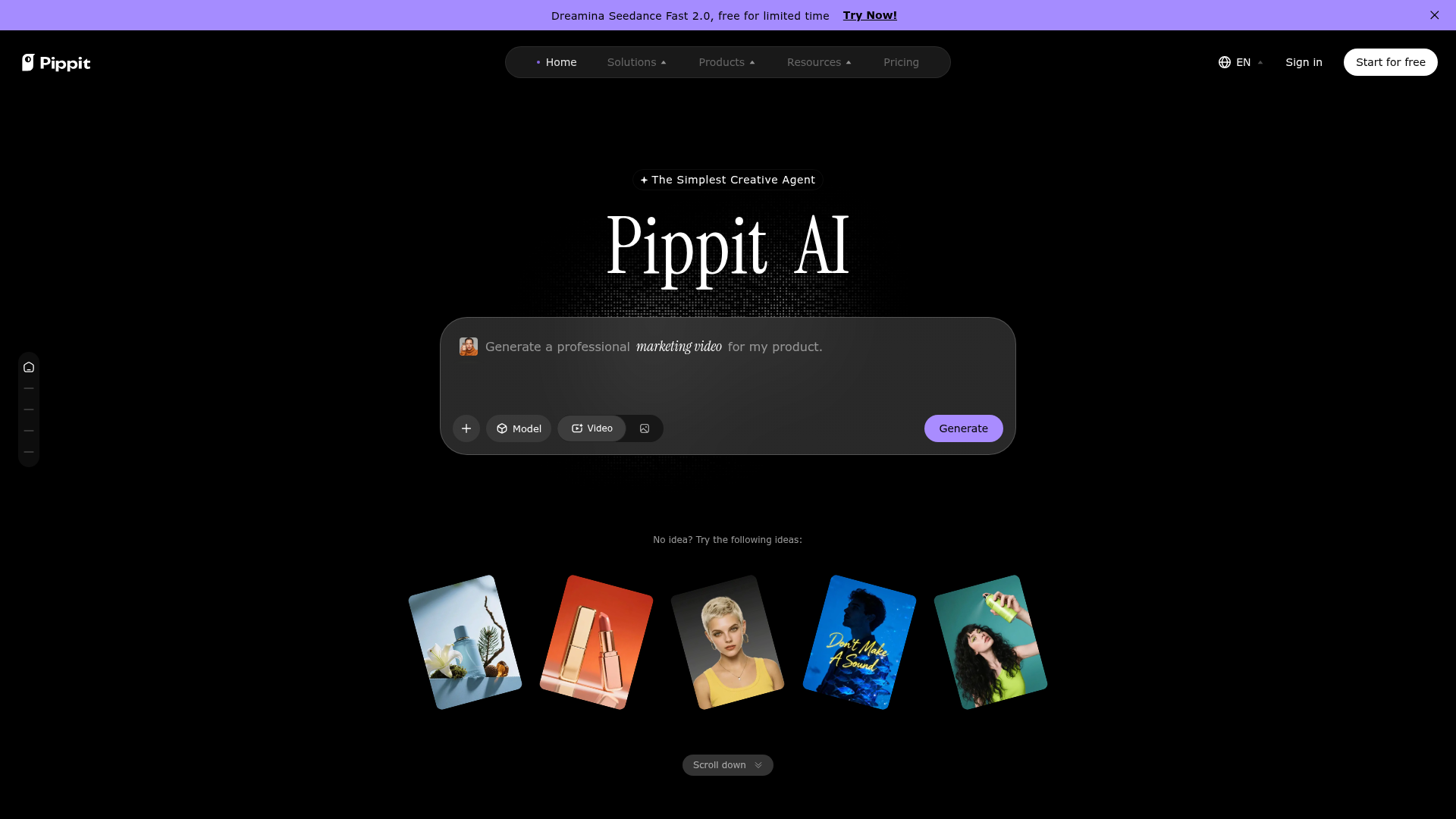
Pippit is ByteDance's entry, built around CapCut, and for a TikTok-native seller the free starting point and the auto-publish-to-socials workflow are a real on-ramp. Paste a product link, get a video with an AI avatar, schedule it out. For zero dollars at low volume that is hard to argue with as a first step.
Two honest cons, and the second is the one nobody else will state plainly. First, the pricing is opaque: paid usage is credit-metered without the clean monthly tiers every other tool here publishes, which makes it impossible to cost properly in advance, and I will not invent a per-video number I cannot verify. Second, this is a ByteDance-owned tool whose value proposition is proximity to TikTok's distribution. For a small TikTok Shop seller that proximity is a feature. For anyone with a governance, data-residency or platform-risk concern it is a question you should answer deliberately before building a creative pipeline on it, not a detail to discover later. Pippit is a strong free on-ramp with a real strategic asterisk.
- Free to start, genuinely usable for low-volume TikTok-native sellers.
- One-click product-link to video plus auto-publish into socials.
- Tied into the CapCut ecosystem most TikTok sellers already use.
- Lowest possible entry cost: zero.
- Opaque credit pricing; impossible to cost reliably in advance.
- ByteDance ownership is a governance and platform-risk question, not a footnote.
- Realism and control trail the dedicated actor tools.
- The free tier's ceiling is low; serious volume forces the unpriced credit path.
Use Pippit as a free first experiment if you sell on TikTok. Decide the ByteDance question consciously before you make it infrastructure.
The ones to avoid, and the rigged SERP
This is the section the other lists do not write, because they are the section. Here is how to read an AI UGC listicle in ten seconds, including this one: hover the #1 tool's link and look at the URL.
Do that on DesignRevision's "7 Best AI UGC Tools", currently a top organic result. Its #1 pick, ClipLoft, links to https://cliploft.com/?ref=designrevision.com. That ?ref= is an affiliate tag. ClipLoft is not ranked first because it beat Arcads on a test. It is ranked first because that link pays the publisher. The page even carries a "Human Written" badge, which makes the placement worse, not better, because a human chose to put the paying tool above the better-known ones. ClipLoft does not publish transparent pricing, which is the same red flag I docked Arcads a point for, except here it sits at #1 with no scrutiny.
Now Cometly's "Best AI UGC Generator", another top result. Its #1 is AdStellar AI. Cometly is an ad-attribution vendor and AdStellar is an adjacent ad-creative product in the same orbit. Ranking it above Arcads and Creatify is a house-pick conflict, the listicle equivalent of a fund rating its own product five stars. It is not necessarily a bad tool; it is a non-credible #1 in that context.
Then the category error: Pictory and InVideo show up on these lists as "AI UGC". They are slideshow and stock-footage video tools. They turn a blog post or a script into a montage of licensed clips with a voiceover and captions. That is a real product with a real use, repurposing long-form content, and it is not a person talking to camera about your product. Run a Pictory output as a cold-traffic UGC ad and it reads as a stock-footage ad in the first frame, the scroll happens, and your CPM climbs because the platform's authenticity weighting sees exactly what the viewer sees. Putting these tools on a UGC list is either ignorance or filler, and either way it costs the reader who buys one expecting scroll-stop creative roughly a month of wasted spend before they diagnose why nothing converts.
The fifth thing to avoid is a pricing structure, not a tool: the lifetime deal and the bottomless "unlimited" free tier. A lifetime-deal UGC tool has no recurring revenue to fund model upgrades, and in a category where the underlying video models reset every quarter, a tool frozen at its launch model is worse than nothing within two cycles. The bottomless free tier is the same trap from the other side: if the unit economics do not work, either the model is the cheap one, the data is the product, or the tool is a customer-acquisition loss-leader for an upsell you have not seen yet. None of the eight ranked tools above runs on either model, and that is not a coincidence; it is the filter.
The structural rule, applied to this page too: trust the list whose ranking does not change when you check the link tags. My #1 is Arcads, which runs no affiliate program I benefit from, and I docked it for hidden pricing and no trial in the same breath. That is what an unrigged ranking looks like.
One more thing to avoid, and it is a behavior, not a tool: the uncontrolled case study. The $14,000-to-$1.3-million same-script story attached to AI UGC is shared constantly with no control arm, no account context, no disclosure of what else changed. Operators on X report 22% to 44% CAC reductions after shifting 80%+ of creative to AI UGC in Q1 2026, and a baseline of roughly $13.60 CPA at 3.8x ROAS on $720/day per ad. Those numbers are directionally believable and consistent with the controlled 26% figure, but every one of them is self-reported without a holdout. Use them to size the opportunity, never to justify the spend. The spend is justified by your own controlled test or it is not justified.
FAQ
What is the best AI to create UGC ads?
For cold-traffic ad testing where realism matters most, Arcads at about $11 per finished video. For the full create-launch-track loop on a budget, Creatify Pro at $49/month. There is no single best; it routes by whether you are buying actor realism, the ad-platform loop, or languages. Be skeptical of any list with one permanent #1.
Can you make UGC with AI?
Yes. Modern tools script, cast an AI actor and render a creator-style video in minutes for $3 to $11, versus $150 to $500 and 5 to 14 days for a human creator. The hard part is not the rendering; it is creative fatigue at day 10 to 14 and platform authenticity rules, which is where most of the spend is actually won or lost.
Which AI tool is best for UGC?
It depends on the job. Realism at testing volume goes to Arcads, the launch-and-track loop to Creatify, localization across 175+ languages to HeyGen, cheapest serious entry to Captions Max at $24.99. Treat any roundup with a fixed #1, especially one with an affiliate tag in the link, as a sales page.
What are the best AI tools for content creators?
For ad creators specifically: Arcads, Creatify, HeyGen and Captions. For training and explainer creators: Synthesia. They are not interchangeable, and the single most common and expensive mistake is buying a training-video tool like Synthesia for cold-traffic ad UGC.
How much do AI UGC ads cost?
$3 to $11 per finished video at scale: Arcads about $11 on Starter, Creatify roughly $0.50 to $2 on Pro credits, Topview about $1.50 on annual Pro. A human asset is $150 to $500. The number that actually matters is not the render fee; it is the ad test budget required to find a winner before the creative fatigues.
Are AI UGC ads allowed on Meta and TikTok?
Yes, but both platforms down-weight low-authenticity creative, and TikTok requires disclosure of AI-generated content. Undisclosed synthetic UGC is a policy and trust risk on top of a performance risk, so disclosure is not optional and "looks human enough to skip the label" is the wrong reading of the rule.
Do AI UGC ads actually convert better than human UGC?
Controlled third-party data shows roughly 26% lower CPA for AI creative in e-commerce, mostly because volume finds winners in 4.2 days versus 16.8, not because an AI actor out-persuades a human. The viral revenue case studies have no control arms; the velocity advantage is the real, defensible mechanism.
Arcads vs Creatify, which should I buy?
Buy Arcads if your single bottleneck is actor realism in cold-traffic tests and you will cycle 15-plus variants a fatigue window by hand. Buy Creatify Pro at $49 if you need the launch-and-track loop, you run multiple clients, or you want the lowest real cost per video. Most operators are better served by Creatify; the realism gap to Arcads is real but rarely the thing that is actually capping your CAC.
How many AI UGC variants should I test to find a winner?
Plan on one genuine scaling winner per 10 to 20 tested concepts, so budget around 15 variants per cycle. The point of AI UGC is that 15 renders cost about $165 on Arcads versus $2,250 to $7,500 in human creative, and you can run the test in days instead of weeks. Then refresh before day 10, because the winner fatigues inside two weeks.
Which should you choose
The answer routes by who you are, which is the only honest way to answer it.
If you run an agency or in-house team servicing 3 to 10 clients, buy Creatify Pro at $49/month. The 5 seats, the Ad Launcher into Meta, TikTok and AppLovin, and the Competitor Ad Tracker on 10M+ ads make the per-client cost trivial and the loop tight. The realism gap to Arcads is real and does not matter at your volume; throughput and the launch loop do.
If you run a sub-$5M DTC brand chasing a specific CAC target, buy Arcads, run high-volume hook and actor tests, and do the hybrid: take the single winning concept to a human creator for the scaled polished version. That is the workflow the operators with real track records actually use, and it captures the cited 26% CPA edge without betting the account on synthetic creative.
If you are a solo operator or creator validating an offer before committing real ad spend, buy Captions Max at $24.99 or Topview Pro at $29. Lowest risk, real AI actors, enough to learn whether AI UGC works for your product before you spend Arcads money.
If you are a global or multilingual brand, find the winner on Arcads or Creatify first, then scale and localize it on HeyGen across 175+ languages. Do not run cold-traffic tests on HeyGen; its avatars read as an ad and raise your CPM.
And if you typed "AI UGC" but you actually need an explainer or training video, buy Synthesia, and stop calling it UGC. Matching the tool to the real job is the entire decision. Every rigged listicle exists to stop you doing exactly that.
One thing to do this week
Pick the single tool that matches your row above, run one controlled test with a real holdout, and measure CPA against the Triple Whale $38.17 baseline before you scale anything. If you want the operator framework I use to decide which parts of a marketing workflow to automate and which to keep human, including the controlled-test discipline this whole piece rests on, the AI business workflow audit checklist walks the exact decision tree. Take that, run your one test, and let the number decide.
May 19, 2026
More from Growth

9 Best AI Call Tracking Tools in 2026 (and the 4 Priced Out by CallRail's Free Conversation Intelligence)
CallRail just bundled Conversation Intelligence into every plan free. I priced 9 AI call tracking tools against the new math, and 4 are now overpriced.
May 20, 2026
9 Best AI Heatmap Tools in 2026 (and Why Clarity Wins Free)
Microsoft Clarity is free and AI-first. Hotjar is now Contentsquare. I priced 9 AI heatmap and session-recording tools, and 3 are now obsolete.
May 20, 2026
9 Best AI Heatmap Tools in 2026 (and Why Clarity Wins Free)
Microsoft Clarity is free and AI-first. Hotjar is now Contentsquare. I priced 9 AI heatmap and session-recording tools, and 3 are now obsolete.
May 20, 2026