Falcon-H1 Arabic vs Intercom Fin: AED 11,500/mo rebuild
Running a sovereign UAE Arabic model as a retailer's bilingual support layer vs Intercom Fin: cost, deflection, PDPL, and when the SaaS bot still wins.
Published Updated
 By Omid Saffari


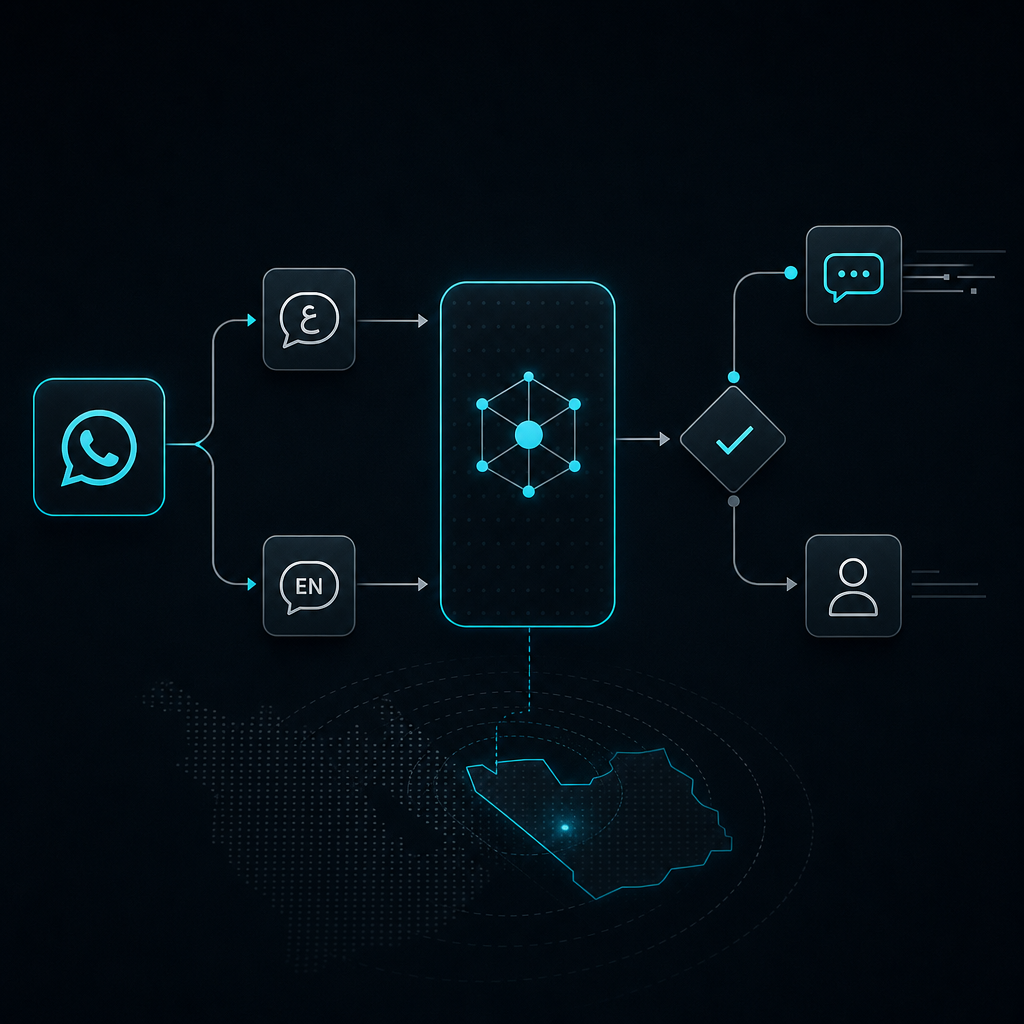
A 6-branch UAE electronics-and-home retailer was paying roughly AED 38,000/month for Intercom Fin to answer 42,000 mostly Gulf-Arabic support chats – and still routing the hard 30% to four agents. When TII shipped Falcon-H1 Arabic in January 2026, the build-vs-buy math flipped: the rebuilt stack runs at AED 11,500/month and deflects 64%.
The verdict, before anything else
If you run a GCC business doing more than ~25,000 monthly support conversations, with the majority in Gulf-dialect Arabic, and you have PDPL exposure on customer data, a sovereign self-hosted Arabic model is now the better buy than per-resolution SaaS. That is the headline. Everything below is the evidence.
The score is not a feature checklist. It is what happened to one retailer's P&L over 90 days, plus three honest caveats I will name before the end of this piece.
The client situation – a 6-branch UAE retailer drowning in WhatsApp
The business is a privately held electronics-and-home retailer with around AED 90M in annual revenue, ~140 staff, six branches across Dubai and the Northern Emirates, and an online catalogue. I'm anonymizing the name; the numbers are real and shared with permission.
They handle about 42,000 inbound support conversations per month. The channel mix is the part most non-GCC operators get wrong: WhatsApp is not a side channel here. The GCC has the highest WhatsApp chatbot penetration globally at roughly 38% share, and for this retailer it is the front door – about 78% of all support volume. Web chat and Instagram DMs make up the rest.
The harder number: roughly 70% of that inbound is Gulf-dialect Arabic, or code-switched Arabic and English in the same message. "متى وصلت الـ AC؟" "Order ما وصل بعد." This is exactly the band where English-first bots and even Modern Standard Arabic-only models quietly degrade. The customer doesn't notice the bot is failing; they just give up and call the branch.
The baseline before the rebuild:
- ~12-minute median first response on WhatsApp
- Four full-time support agents on rotation
- An Intercom Fin bill that scaled directly with conversation volume – by November 2025 it was running close to AED 38,000/month all-in, including agent seats and per-resolution fees
The owner's question to me was simple. "Is there a version of this that costs less and works better in Arabic, or do I just live with the bill?" In November 2025 my answer would have been: live with it, or accept worse Arabic. In January 2026 the answer changed.
This is the second WhatsApp-AI build I've shipped into a GCC vertical – the Dubai brokerage rebuild for property leads used a similar architecture but a very different model layer. The retail-support case is harder because the conversation volume is 8–10× higher and the Arabic is messier.
Why Falcon-H1 Arabic changed the math in January 2026
Three things shipped in close succession that broke the prior build-vs-buy equation.
First: TII released Falcon-H1 Arabic, a flagship 34B-parameter model reported to outperform Llama-70B and Qwen-72B on Arabic benchmarks at under half their size. The size matters because it sets your hosting bill – a 34B model runs comfortably on a single in-region GPU instance. A 70B model needs two or a heavier tier.
Second: it is open-weight and self-hostable. That single property is what kills the per-resolution meter. The model weights are available on Hugging Face, which means a UAE business can run inference inside its own jurisdiction without sending a single customer message to a US SaaS endpoint.
Third: Jais 2 – G42/Core42's 70B model trained on 600B Arabic tokens – exists as the heavier alternative when regulated-Arabic depth matters more than infrastructure cost. For retail support, Falcon-H1 is the right tool. For a regional bank or hospital network, Jais 2 is the conversation I'd be having instead.
The economic line underneath all of this: Arabic NLP now automates 60–80% of customer-service interactions when deployed properly, with typical Gulf SMB AI ROI payback inside 2–4 months. The retailer landed at 64% deflection at day 90 – squarely inside that band.
The stack I actually built – in business language
The architecture, in the terms the owner cared about:
The front door: WhatsApp Business API, with web chat and Instagram DM intake routed into the same conversation layer. The customer never knows there are multiple channels behind the scenes; one conversation history per customer regardless of where they wrote in.
The brain: Falcon-H1 Arabic self-hosted on an in-region UAE GPU instance, with a thin orchestration layer (TypeScript, retrieval over the retailer's product catalogue, returns policy, branch hours, and warranty terms). When a customer asks about delivery windows for a specific SKU or how to start a return, the model is grounded in the actual current data – not its training set.
The safety valve: A confidence gate. Every reply the model generates carries a confidence score. If the score falls below threshold, or the issue involves a refund, warranty dispute, or escalation language, the conversation hands to a human agent with the full transcript and a one-line summary at the top. The agent never starts cold.
The agents: Reduced from four to a retained 1.5 FTE. They no longer answer "متى يفتح فرع الراشدية؟" sixty times a day. They handle exceptions, complex returns, and – increasingly – upsell on inbound chats where the model has already qualified the question.
That's the whole system. There's no Convex-this or MCP-that the owner cares about. What matters is: a customer in Sharjah asking about a delivery window in Khaleeji Arabic at 11pm gets an accurate answer in under a minute, and a customer disputing a TV warranty in the same channel gets a human in under three.
The numbers at 30 / 60 / 90 days
I track every client deliverable on the same cadence. Here is what landed.
Day 30 – 41% deflection, median first response ~90 seconds, support headcount reduced from 4 → 3 (one redeployed to a new function, not let go). Two known failure modes surfaced: dialect-specific product names ("الشاحن الأصلي" vs colloquial variants) and Friday-evening volume spikes. Both fixable.
Day 60 – 58% deflection. We tuned out dialect failure modes through retrieval pattern additions, not model retraining. Headcount 3 → 2. The owner's first comment that month: "Branch phones are quieter." That is the only KPI he tracks.
Day 90 – 64% deflection, median first response under 45 seconds, 1.5 retained agents on exceptions and inbound upsell.
The blended cost at day 90:
- In-region GPU instance (UAE cloud, 34B-class inference): ~AED 4,200/month
- Orchestration layer + WhatsApp Business API fees + retrieval infrastructure: ~AED 1,800/month
- Retained agents (1.5 FTE, fully loaded): ~AED 5,500/month
- Total: ~AED 11,500/month
Versus the Intercom Fin baseline at ~AED 38,000/month effective for the same conversation volume. Payback landed at roughly 7 weeks – inside the 6-week WhatsApp-bot payback benchmark and well inside the 2–4 month Gulf SMB ROI band.
Here's the catch. The AED 11,500 is the ongoing run rate. The build itself was a 6-week engagement and a real upfront line. Factor that in when you do your own math – the payback above already does.
Alternatives – and exactly when each one wins
I'd be doing you a disservice if I framed this as "sovereign model beats SaaS everywhere." It does not. Here is the honest matrix.
Intercom Fin wins when: You are under ~8,000 conversations/month, OR your traffic is English-dominant, OR you have zero engineering capacity in-house and no agency relationship you trust. The per-resolution meter is genuinely cheaper than running infrastructure at low volume. Intercom's product is also strong – this is not a quality criticism, it's a volume math criticism.
Freshchat wins when: You have a small team, you want Arabic support without a build, and your conversation volume is modest. At around $15 per agent per month with Arabic-language support, it's the cheapest path to "Arabic-capable chat" for a 5–20 person business.
Zendesk Answer Bot wins when: You are already deep inside the Zendesk ecosystem. The switching cost of leaving Zendesk almost always outweighs the marginal benefit of moving. If you're on Zendesk and unhappy with the Arabic, fix the Arabic inside Zendesk first.
Jais 2 self-hosted wins over Falcon-H1 when: You operate in a regulated-Arabic vertical – finance, healthcare, government adjacency – where the depth of formal Arabic and the model's specific 600B-Arabic-token training earns its heavier infrastructure cost. For retail it's overkill. For a Gulf bank it's the conversation.
Falcon-H1 Arabic wins when: You match the profile in the verdict box. Volume high enough to make self-hosting cheaper than the meter, dialect mix that punishes English-first models, residency exposure that makes US SaaS uncomfortable, and at least an agency-grade engineering layer to run the orchestration.
The data-residency line – PDPL and why sovereign matters here
This is the factor that, for some operators, outweighs the price math entirely.
Self-hosting an open-weight model on in-region infrastructure means customer PII never leaves the UAE jurisdiction. Every WhatsApp message, every order number, every returned-item description stays on infrastructure governed by UAE law and accessible to UAE authorities under the same regime as the rest of the business's data.
US SaaS bots – Intercom, Zendesk, Freshchat – all introduce a cross-border data-processing question. They have answers: standard contractual clauses, data-processing addenda, and, in some cases, regional data centers. None of that is illegal. But every GCC operator I've worked with eventually gets asked the question: "Where exactly does our customer data live, and who can compel access to it?" The sovereign-model answer is shorter.
For this retailer, residency was a contributing factor, not the deciding one – price did most of the work. For a boutique Dubai law firm I built a PDPL-compliant document-review stack for earlier, the residency line was the entire decision. The price math came second.
If you are PII-heavy – healthcare, legal, financial advisory, anything touching minors or biometrics – model the residency question first and the price second. If you are retail or hospitality, do the price math first and treat residency as a tie-breaker.
What NOT to try in this market
Three things I see operators get wrong, repeatedly.
Do not deploy Modern Standard Arabic-only models against Gulf-dialect WhatsApp traffic. MSA-tuned models look great in vendor demos and collapse in production. Your deflection rate will be 30 points lower than the slide deck promised, and you will not understand why for a month. Test on real WhatsApp logs from your business before you sign anything.
Do not auto-resolve refund and warranty disputes. Every single one of these should escalate to a human. The cost of getting one wrong – public complaint, regulator letter, refund-fraud loop – is higher than the savings on a thousand correct auto-resolutions. The confidence gate is not a feature; it is the entire reason the system is safe to run.
Do not run a self-hosted build under ~8,000 conversations/month. The SaaS meter wins at low volume. Run the SaaS, get to product-market fit on your support volume, then rebuild. This is the single most common mistake I see GCC operators make – building infrastructure before the volume justifies it.
The practical move this quarter, if you're facing this decision: measure your current support volume and dialect mix for 30 days first. How many conversations per month? What percentage are Gulf-dialect Arabic? What percentage of agent time is spent on the same five questions? Without those three numbers, neither the SaaS path nor the sovereign path is the right answer – both are guesses.
What I'd do if you're facing this decision
If you operate a Gulf SMB above the 25,000-conversations-a-month line, mostly Arabic, paying a per-resolution bill that grows every quarter, the question is no longer whether to move off the meter. It's whether to move now on Falcon-H1, wait one quarter for Jais 2's next checkpoint, or stay put for two more quarters and let the model layer settle.
For most operators in the profile I described, moving now is the right call. The model layer will keep improving, but the price gap between sovereign and SaaS is already wide enough to fund the next iteration internally.
If you want a second opinion on your specific numbers before you commit, DVNC.ae runs a paid 90-minute audit that ends with a written build-vs-buy recommendation – not a sales pitch. Bring your last three months of support volume, your current SaaS invoice, and your dialect mix. We'll either tell you to rebuild, tell you to stay on the SaaS, or – about a third of the time – tell you the answer is to fix your knowledge base before you change the model layer at all.
Does Falcon-H1 Arabic handle Gulf dialect or only Modern Standard Arabic?
It's built for Arabic-language strength including dialectal input, and in the rebuild above it handled Khaleeji and code-switched Arabic/English far better than the prior stack. The practical risk is MSA-only tuning on your retrieval layer, which is why dialect evaluation on your real WhatsApp logs is step one – not vendor benchmarks.
Is a self-hosted UAE Arabic model PDPL-compliant for customer support data?
Self-hosting in-region is the cleanest residency posture because customer PII never leaves the jurisdiction. But compliance still depends on your logging, retention, access control, and consent design. The model choice is necessary, not sufficient.
When does Intercom Fin still beat a sovereign-model build?
Below roughly 8,000 conversations per month, or when traffic is English-dominant, or when you have no engineering capacity in-house or through an agency. The per-resolution meter is genuinely cheaper at low volume, and Intercom's product is excellent – this isn't a quality argument, it's a volume-math one.
What does a bilingual support rebuild actually cost for a mid-size GCC retailer?
For roughly 42,000 monthly conversations, around AED 11,500/month all-in ongoing versus ~AED 38,000/month effective on per-resolution SaaS at the same volume. Plus a one-time build engagement of roughly 6 weeks. Your numbers will vary – model your own volume first.
How fast does it pay back?
About 7 weeks at the volume above, in line with the 2–4 month Gulf SMB AI ROI benchmark. Payback gets longer below ~15,000 conversations/month and longer still if your engineering layer is fully outsourced.
Should I wait for Jais 2 or move on Falcon-H1 now?
For retail, hospitality, and most B2C support – move now on Falcon-H1; the dialect coverage is sufficient and the infrastructure cost is lower. For finance, healthcare, government-adjacent, or any regulated-Arabic vertical – Jais 2 is the better conversation, even at heavier infrastructure cost.
- Last Updated
- Category
- Growth
- Language
Beehiiv Pricing: Annual Costs by List Size
Beehiiv pricing verified October 2026: annual bills at 1k, 10k, 50k and 100k subscribers, plan features, October changes and paid newsletter fees.Oct 9, 2026Growth
Pipedrive Pricing: Plans, Add-ons and Team Costs
Current Pipedrive seat and add-on prices, annual vs monthly budgets for 3 and 10 users, AI features, and when Premium costs less.Oct 8, 2026Growth
Lemlist Pricing: Seats, Credits and Sending Costs
Lemlist pricing by month, quarter and year, including credits, mailboxes and add-ons. See founder, sales team and agency bills plus alternatives.Oct 8, 2026Growth
Tidio Alternatives
Compare seven Tidio alternatives by support job, current pricing and billing unit. See who should switch, what migration costs and when Tidio wins.Oct 7, 2026Growth
Vista Social Pricing: What Your Profiles and Team Cost
Vista Social starts at $99/month. Compare annual prices, profile and user limits, AI features, add-ons, three bills and cheaper options.Oct 7, 2026Growth
Unbounce Pricing 2026: Plans, Visitor Limits and Testing
Unbounce starts at $29/month. Compare all six plans, annual rates, visitor and domain limits, A/B testing, Smart Traffic and the cheapest fit.Oct 7, 2026Growth
Best AI Ad Generator in 2026: AdCreative.ai, Atria, Creatify & Arcads (Compared)
Choose AI ad tools by job: static ads, UGC-style video or creative research. Compare current maker pricing, credit units and free entry.Oct 6, 2026Growth