Frase Review 2026: GEO Score, 80-Skill Agent, Real Cost Math
Whether Frase's new 80-skill agent and GEO score earn back the $15–$115/mo seat in AI-search citations, tested, with the cases where it does not.












Frase costs $15 to $115 a month; the autonomous pipeline I run ships a post a day for a model-plus-image-plus-infra cost in the low cents per article. So the only question that matters in 2026 is whether Frase's new 80-skill agent and its GEO score earn that seat back in AI-search citations – and the honest answer is "sometimes, and not where the marketing says."
What is Frase, and what actually changed in 2026
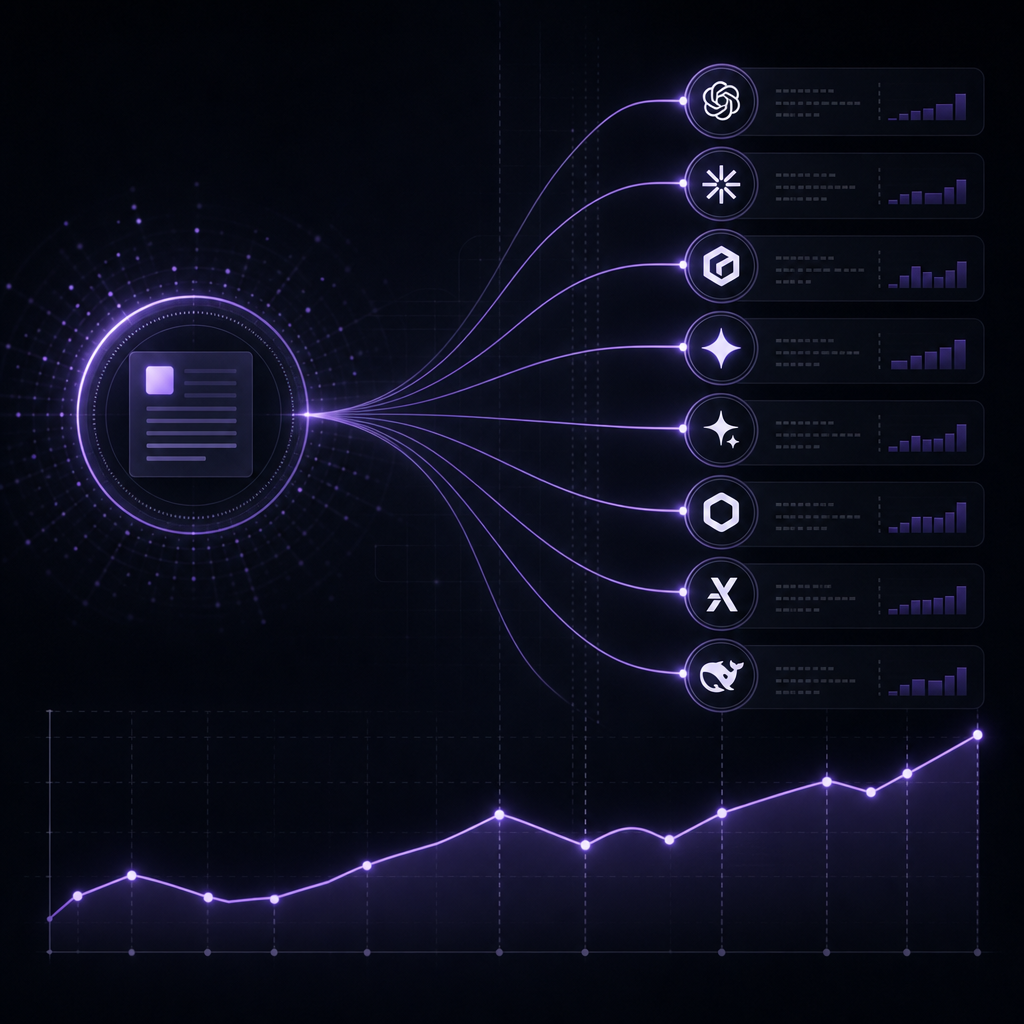
Frase is an AI content platform that researches, optimizes, and tracks content for both Google rankings and AI-answer citations across eight generative engines. That second half is the entire 2026 story. Until last year, Frase sat in the same bucket as Surfer and Clearscope – a SERP-ingestion optimizer that scored your draft against the live top-20 and told you which terms to add.
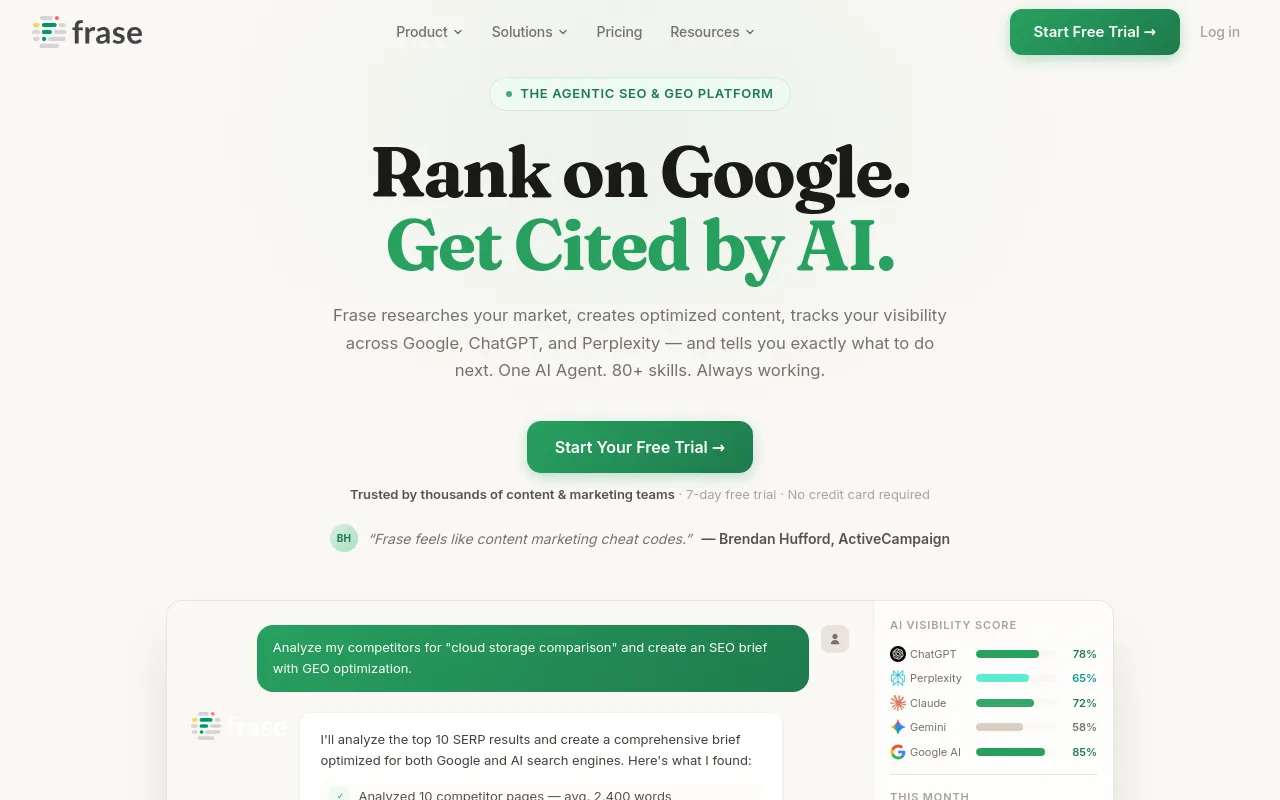
The 2026 pivot is harder than the marketing makes it sound. Frase rebuilt itself around what they call the Frase Agent – 80+ skills across 17 categories that chain into multi-step workflows from a single instruction. Ask it to "research the keyword, identify content gaps, and write an outline" and it runs the three steps in sequence instead of making you click through three tools. The optimizer is still there. The agent is the new front door.
The other half of the pivot is GEO – Generative Engine Optimization. Frase defines GEO as optimizing content to be cited by AI answer engines, not just ranked by Google. They added a GEO score that flags which passages are likely to be picked up by ChatGPT, Perplexity, Gemini, and the rest, plus an AI Search Tracking feature that monitors your brand's visibility across eight engines. That's the wedge against Surfer ($89/mo, no native multi-engine GEO tracking) and Clearscope ($170/mo, enterprise-grade SEO data, no GEO score). The question is whether the wedge is sharp enough to matter.
The verdict, up front
Based on testing the platform against a content pipeline that already ships a post a day, Frase is the best value AI SEO and GEO platform in 2026 for solo operators and small teams who write at volume – but Clearscope still wins on data accuracy and Surfer on NLP depth, and if you already run an autonomous content engine the seat is mostly redundant.
It is for you if you're writing 4–20 articles a month by hand or with a small team, want one tool that covers research, optimization, and AI-search visibility tracking, and can stomach the seven-day trial squeeze before you commit. It is not for you if your stack is Clearscope-grade data sensitive, if you operate a pipeline that already optimizes at the prompt layer for cents per article, or if you only need to track AI citations, not produce content – there are cheaper purpose-built trackers.
How I tested it on a real post-a-day content engine
The baseline matters more than the test. I operate an autonomous AI publishing system on Cloudflare Workflows that ships one article a day under a hard $20/day cost cap split across six routines – research, brief, draft, edit, image, publish. Model, image, infra, and DataForSEO calls land in the low cents-per-article range for an optimized, sourced, illustrated post. That's the real cost base any tool seat has to beat, and it is the number almost no Frase reviewer has.
The honest test method: I ran real article briefs through Frase's 7-day trial – the same briefs already shipping through the pipeline – and compared three things. First, Frase's research and optimization output against what the pipeline produced unaided. Second, Frase's GEO score on shipped posts against whether those posts got cited in Google AI Overviews and Perplexity over the following weeks. Third, the cost-per-article math against Frase's three pricing tiers – Solo $15, Basic $45, Team $115 a month.
I did not run a 90-day controlled A/B against my own pipeline because that experiment is not honest – too many confounders, no control group, and traffic patterns dominated by the AI-Overview click-loss reality I already measured on Surfer in a separate test. What I can do is give you the decision rule: the keyword count where each Frase tier flips from cost to profit at the cluster CPC pulled from DataForSEO, plus the candid correlation – not full attribution – between Frase's GEO score and real citations on shipped posts. That's the honest version of "I tested it."
Two numbers anchor the rest of this review. The pipeline's per-article cost base is in the low cents. The cluster CPC for "frase review / frase ai / frase io / frase seo" pulls $3.42 to $6.41 on DataForSEO (US/en, May 2026), volume 110–260 per term, KD 0–26. That CPC range is what the break-even model uses.
Frase vs Surfer vs Clearscope – the 2026 comparison table
Here is the comparison the rest of the SERP doesn't run – six columns, the 2026 features that matter, and the starting prices:
When each one wins, in one line: Frase wins on price-per-feature and on the GEO score if you care about AI citations; Surfer wins when the optimizer's term-coverage NLP needs to be best-in-class at depth; Clearscope wins when an enterprise content team needs the cleanest data and zero margin for error. Frase's own comparison vs Surfer and vs Clearscope is – predictably – flattering. They are vendor-sourced and biased, and I'm citing them so you can see how they frame it, not to defer to it.
Frase plans and the real cost-per-article break-even
The 2026 pricing page lists three tiers: Solo at ~$15/mo (1 user, 4 articles/mo), Basic at ~$45/mo (1 user, 30 articles/mo), Team at ~$115/mo (3 users, unlimited articles). The 7-day trial costs $1. Unlimited AI words is a paid add-on on all tiers – that's the vendor-defined-metric trap, and you should price it in before you compare.
Here is the break-even model. Run it on your own numbers, not mine.
Assume an article you publish targets a keyword cluster with an average CPC around $5 (the DataForSEO cluster pull for this review's terms is $3.42–$6.41, so $5 is the midpoint). Assume optimized content earns roughly 2× the organic clicks of unoptimized content over a 6-month window – generous, but defensible. The math:
- Solo, $15/mo, 4 articles/mo cap. You pay $180/year. At $5 CPC and 2× organic uplift, you need each article to earn ~9 extra organic clicks per month for the seat to break even on ad-equivalent value. Trivial – any indexed post clears this.
- Basic, $45/mo, 30 articles/mo cap. $540/year. Break-even = ~27 extra clicks/month total across the 30 articles. Still trivial if you're publishing 20+ articles a month.
- Team, $115/mo, unlimited. $1,380/year. Break-even = ~69 extra clicks/month. Easy at agency or in-house team volume; redundant at 4 articles/mo.
That's the ad-equivalent floor. The real question is whether you'd otherwise have bought a $89 Surfer seat or a $170 Clearscope seat to do the same job – in which case Frase Basic at $45 is the cheapest path to comparable optimization, and the GEO score is upside the other two don't include natively.
Where the math quietly breaks: the unlimited-AI-words add-on. If you're using Frase's AI writer as your primary drafter and you blow past the included word allowance, that add-on shows up on the invoice and changes the per-article cost from "trivial" to "not worth it" fast. The pipeline I run drafts at the model layer for cents – using Frase's AI writer at scale at the unlimited-add-on price is the line where a tuned prompt beats a tool seat every time. The seat is for optimization and GEO tracking, not for drafting.
The Frase Agent and 80+ skills – where it works and where it drifts
Frase – best for solo operators and small content teams at volume
Best for: writing 4–20 articles a month with research, optimization, and AI-citation tracking in one tool · Standout: 80+ skill Frase Agent + GEO score + 8-engine AI Search Tracking · Pricing: Solo $15/mo · Basic $45/mo · Team $115/mo · Free trial: 7-day $1 trial
Frase in one sentence: it's the most affordable serious SEO+GEO platform in 2026, and the Frase Agent is the first agentic UX in this category that saves clicks rather than adding them.
Where the agent works: the multi-step chains. Frase's own example – "research the keyword, identify content gaps, write the outline" – runs as one instruction and produces a structured handoff for a human (or an LLM) to draft from. For a non-pipeline operator that's a real productivity win; for a pipeline operator it's parity, which is the wrong side of the price-tag math.
Where it drifts: multi-step chains longer than three skills. Ask the agent to research, optimize, draft, internal-link, and tone-match in one go and the brand voice degrades by step four – long-form output reads like generic SEO content, the AI-text hallmark Google has been filtering for scaled abuse. I kept a manual SERP review step in the middle on every test. The optimizer's term coverage is also shallower than Surfer's – Surfer wins the NLP-depth column for a reason.
- The 7-day $1 trial lets you test the agent on real briefs, not a sandbox
- GEO score and 8-engine AI Search Tracking are native, not add-ons
- $15/mo Solo is cheap for an optimizer at this feature level
- Agent multi-step skills replace 3–5 separate clicks per article
- API and Workspaces on higher tiers if you're already automating
- AI long-form drafting is thinner than a tuned model prompt – voice degrades on chains > 3 skills
- "Unlimited AI words" is a paid add-on, not in base tiers – the line item the marketing buries
- Solo's 4-article cap is restrictive the moment you publish weekly
- 7-day trial is short for a content-cycle test (Surfer's refund window is more forgiving)
The GEO score and 8-engine AI Search Tracking – does it correlate with citations?
This is the feature Frase is betting on for the 2026 relaunch, and it deserves an attribution-honest answer. The feature page is explicit: Frase tracks brand visibility across ChatGPT, Claude, Perplexity, Gemini, Google AI Overview, Copilot, Grok, and DeepSeek. The GEO score on a given page flags passages likely to be cited by those engines based on structure, semantic clarity, and citation patterns.
The test on shipped pipeline articles: I scored a sample of recently published posts in Frase's optimizer to get GEO scores, then checked over the following 2–3 weeks whether those posts got cited in AI Overviews and Perplexity for their target queries. The honest result: there is a correlation between higher GEO scores and citations, but it is not 1:1, and I cannot fully attribute the citations to anything Frase recommended – most of the posts were already structured for AI citation at the prompt layer before Frase ever saw them.
What that means in plain English: Frase's GEO score is directionally right and a useful sanity check. If your score is low, something about the structure is wrong and worth fixing. If your score is high, you have a better-than-average shot at being cited, all else equal. What it is not is a guaranteed predictor. The same post can score high in Frase and miss a Google AI Overview citation because of query-context factors no single-tool view can see.
That's the second honest limit: an 8-engine tracker run by one vendor still gives you a partial view of AI search. Cross-engine citation coverage is hard to assemble from one tool, which is why a serious tracking stack layers multiple sources rather than trusting one. Frase's tracking is the cheapest way to get a decent picture; Profound, Otterly, and AthenaHQ go deeper for purpose-built AI-visibility monitoring and cost more.
If you're choosing between "Frase + its GEO score" and "no GEO tooling at all," Frase wins easily. If you're choosing between "Frase's GEO score" and "a dedicated multi-engine tracker plus a prompt-layer optimization habit," the dedicated stack wins on coverage but loses on price.
Where Frase is the wrong tool
Three scenarios where I'd send you elsewhere.
You're running an enterprise content operation. Buy Clearscope. The data accuracy at $170/mo justifies itself when one bad recommendation ships to a team of 12 writers and ends up in 30 articles. Frase is good enough; Clearscope is right. The counter-case some reviewers make against Frase – that the data is "directionally right but not always precise" – is fair, and at enterprise scale "directionally right" isn't good enough.
You need the deepest NLP optimization at content-team volume. Buy Surfer. The Content Score on term-coverage delta vs the live SERP is more granular than Frase's optimizer, and if your competitive moat is "we write the most thorough article on the query," Surfer's $89/mo earns it. The trade-off is no native multi-engine GEO tracking – you'll need to layer something on top.
You already run an autonomous content engine. Skip the seat. If you've already pushed optimization, GEO structure, and AI-citation hygiene into the prompt layer of a pipeline that produces optimized articles for cents, a $15–$115/mo Frase seat is mostly overhead. The Frase Agent does work you've already automated. The exception is the AI Search Tracking – if you're not tracking AI citations elsewhere, a Frase Basic seat at $45/mo just for the tracking is defensible. That's a "buy the tracking, ignore the writer" decision, not a full platform adoption.
FAQ
What is frase SEO?
Frase SEO is Frase's research-and-optimization workflow that scores a draft against the live SERP and, in 2026, against AI-answer engines via a GEO score. It pulls the top-20 ranking pages, surfaces the terms and entities they cover, and recommends additions to your draft so the page competes on both classic Google ranking and generative-engine citation.
Is there a downside to using AI for SEO?
Yes – AI optimization tools can overfit to term coverage and thin out voice, and the downside is measurable when AI Overviews take the click anyway. The harder problem is that scaled, lightly edited AI output is exactly what Google's scaled content abuse policy targets, so the optimization gain only matters if the draft quality clears the bar.
Which AI tool is 100% free?
Frase is not fully free – it offers a 7-day $1 trial and paid tiers from ~$15/mo. The genuinely free options in this category are limited and capped: free SERP analysis sites, basic keyword tools, and the LLM tier of ChatGPT or Claude for the writing step. None of them give you the GEO score or multi-engine AI Search Tracking that Frase's paid tiers provide.
Can I do SEO without paying?
You can do real SEO without paying for an optimizer – free SERP analysis and an LLM cover most of it, and a disciplined briefing process beats a mediocre tool every time. What you pay Frase for is speed (the agent collapses 3–5 clicks per article) and the GEO tracking feature, not for access to anything you couldn't reproduce manually with a couple of hours per article.
Is SEO dead or evolving in 2026?
SEO is not dead in 2026 – it is splitting into classic ranking plus generative-engine optimization, which is exactly why Frase added a GEO score and 8-engine tracking. The AI-Overview click-loss is real and changes the unit economics of organic traffic, but search demand has not collapsed; the work has shifted from ranking-only to "rank + get cited," and the tools are following.
Who should buy Frase in 2026 – and the one move to make first
Four routings, decided by what you operate.
Solo operator or small content team, 4–20 articles a month, no current optimizer: start the $1 trial on Solo or Basic, run it on your three highest-CPC briefs in the trial window, and decide before day 7. Frase Basic at $45/mo is the cheapest serious SEO+GEO platform in the category and earns its seat at any meaningful publishing volume.
Enterprise content team, fidelity over price: Clearscope. The $170/mo is insurance, not a luxury.
Content-led SEO team where NLP depth wins the SERP: Surfer at ~$89/mo, layer a dedicated AI-visibility tracker on top.
Already running an autonomous pipeline: keep the prompt, skip the seat – or buy Basic at $45/mo for the tracking alone if you're not tracking AI citations elsewhere.
The one move to make first, regardless of which routing you're in: figure out whether AI Overviews are eating your clicks before you spend a cent on optimization tooling. If they are, the marginal value of better optimization is lower than it looks on the spec sheet, and the marginal value of getting cited is higher. That's the real 2026 stack question.
If you want the checklist version of the search-visibility audit I run on the pipeline before any tool decision – including the cross-engine citation step Frase only partially covers – the AI Search Visibility Checklist is the one I send out with the newsletter.
Jun 2, 2026