Can AI Agents Safely Operate Lab Equipment 2026
Anthropic's MHS cuts some lab integrations from weeks to hours, but safety still depends on hard limits, validated drivers, and human oversight.
Published
 By Omid Saffari
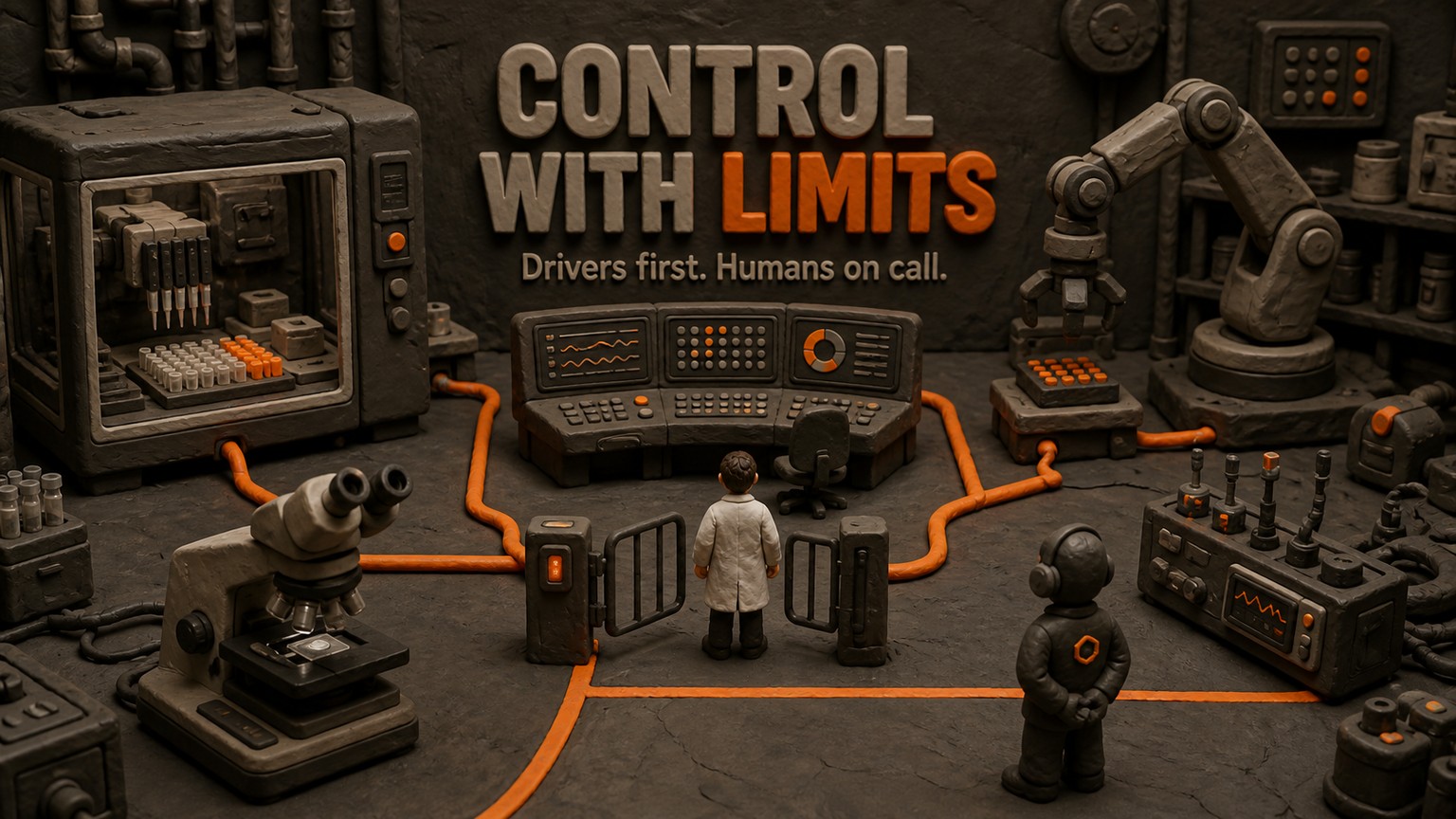
The defensible answer is yes for narrow, instrumented workflows, and no for a general AI agent left alone with a lab. Anthropic's Model Hardware Standard can replace weeks or months of one-off equipment integration with hours or minutes in early projects, but the safety bill does not disappear. It moves into validated drivers, hard device limits, failure testing, and expert exception handling.
The short answer: safe means bounded
An AI agent can operate some programmable lab equipment safely enough for a controlled pilot in 2026. It cannot be assumed safe around arbitrary hardware, unfamiliar physical failures, people, or irreplaceable samples.
That distinction matters because Anthropic's Model Hardware Standard research preview is an interface, not a safety certification. MHS gives an agent a consistent way to discover a device, read its state, issue allowed commands, and see the limits an operator has set. Anthropic is still developing additional physical safety evaluations and a safety roadmap, and access is limited and application-only.
The first business consequence is integration speed. A Carnegie Mellon team built drivers for a liquid handler, plate reader, robotic arm, and monitoring cameras, plus an orchestration layer, in about eight hours. Anthropic says a vendor-built setup typically takes several weeks. Eight hours is 90% less than the first 80 hours in a two-week calendar, although that comparison is not proof of a general 90% labor or dollar saving.
The second consequence is where you spend. Instead of paying repeatedly for custom connections between every machine, a lab could spend more of its automation budget on reusable drivers, validation, independent safety controls, and the people who resolve physical exceptions.
What MHS actually changes
MHS is a common control contract for programmable equipment. Think of it as a staffed control room where every machine uses the same switches and status lights, even when the machines came from different vendors.
The translator for each machine is called a driver. A driver exposes simple actions such as read and write, makes the device discoverable on a network, and carries the physical facts an agent cannot infer from code alone. A robot arm's weight is one example. The driver can also produce a reference file that states what the device measures, what can be adjusted, and which safety limits are enforced.
The agent can reach that control layer in three ways:
- MCP, a standard protocol through which an agent asks tools to act.
- A command-line interface, which is a text console for direct commands.
- Code files or APIs, which package commands into software that can run repeatedly.
That third path is important. An agent can explore a task, learn a useful sequence, and turn it into a deterministic script, meaning an inspectable program that follows defined conditions rather than reasoning from scratch on every physical action.
MHS is model-agnostic, so the control layer is not tied to Claude. Any agent system can access it through supported standard protocols. It also works only with equipment that has a programmable interface. An old machine with no API, SDK, or controllable software still needs a new driver path from its manufacturer.
How a bounded physical run works
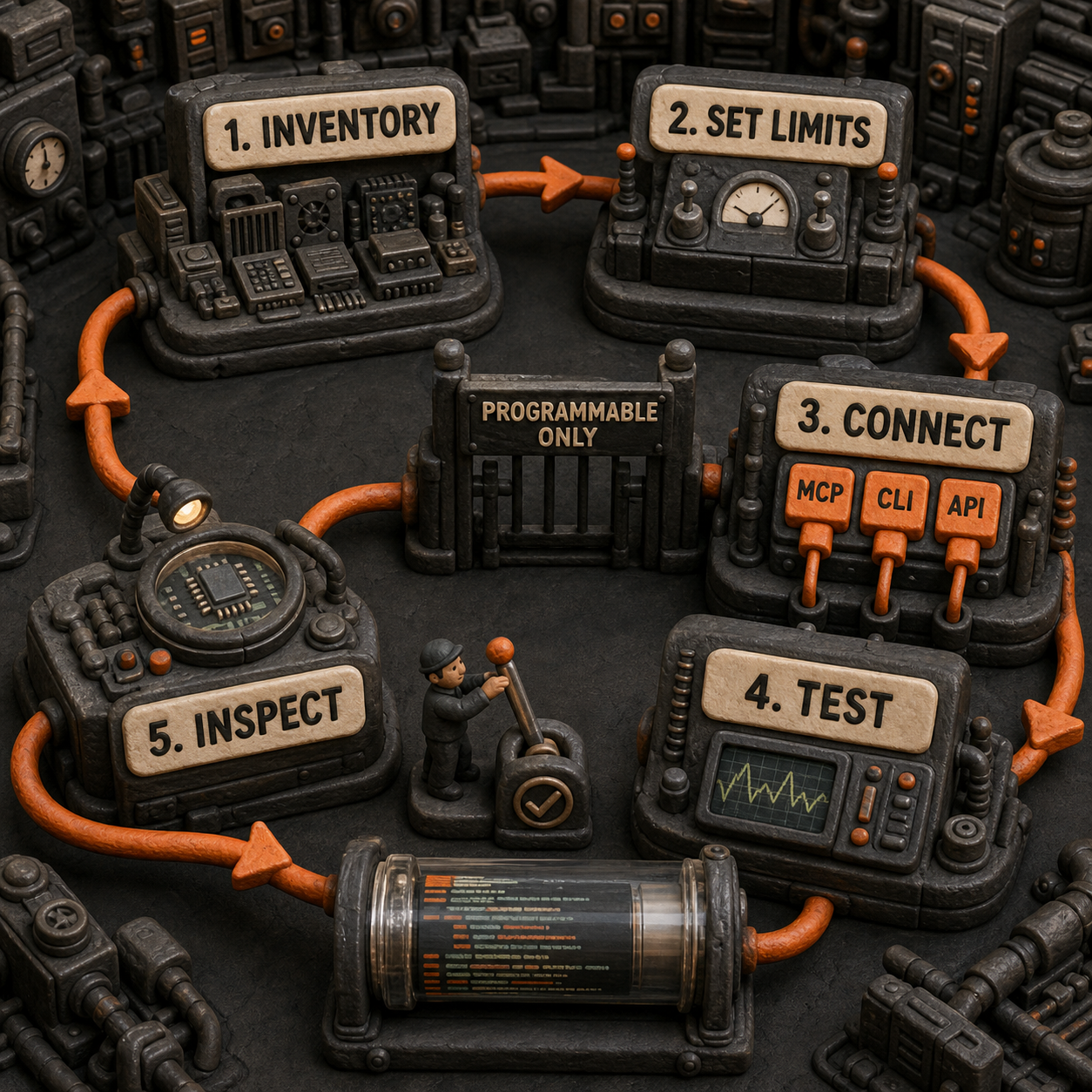
The safest pattern in the published pilots separates learning from production:
- Inventory the machine. Record every readable state, allowed action, physical characteristic, and hazardous boundary.
- Write and test the driver. Translate the vendor interface into standard MHS primitives, then verify that forbidden values stay forbidden.
- Connect the agent. Let the agent observe state and propose actions through MCP, the command line, or an API.
- Explore inside a controlled test. Use reversible conditions, non-critical material, simulated faults, and human approval for consequential actions.
- Promote the useful behavior. Turn a stable sequence into deterministic code, inspect it, test it against known failures, and keep an expert escalation path.
This is the physical cousin of multi-action computer use, with a much higher cost of error. A bad browser action can corrupt a form or lose a session. A bad physical action can ruin a plate, crash a microscope objective, damage an instrument, or create a safety hazard. The interface has to assume that the model will sometimes misunderstand the world.
The business math is integration, not cheaper equipment
MHS does not lower the purchase price of a robot or microscope. It attacks the glue work that makes existing equipment cooperate.
The current US result page for "lab automation software pricing" surfaces published market anchors of $20,000 to $500,000 or more for new lab automation systems, $20,000 to $200,000 or more for standalone liquid handlers, and $75 to $1,600 per user per month for subscription LIMS software. These are search-result price anchors, not audited quotes, and they are not MHS pricing. Anthropic has not published a price for the preview.
The useful comparison is inside the integration budget:
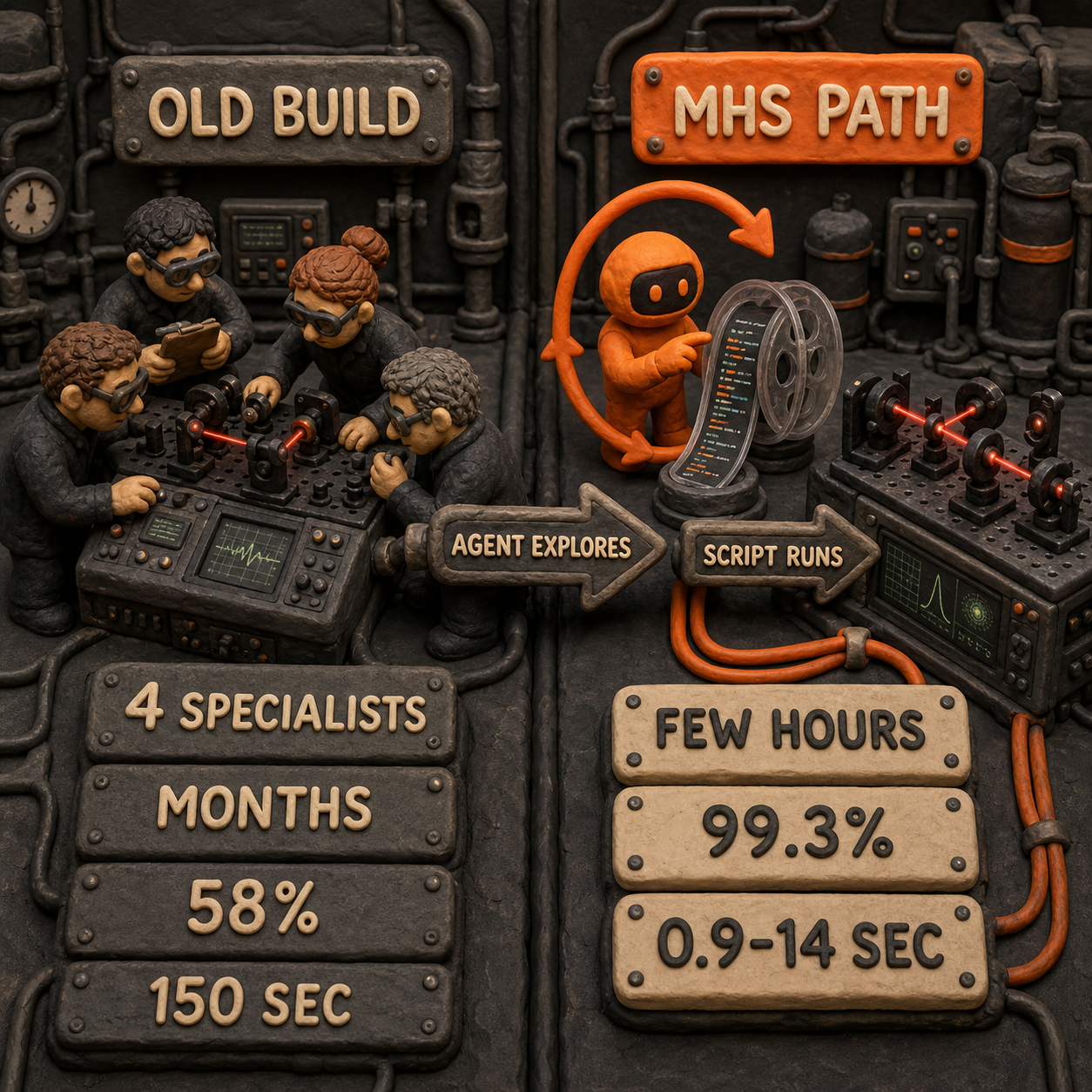
The QuEra result is the cleanest proof of the budget shift. Before MHS, a laser-systems engineer, software engineer, algorithms specialist, and tester spent several months on a bespoke recovery script. With MHS, the first agent-assisted setup took a day or two and repeat setup now takes a few hours. The final recovery controller no longer needed an AI agent in production. The agent helped discover the decision tree; ordinary code executed it.
That is a better commercial pattern than asking a model to improvise forever.
Who profits first: seven real use cases
These use cases are ranked by how directly an organization can convert integration time, equipment uptime, or scarce expert attention into money.
1. A biotech lab with a mixed-vendor automation cell
A drug discovery lab that already owns a liquid handler, robotic arm, and plate reader has the clearest near-term payoff. Its automation lead could write one MHS driver per instrument, describe a BCA assay in plain language, let an agent coordinate trial runs, and promote the accepted procedure into code.
The payoff is not fewer scientists. It is a shorter path from experimental design to a repeatable automated run. In Anthropic's Carnegie Mellon example, the full driver and orchestration setup took about eight hours rather than several weeks. Genentech's proof of concept also showed why an expert remains essential: Claude initially treated foaming in a viscous sample like a software problem until researchers supplied the missing physical explanation.
2. A lab-equipment manufacturer selling easier integration
An instrument maker could ship a maintained MHS driver with each programmable device. The customer would onboard the device once, expose its measurements and controls in a standard format, and reuse that integration across compatible agent systems.
The payoff is a shorter sales-to-production gap and a support product that reaches beyond the machine itself. QIAGEN is testing MHS for guided troubleshooting on a nucleic acid purification platform, while Tecan plans support for its Fluent liquid handlers. The commercial value sits in verified compatibility, safe defaults, updates, and support, not in a logo that says "AI ready."
3. A quantum-computing operations team protecting uptime
A quantum hardware team could let an agent test recovery strategies against induced disturbances, inspect the resulting decision tree, and deploy the accepted method as deterministic code. The agent explores; the production controller follows known conditions.
QuEra's finished controller recovered a laser lock 695 times across 700 blind trials. The hardest recoveries took 10 to 14 seconds, compared with 5 to 10 minutes for a human at the bench. For a fleet operator, the payoff is fewer overnight expert callouts and less downtime around a scarce physical skill.
4. A contract research lab routing jobs across available machines
A contract lab could describe a protocol in device-independent terms, query the network for compatible equipment, and map the job onto the workcell that is free. If a centrifuge accepts rotor speed while the protocol specifies force, the orchestration layer could perform the conversion once the driver's physical details are available.
The payoff is better equipment utilization and less protocol rewriting when a machine changes. The catch is validation: a regulated customer will care that the converted procedure is reproducible on the exact instrument, not merely that the command ran.
5. A microscopy core serving many research teams
A core facility could expose camera, laser, mirror, and sensor states through one shared interface. Reusable viewers and analysis modules could monitor live data, while an agent enters only at defined decision points such as choosing where to image next.
At HHMI Janelia, one rig moved from seven vendor APIs to a shared interface, and device-level limits constrained actions such as excess laser power. The payoff is fewer per-device rewrites, fewer unusable recordings discovered hours later, and more experiments per expensive microscope.
6. A high-throughput research group that loses nights to plate swaps
A protein or qPCR lab could remotely monitor instruments, stop a procedure when a measured curve reaches a threshold, and coordinate collision-free handoffs between a robotic arm and a liquid handler. A human would approve the workflow and handle physical exceptions.
The University of Washington pilot demonstrated all three building blocks. The payoff is fewer late-night status checks, earlier fault discovery, and less time spent moving plates between long machine cycles. It does not remove the need for someone who understands the biology when bubbles, viscosity, contamination, or sample degradation change what the machine should do.
7. An advanced manufacturer coordinating inspection cells
A manufacturer could connect programmable robotic arms and inspection sensors through standard drivers, let an agent plan a QA sequence, and convert the accepted sequence into code for repeated execution. Doosan Robotics is testing MHS for automated quality assurance and coordination across multiple robots.
The payoff could be faster cell reconfiguration when products change. This is also the most safety-sensitive use case on the list. Industrial interlocks, which are independent mechanisms that block unsafe motion, remain mandatory even if an MHS driver declares limits.
Three products worth building
The strongest commercial opening is not another general lab agent. It is assurance infrastructure for the teams connecting agents to expensive machines.
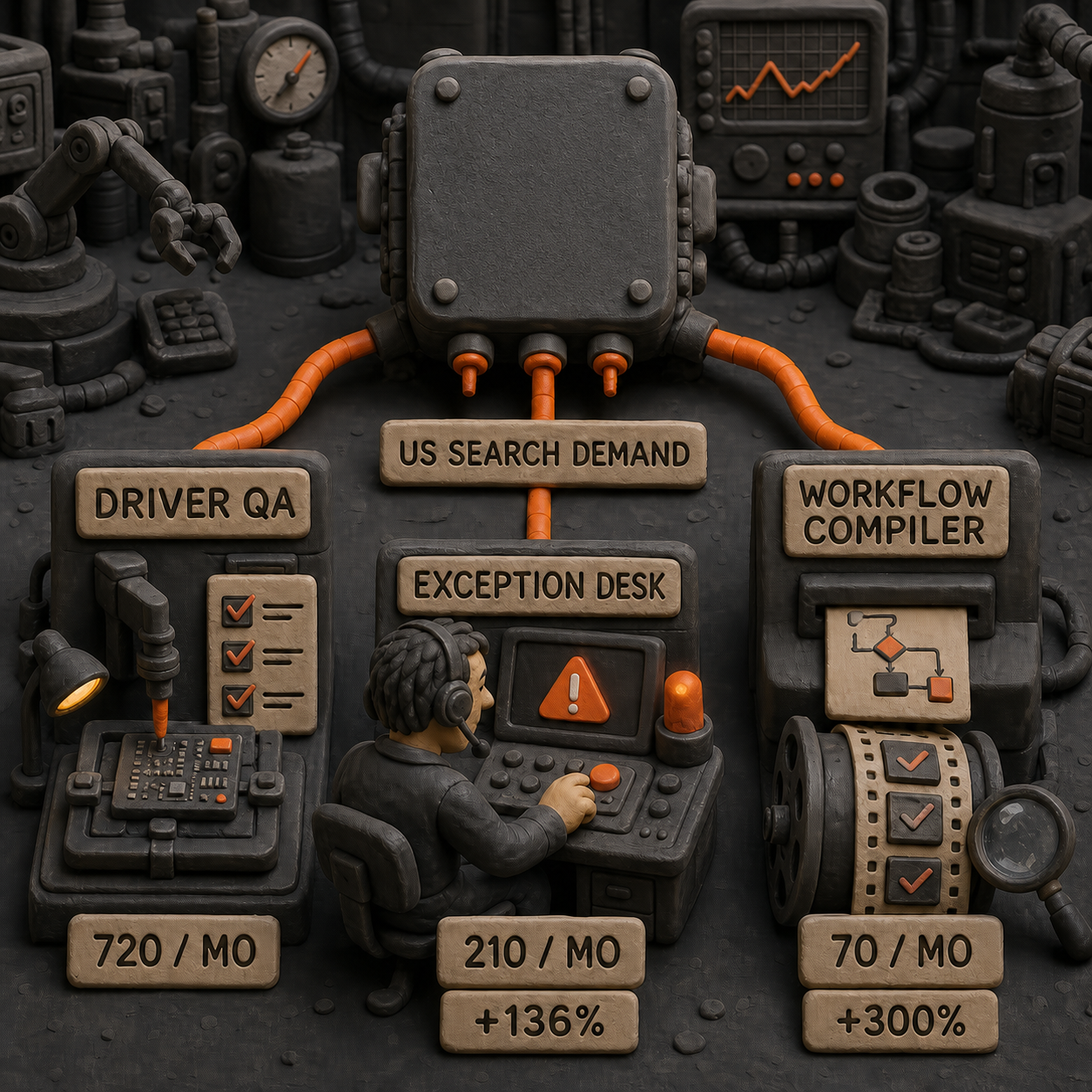
1. MHS Driver Assurance Kit, the strongest opportunity
Product: A test suite and service that inventories a device, scaffolds its MHS driver, injects known faults, verifies limits, and produces a signed validation report for lab automation teams and equipment makers.
Demand: "Lab automation" receives about 720 US searches per month, carries commercial intent, has keyword difficulty 1, and costs advertisers $25.53 per click. That is unusually clear commercial demand for a technically narrow market. "Lab automation solutions" adds 90 searches per month, is up 80% year over year, and carries a $69.88 CPC.
Smallest sellable version: Start with one vertical and two or three common programmable devices. Ship a driver schema checker, a replayable simulator, 20 failure cases, a limits report, and a human approval policy template. Sell the implementation and validation together before trying to make it self-serve.
Catch: The standard is still a limited preview and may change before open source. A report is not regulatory certification. The moat comes from device fixtures, failure libraries, and trusted validation history, not from generating driver boilerplate.
2. Remote exception desk for autonomous labs
Product: A monitored console that pauses risky actions, routes instrument faults to the right expert, records approvals, and preserves a complete audit trail for labs that want longer unattended runs.
Demand: "Autonomous laboratory" receives about 210 US searches per month, is up 136% year over year, and has keyword difficulty 4. The real question behind that growth is not whether a robot can pipette. It is who responds when the sample foams, an arm misaligns, or a sensor disagrees with the plan.
Smallest sellable version: Support one assay family. Ingest MHS state, trigger alerts from five defined fault types, provide approve, modify, or stop actions, and attach the decision to a run log. Staff the service during the customer's active window before promising 24-hour coverage.
Catch: This is an operations business wearing a software interface. Response time, lab security, network reliability, and liability can matter more than the dashboard. A weak on-call process will erase the value quickly.
3. Protocol-to-workcell compiler
Product: A tool that turns a plain-language protocol into a device mapping, a simulated run, and a deterministic execution package for a specific MHS-connected workcell.
Demand: "Lab workflow automation" receives about 70 US searches per month, is up 300% year over year, and has keyword difficulty 2. The volume is smaller than the broad automation market, but the growth and commercial intent point at teams actively trying to make protocols executable.
Smallest sellable version: Choose one repetitive protocol, one plate format, and a fixed equipment set. Parse the protocol, show every machine mapping and unit conversion, run it in simulation, require expert approval, then export the code and validation record.
Catch: Scientific language hides physical assumptions. Viscosity, calibration, contamination, and local operating procedures can make two similar protocols behave differently. A general compiler is a distant goal; a narrow validated workflow is a product.
What MHS does not solve
MHS does not remove physical uncertainty. Claude learns about the physical world through text and images, and Anthropic says its spatial and physical reasoning still requires expert oversight. The Genentech foaming example is the warning: the software saw an error, but it did not initially understand the material cause.
It also does not solve these constraints:
- Unprogrammable equipment: No programmable interface means no current MHS path.
- Incomplete assurance: The research preview is being used to develop safety evaluations and best practices. Those are not finished.
- General availability: Access is application-only, the standard is not yet open source, and no public MHS price is listed.
- Independent protection: A driver limit should not be the only barrier between a model mistake and an unsafe physical motion.
- Scientific judgment: An agent can coordinate and optimize within a stated goal. It cannot decide whether the goal, sample, or interpretation is scientifically sound.
Do not use the preview for a workflow where one mistaken command can immediately injure a person, release a hazard, destroy an irreplaceable sample, or damage equipment and there is no independent interlock or approval gate. Do not start with a regulated production assay. Start where actions are reversible, faults can be injected safely, and every result can be checked.
The Monday move
On Monday, a lab automation lead should choose one non-production workflow on programmable equipment and draw a boundary around it. List every readable state, every allowed action, and every action that needs human approval. Build one driver, test 20 known failure cases, and measure four things: integration hours, human interventions, failed runs caught, and unsafe commands blocked.
If the pilot passes, turn the accepted sequence into inspectable code and repeat the tests without the agent making live decisions. That is the buying decision MHS changes: not "Which model gets the keys?" but "Which bounded workflow earns promotion from supervised exploration to deterministic operation?"
Questions people are asking
How safe are AI agents?
An AI agent is only as safe as the system around it. For physical equipment, that means a narrow task, validated drivers, enforced device limits, independent interlocks, failure tests, logs, and a human escalation path. MHS supplies part of that control layer, but Anthropic is still building its safety evaluations and physical safety roadmap.
Can you give me an example of laboratory automation?
At Carnegie Mellon, an agent used MHS to coordinate a liquid handler, plate reader, robotic arm, and monitoring cameras for dose-response experiments. The team built the drivers and orchestration layer in about eight hours, and the experiments ran roughly three times faster than before.
Will AI replace lab technician?
The evidence in the MHS preview points to task redistribution, not replacement. Agents handled coordination, parameter search, monitoring, and routine recovery. Experts still defined goals, supplied missing physical context, approved risky actions, interpreted results, and handled failures the model did not understand.
What skills do you need for lab automation?
You need device integration, protocol design, validation, safety engineering, and domain expertise. With MHS, less time may go into one-off connector code, but more goes into describing device behavior, setting limits, testing faults, and deciding when a human must intervene.
If you want one of these bounded physical-agent systems built for your business, AI agent development is the right place to start.
- Published
- Category
- AI
- Language

Otter AI Alternatives: Granola, Krisp, MeetGeek, Circleback and Claap
Choose Granola, Krisp, MeetGeek, Circleback or Claap by the job. Compare live prices, free limits, bot-free capture and CRM handoffs.Oct 8, 2026AI
Mistral Large 4: Pricing, Open Weights, and When to Use It
Mistral Large 4: verified API prices, the launch offer, claimed benchmarks, and when to test the preview or wait for self-hosting.Oct 7, 2026AI
Lindy AI Review (Verified October 2026)
Lindy AI review: current plans, credit costs, email and meeting setup, integration limits, and when Gumloop, n8n or Marblism fits better.Oct 7, 2026AI
Mistral Pricing (2026): API Costs and Vibe Seats
Mistral API rates, Le Chat and Vibe plans, free limits, EU hosting costs and a worked monthly bill. Verified October 2026.Oct 6, 2026AI
Claude Skills
Use Claude Skills across the apps, Claude Code and API. Build a weekly client-report skill file by file, then install and share it.Oct 6, 2026AI
AI Employee: What It Does, Costs, and How to Start
What AI employees can do, current prices for six tools, and how to pick one role, keep human review and measure a 30-day pilot.Oct 6, 2026AI
Wispr Flow Alternatives (2026): VoiceOS, Superwhisper, Aqua Voice, Willow and Monologue
Compare VoiceOS, Superwhisper, Aqua Voice, Willow and Monologue by work task, current price, offline privacy, team controls and coding-agent input.Oct 5, 2026AI