Best AI Assistants for Field Service Technicians 2026
Six AI assistants compared for field technicians, with live pricing, safety limits, payback math, and a two-week rollout plan.
Published
 By Omid Saffari
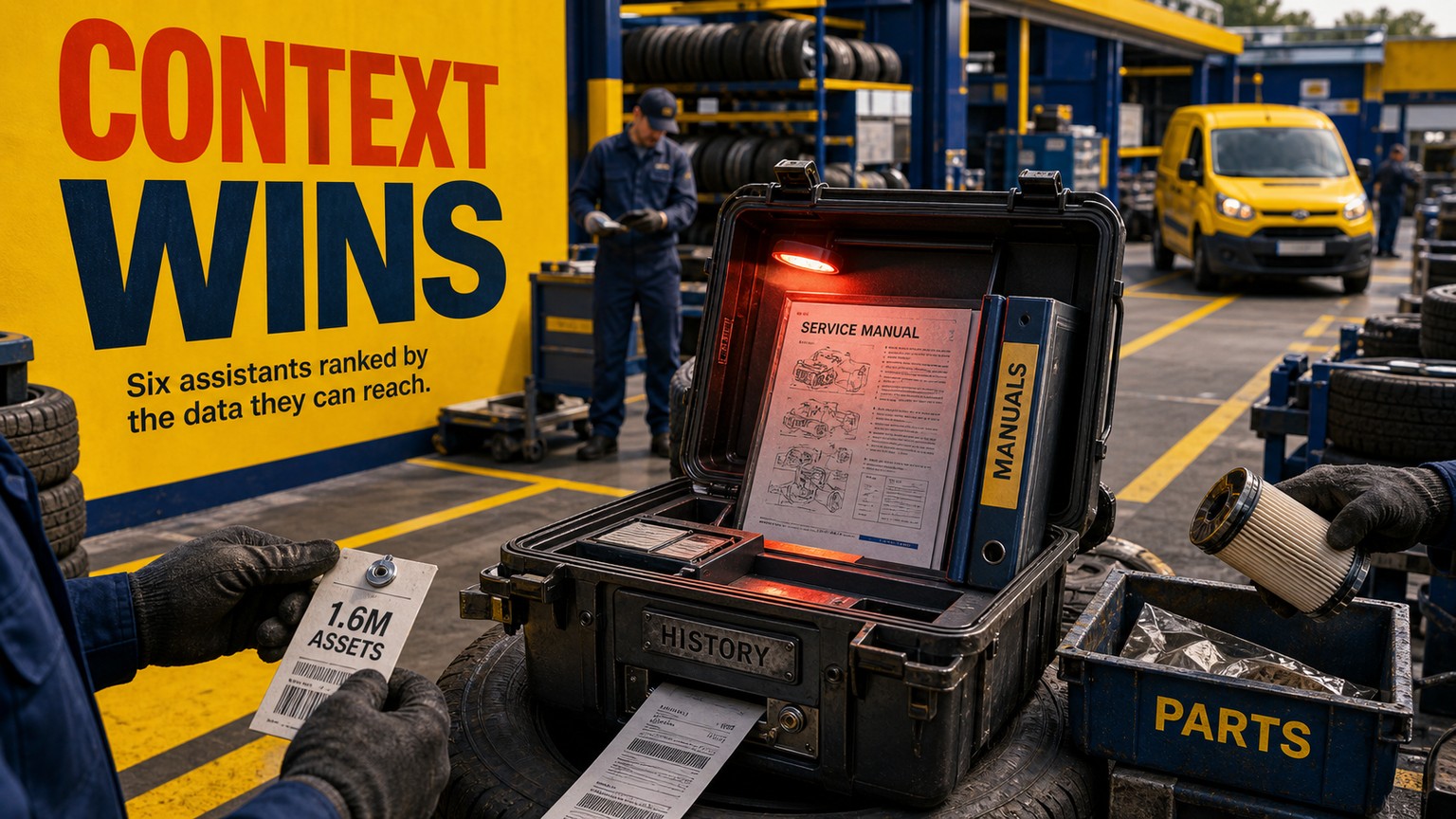
The best AI assistants for field service technicians 2026 are MaintainX Assist for mixed equipment, Cat AI Assistant for Caterpillar fleets, and ServiceTitan Atlas for the trades. The budget split is sharp: Microsoft starts at $105 per full user each month, Salesforce reaches $300 per technician when its $175 base license and $125 AI add-on are combined, while the assistants with the deepest equipment context often sit behind an enterprise quote.
Prices, plan access, and product capabilities were verified against the vendors' live pages on August 31, 2026. That matters in this category because an assistant advertised across a platform may still require a different tier for manual search, equipment diagnostics, or technician access.
The central buying rule is simple: choose the assistant connected to the most authoritative context your technician needs at the moment of work. Model fluency comes second. A fast answer from the wrong manual, old work order, or generic web knowledge is not a productivity gain.
Best AI Assistants for Field Service Technicians 2026: At a Glance
MaintainX Assist is the strongest general choice for a mixed equipment estate. Cat AI Assistant can be better inside a Caterpillar fleet because it starts with Caterpillar's own manuals, parts, machine, and service context. ServiceTitan Atlas is the more natural fit for HVAC, plumbing, electrical, and other trades already running on ServiceTitan.
This ranking deliberately separates an assistant for the technician from AI elsewhere in field service. Predictive scheduling, route optimization, automated booking, and customer chat can improve the operation, but they do not help a person standing beside a failed asset find the right procedure, part, or prior fix.
How These AI Assistants Were Picked
Six products made the list because their live vendor pages document a technician-facing workflow grounded in at least one controlled source: asset manuals, equipment data, work orders, customer history, service records, or governed SOPs.
Each product was evaluated on five buyer questions:
- Context: What authoritative data can it reach without the technician copying material into a generic chatbot?
- Point of work: Does it operate in the mobile or field application the technician already uses?
- Actionability: Can the answer become a procedure, work order, part lookup, schedule change, or service note?
- Verification: Does the workflow expose source material or make human review explicit?
- Cost boundary: Which plan buys the useful assistant, and what other platform license must exist first?
Ten products would force this category into broad field-service platform blurbs. Six assistants made the cut because each has a documented technician workflow and enough current evidence to expose the exact wall a buyer hits. A platform was cut when its current vendor material could only support adjectives about AI, scheduling, or automation without showing a live technician-assistant workflow.
Generic consumer chatbots were also cut. They can explain general concepts, but this comparison requires a documented connection to the operational record. A custom assistant can bridge that gap, although it adds identity, retrieval, permission, and monitoring work. The managed agent tools comparison covers part of that build path.
1. MaintainX Assist
MaintainX Assist is the best general-purpose assistant here for technicians working across a mixed estate of machines, vehicles, and facilities.
MaintainX is a computerized maintenance management system, or CMMS, that already holds assets, procedures, and work orders. Its assistant can search uploaded manuals, consolidate information from several documents, retrieve work-order history, troubleshoot an issue, generate a procedure, improve a work order, translate an SOP, and summarize completed work. The useful distinction is that the answer can stay inside the maintenance record instead of ending as disposable chat text. MaintainX Assist documentation
Manual search is the strongest reason it ranks first. A technician can ask a natural-language question against an asset's processed manuals, receive an answer, and open links to the relevant source pages. That source path makes review practical: the assistant helps locate and synthesize the instruction, while the technician can still inspect the actual OEM document before acting. MaintainX manual-search workflow
The wall is procurement. MaintainX Basic is $0, Essential is $20 per user/month billed annually or $25 monthly, and Premium is $65 annually or $75 monthly. MaintainX Assist is not available on any of those plans. It is an Enterprise feature with custom pricing. A buyer comparing the $65 Premium price with another assistant is comparing the wrong product. MaintainX pricing
The technical limits are concrete. Manuals can be PDFs up to 300MB. Voice notes are limited to 2 minutes, and a chat that cannot produce an answer times out after 2 minutes. Full users and administrators can use Assist on web and mobile; requester users cannot. Those are manageable limits, but they matter when a team expects every contractor or occasional requester to receive the same assistant access.
Best for: Industrial maintenance and service teams with mixed equipment brands, existing work-order history, and enough scale for an Enterprise quote.
Standout: Source-linked manual search that can turn an answer into a procedure or work order.
Pricing: Basic $0; Essential $20 annually or $25 monthly; Premium $65 annually or $75 monthly; Enterprise custom. Assist is Enterprise-only.
Free trial: Essential and Premium advertise a free trial; the Assist-bearing Enterprise tier is offered through a demo.
- Grounds answers in asset manuals, work orders, procedures, notes, and prior interactions.
- Returns links to relevant manual pages for review.
- Converts answers into reusable procedures and work-order content.
- Works on web and mobile for full users and administrators.
- MaintainX Assist requires Enterprise, with no public assistant price.
- Requester users cannot use it.
- Existing assets may require manual processing of attached documents before search works.
- A 2-minute voice-note limit can be tight for a complex field handoff.
A practical MaintainX Assist setup
The assistant becomes useful only after the source set is clean. Start with a controlled slice of equipment, not a company-wide manual dump.
Choose a narrow asset set
Pick five recurring assets with current OEM manuals and enough completed work orders to expose common failures. Exclude obsolete manuals and duplicate revisions before upload.
Attach and process the manuals
Upload the relevant PDF to each asset in the MaintainX web app. For an existing asset, open Ask MX Assist, open the document library, and enable processing for the correct manual.
Ask a source-specific question
Include the asset, component, symptom, and desired outcome. “What safety checks are required before replacing this motor?” is more useful than “How do I fix it?”
Open the cited manual pages
Use the source control to inspect the relevant pages before accepting torque, sequence, clearance, or safety instructions. The generated summary is a locator and working aid, not a replacement for the controlled document.
Write the result back into work
Generate a procedure or work order from the reviewed answer, then require the technician to record the actual fix and any deviation. That creates better context for the next visit.
MaintainX wins when the service organization owns the knowledge base and works across many brands. It loses when the equipment manufacturer already offers a better proprietary corpus, or when Enterprise pricing cannot be justified by the measured reduction in search and escalation time.
2. Caterpillar Cat AI Assistant
Caterpillar Cat AI Assistant is the best choice for a Caterpillar fleet because no horizontal platform starts with the same manufacturer-owned equipment context.
The important August change is deployment, not a speculative feature list. Caterpillar's CTO said the assistant is now being used by customers, operators, and technicians. A field technician can use voice commands to retrieve repair procedures, troubleshoot a problem, and identify likely parts before beginning a repair. The system draws on a Caterpillar data estate of about 1.6 million connected assets and more than 16 petabytes of structured data. Current deployment report
That context changes the budget decision for a Cat-heavy operation. Before buying another per-seat assistant, check whether Cat AI Assistant already covers the highest-frequency manual, maintenance, parts, fleet-status, and service-history questions. Guest Mode provides general equipment information. Logged in Mode adds personalized fleet insights, machine history, and recommendations through Caterpillar's connected digital experiences. Open Cat AI Assistant
There is no separate Cat AI Assistant price on the live product page. That does not prove every underlying Caterpillar service is free. It means procurement should ask what is included in the organization's existing Cat.com, VisionLink, Cat Central, parts.cat.com, or SIS2.0 access before creating a new software budget.
The strongest limitation is also unusually clear. Caterpillar says the output is provided as-is, must not directly control emergency or safety functions, and must be independently validated against official source documents. The terms also say AI inputs and outputs may be used under Caterpillar's data-governance statement, including to train computational models. A service organization should decide what jobsite, customer, and fault information technicians may enter before rollout.
In-cab assistance remains future work with no set availability date on the current product page. Buy for what technicians can use today in Caterpillar's web and application surfaces, not for a voice copilot that may later sit at the controls.
Best for: Cat dealers, contractors, fleet operators, and technicians working predominantly on Caterpillar equipment.
Standout: Manufacturer-owned manuals, parts, purchase, machine, and fleet context tied to a large connected-asset estate.
Pricing: No standalone assistant price published; confirm entitlements inside the organization's existing Caterpillar services.
Free trial: Guest Mode provides general equipment answers without the personalized Logged in Mode context.
- Uses Caterpillar's own equipment and service knowledge rather than a generic web corpus.
- Supports manual help, troubleshooting, parts, fleet status, service history, and dealer workflows.
- Voice access fits hands-busy technician work.
- Guest and logged-in paths let a team separate general questions from personalized fleet context.
- It is a Caterpillar ecosystem assistant, not a mixed-fleet answer.
- No standalone public price makes total entitlement cost hard to compare.
- In-cab availability has no set date.
- Caterpillar requires independent validation and permits specified data use under its governance terms.
Cat AI Assistant moves to the top when Cat equipment dominates the work. It falls below MaintainX for a mixed fleet because the value comes from Caterpillar's data boundary, not from pretending one assistant covers every manufacturer.
3. ServiceTitan Atlas
ServiceTitan Atlas is the best fit for technicians in HVAC, plumbing, electrical, and other trades already running customer, job, and equipment work through ServiceTitan.
Atlas is the conversational interface to ServiceTitan's Titan Intelligence layer. Core Atlas lets technicians ask about job details and customer history in natural language from the mobile app. Atlas in Field Pro adds the technician-specific material that justifies this ranking: equipment documents, troubleshooting guidance, calculators, diagnostic tests, and replacement-parts lookup. ServiceTitan Atlas documentation
That product boundary is the buying decision. Atlas is a Core product available to ServiceTitan customers, but equipment knowledge and troubleshooting require a Field Pro subscription. A buyer who hears “Atlas is included” and assumes that means field diagnostics are included can approve the wrong package.
ServiceTitan publishes three packages: Starter, Essentials, and The Works. All use per-technician pricing and all require a quote. The public pricing page does not show a dollar rate, and the Atlas documentation does not publish a Field Pro add-on rate. That makes a measured pilot and a written line-item quote essential. ServiceTitan packages
The operational fit is strong because Atlas lives in both ServiceTitan Mobile Legacy and the newer ServiceTitan Field Mobile App. A technician does not have to leave the job record to search customer history or equipment material. The tradeoff is platform dependence: this is compelling when ServiceTitan already holds the job, pricebook, customer, and equipment context, and expensive overkill if the business needs only a searchable manual assistant.
ServiceTitan also warns that Atlas may generate inaccurate, incomplete, or outdated responses. Conversations may be stored to improve the service and may be shared with third-party service providers under its privacy policy. Those are rollout requirements, not fine print to discover after technicians begin entering customer details.
Best for: ServiceTitan customers in residential and commercial trades that want technician help inside the existing job workflow.
Standout: One interface for job/customer context in Core and equipment documents, diagnostics, calculators, and parts in Field Pro.
Pricing: Starter, Essentials, and The Works are quote-only per-technician packages; Field Pro pricing is also not public.
Free trial: Personalized demo; no self-serve free trial is listed on the pricing page.
- Lives inside the field application technicians already use for jobs.
- Core access handles job and customer questions.
- Field Pro adds equipment manuals, troubleshooting, calculators, diagnostics, and parts lookup.
- The trade-specific context is more relevant than a generic assistant for ServiceTitan customers.
- The useful diagnostic layer requires Field Pro.
- Every package and add-on price requires a quote.
- Platform value is much lower outside a ServiceTitan operation.
- The vendor explicitly warns that output can be inaccurate, incomplete, or outdated.
Atlas beats Cat AI Assistant for a multi-brand trade contractor whose operational truth already lives in ServiceTitan. Cat wins when manufacturer knowledge is the hard part. MaintainX wins when maintenance history and manuals span a broader industrial asset estate.
4. Microsoft Copilot in Dynamics 365 Field Service
Microsoft Copilot in Dynamics 365 Field Service is the cleanest public-price choice for an organization already committed to Dynamics, Teams, Outlook, and Azure.
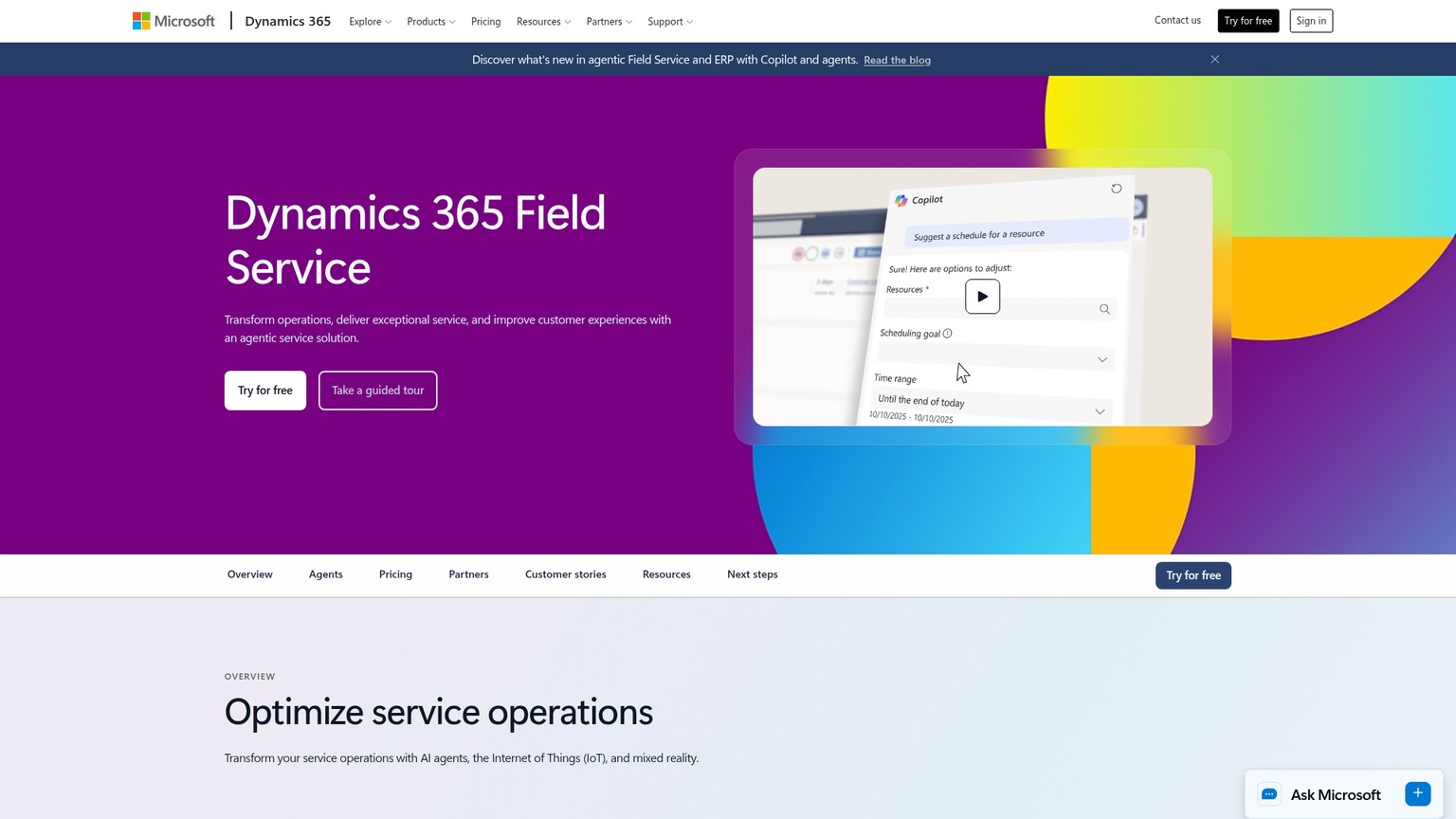
The full Dynamics 365 Field Service license is $105 per user/month paid yearly. Copilot assistance for work-order creation and updates, scheduling, and summarization is included. Copilot can also search lengthy product manuals, retrieve work-order information in natural language, and draft customer responses with key details and next steps. Dynamics 365 Field Service pricing
The cheaper Contractor license is $50 per user/month, but Microsoft's comparison table does not show full Copilot assistance as included there. Resource Scheduling Optimization is another $30 per resource/month paid yearly. Prebuilt and custom agents require Copilot Credits plus an Azure subscription, with prepaid and pay-as-you-go options rather than one universal public credit rate.
The cost is transparent enough to set a real threshold. Twelve full technician licenses cost $1,260/month before tax, scheduling optimization, Copilot Credits, configuration, or implementation. At an explicit planning assumption of $45 per productive technician hour and 20 field days per month, each minute saved per technician per day is worth $15/month. The $105 license clears that narrow labor threshold at 7 minutes saved per day.
That does not make a Dynamics rollout a seven-minute decision. The break-even applies only when the company already needs the underlying Field Service platform or can allocate its cost to other workflows. Replacing an existing FSM adds migration, data cleanup, mobile configuration, training, and administration that the license line does not capture.
Best for: Mid-market and enterprise service teams already using Microsoft business applications and wanting a priced full FSM with Copilot included.
Standout: Public base pricing plus manual search, work-order help, scheduling context, and Microsoft workflow integration.
Pricing: Field Service $105/user/month annual; Contractor $50/user/month annual; Resource Scheduling Optimization $30/resource/month annual; agent usage requires Copilot Credits.
Free trial: Microsoft advertises a free Field Service trial.
- The $105 full-user price and $50 contractor price are public.
- Copilot assistance is included with the full Field Service license.
- Manual search and work-order retrieval address technician questions directly.
- Microsoft integration is valuable when identity, communication, and operations already live in that stack.
- The Contractor tier does not show full Copilot assistance as included.
- Scheduling optimization and agent usage can add separate costs.
- An Azure subscription is required for agents.
- The economics deteriorate quickly if the business must replace a working FSM just to obtain Copilot.
Microsoft ranks fourth because it is a strong platform choice rather than the deepest equipment specialist. It moves above ServiceTitan when the organization already runs on Dynamics and serves industries beyond the trades. It moves below MaintainX when mixed-asset manual and maintenance knowledge is the main need.
5. Salesforce Agentforce for Field Service
Salesforce Agentforce for Field Service is the most capable enterprise workflow layer in this list and the hardest public-price case to justify for a technician-only problem.
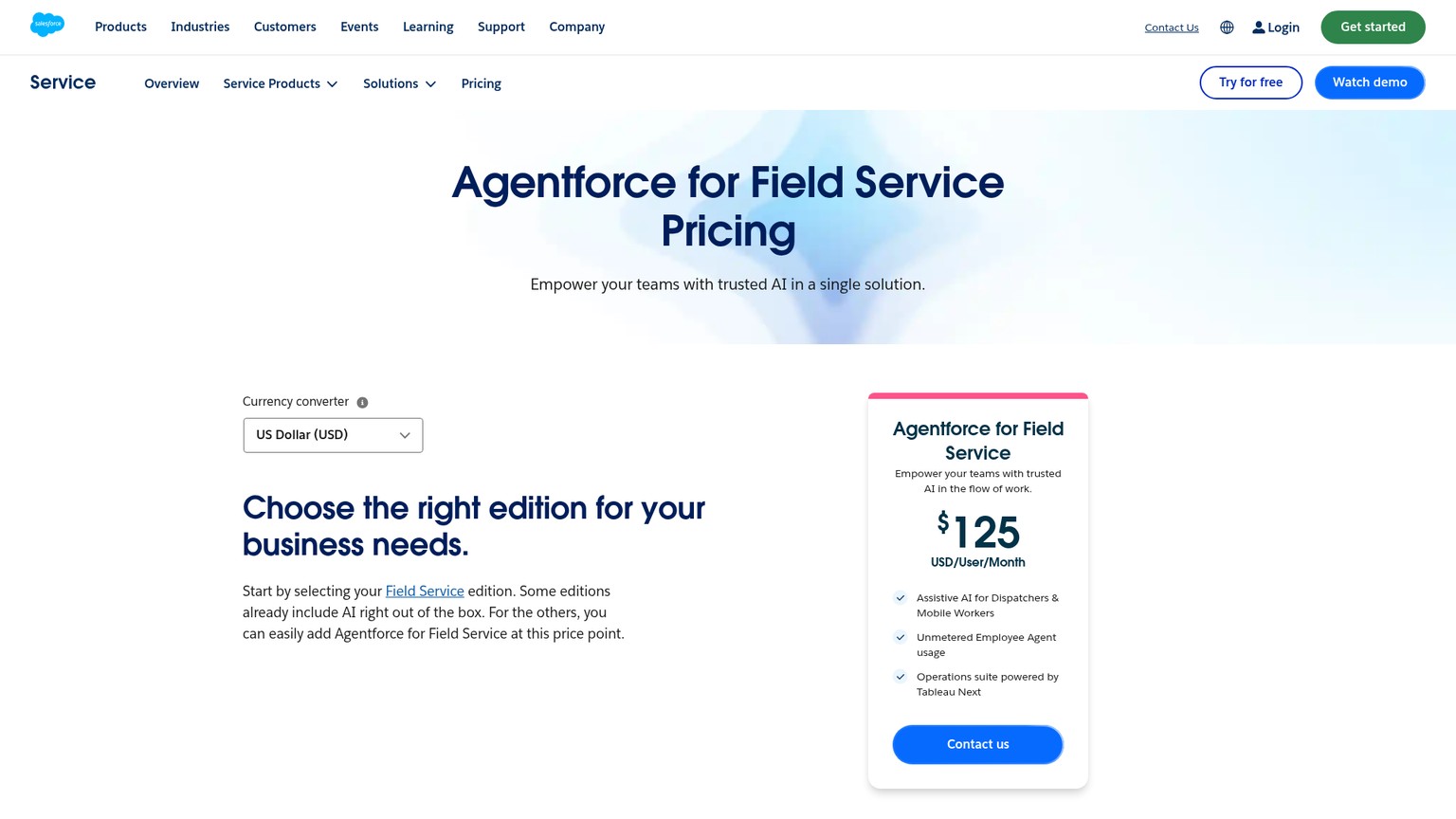
The $125 per user/month annual add-on includes pre-work briefs, on-site knowledge search, multimodal troubleshooting, Siri activation, post-work summaries, service-note summaries, schedule summaries, and tools for resolving schedule gaps. It runs inside Salesforce Field Service rather than as a stand-alone technician app. Agentforce for Field Service pricing
The base matters. A Salesforce Technician license is $175 per user/month billed annually, so a technician who needs the $125 add-on represents a $300 monthly stack. Dispatcher is also $175, Contractor is $55 per user or $22 per login, Contractor Plus is $80 per user or $32 per login, and Field Service Plus is $230 per user. Agentforce 1 Field Service bundles the full platform and AI at $650 per user/month. Salesforce Field Service editions
For 12 technicians, the base-plus-add-on route is $3,600/month. At the same $45/hour and 20-day assumptions, that $300 per-tech cost needs 20 minutes saved per technician per field day. Twelve Agentforce 1 Field Service seats cost $7,800/month and need about 43.3 minutes saved per technician per day before implementation or administration.
Those thresholds can still work in a complex operation. Pre-work briefs can compress research before arrival, multimodal troubleshooting can use jobsite images, and post-work summaries can reduce documentation time. The purchase becomes stronger when the same data and AI also serve dispatchers, service leaders, customer operations, and revenue workflows. It becomes weaker when procurement is trying to solve only manual search for technicians.
Salesforce calls its base mobile app offline-first, but its current product page does not promise that every Agentforce interaction works offline. Treat offline access to records and offline AI execution as separate requirements in the pilot.
Best for: Large Salesforce customers that need one governed AI layer across technicians, dispatchers, assets, service records, and customer operations.
Standout: Pre-work, on-site, multimodal, scheduling, and post-work assistance in one field-service suite.
Pricing: $125/user/month add-on; Technician $175; combined $300 when both are required; Agentforce 1 Field Service $650/user/month.
Free trial: No standalone Agentforce for Field Service trial; qualifying customers can access it through Salesforce Foundations, and a Developer Edition route is available for exploration.
- Covers the technician workflow before, during, and after a visit.
- Connects field work with Salesforce customer, asset, knowledge, and dispatch context.
- Multimodal troubleshooting and Siri activation fit hands-busy work better than text alone.
- Public add-on and base prices support honest budget modeling.
- The $125 AI price sits on top of a Field Service edition unless the chosen bundle includes it.
- A $300 or $650 per-tech monthly path needs substantial measured time or broader platform value.
- There is no standalone free trial.
- Offline-first records do not establish offline availability for every AI interaction.
Salesforce earns fifth place because its breadth is useful only when the organization can use it. It moves above Microsoft when Salesforce already holds the service and customer data and multimodal field help matters. It moves below simpler choices when the buyer would be purchasing a CRM-centered platform to answer a manual question.
6. Trainual
Trainual is the honest partner pick for mobile SOP retrieval and technician onboarding, not a substitute for equipment diagnostics.
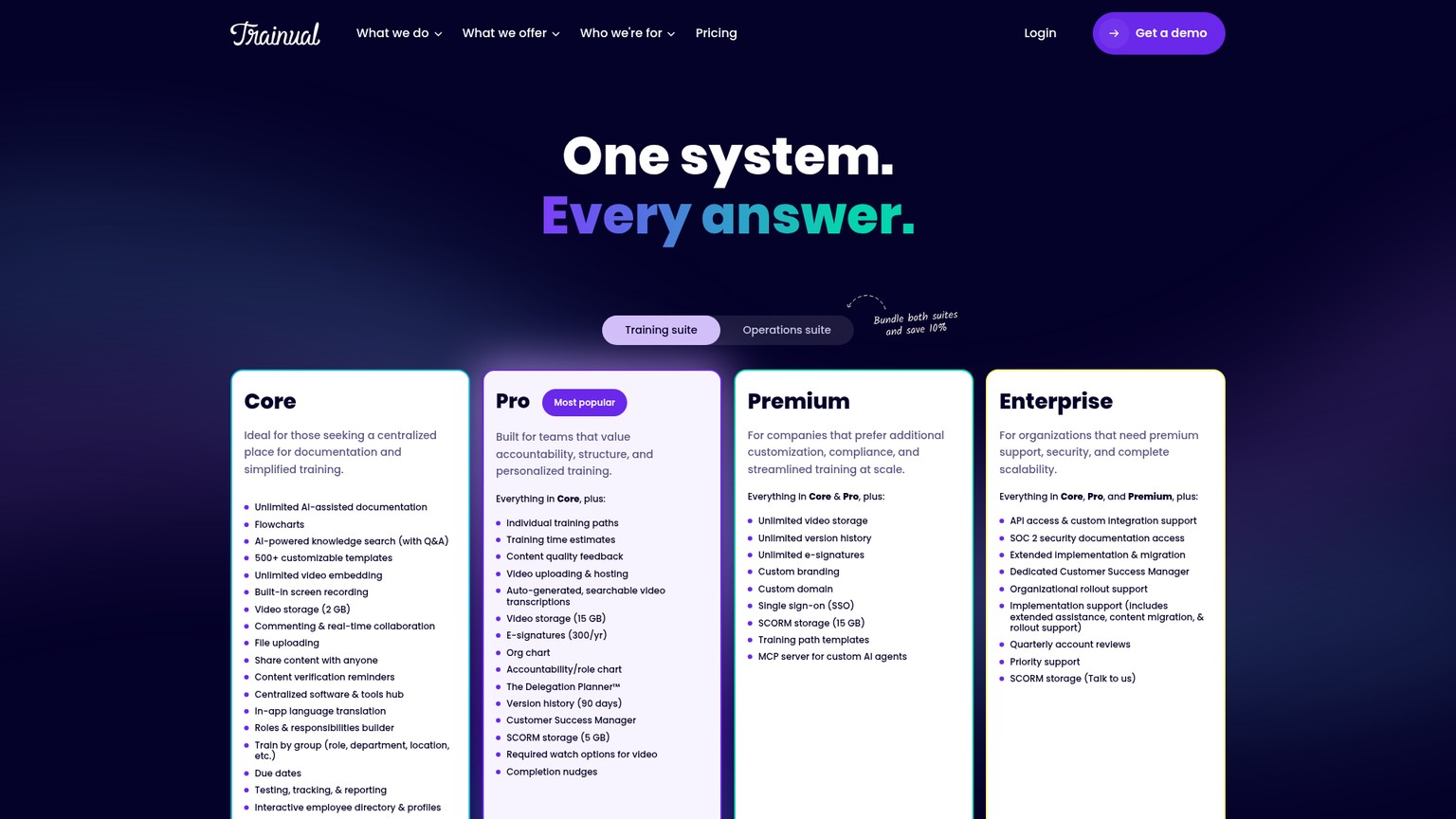
Trainual Core includes unlimited AI-assisted documentation, AI-powered knowledge search with Q&A, more than 500 customizable templates, mobile app access, and training, testing, and reporting. A technician can use the mobile app to retrieve company procedures, policies, videos, quizzes, and assignments from the field. Trainual plans
That is useful when the recurring question is company-specific: how to document a site handoff, perform an approved inspection, escalate a warranty claim, close a job, or follow a customer-specific checklist. It is not an asset-aware CMMS, OEM service corpus, dispatch engine, or troubleshooting system. The live Trainual page does not promise equipment telemetry, work-order execution, or authoritative OEM-manual diagnosis.
Pricing is less transparent than the feature boundary. Trainual offers Core, Pro, Premium, and Enterprise, but publishes no subscription dollar rate for any tier. Every new customer also pays a one-time $1,000 implementation fee, and the vendor positions the product primarily for organizations with 25 to 1,000 employees. The evaluation path is a guided demo rather than a self-serve trial.
Trainual belongs in this roundup because field service failures are not always diagnostic. Many come from inconsistent process, tribal knowledge, incomplete onboarding, or a technician not knowing which approved workflow applies. A governed training assistant can solve that narrow problem more honestly than an enterprise field-service platform.
Best for: Field teams whose main gap is SOP retrieval, onboarding, policy consistency, and role-based training.
Standout: AI Q&A over the organization's documented knowledge, delivered through a mobile training workflow.
Pricing: Core, Pro, Premium, and Enterprise are quote-only; a one-time $1,000 implementation fee applies.
Free trial: Guided demo; no self-serve trial is stated.
- AI knowledge search is included from the Core tier.
- Mobile access fits distributed technicians and contractors on site.
- Training paths, quizzes, completion tracking, and assignments support adoption beyond one-off answers.
- It is a natural choice when the authoritative source is the company's SOP library.
- Subscription prices are not public.
- The $1,000 implementation fee applies before recurring subscription cost.
- It does not claim equipment diagnostics, asset history, or work-order execution.
- It is a weaker fit below its stated 25-employee lower best-fit boundary.
Trainual ranks sixth because its field-service role is narrower, not because the product is weaker at training. It is also the only active partner in this roundup, and that partnership does not move it above tools with stronger diagnostic context.
Who Should Pick What
Pick Caterpillar Cat AI Assistant when Caterpillar equipment represents most of the service load. Its advantage is not a generic model. It is the combination of manufacturer manuals, parts, purchase, fleet, machine, and service context. Confirm current entitlements, define allowed data entry, and keep official-document verification in the work instruction.
Pick MaintainX Assist when the organization services mixed brands and wants manuals, procedures, and prior work orders to compound into one maintenance knowledge base. The choice flips away from MaintainX when Enterprise pricing cannot clear the pilot threshold or when a manufacturer assistant owns better source material for the dominant fleet.
Pick ServiceTitan Atlas when the company already runs ServiceTitan and the technicians work in the trades. Insist that the pilot includes Field Pro, not only Core Atlas, because equipment documents, diagnostics, calculators, and replacement-parts lookup are the work being evaluated.
Pick Microsoft Copilot in Dynamics 365 Field Service when Dynamics already owns the service record or the company needs a broader Microsoft field-service platform. Its $105 full-user rate makes the license threshold visible, while Contractor access, scheduling optimization, and agent credits must be modeled separately.
Pick Salesforce Agentforce for Field Service when the same assistant must connect technicians, dispatchers, customer operations, assets, knowledge, and CRM workflows. The choice flips to Microsoft or a specialist when a $300 or $650 per-tech path cannot earn back its breadth.
Pick Trainual when the knowledge problem is company process, training, compliance, and consistent execution. Do not ask it to become an OEM diagnostic assistant.
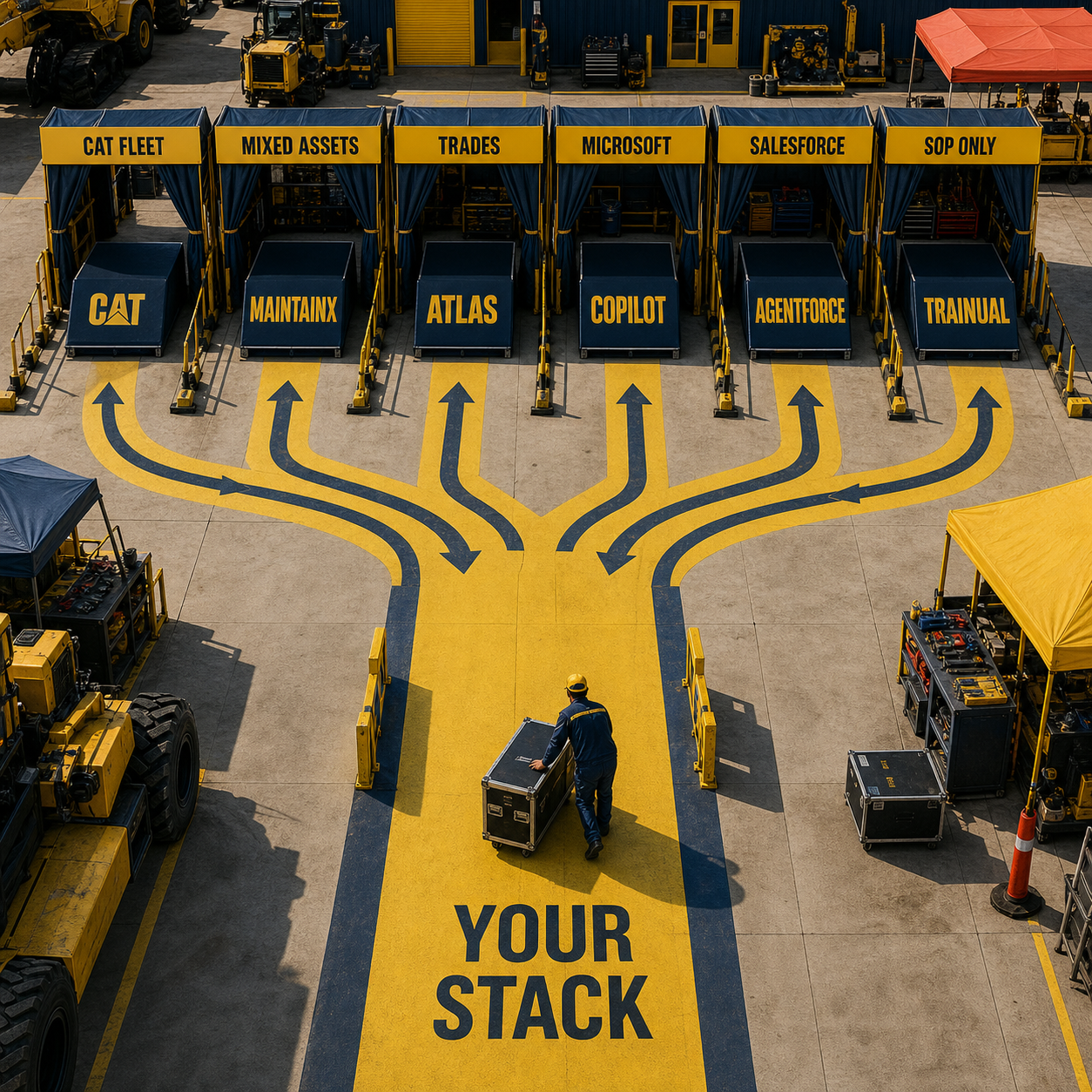
The explicit decision rule is: if an assistant cannot reach the authoritative source and cannot keep the technician inside the current job workflow, do not buy it for field diagnosis. If two products pass, keep the existing system of record unless the specialist saves enough measured time to cover both its license and the integration burden.
The Field-Service AI Budget Line
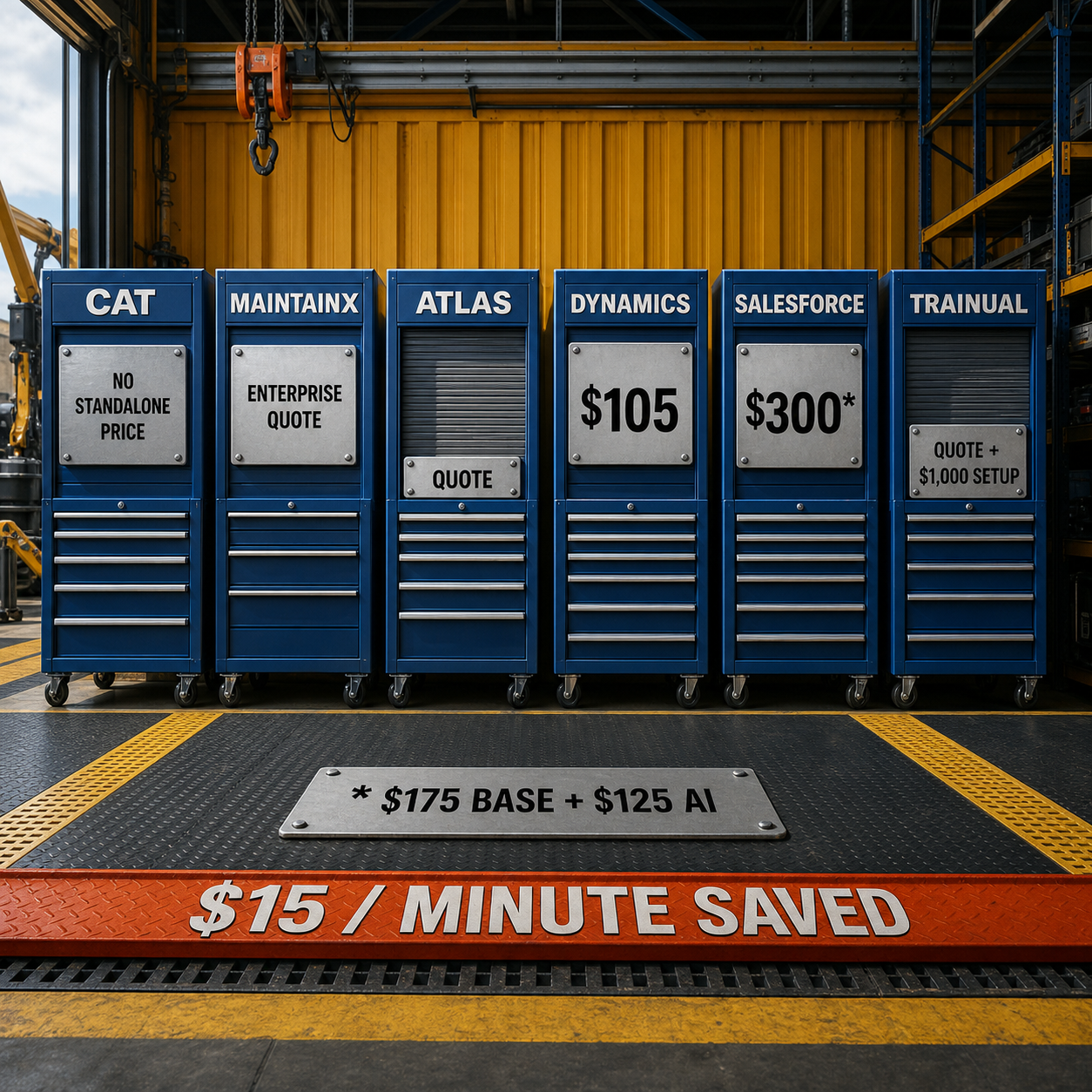
One saved minute per technician per field day is worth $15/month under the explicit assumption of $45 per productive hour and 20 field days. That unit turns a vague AI promise into a purchasing threshold.
- A $105 Dynamics full-user license needs 7 saved minutes per technician per field day.
- A $300 Salesforce Technician plus Agentforce stack needs 20 saved minutes.
- A $650 Agentforce 1 Field Service license needs about 43.3 saved minutes.
- A quote-only assistant needs the same calculation after the vendor puts every required module, service, and implementation charge in writing.
The most important denominator is not chat sessions. It is successful technician work: minutes to a verified answer, escalations avoided, repeat visits avoided, documentation completed, or jobs finished with the right part. A chat that feels fast but sends the technician to the wrong source increases cost.
A 12-technician team saving 15 minutes per technician across 20 field days recovers 60 hours/month. At the $45 planning assumption, that is $2,700/month. Dynamics' $1,260 monthly seat total could clear that narrow labor line before other costs. Salesforce's $3,600 base-plus-add-on total would not clear it on time savings alone, so broader dispatcher, customer, asset, or revenue value would need to carry the rest.
The Ones to Avoid
Avoid ChatGPT, Claude, or Gemini consumer apps as diagnostic authorities. This is not a claim that their models cannot explain equipment concepts. It is a procurement boundary: their consumer interfaces do not become the controlled asset manual, service history, parts system, or work order merely because the answer sounds confident.
Avoid MaintainX Basic, Essential, or Premium when the requirement is MaintainX Assist. Those plans can support maintenance workflows and some AI features, but the live availability table places the assistant itself on Enterprise. A $65 Premium comparison is a false assistant price.
Avoid ServiceTitan Core alone when the requirement is equipment troubleshooting. Core Atlas supports natural-language access to job and customer context. The equipment documents, troubleshooting, calculators, diagnostics, and parts lookup that make Atlas a technician assistant require Field Pro.
Avoid any quote that groups the assistant with the whole platform but does not identify technician seats, required add-ons, implementation, document ingestion, mobile access, usage credits, and support. The number cannot be compared until the usable workflow is priced.
Avoid autonomous safety action. Caterpillar explicitly says its assistant must not directly control emergency or safety functions and that official source documents control. Use that as a sensible minimum for every vendor, even when its terms are less direct.
The Monday Move: Run a Two-Week Technician Pilot
On Monday, choose three technicians, 20 recently closed jobs, and five recurring fault codes. Use historical work so the correct procedure, part, and outcome are already known. Do not begin with a live safety-critical failure.
For each case, record four measures:
- Minutes from question to a usable answer.
- Whether the assistant identifies or links the authoritative source.
- Whether the technician must call a senior technician, dispatcher, or manufacturer.
- Whether the final work note is complete enough for the next visit.
Run the current workflow first, then the assistant workflow on the same class of task. Keep customer identifiers and sensitive jobsite information out unless the vendor agreement and company policy permit them. Require a human to validate procedures, parts, and safety instructions against the controlled source.
At the end of two weeks, convert the median minutes saved into monthly value using the team's own loaded labor rate. Add an avoided escalation or repeat visit only when the pilot documents that outcome. Compare the resulting value with the complete monthly quote, implementation, training, administration, and migration cost.
The Monday decision is not “roll AI out to every technician.” It is “prove one authoritative question path on a controlled job set.” Expand only after the assistant consistently finds the right source, technicians use it inside the existing workflow, and the cost clears the measured threshold.
Frequently Asked Questions
Which AI assistant is the best in 2026?
MaintainX Assist is the best cross-brand maintenance choice in this ranking, Cat AI Assistant is best for Caterpillar fleets, and ServiceTitan Atlas is best for trade contractors already on ServiceTitan. The right answer changes with the system that owns the authoritative manuals, work orders, and asset history.
What's the best AI assistant right now?
The best current assistant is the one already connected to the technician's authoritative sources and field workflow. For a mixed industrial estate that is MaintainX Assist; for a Cat fleet it is Cat AI Assistant.
What is the most widely used AI assistant?
A most-used claim would require a cross-market field-service adoption dataset, and the vendors do not provide one. Consumer chatbot popularity does not establish technician adoption inside an OEM, CMMS, or field-service platform.
What are the most used AI platforms in 2026?
There is no single verified usage list that answers the field-service buying question. Measure active technician use inside the organization's current Cat, MaintainX, ServiceTitan, Dynamics, Salesforce, or Trainual workflow instead of borrowing broad consumer rankings.
What three jobs will not be replaced by AI?
No credible source can guarantee three protected jobs. Field service work remains difficult to automate end to end because it combines physical action, changing site conditions, customer interaction, safety responsibility, and accountable judgment.
What is the 30% rule in AI?
There is no universal 30% rule for field-service AI procurement. Use a measured rule instead: verified-answer rate, minutes to source, escalations avoided, and monthly value compared with the complete platform cost.
What jobs will be gone by 2030 due to AI?
No reliable source can produce a deterministic list. For field service, analyze which tasks can be assisted, such as manual search and note summarization, while keeping physical repair, safety decisions, and final accountability with qualified people.
What is AI not allowed to do?
The answer depends on the product, contract, and jurisdiction. Caterpillar's current terms specifically say its AI must not directly control emergency or safety functions and that users must validate output against official source documents.
Which 5 jobs will survive AI?
There is no authoritative five-job list. Roles that combine physical dexterity, changing environments, human trust, regulated responsibility, and final accountability are more resistant to complete automation, but their tasks will still change.
Get the AI Tools Map for Business Owners
Use the free AI Tools Map for Business Owners to place field-service assistants beside the other AI systems competing for the same budget.
- Published
- Category
- AI
- Language

Claude for Google Workspace
How to install and deploy Claude in Docs, Sheets and Slides, control edits, and test the paid-plan beta with three practical team workflows.Oct 10, 2026AI
Claude Dashboards
Set up Claude Dashboards beta, inspect SQL and refresh timestamps, check a sales metric, and decide when to keep your BI tool.Oct 10, 2026AI
Granola AI Review
Granola reviewed for business meetings: bot-free notes, current pricing, templates, recipes, consent, platform limits and who should choose an alternative.Oct 10, 2026AI
Fyxer Review
Fyxer reviewed through current pricing, help docs and public feedback: inbox sorting, drafts, meetings, privacy and who should pay for Pro or Team.Oct 9, 2026AI
GPT 6 Explained: Models, Release Dates, Access, and Prices
GPT-6 Astra, Sol, 6.1 Sol and Luna explained: release dates, ChatGPT plan access, Work and Codex availability, and verified API costs.Oct 9, 2026AI
Is ChatGPT Free? What You Get for $0
Yes. See what ChatGPT Free includes, its work limits, ads, account access, and when the $8 Go or $20 Plus plan is worth paying for.Oct 9, 2026AI
Gemini Enterprise: What It Is and When to Pilot
Gemini Enterprise explained for IT leads: Gemini agent availability, connectors, identity, spend caps, pricing and a 30-day Plus pilot.Oct 9, 2026AI