Best Cross-Device Coding Agents 2026
Compare five cross-device coding agents for persistent sessions, local execution, mobile approvals, privacy walls, and current 2026 pricing.
Published Updated
 By Omid Saffari




VS Code Agent Host with GitHub Copilot is the best cross-device coding-agent setup in 2026 because one authoritative session can now survive the folder that started it and stay synchronized across clients. At a $100 loaded engineering hour, Copilot Pro's $10 monthly seat needs to save just 6 minutes of reorientation to pay for itself.
The best cross-device coding agents at a glance
These are the five products that pass a strict continuity test: you can start, steer, inspect, approve, or resume the same agent session from more than one client or device. A synced transcript alone does not qualify, and neither does starting a second cloud task with the same prompt.
Prices were verified against live vendor pages on August 29, 2026. "Starting price" means the least expensive published route to the cross-device capability, not the cheapest plan that carries the brand name.
The ranking is not a model leaderboard. It answers a more operational question: when you leave the screen, does the agent keep the same state, tools, repository, and approval path, or do you have to reconstruct the job somewhere else?
That distinction matters because a short context rebuild rarely stays short. You reopen the branch, inspect the diff, remember which command failed, recover the agent's last decision, and check whether another client already approved something. The direct cost is small; the interrupted engineering hour is not.
Why VS Code Agent Host changes the buying decision
Until August 26, VS Code's local agent runtime was tied to the extension host inside one editor window. Close that window and the runtime stopped. The new Agent Host architecture moves session state, harness adapters, and baseline workspace capabilities into a dedicated process, so the folder and window become clients of the work instead of owners of it.
That is the consequence hidden inside the architecture announcement. The budget line is no longer only "which model writes the best patch?" It is also "how many times do engineers pay to reconstruct a live task after changing windows, machines, or approval surfaces?"
The host now owns the authoritative session. Multiple VS Code windows and the Agents window can connect to it, while an Agent Host on another machine can be reached from desktop or browser through SSH or a development tunnel. The open Agent Host Protocol gives clients a common way to observe progress, contribute actions, approve tool calls, and cancel work without cloning the session.

There are three execution patterns hiding under the same "cross-device" label:
- Local host, multiple clients. The agent and tools stay on your primary machine. Other screens become control surfaces. The machine must remain awake.
- Remote host, multiple clients. The session lives on a development box that can remain online while laptops come and go. This is the strongest pattern for long-running repository work.
- Cloud task, synchronized clients. The agent runs in a vendor environment. It is easiest to reach, but you accept that platform's environment, data boundary, and integration model.
VS Code Agent Host ranks first because it makes that boundary explicit and supports more than one harness. Copilot retains its own SDK and agent behavior; Claude retains its Agent SDK, permissions, subagents, commands, and hooks. The host coordinates the session without pretending the agents are interchangeable.
The Monday move is narrow: choose one repository with long-running test or migration work, run one Agent Host session on a machine that stays available, and require every handoff to continue that session instead of opening a new chat. Track only two things for a week: minutes spent re-establishing context and approvals answered away from the original window. If those two measures do not beat the seat cost, do not expand the rollout.
1. VS Code Agent Host with GitHub Copilot: best overall
VS Code Agent Host with GitHub Copilot is the best pick when session continuity matters more than a phone-first interface.
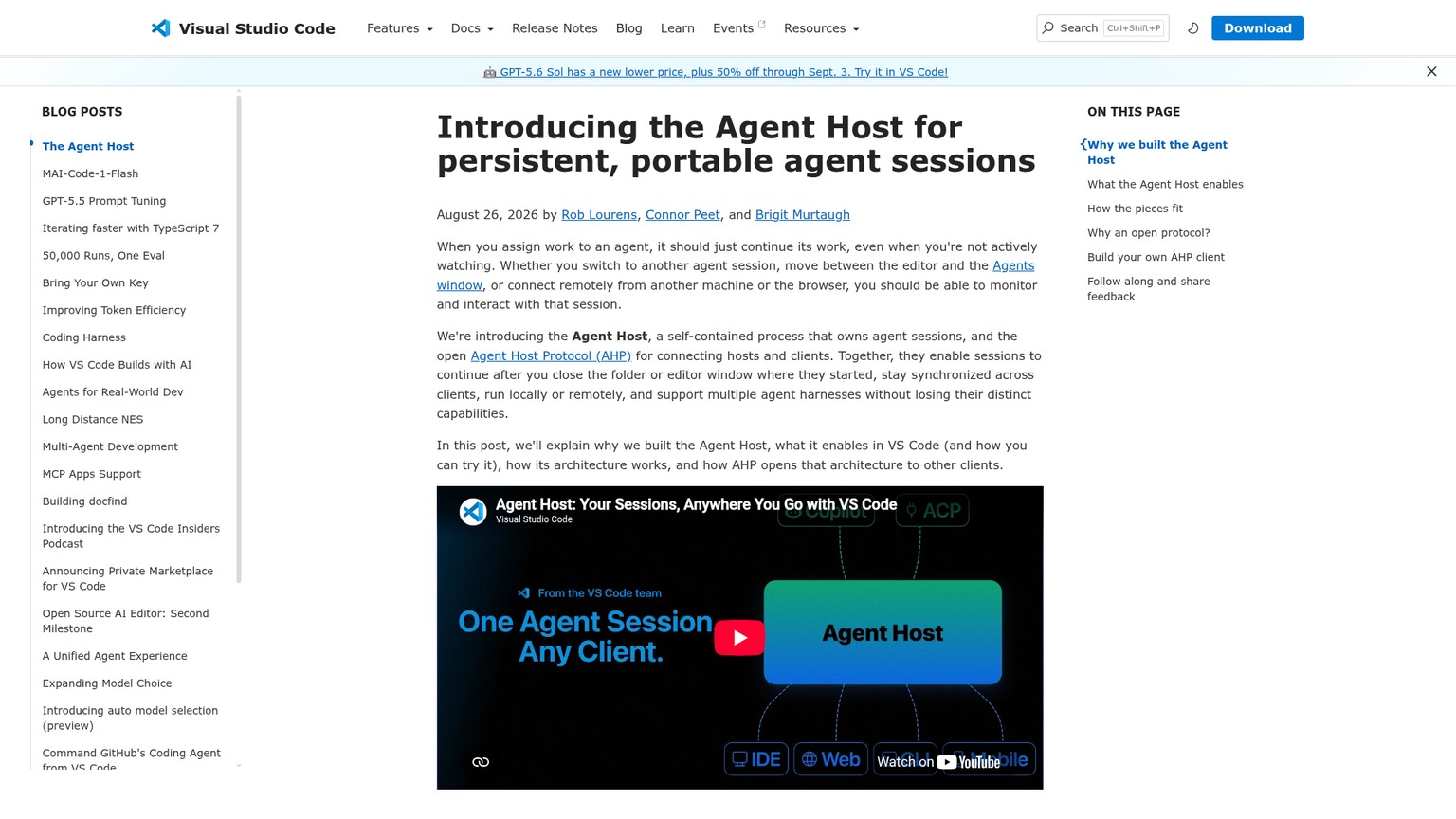
Its advantage is structural. The dedicated host owns one live session while the editor, Agents window, browser, or another VS Code client connects to it. Close the original folder and the turn continues, provided VS Code itself remains running for a local host. Put the host on another machine and the browser or desktop can reconnect to that machine instead.
The host also avoids a common multi-agent compromise. The Copilot harness still uses the GitHub Copilot SDK, while the Claude harness retains its own loop, tools, permissions, subagents, slash commands, and hooks. AHP standardizes the client-facing state, not the way every agent reasons.
There are two different persistence features to configure. Agent Host keeps the live runtime independent of one editor window. Session history sync uploads local Copilot sessions to the developer's GitHub account by default so history can be queried across VS Code, Copilot CLI, cloud agent, code review, and Copilot Desktop. Synced sessions are private by default, but privacy-sensitive repositories should still be excluded deliberately.
Set chat.sessionSync.enabled to false to keep new session data local, or use chat.sessionSync.excludeRepositories for exact repositories and patterns. GitHub says tokens, API keys, credentials, passwords, and connection strings are filtered before sync. Business and Enterprise administrators can also force session sync off by policy.
The wall is availability, not intelligence. A local session still depends on the VS Code process. If the app quits or the machine sleeps, the host cannot keep executing. A remote host fixes the laptop problem, but adds SSH or tunnel setup, host patching, repository access, and a second machine to secure. Microsoft also labels both the VS Code implementation and AHP as under active development, so protocol and client behavior can still move.
Best for: Development groups already standardized on VS Code that want one live session across editors, an Agents window, browser access, and remote machines.
Standout: One host owns authoritative state while multiple clients and multiple agent harnesses connect to it.
Pricing: Copilot Free and Student are $0. Pro is $10 per month with 1,500 monthly AI credits. Pro+ is $39 with 7,000. Max is $100 with 20,000. Business is $19 per granted seat with 1,900 credits per user, and Enterprise is $39 per granted seat with 3,900. Additional organization usage is $0.01 per AI credit; paid-plan completions and next edits remain unlimited.
Free trial: Copilot Free is a limited free plan. GitHub says new self-serve Business and Enterprise purchases and trials have been temporarily paused since April 22, 2026, so new organization buyers are routed to sales.
- One authoritative session can stay synchronized across multiple VS Code clients.
- Local and remote hosts cover both laptop-bound and always-on development-box workflows.
- Copilot and Claude harnesses keep their provider-specific capabilities.
- Repository-specific sync exclusions and enterprise controls make the data boundary configurable.
- A local host still stops when VS Code or its machine stops.
- A remote host adds machine, tunnel, access, and patching overhead.
- The Agent Host implementation and AHP are still under active development.
A five-step continuity setup
Update VS Code
Use the latest VS Code Stable or Insiders build, where Agent Host is enabled. Confirm that Copilot appears in the harness picker before moving an important task.
Start one bounded task
Open a repository, select Copilot, and assign a task with a clear completion check such as a named test command or migration result. A precise boundary makes it easy to tell whether the same session survived.
Prove local persistence
While the agent is working, close the folder but keep VS Code running. Open the Agents window, locate the same session, and verify that its progress and state match the original editor view.
Move the host if needed
For work that must outlive a laptop, run the host on a remote machine and connect through SSH, a development tunnel, or the browser. The standalone commands are
code agent hostfor Stable andcode-insiders agent hostfor Insiders.Set the sync policy
Decide which repositories may sync session history before broad adoption. Exclude sensitive repositories or disable sync, then document who owns the remote host and how it is patched.
Pick VS Code Agent Host if your pain is fragmentation between editor windows, browser review, and long-running development machines. Skip it if your primary requirement is a polished phone client today; Claude, Cursor, Codex, and Happy put the mobile control surface closer to the center.
2. Claude Code Remote Control: best for Android and local tools
Claude Code Remote Control is the strongest choice when the agent must keep using a local filesystem, MCP servers, tools, and project configuration while you steer it from iOS, Android, or another browser.
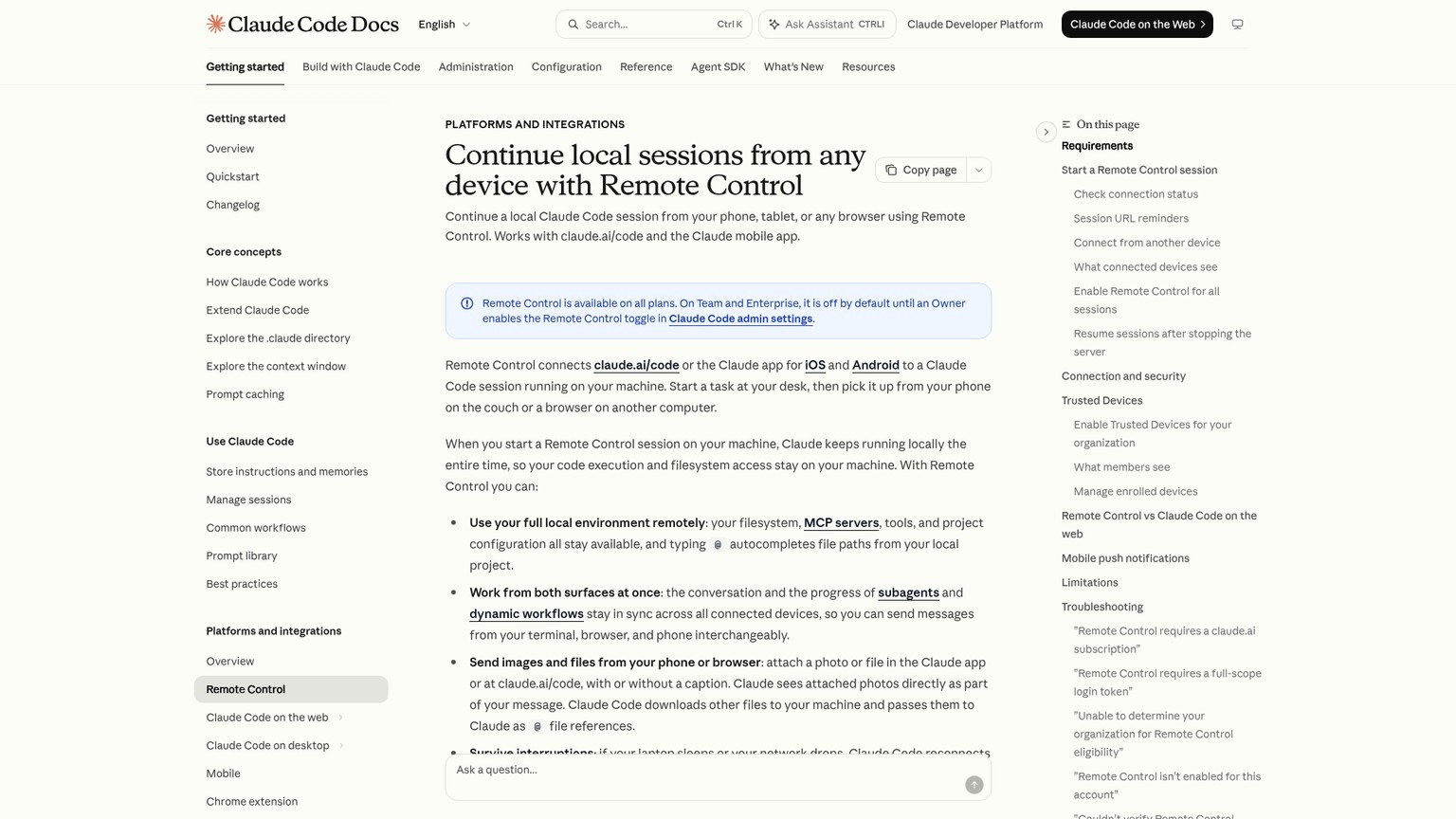
The terminal process remains the execution boundary. Your phone and browser can send messages, approve work, attach files, follow subagents, and see the synchronized conversation, but code execution and filesystem access stay on the machine that launched Claude Code. That makes Remote Control a continuation of local work, not a migration into an anonymous cloud container.
It also handles temporary interruption sensibly. When a laptop sleeps or its network drops, Claude Code reconnects after the machine returns and queues messages, permission prompts, and subagent status during recovery. Server mode can expose multiple sessions, with same-directory, worktree, or single-session spawning and a default capacity of 32.
The worktree option matters for parallel use. Same-directory sessions can edit the same files and collide. Worktree mode isolates each on-demand session in its own Git worktree, which is a safer default when several remote tasks may overlap. Resuming by --continue or --session-id requires Claude Code v2.1.200 or later.
Anthropic's own page contains a pricing ambiguity worth calling out. Its header says Remote Control is available on all plans, but the requirements block says Pro, Max, Team, and Enterprise and explicitly rejects API keys. The stricter block is the safer purchase assumption because Claude Free does not list Claude Code as included.
The authentication wall is unusually specific. Remote Control does not support API-key sessions, Amazon Bedrock, Google Cloud's Agent Platform, Microsoft Foundry, a custom ANTHROPIC_BASE_URL, or enterprise Claude apps gateway sign-in. If your company routes model traffic through one of those controls, this feature is not a shortcut around that architecture.
The machine must also keep the claude process alive. Close the terminal, quit VS Code, or stop the process and the remote view goes offline. On a remote SSH box, Anthropic recommends keeping the process alive with tmux or screen.
Best for: Developers who need Android support or who rely on local MCP servers and project configuration.
Standout: Terminal, browser, iOS, and Android can exchange messages against the same local conversation and subagent progress.
Pricing: Free is $0 but does not list Claude Code. Pro includes Claude Code at $17 per month with a $200 annual payment, or $20 monthly. Max 5x is $100 per month and Max 20x is $200, both monthly-only web subscriptions. Team supports 2 to 150 people: Standard is $20 per seat monthly on annual billing or $25 month-to-month; Premium is $100 annualized or $125 monthly. Enterprise self-serve is $20 per seat plus usage at API rates; sales-assisted Enterprise is custom.
Free trial: No Remote Control trial is listed; budget for an eligible paid login.
- Native paths cover iOS, Android, and browsers.
- Filesystem access, local tools, MCP servers, and project settings remain on the host machine.
- Conversation, permission prompts, and subagent progress stay synchronized.
- Worktree spawning provides a defensible path for parallel remote sessions.
- The local Claude process and machine must remain available.
- API keys, major cloud-provider routes, custom base URLs, and enterprise app gateways are unsupported.
- The documentation contradicts itself on all-plan versus paid-plan availability.
- Session transcripts are stored on Anthropic servers while Remote Control is connected.
Choose Claude when keeping the exact local environment is non-negotiable and Android access matters. Skip it when your company requires API-key billing, Bedrock, Microsoft Foundry, Google Cloud's agent platform, or a model gateway. In that case the remote-control feature conflicts with the infrastructure decision before model quality enters the discussion.
3. Cursor Remote Control: best iPhone handoff
Cursor Remote Control is the best iPhone-first option for developers who want to choose between keeping tools local and moving an agent into the cloud.
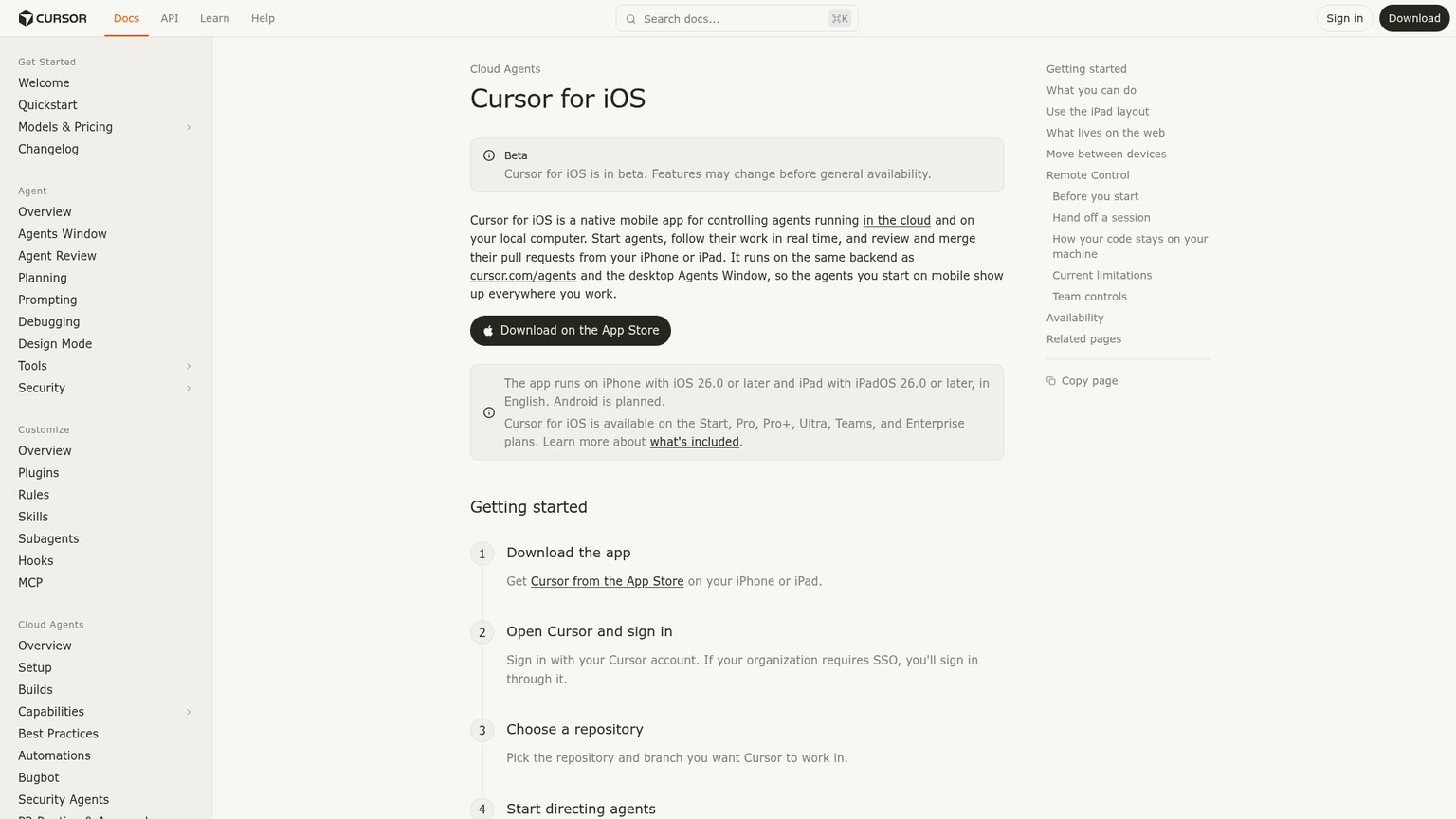
Cursor exposes two distinct handoffs. Move to Cloud pushes work to a cloud agent that keeps running after the phone disconnects. Remote Control moves the agent loop into Cursor's cloud while every terminal command, file edit, test, and Git action still runs on the developer's computer. That distinction lets you choose convenience or environment fidelity per task.
The mobile app shares a backend with cursor.com/agents and the desktop Agents window, so agents launched on one surface appear on the others. It can follow live work, review and merge pull requests, inspect diffs and checks, send follow-ups, use repository commands and skills, and track up to 8 agents through iOS Live Activities. It is a control and review surface, not a full mobile IDE: environment configuration, secrets, source-control setup, billing, and the full editor stay on the web or desktop.
For Remote Control, Cursor sends conversation state, tool results, and the model context needed to continue, while the repository, secrets, credentials, and build caches remain on the host machine. The model loop is therefore cloud-side even though tool execution remains local. Buyers who require no cloud-stored conversation state should treat that as a hard wall, not a preference toggle.
The device requirements narrow the audience. Cursor for iOS is a beta that requires iOS 26.0 or iPadOS 26.0, runs in English, and has no Android release yet. Remote Control requires Cursor 3.9.8 or later, cloud data storage, and a Pro, Pro+, Ultra, Teams, or Enterprise plan. The host can be a local or Remote SSH workspace, but it must remain awake and online. Team administrators must enable the feature.
Best for: Cursor users on iPhone or iPad who want both cloud continuation and a local-tool execution path.
Standout: One product offers an explicit choice between Move to Cloud and Remote Control.
Pricing: Hobby is free but does not include Remote Control. Start is India-only at INR 649 per month, tax included, and includes the iOS app but not Remote Control. Pro is $20 per month, Pro+ is $60, and Ultra is $200. Teams Standard is $40 per user per month and Teams Premium is $120. Enterprise pricing is custom through sales.
Free trial: No Remote Control trial is listed; Pro at $20 per month is the global individual entry point.
- Move to Cloud and Remote Control cover two different execution needs.
- Cloud tasks continue when the phone disconnects.
- Local Remote Control keeps repository files, secrets, credentials, and build caches on the host.
- The iOS client includes serious review controls rather than only chat.
- Android is only planned.
- The beta requires iOS 26.0 or iPadOS 26.0 and is English-only.
- Remote Control moves the model loop and required context through Cursor's cloud.
- The local host must remain awake for every tool call.
Cursor wins when the developer already lives in Cursor and an iPhone is the main remote surface. Skip it for an Android-heavy group, a no-cloud-data policy, or a machine fleet that cannot remain awake. If you need broader distinctions among the three major coding-agent ecosystems, the Codex vs. Claude Code vs. Cursor comparison goes deeper on their non-mobile behavior.
4. OpenAI Codex Remote: best phone approval surface
OpenAI Codex Remote is the cleanest choice for following tasks, approving commands, and reviewing diffs and tests from the ChatGPT mobile app while a connected Mac or Windows PC does the work.
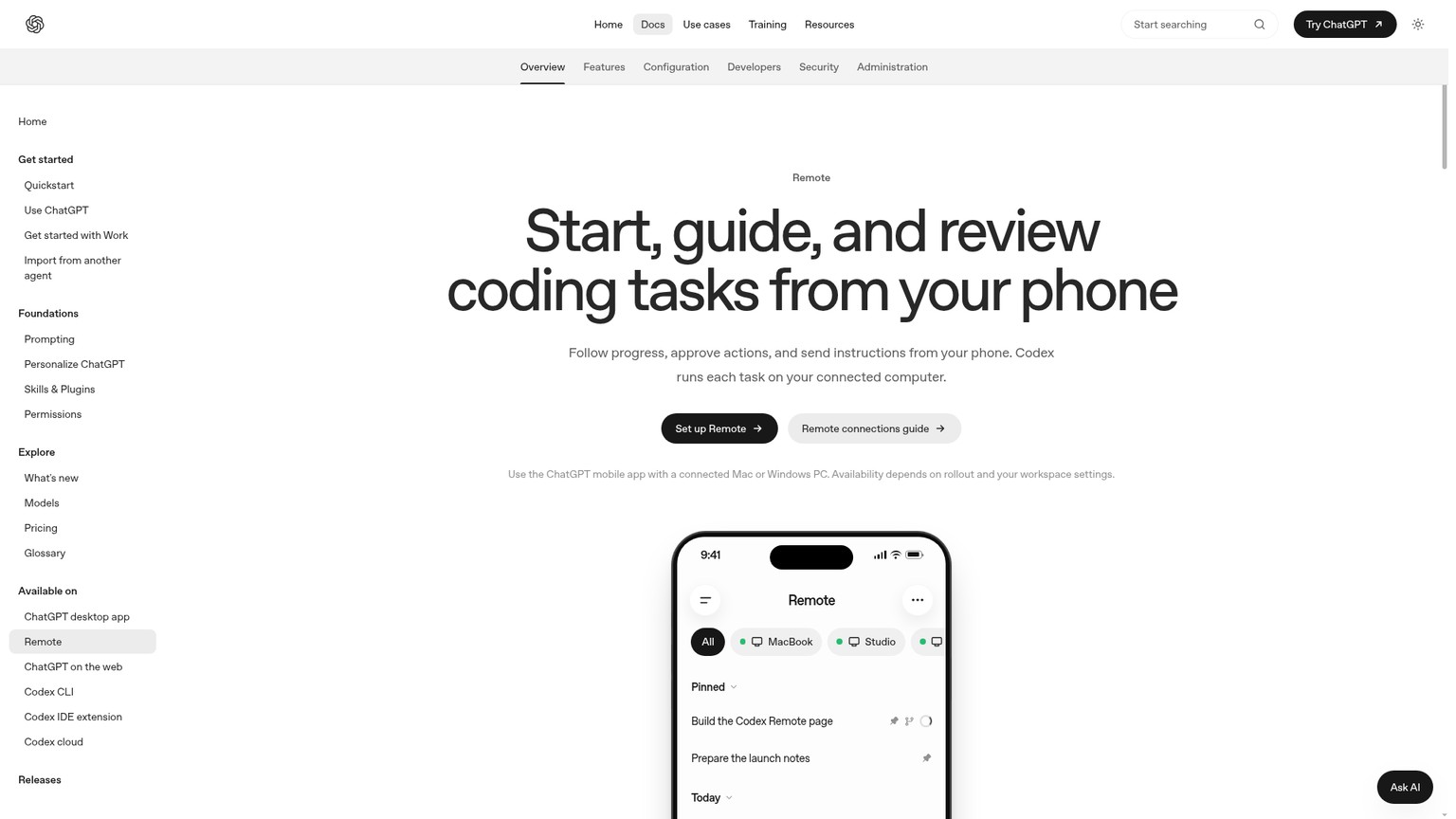
The control path is explicit. Choose a connected computer and project from the phone, describe a new task or continue an existing conversation, watch the work, approve requested commands and actions, then inspect changed files, diffs, and test results. The connected computer remains the execution environment and stays under the organization's machine policies.
This is a good fit for review-heavy workflows. A developer can leave a test suite or refactor running on the office machine and answer the moment Codex asks for permission. The phone does not need to become an IDE; it needs to expose the decision points that would otherwise stall the job.
The wall is deployment maturity. OpenAI says availability depends on rollout and workspace settings. Pairing requires the same ChatGPT account and workspace on the phone and computer, and the Mac or Windows PC must stay awake and online. That means a buyer should verify Remote appears in the intended workspace before treating the feature as a guaranteed organization-wide capability.
ChatGPT Work and Codex share usage, credits, and limits. Heavy coding sessions therefore compete with other Work usage inside the same plan allowance. API-key users get Codex in the CLI, SDK, or IDE extension on usage-based pricing, but that route does not include cloud features and is not the route to this mobile control surface.
Best for: ChatGPT users who want phone-based approval, diff review, and test-result inspection against a known work computer.
Standout: The mobile flow centers the decisions that stop unattended work: commands, requested actions, changed files, diffs, and tests.
Pricing: Free is $0 and Go is $8 per month. Plus is $20 and includes Codex on web, CLI, IDE, and iOS. Pro starts at $100 for 5x Plus limits; the $200 tier provides 20x. Business is $20 per user per month for 2 or more users billed annually, or $25 monthly. Enterprise and Edu are custom through sales. API-key access is usage-based, but it excludes cloud features.
Free trial: ChatGPT Free is a $0 plan, not a timed trial; Remote availability still depends on rollout and workspace settings.
- The phone exposes approvals, changed files, diffs, and test results.
- Existing conversations can be continued on a paired computer.
- Mac and Windows hosts keep execution inside a known machine boundary.
- A $0 plan creates a low-cost validation path where Remote is available.
- Availability varies by rollout and workspace settings.
- The connected PC must remain awake and online.
- Work and Codex draw from the same usage pool.
- API-key access does not supply this cloud-connected mobile feature set.
Choose Codex if the organization already pays for ChatGPT and wants a focused approval and review surface on the phone. Skip it if you need a guaranteed feature across every workspace today, an offline host, or API-key-only authentication. For a wider phone-first market view, see the mobile remote-control coding-agent roundup.
5. Happy: best open-source bridge
Happy is the best open-source control layer for developers who want one mobile and web bridge across Claude Code and Codex.
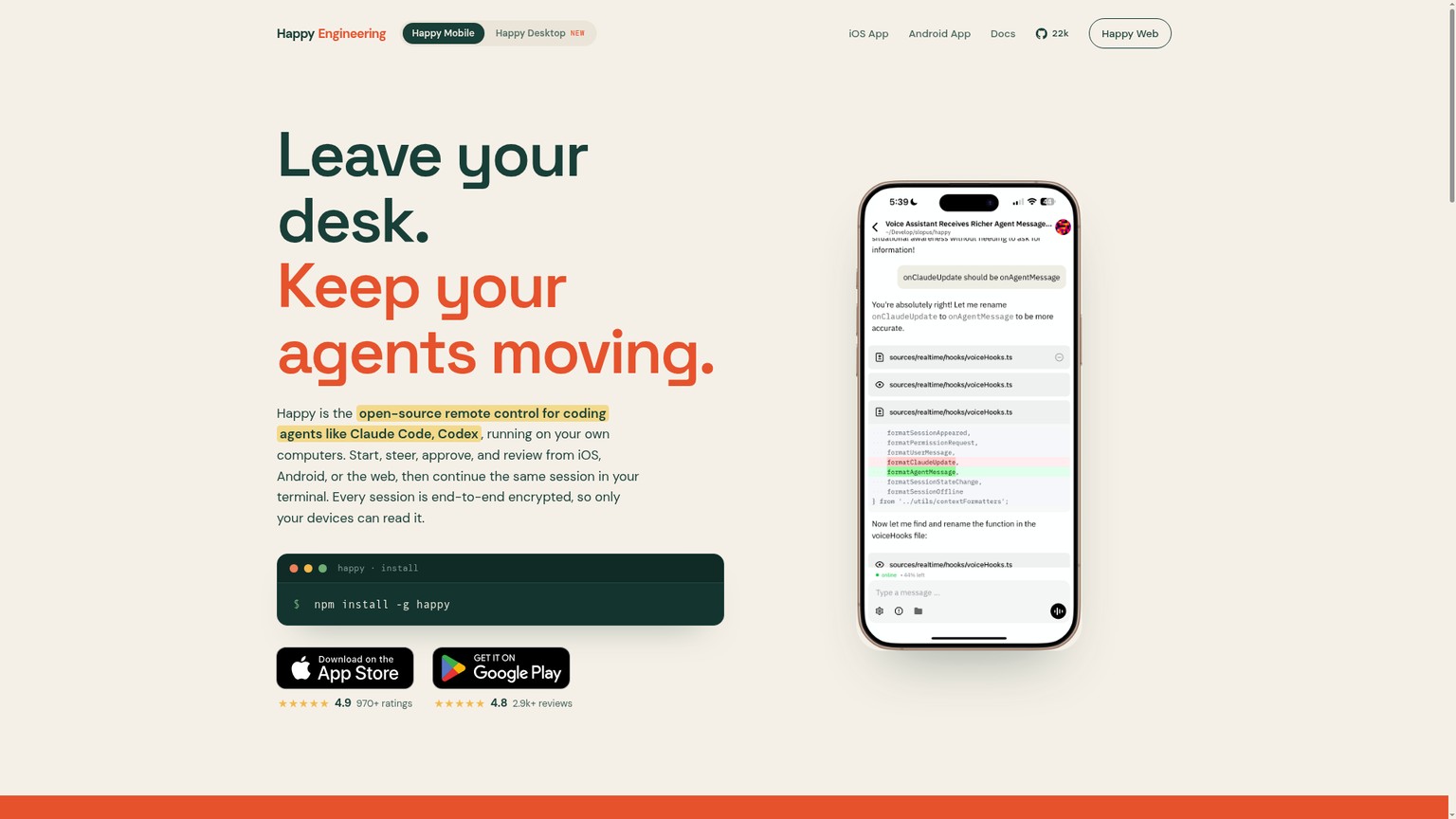
The agent and repository continue running on the developer's own computer. Happy's iOS, Android, and web clients can start, steer, approve, and review work, then hand the same session back to the terminal. That cross-agent support is the reason to consider it after the first-party options: one control surface can sit above two agent ecosystems.
Its security model is also legible. Happy says the code, agent, and encryption keys remain on the developer's devices. The backend stores and relays encrypted blobs but does not receive the key, so it cannot read prompts, responses, code, or session context. This is a stronger explanation than a vague claim that data is "secure."
The wall is product dependency. Happy does not replace Claude Code or Codex, their accounts, their limits, or the host computer. It adds another client, pairing process, mobile app, open-source server, and support surface to the chain. A small public team can be responsive, but it cannot provide the procurement assurance or enterprise policy surface of a first-party vendor by default.
Pricing is the other unresolved line. Happy's vendor homepage lists no subscription tiers, price, or trial as of August 29, 2026. Open source does not automatically make every hosted relay or mobile distribution cost-free forever, so a finance owner should not enter $0 as a permanent vendor commitment without confirmation. The upstream Claude or Codex plan still applies either way.
Best for: Technical users who want iOS, Android, and web control across both Claude Code and Codex, and who are comfortable evaluating open-source infrastructure.
Standout: End-to-end encrypted session relay with code, agent, and keys staying on the user's devices.
Pricing: No Happy subscription tiers or price are posted on the vendor homepage; add the upstream Claude Code or Codex cost.
Free trial: No trial is posted.
- One client layer supports both Claude Code and Codex.
- iOS, Android, and web are all covered.
- The encryption boundary is explained in concrete key and ciphertext terms.
- The app, CLI, and server are open source.
- It adds a third-party layer to two fast-moving upstream products.
- Public pricing is absent, so a stable budget cannot be confirmed from the vendor page.
- Upstream agent plans, usage limits, and host availability still apply.
- Enterprise controls and support expectations require separate diligence.
Happy is a smart fit for an individual or technical group that values an auditable bridge and Android coverage. Skip it when procurement requires a published commercial tier, contractual support, or one accountable vendor for the full execution path.
Who should pick what
Start with the execution boundary, not the model badge.
Pick VS Code Agent Host with GitHub Copilot when several VS Code surfaces or development machines need to converge on one authoritative session. It has the strongest architecture for persistent multi-client work, and it can host more than one harness. The decision flips away from it when phone UX is the primary surface or when nobody can operate a remote development host.
Pick Claude Code Remote Control when Android matters, the full local filesystem and MCP environment must remain available, and a claude.ai login fits company policy. The decision flips away when API-key billing, Bedrock, Google Cloud's Agent Platform, Microsoft Foundry, a custom model gateway, or an enterprise Claude apps gateway is mandatory.
Pick Cursor when the group already uses Cursor, works on iPhone or iPad, and wants a per-task choice between a cloud agent and local tool execution. The decision flips away for Android users, legacy no-cloud storage requirements, or host machines that cannot stay awake.
Pick OpenAI Codex Remote when the organization already uses ChatGPT and the highest-value mobile actions are approving commands and reviewing diffs or tests. The decision flips away if the target workspace has not received Remote, if the company is API-key-only, or if a connected Mac or Windows host is not acceptable.
Pick Happy when one open-source control layer across Claude Code and Codex is more valuable than a single-vendor support path. The decision flips away when procurement needs published pricing, contracted support, or a first-party policy console.
The simplest rule is this: if the original machine may sleep, do not buy a local remote-control setup and hope notifications will save it. Put the host on an always-on remote machine or choose a cloud task. If the repository, secrets, and toolchain must stay local, accept that the host must remain available and choose the client coverage your developers use.

The price bands are less important than the wasted handoff they must eliminate. A $10 seat needs 6 saved minutes per month at the stated labor assumption. A $20 seat needs 12 minutes, a $40 seat needs 24, and a $100 seat needs 60. That is why the Monday trial should measure reorientation and stalled approvals, not lines of code produced.
How these were picked
This comparison was source-verified, not presented as hands-on testing. Each product had to document the same-session path on a live first-party page on August 29, 2026. Five criteria determined the order:
- Session identity: Does another client join the same authoritative session, or merely copy history and start again?
- Execution location: Do the agent loop and tools run on a local machine, a remote host, or a vendor cloud?
- Client coverage: Can the developer use editor, browser, iOS, Android, desktop, or a second machine?
- Failure behavior: What happens when the original window closes, the host sleeps, the process stops, or the network drops?
- Commercial boundary: Which paid tier unlocks the capability, what does a ten-seat group spend, and which policy or authentication choice blocks it?
The five-tool count is deliberate. Adding desktop-only products would reward brand breadth instead of cross-device continuity. Five tools made this list because they document the session path; the rest are better evaluated in a broader AI coding-agent comparison.
The ones to avoid for cross-device continuity
Avoid Replit Agent when the requirement is to continue one local coding-agent session across devices. Replit is a capable cloud-native app builder that can build, refine, test, and fix work inside a Replit workspace. That is useful, but it solves availability by moving the project into its platform, not by preserving an existing local terminal or editor session. Choose it for a cloud workspace; do not confuse that with host-level continuity.
Avoid Cursor Hobby and Cursor Start if Remote Control is the purchase reason. Hobby provides limited Agent, Chat, and Tab access, and India-only Start includes the iOS app, but Cursor lists Remote Control only for Pro, Pro+, Ultra, Teams, and Enterprise. A free plan that cannot activate the target feature is not a free cross-device option.
Avoid Claude Code's API-key and cloud-provider routes if Remote Control is mandatory. Anthropic lists API keys, Bedrock, Google Cloud's Agent Platform, Microsoft Foundry, custom ANTHROPIC_BASE_URL hosts, and the enterprise Claude apps gateway as unsupported. Do not design a secure provider route first and discover during rollout that the remote client bypass is unavailable.
Avoid any workflow that claims continuity because it can export a transcript. A transcript preserves words; it does not preserve a running process, filesystem state, tool permissions, pending approvals, subagent progress, or the authoritative order of actions. For cross-device work, those are the product.
Frequently asked questions
Which AI agent is best for coding in 2026?
For cross-device coding, VS Code Agent Host with GitHub Copilot is the best overall setup because the host owns one session and multiple clients can connect to it. For coding quality in a single environment, the answer can change by repository, model, and workflow; this ranking is deliberately about continuity.
Which AI coding agent is currently the best?
VS Code Agent Host ranks first for multi-client session architecture. Claude Code is the better choice when Android and local MCP tools are essential, while Cursor is stronger for an iPhone-first handoff and Codex is strongest for phone approvals and review inside an existing ChatGPT setup.
What is the best coding model in 2026?
A coding model is only one layer of a cross-device agent. The session host determines whether context, tools, approvals, and file state survive a device switch, so choose the execution boundary first and the model second.
Are there free cross-device coding agents in 2026?
GitHub Copilot Free and ChatGPT Free provide $0 entry points, although limits and feature rollout apply. Happy posts no subscription price, but it still depends on an upstream Claude Code or Codex setup, while Claude Remote Control and Cursor Remote Control require eligible paid plans.
The short version
Get the AI Business Workflow Audit Checklist by joining the newsletter, then use its handoff review to choose one repository for a one-week continuity test.
- Last Updated
- Category
- Build
- Language

Firecrawl Pricing 2026: What Your Pages Cost
Firecrawl plans and credit packs verified October 2026. Calculate JSON extraction, failed pages and weekly crawl bills at your volume.Oct 9, 2026Build
Claude Code vs GitHub Copilot 2026
Claude Code vs GitHub Copilot: current plans, usage limits, models, team controls, one-seat and ten-seat costs, and when to use both.Oct 8, 2026Build
LangGraph vs CrewAI
Compare LangGraph and CrewAI on the same approval workflow, state, memory, MCP, observability and current hosted-platform prices.Oct 7, 2026Build
How to Build MCP Server
Build an order lookup MCP server with Python, test it in Inspector, connect Claude Code and Cursor, then add HTTP auth and hosting.Oct 7, 2026Build
Gumloop vs n8n (Verified October 2026)
Gumloop vs n8n: current pricing, credits vs executions, self-hosting and the same AI lead workflow, with a verdict for each builder.Oct 7, 2026Build
AI Agent Frameworks in 2026: LangGraph, CrewAI, OpenAI Agents SDK, Claude Agent SDK, Mastra and Google ADK (Compared)
Compare eight AI agent frameworks by language, state, MCP, approvals and current hosted prices. Pick the right runtime for production.Oct 7, 2026Build
Codex Cloud
Set up a reusable Codex Cloud environment, keep coding tasks running with your laptop off, steer from your phone, and choose cloud or local CLI.Oct 7, 2026Build