Best Open Weight Coding Models for Private Agents 2026
Five open-weight coding models ranked for private agents, with live GPU costs, licenses, framework limits, and the GLM-5.3 deployment decision.
Published Updated
 By Omid Saffari

The best open weight coding models for private agents 2026 are GLM-5.3 for frontier work, Qwen3.8-Flash-Next for efficient long loops, Nemotron-Cascade-2 for a single data-center GPU, Gemma 4 31B for multimodal code review, and Devstral Small 1.0 for a workstation. GLM-5.3 leads, but its 753B parameters imply a 376.5GB raw 4-bit weight floor before cache and runtime overhead.
Best Open Weight Coding Models for Private Agents 2026: The Short Answer
GLM-5.3 is the strongest overall choice when private means a controlled enterprise runtime and the budget includes a multi-GPU serving stack. Devstral Small 1.0 is the better default when private means one workstation, one repository, and one operator. The models between them trade memory, agent compatibility, multimodal input, and benchmark strength in ways that matter more than a single leaderboard rank.
The weights are free in the narrow acquisition sense. The runtime is not. At Runpod's live rates, an RTX 4090 left on for 730 hours costs $540.20 per month, and one A100 PCIe costs $1,014.70. A 753B model turns a software line item into an infrastructure and operations line item.
Best Open-Weight Coding Model: The Decision Rule
Pick the smallest model that clears your repository tasks inside the agent framework you will actually run. A larger benchmark number cannot rescue a model that misses your tool-call format, exceeds your memory budget, or sends sensitive traces somewhere your policy forbids.
Five terms keep this decision honest:
- Open-weight means the trained parameter files are available. It does not promise the training data, complete training code, or unrestricted use.
- Private agent means the model endpoint, repository, tool calls, logs, and credentials stay inside a boundary you control. Downloading weights is only one part of that boundary.
- Active parameters are the subset a mixture-of-experts model uses for one token. Fewer active parameters can reduce compute, but every stored parameter still affects memory and distribution.
- Quantization stores weights at lower precision, such as 4-bit instead of BF16, to reduce memory. The idealized arithmetic is useful for screening, not a deployment guarantee.
- KV cache is the working memory used to retain prior tokens during generation. Long context can consume enough memory to invalidate a fit calculation based on weights alone.
The explicit ranking rule is capability first, then deployability. GLM-5.3 wins overall because its newly available weights pair frontier coding evidence with several serving paths. Qwen3.8-Flash-Next wins when long loops and lower active compute matter. Nemotron wins when one data-center GPU and OpenHands are fixed requirements. Gemma wins when the agent needs to inspect screenshots or diagrams. Devstral wins when the machine is already under a desk.
That rule also tells you when to skip the ranking. If your workload is ten short, non-sensitive coding prompts per week, a managed plan is usually the cleaner purchase. If the agent reads unreleased product code, uses internal tools, or needs a private fine-tune, model ownership starts to justify the operational load.
1. GLM-5.3: Best Overall for Frontier Private Agents
GLM-5.3 is the best overall open-weight model here for complex repository work, but only for an organization that can operate it as infrastructure rather than treat it as a desktop download. Its official weights are now available, changing the decision from a future promise into a deployment option.
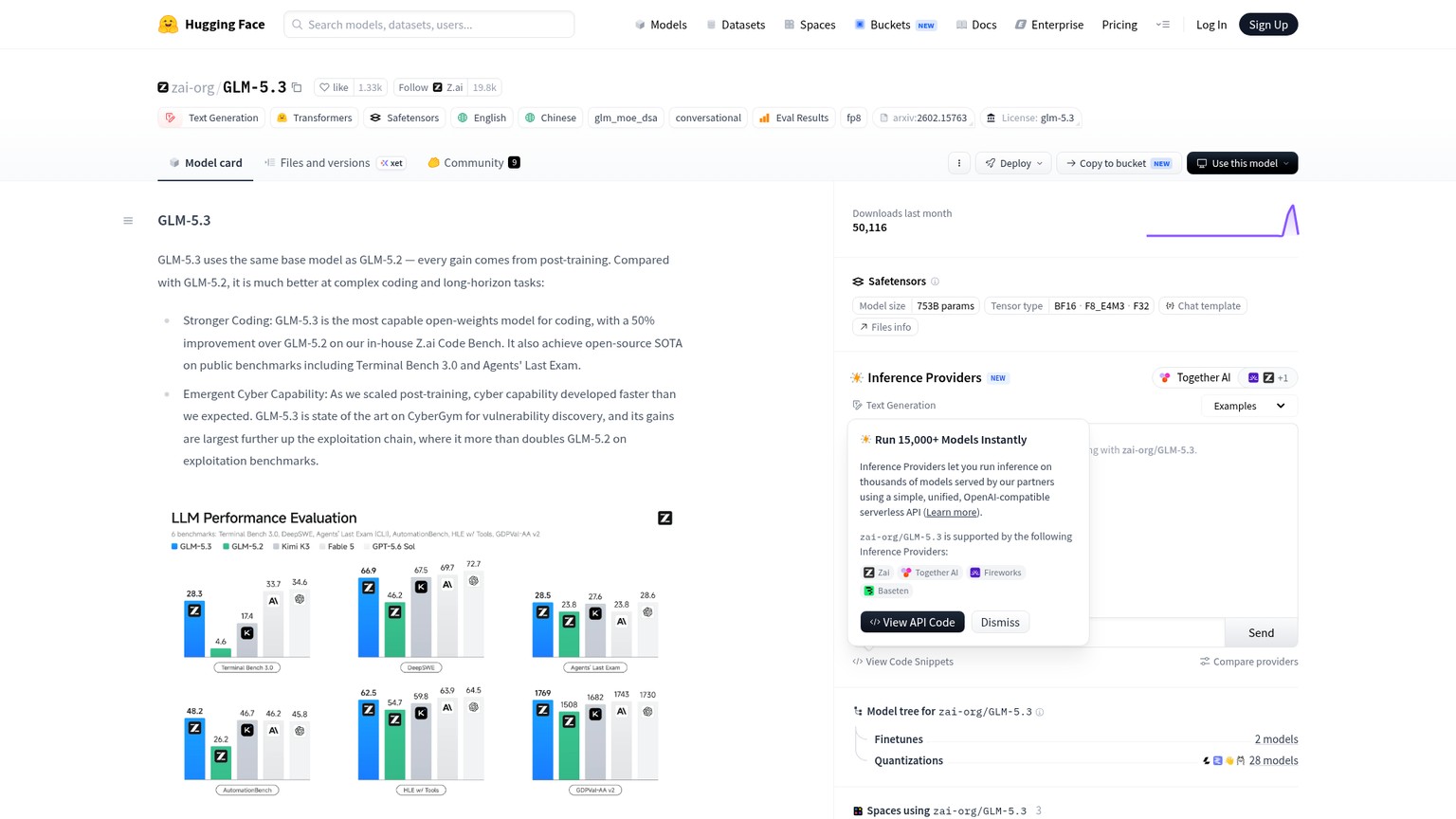
The official GLM-5.3 model card lists 753B parameters and serving support across SGLang, vLLM, TokenSpeed, Transformers, KTransformers, Unsloth, and Ascend NPU frameworks. Z.ai says the model keeps the GLM-5.2 base and gets its improvement from post-training. On Z.ai's own evaluations, Terminal Bench 3.0 moves from 4.6 to 28.3, DeepSWE v1.1 from 46.2 to 66.9, and Agents' Last Exam from 23.8 to 28.5.
Those comparisons are useful because the vendor evaluated two generations of its own family. They do not make every cross-vendor row interchangeable. Agent scaffolds, context budgets, timeouts, sampling, and tool permissions differ. The honest conclusion is that GLM-5.3 is a substantial update over GLM-5.2, not that one table proves it wins every repository.
The business consequence sits in memory. At 753B parameters, BF16 weights alone imply 1,506GB. An idealized 4-bit copy implies 376.5GB before KV cache, batching, runtime memory, and quantization metadata. Five 80GB A100s provide 400GB and cost $5,073.50 per 730-hour month at the current $1.39 per GPU-hour rate. That is a mathematical raw-weight floor, not a safe topology recommendation.
A mid-market CTO should choose GLM-5.3 when the private agent tackles changes expensive enough to justify that floor: multi-service migrations, infrastructure debugging, large refactors, or security review across a controlled code estate. A solo technical founder should not choose it merely because the download button exists. The operations work can cost more than the model access it replaces.
GLM-5.3 also exposes low, high, and max reasoning effort, with max as the default. That is valuable for routing: use lower effort for bounded edits and reserve maximum effort for difficult diagnosis. It is not a free speed switch. Lower per-turn thought can cause retries, and the only useful measure is accepted work per GPU-hour.
Best for: Frontier-grade private agents owned by an infrastructure-capable organization.
Standout: Downloadable 753B weights plus several first-party serving paths and a large GLM-5.2-to-5.3 coding gain.
Pricing: $0 for the weights; a five-A100 raw 4-bit floor models to $5,073.50 per 730-hour month before storage, networking, redundancy, and operations.
Free trial: Not applicable; the official weights are downloadable.
- Strong vendor-reported gains on long-horizon coding and terminal tasks.
- Multiple serving frameworks reduce dependence on one inference engine.
- Reasoning-effort controls support workload routing.
- Weight ownership enables private version pinning and artifact control, subject to the license.
- The 753B artifact creates a multi-GPU memory and operations burden.
- The custom glm-5.3 license needs legal review before commercial deployment or redistribution.
- Vendor benchmark rows still need reproduction on your scaffold and repositories.
- A private endpoint does not secure the agent's shell, tools, secrets, or logs by itself.
A practical GLM-5.3 pilot
Lock the artifact and terms
Record the exact model revision, the
glm-5.3license text, quantization, serving engine, tokenizer, and chat template. A model family name is not a reproducible deployment.Size memory before buying compute
Start with the 376.5GB idealized 4-bit weight floor, then add measured KV cache, runtime, batching, and failover headroom. Do not turn the five-A100 arithmetic into an architecture diagram.
Put the endpoint behind the boundary
Keep repository mounts read-only first. Give the agent an allow-listed package mirror, a disposable worktree, short-lived credentials, outbound-network controls, and a complete tool-call log.
Price accepted patches
Run the same twenty repository tasks through the candidate and the current managed baseline. Divide GPU spend by accepted patches after human review, then add operator time and failed-run cleanup.
2. Qwen3.8-Flash-Next: Best for Long, Fast Agent Loops
Qwen3.8-Flash-Next is the best balance of frontier-scale capability and lower active compute in this ranking. It is still a large deployment, but its 6B activated language parameters make it a more credible high-throughput private-agent target than its 180B total size first suggests.
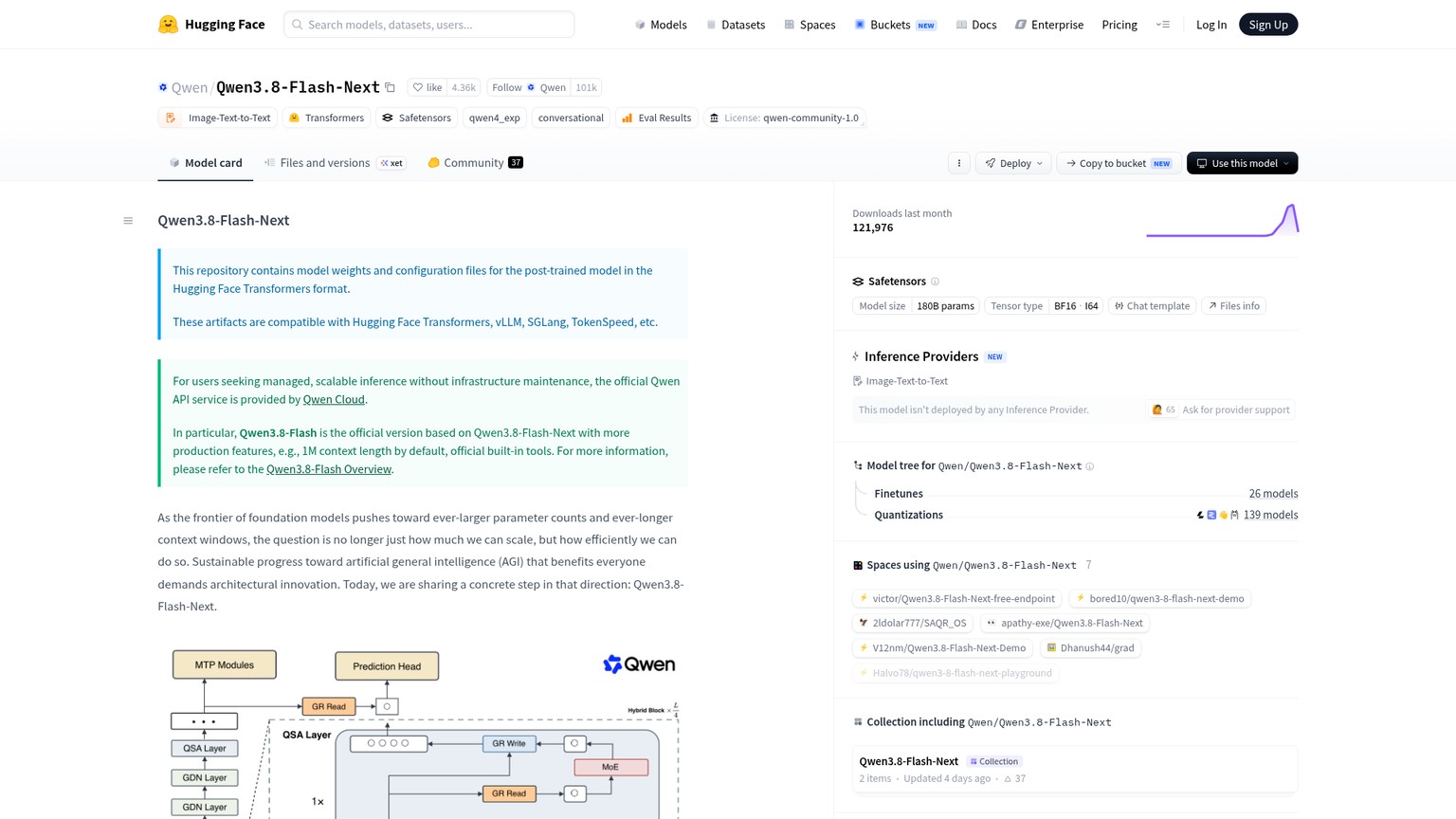
The official Qwen3.8-Flash-Next model card separates storage from active compute: 125B language parameters with 6B activated, plus 51B n-gram embedding parameters and 4B MTP parameters. Hugging Face lists the complete artifact at 180B. That distinction matters. Active parameters influence work per token, while total parameters still have to live somewhere.
The model supports 262,144 tokens natively and documents an extension to 1,000,000. The native number should drive the first production plan. Extending context changes positional scaling and adds KV-cache pressure, so the million-token setting belongs in a measured workload, not a marketing checkbox.
Qwen reports 58.7 on DeepSWE 1.1, 62.5 on SWE-bench Pro, 81.0 on SWE-bench Multilingual, and 73.5 on Toolathlon Verified. The model card also names the evaluation setups and context settings, which makes the evidence more useful than an unexplained composite score. For an engineering platform team with multilingual repositories, visual inputs, and long tool chains, that combination is compelling.
The raw-memory screen remains substantial. A 180B artifact implies 360GB at BF16 and 90GB at an idealized 4-bit floor. Two 80GB A100 PCIe GPUs cost $2,029.40 per 730-hour month at current Runpod rates. That pair clears the raw 4-bit number, but it is not a guaranteed production fit once cache, runtime, and concurrency enter.
The named wall is maturity. Qwen calls this an experimental preview of the architecture behind Qwen4, while the managed Qwen3.8-Flash product adds production features such as default million-token context and built-in tools. The downloadable preview and the managed product are related, not operationally identical. A private deployment owns the missing production layer.
Best for: High-volume private agents that need long context, vision, multilingual code work, and efficient active compute.
Standout: 180B total parameters with 6B activated, plus first-party agent and software-engineering evaluations.
Pricing: $0 for the weights; two A100 PCIe GPUs model to $2,029.40 per 730-hour month before operational overhead.
Free trial: Not applicable; the official weights are downloadable.
- Lower active-parameter count supports a better throughput story than the total size suggests.
- Native 262,144-token context is already large enough for substantial repository work.
- Text, image, and agent evidence make it useful beyond autocomplete.
- vLLM, SGLang, and TokenSpeed support provide several serving paths.
- The 180B total still creates a multi-GPU storage and memory problem.
- The million-token path is an extension that needs workload-specific validation.
- The downloadable preview does not include every production feature in the managed product.
- The custom qwen-community-1.0 license requires review for the intended commercial use.
For a compact sibling decision, the site's Qwen3.8 Flash versus GLM-5.3 Flash comparison covers the pilot-sized versions rather than these full deployment classes.
3. Nemotron-Cascade-2-30B-A3B: Best Single Data-Center GPU Choice
Nemotron-Cascade-2-30B-A3B is the best option when the architecture is fixed to one data-center GPU and the agent scaffold is OpenHands. Its 32B stored size is manageable, its 3B activated design is efficient, and NVIDIA documents a single-GPU vLLM path.
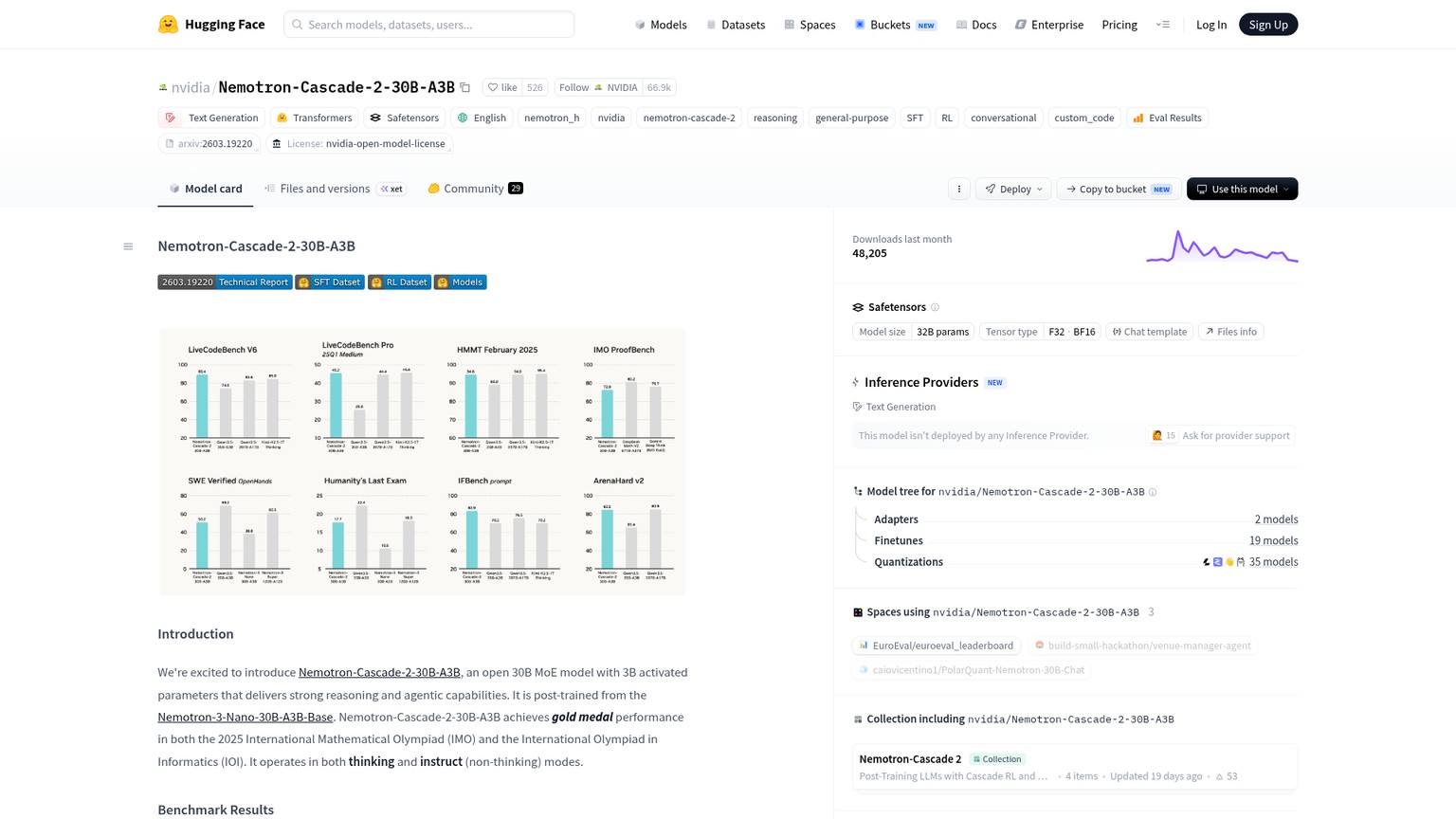
The official NVIDIA model card reports 50.2 on SWE Verified with OpenHands, 21.1 on Terminal Bench 2.0, and 87.2 on LiveCodeBench v6. It supports thinking and instruct modes, up to a 1M-token context, and an OpenAI-compatible endpoint through vLLM.
The deployment fit is easier to reason about than the frontier models. A 32B artifact implies 64GB at BF16 and 16GB at an idealized 4-bit floor. One 80GB A100 costs $1,014.70 per 730-hour month on the live Runpod page. A 24GB card can clear the raw 4-bit number, but long context and concurrency can consume the remaining headroom quickly.
The biggest limitation is not benchmark performance. NVIDIA says the model does not currently support OpenCode and primarily supports OpenHands for agentic coding and SWE tasks. The documented vLLM setup requires version 0.17.1 or later, a specific reasoning parser, a Qwen3 Coder tool-call parser, and trust_remote_code. That is an integration and supply-chain review, not a one-line swap.
A senior operator should choose Nemotron when OpenHands is already accepted, one GPU is the ceiling, and predictable control matters more than broad scaffold portability. Do not choose it because a million-token context sounds like a repository strategy. Retrieval, summarization, cache sizing, and the agent's ability to find the right files still decide whether that context is useful.
Best for: OpenHands-based private software-engineering agents on one data-center GPU.
Standout: 32B total and 3B active parameters, with a documented single-GPU vLLM route.
Pricing: $0 for the weights; one A100 PCIe models to $1,014.70 per 730-hour month.
Free trial: Not applicable; the official weights are downloadable.
- Realistic single-GPU deployment class at BF16 or smaller cards when quantized.
- OpenHands SWE evidence maps to a recognizable agent workflow.
- Thinking and instruct modes let the operator trade latency for deliberation.
- NVIDIA publishes concrete parser and serving requirements.
- No current OpenCode support narrows scaffold portability.
- trust_remote_code deserves a pinned revision and code review.
- One-million-token context can overwhelm memory before it improves task quality.
- The NVIDIA Open Model License is not the same as Apache 2.0.
4. Gemma 4 31B IT: Best for Multimodal Private Code Review
Gemma 4 31B IT is the best choice when the private agent must read code and also inspect screenshots, diagrams, PDFs, or UI states. It is a general multimodal agent model with credible coding ability, not a coding-only specialist.
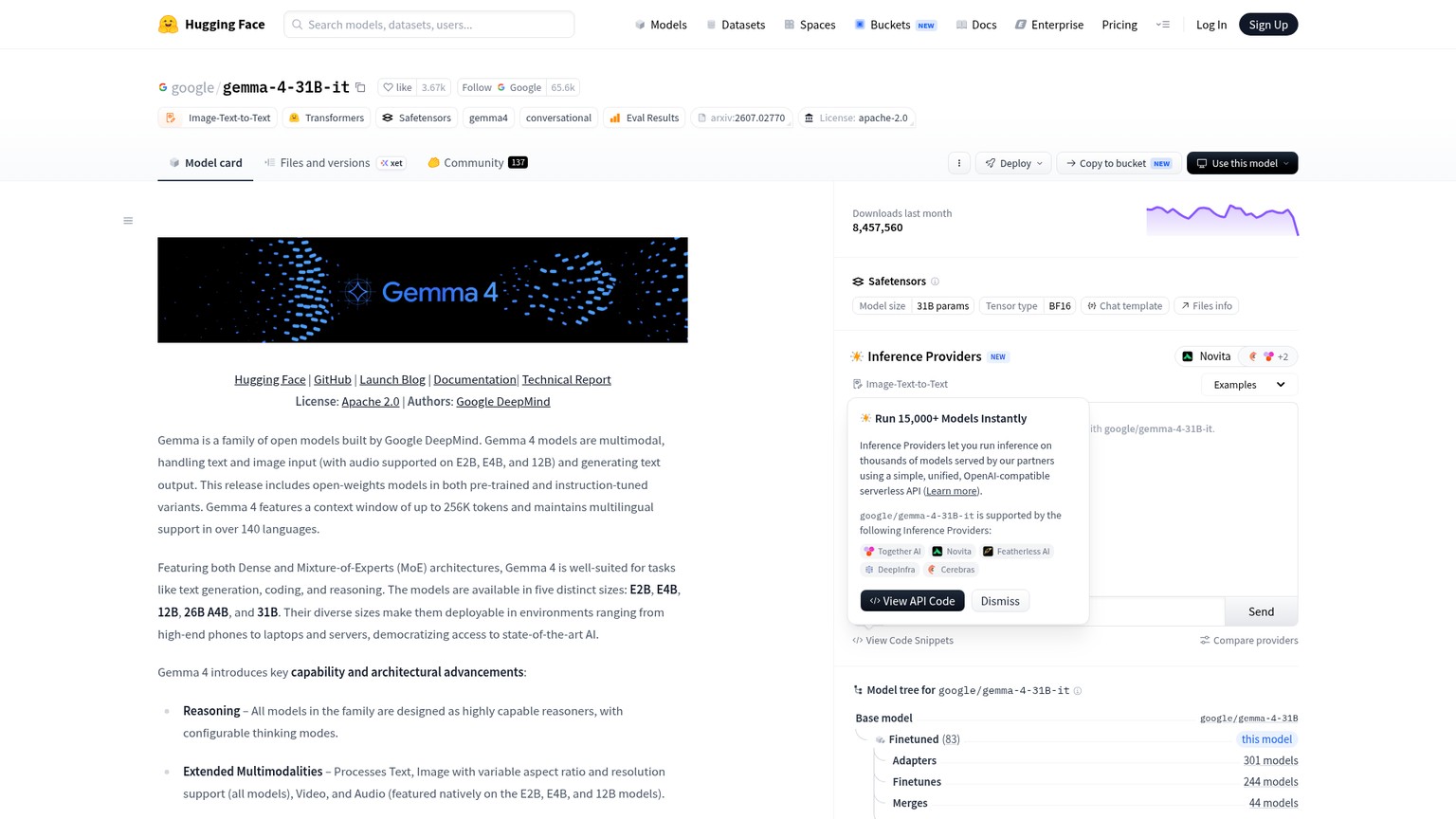
Google's official Gemma 4 31B IT card lists a 30.7B dense model, a 256K-token context, text and image input, native function calling, and support for code generation, completion, and correction. Google reports 80.0% on LiveCodeBench v6, a Codeforces ELO of 2,150, and 76.9% on Tau2.
That capability mix fits a specific workflow: a private product-engineering agent that reads a failing test, compares it with a screenshot, checks a design artifact, and proposes a patch. Qwen can also process vision, but Gemma's 31B footprint and official quantization-aware releases make it easier to place on a workstation or one modest server.
The official Gemma 4 QAT card publishes Q4_0 GGUF and compressed-tensors w4a16 formats and says quantization-aware training preserves similar quality to BF16 while materially reducing load memory. The 30.7B parameter count produces a 15.35GB idealized 4-bit weight floor. Leave room for the vision encoder, cache, runtime, and actual context.
The wall is agent specialization. LiveCodeBench measures code problem solving, not multi-file repository autonomy. Gemma's function calling helps, but the model card does not provide the same OpenHands-oriented software-engineering proof as Devstral or Nemotron. Choose it because the workflow is multimodal, not because 31B is a convenient number.
Best for: Private agents that combine repository work with screenshots, diagrams, or document inspection.
Standout: Multimodal input, native function calling, 256K context, Apache 2.0, and official QAT formats.
Pricing: $0 for the weights; infrastructure depends on precision, context, and concurrency.
Free trial: Not applicable; the official weights and QAT artifacts are downloadable.
- Apache 2.0 is a familiar standard license rather than a model-specific license.
- Vision and function calling support mixed UI-and-code workflows.
- Official QAT artifacts reduce dependence on community conversions.
- The 31B class is accessible to workstation and single-server deployments.
- General coding benchmarks do not prove autonomous repository performance.
- Dense 31B compute can be slower than a similarly stored sparse model.
- The 256K context is smaller than the frontier-scale million-token options.
- Vision input adds its own preprocessing and attack surface.
5. Devstral Small 1.0: Best Local AI Model for Coding
Devstral Small 1.0 is the strongest workstation choice when local means one RTX 4090 or a Mac with 32GB RAM. It gives up vision and frontier-scale context in exchange for a model an individual builder can actually own.
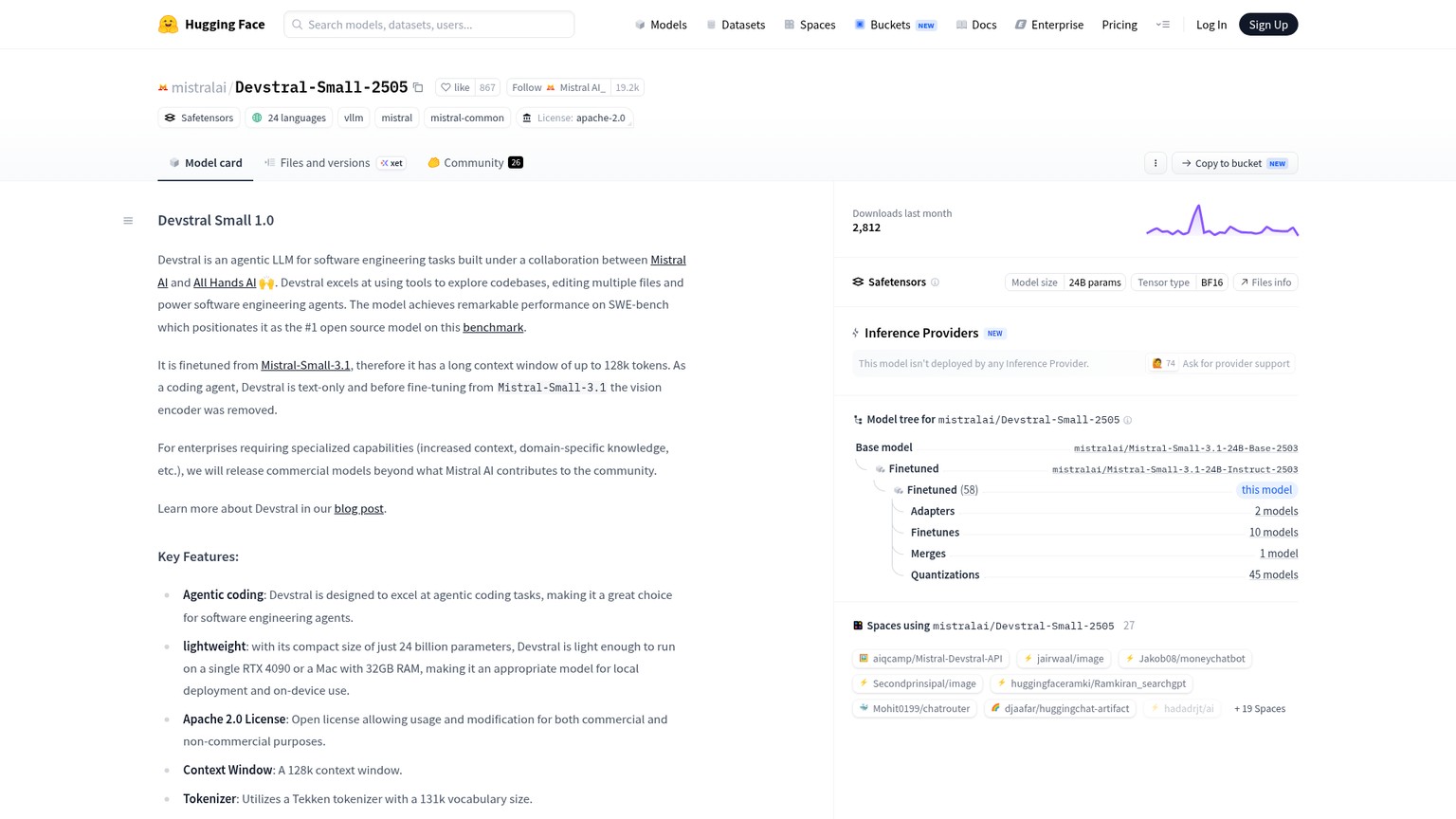
The official Devstral Small 1.0 card lists 24B parameters, a 128K-token context, Apache 2.0 terms, and a text-only architecture. Mistral says it runs on a single RTX 4090 or a Mac with 32GB RAM. It reports 46.8% on SWE-bench Verified using the OpenHands scaffold.
That combination makes Devstral the cleanest first private-agent pilot. A funded founder can put it on an existing workstation, mount one repository into a sandbox, and learn whether model ownership changes the workflow before buying data-center capacity. The deployment ecosystem includes vLLM, mistral-inference, Transformers, LM Studio, llama.cpp, Ollama, and an explicit OpenHands tutorial.
The 128K context is enough for targeted repository slices but not permission to dump an entire monorepo into every prompt. A good agent still searches, opens the relevant files, runs tests, and compresses history. That behavior lowers cache growth and makes the smaller model more usable.
The hard wall is text-only input. Devstral cannot inspect a screenshot of the broken interface or compare a rendered component against a visual brief. Its 2025 checkpoint is also older than the 2026 frontier entries. Maturity helps compatibility, but it does not erase a capability gap.
Best for: Solo technical builders and teams piloting a private repository agent on existing hardware.
Standout: Official one-RTX-4090 or 32GB-Mac fit, OpenHands evidence, Apache 2.0, and a mature local ecosystem.
Pricing: $0 for the weights; an owned workstation has no hourly rental line, while a Runpod RTX 4090 left on for 730 hours models to $540.20 per month.
Free trial: Not applicable; the official weights are downloadable.
- The most practical hardware target in the ranked five.
- OpenHands evidence maps directly to multi-file software-engineering work.
- Apache 2.0 simplifies commercial and modification review.
- Several local runtimes reduce setup dependence on one vendor.
- Text-only input blocks visual debugging and UI review.
- The 128K context is the smallest in this ranking.
- It trails newer frontier models on difficult long-horizon work.
- A consumer GPU still needs an owner for updates, access, logs, and recovery.
For a broader hardware-oriented view, the site's best open-source LLMs ranking separates local, hosted, and specialized model choices beyond coding agents.
Local AI Models for Coding: The Hardware and Budget Map
Self-hosted coding models save money only when the GPU is already owned, used heavily, or required by policy. Renting a private endpoint around the clock usually costs more than a managed coding subscription, especially at the workstation tier.
Runpod's live GPU pricing page lists an RTX A5000 24GB at $0.27 per hour, an RTX 4090 24GB at $0.74, an A40 48GB at $0.44, an RTX A6000 48GB at $0.53, an A100 PCIe 80GB at $1.39, an H100 PCIe 80GB at $2.89, and a B200 180GB at $6.79. Availability, region, storage, networking, and secure-cloud choices can change the real invoice.
Z.ai's live Coding Plan page provides the managed baseline. Monthly list prices are $18 for Lite, $80 for Pro, and $168 for Max. Annual billing shows monthly equivalents of $12.60, $56, and $117.60. Team tiers list $88 per seat for Daily Medium Repo Development and $188 per seat for Daily Medium & Large Repo Development, with annual equivalents of $79.20 and $169.20.
Those are not performance-equivalent products. A plan includes a managed model and quota; a GPU buys time on a machine and leaves the model, serving layer, monitoring, storage, and reliability to you. The comparison still exposes the budget consequence:
- One RTX 4090 at $540.20 per 730-hour month costs more than three $168 Max seats before operations.
- One A100 PCIe at $1,014.70 per 730-hour month costs more than five $188 team seats before operations.
- Five A100s at $5,073.50 per month only reach GLM-5.3's idealized 4-bit raw-weight floor. They do not include the headroom that makes an agent service reliable.

The control premium pays for specific outcomes: no third-party model call, a pinned model version, custom weights, controllable logs, and a failure boundary your team owns. If none of those outcomes matters, the premium has no buyer. Keep the managed plan.
If one does matter, optimize utilization before model size. Shut down development pods when idle. Route routine edits to Devstral or Nemotron and reserve GLM-5.3 for the tasks that earn its cost. Separate interactive latency from batch work. Store prompts and traces under the same retention policy as source code, because private inference with public logs is not private.
How These Were Picked
The five ranked models cleared six requirements: an exact first-party weight artifact, a named license, coding or agent evidence, a documented serving path, enough size information to calculate a memory floor, and a distinct buyer use case. A family announcement without weights did not qualify. A benchmark without its agent context did not decide the order.
All model cards, pricing pages, and license identifiers were verified against live first-party pages on 30 August 2026. The analysis did not exercise the models, subscribe to plans, or claim a production deployment. "Best" here means best fit under the stated decision rule, not a fabricated hands-on test.
The order weights production usefulness more heavily than benchmark breadth:
- Capability: evidence on repository, terminal, tool, or code tasks.
- Deployability: total stored size, active size, precision options, and serving support.
- Agent fit: tool-call format and named scaffold compatibility.
- Control: downloadable weights, version pinning, and license clarity.
- Operations: the infrastructure and ownership required to keep the endpoint safe.
Models were cut when they could only be praised in adjectives, when the artifact was not available, or when their deployment burden did not create a defensible private-agent use case. That last cut is why a very capable model can appear in the avoid section rather than the ranked five.
The Best Open-Source Model for Coding Is Usually Open-Weight
The leading downloadable code model is usually described more accurately as open-weight. The distinction matters because weights answer "can we run it?" while a license and the surrounding release answer "what may we change, redistribute, and use commercially?"
Gemma 4 31B IT and Devstral Small 1.0 carry Apache 2.0 terms. GLM-5.3, Qwen3.8-Flash-Next, Nemotron-Cascade-2, and Kimi K3 use named model-specific licenses. A download button is not a substitute for reading those terms.
Private also needs a systems definition. The model can run in your account while package downloads, telemetry, error reports, prompt logs, or agent tools still cross the boundary. Draw the data flow from repository mount to final trace. Mark every network hop, credential, storage location, and human reviewer. Only then can "private" become a property of the system rather than a label on the model.
The Ones to Avoid
Avoid Kimi K3 for an ordinary private deployment
Kimi K3 is a frontier multimodal model with strong coding evidence, but it is the wrong default for most private-agent buyers because its 2.8T total parameters imply a 1.4TB idealized 4-bit raw-weight floor. That burden overwhelms the practical benefit for a workstation, a single server, or a small platform team.
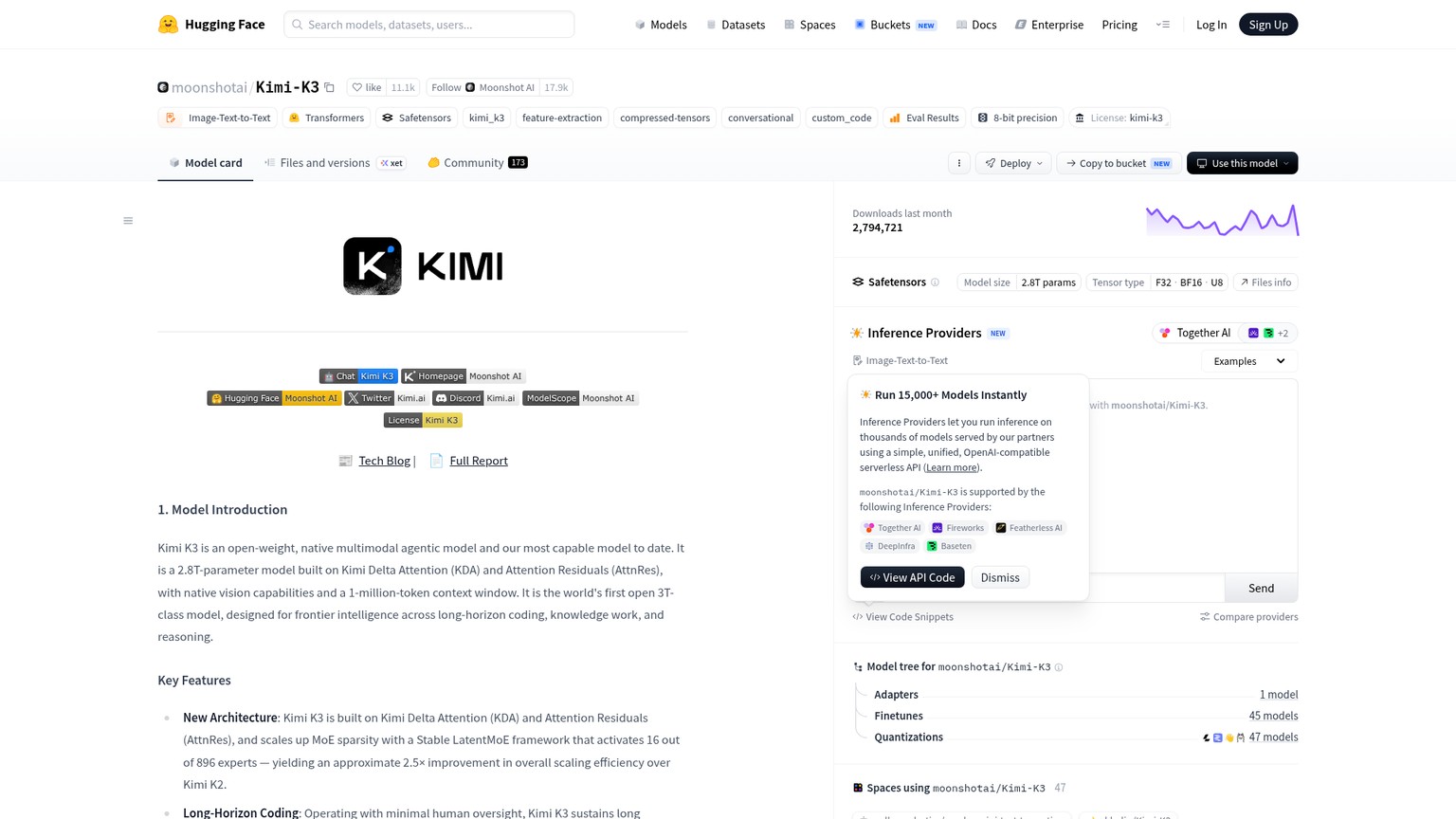
Moonshot's official Kimi K3 card lists 104B activated parameters, a 1,048,576-token context, full weight availability under the Kimi K3 License, and vendor-reported scores of 67.5 on DeepSWE and 88.3 on Terminal Bench 2.1. Those are reasons to consider it for a serious model-serving organization. They are not reasons to call a 2.8T artifact local-friendly.
Avoid Gemma 4 E2B and E4B for autonomous repository changes
Gemma 4 E2B and E4B are impressive edge models, but Google's own LiveCodeBench v6 rows show 44.0% and 52.0%, versus 80.0% for Gemma 4 31B. Use the small variants for constrained assistance, extraction, or device-side workflows. Do not hand them broad write access and expect the 31B model's coding judgment.
Avoid GLM-5.2 for a fresh deployment
GLM-5.2 still makes sense when an existing quantization, integration, or validated workflow depends on it. A new deployment should start with GLM-5.3 because Z.ai reports the same base model, a 50% in-house coding improvement from post-training, and major gains on the family's published agent evaluations. Compatibility is the only clean reason to absorb new operations work around the older checkpoint.
Avoid choosing any model by context length alone
A million-token window is capacity, not navigation. An agent that opens the wrong files can be confidently wrong over a larger prompt. Retrieval quality, tool reliability, compaction, cache cost, and accepted-patch rate matter before the maximum context number.
The Monday Move: Run a 20-Task Control-Premium Pilot
Start next Monday with Devstral Small 1.0 on an existing 32GB Mac or RTX 4090 unless a policy or task already proves you need a larger model. The goal is not to crown a benchmark winner. It is to learn whether model ownership improves the accepted work enough to justify the control premium.
Build a twenty-task set from real repository work, with four tasks in each of five groups: bug diagnosis, bounded feature work, test repair, refactoring, and documentation tied to code. Remove live secrets, preserve the dependency and test environment, and define the accepted result before the model sees the task.
For every run, capture:
- accepted or rejected patch after human review;
- human correction minutes;
- GPU time and peak memory;
- failed and retried tool calls;
- files read, changed, and executed;
- outbound network attempts and permission denials;
- final test result and rollback state.
Run the same set through the current managed baseline. Calculate cost per accepted patch, not cost per token. A cheap run that creates thirty minutes of cleanup is expensive. A larger model that resolves a migration without escalation can be cheap even when its GPU-hour costs more.

The go rule is simple: zero permission-boundary violations, a lower or strategically acceptable cost per accepted patch, and a named owner for the serving stack. If Devstral clears it, stop. If it fails on capability but not integration, move the same task runner to Nemotron, Gemma, Qwen, then GLM-5.3. Escalating model size before the smaller deployment produces evidence only buys a more expensive unknown.
Frequently Asked Questions
What is the best open-source LLM for coding in 2026?
GLM-5.3 is the strongest overall open-weight choice for a frontier private agent, while Devstral Small 1.0 is the practical workstation answer. "Open-source" should be checked against the exact license and artifacts, not inferred from weight access.
Which model is best for coding in 2026?
GLM-5.3 wins this open-weight ranking for maximum capability. Qwen3.8-Flash-Next wins for efficient long loops, Nemotron for one data-center GPU, Gemma for multimodal review, and Devstral for a workstation.
Which is the best open weight coding model?
GLM-5.3 is the best overall when infrastructure can support it. Qwen3.8-Flash-Next is the more deployable frontier-scale alternative, and Devstral Small 1.0 is the local default.
What is the best coding agent in 2026?
A model is not a complete coding agent. The scaffold, shell sandbox, repository tools, permission boundary, tests, compaction, and review loop decide whether the system is production-ready.
Is Claude code the best coding agent?
Claude Code is a capable agent scaffold, but it is not an open-weight model. Several models in this ranking can run behind compatible private endpoints or in other scaffolds, so the best choice depends on the complete controlled system.
Is coding still relevant in 2026?
Yes. Agentic coding shifts more effort toward specification, architecture, testing, security boundaries, and review. Those are coding responsibilities even when a model writes the first patch.
What did Elon Musk say about coding?
That question does not help select a private coding model. The useful evidence is the model artifact, license, agent compatibility, memory fit, and performance on your repository tasks.
What is the best coding language in 2026?
The best language follows the product, runtime, team, and maintenance constraints. A coding model should work inside that architecture decision, not replace it.
How to write “I love you” in coding?
Use a normal string literal in the language you are working in. This question is unrelated to selecting a private coding-agent model.
What is the best local LLM for coding 2026?
Devstral Small 1.0 is the best local workstation choice in this ranking because Mistral documents one RTX 4090 or a 32GB Mac, OpenHands support, and Apache 2.0 terms.
What is the best AI model for coding 2026?
GLM-5.3 leads this open-weight list for frontier private work. The better business choice can still be Devstral, Nemotron, Gemma, or Qwen when hardware, vision, throughput, or scaffold support is the binding constraint.
Get the AI Business Workflow Audit Checklist
Turn one private-agent idea into a scoped workflow with an owner, budget, permission boundary, and stop condition. Subscribe to get the checklist free.
- Last Updated
- Category
- Build
- Language

Firecrawl Pricing 2026: What Your Pages Cost
Firecrawl plans and credit packs verified October 2026. Calculate JSON extraction, failed pages and weekly crawl bills at your volume.Oct 9, 2026Build
Claude Code vs GitHub Copilot 2026
Claude Code vs GitHub Copilot: current plans, usage limits, models, team controls, one-seat and ten-seat costs, and when to use both.Oct 8, 2026Build
LangGraph vs CrewAI
Compare LangGraph and CrewAI on the same approval workflow, state, memory, MCP, observability and current hosted-platform prices.Oct 7, 2026Build
How to Build MCP Server
Build an order lookup MCP server with Python, test it in Inspector, connect Claude Code and Cursor, then add HTTP auth and hosting.Oct 7, 2026Build
Gumloop vs n8n (Verified October 2026)
Gumloop vs n8n: current pricing, credits vs executions, self-hosting and the same AI lead workflow, with a verdict for each builder.Oct 7, 2026Build
AI Agent Frameworks in 2026: LangGraph, CrewAI, OpenAI Agents SDK, Claude Agent SDK, Mastra and Google ADK (Compared)
Compare eight AI agent frameworks by language, state, MCP, approvals and current hosted prices. Pick the right runtime for production.Oct 7, 2026Build
Codex Cloud
Set up a reusable Codex Cloud environment, keep coding tasks running with your laptop off, steer from your phone, and choose cloud or local CLI.Oct 7, 2026Build