Best Persistent AI Workspaces for Multi-Step Tasks 2026
Compare eight persistent AI workspaces on continuity, files, governance, and current pricing. See which one actually cuts restart cost for your team.
Published
 By Omid Saffari


The best persistent AI workspaces for multi-step tasks 2026 do one expensive thing ordinary chat does not: they keep enough state that Monday's work starts where Friday's stopped. ChatGPT Work is the best overall pick, but the budget case comes first: at a $60 loaded hourly rate, 30 minutes of repeated setup each workday costs $600 a month.
Pricing was checked on September 1, 2026. “Starting price” means the first tier that can do the persistent job described, not the cheapest plan with the vendor's logo on it.
Best Persistent AI Workspaces for Multi-Step Tasks 2026: The Short Answer
ChatGPT Work is the best overall persistent AI workspace for mixed business tasks. It has the widest useful combination here: project work that can last for hours, cloud access across web and mobile, local file and app reach on desktop, a built-in browser, scheduled work, finished documents, and a filesystem that has been observed persisting across Work sessions. The catch is equally important: Work Cloud and Work Local are different operating contexts, and giving an agent private data, untrusted web content, and permission to act creates a security problem that no convenience feature erases.
Perplexity Computer takes second place because its persistence story is more explicit. Projects have persistent files, memory, connectors, shared history, and cross-task context. Its September 2026 hybrid-compute release can divide one job between frontier reasoning in the cloud and protected processing on a Mac. That makes it the sharper choice for a research, legal, finance, or strategy workflow where public evidence and private documents must meet. The tradeoff is a second meter: Computer credits sit beside the subscription.
Claude Cowork ranks third for buyers who want strong file handling and a clearer approval posture. Manus and Genspark follow for reusable agent projects and broad deliverable production. Notion and monday.com become better choices when the durable object is not a folder or report but the company's living record of projects, decisions, owners, and status. Close ranks eighth overall and first for one narrow job: sales work that must continue inside the CRM record.
The decision changes on one question: where must the truth survive? If it must survive in files and deliverables, start with ChatGPT Work or Claude Cowork. If it must survive as sourced research while private material stays local, choose Perplexity Computer. If it must survive in the team's operating database, choose Notion or monday.com. If it must survive in the lead and deal record, choose Close.
Persistence Is a Budget Feature, Not a Memory Checkbox
“Memory” is often a preference store: the assistant remembers your role, tone, or recurring interests. A persistent workspace must preserve more. It needs to retain the materials, working state, instructions, permissions, and output trail that let a job continue without rebuilding its operating context.
Use six checks before calling any product persistent:
- Task state: Can a long job keep running, pause safely, or be reopened without losing its work?
- Workspace state: Do the files, instructions, artifacts, and task history survive beyond one conversation?
- Execution reach: Can the agent use the browser, connected apps, or local files required to finish the job?
- Unattended continuity: Does the job continue when the laptop closes, and which local actions stop when the device disconnects?
- Control: Can a person or admin limit access, require approval, review actions, and reverse changes?
- Cost continuity: What happens at the usage limit: a graceful pause with saved work, a blocked new task, a degraded model, or an unknown overage?
Call the repeated briefing and reconstruction the restart tax. It is the paid time spent finding the same source files, restating the same constraints, recreating intermediate work, and checking where a previous session stopped. At 30 minutes per workday across 20 days, it consumes 10 hours. At a $60 loaded hourly cost, that is $600 a month before any missed deadline or inconsistent output enters the calculation.

That $600 is not a savings promise. It is a ceiling for one person's avoidable setup time under stated assumptions. Replace the inputs with a real baseline: how long a recurring task takes to reopen, how often it runs, and whose loaded time it uses. A $200 power-user plan can be cheap if it removes four hours of senior analysis. A $20 plan can be wasteful if a person still spends longer checking the agent than doing the task directly.
Persistence also creates a new liability. The same workspace that can remember a customer folder, continue a browser session, and update a connected system has more opportunity to carry a bad instruction forward. The right purchase therefore preserves useful state and limits authority at the same time. Buyers evaluating managed agent access should also compare the control layer in this guide to AI gateways with managed agent tools.
The Eight Best Persistent AI Workspaces Ranked
1. ChatGPT Work: Best Overall for Mixed Multi-Step Work
ChatGPT Work is the strongest generalist because it combines a long-running agent, connected business context, browser actions, local desktop reach, and finished deliverables in one familiar product.
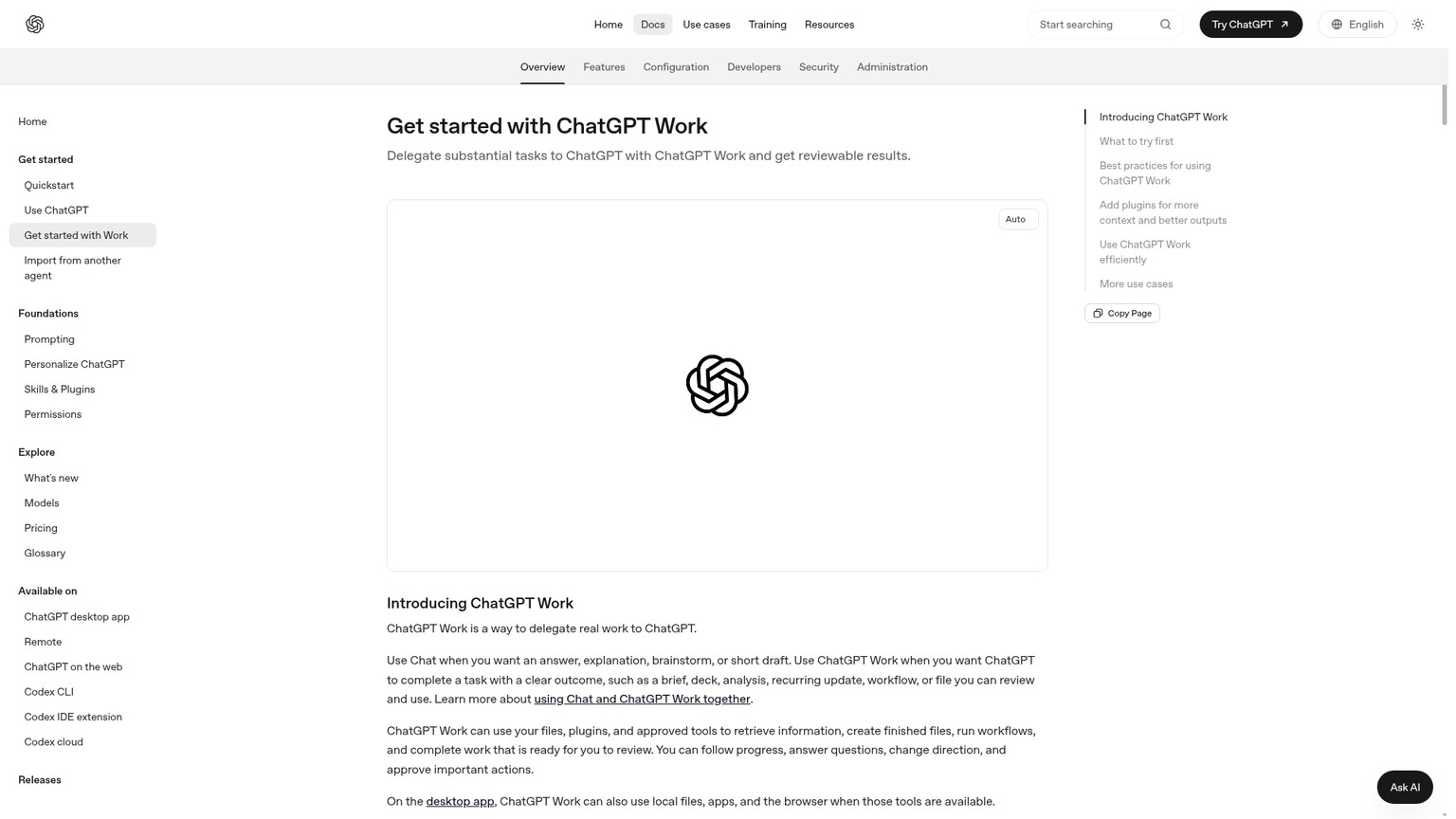
A practical use case is a weekly operating review: pull updates from Slack and email, reconcile them with a spreadsheet, build the narrative, and update a deck or internal site. OpenAI says Work can stay with a project for hours, break it into steps, create sheets, slides, documents, and web apps, and keep scheduled tasks moving when the user is away. That breadth is why it ranks first.
The persistence claim has unusually concrete evidence. In his August 30 analysis, Simon Willison documented that Work session folders persisted across chats and that concurrently running sessions could see edits on a shared /workspace volume. He also found a real boundary: sessions did not share process space, so a local server in one session was not available to another. Files persist; a running process does not automatically become a shared service.
The other boundary is location. Work Cloud can keep moving on OpenAI's infrastructure and follow you across surfaces. Work Local reaches files and programs on the computer. The current Work documentation adds local files and apps, a built-in browser, and Computer Use on desktop. A task that depends on a local folder or desktop app still depends on that environment being available, even if its broader project context lives in ChatGPT.
Best for: Operators, founders, analysts, and builders whose recurring work crosses files, the web, business apps, and multiple output formats.
Standout: The broadest bridge from a natural-language goal to an editable sheet, deck, document, or site, with observed cross-session files.
Pricing: Checked September 1, 2026. Individual plans are Free $0, Go $8/month, Plus $20/month, and Pro from $100/month. Free and Go get limited Work on desktop; Plus and Pro get expanded desktop, web, and mobile access. Business plans are Standard at $20/seat/month annually or $25 monthly, Premium at $100 annually or $125 monthly, and Enterprise at contact-sales pricing.
Free trial: Free and Go provide limited desktop access; full cross-surface Work starts on Plus.
Choose one finished artifact
Start with a recurring output someone already knows how to judge: the weekly pipeline brief, month-end variance deck, launch-readiness report, or customer-research synthesis. Name the output, its owner, and the decision it supports.
Assemble durable context
Create the project, add the source files or approved connectors, and write the standing constraints once. Include the template, date boundary, source-of-truth rule, and what the agent must never change without approval.
Set checkpoints before actions
Ask Work to show its plan, cite source material, and stop before sending messages, changing records, publishing, deleting, or spending money. A persistent agent earns more authority only after its checkpoints are predictable.
Run once without a schedule
Watch where the task asks for missing context, loses a local dependency, or produces an output that is hard to review. Fix the workspace and instructions, not just the final prompt.
Schedule only the stable middle
Automate collection, reconciliation, and draft production. Keep the final decision or external action with a named person until the workflow has a reliable audit trail and failure path.
- Cross-surface Work access on paid individual and business plans
- Observed cross-session filesystem plus local desktop file reach
- Built-in browser, connected apps, scheduled tasks, and several deliverable formats
- Business and Enterprise controls for tools, context, network access, and spend
- Work Cloud and Work Local remain confusingly different environments
- Shared files do not mean shared processes or shared localhost services
- Broad access to private data and untrusted web content raises prompt-injection risk
- Usage for complex work varies, so a seat price is not always the full operating cost
The best reason to choose ChatGPT Work is range, not novelty. It can become the default workspace for several kinds of finished work. The best reason to skip it is the same: if one agent should not touch that many systems, a narrower product with a clearer data boundary is easier to govern. The broader ChatGPT review covers the platform outside this persistent-work decision.
2. Perplexity Computer: Best for Research That Crosses Cloud and Local Data
Perplexity Computer is the best choice when a multi-step job needs current, cited public research and controlled access to private local material.
Its Projects are built around persistence rather than a long chat. Perplexity describes a persistent filesystem, Brain memory across tasks, project-scoped connectors, and shared files, artifacts, and history. Windows users can keep sessions in the background and pick work up between web and desktop. A diligence project can therefore retain the source set, assumptions, work products, and unresolved questions across several research sessions.
The September release changes the buying decision for sensitive work. Hybrid compute on Mac lets the cloud handle planning, web research, and frontier reasoning while a local model processes protected files and on-device actions. A privacy gate can mask data, keep it local, refuse a transfer, or request consent. It requires an Apple silicon Mac on macOS 15 or later with at least 24 GB of unified memory. Portable Computer provides a separate local-first route on NVIDIA DGX Spark, with on-device work carrying no credit charge.
The wall is not capability but metering. Computer prices work in credits: 100 credits currently equal $1, complex tasks typically use 350 to 950, heavy tasks 875 to 2,275, and mega tasks 2,400 to 9,800. Pro includes no recurring monthly Computer allocation. Max includes 10,000. If credits hit zero, active work is saved and pauses, then resumes automatically after a reset or purchase. That is good persistence behavior, but it means the purchasing question is subscription plus task volume.
Best for: Research, strategy, diligence, legal, and finance workflows that must combine live sources with protected files.
Standout: One orchestrated job can divide public reasoning and private local processing without making the user manually split the prompt.
Pricing: Checked September 1, 2026. Standard is $0; Pro is $20/month or $200/year; verified Education Pro is $10/month; Max is $200/month or $2,000/year. Enterprise Pro is $40/month or $400/year per seat; Enterprise Max is $325/month or $3,250/year per seat.
Free trial: Free search tier; Perplexity states that Enterprise Pro and Enterprise Max have no trials.
- Projects keep files, memory, connectors, artifacts, and history together
- Public research remains cited and checkable
- Mac hybrid compute creates an explicit local/cloud privacy boundary
- Credit exhaustion pauses and preserves work instead of cancelling it
- Pro's $20 subscription includes no recurring monthly Computer credits
- Max is a sharp jump to $200/month
- Hybrid compute needs recent Apple silicon and at least 24 GB unified memory
- Brain remains a research preview and is not guaranteed to every Max user immediately
Choose Perplexity over ChatGPT Work when the report's source trail and data boundary matter more than general app breadth. Skip it when the task is mostly internal operations inside one structured system, or when variable task credits are harder to approve than a simpler seat plan.
3. Claude Cowork: Best for Controlled File and Browser Work
Claude Cowork is the strongest alternative for file-heavy work that benefits from visible plans, granular approval choices, and a clear separation between cloud continuation and local access.
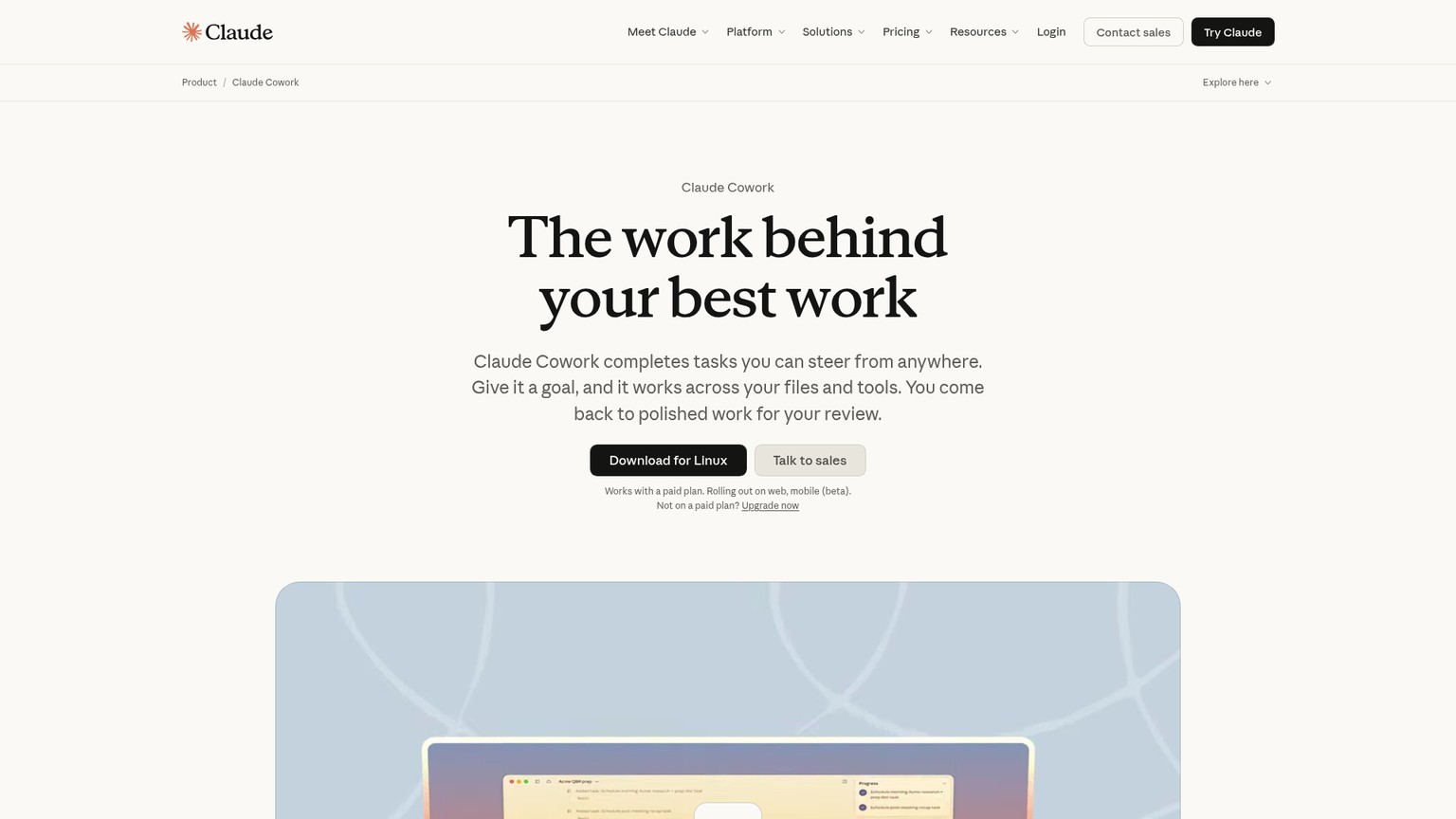
Anthropic says Cowork's cloud sessions and files follow the Claude account across desktop, web, and mobile. Projects hold their own files, links, instructions, and memory. Cloud sessions continue after the laptop closes, and scheduled tasks can run without any device online. That is genuine continuity for a research synthesis, document package, or spreadsheet and presentation workflow.
Local work has a precise limitation. If Claude needs a file, browser, or computer on your machine, Claude Desktop must remain open and connected. The cloud session survives a sleeping laptop, but the local dependency does not. Buyers should split a workflow into cloud-safe work and device-dependent work before they promise unattended completion.
Cowork also provides Manual, Auto, and Skip modes. Manual asks for approval, Auto reviews actions and may find a safer route, and Skip removes that review. Auto consumes more usage. Anthropic explicitly says prompt-injection risk is non-zero, and permanent file deletion requires approval. The product's honesty about those boundaries is a reason to rank it highly, not a flaw to hide.
Best for: Analysts, operations leads, and knowledge workers producing structured files while retaining control over browser and connector actions.
Standout: Cloud sessions keep running and follow the account, while local file access remains available through the desktop bridge.
Pricing: Checked September 1, 2026. Free is $0 but excludes Cowork. Pro is $17/month on annual billing, charged $200 upfront, or $20 monthly. Max 5x is $100/month and Max 20x is $200/month. Team Standard is $20/seat/month annually or $25 monthly; Team Premium is $100 annually or $125 monthly. Enterprise is $20/seat plus usage at API rates.
Free trial: No free Cowork tier; Team and Enterprise purchasing routes are separate from the individual Free plan.
- Persistent Projects with files, instructions, links, and memory
- Cloud sessions continue with the laptop closed and work across devices
- Direct local file access plus browser action when Desktop is connected
- Explicit approval modes and protected permanent deletion
- Device-dependent steps stop when the desktop bridge is unavailable
- Auto approval consumes more usage than the other modes
- Enterprise cloud sessions are off by default and need an admin decision
- The Free plan does not include Cowork
Claude Cowork beats ChatGPT Work when the reviewer wants a more legible approval model and the job centers on files. ChatGPT Work wins when wider connected-app execution and output variety matter more. Teams designing reusable agent capabilities should also compare the architectural choices in Notion skills versus Claude skills for agent teams.
4. Manus: Best for Reusable Projects and Parallel Task Volume
Manus is the best fit for a buyer who wants a persistent project template, a knowledge base, and many concurrent or scheduled agent tasks without starting at a three-figure plan.
Manus Projects store a master instruction and a file-based knowledge base that automatically apply to each new task. That makes a project useful for weekly competitor reviews, repeatable research, content production, or code review where the operating brief should not be rewritten every time. Projects exist on every plan and have no published count limit.
Its wall is subtle and important. An instruction update applies on the next message in an existing task, but a changed knowledge-base file applies only to new tasks. Older tasks retain the project configuration they began with. This protects reproducibility, but it can surprise a team that expects one corrected source file to rewrite every running job.
Collaboration is also task-scoped. Projects and tasks are private by default. A colleague invited to the project receives the shared instruction and knowledge base but sees only tasks they created unless a specific task is separately shared. That is useful privacy for individual work, but it is not the same as one transparent shared queue.
Best for: Agencies, research teams, and operators who repeat the same project setup across many separate tasks.
Standout: A persistent master instruction and knowledge base come with high scheduled and concurrent task counts on Pro.
Pricing: Checked September 1, 2026. Free is $0 with 300 daily credits, 1 concurrent task, and 2 scheduled tasks. The first Pro level starts at $20/month with 4,000 monthly credits. A second Pro level starts at $40 with 8,000 credits and a 7-day trial; both publish 20 concurrent and 20 scheduled tasks. Team starts at $20/seat/month. Manus advertises 17% savings with annual billing on paid plans.
Free trial: Free plan; 7 days on the $40 Pro option.
- Persistent instructions and files apply automatically to new work
- Projects are available on every tier with no published count cap
- Pro supports 20 concurrent and 20 scheduled tasks
- Clear privacy defaults for projects and individual tasks
- Updated project files affect new tasks, not existing ones
- Shared project access does not expose colleagues' tasks automatically
- Credits combine model, virtual-machine, and third-party API use, which makes forecasting less intuitive
- The two Pro price points are not clearly distinguished by memorable plan names
Manus is better than a general chat subscription when task concurrency is the bottleneck. It is weaker than Notion or monday.com when managers need a shared operating record that every person and agent can inspect together.
5. Genspark AI Workspace: Best All-in-One Deliverable Membership
Genspark AI Workspace is the broadest bundle in the ranking, combining multiple model families with slides, sheets, documents, code, storage, and agent products under one membership.
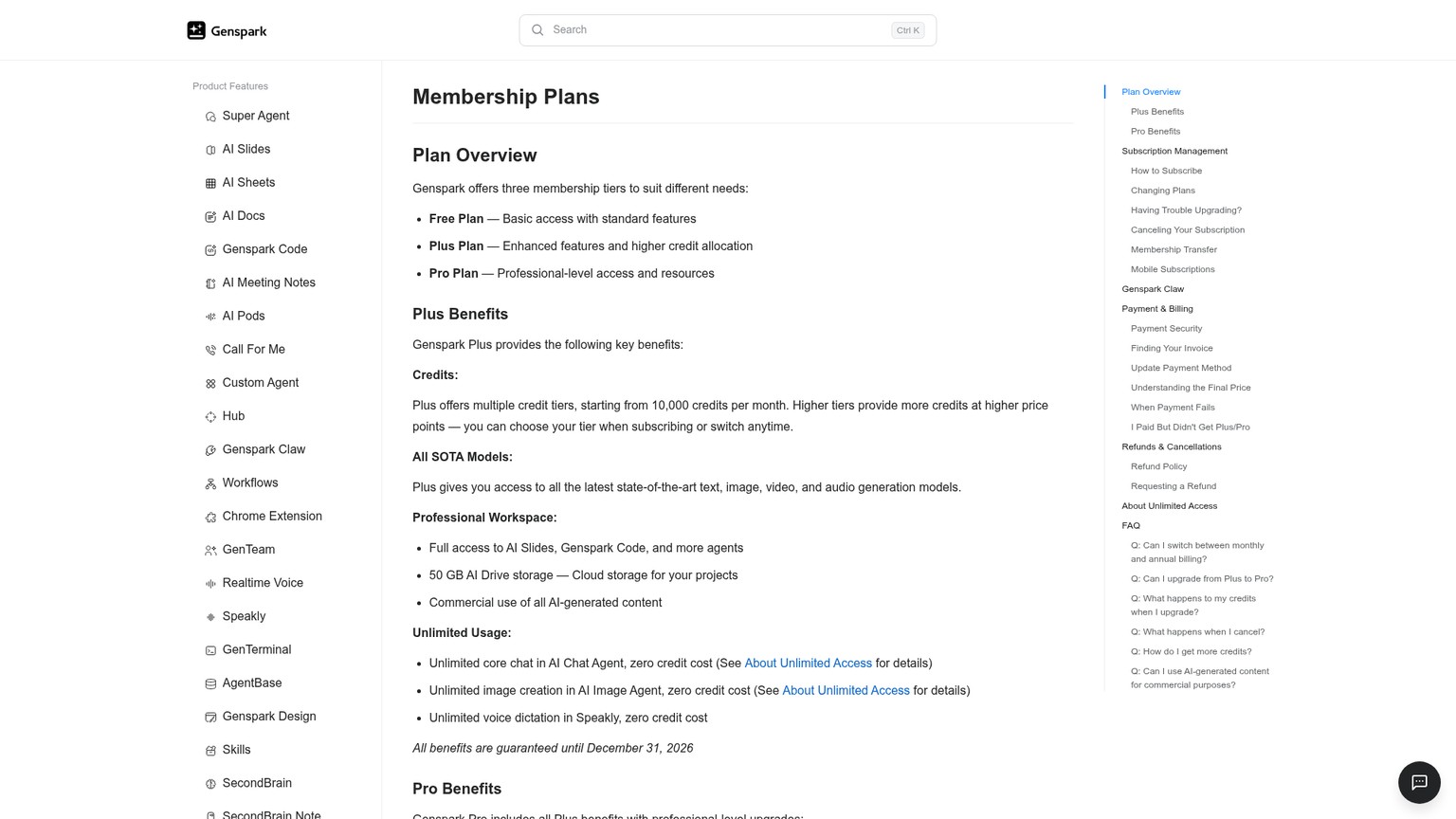
The practical buyer is a small studio or operator who would otherwise maintain several separate subscriptions to produce research, presentations, office files, images, and code. Genspark's current membership materials give Plus 10,000 monthly credits and 50 GB of AI Drive, while Pro gets 125,000 credits and 1 TB. The platform also advertises unlimited core AI Chat and AI Image use under session guardrails through December 31, 2026.
The bundle creates its own wall. Monthly membership credits do not roll over, and the jump from Plus to Pro is ten times the monthly price. Genspark Cloud Computer is a separate subscription, and its official help page says the runtime is reclaimed and its stored data permanently erased after cancellation takes effect. A cloud computer can execute persistently, but it should never be the only archive of valuable work.
This is also the one product whose public membership landing page returned a sign-in shell to the structured scraper. The live official page was read directly and cross-checked against the official help center. That source limitation is worth stating because a buyer should not mistake a dynamic checkout display for a durable pricing guarantee.
Best for: Small studios and multi-format producers trying to consolidate model, office, image, and code subscriptions.
Standout: One paid workspace spans Slides, Sheets, Docs, Code, AI Drive, and a large model catalog.
Pricing: Checked September 1, 2026. Free refreshes 100 credits daily. Plus is $24.99 monthly or $19.99/month on a $239.99 annual charge, with 10,000 monthly credits. Pro is $249.99 monthly or $199.99/month on a $2,399.99 annual charge, with 125,000 credits. Team is $30/seat/month for 2 to 150 users, with 12,000 credits and 60 GB per seat. Enterprise is contact sales.
Free trial: Free plan rather than a timed trial.
- Wide range of models and output types inside one workspace
- 50 GB on Plus and 1 TB on Pro for project artifacts
- Team tier adds centralized billing, roles, analytics, SSO/SAML, and connector controls
- High paid credit allocations for multi-format production
- Plus to Pro rises from $24.99 to $249.99 monthly
- Membership credits reset without rollover
- “Unlimited” chat and image access still has session guardrails
- Cloud Computer storage is erased after cancellation, so backups are mandatory
Choose Genspark when subscription consolidation is the economic goal. Skip it when the company needs a narrow, auditable workflow with one source of truth; breadth then becomes extra surface area to govern.
6. Notion: Best When the Workspace Is Already the Knowledge Base
Notion is the best persistent AI workspace when the company's docs, databases, meeting notes, owners, and operating history already live in Notion.
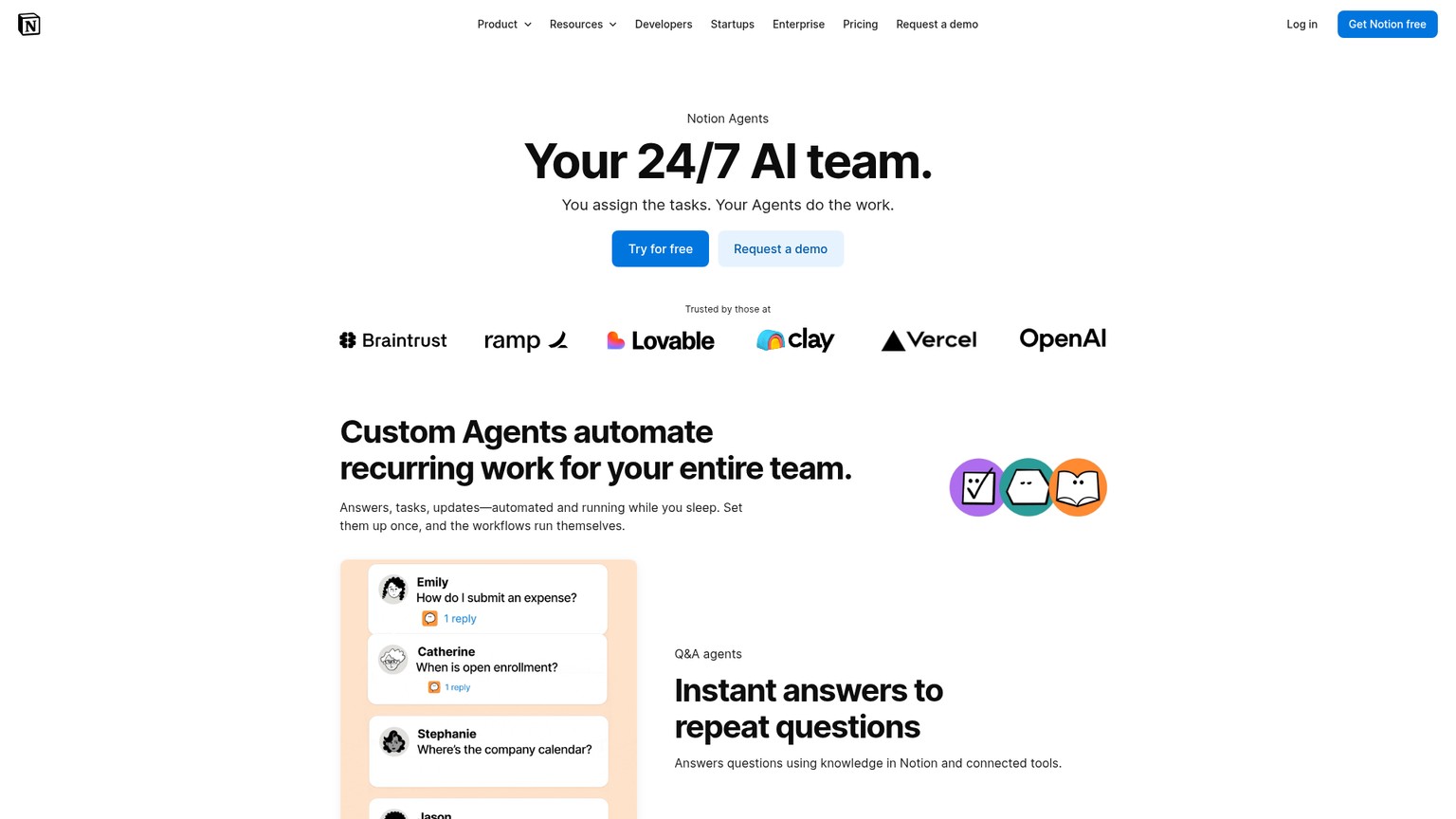
Notion Agent uses existing docs and databases as context, while Custom Agents can run on triggers or schedules across Notion, Slack, Mail, Calendar, and MCP connections. The durable object is the workspace record itself. A status agent can read project pages, create or update database items, draft a weekly summary, and leave the result where the team already works.
The governance model is the stronger reason to buy. Custom Agents receive their own permissions, every run is logged, changes are reversible, and administrators can control who creates agents, what they access, and whether they remain enabled. A workspace built around current, verified pages gives the agent a cleaner source of truth than a folder of loosely named files.
The wall is tier and usage coupling. Custom Agents require Business or Enterprise. A downgrade to Free or Plus switches them off, though it does not delete them. Notion's pricing page lists credits at $10 per 1,000; monthly credits reset and do not roll over.
Notion's published example for 60 status-update runs is about $4.80 to $10.80, but more reading, actions, and advanced models increase the meter. Its credit dashboard shows actual usage after each run.
Best for: Product, operations, and knowledge teams whose process already lives in Notion pages and databases.
Standout: Agent actions inherit a structured, permissioned source of truth with logs and reversible edits.
Pricing: Checked September 1, 2026. Base plans are Free $0, Plus $10/member/month, Business $20/member/month, and Enterprise at custom pricing. Custom Agents are free to try on Business and Enterprise, then use monthly credits at $10 per 1,000.
Free trial: Business trial includes Custom Agents.
- Durable workspace context already exists in pages and databases
- Custom Agents run on triggers and schedules across connected work
- Per-agent permissions, logs, admin controls, and reversible changes
- Published per-run cost ranges make a small pilot forecastable
- Custom Agents require Business or Enterprise
- Credits reset monthly and agents pause at zero
- A messy or stale Notion workspace gives the agent messy or stale truth
- It is not the best tool for arbitrary local-file or desktop-app execution
Notion wins when persistence means organizational memory with controlled updates. It loses when the job must freely research the web, manipulate local folders, and create several kinds of standalone deliverables outside the workspace.
7. monday.com: Best for Governed, Structured Workflow Execution
monday.com is the best option when an agent's state should be visible as rows, owners, dates, dependencies, and status inside a managed work system.
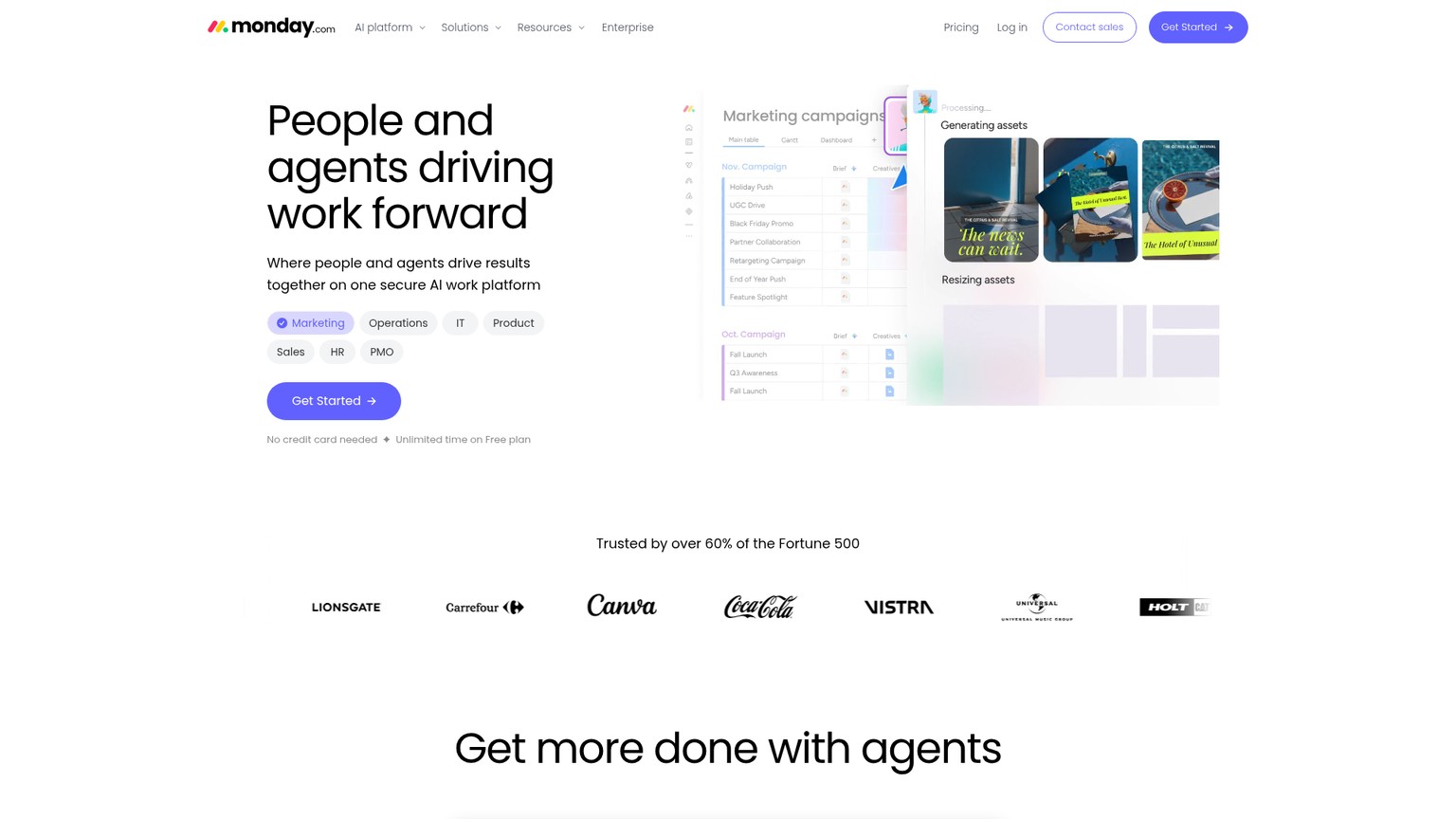
The concrete use case is intake triage: read a request, classify it, create or update a work item, assign an owner, notify the requester, and keep the board current. That is less free-form than ChatGPT Work, but easier for a manager to audit. monday.com publishes active AI workflow limits of 3 on Standard, 20 on Pro, and 250 on Enterprise.
Its cost model is unusually legible at the base-plan level. The annual 10-seat examples on the live pricing page are $90 a month for Basic, $120 for Standard, and $190 for Pro. Those tiers include 1,000, 2,000, and 3,000 monthly AI credits respectively. Agent runs then vary from roughly 10 to 50 credits for simple tasks, 50 to 150 for intermediate work, 150 to 250 for complex work, and 250 or more for extra-complex work.
The wall is that structured persistence requires structured implementation. Someone must own board design, field quality, permissions, error states, and exceptions. A free-form research project will feel constrained. A repeatable operation with clear records will feel safer.
Best for: Operations teams that need agents to update visible work records with owners, permissions, and workflow limits.
Standout: Persistent state is inspectable in the same boards humans already manage.
Pricing: Checked September 1, 2026. monday.com plans are Free $0 for up to 2 seats, Basic $9/seat/month annually with 1,000 credits, Standard $12 with 2,000, Pro $19 with 3,000, and Enterprise at custom pricing.
Free trial: 14-day Pro trial.
- Work state is visible in structured boards instead of hidden in one agent thread
- Standard, Pro, and Enterprise publish clear active workflow caps
- Included credits and published task ranges support an initial forecast
- Admins receive warnings at 80% and 100% of credit use
- Requires deliberate board and workflow design before the agent is useful
- Extra-complex tasks can consume 250 or more credits per run
- Free-form research and local-file manipulation are not its strongest jobs
- Some AI work pauses after the credit limit, so owners need a top-up or fallback rule
monday.com beats Notion when process structure, ownership, and workflow orchestration matter more than flexible knowledge pages. Notion wins when writing, research context, and team knowledge are the center of gravity.
8. Close: Best Specialist Workspace for Persistent Sales Follow-Up
Close is the specialist choice for persistent sales work because the agent, workflow, communication history, and deal state live in the same CRM record.
This site has an active partner relationship with Close. That does not make Close a general-purpose workspace, which is why it ranks eighth overall. It earns a place because a sales team has a different persistence requirement: every call, email, SMS, task, qualification result, follow-up, and owner change must survive on the lead and opportunity record.
Close Workflows can sequence email, SMS, calls, and tasks until steps finish or a goal stops the sequence. Chloe can work inside that system, and the CRM remains the human-readable source of truth. A research agent may produce a better account brief elsewhere, but a sales agent is incomplete if its result never updates the record reps use.
The wall is the real starting tier. Solo and Essentials include Chloe features but not Workflows. Persistent automated follow-up starts on Growth at $99 per user on annual billing, before telephony and extra AI credits. Close separates the CRM subscription, telephony, and AI credits into three billing areas, so a forecast based only on seats is incomplete.
Best for: Founder-led and small sales teams that need AI-assisted follow-up to remain attached to CRM history and pipeline state.
Standout: Communication, workflow, AI action, and deal context stay in one sales system of record.
Pricing: Checked September 1, 2026. Close plans are Solo at $19 monthly or $9 annually with 500 credits; Essentials at $49 or $35 with 1,000 credits per user; Growth at $109 or $99 with 1,500; and Scale at $149 or $139 with 2,000. AI credit subscriptions start at $20 for 1,200 credits and reach $10,000 for 1,000,000; telephony is separate.
Free trial: 14 days, plus a 30-day money-back guarantee.
- Sales history, communication, tasks, and AI actions share one CRM record
- Workflows can continue until steps finish or a goal stops them
- Core Chloe Chat, AI Search, Knowledge Sources, and Notetaker do not consume AI credits
- The 14-day trial includes calling and AI credits for a realistic workflow check
- Workflows require Growth or Scale, not Solo or Essentials
- Seats, telephony, and AI credits are separate cost lines
- Voice, enrichment, and auto-updates pause when AI credits hit zero
- It is a specialist sales workspace, not a general multi-step research environment
Close belongs here precisely where it honestly fits. Pick it when the persistent object is a lead, a deal, and the next sales action. Do not pick it to build decks, run broad web research, or manage product work.
Who Should Pick What
The explicit decision rule is choose the system that already owns the state the agent must preserve. Model quality matters, but moving the source of truth into a new tool creates another synchronization problem.

Choose ChatGPT Work when the job crosses several kinds of information and must end as a polished artifact. It is the best default for a founder preparing a board update, an analyst reconciling files and public context, or an operator converting scattered inputs into a repeatable deliverable.
Choose Perplexity Computer when citations and local privacy are both hard requirements. Its Projects, Brain, and hybrid compute make the strongest case for research that must combine fresh public evidence with protected local records.
Choose Claude Cowork when direct file work and approval posture decide the purchase. It is the better fit for a reviewer who wants cloud continuity but also wants the exact local dependency and action boundary made visible.
Choose Manus for reusable project setup and many concurrent or scheduled tasks. Choose Genspark AI Workspace when consolidating model and deliverable subscriptions matters more than creating one narrow, governed workflow.
Choose Notion when the company knowledge base is the source of truth. Choose monday.com when the source of truth is a structured board with owners and workflow state. Choose Close only when the source of truth is the sales CRM.
The flip point between a generalist and a system-of-record product is review. If the reviewer wants a report or file, the generalist usually wins. If the reviewer wants to inspect every changed record, owner, trigger, and status in the operating system, Notion, monday.com, or Close wins.
How These Were Picked
These products were compared, not hands-on tested. The evidence comes from current vendor pricing pages, product documentation, help centers, release notes, and one named independent observation of ChatGPT Work's filesystem behavior. That is a narrower claim than “tested,” but it makes every price, limit, and capability checkable.
The ranking applies six filters in order:
- A durable project, workspace, file system, or business record must survive more than one chat.
- The product must carry a multi-step job forward, not merely remember preferences.
- Its execution boundary must be named: cloud, browser, connectors, local device, or structured record.
- A buyer must be able to identify approvals, permissions, logs, or a clear human checkpoint.
- Current base tiers and usage meters must be public enough to build a real monthly budget.
- The failure behavior at a limit must be knowable, especially whether work pauses, disappears, or continues to incur cost.
Chat-only model wrappers were cut because one history sidebar is not a persistent execution workspace. Tools with no verifiable current price or no named durable project model were cut because a buyer cannot compare the consequence. Products that excel at building custom agent systems were also cut when they required a separate implementation project; this page ranks workspaces a team can adopt, not platforms a developer must assemble.
The order is deliberately not a feature count. ChatGPT Work ranks above a more explicit project system because it covers the widest useful work. Perplexity ranks above a cheaper product because its current local/cloud architecture solves a harder data-boundary problem. Close appears only in the specialist slot despite the partner relationship. That is the kind of constraint a useful buying guide should expose.
The Plans to Avoid for Persistent Work
Avoiding the wrong tier saves more money than negotiating the right tool. Four plans look cheaper but fail the persistent job described here.
- ChatGPT Go for cross-surface Work: Go costs $8 but has only limited desktop Work. Plus at $20 is the first individual tier with expanded Work on desktop, web, and mobile. Buy Go for more ChatGPT, not as the operating tier for a persistent multi-device workflow.
- Perplexity Pro for a fixed recurring Computer budget: Pro is $20 but includes no monthly Computer credits. It is sensible for search and occasional purchased tasks. Max or an Enterprise tier is easier to forecast when Computer runs every week.
- Notion Plus for Custom Agents: Plus costs $10 per member, but Custom Agents require Business or Enterprise. Downgrading switches existing Custom Agents off. The relevant starting price is Business at $20, plus credits.
- Close Essentials for automated follow-up: Essentials includes CRM and Chloe features but not Workflows. Growth at $99 per user annually is the first tier for the persistent sales sequence described here.
The same rule applies to every vendor: compare the first capable tier, not the cheapest logo-bearing tier. A table that says “starts free” can hide the entire budget consequence.
The Monday Move
Start with one recurring workflow that currently loses context. Good candidates are a weekly operating review, competitive brief, customer-feedback triage, account-preparation packet, or sales follow-up sequence. Name one owner and one finished result. If neither is clear, persistence will only preserve confusion.
Measure the current restart time before adding software. Record how long it takes to find inputs, restate constraints, reproduce intermediate work, and check the last version. Use actual loaded labor, not a generic $60 assumption, in the approval case.
Then write a short persistence contract for the workflow:
- Which files, records, and connected apps are authoritative?
- Which state must survive between runs?
- Which steps may continue unattended?
- Which actions always require approval?
- What happens when the device disconnects or credits reach zero?
- Where does the reviewer see the final artifact and action history?
Choose the workspace from that contract. A mixed deliverable points to ChatGPT Work. A sourced research process with local private files points to Perplexity Computer. A controlled file job points to Claude Cowork. A record-centered workflow points to Notion, monday.com, or Close.
Run the first cycle manually with every checkpoint visible. Fix missing sources and unsafe permissions before adding a schedule. Set the smallest sensible credit or spend limit, name the person who receives the warning, and define whether the workflow pauses, falls back to manual work, or skips a nonessential step.
By Friday, compare three numbers: restart time before, review time after, and total seat plus usage cost. Keep the tool only if the workflow is faster or more reliable after review, not merely faster before it. The Monday decision is one workflow, one owner, one source of truth, one approval boundary, and one budget cap.
Frequently Asked Questions
What is the best AI workstation in 2026?
If “workstation” means software for persistent multi-step work, ChatGPT Work is the best general choice in this comparison. If it means physical hardware for running models locally, that is a separate decision involving GPU memory, power, model size, and the local software stack; Perplexity Portable Computer currently supports NVIDIA DGX Spark, while its Mac hybrid route needs Apple silicon, macOS 15 or later, and at least 24 GB unified memory.
Which AI is best for repetitive tasks?
monday.com is best when the repeated task changes structured work records, Notion when it changes a knowledge workspace, and Close when it changes CRM state. ChatGPT Work is stronger for repetitive work that ends in varied deliverables such as reports, decks, spreadsheets, or sites.
What is the 30% rule in AI?
There is no universal 30% rule for choosing an AI workspace. Treat any such heuristic as a starting hypothesis, then measure saved setup time, review time, error cost, and monthly seat plus usage cost on one real workflow.
Which is the best AI platform in 2026?
No platform is best across every job. ChatGPT Work is the best overall persistent workspace here; Perplexity Computer leads for cited research with a local/cloud boundary; Notion and monday.com lead when the durable record already lives in their systems.
What AI is better than ChatGPT?
Perplexity Computer is better than ChatGPT Work for a workflow dominated by cited web research and controlled local processing. Claude Cowork can be better for file-centered work with explicit approval modes. Neither is universally better across all tasks.
Which AI is better in 2026, Gemini or ChatGPT?
ChatGPT has the stronger persistent execution workspace for the mixed tasks ranked on this page. Gemini can be the more natural choice when the job and permissions already live entirely inside Google Workspace. Compare the workflow, not only the underlying model.
Which AI is more powerful than Gemini?
“Powerful” can mean model reasoning, tool reach, local execution, context, governance, or finished-work reliability. ChatGPT Work, Claude Cowork, and Perplexity Computer each beat a model-only comparison by adding a workspace and execution layer, but the winner changes with the job.
What can I replace Gemini with?
Replace Gemini with ChatGPT Work for mixed execution and deliverables, Claude Cowork for controlled file work, or Perplexity Computer for research-heavy jobs. If the real need is persistent records rather than a general assistant, choose Notion, monday.com, or Close instead.
Is Gemini outperforming ChatGPT?
No blanket claim is defensible because model and product performance changes by task. For a purchasing decision, compare the same recurring workflow on output quality, preserved context, review burden, failure behavior, and total monthly cost.
Audit the Workflow Before You Buy the Workspace
The durable workspace should follow a durable process. Get the AI Business Workflow Audit Checklist free to define the source of truth, owner, approval boundary, and budget cap before another agent enters the stack.
- Published
- Category
- Build
- Language

CLAUDE.md: Write It Once, Start Every Session Right
Write a useful CLAUDE.md, scope project rules, and manage Claude Code auto memory with a 35-line starter and a monthly cleanup routine.Oct 11, 2026Build
Jev Alternatives in 2026: OpenAI, Microsoft, Clef, d1, Perplexity and Strands (Compared)
Compare Jev alternatives by job, maker-verified input pricing, licences and deployment: OpenAI, Microsoft, Clef, Liquid d1, Perplexity and Strands.Oct 11, 2026Build
OpenAI Decisions API
Use OpenAI Decisions API for ticket routing, labels, and action gates. Three guide requests, refusal handling, pricing, limits, and when to keep your LLM.Oct 11, 2026Build
Claude Code Remote Control
Set up Claude Code Remote Control from CLI, VS Code or Desktop, connect your phone or browser, and fix documented login and connection failures.Oct 9, 2026Build
Cursor Remote Control
Set up Cursor Remote Control on iPhone, pair your laptop, keep local agents reachable, and compare cloud agents, Claude Code and Codex.Oct 9, 2026Build
Firecrawl Pricing 2026: What Your Pages Cost
Firecrawl plans and credit packs verified October 2026. Calculate JSON extraction, failed pages and weekly crawl bills at your volume.Oct 9, 2026Build
Claude Code vs GitHub Copilot 2026
Claude Code vs GitHub Copilot: current plans, usage limits, models, team controls, one-seat and ten-seat costs, and when to use both.Oct 8, 2026Build