Claude Code vs GitHub Copilot 2026
Claude Code vs GitHub Copilot: current plans, usage limits, models, team controls, one-seat and ten-seat costs, and when to use both.
Published
 By Omid Saffari



Claude Code vs GitHub Copilot comes down to where you want an agent to work: choose GitHub Copilot for daily editor help and GitHub-based team controls, or Claude Code for terminal-led refactors and scripting. For a solo developer, Copilot Pro costs $10/month and Claude Pro costs $20/month; ten managed monthly seats start at $190 for Copilot Business versus $250 for Claude Team Standard, before additional usage.
Prices and plan details verified against GitHub's Copilot plans page and Claude's pricing page on 8 October 2026, with the makers' documentation used for purchase minimums, model access and billing rules. All prices below are USD, before tax. Recommendations reflect documented workflows and calculated costs; no coding benchmark was run for this comparison.
Claude Code vs GitHub Copilot: Which Should You Pick?
Pick Copilot when your editor and GitHub account are the center of the work. Pick Claude Code when you want to delegate a repository task through the terminal and control how it runs. Both can edit multiple files and run commands, so the decision needs more than an autocomplete-versus-agent label.
The rule that flips the choice is where you want to supervise the task. If the job begins with an issue and ends with a pull request on GitHub, Copilot is the natural first purchase. If it begins with a local repository, shell tools and a large implementation brief, Claude Code is the stronger workflow fit. Those are buying judgments, not claims that either writes more correct code.
At a Glance: Price, Agents and the Dealbreaker
Claude Code is Anthropic's coding agent, available through a CLI and other interfaces. GitHub Copilot combines editor assistance with local and hosted coding agents. Compare the execution workflow and allowance you will buy, rather than the model name alone.
The criteria behind the verdict are execution location, model access, administrative fit and the behavior when you exhaust usage. A long feature list matters less than a clear answer to those questions.
GitHub Copilot Pro vs Claude Code: Plans and Costs at One and Ten Seats
Copilot has the lower entry bill; Claude's included allowance cannot be converted into a guaranteed number of Copilot requests or tokens. For a team, use managed plans when you need central billing and policies. Multiplying individual subscriptions does not add those controls.
GitHub Copilot plans and their current usage limits
GitHub Copilot's current individual plans include AI credits, a balance consumed by model work. One AI credit represents $0.01. The public plans page distinguishes the subscription charge from the larger current allowance.
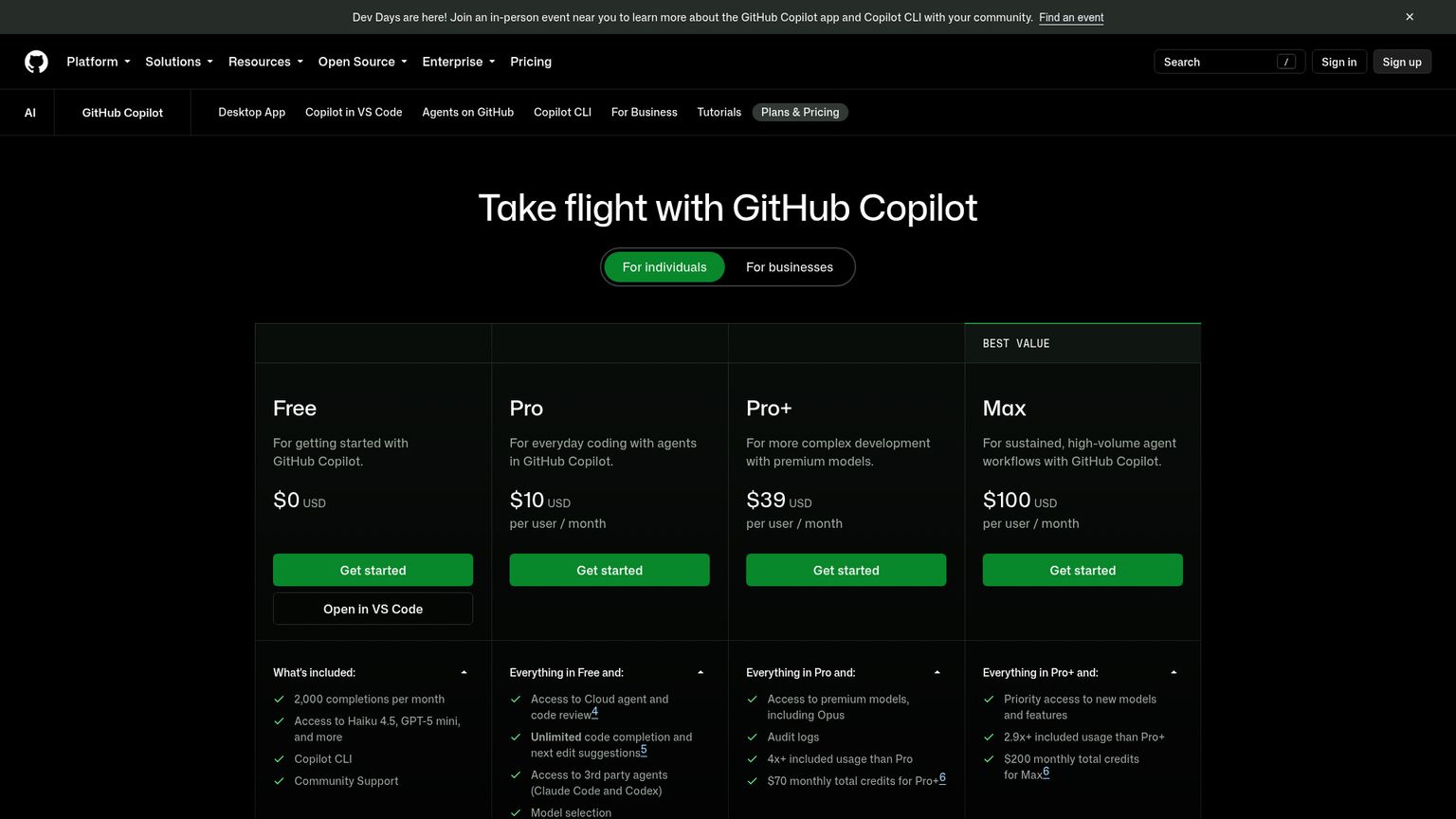
- Free: $0. Includes 2,000 code completions per month and limited chat/agent usage. The current page does not promise a fixed count of agent prompts. CLI access is included.
- Pro: $10/month. Includes 1,000 base credits plus 500 variable flex credits, currently 1,500 credits worth $15. Ten individual subscriptions cost $100/month.
- Pro+: $39/month. Includes 3,900 base plus 3,100 flex credits, currently 7,000 credits worth $70. Ten individual subscriptions cost $390/month.
- Max: $100/month. Includes 10,000 base plus 10,000 flex credits, currently 20,000 credits worth $200. Ten individual subscriptions cost $1,000/month.
Those allowance totals are verified on GitHub's individual billing page. Flex allotments can change. Free and the no-cost Student plan use automatic model selection; Student includes unlimited completions and excludes third-party agents. See GitHub's plan documentation.
For managed seats, Copilot Business costs $19 per user per month and contributes 1,900 credits per seat. Copilot Enterprise costs $39 and contributes 3,900 credits; it requires GitHub Enterprise Cloud. At ten seats, the respective bills are $190 and $390, with pools worth the same amounts. Pooling lets heavier users consume unused capacity from lighter users. These seat charges are additional to your underlying GitHub plan. Organization plan prices.
Paid code completions and next edit suggestions are unlimited and do not consume AI credits. Chat, agent mode, CLI and hosted agent work do. Unused credits do not roll over. When additional usage is permitted, token consumption above the allowance adds to the invoice. Copilot billing rules.
Premium requests are now a legacy billing case. GitHub switched to AI credits on 1 June 2026. Some existing annual Pro and Pro+ subscribers remain on premium-request billing, with their own allowances and model multipliers. Check your account's billing system before applying a request-count calculation; a new credit allowance is not a monthly prompt count. Legacy billing transition.
For the longer plan-by-plan breakdown, use our GitHub Copilot pricing guide.
Claude plans and the limits shared with Claude Code
Claude Code is included with Claude Pro, Max and current Team seats. Claude's price buys access to a shared usage allowance, rather than a published fixed token balance.
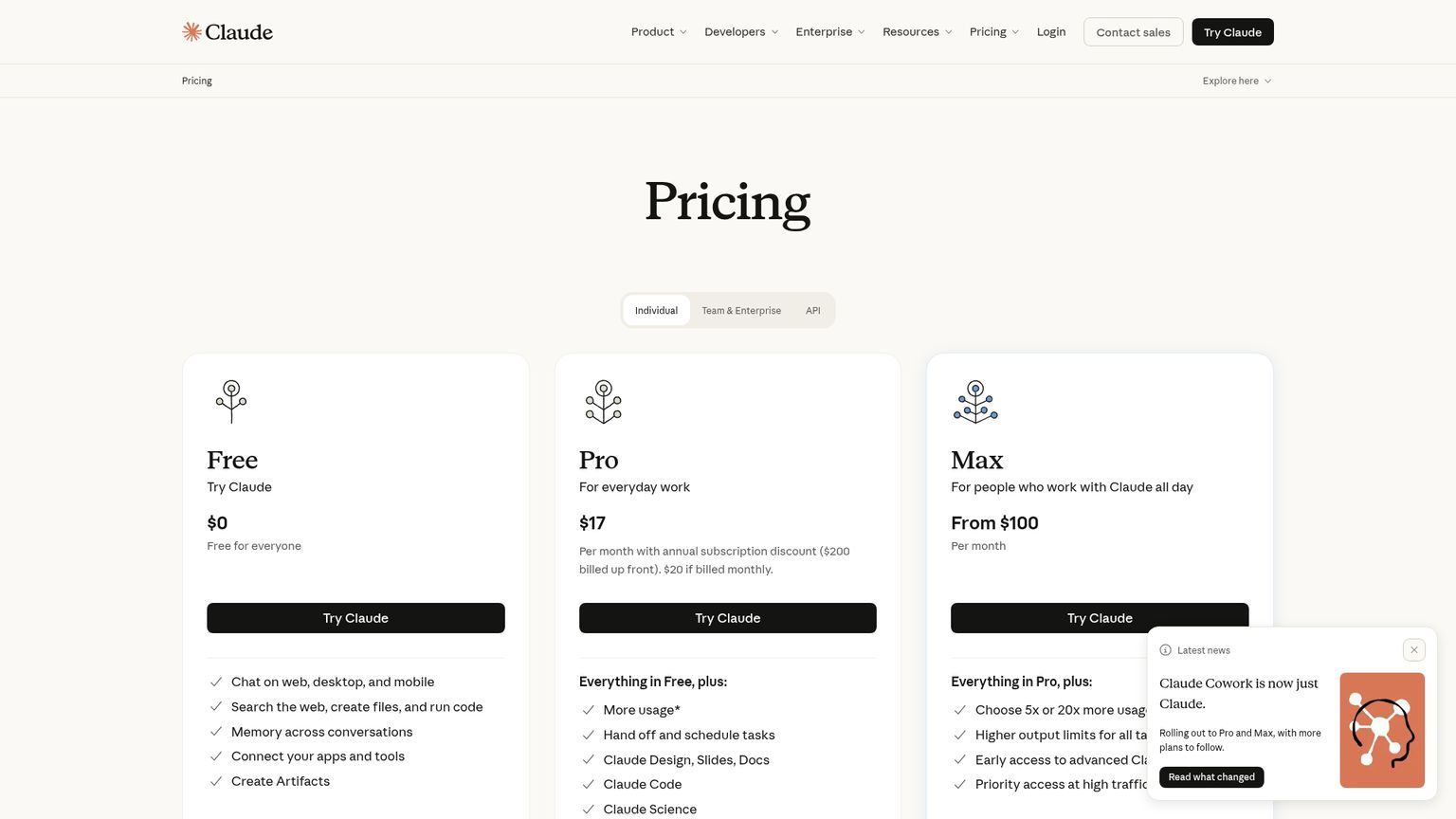
- Free: $0. The Claude app's free plan does not include Claude Code.
- Pro: $20/month. Annual billing is $200 paid upfront, advertised as $17/month. Ten monthly individual subscriptions cost $200; they do not provide Team administration.
- Max 5x: $100/month. Provides five times Pro's per-session allowance. Ten individual subscriptions cost $1,000/month.
- Max 20x: $200/month. Provides twenty times Pro's per-session allowance. Ten individual subscriptions cost $2,000/month. The exact Max tier prices are stated in Anthropic's Max help page.
- Team Standard: $25 per seat monthly, or $20 with annual billing. More usage than Pro. Ten seats cost $250/month on monthly billing, or $200/month equivalent with a $2,400 annual seat commitment.
- Team Premium: $125 per seat monthly, or $100 annually. Five times Standard's usage. Ten seats cost $1,250/month monthly, or $1,000/month equivalent with a $12,000 annual seat commitment.
Team supports 2 to 150 seats, permits mixed seat types, and includes Claude Code on Standard as well as Premium. The smallest monthly Standard purchase is therefore $50, not a single $25 account. Claude Team pricing, Claude Code access by seat.
New Claude Enterprise plans cost $20 per seat per month, billed annually, plus usage at API rates. The seat fee includes no model usage. Self-serve Enterprise requires at least 20 seats; sales-assisted purchasing starts at 50. A ten-person company therefore faces at least $400/month equivalent and $4,800 in annual seat fees, plus usage, on the self-serve route. It cannot purchase a ten-seat Enterprise plan for $200. Enterprise purchase minimums, Enterprise billing.
Claude's included-usage plans use rolling five-hour windows, with weekly limits on paid plans. Conversation length, model, complexity and features affect consumption; Anthropic does not provide a fixed message count. Claude app activity and Claude Code usage draw from the same allowance. Max's 5x or 20x multiplier describes session capacity, not guaranteed uninterrupted coding hours. Claude pricing and usage FAQ.
When you exhaust the allowance, you can wait, upgrade, or enable usage credits billed at API rates. Those credits can have a monthly spending cap. If a developer uses Claude heavily for documents before starting a refactor, the remaining coding allowance is lower. Usage credits for paid Claude plans.
One credit benefit needs special care: monthly API credits included with Max or Team cannot be spent in Claude Code or the Claude apps, including extra usage. They do not erase your Code overage bill. Pro/Max access and billing, Team access and billing.
Our Claude Code pricing guide covers the subscription-versus-API decision in more detail.
The Same Claude Model: Token Cost and the Upgrade Crossovers
The same Claude Sonnet 5.5 token bundle has the same published model price through Copilot and Anthropic's API. The subscription allowance changes the invoice. A token is a unit of text processed by a model; agent work consumes input as it reads context and output as it responds.
Both makers quote $2 per million uncached input tokens and $10 per million output tokens for Claude Sonnet 5.5. Normalized, that is $0.002 per 1,000 input tokens and $0.010 per 1,000 output tokens. Anthropic rates, GitHub model rates.
Take a hypothetical bundle of 100,000 uncached input tokens and 10,000 output tokens. Its cost is $0.20 input plus $0.10 output, or $0.30 through either route. In Copilot, that is 30 AI credits. This isolates model consumption: it excludes caching, tool charges, Actions minutes and tax. It is a defined token bundle, not a measured average coding task.
For 100 bundles in a month, the raw model cost is $30. Claude Code authenticated to an API account incurs $30 of model usage. Copilot Pro's invoice is $25 when additional usage is enabled: $10 subscription plus $15 beyond its current $15 allowance.
Claude Pro could instead remain $20 if that workload fits its included limits. Its public allowance does not let us prove that it will. Account activity and the timing of the work matter, so equating a Claude subscription to a fixed quantity of Copilot credits would create false precision.
At ten developers using 100 bundles each, the combined raw model cost is $300. Copilot Business costs $300: $190 in seats plus $110 above the pooled allowance. Claude Team Standard starts at $250, but stays there only if each developer fits their included usage; any usage credits add to that total. These are comparable invoices under stated conditions, not guaranteed monthly costs for equivalent finished code.
When the cheaper Copilot plan flips
Let W be monthly model consumption valued at GitHub's list rates. With additional usage enabled, the invoice is:
Subscription price + max(0, W minus included allowance).
Using today's flex allotments, Pro and Pro+ cost the same at $44 of model usage: Pro is $10 + $29 = $39, while Pro+ remains $39. Above $44, Pro+ costs less. Pro+ and Max cross at $131: Pro+ is $39 + $61 = $100, while Max remains $100. Above $131, Max costs less. Features and model eligibility can justify upgrading sooner.
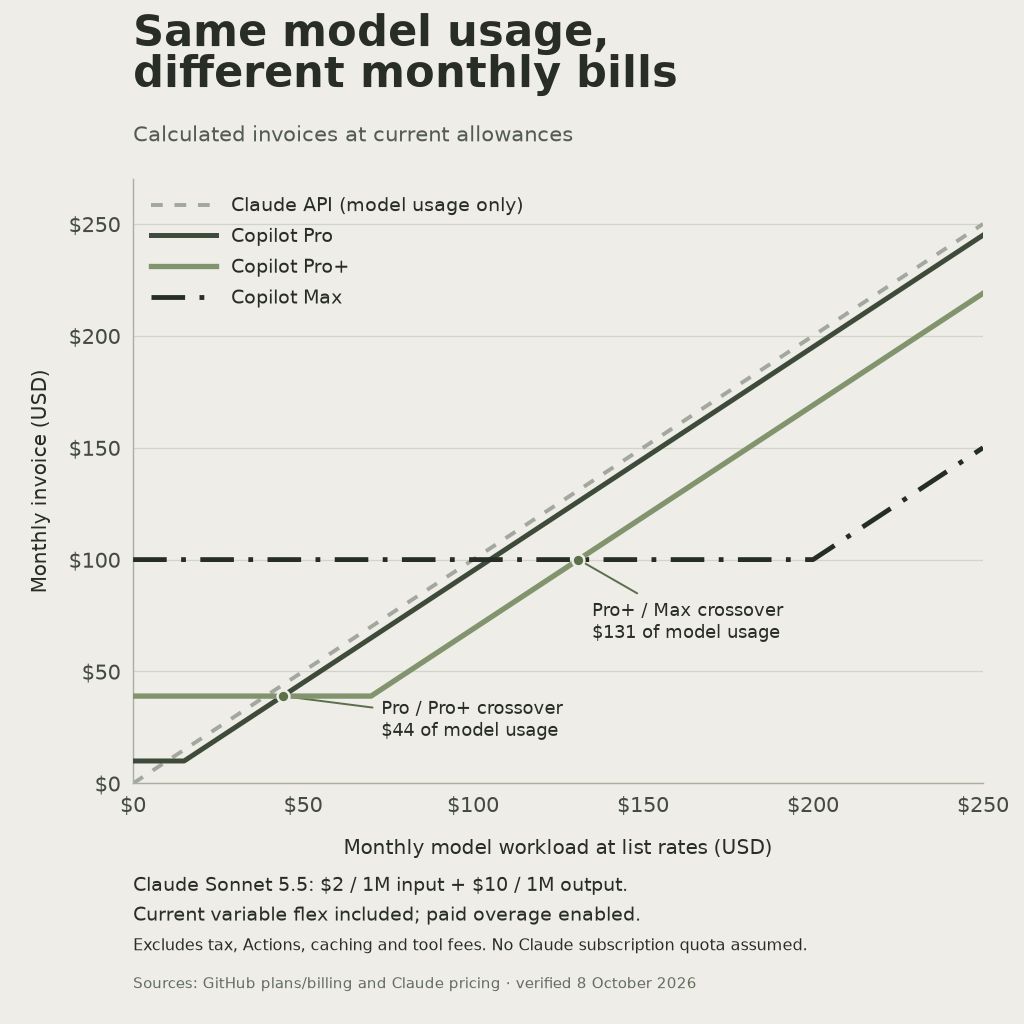
Against a $20 Claude Pro subscription, Copilot Pro reaches the same invoice at $25 of raw usage. That is a conditional buying threshold: Claude must still accommodate the work inside its shared limits. For ten monthly managed seats, Business reaches Team Standard's $250 base at $250 of pooled usage, subject to the same condition on the Claude side.
Winner on the starting bill: Copilot. Winner on a heavy month: the plan that accommodates your measured consumption. Record model usage and interruptions during a pilot; the advertised monthly price alone cannot select that plan.
GitHub Copilot vs Claude Code: Daily Work in the Editor
Winner: GitHub Copilot for continuous assistance while you write code. Inline suggestions and next edit suggestions address the small changes between larger tasks, and paid plans keep them outside the AI-credit meter.
For a solo developer adding an endpoint in VS Code, that means you can keep receiving inline help without spending the allowance reserved for chat or agents. When the change expands across files, Copilot's agent mode can select files, edit them and run commands, with approval behavior determined by your settings and policies. It supports VS Code, Visual Studio, JetBrains, Xcode and Eclipse. Agent mode documentation.
Claude Code also runs inside VS Code and JetBrains. Its VS Code extension provides inline diffs, plan review and conversation history, so choosing Claude does not force you to leave the editor. It is suited to reviewing a delegated change there; Copilot is my pick when ongoing inline assistance is the main job. Claude Code interfaces.
Copilot's wall is that agent and chat consumption still draws credits even when completions are unlimited. Claude's wall is that an editor session shares the same allowance as its terminal and app sessions. Choose by the work you do between major refactors, then size the agent budget separately.
Claude Code vs GitHub Copilot Agent: Refactors and GitHub Tasks
Winner for a terminal-led refactor workflow: Claude Code. Winner for handing off work inside GitHub: Copilot. Neither verdict requires claiming a code-quality or speed advantage we did not measure.
For a large refactor, the useful unit is a reviewable change: update the implementation, affected callers and tests, then inspect the diff. Claude Code can read a repository, edit multiple files, run commands and tests, and work with Git. Project instructions, skills and hooks let you make the steps explicit. A hook is a command run around an agent action; a skill packages repeatable instructions. Claude Code workflows.
My reason for selecting Claude here is the workflow: one agent you can invoke from the shell and compose with your existing commands, with an explicit planning/execution model option. Copilot agent mode can also do multi-file work. If your refactor is easiest to supervise in VS Code, stay with it instead of switching purely because the word “agent” appears on Claude's product page.
GitHub Copilot CLI vs Claude Code: The Terminal Decision
Try Copilot CLI first if you already pay for Copilot. It is a terminal agent that can plan, edit, run commands and create pull requests, with interactive and programmatic modes. It supports project instructions, skills, hooks and Model Context Protocol, or MCP, connections to external tools. Organization-supplied access requires the CLI policy to be enabled. Copilot CLI documentation.
That makes “I need an agent in the terminal” an insufficient reason to buy another subscription. Add Claude when its configuration and delegation workflow fit the work better, or when separating coding capacity from your Copilot credit balance earns the extra bill. Use our Copilot CLI terminal setup guide for installation and first tasks.
GitHub-hosted work and its hard boundaries
Copilot cloud agent works in a hosted development environment, can change files and run tests, and feeds the GitHub review workflow. Its current documentation states a 59-minute maximum per session and restricts it to repositories hosted on GitHub. A long-running task or a repository on another host crosses a named boundary. Copilot on GitHub.com.
Paid Copilot plans also offer hosted Anthropic Claude and OpenAI Codex partner agents in public preview. These consume GitHub AI credits and Actions minutes. Buying a separate Claude subscription is therefore not the only way to delegate work to an Anthropic agent on GitHub. Availability still depends on administrator policies and the partner agent's supported models. Third-party coding agents.
Copilot code review also has two billing components: AI credits for model consumption and Actions minutes for the review infrastructure. GitHub selects its model automatically and does not disclose it, so the model picker cannot give you an exact review-cost estimate. Keep that usage separate from unlimited inline suggestions. Code review billing.
Claude has its own hosted web interface and GitHub Actions integration. The latter supports API credentials or subscription OAuth credentials, but requires the repository integration and workflow to be configured. GitHub execution is available through Claude; Copilot has the advantage when you want the existing GitHub interface to own the handoff. Claude Code interfaces, Claude GitHub Actions.

A hosted agent also changes the delivery environment. A command that works because of your laptop's installed tools may need setup in the hosted environment. Include the test command and required dependencies in the task, and make human review part of the completion criterion.
Models: Choice, Availability and the Claude-in-Copilot Question
Winner: GitHub Copilot for provider choice. Claude Code is the narrower choice when you want Anthropic's agent and models together. Model availability is a plan decision as well as a product decision.
Claude Code's current Anthropic API aliases resolve to Claude Sonnet 5.5, Claude Opus 5.5 and Claude Haiku 5.5. The fable alias normally resolves to Claude Fable 5.1, with an exception for Claude apps gateway sessions. Cloud-provider aliases can resolve to different versions. Use /model to inspect your account's choices; opusplan uses Opus for planning and Sonnet for execution. Model configuration.
Copilot's supported catalog includes those Claude families alongside OpenAI GPT-6.1 Sol, GPT-6 Astra and GPT-5.3-Codex, Google Gemini 3.8 Flash, Microsoft MAI-Code-1.1-Flash, xAI Grok 4.7 and Kimi K3. The current paid-plan matrix includes Sonnet 5.5 on Pro, but excludes Opus 5.5, Fable 5.1 and GPT-6.1 Sol from Pro; those appear on Pro+, Max, Business and Enterprise. Client support and organization policy can narrow access further. Supported models and plan matrix.
That is a material price difference for an Opus buyer: Claude Pro includes Opus access at $20/month; individual Copilot Opus 5.5 model selection starts with Pro+ at $39/month. Capacity still differs, so model access alone does not settle the purchase. Claude Fable also has special allowance rules: Pro uses usage credits; Max includes it within 50% of weekly limits, and Team's included Fable allowance is on Premium seats. Claude model access and limits.
Claude Code vs GitHub Copilot With Claude: Same Model, Different Agent
Selecting a Claude model in Copilot changes the model answering inside Copilot's workflow. It does not transfer your Claude Pro allowance, project configuration or session history into Copilot.
The hosted Anthropic partner agent is another option, distinct from selecting a Claude model in Copilot Chat. Its model menu is narrower than Copilot's overall catalog. Decide which engine and billing route you want, then check the relevant menu. “Runs Claude” describes a model relationship, not an entitlement to every Claude Code surface. Partner agent model lists.
Team Administration and Data Controls
Winner for an existing GitHub-managed engineering team: Copilot Business or Enterprise. Seat assignment, feature policies, model access and usage pooling fit the account structure you already administer. Claude Team offers central billing and single sign-on; Claude Enterprise adds SCIM account provisioning, audit logs, role-based access and custom retention controls, with the purchase minimum discussed above.
For a budget-capped Copilot rollout, the important default is additional usage enabled. Disable the AI credits paid usage policy if you want spending to stop at the pool. User-level budgets impose hard consumption stops across included and metered usage; metered spending budgets need the stop-usage setting to enforce a cap. Do not set a user's budget to $0 expecting free use of the pool: GitHub states that it blocks the user immediately. Billing defaults, Budget behavior.
Copilot CLI's session credit limit is a separate, soft limit in public preview. For example, /limits set max-ai-credits 100 targets $1 of session usage, but a response already in progress can finish beyond the cap. Use the organization billing controls for the budget boundary. CLI session limits.
Two control gaps deserve a concrete check:
- Copilot content exclusions do not apply to CLI or IDE agent mode. An excluded folder in your editor policy is not a general barrier for those agents. Review the surface's actual filesystem/tool access before assigning a sensitive repository task. Content-exclusion coverage.
- Claude's initial model setting is not an enforced model policy. Managed allowlists need the documented enforcement settings, including
enforceAvailableModelswhen restricting Default. Merely picking a cheaper startup model does not prevent a user selecting another. Claude model controls.
Data controls also vary by route. GitHub states that Business and Enterprise data is not used to train its models; individual subscribers can opt out of model training. For Business and Enterprise, its plans page distinguishes default IDE chat/completion retention from other surfaces: IDE prompts and suggestions are not retained, while other access/use retains them for 28 days. GitHub data policies.
A model-specific exception matters: GitHub's current documentation says Claude Fable 5 and 5.1 retain prompts and outputs for safety classifiers by default, with a time-bound zero-retention exemption that eligible customers can request through the end of 2026. A blanket claim that every Claude model in Copilot has identical retention would be wrong. Fable retention conditions.
Anthropic distinguishes consumer and commercial use. Claude consumer training follows the user's choice; Team, Enterprise and API content is not used to train generative models unless the customer opts in. Claude Code's standard commercial retention is 30 days; zero-retention arrangements and exceptions have separate conditions. Consumer opt-out retention is also 30 days, while allowing model improvement changes it to five years. Claude Code data usage.
For confidential company work, make the purchasing account, execution surface and selected model part of the approval. “We pay for an AI tool” does not identify those controls.
Switching from Copilot to Claude Code, or the Other Way
The repository is portable; the surrounding workflow needs migration. Source files and Git history stay in the repository, but instructions, permissions, integrations and conversations are not a universal shared configuration.
When you switch from Copilot to Claude Code, carry over your build/test commands, coding conventions and review checklist, then configure Claude's project instructions and integrations. Claude supports CLAUDE.md and can read an existing AGENTS.md; that helps preserve rules, but does not automatically recreate all tool settings. Claude project memory and instructions.
When you switch the other way, configure Copilot's instructions, model policies and credit budget. Treat hooks and MCP connections as integrations to verify, rather than assuming matching names mean identical behavior. Copy a concise task history when continuing work in a new agent; do not assume the conversation followed the files.
Do not switch a functioning GitHub-managed team solely to obtain terminal or multi-file agents. Copilot already offers both. Do not move a working Claude workflow solely to save the $10 difference in solo entry subscriptions without checking its model access and resulting usage invoice.
GitHub Copilot vs Cursor vs Claude Code: When an Editor Change Matters
If the purchase also involves replacing your editor, compare that decision separately. Our Cursor vs GitHub Copilot comparison covers that shortlist. Claude Code can integrate with supported VS Code forks, including Cursor, so buying its agent need not settle your editor choice. Claude IDE access.
Use Both: The Setup and the Monthly Bill
Use Copilot for continuous editor assistance and Claude Code for deliberate delegated changes. Two subscriptions earn their place when they address distinct jobs, with one agent owning an active change.
For a solo developer, Copilot Pro plus Claude Pro is $30/month in base subscriptions. Copilot chat and agents consume its current $15 allowance; Claude Code draws from your shared Claude limits. Any permitted overage is additional.
For ten developers with managed accounts, ten Copilot Business seats plus ten Claude Team Standard seats cost $440/month, using monthly Claude billing: $190 + $250. A narrower setup, ten Copilot Business seats plus two Claude Team Standard seats, costs $240/month. It meets Claude Team's two-seat minimum and gives Claude access to the two people doing the delegated work. That is selective licensing, not a claim that ten developers can share two accounts.
Assign each tool a job
Keep Copilot's inline help in the editor. Hand Claude Code a bounded change with the affected area, acceptance criteria and test command. Avoid two editing agents making competing changes in the same working tree.
Verify the billing route
Sign into Claude Code with the subscription account you intend to use. An
ANTHROPIC_API_KEYenvironment variable can route usage to separate API billing. Check the selected route before assuming the task is covered by Pro or Team. Claude authentication and billing.Set limits before the pilot
Configure Copilot's paid-usage policy and budget. Leave Claude usage credits off for a strict subscription-only pilot, or set a monthly cap deliberately. Track allowance use and interruptions alongside completed, reviewed changes.
Review before expanding
Inspect the diff and run the repository's checks. Expand seats or allowances when the pilot shows which work benefits and what it costs. Claude's
/usagereports allowance consumption; its displayed session token-cost estimate is not the subscription invoice. Claude cost tracking.
The Monday move for an engineering lead is to choose the managed base plan, select a developer with a bounded refactor, and record consumption and review effort on that task. Upgrade from evidence about your workload, not a reported benchmark win from someone else's repository.
Frequently Asked Questions
Is Claude better than GitHub Copilot for coding?
Claude Code is my pick for terminal-led delegated work; Copilot is my pick for daily editor assistance and GitHub team workflows. Both have multi-file agents. This comparison establishes workflow fit and cost, not a measured code-quality winner.
Can I use the Claude code if I have GitHub Copilot?
Yes. Separate Claude and Copilot subscriptions can coexist; Pro plus Pro starts at $30/month. Paid Copilot plans also offer hosted Anthropic partner agents in public preview, billed through GitHub. A Copilot subscription does not transfer Claude Pro's allowance into the standalone Claude Code subscription route.
Is GitHub Copilot cheaper than Claude code?
The solo entry subscriptions are $10/month for Copilot Pro and $20/month for Claude Pro. Ten managed monthly seats start at $190 for Copilot Business and $250 for Claude Team Standard. Usage charges, model eligibility and Claude's shared limits can change the final comparison.
Which is better, Claude or Microsoft Copilot?
For this developer decision, the relevant product is GitHub Copilot. A Microsoft productivity-tool purchase is a separate comparison. Choose between these coding tools from the execution workflow, current model access and bill described above.
What can Claude do that Copilot cannot?
Terminal access and multi-file editing are not exclusive to Claude Code. Its particular project configuration, Claude model controls and agent workflow may fit your process better. Copilot has its own agents and hosted Anthropic partner option, so compare the exact surface rather than assuming a broad capability gap.
Is there a Microsoft Copilot equivalent to the Claude code?
GitHub Copilot CLI is the relevant terminal coding agent. Copilot agent mode handles delegated changes inside supported IDEs, while Copilot cloud agent handles hosted GitHub tasks. They are distinct execution routes.
Why did GitHub Copilot fail?
A universal failure is not established here. For a failed task, inspect its instructions, permissions, environment and remaining allowance. A poor result or stopped session does not by itself establish that a different tool would complete the same work correctly.
Is GitHub Copilot outdated?
No: current GitHub documentation includes editor agent mode, a terminal CLI, hosted coding agents and AI-credit billing. Evaluating it solely as autocomplete misses those current capabilities.
Which IDE is best for GitHub Copilot?
VS Code is a sensible default for a solo developer who wants editor assistance and agent workflows together. Copilot also supports other IDEs; verify the agent features and models you need in your existing editor before switching. An editor choice is not a benchmark result.
Before adding another developer subscription, get the AI Business Workflow Audit Checklist.
- Published
- Category
- Build
- Language

LangGraph vs CrewAI
Compare LangGraph and CrewAI on the same approval workflow, state, memory, MCP, observability and current hosted-platform prices.Oct 7, 2026Build
How to Build MCP Server
Build an order lookup MCP server with Python, test it in Inspector, connect Claude Code and Cursor, then add HTTP auth and hosting.Oct 7, 2026Build
Gumloop vs n8n (Verified October 2026)
Gumloop vs n8n: current pricing, credits vs executions, self-hosting and the same AI lead workflow, with a verdict for each builder.Oct 7, 2026Build
AI Agent Frameworks in 2026: LangGraph, CrewAI, OpenAI Agents SDK, Claude Agent SDK, Mastra and Google ADK (Compared)
Compare eight AI agent frameworks by language, state, MCP, approvals and current hosted prices. Pick the right runtime for production.Oct 7, 2026Build
Codex Cloud
Set up a reusable Codex Cloud environment, keep coding tasks running with your laptop off, steer from your phone, and choose cloud or local CLI.Oct 7, 2026Build
GitHub Copilot Pricing (2026): The Seat Is the Floor, Credits Are the Bill
GitHub Copilot plans, AI Credits, model rates, and three worked monthly bills. Choose Pro, Pro+, Max, Business, or Enterprise with spending limits.Oct 6, 2026Build
GitHub Copilot CLI
Install GitHub Copilot CLI, sign in, fix tests and open a PR. Current GitHub plans, AI credits, models, permissions, MCP and instructions.Oct 6, 2026Build