Claude for Google Workspace
How to install and deploy Claude in Docs, Sheets and Slides, control edits, and test the paid-plan beta with three practical team workflows.
Published
 By Omid Saffari

Claude for Google Workspace lets your team rewrite a live document, turn a messy export into a pivot table, and build slides in the company theme without carrying drafts between browser tabs. The sensible rollout is a small pilot around a recurring reporting job: measure the time to an approved result, including corrections, before adding another assistant across the company.
The add-on entered public beta on 6 October 2026 for all paid Claude plans. That means Pro, Max, Team and Enterprise. Free does not include this add-on. Anthropic's launch post establishes the availability; the setup guide names the plans. Details below were checked on 10 October 2026.
What Claude Does Inside Each App
Think of the sidebar as an editor sitting beside the file you already have open. You point at the passage, cells or slide; Claude can read that context and change the file itself.
These are documented capabilities, not results from a hands-on test. The worked tasks below are pilot recipes with acceptance checks.
There are two separate ways in. The Marketplace add-on brings Claude into an open Google file. The beta Google Docs, Google Sheets and Google Slides connectors bring Google files into a Claude conversation, where Claude can create or edit them. Those connectors are also separate from Google Drive, which handles tasks such as finding files. Connector guide.
Install It for Yourself, Then Deploy a Pilot Group
One Marketplace installation covers Docs, Sheets and Slides.
- Open the official Claude listing in Google Workspace Marketplace, choose Install, and select your work Google account.
- Review the Google permission request and continue. Reload any files already open.
- In a Google file, choose Extensions > Claude > Open Claude.
- Sign in with your paid Claude account. Start with a question about the file before requesting an edit.
If the app is blocked, a Workspace administrator must allowlist or install it. An API key is not a substitute for Claude-account sign-in in this beta. Installation help.
For deployment, a Google Workspace super administrator can start in the Google Admin console > Apps > Google Workspace Marketplace apps > Apps list > Install app. Find Claude, choose Admin install, review access and terms, then select the whole organization or particular groups or organizational units. Finish the installation and have pilot users reload their files. Google supports admin installation even when users cannot install Marketplace apps themselves. Google's deployment instructions.
My recommendation: use a group containing the people who prepare and approve the same weekly report. The reviewer belongs in the pilot because correction time determines whether this saves work.
Enable the Separate Connectors Only When You Need Them
For work that starts in Claude, a Team or Enterprise Owner or Primary Owner must first enable the Docs, Sheets and Slides connectors. In Organization settings > Connectors, browse for the connectors and add them to the team. Members then connect their Google account through the normal authentication flow. Organization setup.
In a Claude chat, use + > Connectors to turn on the relevant connector. Paste an existing Google file link or explicitly ask for a Google document, spreadsheet or presentation. The file can open beside the conversation on supported setups: Chrome on Claude's website, or Claude Desktop with its built-in browser enabled. Open in Google is the alternative when the pane is unavailable. Live-editing setup.
Installing the sidebar does not perform this owner-level connector setup. Claude's file access follows your existing Google sharing permissions; enabling a connector does not give a user access to a colleague's restricted file.
Choose How Edits Get Approved
Start the pilot in Ask before edits, the default. Claude describes an intended change and waits for approval. Accept all edits applies ordinary content changes without stopping, but the help guide still requires approval for sensitive actions involving links, external images or file access. It is not a blanket permission switch. Editing modes.
Use the first mode on shared work; consider the second on a disposable working copy once you understand the task. Google records Claude's edits under your name. Undo and version history are your recovery tools.
Three Worked Tasks to Run in the Pilot
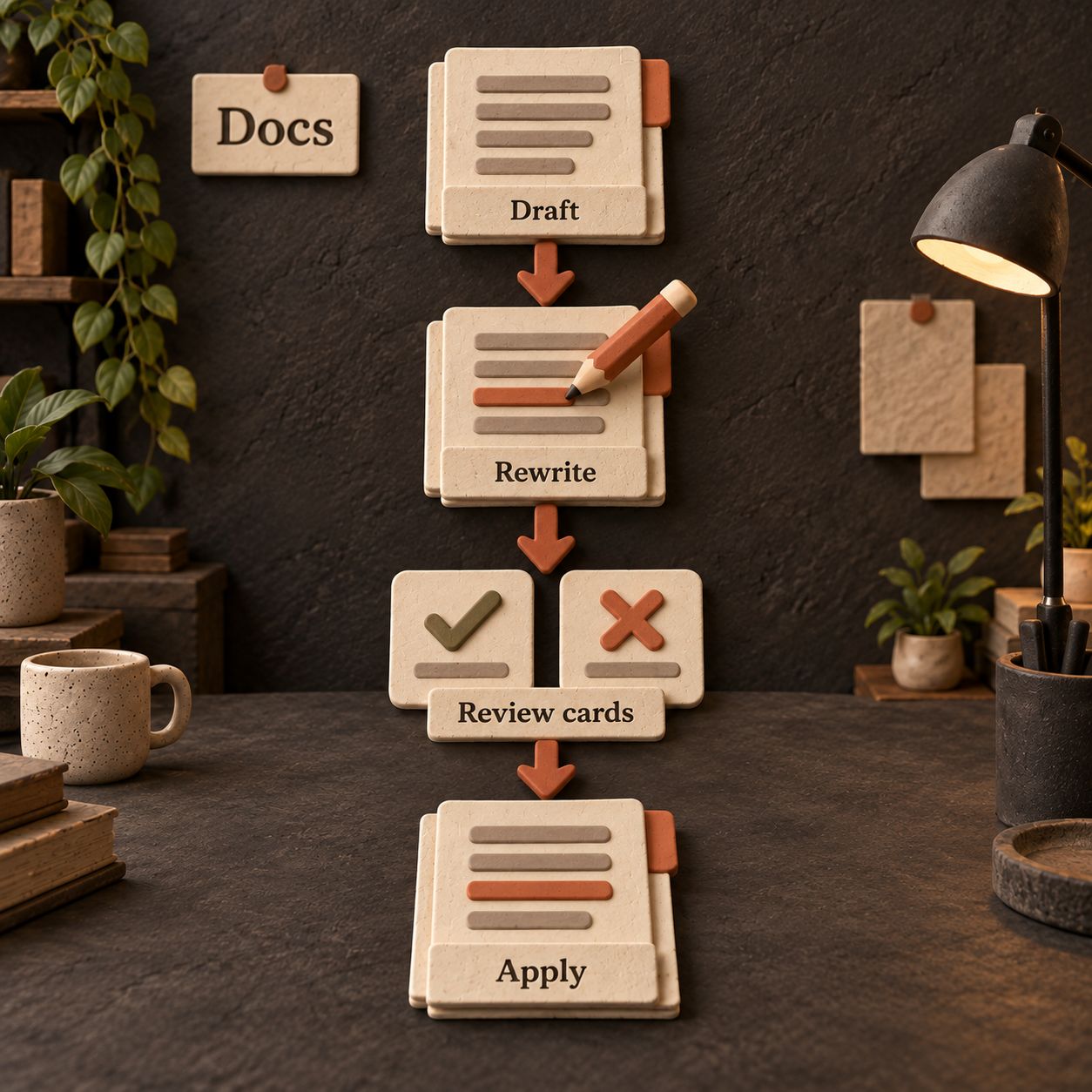
Docs: Rewrite a Decision Memo With Suggestion Cards
A product lead could use this to turn an unfocused project memo into something the steering group can approve. The payoff is less rewriting and fewer rounds clarifying what decision is needed.
- Open a working copy of the memo and select its executive summary. Keep Ask before edits selected.
- Ask: “Propose a tighter summary as suggestion cards. Start with the decision requested, then explain the evidence and the unresolved risk. Preserve every commitment, owner and date. Do not invent missing information.”
- Read each card against its highlighted source passage. Apply changes that preserve the meaning; dismiss wording that exaggerates certainty or changes the commitment.
- Ask for the action items to become a table with an owner and deadline. Compare each row with the source before approving the change.
- Read the final summary without the chat beside it. A colleague should be able to identify the decision, supporting evidence and remaining risk.
The distinction matters: sidebar suggestion cards are a review interface; applied changes become direct document edits. The add-on does not create Google's native suggestions or accept and reject existing ones. Docs behavior and limitations.
Sheets: Build a Pivot From a Messy Export
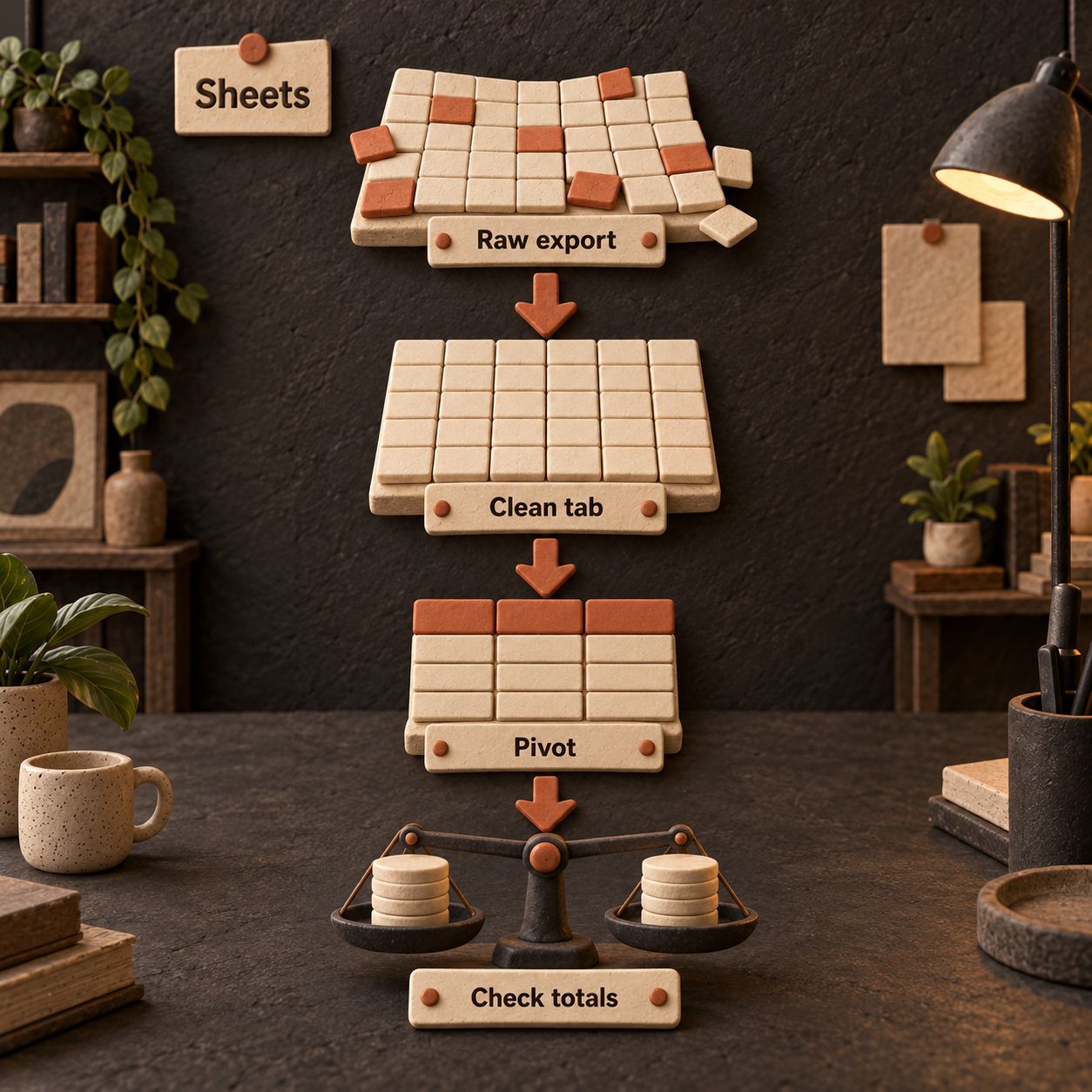
An operations lead could start with an order export containing inconsistent region names, mixed date formats and amounts stored as text. A pivot table is a grouped summary: for example, revenue by region and month.
- Import the export into a tab named Raw. Keep that source intact and select the populated range.
- Ask: “Inspect this export before changing it. Identify date formats, region variants, amount fields and possible duplicate order IDs. List ambiguous rows and propose cleanup rules.”
- Approve explicit rules. For example, map “North ” to “North” after trimming spaces; choose a date convention; keep unclear dates and duplicate IDs on an exceptions list for review.
- Ask Claude to write the cleaned data to Clean, with an explanation of exclusions. It can use Python, a programming language used here for data processing, when cleaning or joining ranges. You do not need to write the code.
- Request a pivot on Summary: rows by region, columns by month, values as the sum of the agreed amount field. Ask for a native Sheets chart if it helps the meeting.
- Reconcile the raw total, cleaned total and pivot total, accounting for every excluded row. Spot-check a known order and a deliberately awkward date before distributing the report.
For a tiny fictional check, suppose the same month contains North amounts of “100” and “50,” plus a South amount of “75.” After converting those text values to numbers, the pivot should show North 150, South 75, and a grand total of 225. A different result needs an explanation.
The essential human decision is what a row means. Two appearances of an order ID might be a duplicate, a partial shipment or a refund. A plausible cleanup rule can still produce the wrong business answer. Anthropic documents the cleaning, pivot and chart capabilities; these validation rules are the proposed pilot design. Sheets capabilities.
Slides: Build a Deck on the Company Theme
A team lead could turn approved project notes into a regular leadership update while preserving the layouts colleagues expect.
- Make a copy of the approved company presentation yourself and open it. Keep the layouts and theme you want Claude to use.
- Paste the approved project notes into the sidebar or attach the reference file. Specify the audience and the decision the meeting needs.
- Ask: “Build a project update using this deck's existing theme and layouts. Cover progress, evidence, risks and the decision needed. Use only the supplied facts; flag any missing evidence.”
- Review the proposed edits, then ask Claude to check overlapping objects, content outside slide boundaries and text that is difficult to read.
- Inspect the deck in presentation view. Check the story, source figures and visual hierarchy yourself before sharing it.
Claude can use the existing theme and flag layout defects. That does not guarantee a persuasive story or complete adherence to every brand rule. Also, charts it creates in Slides are images, not live-linked Sheets charts. Changed figures require a regenerated chart; updating an existing linked chart remains a manual action. Slides launch details, chart limitations.

Which Teams Benefit First?
Prioritize repeated preparation work with an obvious acceptance test. My rollout order is:
These are proposed uses, not measured customer outcomes. Existing Claude users can consult the broader Claude review for context beyond this add-on.
What the Admin Controls, and What Still Needs Review
Google Workspace controls distribution through Marketplace policy and installation scope. Claude organization settings control the available models, skills and connectors. The sidebar inherits those Claude settings. Keep those responsibilities separate in the rollout checklist. Admin controls.
Anthropic explicitly names three Enterprise controls for the add-on:
Those controls are named in the launch post and detailed in the Enterprise help section. They should not be read as a promise that every Enterprise setting carries across: the guide says custom retention settings are not inherited and Zero Data Retention is unavailable for the extension. It states deletion within 30 days, subject to the exceptions it links.
For access, distinguish the current file from connected sources. The add-on works with the open file plus content you supply or enable through connectors. Do not treat a Marketplace install as permission to search everyone's Drive. For the separate connectors, Google's existing sharing permissions continue to govern access. Add-on access, connector access.
Make Claude Earn Its Place Beside Gemini
Google already includes Gemini in Docs, Sheets and Slides in Business Standard, Business Plus and Enterprise; its pricing table does not include those app features in Business Starter. Google's edition comparison.
If your team already pays for an eligible edition, give Gemini and Claude the same source files and acceptance checks, and add Claude only where its approved output or reuse of your Claude workflows justifies the extra subscription and administration.
Measure Finished Work, Including Corrections
Use staff time as the starting budget line. Illustration, not a benchmark: five people spending 60 minutes each on a weekly report over four cycles consume 20 staff-hours. If the pilot brings preparation plus review to 40 minutes each, that becomes 13 hours 20 minutes, saving 6 hours 40 minutes per month.
Value those hours at your own internal rate, then subtract incremental Claude subscription, usage and administration costs. If people already have paid Claude accounts, do not count their whole existing subscription again as a new cost. If corrections erase the time saving, a fast first draft has not earned a rollout.
Two Things Worth Building Around This
Build the reusable rules and review process around a specific job. The beta sidebar is not a documented scheduling or unattended automation system.
The strongest opportunity is an export-to-report package for operations teams. A consultant or internal builder could sell a configured cleanup rulebook, a Sheets template, repeatable prompts and an acceptance checklist for one recurring export. The minimum useful version supports one source format and one report, with explicit exception handling and reconciliation.
DataForSEO's US English keyword check on 10 October 2026 estimates 480 monthly searches for “ai spreadsheet generator.” That is evidence of category interest, not proof that 480 buyers want this package. The reason I favor it is the recurring job and measurable pass/fail test. The catch: column changes, ambiguous transactions and poor source data create maintenance work. The value must come from domain rules and reliable review, because generic pivot creation is already a built-in capability.
A company-theme briefing pack is the second opportunity. A presentation specialist could package approved Slides layouts, a structured intake document and a reusable Claude skill describing the briefing format. The smallest sellable version serves one audience and one recurring meeting, with human approval before delivery. Anthropic explicitly supports carrying Claude skills into the sidebar. Skills in the add-on.
The same DataForSEO check estimates 9,900 monthly US English searches for “ai presentation maker,” and its related searches include “AI presentation maker from text.” That broader demand is much larger, but generic deck generation is a crowded proposition. The defensible work is the customer's evidence standard and repeatable briefing structure. The catch is ongoing editorial review and charts that may need regeneration when the numbers change.
Both are build hypotheses based on the documented interactive workflow. Neither assumes this add-on exposes an automation API.
Where the Beta Stops
Keep the sidebar open while Claude works; closing it stops the task. A single operation can hit Google's six-minute limit, so split large jobs into stages. The add-on currently supports Chrome, Edge and Safari, not Firefox. Beta limitations.
The app-specific limits affect the pilot design too. Docs comments need to be pasted into the sidebar if you want the add-on to act on them. Connected Sheets data needs extraction into an ordinary tab first. Scheduled refreshes are unsupported, and Slides charts do not become live reports merely because Claude created them. The separate Docs connector has different comment and suggestion capabilities; do not transfer claims between the two interfaces. Add-on limits, connector capabilities.
My take: pilot it where someone already owns the source and can verify the result. Hold off on company-wide deployment when the team cannot define what a correct report, rewrite or deck looks like.
How do I integrate Claude with Google Workspace?
Install the official Marketplace add-on and open Extensions > Claude > Open Claude inside a file. For work that starts in Claude, enable the separate Google Docs, Sheets and Slides connectors. Team and Enterprise owners must make those connectors available first.
How do I get Claude to edit Google Sheets?
Open the spreadsheet, open the Claude sidebar, select the relevant cells and describe the desired result. Review proposed edits in Ask before edits mode. For a pivot, specify the grouping fields, calculation and reconciliation check.
Can Claude make a Google Slides presentation from text?
Yes. Supply your notes in the sidebar of an existing themed deck and ask for slides using its layouts. Alternatively, use the Slides connector from Claude and explicitly request a Google Slides file. Review the claims and layout before sharing.
Monday move: ask your Workspace admin to install Claude for the reporting pilot group. Run the memo, export and themed-deck tasks on working copies, record preparation and correction time, and decide whether the recurring reporting job merits expansion.
If you want a reviewed reporting workflow built around your team's files, we build AI automation for business operations.
- Published
- Category
- AI
- Language

Claude Dashboards
Set up Claude Dashboards beta, inspect SQL and refresh timestamps, check a sales metric, and decide when to keep your BI tool.Oct 10, 2026AI
Granola AI Review
Granola reviewed for business meetings: bot-free notes, current pricing, templates, recipes, consent, platform limits and who should choose an alternative.Oct 10, 2026AI
Fyxer Review
Fyxer reviewed through current pricing, help docs and public feedback: inbox sorting, drafts, meetings, privacy and who should pay for Pro or Team.Oct 9, 2026AI
GPT 6 Explained: Models, Release Dates, Access, and Prices
GPT-6 Astra, Sol, 6.1 Sol and Luna explained: release dates, ChatGPT plan access, Work and Codex availability, and verified API costs.Oct 9, 2026AI
Is ChatGPT Free? What You Get for $0
Yes. See what ChatGPT Free includes, its work limits, ads, account access, and when the $8 Go or $20 Plus plan is worth paying for.Oct 9, 2026AI
Gemini Enterprise: What It Is and When to Pilot
Gemini Enterprise explained for IT leads: Gemini agent availability, connectors, identity, spend caps, pricing and a 30-day Plus pilot.Oct 9, 2026AI
Marblism Review
Marblism's seven AI employees, current plans, shared-hour costs, dated public reviews and the jobs that still need human approval.Oct 9, 2026AI