ElevenLabs Pricing (2026): Creator Wins, API Goes Further
ElevenLabs plans, credits, annual totals, API and PAYG rates, break-even points, hidden costs, and cheaper alternatives. Verified in August 2026.
Published
 By Omid Saffari

ElevenLabs costs $0 to $990 a month, but Creator at $22 is the sensible paid plan for most serious voice work. The hidden advantage is the API: that same Creator plan stretches from about 121 UI minutes to roughly 220 Multilingual or 440 Flash/Turbo API minutes.
ElevenLabs pricing at a glance
ElevenLabs Creator is the best paid starting point if you need a reusable branded voice; Starter is enough when commercial rights and Instant Voice Cloning are the whole job. Pro makes sense near 549 finished UI minutes a month or when the workflow requires 44.1kHz PCM through the API. Scale and Business are team plans, not automatic quality upgrades.
The prices and limits below were verified against ElevenLabs' live pricing page, API page, Agents page, and billing documentation on 9 August 2026.
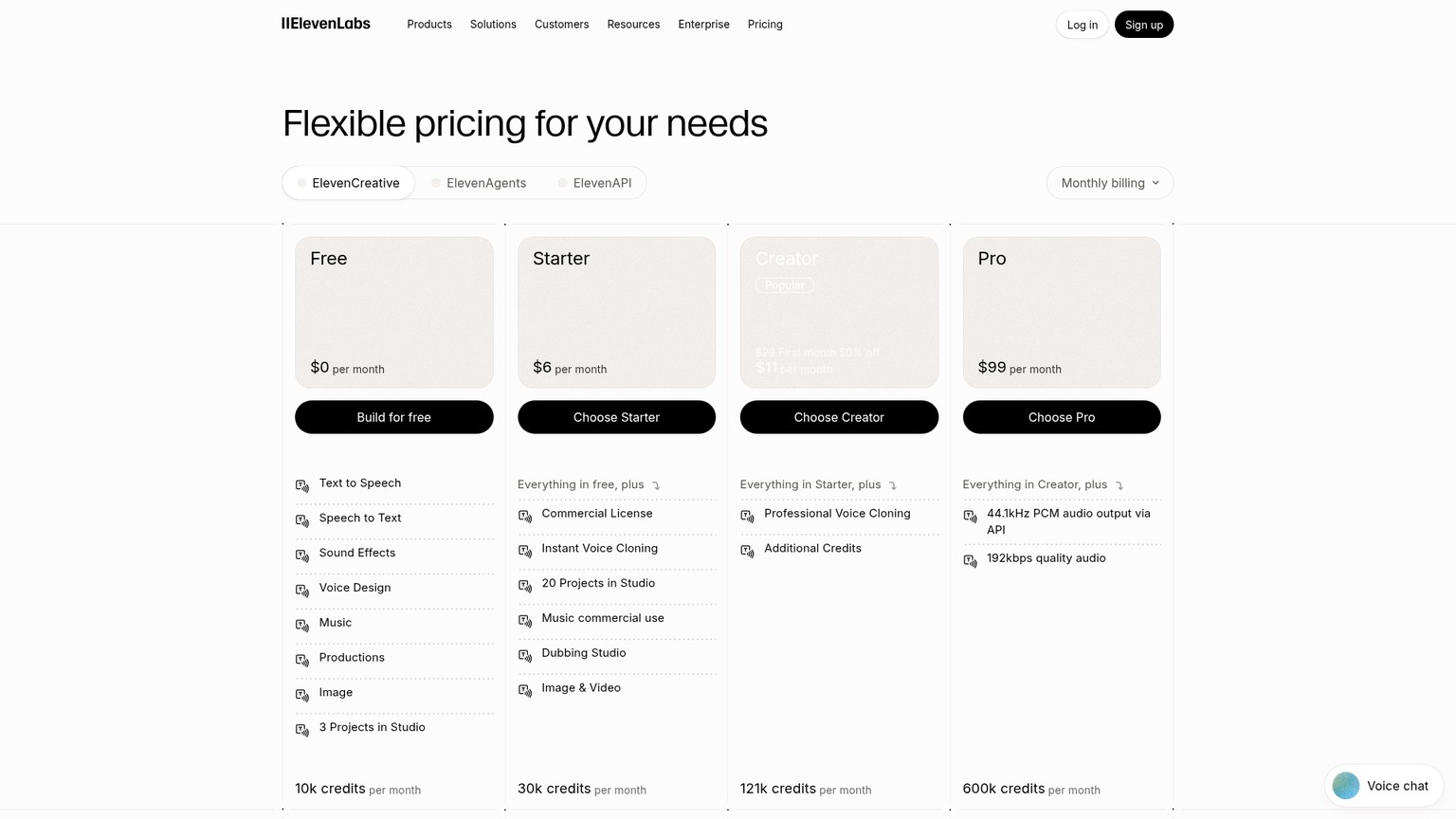
Annual billing saves two monthly payments, or 16.7% against paying month by month. It is an upfront commitment, while credits still reset monthly. Do not read the annual allowance as one flexible yearly pool.
The plan boundaries are practical:
- Free is a noncommercial evaluation tier. It includes Voice Design, but not voice cloning.
- Starter is the cheapest route to commercial rights, Instant Voice Cloning, Dubbing Studio, and 20 Studio projects.
- Creator adds Professional Voice Cloning and the ability to buy more usage. A professional clone is a reusable model of one approved speaker's voice.
- Pro adds 192kbps audio and 44.1kHz PCM through the API. PCM is uncompressed digital audio, useful when the file is heading into a serious edit or mix.
- Scale adds team collaboration, 3 seats, and 3 professional clones.
- Business raises that to 10 seats and 10 professional clones, with low-latency TTS listed as low as $0.05 per minute.
- Enterprise is the sales-led tier for custom volume, SSO, HIPAA BAAs, DPA and SLA terms, elevated concurrency, managed dubbing, and priority support.
- Free is useful enough to judge the workflow before entering a subscription.
- Starter opens commercial use and Instant Voice Cloning for $6 monthly.
- Creator combines Professional Voice Cloning with a meaningful 121-minute UI allowance.
- API rates are materially lower than generating the same volume inside the app.
- Paid credits can roll over for up to two months while the same plan stays active.
- One shared credit pool makes a nominal TTS allowance unreliable when you also dub, generate music, or process audio.
- Scale costs slightly more per included UI minute than Pro, so volume alone does not justify the jump.
- Annual billing locks the full charge upfront while credits still arrive monthly.
- PAYG funds expire after 12 months, and top-ups are nonrefundable.
- New self-serve pricing is prepaid, so failed Auto Top Up can stop production immediately.
The free plan is enough only for private evaluation
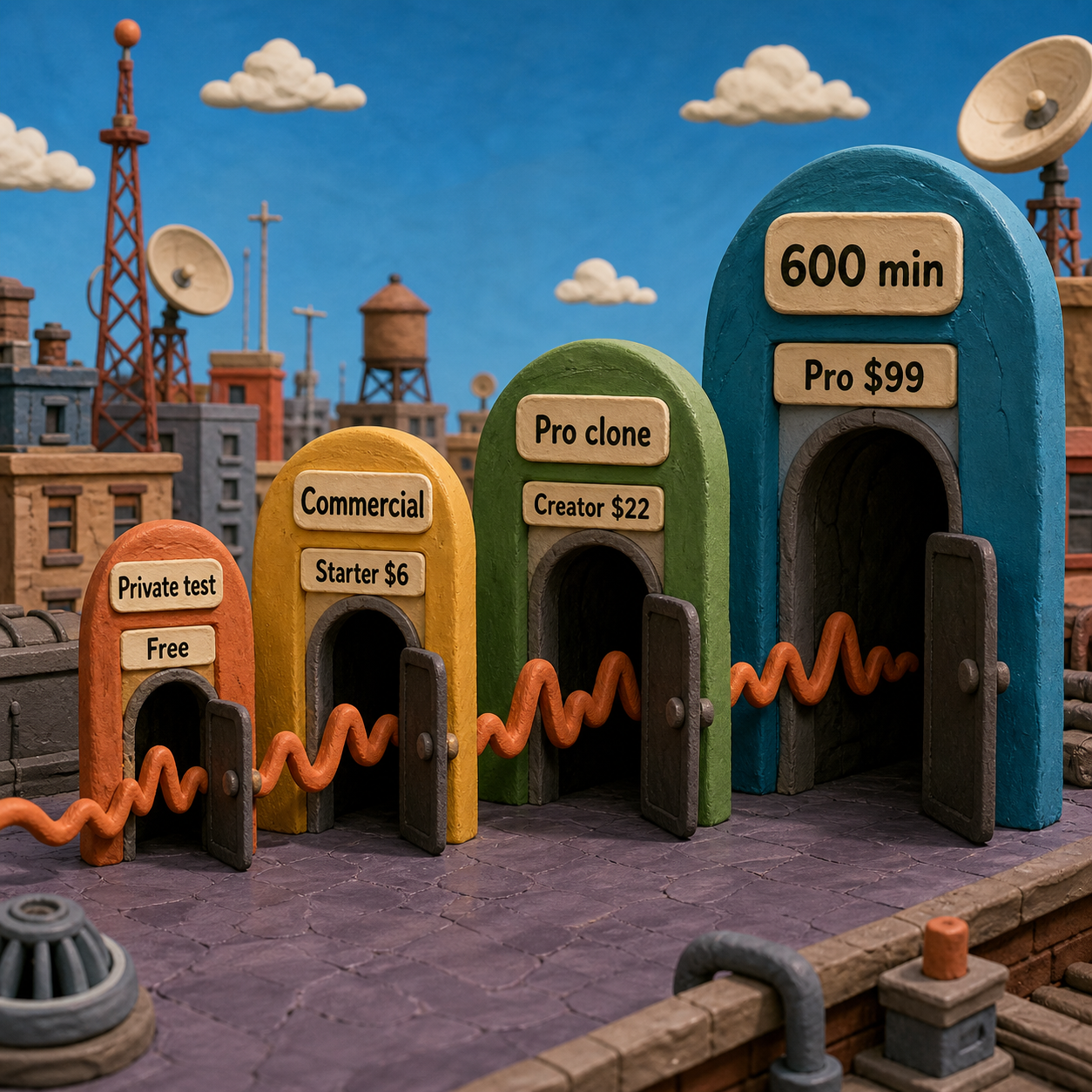
ElevenLabs Free is enough for someone making up to about 10 minutes of private, noncommercial voice work each month. It costs $0, supplies 10,000 credits, allows 3 Studio projects, and opens Text to Speech, Speech to Text, Sound Effects, Voice Design, Music, Productions, and Image.
The word free needs two qualifications. First, the output is for noncommercial use with attribution. A paid client video, monetized podcast, ad, course, or product narration needs at least Starter. Second, Free offers 3 custom slots for Voice Design, which creates a voice from a description, but voice cloning starts on Starter. Voice Design and voice cloning are different jobs.
Who never needs to pay? A designer privately auditioning voices, a founder prototyping narration for an internal pitch, or a student exploring sound direction can stay on Free indefinitely if the 10-minute allowance is enough and nothing ships commercially. Free is not a trial clock. It is a small recurring allowance.
Starter becomes the correct move at the first commercial deliverable, not only when Free runs out. For $6 monthly, it adds a commercial license, Instant Voice Cloning, 20 Studio projects, Dubbing Studio, and commercial use for Music. Its 30,000 credits work out to about 30 UI TTS minutes.
Creator is the default paid plan, but usage sets the break-even
Creator wins for regular creative work because $22 buys Professional Voice Cloning and about 121 UI TTS minutes without pushing a solo buyer into Pro's $99 floor. The first month is $11, but the ongoing decision must be made against $22.
At full monthly utilization, the base-plan cost per included UI TTS minute is:
- Starter: $0.20
- Creator: $0.1818
- Pro: $0.1650
- Scale: $0.1661
- Business: $0.1650
That curve reveals the real packaging. Pro is the lowest individual unit cost. Scale is fractionally worse on pure output because its value is 3 seats, collaboration, and 3 professional clones. Business returns to roughly the Pro unit cost while adding 10 seats and 10 professional clones.
For a production calendar, Creator covers twelve complete 10-minute voiceovers with one minute left. That is about $1.82 per finished 10-minute voiceover when the allowance is fully used. Pro covers sixty such voiceovers at $1.65 each. These figures price generation capacity, not editing labor, music, or the cost of revisions.
Annual billing lowers those full-use figures to about $0.1515 per minute on Creator and $0.1375 on Pro. The annual discount is useful only when the workload recurs every month. A quarterly launch cycle can leave credits trapped behind monthly resets even after paying for the year.
The approximate UI top-up rates let us calculate where each upgrade becomes cheaper than staying on the lower plan:
Starter to Creator: 110 minutes
Starter includes about 30 minutes. Add 80 minutes at roughly $0.20 and the total reaches $22, equal to Creator. Creator includes about 121 minutes and Professional Voice Cloning, so it wins from roughly 110 minutes even before valuing the feature.
Creator to Pro: about 549 minutes
Creator includes about 121 minutes. Another 428 minutes at roughly $0.18 brings the bill to about $99. Pro includes about 600 minutes, plus 192kbps output and 44.1kHz PCM through the API.
Pro to Scale: about 1,777 minutes
Pro plus approximately 1,177 extra minutes at $0.17 reaches Scale's $299 price. The threshold sits close to Scale's 1,800-minute allowance, so seats and collaboration should make the decision before a tiny output difference does.
Scale to Business: about 5,865 minutes
Scale plus roughly 4,065 extra minutes at $0.17 reaches $990. Business includes about 6,000 minutes and expands the workspace from 3 to 10 seats.
Scale works out to about $99.67 per included seat-month. Business is $99 per included seat-month. Since everyone draws from one shared credit pool, these are access costs, not separate output allowances for each teammate.
The blunt buying rule is simple. Choose Creator for one serious creator, Pro for one high-volume creator or a production API requirement, Scale for a three-person working group, and Business for a ten-person operation with enough shared usage to keep 6 million credits productive.
The API can deliver up to 3.64 times the Creator output
ElevenLabs API usage goes much further than ElevenCreative UI usage on the same subscription. An API, or application programming interface, lets software send text and receive generated audio without a person working through Studio one project at a time.
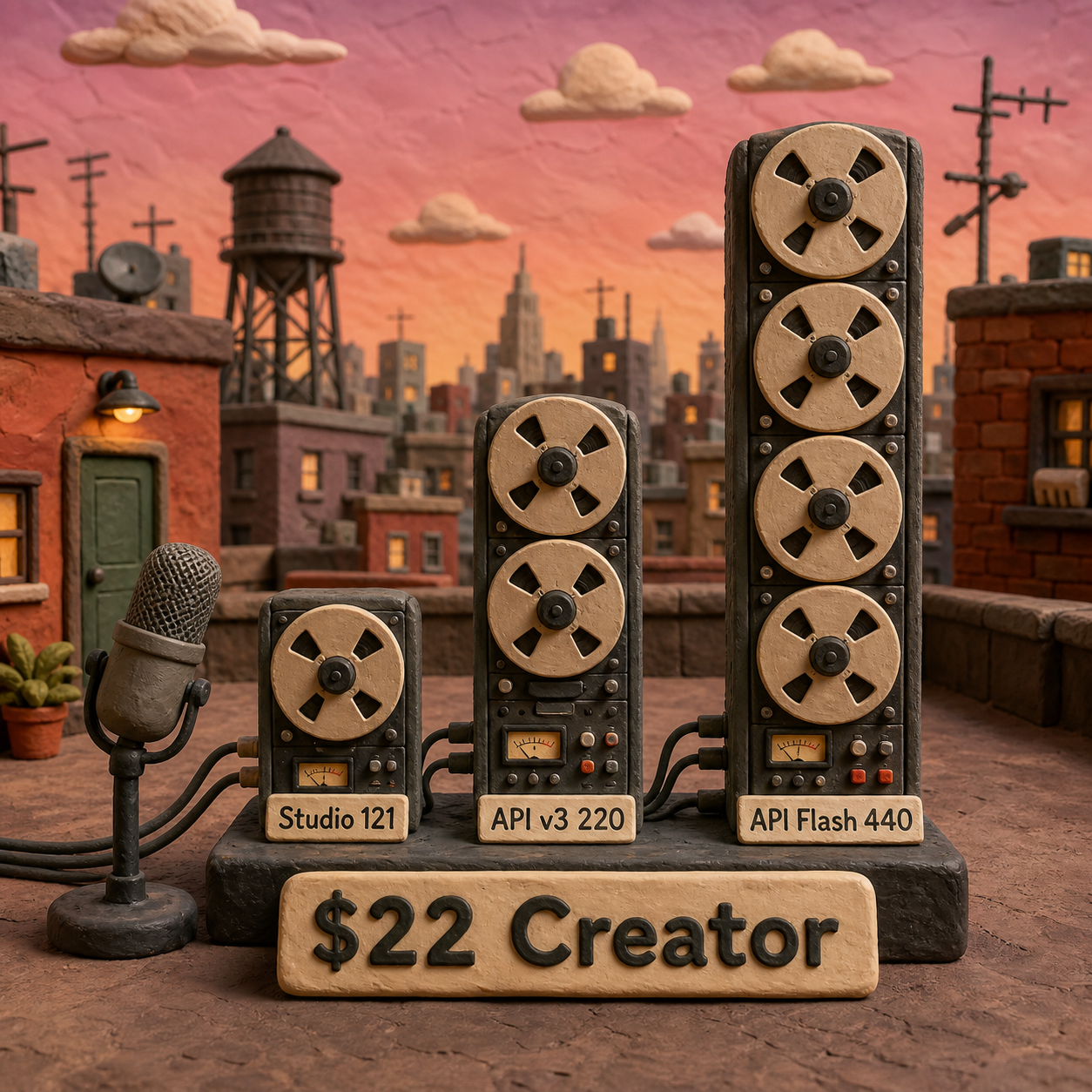
On Creator at $22, the live allowances are about 121 UI TTS minutes, 220 Multilingual v2/v3 API minutes, or 440 Flash/Turbo API minutes. That is 1.82 times the UI output with Multilingual, or 3.64 times with Flash/Turbo.
The current ElevenAPI pricing is metered directly in dollars:
- Text to Speech: $0.05 per 1,000 characters for Flash/Turbo, or $0.10 for Multilingual v2/v3. ElevenLabs equates each to roughly the same number of minutes.
- Speech to Text: $0.22 per hour for Scribe v2, plus $0.07 per hour for entity detection and $0.05 for keyterm prompting. Scribe v2 Realtime is $0.39 per hour.
- Speech Engine: $0.08 per call minute, or $0.16 at burst pricing.
- Music: $0.15 per generated minute.
- Voice Isolator and Voice Changer: $0.12 per minute each.
- Sound Effects: $0.12 per minute.
- Dubbing v1: $0.33 per source minute with a watermark or $0.50 without one.
- Dubbing v2: $2.20 per source minute.
The app-versus-API decision is about the work surface, not technical prestige. Stay in ElevenCreative when a person is directing individual performances, rearranging a production, listening between changes, and making craft judgments. Use the API when approved scripts, voices, naming rules, and output formats repeat across many assets.
A brand designer producing six hero films a year gains little by automating the last mile. A localization team generating the same product script across a large catalog can waste money by paying UI rates for a repeatable job. The API earns its setup cost when the creative decision has already been made and volume is now the problem.
PAYG, rollover, and annual billing carry the hidden costs
ElevenLabs no longer gives new self-serve customers the old postpaid overage model. Pay As You Go, or PAYG, is prepaid: add funds, consume subscription credits first, then draw down the PAYG balance at the current product rate.
PAYG is available on Free, Starter, Creator, Pro, Scale, and Business. The minimum top-up is $5. A balance has no monthly rollover cap, but each purchase expires after 12 months and every top-up is nonrefundable. Adding funds does not upgrade the underlying voice slots, feature access, concurrency, or plan limits.
Auto Top Up defaults to a $20 charge when the balance falls below $10. With Auto Top Up enabled, ElevenLabs requires a $5 minimum balance buffer. If the payment fails, service pauses. With Auto Top Up off, service pauses when the balance reaches $0. The optional monthly spend cap exists, but it is off by default.
That default matters for a production API. Auto Top Up prevents a clean hard stop, while the disabled spend cap removes a clean budget ceiling. Set both deliberately. A top-up feature is not a budget policy.
PAYG also stores value in dollars and displays it as credits at the current plan's conversion rate. Downgrading can reduce the visible credit count even though the dollar value does not change. Upgrading can increase it. The system shows the conversion before a downgrade, but the mechanic makes credit screenshots a poor accounting record.
One credit pool makes the headline allowance slippery
Every ElevenCreative product spends from the same monthly pool. Text to Speech uses about 1 credit per character, Speech to Text about 330 credits per minute, Music about 900 per minute, Sound Effects about 200 per generation, and Voice Changer or Voice Isolator about 1,000 per minute.
Dubbing is the sharpest example. Automatic dubbing uses about 2,000 credits per minute with a watermark or 3,000 without one. Dubbing Studio uses about 5,000 with a watermark or 10,000 without one. A 10-minute watermark-free Dubbing Studio job therefore consumes 100,000 credits. On Creator, that leaves only 21,000 credits, or about 21 UI TTS minutes, from the original 121,000.
This is why "121 minutes" is not a promise once the workspace mixes products. Price the actual output mix, not the biggest TTS number on the card.
Credits are charged when a generation is requested, not when it is downloaded. ElevenLabs may offer limited free regenerations when the content and specified settings do not change, and the interface indicates that before generation. A revised script, voice, or qualifying setting can turn a creative correction into another charge.
Rollover helps steady subscribers, then disappears on exit
Paid-plan credits can roll over for up to two months while you keep the same active subscription. The balance can therefore reach at most three times the monthly allowance: the current allocation plus two stored months. Free credits do not roll over.
Canceling or downgrading takes effect at the end of the cycle and forfeits unused subscription credits. Upgrading carries unused credits into the new cycle. PAYG funds sit separately under their 12-month expiry.
Annual billing adds another lock. ElevenLabs charges ten monthly payments upfront, renews annually unless canceled, and still resets self-serve credits each month. You cannot switch an annual subscription back to monthly mid-cycle, and a paid subscription cannot be paused. Public prices also exclude taxes, levies, and duties.
ElevenAgents is a separate cost stack
ElevenAgents uses the same plan prices but measures call minutes and concurrency separately from the Creative credit story. Free, Starter, Creator, Pro, Scale, and Business include 15, 75, 275, 1,238, 3,738, and 12,375 call minutes, with 4, 6, 10, 20, 30, and 40 concurrent calls respectively.
Additional calls cost $0.08 per minute. Calls above the plan's concurrency limit can use burst capacity at $0.16 per minute, and text messages cost $0.003 each. The number of agents is not the limit; simultaneous calls and monthly call minutes are.
The plan card is not the complete call cost. LLM usage and telephony are charged separately at cost. A 1,000-minute Creator workload is $22 plus 725 extra minutes at $0.08, or $80 before LLM and telephony. Creator and Pro reach the same platform cost at about 1,238 minutes, almost exactly Pro's included allowance.
That makes Creator the economical prototype tier for a modest agent workload. Pro becomes the cleaner operating choice when usage approaches 1,238 minutes, concurrency needs exceed 10 calls, or a hard capacity buffer matters more than a small monthly saving.
Murf and Speechify are cheaper in specific workloads
ElevenLabs is not the automatic price winner. Murf is near parity for annual creator voiceover capacity, while Speechify undercuts it sharply on raw Studio minutes and API characters. The right comparison depends on whether you are buying a directed creative workspace, a cloned brand voice, or bulk speech generation.
For a wider quality and use-case shortlist, compare the best AI voice generators and best text-to-speech tools. The figures here isolate price and published capacity, not unmeasured voice quality.
Murf is almost the same annual creator deal
Murf Creator costs $19 per month billed annually, or $228 upfront, and includes 24 hours of voice generation for the year. That is 1,440 minutes and about $0.1583 per minute at full use.
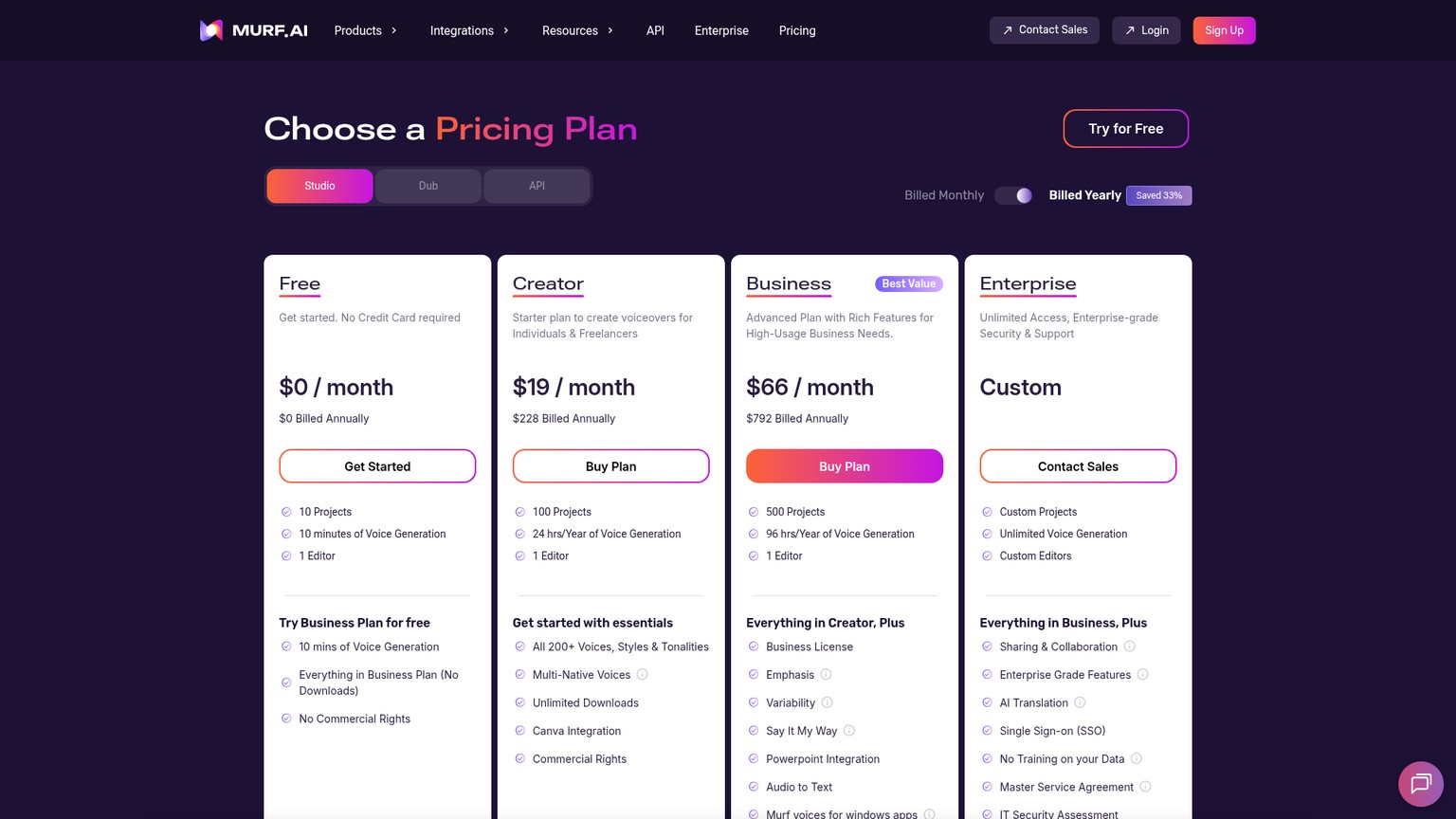
ElevenLabs Creator annual costs $220 and supplies about 1,452 UI minutes across twelve monthly allocations. That is about $0.1515 per minute. ElevenLabs is $8 cheaper for 12 more published minutes, which is too small a difference to decide the tool.
The allocation pattern can decide it. Murf publishes 24 hours per year. ElevenLabs supplies about 121 minutes each month, with only two months of rollover. A bursty annual narration project may fit the yearly pool better. A steady channel publishing every week fits the monthly cadence.
Murf Free also offers 10 minutes, but no downloads or commercial rights. Murf Creator adds 200+ voices, unlimited downloads, Canva integration, commercial rights, 100 projects, and one editor. Murf Business costs $66 per month billed annually, or $792, for 96 hours a year and one editor. That lands at the same $0.1375 full-use price per minute as ElevenLabs Pro or Business annual, but at a much smaller total capacity.
Choose Murf when the editor, stock voice library, and yearly allocation fit the job. Choose ElevenLabs Creator when Professional Voice Cloning and the broader audio stack justify the nearly identical annual creator spend.
Speechify wins the raw-minute and API price
Speechify Studio Starter costs $100 per year and includes 86,400 Studio credits. Voiceover consumes 1 credit per second, so the plan carries 1,440 voiceover minutes at about $0.0694 per minute. That is roughly 54% below ElevenLabs Creator annual on raw voiceover capacity.
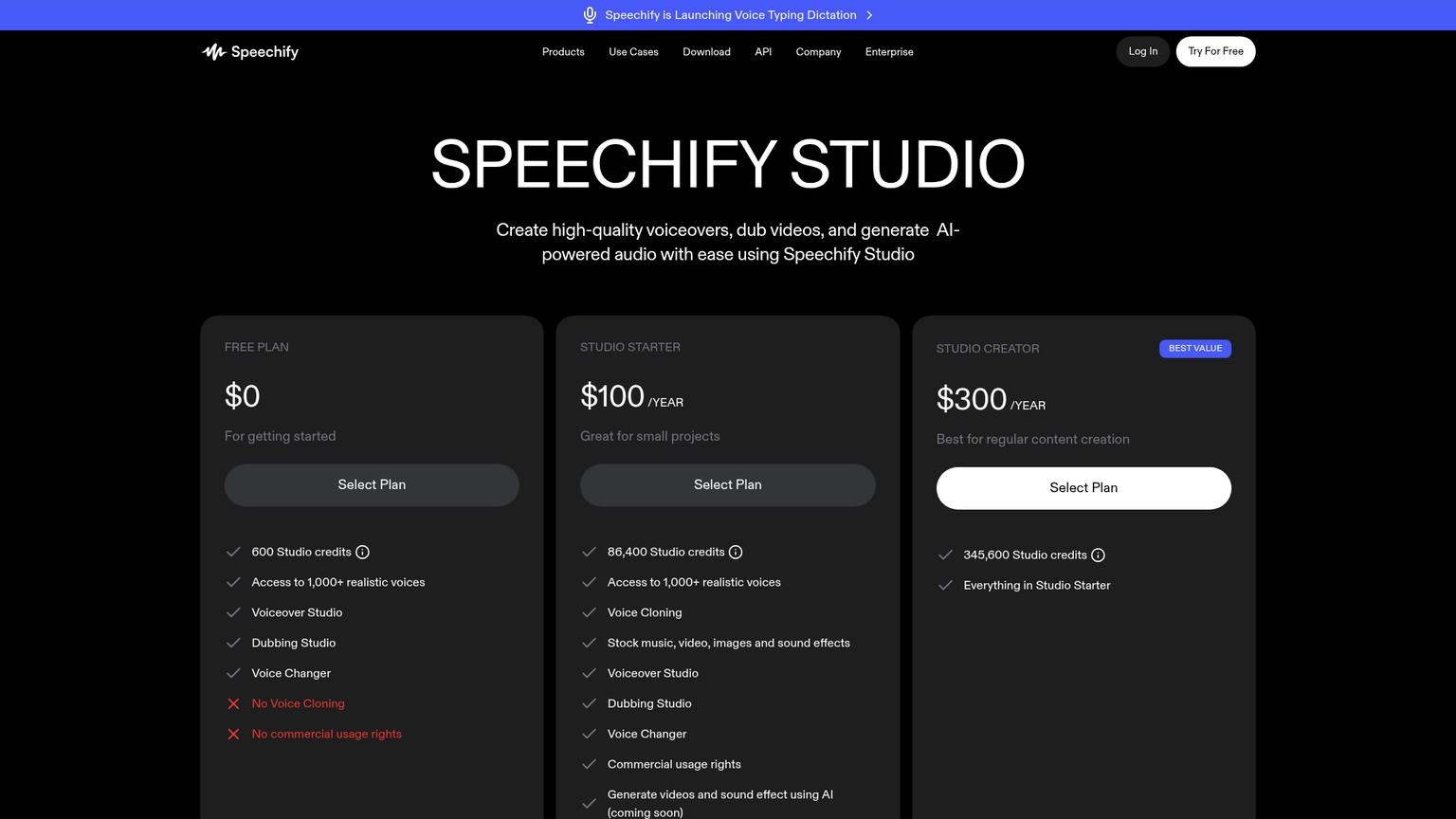
Speechify Studio Creator costs $300 per year for 345,600 credits, equal to 5,760 pure voiceover minutes at about $0.0521 per minute. The catch is the workload mix: dubbing consumes 3 credits per second and avatars consume 30. The same pool collapses much faster when the output is not plain voiceover.
Speechify Free includes 600 credits, equal to 10 voiceover minutes, but no voice cloning and no commercial rights. Starter adds both. That makes its $100 annual plan unusually aggressive for a creator whose dominant job is straightforward licensed voiceover.
The API gap is larger. Speechify API Starter costs $10 per month with 1 million TTS characters included, then $10 per additional million. ElevenLabs costs $50 per million Flash/Turbo characters or $100 per million Multilingual v2/v3 characters. Speechify is therefore five times cheaper than ElevenLabs Flash and ten times cheaper than Multilingual on raw character price. This comparison says nothing about which voice is better; it says the unit economics are not close.
Price a 10-minute brand-film brief before generating it
A ship-ready 10-minute brand-film voiceover should not begin with a full 10-minute generation. The first pass is where pronunciation, emphasis, pace, and voice fit are least certain, so it is the most expensive place to generate the whole script.
Take a brief with one product name, two technical terms, a quiet opening, and a faster call to action. A full-script first pass can be convincing and still fail on the product name, flatten the contrast between sections, or rush the close. Regenerating all 10 minutes pays again for nine minutes that were already usable.
The better before-to-after is procedural. Before, one long script asks the model to solve voice choice, pronunciation, pacing, and final delivery at once. After, a short proof locks the difficult decisions, then the approved script runs in sections so one weak line does not invalidate the rest.
Price the finished output
Count final minutes, commercial rights, required voice type, and export quality. A commercial 10-minute film rules out Free. Starter works for an instant clone; Creator is the first tier for Professional Voice Cloning; Pro is the boundary for 192kbps and 44.1kHz PCM through the API.
Build a 30-second stress test
Use the hardest product name, one technical phrase, a sentence with an intentional pause, and the emotional turn from the brief. Generate that excerpt before the full script. The goal is not a beautiful sample; it is to expose the failure points cheaply.
Fix the direction, not only the wording
Correct pronunciation, break long sentences, make pauses explicit, and choose the final voice and model. Flash/Turbo is priced for cheaper volume; Multilingual v2/v3 costs twice as much per API character. Make that choice before scaling the approved text.
Generate and export in sections
Split the script at natural editorial boundaries, approve each section, then export at the quality the edit requires. Regenerate only the failed segment. Move a stable repeated workflow to the API once scripts, voice IDs, naming, and delivery settings stop changing.
The craft bar is simple. A mood-board sample needs a plausible voice and tone. A ship-ready file needs the right license, exact pronunciations, consistent pacing across sections, no accidental voice drift, and the required audio format. A compelling first take that fails any one of those checks is still a draft.
Refunds, education pricing, and the 2026 price change
ElevenLabs refunds are narrow: a request must be filed within 14 days of payment, and none of the credit quota for that period can have been used. Once generation starts, assume the subscription charge is committed. PAYG top-ups are explicitly nonrefundable.
The documented education discount applies to ElevenReader, not to a general ElevenCreative student tier. Eligible students and educators must be at least 16, and eligibility depends on institution domain and country. The live ElevenCreative pricing page does not publish a general student rate.
Pricing did change in 2026. On 7 May, ElevenLabs announced lower API and Agents pricing plus PAYG. It said TTS fell by up to 55%, Speech to Text by up to 45%, and ElevenAgents by up to 20%. Its Creator Flash example moved from $0.11 to $0.05 per 1,000 characters, while its Starter Agents example moved from $0.10 to $0.08 per minute.
Treat $5 Starter, 100,000 Creator credits, $330 Scale, $1,320 Business, and general postpaid self-serve overages as historical values. The current structure is $6, 121,000, $299, $990, and prepaid PAYG.
Frequently asked questions
How much does ElevenLabs cost?
ElevenLabs costs $0 for Free, then $6 Starter, $22 Creator, $99 Pro, $299 Scale, and $990 Business per month. Creator is $11 for the first month. Enterprise pricing is custom.
How much can I use ElevenLabs for free?
Free includes 10,000 monthly credits, equal to about 10 UI TTS minutes, plus 3 Studio projects. It is for noncommercial use with attribution, offers Voice Design rather than voice cloning, and its credits do not roll over.
Is ElevenLabs worth the money?
Creator is worth $22 for regular commercial voice work when Professional Voice Cloning matters. Starter is better for occasional commercial clips. Pro pays near 549 UI minutes a month or when 192kbps and 44.1kHz PCM API output are required. Pure high-volume TTS can be cheaper through Speechify.
What is the best ElevenLabs alternative?
Murf is the closest annual creator-value alternative: $228 for 1,440 minutes versus ElevenLabs at $220 for about 1,452 UI minutes. Speechify is the cheaper raw-volume choice at $100 for 1,440 annual Studio voiceover minutes or $10 per million API characters.
Does ElevenLabs offer a student discount?
ElevenLabs documents an education discount for ElevenReader, subject to institution, country, and age eligibility. It does not publish a general ElevenCreative student price on the live Creative pricing page.
What is the ElevenLabs refund policy?
A subscription refund request must arrive within 14 days of payment, and no quota from the requested period can have been used. PAYG top-ups are nonrefundable.
How much does the ElevenLabs API cost?
Flash/Turbo TTS costs $0.05 per 1,000 characters and Multilingual v2/v3 costs $0.10. Scribe v2 transcription is $0.22 per hour, Realtime is $0.39 per hour, Music is $0.15 per minute, and product-specific processing and dubbing rates apply.
Did ElevenLabs pricing change in 2026?
Yes. ElevenLabs cut API and Agents prices and introduced PAYG in May 2026. Current Creative prices include $6 Starter, $299 Scale, and $990 Business; the older $5, $330, and $1,320 figures are no longer current.
Stop paying for overlapping creative AI plans. Get the AI Business Workflow Audit Checklist.
- Published
- Category
- Design
- Language
ElevenLabs Alternatives: Murf, MAI-Voice-2, OpenAI TTS and Cartesia (Verified October 2026)
Compare ElevenLabs, Murf, MAI-Voice-2, OpenAI, Cartesia, Google and Speechify by studio or API job, with verified prices and switching costs.Oct 4, 2026Design
Higgsfield API Pricing
Price Higgsfield API video and image jobs, separate API dollars from app credits, and check top-ups, expiry and cashback before scaling.Sep 27, 2026Design
Is Gemini Live Avatar Free
Check Gemini Live Avatar access, Enterprise API charges and custom-avatar limits before budgeting a customer-facing video agent.Sep 27, 2026Design
Gemini 3.8 Flash TTS Pricing
Price Gemini 3.8 Flash TTS by audio minute, compare Flash-Lite and service tiers, and budget the January 2027 increase.Sep 24, 2026Design
ngram vs Demosmith
Compare ngram and Demosmith for product videos, browser capture, revisions and usable exports, with costs matched to the same job.Sep 19, 2026Design
ArtPatt Pricing
ArtPatt pricing explained: Free limits, Pro exports, saved patterns, AI-image allowances, and when a paid plan earns its place.Sep 15, 2026Design
Cutsio Video Indexing Cost
Decode Cutsio's indexed minutes, stored hours, seats, and overages to choose a plan for a growing video library.Sep 13, 2026Design