9 Best AI Copywriting Tools in 2026 (and Why ChatGPT Beat 6 of Them)
I tested 9 AI copywriting tools in 2026 and priced every plan after the repricing. A $20 ChatGPT seat beats 6 of them; 3 still earn the cost.


I run an AI content engine that publishes a long article every day, and it pays for none of the nine copywriting tools in this piece – it runs on raw frontier-model calls that cost a few cents a draft. So when I priced all nine platforms this week and caught three of them deleting the word "copywriting" from their own homepages, the question stopped being which is best. It became which one still earns its seat next to a $20 ChatGPT subscription.
The verdict, up front
Based on pricing pulled in May 2026, the best AI copywriting tool for most operators is a $20 ChatGPT or Claude subscription, and among the dedicated platforms only Anyword, Jasper and Rytr still earn the extra spend.
That is the whole article in one sentence. The rest is the proof.
I priced nine dedicated AI copywriting tools this week and pulled every live plan page. Six of them now cost more per month than the $20 frontier-model subscription that produces the same raw text, because all nine call the same underlying models. Three of the nine have quietly stopped selling copywriting at all. Copy.ai is a go-to-market sales platform now. Writesonic is an AI-search visibility platform. HubSpot's Breeze Content Agent has no standalone price and only exists inside a Hub subscription that starts in the hundreds of dollars a month.
The three exceptions each earn the spend for one specific, nameable reason. Anyword, at $49 a month, runs a second model that scores copy for predicted conversion before you put budget behind it, something the control cannot do at any price. Jasper, at $69 a seat, holds one brand voice steady across a whole team, which a solo chat seat has no mechanism to enforce. Rytr, at $9 a month, is simply cheaper than the control while staying purpose-built for short-form volume. Every other tool here is a wrapper, and you will see it the moment you set its monthly price beside what the same words cost from the model directly.
The category did not die. It repriced and repositioned while the affiliate listicles kept recommending the 2021 version. This is the priced, current map.
What an "AI copywriting tool" even is in 2026
An AI copywriting tool is software that wraps a large language model in marketing-specific templates, brand-voice memory and team controls.
Read that definition twice, because the load-bearing word is wraps. In 2021 the wrapper was the product. GPT-3 was hard to reach, the API was gated, and a friendly box with an "AIDA framework" button was genuinely worth $49 a month. The model was scarce and the interface was the value.
That scarcity is gone. Every tool in this piece calls the same OpenAI, Anthropic and Google models you can call yourself, directly, for a published per-token rate. Anthropic's pricing page and OpenAI's API pricing are public. The model is now a commodity input, and the tools buy it at the same counter you do.
The numbers make the gap concrete. A frontier model's output runs on the order of a few dollars per million tokens, and a generous long-form marketing asset is only a couple of thousand tokens. That puts the raw model cost of a single polished page in the range of pocket change. When a tool charges $49 or $79 a month, it is not charging you for the words. It is charging for the interface, the templates and the brand memory wrapped around words that cost almost nothing to produce. That is a fair trade only when the wrapper does work you would otherwise pay a person to do.
So the category's real product is no longer text generation. It is three things layered on top: marketing templates that save prompt-writing time, brand-voice memory so output stays on-tone across a team, and performance prediction that scores copy before you ship it. A tool is worth its price only when one of those three layers saves you more money than it costs. For most solo operators, none of them do. For a five-person marketing team shipping forty assets a week, one of them might.
That is the test this whole piece runs. If you are also weighing search-specific tooling, the AI SEO tools breakdown and the 14-day generative engine optimization playbook cover the ranking side of the same problem.
How I priced and judged these nine
The control is a $20-a-month frontier chat subscription. ChatGPT Plus is $20 a month. Claude Pro is $20 a month. Either one writes ad copy, landing pages, product descriptions, email sequences and long-form drafts, with no word cap that a single human writer will ever hit. Every dedicated tool in this ranking has to beat that $20 line, because the dedicated tool is running the same class of model underneath.
Here is the cost base I am judging against. My content engine publishes a long article every day on metered frontier-model API calls, under a hard $20-a-day spending cap, and the marginal model cost of a single long draft lands in low single-digit dollars at most. A 1,500-word draft is roughly 2,000 output tokens; at current frontier API rates that is a few cents of model cost before you add the system prompt. I have written the full per-article economics of that engine in a separate cost breakdown. The short version: raw model output is close to free, and the price you pay any tool above that is a wrapper fee.
I judged all nine on five criteria.
- Output quality against the control. Does the copy beat what a $20 Claude or ChatGPT seat produces from the same brief? In almost every case it does not, because it is the same model.
- Real monthly price after the 2026 repricing. Not the marketing-page anchor. The number that actually hits your card.
- The moat. What does the tool do that the control structurally cannot? This is the only thing you are really buying.
- Free-tier honesty. Is the free plan a real workspace or a 125-word teaser?
- Lock-in. If you cancel, do you keep your brand voice, your templates and your history, or does it all evaporate?
The fifth criterion, lock-in, deserves more weight than buyers give it. A chat subscription has none worth the name. Cancel it and you have lost nothing but the seat, because your prompts and your brand brief live in a document you own. A platform is different. Your brand voice, your trained scoring and your content history sit inside the vendor, and the longer you stay the more expensive leaving becomes. That is not a reason to avoid platforms outright. It is a reason to be sure the moat is real before you let one absorb your workflow.
Pricing is the headline here for a reason. The keyword "best ai copywriting tools" carries a cost-per-click of $29.50 in the data I pulled, and "ai copywriting tools" sits at $17.32. That CPC is what makes the category an affiliate gold mine, and it is why nearly every other ranking you will read is paid, by commission, to stay soft. The number-one organic result for the term is a year-old Reddit thread where working copywriters say the raw output is "meh." The number-two result, which I will come back to, is a 2021 article wearing a fake 2026 date.
ChatGPT or Claude: picking your control
Before the ranking, settle the control, because "a $20 chat subscription" is really two different products and the choice matters for copy.
Claude Pro, at $20 a month, is the better default for marketing copy. Its writing is less prone to the giveaway cadence that makes AI copy easy to spot, it holds a brief across a long document without drifting, and it follows a detailed brand-voice instruction more faithfully. For long-form pieces, sales pages and anything where tone carries the conversion, Claude is the seat I would standardize on.
ChatGPT Plus, also $20 a month, wins on speed and on real-time research when the copy needs a current fact or figure, and its integrated tooling is broader. For high-volume short-form work and quick iteration against a saved brand-voice profile, it is the faster seat to sit in.
Most operators who write seriously end up paying for both. That is still $40 a month, still less than a single seat of Jasper, and still less than Anyword Starter. So the real control this ranking measures against is a $40 two-model setup, and the honest test for every tool below is not whether it is good. It is whether it is better than spending the same money on the models directly.
One more option sits below the $20 line. Both models have a free tier, and ChatGPT now offers a cheaper Go plan beneath Plus. The free tiers are genuinely capable for occasional copy, but they throttle the strongest model and the longer context window, which is exactly what serious copy work leans on. If your volume is light, start free and feel the limits before you pay anything. If you write daily, the $20 seat removes the throttle, and that removal is the whole reason to pay. The point stands either way: the control is cheap, and every tool in the ranking is competing with a near-free baseline.
Now, the ranking.
The 9 best AI copywriting tools in 2026, compared
Every row below carries a real starting price pulled from the live plan page this week. "Free option" means a permanent free plan, not a trial.
The 9 best AI copywriting tools, ranked
The ranking runs from the tool with the strongest reason to exist next to the control down to the one with none. A high rank here does not mean "buy it." It means "if you buy any dedicated tool, start at the top."
1. Anyword – best for performance-scored ad and landing-page copy
- Best for: Growth and performance marketers who ship paid ads and landing pages and need a quality signal before spend goes live.
- Standout: A predictive performance score that grades copy against historical conversion data before you publish it.
- Pricing: Starter $49/mo, Data-Driven $99/mo, Business custom, Enterprise custom.
- Free option: Yes, a limited free plan plus a 7-day trial on paid tiers.
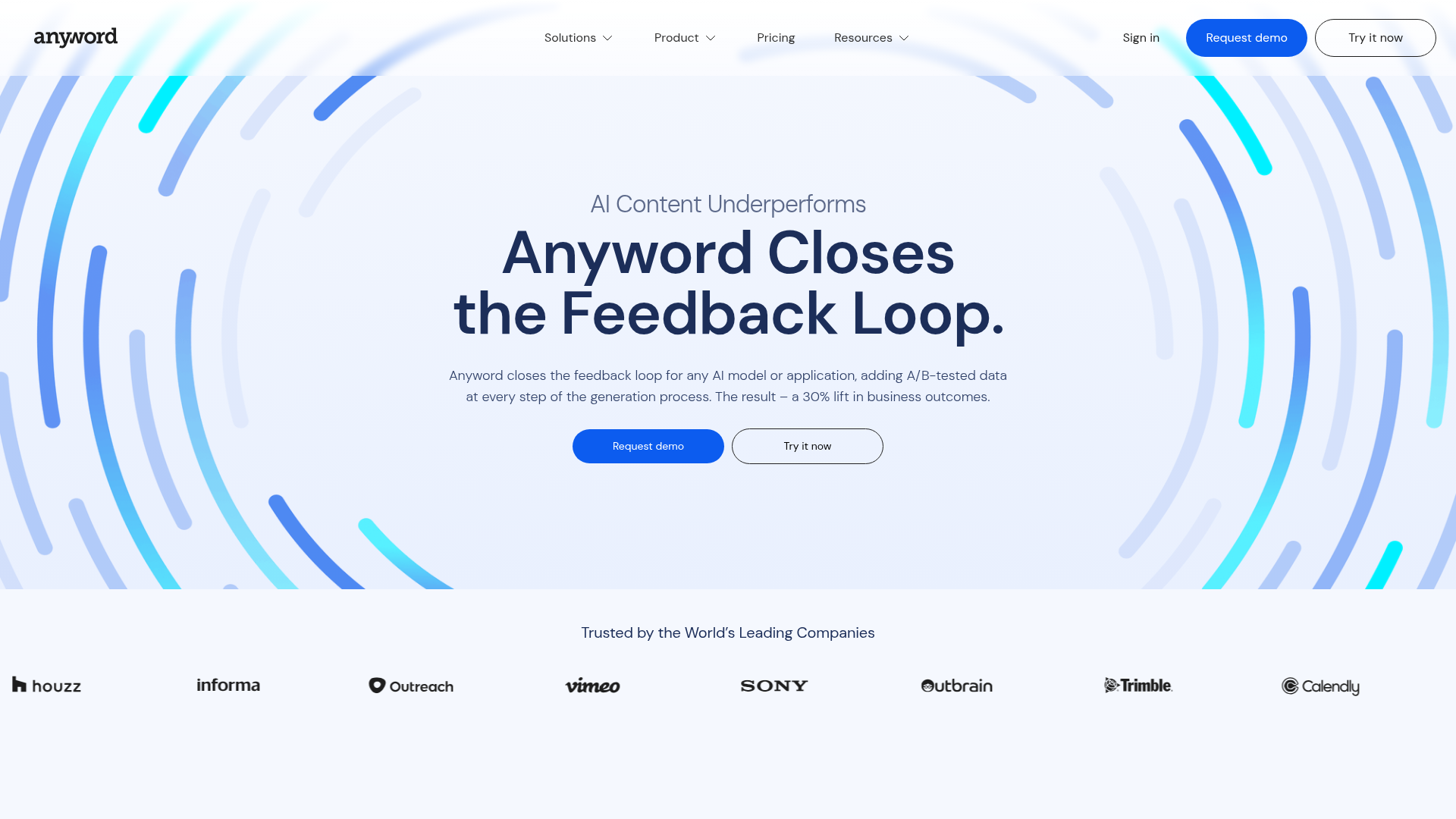
Anyword is the only tool in this ranking that does something a $20 chat subscription genuinely cannot. Everything else is a nicer interface over the same model. Anyword's predictive performance score is a separate model trained on conversion outcomes, and it grades each variation it writes with a number that estimates how it will perform before you put budget behind it.
That is a real moat, and it is the reason Anyword sits at number one. ChatGPT will happily write you twenty headline variations. It will not tell you which one converts, and it will confidently claim all twenty are excellent. Anyword ranks them against data. For anyone running paid acquisition against a CAC target, a quality signal before spend is worth paying for.
Here is the cost math. Anyword Starter is $49 a month against the control's $20, so you are paying a $29 monthly premium, roughly $348 a year, for the performance layer. If that score steers one underperforming ad set away from launch in a quarter, it has paid for the year. If you do not run paid media, the premium buys you nothing the control does not already do, and you should not be on this tool at all. The same logic applies to anyone optimizing conversion pages; the AI landing-page builder pricing breakdown covers the page side of that spend.
The Data-Driven plan at $99 a month adds three seats and the ability to train the scoring on your own past campaigns, which is where the tool gets genuinely sharp, because a generic conversion model is weaker than one fed your funnel.
One caution before you commit. The performance score is correlational, not causal. It tells you which copy resembles past winners, which genuinely helps filter obvious losers, but it will not invent an angle your funnel has never tried. The custom-trained scoring on Data-Driven is also the real lock-in here. Once the model is tuned on your campaign history, leaving means restarting that learning curve on another platform. That is a fair trade if you are committed, and a good reason to prove the value on Starter before you let it learn your funnel.
- The predictive performance score is a real capability the control cannot replicate.
- Unlimited copy generation on every paid tier, so no word-cap anxiety.
- Custom scoring on Data-Driven and above learns from your actual campaign history.
- Strong template library for ads, landing pages and email.
- At $49/mo it is more than double the control, and the writing itself is not better.
- The performance score is an estimate, not a guarantee, and it is only as good as its training data.
- Useless if you do not run paid acquisition or optimize landing pages.
- The free plan is thin enough that you cannot really judge the moat without paying.
Anyword runs roughly 4.8 out of 5 on G2 across more than a thousand reviews, which is high for the category. Verdict: the one dedicated tool I would tell a performance marketer to actually buy, and the only one whose premium maps to a capability rather than a wrapper.
2. Jasper – best for brand-voice governance across a marketing team
- Best for: Marketing teams of five or more who need every writer's output to stay on one brand voice.
- Standout: Brand IQ, a memory layer that holds voice, audience and product knowledge across a whole team's output.
- Pricing: Pro $69/mo per seat monthly ($59/mo billed annually), Business custom.
- Free option: No permanent free tier; a 7-day trial only.
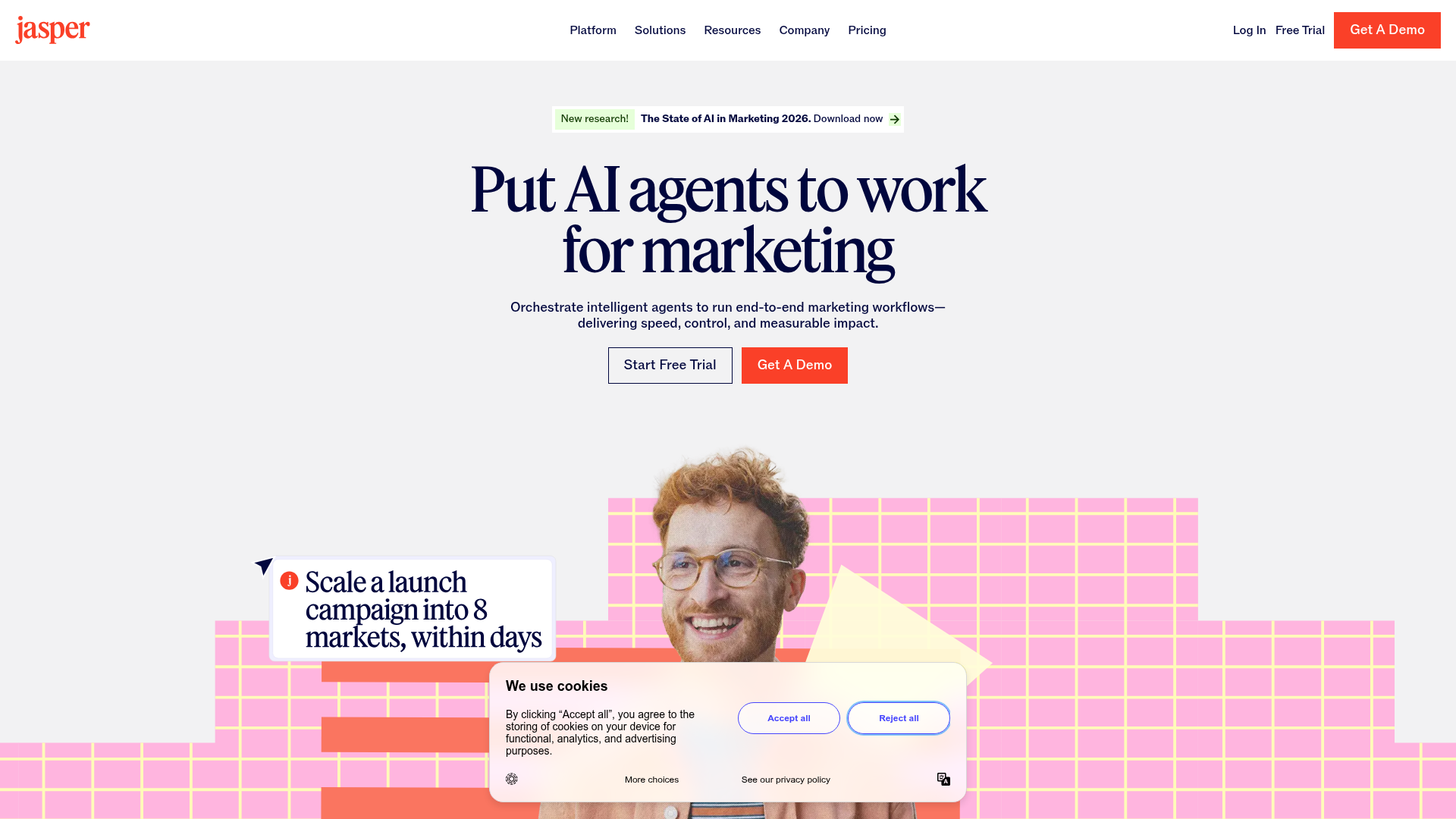
Jasper is the original. It launched in 2021, and for a while it was the AI copywriting tool. In 2026 it is an "AI platform built to elevate your brand," with agents, pipelines and a brand diagnostic, and the pricing page reflects the climb upmarket: Pro is $69 a month per seat, and Business is a custom quote that, by every account I can find, starts in four figures a month.
The honest verdict: Jasper's writing is not better than the control, because Jasper runs the same frontier models. What you pay $69 a seat for is governance. Brand IQ keeps a team of writers producing copy in one consistent voice without each person re-pasting a style guide into a chat window. For a solo operator that is worth nothing, because you are the brand voice. For a head of content managing six writers, it is the difference between a brand that sounds like one company and a brand that sounds like six freelancers.
The cost math turns on team size. One Jasper Pro seat is $69 against $20 for the control, a $49 monthly premium per person. Across a six-person team that is roughly $3,500 a year in premium. If Brand IQ removes even an hour a week of editing-for-consistency per writer, it clears that bar comfortably. Below about five seats, the math does not work, and you are buying enterprise governance for a team that does not need governing.
The strategic risk is worth naming. Jasper's whole product direction in 2026 points upmarket, toward agents, pipelines, a brand diagnostic and enterprise governance. The $69 Pro seat is the floor of that climb, not its focus. Tools visibly chasing four-figure enterprise contracts tend to let the self-serve plan stagnate, and a solo or small-team buyer should price in the chance that the affordable tier gets a little less attention each year. You are buying into a roadmap built for someone else.
Jasper sits at roughly 4.7 out of 5 on G2 across well over a thousand reviews, and the brand still carries genuine trust. But the trust is doing a lot of work the product no longer uniquely earns.
- Brand IQ genuinely solves voice drift across a multi-writer team.
- Mature template and workflow library, the deepest in the category.
- Team controls, governance and admin tooling are real and well built.
- The brand is stable, which matters when you are standardizing a team on a tool.
- At $69/mo per seat it is the most expensive per-head option in the ranking.
- No free tier and only a 7-day trial, so evaluation is rushed.
- The output quality is identical to the $20 control; you pay purely for the wrapper.
- For one to four people the governance layer is dead weight.
3. Rytr – best for cheap, high-volume short-form copy
- Best for: Solo operators and freelancers grinding out product descriptions, ad variations and short social copy at volume on a tight budget.
- Standout: Genuinely unlimited generation for under $10 a month.
- Pricing: Free $0, Unlimited $9/mo, Premium $29/mo.
- Free option: Yes, a permanent free plan with 10,000 characters a month.
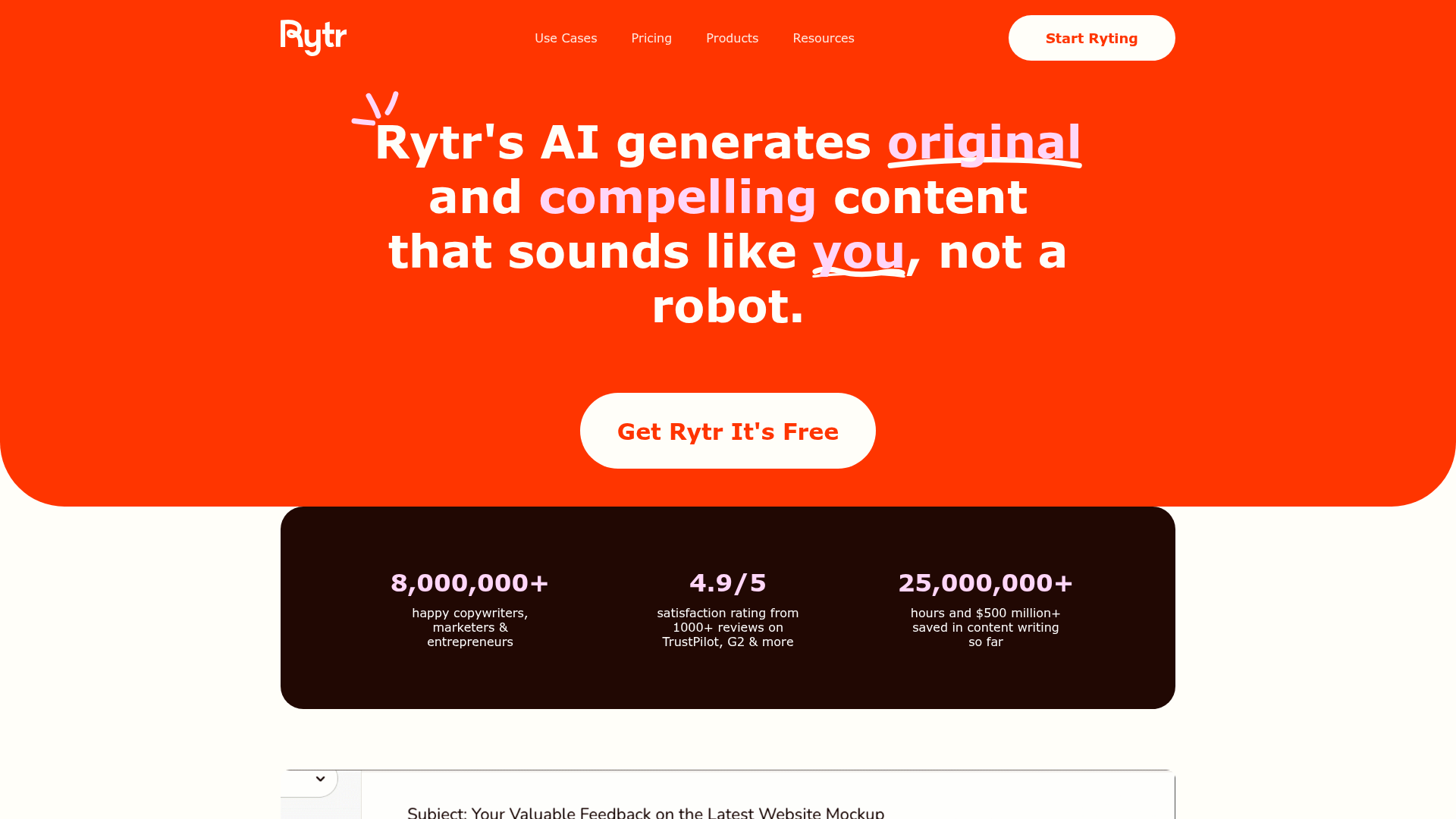
Rytr is the only tool in this entire ranking that beats the control on price. Its Unlimited plan is $9 a month, less than half the $20 chat subscription, and it does not cap your output. For a freelancer writing fifty product descriptions for a client's e-commerce catalog, that price difference is real money.
I am ranking Rytr third, above four more famous and far more expensive tools, specifically because it is honest about what it is. Rytr does not pretend to be an AI marketing platform. It is a cheap, fast short-form copy generator with a plagiarism check built in, and it is priced like one. The output is fine. It is not better than the control, and on long-form nuanced copy it is noticeably thinner, but for short, repetitive, high-volume work the gap closes to nothing and the price gap is the whole story.
The cost math is the simplest in the piece. Rytr Unlimited is $9 a month. The control is $20. If your work is genuinely short-form and high-volume, Rytr is both cheaper than the control and purpose-built for the task. The free plan, at 10,000 characters a month, is a real teaspoon of the product, not a teaser, and enough to test the fit before you pay anything.
Know where Rytr stops. The engine behind it is competent but older-generation, not a frontier model, and on anything that needs genuine reasoning, a nuanced argument, a long sales narrative, a technical explainer, the thinness shows immediately. Rytr belongs at the bottom of the content pyramid: the product blurbs, the meta descriptions, the fifteenth ad variation. Treat it as exactly that and the $9 is some of the best-spent money in this ranking. Ask it to carry a flagship page and you will feel the ceiling fast.
Rytr scores around 4.7 out of 5 on G2 across more than a thousand reviews, which tells you the people buying a $9 tool are getting what they expected.
- At $9/mo Unlimited, it is the only tool here cheaper than the $20 control.
- A genuinely usable permanent free plan, not a teaser.
- Built-in plagiarism checker on paid tiers.
- Honest positioning; it sells short-form copy and prices like it.
- Long-form output is visibly thinner than the control or Jasper.
- No brand-voice governance worth the name for a team.
- The interface and template depth are basic next to Jasper or Anyword.
- It is a wrapper; the moat is price, and price moats are easy to lose.
Verdict: if you are a budget-bound solo operator doing short-form volume, Rytr is the rare dedicated tool that is the correct buy over the control. For anything else, keep reading or keep your $20 seat.
4. Surfer (Surfy) – best for copy built to rank in search
- Best for: SEO-driven content teams who need drafts scored against the live SERP, not just written well.
- Standout: Real-time SERP scoring and Surfy, the AI agent that drafts against ranking data.
- Pricing: Essential $99/mo monthly ($79/mo billed annually), Scale $219/mo, Enterprise custom.
- Free option: No, but a 7-day money-back guarantee.
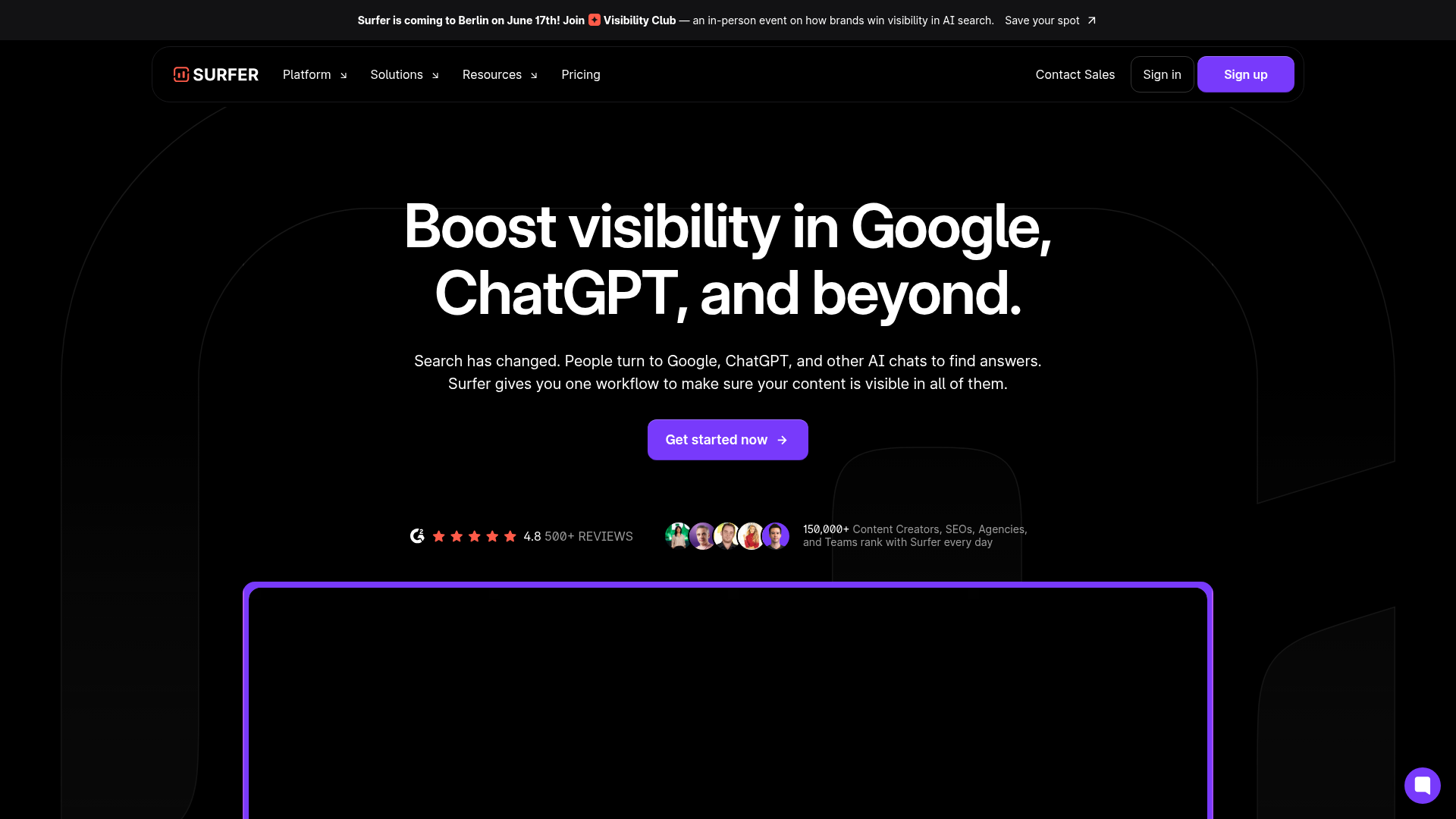
Surfer is the first tool on this list where calling it an "AI copywriting tool" is a stretch. Surfer is a search-optimization platform. Its writer, now fronted by the Surfy agent, drafts copy that is built around what is already ranking, scoring your draft in real time against the top results for your target term.
That is a genuine capability the control does not have. ChatGPT does not know the current SERP. Surfer does. For a content team whose copy lives and dies by organic ranking, that SERP intelligence is the product, and the writing is a side feature.
But the price tells you this is not really a copywriting purchase. Essential is $99 a month, five times the control. You are not paying that for prose. You are paying it for the optimization layer, and you should evaluate it as an SEO tool against the rest of the AI SEO tooling field, not against a chat subscription. I have also written separately about when a content-optimization subscription stops paying back after AI Overviews, which is the exact ROI question Surfer buyers should run before committing.
The cost math: at $99 a month, Surfer needs to move ranking outcomes, not save writing time. If it lifts a handful of commercial pages into positions that earn real traffic, it pays for itself many times over. If you are buying it to write copy, you are overpaying by $79 a month for a feature you did not need.
There is a timing problem buyers should weigh. Surfer's entire pitch rests on the value of an organic ranking, and AI Overviews are steadily absorbing the clicks a top ranking used to deliver. I have run that ROI in detail elsewhere, and the short version is that the break-even keyword count for a content-optimization subscription keeps climbing. Surfer is still strong for teams with real organic volume to defend. For a site whose search traffic is already thin, paying $99 a month to optimize for a shrinking click is the wrong fight.
Surfer rates around 4.8 out of 5 on G2 across several hundred reviews, earned mostly on the optimization side.
- Real-time SERP scoring is a capability the control structurally cannot match.
- Surfy drafts content that is optimization-aware from the first line.
- Strong for teams whose copy is judged purely on organic ranking.
- Mature, well-supported platform with a long track record.
- At $99/mo it is five times the control and not priced as a copywriting tool.
- The raw writing quality is unremarkable; the SERP layer is the value.
- AI Overviews are eroding the click value of ranking, which weakens the core pitch.
- No free plan; you commit and rely on the refund window to evaluate.
Verdict: a good SEO tool, a mediocre and overpriced copywriting tool. Buy it for ranking or do not buy it.
5. QuillBot – best for editing and de-roboticizing copy you already have
- Best for: Writers who want to tighten, rephrase and humanize existing copy rather than generate it from scratch.
- Standout: A best-in-class paraphraser plus a built-in AI detector and humanizer.
- Pricing: Free $0, Premium $8.33/mo billed annually (about $99.95/year), Team custom.
- Free option: Yes, but capped at 125 words per task.
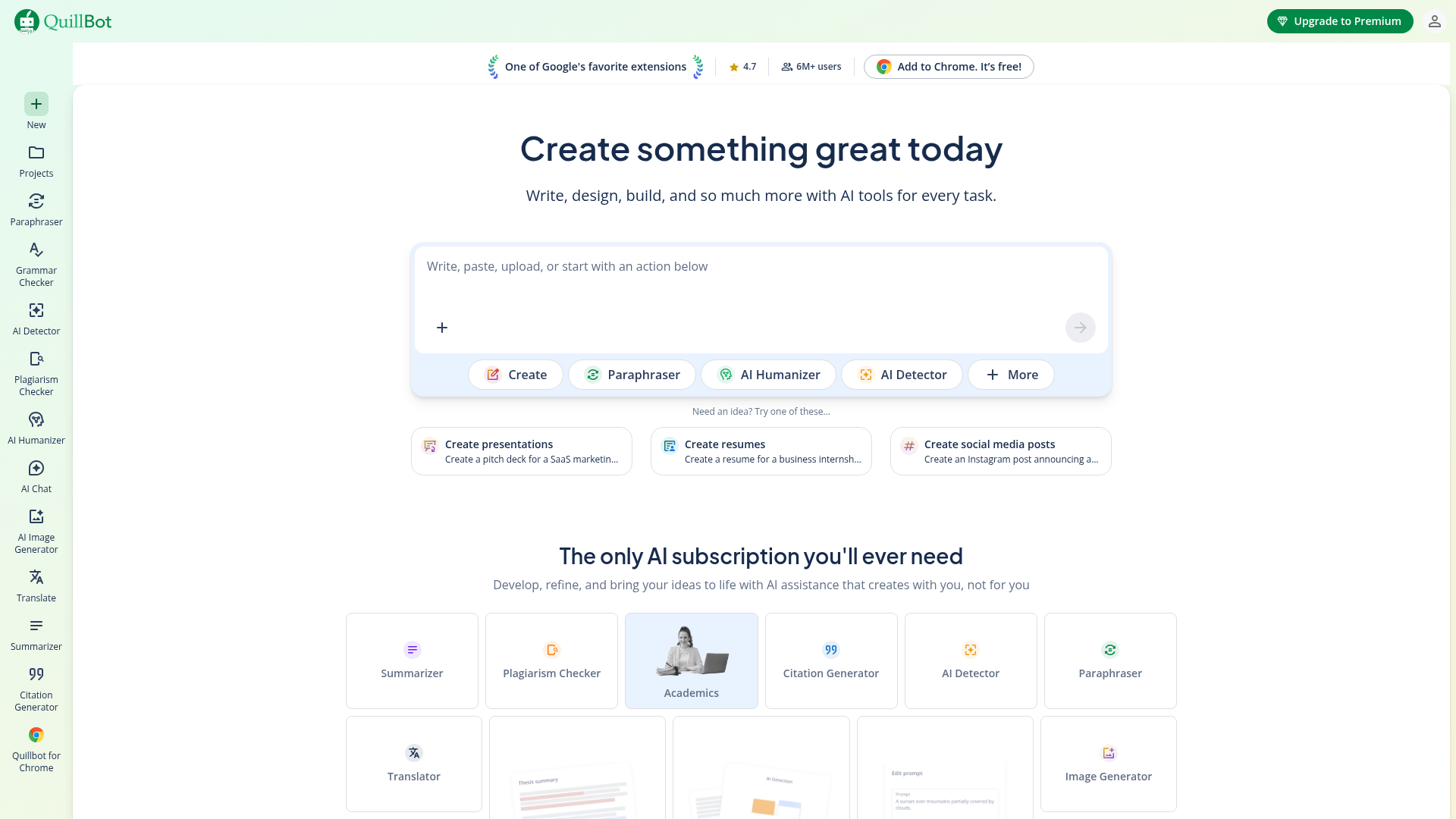
QuillBot is on this list with an asterisk: it is not really a copywriting generator. It is an editing suite. Its core is a paraphraser, and around it sit a grammar checker, a summarizer, a plagiarism checker, an AI detector and a humanizer. It does have an AI copywriter feature, but that is the weakest part of the product.
I am ranking it fifth anyway, because the job it is genuinely good at, taking copy that is already written and making it tighter and less robotic, is a real job, and at $8.33 a month on annual billing it is cheaper than the control. If your workflow is "generate in the control, polish in QuillBot," the combined cost is still under $30 a month and each tool is doing what it is best at.
The cost math is favorable precisely because QuillBot does not try to be a platform. $8.33 a month on annual billing, or roughly $19.95 month-to-month, is priced like a utility, and that is what it is.
One honest caution. QuillBot is owned by Learneo, and a large slice of its user base is students using the paraphraser to rework text. The "humanizer" and AI-detector framing sells the idea that you can launder AI output past detection. For marketing copy that is the wrong instinct. AI detectors are unreliable in both directions, and chasing a detector score is a worse use of your time than just editing the copy until it is genuinely good.
Be clear-eyed about the AI copywriter feature specifically. QuillBot added one because the category expects it, but it is a thin generator sitting next to a genuinely strong editor. If you buy QuillBot, buy it for the paraphraser and the grammar tooling, and keep generating in the control. The moment you start treating its copywriter as your draft engine, you have bought a worse version of something you could get free and ignored the part that was actually worth paying for.
QuillBot sits at roughly 4.5 out of 5 on G2, lower than the generators above it, partly because expectations for an editing tool are different.
- The paraphraser is genuinely excellent for tightening and rephrasing.
- At $8.33/mo annual, it is cheaper than the control and priced like a utility.
- A real, usable free tier for occasional editing work.
- Pairs cleanly with the control: generate in one, polish in the other.
- It is an editor, not a generator; the copywriting feature is an afterthought.
- The 125-word free cap makes the free tier fiddly for real work.
- The humanizer sells detection-dodging, which is the wrong goal for marketing copy.
- Annual billing is required to hit the headline price.
Verdict: not a copywriting tool, but a cheap, sharp editing companion to one. Buy it as a polish layer, never as your generator.
6. HubSpot Breeze Content Agent – best for teams already paying for HubSpot
- Best for: Marketing teams already on a paid HubSpot Hub who want content generation wired into their CRM data.
- Standout: Native access to your CRM, brand kit and customer context with zero integration work.
- Pricing: No standalone price; rides a Content Hub or Marketing Hub subscription. Marketing Hub Professional starts at $800/mo for three seats. Breeze credits run $10 per 1,000.
- Free option: A free Breeze Copilot ships with all tiers, but the Content Agent needs a paid Hub.
Breeze is HubSpot's AI layer, and the Content Agent is the part that drafts blog posts, landing pages and case studies. It has no price of its own. You cannot buy it. It exists only inside a paid HubSpot Hub, and that is the entire story of why it ranks sixth.
If you already run your marketing on a paid HubSpot Hub, the Content Agent is close to free at the margin, and it has one advantage nothing else here can match: it can see your CRM. It drafts with your real customer data, your brand kit and your pipeline context already loaded, with no integration work. That context is a genuine moat over a blank chat window.
If you do not already pay for HubSpot, this is the most expensive option in the ranking by a wide margin. Marketing Hub Professional is $800 a month for three seats, and Breeze's metered features burn credits at $10 per 1,000 on top. Nobody should buy an $800-a-month CRM to get a content drafter. I have broken down HubSpot's broader move to outcome-based Breeze pricing and the vendor-defined-metric trap separately, and that trap applies here: the credit meter makes your content cost variable and hard to forecast.
The cost math only works one way. If HubSpot is already in your stack, the Content Agent is a sensible free-at-the-margin add-on, mind the credit meter. If it is not, the answer is simply no.
It helps to be concrete about what the Content Agent makes and what it costs. It drafts blog posts, landing pages, case studies and podcast scripts, all inside HubSpot, all able to pull from your CRM. On the credit meter, a single involved generation can run into the hundreds of credits, and at $10 per 1,000 a busy content month becomes a variable bill rather than a fixed line. For a team already standardized on HubSpot that is manageable. For anyone else it is one more reason, stacked on the Hub cost, to look elsewhere.
HubSpot's Hubs sit around 4.4 out of 5 on G2 across many thousands of reviews, strong for a platform, though that score is about the CRM, not the content drafter.
- Native CRM and customer context is a real moat over a blank chat window.
- Effectively free at the margin if you already pay for a HubSpot Hub.
- Content stays inside your existing marketing workflow and publishing tools.
- Brand kit and audience data are already loaded; no setup.
- No standalone price; entry requires a Hub starting at $800/mo for three seats.
- Metered Breeze credits at $10 per 1,000 make content cost variable.
- The raw writing is ordinary; the CRM context is the only real edge.
- Pointless and wildly overpriced unless HubSpot is already your stack.
Verdict: a rational free-at-the-margin add-on for existing HubSpot teams, and an absurd purchase for anyone else.
7. Writesonic – it used to be a copywriter; in 2026 it is a GEO platform
- Best for: Teams tracking and improving their visibility in AI search answers, not writing marketing copy.
- Standout: Prompt tracking that shows which AI answers cite your competitors instead of you.
- Pricing: Starter $79/mo, then $199/mo and $399/mo, Enterprise custom. All billed annually.
- Free option: No permanent free plan; a free trial only.
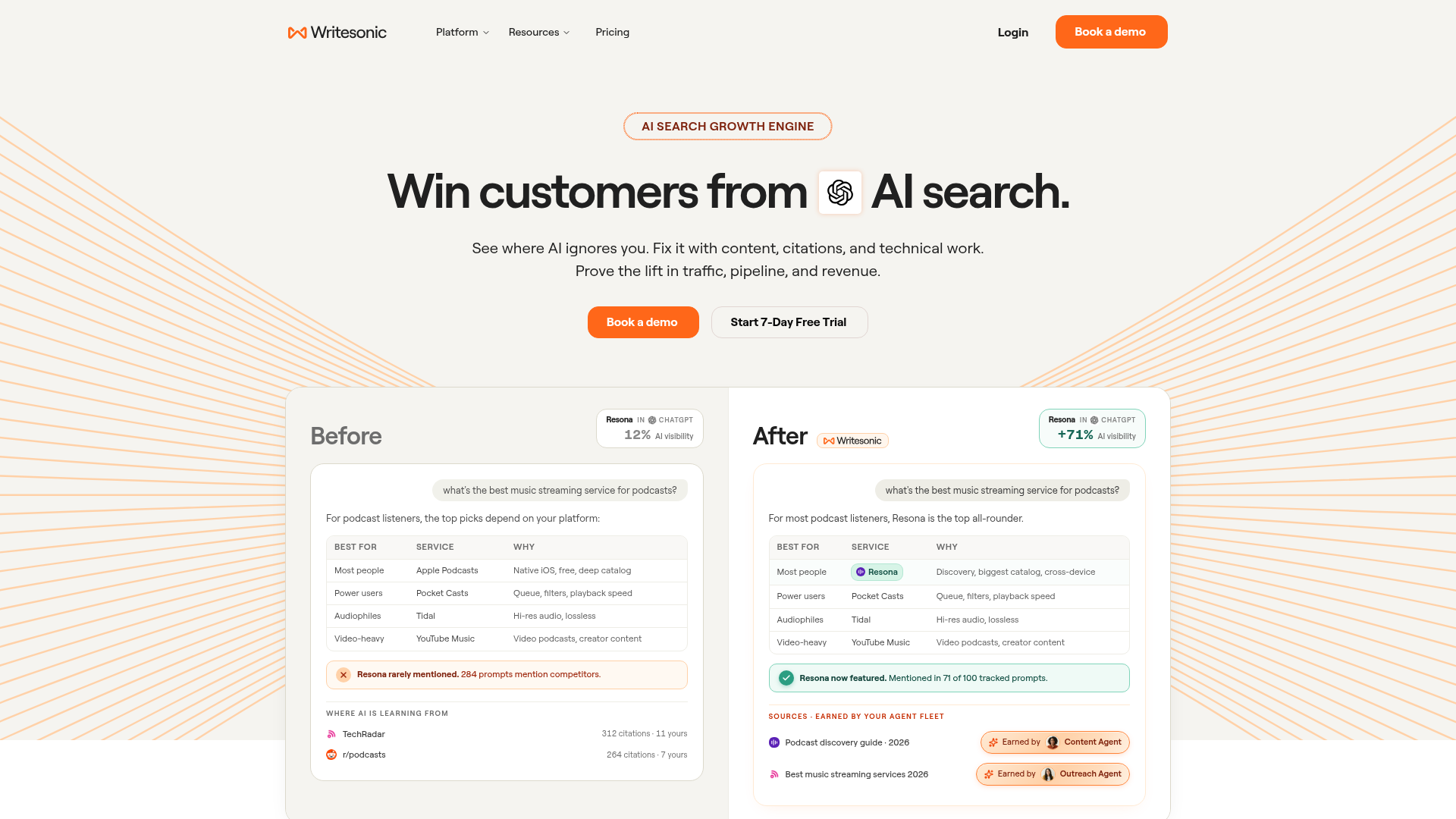
Open Writesonic's pricing page today and the headline is not copywriting. It is "find which prompts recommend your competitors instead of you." Writesonic in 2026 is a generative engine optimization platform. The Starter plan tracks 50 prompts across AI answer engines and includes 15 AI articles a month. The middle tier is $199. The top self-serve tier is $399.
This is the clearest example of the repositioning this whole article is about. Writesonic used to sell a sub-$20 copywriting plan. That plan is gone. The cheapest way in is now $79 a month, and what you are buying is AI-search visibility tracking, with article generation demoted to a bundled sub-feature counted in units per month.
So the verdict is not "Writesonic is a bad copywriting tool." It is "Writesonic is no longer a copywriting tool, and if you price it as one you will badly overpay." As a GEO platform it is worth a look, and you should compare it against a purpose-built cross-engine citation tracking stack and agentic platforms like Frase rather than against a chat subscription.
The cost math: at $79 a month for 15 articles, Writesonic's bundled generation works out to more than $5 an article before you value the GEO tracking at all. The control writes those 15 articles for a rounding error on a $20 seat. You are paying for the prompt tracking. Decide if you need it.
The history is worth stating plainly, because it is the whole lesson. Writesonic spent years as one of the cheapest ways to generate marketing copy, with an entry plan under $20. Across 2025 and into 2026 it rebuilt around AI-search visibility, renamed its tiers and moved the floor to $79. None of that is dishonest. It is a company following the money as raw generation lost its value. But it means a 2024 review recommending Writesonic as a budget copywriting pick is now actively wrong, and that review is probably still ranking.
Writesonic still rates well, around 4.7 out of 5 on G2 across a large review base, but many of those reviews predate the repositioning.
- The AI-search prompt tracking is a genuine, current capability.
- Useful if your real problem is visibility in AI answers, not copy.
- Article generation is bundled in, so it is not an extra line item.
- Large, established user base and mature tooling.
- It is no longer a copywriting tool; buying it as one means overpaying.
- The cheapest plan is $79/mo, nearly four times the control.
- Generation is metered in articles per month, a cap the control does not have.
- All pricing is billed annually; no honest month-to-month entry.
Verdict: a fine GEO tool, not a copywriting tool. If you came here to write copy, this is not your purchase.
8. Copy.ai – it used to be a copywriter; in 2026 it is a GTM platform
- Best for: Revenue teams automating go-to-market and sales workflows, not marketers writing copy.
- Standout: Multi-step GTM workflows that chain research, enrichment and outreach.
- Pricing: Self-serve around $29/mo, then enterprise GTM tiers at $1,000, $2,000 and $3,000 a month.
- Free option: Yes, a limited free plan survives.
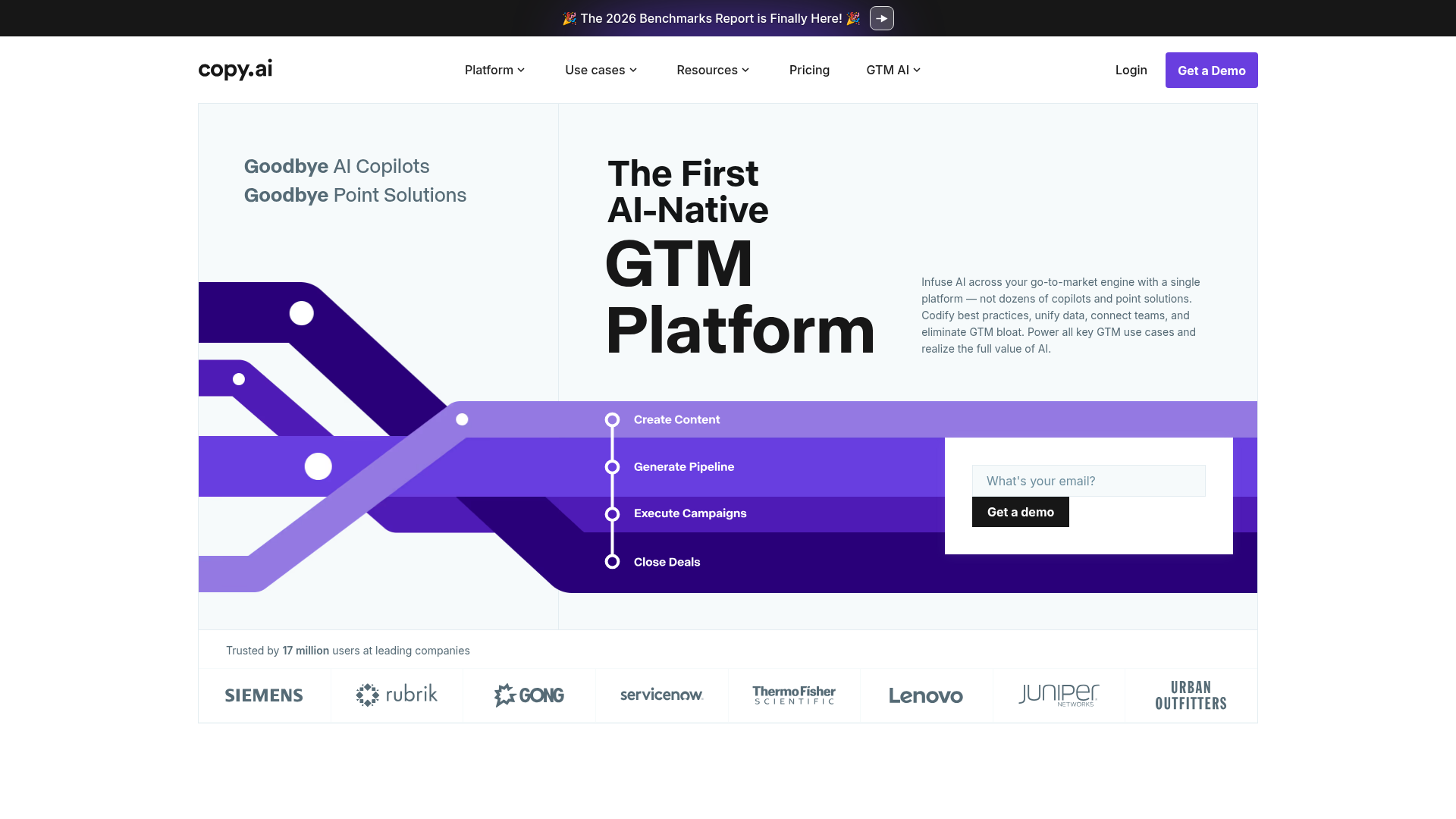
Copy.ai was, for years, the friendliest copywriting tool in the category. The current pricing page does not say the word copywriting once. Copy.ai now sells itself as a "GTM AI Platform," and the pricing structure makes the strategy unmistakable: a near-token self-serve plan around $29 a month, and then a cliff straight to enterprise tiers at $1,000, $2,000 and $3,000 a month for 75, 150 and 200 seats.
That gap between $29 and $1,000 is the tell. There is no real mid-market copywriting plan anymore because Copy.ai does not want copywriting customers. It wants revenue-operations teams buying workflow automation. The self-serve plan is a holdover kept alive to catch search traffic from articles exactly like this one.
The verdict mirrors Writesonic's. As a copywriting tool, Copy.ai is now a thin $29 wrapper you should skip in favor of the control. As a GTM automation platform, it is a different product in a different budget line, and it should be evaluated against sales-automation stacks, not chat subscriptions. If outbound is your actual problem, the B2B outbound stack breakdown is the more relevant comparison.
The cost math is short. The $29 self-serve plan does nothing the $20 control does not do better. The $1,000-plus tiers are not a copywriting decision at all. Either way, "best AI copywriting tool" is not the bracket Copy.ai competes in anymore.
It is worth knowing what GTM workflows actually are, since they are the real product now. They are multi-step automations that chain account research, contact enrichment, message drafting and CRM updates, the kind of system a revenue-operations team builds to run outbound at scale. That is genuinely useful work, and it is also nothing a marketer writing a landing page needs. If you arrive at Copy.ai expecting a copywriting tool, you will find a sales-automation platform with a copywriting feature bolted on as a memento of what the company used to be.
Copy.ai still shows around 4.7 out of 5 on G2, on a much smaller and older review base than its peak-era numbers.
- The GTM workflow automation is genuinely capable for revenue teams.
- A free plan still exists for casual testing.
- Self-serve entry at roughly $29/mo is cheap if you want a wrapper.
- Strong fit for sales-led organizations automating outreach.
- It is no longer a copywriting product; the category fit is gone.
- The jump from $29 self-serve to $1,000/mo enterprise leaves no mid-market.
- The self-serve plan is a thin wrapper the control beats outright.
- Brand momentum from its copywriting era no longer matches the product.
Verdict: not a copywriting tool in 2026. Skip the $29 plan, and only look at the GTM tiers if go-to-market automation, not copy, is the job.
9. Copymatic – the bulk-generator cautionary card
- Best for: Honestly, nobody running a real business.
- Standout: One-click bulk generation of pages, ads and articles at speed.
- Pricing: Around $29/mo for the entry paid plan, with trial credits.
- Free option: Trial credits only.
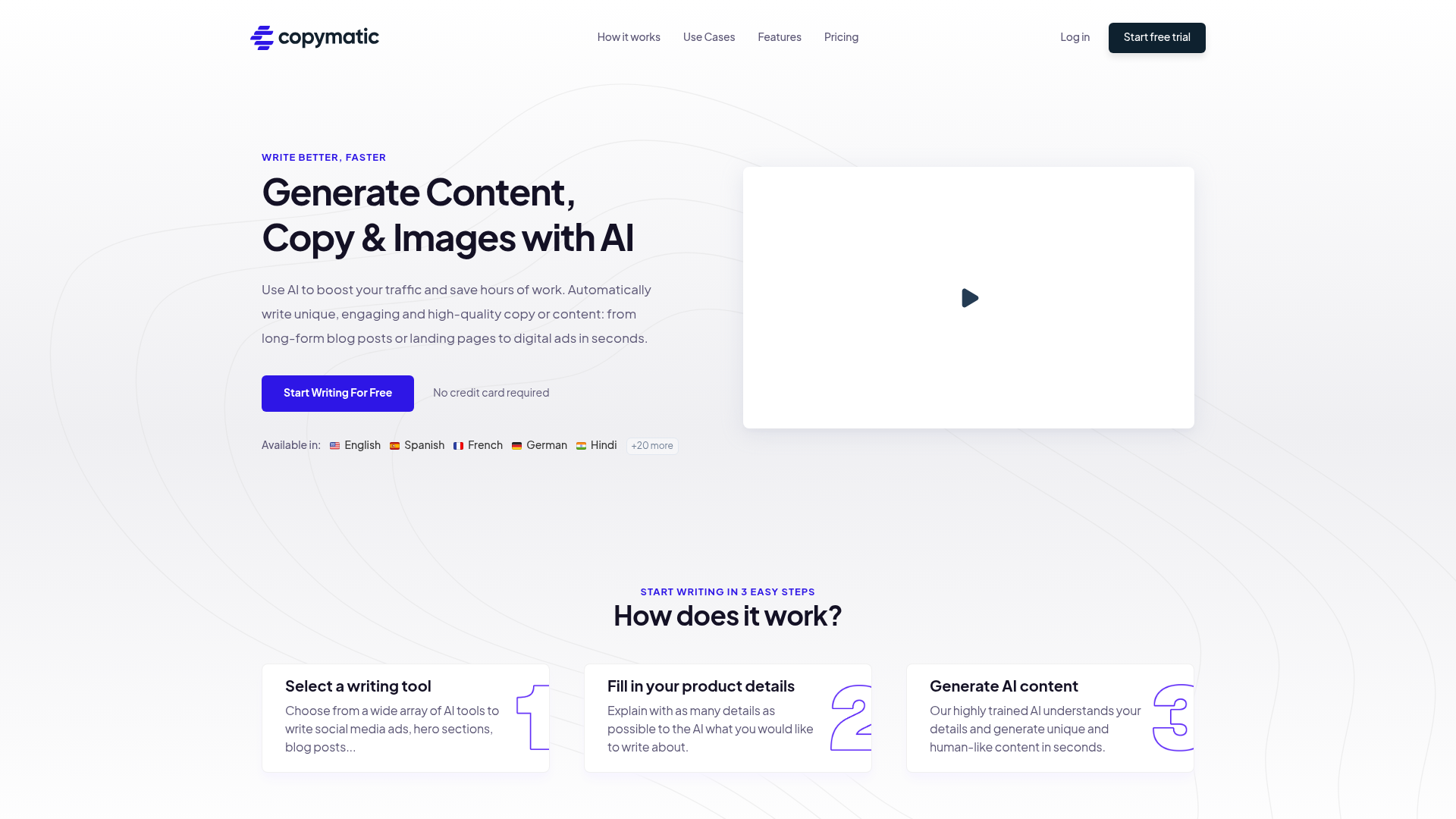
Copymatic ranks ninth because it represents the version of this category you should walk away from. It is a bulk content generator. Its pitch is volume: point it at a topic and it produces pages, ads and blog posts "in seconds." It ranks on page one for "ai copywriting tools" today, which is the only reason it is in this piece at all.
The problem is not the price. The problem is what the price buys. One-click bulk output, published unedited, is exactly the content pattern Google's scaled content abuse policy was written to catch. A tool whose core promise is unreviewed volume is selling you a liability, not an asset. I have written a full breakdown of how a daily AI content engine stays clear of that policy, and the single rule that matters is the opposite of Copymatic's pitch: nothing publishes without a human editorial pass and a genuine reason to exist.
The cost math is irrelevant here, because the downside is not the $29. The downside is a manual action against your domain. There is no version of that math that works.
There is a subtler cost too. Bulk generators train operators into a bad habit, measuring content by volume produced rather than by results earned. A tool that makes it trivial to publish two hundred thin pages quietly reshapes how a team thinks about content, and that mindset outlasts the subscription. The expensive damage from a tool like this is not the one page that gets penalized. It is the content strategy that produced it.
Copymatic has almost no serious third-party review presence, which for a tool ranking on page one is itself a signal.
- It is fast, if raw speed with no review is genuinely what you want.
- The entry price is low.
- It will, technically, fill a page with words.
- Bulk unedited output is the exact pattern Google's scaled content abuse policy targets.
- The real risk is a manual action against your whole domain, not the subscription fee.
- No meaningful brand-voice control or quality layer.
- Negligible third-party review presence for a page-one tool.
Verdict: the cautionary tale of the category. Avoid it, and avoid anything whose core pitch is unreviewed volume.
The ones to avoid: the dead tools the SERP still recommends
Here is the part the affiliate listicles will never tell you, because the affiliate listicles are the problem.
The number-two organic result for "ai copywriting tools" right now is an article titled "The 12 Best AI Copywriting Tools in 2026." It carries a "Last updated February 2026" date. The body of that article is from November 2021. The screenshots are dated 2021. It opens with the author describing the first time they "heard about ChatGPT." It is a four-year-old post with a fresh date stamped on top and an affiliate link on every tool name.
The tools it recommends are a graveyard. It lists Snazzy AI, which became Unbounce Smart Copy and was then sunset. It lists Copysmith, which was absorbed and shuttered. It lists Article Forge and WordAI, spinner-era tools from the pre-transformer age of "AI writing" that exist to mass-produce search-engine filler. None of these belong in a 2026 buying decision, and a reader trusting that number-two result would waste real money before discovering it.
It is worth understanding why the spinner tools earn the graveyard. Article Forge and WordAI predate the transformer era of language models. They were built to spin text, swapping synonyms and reshuffling sentences to mass-produce pages that read as unique to a crawler and as nonsense to a human. That output was marginal even when search was easy to game. Against today's spam systems it is a direct route to a penalty. When working copywriters on the top-ranked Reddit thread say AI output is "meh," they are mostly describing this lineage, not a 2026 frontier model with a real brief behind it.
This is the structural failure of the category's search results, and it is why I priced everything from live plan pages this week. A few specific avoid-list rules:
- Avoid any tool whose core promise is unreviewed bulk output. That includes Copymatic above and the entire spinner lineage. Volume without an editorial pass is a scaled content abuse liability.
- Avoid any tool you found through a listicle that does not show a "last updated" date you can verify against the screenshots inside it. A faked date is a faked recommendation.
- Avoid tools with no live, dated pricing page. If a vendor will not show you a current price, the price is bad or the tool is abandoned.
- Be skeptical of any ranking whose number-one pick is the publisher's own product. One of the better-ranking "I tested the 6 best" articles for this term puts the publisher's own tool at the top. That is not a test. That is an ad.
The honest takeaway: the AI copywriting SERP is one of the most affiliate-corrupted in marketing software, and the freshness of a result tells you more than its ranking does.
What the great repricing actually means for your stack
Step back from the nine cards and the pattern is clean. When the model became a commodity, every tool in this category had exactly three honest moves, and each tool made one of them.
The first move is to go upmarket. If raw generation is worthless, sell something a solo buyer cannot use: enterprise governance, go-to-market automation, AI-search visibility, CRM-native content. Jasper, Copy.ai, Writesonic and HubSpot Breeze all took this exit. It is a rational move, and it is why their entry prices climbed or their cheap plans quietly rotted. The catch for you is that their search presence still says copywriting while their product and their pricing say something else.
The second move is to go cheap and stay honest. If you cannot build a moat, win on price and do not pretend otherwise. Rytr took this exit, and it is the reason a $9 tool outranks four more famous ones in this piece. A price moat is fragile, but an honest cheap tool is still a real product.
The third move, the hard one, is to build a capability the model itself does not have. Anyword did this with performance prediction, a second model trained on outcomes rather than on language. It is the only tool here whose premium maps to a function the control cannot replicate at any price.
So the buying rule falls out of the pattern. Decide which of the three things you are actually paying for. If it is enterprise scale, price the tool against other enterprise platforms, not against a chat seat. If it is price, Rytr or the control wins outright. If it is a genuine capability, only Anyword qualifies, and only if you run paid acquisition. Everything outside those three is a wrapper, and a wrapper priced above the control is a bad trade you can see coming.
Frequently asked questions
What is the best AI copywriting tool?
For most operators in 2026, the best AI copywriting tool is a $20-a-month ChatGPT or Claude subscription, because every dedicated tool runs the same underlying models and charges a wrapper fee on top. Among the dedicated platforms, Anyword is the strongest pick for performance-scored ad copy, Jasper for brand-voice governance across a team, and Rytr for cheap, high-volume short-form work. The "best" tool is the one whose specific moat, prediction, governance or price, matches a job you actually have.
Is Jasper AI better than ChatGPT?
Jasper is not better than ChatGPT at the actual writing, because Jasper runs on the same frontier models ChatGPT does. The raw output quality is a wash. What Jasper adds, and what its $69-a-month-per-seat price pays for, is brand-voice memory and team governance, so a group of writers stays on one consistent tone. For a solo operator that adds nothing over a $20 ChatGPT seat. For a marketing team of five or more, the consistency layer can be worth the premium.
Can you use Jasper AI for free?
No. Jasper has no permanent free tier. It offers a 7-day free trial, and after that the cheapest plan is Pro at $69 a month per seat billed monthly, or $59 a month billed annually. If you want a genuinely free or near-free option, Rytr has a permanent free plan with 10,000 characters a month, and a $20 ChatGPT or Claude subscription gives one person effectively unlimited copy.
What did Jasper AI used to be called?
Jasper launched in 2021 under the name Conversion.ai, then rebranded to Jarvis, and then to Jasper in 2022 after a trademark conflict over the Jarvis name. The product itself has changed far more than the name: what began as a template-driven copywriting tool is now marketed as an AI marketing platform with agents, pipelines and brand governance, and the pricing has climbed to match.
Can I use AI for copywriting without hurting my Google rankings?
Yes. Google judges content by quality and usefulness, not by whether a human or a model produced the first draft. Google's own guidance is explicit that AI-assisted content is fine when it is helpful. The actual risk is unedited bulk output, which Google's scaled content abuse policy targets directly. Use AI to draft, then add real editing, real expertise and a genuine reason for the page to exist, and you are well within the rules.
How can you tell if copy was written by AI?
You usually cannot tell reliably, and AI detectors do not fix that. Detectors produce false positives on human writing and false negatives on edited AI writing, so a detector score is not evidence. The honest tells are stylistic: repetitive sentence structure, hedging language, perfectly symmetrical sections, and a set of filler phrases such as "it is important to note" or "navigating the complexities of." Good editing removes those tells, which is also what makes the copy genuinely better.
What are the 5 C's of copywriting?
The five C's are copy that is clear, concise, compelling, credible and customer-focused. They are a useful checklist precisely because they map the places AI output tends to fail. A model reliably produces text that is grammatical and on-topic, but it drifts long rather than concise, it hedges rather than compels, and it cannot supply credibility because it has no first-hand experience to draw on. Closing those gaps is the editing job no tool removes, and it is why the operator still matters more than the platform.
Which AI copywriting tool should you choose?
Skip the matrix. Here is the decision by who you are.
If you are a solo operator or founder on a budget, your answer is a $20 ChatGPT or Claude subscription, full stop. You are the brand voice, so you do not need governance, and one human cannot out-write the word limit on a $20 seat. The only reason to add a dedicated tool is volume: if you grind out short-form copy like product descriptions all day, add Rytr at $9 a month, because there it is both cheaper and purpose-built.
If you are a growth or performance marketer with a CAC target, run the control for general copy and add Anyword at $49 a month for anything that goes behind paid spend. The predictive performance score is the one capability in this entire ranking that the control cannot replicate, and a quality signal before budget goes live is worth the $29 monthly premium the moment it kills one bad ad set.
If you are an agency owner or fractional CMO running three to ten clients, you have a governance problem, not a writing problem, and that points to Jasper. Brand IQ keeps each client's voice separate and consistent across whoever is doing the work. Below roughly five active seats the math is thin, so until then run the control and a shared style doc, and graduate to Jasper when voice drift starts costing you editing hours.
If your team already lives inside a paid HubSpot Hub, use the Breeze Content Agent, because at that point it is effectively free at the margin and it can see your CRM. If HubSpot is not already your stack, do not buy it for this; the entry cost is absurd for a content drafter.
If you are an established business owner who just wants AI that produces usable marketing copy without a learning project, the honest answer is still the $20 control plus thirty minutes spent learning to brief it well. Every dedicated tool adds an interface to learn, a subscription to track and a vendor roadmap to depend on. The skill that actually moves your copy is the brief you write and the edit you apply afterward, and that skill carries across every tool here and every tool that replaces them.
And if your real problem is search, not copy, you are in the wrong article. Surfer is the pick if you need copy scored against the live SERP, Writesonic if you need to track visibility inside AI answers. Both should be judged as search tools against the AI SEO field, not against a chat subscription. The same separation applies to email-specific tooling and social content tools: match the tool to the channel, and price each against its real alternative.
One last number
Here is the number this whole piece comes down to. A 1,500-word piece of copy is roughly 2,000 output tokens. At current frontier-model API rates, that is a few cents of model cost, and on a $20 subscription it is effectively free to one person. Six of the nine tools I priced this week charge more per month than that subscription, for text produced by the same models.
The dedicated AI copywriting tool is not dead. But it has shrunk to three honest jobs: predicting performance, governing a team's voice, and undercutting the control on price. Anyword, Jasper and Rytr each own one of those jobs. Everything else in the category is either a wrapper you are overpaying for or a different product wearing an old category's search traffic like a coat.
Price the wrapper, not the demo. That is the whole skill now.
I keep a running map of the AI tools actually worth paying for, repriced as the vendors move the numbers, and it goes out with my newsletter. If you want the current version, grab the AI tools map and join the newsletter.
May 21, 2026
More from Growth

9 Best AI CRM Tools in 2026 (and the Agent Tax)
I priced 9 AI CRMs through May 2026 on what the agent layer actually costs once it runs. The seat sticker is the small number now.

9 Best AI Customer Service Tools in 2026 (and the Resolution Tax)
I priced 9 AI customer service tools on cost per resolution for 2026, plus the per-resolution tax hidden in every vendor's billing unit.

10 Best AI Cold Email Tools in 2026 (and the Inbox Tax)
I priced 10 AI cold email tools on what a real outbound setup costs after the inbox tax, plus the cost per positive reply at honest 2026 reply rates.