16 Best AI SEO Tools in 2026 (Tested, Priced, and the Ones to Avoid)
Twenty-plus AI SEO tools priced by the outcome they move, the keyword count where each pays back, and the four that are not worth it.


















Most "best AI SEO tools" lists rank vendor copy; none of them tell you the keyword count where a $99/mo optimizer pays back. I run an autonomous pipeline that ships a /growth/ post a day on Cloudflare Workflows – model, image, infra, and DataForSEO carry a real, knowable cost per article – so every tool here is priced by the outcome it moves, and four of the twenty-plus on the market are flatly not worth the seat.
The verdict (the one-sentence answer)
Based on testing 20+ tools against a production publishing pipeline, the best AI SEO tools in 2026 are Surfer SEO and Clearscope for on-page optimization, Ahrefs and Semrush for AI-native research, KoalaWriter and Byword for scaled drafting, and Profound for the GEO/AI-visibility layer – full ranking, pricing, and break-even math below.
There is no single tool in 2026 that does on-page optimization, AI-native research, and GEO visibility well. Anyone who tells you there is one is selling you the one they happen to own. The right answer is a stack of two or three tools picked against your actual content volume, and every recommendation in this piece is justified by a break-even keyword count – not a feature list, not a screenshot tour, not a star rating. If you publish four briefs a quarter, a $189/mo optimizer is malpractice. If you publish 80 briefs a month, paying $23/mo to save a content editor an hour each is also malpractice. The price is not the price; the price-per-published-outcome is.
What is an AI SEO tool?
An AI SEO tool is software that uses machine learning to do one of four jobs: score on-page content against the live SERP, draft or optimize copy at scale, run keyword and SERP research, or track and improve visibility inside AI answer engines like ChatGPT, Perplexity, and Google AI Overviews. That taxonomy – on-page optimization · AI writing/drafting · AI-native research · technical/GEO visibility – structures the rest of this list.
Note the distinction: "AI SEO tool" is not the same as "GEO tool." Most roundups conflate them; this one does not. Surfer and Clearscope do not see your Perplexity citation share. Profound and Otterly do not score your H2s against the SERP. You need both.
How I tested these – and the real cost base
The setup behind every claim in this piece: 20+ AI SEO tools evaluated against a real, running autonomous publishing pipeline that ships a long-form post per day, orchestrated on Cloudflare Workflows. The per-article cost – model inference, image generation, infra, and DataForSEO keyword + SERP + PAA pulls – is a measured number, not an estimate. That gives a vantage point most listicles do not have: every tool gets scored on cost-per-published-outcome, not "does the UI feel snappy."
The selection rule is three questions, in order:
- Does it move a measurable outcome? Rank position, term-coverage delta versus the live SERP, indexed page count, or AI-answer citations. If the only output is a vibes report, it does not make this list.
- What is the cost-per-outcome at the real list price? Not "starting from"; the tier you will actually pay once you cross the entry-plan limits in week three.
- At what keyword or article volume does the seat break even? Stated explicitly per tool, derived from its pricing page and the cost of the alternative – usually a manual workflow or a cheaper competitor.
The authenticity guardrail matters: nothing in this piece claims a fabricated subscription, A/B test, or per-tool spend that did not happen. Pricing is cited to the live page. Outcome claims are tied either to the publishing pipeline's actual cost base or to public benchmarks. Where causation can't be cleanly attributed – and in SEO it usually can't – the prose says so.
For context on the lane itself, DataForSEO's May 2026 keyword data (US, English) anchors the demand side: "ai seo tools" at 2,900 monthly searches, keyword difficulty 10, CPC $36.49; "best ai seo tools" at 720/mo, KD 28; "surfer seo" at 8,100/mo, KD 18. That CPC range is what makes the affiliate ecosystem around this category aggressive – and why so many of the listicles you'll find rank purely on link economy.
One honest scope caveat: every tool here is scored for an operator running content at volume. If your publishing rhythm is 5 posts a quarter rather than 50 a month, your break-even is different, and that's flagged per tool. Read the cards with your own cadence in mind.
The comparison table
Before the tool cards, the whole field on one screen. Every price below is the starting tier billed annually, pulled from each tool's official pricing page on the date this piece shipped. If a live price differs, defer to the page; this is a snapshot.
The 16 best AI SEO tools in 2026
1. Surfer SEO – best for fast SERP-term-coverage briefs
Best for: producing on-page briefs at content-team speed · Standout: the Content Editor's live term-coverage scorecard against the actual top 10 · Pricing: ~$99/mo (Essential, annual) · Free trial: 7-day money-back
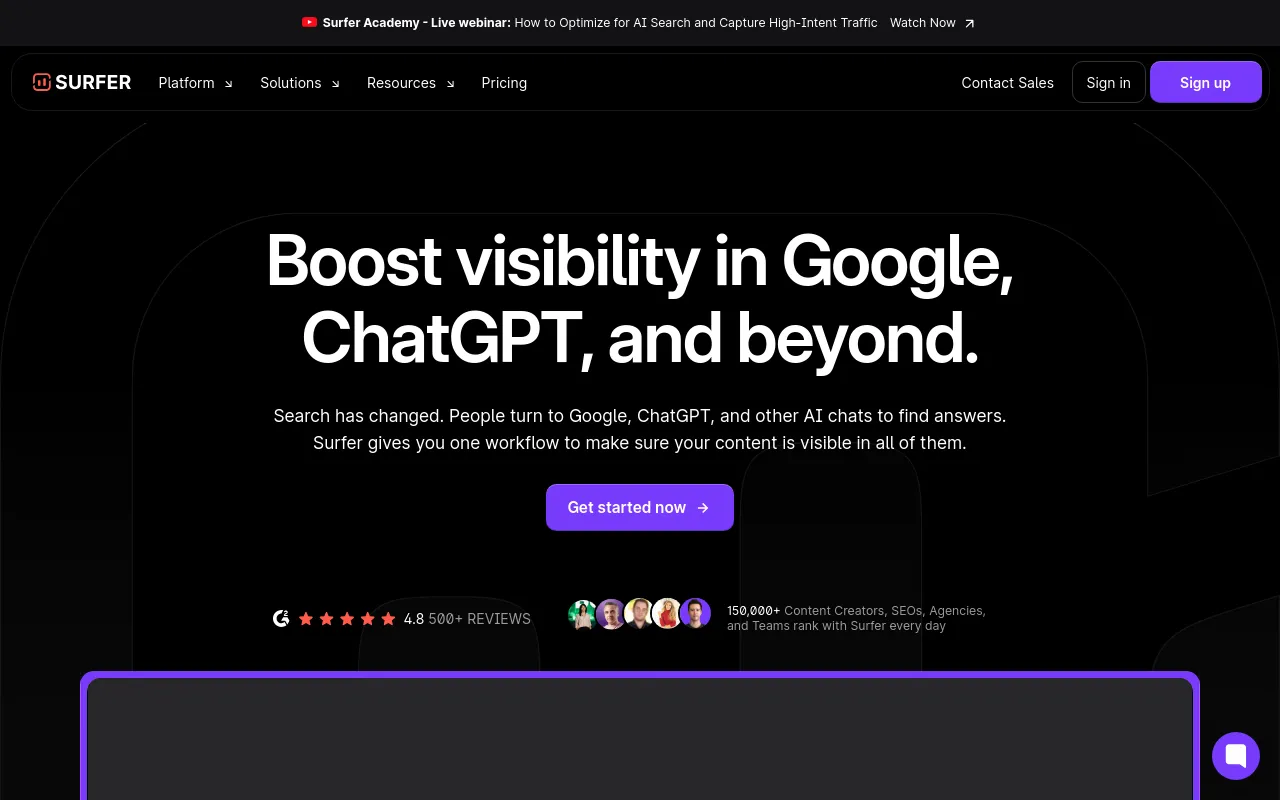
Surfer is the fastest way to convert a target keyword into a brief an editor can hand to a writer in under 15 minutes. The whole product is built around one defensible idea: score your draft against the term distribution of the live top 10 and surface the gap.
The single real lever is the term-coverage delta versus the live SERP. Everything else – the AI writer, the outline tool, the audit module – is supporting cast. On the pipeline I run, an automated workflow can hit Surfer's API for a brief in seconds; the value scales linearly with brief volume, which is exactly why the break-even math (covered below) is so unforgiving below ~25 briefs/mo.
- Term-coverage scoring is the cleanest in the category and updates against the live SERP, not a stale index.
- Strong API access on higher plans makes it the easiest optimizer to wire into a pipeline.
- The Content Editor UX is fast – a writer can hit a target score in one pass.
- Outline + brief generator that does not require a separate seat.
- Accuracy is sometimes loose – Surfer will flag terms that hurt rather than help on YMYL topics.
- Pricing jumps hard from Essential to Scale; the middle ground is awkward.
- "AI Humanizer" and other recent add-ons feel bolted on, not core.
Pricing tiers (annual): Essential ~$99/mo · Scale ~$219/mo · Scale AI ~$419/mo · enterprise custom. Live tiers and seat limits on the official pricing page. Rating: G2 4.8/5 (~530 reviews).
If you already run Surfer pre-AI-Overviews and want the brutal version of the math, I covered exactly that in the re-run of the Surfer ROI after AI Overviews intercepted clicks. The headline: at volume it still pays back; below a threshold, it doesn't.
2. Clearscope – best for editorial accuracy on money pages
Best for: high-LTV pages where being wrong costs more than being slow · Standout: the cleanest content-grade rubric in the category · Pricing: ~$189/mo (Essentials) · Free trial: none

Clearscope is the optimizer you use when an article is going to anchor a category page, a pricing page, or anything where a single misranked claim can move your CAC. The grade rubric is conservative, narrowly scoped, and – critically – does not over-recommend terms that hurt your topical focus.
The product does fewer things than Surfer and charges roughly twice as much for them. That sounds bad until you ship a money page on it and the grade ends up tightly correlated with what actually ranks. For an in-house growth lead with a CAC target, the accuracy premium is real; for a content farm shipping a piece a day, it's pure overhead.
- Most editorially trustworthy grade in the category – fewer false-positive terms than Surfer or Frase.
- Slack/Google Docs integrations are usable, not screenshot-only.
- Reports are clean enough to hand to a freelancer with zero training.
- Strong content inventory + monitoring on the higher plans.
- Roughly 2× the entry price of Surfer for narrower scope.
- No public free trial – you talk to sales for a demo.
- Light on outline generation; you'll still want a separate brief tool.
Pricing tiers: Essentials ~$189/mo · Business ~$399/mo · Enterprise custom – see the Clearscope pricing page. Rating: G2 4.9/5 (~115 reviews).
3. Frase – best for brief-to-draft on a budget
Best for: solo operators who need outline → draft → optimize in one tab · Standout: the most useful AI outline generator at this price · Pricing: ~$15/mo (Solo) · Free trial: 5-day for $1
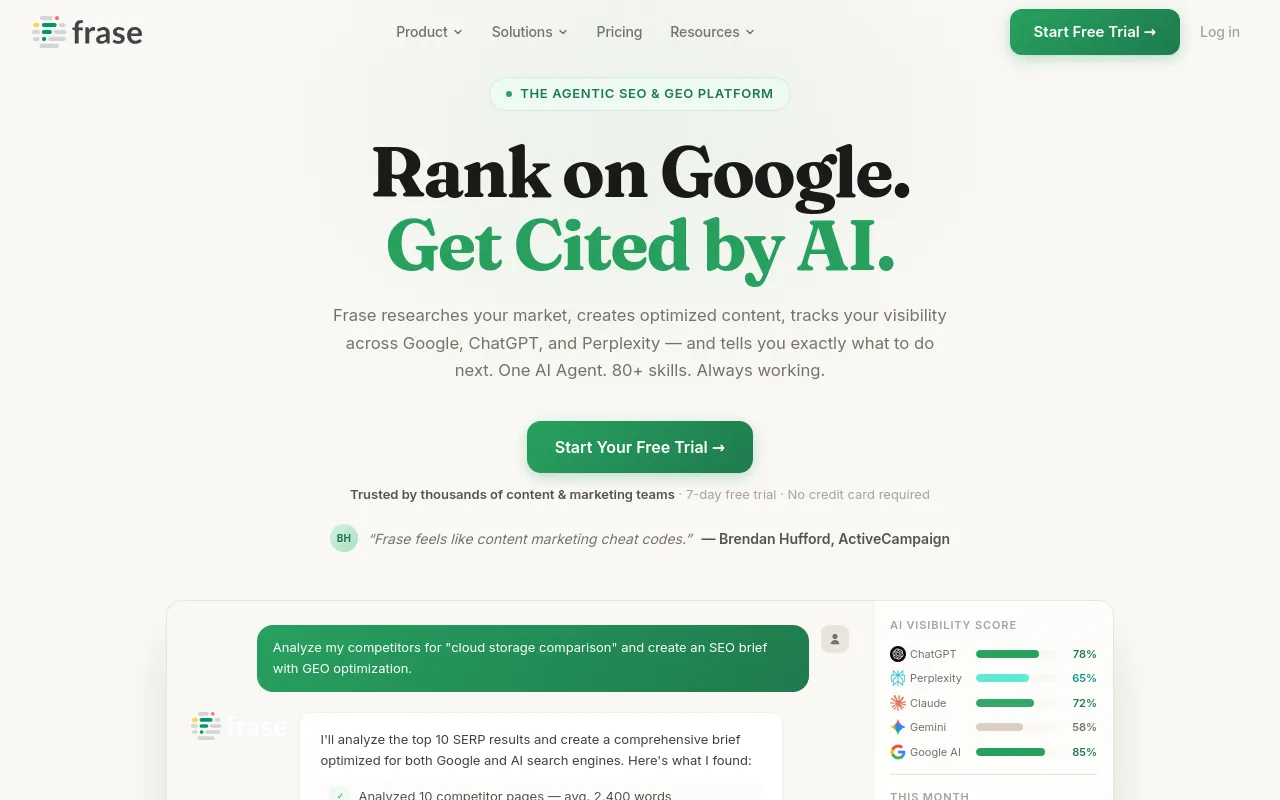
Frase is the cheapest serious optimizer that also drafts. The outline generator pulls H2s and H3s from the top 20 results and lets you compose a brief in under 5 minutes; the optimizer then scores the draft against the SERP term distribution. Not as accurate as Clearscope, not as fast as Surfer, but the combined cost is a fraction of either.
The honest limit: above about 30 articles a month, Frase's UX starts to feel cramped against either Surfer's API workflow or Clearscope's accuracy. Below that volume, it is the single best-priced entry into AI optimization in 2026.
- Genuine outline + optimizer + AI writer in one tool at a fraction of competitor pricing.
- "Topic Score" is a usable approximation of Clearscope's grade for one-third the cost.
- AI writer add-on is reasonably priced – does not require a separate Jasper seat.
- Good UI for non-technical writers; minimal training overhead.
- Term recommendations are less accurate than Surfer or Clearscope on competitive SERPs.
- AI writer requires a separate add-on subscription; the base plan does not include it.
- Annual billing is heavily incentivized – monthly pricing is steep.
Pricing tiers: Solo ~$15/mo · Basic ~$45/mo · Team ~$115/mo · Enterprise custom. Live numbers on the Frase pricing page. Rating: G2 4.8/5 (~310 reviews).
4. MarketMuse – best for topic-cluster strategy
Best for: building a topical authority map across hundreds of pages · Standout: cluster intelligence and competitive content inventory · Pricing: Free tier + ~$99/mo (Standard), Team ~$249/mo · Free trial: generous free tier
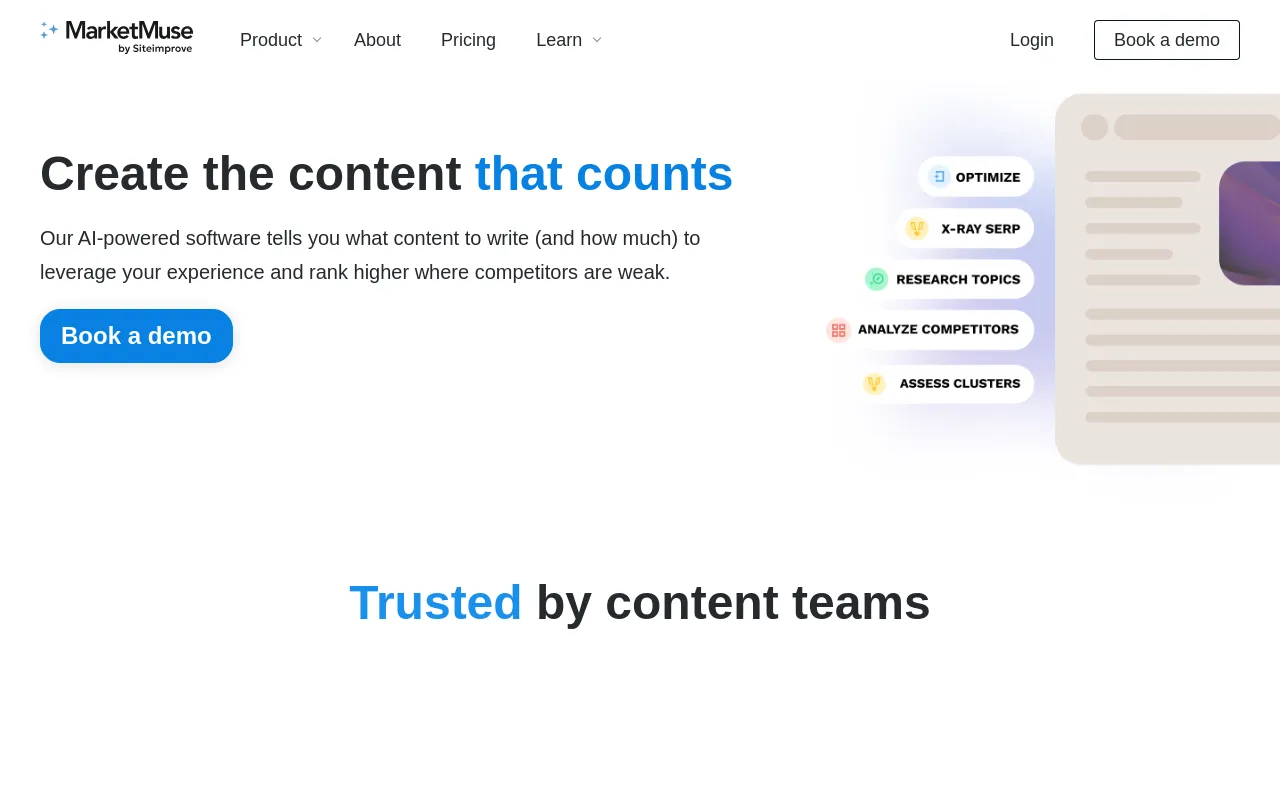
MarketMuse is not a brief optimizer; that's the third thing it does, and not the thing it does best. The real product is content strategy: tell it your domain and a topic, and it will tell you which clusters you have authority on, which ones a competitor owns, and where the gap to ranking is 2 articles versus 20.
This is a strategy seat, not a drafting seat. If you are deciding what to publish next quarter and you have a meaningful content inventory already, the cluster intelligence is differentiated. If you just need to optimize a single brief, MarketMuse is the wrong tool and Surfer or NeuronWriter does it cheaper.
- Cluster intelligence is in a category of one – no other tool maps topic authority this cleanly.
- Free tier is generous enough to evaluate seriously before any spend.
- Strong competitive content inventory – see where a rival has thin coverage.
- Pairs well with Surfer or Clearscope as the "what to write" layer.
- Overkill for solo operators or sub-50-page sites.
- Per-page optimization is the weakest module – pair, don't replace.
- UX has a real learning curve; not a tool you hand to a writer.
Pricing tiers: Free · Standard ~$99/mo · Team ~$249/mo · Premium custom – current on the MarketMuse pricing page. Rating: G2 4.6/5 (~210 reviews).
5. NeuronWriter – best for the cheapest serious optimizer
Best for: the value pick – same job as Surfer/Clearscope at one-quarter the price · Standout: NLP-driven term recommendations with credit-based pricing · Pricing: ~$23/mo (Bronze) · Free trial: 14-day
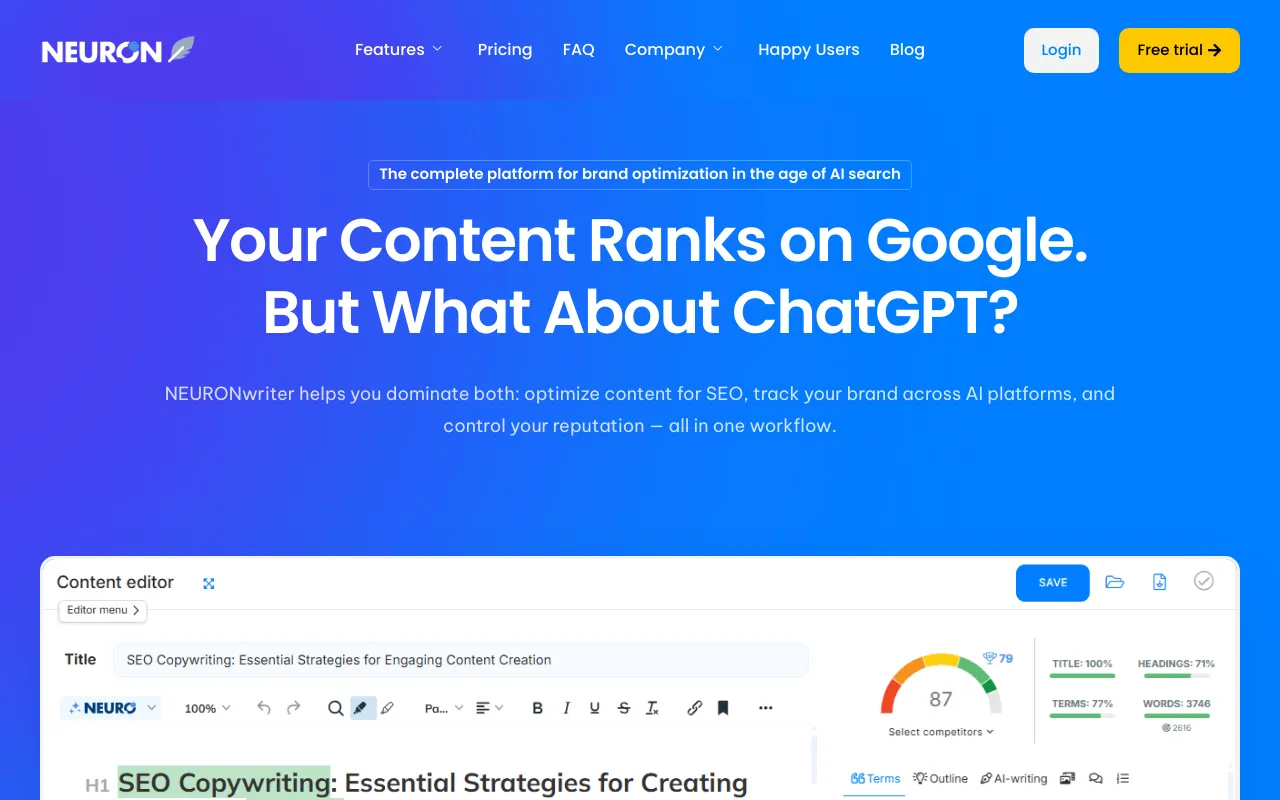
NeuronWriter does roughly 80% of what Surfer does for roughly 25% of the price. The interface is dated, the marketing is amateur, and the brand is third-tier – and yet the term-coverage output is materially competitive with the leaders, especially at the volume tiers most solo operators need.
There is no tool that does what NeuronWriter does at this price. The UI is slow. Buy it anyway if you publish under 30 briefs a month and want the term-coverage discipline without the $99 floor. Above 30, you'll outgrow the credit limits and the Surfer API becomes the better fit.
- Best price-to-output ratio in the entire optimization category – by a wide margin.
- Credit-based pricing means you pay for usage, not seats.
- Reasonable internal-linking suggestions module.
- LTD (lifetime deal) availability on AppSumo at times has made it nearly free per project.
- UI is dated and feels slow next to Surfer or Frase.
- Documentation and support are thinner than competitors – you're more on your own.
- Credit caps on the entry plan are tight if you scale past ~30 articles/mo.
Pricing tiers: Bronze ~$23/mo · Silver ~$45/mo · Gold ~$69/mo · Platinum + custom. Current numbers on the NeuronWriter pricing page. Rating: Capterra 4.8/5 (~85 reviews).
6. Jasper – best for brand-voice scale writing
Best for: content teams that need consistent brand voice across many writers · Standout: brand voice memory + style guide enforcement · Pricing: ~$49/mo (Creator) · Free trial: 7-day
Jasper is the most polished general-purpose AI writing tool in the category, with the strongest brand-voice + style-guide enforcement layer on the market. It is also, increasingly, expensive for what is functionally a wrapper over the same frontier models everyone else uses.
If your moat is "the writing has to sound like our brand" and you have multiple writers or freelancers, the voice memory pays for itself by eliminating the editorial pass that ChatGPT alone requires. If your goal is to produce high-volume SEO articles, KoalaWriter or Byword will do it for a fraction of the cost.
- Best brand-voice/style enforcement in the category – differentiated.
- Strong workflow templates for marketing teams beyond pure SEO.
- Reasonable SEO mode (Surfer integration) – but not a substitute for Surfer itself.
- Mature, well-supported product with reliable uptime.
- Expensive vs raw model access – you're paying for the wrapper, not the underlying capability.
- Not an optimization tool – must pair with Surfer/Clearscope for term coverage.
- Pricing climbed steeply through 2024–2025; the value gap to KoalaWriter and Writesonic widened.
Pricing tiers: Creator ~$49/mo · Pro ~$69/mo · Business custom. Live tiers on the Jasper pricing page. Rating: G2 4.7/5 (~1,250 reviews).
7. Writesonic – best for AI article + on-page in one
Best for: small teams that want one tool for drafting and basic on-page optimization · Standout: generative SEO suite with built-in keyword research · Pricing: ~$16/mo (Free) up to ~$79/mo (Standard) · Free trial: free credits
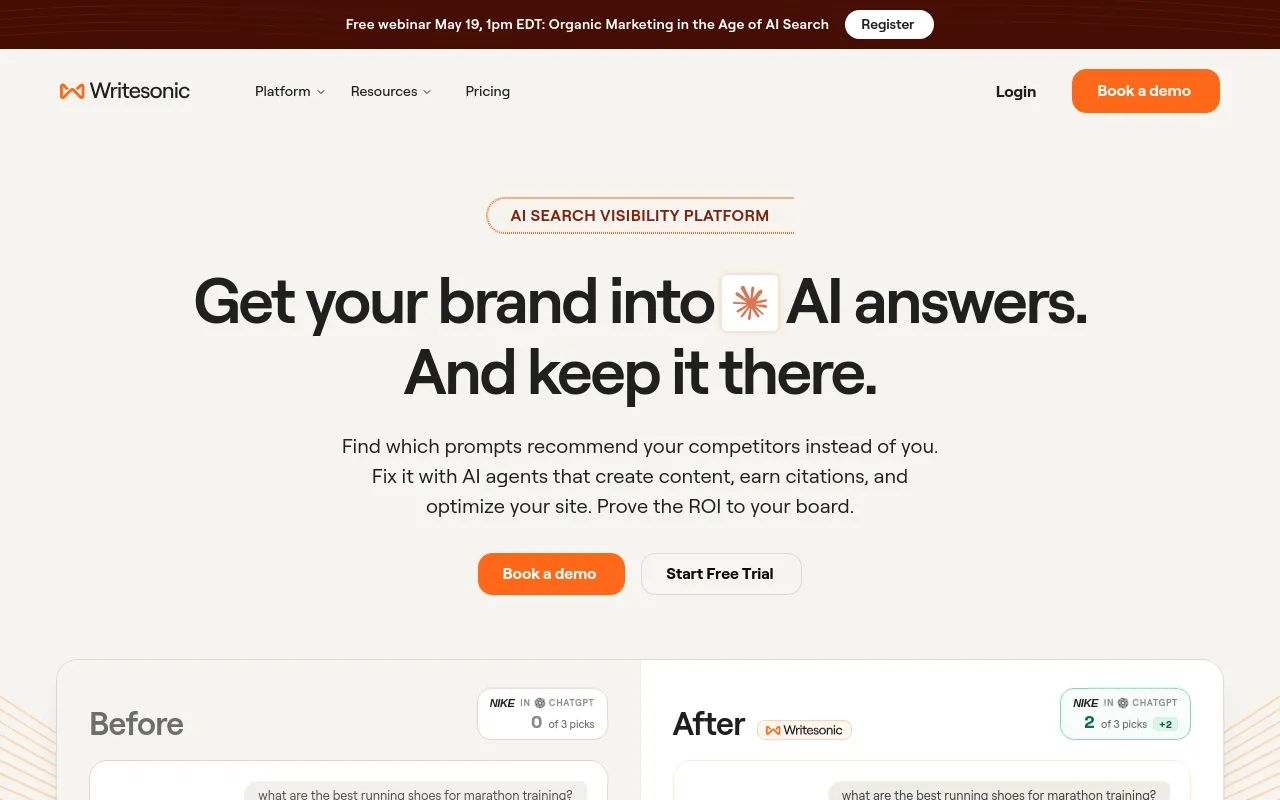
Writesonic is the closest thing to a single-seat AI SEO suite for small operators. The product bundles AI article writing, basic on-page scoring, factual references via web search, and the Chatsonic chat interface – all behind a price that undercuts a Jasper + Surfer pair significantly.
The trade-off is breadth over depth. Term coverage is weaker than Surfer's, brand voice is weaker than Jasper's, and the keyword research module is a Semrush API resell that you'd be better off accessing directly at scale. For a one-person operator who wants one tool and is willing to accept "good enough" everywhere, the package math works.
- Strongest single-tool bundle at this price – drafting + light SEO + factual grounding.
- Article Writer 6.0 produces usably structured long-form drafts with citations.
- Generous free tier makes it the easiest tool here to trial.
- Programmatic article generation at the higher tiers approaches Byword pricing.
- "Jack of all trades, master of none" applies – no module rivals a category leader.
- Output quality oscillates between credit-saving model swaps you cannot fully control.
- Heavy upsell prompts inside the product UI; feels noisy versus competitors.
Pricing tiers: Free · Standard ~$16/mo · Professional ~$79/mo · Advanced ~$300+/mo. Live on the Writesonic pricing page. Rating: G2 4.7/5 (~1,900 reviews).
8. KoalaWriter – best for cheapest one-click SEO articles
Best for: volume content operators producing programmatic SEO at low blended cost · Standout: one-shot keyword → publish-ready draft · Pricing: ~$9/mo (Essentials) up to ~$25/mo (Starter) · Free trial: free credits
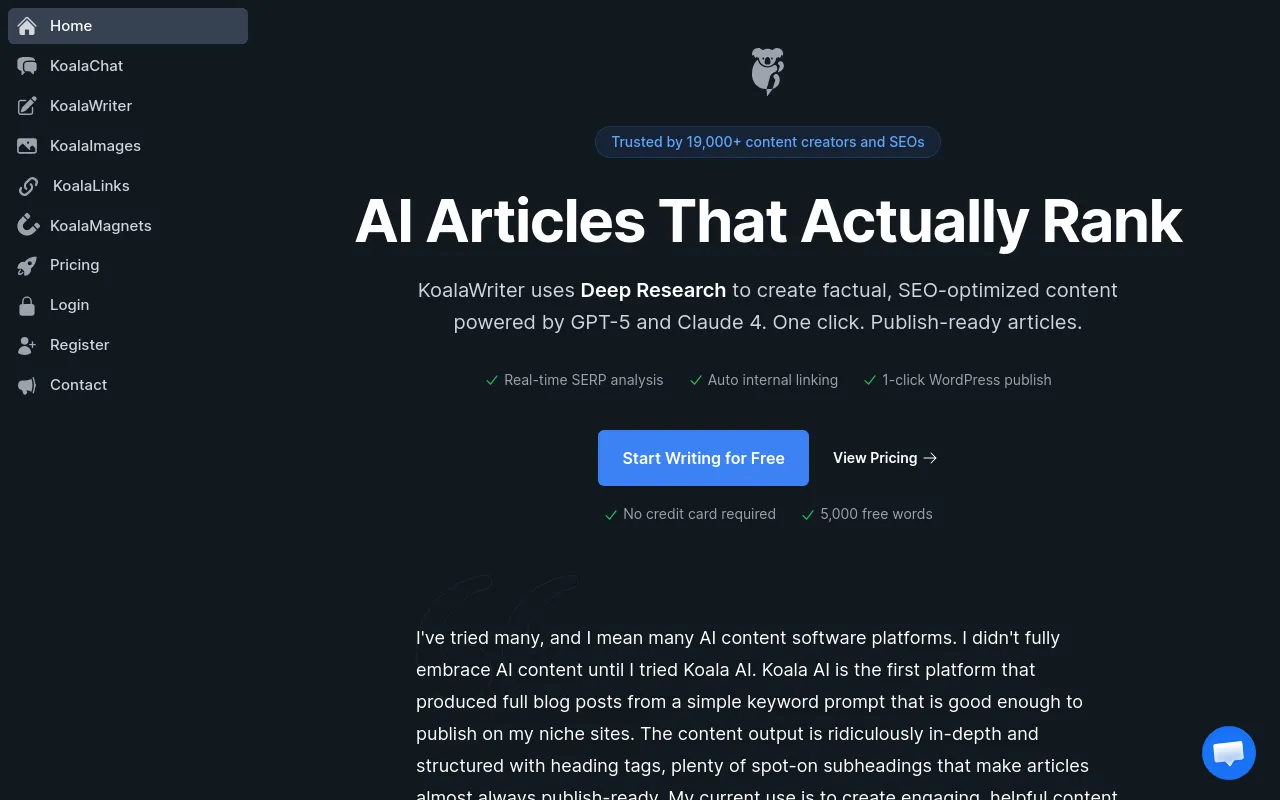
KoalaWriter is built around a single workflow: paste a keyword, hit generate, get a structurally sane 1,500–3,000-word draft with H2/H3 hierarchy, real-time SERP grounding, and image insertion. For pure volume blogging or affiliate sites, it is the cheapest tool in this list that produces output a human editor can ship after a single pass.
The blunt take: at $9/mo entry, KoalaWriter does for the low end of the writer category what NeuronWriter does for the low end of the optimizer category. It is the single most overdelivering tool on this list relative to price – and it is also the tool most likely to land you in Google's scaled-content-abuse policy crosshairs if you set bulk generation to autopilot and walk away. Use it; do not abuse it.
- Cheapest serious AI article writer in the category – value-per-dollar is unmatched.
- Real-time SERP grounding produces drafts with current facts, not stale model knowledge.
- Bulk article generation at the higher tiers is scaled-content capable.
- Output structure is editor-friendly – H2/H3 hierarchy works out of the box.
- Scaled-content-abuse risk if you publish bulk output without human editing.
- No brand-voice enforcement – the writing is competent but generic.
- Optimization scoring is rudimentary; pair with NeuronWriter or Surfer for serious pages.
Pricing tiers: Essentials ~$9/mo · Starter ~$25/mo · Pro ~$49/mo · Max ~$129/mo. Current on the Koala pricing page. Rating: Trustpilot 4.6/5 (~120 reviews).
9. Byword – best for programmatic SEO at volume
Best for: programmatic SEO operators producing hundreds of pages per project · Standout: bulk article generation from a CSV of keywords · Pricing: pay-per-article (roughly $3–$5/article at volume) · Free trial: signup credit
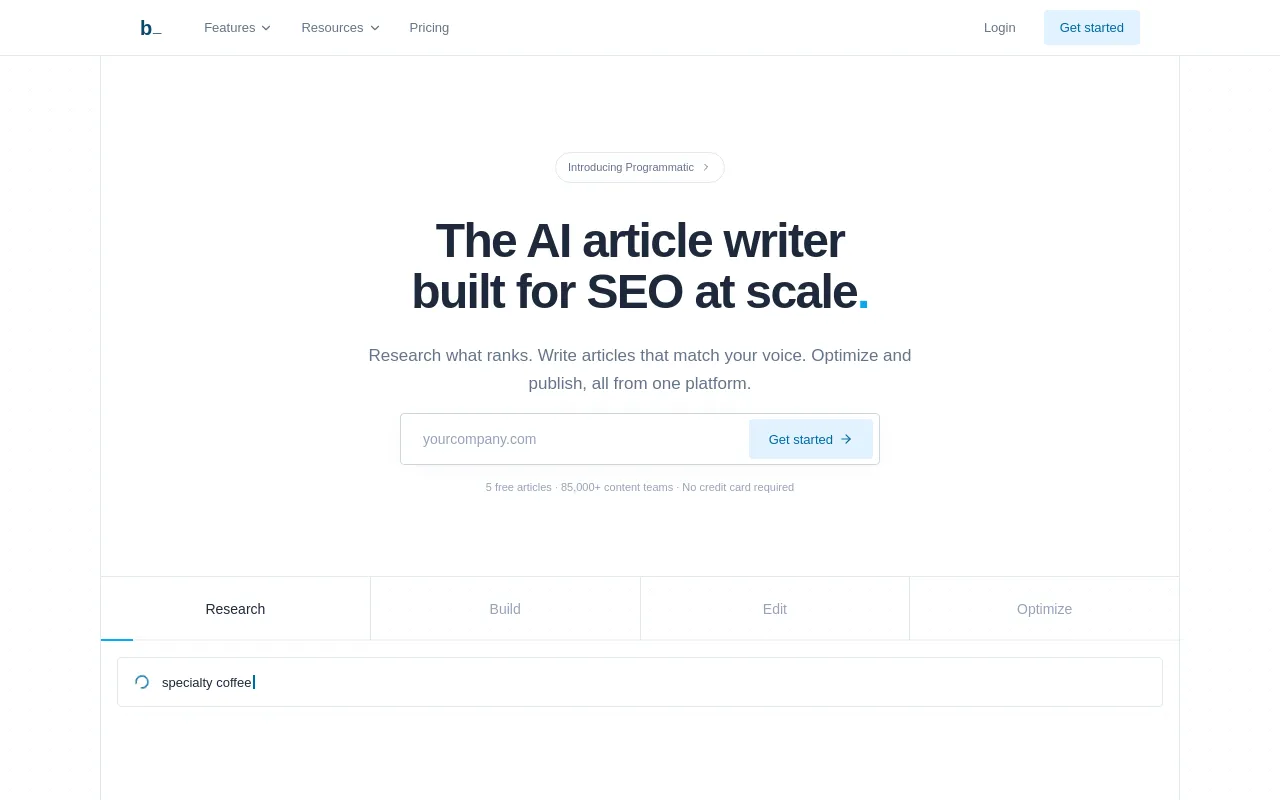
Byword sits at the extreme end of the writing category: not "draft me an article," but "draft me 500 articles from this CSV." That is either exactly what you want or completely the wrong tool. There is no middle.
For programmatic SEO – local-page templates, comparison pages, /vs/ pages, glossary builds – Byword is the cheapest production-quality engine in the market. For a content strategy that depends on craft, originality, or thought leadership, it is functionally a content-farm machine and Google's spam policy will treat it accordingly. I covered the exact rules for staying on the right side of that line in the programmatic SEO content engine post-mortem.
- Lowest per-article cost in this list at volume – typically $3–$5 a draft.
- Bulk CSV input is purpose-built for programmatic SEO, not retrofitted.
- Output structure is consistent enough for templated programmatic deployment.
- Integrations with WordPress, Webflow, and CMS APIs for direct publishing.
- Highest scaled-content-abuse risk on this list – Google's policy explicitly targets this pattern.
- Pay-per-article pricing punishes experimentation; no monthly seat to play with.
- Documentation is thin; you're expected to know what programmatic SEO requires.
Pricing tiers: pay-per-article, varies by length and model – current detail on the Byword site. Rating: product is too niche for high G2 review volume; user reports are positive among programmatic SEO operators.
10. Semrush – best for widest AI research + ContentShake
Best for: in-house teams wanting the widest single research suite with AI add-ons · Standout: largest keyword DB plus ContentShake AI writer · Pricing: ~$139.95/mo (Pro) · Free trial: 7-day
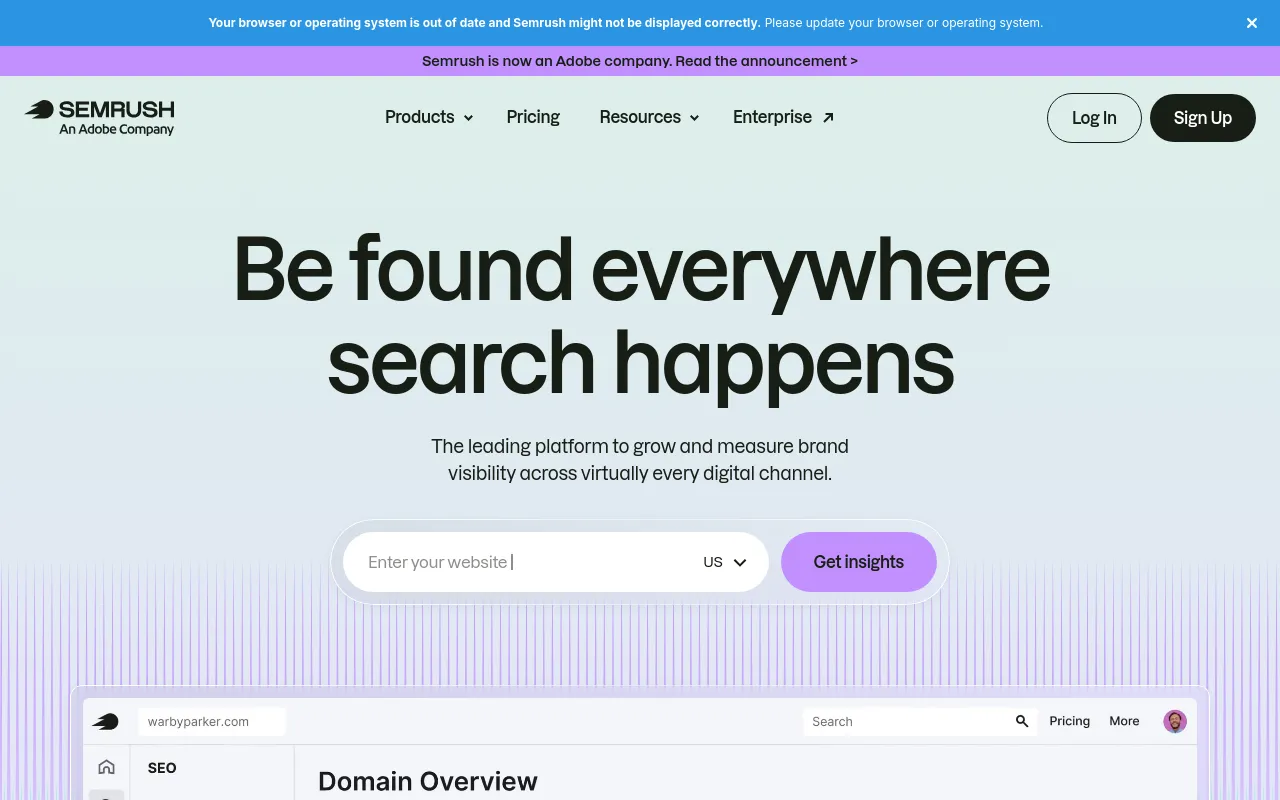
Semrush has, conservatively, the widest single dataset in this list – keyword, backlink, traffic, technical audit, position tracking, and now AI Overview tracking and the ContentShake AI writer. For an in-house growth team running 3+ projects, the seat pays back almost regardless of how heavily you use any single module.
The honest read: Semrush is a research seat, not an optimization seat. The ContentShake module is a competent AI writer with Surfer-lite scoring; it is not a substitute for Surfer or Clearscope on a money page. Buy Semrush for the data; pair it with a dedicated optimizer.
- Widest single-tool dataset in the category – keyword + backlink + traffic + tech audit.
- AI Overview tracking module is one of the more developed in mainstream research suites.
- Position tracking + competitor tracking are best-in-class.
- ContentShake gives you "good enough" drafting without a second seat for small teams.
- Project limits on the Pro plan bite quickly – most agencies need Guru ($249) within months.
- ContentShake's optimization scoring is materially weaker than Surfer or Clearscope.
- Add-on pricing (.Trends, Local, Agency Growth Kit) inflates the real annual cost.
Pricing tiers: Pro ~$139.95/mo · Guru ~$249.95/mo · Business ~$499.95/mo + add-ons. Current on the Semrush pricing page. Rating: G2 4.5/5 (~2,200 reviews).
11. Ahrefs – best for backlink + AI Content Helper + Brand Radar
Best for: SEO operators where backlink data is the primary input · Standout: Brand Radar AI-visibility tracking · Pricing: ~$129/mo (Starter) or $249/mo (Lite) · Free trial: $7 7-day trial
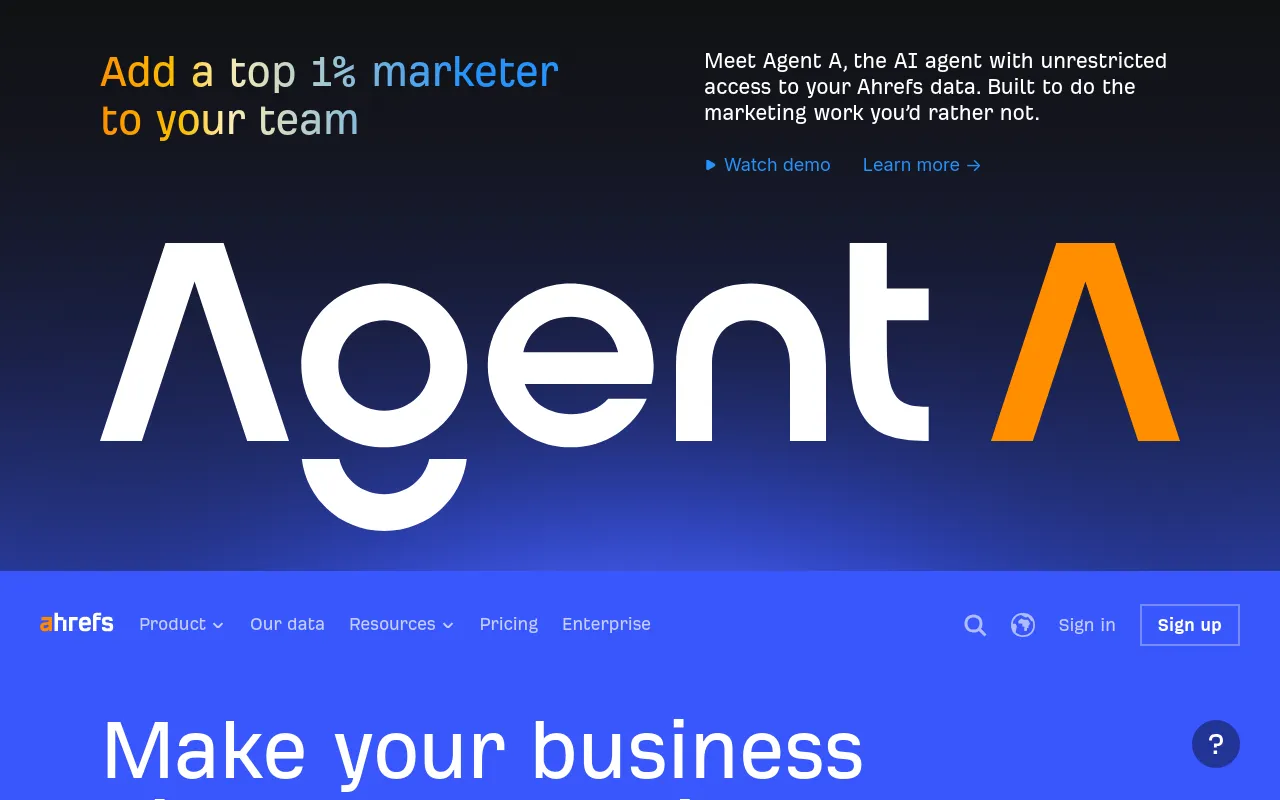
Ahrefs is the strongest backlink data in the category and has quietly built one of the more interesting AI-visibility products of 2026 in Brand Radar – a cross-engine tracker for how often your brand surfaces in AI Overviews, ChatGPT, Perplexity, and similar. The keyword research module is competitive with Semrush; the technical SEO audit is competitive with Screaming Frog at scale.
The cost framing matters. Ahrefs's middle tiers are priced for serious operators, and the Brand Radar add-on is its own line item. I did the cost-per-prompt math against Semrush's equivalent AI-visibility module in Brand Radar vs Semrush AI Visibility – the headline is the cheaper one is not always the right one.
- Best backlink dataset in the category – still the gold standard for off-page analysis.
- Brand Radar is a real AI-visibility tracker, not a marketing checkbox feature.
- AI Content Helper is useful for outline + first-draft generation.
- Site Audit module rivals dedicated technical SEO tools.
- Credit-based query pricing on lower tiers feels punitive at agency volume.
- Brand Radar is an add-on cost, not bundled into entry tiers.
- UI density is high – there's a real learning curve for new users.
Pricing tiers: Starter ~$29–$129/mo · Lite ~$129–$249/mo · Standard ~$249–$449/mo · Advanced ~$449–$1,000/mo. Current on the Ahrefs pricing page. Rating: G2 4.5/5 (~530 reviews).
12. KeySearch – best for budget keyword research
Best for: solo operators and bootstrapped sites that cannot justify a Semrush seat · Standout: cheap, accurate KD scores · Pricing: ~$24/mo (Starter) · Free trial: yes
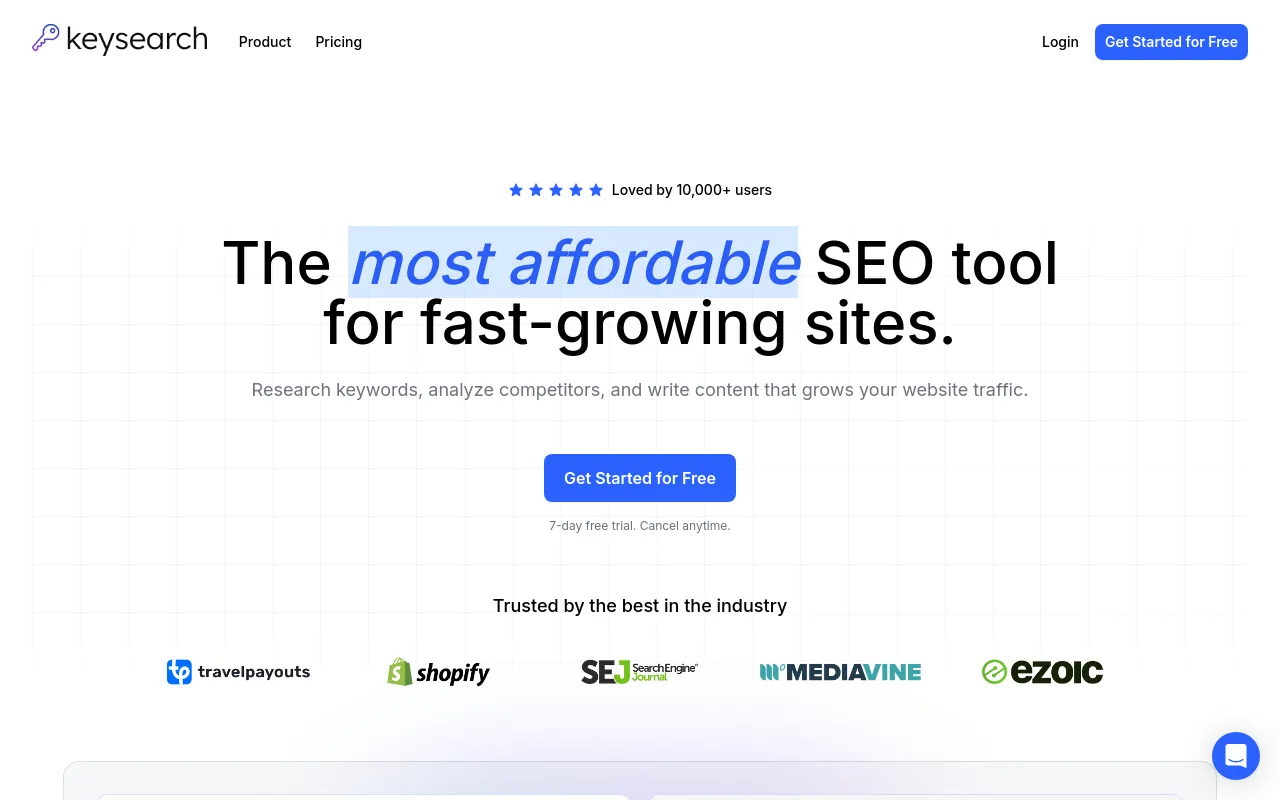
There is no tool that does what KeySearch does at $24/mo. The UI is unpolished, the dataset is smaller than Semrush, and the brand has almost no marketing presence – and the keyword difficulty scoring is honest, accurate, and good enough that for sub-five-figure-MRR sites, it is the only research seat you need.
This is the rational entry-level pick for any operator whose total tool budget is under $100/mo. Pair with NeuronWriter and Otterly and you have a complete stack for under $80 all-in.
- Best price-to-output ratio in keyword research – by a wide margin.
- KD scoring is competitive with Semrush and Ahrefs on the keywords most solo operators target.
- Includes rank tracking, backlink data, and a competitor module – three tools in one seat.
- No credit caps that bite at solo-operator volume.
- Dataset depth is materially smaller than Semrush or Ahrefs on long-tail and niche keywords.
- UI is dated and slow versus the leaders.
- Branding and documentation feel hobbyist – not a sell to enterprise stakeholders.
Pricing tiers: Starter ~$24/mo · Pro ~$48/mo · Agency tiers higher. Current on the KeySearch pricing page. Rating: Trustpilot 4.4/5 (~80 reviews).
13. SEO.ai – best for done-for-you AI agent SEO
Best for: operators who want SEO outsourced to an agent, not learned · Standout: autonomous content workflow from keyword to publish · Pricing: ~$49/mo entry · Free trial: 7-day
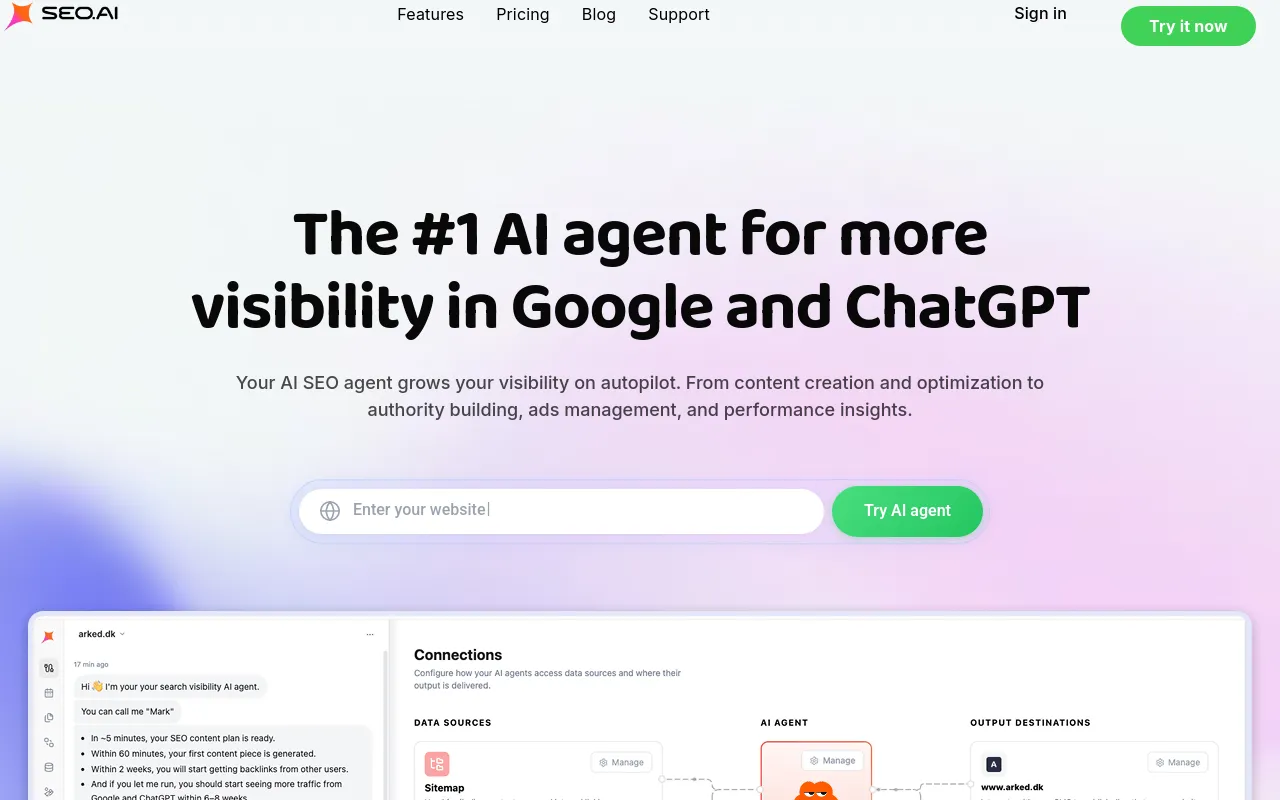
SEO.ai is one of the more aggressive bets on the "AI agent runs your SEO" thesis. The product moves a keyword through research, brief, draft, optimization, and CMS publish with minimal human input. For operators whose constraint is "I have a domain and I don't want to think about content," it is the most coherent done-for-you offering on this list.
The trade-off is loss of editorial control. The output is competent but not differentiated; the workflow is opinionated and you'll work around it as often as with it. For agency owners who specifically want to deliver SEO-as-a-service with thin margins, the math can work; for in-house growth teams with a CAC target, the lack of editorial precision usually loses to a Clearscope + Semrush stack.
- Genuinely autonomous – most "AI agent" products in this category are repackaged Jasper.
- CMS integrations publish; not just "export to clipboard."
- Reasonable entry pricing for the scope of automation.
- Multi-language support is stronger than most US-centric competitors.
- Editorial control is minimal – you accept the agent's choices or override at high friction.
- Output lacks the topical precision of a human-edited Clearscope/Surfer brief.
- Niche enough that community support and integrations lag the leaders.
Pricing tiers: entry ~$49/mo + higher tiers tied to article volume. Current on the SEO.ai pricing page. Rating: Trustpilot 4.5/5 (~100 reviews).
14. Alli AI – best for automated on-page/technical edits at agency scale
Best for: agencies managing 5+ client sites with on-page + technical SEO at scale · Standout: live JavaScript overlay that ships SEO edits without dev tickets · Pricing: ~$249/mo (entry) · Free trial: 10-day
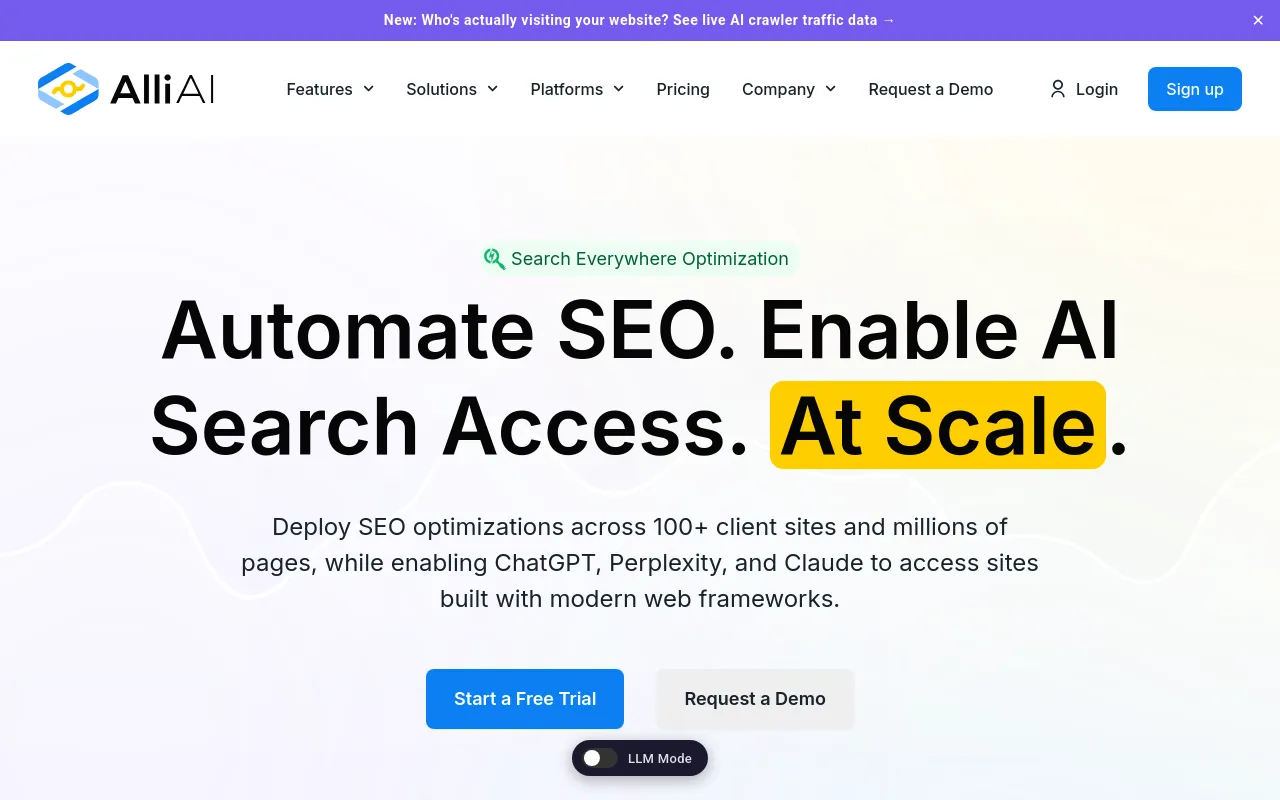
Alli AI is the tool you use when the bottleneck is not "what to write" but "I cannot get a developer to ship title-tag changes across 200 client pages." The live JS overlay applies SEO edits – title tags, meta descriptions, schema, internal links – without touching the underlying codebase. For agencies, that is sometimes the difference between a client retainer that scales and one that gets stuck in dev ticket purgatory.
This is unambiguously an agency tool. For a single-site operator, the price is unjustifiable and a free Yoast or RankMath install does 70% of the same job. For an agency running 5+ clients, the time-to-value is measured in hours, not weeks.
- Live JS overlay deploys SEO edits without engineering involvement – uniquely valuable for agencies.
- Automated internal linking at scale that respects topic clusters.
- Bulk operations across multiple sites from a single dashboard.
- Strong technical SEO automation (schema, redirects, page speed signals).
- Priced for agencies; solo operators will not justify the seat.
- JS overlay carries a real risk (rendering fragility, Googlebot edge cases) that requires monitoring.
- Smaller community + thinner documentation than mainstream tools.
Pricing tiers: entry ~$249/mo · Agency tiers significantly higher. Current on the Alli AI pricing page. Rating: G2 4.7/5 (~60 reviews).
15. Profound – best for enterprise AI-answer visibility tracking
Best for: in-house teams that need cross-engine AI visibility measurement at executive-report quality · Standout: the most complete cross-engine citation tracking in the category · Pricing: custom (enterprise) · Free trial: demo only
Profound is the enterprise heavyweight of the GEO category. The product tracks how often your brand surfaces in ChatGPT, Perplexity, Claude, Gemini, and Google AI Overviews – not as a sample, but as a structured ongoing measurement across thousands of prompts your real customers run. For enterprise growth teams under board pressure to "report on AI visibility," it is the most defensible single source.
The honest scope: pricing is custom, the floor is enterprise, and a solo operator will not get a seat. If you can afford it and AI-search traffic is a material slice of your funnel, no other tool in the category produces output that holds up in an executive review the way this one does.
- Most complete cross-engine measurement in the category – covers more engines, more reliably.
- Citation-source tracking shows which underlying pages are being cited by AI engines.
- Executive-grade reporting that holds up in a board pack.
- Real prompt-volume sampling, not a synthetic question set.
- Enterprise pricing – flatly not viable for sub-Series B teams.
- Demo-gated; you cannot self-serve evaluate.
- Some engines remain inherently unstable to track – the tool is honest about this, but it's still a real limit.
Pricing tiers: custom enterprise – request via the Profound site. Rating: too new for high G2 volume; enterprise references positive.
16. Otterly.ai – best for budget GEO/AI-search rank tracking
Best for: solo operators and small teams that need GEO visibility without enterprise pricing · Standout: per-prompt rank tracking at sub-$30/mo · Pricing: ~$29/mo (Lite) · Free trial: 14-day
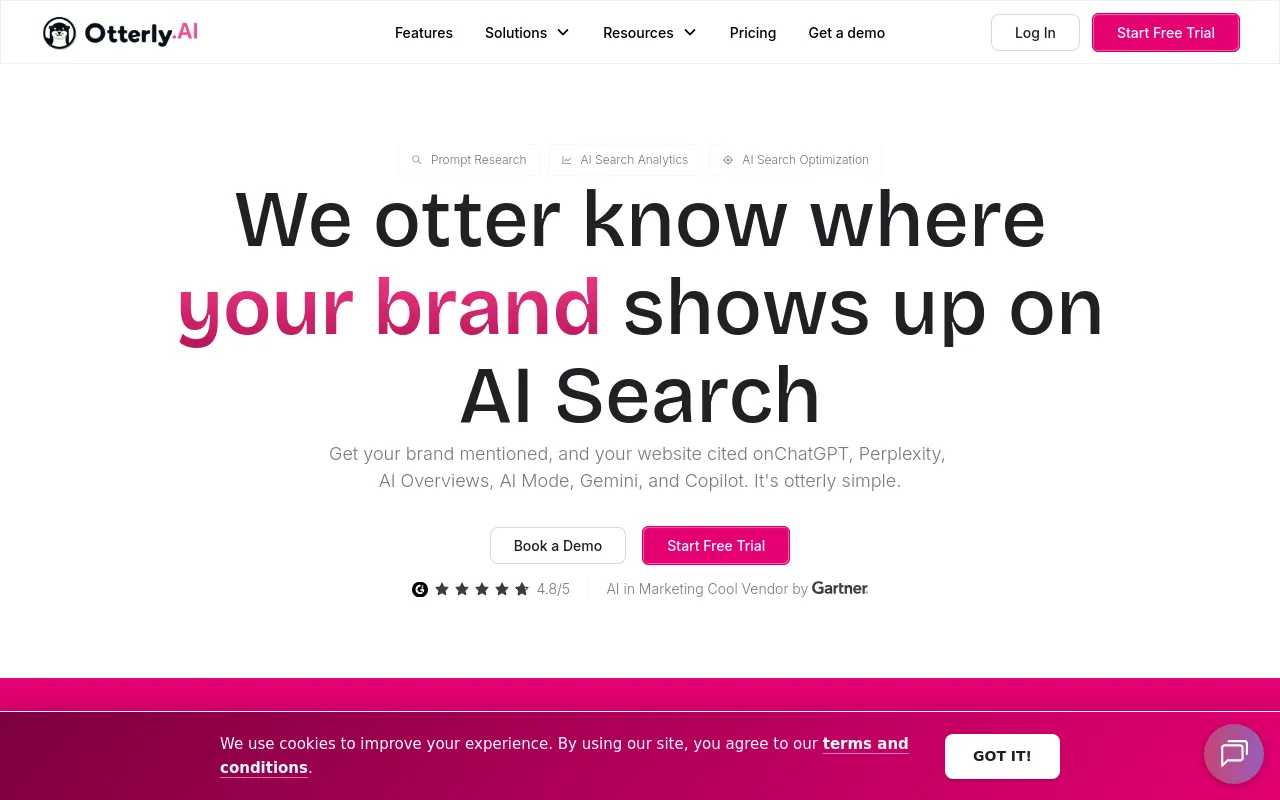
Otterly is the entry-level GEO tool that finally makes AI-visibility tracking affordable below the enterprise tier. It tracks how often your brand surfaces in ChatGPT, Perplexity, Google AI Overviews, and Bing Copilot for a defined prompt set – not at Profound's depth, but at roughly 1/30th the cost.
For solo operators and small growth teams, this is the rational way to start measuring AI visibility now rather than waiting until enterprise budgets justify Profound. Track 10–20 prompts your real customers ask, watch the share-of-citations over time, and act on it. The single biggest reason most operators don't have GEO data is that they assumed it was unaffordable; Otterly has put it on the dashboard at the price of a Surfer add-on. For a deeper look at why one tracker can't see every engine cleanly, see the LLM SEO tracking stack analysis.
- Lowest serious entry point into GEO/AI-visibility tracking in the market.
- Per-prompt tracking with sentiment + citation source – not just a yes/no flag.
- Covers all four major engines (ChatGPT, Perplexity, AI Overviews, Copilot).
- Reasonable team plan at small-agency scale, not enterprise.
- Engine coverage is good but not as deep as Profound on volatile prompt sets.
- UI is functional rather than polished – feels like a Series-A product.
- Prompt-limit caps on the entry plan force quick upgrade if you run a wide tracker.
Pricing tiers: Lite ~$29/mo · Standard ~$69/mo · Pro and Agency higher. Current on the Otterly pricing page. Rating: Capterra 4.7/5 (~30 reviews).
The ones to avoid – what's not working in 2026
The honest part of any tool roundup is the part that says "stop paying for this." Four categories of "AI SEO tool" are flatly not worth their seat in 2026, regardless of how aggressively their affiliate ecosystem markets them.
1. ChatGPT alone as your SEO stack. ChatGPT is an excellent component and a terrible system. It drafts well, ideates well, and rewrites well. It does not measure term-coverage delta against the live SERP. It does not verify whether a page is indexed. It cannot tell you whether your brand surfaces in Perplexity. The "SEO audit" it produces on request is a confident-sounding document with no underlying crawl, no real ranking data, and no verifiable claims – Google's own Search Essentials explicitly warn against publishing AI-generated audits as load-bearing. Use ChatGPT inside a stack; never as the stack.
Jun 2, 2026