Omnisend vs Klaviyo (2026): The Honest Pick for Ecommerce Email, With Real Pricing
Omnisend vs Klaviyo with this-week pricing at matched contact tiers, the billing model that decides the real cost, and who should pick which.
Published Updated
 By Omid Saffari




Omnisend and Klaviyo start at the exact same free tier, 250 contacts and 500 emails a month, and then their bills diverge hard. At 500 contacts Omnisend runs $16 a month to Klaviyo's $20; by 25,000 contacts Klaviyo is charging roughly $400 while Omnisend never bills you for a single unsubscribed contact. The gap is not the sticker price. It is what each one makes you pay for as your list grows.
So this is not "cheap one versus powerful one." It is a bet on where your store will be in 18 months, and which billing model is kinder when you get there.
The verdict in one line
Pick Omnisend if you want email, SMS, and push in one cheaper bill and you will not live inside advanced segmentation. Pick Klaviyo if your margins depend on slicing customers by behavior and predicted value, and you have someone to actually run it.
Omnisend is the value-and-all-channel platform: a genuinely usable free tier, paid plans from $16 a month, every channel in one price, and a billing model that never charges you for unsubscribed contacts. It is built so a small team can launch revenue-generating automations, the welcome flow, the abandoned-cart flow, the post-purchase flow, in an afternoon.
Klaviyo is the data platform that happens to send email. Its edge is depth: predictive analytics that estimate a customer's lifetime value and their next order date, segmentation granular enough to target "bought twice, opened nothing in 30 days, lives in a cold state," and the deepest integration ecosystem in ecommerce. You pay for that power in both dollars and the time it takes to use it.
If your honest answer to "will we build segments more complex than 'opened' and 'bought'?" is no, you are paying Klaviyo's premium for features you will not touch. If it is yes, and that targeting moves real revenue, Omnisend will feel shallow fast. The rest of this is how to tell which store you are, with current pricing at matched tiers.
Pricing at matched tiers
At small lists the two are within a few dollars; the distance opens as you scale, and the billing model is what opens it. Here is the side-by-side at comparable contact counts, with this-week pricing.
The Klaviyo figures reflect its current 2026 email-plan tiers; the Omnisend figures are off its own pricing page this week (Standard and Pro currently show a 30%-off-for-three-months intro, so $16 and $59 are the regular rates you settle into).
For a 5,000-contact DTC brand emailing twice a week, the monthly difference is real but survivable. For a 50,000-contact brand that ran a few giveaways and carries a bloated list, the difference is a part-time salary. That is the number to model, not the headline tier.
Omnisend: the value and all-channel pick
Omnisend's pitch is that email, SMS, and web push live in one bill, and that bill stays low because you are not paying for contacts you do not message. For a small or mid-size store, that combination is hard to beat on cost per outcome.
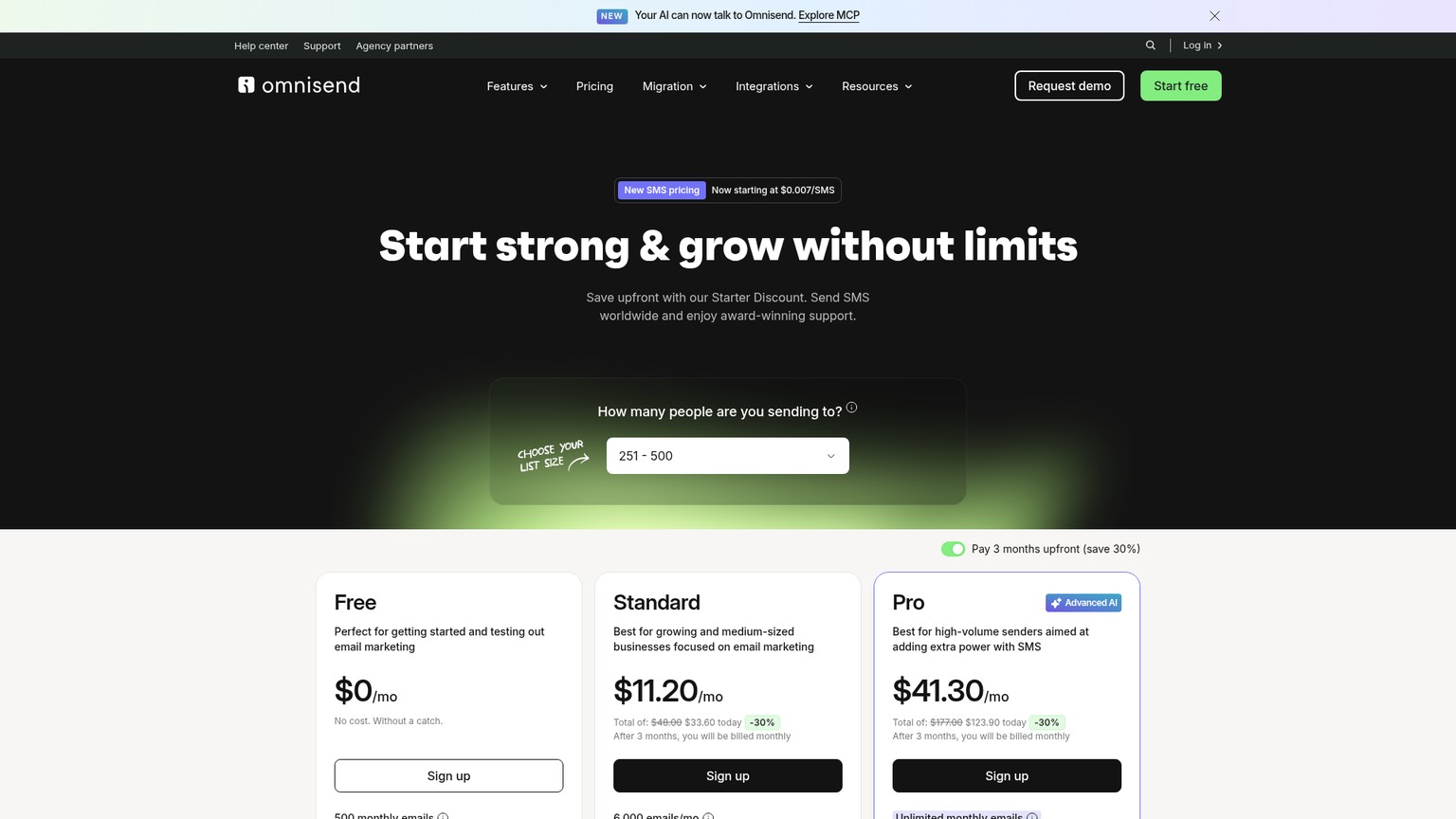
The plans:
Free: $0, with 500 emails a month to up to 250 contacts, plus 500 web-push notifications, the full automation library, and 24/7 live-chat and email support, on the free plan, which almost no competitor offers.
Standard: from $16/mo at 500 contacts, with a send limit of 12x your list size (6,000 emails at that tier). The plan most growing stores live on.
Pro: from $59/mo at 2,500 contacts, with unlimited monthly emails (a fair-use ceiling of 60x your list), bonus SMS credits equal to your monthly bill, and priority support.
SMS is pay-as-you-go, from $0.009 per message down to $0.007 once you are spending over $10,000, so you are not pre-buying credits you might waste. And any account spending $400 a month or more gets a free dedicated Account Expert, a human who helps set up your flows, which at that price point is unusual.
Where Omnisend caps out is depth. Its segmentation handles the standard ecommerce jobs, cart abandoners, lapsed buyers, VIPs, cleanly, but it does not match Klaviyo's predictive modeling or the granularity brands use to squeeze another few points out of a mature list. For most stores that ceiling is far overhead. For a brand whose growth now comes from out-segmenting competitors, it arrives fast.
Klaviyo: the data and segmentation pick
Klaviyo earns its premium when segmentation and prediction are how you make money, not a nice-to-have. It is less an email tool than a customer-data platform with sending attached, and that framing explains both its power and its price.
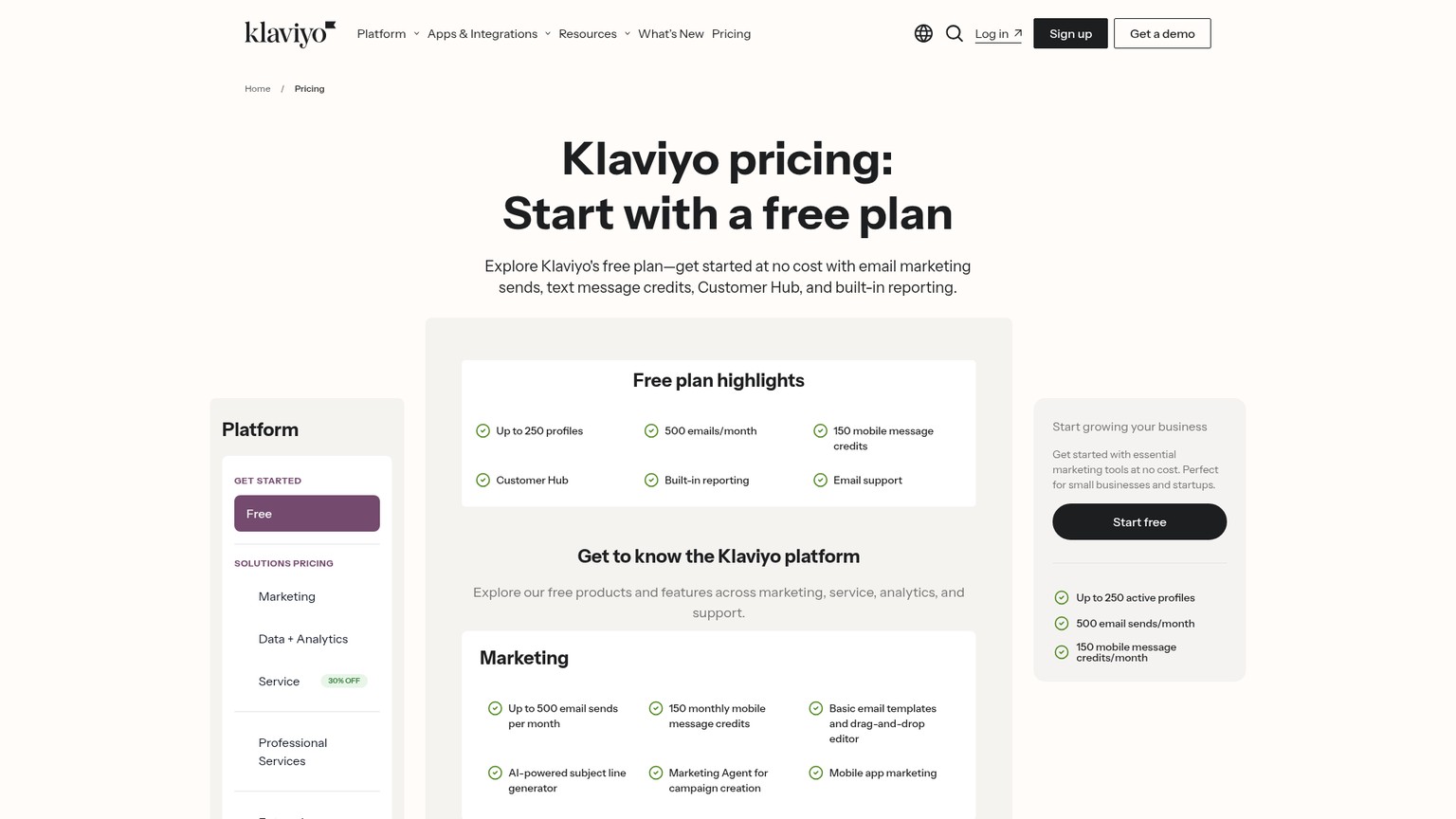
The depth shows up in three places. Its predictive analytics estimate each customer's lifetime value, their likelihood to churn, and their predicted next order date, then let you build flows off those predictions, an email that fires when a customer is statistically about to lapse. Its segmentation is granular enough to target behavior most platforms cannot express. And its integration ecosystem is the deepest in ecommerce, so the data feeding those segments is richer.
The free plan matches Omnisend's on paper: up to 250 active profiles, 500 email sends a month, plus 150 mobile-messaging credits. One catch is easy to miss: full email support lasts only the first 60 days on free; after that you are on the Help Center and community until you upgrade.
Paid plans scale by active profiles: roughly $20 a month at 500 profiles, $30 at 1,000, about $60 at 2,500, $100 at 5,000, and $400 at 25,000, climbing toward $2,300 at 250,000. The steepest jumps land in the mid-tiers, where doubling your list can more than double the invoice.
Who should pick Klaviyo: an established brand past roughly $2-3M a year where a 5% lift from better targeting is real money; a team with a dedicated email or retention owner; a store whose catalog and repeat-purchase behavior are rich enough that prediction actually has signal to work with.
The honest decision rule
Map it to your store, not to a feature checklist:
The rule underneath the table: Klaviyo's premium is a bet that better segmentation will return more than it costs. Above a few million in revenue with someone to run it, that bet usually pays. Below it, or without that person, you are buying capability you will not convert, and Omnisend does the 80% that drives most of the revenue for a fraction of the bill.
The switching cost is the other half. Klaviyo's lock-in is real, your flows, segments, and historical data live in its format, so the time to migrate goes up the longer you wait. If you are genuinely unsure, start on Omnisend; moving up to Klaviyo later when you have the list and the data to justify it is far easier than walking the cost back down once you have built everything in Klaviyo. For the closest sibling decision, Klaviyo vs Mailchimp comes down to the same pricing math, and the broader AI email tools roundup covers the field beyond these two.
Count your real, mailed contacts
Pull your list and subtract the unsubscribed and the chronically unengaged. That billable number, not your total list, is what you actually pay for, and it is where Omnisend's no-unsubscribed-billing can swing the comparison.
Score your segmentation honestly
Write down the segments you run today. If they are mostly "opened," "clicked," and "bought," you do not yet need Klaviyo's depth. If you already wish you could target by predicted value or churn risk, you do.
Model the cost at next year's list size
Price both at the contact count you expect in 12 months, not today's. The platforms are close at 1,000 contacts and far apart at 25,000; decide on where you are going.
Start on the free tier that fits, then commit
Both give you 250 contacts free. Build your core flows there, see which interface your team actually uses, and upgrade only when a limit forces it.
Alternatives and the SMS factor
If both feel like too much, the lighter end of the market is real. Mailchimp is the familiar generalist (cheaper at the very bottom, weaker on ecommerce automation and famous for steep list-size jumps), and MailerLite is the budget pick for simple newsletters without deep store integration. Neither matches Omnisend's all-channel value or Klaviyo's data depth, but for a content brand or a store sending occasional campaigns, they can be enough.
The factor that often decides it is SMS. If text is a real channel for you, abandoned-cart texts, launch blasts, Omnisend's pay-as-you-go rates and bundled credits usually beat buying SMS as a Klaviyo add-on, and you avoid running a second tool. If SMS is an afterthought, it should not drive the choice. Where attribution matters and you are tracking which channel actually drove the sale, the revenue-tier-tax problem shows up across marketing tools, email platforms included.
Is Omnisend or Klaviyo better?
Neither universally. Omnisend is better for small-to-mid ecommerce stores that want email, SMS, and push in one cheaper bill with fast setup. Klaviyo is better for established, data-driven brands that monetize advanced segmentation and predictive analytics and have someone to run them. The deciding question is whether you will actually use Klaviyo's data depth.
How much is Omnisend per month?
Omnisend has a free plan (250 contacts, 500 emails a month). Paid plans start at $16 a month for the Standard plan at 500 contacts, and the Pro plan starts at $59 a month at 2,500 contacts with unlimited emails. SMS is pay-as-you-go from about $0.007 to $0.009 per message. Pricing scales with your contact count.
Is Klaviyo still relevant?
Yes, especially for established ecommerce brands. Klaviyo's relevance rests on its predictive analytics, deep segmentation, and the richest integration ecosystem in ecommerce. Its weakness is cost as you scale and the time investment to use its depth, which is why smaller stores often outgrow the value before they outgrow the platform.
Is Omnisend any good?
Yes. For small and mid-size ecommerce stores it is one of the best value-for-money platforms: a usable free tier, every channel in one bill, 24/7 support even on free, and a billing model that does not charge for unsubscribed contacts. Its limit is segmentation depth, which most stores do not hit for a long time.
Want to know which tools in your stack are quietly overcharging you as you scale? Get the free AI business workflow audit checklist and find the line items returning less than they cost.
- Last Updated
- Category
- Growth
- Language

Beehiiv Pricing: Annual Costs by List Size
Beehiiv pricing verified October 2026: annual bills at 1k, 10k, 50k and 100k subscribers, plan features, October changes and paid newsletter fees.Oct 9, 2026Growth
Pipedrive Pricing: Plans, Add-ons and Team Costs
Current Pipedrive seat and add-on prices, annual vs monthly budgets for 3 and 10 users, AI features, and when Premium costs less.Oct 8, 2026Growth
Lemlist Pricing: Seats, Credits and Sending Costs
Lemlist pricing by month, quarter and year, including credits, mailboxes and add-ons. See founder, sales team and agency bills plus alternatives.Oct 8, 2026Growth
Tidio Alternatives
Compare seven Tidio alternatives by support job, current pricing and billing unit. See who should switch, what migration costs and when Tidio wins.Oct 7, 2026Growth
Vista Social Pricing: What Your Profiles and Team Cost
Vista Social starts at $99/month. Compare annual prices, profile and user limits, AI features, add-ons, three bills and cheaper options.Oct 7, 2026Growth
Unbounce Pricing 2026: Plans, Visitor Limits and Testing
Unbounce starts at $29/month. Compare all six plans, annual rates, visitor and domain limits, A/B testing, Smart Traffic and the cheapest fit.Oct 7, 2026Growth
Best AI Ad Generator in 2026: AdCreative.ai, Atria, Creatify & Arcads (Compared)
Choose AI ad tools by job: static ads, UGC-style video or creative research. Compare current maker pricing, credit units and free entry.Oct 6, 2026Growth