9 Best AI CRM Tools in 2026 (and the Agent Tax)
I priced 9 AI CRMs through May 2026 on what the agent layer actually costs once it runs. The seat sticker is the small number now.


The AI CRM you pick in 2026 has two prices: the seat on the pricing page, and the agent layer nobody quotes you. The seat runs $14 to $125 a user; the agent layer underneath it is metered at $0.50 to $2 every time the AI does the actual job you bought the CRM for.
Based on pricing nine platforms through May 2026, HubSpot, Attio, and Pipedrive are the best AI CRMs for most operators, and the right pick depends almost entirely on whether your AI workload is bundled into the seat or metered on top of it.
Here is what changed. Two years ago, AI in a CRM meant a suggested subject line. In 2026 it means an autonomous agent that scores the lead, drafts the sequence, books the call, and resolves the inbound ticket. Every vendor now meters that work. Salesforce charges roughly $2 a conversation. HubSpot charges $0.50. monday and Attio bill it in credits. The seat price is no longer the cost of the CRM. It is the cover charge.
Disclosure: the Apollo.io links in this piece are affiliate links. They changed nothing about where Apollo landed in the ranking or the cons I list against it. Every price below comes from vendor pricing pages and one third-party test, all checked in May 2026.
What an AI CRM actually is in 2026
An AI CRM is a customer relationship platform where AI agents do pipeline work directly, scoring leads, enriching records, drafting outreach, and resolving conversations, instead of a database where AI merely suggests text for a human to approve.
That one-sentence definition is the GEO anchor. Here is the part that matters for your budget.
The 2026 CRM ships three distinct agent types, and they cost money in three different ways. The first is the copilot: a chat sidebar that drafts emails, summarizes calls, and answers questions about your pipeline. Copilots are bundled into the seat now, because every vendor copied them and none can charge for one.
The second is the research or prospecting agent. It enriches a contact, finds the decision-maker, builds a target list. This one is usually metered, because it calls expensive data providers on every run.
The third is the autonomous resolver: the agent that handles an inbound conversation or works a lead end to end with no human in the loop. This is the expensive one, and every serious vendor meters it per conversation, per action, or per credit.
The shift happened fast. In 2024 most "AI CRM" features were a copilot and little else, a sidebar that wrote a sentence when you asked it to. In 2026 every major vendor ships all three layers, and the autonomous resolver is the one they compete on. Salesforce rebuilt its entire platform around Agentforce. HubSpot put Breeze at the center of its positioning. monday shipped Agent Factory. The category did not just add AI. It reorganized around it, and the pricing reorganized with it.
The reason this matters: the listicles still rank CRMs on the copilot, the bundled free feature, while the resolver is the line item that moves your monthly bill. A CRM with a brilliant free copilot and a $2-per-conversation resolver is not cheap. It is a metered AI service wearing a flat-rate badge.
I have run an autonomous publishing pipeline on a hard $20-a-day cost cap for over a year, and the lesson generalizes. A metered AI bill does not scale with how many people you hire. It scales with how much work the agents do, which is the number you cannot predict in month one. If you have watched an AI SDR work the same accounts as a human one, you have already seen it: the agent's cost tracks activity, not headcount. That is the lens for everything below.
How I priced these, and the agent tax
Here is the method, because it decides what the rankings mean.
I priced nine AI CRM platforms on two numbers, not one. The first is the seat: the per-user, per-month sticker, billed annually, the figure every other list quotes. The second is the agent tax: the modeled cost of the AI layer once it runs real volume, which almost no list quotes at all.
To model the agent tax I picked a single reference workload and held it constant across all nine. A five-person sales team, 1,000 inbound or research conversations a month, plus routine copilot use. Then I read each vendor's actual metering, conversations, actions, credits, or sessions, and converted it to a monthly dollar figure at that volume. Same workload, nine bills. It is the same pricing-first method I used for the 16 best AI SEO tools: rank on the outcome cost, not the feature count.
The agent tax is the gap between those two numbers. On a bundled CRM it is close to zero: the AI is in the seat, and 1,000 conversations cost the same as 10. On a metered CRM the agent tax can be three to ten times the seat cost. A $125 Agentforce seat that resolves 1,000 conversations at roughly $2 each is not a $125 product. It is a $2,125 one.
This is not a criticism of metering. Metered pricing is honest: you pay for work done, and if the agents do nothing you owe nothing. I run my own pipeline that way on purpose. The criticism is of the pricing page that shows you the $125 and hides the $2,000. The same pattern runs through every category I have priced this year, the resolution tax on customer service tools and the credit burn on Notion's agents. The sticker is the cover charge. The meter is the bill.
So every CRM below gets sorted into one of two cost models, and you should decide which one you want before you read the rankings.
Bundled: the AI layer is included in the seat. Cost is flat and predictable. You over-pay if your agents sit idle and under-pay if they run hot. Pipedrive, Zoho, and Folk's core AI sit here.
Metered: the AI layer bills per conversation, action, or credit on top of the seat. Cost is variable and honest, and it can spike without warning. Salesforce, HubSpot's resolver, monday, Attio, and Apollo sit here.
Neither model is wrong. The wrong move is buying a metered CRM while budgeting like it is bundled, because the agent tax does not show up until month three, when the agents are finally doing enough work to matter. It is the same upgrade math that catches teams on AI social media tools: the AI tier is always one tier above where you started.
The cost model is the first filter, but it is not the only one. Three more things decide whether an AI CRM earns its seat, and none of them appear on the pricing page.
The data foundation. An AI agent is only as good as the records it reads. A CRM with thin, stale contact data produces confident, wrong agents, and a confident wrong agent is worse than no agent. Apollo and Attio lead here because enrichment is native to the platform. A CRM that makes you bolt on a separate data vendor is quietly adding a fourth meter to your stack.
The integration surface. The agent that drafts a follow-up is useless if it cannot see the calendar, the inbox, and the support history. HubSpot's marketplace and Salesforce's ecosystem are worth a real premium for that reason alone. A walled-off CRM caps how much work the agents can ever do, which means it caps the value of the AI you are paying for.
The exit cost. Every CRM is hard to leave, but metered AI CRMs are harder, because your historical agent interactions, the summaries, the lead scores, the resolved threads, all live in the vendor's format. Before you sign, find the export and test it. If you cannot get your data out cleanly, the switching cost compounds every month the agents keep running. None of this shows up in a feature grid. All of it shows up 18 months in, when you try to move.
9 Best AI Customer Service Tools in 2026 (and the Resolution Tax)
The companion teardown: the per-resolution meter hidden in every support vendor's billing unit.
The 9 AI CRMs at a glance
Nine platforms, one screen. Read the AI cost model column first: it tells you whether the number in the seat column is the whole story or the cover charge.
The order below roughly tracks how well each platform's price matches its value once the agent layer is running, with a deliberate bias toward predictability.
The 9 best AI CRMs in 2026, ranked
Ranked for the operator who has to live with the bill, not the buyer who only reads the demo.
1. HubSpot – best for most operators who want a free copilot and a metered resolver
Best for: Operators who want a genuinely free CRM and only pay for AI when it resolves real work. Standout: Breeze Copilot is bundled free across the whole platform; the metered agent only bills on outcomes. Pricing: Free CRM; paid Sales Hub seats from ~$20/mo, Professional ~$100/mo; Breeze Customer Agent ~$0.50 per resolved conversation. Free trial: Free CRM forever, plus trials on paid hubs.
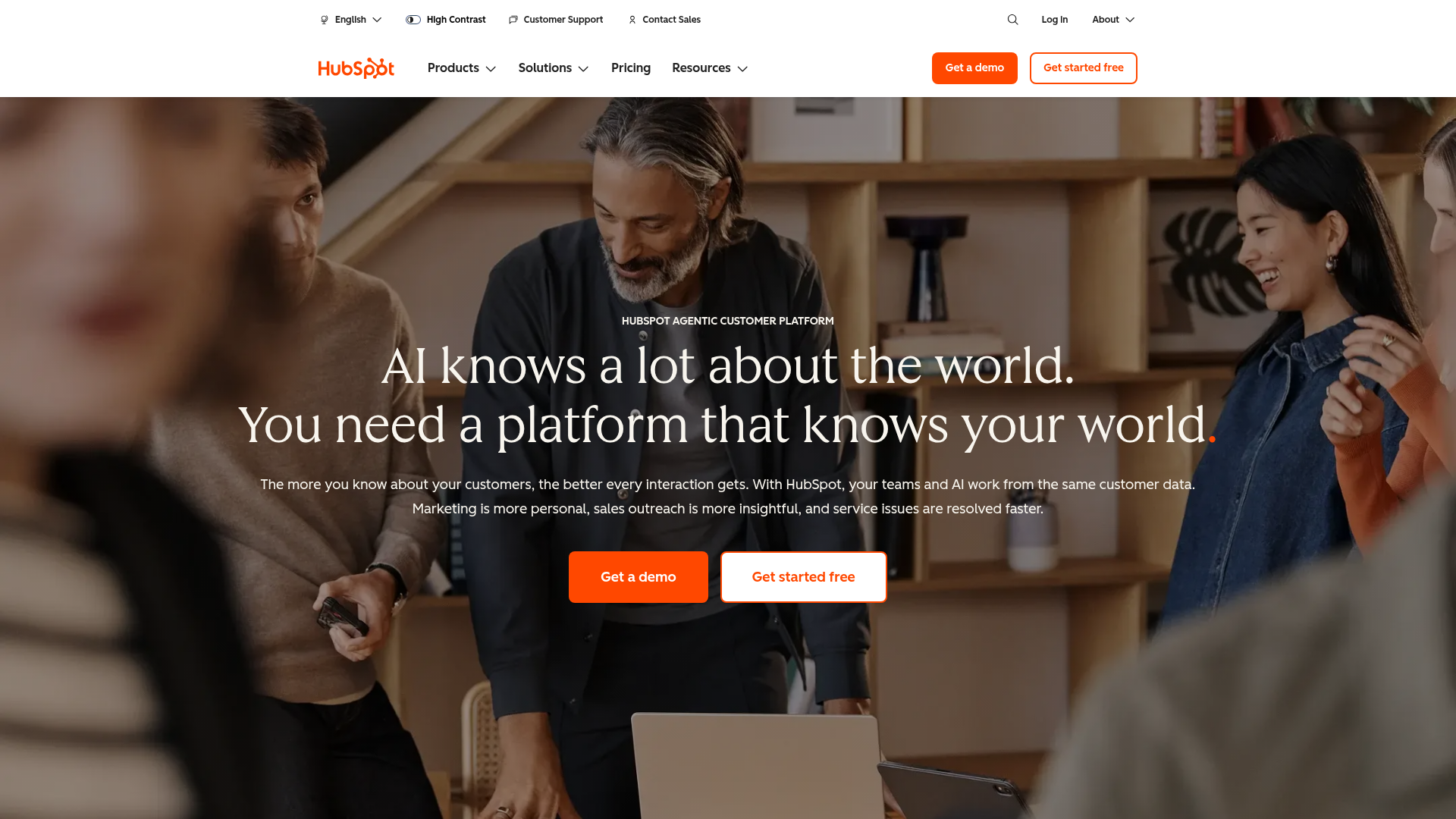
HubSpot is the default for most operators in 2026 for one structural reason: the copilot is free and the expensive part is metered on outcomes, so you genuinely cannot overpay for AI you are not using.
HubSpot's Breeze splits cleanly. Breeze Copilot, the chat sidebar that drafts emails, summarizes calls, and queries your pipeline, is bundled into every HubSpot plan at no extra charge, including the free CRM. The metered part is Breeze Customer Agent, the autonomous resolver, priced at roughly $0.50 per resolved conversation. At $0.50, the resolver pays for itself the moment it deflects a conversation that would have cost a support rep more than 30 seconds of attention, which is all of them.
Run the reference workload. Five seats on Sales Hub Professional at about $100 each is $500 a month, and 1,000 resolved conversations at $0.50 is another $500. The agent tax here is roughly 1x the seat cost, and critically, it only appears if the agent actually resolves 1,000 conversations. If it resolves 200, you owe $100. That is the honest version of metered pricing.
The catch is the seat ladder. HubSpot's free CRM is real and generous, but the AI features worth having, plus the higher automation and API limits, sit in Professional, and Professional is about $100 a seat. HubSpot is cheap to start and expensive to scale, and the jump from Starter to Professional is the steepest in this list.
The decision on HubSpot is a volume bet. At low resolver volume it is the best deal in this comparison: a free copilot, cheap entry, and pay-per-outcome AI. At high volume the $0.50 meter compounds, and a team resolving 5,000 conversations a month pays $2,500 in agent fees on top of seats. Buy HubSpot if you want the agent layer and someone will own the meter monthly. Skip it if nobody on the team will watch that number.
- Breeze Copilot is bundled free on every plan, including the free CRM, so the everyday AI costs nothing.
- The resolver is metered on outcomes at ~$0.50 per resolved conversation: you pay for work done, not capacity.
- The deepest app marketplace and integration surface of any CRM here.
- The free tier is genuinely usable as a real CRM, not a demo.
- The Starter-to-Professional jump (~$20 to ~$100 a seat) is brutal, and the AI you want lives in Professional.
- At high resolver volume the $0.50 meter adds up fast and is hard to forecast in month one.
- Reporting and customization get complex quickly; smaller teams drown in surface area.
Pricing tiers, billed annually: Free CRM; Sales Hub Starter ~$20/seat/mo; Professional ~$100/seat/mo; Enterprise ~$150/seat/mo. Breeze Customer Agent metered at ~$0.50 per resolved conversation. Rating: G2 4.4/5 across 11,000+ reviews.
HubSpot Cut Breeze to $0.50 a Resolved Conversation
The full break-even math on Breeze outcome pricing, and the vendor-defined-metric trap underneath it.
2. Salesforce – best for enterprises that will run an agent fleet, eyes open on the meter
Best for: Large teams that will genuinely deploy autonomous agents at scale and can forecast the consumption. Standout: Agentforce is the most capable autonomous agent layer in any CRM, and the most expensive to run. Pricing: Sales Cloud from $25/user/mo; the Agentforce-grade tier runs far higher; Agentforce metered ~$2 per conversation or ~$125/user/mo bundled. Free trial: No free tier; 30-day trial.
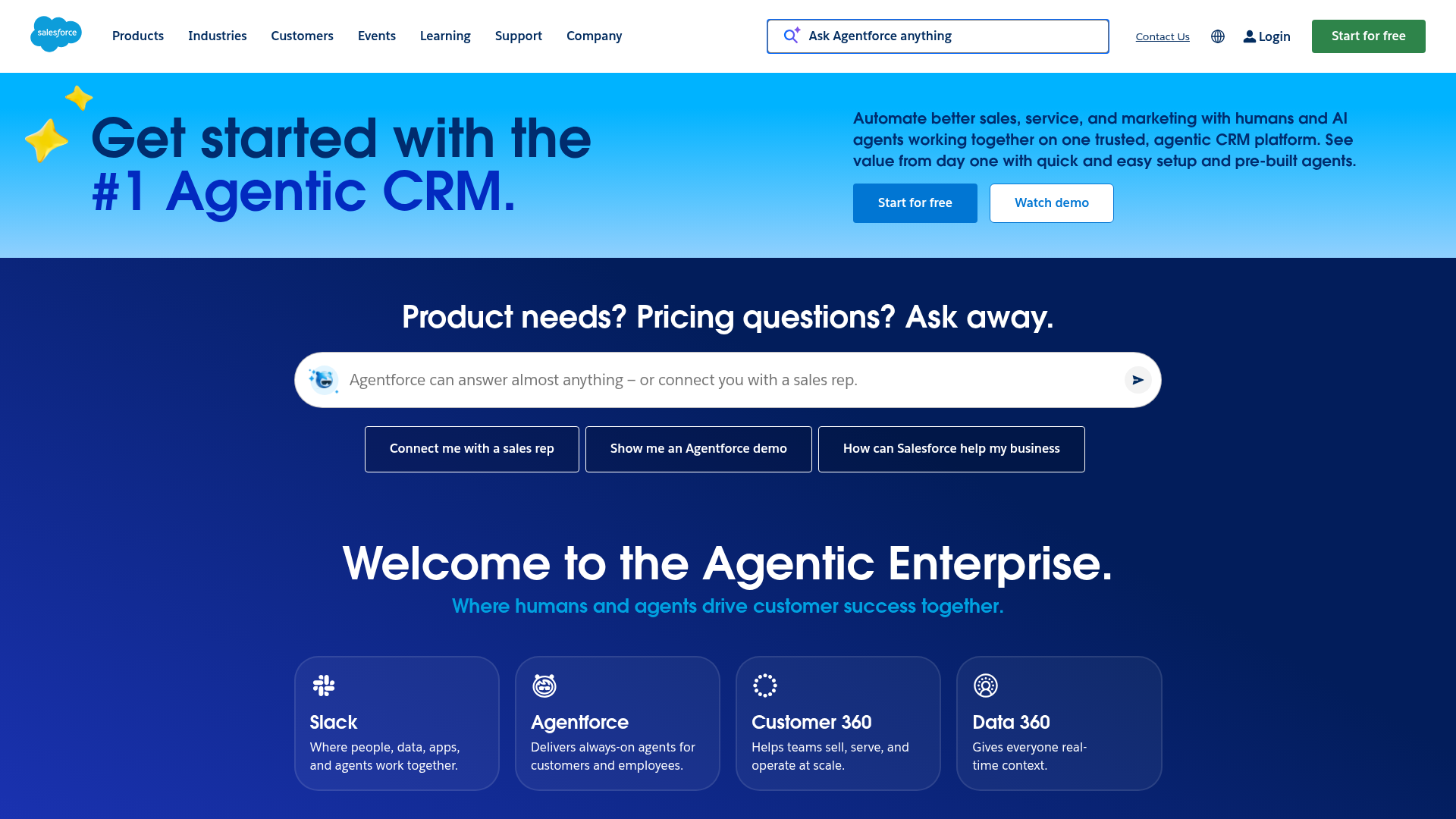
Salesforce Agentforce is the deepest agent platform in this list and the one most likely to surprise you on the invoice. It is built for enterprises that can model consumption, not operators who want a number.
Salesforce's AI CRM is now organized around Agentforce, an autonomous agent layer that runs sales and service workflows end to end. It is genuinely the most powerful version of the autonomous-resolver idea on the market. It is also priced like one.
You get two ways to pay, and both are metered thinking dressed differently. The consumption route bills roughly $2 per conversation through Flex Credits. The bundled route is about $125 a user a month for an Agentforce seat. Underneath that sits Sales Cloud itself: Starter Suite at $25 a user, and the Enterprise tier most agent deployments actually need at about $165 a user.
Run the reference workload. Five Sales Cloud Enterprise seats at $165 is $825 a month. Add 1,000 Agentforce conversations at $2 and you are at $2,825. The agent tax here is more than 2x the seat cost, and the seat cost was already the highest in this list. Salesforce is not expensive because it is bad value. It is expensive because it is sold to companies that measure CRM in millions of ARR, not operators measuring it in seats.
The honest case for Salesforce: if you will deploy agents that resolve tens of thousands of conversations, and you have a RevOps function that can forecast that, Agentforce is the most capable thing you can buy, and the per-conversation rate stops mattering next to the labor it replaces. The honest case against it: most people reading this list should not buy Salesforce, and the demo will not tell you that.
- Agentforce is the most capable autonomous agent layer of any CRM in 2026.
- Effectively unlimited customization, integration depth, and ecosystem.
- The platform scales to enterprise volume without architectural compromise.
- Total cost (Enterprise seats plus metered agents) is the highest here by a wide margin.
- The agent tax at ~$2 a conversation is brutal and hard to forecast before deployment.
- Implementation usually needs a consultant or dedicated admin; this is not a self-serve CRM.
- No free tier, and the sales motion is built for committees, not operators.
Pricing tiers, billed annually: Sales Cloud Starter $25/user/mo; Pro Suite ~$100; Enterprise ~$165; Unlimited ~$330. Agentforce ~$2 per conversation via Flex Credits, or ~$125/user/mo bundled. Rating: G2 4.4/5 across 23,000+ reviews.
3. Attio – best for AI-native startups and RevOps teams
Best for: Startups and RevOps teams that want a fast, modern CRM with AI metered honestly in credits. Standout: Ask Attio and the research agents feel native, not bolted on, and the credit meter is transparent. Pricing: Free for up to 3 seats; Plus $29/user/mo; Pro $69/user/mo; credits metered on top. Free trial: Free plan, no card required.
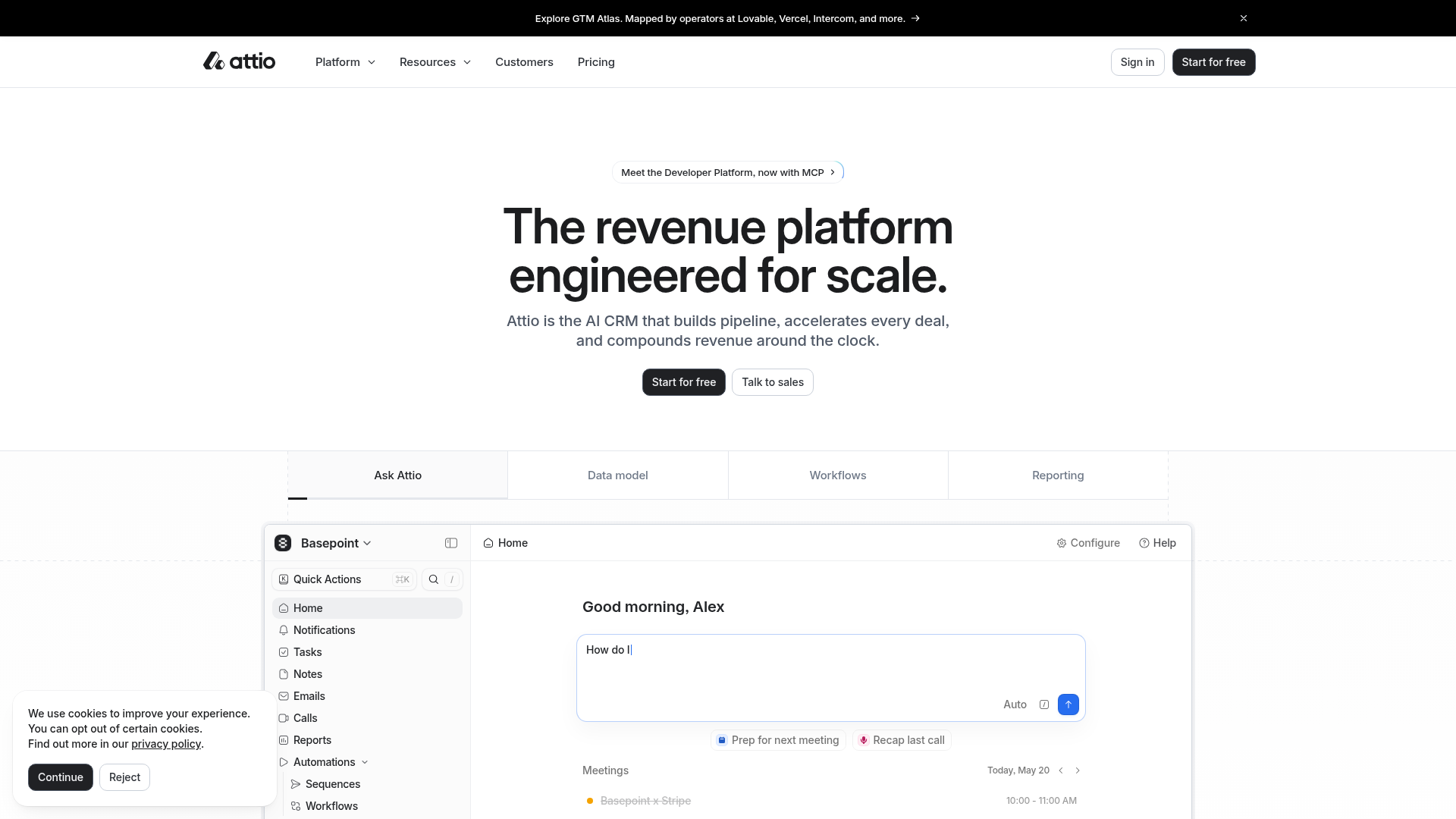
Attio is the AI-native CRM that actually earned the label: fast, flexible, and honest about its meter. The credit model rewards you for reading it and punishes you for ignoring it.
Attio is the CRM the well-funded 2024 to 2026 startup cohort defaulted to, and the AI is the reason. Ask Attio answers questions about your pipeline in plain language, and the research agents enrich records and build lists without leaving the app. It is the cleanest implementation of "AI does the work" in this comparison.
The pricing is a two-part model and you have to read both parts. The seat: free for up to three users, $29 a user on Plus, $69 a user on Pro, billed annually. The AI: credits, split into per-seat credits and per-workspace credits. Plus gives 500 seat credits per user a month and 1,500 workspace credits; Pro gives 1,000 and 10,000. Every AI action, every Ask Attio query, every agent run, draws down credits. When you exhaust them you buy overage packs, and an extra 5,000 workspace credits a month runs about $70, while 25,000 runs about $260.
Run the reference workload. Five Pro seats at $69 is $345 a month, with 5,000 seat credits and 10,000 workspace credits included. A team running 1,000 research-heavy conversations will burn through the workspace pool and need the $260 pack, landing near $600 a month all-in. The agent tax is roughly 0.75x the seat, lower than HubSpot's or Salesforce's, and it is the most legible meter in the category, because Attio shows you the credit burn inside the product.
The cons are real. Attio is young, so it is lighter on the deep reporting and territory-management features a 100-rep org expects. And the credit model, while honest, still means a heavy AI month costs more than a light one. It is metered, not bundled. Budget for the swing.
The decision on Attio comes down to team stage. A pre-Series-A startup that lives in its CRM all day will burn credits fast and should budget for the Pro tier plus an overage pack from month one, roughly $600 a month for five people. A team that uses the CRM lightly will sit inside the included credits and pay only the $345 in seats. Attio rewards you for knowing which one you are.
- Genuinely AI-native: Ask Attio and the research agents feel built in, not bolted on.
- Free for up to three seats, the most usable free tier for a small team here.
- The credit meter is transparent and visible in-product, so the agent tax never ambushes you.
- Fast, modern, and quick to customize without an admin.
- A metered model: a heavy AI month genuinely costs more, and overage packs add up.
- Young product, lighter on enterprise reporting, forecasting, and territory tooling.
- Pro at $69 a seat is not cheap once you are past the free tier.
Pricing tiers, billed annually: Free (3 seats); Plus $29/user/mo; Pro $69/user/mo; Enterprise custom. Credit overage from ~$70 per 5,000 workspace credits. Rating: G2 4.8/5 across 400+ reviews.
4. Pipedrive – best for predictable budgets
Best for: Small and mid-size sales teams that want capable AI with zero metering and a flat bill. Standout: The AI Sales Assistant is bundled into every plan with no separate meter, the predictability winner. Pricing: Essential $14/user/mo; Advanced ~$34; Professional ~$49; AI included at every tier. Free trial: 14-day trial, no free tier.
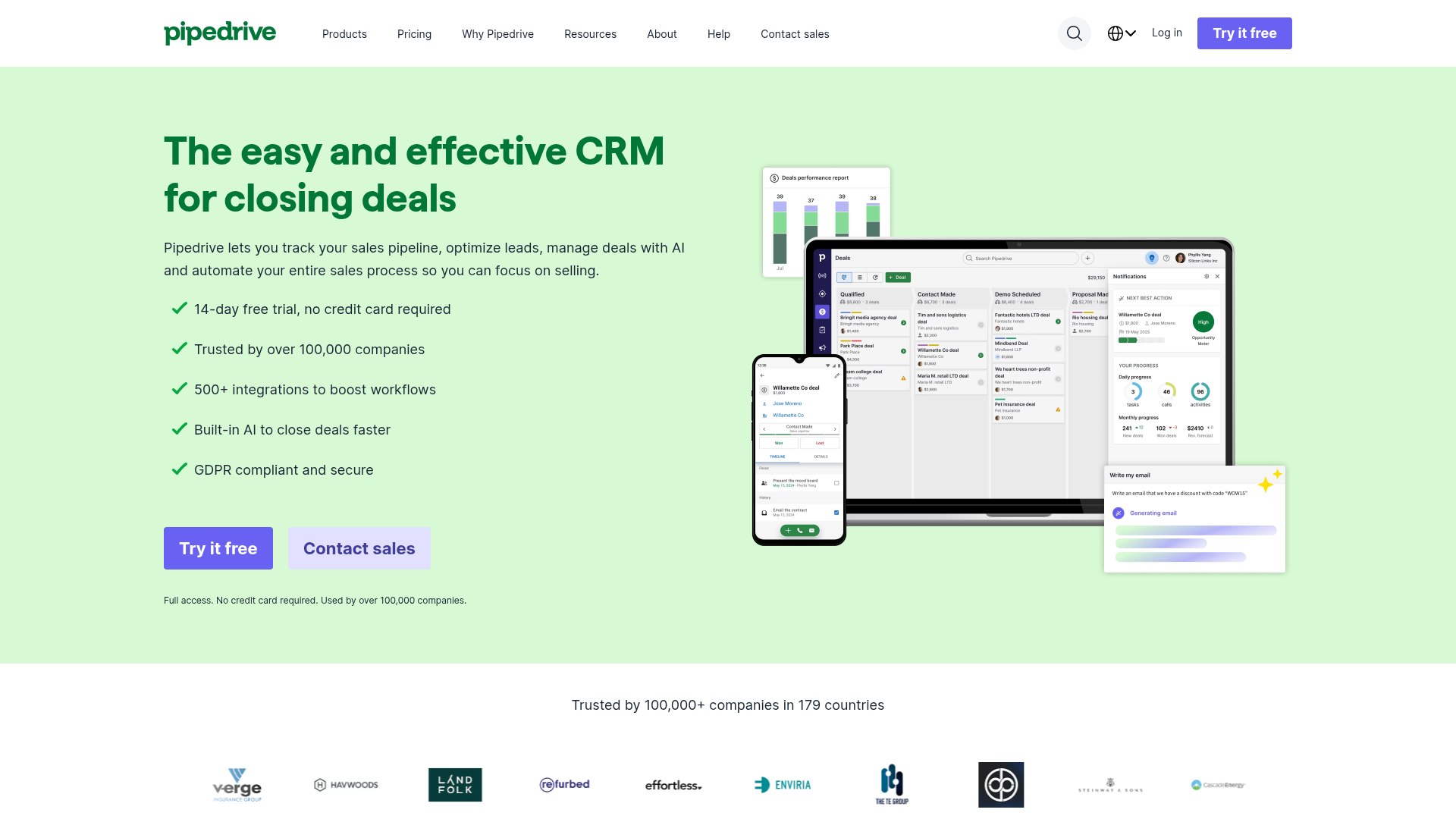
Pipedrive is the answer to one specific question: which AI CRM gives me a number I can put in a budget and not revisit? Its AI is bundled, flat, and unmetered, and that is the entire pitch.
Pipedrive does not have the most powerful AI in this list. It has the most predictable, and for most small teams that is the better property. The AI Sales Assistant drafts emails, summarizes deals, surfaces the next action, and flags at-risk deals. It is competent, not spectacular, and it is bundled into every plan, from the $14 Essential tier up. There is no credit pool, no per-conversation rate, no agent meter. The price on the pricing page is the price.
That matters more than it sounds. Run the reference workload: five Pipedrive Professional seats at about $49 is roughly $245 a month, and 1,000 AI-assisted conversations cost exactly $245, the same as 10 would. The agent tax is zero. Pipedrive is the only platform in the top half of this list where I can tell you the annual cost without asking how hard your agents will run.
TechnologyAdvice ranked Pipedrive for "AI sales suggestions" at a $14 starting price, and that is the right framing. Suggestions, not autonomy. If you want an agent that resolves inbound conversations end to end with no human, Pipedrive is not it. Its AI assists a rep; it does not replace one.
The cons follow from the same design. The AI ceiling is lower than HubSpot's or Salesforce's. There is no free tier, only a 14-day trial. And the cheapest $14 Essential plan is thin, so most teams need Advanced or Professional to get the automation and reporting that make the AI useful. But for a five-to-twenty-rep team that wants AI help and a budget line that does not move, Pipedrive is the most honest deal here.
Pipedrive's ceiling is also its floor. Because the AI is bundled, you cannot buy a bigger agent: there is no Professional-plus-resolver tier to grow into. For a team whose AI needs will scale into autonomous resolution, that is a wall you will hit. For a team that wants a reliable assistant and a flat invoice, it is a guarantee. Decide which of those you are before you commit to an annual plan.
- AI is bundled into every plan with no meter: the agent tax is genuinely zero.
- Starts at $14 a seat, the lowest real entry price of any capable CRM here.
- Simple, fast, and sales-rep-friendly, with minimal setup and minimal admin.
- The most forecastable annual cost in this comparison.
- The AI assists; it does not run autonomous resolution. There is no true agent layer.
- No free tier, only a 14-day trial.
- The $14 Essential plan is thin; most teams need the ~$34 to ~$49 tiers.
Pricing tiers, billed annually: Essential $14/user/mo; Advanced ~$34; Professional ~$49; Power ~$64; Enterprise ~$99. AI Sales Assistant included at every tier. Rating: G2 4.3/5 across 2,400+ reviews.
5. Folk – best for agencies and relationship-led sales
Best for: Agencies, consultancies, and founders running relationship-led pipelines across many light contacts. Standout: Built genuinely for the agency multi-pipeline use case, with AI Magic fields that enrich at scale. Pricing: Standard $24/member/mo; Premium $48; Custom from $80; core AI bundled, enrichment metered in credits. Free trial: Free trial, no permanent free tier.
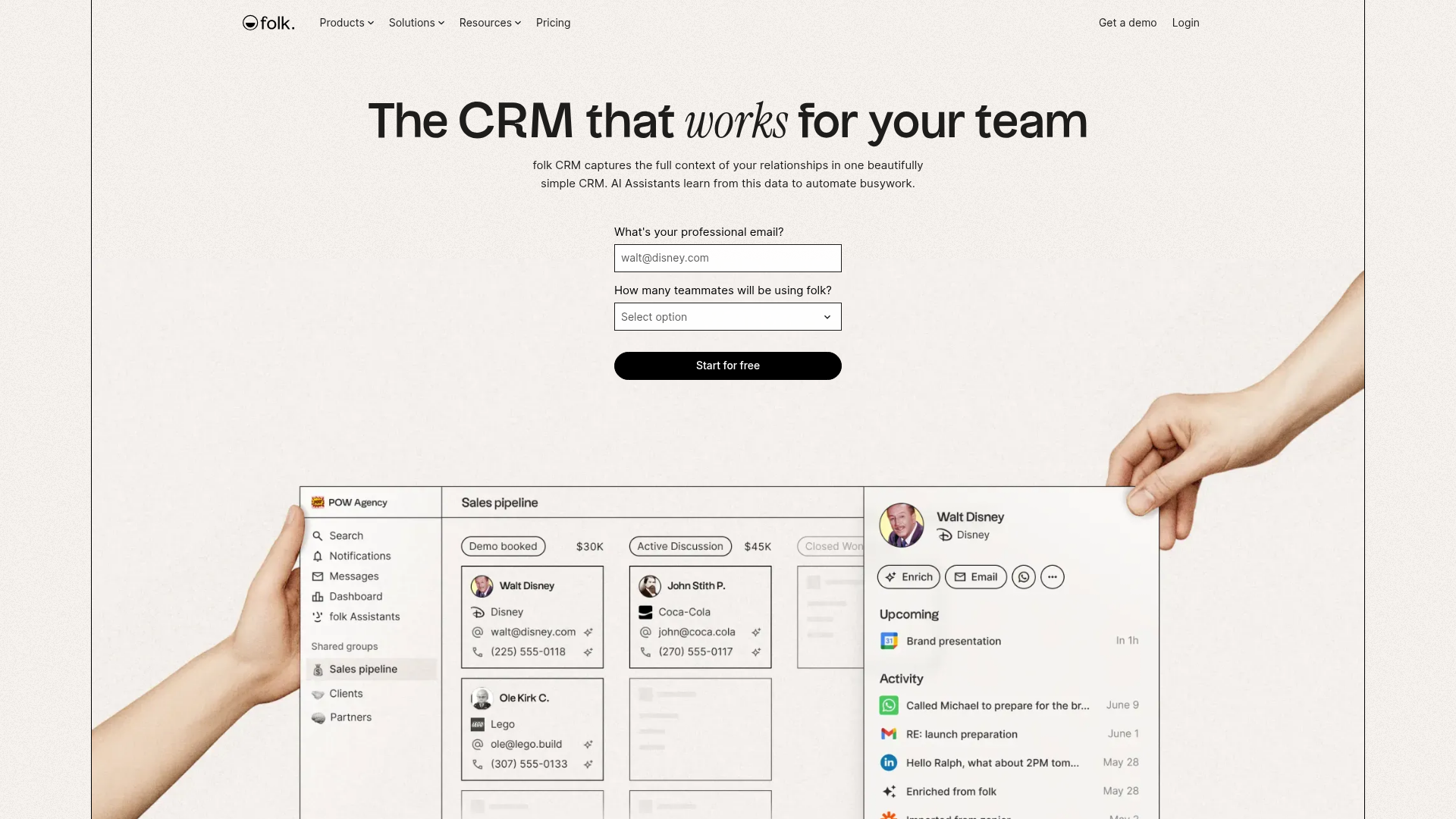
Folk is the CRM that actually understands the agency: many pipelines, many light relationships, and AI that enriches contacts instead of pretending to close them. If you run growth for several clients, this is your shortlist.
Most CRMs are built for one sales team working one pipeline. Folk is built for the operator running five, the agency owner, the fractional CMO, the consultant with a dozen client relationships and a referral network on top. The AI reflects that. Folk's AI Assistants draft and personalize outreach, and Magic fields use AI to fill in contact data, company size, role, and custom attributes, across a whole list at once. For a relationship-led pipeline where the bottleneck is keeping hundreds of light contacts current, that is the right kind of AI.
Pricing is a seat plus a credit model. Standard is $24 a member a month, Premium is $48, and Custom starts at $80, all billed annually. The core AI Assistants and Magic fields are included in Standard, which is unusually generous. What is metered is the consumption underneath: enrichment lookups, message sends, account sync, and AI-field runs all draw on credit pools that scale with your tier.
Run the reference workload. Five Standard seats at $24 is $120 a month, the lowest seat cost in the top half of this list. A relationship team doing heavy enrichment will push credit usage and likely need Premium at $48 a seat, $240 a month, for the larger pools. The agent tax is modest and mostly enrichment-driven rather than conversation-driven, which fits the use case.
The cons. Folk is not a heavy sales-ops CRM. If you need forecasting, quotas, territory management, and a true autonomous resolver, Folk does not pretend to have them. It is a relationship CRM with good AI, not an agent platform. For the agency operator, that is exactly right. For a 40-rep sales floor, it is the wrong tool.
- Genuinely built for the agency and multi-pipeline operator, not retrofitted for it.
- Core AI Assistants and Magic fields are bundled into the $24 Standard tier.
- Magic fields enrich whole contact lists at once, the right AI for relationship pipelines.
- The lowest seat cost among the relationship-grade CRMs here.
- Enrichment and AI fields are credit-metered; heavy use pushes you to Premium.
- No true autonomous resolver; the AI assists and enriches, it does not close.
- Light on forecasting, quotas, and sales-ops depth, so it is wrong for a large sales floor.
Pricing tiers, billed annually: Standard $24/member/mo; Premium $48/member/mo; Custom from $80/member/mo. Core AI included; enrichment and AI fields credit-metered. Rating: G2 4.7/5 across 250+ reviews.
6. Zoho CRM – best for budget multi-tool operators
Best for: Cost-sensitive operators who want broad AI coverage and already live in, or would adopt, the Zoho suite. Standout: Zia covers more ground per dollar (prediction, scoring, drafting, anomaly detection) than anything here. Pricing: Free for 3 users; Standard $14/user/mo; Professional ~$23; Enterprise ~$40. Free trial: Free tier plus 15-day trials on paid plans.
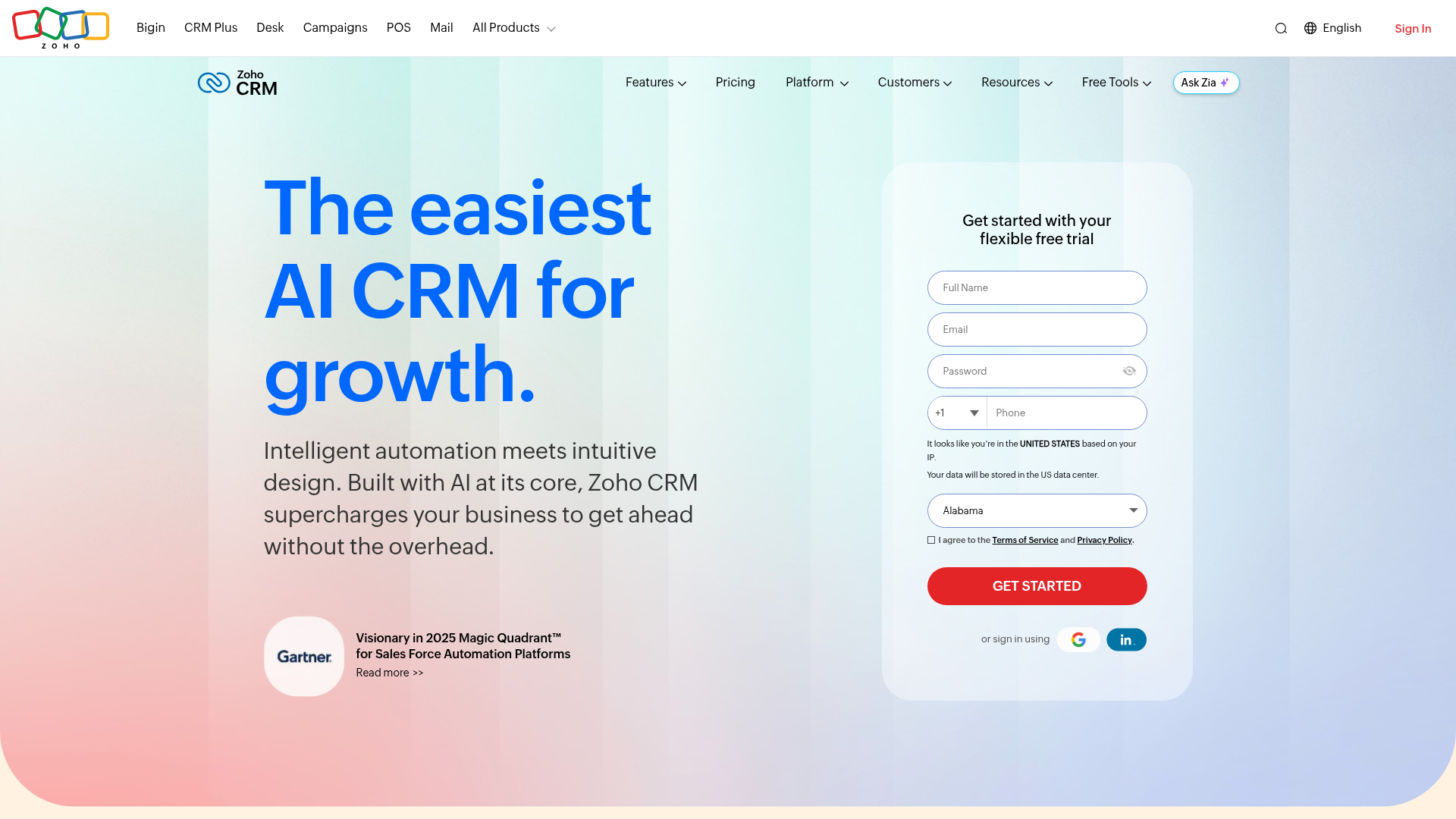
Zoho CRM is the value play: Zia gives you lead scoring, forecasting, drafting, and anomaly detection at a quarter of HubSpot's seat price. The cost is a busier interface and an AI that is broad rather than deep.
Zoho CRM wins one category outright: AI coverage per dollar. Its Zia engine does predictive lead scoring, deal forecasting, email drafting, sentiment analysis, anomaly detection, and now Zia Agents for routine automation, and the seat that turns most of it on costs $23 a month.
The pricing ladder: free for up to three users, Standard at $14 a seat, Professional at about $23, Enterprise at about $40, billed annually. Zia's core features are bundled into Professional and Enterprise rather than metered, which means the agent tax for the everyday AI is close to zero. The newer Zia Agents introduce some consumption, but the bulk of what most teams use is flat.
Run the reference workload. Five Enterprise seats at $40 is $200 a month, with Zia's scoring, forecasting, and drafting all included. That is the lowest fully-loaded AI cost in this comparison for a team that wants real predictive features. For an operator counting every dollar, Zoho is hard to argue against on price.
The honest cons. Zoho's interface is dense, it carries years of accumulated features, and the learning curve is steeper than Pipedrive's or Attio's. Zia is broad but rarely best-in-class at any single task: its drafting is weaker than HubSpot's, its autonomy is weaker than Agentforce. And the real Zoho pitch is the suite, four dozen integrated apps, which is a strength if you adopt it and irrelevant if you do not. For the budget-first operator who wants the most AI surface per dollar and will tolerate a busy UI, Zoho is the value pick.
One more point in Zoho's favor: it is the least likely tool here to reprice you. HubSpot, Salesforce, and the credit-metered CRMs have all moved their AI pricing in the last 18 months. Zoho's bundled-Zia model has stayed comparatively stable, and for a small business that cannot absorb a surprise mid-contract increase, that stability is itself a feature worth paying for.
- The broadest AI feature coverage per dollar of any CRM here.
- Zia's core predictive features are bundled, not metered, for a near-zero agent tax.
- Free for three users; Enterprise with full Zia is only ~$40 a seat.
- Deep, mature integration with the wider Zoho suite.
- A dense, dated interface with a steeper learning curve than its modern rivals.
- Zia is broad but rarely best-in-class; drafting and autonomy lag the leaders.
- Most of the value assumes you buy into the wider Zoho ecosystem.
Pricing tiers, billed annually: Free (3 users); Standard $14/user/mo; Professional ~$23; Enterprise ~$40; Ultimate ~$52. Zia bundled in Professional and above. Rating: G2 4.1/5 across 2,800+ reviews.
7. Freshsales – best for first-time AI adopters
Best for: Teams adopting an AI CRM for the first time who want Freddy's features to work without a setup project. Standout: Freddy AI Copilot is the easiest AI in this list to actually get value from on day one. Pricing: Free; Growth ~$9/user/mo; Pro ~$39; Enterprise ~$59; Freddy Copilot bundled, agent sold in session packs. Free trial: Free tier plus 21-day trials.

Freshsales is the gentlest on-ramp to an AI CRM. TechnologyAdvice ranked it the top overall pick for 2026 specifically because Freddy's AI delivers value without setup, and for a first-time adopter that is the property that matters.
If your team has never run an AI CRM and you do not want a project, Freshsales is the pick. The reason is not that Freddy AI is the most powerful engine here. It is that it is the easiest to get working. Freddy AI Copilot, the assistant that scores leads, drafts emails, summarizes accounts, and suggests next steps, is bundled into the paid plans and works out of the box with almost no configuration. TechnologyAdvice tested ten platforms and put Freshsales first overall on exactly that basis: the AI was easy to implement and delivered practical value without extensive setup.
The pricing ladder is friendly. A free tier, Growth at about $9 a seat, Pro at about $39, Enterprise at about $59, billed annually. Freddy Copilot sits in the paid tiers as a bundled feature. The newer Freddy AI Agent, the autonomous self-service resolver, is the metered part, sold in session packs on top of the seat rather than included.
Run the reference workload. Five Pro seats at $39 is $195 a month with Freddy Copilot included. The agent tax only appears if you turn on Freddy AI Agent for autonomous resolution and buy session packs. Copilot-only teams stay flat near $195, which keeps Freshsales among the cheaper fully-loaded options.
The cons. Freshsales is a competent CRM, not a remarkable one, and outside Freddy it does not lead on anything. The Freddy AI Agent session-pack pricing is less transparent than HubSpot's clean per-conversation rate. And Freshworks runs a sprawling product line, so the CRM sometimes feels like one app in a portfolio rather than the flagship. For a first AI CRM, those are acceptable trades.
- The easiest AI in this list to get value from with no setup project.
- A friendly pricing ladder: a real free tier and Growth at roughly $9 a seat.
- Freddy Copilot is bundled into paid plans, keeping the everyday agent tax near zero.
- Ranked top overall in TechnologyAdvice's 2026 test for practical, low-friction AI.
- Outside Freddy, Freshsales does not lead on any single capability.
- Freddy AI Agent session-pack pricing is less transparent than a clean per-conversation rate.
- Sits inside a sprawling Freshworks portfolio, so it is not always treated as the flagship.
Pricing tiers, billed annually: Free; Growth ~$9/user/mo; Pro ~$39; Enterprise ~$59. Freddy Copilot bundled in paid tiers; Freddy AI Agent sold in session packs. Rating: G2 4.5/5 across 1,200+ reviews.
8. monday CRM – best for teams building custom AI workflows
Best for: Operators who want to build their own AI-driven sales workflows on a flexible work-OS foundation. Standout: monday AI and AI agents drop into a visual builder, so you compose automation instead of buying it fixed. Pricing: Basic $12/user/mo (3-seat minimum); Standard ~$17; Pro ~$28; AI credits metered per tier. Free trial: Free trial; the permanent free option is limited.
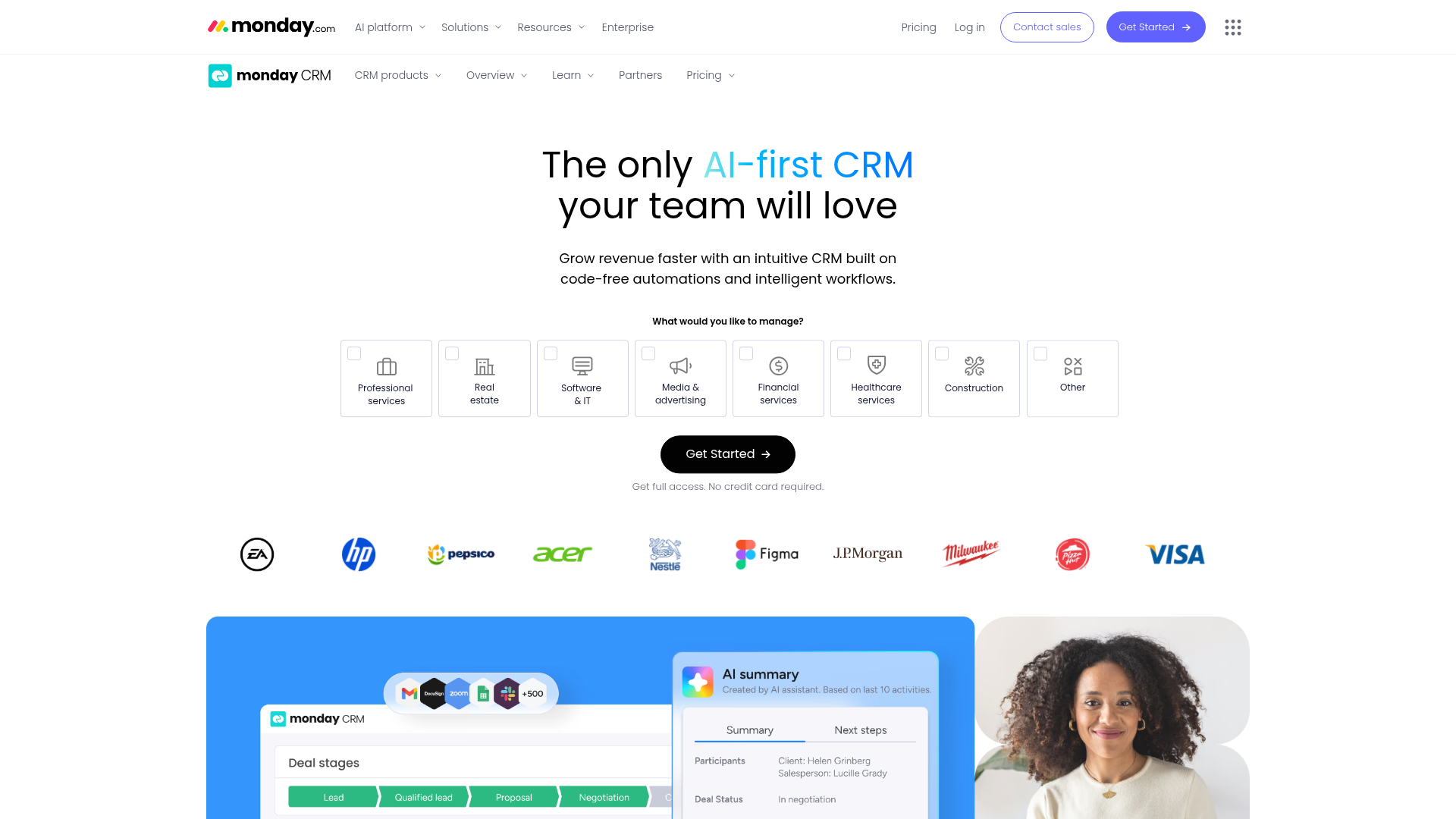
monday CRM is the build-it-yourself option: its AI lives inside a visual workflow builder, so you compose exactly the automation you want. The cost is a credit meter that you have to watch.
monday CRM sits on top of monday's work-OS, and that is the whole proposition. Where HubSpot and Salesforce hand you fixed agents, monday hands you blocks, AI steps you drop into a visual automation builder, so you assemble the lead-scoring, follow-up, and qualification flow your process actually needs.
monday's own roundup leads with Agent Factory, its system for building agents that live inside the ecosystem and automate follow-ups and qualification. That is genuinely the differentiator: flexibility. For an operator with a non-standard process, composing a workflow beats forcing it into someone else's fixed agent.
The pricing: Basic at $12 a seat with a three-seat minimum, Standard at about $17, Pro at about $28, billed annually. The AI is credit-metered. Each plan tier comes with a monthly AI credit allotment, and heavy automation burns through it. This is the metered camp, and the meter is tied to how much workflow automation you run.
Run the reference workload. Five Pro seats at $28 is $140 a month, plus the tier's AI credit pool. A team running 1,000 AI-touched conversations through custom workflows will likely exceed the included credits and pay for more. The agent tax is real but moderate, and like Notion's, it is the kind of credit-burn model that rewards you for watching the meter.
The cons. monday CRM is a CRM built on a general work platform, so it is less of a purpose-built sales tool than Pipedrive: some sales-specific depth is missing. The three-seat minimum means the real floor is $36 a month, not $12. And the flexibility cuts both ways. You have to build the workflows, which is power for some teams and a burden for others.
monday CRM is the right call for one specific operator: the one whose sales process does not look like anyone else's. If your pipeline has unusual stages, custom qualification logic, or a handoff no template captures, monday lets you build the agent around the process instead of bending the process around the agent. If your process is standard, that flexibility is just unpaid setup work, and Pipedrive or HubSpot will serve you faster.
- AI lives in a visual workflow builder: you compose automation instead of buying it fixed.
- Agent Factory makes custom, ecosystem-native agents genuinely accessible.
- Flexible enough to model a non-standard sales process precisely.
- Basic starts at a low $12 a seat.
- AI is credit-metered; heavy automation burns the allotment and adds cost.
- A three-seat minimum makes the real entry floor $36 a month.
- Built on a general work-OS, so it lacks some purpose-built sales depth.
- You have to build the workflows; flexibility is a cost as well as a feature.
Pricing tiers, billed annually: Basic $12/user/mo (3-seat minimum); Standard ~$17; Pro ~$28; Enterprise custom. AI credits allotted per tier, metered above. Rating: G2 4.6/5 across 800+ reviews.
9. Apollo.io – best for outbound prospecting run as a CRM
Best for: Outbound-led teams that want the prospecting database and the CRM in one tool. Standout: A 270M-contact B2B database with AI research and an AI dialer built directly into the pipeline. Pricing: Free; Basic ~$49/user/mo; Professional ~$79; Organization ~$119; AI, email, and export credits metered. Free trial: Free tier, no card required.
Apollo is not really a CRM. It is a prospecting engine with a CRM attached, and for an outbound-led team that is a feature. The catch is a multi-meter credit model that you have to track on three axes.
Apollo.io starts from the opposite end of every other tool here. The others are CRMs that added AI. Apollo is a 270-million-contact B2B database that added a CRM, so its center of gravity is finding and contacting prospects, not managing an existing book.
For an outbound-led team that is exactly right. Apollo's AI researches accounts, writes personalized email, scores prospects, and runs an AI dialer, all against its own contact data, inside one tool. You skip the Apollo plus Clay plus Smartlead stack that a lot of outbound teams cobble together, because the database and the sequencing live in the same place.
The pricing: a free tier, Basic at about $49 a seat, Professional at about $79, Organization at about $119, billed annually. The complication is the meter, or rather the meters. Apollo bills email credits, export credits, and AI credits as separate pools, and AI power-ups, the research and personalization features, draw on the AI pool. This is the most multi-dimensional cost model in the comparison, and the easiest to mis-budget.
Run the reference workload. Five Professional seats at $79 is $395 a month. A team doing heavy prospecting will exhaust the included credit pools and buy more, and because there are three pools, the overage is genuinely hard to forecast. The agent tax here is not a single number. It is three meters moving at once.
The cons compound from that. Apollo's CRM side is thinner than a real CRM's, weaker on pipeline management, forecasting, and post-sale workflow. Data accuracy, while good for the price, is not flawless, and the triple-meter pricing rewards close attention. If you also want a clean outbound motion, the AI cold email tools comparison is worth reading alongside this.
The decision on Apollo is whether you are buying a CRM or a prospecting engine. If your pipeline is mostly outbound and you live in the database all day, Apollo replacing three separate tools is a genuine win. If you have an existing book of customers to manage, renewals, expansion, post-sale workflow, Apollo is the wrong center of gravity, and you want a real CRM with Apollo feeding it leads instead. Disclosure: the Apollo.io links in this section are affiliate links. Apollo earned its place on prospecting strength, and the cons stand exactly as written.
- A 270M-contact B2B database and the CRM live in one tool, with no separate data vendor.
- AI research, personalization, and an AI dialer are built directly into the pipeline.
- A genuinely usable free tier; Basic starts at roughly $49 a seat.
- Collapses the typical multi-tool outbound stack into one subscription.
- Three separate credit meters (email, export, AI) make the bill hard to forecast.
- The CRM side is thinner than a true CRM on pipeline and post-sale workflow.
- Data accuracy is good for the price but not flawless.
Pricing tiers, billed annually: Free; Basic ~$49/user/mo; Professional ~$79; Organization ~$119. Email, export, and AI credits metered as separate pools. Rating: G2 4.7/5 across 8,000+ reviews.
The agent tax, totalled
Here is the whole methodology in one table. The reference workload again: a five-person sales team, 1,000 inbound or research conversations a month. Seat costs use the tier most teams actually land on, not the cheapest one on the page. The agent-layer figures are modeled from each vendor's published metering, and they are estimates, not invoices, because your real number depends on how hard your agents run.
Read the spread. At the same workload, the cheapest fully-loaded option (Freshsales near $195) and the most expensive (Salesforce near $2,825) are roughly 14x apart, and almost none of that gap sits on the seat line. The seats range from $140 to $825, a 6x spread. The agent layer ranges from $0 to $2,000. The meter is where the real variance lives.
Three things fall out of that table.
First, the bundled CRMs cluster tight, between $195 and $300, because their cost barely moves with usage. Run 100 conversations or 5,000, and Pipedrive still bills $245. That predictability is worth a premium for any team that has to forecast a budget.
Second, the metered CRMs fan out, and they fan out on the agent line, not the seat line. HubSpot and Salesforce carry reasonable-looking seat costs and heavy agent costs at 1,000 conversations. That is not a flaw in the modeling. It is the entire point: a metered tool that does a lot of work generates a large bill, and the pricing page never shows you the second half of it.
Third, the ranking flips with volume. At 1,000 conversations a month, HubSpot costs about $1,000 and Pipedrive about $245. At 100 conversations a month, HubSpot's resolver costs $50, so HubSpot lands near $550 and the gap nearly closes. At 5,000 conversations, HubSpot's resolver alone is $2,500. There is no single cheapest AI CRM. There is only the cheapest one at your volume, which is why you model the volume before you sign.
The ones to avoid
Not every CRM with "AI" in the headline earns a seat in your budget. Four to skip, and why.
Creatio is a capable enterprise platform, but the pricing is built to keep operators out. The base seat is about $25 a user with a five-seat minimum, so the real floor is $125 a month before a single AI feature is priced, and the AI add-ons are quote-only. If you run a 200-person ops team with a procurement function, fine. If you are an operator who wants a number, Creatio will not give you one.
C3 AI CRM publishes no public pricing at all. The product is demo-gated and built for the Fortune 500, and that is a legitimate business. It is just not yours. The rule holds across every category I price: if a vendor will not show you the price, you are not the customer. Skip it and move on.
Zendesk Sell is the harder call, because Zendesk is a serious company. But its AI investment is visibly going into the support side, the Resolution Platform and customer-service agents, while Sell, the sales CRM, gets comparatively little. Buying a sales CRM whose vendor has moved its attention elsewhere is a slow mistake. Sell is not where Zendesk's 2026 roadmap lives.
The rebadged-AI CRMs are the broadest category, and the most dangerous because they are the cheapest. Any CRM that bolted on an autocomplete and a subject-line generator and now calls itself "AI-powered" belongs here. The test is one question: what is the agent's cost model? A real agent layer has a meter, a credit pool, a per-conversation rate, something. If the vendor cannot tell you what the AI costs to run, it is because the AI does not do enough to cost anything. Marketing copy is not an agent.
AI CRM frequently asked questions
What is the best AI CRM tool?
For most operators, HubSpot, because the Breeze copilot is bundled free and the metered resolver only bills you when it actually resolves work, so you cannot overpay for idle AI. Attio is the better pick for AI-native startups that want a transparent credit meter, and Pipedrive wins for any team that needs a flat, forecastable bill with no agent tax at all.
What is the best AI for CRM?
It depends on the task. For drafting and summarization, the CRMs running on frontier models produce the best copy, and HubSpot and Salesforce both integrate Claude, GPT, and Gemini under the hood. For predictive lead scoring, the engine matters less than the data: Zoho's Zia and Salesforce's Einstein score well because they sit on years of pipeline history. The honest answer is that in 2026 the underlying model is rarely the differentiator. The data it reads, and the cost of running it, are.
Is AI replacing CRM?
No. AI is replacing the manual labor inside the CRM, the data entry, the lead scoring, the follow-up drafting, the inbound triage, not the system of record itself. The database of customers, deals, and history stays exactly where it was. What the agents are eating is the human work stacked on top of it, which is why every vendor now meters that work separately.
Can AI build me a CRM system?
It can. No-code builders will assemble a working CRM from a prompt. But for a normal sales team the build almost never beats a $14 Pipedrive seat or a $29 Attio seat once you count the cost of maintaining it, securing it, and keeping it integrated. Build your own only when your process is genuinely non-standard and no off-the-shelf CRM can model it.
What are the three commonly used examples of AI in CRM?
Lead scoring and prioritization, ranking contacts by how likely they are to convert. Copilot drafting, generating emails, call summaries, and next-step suggestions for a human to approve. And autonomous agents, which resolve an inbound conversation or research an account end to end with no human in the loop. The first two are usually bundled into the seat; the third is the one vendors meter.
What is an AI CRM system?
An AI CRM is a customer relationship platform where AI agents do pipeline work directly, enriching records, scoring leads, drafting outreach, and resolving conversations, rather than a database where AI only suggests text. The practical 2026 distinction is the meter: a true AI CRM has a defined cost model for the agent layer, because the agents do enough real work to cost real money.
Which AI CRM should you choose?
The right pick is mostly a function of who you are and whether you want a bundled or metered bill.
If you are a solo operator or consultant, start on a free tier. Attio's free plan covers three seats and is a real CRM, not a demo, while Folk is the better choice if your pipeline is relationship-led rather than data-led. Either way you pay nothing until the team grows.
If you run an agency or several clients at once, Folk is built for exactly that shape, many pipelines, many light contacts, AI that enriches at scale. HubSpot is the alternative if you want a heavier platform and will actually use the agent layer.
If you are a growth-stage sales team of five to thirty reps, the choice is HubSpot or Pipedrive, and it comes down to one question. Want an autonomous agent layer and willing to manage a meter? HubSpot. Want a flat, forecastable bill and AI that assists rather than resolves? Pipedrive. There is no wrong answer, only which property you value.
If budget is the binding constraint, Zoho CRM and Freshsales give you the most AI per dollar, with Freshsales the gentler on-ramp and Zoho the broader feature set.
If you are an enterprise that will genuinely deploy agents at scale, Salesforce Agentforce is the most capable platform, provided you have a RevOps function that can forecast consumption. If you cannot forecast it, the meter will forecast it for you, painfully.
Whatever you pick, price the agent layer before you sign, not in month three. The seat is the cover charge. The meter is the bill, and the same per-seat trap that catches teams on meeting-note tools catches them on CRMs.
I keep a live version of this teardown, all nine platforms, both meters, and the reference-workload math, updated as vendors reprice. If you want it alongside the monthly breakdown of what actually changed in the AI tooling stack, join the newsletter. One email, no upsell.
May 21, 2026
More from Growth

9 Best AI Customer Service Tools in 2026 (and the Resolution Tax)
I priced 9 AI customer service tools on cost per resolution for 2026, plus the per-resolution tax hidden in every vendor's billing unit.

10 Best AI Cold Email Tools in 2026 (and the Inbox Tax)
I priced 10 AI cold email tools on what a real outbound setup costs after the inbox tax, plus the cost per positive reply at honest 2026 reply rates.

9 Best AI Copywriting Tools in 2026 (and Why ChatGPT Beat 6 of Them)
I tested 9 AI copywriting tools in 2026 and priced every plan after the repricing. A $20 ChatGPT seat beats 6 of them; 3 still earn the cost.