9 Best AI Customer Service Tools in 2026 (and the Resolution Tax)
I priced 9 AI customer service tools on cost per resolution for 2026, plus the per-resolution tax hidden in every vendor's billing unit.


Klarna's AI assistant did the work of 700 full-time agents within a month of launch, and operators now peg the swing at roughly $15 a human resolution down to $2 an AI one. Every customer service vendor watched that number, rebuilt its pricing around the win, and quietly kept the right to define what counts as a billable resolution.
Based on pricing nine tools on real cost per resolution rather than feature lists, Intercom Fin, HubSpot Breeze, and Zendesk AI agents are the best AI customer service tools as of May 2026.
That verdict will annoy two camps. The enterprise crowd wants Sierra or Decagon on the podium, and the bargain crowd wants a $29 chatbot. Both miss the point of what changed this year.
The point is the billing unit. In 2026, you no longer buy a customer service tool by the seat. You buy it by the resolution, and the resolution is a number the vendor calculates, not one you can audit line by line. Get the unit wrong and a tool that looks cheap on the pricing page bills like an enterprise contract by the third month.
I run an autonomous publishing system that meters every paid model call against a hard $20 daily cap. Every call is logged with a token count and a dollar cost before it is allowed to complete. That habit makes vendor pricing pages easy to read: a support agent is a metered API, and the only question that matters is what you pay per unit of real work done.
So that is how I priced all nine. Not by sticker. By cost per resolution after the resolution rate, which is the only number that survives contact with a real support volume.
What an AI customer service tool actually is in 2026
An AI customer service tool is software that resolves a customer ticket end to end without a human, and bills you on the resolution rather than the seat.
That one sentence carries the entire 2026 shift. Two years ago these tools were deflection bots bolted onto a helpdesk, sold as a per-agent add-on. The bot answered easy questions, failed the hard ones, and you paid the same flat fee either way. Resolution was a marketing word.
A 2026 AI customer service tool does three jobs. It resolves tier-one tickets end to end, the refund status, the password reset, the where-is-my-order. It assists human agents on the harder tickets by drafting replies and summarizing long threads. And it routes, reading intent and sending the urgent case to the right person.
Only the first job, full resolution, is what the new pricing bills on, because it is the only one that removes a salary line instead of speeding one up. When a vendor quotes a resolution rate, that figure is the share of job one the agent can finish alone.
Now resolution is the invoice line. Zendesk launched outcome-based pricing for its AI agents at its Relate 2026 conference and called itself the first in the CX industry to bill purely on resolutions rather than seats, according to its own pricing announcement. Intercom had been there for over a year with Fin. HubSpot moved Breeze to a per-resolved-conversation credit charge. Help Scout, Gorgias, and the enterprise platforms all converged on the same model within twelve months.
The shift was not vendor generosity. It was economics catching up. When Intercom first shipped Fin on per-resolution pricing, its agent resolved roughly 35% of tickets, and at that rate the model lost the vendor money on every weak month. Three years of cheaper inference and better context engineering pushed the rate past 65%.
Per-resolution flipped from a risk the vendor absorbed into a margin it could defend. Outcome pricing exists in 2026 because the AI finally got good enough to make the vendor money, not because anyone in a boardroom decided to be fair to buyers.
That history matters because it tells you where the next squeeze comes from. The rate is low now while vendors fight for installed base. Once you are integrated, switching costs are real, and the per-resolution number is the easiest line in any contract to nudge upward at renewal.
The pitch is seductive. You pay only when the AI wins. A failed conversation costs nothing, so the vendor carries the risk of a weak model. On paper, incentives finally align.
In practice, the model splits into two camps, and the split is the whole story. The first camp bills per resolution: you pay a fixed price only when the AI closes the ticket. The second camp bills per conversation: you pay every time the AI opens its mouth, win or lose. Vendors in both camps describe themselves as outcome-based and pay-for-performance. Only one camp actually is.
That distinction is the difference between a predictable line item and a bill that scales with your worst tickets. It is also invisible on every ranked list currently on this search results page, because those lists sort by features and rank the publisher's own product first.
Some operators ask why not skip all nine and build the agent on a raw model API. I run that kind of system, and the honest answer is that the model call is the cheap part.
The expensive part is the retrieval layer, the escalation logic, the resolution ledger that proves what you were billed for, and the year-plus of ticket history that teaches the agent your edge cases. The vendors below are selling that scaffolding, not the model underneath it. Build it yourself only if customer support is your actual product.
So before the tools, the math.
How I priced these, and the per-resolution tax
I priced every tool on one number: real cost per resolution. Not the sticker. The sticker divided by the rate at which the tool actually resolves tickets.
Here is the method. Take the billable unit and its price. If the tool bills per resolution, the sticker is the real cost, because you only pay on a win. If the tool bills per conversation, divide the sticker by the resolution rate, because you are paying for the failures too. A $0.40 per-conversation tool that resolves 57% of tickets has a real cost per resolution of $0.70. The 43% it could not solve still landed on your invoice.
That gap is the per-resolution tax, and it is the single most expensive thing buyers miss.
Run it on a mid-size support volume. A SaaS company handles 5,000 customer conversations a month. Assume a 60% resolution rate, which is honest for a well-tuned 2026 agent. That is 3,000 resolutions and 2,000 failures.
A true per-resolution tool bills only the 3,000 wins. Intercom Fin at $0.99 charges $2,970. HubSpot Breeze at roughly $0.50 charges $1,500. Zendesk at $1.50 committed charges $4,500. Help Scout at $0.75 charges $2,250.
A per-conversation tool bills all 5,000 touches. eesel at $0.40 charges $2,000, which reads cheap until you divide by 0.6 and see a real $0.67 per resolution. Freshdesk at $0.49 a session charges $2,450, a real $0.82. The spread between the cheapest credible option and the most expensive is over $3,000 a month on identical work. None of it shows up on a feature grid.
Here is the same scenario priced across the eight tools that scale to it. Identical inputs: 5,000 conversations a month, a 60% resolution rate, 3,000 resolutions and 2,000 failures. The figures are AI usage only, with base seat fees stacked separately.
Two things jump out of that table. First, the per-conversation tools shuffle their rank once the tax is applied: eesel's $0.40 sticker is genuinely the second-cheapest real cost, while Tidio's mid-pack $0.78 conversation price becomes the second-most-expensive resolution. Second, Crisp is absent, because its flat per-workspace plans are not built for 5,000 conversations a month. Crisp is a tool for low and predictable volume, and at this scale the other eight are the real field.
The base seat fees I excluded are not a rounding error. Add a ten-seat Zendesk Suite Professional plan and you are paying roughly $1,150 a month before the first AI resolution. Help Scout on Standard for the same team adds $250. HubSpot Service Hub Professional adds $900. The AI line is only one of the meters running, and a fair comparison reads all of them.
Now the opposite trap, because per-resolution billing has its own catch. When you only pay on a resolution, the vendor decides what a resolution is. That definition is written into the contract, and it is rarely symmetrical in your favor.
Intercom Fin is the clearest case, and to its credit the most honest about it. Fin bills $0.99 per outcome, and an outcome is either a resolution or a procedure handoff, per its pricing page. A procedure handoff means Fin ran a configured workflow and passed the conversation to a human. You pay full price for a ticket the AI did not actually close. That is defensible, since Fin still did work, but it means the billable unit is broader than the word resolution suggests.
Help Scout runs the definition the other way. A resolution counts only if the customer receives an AI answer and does not escalate, search the knowledge base, ask a follow-up, or click the "I still need help" button. If the customer asks for a human, you are not charged. That is a buyer-friendly definition, and it is the exception, not the rule.
This is the same lesson the per-seat era taught and buyers keep forgetting. I went through it pricing AI meeting note takers against the per-seat cliff and again pricing the AI-tier upcharge on social media tools. The unit always moves to wherever the vendor captures the most margin. In 2026 that unit is the resolution, and you should read the contract clause that defines it before you read the price.
One more number sets the ceiling. Gartner has warned that generative-AI cost per resolution could climb past $3 by 2030 as models get heavier and ticket complexity rises, which would put AI above the cost of an offshore human agent. The current $0.50 to $2.00 band is not a law of physics. It is a land-grab price while vendors compete for installed base. Sign nothing that locks you into a per-resolution rate with an uncapped escalator.
The decision rule I would actually run: pick a true per-resolution tool if your ticket mix is hard and your resolution rate sits below 65%, because you stop paying for failures. Pick a per-conversation tool only if your resolution rate is high and stable, because then the failure tax is small and the lower sticker wins. And whatever you pick, set a monthly spend cap on day one.
The same logic I used to price AI SDRs against human SDRs on cost per booked meeting applies here without a single change: never buy the outcome tool on the sticker, buy it on the outcome.
What separates a tool worth paying for
Price is how I ranked these. It is not the only thing I checked. Five criteria decided which tools made the list of nine and which got sent to the avoid pile, and you should run the same five against any vendor a sales team puts in front of you.
The first is a published resolution rate. A per-resolution tool is unpriceable without one, because the rate is the denominator in every cost calculation. Intercom publishes 67%. Help Scout publishes 73%. HubSpot reports around 65%. Tools that will not tell you their resolution rate are asking you to sign a metered contract without showing you the meter, and that alone moved several names off this list.
The second is a billing unit you can forecast. Per-resolution billing is more honest for a hard ticket mix, because you stop paying the moment the AI fails. Per-conversation billing only wins when your resolution rate is high and stable. Neither is wrong, but you need to know which one you are signing, and the vendor's marketing will call both of them outcome-based.
The third is an escalation path that does not bill you. When a customer asks for a human, the best tools, Help Scout among them, treat that as a non-event and charge nothing. The weaker contracts count a handoff as a billable outcome. Read that clause before the price, because it is worth more than a ten-cent rate difference.
The fourth is a hard spend cap. eesel, Help Scout, and the better tools let you set a monthly ceiling that disables the AI when hit. A metered tool without a cap is an open invoice, and I do not run anything, AI pipeline or support agent, without a cap on it. The system that publishes this site refuses any model call that would breach a daily limit. A support tool should give you the same control.
The fifth is context fit. An agent that can read your order data, your CRM record, or your subscription state resolves a different class of ticket than one answering from a help-center article. Gorgias reads a Shopify order. HubSpot Breeze reads the CRM. That fit is why two tools at the same rate are not the same purchase. I applied the same pricing-first method when I ranked the AI SEO tools worth paying for: the sticker gets you in the room, the fit and the unit decide the buy.
The 9 best AI customer service tools at a glance
Every price below is the published 2026 rate. The real cost per resolution column applies the tax: per-resolution tools show the sticker, per-conversation tools show the sticker divided by a 60% resolution rate.
Read the last two columns together. Tidio's per-conversation sticker looks mid-pack, but its real cost per resolution is the highest self-serve number on the table once you account for the conversations Lyro cannot close. That is the tax made visible.
The 9 best AI customer service tools, ranked
The ranking is for an operator buying against a real P&L, not an enterprise procurement team. Self-serve, auditable pricing, and a billing unit you can forecast all count. Hype does not.
1. Intercom Fin: best for transparent per-resolution pricing
- Best for: teams that want one flat, forecastable number per solved ticket
- Standout: $0.99 per outcome with no seat fees and no platform charge when run on an existing helpdesk
- Pricing: $0.99 per resolved outcome, 50-resolution monthly minimum
- Free trial: 14 days
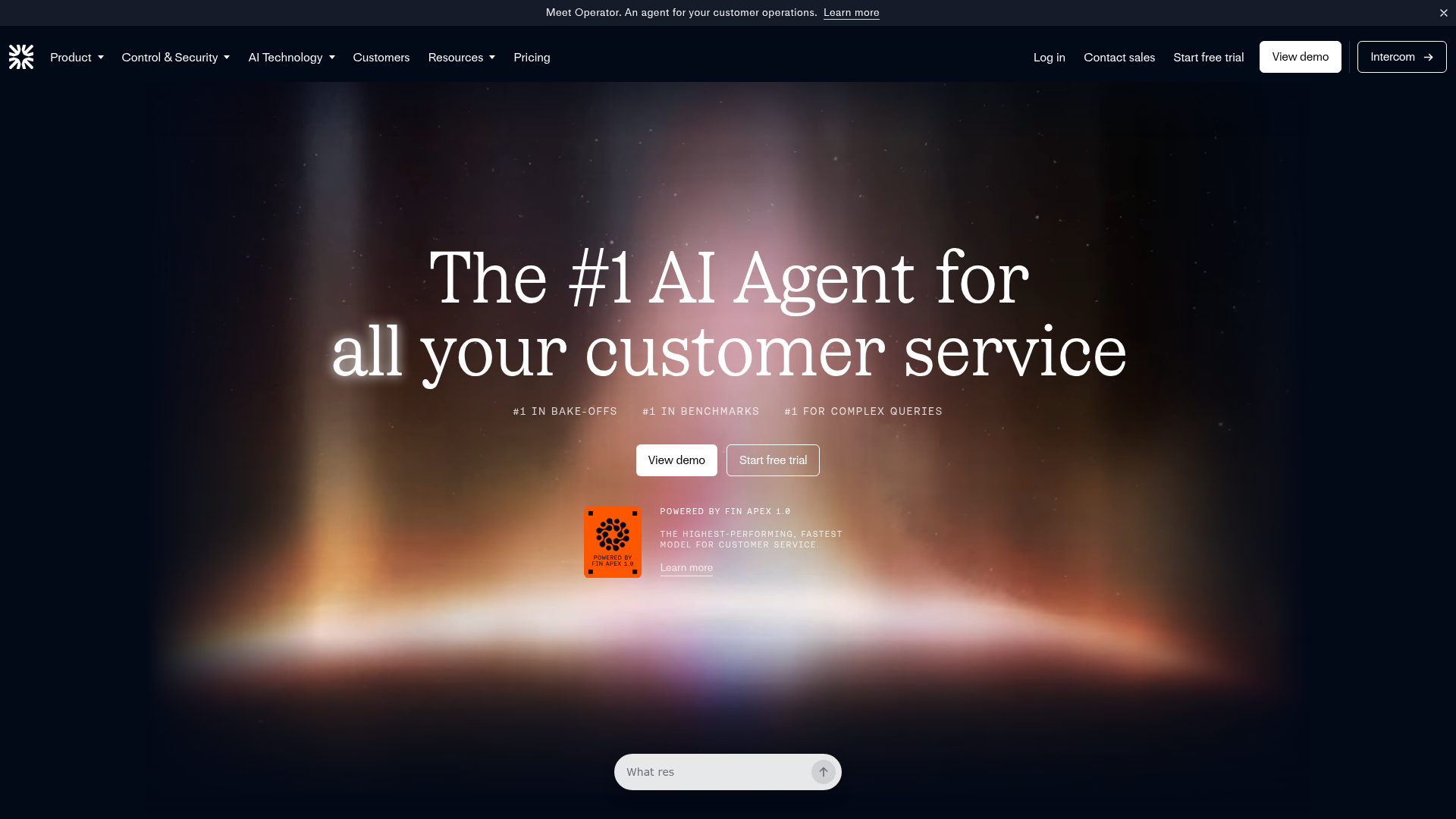
Fin is the cleanest pricing model in the category, and clean pricing is worth more than a marginally better model.
The number is one number. You pay $0.99 when Fin produces an outcome, you pay nothing when it does not, and there are no per-seat fees if you point Fin at a helpdesk you already run. Intercom reports an average resolution rate of 67% across more than 7,000 customers, improving roughly one point a month. That rate is published, which alone puts Intercom ahead of most of this list, because you cannot price a per-resolution tool without it.
Run the multiplication before you start the trial. At a 67% resolution rate on 4,000 monthly conversations, Fin bills 2,680 outcomes at $0.99, so $2,653 a month. The same volume handled by humans at the operator benchmark of $15 a resolution would cost roughly $40,000. The AI math wins by an order of magnitude on the resolved portion, and the only real decision is whether 33% of tickets bouncing to your team is acceptable service.
The honest catch is the definition of outcome. Fin counts a procedure handoff to a human as a billable $0.99, so a conversation the AI escalated still hits the invoice. That is fair, since Fin did the triage work, but budget for it. Your effective cost per genuine resolution is a few cents above the sticker. Intercom is the rare vendor that documents this plainly instead of burying it, which is why it still ranks first.
If you operate in a bilingual market, the language coverage matters as much as the price. I weighed Fin against a sovereign Arabic support stack in the Falcon H1 bilingual support comparison, and Fin held up on English-first volume while losing ground on regional nuance.
- One flat $0.99 per outcome, the easiest number in the category to forecast.
- No seat fees and no platform charge when deployed on an existing helpdesk.
- A published 67% resolution rate across 7,000-plus customers, improving about a point monthly.
- Works on top of Zendesk, Salesforce, or your current stack without a rip-and-replace.
- A procedure handoff to a human still bills the full $0.99.
- The 50-resolution monthly minimum is a small floor for very low-volume teams.
- Adding Intercom's own helpdesk adds $29 per seat per month on top of the per-resolution fee.
- At very high volume, $0.99 compounds faster than HubSpot's $0.50.
Pricing in full: $0.99 per resolved outcome with a 50-resolution monthly minimum, which is a $49.50 practical floor. No seat fees standalone. If you want Intercom's helpdesk underneath Fin, that starts at $29 per seat per month. G2 rates Intercom 4.5 out of 5 across more than 3,000 reviews. The verdict: if you cannot decide, buy Fin, because you will never be surprised by the bill.
2. HubSpot Breeze Customer Agent: best value if you already run HubSpot
- Best for: teams whose CRM, marketing, and service already live in HubSpot
- Standout: roughly $0.50 per resolved conversation, the lowest credible per-resolution rate on this list
- Pricing: 50 HubSpot credits per resolved conversation, on top of a Service Hub plan
- Free trial: free Service Hub tier for up to 2 users
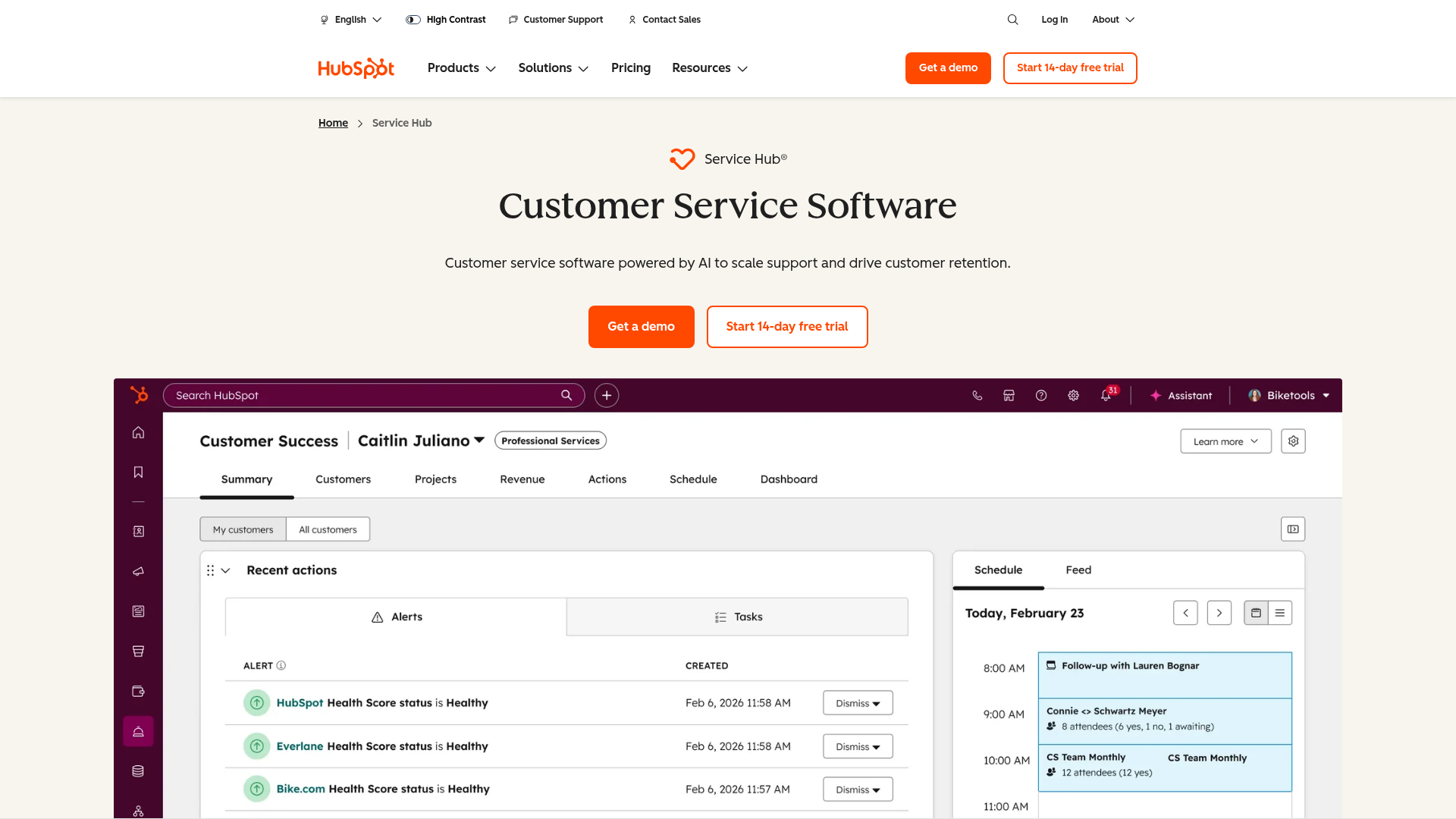
Breeze is the cheapest per-resolution rate any mainstream vendor will quote you, and if your business already runs on HubSpot it is close to a default.
The mechanics: Breeze Customer Agent charges 50 HubSpot credits per resolved conversation, which lands at roughly $0.50 once you price the credit pool. That is half of Intercom Fin and a third of Zendesk. The agent sits natively on HubSpot's customer data, so it answers with full context on the contact, the deal, and the ticket history without a separate integration project.
The catch is the credit pool, and it is a real one. Breeze does not bill you cleanly per resolution like Fin. It draws from a shared HubSpot credit balance that also feeds other Breeze features, so a busy month of AI usage elsewhere in HubSpot quietly shortens your support runway.
The $0.50 is accurate only if you account for the pool as one budget. I walked the full break-even in the HubSpot Breeze outcome-pricing analysis, and the short version is that the vendor-defined credit unit is the thing to model, not the headline rate.
The other cost is the platform underneath. Breeze needs a Service Hub plan, and Professional runs $90 per seat per month with a one-time $1,500 onboarding fee. For a team already paying that, Breeze is nearly free margin. For a team buying HubSpot solely to get Breeze, the real entry cost is several thousand dollars before the first resolution.
Model it honestly. A team already on Service Hub Professional, five seats at $90, pays $450 a month for a platform it would keep regardless. Layer Breeze on 1,000 resolved conversations and the AI adds roughly $500. A $950 all-in for five seats and a thousand resolutions is among the best totals on this list, but only because the $450 was already a sunk cost. Re-run that math with the platform counted as a new expense, plus the $1,500 onboarding, and Breeze loses to Intercom Fin inside the first year.
- Roughly $0.50 per resolved conversation, the lowest credible per-resolution rate here.
- Native access to HubSpot CRM data, so answers carry full customer context.
- No separate integration build if you already run HubSpot.
- HubSpot reports faster ticket resolution for teams using the customer agent.
- Billed from a shared credit pool, not a clean per-resolution line, so the $0.50 needs active budgeting.
- Requires a paid Service Hub plan, $90 per seat per month at Professional plus $1,500 onboarding.
- Poor value if you are not already a HubSpot shop.
- Resolution rate is reported around 65%, slightly below Intercom's published figure.
Pricing in full: Service Hub is free for up to 2 users, $20 per seat per month at Starter, $90 at Professional plus $1,500 onboarding, and $150 at Enterprise plus $3,500 onboarding. Breeze Customer Agent adds 50 credits, about $0.50, per resolved conversation. G2 rates HubSpot Service Hub 4.4 out of 5 across more than 2,000 reviews. The verdict: if HubSpot already runs your business, Breeze is the best-value resolution on the market. If it does not, the platform cost erases the rate advantage.
3. Zendesk AI agents: best for established support organizations
- Best for: support teams already on Zendesk that need depth, channels, and governance
- Standout: double-verified resolutions trained on roughly 20 billion ticket interactions
- Pricing: $1.50 per automated resolution committed, $2.00 pay-as-you-go, on top of a Suite plan
- Free trial: 14 days
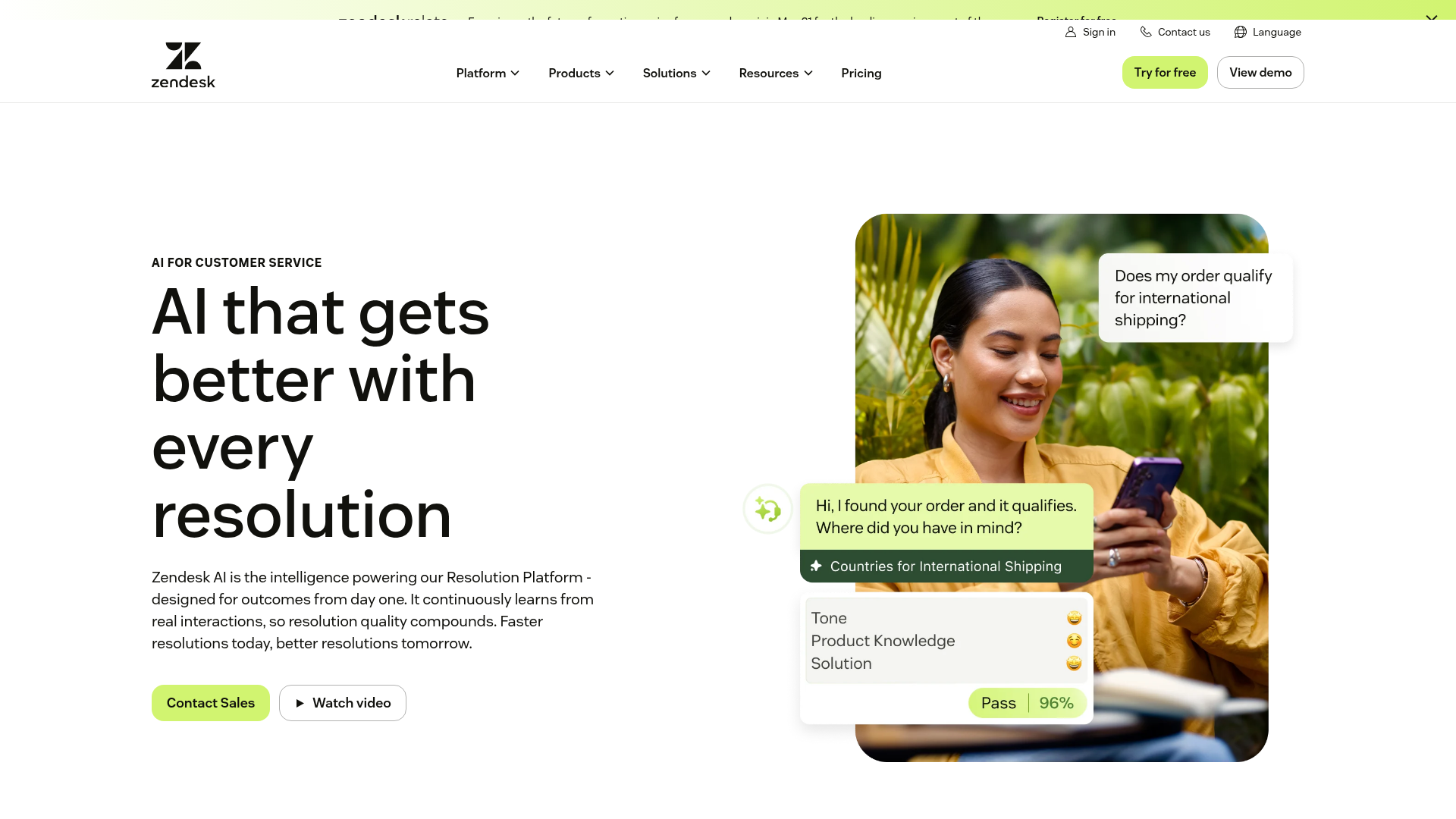
Zendesk is the most expensive per-resolution rate on this list, and for a large, mature support organization it is still the right buy.
At Relate 2026, Zendesk rebuilt its AI agents around outcome-based pricing and announced it through a press cycle covered widely, including CMSWire's report on the autonomous workforce launch. The rate is $1.50 per automated resolution on a committed plan, $2.00 if you pay as you go. That is steep next to Fin's $0.99 and triple HubSpot's $0.50.
What you buy for the premium is verification and scale. Every resolution Zendesk charges for is confirmed twice, first by the agent that resolved it and again by a separate evaluation model, so you are billed on checked work rather than the agent's own claim. The agents are trained on roughly 20 billion ticket interactions and run across messaging, email, and voice as one system. For a support org with strict QA, audit, and channel requirements, that double-verification is the feature that justifies the rate.
The cost stack is the problem for everyone else. The $1.50 resolution fee sits on top of a Suite plan, where Suite Team is $55 per agent per month and Suite Professional is $115. Advanced AI capabilities historically carry a further $50 per agent per month add-on. A ten-agent team is paying well over $1,000 in seats before a single AI resolution is billed. Zendesk bundling AI into the base plan echoes the move I covered when CallRail folded conversation intelligence into every tier, except Zendesk kept the premium attached.
- Double-verified resolutions, billed only on confirmed work.
- Trained on roughly 20 billion ticket interactions, strong on complex and multi-step issues.
- One agent across messaging, email, and voice, with mature reporting and QA.
- Outcome-based pricing means a failed conversation costs nothing.
- $1.50 to $2.00 per resolution is the highest self-serve rate here.
- The resolution fee sits on top of $55 to $115 per agent per month in seats.
- Advanced AI has historically carried a further $50 per agent per month add-on.
- Total cost of ownership is hard to forecast across base, add-on, and usage layers.
Pricing in full: Zendesk Support Team is $19 per agent per month, Suite Team $55, Suite Professional $115, all billed annually. AI agents are outcome-priced at $1.50 per automated resolution committed or $2.00 pay-as-you-go. G2 rates the Zendesk Suite 4.3 out of 5 across more than 6,000 reviews. The verdict: the right call for a large, established support org that needs verification and governance, an overbuy for anyone else.
4. Gorgias: best for Shopify and e-commerce stores
- Best for: Shopify and e-commerce brands that need order-aware support
- Standout: unlimited user seats and a flat per-resolved-conversation AI rate
- Pricing: $0.90 to $1.00 per resolved conversation, on top of a ticket-based plan
- Free trial: free trial available
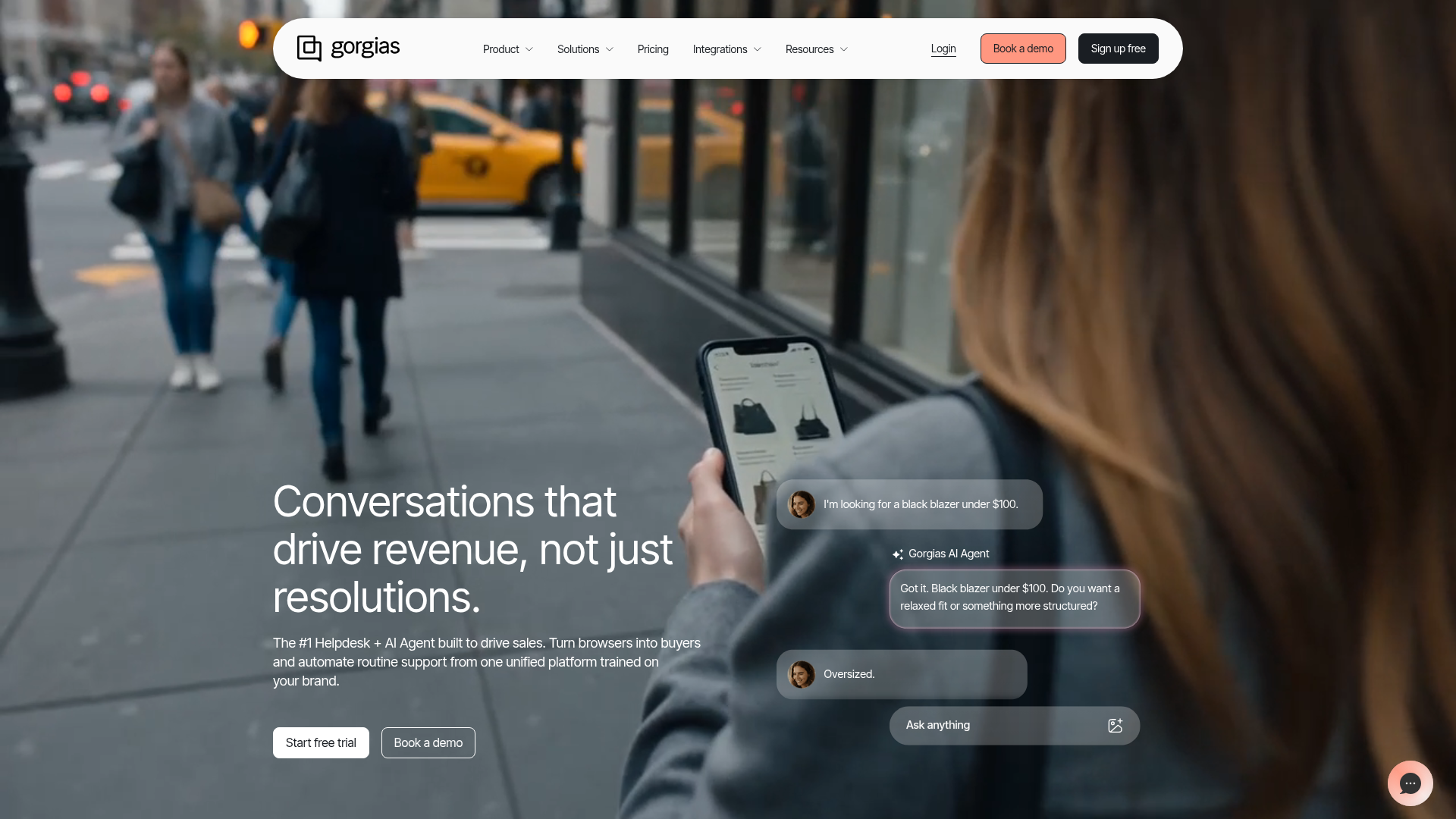
Gorgias is built for stores, and if you sell on Shopify it is the only tool here that understands an order without a custom integration.
The AI agent resolves order-status, return, and where-is-my-package tickets directly against your store data. It charges $1.00 per resolved conversation on the Starter plan and $0.90 on Basic and above, and Gorgias is explicit that you pay only for fully automated interactions. That is a true per-resolution model, with the rate sitting between Fin and Zendesk.
The structural advantage is seats. Gorgias does not charge per agent at all. Every plan is unlimited users, and the base plan is priced on ticket volume instead: $10 a month for 50 tickets at Starter, $50 for 300 at Basic, $300 for 2,000 at Pro, $750 for 5,000 at Advanced. For a store with a lean team handling seasonal spikes, unlimited seats removes the exact cost that makes Zendesk expensive.
The limit is focus. Gorgias is e-commerce software. If you run a SaaS product, a B2B service, or anything without an order object, you are buying a tool whose best features do not apply, and a general-purpose agent like Fin will serve you better. The base plan is also a metered ticket bucket, so overage tickets bill at $0.36 to $0.40 per hundred on top of the AI resolution fee. Two meters run at once, and you should model both.
Price a real store. A Shopify brand on the Pro plan pays $300 a month for a 2,000-ticket bucket. If the AI agent resolves 1,200 of those tickets at $0.90, that adds $1,080 in resolution fees, for a $1,380 monthly total with unlimited seats included. The same 1,200 resolutions on Zendesk would cost $1,800 in AI fees alone, before a single $55 seat. For a lean store with seasonal staffing, the seatless structure is the saving, and it grows every time you add a person.
- Unlimited user seats on every plan, no per-agent cost.
- AI agent resolves order, return, and shipping tickets against live store data.
- True per-resolution billing at $0.90 to $1.00, you pay only on full automation.
- Deep, native Shopify integration with no custom build.
- E-commerce only, weak fit for SaaS or B2B service.
- The base plan is a metered ticket bucket, so overage tickets bill separately from AI resolutions.
- $0.90 to $1.00 per resolution is mid-to-high for the category.
- Ticket-volume tiers can force a plan jump during seasonal spikes.
Pricing in full: Starter $10 a month for 50 tickets, Basic $50 for 300, Pro $300 for 2,000, Advanced $750 for 5,000, Enterprise custom. AI agent at $1.00 per resolved conversation on Starter, $0.90 on Basic and above. Unlimited users on all plans. G2 rates Gorgias 4.6 out of 5 across more than 500 reviews. The verdict: the default for a Shopify store, irrelevant for anyone not selling physical products.
5. Help Scout: best for small teams that want it simple
- Best for: small support teams that want a buyer-friendly resolution definition
- Standout: a resolution does not count, and does not bill, if the customer asks for a human
- Pricing: $0.75 per AI resolution, plus $25 to $75 per user per month
- Free trial: 15-day plan trial plus 3 months of unlimited AI resolutions
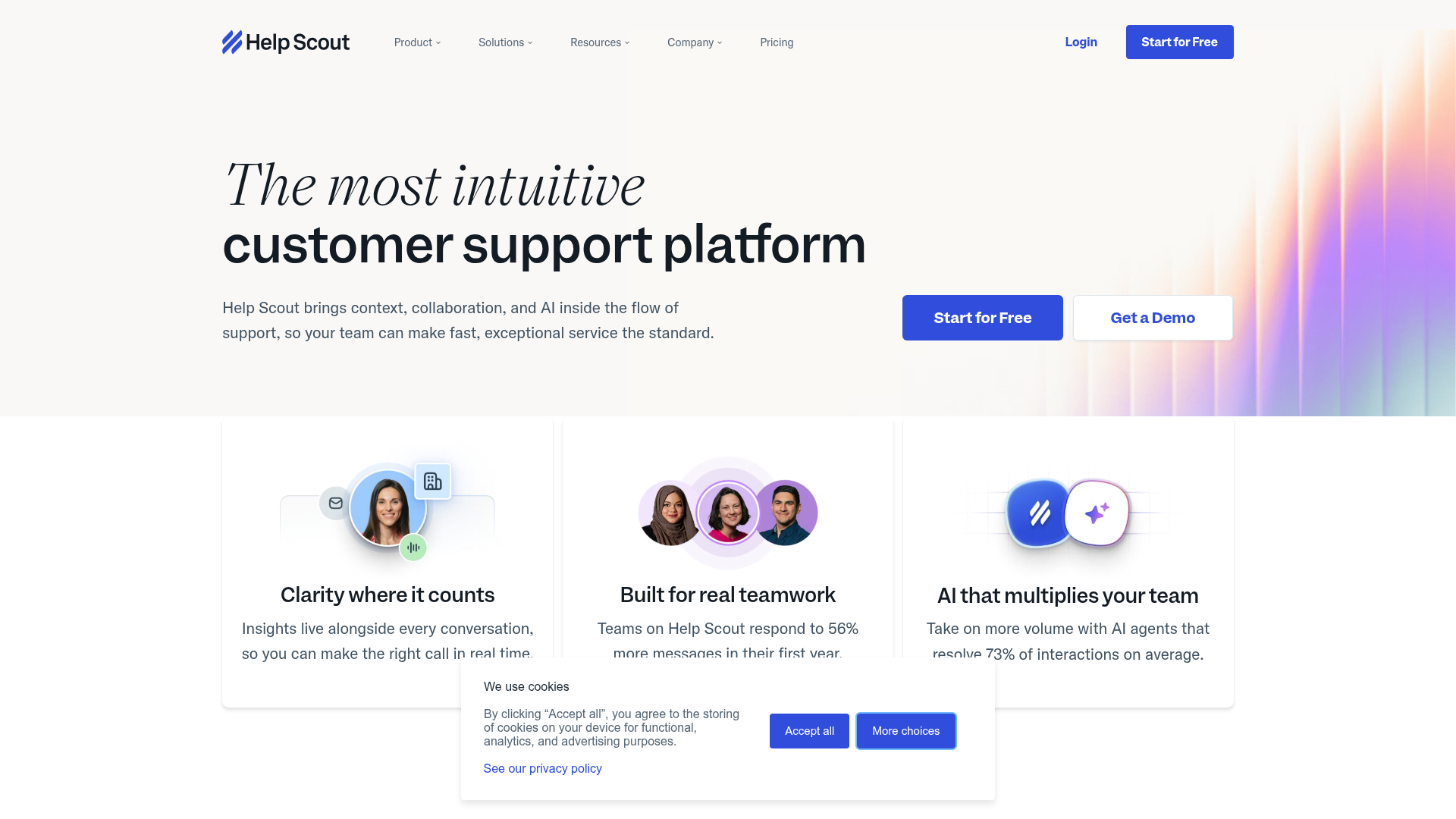
Help Scout writes the resolution definition in the buyer's favor, and that is rare enough to carry the whole recommendation.
AI Answers charges $0.75 per resolution, between HubSpot and Intercom on rate. The difference is what counts as a resolution. Help Scout bills only when the customer receives an AI answer and then does not escalate, search the knowledge base, ask a follow-up, or click "I still need help." If the customer pushes back at all, the resolution does not count and you are not charged. After the per-resolution camp's usual generosity toward the vendor, that asymmetry is genuinely unusual.
Two more buyer-side features back it up. You can set a hard monthly cap on AI spend, and when you hit it AI Answers switches off until the next cycle, so the bill cannot run away. And new accounts get three full months of unlimited AI resolutions free, which is enough runway to measure the real resolution rate on your own ticket data before a dollar is committed. Help Scout cites a 73% average resolution rate, the highest published figure on this list.
The trade-off is the seat fee. Help Scout still charges per user, $25 a month at Standard, $45 at Plus, $75 at Pro, so the AI rate is not the whole bill. For a small team that is fine, since a five-seat Standard plan is $125 plus usage. For a large org the per-seat layer scales the wrong way, and a seatless model like Fin or Gorgias wins.
- A genuinely buyer-friendly resolution definition, no charge if the customer escalates.
- Hard monthly spend cap that disables AI when hit, so the bill cannot surprise you.
- Three months of unlimited free AI resolutions to measure your real rate first.
- A published 73% average resolution rate, the highest on this list.
- Still charges per user seat, $25 to $75 per month, on top of AI usage.
- The per-seat layer scales poorly for large teams.
- Lighter on advanced automation and voice than Zendesk.
- Best fit is capped at small and mid-size teams.
Pricing in full: Free plan for 5 users with one inbox, Standard $25 per user per month, Plus $45, Pro $75. AI Answers at $0.75 per resolution, with a 3-month unlimited free trial on signup and a configurable spend cap. G2 rates Help Scout 4.4 out of 5 across more than 400 reviews. The verdict: the safest pick for a small team, because the contract is written so the bill cannot ambush you.
6. Tidio (Lyro): best free starting point
- Best for: small businesses testing an AI agent before committing budget
- Standout: 50 free Lyro AI conversations every month, on every account, forever
- Pricing: Lyro AI Agent from $39 a month for 50 conversations, scaling to $289 for 500
- Free trial: 7-day full trial plus the permanent free tier
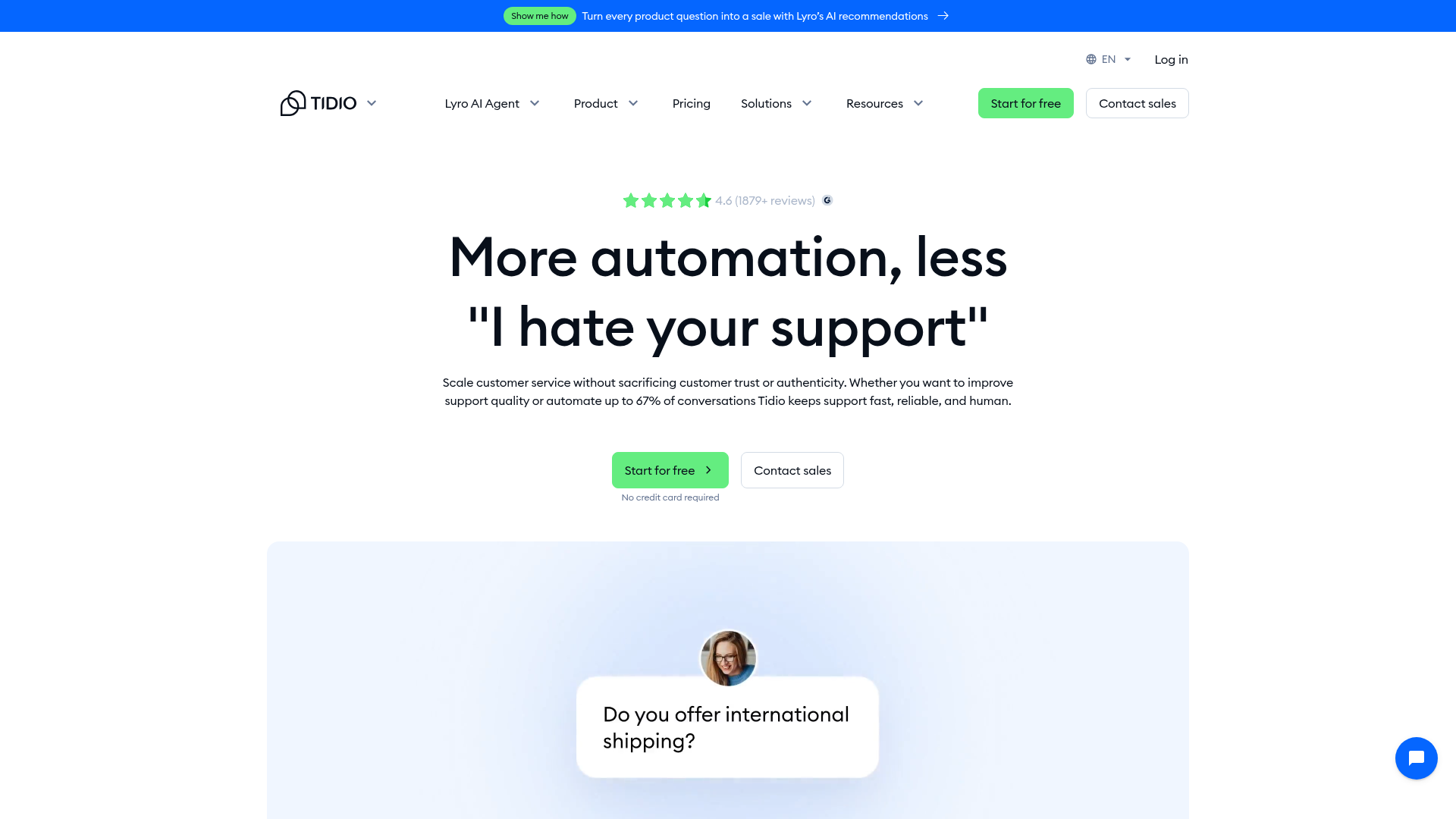
Tidio is the easiest way to find out whether an AI agent works on your tickets without spending anything, and that is exactly what it is for.
Every Tidio account, including the free one, includes 50 Lyro AI conversations a month at no cost. That is a real test budget. You can connect Lyro to your site, point it at your help content, and watch 50 live conversations resolve or fail before you decide. For a small store or a solo operator, that removes the entire risk of the first purchase.
The honest problem is the billing unit once you scale past free. Lyro bills per conversation, not per resolution. The Lyro AI Agent plan starts at $39 a month for 50 conversations and runs to $289 for 500, which is roughly $0.58 to $0.78 per conversation. A conversation counts whether or not Lyro solves it. Apply the tax: at a 60% resolution rate, that $0.78 conversation is a real $1.30 per resolution, the highest self-serve number in this comparison. Tidio is cheap to start and expensive to scale.
The structure adds friction too. Lyro is billed on top of a base Tidio plan, and the base Customer Service plans run $29 to $59 a month before the AI line. The interface is genuinely friendly and the setup is fast, which is the whole appeal for a non-technical owner. But the moment your volume is serious, the per-conversation tax makes a true per-resolution tool the cheaper home.
- 50 free Lyro AI conversations a month on every account, a real no-cost test.
- Fast, non-technical setup, friendly interface.
- 7-day full-feature trial with no credit card required.
- Strong fit for small stores and solo operators getting started.
- Lyro bills per conversation, not per resolution, so you pay for failures.
- Real cost per resolution near $1.30 at a 60% resolution rate, the highest self-serve figure here.
- Lyro is billed on top of a $29 to $59 base plan.
- Built for small business, thin for complex or high-volume support.
Pricing in full: Free plan with 50 Lyro conversations a month. Customer Service base plans roughly $29 to $59 a month, Plus from $749. Lyro AI Agent from $39 a month for 50 conversations to $289 for 500. G2 rates Tidio 4.7 out of 5 across more than 1,500 reviews. The verdict: the best place to start and the wrong place to scale, use the free 50 to learn your resolution rate, then move the volume.
7. Freshdesk (Freddy AI): best budget omnichannel
- Best for: budget-conscious teams that need email, chat, and social in one tool
- Standout: $29 per agent omnichannel support with the lowest per-unit AI rate here
- Pricing: $0.49 per Freddy AI session after 500 free, plus $29 per agent per month
- Free trial: 14 days on the Enterprise plan
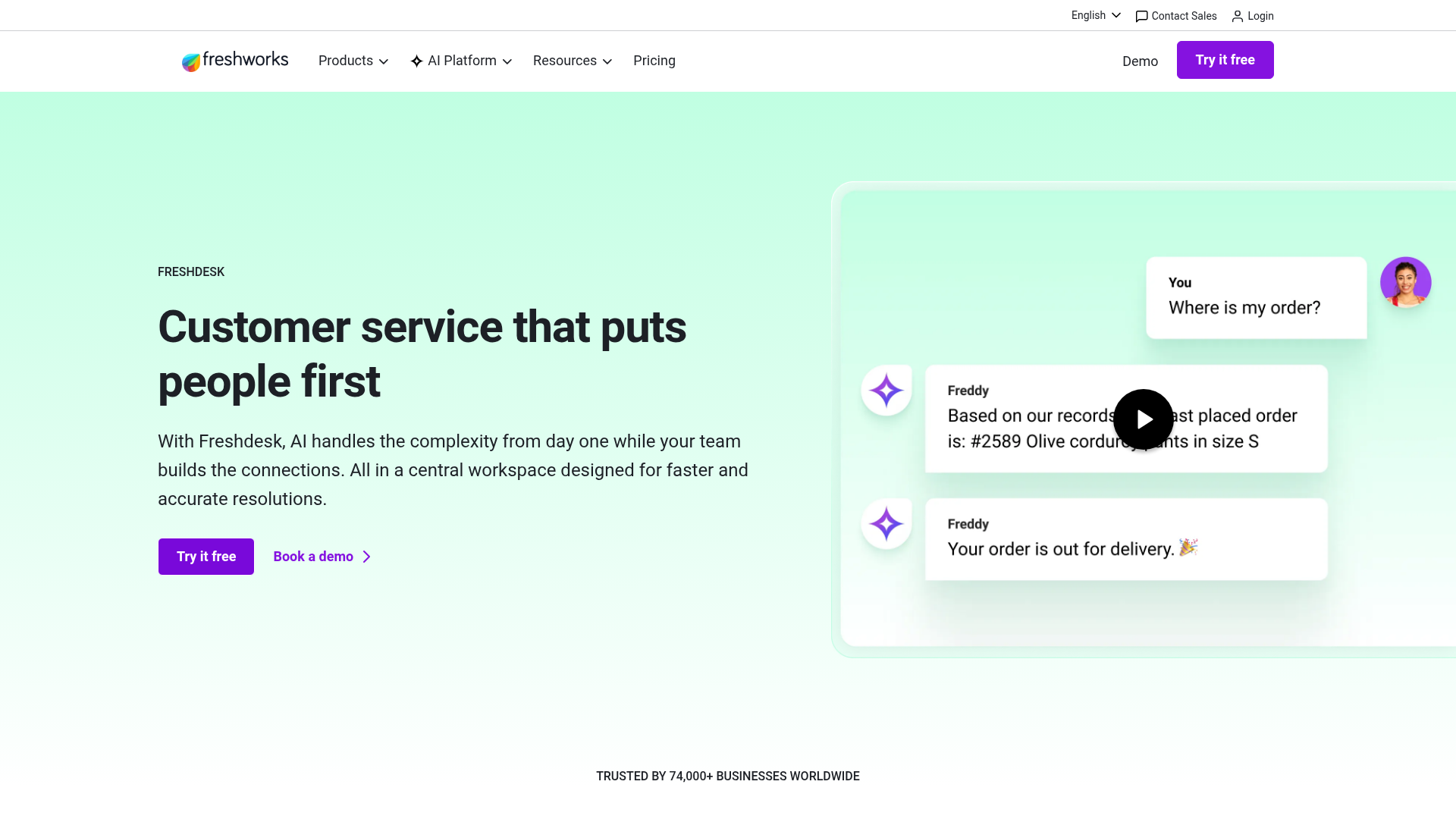
Freshdesk is the budget omnichannel option, and Freddy AI carries the lowest per-unit AI rate in the comparison, with one asterisk.
The base value is real. Freshdesk Omni starts at $29 per agent per month billed annually and covers ticketing, email, chat, SMS, and messaging in a single tool. For a small team that wants every channel without an enterprise contract, that is a strong floor. Freddy AI Agent sessions are included free for the first 500 on Pro and Enterprise plans, then bill at $49 per 100, which is $0.49 a session.
The asterisk is the word session. Freddy bills per session, not per resolution, so it is a per-conversation model in the same camp as Tidio and eesel. The $0.49 is the lowest unit price on this list, but apply the tax: at a 60% resolution rate the real cost per resolution is about $0.82. That is still competitive, below Intercom and well below Zendesk, so Freshdesk survives the tax better than Tidio does because its sticker starts so low.
The trade-off is depth. Freshdesk's AI is solid on common tier-one tickets and weaker on the multi-step, context-heavy cases that Zendesk's 20-billion-interaction training handles. You are buying breadth of channel and a low price, not the strongest agent. For a team whose tickets are mostly routine, that is the correct trade. For complex support, it is not.
Run the budget. A six-agent team on Freshdesk Omni pays roughly $174 a month in seats. Add 2,000 Freddy sessions past the free 500, which is 1,500 billable sessions at $0.49, or $735. The $909 all-in covers every channel and a competent tier-one agent. That is one of the lowest total figures on this list, and the reason is the $29 seat, not the AI line. Freshdesk wins on the base plan and merely keeps pace on the agent.
- $29 per agent per month for genuine omnichannel coverage.
- $0.49 per Freddy AI session, the lowest per-unit AI price here.
- 500 free Freddy sessions on Pro and Enterprise to test before paying.
- Mature, established platform with broad integrations.
- Freddy bills per session, not per resolution, so failures are on your invoice.
- Real cost per resolution near $0.82 once the tax is applied.
- The AI is weaker on complex, multi-step tickets than Zendesk.
- Still a per-agent seat model on top of session billing.
Pricing in full: Freshdesk Omni from $29 per agent per month billed annually, higher Pro and Enterprise tiers above that. Freddy AI Agent, first 500 sessions free on Pro and Enterprise, then $49 per 100 sessions, or $0.49 each. G2 rates Freshdesk 4.4 out of 5 across more than 3,000 reviews. The verdict: the budget pick for routine, multi-channel support, the wrong pick if your tickets are hard.
8. Crisp: best for a predictable flat bill
- Best for: small teams that want a fixed monthly cost with no usage surprises
- Standout: flat per-workspace pricing, no per-seat fee and no per-resolution meter
- Pricing: $0 to $295 a month per workspace, with cheap bundled AI credits
- Free trial: 14 days
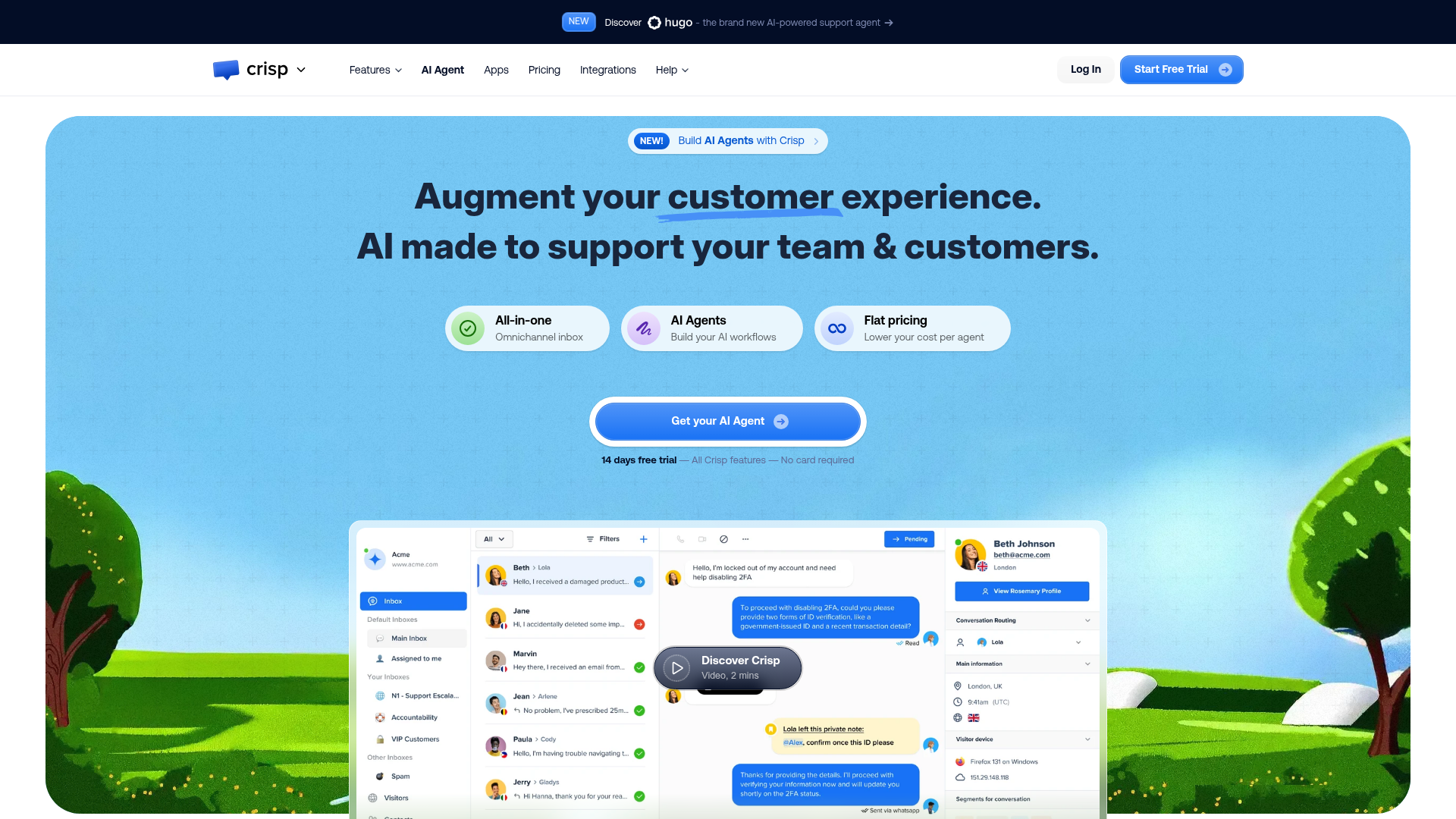
Crisp is the one tool here that refuses the meter, and for a certain kind of operator that refusal is the entire value.
Crisp prices a flat rate per workspace. The Free plan covers 2 agents, Mini is $45 a month for 4, Essentials is $95 for 10, and Plus is $295 for 20 or more with extra seats at $10 each. There is no per-seat scaling and, critically, no per-resolution meter.
Crisp says plainly that it will not bill on consumption the way every other vendor does. The AI runs on bundled credits, roughly $5 of credit covering about 90 automated conversations on Mini and $25 covering about 450 on Essentials, which works out to roughly $0.06 per automated conversation.
That is by far the cheapest AI unit on this list, and it is fixed. If you value a bill you can predict to the dollar 12 months out, no other tool here gives you that. For a small team or an agency managing a fixed client retainer, a flat cost is worth more than a marginally smarter agent.
The trade-off is the agent itself. Crisp's AI is competent on FAQ-style deflection and weaker than Fin, Zendesk, or Decagon on anything that needs reasoning across a customer's history. The credit pool is small, so a busy month exhausts it and the AI quiets down until the next cycle or a top-up. You are buying predictability and a low ceiling, not raw resolution power. Know which one you actually need before you sign.
Put a number on the ceiling. The Essentials plan at $95 a month bundles roughly 450 automated conversations. A team handling 600 support chats a month exhausts that pool before the cycle closes and either tops up or watches the agent go quiet. Crisp is correctly priced for a business with a few hundred conversations a month and a strong preference for a bill that never moves. Push past about 500 a month and the flat model stops being the saving it first looked like.
- Flat per-workspace pricing, no per-seat fee, no per-resolution meter.
- Roughly $0.06 per automated conversation, the cheapest AI unit here.
- A bill you can forecast exactly, ideal for fixed retainers.
- Generous free plan for 2 agents.
- The AI is weaker on complex, reasoning-heavy tickets.
- Bundled credit pools are small and exhaust in a busy month.
- No published resolution rate to price against.
- The flat model caps you, there is no clean path to heavy AI volume.
Pricing in full: Free for 2 agents, Mini $45 a month for 4 agents, Essentials $95 for 10, Plus $295 for 20-plus with extra seats at $10. AI credits bundled, roughly $5 per 90 automated conversations on Mini and $25 per 450 on Essentials. G2 rates Crisp 4.5 out of 5 across more than 100 reviews. The verdict: the right pick when a predictable bill beats a powerful agent, which is more often than the category admits.
9. eesel AI: best for wrapping an existing helpdesk
- Best for: teams that already own a helpdesk and want an AI layer on top
- Standout: simulation against historical tickets before you go live, no platform or seat fee
- Pricing: $0.40 per ticket handled, no minimum, no platform fee
- Free trial: $50 of free usage, no credit card
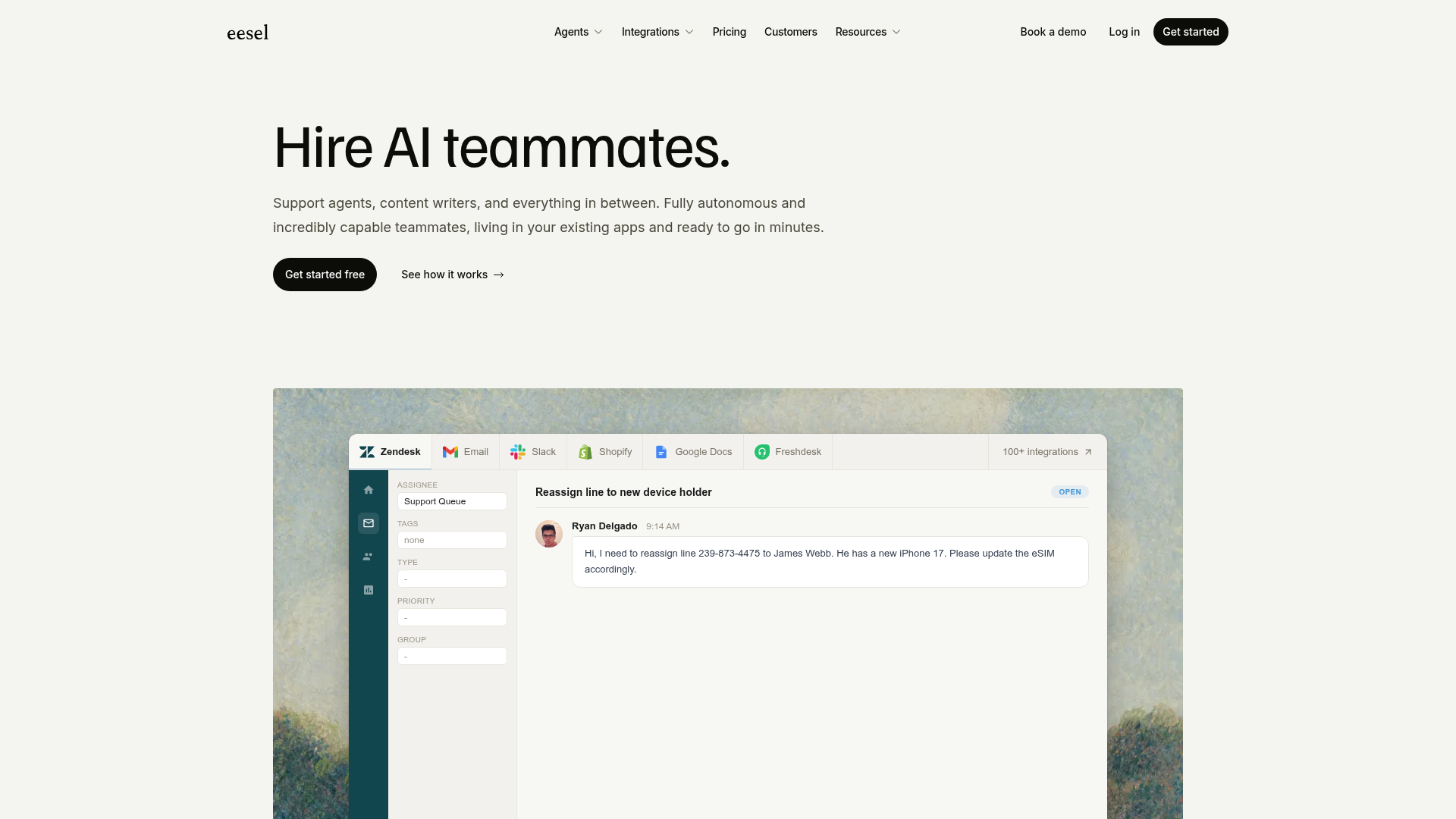
eesel is the wrapper, the tool you add to a helpdesk you already run rather than the helpdesk itself, and it does that one job well.
eesel connects to your existing stack, learns from past tickets and help content, and resolves tickets in place. The pricing is refreshingly plain: $0.40 per ticket the AI handles, no platform fee, no per-seat fee, no minimum. A $50 free usage credit lets you start without a card, and you can set a hard spend cap, default $250, so the bill is bounded from day one.
The standout feature is the simulation: eesel runs the agent against your historical tickets and shows you the projected resolution rate before you route a single live customer. That is the right way to buy a per-unit tool, and almost no one else offers it.
The catch is the billing unit, and it is the same catch as Tidio and Freshdesk. eesel bills $0.40 per ticket handled, not per ticket resolved. You pay whether or not the AI closes it. Apply the tax: at a 57% resolution rate, the real cost is about $0.70 per resolution. Still mid-pack, still reasonable, but not the bargain the $0.40 sticker implies. Use the simulation to learn your real rate, then do the division before you commit.
The other limit is scope. eesel is a layer, not a system. It has no helpdesk, no ticketing UI, no channel management of its own. If you do not already run a support tool, eesel is not your answer. If you do, and you are happy with it, eesel is the lowest-friction way to add a competent AI agent without migrating anything.
- Simulation against historical tickets shows your projected resolution rate before launch.
- $0.40 per ticket handled, no platform fee, no per-seat fee, no minimum.
- $50 free usage with no credit card, plus a configurable hard spend cap.
- Adds AI to an existing helpdesk with no migration.
- Bills per ticket handled, not per resolution, so failures are billed.
- Real cost near $0.70 per resolution once the tax is applied.
- No helpdesk of its own, useless as a standalone tool.
- A thinner, newer review base than the incumbents.
Pricing in full: $0.40 per ticket handled, with light dashboard queries free and heavy tasks billed higher. A $300 monthly annual commitment cuts the rate 25% to about $0.30 a ticket. Enterprise is $1,000 a month. $50 free usage to start, configurable spend cap defaulting to $250. G2 rates eesel AI 4.8 out of 5 across a smaller, newer review base. The verdict: the best way to bolt AI onto a helpdesk you already like, priced honestly, just remember it bills per ticket touched.
The ones to avoid: the enterprise four
Sierra, Ada, Decagon, and Forethought build genuinely excellent AI agents. For nearly everyone reading this, they are still the wrong buy, and the reason is pricing you cannot see.
None of the four publishes a price. There is no pricing page, no calculator, no public per-resolution rate. Every contract is custom-quoted through a sales process, and the public-record numbers are sobering. Vendr deal data puts the annual contracts in a band that runs from roughly $60,000 to $386,000, depending on the vendor and the support volume.
The technology is real. The problem is never the unit. It is the $50,000 platform fee and the six-figure annual minimum sitting underneath it.
Sierra is the most decorated of the four. Founded by Bret Taylor, former co-CEO of Salesforce and chair of OpenAI's board, it runs a true outcome model documented in its own pricing essay, billing only on resolved conversations at roughly $2 to $5 each. The unit rate is fine. The entry is not: annual contracts start near $150,000, setup runs $50,000 to $200,000, and a realistic year-one budget clears $200,000. Sierra is built for brands with a support org large enough to make that math trivial.
Decagon posts the most attractive headline rate of the group. Its resolution-based pricing reportedly reaches as low as $0.50 a resolution at volume, matching HubSpot Breeze. Then you find the floor: a roughly $50,000 annual platform fee regardless of model, and a Vendr median annual contract near $386,000. The $0.50 is real and the $386,000 is also real, and only one of them is on the website.
Ada keeps pricing fully private and bills per conversation rather than per resolution, with reported rates of $1.00 to $3.50 an interaction. Annual platform fees commonly run $150,000 to $300,000 and up, though the Vendr median buyer lands closer to $70,000 a year. The per-conversation unit means the resolution tax applies on top of an enterprise contract, which is the worst of both structures.
Forethought is now part of Zendesk, which agreed to acquire it in March 2026. Its pricing blends a platform fee with committed usage tied to deflection and ticket volume, and the Vendr median sits near $59,500 a year. With the acquisition, a Forethought evaluation is effectively a Zendesk evaluation, so a buyer at that scale should price the two as one decision.
Here is the real avoid rule, and it applies to all four and to any contract you are handed. Do not sign a per-resolution deal where you do not control the definition of resolution. When the rate is custom, the definition is custom too, and a broad definition written by the vendor's legal team turns every ambiguous interaction into a billable event.
The self-serve tools above publish their definitions because they have to compete on a pricing page. The enterprise four negotiate theirs behind an NDA, and that asymmetry is the thing to avoid, not the software.
If you are a true enterprise with a support org of hundreds and a procurement team that can hold its own in that negotiation, these four belong on your shortlist. If you are an operator, an agency, or a growth-stage company running support against a real P&L, the per-resolution math on Fin, Breeze, or Help Scout gets you the same resolved ticket without the six-figure floor.
Frequently asked questions
What is the best AI chatbot for customer service?
For transparent pricing, Intercom Fin at $0.99 per resolved outcome, because you pay one flat number only when it solves the ticket and the resolution rate, 67%, is published. The honest answer is that "best" depends on the billing unit you can forecast. A Shopify store should pick Gorgias, a HubSpot shop should pick Breeze, and a small team that wants a buyer-friendly contract should pick Help Scout.
How much does an AI customer service chatbot cost?
Self-serve AI customer service tools cost $0.40 to $2.00 per resolution or conversation in 2026. True per-resolution tools run $0.50 to $1.50, and per-conversation tools advertise lower stickers that rise once you account for failed conversations. Enterprise platforms like Sierra, Ada, and Decagon start around $30,000 to $50,000 a year in platform fees, with median annual contracts reaching $386,000.
How are AI chatbots used in customer service?
They resolve tier-one tickets end to end, draft replies for human agents to approve, summarize long conversation threads, detect customer intent, and route urgent cases to the right team. The end-to-end resolution use case is the one vendors now bill on, because it is the one that removes a human cost rather than just assisting one.
How do you set up an AI chatbot for customer service?
Connect your help center articles and past tickets as the knowledge source, run a simulation against historical conversations to see a projected resolution rate, then roll out gradually by routing a small share of live tickets first. Tools like eesel AI run the simulation step before launch, which is the safest way to learn your real resolution rate before you commit budget.
What is good customer service AI?
Good customer service AI has three things: a high verified resolution rate, ideally published and double-checked rather than self-reported, a billing unit you control and can forecast, and an escalation path that does not bill you when the customer asks for a human. A tool that scores well on the first and fails the other two will still surprise you on the invoice.
What is the best AI tool for customer service?
It depends on the stack you already run. For a Shopify store the best tool is Gorgias, for a HubSpot business it is Breeze, for a small team that wants a safe contract it is Help Scout, and for a flat, stack-agnostic number per solved ticket it is Intercom Fin. There is no single winner, only a best fit for your billing tolerance and your data.
Which AI customer service tool should you choose?
The choice routes cleanly off two questions: what stack do you already run, and how hard are your tickets.
If you sell on Shopify, the decision is made. Gorgias understands an order natively, charges nothing per seat, and resolves shipping and return tickets that a general agent would fumble. Pay the $0.90 and move on.
If your business already lives in HubSpot, Breeze is the same kind of default. Roughly $0.50 a resolution against full CRM context, with no integration project, beats every standalone tool on total cost. Just budget the shared credit pool as one line, not the headline rate.
If you run a small team and want to never be ambushed by a bill, Help Scout. The resolution definition is written in your favor, the spend cap is hard, and three free months of AI let you measure before you commit. For a larger established support org with QA and governance needs, Zendesk earns its premium through double-verified resolutions, and nothing else here matches it on audit depth.
If you want one flat, forecastable number and no stack lock-in, Intercom Fin. It runs on top of whatever helpdesk you already have, the $0.99 never moves, and the resolution rate is the most transparent in the category. It is the pick when you cannot decide, which is why it is first.
And if you are still testing whether AI resolves your tickets at all, start free. Tidio's 50 monthly Lyro conversations or eesel's $50 credit and pre-launch simulation will tell you your real resolution rate, and that number, not any vendor's pricing page, is what should drive the purchase. The same instinct pays off across the whole automation stack, the way a tracked ManyChat DM flow exposes the real cost per booked call: measure the outcome first, buy second.
Whatever you choose, set a monthly spend cap before you route a single live ticket, and read the contract clause that defines a resolution before you read the price. The vendor controls that definition. Pricing it is your job, and it is the only job that decides whether the tool pays for itself.
If you want the break-even model I used to price all nine, including the per-resolution tax calculation and the volume thresholds where each tool flips from cheap to expensive, I built it into a free AI business workflow audit checklist. Take it, run your own numbers, and join the newsletter while you are there for the next teardown.
May 21, 2026
More from Growth

9 Best AI CRM Tools in 2026 (and the Agent Tax)
I priced 9 AI CRMs through May 2026 on what the agent layer actually costs once it runs. The seat sticker is the small number now.

10 Best AI Cold Email Tools in 2026 (and the Inbox Tax)
I priced 10 AI cold email tools on what a real outbound setup costs after the inbox tax, plus the cost per positive reply at honest 2026 reply rates.

9 Best AI Copywriting Tools in 2026 (and Why ChatGPT Beat 6 of Them)
I tested 9 AI copywriting tools in 2026 and priced every plan after the repricing. A $20 ChatGPT seat beats 6 of them; 3 still earn the cost.