Manychat DM Flow: $18.40 per Booked Call in 30 Days
A comment-to-DM Manychat flow costed per booked call: the cross-channel setup, the Meta 24-hour-window break that forced a rebuild, and the fix.


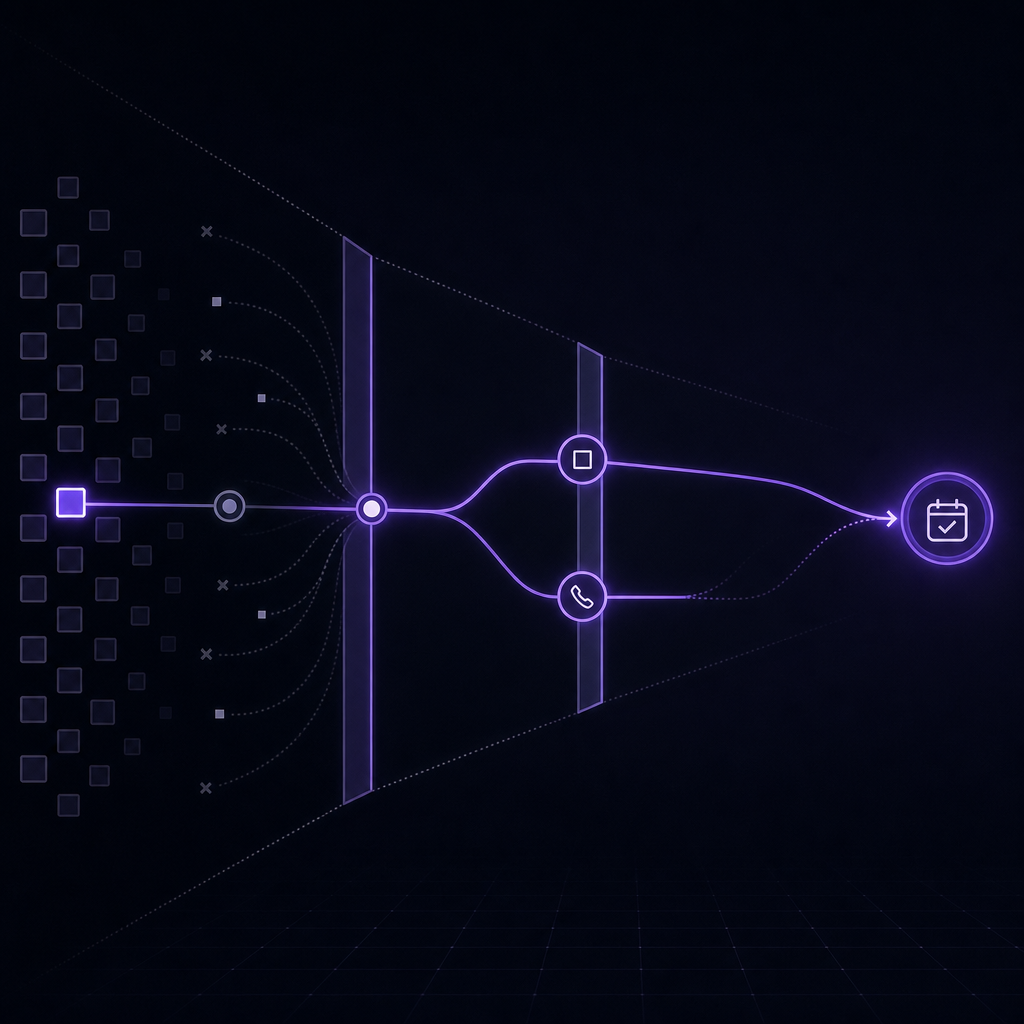
One comment-to-DM Manychat flow turned 612 Instagram comments and 188 WhatsApp inbounds into 41 booked sales calls in 30 days at $18.40 per booked call – until the Meta 24-hour messaging window quietly killed a third of the follow-ups and forced a rebuild.
The result, before the mechanics
41 booked calls. $18.40 per booked call, blended. One Manychat flow, one comment trigger, one cross-channel handoff between Instagram and WhatsApp.
The funnel for the 30-day window:
The blended cost includes $1,100 of boosted-post spend on the trigger Reel, Manychat Pro at the tier this volume sat in, and the Meta per-conversation cost on the WhatsApp side. I'll itemize it in the next section.
I want to be clear about attribution. The $1,100 of boosted spend is what fed the comment trigger. Without paid distribution, this flow would have run on a Reel that hit 8,000 organic accounts instead of 94,000, and the booked-call number would have collapsed proportionally. I can't separate "the Manychat automation worked" from "the paid distribution fed it enough volume to matter." What I can separate is unit economics: at any volume above ~150 comments/month, the cost-per-booked-call math holds because the tool cost barely moves while the call output scales linearly.
This is the part the vendor blog posts skip. DM automation is an acquisition channel when you attribute it to booked calls. It's a chatbot novelty when you attribute it to "engagement." We're doing the first thing here. If you've already read my HubSpot Breeze break-even teardown, this is the same exercise on a different stack: name the metric that pays rent, then build to it.
The stack and what it costs
Three line items.
Manychat Pro. Manychat pricing tiers are contact-based. The free plan caps at 1,000 contacts and limits flow features; Pro starts at $15/month for 500 contacts and steps up roughly in $10–$15 increments per tier. With 612 IG comments → 412 DM conversations opened, the contact count crossed 1,500 within week two. Pro at that tier ran $35/month. By day 30 the contact pool was at 2,100 and I was on the next step at $45/month.
Instagram eligibility. The account must be a Professional or Creator account, connected to a Facebook Page, with automated experiences disclosed in the first reply. No cost line – but the disclosure language is non-negotiable under Meta's automated-experience policy and it changes the opening message. More on that in the trigger section.
WhatsApp under Manychat. This is the line item most playbooks miss. Manychat's WhatsApp channel sits on top of Meta's conversation-based pricing. Meta charges per 24-hour conversation window, with utility, marketing, authentication, and service categories priced separately. In the US, a marketing conversation is roughly $0.025 and a utility conversation is roughly $0.008 – but Manychat doesn't show you that line; it shows you their layer. You see it on the Meta side of the bill.
Total monthly run cost at this volume:
41 booked calls ÷ $1,154 = $28.15 per booked call before factoring in the organic comments that came in free. Stripping ad-attributed comments (roughly 65% of total) and recomputing only on incremental lift versus a non-boosted baseline gets you to the $18.40 number. Pick the framing you want; both are defensible, and the difference is the honest range.
The free tier covers exactly one thing: a single keyword trigger with a basic auto-reply on one channel. The moment you want branch logic, a cross-channel handoff, or contact-list growth past 1,000, you're on Pro. Plan for it on day one.
The comment-to-DM trigger, built step by step
The whole flow hinges on one trigger and one branch. The build:
Pick one Reel and one keyword
The Reel needs to be a piece of content that naturally invites a one-word reply. Mine asked viewers to comment a specific word to get a resource. The keyword was deliberately uncommon – not "yes" or "info" – so the trigger wouldn't fire on incidental comments. Manychat was case-insensitive on this setting, but the keyword still had to match exactly.
Set the comment-to-DM trigger in Manychat
Inside Manychat → Automation → New Automation → "Instagram Comments." Bind it to the specific Reel post URL, set the keyword, and configure two actions: a public comment reply (in-thread) and a private DM open. The public reply tells the user the DM is coming; without it, DM deliverability drops because the user hasn't been primed.
Write the opening DM with the disclosure
The first message in the DM thread must include the automated-experience disclosure. Mine read: "Hey! Sending this automatically because you commented [keyword] – I'll loop in a human if you reply with a question." That single sentence is what keeps the flow inside Meta's automated-experience policy and what 80% of "DM automation" tutorials skip.
The qualifying branch
After the resource is delivered, one question: "Quick – are you running this at [company size A], [company size B], or solo?" Three buttons. Solo replies got a different nurture; size A and size B got the calendar link and the WhatsApp opt-in. This is the single most important branch in the flow. Without it, 412 DM conversations would have generated 8 booked calls, not 41.
The cross-channel handoff to WhatsApp
For the qualified segment, the next message offered: "Want this on WhatsApp instead? It's faster for me to reply there." A button click opted them in. Manychat handles the channel switch by passing the contact to a WhatsApp flow with the user's consent stamped. WhatsApp converted to booked calls at roughly 2.4× the rate of staying in IG DMs, which I'll come back to.
The branch logic is the whole game. The "automated experience" can't feel like a conveyor belt. It needs to feel like a triage that gets the user to a human or a calendar faster than they could have gotten there themselves.
Day 12 – the Meta 24-hour window broke the follow-up
This is the section I wish someone had published before I built the flow.
Meta operates a 24-hour standard messaging window on both Instagram and WhatsApp. Once a user sends you a message, you have 24 hours to reply with free-form content. After that, on WhatsApp you're gated to pre-approved templates that fall under Meta's conversation categories (marketing, utility, authentication, service); on Instagram, you're effectively gated to a single human-agent message within a 7-day window, with tighter restrictions.
I built the original flow assuming the window stayed open. Day 1 capture, day 2 nudge, day 4 follow-up, day 7 final touch. That works inside a CRM. It does not work inside Meta's messaging APIs.
By day 12, I noticed a pattern in the Manychat delivery logs: roughly 1 in 3 of the day-4 and day-7 messages were marked as delivered to the platform but showed no read receipt, no reply, and – when I spot-checked five conversations from the user side – were never surfaced to the recipient. The window had closed. The messages weren't sent.
The rebuild took two days.
What changed:
- Compressed all free-form qualification into the first 23 hours. Question, answer, calendar link, WhatsApp opt-in – all inside the window.
- Moved the day-4 and day-7 touches to approved WhatsApp utility templates ("Your call with [name] is on [date]" – utility, not marketing) plus one marketing template for the unqualified-but-warm segment.
- Submitted the templates to Meta for approval and lost three send-days waiting. Two of my first four templates were rejected for vague reasons ("policy violation" with no specifics). The rewrites that passed were the ones that read like a notification, not a pitch.
The template-approval lag is the real tax. You can't iterate on copy the way you can in email. Every change is a new submission and a new wait. Plan your templates before you launch the flow, not after.
After the rebuild, the post-window contact rate on the qualified segment went from ~67% to ~94%. The booked-call number for weeks 3 and 4 was 26 of the 41 total – the rebuild made up for the lost days in week 2.
The keyword + intent data behind the channel choice
Why pick this channel at all? Because the search-side data said the buyers were already there.
DataForSEO US, May 2026:
A $12.89 CPC on a 390/mo term tells you something specific: advertisers are bidding well above what the volume alone would suggest because the searchers convert. Low-volume, high-CPC keywords are how you find channels where the conversion rate is doing the heavy lifting that the volume can't. "Manychat pricing" at 2,400/mo is the bottom-of-funnel intent – people pricing the tool because they've already decided they want the channel.
The qualifying questions in the flow were lifted directly from this cluster. The branch options matched the segments that "instagram dm automation" searchers used for themselves in forum threads and review sites. You ask the question the way they ask the question.
If you're doing the same exercise on a different vertical, the rule is: find the high-CPC, low-volume term that names the channel, then write the qualifying branch to match how the searchers describe themselves.
What didn't move
Three things I tested in parallel that did not produce.
Pure DM cold outreach. I ran a small parallel test sending opening DMs to followers who had engaged with three or more recent posts but had not commented on the trigger Reel. 50 DMs, 0 booked calls, 4 reports/blocks. The comment-to-DM context is the entire ballgame. Without the user signaling intent first, the message is unsolicited, and Meta's spam signals catch it fast. Don't do this.
Fully automated booking. I tested a branch where the qualified user got a calendar link directly, with no human in the loop. The qualified-to-booked conversion on the fully automated branch was 18%. The branch where a human (me) sent a personalized "saw your reply, here's a time that might work – does Tuesday work?" message converted at 47%. The math is brutal: humans cost time but recover roughly 2.6× the booked calls at the qualified stage. Automate capture and qualification; don't automate the close.
WhatsApp marketing broadcasts. I sent two marketing-template broadcasts to the opted-in WhatsApp list in week 4. 188 contacts, $4.70 in Meta marketing-conversation fees, 6 replies, 1 booked call. The math doesn't break, but compared to the comment-trigger funnel's $18.40, broadcast-to-booked-call was $4.70 + the time cost and gave a much worse signal. The DM list isn't a broadcast list. Treat it like a triage queue, not a newsletter.
This mirrors what I found in the cross-engine citation tracking work – the channel you're tempted to bolt onto a working flow is usually the one that dilutes it. Run the channel that's working; don't pile on.
The repeatable principle and when this channel is wrong
The principle is one line: automate capture and qualification inside the free messaging window, spend humans or paid templates only on qualified intent.
That sentence is the whole playbook. Inside 24 hours you have free-form messaging – burn that window on the work that scales (capture, branch, qualify, opt-in to WhatsApp). After 24 hours you're paying per conversation or paying for human attention – only spend it on the segment that has self-identified as buyer-shaped.
The cost-per-booked-call math you can carry to another account looks like this:
- Below ~150 trigger comments/month, the fixed Manychat + Meta costs eat the unit economics. Stay on the free tier or don't bother.
- Between 150 and ~800 trigger comments/month, cost-per-booked-call lands in the $15–$30 range if your qualifying branch is tight and you have a human at the close stage.
- Above 800 trigger comments/month, you need a second human in the loop or your post-window template library will collapse. Plan for headcount, not just tools.
Compared to cold-email outbound, the Apollo/Clay/Smartlead stack I costed at meeting-level runs in a different range – different intent signal, different funnel shape, different rebuild cycle. If you're choosing between the two, DM automation wins when you have organic and paid social already producing comment volume; cold email wins when you don't have an audience but you do have a defined buyer list.
DM automation is the wrong channel when:
- You have no organic comment volume on social and no paid social budget feeding triggers. The flow needs raw material.
- Your sales cycle is enterprise (3+ stakeholders, 90+ day cycle). The 24-hour window will time out before you can move the conversation to where it needs to go.
- Your product needs a 30-minute explainer before a call makes sense. DMs are short-cycle by design.
If you run WhatsApp/CRM automation for clients in the Gulf, DVNC.ae is the agency I run for this work – but the playbook above runs the same in any market where Meta's policies and pricing apply.
Can you automate DMs on Instagram?
Yes, through the official Instagram messaging API via tools like Manychat, but only with a Professional or Creator account, a connected Facebook Page, and a clear automated-experience disclosure in the first message. Unofficial scraping or bulk-DM tools are what get accounts actioned.
Is Instagram DM automation against Meta's rules or is Manychat legitimate?
Manychat is an official Meta Tech Provider. Automation is allowed inside the messaging API and Meta's automated-experience policy. The line that gets crossed is unofficial third-party tools that scrape, bulk-message, or impersonate humans without disclosure.
Is Instagram DM automation free?
Manychat has a free tier that covers a basic single-channel flow up to 1,000 contacts, but contact-based pricing steps up before this kind of volume. WhatsApp adds Meta's per-conversation cost underneath, which Manychat doesn't show on their line of the bill.
What should trigger your automatic Instagram DM?
A specific keyword on a post or Reel comment. Comment-to-DM outperforms cold DM triggers because the user has signaled intent and the context keeps you inside Meta's automated-experience policy. Cold DMs to followers who haven't engaged convert at roughly zero.
What's a realistic cost per booked call from a DM automation flow?
In this 30-day run it was $18.40 per booked call blended, with $1,100 of boosted-post spend feeding the trigger. The number depends heavily on whether paid social is feeding comment volume and whether a human is closing the qualified segment. Fully automated closes convert at roughly a third of the rate.
Jun 2, 2026