Figma Review (Verified August 2026)
Figma review with current pricing, seat-cost math, four product workflows, hard limitations, and clear alternatives for design teams.
Published Updated
 By Omid Saffari



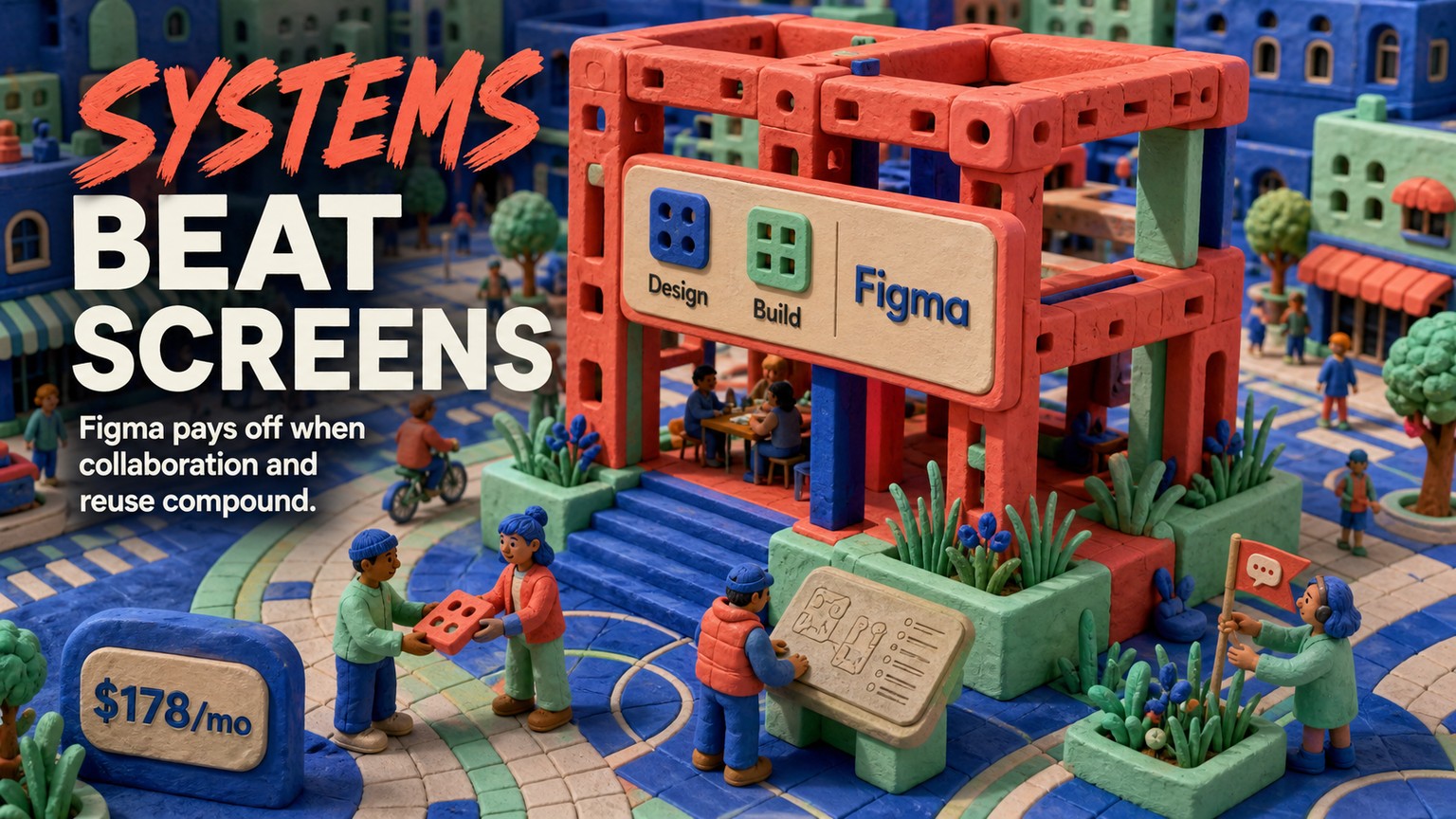
Figma is still worth paying for when design, review, prototyping, and developer handoff happen in the same weekly loop. A representative team with 4 Full, 8 Dev, and 6 Collab seats costs $178 per month on Professional, but the smarter purchase often keeps occasional inspectors on free View seats and saves another $96.
What Figma is
Figma is a cloud-based workspace for designing digital products. Figma Design is the center: designers draw interfaces, build reusable components, manage variables, create prototypes, and share the same file with product managers and developers. Dev Mode packages design information for implementation, FigJam handles whiteboards, Make creates code-backed prototypes from prompts and design context, and Sites publishes websites. The suite is broad, but its defining job is narrower: keep the product interface, its reusable system, its feedback, and its handoff connected. It is a poor substitute for a native offline editor, an open self-hosted stack, or a specialist production website platform when one of those constraints dominates.
Who Figma is for, and who should skip it
Figma is the strongest fit for cross-functional product teams that change the same interface every week. The value compounds when designers reuse a shared system, product managers review live work, and developers repeatedly pull implementation details from the same source.
The purchase turns on four criteria: system reuse, synchronous review, prototype depth, and developer handoff frequency. Figma should own the workflow when at least three recur every week. When only one matters, a narrower product is usually cheaper and easier to govern.
Choose Figma for a product team with one shared system
Figma suits a funded startup, a product group inside a larger company, or an agency delivering interface systems rather than isolated screens. A designer can change the source component, a product manager can comment in context, and an engineer can inspect the same approved layer. That continuity matters more than having another drawing tool.
Professional is the sensible starting tier for one team. It enables unlimited files and folders, team-wide libraries, advanced prototyping, advanced Dev Mode inspection, and the MCP server. Organization becomes relevant when several teams must share libraries, fonts, and admin rules. Enterprise is for a named governance need such as SCIM seat management, custom workspaces, or multi-brand design-system theming and APIs.
The weak fit is a solo designer who exchanges finished exports once a month. That buyer may enjoy Figma, but recurring collaboration is not repaying the subscription. Starter can cover personal drafts; Sketch can be the more durable paid choice if native Mac performance and offline ownership matter.
Choose Sketch when the Mac and offline work are non-negotiable
Sketch is the clearest alternative for a Mac-based designer who wants a native editor and local documents. Standard costs $12 per editor per month billed yearly, while a $120 Mac-only license includes one year of updates and keeps working offline without collaboration features.
That trade is direct. Sketch gives up Figma's browser-first, cross-platform editing model and broad multiplayer adoption in exchange for a native Mac application and a private local workflow. Pick it for a solo product designer who travels without reliable connectivity or whose client policy requires local files. Skip it when Windows editors, frequent stakeholder co-editing, or organization-wide browser access are part of the brief.
Choose Penpot when open standards or self-hosting decide procurement
Penpot is the proportional alternative when ownership and deployment matter more than ecosystem size. Its hosted Professional plan costs $0 for up to 8 team members with unlimited viewers and unlimited design files. Unlimited costs $7 per user per month with a $175 monthly cap, and Penpot also provides a self-host route.
Penpot is the better shortlist entry for a security-conscious technical team that wants inspectable open technology and no proprietary file dependency. Figma still wins when the organization already depends on Figma libraries, community assets, and its connected Design-to-Dev workflow more than hosting control. The decision is not free versus paid. It is open control versus workflow continuity.
Choose Framer when the deliverable is the live website
Framer is more focused when the same person must design and publish a marketing site. Basic costs $10 per month and includes a custom domain plus 2 CMS collections. Pro costs $30 with 10 CMS collections, 100 GB bandwidth, redirects, and staging; additional editors cost $20 per month.
Figma Sites narrows the design-to-publish gap, but it remains a beta product on paid Full seats. Framer is the cleaner choice for a campaign, portfolio, or marketing site where the live result is the work. Figma remains better for application interfaces, reusable product systems, conditional prototypes, and recurring engineering handoff.
Canva belongs on a different branch. It is better for high-volume brand content, presentations, social assets, and template-led marketing production. Figma is better for application states, interface components, responsive rules, and prototypes. The Canva versus Figma comparison handles that boundary directly, while the Figma alternatives guide covers a wider constraint-based shortlist.
The four Figma capabilities that matter
Figma earns the subscription through one connected product workflow. Use a representative evaluation brief: redesign a B2B account-settings area with billing, notification, role, and security screens; support desktop and mobile; include light and dark themes; collect product feedback; and hand the approved states to engineering. The first pass is a group of static screens. The useful result is a governed system that can change without rebuilding every screen.
1. Components, Auto layout, and variables turn screens into a system
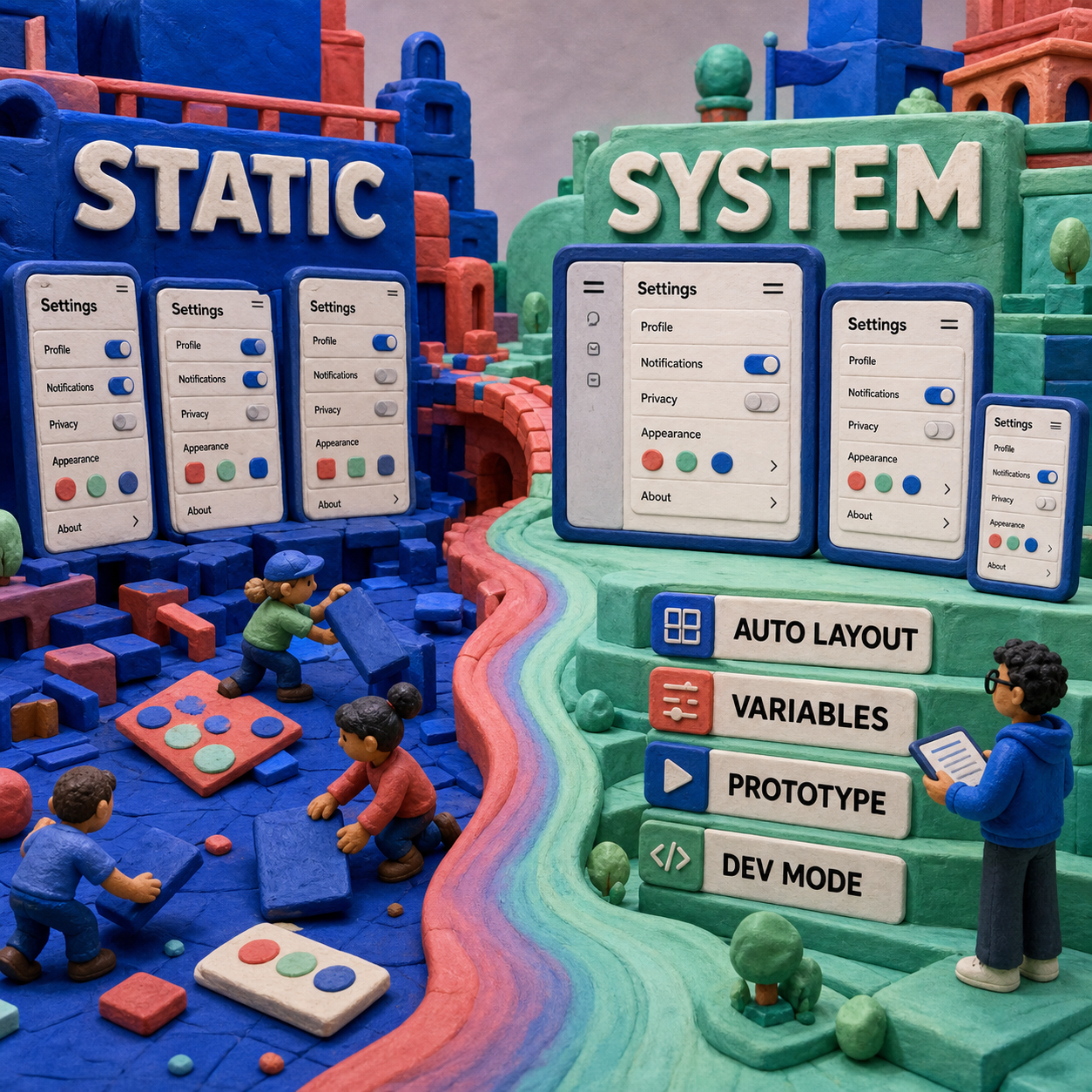
Figma Design matters most when a layout is built to absorb change. Components create reusable interface objects, Auto layout makes frames respond to their contents, and variables store values such as colors and numbers. Modes let one variable collection represent themes or contexts instead of duplicating every screen.
On the settings brief, begin with the smallest repeatable units: field, toggle, alert, navigation item, button, and settings row. Give each component the states the product needs, such as default, hover, disabled, error, and loading. Build the page sections with Auto layout so a longer validation message expands the row instead of colliding with the next element.
Then move color, spacing, radius, and type decisions into variables. Light and dark become modes of the same semantic tokens: surface, text, border, action, danger. A semantic token names the job of a value rather than its literal color, so changing the brand blue does not require finding every blue layer. A designer can update the variable once and review the consequences across every linked component.
This is the before-to-after change that separates system work from screen drawing. Before, the desktop and mobile settings pages contain copied frames, hard-coded colors, and one-off spacing. After, both use the same component set, content drives layout, and theme changes flow through variables. The visual polish may look similar in a screenshot. The after-state is far cheaper to revise.
Professional gives one team shared libraries. Organization adds shared libraries and fonts across unlimited teams, while Enterprise adds multi-brand theming and design-system APIs. That plan distinction should follow the scope of the system. One product team does not need Enterprise because its button library feels important. Several brands with separate token modes, owners, and release rules may.
2. Prototyping makes the behavior reviewable before code
Figma's prototyping surface turns the same settings system into a reviewable interaction. Interactive components cover repeatable behavior, while variables, conditional logic, and expressions support state changes without duplicating a frame for every possibility. The responsive prototype viewer lets reviewers examine the result at different screen sizes.
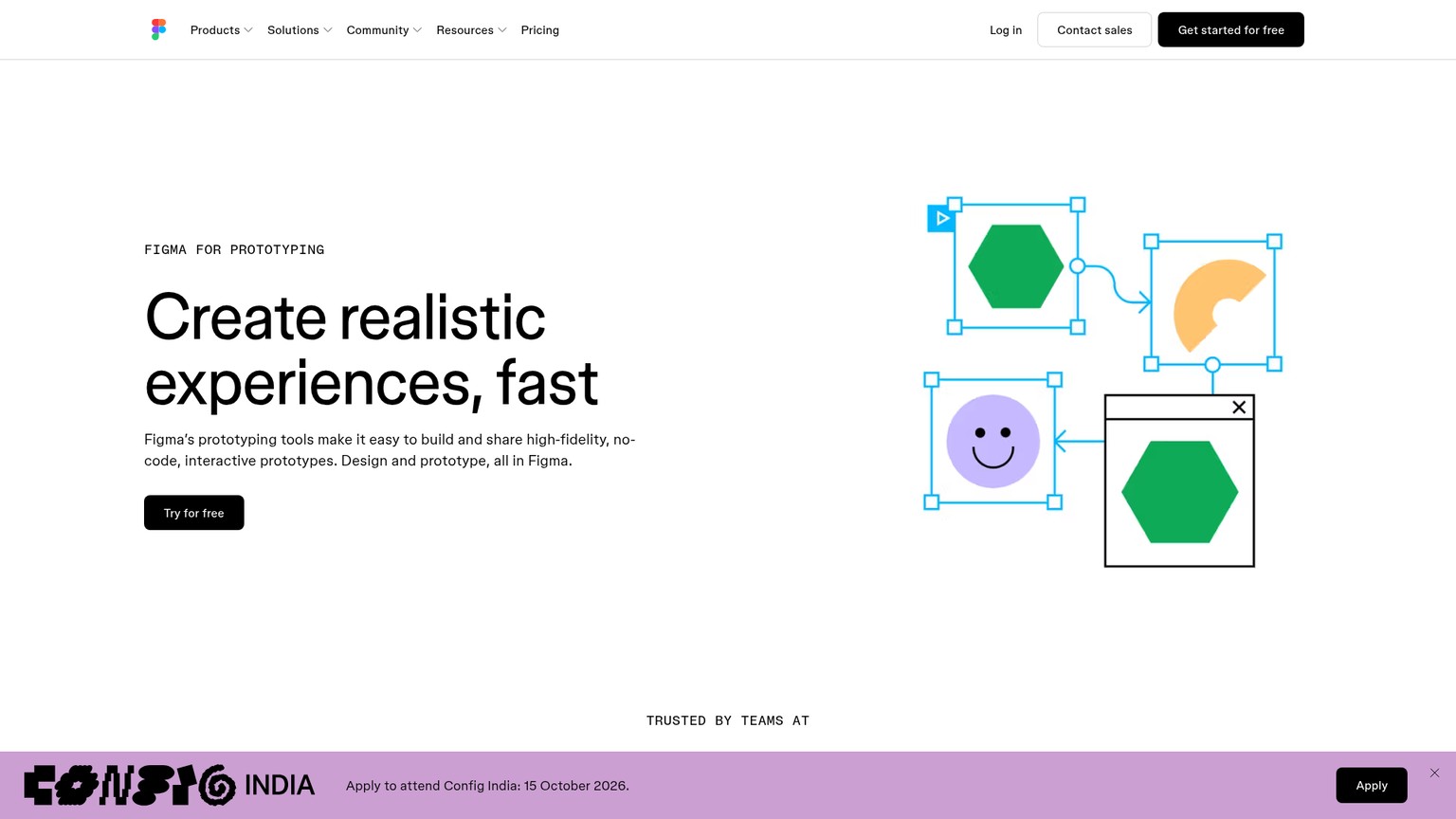
Use the brief's security flow to test the capability. The user selects two-factor authentication, chooses an authentication method, encounters a recovery-code warning, and confirms the change. Build the toggle and selection states into components. Store the chosen method in a variable. Use a condition to show the correct confirmation state and an expression only when the prototype must manipulate a value.
The craft bar is not animation for its own sake. The prototype must answer a product question: can a user understand the consequence, recover from a mistake, and finish the flow on both mobile and desktop? Smart Animate, overlays, video, and spring transitions are useful when they clarify hierarchy or continuity. They are noise when they make an unresolved flow feel finished.
Run the review from a share link and collect comments on the affected state, not in a separate slide deck. Product can challenge copy, research can flag ambiguity, and engineering can identify a state the design system cannot yet represent. Resolve the comments in the file, then mark the agreed section for development. That keeps the reasoning beside the artifact it changes.
Figma's own 2026 report says 29% of designers cite motion design and prototyping among the most in-demand skills. The useful interpretation is not that every screen needs motion. Product teams need designers who can express behavior clearly enough to evaluate it before implementation.
3. Dev Mode is valuable only when free inspection is not enough
Figma Dev Mode earns a paid seat when engineering uses the file as an active implementation surface. It provides advanced inspection, code snippets, component properties, structured layer data, annotations, code syntax for variables, and links from layers to GitHub files, Jira tickets, and Storybook stories.
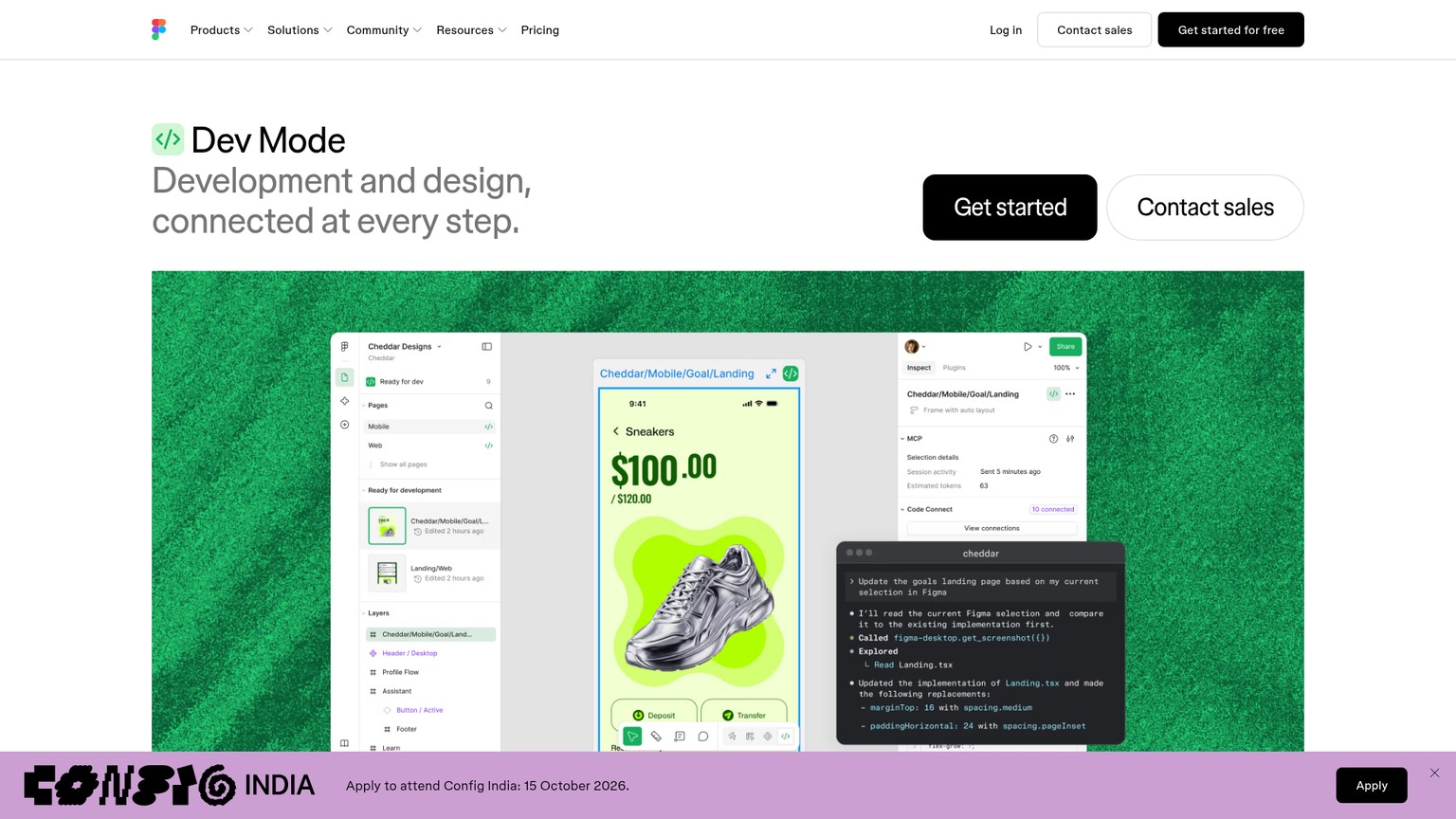
On the settings brief, the designer marks the finished frames ready for development, annotates error and accessibility behavior, and maps design components to production components through Code Connect. The engineer inspects the exact component and variable names instead of translating an unstructured screenshot. If the team uses an agentic coding workflow, Figma's MCP server can provide structured context such as variables and components to a supported coding agent.
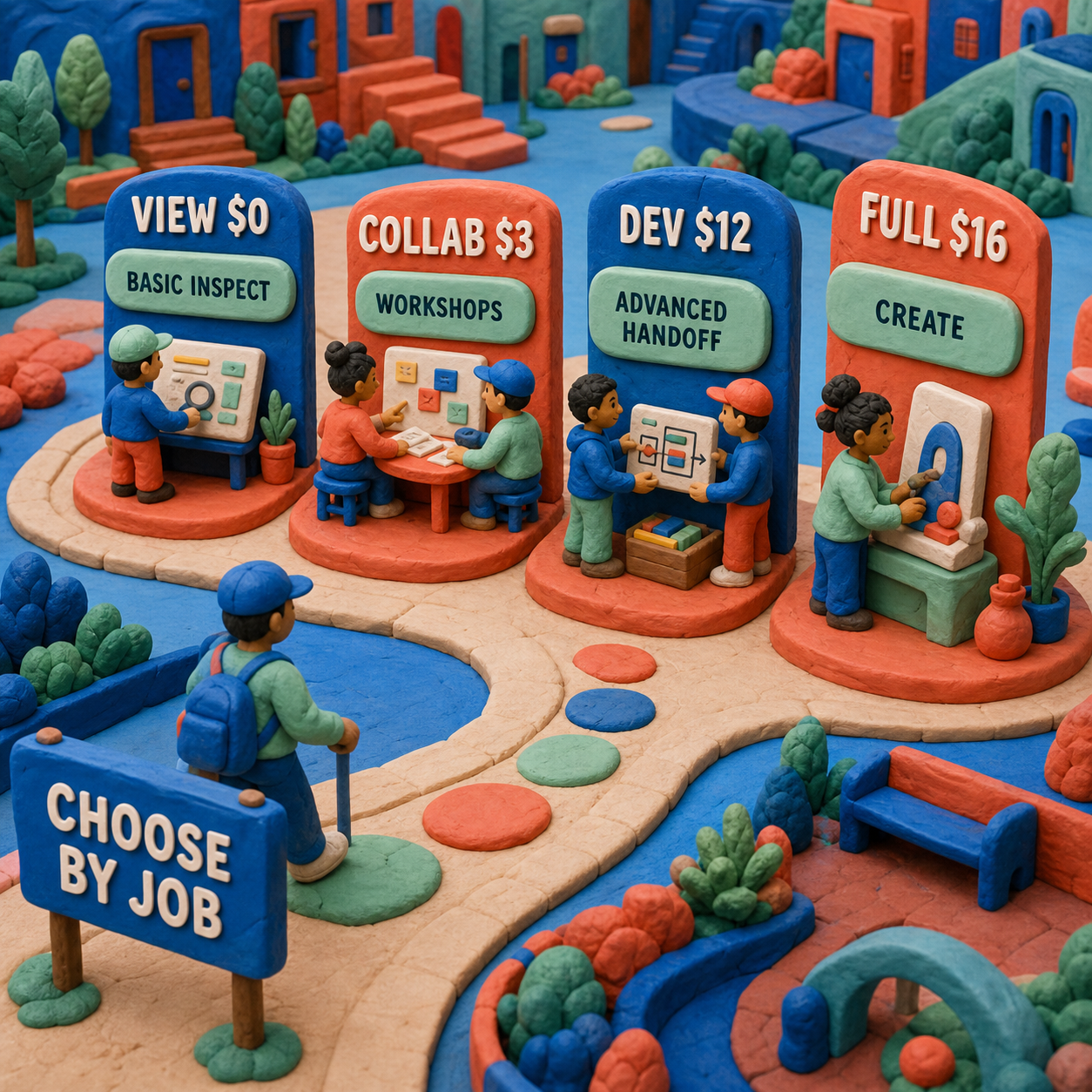
The expensive mistake is assigning Dev seats before defining the developer job. Free View seats can already inspect measurements and property values, copy CSS, iOS, and Android code, export assets, comment, and use cursor chat. An engineer who checks spacing twice a month may need no paid seat. A front-end engineer who lives in advanced inspection, Code Connect, annotations, change comparison, and MCP context probably does.
That distinction changes the bill. Eight Dev seats cost $96 per month on Professional, $200 on Organization, or $280 on Enterprise. Keeping occasional inspectors on View and reserving Dev seats for recurring handoff work produces the same basic access while removing $1,152, $2,400, or $3,360 from annual spend respectively.
The outcome to measure is implementation rework. If Dev Mode reduces clarification loops, exposes the correct production component, or makes design changes visible before code review, the seat has a job. If engineers still work from screenshots and Slack messages, paying for Dev Mode has not created a handoff process.
4. Make, FigJam, and Sites extend the workflow, but do not erase specialists
Figma Make is useful when a static interface needs to become a code-backed, visually editable prototype quickly. It can start from prompts, Figma frames, design systems, npm packages, documents, images, audio, video, or other attachments. Make kits carry library styles and guidelines into the generation context, MCP connectors add external documents or tasks, and point-and-edit lets a designer refine an element in the preview.
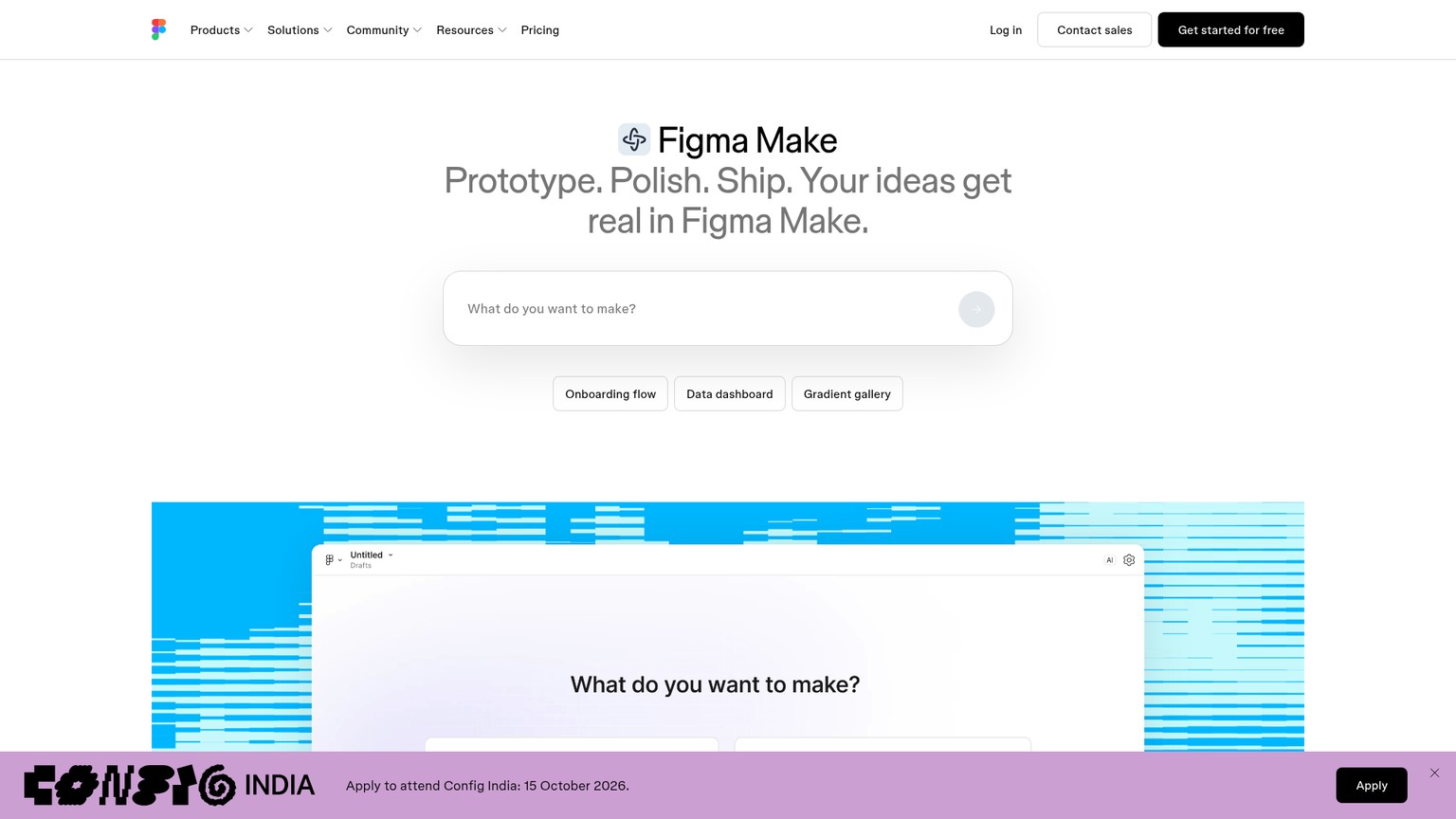
Apply it to the settings brief only after the system is coherent. Attach the approved frames and the library context, describe the expected data and error states, and generate a functional prototype. Figma's pricing comparison lists Supabase support for authentication, user data, and private APIs. The result can make data flow and interaction feel more concrete than a frame-based prototype.
It still needs a design review and a technical review. Prompt output can violate the system, invent a state, or create code that is unsuitable for the product's architecture. Make is strongest as a faster path to a testable prototype, not as permission to skip product, accessibility, security, or engineering judgment.
Figma FigJam covers the messy work before the interface. It is included with every seat on every plan and supports brainstorming, diagrams, workshops, agile rituals, and more than 300 templates.
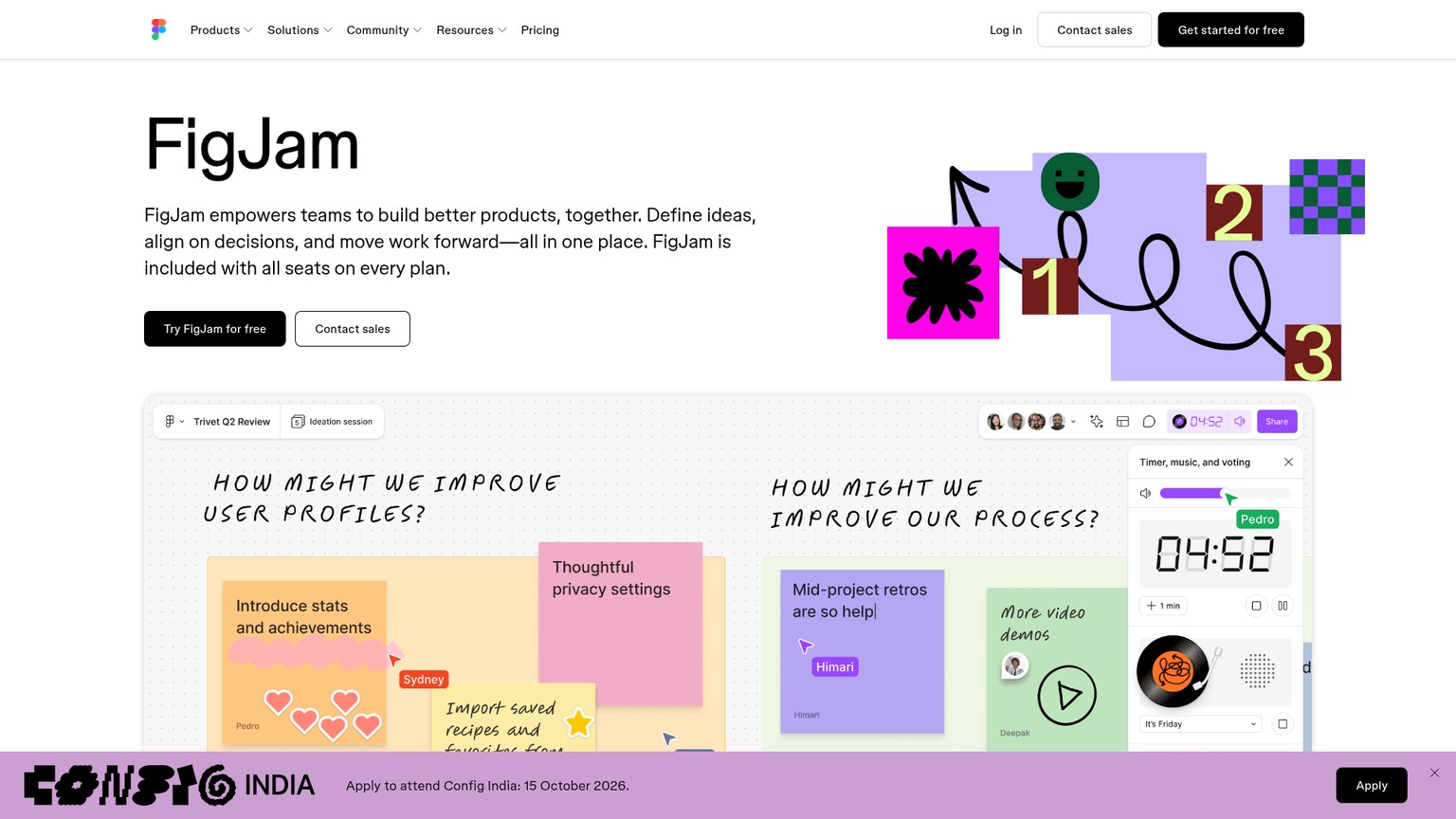
Use FigJam to map the existing account flow, group support complaints, and agree which settings belong together. Then move the resolved structure into Figma Design. The whiteboard should hold divergence and alignment; the design file should hold the product system. Keeping those jobs distinct prevents the final interface from becoming a polished version of an untested brainstorm.
Figma Sites covers the publishable edge of the suite. It can design and build responsive websites, includes CMS capability, and is available in beta on paid Full seats.
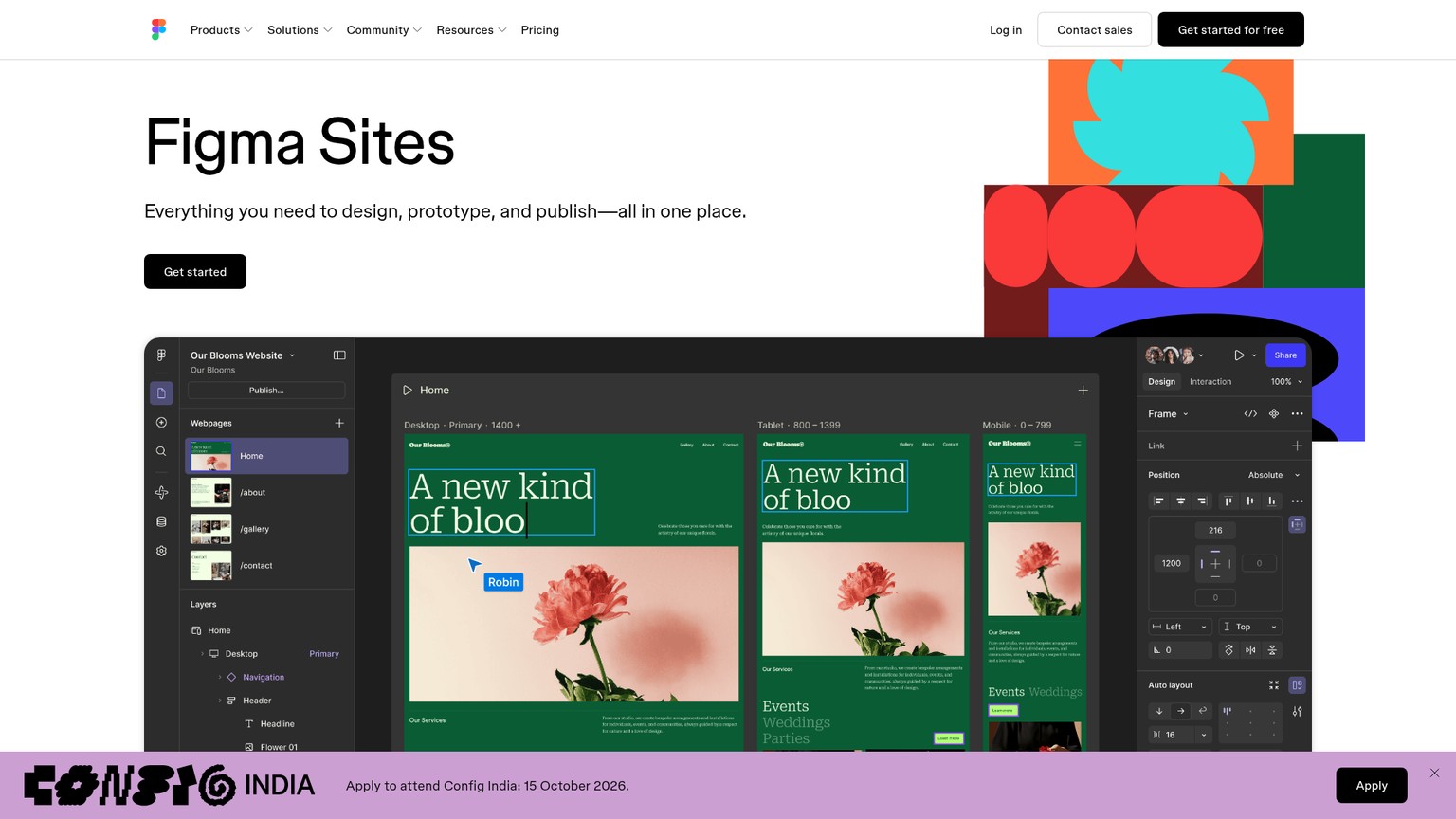
Sites is a useful extension when a design team wants to publish a campaign or portfolio without rebuilding it elsewhere. It is not a reason to replace a proven website operation blindly. Framer is more focused on live marketing sites, and a content-heavy or commerce operation may need a different platform entirely. Suite convenience should remove a handoff, not lower the production bar.
The same rule applies to Motion, which is also beta on paid Full seats. A broad Figma subscription can reduce tool switching, but beta access is not equivalent to a mature specialist workflow. Buy the suite for the connected jobs already present, then treat new surfaces as evaluated options.
A repeatable evaluation recipe
Figma should be evaluated with one representative product slice, not a polished hero screen.
Build the smallest reusable system
Choose one flow with responsive layouts, repeated components, validation, and at least two themes. Build components, Auto layout, variables, and modes before duplicating screens.
Stress the content and states
Insert long labels, errors, loading, empty states, permission differences, and narrow screens. Repair the system rather than patching each frame.
Prototype one consequential path
Use interactive components, variables, and conditions only where behavior must be reviewed. Ask stakeholders to complete a task and comment on the exact state that blocks them.
Price the handoff by job
Keep basic inspectors on free View seats. Give Dev seats to people who repeatedly need advanced inspection, Code Connect, annotations, change comparison, or MCP context. Give Full seats only to people who create across the product suite.
The ship-ready call is simple. Figma is ship-ready as the source for an interface system, a reviewed prototype, and implementation context. Figma Make and Sites outputs still need the same accessibility, performance, security, content, and engineering review as work produced elsewhere. A clickable prototype is evidence that a flow can be evaluated, not evidence that a production product is complete.
Figma pricing: every current tier
Figma pricing is a matrix of plan and seat type. The figures below were verified against Figma's live pricing and Help Center pages on August 8, 2026. Professional offers annual and monthly billing; Organization and Enterprise are annual plans.
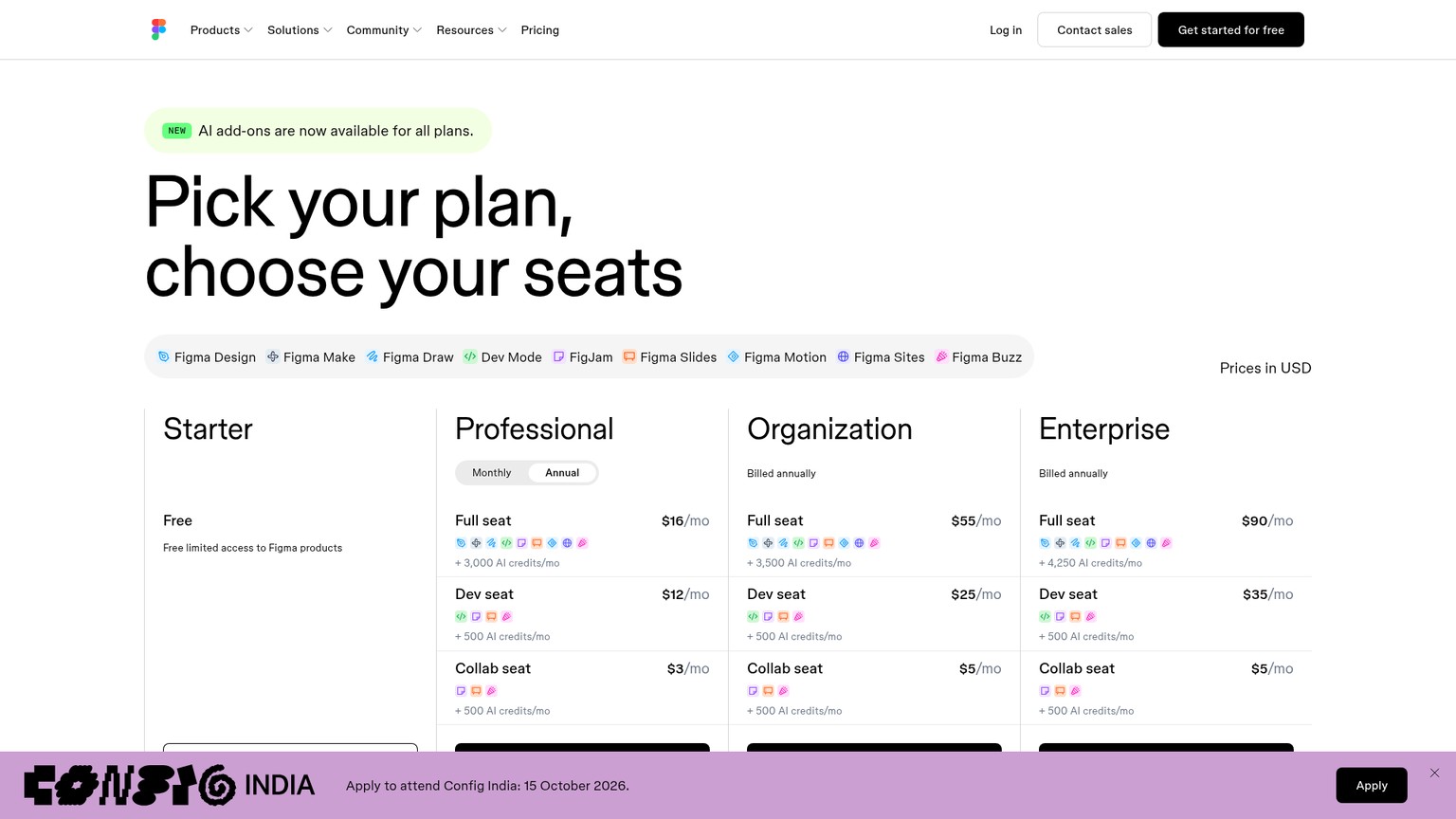
Starter includes unlimited drafts, UI kits, templates, and limited product access. It is enough for a solo evaluation, personal work, and a small proof of concept. It is not the plan for a governed team library or recurring advanced handoff.
Professional is the value tier for one product team. Full seats access the full product suite. Dev seats focus on Dev Mode plus collaboration products, while Collab seats cover FigJam, Slides, and Buzz with view and comment access in Design and basic inspection. View seats remain free on paid plans.
Organization charges for scale across teams: unlimited teams, shared libraries and fonts, and centralized administration. Enterprise adds custom team workspaces, design-system theming and APIs, and SCIM. Governance+ is a separate Enterprise add-on, so even the highest public seat price does not imply every governance control is included.
The cost of one representative product team
Take 4 designers on Full seats, 8 engineers on Dev seats, and 6 product, research, or operations collaborators on Collab seats.
- Professional: $178 per month billed annually, or $2,136 per year.
- Organization: $450 per month, or $5,400 per year.
- Enterprise: $670 per month, or $8,040 per year.
Organization adds $272 per month, or $3,264 per year, over Professional for that team. Enterprise adds another $220 per month, or $2,640 per year, over Organization. Those premiums need owned outcomes. Unlimited teams, central libraries, and admin control can justify Organization. SCIM, custom workspaces, and multi-brand system tooling can justify Enterprise. Company size alone does not.
Now apply the free-inspection rule. If all 8 engineers only need measurements, property values, code copy, asset export, comments, and cursor chat, move them from Dev to View. The bill falls by $96 per month on Professional, $200 on Organization, or $280 on Enterprise. Add Dev seats back only for the engineers whose recurring workflow needs the advanced surface.
This is the cost-per-outcome test Figma pricing needs. A seat should correspond to a weekly job: create, collaborate, hand off, or inspect. “Might need it” is not a job.
AI credits create a second meter
Figma gives Full seats 3,000 monthly credits on Professional, 3,500 on Organization, and 4,250 on Enterprise. Dev, Collab, and View seats receive 500. Starter also receives 500 per month with a 150-credit daily limit.
The credits reset monthly, do not roll over, and cannot be shared or transferred between users. Figma also says agentic AI consumption varies with the underlying model, task complexity, and supplied context. That makes a credit less predictable than a fixed action such as one export or one prototype.
Additional pay-as-you-go credits cost $0.03 each. A 5,000-credit overage therefore costs $150. Figma's 5,000-credit subscription pack costs $120, saving $30 or 20% when that usage is predictable. The subscription is cheaper only when the team consumes the pool; unused seat credits disappear at reset.
Figma's limitations
Figma's limitations are operational, not cosmetic. Cloud access, file architecture, seat administration, credit expiry, and beta-suite boundaries can all change the value of the same interface features.
1. Offline mode is deliberately incomplete
Figma is cloud-based and says it has no plans for a fully featured offline mode. If a connection drops, the current page and pages loaded during the session may remain available, and local changes can sync later. Unloaded pages, library search and insertion, version history, collaborator updates, and multiplayer features are unavailable.
That is manageable for a designer who loses Wi-Fi briefly. It is a structural mismatch for field work, restricted networks, or a client policy that requires local access to the complete source. Saving a .fig file is a snapshot without comments or version history, and importing it creates a new file rather than preserving the shared document lineage.
Use Sketch's Mac-only license when a dependable offline native workflow is the deciding constraint. Use Penpot's self-host route when deployment control is the requirement. Do not buy Figma and hope the cloud model becomes a different product.
2. Large files require active architecture
Figma can become slow when files, libraries, effects, and open tabs grow without boundaries. Its own troubleshooting guidance recommends closing unused Figma tabs, toggling off multiplayer cursors, layout guides, and effects, and splitting files to reduce memory usage.
The correct response is not to remove all detail. Divide a product by durable ownership and loading boundaries. Keep foundations and shared components in governed libraries. Separate large feature areas when their working sets rarely overlap. Archive explorations that no longer inform the live system. Treat a file that contains every screen, workshop, branch, and abandoned concept as an information-architecture failure.
This limitation becomes expensive because the browser model makes clutter easy to share. One link can invite everyone into one growing canvas. A design-operations owner should define file boundaries, library release rules, branching practice, and archival cadence before performance forces an emergency split.
3. Downgrading a seat does not necessarily return the money
Figma's Organization and Enterprise billing model is annual. Added seats are prorated and appear on quarterly invoices, but moving a paid user to a free View seat or removing the user does not create a prorated refund. The paid seat becomes available for someone else to reuse until renewal.
That rule creates deadweight after a project ends or a contractor leaves. The cost is not lost if another person needs the same seat type, but it does not disappear from the term. Procurement should model peak staffing and reuse, not only today's headcount.
Seat approval settings also deserve attention. Admins can require manual approval, approve automatically when a purchased seat is available, or auto-approve every request. Auto-approval can buy a new seat when none is available. Use manual approval until the organization has a reliable role-to-seat policy and a named owner for the invoice.
4. AI credits expire and action costs vary
Figma's AI credits do not roll over, cannot be transferred, and may be consumed at different rates depending on model, task, and context. A designer can therefore exhaust credits during a demanding prototype sprint while another paid seat leaves its allocation unused.
The shared add-on pool fixes availability, not predictability. Pay-as-you-go at $0.03 per credit is easy to enable, and subscription credits are cheaper in a predictable 5,000-credit block. Neither answers which workflow is producing enough value to justify the consumption.
Track credits by feature and outcome. A Make prototype that replaces a week of throwaway implementation may justify a burst. Repeated prompt variations that never enter research, review, or production do not. The limit should encourage an editorial decision, not an automatic top-up.
5. The suite is broad, but several edges are still beta
Figma Sites and Figma Motion are beta products available on paid Full seats. They expand what can happen without leaving Figma, but beta status introduces a moving capability surface. A workflow built around them needs an exit path and an acceptance test.
Use Sites when it removes a handoff for a suitable campaign or portfolio. Use Framer when the live website and its ongoing CMS operation are central. Use a specialist motion tool when timing, export reliability, and motion-system depth are part of the delivery contract. One subscription is not automatically one production standard.
6. Free inspection makes some Dev seats hard to defend
Figma's free View access is more capable than many seat plans imply. Measurements, property values, code copy, exports, comments, and cursor chat cover occasional developer inspection. A Dev seat becomes valuable for advanced inspection, Code Connect, annotations, change workflows, and MCP context.
This creates a management burden: the financially correct seat can change as a project moves from discovery to implementation to maintenance. Review the engineers' seat needs at those phase changes. Leaving every engineer on Dev forever is simple administration, but it can be an expensive substitute for role clarity.
- Components, Auto layout, variables, modes, and shared libraries support a durable interface system rather than isolated screens.
- Multiplayer editing, comments, prototypes, and Dev Mode keep review and implementation context beside the source.
- Professional Full at $16 per month billed annually is strong value for a working product designer.
- Free View access covers measurements, property values, code copy, exports, comments, and cursor chat.
- Make, FigJam, Sites, Motion, Slides, Draw, and Buzz extend the workflow under one account.
- There is no fully featured offline mode, and unloaded pages, libraries, history, and multiplayer are unavailable offline.
- Large files need explicit library, file-boundary, and memory discipline.
- Organization and Enterprise seat downgrades do not generate prorated refunds during the annual term.
- AI credits do not roll over or transfer, and agentic action costs vary.
- Sites and Motion remain beta, so specialist tools can still be safer production choices.
- Dev seats are easy to over-assign because free View access already covers basic inspection.
Figma review verdict
Figma is a buy for a product team when at least three of four conditions are true: multiple people edit or review the same files every week, a reusable interface library has an owner, interactive behavior must be evaluated before code, and developers repeatedly pull implementation context from the design source.
The plan decision follows the work:
- Use Starter to evaluate one representative product slice. Build responsive components, prototype one consequential path, and invite a reviewer before paying.
- Choose Professional for one working product team. Full seats go to creators, Collab seats to frequent FigJam or Slides contributors, Dev seats to recurring advanced handoff users, and View seats to everyone else.
- Choose Organization only when several teams need one governed system. Unlimited teams, shared libraries and fonts, and central administration must save coordination work worth more than the $3,264 annual premium in the representative seat mix.
- Choose Enterprise only when enterprise controls have owners. SCIM, custom workspaces, multi-brand theming, and design-system APIs must solve a procurement or operating requirement worth the additional $2,640 annual premium in that same mix.
- Skip Figma when its cloud model conflicts with the work. Choose Sketch for offline Mac-native design, Penpot for open or self-hosted control, and Framer for a website-first production workflow.
For a solo designer, Professional Full at $16 per month billed annually is defensible when shared libraries, unlimited team files, prototypes, and handoff recur. It is unnecessary when Starter covers personal drafts and collaborators only receive occasional exports.
For a startup product team, Figma remains the default recommendation because the collaboration loop is difficult to reproduce with disconnected tools. Begin with the least expensive seat that completes each person's job. The $178 monthly representative setup is a ceiling only if all eight engineers need advanced Dev Mode. Free View seats can bring the same team down to $82 per month before any Collab changes.
For a multi-team company, Organization is the inflection point, not Enterprise. Central libraries, fonts, and admin tools have immediate design-operations value. Enterprise should arrive with a written requirement for SCIM, workspace structure, theming, APIs, or security governance. Prestige is not a requirement.
The blunt call is this: Figma is worth it for systems and collaboration, not merely for drawing interfaces. Buy the connected workflow. Skip the seats, plan, and beta products that do not have a recurring job.
Figma review FAQ
Is Figma really that good?
Figma is that good for collaborative product design because components, variables, prototypes, comments, and developer inspection live around the same source. It is less compelling when one designer works alone, exports finished files, and does not need a shared system or recurring handoff.
The clean test is weekly recurrence. If system reuse, live review, prototype evaluation, and handoff happen every week, Figma has a strong operating advantage. If only drawing happens, Starter, Sketch, or Penpot may be more proportionate.
What are the cons of Figma?
Figma's main cons are incomplete offline access, memory pressure in poorly structured large files, annual paid-seat deadweight after a downgrade, non-rolling AI credits, and beta boundaries around Sites and Motion.
Free View access also makes Dev-seat assignment harder than it appears. Occasional inspectors can view measurements and properties, copy code, export assets, comment, and use cursor chat without a paid Dev seat.
Is Figma free?
Yes. Figma Starter costs $0 and includes unlimited drafts, UI kits, templates, and up to 500 AI credits per month with a 150-credit daily limit. It is suitable for personal work and evaluating a representative flow.
Paid plans also support free View seats. Viewers can comment and perform basic inspection, including measurements, property values, code copy, and asset exports.
Which is better, Canva or Figma?
Figma is better for digital product interfaces, responsive components, variables, interactive prototypes, and developer handoff. Canva is better for brand templates, presentations, social posts, campaign assets, and high-volume content made by non-design specialists.
Choose by deliverable. An application settings flow belongs in Figma. A campaign kit for ten social channels belongs in Canva. The two tools overlap, but their primary deliverables remain different.
Who is Figma's biggest competitor?
Figma has no single competitor across every job. Sketch is the closest Mac-native interface-design alternative. Penpot is the strongest open and self-hosted alternative. Framer competes for website design and publishing, while Canva competes for broader brand-content work.
The right competitor is the one that removes Figma's mismatch. Choose by constraint rather than by a generic feature count.
Is Figma worth it?
Figma is worth it when at least three jobs recur weekly: shared editing and review, reusable design-system work, interactive prototype evaluation, and developer handoff. Professional Full starts at $16 per seat per month billed annually, and one team can keep many collaborators on lower-cost Collab or free View seats.
It is not worth it when dependable offline work, self-hosted control, or direct website publishing is the primary requirement. Choose Sketch, Penpot, or Framer respectively.
Get the AI business workflow audit checklist to decide which design and handoff steps should stay craft-led, become standardized, or move into an automated production system.
- Last Updated
- Category
- Design
- Language
ElevenLabs Alternatives: Murf, MAI-Voice-2, OpenAI TTS and Cartesia (Verified October 2026)
Compare ElevenLabs, Murf, MAI-Voice-2, OpenAI, Cartesia, Google and Speechify by studio or API job, with verified prices and switching costs.Oct 4, 2026Design
Higgsfield API Pricing
Price Higgsfield API video and image jobs, separate API dollars from app credits, and check top-ups, expiry and cashback before scaling.Sep 27, 2026Design
Is Gemini Live Avatar Free
Check Gemini Live Avatar access, Enterprise API charges and custom-avatar limits before budgeting a customer-facing video agent.Sep 27, 2026Design
Gemini 3.8 Flash TTS Pricing
Price Gemini 3.8 Flash TTS by audio minute, compare Flash-Lite and service tiers, and budget the January 2027 increase.Sep 24, 2026Design
ngram vs Demosmith
Compare ngram and Demosmith for product videos, browser capture, revisions and usable exports, with costs matched to the same job.Sep 19, 2026Design
ArtPatt Pricing
ArtPatt pricing explained: Free limits, Pro exports, saved patterns, AI-image allowances, and when a paid plan earns its place.Sep 15, 2026Design
Cutsio Video Indexing Cost
Decode Cutsio's indexed minutes, stored hours, seats, and overages to choose a plan for a growing video library.Sep 13, 2026Design