Firebase Pricing (2026): What $0 Really Includes
Firebase starts at $0, but Blaze meters reads, storage, bandwidth, and functions. See live 2026 limits, break-even math, and cheaper alternatives.
Published
 By Omid Saffari


Firebase can still cost $0 in production, but it has no flat paid tier: once Spark's quotas stop fitting, Blaze meters each paid product by operation, storage, transfer, compute, or message. In a single-region worked load of 10 million reads, 1 million writes, 10 GiB stored, and 50 GiB egress, the Firebase backend comes to about $9.06 before other services. The deciding budget line is usually bandwidth, not the $0 base.
Firebase pricing at a glance
Firebase has two plans: Spark at $0 and Blaze with no base subscription. Spark protects your card by stopping over-limit service. Blaze protects uptime by serving the excess and billing it.
Pricing and limits below were verified against Firebase's live pricing page and linked billing documentation on August 13, 2026.
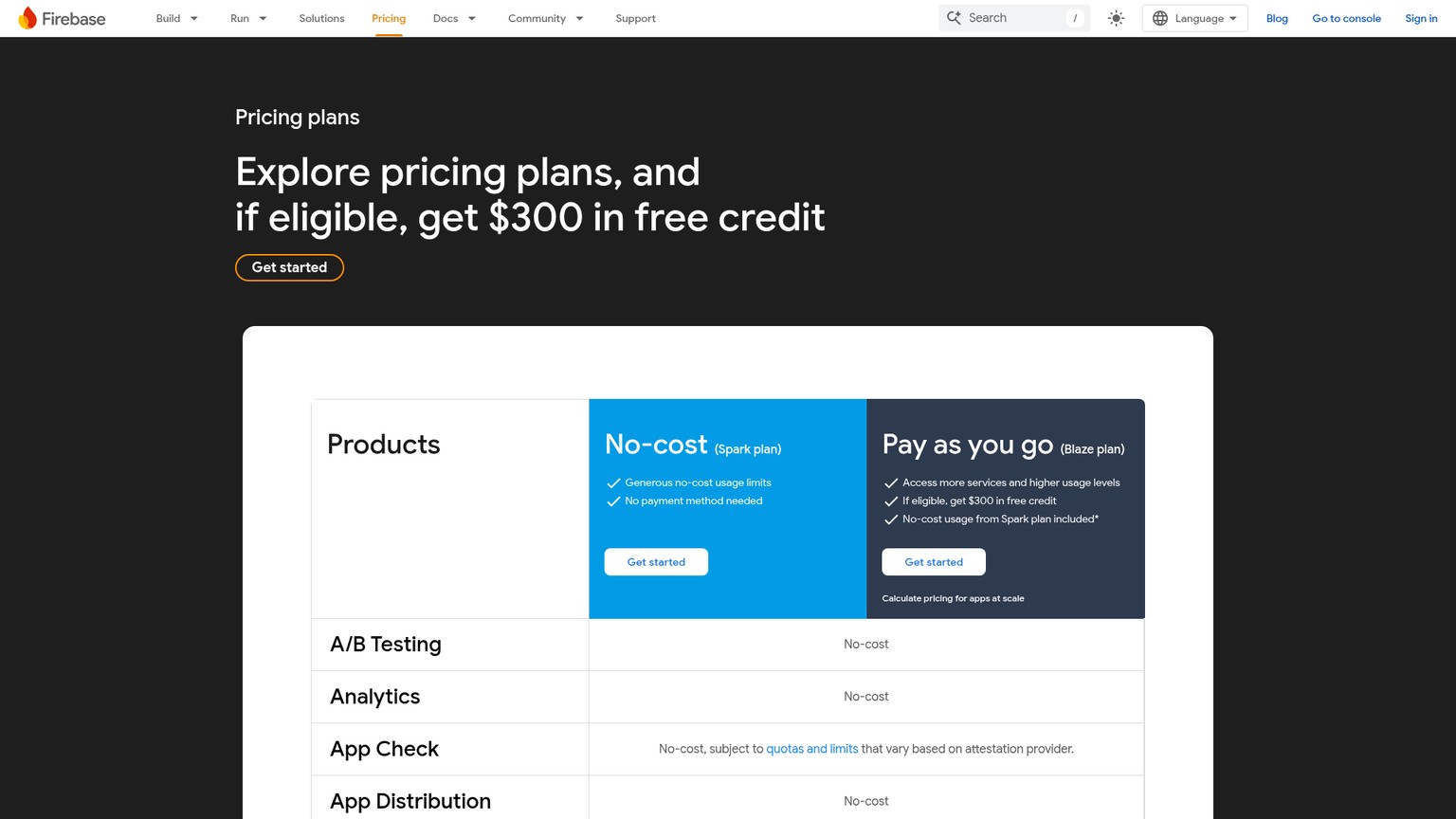
There is no annual Firebase package, annual discount, or $25 production bridge between these plans. Spark is free. Blaze is consumption billing, posted through a linked Google Cloud Billing account.
The decision is not "free or paid." It is hard quota or variable invoice. Spark is the safer budget for a prototype. Blaze is the safer runtime for an app that cannot disappear when one meter crosses its allowance.

Who can stay on Firebase Spark for free
You may never need to pay if your app uses Firebase's no-cost products and stays below every paid-product quota. That is a larger group than the phrase "free tier" suggests.
A/B Testing, Analytics, App Distribution, Cloud Messaging, Crashlytics, In-App Messaging, and Performance Monitoring are no-cost. App Check is also no-cost within the quota of its attestation provider. Most standard Authentication methods are no-cost unless you enable Identity Platform features or send phone verification messages.
For the metered products, Spark's useful boundaries are:
- Cloud Firestore Standard: 1 GiB stored, 50,000 document reads/day, 20,000 writes/day, 20,000 deletes/day, and 10 GiB/month outbound transfer.
- Firebase Hosting: 10 GB stored and 10 GB/month transferred through the CDN. A single file can be no larger than 2 GB.
- Realtime Database: 1 GB stored, 10 GB/month downloaded, and 100 simultaneous connections.
- Remote Config: beginning September 1, 2026, 100,000 direct fetch requests/day. Existing projects receive transition time, covered below.
Spark is enough for a brochure site, an internal prototype, a low-traffic mobile app, or a production app built mainly from no-cost analytics, crash reporting, messaging, and standard sign-in. A founder validating demand can run Firestore below its daily allowances without attaching a card. A small business can run a static site below 10 GB of monthly transfer. Both can stay at $0 indefinitely.
The protection has a sharp edge. If a Spark project exceeds a product's no-cost quota, Firebase shuts off that product for the rest of the month. All apps registered to the same project feel that stop. Hosting offers a short grace period after its transfer limit, then disables sites until the next month or a Blaze upgrade. Reaching the Hosting storage limit blocks new deployments.
Spark also excludes the infrastructure many production apps eventually need. App Hosting requires Blaze. Cloud Functions deployment and paid Google Cloud services require Blaze. Firebase's current pricing table places the free allowance for modern *.firebasestorage.app buckets inside Blaze, with Spark marked not applicable. That current bucket rule is easy to miss because older descriptions still talk broadly about Storage as a free-quota product.
What Firebase Blaze charges for
Blaze costs are the sum of several independent meters. The lack of a monthly fee is useful at low traffic, but it also means there is no single allowance that tells you whether the whole app is safe.
Firestore: cheap units, expensive multiplication
Firestore's single-region operation prices are small enough to look irrelevant. In Iowa, us-central1, the current Standard rates after free quota are $0.03 per 100,000 document reads, $0.09 per 100,000 writes, and $0.01 per 100,000 deletes. That normalizes to $0.0003 per 1,000 reads, $0.0009 per 1,000 writes, and $0.0001 per 1,000 deletes.
The cost driver is how many billable operations one user action creates. Firestore bills documents and index entries read by a query. A query that returns nothing still incurs one document read. Security Rules can trigger additional reads. A real-time listener bills a read when a result document is added or updated. A reconnect can rebill the query, including after more than 30 minutes offline when persistence is enabled.
Only one Firestore database in a project gets the free quota. A named additional database starts billing from its first unit. TTL deletes, point-in-time recovery data, backups, restores, and clones also have no free allowance.
Location changes the result. Firebase's North America multi-region chat example uses $0.06 per 100,000 reads, $0.18 per 100,000 writes, and $0.02 per 100,000 deletes, twice the Iowa operation rates. Its storage example uses $0.18/GiB-month. Pick the region for resilience and latency, then price that region instead of copying a generic Firebase estimate.
Firestore Enterprise uses a different unit model. Its free allowance is 1 GiB stored, 10 GiB/month egress, 40,000 write units/day, 50,000 read units/day, and 50,000 real-time update units/day. Treat it as a separate quote, not a silent upgrade from Standard.
Authentication: free until the sign-in method changes
Standard email and social authentication can remain no-cost at very large user counts. The price appears when you use phone messages or upgrade to Identity Platform.
Identity Platform's Tier 1 providers include email, phone, anonymous, and social sign-in. The first 50,000 monthly active users, or MAU, are free. MAU from 50,000 through 100,000 cost $0.0055 each, and the next band through 1 million costs $0.0046 each. At exactly 100,000 Tier 1 MAU, the bill is $275/month.
Enterprise federation is steeper. SAML and OIDC include 50 MAU, then cost $0.015 per MAU. A 2,000-user enterprise SaaS therefore pays $29.25/month for that federation layer. Phone and multi-factor authentication are priced per SMS by destination. The first 10 SMS/day are not billed, and the official US example uses $0.01 per message.
The practical distinction matters: "Firebase Authentication is free" is true for many standard sign-in flows and false for an Identity Platform or SMS-heavy implementation.
Functions, Hosting, and App Hosting
Cloud Functions includes 2 million invocations/month on Blaze, then charges $0.40 per million. The account also receives 400,000 GB-seconds and 200,000 CPU-seconds/month before location-dependent compute charges. Outbound networking includes 5 GB/month, then costs $0.12/GB. Cloud Build includes 120 minutes/day, then costs $0.003/minute, while Artifact Registry includes 500 MB before its own storage rates.
Firebase Hosting is simpler. After 10 GB of stored content, storage costs $0.026/GB. After 10 GB of monthly transfer, CDN delivery costs $0.15/GB. Retained releases count toward storage, so deleting old deploys can lower the bill.
App Hosting is a different product for server-rendered web apps and requires Blaze. It includes 10 GiB/month outgoing bandwidth, then charges $0.15/cached GiB and $0.20/uncached GiB. Its backend can also bill Cloud Run, Cloud Build, Artifact Registry, Logging, Secret Manager, and Cloud Storage. The first 2 million Cloud Run requests are free, then requests cost $0.40/million, but transfer can become material sooner than compute.
Storage and Realtime Database
Cloud Storage pricing depends on bucket generation and location. A legacy *.appspot.com bucket includes 5 GB stored, then $0.026/GB, plus 1 GB/day downloaded, then $0.12/GB. It also meters operations after 20,000 uploads/day and 50,000 downloads/day.
A current *.firebasestorage.app bucket in us-central1, us-west1, or us-east1 receives 5 GB-months, 100 GB/month transfer, 5,000 Class A operations, and 50,000 Class B operations at no cost on Blaze. Iowa Standard storage is about $0.022/GiB-month at the displayed hourly rate. General internet transfer is $0.12/GiB through the first 10 TiB after applicable free usage. Buckets elsewhere may not receive those allowances.
Realtime Database looks simple because it does not charge per read. It charges $5/GB-month stored and $1/GB downloaded after 1 GB storage and 10 GB monthly download. The download meter includes protocol, connection, encryption, denied-request, and console traffic, not only the data your interface displays. Blaze raises simultaneous connections from 100 to 200,000 per database.
SQL Connect and Test Lab
SQL Connect gives one default Cloud SQL trial per project for three months. Blaze includes 250,000 operations/month, then charges $0.90 per million, plus 10 GiB/month network egress before Google Cloud transfer rates. The first instance starts as low as $9.37/month after the trial, depending on region and configuration. A project that does not move to Blaze at trial end has the instance archived and then deleted after another 90 days.
Test Lab includes 60 virtual device minutes/day and 30 physical device minutes/day on Blaze. Overage is $1/device-hour for virtual devices and $5/device-hour for physical devices. Android Device Streaming includes 30 minutes/project/month, then costs $0.15/minute.
Firebase AI Logic is available on Spark, but the model call follows Gemini Developer API or Google Cloud pricing rather than a bundled Firebase allowance. Firebase Phone Number Verification also uses a separate pay-as-you-go rate table. Gemini in Firebase is no-cost for individuals and groups outside Google Workspace; Workspace users need a valid Gemini Code Assist subscription. Firebase Studio includes three workspaces, rising to 10 for Standard Google Developer Program members and 30 for Premium members, but integrations such as App Hosting can still require Blaze.
Three bills that expose the Firebase cost curve
Firebase is compelling when the units stay small and dangerous when one high-volume meter is hidden inside an ordinary user action. These scenarios put the rates on one budget line.
A $9.06 Firestore backend
Assume one Iowa Standard database spreads 10 million reads and 1 million writes evenly across a 30-day month, stores 10 GiB, and sends 50 GiB to worldwide destinations excluding China and Australia.
The daily read allowance removes 1.5 million reads, leaving 8.5 million billable. At $0.03 per 100,000, reads cost $2.55. The daily write allowance removes 600,000 writes, leaving 400,000 billable. At $0.09 per 100,000, writes cost $0.36.
Nine GiB of billable storage costs about $1.35 for 730 hours. Forty GiB of billable transfer costs $4.80. The total is about $9.06/month before Functions, authentication, backups, other storage, or tax.
The lesson is favorable to Firebase: operation billing can be extraordinarily cheap. In this workload, egress already costs more than reads, writes, and database storage combined.
The $25 Hosting break-even
Firebase Hosting transfer is free through 10 GB/month and $0.15/GB after that. Its transfer bill reaches $25 at about 176.7 GB total transfer. At 250 GB, it costs $36.
That gives an operator a clean switch point. Below roughly 177 GB, a $0 base can beat a $25 fixed plan. Above it, a $25 alternative that includes 250 GB or more begins with the lower invoice, even before Firebase's other meters are added.

The workloads that jump
Realtime Database becomes costly when the payload is large. A project storing 20 GB and downloading 500 GB/month pays $95 for storage and $490 for download after free allowances, or $585/month. Optimizing connection reuse helps, but the $1/GB transfer meter still decides the budget.
App Hosting shows the same pattern with a modern web stack. Firebase's official example assumes 10 billed requests per visit, a 400 KiB average response, one-second response latency, and a 50% cache hit rate. It estimates $0.01 at 10,000 visits and $69.58 at 1 million visits. At the larger scale, $68.25 comes from cached and uncached bandwidth. Compute requests contribute only $1.20.
Remote Config pricing changes on September 1, 2026
Remote Config can become a new budget line even if it has always felt free. Starting September 1, Spark and Blaze both include 100,000 direct fetch requests/day. Blaze then charges $0.000006/request, or $0.06 per 10,000, through 10 million requests/day. Requests above 10 million/day cost $0.000001 each, or $0.01 per 10,000.
At the recommended 12-hour fetch interval, 50,000 active devices making two fetches/day consume the allowance. One million fetches/day leaves 900,000 billable requests. That costs $5.40/day, or about $162 over 30 days.
Cached reads on the device do not count. Opening a real-time connection does not continuously bill, but the fetch that follows an invalidation does. Fetches called directly through client SDKs, REST APIs, or backend code count. Redundant calls on app resume, screen transition, or background work are therefore a budget decision.
Existing projects receive transition time. A Spark project with Remote Config enabled before September 1 has until December 1, 2026. Upgrading it before November 15 extends commencement to February 1, 2027. Existing Blaze projects also begin standard billing on February 1, 2027. A newly enabled Spark project that first crosses 100,000 daily requests receives a 30-day grace period, then over-limit requests are throttled.

The business move is to measure fetches before the grace period obscures the eventual cost. Stable configuration can use a 24-hour or 48-hour interval instead of 12 hours. A one-million-fetch workload drops sharply when clients activate cached values rather than contacting the service on every resume.
Hidden Firebase costs and the controls that work
The largest Firebase surprise is not one high rate. It is a low rate multiplied by behavior your product team does not see.
A screen is not one Firestore read. A list may read every returned document, plus index-entry batches, plus Security Rules dependencies. A listener can rebill changing documents and reconnects. An offset charges for skipped documents, so cursor pagination is cheaper.
A payload is not all Realtime Database transfer. Protocol and encryption overhead count. Denied operations can count. Frequent short REST connections add handshakes, while a maintained native-SDK connection reduces that overhead.
A Firebase invoice can contain Google Cloud products. App Hosting invokes Cloud Run, Cloud Build, Artifact Registry, Logging, Secret Manager, and Storage. Functions bring compute and networking. The marketing plan name stays "Blaze," but the invoice is a set of underlying service meters.
Free allowances reset on different clocks. Firestore operation quota resets daily, Functions allowance is monthly, and some Storage quotas are daily or monthly depending on bucket type. Averaging a monthly forecast can hide a daily spike that is fully billable.
The $300 credit is temporary. Eligible new users get 90 days. Upgrading to a paid account does not extend the expiration. Usage outside the remaining credit or Free Tier bills the payment method.
A budget alert is not a universal hard cap. Firebase and Google Cloud do not stop every service at the threshold by default. Spend caps currently apply to Firebase AI Logic, App Hosting through Cloud Run, Cloud Functions, and Extensions. Firestore, Storage, Hosting, Realtime Database, and most other paid products cannot use that control.
Baseline every meter
Open Usage and billing, then record daily Firestore reads, writes, deletes, egress, Hosting transfer, Storage transfer, Function invocations, authentication messages, and Remote Config fetches. Use the busiest normal day, not a quiet monthly average.
Set alerts below the approval line
Create a Google Cloud budget with email alerts at thresholds your operator can act on. Firebase suggests several low percentages during testing and pivotal actual plus forecast thresholds in production. An alert buys response time; it does not guarantee a stop.
Add supported spend caps
Apply a spend cap to App Hosting, Functions, Extensions, or Firebase AI Logic when service pause is preferable to further spend. Document which products remain uncapped so nobody assumes the project budget is a kill switch.
Reproduce growth before launch
Use the Local Emulator Suite for Firestore, Realtime Database, and Functions. Test query limits, listener reconnects, Function retries, fan-out, and loops. Price one launch-day load test from the resulting unit counts.
Firebase vs Supabase and Appwrite on price
Firebase is the least expensive starting point when usage is low. Supabase and Appwrite become easier to approve when a $25 base buys the bandwidth and capacity Firebase would meter separately.
Supabase: $25 for a predictable production floor
Supabase starts at $0 for two active projects, 50,000 MAU, a 500 MB database, 5 GB egress, 5 GB cached egress, and 1 GB file storage. Free projects pause after one inactive week, so it is a poor unattended demo.
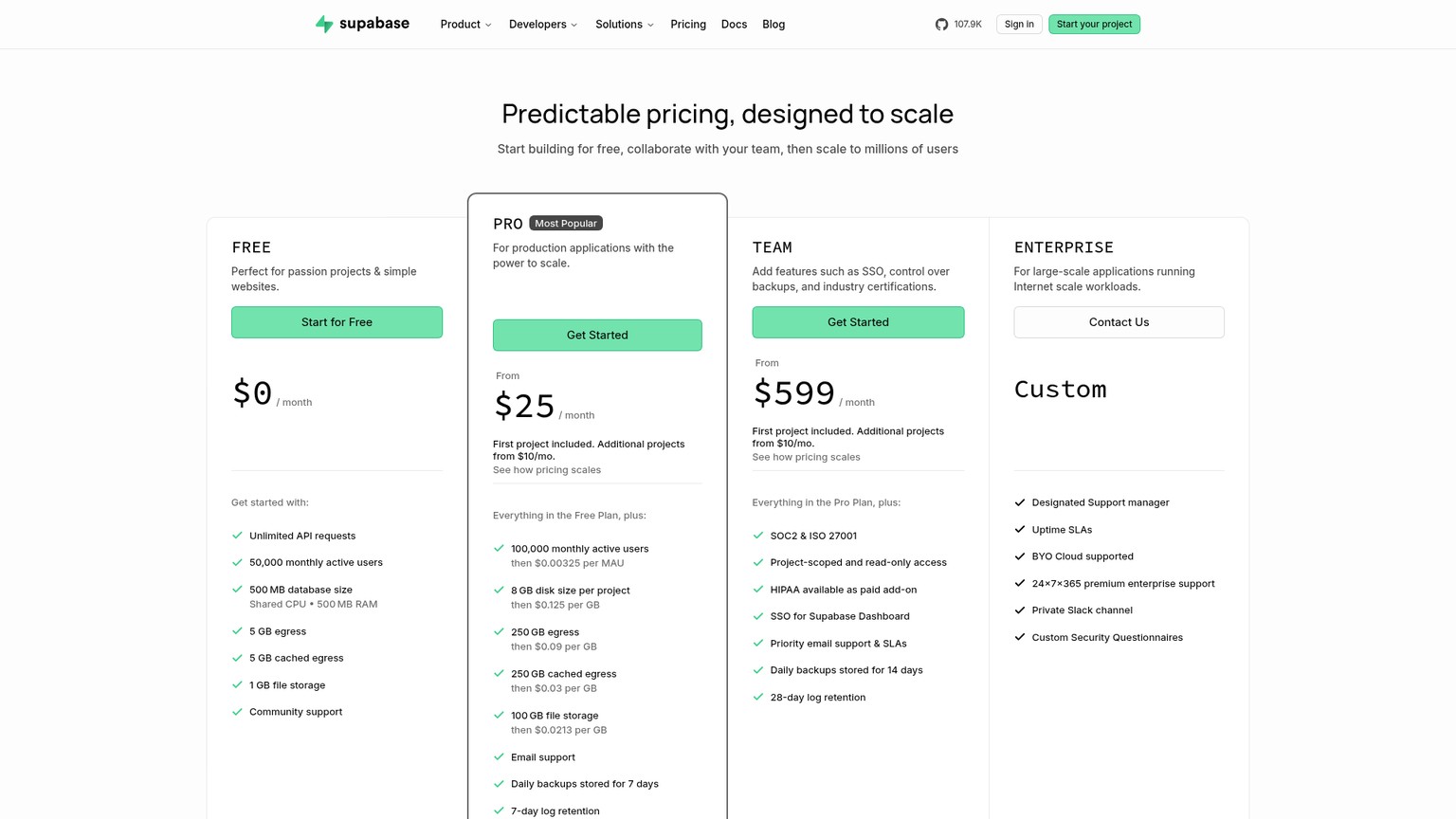
Supabase Pro starts at $25/month. It includes $10 of compute credit for one Micro project, 100,000 MAU, 8 GB disk, 250 GB egress, 250 GB cached egress, and 100 GB file storage. Beyond those allowances it charges $0.00325/MAU, $0.125/GB database disk, $0.09/GB egress, $0.03/GB cached egress, and $0.0213/GB file storage.
At 250 GB transfer, Firebase Hosting costs $36 while Supabase Pro's listed egress allowance remains inside $25. That is not a universal platform comparison because Supabase and Firebase meter different products, but it is a useful bandwidth decision. Below roughly 177 GB and with light database use, Firebase can still be cheaper. For the complete fixed-plan and add-on detail, use the current Supabase pricing breakdown.
Appwrite: $25 with a much larger bandwidth bundle
Appwrite starts at $0 with 5 GB bandwidth, 2 GB storage, 750,000 executions, 75,000 MAU, and two projects. Each project is limited to one database, one bucket, and two Functions. Inactive free projects pause after one week.
Appwrite Pro starts at $25/month and includes $10 of database-compute credit, one dedicated project, 2 TB API bandwidth, 150 GB storage, 3.5 million executions, 200,000 MAU, and unlimited databases, buckets, and Functions. Overage is $15/100 GB API bandwidth, $2.80/100 GB storage, $3/1,000 MAU, $0.060/100,000 reads, and $0.10/100,000 writes. Each additional project costs $15.
Appwrite's bandwidth bundle is the strongest of these three $25-or-less starting shapes. Its wall is project economics: the base includes one dedicated project and extra projects add a fixed charge. Firebase has no project subscription and can be cheaper across several tiny apps, provided each app's variable meters remain low.
Price should not decide the database architecture alone. Supabase is managed Postgres, Firebase centers on document and real-time services, and Appwrite bundles a broader app platform. The Supabase vs Firebase decision guide covers that architecture choice separately.
Which Firebase plan should you choose?
Choose Spark for a prototype, personal project, static site, or low-traffic app when you can tolerate the affected service stopping at quota. It is also a durable $0 choice for products built mainly on Analytics, Crashlytics, Cloud Messaging, Performance Monitoring, and standard sign-in.
Choose Blaze before deploying Functions, App Hosting, a modern Storage bucket, paid Google Cloud services, or any workload where a quota stop would breach customer trust. The $0 minimum makes Blaze efficient for light and spiky usage, but the team must own its meters.
Skip Firebase on cost grounds when predictable outbound transfer already crosses the fixed-plan break-even, Realtime Database downloads dominate the workload, enterprise authentication creates a large MAU line, or finance requires a universal hard invoice cap. Supabase is the stronger price shape for a single relational production app. Appwrite is the stronger bundle for high API bandwidth at the same base.
- Spark needs no payment method and can remain $0 indefinitely.
- Blaze has no monthly minimum, so light production usage can stay below fixed-price alternatives.
- Core telemetry and messaging products remain no-cost.
- Firestore operation rates are tiny when queries and listeners are bounded.
- There is no flat tier between Spark's hard stop and Blaze's variable invoice.
- Product, region, bucket, and reset-period differences make one monthly estimate misleading.
- Most paid products cannot use a budget spend cap.
- Transfer, SMS, federation, and reconnect behavior can outweigh the database's headline rates.
The Monday move is concrete: export the last seven days of usage, multiply the busiest day by a launch factor your team approves, and put each result against its own free allowance. Add Remote Config fetches now, even if transition grace means no charge yet. Approve Blaze only after one person owns the alert path and the uncapped meters are named.
Firebase pricing FAQ
Is Firebase free?
Yes. Spark costs $0, needs no payment method, and includes no-cost products plus product-specific allowances. The catch is operational: when a metered product crosses its Spark quota, that product stops serving or blocks more usage instead of billing an overage.
How much does Firebase cost per month?
Firebase has no standard monthly charge on Blaze. Your bill is the sum of usage beyond each product's free allowance. The worked Iowa Firestore load above costs about $9.06, while Firebase's own App Hosting example reaches $69.58 at 1 million visits and its multi-region chat example reaches $292.02/month at 100,000 daily active users.
Does Firebase have a pricing calculator?
Yes. Firebase links a Blaze calculator from its pricing page, and Google Cloud provides calculators for the underlying infrastructure. Use the calculator after choosing regions and counting reads, writes, storage, transfer, compute, and authentication separately.
Does Firebase offer annual pricing?
No annual Firebase subscription or annual discount is listed. Spark is $0 and Blaze is usage-based. You can upgrade, downgrade, or cancel, but Firebase says downgrades and cancellations do not receive prorated refunds.
Does Firebase have a student discount?
No. Firebase says it does not offer special educational, nonprofit, open-source, or school plans because Spark is available to everyone. Eligible new Google Cloud and Firebase users can receive $300 of trial credit valid for 90 days, but that is not a student discount.
What is the Firebase refund policy?
Firebase's Paid Services Terms say fee disputes must be raised within 60 days. Refunds are discretionary and, when granted, are issued as paid-service credit. Firebase also says cancellations and downgrades are not prorated.
Did Firebase pricing change in 2026?
Yes. Remote Config introduces its 100,000-fetch daily allowance and overage pricing on September 1, 2026, with transition dates for existing projects. App Hosting already began charging beyond its allowances on August 1, 2025. The older $25/month Flame plan stopped accepting new sign-ups in January 2020, and remaining Flame projects moved to Spark in February 2022.
How much does Firebase Realtime Database cost?
It includes 1 GB stored and 10 GB/month downloaded. On Blaze, storage beyond that costs $5/GB-month and download costs $1/GB. A 20 GB database sending 500 GB/month therefore costs $585 after the included amounts, before other Firebase services.
How much do Firebase Cloud Functions cost?
Blaze includes 2 million invocations/month, then charges $0.40 per million. It also includes 400,000 GB-seconds, 200,000 CPU-seconds, 5 GB outbound networking, and 120 Cloud Build minutes/day before their respective overages.
Get the AI Business Workflow Audit Checklist and the operator newsletter.
- Published
- Category
- Build
- Language

CLAUDE.md: Write It Once, Start Every Session Right
Write a useful CLAUDE.md, scope project rules, and manage Claude Code auto memory with a 35-line starter and a monthly cleanup routine.Oct 11, 2026Build
Jev Alternatives in 2026: OpenAI, Microsoft, Clef, d1, Perplexity and Strands (Compared)
Compare Jev alternatives by job, maker-verified input pricing, licences and deployment: OpenAI, Microsoft, Clef, Liquid d1, Perplexity and Strands.Oct 11, 2026Build
OpenAI Decisions API
Use OpenAI Decisions API for ticket routing, labels, and action gates. Three guide requests, refusal handling, pricing, limits, and when to keep your LLM.Oct 11, 2026Build
Claude Code Remote Control
Set up Claude Code Remote Control from CLI, VS Code or Desktop, connect your phone or browser, and fix documented login and connection failures.Oct 9, 2026Build
Cursor Remote Control
Set up Cursor Remote Control on iPhone, pair your laptop, keep local agents reachable, and compare cloud agents, Claude Code and Codex.Oct 9, 2026Build
Firecrawl Pricing 2026: What Your Pages Cost
Firecrawl plans and credit packs verified October 2026. Calculate JSON extraction, failed pages and weekly crawl bills at your volume.Oct 9, 2026Build
Claude Code vs GitHub Copilot 2026
Claude Code vs GitHub Copilot: current plans, usage limits, models, team controls, one-seat and ten-seat costs, and when to use both.Oct 8, 2026Build