Free vs Paid AI Meeting Note Takers 2026
Circleback makes unlimited meeting notes free. See when its $15 Pro plan, $25 Business plan, or Fathom's free archive earns the switch.
Published
 By Omid Saffari

Free vs Paid AI Meeting Note Takers 2026 is no longer a choice between capped and unlimited transcription. Circleback's $0 plan now covers unlimited online and in-person meetings with AI notes and action items; pay $15 per user monthly on annual billing only when 30-day history, limited integrations, or missing team controls block real work.
Free vs Paid AI Meeting Note Takers 2026: Which One Should You Pick?
Pick Circleback Free if you need reliable meeting capture and can live with a rolling 30-day history. Pick Fathom Free if keeping recordings indefinitely matters more than getting advanced AI features on every call. Pick Circleback Pro when old meeting memory, CRM connections, or full API access has become part of the job. Move to Circleback Business only when a manager needs enforceable settings, retention controls, and a usage view.
That is the decision in one screen. Meeting volume no longer justifies the upgrade because Circleback Free already covers unlimited online and in-person meetings. The paid trigger is a workflow failure, not a minute counter.
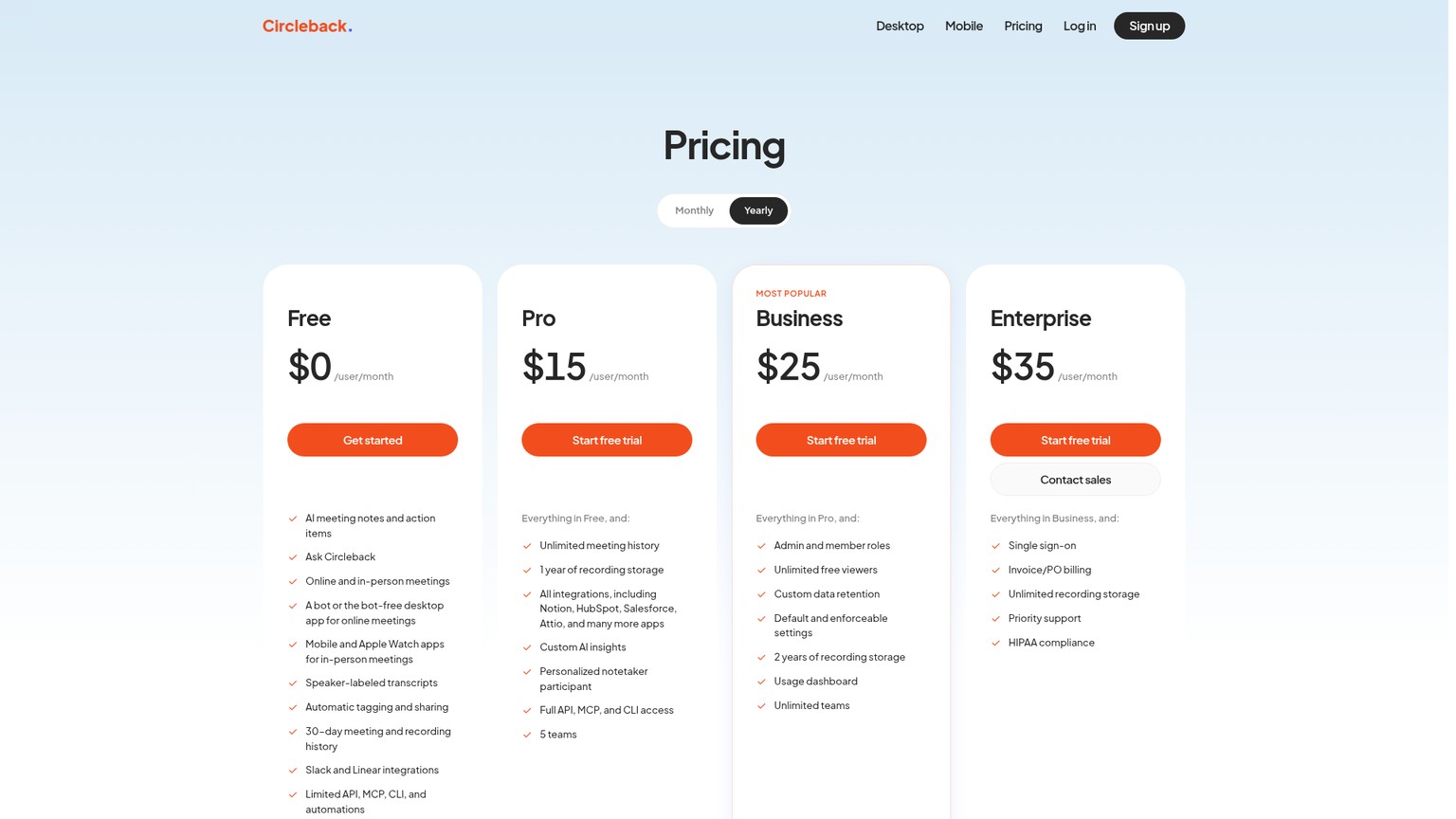
Fathom Free is the archive counterweight: it keeps recordings indefinitely at $0, but its richer AI layer has a call allowance.
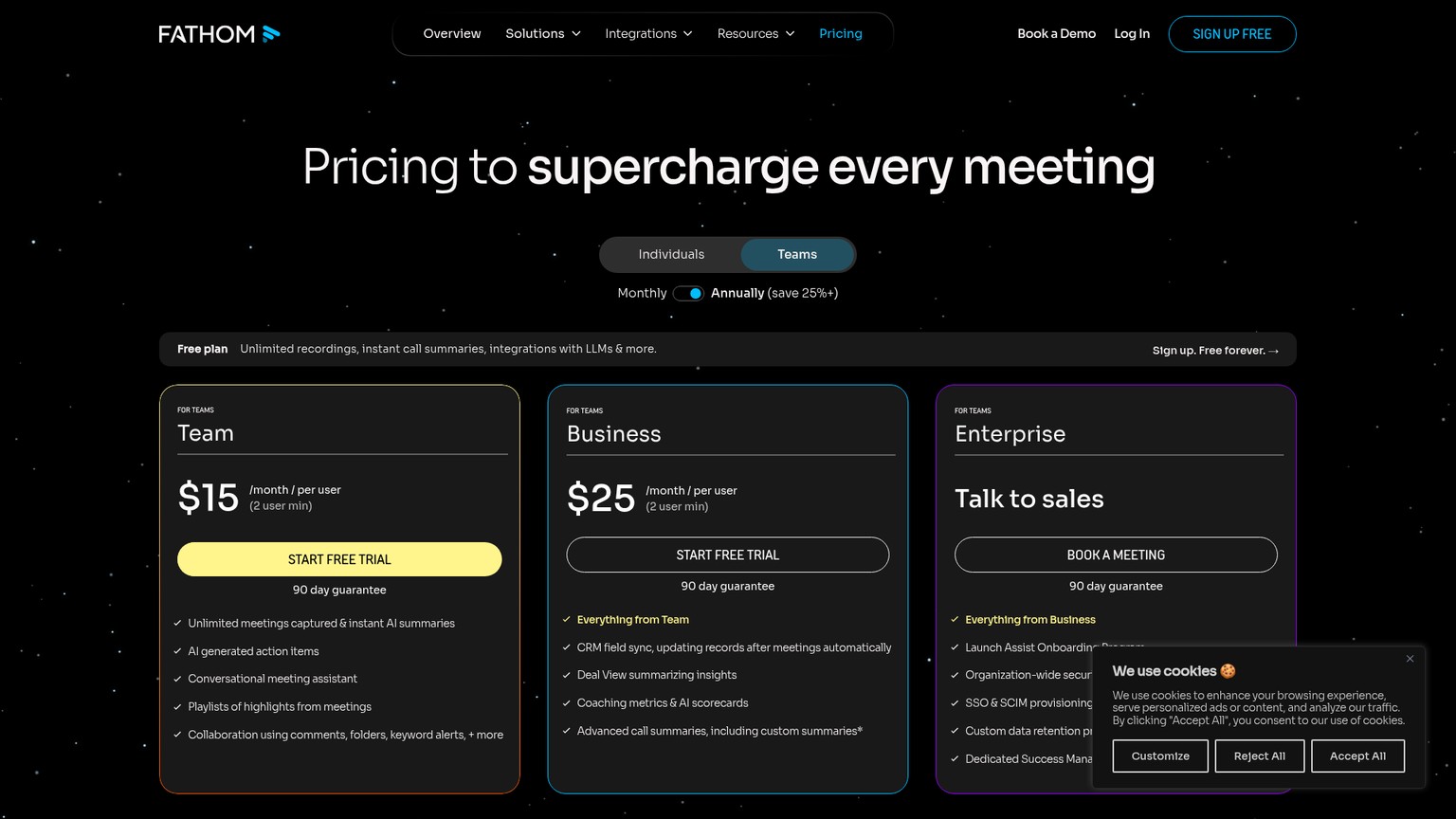
The table exposes an unusual pricing shift. Free and paid are not different quantities of the same product. They are different jobs. Free captures and summarizes the conversation. Pro turns the archive into a connected operating memory. Business lets an organization govern that memory.
This produces a clean rule: stay free until you can name the first meeting, connector, or policy that Free cannot handle. A vague feeling that paid must be better is not a buying reason. Neither is meeting volume.
How the comparison was judged
Four criteria decide the verdict, in this order.
First, the free plan must finish the core job. A plan does not qualify as useful because it records audio. It must create notes a person can scan, identify follow-up work, and preserve enough context to verify the summary. Circleback Free clears that bar with AI notes, action items, and speaker-labeled transcripts. Fathom Free clears it with recordings, transcripts, and its General/Enhanced summary after the advanced allowance is used.
Second, the limit must be measured against normal work. A 5-call AI allowance can be generous for a founder with occasional investor calls and restrictive for a customer-success manager in back-to-back conversations. A 30-day archive can cover an active project and fail a quarterly account review. The plan name matters less than the first normal task that crosses its boundary.
Third, paid capability must replace labor or risk. Full integrations can remove copy-paste. Enforceable defaults can replace manual policy checks. Single sign-on can satisfy procurement. A prettier summary template with no downstream consequence does not deserve the same budget weight.
Fourth, evidence must be separated from marketing. Vendor pages establish current prices and published capabilities. A third-party accuracy result belongs to its measurer and sample. This comparison did not run private customer calls through the products, so it does not manufacture an accuracy winner from screenshots or vendor claims.
That rubric deliberately keeps transcription quality from swallowing the decision. Both free options promise the core transcript. Circleback does not publish a different accuracy level for Pro. Until a buyer measures its own calls, the defensible plan choice comes from capacity, memory, workflow, and control.
Prices and plan boundaries in this comparison were verified against the live Circleback pricing page and Fathom pricing page on August 31, 2026. The Circleback page shows Pro at $15 per user monthly with annual billing, not the earlier $14 figure that circulated before the final plans went live.
What Circleback Made Free on August 31
Circleback removed meeting capacity from the budget decision. Its new plan announcement, dated August 31, says Free includes AI notes and action items for unlimited online and in-person meetings. It is a permanent free plan, not a trial.
That matters because the old freemium pattern used transcription minutes as pressure. A founder could try the product, but a normal week of customer calls pushed the account into a paid tier. Circleback now lets a solo operator or small team keep recording without watching a meter.
The $0 plan is more than raw speech-to-text. It includes speaker-labeled transcripts, automatic tagging and sharing, online capture through a meeting bot or a bot-free desktop app, and in-person capture through mobile and Apple Watch apps. The core outcome is complete: a conversation becomes notes, action items, and a transcript a person can review.
Free still has four walls, and each one maps to a different paid buyer:
- Memory: meeting and recording history covers 30 days.
- Connections: Slack and Linear are included, while the broader integration catalog is paid.
- Automation: API, Model Context Protocol, command-line, and automation access is limited. Model Context Protocol, or MCP, is a standard that lets AI tools retrieve context from external systems.
- Workspace shape: Free supports 2 teams.
Those are not hidden usage caps. They are product boundaries. A consultant who needs notes from this month's calls can stay free. A revenue operator who needs a customer objection from last quarter cannot treat 30 days as a knowledge base. A growth lead who copies every action item into HubSpot is already doing the work Pro is priced to remove.
The release changes the budget conversation from "How many meetings do we run?" to "What must happen after the meeting?" That is a healthier buying question because it ties spend to an outcome instead of activity.
The Best AI Meeting Note-Taking App Is Free Until Memory Becomes Workflow
The strongest option depends on what happens after the summary arrives. Comparing transcription alone misses the commercial difference between these plans.
Winner for core capture: Circleback Free
Circleback Free wins the basic job because it does not ration meetings, AI notes, or action items, and it explicitly covers both online and in-person conversations. A local-services owner can record a site visit on a phone, while a remote agency owner can use a bot or the desktop app for a client call. Both end at $0.
The candid limit is the 30-day window. That is generous for follow-up and weak for institutional memory. A project manager closing current tasks may never notice. A customer-success lead reviewing a past renewal conversation will.
Winner for a permanent free archive: Fathom Free
Fathom Free wins when the archive itself is the product. Its current documentation lists unlimited recordings, storage, and transcription. A solo seller who wants every Zoom, Google Meet, or Microsoft Teams call available later gets a durable record without a subscription.
The tradeoff sits above transcription. Fathom gives Free users advanced summaries for the first 5 calls each month. Later meetings keep a General/Enhanced summary, while advanced AI action items, follow-up emails, custom summaries, and Ask Fathom belong to Premium. The archive is uncapped; the richer processing is not.
Winner for connected memory: Circleback Pro
Circleback Pro wins as soon as meeting context must leave the note-taking app. It adds unlimited meeting history, 1 year of recording storage, all integrations including Notion, HubSpot, Salesforce, and Attio, custom AI insights, and full API, MCP, and command-line access.
At $15 per user monthly on annual billing, the buyer is not purchasing more calls. The buyer is purchasing fewer manual transfers and a longer memory. Pro is worth it when a meeting note must update a deal, create work, answer a later question, or feed an internal agent without copy-paste.
The limit is organizational control. Circleback's published plan grid puts admin and member roles, enforceable defaults, custom retention, and the usage dashboard on Business. Pro connects a person's work. It is not the full control plane for a company.
Winner for governance: Circleback Business
Circleback Business wins when consistency is a requirement rather than a preference. It costs $25 per user monthly on annual billing and adds admin/member roles, unlimited free viewers, custom data retention, default and enforceable settings, 2 years of recording storage, a usage dashboard, and unlimited teams.
A 10-person demand-generation team may not need those controls. A 100-person revenue organization probably cannot rely on every employee choosing the right sharing and retention settings. Business is the point where the product becomes centrally managed software.
Enterprise goes one step further at $35 per user monthly on annual billing. It adds single sign-on, invoice or purchase-order billing, unlimited recording storage, priority support, and HIPAA compliance. Those are procurement and risk requirements, not productivity upgrades.
The Normalized Cost: One 300-Meeting Workload
A shared workload makes the budget consequence visible. Take a 10-person B2B SaaS growth team, with each person attending 30 recorded meetings per month. That is 300 meetings monthly.
Circleback Free processes the workload for $0. Circleback Pro costs $150 per month at its annual-effective rate, or $0.50 per meeting. Paying month to month raises that to $180, or $0.60 per meeting. Circleback Business costs $250 per month annually, about $0.83 per meeting, or $290 month to month, about $0.97 per meeting.
Ten separate Fathom Free individual accounts also transcribe all 300 meetings for $0. If usage is evenly distributed, the 5 advanced summaries per person cover 50 meetings. The other 250 receive the General/Enhanced template. This is not a shared team workspace: Fathom's current Team and Business plans no longer offer free seats. The $0 scenario is valid for independent users, not for a manager who needs one governed repository.

The annual budget makes the same point at a scale a finance owner recognizes. Ten Circleback Pro seats cost $1,800 per year. Business costs $3,000. Enterprise costs $4,200. Every tier can handle the same meeting count, so the extra $1,200 from Pro to Business must be justified by governance, not output volume.
There is a useful time-saved break-even. Use an illustrative loaded labor value of $50 per hour. A $15 Pro seat needs to remove 18 minutes of manual work per user per month to pay for itself. Across 10 seats, that is 3 team-hours monthly. The $100 monthly premium from Pro to Business at 10 annual-rate seats needs to remove 2 team-hours monthly, or prevent a policy failure that costs more than $100.
This is the "memory, not minutes" crossover. A paid plan does not become rational at an arbitrary meeting or hour threshold because meeting capacity is already unlimited. It becomes rational at one of three events:
- Someone needs the first Circleback meeting older than 30 days.
- A missing connector or API step creates more than 18 minutes of monthly manual work per paid user.
- A manager needs a setting, retention rule, or access policy to be enforced rather than requested.
Annual billing changes the answer enough to matter. Circleback Pro is $18 month to month and $15 on annual billing. Business is $29 month to month and $25 annually. A team still learning its workflow should pay the monthly premium for flexibility before locking a year. Once the friction log proves the tier, annual billing lowers the recurring cost.
Where Free Wins
Free wins for most individual contributors because the essential output is already present. If your meetings produce a summary, action items, a transcript, and something you can share, the marginal value of another feature is often lower than the certainty of another subscription.
Consider a solo agency owner running regular client calls. Circleback Free handles the volume, captures in-person workshops, and sends notes through Slack or Linear. There is no financial case for Pro unless the owner regularly needs an older meeting or moves the notes into a connector outside those two apps.
A founder interviewing customers has the same answer. The call count can rise without changing cost. Free also makes experimentation cleaner: the founder can compare capture modes, see whether action items are useful, and learn which meetings deserve retention before choosing a paid system.
Free is also the better default when adoption is uncertain. A 10-seat rollout at $15 per user commits $1,800 annually. Starting with Free exposes who uses the system, how many paid accounts are needed, and which integrations would replace labor. Paying first hides that information behind sunk cost.
Fathom Free wins a different free use. Its unlimited storage supports a personal call archive without a 30-day boundary. A consultant who wants to revisit last year's discovery calls but does not require advanced summaries on every meeting has a strong reason to choose it over Circleback Free.
The catch is that neither $0 option solves every team problem. Circleback limits memory and broad workflow access. Fathom limits advanced AI processing after 5 calls per month and restricts CRM sync to 3 users per email domain on its individual plans. Free is excellent when the missing feature is genuinely optional. It is expensive in staff time when a person rebuilds the missing workflow by hand.
Fathom AI Note Taker Is the Strongest $0 Archive Alternative
Fathom is the closest counterexample to the idea that paid software is necessary for long-term meeting memory. The current Free-versus-Premium documentation gives both plans unlimited recordings, storage, and transcription in 38 languages. That is a stronger archive promise than Circleback Free's published 30-day history.
Its free-to-paid boundary is richer analysis. The first 5 calls each month get advanced summaries. After that, Free retains the General/Enhanced template. Premium adds unlimited advanced summaries, AI-generated action items, follow-up emails, custom formats, and Ask Fathom.
A small independent benchmark offers useful context without settling the buying decision. AI Tools Digest created manual reference transcripts for five meetings lasting 15 to 60 minutes and measured Fathom at 96.1% average word accuracy and 94% speaker-identification accuracy. That is the measurer's result, not ours, and five meetings is too small to generalize across accents, room acoustics, or specialized vocabulary.
There is no equivalent independent Circleback Free-versus-Pro accuracy result to cite. More importantly, Circleback lists the same core notes and transcript capability on Free. The plan page does not show a paid accuracy engine. Paying for Pro should therefore be justified by memory and workflow, not an assumed improvement in transcript quality.
Who should pick Fathom Free: an individual who records mostly online meetings, wants to retain everything, and can accept basic summaries after the fifth advanced call. Who should skip it: someone who needs unlimited action-item extraction, broad in-person capture, or a connected team workflow without a paid tier.
An AI Meeting Note Taker App Should Match the Capture Context
Capture context can eliminate a plan before price matters. Circleback Free explicitly supports online and in-person meetings, a bot or bot-free desktop app online, and mobile or Apple Watch capture in person. One account can cover a Zoom call, a coffee-shop interview, and a field visit.
Fathom Free lists a choice between bot capture and a bot-free mode in beta. That is compelling for online meetings because the user can avoid adding another named participant to the call. A beta capture path may still be the wrong default for a company that requires a uniform, supportable method across every employee.
The buying rule is simple: choose the capture method before choosing the plan. If half of the conversations happen away from a laptop, Circleback's in-person support earns weight. If every meeting is online and the archive matters most, Fathom's unlimited storage earns weight. If a native Zoom or Microsoft Teams assistant already produces acceptable notes, a separate app must earn its seat through cross-platform memory or downstream action.
No capture mode removes the need to tell participants and follow the applicable recording rules. Bot-free means less visual friction, not invisible consent.
Where Paid Wins: History, Integrations, and Governance
Paid wins when meeting notes become shared infrastructure. That happens in stages, and buying the next stage early wastes money.
Pro wins at the memory boundary
Circleback Pro is the direct answer to the day-31 problem. It adds unlimited meeting history and 1 year of recording storage. The distinction matters: meeting history lets the user find and work with the old record, while recording storage defines how long the media itself remains available.
For a B2B SaaS growth lead, one old meeting can justify the plan. A prospect mentioned a security objection, returned months later, and the new account executive needs the exact context. If the original note is outside Free's history, the operating memory failed at the moment it was valuable.
Pro also earns its cost when context must move. The live plan includes all integrations, naming Notion, HubSpot, Salesforce, and Attio, plus full API, MCP, and command-line access. A meeting can update a deal, create work, or become context for an internal assistant without a person copying the summary.
That is why the 18-minute break-even is useful. A handful of manual CRM updates can clear it. If nobody uses the integration, Pro is a $180 annual insurance policy per person against a problem the team does not have.
Business wins at the control boundary
Business is not "better Pro." It is the first Circleback plan whose published features address central administration: admin and member roles, default and enforceable settings, custom data retention, a usage dashboard, unlimited teams, and unlimited free viewers.
The named situation is a revenue organization where meeting records contain customer details and every employee should follow the same sharing rule. A policy document asks people to behave consistently. An enforceable setting makes the product behave consistently. That difference is what the extra $10 per seat at annual rates buys.
Unlimited free viewers also changes seat economics. A person who only needs to read notes should not become a full paid seat by habit. Separate recorders, editors, and viewers before calculating the Business budget.
Enterprise wins only at the procurement boundary
Enterprise earns consideration when a contract requires single sign-on, invoice or purchase-order billing, unlimited recording storage, priority support, or HIPAA compliance. Circleback lists those features at $35 per user monthly with annual billing.
Do not treat a compliance label as blanket approval. A regulated buyer still needs legal, security, retention, and access reviews for the specific workflow. The plan tells you where the vendor places the feature; it does not make the implementation compliant by itself.
AI Meeting Note Taker for Teams: The Seat Test
The right tier changes with the operating situation, not with company prestige.
A solo agency owner should start on Circleback Free. Unlimited capture removes the usage worry, 30 days covers active client follow-up, and Slack or Linear may be enough. Upgrade only if old conversations become a recurring source of truth or a connector replaces repeated admin.
A 10-seat B2B SaaS growth team should run Free before buying Pro. At annual rates, Pro is $1,800 per year. A short trial can identify which users record meetings, which connectors matter, and whether the team needs history beyond 30 days. Buying every seat before checking roles can inflate the budget.
A revenue leader should consider Business when the workflow needs enforcement. The plan's $3,000 annual cost for 10 paid seats is not justified by more transcripts. It is justified when admins must set defaults, monitor usage, control retention, and give non-recording colleagues view access.
A regulated operator should skip the lower-tier experiment for sensitive calls. If single sign-on or HIPAA is a requirement, the published plan boundary points to Enterprise. A free rollout with sensitive data does not become prudent because it is easy to start.
A company whose meeting platform already includes acceptable notes should test that option first. A dedicated note taker must earn its extra system through cross-platform capture, better retrieval, or automation. Duplicate summaries in two repositories create more search work, not less.
This seat test prevents the common purchasing error: buying Business because the company is a business. Plan names describe packaging, not fit. Buy the lowest plan that satisfies the named constraint.
For a wider market view beyond Circleback and Fathom, the nine-tool AI meeting note taker comparison covers capture modes, per-seat costs, and privacy tradeoffs. The adjacent AI note-taking apps comparison is broader than meetings and helps when the real need is a personal knowledge system.
Switching Costs and Who Should Not Switch
Switching is easier than rebuilding a meeting archive by hand, but it is not free. The cost lives in data coverage, permissions, workflow repair, and trust.
Circleback reduced the data part on August 28. Its meeting import release says users can connect the app they are leaving, preview meetings, and bring over notes, transcripts, attendees, and recordings when available. Imported meetings can be searched, shared, and queried like native Circleback meetings.
There is still a team step: each person imports their own meetings. Circleback says the meetings keep their existing sharing relationships, but an operator should verify a sample before moving the whole archive. Check a private meeting, a shared customer call, a recording, a transcript with several speakers, and an older note that people still reference.
Workflow migration is the larger cost. A HubSpot field mapping, a Slack notification, a Linear issue rule, or an internal agent that reads transcripts has to be rebuilt and checked. A technically successful import can still fail the business if follow-up stops flowing to the right place.

Do not switch from Fathom Free to Circleback Free just to save money. Both cost $0. Switch if unlimited advanced notes, in-person capture, or Circleback's workflow shape is more important than Fathom's unlimited free storage. Stay with Fathom if the durable archive is the deciding outcome and the 5-call advanced-summary allowance is enough.
Do not upgrade from Circleback Free because the paid page looks more professional. Upgrade when the friction log has a named item: an inaccessible old meeting, a required connector, repeated manual work, an admin setting, or a procurement requirement.
Do not switch a regulated workflow directly into Free or Pro when Enterprise features are mandatory. The cheaper tier does not satisfy a requirement that only the higher tier lists.
Do not standardize on either product solely from an accuracy percentage. The cited Fathom test used five reference-checked meetings, and no comparable independent plan-level Circleback benchmark was available. Run both on a consented sample of your normal audio, including accents, cross-talk, product names, and the rooms where people meet.
Export the decision, not just the data
Write down why the current tool is failing: history, capture context, summary depth, integration, or control. If the reason is not specific, keep the current system.
Import a representative sample
Bring over private, shared, old, and media-rich meetings. Confirm transcripts, attendees, recordings, search, and permissions before moving the whole team.
Rebuild one downstream workflow
Connect the CRM, project tool, or agent that receives the meeting output. Validate the result with a real but non-sensitive call.
Move only the paid roles
Assign paid seats to recorders, editors, automators, and admins. Keep viewers out of the paid-seat count where the plan allows it.
The Monday Move
Start Monday on Circleback Free and spend one week collecting evidence, not opinions.
Create a friction log with three tags: memory, workflow, and control. Add an entry whenever someone cannot reach an older meeting, copies information into another system, or asks for a setting they cannot enforce. Include the person, minutes spent, and business consequence.
At the end of the week, make one of four moves:
- Stay on Free if the log is empty or the work is below the 18-minute-per-user monthly Pro break-even.
- Choose Pro if old history or integrations remove recurring work.
- Choose Business if the problem is roles, retention, defaults, or usage oversight.
- Keep or test Fathom Free if indefinite $0 storage matters more than unlimited advanced AI output.
Do not annualize on Monday. Use monthly billing while the process is uncertain, even though it costs $18 instead of $15 for Pro and $29 instead of $25 for Business. Lock the annual rate after the workflow proves which seats and tier are necessary.
The result should be a one-line budget defense: "Pro costs $150 a month for 10 seats and removes at least 3 hours of monthly transfer work," or "Free covers the job, so the budget stays at $0." If the team cannot write that sentence, it has not earned the subscription.
Frequently Asked Questions
What is the best free AI note taker for meetings?
Circleback Free is the stronger default for unlimited online and in-person AI notes and action items. Fathom Free is stronger when unlimited recording storage matters more than receiving advanced AI features on every call.
What is the best AI meeting note taker in 2026?
No single tool wins every job. Circleback Free wins the narrow comparison here for unlimited core capture; Fathom Free wins the free archive; Circleback Pro wins connected history; Circleback Business wins governance.
How much does an AI meeting note taker cost?
The options here run from $0 to $35 per user monthly on annual billing. Circleback Pro is $15, Business is $25, and Enterprise is $35 per user monthly when billed annually; month-to-month Pro and Business are $18 and $29.
Which AI note taker is the best?
Pick from the failure you need to remove. Use Circleback Free for unlimited basic capture, Fathom Free for indefinite storage, Circleback Pro for history and integrations, and Business for centrally enforced controls.
What is the most secure AI note taker?
There is no universal winner because security depends on access, retention, identity, consent, and contract requirements. Circleback places custom retention on Business and lists single sign-on plus HIPAA compliance on Enterprise; buyers should validate the full workflow, not rely on a tier label.
Can ChatGPT take notes?
Yes. OpenAI's small-team meeting guide says ChatGPT Record in the macOS desktop app can capture a meeting and produce a transcript, summary, and action items. Check current workspace availability before treating it as a dedicated recorder, and verify important output.
Why are people leaving ChatGPT?
That is separate from the free-versus-paid meeting-note decision. People change AI products for different capability, price, privacy, interface, and workflow reasons; none of those reasons proves which meeting recorder fits a team.
Can AI write minutes of meeting?
Yes. A meeting assistant can turn a transcript into decisions, action items, owners, and a concise record. A human owner should verify names, dates, commitments, and disputed wording before those minutes become authoritative.
What's the difference between AI and GPT?
Artificial intelligence is the broad field of systems that perform tasks associated with human reasoning or perception. GPT is a family of generative models that can summarize a transcript, but capture, speaker labeling, storage, permissions, and integrations come from the surrounding meeting product.
How do automatic meeting notes in Teams work?
Microsoft Teams or a connected third-party tool captures meeting audio, produces a transcript, and turns it into a summary and action items. Availability depends on the organization's licenses and tenant settings, and recording still requires the appropriate participant notice and consent.
What is the best AI meeting note taker free?
Circleback Free wins when the priority is unlimited AI notes across online and in-person meetings. Fathom Free wins when the priority is unlimited recording storage and the first-5-call advanced-summary boundary is acceptable.
Get the AI Business Workflow Audit Checklist to map which meeting steps should stay free and which are worth automating.
- Published
- Category
- Growth
- Language

Beehiiv Review
Beehiiv reviewed for business newsletters: current pricing, growth, monetization, AI, MCP, analytics and the costs that change the buying decision.Oct 10, 2026Growth
Trainual Review
Trainual review for SOPs and onboarding: AI drafting, knowledge search, read-only MCP, quote-only plans, implementation and who should skip it.Oct 10, 2026Growth
SocialBee Review
SocialBee review of evergreen scheduling, AI Copilot and client workspaces, with all six plans, add-on costs, and Buffer and Later comparisons.Oct 10, 2026Growth
SurveyMonkey Pricing: Plans, Response Caps and Annual Bills
SurveyMonkey prices, response caps and AI limits, with annual bills for one person and three-seat teams. See when overages change the best plan.Oct 10, 2026Growth
ActiveCampaign Alternatives: GetResponse, Kit and More
Compare ActiveCampaign alternatives at 2,500, 10,000 and 25,000 contacts, with vendor prices, workflow trade-offs and a migration checklist.Oct 9, 2026Growth
CallRail Alternatives: WhatConverts and More Compared
Compare six CallRail alternatives by vendor pricing, usage fees, AI and reporting. Includes WhatConverts cost math and a pre-switch checklist.Oct 9, 2026Growth
Monday.com Pricing: Seat Buckets and the Yearly Bill
Calculate monday.com Work Management costs for 5, 12 and 40 people, including seat buckets, annual vs monthly billing and AI credit charges.Oct 9, 2026Growth