Gemini 3.6 Flash Review: Adopt It for Agents, Not Every Task
Gemini 3.6 Flash cuts output price to $7.50/M and output use by 17%. See the benchmarks, migration risks, cost math, and adoption verdict.
Published Updated
 By Omid Saffari


Gemini 3.6 Flash is the right upgrade for complex agent and coding loops, not the new default for every Gemini workload. Google cut the output price from $9.00 to $7.50 per million tokens and reports 17% fewer output tokens than 3.5 Flash, but simple extraction still belongs on the $2.50-output Flash-Lite tier.
The verdict: move agents, not everything
Gemini 3.6 Flash should replace 3.5 Flash when the workload loops through planning, tools, code, and verification. It should not replace the cheaper Flash-Lite model for routine extraction, classification, or structured parsing that already clears your quality bar.
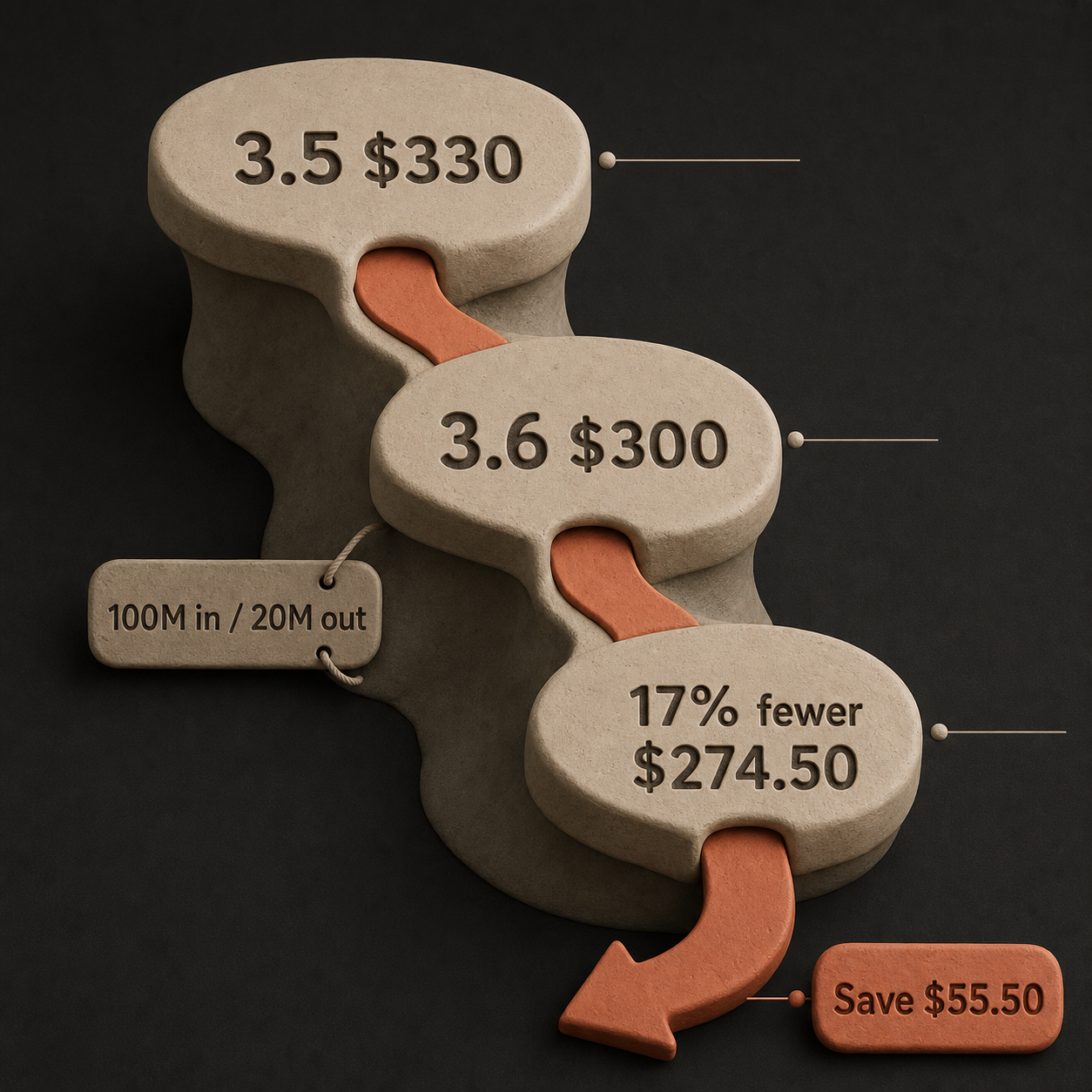
According to Google’s current model guide, the model is generally available under the stable ID gemini-3.6-flash, with medium thinking by default. That makes it a production option, not a preview bet. It also changes the decision created by the Gemini 3.5 Pro delay: there is still no reason to wait for Pro when a stronger workhorse is live now.
The explicit decision rule is simple: move a workload to 3.6 only when its lower retry rate, lower output use, or higher accepted-task rate beats the cheaper model after human review. Model price is the meter. Cost per accepted task is the bill.
The broader Gemini 3 lineup still matters for consumer plans and flagship reasoning. This review is narrower: which API workload deserves the new Flash model.
What changed: fewer loops now matter as much as lower price
Gemini 3.6 Flash improves the two costs that compound inside an agent: the price of each output token and the number of tokens generated while the agent works.
An agentic loop is a repeated cycle of plan, act, inspect, and retry. A support agent might search an order, call a refund tool, check policy, draft a response, notice a mismatch, and call another tool. Every extra reasoning turn adds tokens, latency, and another chance for a malformed call. A cheaper token helps once. A shorter loop helps at every turn.
In its July 21 release, Google reports that 3.6 Flash used 17% fewer output tokens than 3.5 Flash on the Artificial Analysis Index. The company also says the model takes fewer reasoning steps and tool calls on multi-step work. That is the release’s strongest business case because it can reduce both the unit rate and the amount consumed.
The quality gains point to the same use:
These are Google-published results, so treat them as a reason to evaluate, not as proof that your workflow will improve by the same amount. Their pattern is still useful. The largest gains land on sustained engineering, machine-learning work, computer use, and very long context. A one-turn classifier does not receive the same benefit.
The model also changes its working style. Google documents more upfront diagnostic scripting, fewer unwanted code edits, and fewer execution loops. That behavior is valuable when a mid-market CTO has an agent tracing a failure across several services. It can be wasteful when a solo builder asks for a small CSS change and the model inspects half the project first.
The cost math: $330 becomes $274.50 in the favorable case
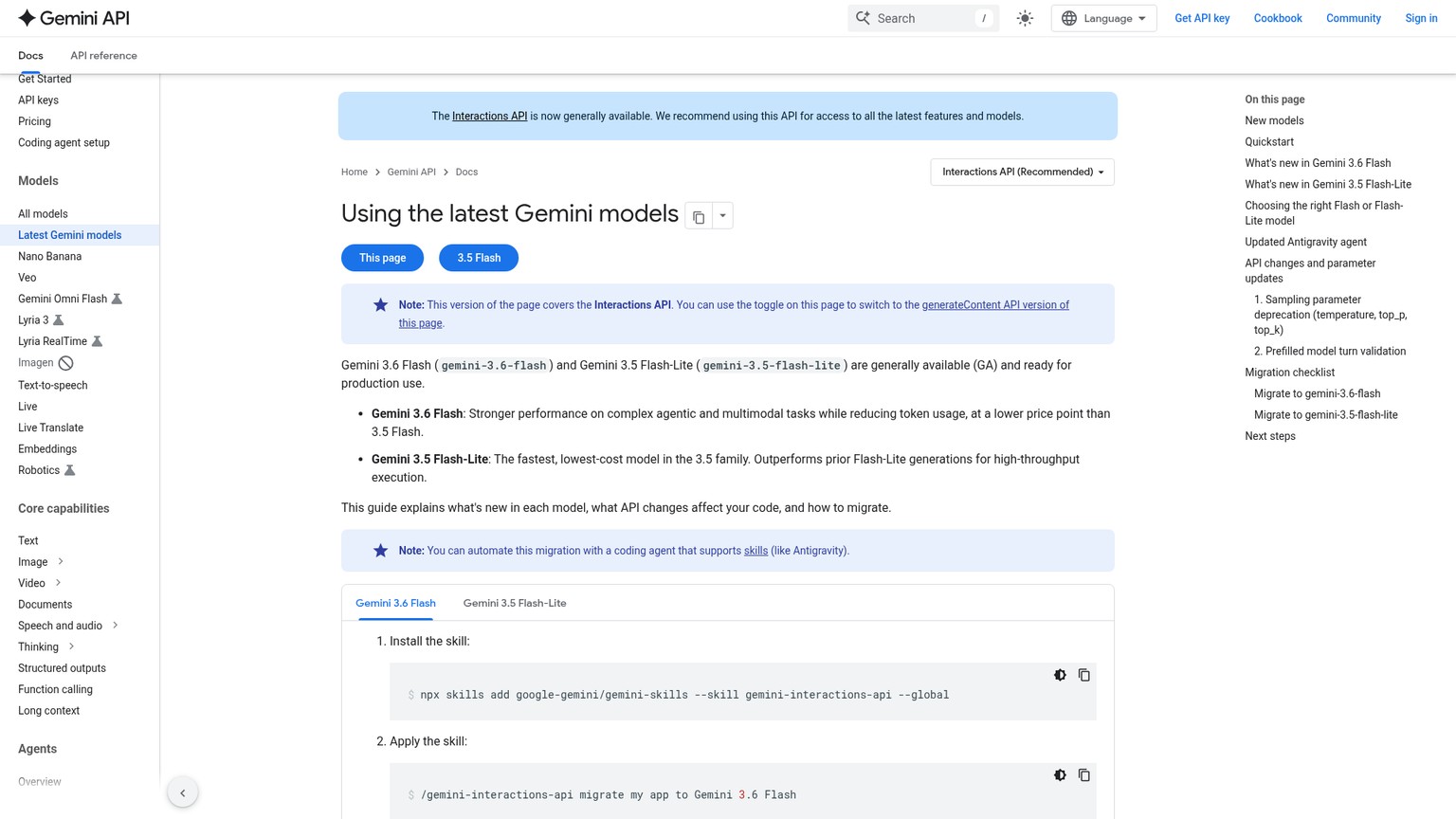
Gemini 3.6 Flash saves 9.1% at identical token volume, and the saving reaches 16.8% in a worked workload if Google’s 17% output-token reduction carries over.
Take a production agent using 100 million input tokens and 20 million output tokens per month:
- Gemini 3.5 Flash input: 100M at $1.50 per million = $150
- Gemini 3.5 Flash output: 20M at $9.00 per million = $180
- Gemini 3.5 Flash total: $330
Keep the same token volume on 3.6 Flash and output falls to $150, producing a $300 total. Now apply the reported 17% reduction to output volume. The agent generates 16.6 million output tokens instead of 20 million:
- Gemini 3.6 Flash input: $150
- Gemini 3.6 Flash output: 16.6M at $7.50 per million = $124.50
- Gemini 3.6 Flash total: $274.50
- Saving versus 3.5 Flash: $55.50 per month, or 16.8%
That is not a forecast. The 17% came from one evaluation, and your prompts, tools, retries, and thinking settings determine whether it transfers. It is the right scenario to test because it separates the guaranteed price cut from the workload-dependent efficiency gain.
Google’s current Gemini API price card exposes four consumption prices for 3.6 Flash. Standard is $1.50 input and $7.50 output per million tokens. Batch and Flex each cut those rates to $0.75 and $3.75. Priority raises them to $2.70 and $13.50. The same 100M-input and 20M-output workload costs $150 at Batch or Flex list rates before any output reduction.
Context caching can reduce repeated prompt input to $0.15 per million cached tokens, plus $1.00 per million tokens per hour for storage. That matters when every agent run includes the same handbook, schema, or policy corpus. It does not rescue a prompt that changes almost completely on every request.
Search grounding has its own meter: 5,000 prompts per month free, shared across Gemini 3, then $14 per 1,000 search queries. A research agent therefore needs two budget lines, model tokens and retrieval. Treating grounded calls as token-only work understates the bill.
The benchmarks say upgrade, not “new universal leader”
Gemini 3.6 Flash is convincingly better than 3.5 Flash, but Google’s own July model-card table does not make it the best model at every hard task.
The position is precise: 3.6 Flash is a Flash upgrade with a credible computer-use edge, not a reason to route every difficult task away from the frontier model already winning it. If your bottleneck is repository-scale engineering rather than cost-efficient agent throughput, compare the current coding-model choices before standardizing.
Benchmarks also compress production behavior into one score. A high aggregate completion rate can still be expensive when the remaining failures require long traces, repeated tool calls, or senior review. The model with the lower token rate can lose on cost per accepted task when it retries much more often. The more useful scorecard tracks:
- accepted tasks without manual repair
- output tokens per accepted task
- tool-call success and malformed-call rate
- p50 and p95 latency
- timeout and retry rate
- reviewer minutes per result
- Standard output price falls from $9.00 to $7.50 per million tokens.
- Google reports 17% fewer output tokens than 3.5 Flash on the Artificial Analysis Index.
- The largest vendor-reported gains land on long-horizon coding, machine-learning engineering, computer use, and 1M-context retrieval.
- The stable model ID is generally available, with Batch, Flex, and Priority options.
- Several frontier rivals still lead Google’s own coding and knowledge-work comparisons.
- Google acknowledges occasional slowness and timeout issues.
- Human evaluators preferred earlier models for visual layout and styling.
- The migration deprecates familiar sampling controls and rejects prefilled model turns.
The production wall is behavior, not context size
Gemini 3.6 Flash has enough context and tools for serious agents. The wall is whether its behavior stays predictable across your tools, latency budget, and review standard.
The documented Gemini 3.6 Flash model page sets an input limit of 1,048,576 tokens and an output limit of 65,536 tokens. It accepts text, image, video, audio, and PDF, then returns text. It supports caching, code execution, file search, function calling, search and Maps grounding, structured output, thinking, URL context, and computer use in Preview.
That breadth makes it a sensible engine for a funded founder building an operations agent that reads contracts, checks a dashboard, calls internal tools, and drafts an exception report. It also fits a senior operator reviewing mixed PDFs, charts, and meeting audio inside one case.
The boundaries are just as important:
- Computer use is Preview. Put approval gates around actions that change customer, financial, or production state.
- Image generation, audio generation, and the Live API are not supported. A real-time voice or media-generation product needs another model in the stack.
- The knowledge cutoff is March 2026. Use search grounding or your own retrieval when current facts decide the answer.
- Hallucinations remain a known limitation. Long context is capacity, not truth.
- Occasional slowness and timeouts are documented. A customer-facing workflow still needs retries, idempotency, and a fallback path.
- Visual styling can regress. Google says human evaluators preferred earlier models for layout and styling even when 3.6 produced more functional code.
The last point is easy to miss. A solo technical builder asking for a polished landing page can receive cleaner logic and a weaker composition. Give explicit design rules, validate screenshots, and do not let a coding benchmark stand in for a design review.
Migrate without breaking production
Gemini 3.6 Flash is not a model-ID-only swap. Google’s migration guide changes request controls, turn validation, and parts of function-call handling.
The breaking edges are concrete:
- Remove
temperature,top_p, andtop_k. They are deprecated and ignored, and Google says future model generations will return HTTP 400 when they are supplied. - Replace
thinking_budgetwiththinking_levelset tomediumorhigh. - Remove
candidate_count, which Gemini 3.x does not support. - Remove prefilled model turns. A request ending in a non-empty
modelrole turn returns HTTP 400. - Standardize multi-turn state on server-side
previous_interaction_id. - If you use
generateContent, includecall_idandnamein everyFunctionResponse.
Do not discover those changes after routing live traffic. Run the migration as a controlled model evaluation:
Freeze an acceptance set
Select real, sanitized tasks that represent successful work, common failures, long tool chains, multimodal inputs, and timeout-sensitive paths. Record the 3.5 Flash result, output tokens, latency, retries, tool calls, and reviewer time.
Clean the request contract
Remove the deprecated sampling fields, prefilled model turns,
thinking_budget, andcandidate_count. Update multi-turn and function-response handling before changing the model ID.Shadow 3.6 beside 3.5
Send the same eligible inputs to both models without allowing the 3.6 result to change external state. Compare accepted-task rate and cost per accepted task, not just fluent output.
Canary the safest slice
Route a small, reversible workload to
gemini-3.6-flash. Watch p95 latency, timeouts, malformed tool calls, token use, and human overrides. Keep 3.5 Flash as the immediate rollback.Expand by task class
Move complex coding and agent loops first. Leave simple extraction on Flash-Lite and leave any task that misses its quality gate on the incumbent. A mixed router is a valid end state.

Who should adopt Gemini 3.6 Flash now
Teams with complex Flash workloads should evaluate now; teams paying for simple throughput should stay on Flash-Lite.
Adopt when the work benefits from fewer loops. Wait when the workflow is latency-critical, styling-heavy, already reliable on Flash-Lite, or dependent on a benchmark where 3.6 still trails.
The clean architecture is a router, not a favorite model: Flash-Lite for predictable volume, 3.6 Flash for complex agent loops, and a frontier escalation path for the failures whose value justifies the higher bill.
Frequently asked questions
How much does Gemini 3.6 Flash cost?
Standard paid API pricing is $1.50 per million input tokens and $7.50 per million output tokens, including thinking tokens. Batch and Flex are $0.75 input and $3.75 output; Priority is $2.70 input and $13.50 output.
Is Gemini 3.6 Flash a reasoning model?
Yes. Gemini 3.6 Flash supports thinking and uses medium as its default thinking level. Google recommends medium or high when migrating from the older thinking_budget control.
What is the Gemini 3.6 Flash context window?
The documented input limit is 1,048,576 tokens and the output limit is 65,536 tokens. It accepts text, image, video, audio, and PDF inputs, with text output.
Is Gemini 3.6 Flash better than Gemini 3.5 Flash?
Yes for complex Flash workloads. It costs less per output token, Google reports 17% fewer output tokens, and its published scores are higher across coding, machine-learning engineering, computer use, and long-context retrieval. Keep 3.5 Flash as a rollback until your own canary clears its acceptance gates.
Want the AI tools map for business owners? Get it with the newsletter.
- Last Updated
- Category
- AI
- Language

Gamma Alternatives in 2026: Beautiful.ai, Prezi and More
Compare Gamma alternatives for brand control, editable PowerPoint and Google Slides, pitch decks and live talks. Current plans and clear tradeoffs.Oct 11, 2026AI
Reflection AI Beam: What It Means for Coding and Agents
Reflection AI Beam explained: October release plans, vendor benchmark claims, beta access and whether builders should wait before switching models.Oct 10, 2026AI
Claude for Google Workspace
How to install and deploy Claude in Docs, Sheets and Slides, control edits, and test the paid-plan beta with three practical team workflows.Oct 10, 2026AI
Claude Dashboards
Set up Claude Dashboards beta, inspect SQL and refresh timestamps, check a sales metric, and decide when to keep your BI tool.Oct 10, 2026AI
Granola AI Review
Granola reviewed for business meetings: bot-free notes, current pricing, templates, recipes, consent, platform limits and who should choose an alternative.Oct 10, 2026AI
Fyxer Review
Fyxer reviewed through current pricing, help docs and public feedback: inbox sorting, drafts, meetings, privacy and who should pay for Pro or Team.Oct 9, 2026AI
GPT 6 Explained: Models, Release Dates, Access, and Prices
GPT-6 Astra, Sol, 6.1 Sol and Luna explained: release dates, ChatGPT plan access, Work and Codex availability, and verified API costs.Oct 9, 2026AI