GPT-5.6 vs Claude Sonnet 5: Sonnet Wins on Value, Sol Wins the Ceiling
GPT-5.6 vs Claude Sonnet 5 on price, coding, agent benchmarks, long context, and the routing rule that decides which model fits.
Published Updated
 By Omid Saffari



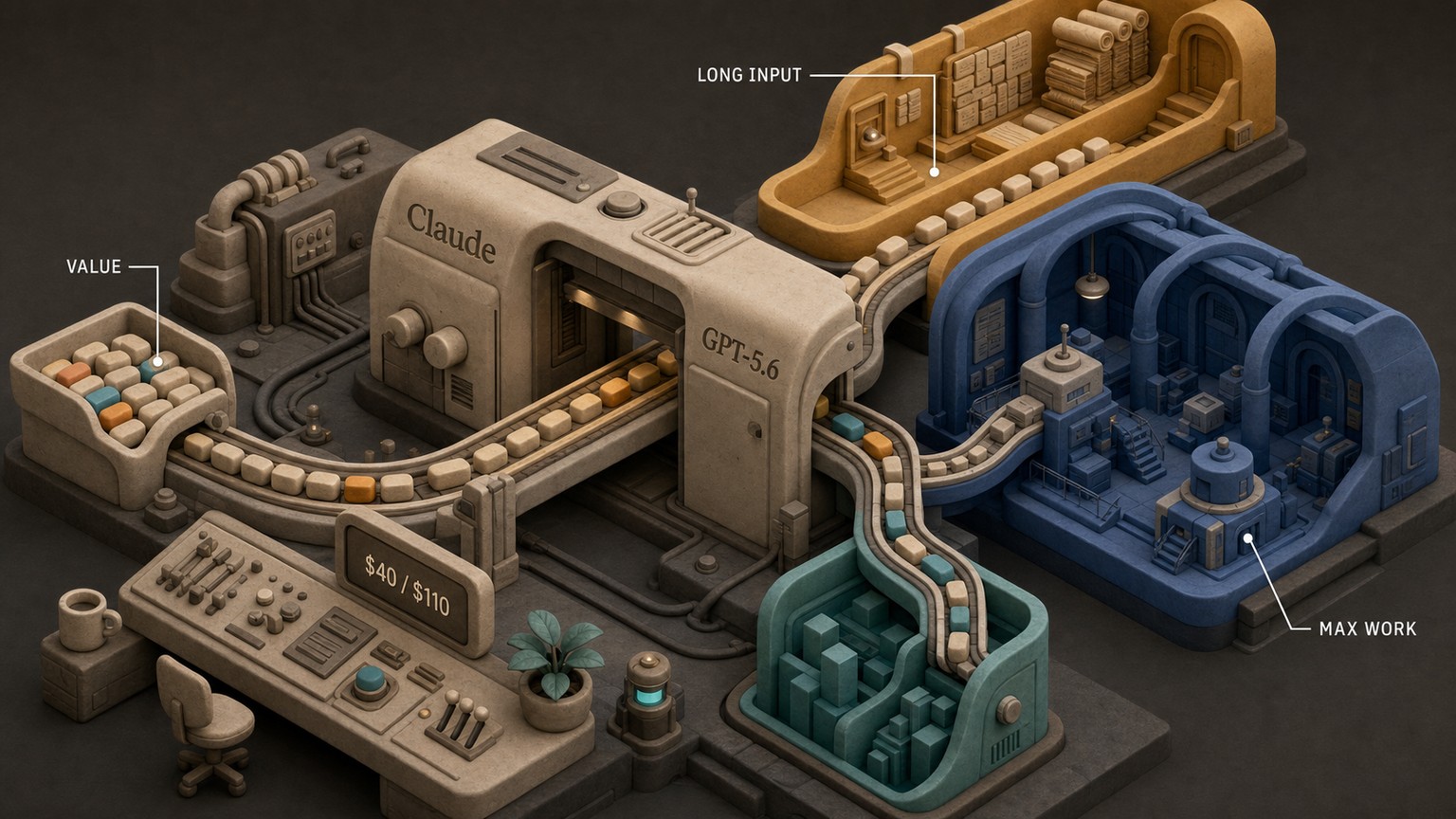
Claude Sonnet 5 is the better one-model default at $2/$10 per million tokens through August 31; GPT-5.6 Sol is the higher-ceiling choice at $5/$30, and Terra is the OpenAI value route at $2.50/$15. On a 10M-input, 2M-output monthly workload, that is $40 for Sonnet, $55 for Terra, or $110 for Sol before caching, but the model that wins still flips with context length and agent design.
GPT-5.6 is a three-model family, not one direct Sonnet equivalent: Sol buys maximum capability, Terra balances capability and cost, and Luna absorbs cheap volume.
Claude Sonnet 5 is one model with a wide effort range, a 1M-token context window, and a temporary launch price that undercuts both Sol and Terra.
GPT-5.6 vs Claude Sonnet 5: the verdict
Claude Sonnet 5 wins as the default production agent today; GPT-5.6 Sol wins when the hardest task or OpenAI's agent control surface earns its premium. Terra is the sharper OpenAI comparison for ordinary production work, while Luna belongs below both as a validated first-pass route.
All four accept text and images and return text. The useful difference is not GPT-5.6's slightly larger context specification. It is how each model turns context, reasoning effort, tools, and retries into a completed task.
The deeper GPT-5.6 review explains the Sol, Terra, and Luna routing split. The Claude Sonnet 5 review covers its tokenizer and migration changes.
The benchmarks disagree, and that is the useful answer
No honest benchmark gives either model a universal win. Two direct independent comparisons point in opposite directions because they test different shapes of work.
OmniaBench, a new general-agent evaluation with 1,431 tasks and a 644-task challenging subset, reports 58.54 Overall Pass@1 for Claude Sonnet 5 and 57.14 for GPT-5.6 Sol. Sonnet leads by 1.40 points. That is close enough to call the models peers on this particular task distribution, and low enough to show the real limitation: both still fail a large share of tasks.
Artificial Analysis reaches the opposite verdict. Its Intelligence Index scores GPT-5.6 Sol at max effort 59 and Claude Sonnet 5 at adaptive max effort 53. Against Terra at medium effort, Sonnet scores 53 to Terra's 46. The effort settings matter: comparing a max-effort Sonnet to medium-effort Terra is a cost-and-latency comparison as much as an intelligence comparison.
This is why a leaderboard winner can lose your production eval. A benchmark rewards its own task mix, tool setup, time budget, reasoning setting, and scoring rule. Your customer-support triage agent may care about structured output and cheap retries. A repository agent cares about patch correctness, tests, and sustained tool use. A research agent cares about source recovery and constraint maintenance. Those are different products even when they share a model endpoint.
For coding agents, the execution system decides the winner
GPT-5.6 Sol is the better bet for terminal-heavy work when you want OpenAI's highest effort and agent orchestration; Claude Sonnet 5 is the better default when sustained repository work, Claude Code, and price discipline matter together.
The model is only the reasoning engine. The coding agent around it supplies the repository map, terminal, patch mechanism, test loop, permissions, and memory. A smaller gap in model quality can disappear when one execution system gives the model cleaner context or catches a failed test before the answer ships.
OpenAI's differentiated tool is Programmatic Tool Calling. GPT-5.6 can write a small in-memory program that coordinates eligible tools and filters intermediate results, reducing repeated model round trips. The Responses API also offers multi-agent execution in beta, while Ultra coordinates four agents by default. This is valuable for a funded founder or CTO splitting a migration into independent code, test, documentation, and review workstreams.
Anthropic's differentiated environment is Claude Code with Sonnet 5's adaptive thinking. Sonnet defaults to high effort in Claude Code and the Claude API, and Anthropic positions it for agents that plan, use tools, and finish multi-step work. It is also available through the native Claude Platform, AWS, Google Cloud, and Microsoft Foundry, which can reduce procurement friction for a mid-market team already standardized on one of those clouds.
For a solo technical builder, the practical rule is smaller. Keep Sonnet as the default if it finishes the whole change at $2/$10. Send terminal-heavy failures or tasks that divide cleanly across agents to Sol. If Terra passes the same acceptance tests, route routine implementation there and keep Sonnet or Sol for the hard tail.
What breaks in production is not usually syntax. It is a model taking an unnecessary path, losing a constraint after several tool calls, rewriting too much code, or declaring success before the test suite passes. Require a diff, named tests, and an explicit completion condition from either model. Expensive reasoning is not a substitute for a bounded agent.
Sonnet wins the current cost math, especially on long context
Claude Sonnet 5 is cheaper than Terra and Sol at its launch price, and its advantage widens when an OpenAI request crosses 272K input tokens. The September price change narrows the short-context advantage but does not remove the long-context one.
Here are three workload shapes using the vendors' current API rate cards:
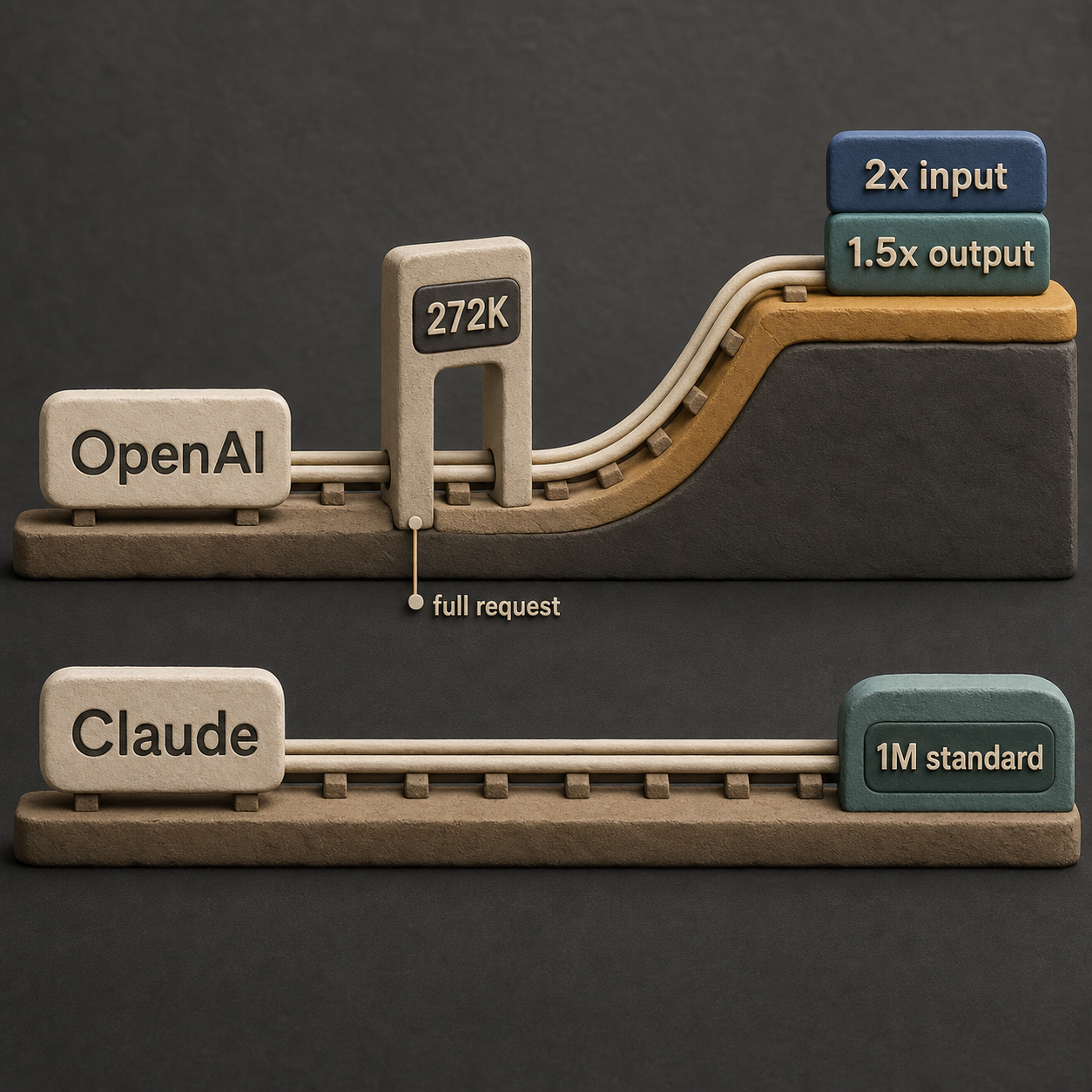
The 300K row is the one most comparisons miss. OpenAI charges 2x input and 1.5x output for the full request once input exceeds 272K tokens. Anthropic includes the full 1M-token Sonnet context at standard per-token rates. A 300K-input, 30K-output call therefore costs $2.175 on Terra but only $1.35 on Sonnet even after Sonnet's September increase.
The first row shows the other side. At 100K input and 10K output, Sonnet costs $0.30 during the launch window, Terra costs $0.40, and Sol costs $0.80. Starting September 1, Sonnet rises to $0.45, which puts Terra ahead on this exact short-context request. Terra becomes the lower-cost mid-tier on list price, while Sonnet may still win on completed-task cost if its higher success rate avoids a retry.
Sonnet's tokenizer needs a precise caveat. Anthropic says the same input can become 1.0x to 1.35x as many tokens as Sonnet 4.6, depending on content. That does not establish the same increase against GPT-5.6. Tokenizers split text differently, so the only fair cross-vendor comparison is the token count each API reports for the same representative workload.
Caching is close at the short duration. OpenAI and Anthropic both charge 1.25x base input for a standard cache write and 0.1x for a cache read. OpenAI states a 30-minute minimum cache life for GPT-5.6 explicit caching. Anthropic offers a 5-minute write at 1.25x or a 1-hour write at 2x. Anthropic also cuts asynchronous Batch API input and output prices by 50%, taking Sonnet's launch batch rate to $1/$5.
GPT-5.6 is the stronger system when you use the whole family
GPT-5.6 earns its premium through routing and orchestration, not by making Sol the default for every call. OpenAI gives you three endpoints with the same 1.05M-token context and 128K maximum output, then lets you match model cost to the consequence of the task.
Best for: teams already on the Responses API that can route easy, medium, and hard work
Standout: Programmatic Tool Calling plus a multi-agent beta, with Sol as the high-capability route
Pricing: Luna $1/$6, Terra $2.50/$15, Sol $5/$30 per 1M input/output tokens
Skip if: you want one economical endpoint for every workload or most requests exceed 272K input tokens
Luna should classify, extract, summarize, and draft when a validator can catch failure. Terra should handle the ordinary production middle. Sol should take the tasks where judgment or failure cost dominates token cost. Calling the unsuffixed gpt-5.6 alias selects Sol, so an unreviewed migration can quietly choose the most expensive tier.
- Three price and capability tiers make explicit routing possible
- Sol has the higher ceiling on the current Artificial Analysis comparison
- Programmatic Tool Calling can reduce model round trips in tool-heavy workflows
- Multi-agent beta and Ultra support work that divides cleanly into parallel streams
- Sol costs $5/$30, well above Sonnet's current and September rates
- The >272K multiplier can more than double Terra or Sol's advantage on long documents
- Three tiers create evaluation and routing work that a one-model stack avoids
- Terra at medium effort trails Sonnet at adaptive max on the current Artificial Analysis comparison
The GPT-5.6 family is the right architecture when the workload is heterogeneous. A mid-market CTO processing a large routine queue and a small tail of difficult investigations should not pay Sol prices for every record. Route the routine queue to Luna, the ambiguous middle to Terra, and only the costly mistakes to Sol.
Claude Sonnet 5 is the better one-model default
Claude Sonnet 5 gives a production agent close-to-frontier capability, a full 1M context at standard rates, and a lower current price without asking you to maintain three model routes. That simplicity is valuable when the evaluation program is still young.
Best for: Claude Code, long repository or document context, and teams that want one strong agent endpoint
Standout: 58.54 on OmniaBench at $2/$10 through August 31
Pricing: $2/$10 through August 31, then $3/$15 per 1M input/output tokens
Skip if: your workload specifically benefits from OpenAI's Programmatic Tool Calling, multi-agent beta, or Sol's higher measured ceiling
Adaptive thinking means Sonnet can spend more work on harder requests without a separate flagship endpoint. High effort is the default in the API and Claude Code. That is convenient, but it also means latency and token use can rise if you leave effort implicit. Set it deliberately.
- Lowest current list price among the serious one-model defaults in this comparison
- Full 1M-token context stays at standard rates
- Slight lead over Sol on the fresh OmniaBench general-agent set
- Claude Code and four major cloud access paths reduce integration friction
- Launch pricing ends August 31 and rises to $3/$15
- The new tokenizer can count the same text as up to 1.35x the Sonnet 4.6 tokens
- One endpoint does not provide Luna-style cheap volume or Sol-style explicit ceiling routes
- Sol leads the current Artificial Analysis Intelligence Index comparison
Sonnet is the better starting point for a senior operator building a research, analysis, or document agent with uncertain request shapes. It gives you one strong baseline and avoids OpenAI's long-context price cliff. Add a cheaper model only after the workload shows enough repeatable easy tasks to justify a router.
Who should pick what
The choice flips on four variables: consequence of failure, input length, acceptable latency, and how much routing infrastructure you can support.
Wait if neither model improves your accepted-result rate. A stable existing path that already passes the workload is worth more than a new endpoint with unmeasured regressions. Adopt when the new model lowers cost, reduces review time, raises completion, or enables a tool pattern the old path cannot support.
A production routing policy that survives the next release
The durable architecture starts with task consequence, not a permanent model winner. Keep tool schemas and acceptance tests provider-neutral, then route by evidence.
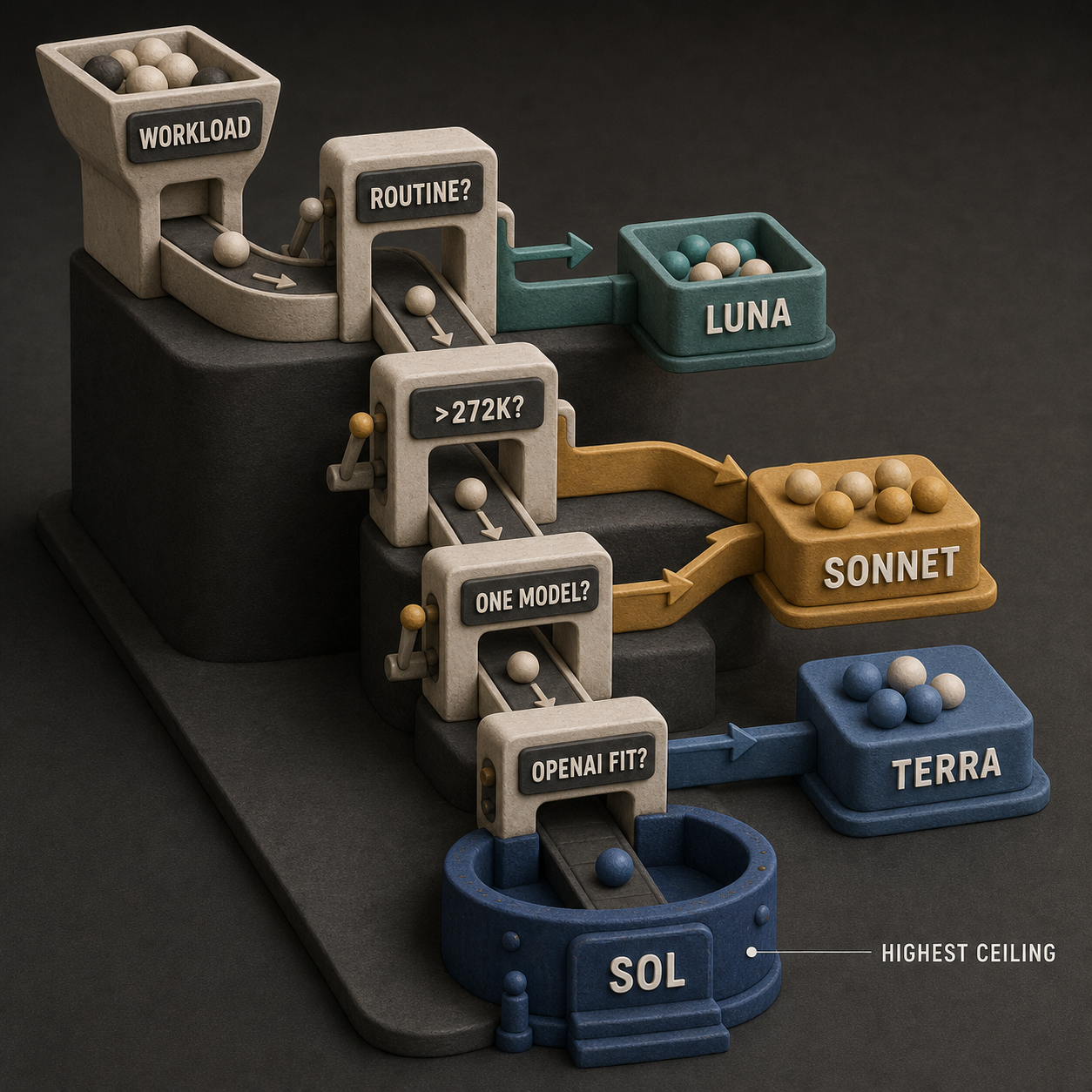
Set Sonnet as the strong baseline
Run representative coding, research, document, and tool-use tasks on
claude-sonnet-5at a named effort setting. Record accepted result, tokens, latency, retries, and human repair time.Add Terra and Luna where the task is cheap to validate
Send structured extraction, classification, summaries, and routine implementation to
gpt-5.6-lunaorgpt-5.6-terra. Escalate missing fields, failed tests, policy uncertainty, and low-confidence outputs.Reserve Sol for a measured hard tail
Use
gpt-5.6-solfor hard debugging, high-consequence analysis, security work, or parallelizable agent tasks. Do not use thegpt-5.6alias unless selecting Sol is intentional.Route long requests before they cross 272K
Measure token count before the call. Move genuine million-token work to Sonnet, retrieve a smaller evidence set, or accept OpenAI's full-request multiplier deliberately.
Keep both providers behind one contract
Normalize tool names, structured outputs, error handling, and approval gates. A vendor fallback protects the product from capacity limits, regressions, and the next benchmark reversal.
Is Claude Sonnet 5 better than GPT-5.6 for coding?
Not universally. OpenAI reports 64.6% for Sol and Anthropic reports 63.2% for Sonnet on SWE-Bench Pro, but those are separate vendor runs. Sol has the stronger terminal-agent signal; Sonnet is the better current value default. Run both on your repositories, tests, and review rubric.
Which is cheaper, GPT-5.6 or Claude Sonnet 5?
Through August 31, Sonnet 5 at $2/$10 is cheaper than Terra at $2.50/$15 and Sol at $5/$30. Starting September 1, Sonnet moves to $3/$15, making Terra cheaper on input and equal on output. Luna remains the cheapest at $1/$6.
Which model has the larger context window?
GPT-5.6 lists 1.05M tokens and Sonnet 5 lists 1M. Sonnet is usually the better long-context economic choice because Anthropic keeps standard rates across the full window, while OpenAI charges 2x input and 1.5x output for the full request above 272K input tokens.
Can I switch between Claude Sonnet 5 and GPT-5.6 in one app?
Yes. Put both behind a provider-neutral adapter for messages, tools, structured output, errors, and approvals. Route by task type and keep the second provider as a fallback instead of spreading provider-specific behavior through the product.
Get the AI tools map for business owners
A plain-English map of which models and tools fit which business job, updated as prices and capabilities change. Free to subscribers.
- Last Updated
- Category
- AI
- Language

Claude for Google Workspace
How to install and deploy Claude in Docs, Sheets and Slides, control edits, and test the paid-plan beta with three practical team workflows.Oct 10, 2026AI
Claude Dashboards
Set up Claude Dashboards beta, inspect SQL and refresh timestamps, check a sales metric, and decide when to keep your BI tool.Oct 10, 2026AI
Granola AI Review
Granola reviewed for business meetings: bot-free notes, current pricing, templates, recipes, consent, platform limits and who should choose an alternative.Oct 10, 2026AI
Fyxer Review
Fyxer reviewed through current pricing, help docs and public feedback: inbox sorting, drafts, meetings, privacy and who should pay for Pro or Team.Oct 9, 2026AI
GPT 6 Explained: Models, Release Dates, Access, and Prices
GPT-6 Astra, Sol, 6.1 Sol and Luna explained: release dates, ChatGPT plan access, Work and Codex availability, and verified API costs.Oct 9, 2026AI
Is ChatGPT Free? What You Get for $0
Yes. See what ChatGPT Free includes, its work limits, ads, account access, and when the $8 Go or $20 Plus plan is worth paying for.Oct 9, 2026AI
Gemini Enterprise: What It Is and When to Pilot
Gemini Enterprise explained for IT leads: Gemini agent availability, connectors, identity, spend caps, pricing and a 30-day Plus pilot.Oct 9, 2026AI