Grok 4.5 Review: The $2/$6 Agent Model Wins on Cost, Not Raw Coding
Grok 4.5 costs $2/$6 per million tokens. See current benchmarks, the 200K pricing cliff, Cursor math, and exactly who should adopt it.
Published Updated
 By Omid Saffari



Grok 4.5 costs $2 per million input tokens and $6 per million output tokens, but it is not the new coding leader. It is the model to adopt when agent cost and token efficiency matter more than winning every benchmark, provided your prompts stay below the 200K pricing cliff.
Grok 4.5 verdict in one table
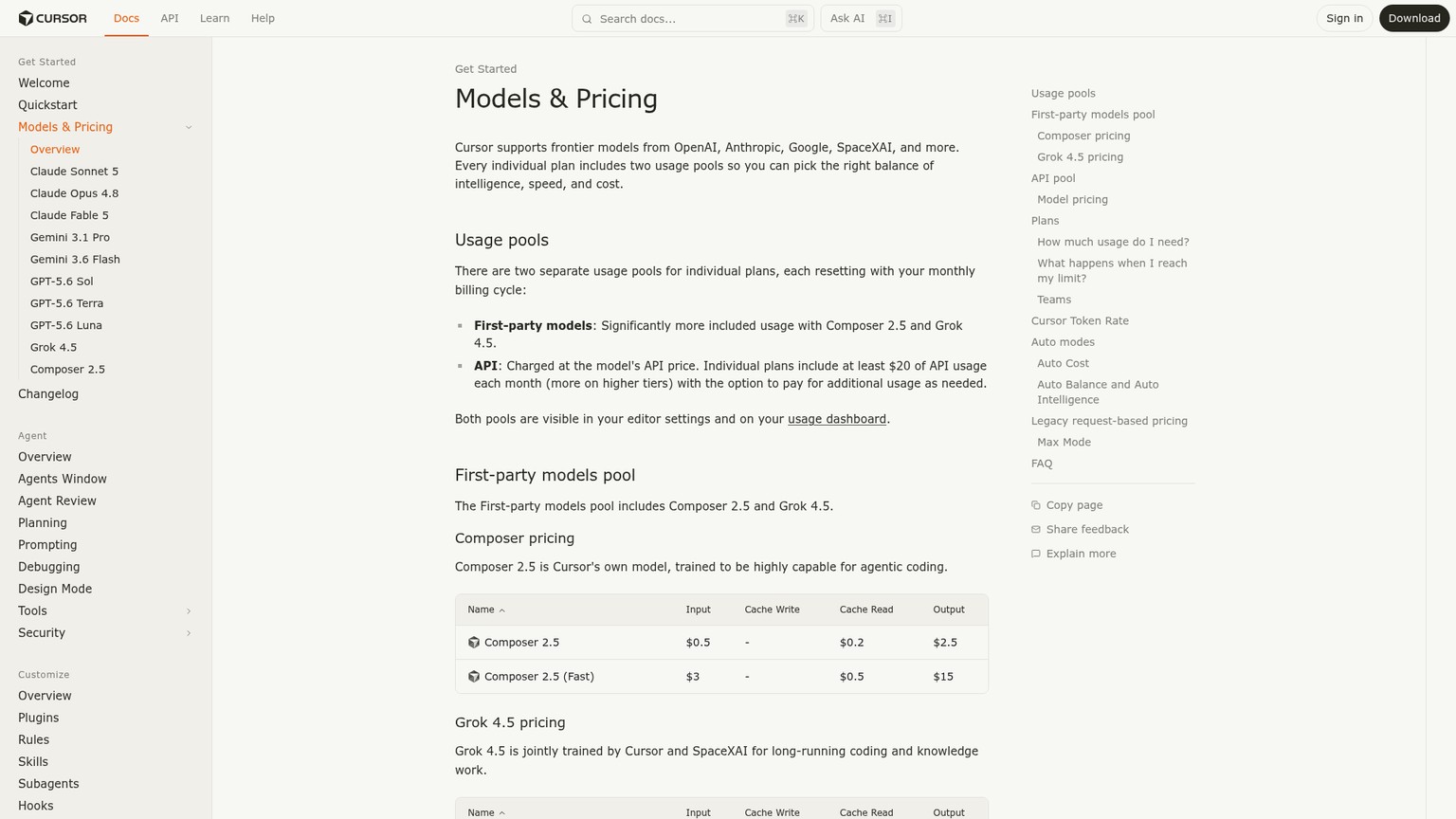
Grok 4.5 is the value pick between the cheapest coding model and the benchmark leader. It costs more than Cursor's Composer 2.5, scores below Claude Fable 5 on most of SpaceXAI's own engineering chart, and still makes a strong case for long-running agents because its output price is $6 instead of Fable's $50 inside Cursor.
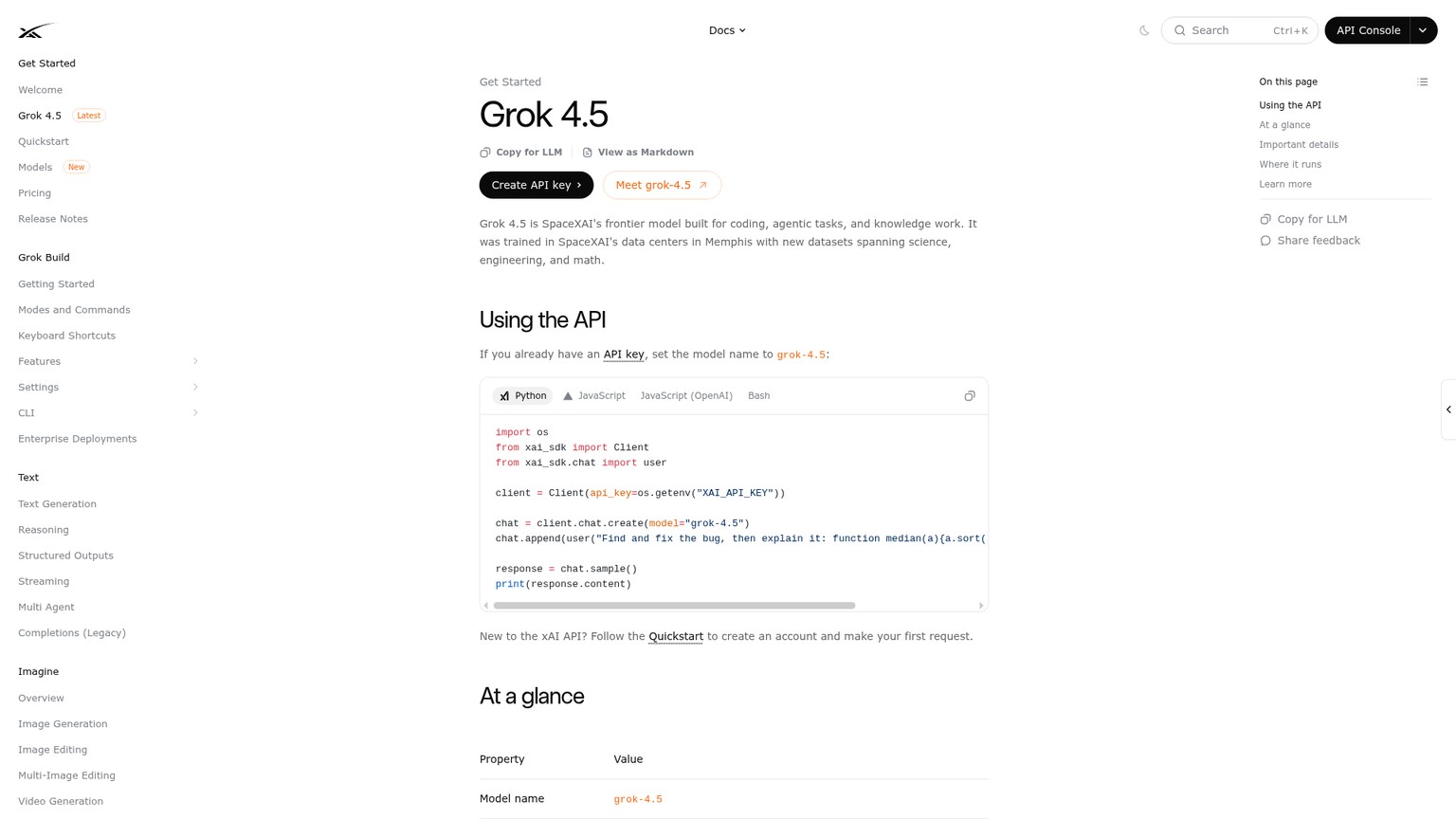
The cleanest comparison is the current Cursor billing surface because it puts first-party and frontier alternatives on one meter. Every price below is per million tokens.
At a monthly workload of 10 million fresh input tokens and 2 million output tokens, those rates produce a simple bill: $32 for Grok 4.5, $10 for Composer 2.5, $200 for Claude Fable 5, and $110 for GPT-5.6 Sol. Cursor also adds a $0.25-per-million token rate to third-party models on Teams and Enterprise, while its first-party Grok and Composer models are exempt.
Cursor is therefore the surface where Grok 4.5's position becomes obvious: not the cheapest model, not the highest scorer, but the pressure valve between them.
That is the verdict. The rest of the decision is about proving whether your workload sits on the right side of it.
What Grok 4.5 is and where it runs
Grok 4.5 is a reasoning model built for coding, agentic tasks, and knowledge work, not merely a new chat preset. Cursor and SpaceXAI describe it as a jointly trained mixture-of-experts model, which means each token activates a selected subset of specialized model components instead of using the whole network for every step.
The rollout happened in two stages. Cursor released Grok 4.5 on July 8, then SpaceXAI published its full launch on July 16. Cursor says the training mix included trillions of tokens of developer-agent interaction data alongside STEM tasks, research papers, and broader knowledge work.
The current model ID is grok-4.5. It accepts text and images, returns text, has a 500,000-token context window, and supports low, medium, or high reasoning effort with high as the default. Its native tools cover function calling, web search, X search, and code execution through the Responses API or Chat Completions.
Distribution is unusually broad for a new model. It is available through the SpaceXAI API, is the default model in Grok Build, runs in Cursor on all plans, powers Word, PowerPoint, and Excel add-ins, and is listed through OpenRouter, Vercel, Cloudflare, Snowflake, and Databricks Mosaic. Inside Cursor, it spans desktop, web, iOS, CLI, and the SDK.
That breadth lowers adoption friction. It does not remove the need to distinguish the model from the product around it. Grok 4.5 through the direct API has different cache pricing from Grok 4.5 inside Cursor, and Grok Build adds an agent loop on top of the model. The earlier Grok Build economics were dominated by a flat subscription gate. Grok 4.5 changes that conversation because the model and the agent now have clearer metered paths.
The benchmarks say value, not outright leadership
Grok 4.5 wins one of the five engineering benchmarks displayed by SpaceXAI, nearly ties the leaders on another, and trails Claude Fable 5 on the other three. Calling it the new coding champion requires ignoring the provider's own numbers.
SpaceXAI's launch chart says the competitor figures come from provider system cards or benchmark leaderboards. That makes the table useful for direction, not a substitute for a workload-specific evaluation. Execution setups, reasoning settings, retries, and token budgets can move a coding score enough to change a buying decision.
The gaps are concrete. Grok trails Fable 5 by 4.1 points on DeepSWE 1.0, 17 points on DeepSWE 1.1, 1 point on Terminal Bench 2.1, and 15.7 points on SWE Bench Pro. Its clear win is SWE Marathon, where 29.0% beats Opus 4.8 at 26.0% and Fable 5 at 24.0%.
The efficiency claim is more compelling. SpaceXAI reports an average of 15,954 Grok output tokens per SWE Bench Pro task versus 67,020 for Opus 4.8 max, about 4.2 times fewer. That is provider-published data, but it points at the right economic unit: a completed task, not the sticker price of one token.
Independent measurement keeps the verdict grounded. Artificial Analysis scores Grok 4.5 high at 54, while GPT-5.5 xhigh scores 55. Its blended 7:2:1 cache/input/output price is $1.35 per million tokens for Grok versus $4.35 for GPT-5.5. The same live comparison measured about 70 output tokens per second for Grok and about 76 for GPT-5.5.
SpaceXAI advertises 80 output tokens per second. The independent result is about 70. That gap is not a failure, but it is a reminder that served speed varies and launch throughput is not a service-level guarantee.
The benchmark verdict is blunt: Grok 4.5 is close enough to frontier performance to be economically interesting, but not strong enough to replace a quality gate with a price chart.
The real Grok 4.5 cost
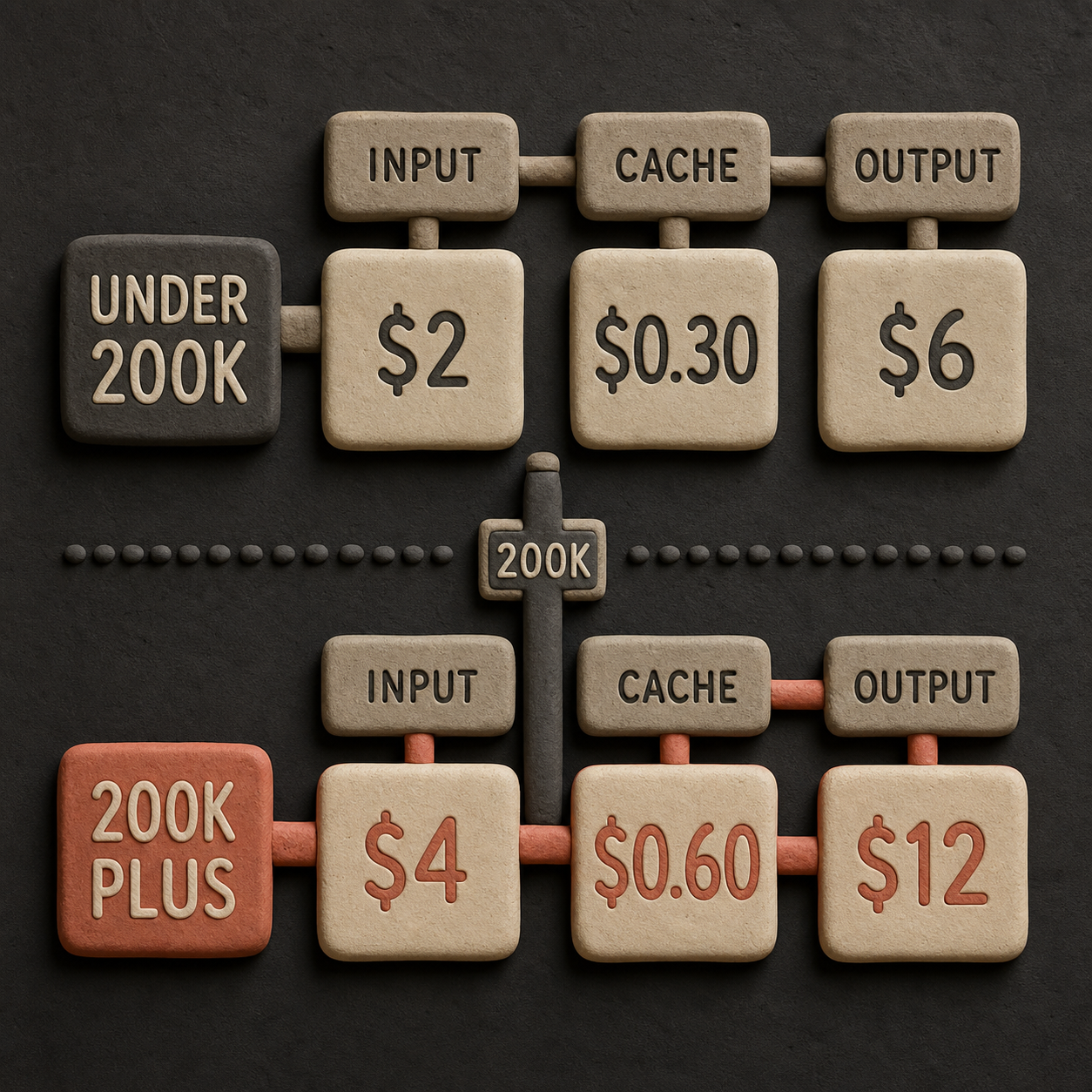
Grok 4.5's $2/$6 headline price is accurate only below 200,000 context tokens. Cross that threshold and SpaceXAI doubles fresh input, cached input, and output rates for the entire request.
The distinction matters because a 500,000-token context window describes capacity, not cheap capacity. A request carrying 250K input tokens and producing 50K output tokens costs $1.60 at long-context rates. At the short-context rates, the same token counts would cost $0.80. The threshold doubles the token bill before web searches, code execution, or retries enter the picture.
Caching can pull the other way. A workload with 10 million fresh input tokens and 2 million output tokens costs $32. If half that input is served from the direct API cache, the bill falls to $23.50, saving $8.50, or about 26.6%.
That saving is not automatic. SpaceXAI recommends setting prompt_cache_key on the Responses API, or x-grok-conv-id with Chat Completions, so a conversation routes to the same server. Without it, a cache-cold server can turn expected cache hits back into full-price input.
Tool use adds a second meter. Web search, X search, and code execution each cost $5 per 1,000 calls. A run that makes 25 such calls adds $0.125 before the model tokens behind those calls. Attachment search costs $10 per 1,000 calls, while collections search costs $2.50 per 1,000.
What breaks in production
The first production failure is silent repricing, not model intelligence. A repo-sized prompt creeps past 200K, every token in the request moves to the long-context rate, and a cost model built from the $2/$6 headline becomes wrong at once.
The second is cache optimism. Repeated agent turns look cache-friendly, but they only earn the $0.30 direct cached-input rate when routing makes the previous prefix reusable. SpaceXAI's explicit cache-key recommendation belongs in the billing design from the first request.
The third is context accumulation. Long-running agents repeatedly read plans, tool output, diffs, tests, and earlier explanations. The 500,000-token window postpones failure; it does not make carrying every old turn sensible. SpaceXAI recommends context compaction for long loops, which means replacing stale detail with a smaller working state before the agent hits the pricing cliff or loses attention in its own history.
The fourth is treating provider benchmarks as a release gate. Grok 4.5's displayed results range from first on SWE Marathon to 17 points behind Fable 5 on DeepSWE 1.1. Production quality will depend on your repository, execution runner, test coverage, tool permissions, and definition of success.
The fifth is surface availability. Cursor's live Grok 4.5 page says the model is not yet available in the European Union through Cursor. That is a Cursor limitation, not proof that every SpaceXAI access path is blocked, but it is enough to stop an EU team from planning a Cursor migration around it today.
Who should use Grok 4.5 and who should skip it
Use Grok 4.5 for cost-sensitive agent loops that remain below 200K and can verify their own work. Skip it when the top displayed coding pass rate is worth the premium, when Composer 2.5 is already good enough, or when your Cursor users are in the EU.
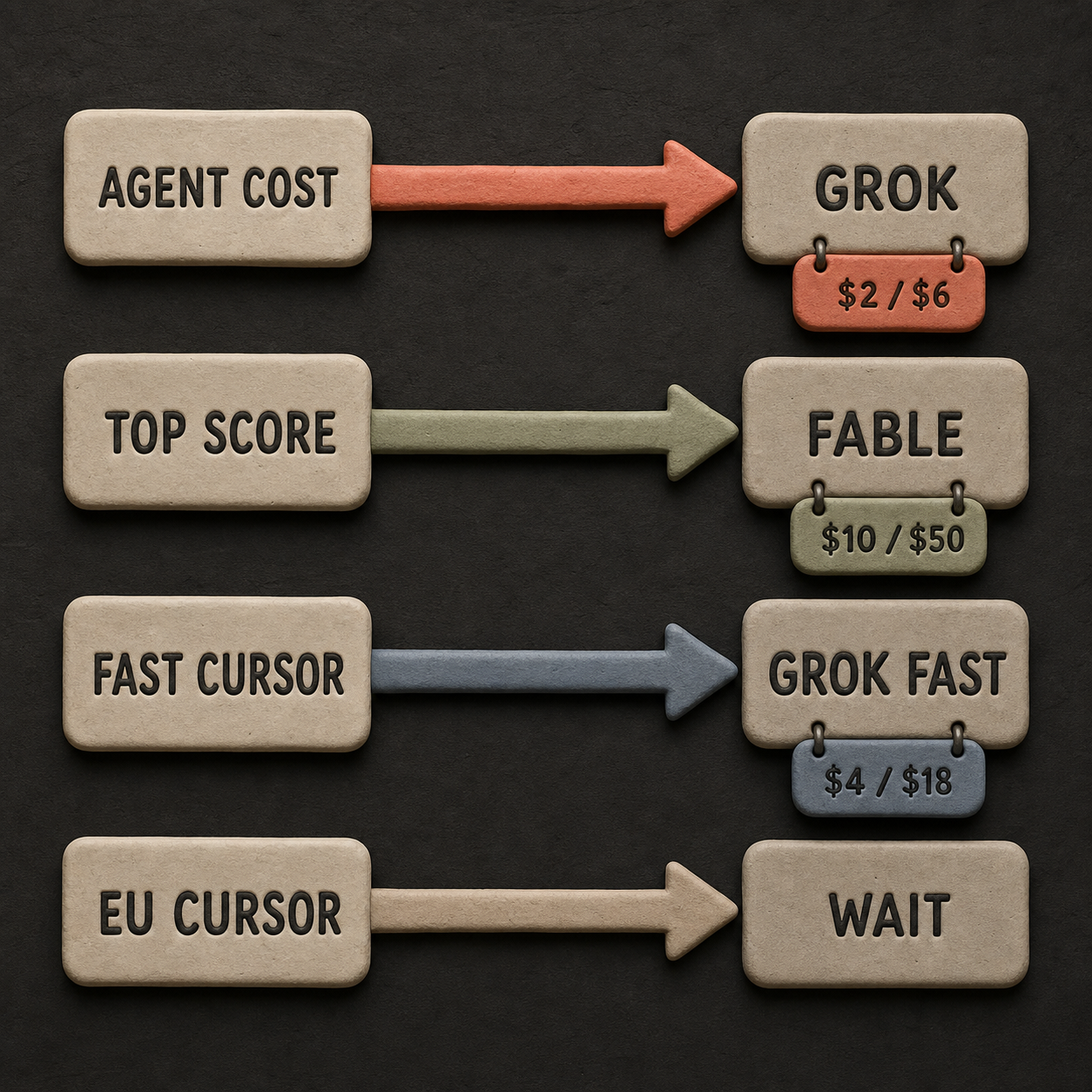
- $2 input and $6 output pricing makes frontier-adjacent agent work materially cheaper than Fable 5 or GPT-5.6 Sol in Cursor.
- A 500,000-token context window leaves room for substantial repositories and long task histories.
- Function calling, web search, X search, code execution, structured output, and two standard API surfaces reduce integration work.
- Provider data shows a real SWE Marathon win and sharply lower output-token use than Opus 4.8 max on SWE Bench Pro.
- Grok 4.5 does not lead four of the five engineering benchmarks on SpaceXAI's own chart.
- Direct API rates double for every token once the request reaches 200K context.
- Reliable cache savings require explicit routing discipline.
- Independent speed is below the provider's 80-token-per-second claim, and Cursor has disclosed contamination in one excluded benchmark.
A safe evaluation plan
The right adoption test compares completed work at a controlled quality bar, not isolated prompts. Keep the task set, agent runner, tool permissions, and acceptance checks identical across models.
Freeze a representative task set
Choose real tasks from the work you intend to delegate: a bug fix with tests, a repository-wide change, a tool-using research task, and a document or spreadsheet deliverable if those matter. Define pass and fail before any model sees them.
Control reasoning and context
Use the same reasoning setting for every Grok run, record the exact prompt size, and separate sub-200K tasks from long-context tasks. Do not let one model see extra files or a different tool budget.
Make caching measurable
Set
prompt_cache_keyorx-grok-conv-idfor repeated conversations. Record fresh input and cached input separately so the cost comparison reflects the bill you can reproduce.Gate on completed-task economics
Capture pass rate, human corrections, retries, total tokens, tool calls, and wall time. Adopt Grok only when the cost per accepted result beats the incumbent without lowering the release bar.
For a funded founder, that gate may be developer review time. For a mid-market CTO, it may be escaped defects and auditability. For a senior operator, it may be whether an Excel or research deliverable survives factual review. For a solo technical builder, it is often whether the lower meter buys more completed work without creating a second job reviewing the agent.
Frequently asked questions
Is Grok 4.5 good?
Yes, when you need strong agentic capability at a lower token cost. It is not the safest default for maximum coding accuracy because Fable 5 leads four of the five engineering benchmarks displayed by SpaceXAI, while Grok's clearest win is cost-efficient long-horizon work.
How much does Grok 4.5 cost?
The direct SpaceXAI API costs $2 per million fresh input tokens, $0.30 per million cached input tokens, and $6 per million output tokens below 200K context. At 200K or more, those rates become $4, $0.60, and $12 for the whole request. Cursor lists $2 input, $0.50 cache read, and $6 output in its first-party pool.
Where can I use Grok 4.5?
SpaceXAI documents access through its API, Grok Build, Cursor, Word, PowerPoint, Excel, OpenRouter, Vercel, Cloudflare, Snowflake, and Databricks Mosaic. Cursor supports it across desktop, web, iOS, CLI, and its SDK, but currently lists it as unavailable in the European Union.
Want the Claude Code + Codex setup checklist? Get it with the newsletter.
- Last Updated
- Category
- AI
- Language

Claude for Google Workspace
How to install and deploy Claude in Docs, Sheets and Slides, control edits, and test the paid-plan beta with three practical team workflows.Oct 10, 2026AI
Claude Dashboards
Set up Claude Dashboards beta, inspect SQL and refresh timestamps, check a sales metric, and decide when to keep your BI tool.Oct 10, 2026AI
Granola AI Review
Granola reviewed for business meetings: bot-free notes, current pricing, templates, recipes, consent, platform limits and who should choose an alternative.Oct 10, 2026AI
Fyxer Review
Fyxer reviewed through current pricing, help docs and public feedback: inbox sorting, drafts, meetings, privacy and who should pay for Pro or Team.Oct 9, 2026AI
GPT 6 Explained: Models, Release Dates, Access, and Prices
GPT-6 Astra, Sol, 6.1 Sol and Luna explained: release dates, ChatGPT plan access, Work and Codex availability, and verified API costs.Oct 9, 2026AI
Is ChatGPT Free? What You Get for $0
Yes. See what ChatGPT Free includes, its work limits, ads, account access, and when the $8 Go or $20 Plus plan is worth paying for.Oct 9, 2026AI
Gemini Enterprise: What It Is and When to Pilot
Gemini Enterprise explained for IT leads: Gemini agent availability, connectors, identity, spend caps, pricing and a 30-day Plus pilot.Oct 9, 2026AI