HeyGen Pricing (2026): What $29 Buys
HeyGen starts at $29, but credits decide output. Compare every 2026 tier, annual rate, overage, API cost, and break-even.
Published Updated
 By Omid Saffari




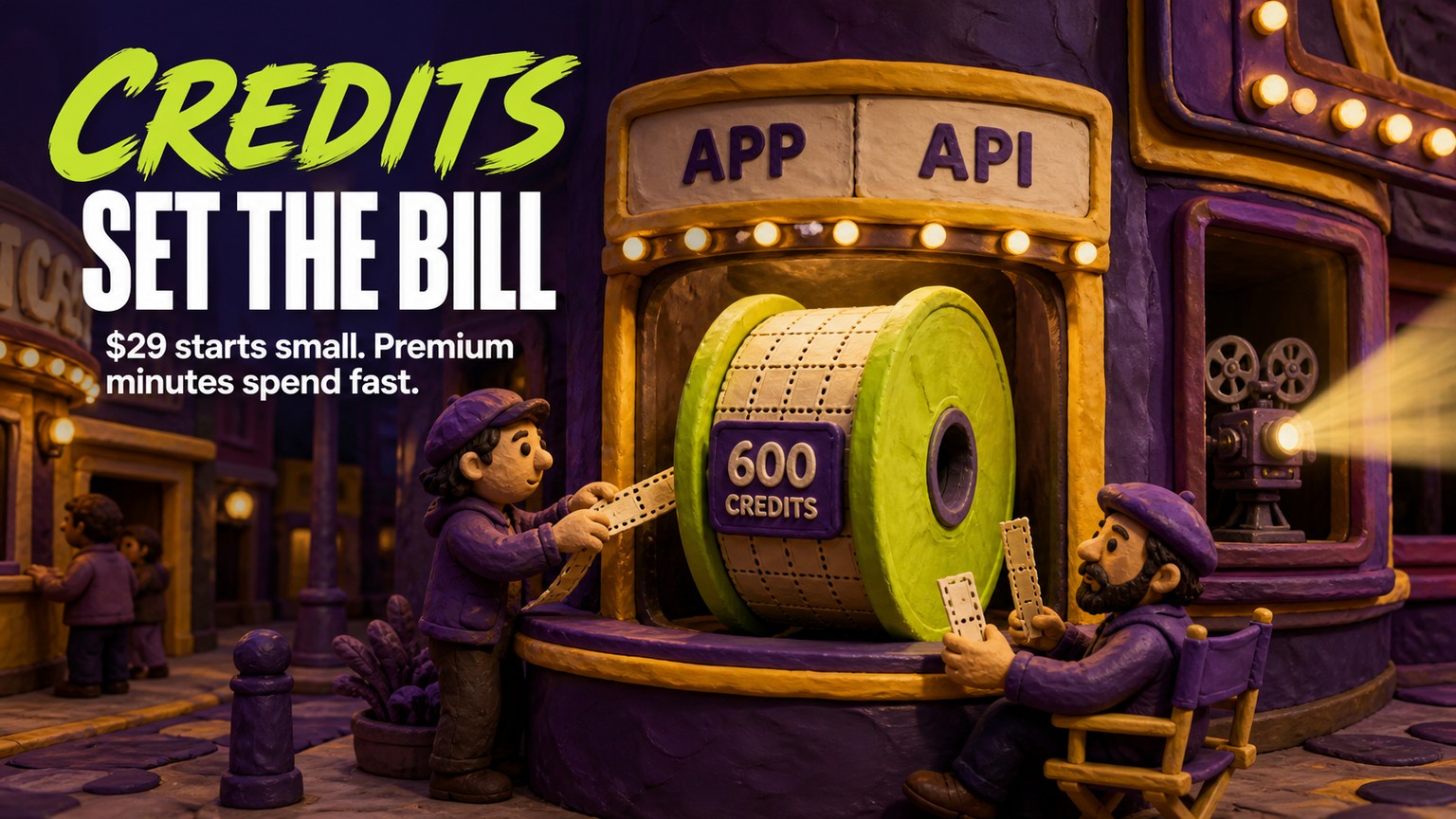
HeyGen starts at $29 a month, but that price buys 600 credits, not a fixed amount of video. Those credits stretch to 200 minutes with Avatar III or only 30 minutes with Avatar IV/V, so the engine you choose matters more than the plan name.
Creator is the sensible paid default for one person. Pro is worth the jump when 4K, translation-script proofreading, or more than 600 credits has a recurring job. Business is a team-controls purchase, not a bargain on credits: its 1,500-credit base costs $149 a month, while the 1,500-credit Pro tier costs $74.
Every price, limit, annual total, and overage below was verified against HeyGen's live pricing page and its linked billing documentation on 9 August 2026. The current pricing is materially different from the old unlimited-plan model, so older screenshots and plan summaries can produce the wrong budget.
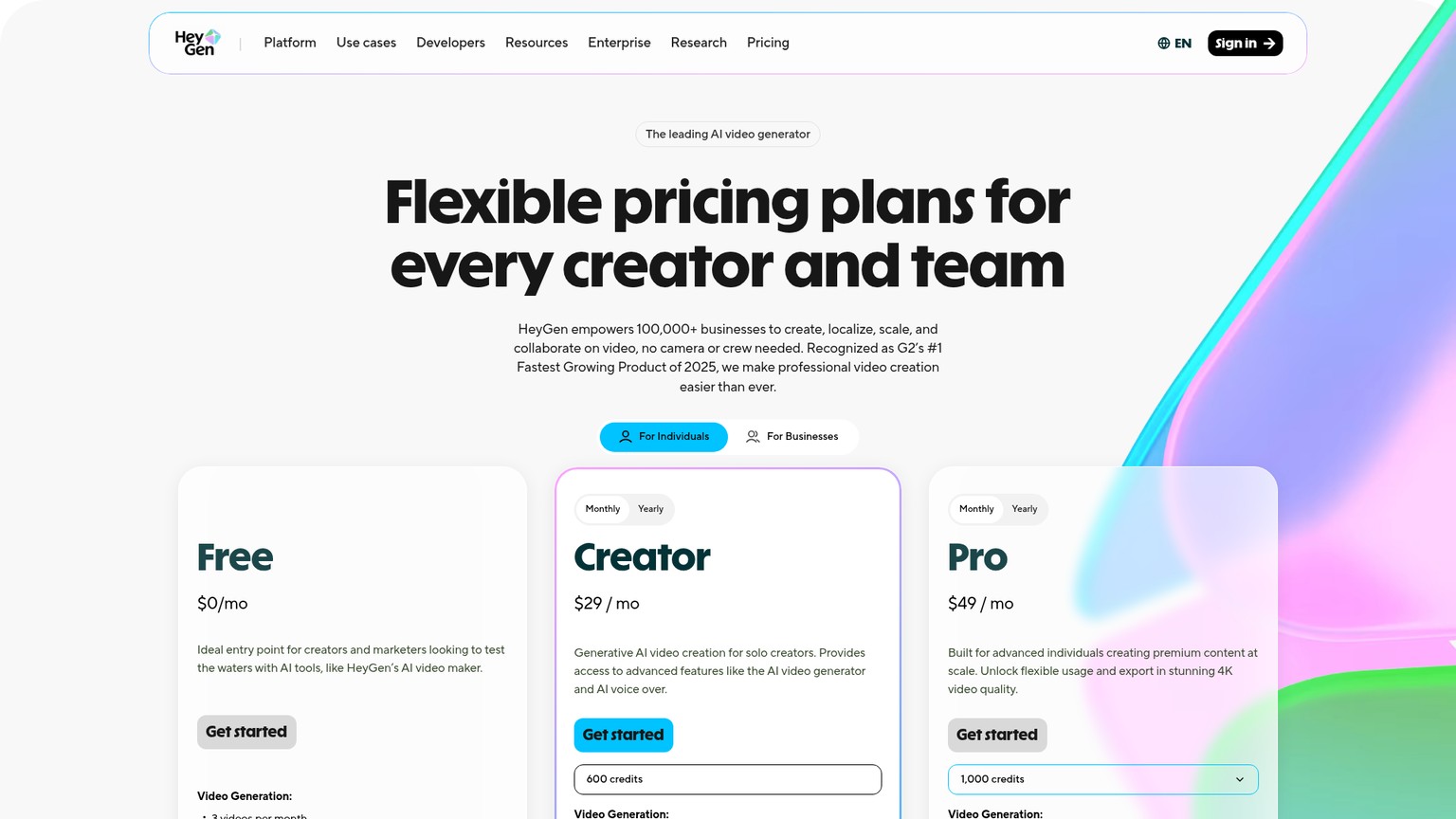
HeyGen pricing at a glance
HeyGen has five named plan levels, but Pro contains ten selectable paid credit allocations. The table shows the purchase boundary; the full Pro ladder follows in prose so its annual checkout totals do not disappear behind an approximate range.
The sticker price hides two separate decisions. First, credits pay for output at very different rates. Second, plan features set the production boundary: Creator stops at 1080p, Pro adds 4K and translation-script editing, and Business adds collaboration, SSO, SCORM, LMS integrations, and longer videos. Paying for a higher plan without naming which boundary you need is how an inexpensive trial becomes an expensive idle subscription.
What HeyGen credits buy
One HeyGen credit has no single video-minute value. The current app rates are 2 credits per minute for dubbing without lip sync, 3 for Avatar III, 5 for lip-synced translation, 10 for Precision translation, 20 for Avatar IV/V, and 40 for Custom Expressive Motion. A generated image costs 2 credits, while some generated video assets charge a fixed amount per asset rather than per minute. HeyGen's credit-plan explainer lists the full consumption schedule.
That spread makes Avatar choice the budget lever. Avatar III at 3 credits per minute yields 6.67 times as much runtime as Avatar IV/V at 20 credits per minute. Lip-synced translation sits between them at 5 credits per source minute. The plan is not unlimited just because a card allows a 30-minute project; the duration cap and the credit balance are separate limits.

Creator's 600 credits can fund 200 minutes of Avatar III, 30 minutes of Avatar IV/V, 15 minutes of Custom Expressive Motion, 120 minutes of lip-synced translation, 60 minutes of Precision translation, or 300 minutes of dubbing without lip sync. Those are single-feature ceilings. A normal project can consume several pools at once when it combines avatar generation, translated variants, generated assets, and model training.
The asset charges make short-form work less predictable. Seedance2 video assets are listed at 60 credits in 720p or 150 credits in 1080p, regardless of the asset's length, while VEO3 is listed at 90 credits per generated asset. One Seedance2 1080p asset consumes a quarter of Creator's monthly allowance; four consume all 600 credits before the main avatar video is generated.
Every HeyGen plan, and the point where it pays
Free: enough to judge the avatar, not enough to run a channel
HeyGen Free is a genuine no-card trial, but its useful ceiling is small: up to three videos a month, one minute per video, standard processing, one custom video avatar, 500+ stock avatars, and 30+ languages. The billing explainer qualifies the quota as 1 to 3 videos depending on region and describes the output as a 720p sharing link. That regional footnote matters if a plan comparison simply promises three videos everywhere.
Someone who only needs a few internal concept clips or avatar-fit checks may never need to pay. A brand publishing finished work will reach the boundary quickly because Creator is where 1080p export, watermark removal, 175+ languages and dialects, voice cloning, and the larger avatar library appear. Free is ship-ready only when a share link and trial-level presentation are acceptable.
The clean use of Free is one representative brief. Build the type of spokesperson clip, language, pace, and framing you would buy the tool for. If the avatar does not meet the craft bar in that brief, more credits will not solve the mismatch.
Creator: the default paid plan for one person
HeyGen Creator costs $29 monthly or $288 upfront for a year, displayed as $24 per month. It includes 600 credits each month, videos up to 30 minutes, 1080p export, watermark removal, 700+ stock video avatars, voice cloning, and 175+ languages and dialects. The annual option saves $60 against twelve monthly payments, a 17.24% reduction.
At monthly billing, the allocation works out to $0.145 per Avatar III minute, $0.967 per Avatar IV/V minute, $0.242 per lip-synced translation minute, and $0.097 per no-lip-sync dubbing minute when all credits go to one outcome. Annual billing lowers those figures to $0.120, $0.800, $0.200, and $0.080 respectively.
Creator's wall is not only 600 credits. It also stops at 1080p and does not support one-time top-ups. If a production month needs 650 credits, the answer is not a small pack. The user must move to Pro. That makes Creator excellent for stable output and awkward for occasional spikes.
Pro: buy the exact credit step, not a vague promise of scale
HeyGen Pro starts at $49 monthly for 1,000 credits and adds 4K export, faster processing, access to the advanced models, and the ability to edit and proofread translation scripts. All Pro levels carry the same feature set. Only the credit allocation changes, so the correct tier is the smallest one above a measured recurring workload.
The exact monthly ladder is 1,000 credits for $49; 1,500 for $74; 2,000 for $99; 3,000 for $149; 5,000 for $240; 7,500 for $360; 10,000 for $460; 20,000 for $900; 50,000 for $2,250; and 100,000 for $4,300.
Annual checkout bills the same allocations at $488 for 1,000 credits, displayed as $41 per month; $738 for 1,500, displayed as $62; $988 for 2,000, displayed as $82; $1,488 for 3,000, displayed as $124; $2,400 for 5,000, displayed as $200; $3,600 for 7,500, displayed as $300; $4,612 for 10,000, displayed as $384; $9,018 for 20,000, displayed as $752; $22,518 for 50,000, displayed as $1,877; and $43,030 for 100,000, displayed as $3,586.
Those annual totals matter because the displayed effective month is rounded. A base annual Pro subscription is $488, not $41 multiplied by 12. At the top end, the checkout commitment is $43,030 even though the card frames it as $3,586 per month.
The first Pro upgrade is easy to evaluate. Paying $20 more than Creator adds 400 credits, enough for 133.3 Avatar III minutes, 20 Avatar IV/V minutes, or 80 minutes of lip-synced translation. It also adds 4K and translation-script proofreading. If neither feature nor the added output has a monthly job, Creator is the better buy.
Pro has the same spike problem as Creator: no one-time credit packs. Moving from 1,000 to 1,500 credits changes the monthly bill from $49 to $74. A buyer expecting occasional heavy months should model whether switching tiers is tolerable before taking an annual contract.
Business: pay for the workspace, not the credit rate
HeyGen Business costs $149 a month for the first seat, plus $20 for each additional seat. Annual billing charges $1,428 upfront for the base plan, displayed as $119 per month. The plan includes 1,500 shared credits, videos up to 60 minutes, 4K export, twice Pro's concurrency, collaboration, centralized billing, SAML/SSO, SCORM export, LMS integrations, interactive video, and five custom digital twins on the public card.
The important comparison is hidden in the Pro ladder. Pro offers the same 1,500-credit quantity to one user for $74 monthly. Business charges $75 more before any additional seat. That premium buys the shared workspace, review loop, security controls, e-learning features, longer video limit, and top-up access. It does not buy a larger starting credit pool.
A five-seat Business workspace costs $229 a month: $149 plus four $20 seats. That is $45.80 per seat-month, but the five people still share 1,500 credits. If they divide Avatar IV/V capacity evenly, each person gets 15 minutes. A ten-seat workspace costs $329, or $32.90 per seat-month, but equal Avatar IV/V capacity falls to 7.5 minutes per person. Seat economics improve while production capacity per person shrinks.
Business is the only self-serve plan with flexible top-ups. Extra credits cost $0.05 each in blocks of 100, with a $5 minimum and optional auto-reload. At that rate, an extra Avatar III minute costs $0.15, Avatar IV/V costs $1.00, Custom Expressive Motion costs $2.00, lip-synced translation costs $0.25, and no-lip-sync dubbing costs $0.10. Doubling Business from 1,500 to 3,000 total credits costs $224 for the month: the $149 base plus $75 of add-ons.
Enterprise: custom usage and procurement controls
HeyGen Enterprise has no published price. It offers flexible usage terms, no maximum video duration, 4K export, the highest concurrency, multi-workspace control, SCIM provisioning, team-member MFA, invoice billing, priority support, and a dedicated success manager.
Enterprise is justified by a written security, governance, support, or volume requirement. It is not the natural next step from a high Pro credit tier. A single advanced creator can scale Pro to 100,000 credits without buying enterprise administration, while a regulated organization may need Enterprise at far lower output.
Cost per finished minute: the engine changes the plan
HeyGen's cheapest published minute is not on its most expensive plan. Creator at $29 gives an Avatar III minute for about $0.145, while base Pro at $49 lands at about $0.147. The difference is tiny because both plans price their starting credits near five cents each. Pro earns its premium through 4K, proofreading, and a larger allowance, not a lower unit cost.
Base Pro's 1,000 credits cover 333.3 Avatar III minutes or 50 Avatar IV/V minutes. That is $0.147 or $0.980 per minute on monthly billing, and about $0.122 or $0.813 when its exact $488 annual bill is spread across twelve monthly allocations.
Business looks expensive per generated minute because the plan bundles team value. If all 1,500 included credits went to one outcome, the $149 base equates to $0.298 per Avatar III minute, $1.987 per Avatar IV/V minute, or $0.497 per lip-synced translation minute. Annual billing lowers those to $0.238, $1.587, and $0.397, but each remains above the comparable solo-plan figure.
The same 60-minute brief can cost $29 or $74
A 60-minute monthly brief built entirely with Avatar IV/V consumes 1,200 credits. Creator's 600 and base Pro's 1,000 both fall short. The smallest fit is Pro with 1,500 credits at $74 monthly or $738 yearly.
The same runtime can fit Creator when premium motion is assigned only where it changes the deliverable. Use Avatar IV/V for 20 close-up or hero minutes at 400 credits, then Avatar III for 40 supporting minutes at 120 credits. The total is 520 credits. Creator covers it at $29 monthly or $288 yearly, saving $45 per month or $450 per year against 1,500-credit Pro.
That is not a claim that the engines look identical. It is a production decision: spend the premium model on the shots where expression and realism carry the message, then use the lighter model where the viewer is following information, screen content, or supporting narration. The craft bar determines which minutes deserve the expensive engine.
1. Lock the output mix
List finished minutes by engine and feature before choosing a plan. Keep Avatar III, Avatar IV/V, Custom Expressive Motion, translation, and generated assets separate because each burns credits differently.
2. Price the recurring month
Multiply each minute bucket by its published rate, then add fixed asset charges. A 12-minute Avatar IV/V piece is 240 credits before translated variants or generated assets.
3. Add revision headroom
Budget for regeneration and iteration. Credits pay for generated outcomes, so a plan that fits only the first render has no room for a revised script, a changed shot, or a second language.
4. Choose the smallest stable tier
Match the recurring total to Creator or the exact Pro step. Stay monthly until two or three representative billing cycles show stable usage; annual savings are useful only after the workload is known.
Hidden costs: rollover, top-ups, seats, and annual lock-in
Annual HeyGen billing improves both price and rollover, but it does not deliver a year's credits upfront. Creator, Pro, and Business annual subscribers pay the contract upfront, then receive credits as monthly allocations. Unused credits can accumulate until annual renewal. Monthly subscribers get only one extra billing cycle of rollover. Cancel to Free and remaining credits stop rolling over.
That structure is better than a strict monthly expiration, but it creates an annual-lock catch: the cash leaves upfront while production capacity still arrives month by month. A seasonal studio cannot buy Creator annual in January and spend all 7,200 nominal yearly credits on one launch in February.
Creator and Pro have no one-time top-ups. A short spike pushes Creator to Pro or Pro to a larger fixed tier. Business can add credits, but its $0.05 rate means premium generation accumulates quickly. One extra block is only $5, yet 1,500 extra credits is $75 and 5,000 is $250.
Additional avatar slots are separate too. A Video Avatar slot costs $29 monthly or $300 yearly. A LiveAvatar slot costs $49 monthly and belongs to the separate LiveAvatar platform, so buying an app plan does not silently include the streaming product.
Refunds should be treated as an exception, not an exit plan. HeyGen's refund policy says payments are generally non-refundable outside legal requirements and discretionary cases. Direct HeyGen and Google Play purchases may be reviewed within 15 days when the app did not suit the project; Apple requests have a 14-day window. Significant credit use can cause a direct request to be denied.
HeyGen API pricing is separate from every app plan
HeyGen API uses pay-as-you-go dollars, not the Creator, Pro, or Business credit pool. No subscription is required, and buying an app plan does not fund API calls. The API is the right purchase when software must generate or translate videos automatically; the app is the lower-cost route for steady production by a person.
The current HeyGen API pricing explainer charges Avatar III at $1 per minute in 720p/1080p or $1.20 in 4K for Photo Avatars, Digital Twins, and Studio Avatars. Avatar IV Photo Avatar costs $3 per minute in 720p/1080p or $4 in 4K. Avatar IV Digital Twin and Studio Avatar cost $4 in 720p/1080p or $5 in 4K.
Video Agent costs $2 per prompted minute through the API. Translation costs $1 per source minute for Speed audio-only, $2 for Speed lip sync, or $4 for Precision lip sync. Creating a Digital Twin or Photo Avatar is $1 per call, while custom Digital Twin creation and proofreading require Enterprise API access.
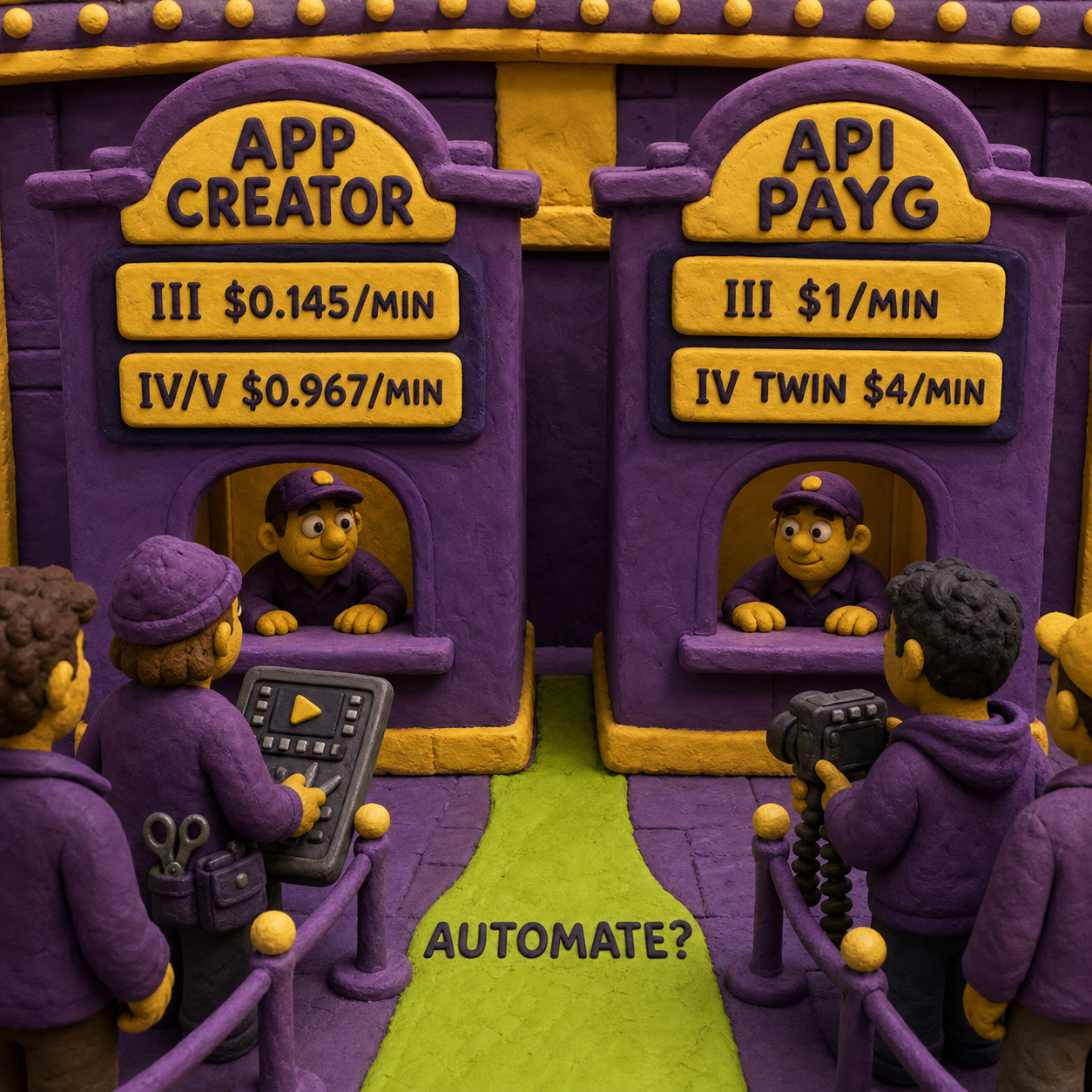
Creator's monthly app allocation is about $0.145 per Avatar III minute when devoted to that engine. The API's $1 rate is 6.90 times higher. Creator's Avatar IV/V allocation is about $0.967 per minute; API Avatar IV Digital Twin is $4, or 4.14 times higher. The comparison is not a billing loophole because the pools do not transfer. It is the price of choosing manual app production or automated API production.
Pay-as-you-go API credits expire after 12 months. HeyGen has offered no free API credits since February 2026, and the current allowance is 10 concurrent videos. A prototype that only needs a few automated clips can stay pay as you go. A steady manual publishing calendar is usually cheaper in the app.
HeyGen vs Synthesia and Colossyan pricing
Raw minute cost makes HeyGen look dramatically cheaper when Avatar III is acceptable, but the comparison is not a quality score. Synthesia and Colossyan sell more predictable minute buckets and different workflow boundaries. Normalize the published capacity, then choose by the kind of video and control the team needs.
Synthesia: the simpler low-volume minute bucket
Synthesia now displays a $19 monthly Starter plan or $14 per month billed yearly, with 10 video minutes a month on monthly billing or 120 minutes for the annual term. That is $1.90 per included minute monthly or $1.40 annually. Creator costs $89 monthly or $59 per month billed yearly, with 30 minutes monthly or 360 minutes annually, equal to $2.97 or $1.97 per included minute.
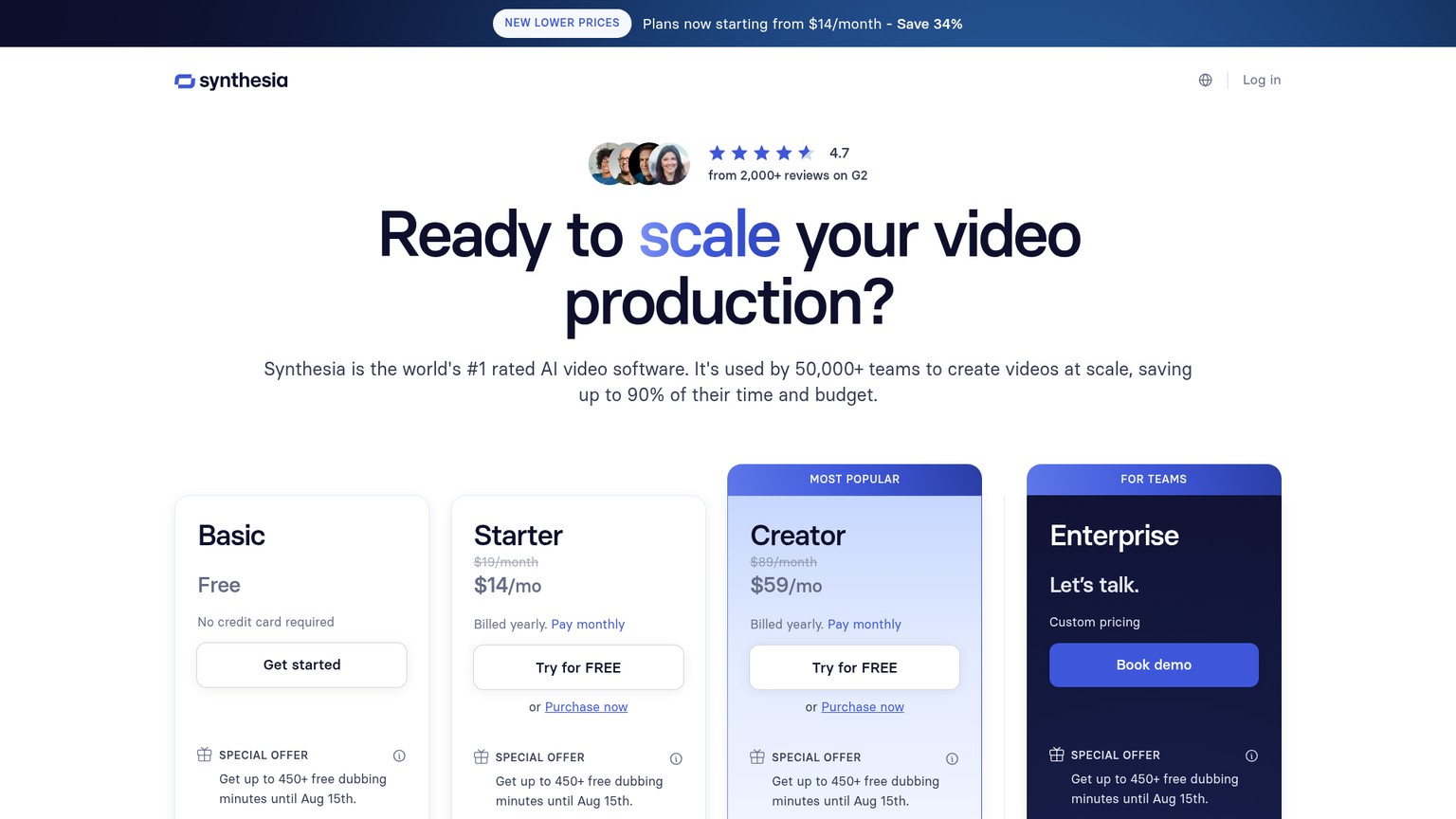
The current cards are the reliable price source. A stale FAQ lower on Synthesia's same live page still quotes Starter at $29 monthly or $264 yearly and Creator at $89 monthly or $804 yearly, even though the cards announce new lower prices of $19/$14 and $89/$59. Synthesia also says unused video minutes do not roll into the next billing period.
Choose Synthesia when the buyer prefers a clear 10- or 30-minute allowance and its avatar, training, and governance workflow fits the deliverable. Choose HeyGen when the team can exploit the cheaper Avatar III rate, wants to mix several generation types inside one credit pool, or values HeyGen's creative avatar options. The fuller product call is in HeyGen vs Synthesia.
Colossyan: the training-first alternative
Colossyan Starter is free and currently lists 20 NEO minutes plus 0.5 NEO2 minutes a month, a 20-minute maximum video, up to 1080p, 15 custom avatars, and 3 cloned voices. Professional costs $89 monthly or $59 per month on annual billing for one editor. It includes 30 NEO minutes, 10 NEO2 minutes, 5 SCORM exports, up to 3 editors, watermark removal, and unlimited MP4 downloads.
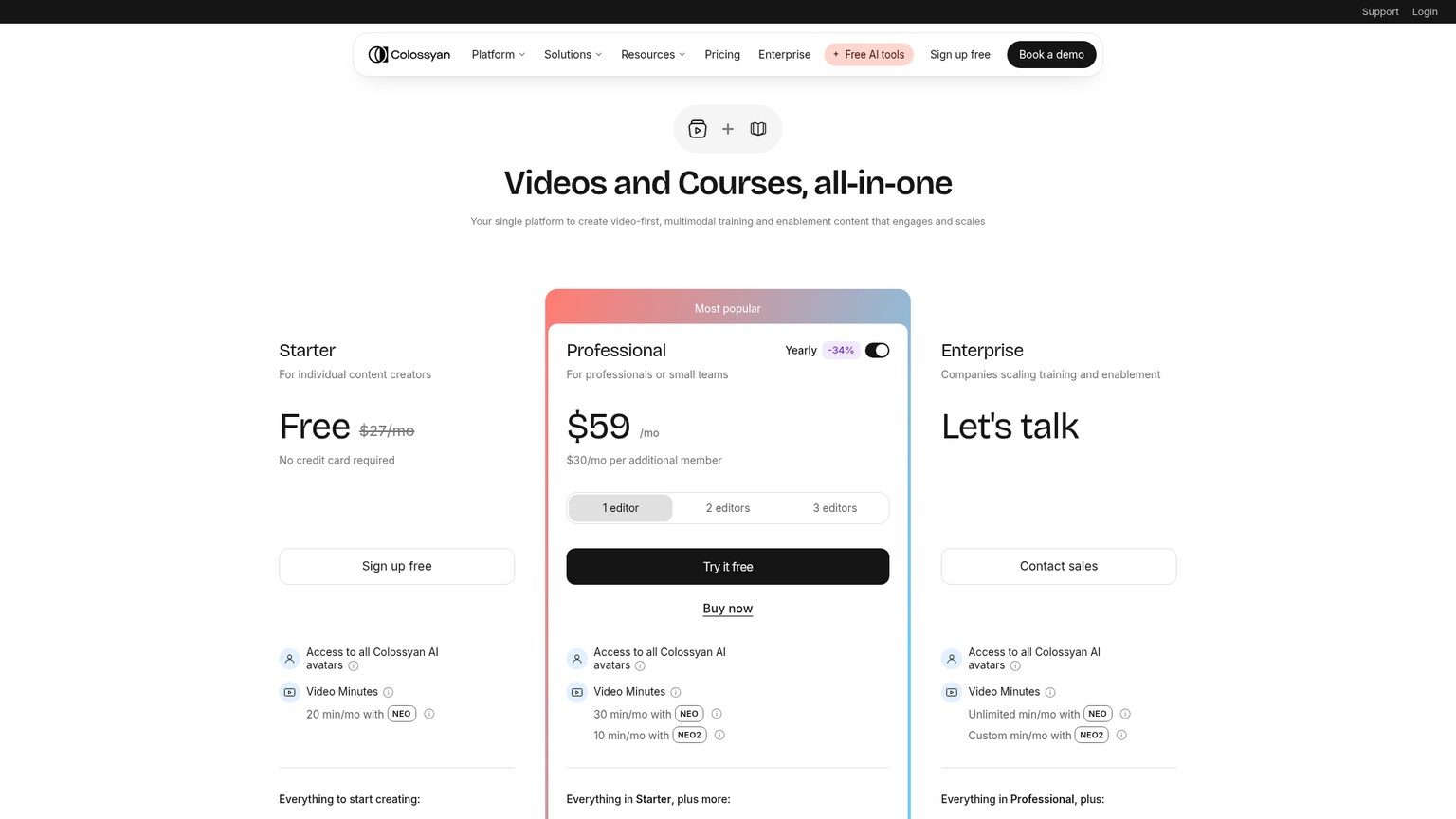
If the full Professional price were assigned only to its 30 NEO minutes, the normalized rate is $2.97 per minute monthly or $1.97 annually, before valuing the separate 10-minute NEO2 allowance. Assigned only to NEO2, it is $8.90 or $5.90. Those are allocation views, not combined charges; both minute pools come with the plan.
Colossyan handles annual capacity differently from HeyGen. It provides the full year's minutes upfront, while HeyGen provides credits monthly and lets unused annual credits accumulate. Colossyan Professional also sells 600 extra NEO2 minutes for $1,500 a year, equal to $2.50 per added minute, and a studio custom avatar costs $1,000 a year.
Choose Colossyan when course creation, SCORM, interactive training, and a defined NEO/NEO2 allowance are central. Choose HeyGen when the work is broader creative avatar video, translation, or mixed-model production and the team can actively manage credits. For projects outside talking avatars, the best AI video generators cover the wider field.
Which HeyGen plan should you choose?
Choose Free when the only job is evaluating a representative avatar brief or producing up to a few one-minute share-link concepts. The regional quota and 720p sharing boundary make it a poor base for a publishing calendar.
Choose Creator when one person needs 1080p output and a measured month fits inside 600 credits. It is the default recommendation because the same credits can cover 200 Avatar III minutes, 30 Avatar IV/V minutes, or a mixed workload, and the monthly price stays at $29.
Choose base Pro when 4K or translation-script proofreading is mandatory, or when the monthly total falls between 601 and 1,000 credits. Choose the 1,500-credit Pro tier at $74 rather than jumping to Business when one person needs more capacity but no team workspace.
Choose a higher Pro tier by measured recurring consumption. The feature set does not improve at 2,000, 5,000, or 100,000 credits. Paying above the smallest fitting step only buys headroom.
Choose Business when collaboration, comments, centralized billing, SSO, SCORM, LMS integration, interactive video, a 60-minute maximum, or purchasable top-ups has a named owner and a recurring job. Do not choose it merely because several people watch the finished videos. Viewer count is not the same as editor-seat need.
Choose Enterprise when procurement requires SCIM, multi-workspace control, team-member MFA, invoice billing, custom usage, or dedicated support. Get the quote against a written control list so custom pricing can be evaluated against a specific requirement.
Skip HeyGen when a simple minute bucket is more valuable than model flexibility, when a training-first workflow is the main job, or when the team cannot preflight credit use before generation. Synthesia and Colossyan make those tradeoffs easier to predict.
- Creator starts at $29 and can deliver very low per-minute cost with Avatar III.
- The same credit pool supports avatar generation, translation, assets, and several AI video features.
- Monthly credits roll one extra cycle, while annual credits accumulate until renewal.
- Pro scales through exact credit steps without forcing a team plan.
- Business supports top-ups, collaboration, SSO, SCORM, and LMS workflows.
- API pay-as-you-go is available without an app subscription.
- The engine can change credit burn by more than sixfold for the same runtime.
- Creator and Pro have no one-time top-ups.
- Additional Business seats add cost but no credits.
- Annual plans are paid upfront while credits still arrive monthly.
- Public HeyGen pages conflict on Video Agent's current credit rate.
- Payments are generally non-refundable, and significant usage can weaken a request.
HeyGen pricing FAQ
Is HeyGen really free?
Yes. HeyGen Free costs $0 and requires no credit card. The main pricing page offers up to three videos per month, each up to one minute, while the billing explainer says the regional quota may be 1 to 3. It includes a 720p sharing link, one custom video avatar, 500+ stock avatars, 30+ languages, and limited access to core creation tools.
Stay free if a few short share-link concepts are the entire job. Pay when finished 1080p export, watermark removal, longer recurring output, 175+ languages and dialects, or a predictable production calendar matters.
Is HeyGen really unlimited?
Not on the plans sold to new customers. HeyGen ended new sales of its old unlimited plans after 15 May 2026 and moved current subscriptions to credit-based usage. Video duration limits can be generous, but generation still consumes credits.
Grandfathered unlimited subscribers may keep their old plan while the subscription remains active and in good standing. If they cancel or switch to a credit plan, they cannot return to the legacy plan.
How much does HeyGen API cost?
HeyGen API is standalone pay as you go. Avatar III costs $1 per minute in 720p/1080p or $1.20 in 4K. Avatar IV Photo Avatar costs $3 or $4 by resolution, while Avatar IV Digital Twin and Studio Avatar cost $4 or $5. Video Agent is $2 per prompted minute, and translation ranges from $1 to $4 per source minute by mode.
API credits expire after 12 months, no free API credits have been offered since February 2026, and the current concurrency allowance is 10 videos.
Does HeyGen offer a student discount?
No standing student-specific plan or student price appeared on HeyGen's live public pricing and credit-plan pages when verified on 9 August 2026. The public billing guide says occasional promo or discount codes can be applied at checkout.
Students can use Free for evaluation. An educational institution that needs SSO, SCORM, LMS integration, or centralized procurement should compare Business and an Enterprise quote rather than assume an individual student rate exists.
Can I get a refund from HeyGen?
HeyGen says payments are generally non-refundable outside legal requirements and specific discretionary cases. Direct HeyGen and Google Play purchases may be reviewed within 15 days when the product did not suit the project, while Apple App Store requests have a 14-day window.
A significant amount of used credits may make a direct refund request ineligible. Canceling stops the next renewal but keeps paid access through the current billing period; it does not refund the unused part by default.
Do HeyGen credits roll over?
Monthly subscribers can roll unused credits into one additional billing cycle. Annual subscribers receive monthly allocations, not all annual credits at once, but unused credits accumulate until the annual renewal date.
Credits stop rolling over after cancellation to Free. That makes annual billing friendlier to uneven monthly production, but it does not let a user pull future monthly allocations forward.
Did HeyGen pricing change in 2026?
Yes. HeyGen stopped selling its old unlimited plans to new customers after 15 May 2026. Current Creator, Pro, and Business plans use credits across avatar video, translation, assets, and other generation features.
Existing legacy subscribers may keep their terms while the subscription stays active and paid. New buyers should budget from the current credit schedule, not from older claims of unlimited Avatar III or premium-credit pools.
Get the AI business workflow audit checklist to map each video step to a recurring outcome before committing to a credit tier or annual plan.
- Last Updated
- Category
- Design
- Language
ElevenLabs Alternatives: Murf, MAI-Voice-2, OpenAI TTS and Cartesia (Verified October 2026)
Compare ElevenLabs, Murf, MAI-Voice-2, OpenAI, Cartesia, Google and Speechify by studio or API job, with verified prices and switching costs.Oct 4, 2026Design
Higgsfield API Pricing
Price Higgsfield API video and image jobs, separate API dollars from app credits, and check top-ups, expiry and cashback before scaling.Sep 27, 2026Design
Is Gemini Live Avatar Free
Check Gemini Live Avatar access, Enterprise API charges and custom-avatar limits before budgeting a customer-facing video agent.Sep 27, 2026Design
Gemini 3.8 Flash TTS Pricing
Price Gemini 3.8 Flash TTS by audio minute, compare Flash-Lite and service tiers, and budget the January 2027 increase.Sep 24, 2026Design
ngram vs Demosmith
Compare ngram and Demosmith for product videos, browser capture, revisions and usable exports, with costs matched to the same job.Sep 19, 2026Design
ArtPatt Pricing
ArtPatt pricing explained: Free limits, Pro exports, saved patterns, AI-image allowances, and when a paid plan earns its place.Sep 15, 2026Design
Cutsio Video Indexing Cost
Decode Cutsio's indexed minutes, stored hours, seats, and overages to choose a plan for a growing video library.Sep 13, 2026Design