Higgsfield Supercomputer on a Real Brand Film — May 2026
A real billable brand-film brief run through Higgsfield's Supercomputer: what the agent handled, where it drifted, the credit ladder, when to pull back.
Published Updated
 By Omid Saffari
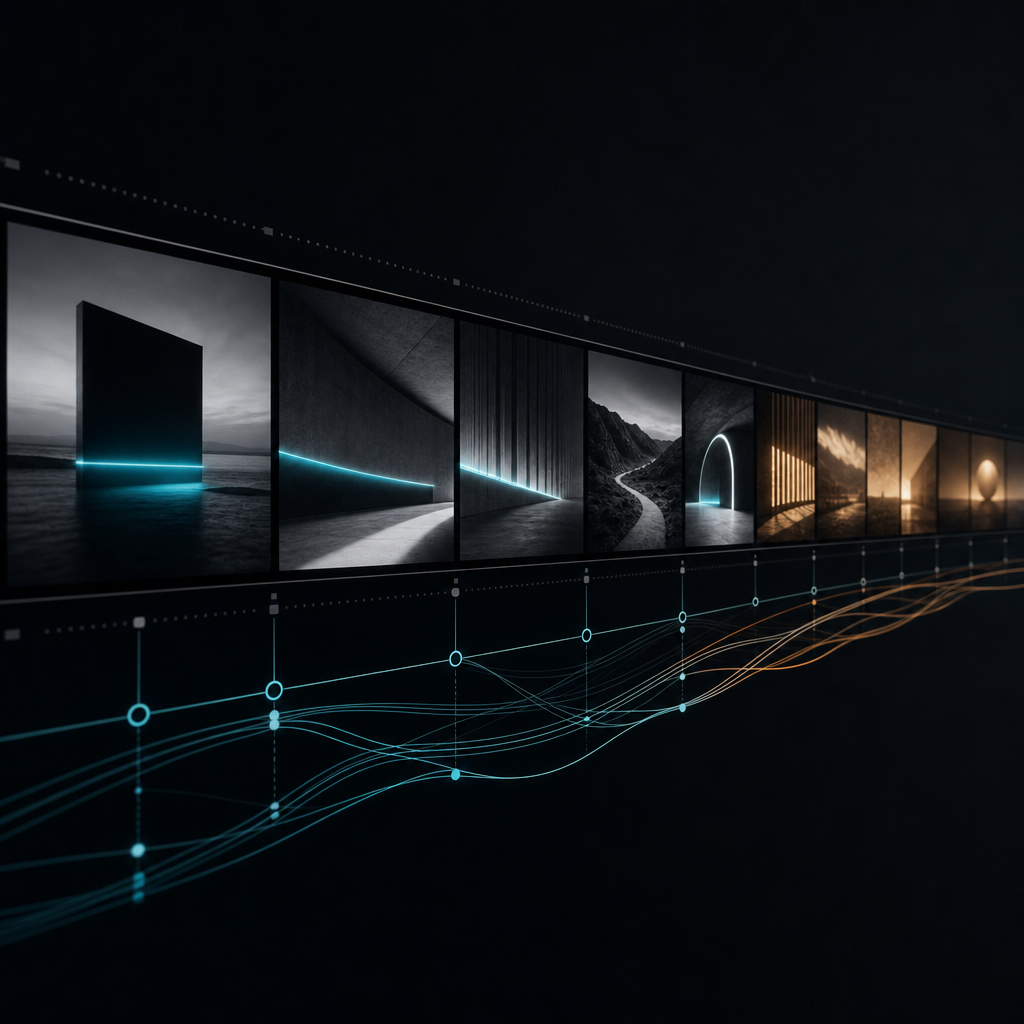
Higgsfield shipped its Supercomputer on May 14 and four days later I handed it a real client brief that normally runs four tools and three days of my direction. It returned a near-finished 45-second brand film in one orchestrated pass – and drifted off the brand world in exactly the two places I'd have caught in a human edit.
The 45-second film it shipped in one pass
The brief was for a wellness brand whose visual system we'd already built at DVNC.studio: cool near-monochromatic world, single electric-cyan accent, slow cut cadence, locked motion grammar (no whip pans, no orbit pushes). 45 seconds, 16:9 hero plus a 9:16 social cut. The kind of work where brand consistency is the deliverable, not the visuals.
I uploaded the brand kit – palette swatches, type ramp, three reference frames, and the motion bible as a one-page PDF – wrote a 180-word treatment, and pressed the orchestration button. Forty-seven minutes later the Supercomputer returned both cuts: script-driven, board-paced, shots generated, music bedded, dialogue mixed, virality scored.
On first watch it was ~80% usable. Camera language was credible, pacing held, the audio mix was tighter than what I'd get out of a junior editor in a day. Two defects blocked delivery: the accent color crept warm across the back half of the film, and the agent inserted a slow orbit push the brief explicitly banned. Both are art-direction failures, not production failures.
The manual pipeline I benchmarked this against – Midjourney boards, Runway shots, ElevenLabs voice, DaVinci color and edit – runs me three days at a director rate, so the comparison isn't close on production cost. It's close on the question of whether you can ship it without me touching it. You can't yet. Here's why.
The brief – a real brand world, not a vibe
The client brand world is the kind of system that breaks generative tools. Palette is locked: a five-step grayscale ramp from near-black to near-white, plus one specific cyan accent (think Pantone 312 territory, cool and slightly desaturated). Type ramp is one display face for the wordmark and one neo-grotesk for body – type doesn't appear in the film but the supers do, and the supers must sit on the same baseline grid as the print system.
Motion grammar is where most AI video falls apart: cut cadence between 1.4 and 2.2 seconds, no whip pans, no orbit pushes, no dolly zooms, camera moves limited to slow lateral truck and locked-off. Lens language: 35mm and 50mm equivalent, no wide-angle distortion. Color story must grade cool across the whole runtime – no warm drift, no skin-tone push.
This isn't a stylistic preference. It's the system the client paid for and the system every other touchpoint – print, web, retail – already lives inside. Brand consistency across shots is exactly where autonomous routing tends to fail, which is why I picked this brief.
What the Hermes Agent took over – skill by skill
The Supercomputer isn't a single model. It's a cloud-native agent stack built on the Hermes Agent logic engine – a custom Hermes 3 from Nous Research – orchestrating 40+ built-in tools and picking from 61 production skills, routing subtasks in parallel to GPT-5.5, Claude Opus, Gemini, Seedance 2.0, Veo, and Kling depending on what each step needs.
Video generation runs on Seedance 2.0, the piece that matters most here: a dual-branch DiT with a Visual Branch (pixel latents for frames) and an Audio Branch (waveform latents for synced SFX and dialogue), generating 4–15-second clips at up to 1080p with multimodal reference up to 3 video / 9 image / 3 audio inputs.
On my brief, after script, boards, and shot generation, the visible later-stage chain was:
- Upscale – internal upscaler pushed the selected takes to 1080p. 120 credits.
- Audio mix – ambient bed, two SFX cues, no dialogue. 80 credits.
- Virality Predictor – ran on both the 16:9 and 9:16 cuts. 60 credits.
- Social cut – agent reframed and re-paced the 9:16 from the same Seedance source clips. 100 credits.
The memory and connectors layer earned its keep on step 3. The brand kit I fed once at the start held across the first six or seven shots – Seedance's reference adherence visibly degraded after that, which lines up with the multimodal reference ceiling. The agent didn't re-prompt the kit between shots and didn't need to be told to; this is the part of the Supercomputer pitch that's real.
Where it drifted off the brand world
Two defects, both art-direction failures, both diagnostic.
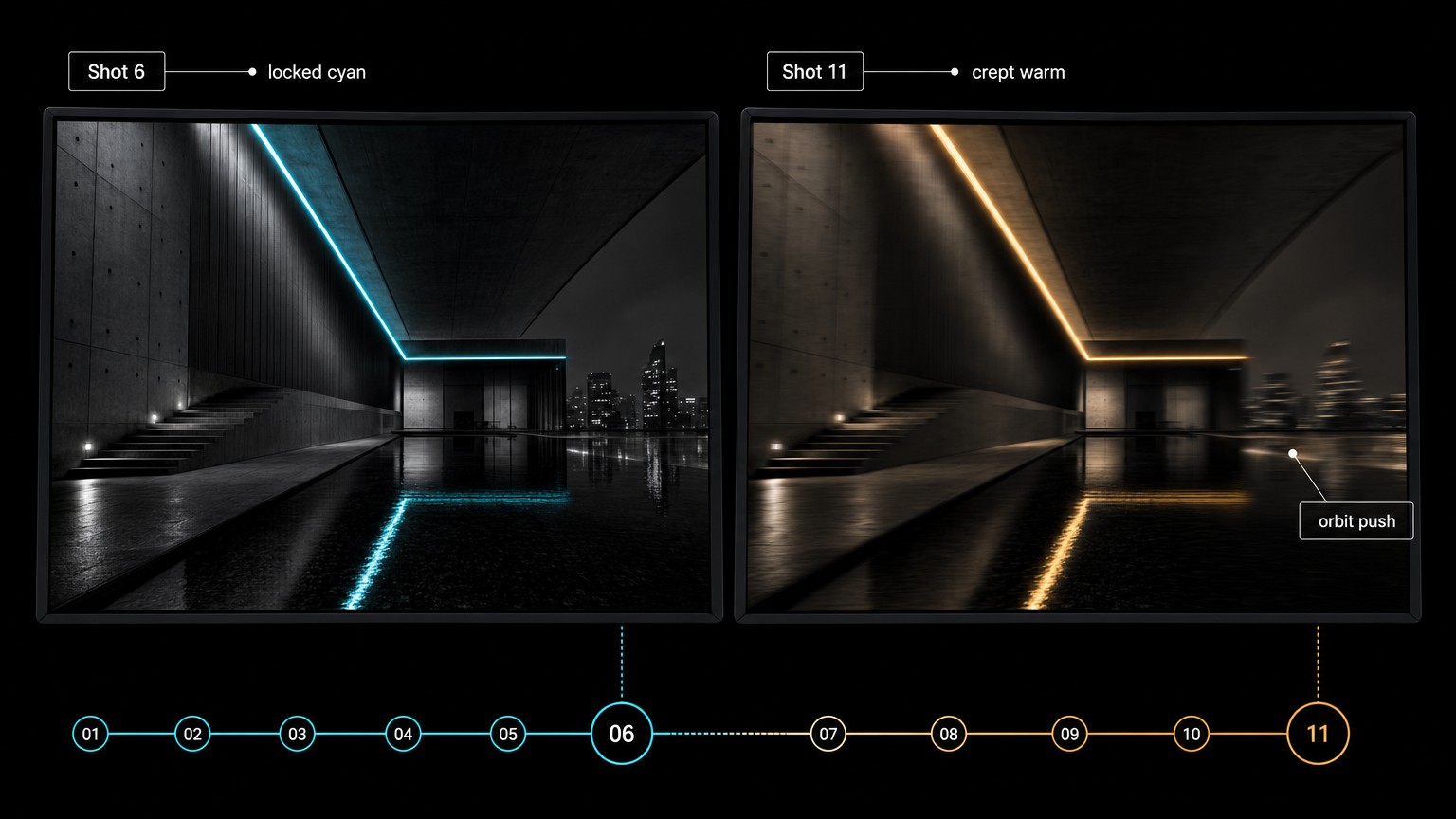
Drift one: accent color crept warm. The cyan accent – a prop element in three shots, a graphic super in one – was on-brand in shots 1 through 6 and visibly warmer in shots 8 through 14. Not catastrophically warm, but enough that a side-by-side against the print system would fail QA. This is the multimodal reference ceiling showing up in practice. Seedance accepts up to 9 image references; once the agent is six or seven shots into a chain, the reference signal weakens and the model defaults toward its training prior, which leans warm and cinematic. A human director catches this in the edit. The agent doesn't, because the agent doesn't grade against a brand swatch – it grades against "looks like the references, mostly."
Drift two: a banned camera move. Shot 11 came back with a slow orbit push around the hero object. Beautiful shot. Wrong shot. The treatment said no orbit, no push, locked or lateral only. The agent read "cinematic product reveal" and routed to a Seedance prompt that produced exactly what its training data says a cinematic product reveal looks like. Autonomous routing optimizes for "cinematic" – a defensible default for generic work and the wrong default for a locked brand system.
The diagnostic moment was the Virality Predictor score: it preferred the off-brand cut. Higher hook score, higher hold rate, slightly warmer color, the banned orbit push intact. The metric the agent optimizes is not the metric the client buys. If you're shipping UGC at volume, that's a feature; if you're shipping a brand system, that's the failure mode.
The credit ladder – what each skill cost
Numbers as tested on the Creator plan ($29/month, ~3,500 credits) in May 2026; verify current values at the pricing page since plans and credit costs have shifted twice since launch.
The full run: 2,140 credits burned, which means another 1,360 credits left in the month for any additional work. Per finished second, that's roughly 47 credits/second, or about $0.40 of the plan allotment per second of finished film at the Creator tier.
The trap is the regeneration cost. Fixing the two drift defects required:
- Re-running shots 8 through 14 with a tighter reference seed and the orbit push prompt-locked out: +820 credits.
- A second upscale pass on the replacements: +60 credits.
- One more Virality Predictor run on the corrected cut: +30 credits.
Corrected delivery: 3,050 credits – 42% over the first-pass figure. The apparent savings against the manual pipeline are real on a clean run and erode quickly once brand QA forces regeneration. On a brief with looser brand tolerance, the ladder favors the Supercomputer by a wide margin. On a locked brand system, it favors a manual pipeline once you cross two or three regeneration cycles.
This is the same pattern I hit on Canva AI 2.0's agentic run and Krea 2's style-transfer chain: the agent's first-pass economics are excellent and the regeneration economics are where the real cost sits.
Where I pulled the edit back – and when I wouldn't
The handoff point that worked on this brief: agent does script → boards → shot generation → rough audio. Human takes color match, final cut, motion compliance, and supers. On my next run I'll prompt-lock the banned camera moves at the treatment level and seed the brand kit with one extra cyan-locked reference frame every five shots, but I'm not relying on those to fix the drift – I'm relying on them to reduce it enough that the manual pass is 90 minutes instead of half a day.
The Supercomputer is the right call for:
- Speed-first social cuts where brand tolerance is wide
- Internal pitch films and pre-viz where the audience is the team, not the customer
- Volume UGC where the brand spec is "stay in the visual neighborhood"
- Any brief where the alternative is "we don't have the budget to make this at all"
It is not the right call for:
- Locked brand systems for paying clients without a human consistency pass
- Anything that has to sit next to existing print or web work without grading
- Briefs where the cut cadence and camera grammar are part of the IP
Runway's agentic studio sits inside one tool and gives you tighter control over a smaller surface; the Supercomputer wins on orchestration breadth and loses on directability. Both fail in the same place – brand consistency across a chain – and both compress production without compressing art direction.
The takeaway in design terms: the Supercomputer compresses production, not art direction. Budget the human pass. Don't pretend it's gone.
Is the Higgsfield Supercomputer good enough to deliver client brand films without a human edit?
Not for locked brand systems. It got ~80% of the way on a real brief but drifted on accent color past shot six and inserted a banned camera move that a client would reject on first watch. For looser briefs – social, pitch, UGC – it's already good enough to ship unedited.
What model powers the Supercomputer's video generation?
Seedance 2.0 – a dual-branch DiT with separate Visual and Audio branches generating 4–15-second clips at up to 1080p, orchestrated by the Hermes Agent logic engine, which routes other steps to GPT-5.5, Claude Opus, Gemini, Veo, and Kling depending on the skill.
How much does a finished brand film actually cost in credits?
On the Creator plan tested, a clean 45-second run was 2,140 credits (~$18 of allotment, ~47 credits per finished second). After regenerating the two brand-drift defects, the corrected delivery was 3,050 credits – 42% over the first-pass figure. The per-skill ladder is in the credit section above.
How is this different from Runway's agentic video studio?
Runway's agent sits inside one tool and gives you tight control over a smaller surface. The Supercomputer routes across many models – Seedance, Veo, Kling, GPT-5.5, Claude, Gemini – and runs 61 production skills end-to-end. Different failure modes: Runway under-commits, the Supercomputer over-routes.
Does the Virality Predictor help pick the best cut?
It scores hook and hold rate, not brand fidelity. On this brief it preferred the off-brand cut with the warmer accent and the banned orbit push. Treat it as a reach signal, not a delivery gate.
If you're running creative AI pipelines on real client work and want the prompts that hold brand consistency across a generative chain, I've packaged the system I use into a free AI poster-and-campaign prompt pack – the exact treatments, reference structures, and prompt-locks that survived the runs in this piece.
- Last Updated
- Category
- Design
- Language
Nano Banana 2.1 Explained: Pricing, Changes, and When to Switch
Nano Banana 2.1 cuts 1K and 2K image costs about in half. Compare monthly budgets, verify the migration, and decide when Pro earns its premium.Oct 8, 2026Design
ElevenLabs Alternatives: Murf, MAI-Voice-2, OpenAI TTS and Cartesia (Verified October 2026)
Compare ElevenLabs, Murf, MAI-Voice-2, OpenAI, Cartesia, Google and Speechify by studio or API job, with verified prices and switching costs.Oct 4, 2026Design
Higgsfield API Pricing
Price Higgsfield API video and image jobs, separate API dollars from app credits, and check top-ups, expiry and cashback before scaling.Sep 27, 2026Design
Is Gemini Live Avatar Free
Check Gemini Live Avatar access, Enterprise API charges and custom-avatar limits before budgeting a customer-facing video agent.Sep 27, 2026Design
Gemini 3.8 Flash TTS Pricing
Price Gemini 3.8 Flash TTS by audio minute, compare Flash-Lite and service tiers, and budget the January 2027 increase.Sep 24, 2026Design
ngram vs Demosmith
Compare ngram and Demosmith for product videos, browser capture, revisions and usable exports, with costs matched to the same job.Sep 19, 2026Design
ArtPatt Pricing
ArtPatt pricing explained: Free limits, Pro exports, saved patterns, AI-image allowances, and when a paid plan earns its place.Sep 15, 2026Design