Hootsuite Pricing (2026): $99 Is the Floor, Not the Budget
Hootsuite costs $99 to $499 per user monthly. Compare every tier, annual savings, free-plan truth, hidden costs, and cheaper alternatives.
Published Updated
 By Omid Saffari






Hootsuite starts at $99 per user per month, but a three-person team pays $3,564 a year on Standard, $7,164 on Professional, or $14,364 on Advanced before tax. Standard is defensible for a solo operator who uses its inbox, listening, and reporting; Advanced only earns its price when approvals and routing remove at least 10 team-hours a month.
Hootsuite pricing at a glance
Hootsuite has three paid self-serve tiers and one custom Enterprise tier. The live Hootsuite pricing page is the source of record, but its default cards show annual-equivalent rates; the month-to-month amounts come from the live billing feed behind those cards.
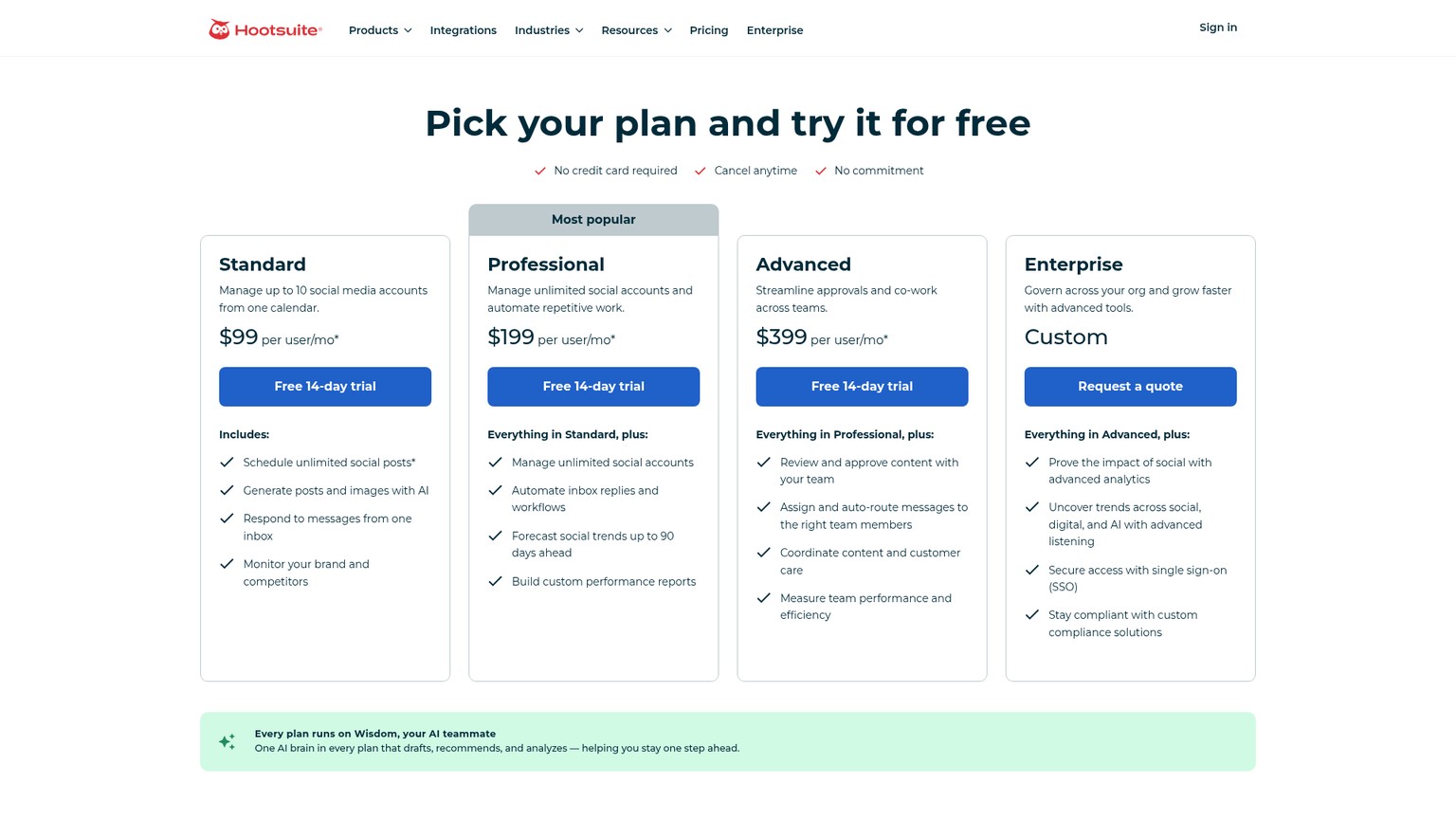
Verified against Hootsuite's live pricing page, billing feed, plan comparison data, and legal terms on August 12, 2026. Prices below are in US dollars per user before tax.
The blunt verdict is that Standard is the sensible Hootsuite plan for one operator, Professional is the scale tier, and Advanced is a workflow purchase rather than a feature upgrade. Enterprise belongs in a procurement process, not a casual pricing comparison.
Which Hootsuite plan should you choose?
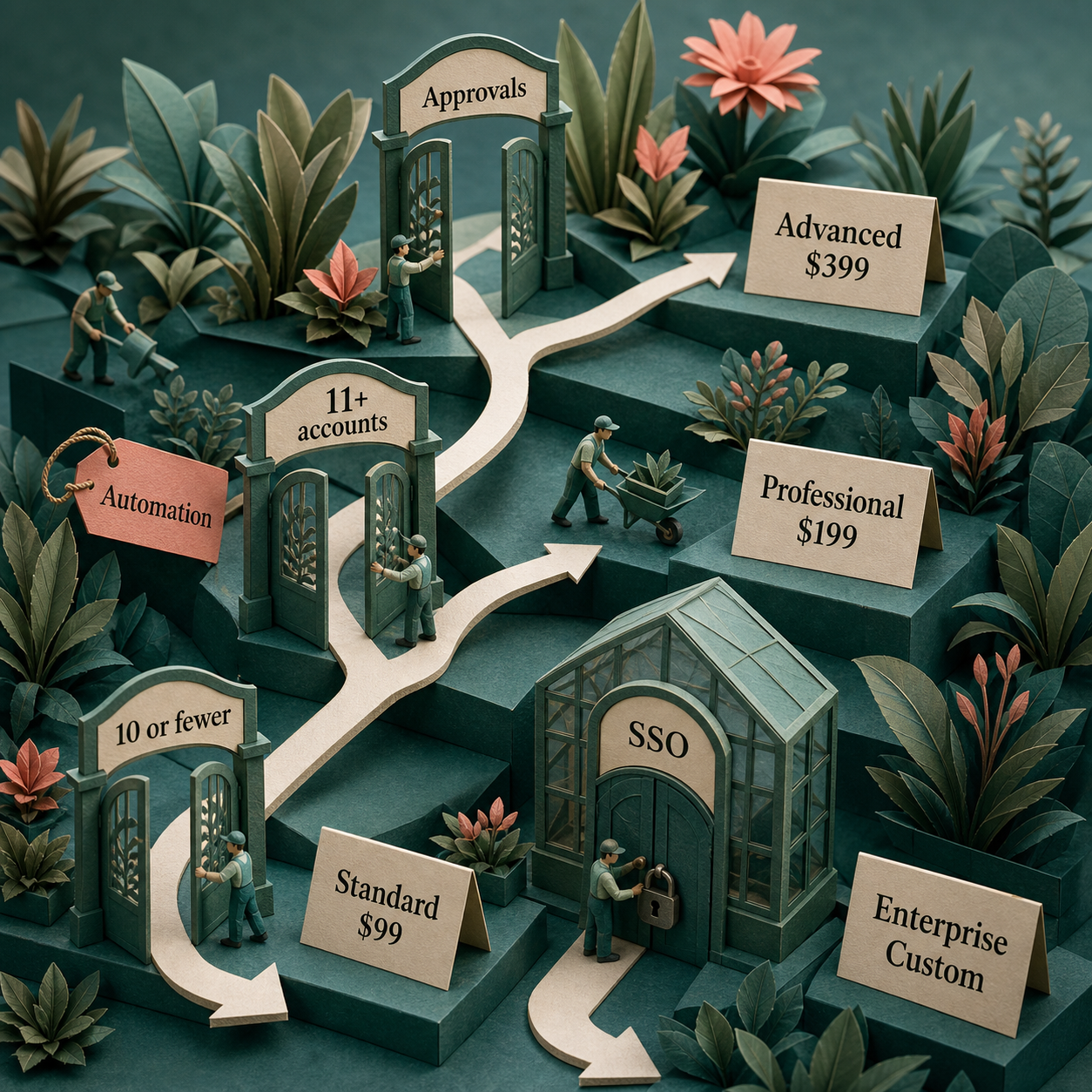
Choose the lowest tier whose operating limit you will hit this quarter. Account count moves buyers from Standard to Professional; approvals, routing, and team accountability move them from Professional to Advanced.
Standard: the right default for one operator with 10 accounts or fewer
Hootsuite Standard costs $99 per user monthly on annual billing or $149 month-to-month. It supports 10 social accounts, unlimited scheduled posts, 100 AI credits per month, a centralized inbox, saved replies, seven days of Quick Search, comparison of two listening results, and benchmarking against five competitors.
That is enough for a local-services group managing one brand across several networks, or a solo agency owner with a tightly limited client roster. At the full 10-account allowance, the annual rate works out to $9.90 per connected account each month. Use only five accounts and the same software line doubles to $19.80 per account-month.
Standard stops being attractive when work needs to move between people. It excludes DM automations, automated responses, custom reports, report exports, approval workflows, internal comments, teammate message assignment, team settings, and team productivity reporting. Adding seats gives more people access, but it does not add the coordination layer those people usually need.
Pick Standard when one owner publishes, monitors, and reports across no more than 10 accounts. Skip it when an approval queue or shared customer-care operation is already part of the job.
Professional: pay for scale and automation, not merely another seat
Hootsuite Professional costs $199 per user monthly on annual billing or $299 month-to-month. It removes the social-account cap and adds DM automations, automated responses, tag and topic automations, custom reports, basic report exporting and scheduling, 30-day Quick Search, trend forecasting, comparison of five listening results, and benchmarking against 20 competitors.
The hard trigger is account 11. Standard cannot cover it, so Professional becomes the first self-serve option. Below 11 accounts, the upgrade needs a workflow case: its $100 annual-equivalent monthly premium should save at least one hour and 40 minutes per seat at an assumed $60 loaded labor cost.
Professional is a strong fit for a solo agency managing many profiles or a growth lead who repeatedly builds custom reports and inbox automations. It is a weaker fit for a three-person content team because it still excludes post approvals, internal comments, teammate message assignment, team settings, team productivity reporting, skill-based routing, and SSO.
Pick Professional for unlimited profiles, repeatable inbox automation, and reports that would otherwise consume recurring labor. Skip it if the real requirement is governance between several people; Advanced is the tier built for that.
Advanced: the approval and customer-care tier
Hootsuite Advanced costs $399 per user monthly on annual billing or $499 month-to-month. It keeps unlimited accounts and adds post approvals, internal comments, teammate message assignment, team settings, inbox productivity reporting, skill-based routing, customer-service surveys, and advanced report exports.
The price consequence is severe because the premium also multiplies by seat. Three annual Advanced seats cost $14,364 per year, exactly $7,200 more than three Professional seats. At an assumed $60 loaded labor hour, approvals, routing, and team reporting must remove or protect 10 hours of team work every month to cover that difference.
Advanced still is not Enterprise. It excludes SSO, advanced listening data sources, 13 months of listening history, listening alerts, scheduled listening reports, and ROI reporting. A regulated company can therefore outgrow a $399 seat before it outgrows the account allowance.
Pick Advanced when several people genuinely route messages, approve content, and need an auditable team workflow every week. Skip it when approval can live in one lightweight external step and the saved time cannot clear the 10-hour monthly hurdle for a three-seat team.
Enterprise: custom governance with a contract clock
Hootsuite Enterprise has custom pricing and supports unlimited accounts and users. It is the only current tier with SSO, advanced listening sources, 13 months of historical listening data, alerts, scheduled listening reports, ROI reporting, custom onboarding, and access to premium listening, analytics, inbox, employee advocacy, review management, Salesforce, and compliance add-ons.
The commercial limit matters as much as the feature list. Hootsuite says the one-year Enterprise contract renews automatically, and non-renewal must reach the Customer Success representative in writing at least 60 days before the term ends. Renewal fees can rise with at least 90 days' notice.
Pick Enterprise only when security, governance, premium data, or implementation support is already a procurement requirement. Ask sales to itemize the base platform, each add-on, implementation, support, seat growth, renewal uplift, and exit date in the quote.
Annual versus monthly Hootsuite billing
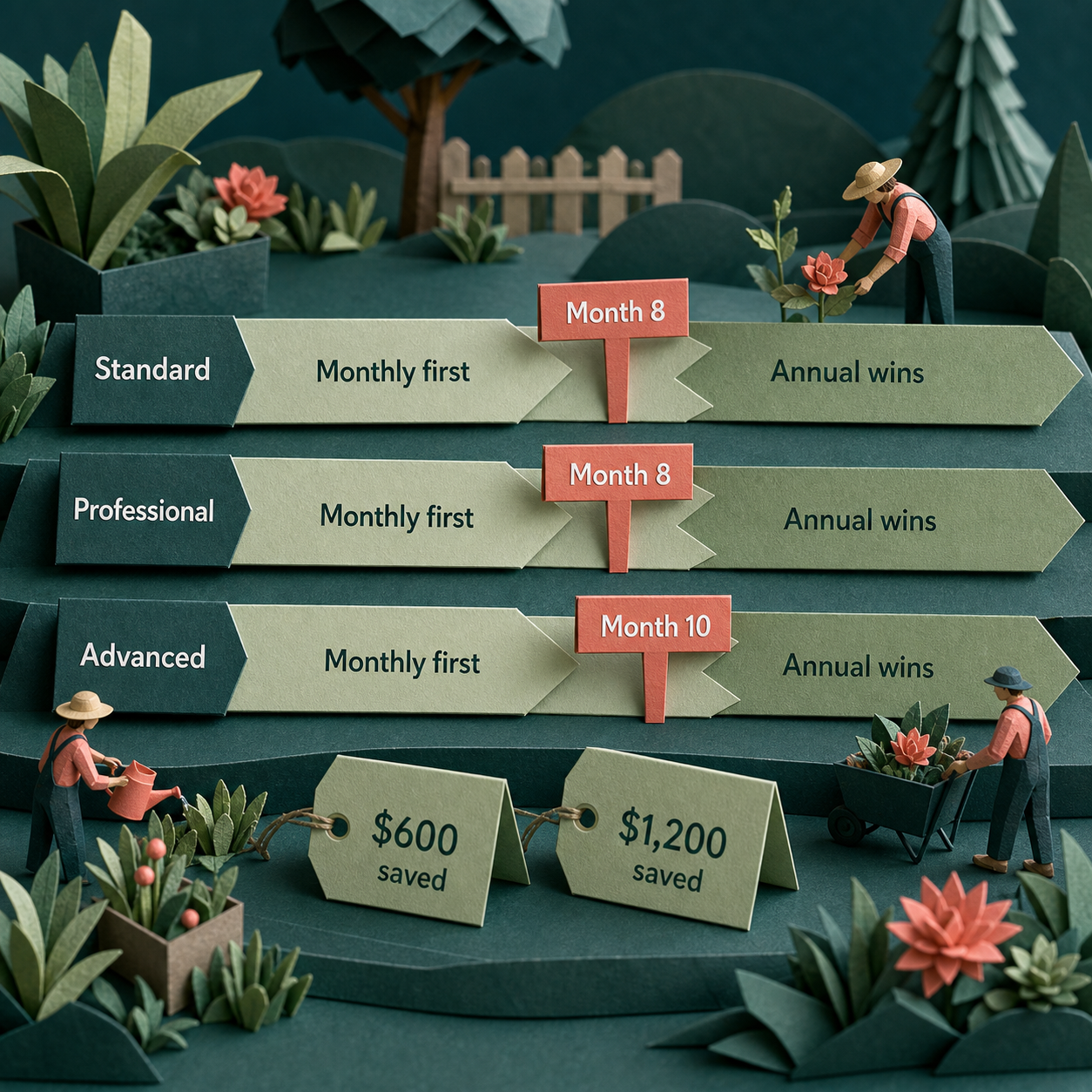
Annual Hootsuite billing wins only after the account crosses a clear commitment line. Standard and Professional become cheaper than continuing month-to-month at about eight paid months; Advanced crosses that line at about 10 months.
Standard costs $1,188 for an annual term versus $1,788 across 12 month-to-month payments, a $600 saving. Professional costs $2,388 annually versus $3,588 across 12 monthly payments, saving $1,200. Advanced costs $4,788 annually versus $5,988 across 12 monthly payments, also saving $1,200.
The percentage discount is not the decision. Expected tenure is. A B2B SaaS growth lead replacing an established scheduler for the next year should take the annual rate after the trial validates the workflow. A new agency with uncertain client retention should stay monthly until the account has survived the commitment line, even though the card price is higher.
Hootsuite's paid self-serve terms add two reasons not to prepay casually. Subscriptions auto-renew, and cancellation or downgrade does not remove the obligation to pay the rest of the term or create a refund entitlement. Taxes are extra. A cheaper annual rate can still be the more expensive decision if the operation changes platforms after four months.
Is Hootsuite free?
Hootsuite does not offer a general free plan in its current public catalog. Standard is the entry tier at $99 per user monthly on annual billing, and the free offer is a 14-day trial.
The current trial does not require a credit card and does not charge automatically when it ends. It is not an unrestricted production account: trial organizations can publish 10 to 20 posts per day depending on plan, and bulk scheduling is unavailable. Those limits make the trial useful for validating navigation, reporting, and inbox fit, but weak for simulating a high-volume launch calendar.
Who never needs to pay for Hootsuite: almost no commercial buyer who wants ongoing access to the full platform. Eligible higher-education classes are the exception. Hootsuite's educator-led Student Program can provide free Hootsuite access, courseware, and certifications to students in qualifying accredited programs. That is not a general discount code for any individual with a student email.
A solo creator who only needs three channels and can live with 10 queued posts per channel has another answer: use Buffer Free and pay $0. Hootsuite Standard earns its $1,188 annual line only when its combined inbox, listening, competitor benchmarking, and reporting replace enough separate work.
Qualified nonprofits have a materially different Hootsuite price card. The HootGiving program lists annual-equivalent rates of $39 for Standard, $79 for Professional, and $159 for Advanced per user monthly. That works out to $468, $948, and $1,908 per seat each year, advertised as savings of up to 60%.
The hidden Hootsuite costs
Hootsuite's biggest hidden cost is not an overage fee; it is buying the correct workflow for every seat. Five casual collaborators on Professional cost the same as five full-time operators even if only two people build reports or run inbox automation.
The seat multiplier
The per-user model turns small plan changes into large budget moves. A three-seat team jumps from $3,564 yearly on Standard to $7,164 on Professional and $14,364 on Advanced. Before adding a seat, decide whether that person needs to work inside Hootsuite or can review an exported report, shared calendar, or external approval link.
The 100-credit AI ceiling
Standard, Professional, and Advanced each include 100 AI credits per month. Upgrading from $99 to $399 does not increase the published allowance. Hootsuite does not publish a top-up or overage price on the current pricing page, so a team planning heavy AI-assisted content should ask what happens after credit 100 before signing an annual term.
This is also a freshness issue. An older Hootsuite comparison page still describes a larger allowance, but the current live plan table says 100 credits. Budget from the current table.
Custom-priced Enterprise add-ons
Premium listening, analytics, inbox, employee advocacy, review management, Salesforce, and compliance capabilities sit behind Enterprise and custom quotes. None has a public add-on price on the current card. A procurement team should request a line-item quote and model the renewal price, not accept one blended first-year number.
Taxes, renewal, and refunds
Hootsuite adds applicable taxes. Paid self-serve plans auto-renew, and the current terms say cancellation or downgrade does not entitle the buyer to a refund for the remaining term. Enterprise adds the 60-day written non-renewal deadline. Put both the renewal date and the notice date into the operating calendar on purchase day.
API versus app pricing
Hootsuite's API terms currently provide API access for free under a limited developer license, with call-volume limits governed by the documentation. Hootsuite also reserves the right to charge for the API later. The API is an integration surface, not a cheaper replacement for the dashboard seats and plan features an operating team needs.
Hootsuite cost per outcome and tier break-even
Hootsuite becomes easier to judge when the invoice is divided by the work it carries. Standard at 10 connected accounts costs $9.90 per account-month; at five accounts it costs $19.80. The same $99 rate spread over 120 scheduled posts is $0.83 per scheduled post before labor and media spend, while 60 posts costs $1.65 each.
That does not prove the software creates revenue. It shows utilization. A DTC brand paying for Standard while connecting five accounts and scheduling 60 posts monthly uses the platform at twice the account cost and twice the post cost of a brand filling all 10 account slots and scheduling 120 posts. The underused account should either expand the workflow into inbox, listening, and reporting or move to a cheaper scheduler.
The Standard-to-Professional decision is equally concrete. Professional adds $100 per seat each month on annual billing. At an assumed $60 loaded labor hour, its unlimited accounts, automation, 30-day search, and custom reporting must save one hour and 40 minutes per seat monthly. Account 11 makes the choice automatic; below that count, saved work must justify it.
Advanced adds another $200 per seat each month. For a three-person team, the $7,200 yearly premium over Professional needs 10 saved or protected hours per month at the same labor assumption. Those hours can come from fewer approval handoffs, faster message routing, less duplicated customer care, or simpler team reporting. If nobody can name the recurring task, the upgrade is premature.
Hootsuite versus Buffer, Later, and Sprout Social on price
Hootsuite sits between low-cost schedulers and another premium per-seat suite. For one operator managing 10 profiles on annual billing, Hootsuite Standard costs $1,188 per year, Buffer Essentials costs $600, Later Growth costs $450, and Sprout Social Professional costs $3,588.
Those numbers are normalized to the smallest current plan that can carry 10 profiles, not presented as feature-equivalent products. The broader AI social media management tools comparison covers category fit beyond this price decision.
Buffer: the price winner for scheduling and a flexible channel count
Buffer Essentials costs $5 per channel monthly on annual billing, so 10 channels cost $50 per month or $600 per year. It includes one user, unlimited scheduled posts, unlimited ideas, advanced analytics, and three API keys with 7,500 requests per month.
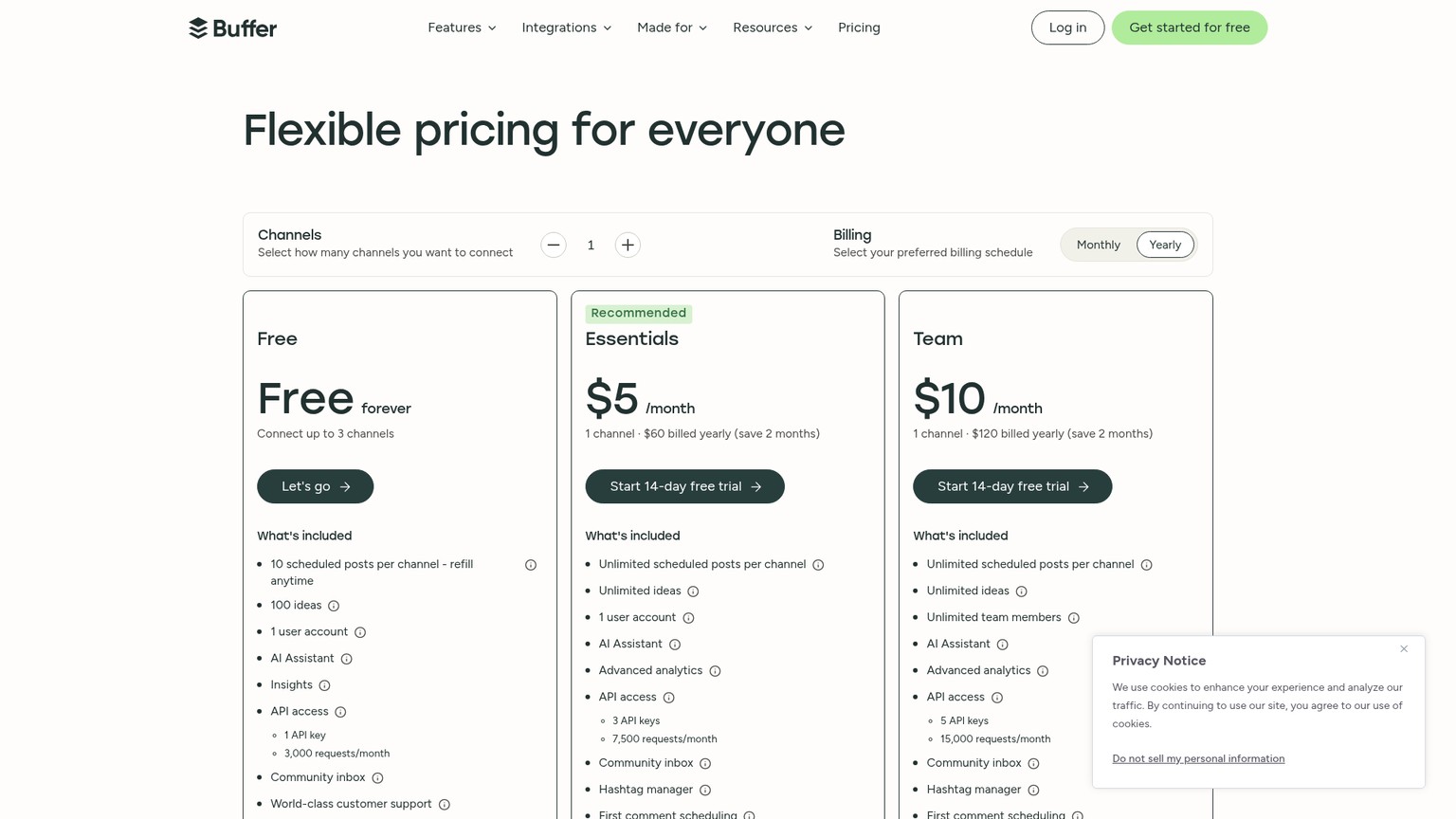
Hootsuite Standard costs $588 more per year in that one-user, 10-profile scenario, a 98% premium. Pay it when Hootsuite's bundled inbox, listening limits, and competitor benchmarking remove enough extra work. If the job is mainly publishing, Buffer is the cleaner budget choice.
For collaboration, Buffer Team costs $10 per channel monthly on annual billing and includes unlimited users, approval workflows, and custom permissions. Ten channels therefore cost $1,200 per year, far below three Hootsuite Advanced seats at $14,364. The tradeoff is product scope, so compare the actual inbox, listening, reporting, and governance requirements rather than the word "approval."
Later: the lowest normalized bill for a visual content team
Later Growth costs $37.50 per month billed yearly, or $450 per year. It includes 16 profiles, two users, 180 posts per profile monthly, 50 AI credits, one year of analytics, approvals, and a social inbox.
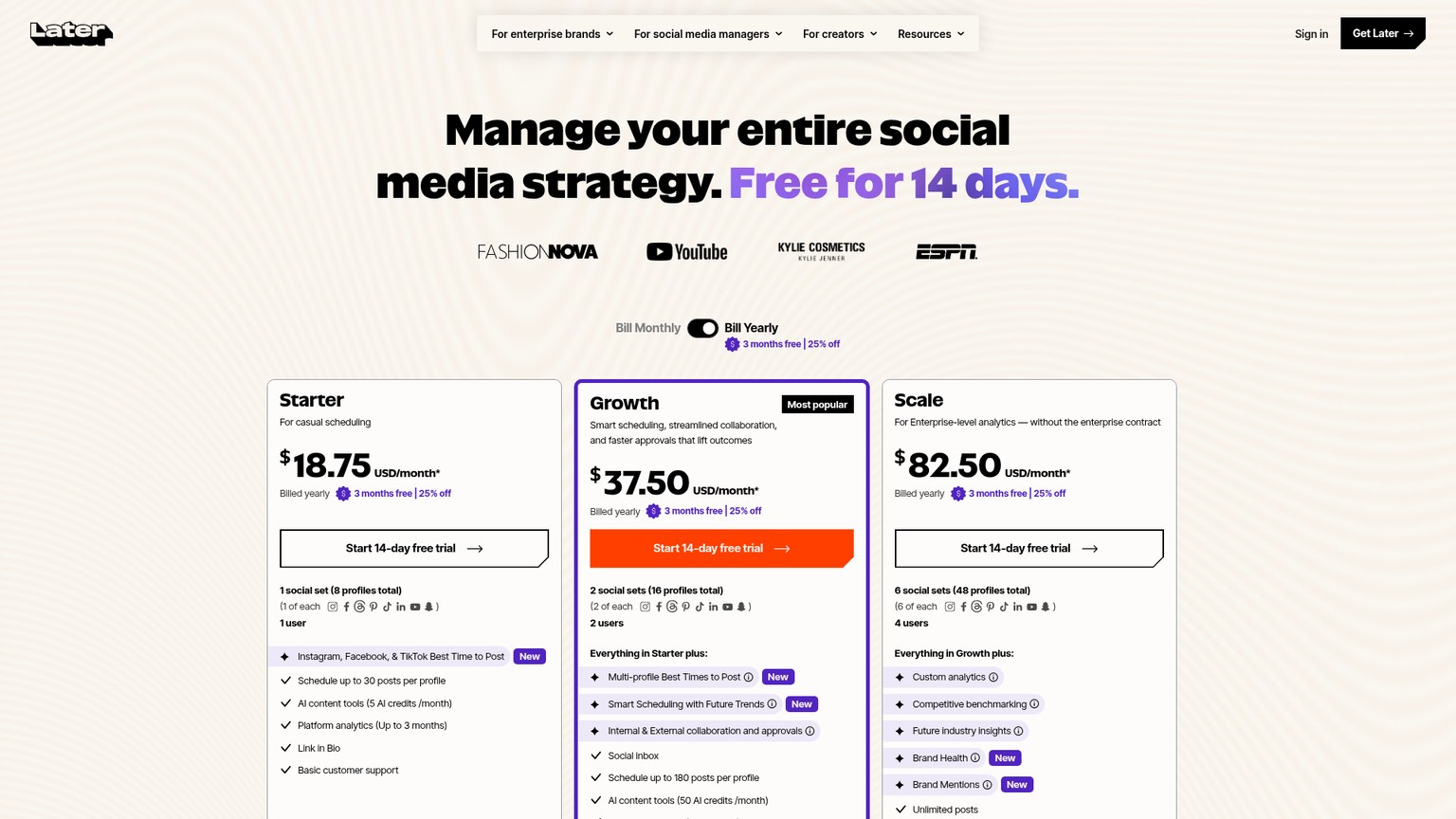
Add one user at the annual rate of $3.75 per month and a three-person approval workflow costs $495 per year. Hootsuite Advanced costs $14,364 for three annual seats. Later is the clear price call when its profile, post, analytics, inbox, and approval limits match the operation.
The wall appears when the team needs Hootsuite's specific automation, routing, listening, reporting, or governance scope. Later Growth also caps AI use at 50 credits monthly and posts at 180 per profile, while Hootsuite's paid tiers publish unlimited scheduled posts and include 100 AI credits. Price the workload that will exist, not the cheapest card that can connect the accounts.
Sprout Social: another premium per-seat decision
Sprout Social Professional costs $299 per seat monthly on annual billing and supports unlimited profiles, message tagging, and extensive competitor, tag, and paid insights. One seat costs $3,588 per year, three times Hootsuite Standard's one-seat annual price.
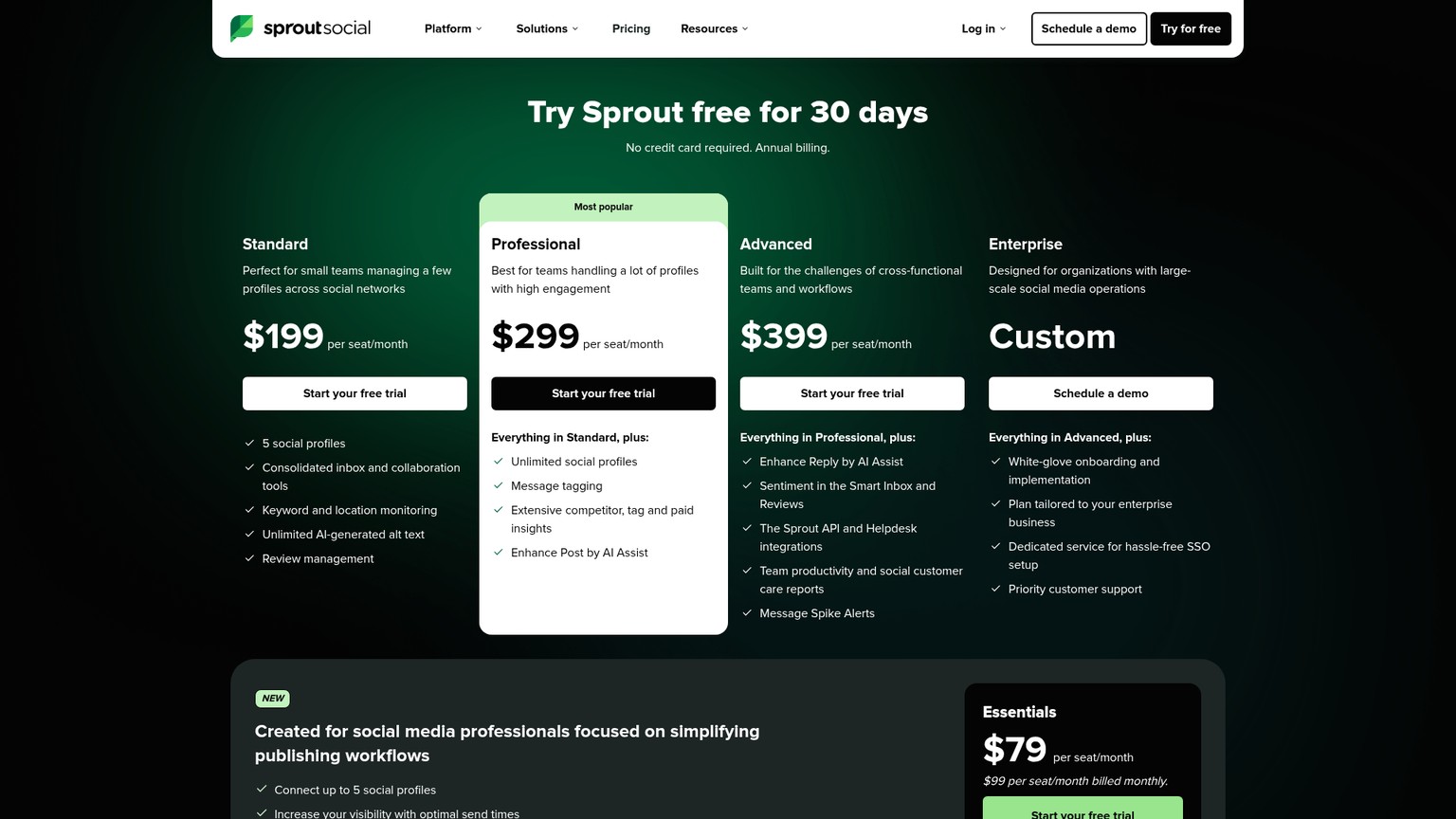
Sprout Social Advanced costs $399 per seat monthly on annual billing, the same published annual rate as Hootsuite Advanced. Both cost $14,364 for three seats. The budget therefore does not decide that matchup; inbox behavior, reporting, integrations, implementation, and the team's existing process do.
The practical shortlist is simple: Buffer for low-cost channel-based scheduling, Later for affordable visual-team workflows, Hootsuite for a broader mid-market social operation, and Sprout Social when its premium workflow fits better at a comparable upper-tier seat price.
Is Hootsuite worth it?
Hootsuite is worth its price when one platform replaces several recurring jobs, not when it merely schedules posts. A solo operator with 10 accounts can justify Standard if the inbox, seven-day listening, five-competitor benchmarking, and reporting save at least a modest block of work every month. A simple publisher should use Buffer or Later and keep the difference.
A growth team should buy Professional when profile count, automation, 30-day search, or custom reporting is already a bottleneck. It should buy Advanced only when approvals and routing happen often enough to clear the $7,200 three-seat annual premium over Professional. Enterprise is defensible when SSO, premium data, compliance, and implementation are requirements with executive owners.
- Standard combines publishing, inbox, basic listening, competitor benchmarking, and reporting for 10 accounts.
- Professional removes the account cap and adds meaningful automation and report control.
- Advanced gives coordinated teams approvals, routing, comments, and productivity reporting.
- Annual billing saves $600 to $1,200 per seat when the expected tenure clears the commitment line.
- Every additional user multiplies an already high self-serve price.
- No general free plan exists beyond the 14-day limited trial.
- All three self-serve tiers publish the same 100 AI credits per month.
- Enterprise add-ons and AI-credit overages have no public price.
- Self-serve terms are non-refundable for the remaining term, and Enterprise has a 60-day non-renewal deadline.
The Monday move: price the workflow before the plan
Run one short audit next week before starting a trial, approving renewal, or adding seats. The output should be one plan, one billing cadence, and one monthly outcome hurdle.
Count accounts and seats
List every social account that must connect and every person who must work inside Hootsuite. Mark account 11 and remove view-only or occasional reviewers from the paid-seat assumption where the process allows it.
Time the recurring work
Measure monthly hours spent building reports, searching recent conversation history, responding to messages, routing customer care, and approving posts. Use the loaded hourly cost the business already uses for staffing decisions.
Map the lowest viable tier
Choose Standard for 10 accounts and one owner, Professional for unlimited accounts or automation and custom reports, Advanced for approvals and routing, and Enterprise for SSO, governance, or premium data.
Test the commitment line
Stay monthly unless Standard or Professional is likely to remain active for at least eight paid months, or Advanced for at least 10. Put the renewal and cancellation dates into the operating calendar.
Set the outcome hurdle
For three Advanced seats, write down the 10 monthly team-hours the upgrade must save at a $60 loaded hourly cost. Replace $60 with the business's real figure, then assign an owner to verify the saving after the trial.
The final budget sentence should read: "Hootsuite will cost us X for Y seats and Z accounts, and it must save A hours or protect B customer conversations each month." If one variable is blank, stay on the lower plan or choose the cheaper alternative.
Frequently asked questions
How much does Hootsuite cost?
Hootsuite costs $99, $199, or $399 per user monthly on annual billing for Standard, Professional, or Advanced. Month-to-month prices are $149, $299, and $499. Enterprise is custom-priced.
Is Hootsuite free?
No general free plan is available. Hootsuite offers a 14-day trial with no credit card and no automatic charge at expiry, but the trial limits organizations to 10 to 20 posts per day and disables bulk scheduling.
Who never needs to pay for Hootsuite?
Eligible students in an educator-led accredited higher-education program can receive free program access. A commercial operator who only needs three channels and 10 queued posts per channel can use Buffer Free instead; ongoing full Hootsuite access starts with Standard.
Why is Hootsuite so expensive?
Hootsuite combines publishing, inbox, listening, analytics, automation, and team workflows, then charges per seat. The bundle can replace separate work, but a buyer who only needs scheduling pays for more scope than necessary.
Does Hootsuite have a student discount?
Hootsuite does not publish a general individual student checkout discount. Its Student Program provides free access, courseware, and certifications through eligible educator-led higher-education classes.
Does Hootsuite offer nonprofit pricing?
Yes. Qualified nonprofits can apply for annual-equivalent per-user rates of $39 for Standard, $79 for Professional, and $159 for Advanced, advertised as up to 60% off.
What is Hootsuite's refund policy?
Hootsuite's paid self-serve terms say cancellation or downgrade does not entitle the buyer to a refund and does not remove the obligation to pay for the rest of the plan term. Enterprise contracts carry their own annual renewal terms.
Did Hootsuite pricing change in 2026?
The live billing feed labels the current Standard, Professional, and Advanced records 26Q2. Use the current four-tier catalog and the August 2026 verification above instead of older references to legacy Team or Business packages.
Does Hootsuite charge for API use?
Hootsuite's API terms currently provide API access for free under a limited developer license, with usage limits set by its documentation. Hootsuite reserves the right to charge for API access in the future, and the API does not replace the app plan an operating team needs.
Use the AI Business Workflow Audit Checklist to decide whether Hootsuite deserves a paid line item.
- Last Updated
- Category
- Growth
- Language

Kit (ConvertKit) Alternatives in 2026: beehiiv, ActiveCampaign and GetResponse
Compare eight Kit (ConvertKit) alternatives by growth, automation, pricing at 1,000 and 10,000 subscribers, and migration effort.Oct 11, 2026Growth
Apollo vs ZoomInfo
Apollo vs ZoomInfo for small sales teams: verified seat prices, quote-based cost math, regional coverage, credits, intent and switching costs.Oct 11, 2026Growth
GetResponse Pricing: Plans, List Sizes and Upgrade Costs
GetResponse prices from 1,000 to 100,000 contacts, feature upgrade triggers, annual bills, and comparisons with Kit, ActiveCampaign and Mailchimp.Oct 11, 2026Growth
Calendly Alternatives in 2026: Cal.com, TidyCal, Acuity & More
Compare Calendly alternatives by need: Cal.com, TidyCal, Acuity, Bookings and more. Verified prices, routing, branding and reasons to stay.Oct 11, 2026Growth
Mailchimp Alternatives in 2026: Kit, beehiiv, ActiveCampaign and GetResponse Compared
Compare Mailchimp alternatives for newsletters, automation and ecommerce, with verified prices at 1,000 and 10,000 contacts and reasons to stay.Oct 11, 2026Growth
Zendesk Alternatives 2026: Tidio, Chatbase, CloudTalk and Helpdesks
Compare Zendesk alternatives by support model: Tidio, Chatbase, CloudTalk and leading helpdesks, with current prices, AI charges and switching advice.Oct 10, 2026Growth
Best CRM for Small Business in 2026: Pipedrive, Close, folk, Keap and More (Compared)
Compare nine small-business CRMs by how you sell, verified prices for five users, free-plan limits, setup effort and the upgrades that matter.Oct 10, 2026Growth