Is Calendly Free?
Calendly is free forever, but one event type and one calendar are the wall. See every 2026 price, hidden seat costs, and the exact upgrade math.
Published
 By Omid Saffari




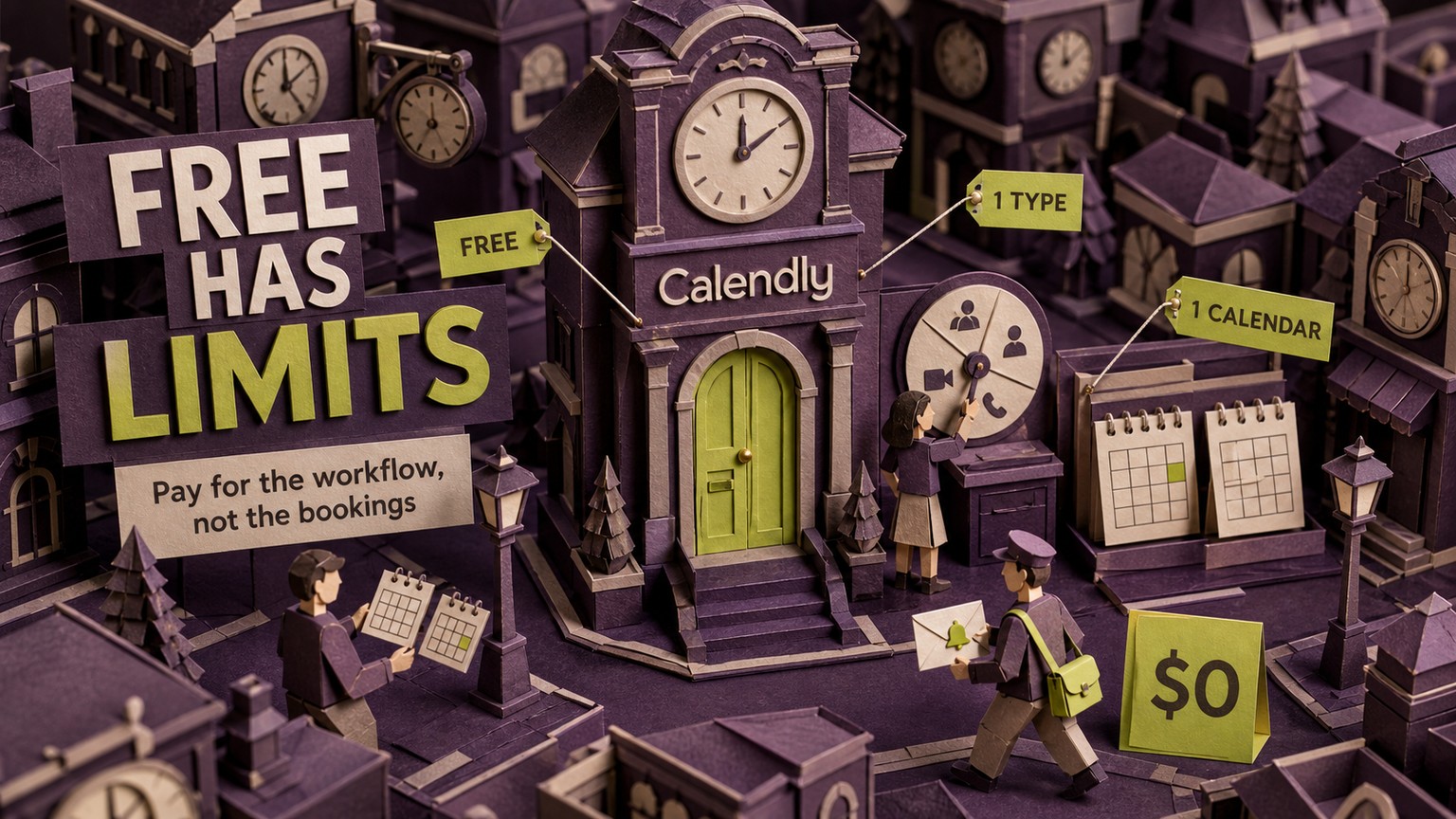
Yes, Calendly is free forever: the $0 plan allows unlimited meetings but only one active event type and one connected calendar. Most solo operators never need to pay; the bill starts when scheduling becomes a workflow, not when booking volume increases.
Calendly pricing at a glance
Calendly has a legitimate free plan, not a short demo disguised as one. The paid ladder begins at $10 per seat per month on annual billing, rises to $16 for team routing, and jumps to at least $15,000 per year when enterprise control becomes the purchase.
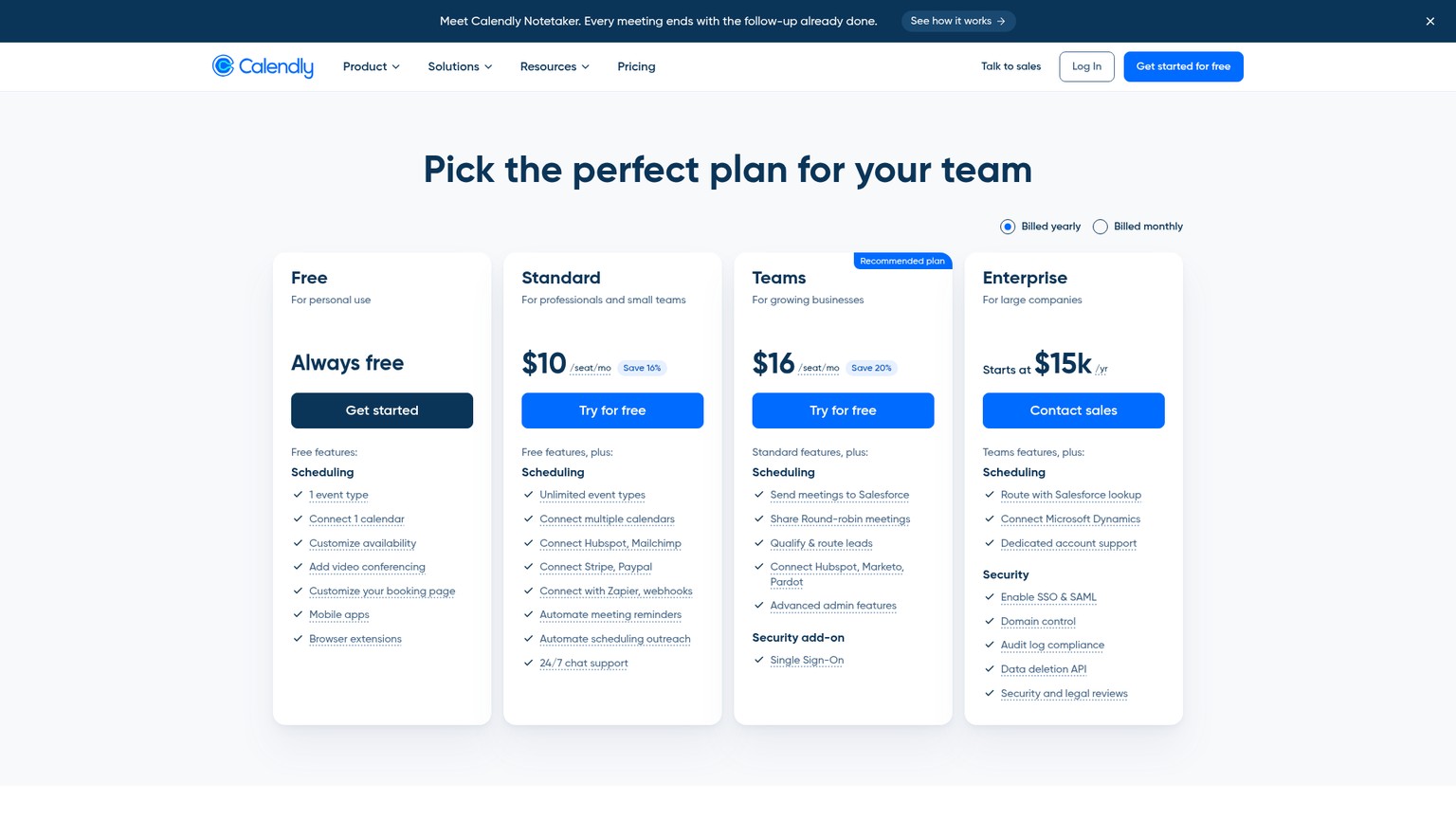
Prices, plan names, and limits were verified against Calendly's pricing page, August 2026. The live page quotes Standard and Teams as monthly equivalents when paid for a year. Taxes can sit on top of those figures.
The practical verdict is narrower than the plan table makes it look:
- Stay on Free when one public meeting link and one connected calendar cover the job.
- Buy Standard when a second appointment type, payment collection, another calendar, or automated follow-up removes recurring manual work.
- Buy Teams only when demand must be distributed, qualified, routed, or synchronized with a sales operation.
- Buy Enterprise when security, identity, audit, or procurement requirements make a self-serve plan unacceptable.
That decision rule prevents the common mistake of upgrading because bookings increased. Calendly allows unlimited meetings on Free. Volume alone does not create the bill.
What Calendly Free actually includes
Calendly Free is enough to run a real solo booking workflow. You can publish one event type, connect one calendar, control availability, add video conferencing, customize the booking page, send confirmation emails, embed the scheduler on a site, and use the mobile app or browser extension. Meetings are unlimited.
The limit is variety, not demand. A solo consultant with one discovery-call link can accept 20 or 250 bookings in a month without a Calendly subscription charge. A local-services owner who needs separate consultation and service links hits the plan wall even at low volume. The second business has fewer bookings and the stronger reason to pay.
New accounts can make the offer look temporary. Calendly starts new users on a two-week Teams trial, then automatically moves the account to Free. Paid features such as Workflows and additional users turn off at the end of that trial, but the scheduling account remains usable at $0. No card action is required to keep the Free plan.
The two hard limits deserve literal treatment.
One event type means one public booking job
An event type is a bookable meeting template. Free lets one of those templates do the work. If prospects need one link while paying clients need another, manual switching is not a stable business process. Standard is the cleaner answer.
One connected calendar can create hidden conflicts
Calendly checks the connected calendar before showing availability. If work and personal commitments live in separate calendars, Free sees only one of them. You can consolidate busy time at the calendar level, but paying for Standard is easier to defend once missed conflicts cost more than $10 per month.
Free is not a weak plan. It is a deliberately narrow one. The honest upgrade trigger is the first repeated workaround, not a desire for a cleaner billing badge.
Standard becomes rational when one workflow becomes several
Calendly Standard is the best paid tier for most solo professionals and small teams because it removes the Free plan's operational walls without charging for sales routing. It costs $10 per seat per month on annual billing or $12 month to month.
Standard expands the account to unlimited event types and up to 6 calendars. It also adds group and collective events, HubSpot, PayPal, Stripe, Workflows for reminders and follow-ups, customized emails and embeds, and 24/7 live chat. Workflows can react when a meeting is rescheduled or canceled, so those changes do not need another manual follow-up. The value is not a larger meeting allowance. The value is replacing separate manual steps around each meeting.
Picture a solo agency owner with prospect calls, client reviews, and paid advisory sessions. Free forces those jobs through one template or requires constant toggling. Standard gives each job its own booking path, checks several calendars, collects payment where appropriate, and sends the follow-up without another reminder on the owner's task list.
The cost per booked outcome falls quickly because the subscription is flat per seat. For one annual-billed Standard seat, 20 monthly bookings cost $0.50 each, 100 cost $0.10 each, and 250 cost $0.04 each. That is original cost-per-booking math using Calendly's current $10 price. It is not a performance claim.
Annual billing saves $24 per seat across a year: $120 instead of $144. A solo operator who knows Standard is staying can take the saving. A business still validating its scheduling process should treat the extra $2 per month as an inexpensive exit option. Paying $12 while the workflow is uncertain can be wiser than saving $24 and locking in the wrong tool.
Standard has a clear wall of its own. It can coordinate several people in group or collective meetings, but it is not the plan for distributing inbound demand across a sales queue. That purchase begins with Teams.
Teams is a routing purchase, not a nicer Standard plan
Calendly Teams costs $16 per seat per month billed annually or $20 billed monthly. It adds round-robin distribution, lead qualification and routing, Salesforce meeting sync, routing from HubSpot, Marketo, and Pardot forms, stronger administration, and optional SSO as an add-on.
The extra annual-billed cost over Standard is $6 per seat per month. For five seats, Standard costs $600 per year and Teams costs $960. The difference is $360 per year, or $30 per month in budget terms.
That $30 buys a shared-demand workflow. Using an explicit illustration, if a manual assignment consumes 10 minutes of labor valued at $30 per hour, each assignment costs $5. Avoiding six of those assignments in a month covers the five-seat Teams premium. The assumption is visible, so you can replace it with your own labor cost and routing volume.

Annual billing matters more as headcount grows. Five Standard seats cost $600 per year on annual billing or $720 across monthly payments, a $120 difference. Five Teams seats cost $960 annually or $1,200 across monthly payments, a $240 difference.
Calendly also discounts additional Teams seats on annual subscriptions. Seats 1 through 30 remain $16 per month. Seats 31 through 50 cost $14.50, seats 51 through 100 cost $14, seats 101 through 200 cost $13.50, seats 201 through 300 cost $13, and seats 301 and above cost $12. These are marginal tiers: reaching a lower tier does not reprice the first 30 seats.
Two billing rules can erase that discount if they are ignored. Every member of one Calendly organization must use the same plan, so you cannot place routing users on Teams and everyone else on Standard inside that organization. Owners and admins also consume paid seats, with no free admin role.
Enterprise starts at $15,000 for control, not more meetings
Calendly Enterprise starts at $15,000 per year, and meeting volume is not the reason to cross that line. The plan adds SAML SSO, advanced provisioning, domain control, Salesforce lookup routing, an audit log, a Data Deletion API, priority support, onboarding, implementation help, Microsoft Dynamics 365, and Power Automate.
The buyer is usually an IT, security, legal, or revenue-operations owner who needs identity and governance around many schedulers. If the requirement is merely more event types, calendars, or reminders, Standard already solves it. If the requirement is round robin and lead routing, Teams already solves it.
Enterprise becomes rational when a missing control blocks deployment or creates a compliance exception. A $15,000 starting price is difficult to defend as convenience and easy to defend when SSO, provisioning, audit, or domain control is a procurement condition.
Hidden Calendly costs that change the budget
Calendly has no per-booking overage, but five other mechanics can move the bill or reduce the value of a paid plan. Model them before choosing annual billing.
Empty seats still cost money
A Calendly seat is billable inventory, not proof that a person actively uses the product. The billing page charges for every seat whether it is filled or empty. Removing a user does not remove the seat, and an owner or admin also occupies a paid seat.
Added seats take effect immediately and are prorated to the current billing cycle. Removed seats and plan downgrades take effect at the end of the cycle. The practical control is simple: reconcile users and seats separately before every renewal. Deactivating a person without reducing the seat count does not lower the next bill.
SMS reminders have a hard ceiling
Standard and Teams include 250 SMS credits per seat per month. Enterprise includes 1,000. A message consumes 0, 1, 3, or 9 credits depending on its destination, so 250 credits can mean 250, 83, or 27 chargeable messages at the corresponding credit rates.
At 100% use, text delivery stops and Calendly falls back to email. Credits reset on the first day of the month at 12 a.m. UTC. Calendly does not publish a direct overage purchase on the help page; its routes to more capacity are adding seats or moving toward Enterprise.
That is a workflow limit, not a surprise invoice. A business relying on texts to reduce no-shows should still treat it as a cost because extra seats purchased only for credits are expensive capacity. Count expected texts per booking and destination mix before assuming Workflows cover every reminder.
Annual savings come with a refund and renewal tradeoff
Calendly's customer terms call subscription fees non-cancellable and non-refundable. A downgrade or cancellation generally takes effect at the end of the current term, rather than returning unused annual fees. Subscriptions also renew automatically.
The same terms allow a renewal increase of CPI plus 3% unless Calendly gives a different notice. Taxes can be added to published fees. The annual price is therefore the correct planning baseline only when the workflow and seat count are stable enough to justify the commitment.
API access changes by endpoint
Calendly's API is not one separately priced product. Developers can make GET and POST requests on behalf of users on any plan, including Free. Webhooks and Scheduling API endpoints require a paid Standard, Teams, or Enterprise subscription, while activity-log and deletion endpoints are Enterprise-only.
The budget consequence is straightforward. A simple data read may work on Free, an automated event handoff may force Standard, and compliance deletion or audit work may force Enterprise. Map the needed endpoints before building the integration.
Meetings themselves have no metered charge
Calendly explicitly includes unlimited meetings on Free, and the paid plans build on that allowance. There is no booking counter that triggers a surprise plan jump. Seat count, event variety, workflow automation, routing, SMS capacity, and governance determine cost.
That distinction is the core pricing truth: Calendly monetizes organizational complexity, not demand volume.
Calendly vs Cal.com and Doodle on normalized cost
Calendly is not the cheapest route to every scheduling outcome. Cal.com offers the strongest free alternative for one user who needs several event types or calendars, while Doodle is compelling when group availability polling is the main job.
Cal.com gives a solo operator more room at $0
Cal.com Individual is free for one user with unlimited event types, calendars, and meetings. It also includes email and SMS notifications, more than 100 app integrations, Stripe and PayPal, and two-way Salesforce and HubSpot sync. That free allowance is materially broader than Calendly's one-event-type and one-calendar limits.
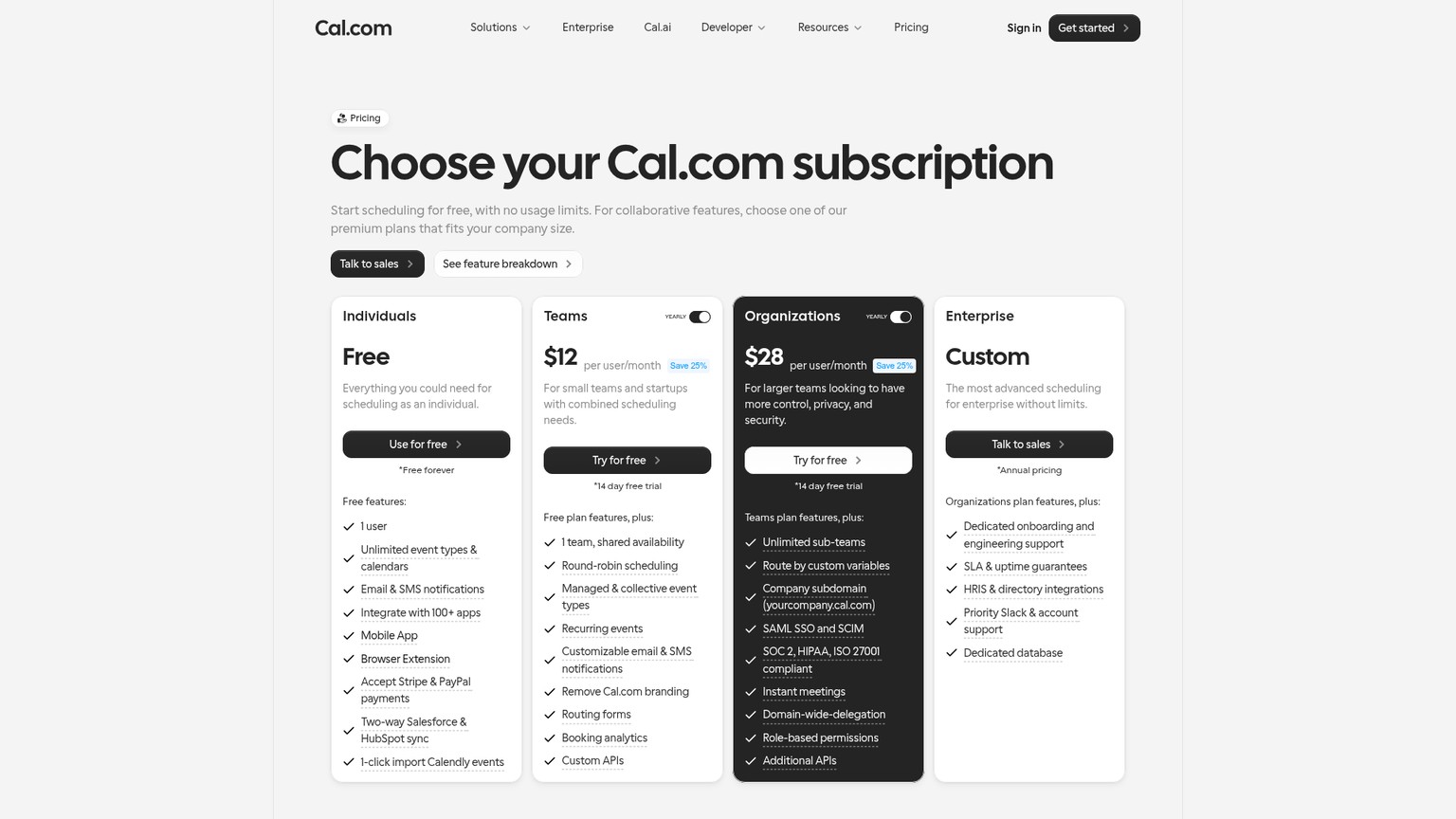
Cal.com Teams costs $12 per user per month billed yearly, with a 14-day trial. Five seats cost $720 per year, versus $960 for five Calendly Teams seats, a $240 difference. Cal.com is the better price when its round robin, routing, and technical control fit the workflow. Calendly remains easier to defend when its familiar administration and specific Salesforce-centered sales path remove more than $240 of annual friction.
The free-plan decision is sharper. Pick Cal.com when multiple event types or calendars are non-negotiable at $0. Pick Calendly when one clean external meeting link is enough and the simpler default matters more than extra capacity.
Doodle wins group polling, not sales routing
Doodle Free supports group meetings, a booking page, and Sign-up Sheet. A single Professional license costs $15 monthly or $132 per year, which normalizes to $11 per month. Doodle Team costs $19.95 per user monthly or $8.95 per user per month billed annually, with a minimum of 2 users.
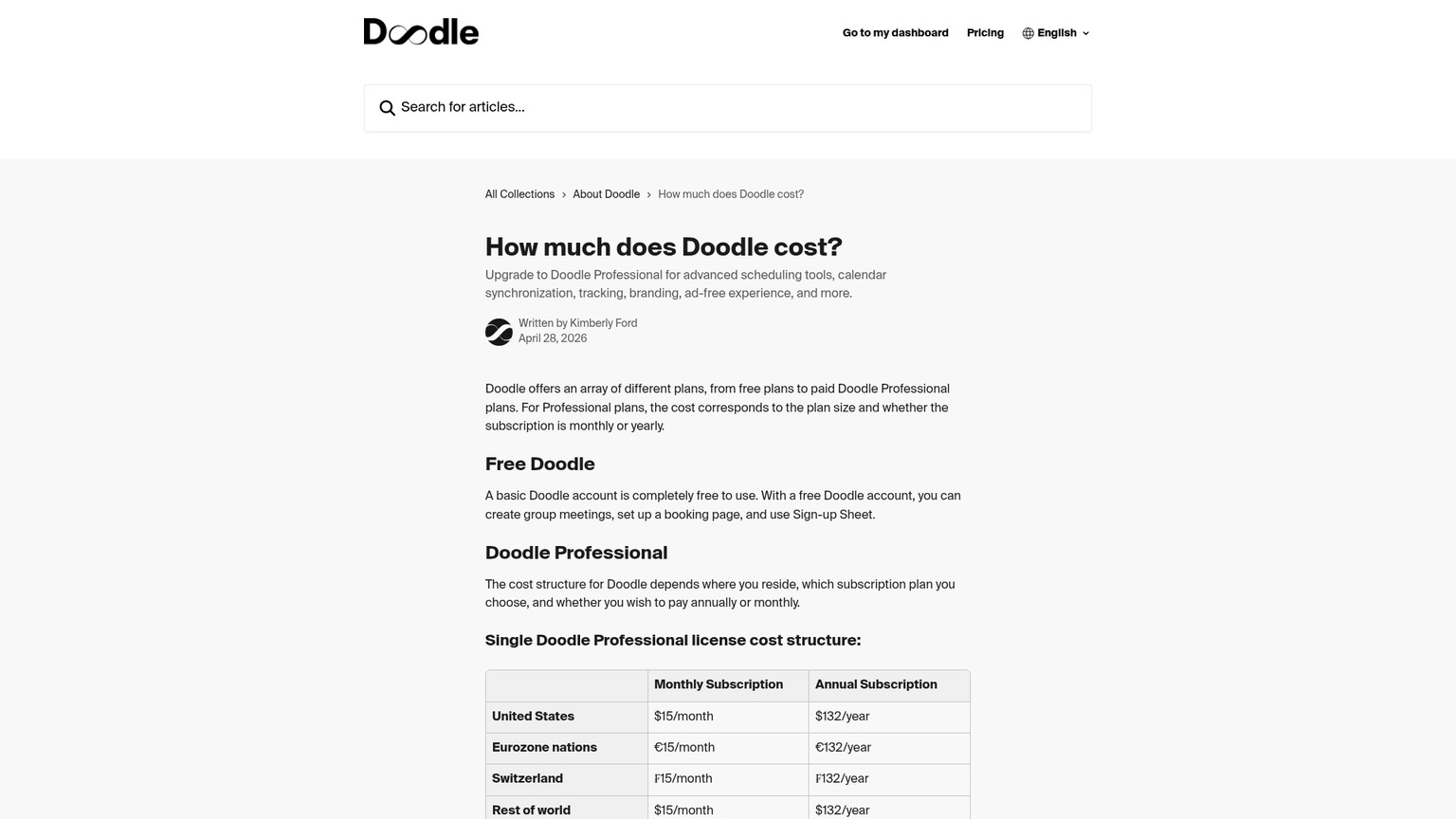
At five annual-billed seats, Doodle Team costs $537 per year and Calendly Teams costs $960, a $423 difference. That is not a like-for-like feature saving. Doodle's center of gravity is finding a time across a group, while Calendly Teams is designed to qualify and distribute inbound meetings. Choose the cheaper tool only after naming the workflow.
For a broader map across appointment commerce, external meetings, task planning, and shifts, use the best scheduling apps comparison. The category changes once the scheduled item is a paid service or an employee shift rather than a conversation.
Which Calendly plan should you choose?
Choose the lowest tier whose named capability removes a current bottleneck. Free is the default, Standard is the workflow tier, Teams is the routing tier, and Enterprise is the control tier.
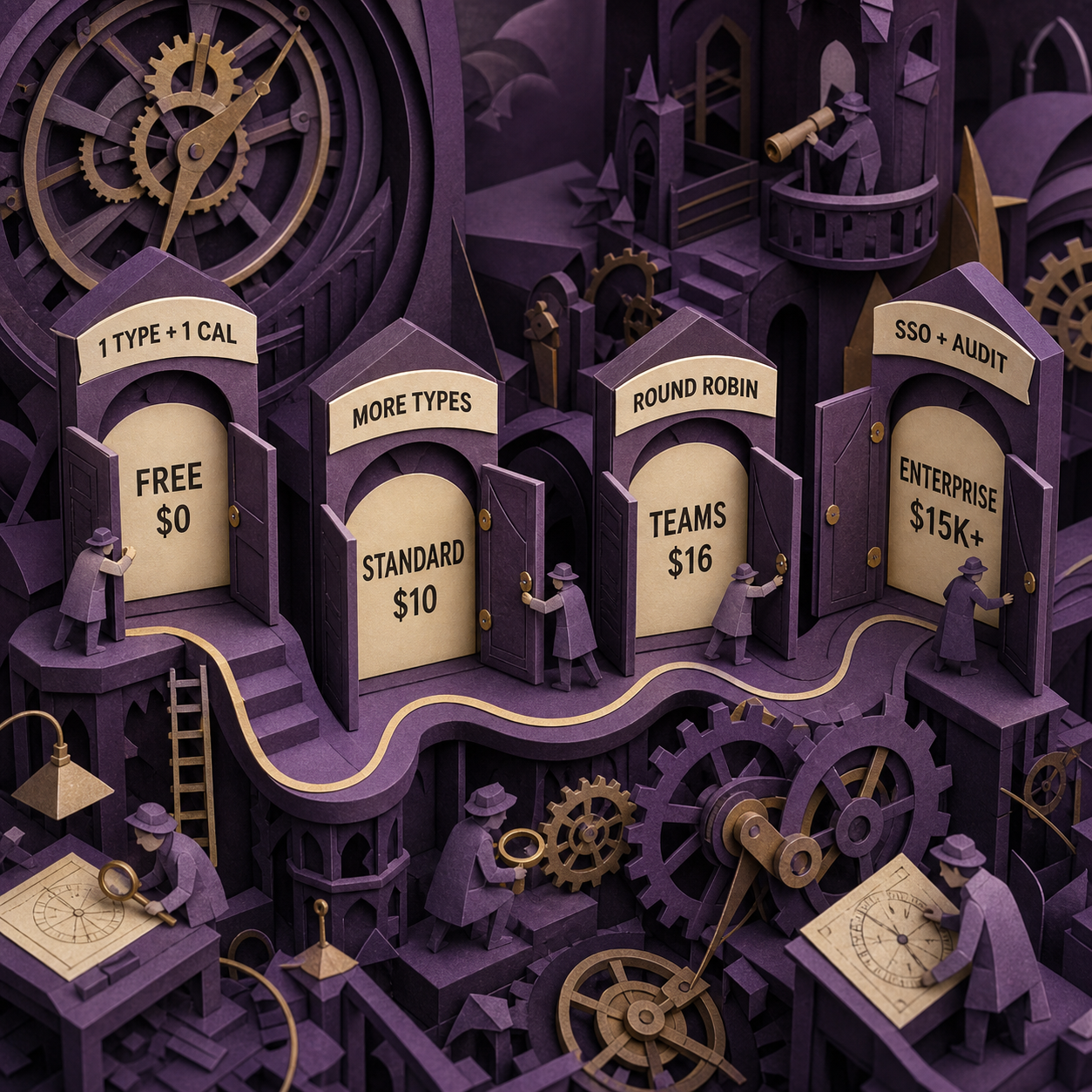
The plan decision can be made without a feature spreadsheet:
- Free: one person, one event type, one connected calendar, unlimited meetings.
- Standard: multiple event types or calendars, payments, group or collective meetings, or automated follow-up.
- Teams: round robin, lead qualification, CRM-based routing, Salesforce sync, or organization-wide administration.
- Enterprise: SSO, provisioning, domain control, audit, data deletion, or formal implementation support.
The Monday move
Count active booking jobs
List only the meeting types that must remain publicly bookable at the same time. If the answer fits one event type, keep Free in the running.
Count calendars and paid seats separately
Identify every calendar that must block availability, then reconcile actual users, owners, admins, and empty seats. Calendly bills seats, not login activity.
Name the manual handoff
Write down the step that still happens after someone picks a time: payment, reminder, assignment, qualification, CRM update, or compliance review. That handoff points to Standard, Teams, or Enterprise.
Price one month and one year
Compare the reversible monthly plan with the annual saving using the seat count you expect at renewal, not the headcount you have today. Choose annual billing only after the workflow is stable.
This keeps the purchase attached to an operating consequence. A paid plan should remove a repeated cost, reduce a real scheduling risk, or satisfy a named control. If it does none of those, Free is still the correct plan.
Frequently asked questions
Is Calendly free forever?
Yes. Calendly Free is always free and includes unlimited meetings, one event type, one connected calendar, custom availability, video conferencing, a booking page, confirmation emails, embedding, mobile apps, and browser extensions.
The separate new-user trial lasts two weeks on Teams. When it ends, Calendly automatically downgrades the account to Free rather than ending access.
How long is Calendly free for?
The Free plan has no published end date. You can stay on it while one event type and one calendar cover the job. The two-week limit applies to the Teams trial, not to Calendly Free.
Is Calendly Free worth it?
Calendly Free is worth it for a solo operator who needs one reliable booking link and one calendar. It is especially strong when booking volume is high but workflow variety is low because meetings remain unlimited.
It stops being worth the workaround when a second event type, another calendar, payment collection, or automated follow-up creates repeated manual work. Standard then costs $10 annually or $12 monthly per seat.
Does Calendly offer a student discount?
Calendly publishes a 25% discount for public education institutions. It does not publish a blanket individual-student discount on that education page. A student should check whether their institution has a Calendly agreement or ask the institution's administrator, rather than assuming a personal education price applies.
Can I get a refund from Calendly?
Calendly's standard customer terms say fees are non-cancellable and non-refundable. Canceling or downgrading normally changes the plan at the end of the current term, so an annual subscription should be treated as a commitment rather than a refundable prepayment.
The legal terms contain a narrow prorated remedy after notice and an unsuccessful 30-day cure for a material service failure, but that is not a general change-of-mind refund policy.
Has Calendly pricing changed?
The current self-serve Standard and Teams prices match an official Calendly community answer edited in October 2023: Standard at $10 annually or $12 monthly per seat, and Teams at $16 annually or $20 monthly. Calendly can still change packaging, features, Enterprise quotes, and renewal prices, so recheck the live Calendly pricing page before purchase.
Is there a better free option than Calendly?
Cal.com is the stronger free option for one person who needs unlimited event types and calendars. Doodle Free is better when the primary job is polling a group for availability. Calendly Free remains the simplest default when one external meeting type and one calendar are enough.
The better option is determined by the first wall you will hit, not by the longest feature list.
Get the AI business workflow audit checklist to map the handoffs, limits, and software costs before adding another scheduling subscription.
- Published
- Category
- Growth
- Language

Beehiiv Review
Beehiiv reviewed for business newsletters: current pricing, growth, monetization, AI, MCP, analytics and the costs that change the buying decision.Oct 10, 2026Growth
Trainual Review
Trainual review for SOPs and onboarding: AI drafting, knowledge search, read-only MCP, quote-only plans, implementation and who should skip it.Oct 10, 2026Growth
SocialBee Review
SocialBee review of evergreen scheduling, AI Copilot and client workspaces, with all six plans, add-on costs, and Buffer and Later comparisons.Oct 10, 2026Growth
SurveyMonkey Pricing: Plans, Response Caps and Annual Bills
SurveyMonkey prices, response caps and AI limits, with annual bills for one person and three-seat teams. See when overages change the best plan.Oct 10, 2026Growth
ActiveCampaign Alternatives: GetResponse, Kit and More
Compare ActiveCampaign alternatives at 2,500, 10,000 and 25,000 contacts, with vendor prices, workflow trade-offs and a migration checklist.Oct 9, 2026Growth
CallRail Alternatives: WhatConverts and More Compared
Compare six CallRail alternatives by vendor pricing, usage fees, AI and reporting. Includes WhatConverts cost math and a pre-switch checklist.Oct 9, 2026Growth
Monday.com Pricing: Seat Buckets and the Yearly Bill
Calculate monday.com Work Management costs for 5, 12 and 40 people, including seat buckets, annual vs monthly billing and AI credit charges.Oct 9, 2026Growth