Linear Pricing (2026): Free Until 250 Issues
Linear is free through 250 issues. See every 2026 tier, monthly and annual prices, AI credit costs, discounts, hidden billing rules, and the right plan.
Published
 By Omid Saffari

Linear is free for unlimited members until your workspace hits 250 issues or needs more than two teams. After that, Basic costs $10 per user/month on annual billing ($12 monthly), but the seat price is no longer the whole budget once coding sessions and Loops start drawing AI credits.
Linear pricing at a glance
Basic is the paid default for most software teams; Business earns its higher price only when private teams, paid guests, unlimited teams, Loops, or its reporting and intake features are requirements. Enterprise begins when identity, security, procurement, or support must be contractual.
Every figure below was verified against Linear's live pricing page and billing documentation on 12 August 2026. The annual prices are displayed as per-user monthly equivalents but commit the buyer to a year. Linear's live billing toggle prices Basic at $12 and Business at $18 when paid month to month.
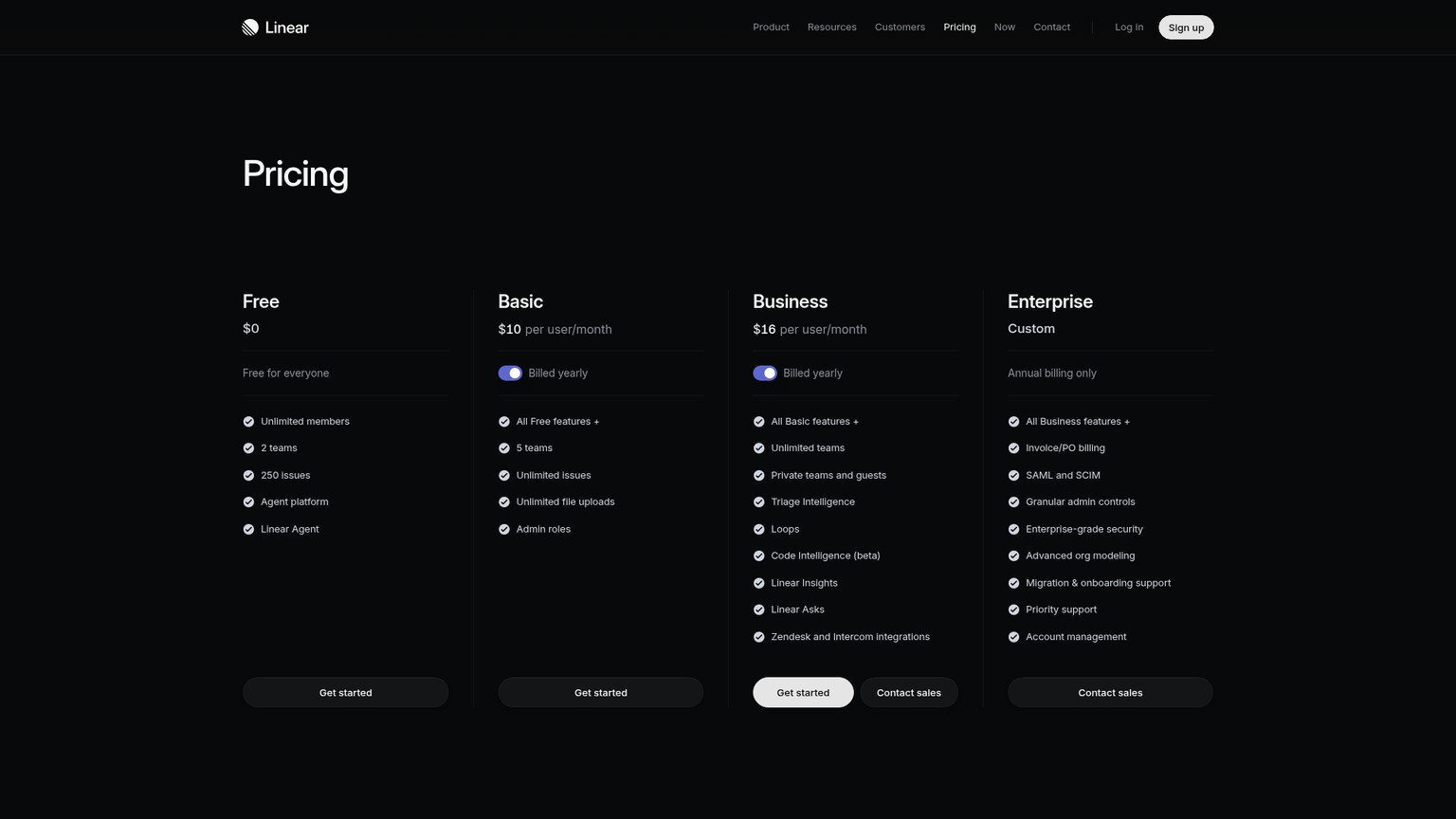
Prices are in US dollars before any applicable sales tax. Free is a permanent plan, not a time-limited trial. Enterprise has no defensible public estimate because Linear quotes it against the organization's requirements.
The decision rule that picks the plan
Choose the first tier whose limits do not break the way your team works, then stop. Paying for a higher plan because it sounds more mature wastes money; waiting until a hard limit blocks delivery wastes time.
The plan flips are concrete:
- Stay on Free while two teams, 250 issues, 10MB uploads, and an all-admin workspace are acceptable.
- Move to Basic when issue 251 arrives, a third team becomes necessary, files need more room, or you need admin roles.
- Move to Business when five teams no longer cover the organization, or when private teams, guests, Loops, Triage Intelligence, Insights, Asks, or the Zendesk and Intercom integrations are required.
- Call Enterprise when SAML, SCIM, invoice or purchase-order billing, granular administration, advanced security, migration support, priority support, or account management is required.

Free: who never needs to pay
Linear Free can remain free indefinitely for a small, focused workspace that stays below 250 issues and two teams. Unlimited members make it unusually good for a broad pilot, a side project, or a company whose Linear workspace holds only current work.
The limits are structural. Free permits two teams, 250 issues, and 10MB file uploads. It includes the Agent platform and Linear Agent, so the basic AI surface is not a paid add-on. The less obvious limit is administration: every user is an Admin on the Free plan. That can be fine for a trusted founding group and inappropriate for a larger company even while the issue count remains low.
A small startup with one product team and one operations team can stay at $0 if it archives completed work before the workspace reaches 250 issues, keeps larger assets elsewhere, and accepts equal administrative power. A much larger company can also stay at $0 for a short pilot because members are unlimited. The same company should not treat that as a production governance model if everyone can administer the workspace.
Who never needs to pay: a solo builder, small software studio, open-source project, or bounded product squad that needs no more than two teams, keeps the live backlog below 250 issues, stores large files elsewhere, and does not need private roles or external guests. Revenue, funding, and headcount do not independently trigger an upgrade.
Free also remains useful after cancellation. Linear says nothing is deleted when a paid subscription ends. If the workspace has more than 250 issues, however, it cannot create new issues until the count falls within the Free allowance or the workspace upgrades again.
Basic: $10 annual or $12 monthly
Basic is the right paid plan when Linear is the system of record but Business-only controls are still optional. It removes the issue cap, allows five teams, makes file uploads unlimited, and adds admin roles.
The annual price is $120 per seat for the year. A 10-seat team pays $1,200 upfront, expressed on the price card as $100 per month. Month-to-month billing costs $12 per seat, or $1,440 across 12 months for the same 10 seats.
Basic's annual break-even is exactly 10 paid months. Ten months at $12 equals the $120 annual seat. If the workspace will remain paid for 11 or 12 months, annual costs less. If the team may cancel before month 10, monthly can cost less in total and preserves cash flexibility.
The five-team cap matters more than the label suggests. A company can organize product, web, mobile, infrastructure, and design inside Basic, but the next distinct team requires either consolidation or Business. Do not create artificial team boundaries simply to justify an upgrade; equally, do not flatten sensitive or operationally separate work just to avoid one.
Basic also supports coding sessions that draw from AI credits. If coding sessions are the only usage-priced AI capability you need, Basic is enough. Loops require Business or Enterprise, so paying for Business solely because the word "AI" appears on the plan card is not a useful rule.
Business: $16 annual or $18 monthly
Business is worth its $6-per-seat monthly premium when one gated capability changes how work enters, moves through, or stays private inside Linear. It is poor value when the buyer only wants the most complete-looking card.
Business removes the team cap and adds private teams and guests. It also includes Triage Intelligence, Loops, Code Intelligence in beta, Linear Insights, Linear Asks, and native Zendesk and Intercom integrations. Those are workflow changes, not cosmetic upgrades: private teams change who can see work, Asks and support integrations change how requests enter, and Loops can run recurring agent work.
The premium over Basic is easy to audit. At annual rates, Business adds $72 per seat per year. That is $720 a year for 10 seats, $1,800 for 25, and $3,600 for 50. Approve Business when the required privacy, intake, reporting, or recurring-agent workflow is worth more than that annual difference. Otherwise, keep Basic.
Guest access has a hidden multiplier. A Linear guest has restricted visibility, but Linear's member-role documentation says that guest is billed as a regular member. Contractors and clients therefore belong in the seat forecast. The permission is narrower; the price is not. App agents are different: Linear says agents are not billable seats, although the third-party service behind an installed agent may have its own price.
Business does not include unlimited usage for Loops. It makes the feature available, then each run consumes AI credits. That makes Business an access decision and an operating-cost decision at the same time.
Enterprise: security and procurement set the quote
Enterprise is necessary when the buying requirement is contractual control, not another product feature. The public price is custom and the commitment is annual only.
The tier adds invoice and purchase-order billing, SAML and SCIM, granular admin controls, enterprise-grade security, advanced organization modeling, migration and onboarding support, priority support, and account management. If the identity team requires automated provisioning, the security team requires enterprise controls, or procurement refuses card billing, the lower public rates are no longer comparable offers.
Do not infer an Enterprise rate from Basic or Business. A quote can reflect seats, support, security, onboarding, and commercial terms that do not appear on the public page. The useful pre-sales document is a requirements list: paid roster, identity provider, security controls, migration scope, support expectations, and billing method. A quote without that list cannot be normalized.
Annual billing saves $24 per seat, but flexibility has a price
Annual billing saves $24 per seat over 12 monthly payments on either paid public plan. The choice is not really $10 versus $12 or $16 versus $18. It is a small discount in exchange for a longer cash commitment.
For Basic, annual becomes cheaper at month 11 because 10 monthly payments already equal the $120 annual seat. For Business, the $192 annual seat equals about 10.67 monthly payments, so the 11th month crosses the line. At 10 seats, staying monthly for a full year costs an extra $240 on either plan. That $240 is the price of being able to stop earlier without leaving prepaid time behind.
Roster changes behave differently by billing cycle. Linear's billing documentation says that on monthly billing, a newly added user is not charged until the following month. Removing a user mid-month does not create a credit for the remainder of that month.
On annual billing, Linear charges for the unsuspended roster at the start of the subscription year. Added users generate a prorated charge for the remaining term. Suspended users generate a prorated credit, but that credit applies to future invoices or renewal rather than returning cash. Linear reconciles those adjustments on the subscription's monthly cycle, and issued invoices are final.
Cancellation is stricter than the smooth proration suggests. A plan change or cancellation takes effect at the end of the paid period, and Linear does not refund a mid-subscription cancellation. Sales tax may also sit above the list price according to the billing address.
AI credits create the second bill
Linear Agent is included on Free, while coding sessions and Loops create a separate usage bill through prepaid AI credits. There is no public $10-per-seat Linear Agent add-on on the current price card. There is also no separate public API tariff on that card; the explicit usage tariff applies to coding sessions and Loops.
Call this the two-line Linear budget:
- The seat line pays for Free, Basic, Business, or Enterprise access.
- The usage line pays for coding sessions and Loops when the workspace opts into AI credits.
Coding sessions are available on Basic, Business, and Enterprise. Loops are available only on Business and Enterprise. Linear's AI credit documentation publishes typical usage ranges rather than a fixed price per task: $0.07 to $0.20 for a Loop run without a coding session, $0.50 to $1 for a copy or styling coding session, $3 to $5 for a small bug fix, and $5 or more for more complex work.
That converts into an operating budget quickly. One hundred Loop runs without coding cost roughly $7 to $20. Twenty small bug-fix sessions cost roughly $60 to $100. Put both workloads on a 10-seat Business workspace at the annual-equivalent seat rate and the monthly total becomes $227 to $280: $160 of seats plus $67 to $120 of AI usage.

Prepayment creates its own controls and costs. An ad-hoc top-up has a $10 minimum; automatic reload has a $50 minimum and produces a separate invoice. Purchased funds roll over across subscription billing cycles but expire 12 months after purchase. Expired balances cannot be refunded, transferred, or restored.
Failed runs, retries, and partial completions can still consume credits for the resources used. Linear lets admins set limits for the workspace, each user, and each Loop on daily, weekly, or monthly reset schedules, but those limits are safeguards rather than exact hard caps. Usage can take up to two minutes to appear, and parallel work can cross a limit before enforcement catches up.
An eligible 10-seat workspace may also have $200 in promotional credit from Linear's $20-per-seat launch grant. The published expiration is 20 August 2026. A promotional balance is not recurring budget, so use it to measure actual cost per accepted Loop or code change, then set the paid cap from that evidence.
Linear vs Jira and ClickUp on normalized cost
Linear is not the cheapest paid tracker; its price must be earned by fit. Jira makes the free comparison about users, while ClickUp undercuts Linear's paid per-seat rates.
Jira costs $0 for up to 10 users and includes 2GB of storage plus 100 automation rule runs per month. Linear Free allows unlimited members but caps the workspace at 250 issues. A team of 10 or fewer with a long-lived backlog gets more runway from Jira Free; a broader pilot with more than 10 people and no more than 250 issues can remain free on Linear.
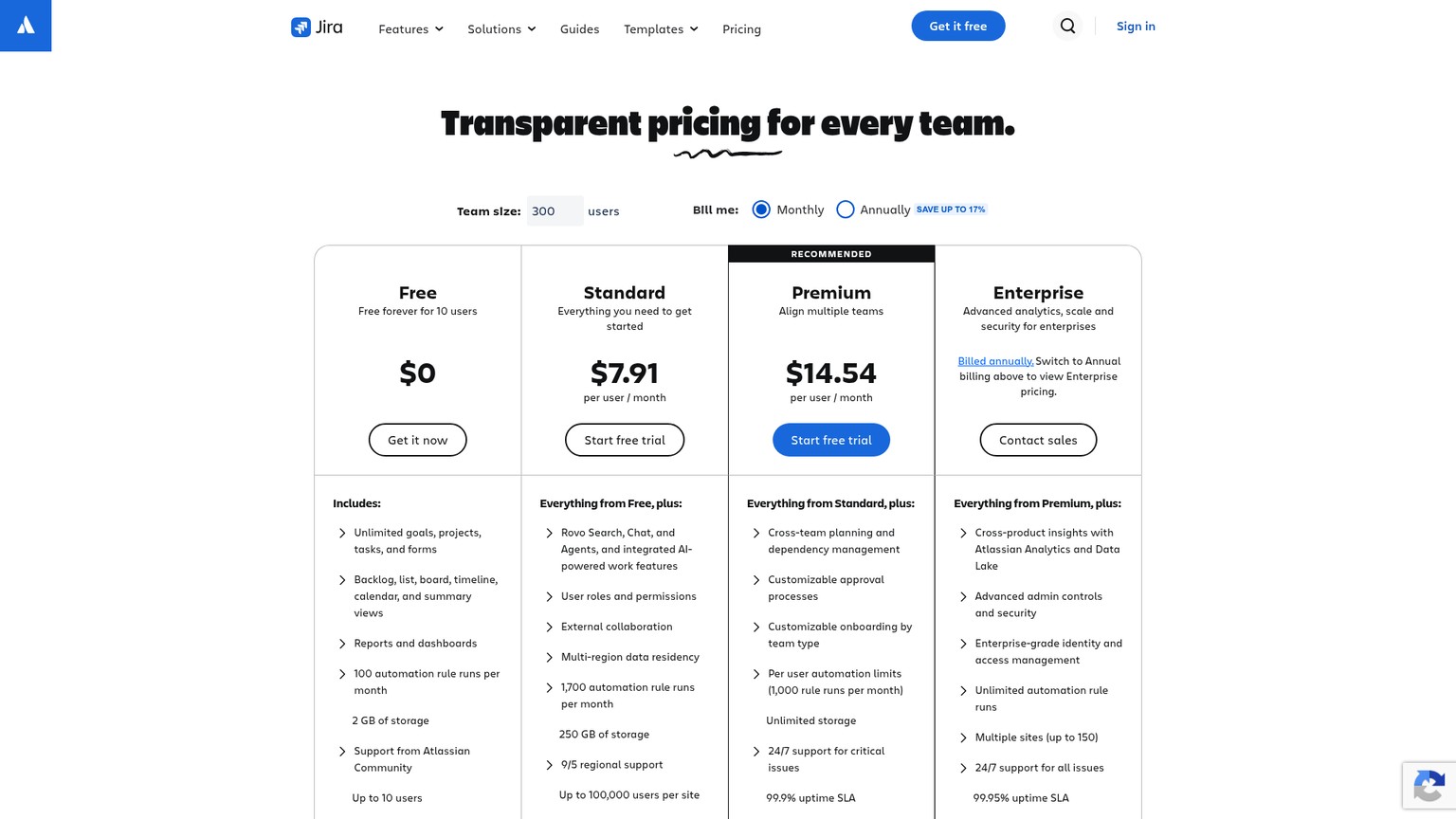
Atlassian's live calculator displayed $7.91 per user/month for Standard and $14.54 for Premium during this verification, but its extracted state did not identify the selected billing context. Atlassian separately says monthly pricing is progressive and annual pricing uses seat tiers. Use its calculator for the exact roster rather than multiplying an ambiguous display rate. The deeper Linear vs Jira comparison maps those seat cliffs and the workflow decision.
ClickUp prices Unlimited at $7 per user/month on annual billing or $10 monthly. Business costs $12 annually or $19 monthly and includes 5,000 automations per month. Its Free Forever plan allows unlimited members and tasks but limits storage to 60MB.
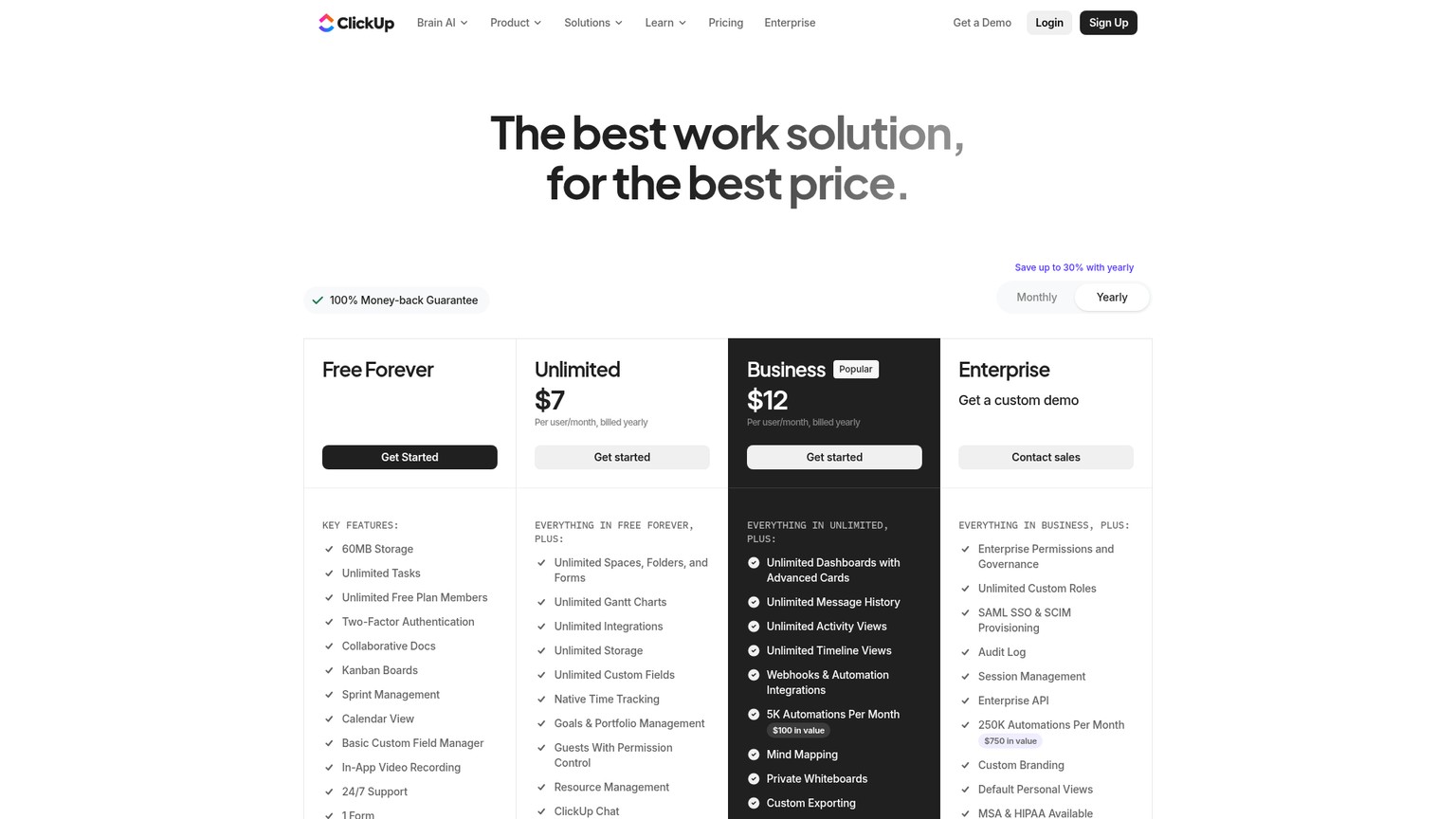
At 10 seats on annual billing, ClickUp Unlimited costs $840 a year against $1,200 for Linear Basic, a $360 saving. ClickUp Business costs $1,440 against $1,920 for Linear Business, a $480 saving. Choose ClickUp when its broader work-management model fits and the lower seat bill matters. Choose Linear only when its focused software workflow is worth the premium. A lower subscription attached to the wrong operating model is not a saving.
Discounts can erase most or all of the bill
Eligible full-time students can receive Basic or Business at a 100% discount for one year. That is more valuable than either annual-billing discount and makes a paid feature set temporarily free.
Linear's special pricing programs give eligible university staff and employees 75% off Basic or Business. Eligible nonprofits also receive 75% off those two public paid plans, but not Enterprise. Linear's startup program offers eligible companies affiliated with a participating partner up to six months of free Basic or Business access.
Education applicants email Linear support from a .edu address and provide the workspace plus proof of enrollment, employment, or institutional eligibility. Treat every special program as an approval, not an automatic coupon. Do not put the discounted number in a budget until Linear confirms eligibility and duration.
Where Linear earns its price and where it does not
Linear earns its premium when a software team values the constrained workflow enough to avoid buying a broader system it will spend time configuring. It does not earn the premium simply because the interface is attractive or the Business card contains more features.
- Free supports unlimited members and includes the Agent platform through 250 issues.
- Basic removes the issue and upload caps at a predictable per-seat rate.
- Annual pricing scales one seat at a time and saves $24 per seat over 12 monthly payments.
- Business packages private teams, guests, intake, reporting, and recurring agent workflows in one tier.
- Free stops at two teams and 250 issues, and every Free user is an Admin.
- Guests are billed as regular members despite their narrower access.
- Business adds $72 per seat each year over Basic before any AI usage.
- AI credits expire after 12 months, and failed or retried work can still consume them.
- SAML and SCIM require a custom-priced annual Enterprise contract.
The Monday move: approve one two-line budget
Next week, turn Linear's price card into one seat line and one usage line before changing plans. The exercise takes a current roster, a workspace count, and a bounded AI workload, not a feature wish list.
Find the first hard limit
Record the current issue count, number of teams, largest upload need, privacy requirement, guest requirement, and identity requirement. The first lower-tier limit that fails identifies the minimum plan.
Count billable humans
Count every unsuspended member and guest in the workspace. Exclude app agents because Linear does not bill them as seats, but add any separate provider price for those agents outside the Linear bill.
Choose the commitment
Use monthly Basic while the paid horizon is below 10 months and monthly Business while it is below about 11. Move annual only when the expected subscription life crosses that break-even and the no-refund rule is acceptable.
Bound AI work
Estimate monthly Loop runs, small edits, bug fixes, and complex sessions from a real queue. Set workspace, user, and Loop limits before enabling automatic reload. If an eligible promotional balance remains, measure it before 20 August 2026 rather than treating it as recurring value.
Write the approval sentence
Use this form: "Linear will cost us X for Y billable seats, plus a capped Z for coding sessions and Loops; Business or Enterprise is required because of Q." If Q is blank, buy Basic or stay Free.
Frequently asked questions
Is Linear free?
Yes. Linear Free costs $0 for unlimited members, two teams, and 250 issues, with 10MB file uploads, the Agent platform, and Linear Agent. All Free users are Admins, and a workspace over 250 issues cannot create new issues after downgrading.
How much does Linear cost per month?
Basic costs $12 per user on monthly billing or $10 per user/month billed yearly. Business costs $18 monthly or $16 billed yearly. Enterprise is custom-priced and annual only.
Does Linear offer a student discount?
Yes. Eligible full-time students can receive a 100% discount on Basic or Business for one year. Eligible university staff and employees can receive 75% off those plans.
What is Linear's refund policy?
Linear does not refund cancellations made during a subscription period. Annual seat suspensions create prorated credits for future invoices or renewal, not cash refunds, and issued invoices are final.
Did Linear pricing change?
The current annual-equivalent list prices are $10 per user/month for Basic and $16 for Business, verified in August 2026. Pages that still present $8 Basic and $12 Business as the annual list rates are stale; $12 is now Basic's monthly rate.
Does Linear charge for guests?
Yes. Guests are available on Business and Enterprise and are billed as regular members. Their access is narrower than a member's, but their Linear seat price is not.
What are the pricing differences between Linear and Jira?
Linear Free allows unlimited members but stops at 250 issues. Jira Free allows up to 10 users and does not use the same 250-issue meter. Paid Jira pricing is progressive monthly and tiered annually, while Linear's public paid plans use a continuous per-seat rate.
Use the AI Business Workflow Audit Checklist to decide whether Linear deserves a paid line item.
- Published
- Category
- Build
- Language

Jev Alternatives in 2026: OpenAI, Microsoft, Clef, d1, Perplexity and Strands (Compared)
Compare Jev alternatives by job, maker-verified input pricing, licences and deployment: OpenAI, Microsoft, Clef, Liquid d1, Perplexity and Strands.Oct 11, 2026Build
OpenAI Decisions API
Use OpenAI Decisions API for ticket routing, labels, and action gates. Three guide requests, refusal handling, pricing, limits, and when to keep your LLM.Oct 11, 2026Build
Claude Code Remote Control
Set up Claude Code Remote Control from CLI, VS Code or Desktop, connect your phone or browser, and fix documented login and connection failures.Oct 9, 2026Build
Cursor Remote Control
Set up Cursor Remote Control on iPhone, pair your laptop, keep local agents reachable, and compare cloud agents, Claude Code and Codex.Oct 9, 2026Build
Firecrawl Pricing 2026: What Your Pages Cost
Firecrawl plans and credit packs verified October 2026. Calculate JSON extraction, failed pages and weekly crawl bills at your volume.Oct 9, 2026Build
Claude Code vs GitHub Copilot 2026
Claude Code vs GitHub Copilot: current plans, usage limits, models, team controls, one-seat and ten-seat costs, and when to use both.Oct 8, 2026Build
LangGraph vs CrewAI
Compare LangGraph and CrewAI on the same approval workflow, state, memory, MCP, observability and current hosted-platform prices.Oct 7, 2026Build