Manychat Pricing (2026): What Each Plan Costs
Manychat costs $0 to $199 monthly. See every 2026 tier, free-plan limits, annual savings, hidden fees, and contact break-even points.
Published
 By Omid Saffari



Manychat costs $0 to $199 per month before contact overages and channel charges, but the practical starting point for an active business is Pro at $39 monthly or $29 per month on a $348 annual commitment. Free stops at 25 active contacts; the buying decision is therefore about how quickly Pro, Business, or Advanced becomes cheaper than paying overages.
Manychat pricing at a glance
Manychat now has five public plans: Free, Essential, Pro, Business, and Advanced. The live Manychat pricing page is the source of record for the public US offer, while the checkout page remains the source of record for tax, billing-country adjustments, and an individual account.
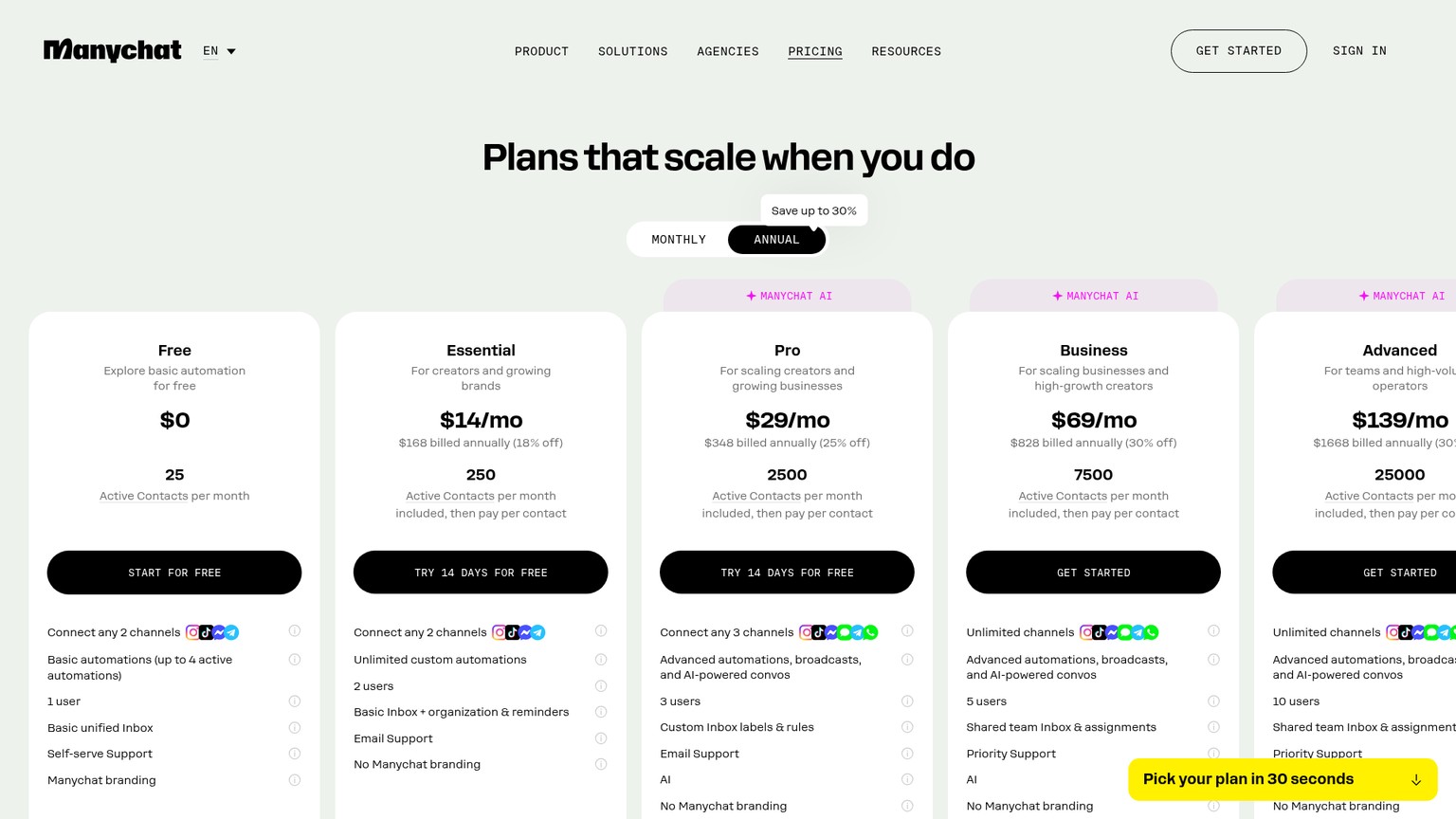
Verified against Manychat's live pricing page and current help center on August 11, 2026. Prices below are in US dollars before tax. An asterisk marks annual pricing shown as a monthly equivalent; the full year is paid upfront.
The blunt verdict is that Pro is the default paid plan for an active social-selling business. Essential is useful only while two basic social channels and a small contact count are enough. Business and Advanced are not status upgrades; they become rational when overage math, channel count, or team workflow crosses a specific threshold.
How Manychat billing works
Manychat bills for people you interact with during the month, not for the size of a dormant database and not for each individual message. An Active Contact is one person who sends or receives a message through an automation, AI conversation, broadcast, or Inbox during the billing period. Ten messages with the same person still count as one Active Contact for that month.
That definition has two business consequences. First, a viral comment-to-DM campaign can raise the bill even when the underlying follower count barely moves. Second, a large stored list can remain inexpensive in a quiet month if few people interact. Forecast from engaged people, not total followers or CRM records.
Every paid plan includes a monthly allowance. If activity runs past it, automations continue and Manychat charges the listed per-contact overage. Annual plans still count Active Contacts monthly and bill overages monthly. You can set an overage threshold, including whether to allow overages at all. If you cross the allowance and upgrade within the same billing cycle, Manychat says the overage already incurred is forgiven and those contacts move under the new plan allowance.
The account, not the person using it, is the billing unit. Each Manychat account has its own plan, contact allowance, users, Inbox seats, and payment details. An agency running five client accounts therefore carries five subscriptions even if one operator manages all of them.
The March 2026 pricing split matters
Manychat introduced this five-plan model on March 2, 2026. The current help center says the plans are available to accounts created on or after that date, with regional variation. Some earlier accounts cannot switch yet and remain on legacy billing.
That means two businesses can open Manychat and see different invoices without either one being wrong. If an account predates March 2, use Settings > Billing > Subscription as the source of truth. The public page is the correct planning baseline for a new account, not proof that a legacy account has already migrated.
Which Manychat plan should you choose?
Choose the lowest tier that covers both the required channels and the expected monthly Active Contacts, then check whether the next tier is already cheaper than overages. Features decide the floor; contact math decides when to move.
Free: a sandbox, not a working growth system
Manychat Free costs $0 and includes 25 Active Contacts, two eligible channels, four live automations, one user, and one Inbox seat. The two channels can come from Instagram, TikTok, Facebook Messenger, and Telegram. WhatsApp, SMS, and Email are unavailable, and the first message to a contact carries Manychat branding.
Free is enough to learn the builder, validate one comment trigger, or run a very small side project. Twenty-five Active Contacts is less than one engaged person per day in a typical month, so a creator with regular comments will outgrow it quickly.
Who never needs to pay: a dormant portfolio account, a tiny community with fewer than 26 interacting people per month, or an operator using Manychat only to demonstrate a four-flow prototype. Anyone calling the automation a growth channel should budget for a paid plan before launch.
Essential: basic automation for a narrow channel mix
Manychat Essential costs $17 monthly or $14 per month on a $168 annual commitment. It includes 250 Active Contacts, two users, one Inbox seat, two eligible channels, unlimited automations, lead capture, tags, Google Sheets sync, and removal of Manychat branding. A 14-day trial is available.
Its hard wall is channel access. Essential can use Instagram, TikTok, Messenger, or Telegram, but not WhatsApp, SMS, or Email. That makes it a clean fit for a solo creator automating Instagram comments and stories, but a poor fit for a DTC brand that wants to carry a lead from Instagram into WhatsApp.
Skip Essential once expected activity rises above roughly 433 annual-plan contacts or 470 monthly-plan contacts. At that point, its base fee plus overages reaches the Pro price even before Pro's added channels and AI have any value.
Pro: the active-business default
Manychat Pro costs $39 monthly or $29 per month on a $348 annual commitment. It includes 2,500 Active Contacts, three users, two Inbox seats, and three channels selected from Instagram, TikTok, Messenger, WhatsApp, Telegram, SMS, and Email. The live plan includes AI-powered automation, broadcasts, custom Inbox rules, integrations, API access, and up to 10,000 emails. A 14-day trial is available.
Under the current five-plan model, Manychat AI is included in Pro, Business, and Advanced. The live pricing page does not show a separate $29 AI add-on for these plans.
Pro is the right starting point for a B2B growth lead qualifying Instagram comments, a DTC brand moving shoppers into WhatsApp, or a creator using AI replies and broadcasts. It is also the point where Manychat becomes a multichannel operating tool rather than a simple auto-reply utility.
The constraint is that three channels and two Inbox seats can become tight for a team. A third Inbox seat costs $25, and contact overages become more expensive than Business at roughly 3,553 annual-plan contacts or 3,700 monthly-plan contacts.
Business: the first team-operations tier
Manychat Business costs $99 monthly or $69 per month on an $828 annual commitment. It includes 7,500 Active Contacts, five users, three Inbox seats, unlimited eligible channels, up to 30,000 emails, AI automation, broadcasts, lead routing, and advanced Inbox workflows. There is no free trial.
Business earns its price when several people share live conversations across social, WhatsApp, SMS, and Email. A small agency or DTC growth team can assign leads and manage follow-ups without squeezing every workflow through Pro's three-channel ceiling.
Do not buy it merely to avoid a few Pro overages. Buy it when activity reaches the mathematical break-even or when unlimited channels and routing save genuine operating time. The plan can scale to five Inbox seats, but each added seat costs $25.
Advanced: high volume and API-dependent operations
Manychat Advanced costs $199 monthly or $139 per month on a $1,668 annual commitment. It includes 25,000 Active Contacts, ten users, five Inbox seats, unlimited channels, up to 100,000 emails, API capabilities, and custom integrations. There is no free trial, and Manychat positions it as the highest standard tier before a custom arrangement.
Advanced is the economic choice once Business plus overages reaches roughly 11,389 annual-plan contacts or 11,500 monthly-plan contacts. It is also the practical choice when a larger team needs more seats or an API-dependent workflow has become business infrastructure.
Its low per-contact overage does not make it a bargain for a smaller list. A business with 5,000 active people is paying for contact capacity and team access it cannot use.

The contact break-even math
Manychat gets cheaper per included Active Contact as the plans rise, but overpaying for unused capacity can still erase that efficiency. At full allowance, Essential costs $68.00 per 1,000 included Active Contacts monthly or $56.00 on annual billing. Pro drops that to $15.60 or $11.60, Business to $13.20 or $9.20, and Advanced to $7.96 or $5.56.
Those figures explain why Essential is a bridge rather than a long-term scale plan. Its base price is low, but each extra contact is expensive. The plan ladder has three useful mathematical switch points:
- Essential to Pro: 470 Active Contacts on monthly billing, or approximately 433 on annual billing.
- Pro to Business: 3,700 Active Contacts monthly, or approximately 3,553 annually.
- Business to Advanced: 11,500 Active Contacts monthly, or approximately 11,389 annually.
The decision rule is simple: when the current plan plus expected overages meets the next plan's base price, upgrade. The higher tier gives more capacity and usually more operational room for the same or less money.
Price Manychat per outcome, not per contact
Contact efficiency is useful for choosing a tier. Business value still needs an outcome denominator such as a booked call, qualified lead, recovered cart, or completed purchase.
A prior 30-day Manychat flow case study recorded 41 booked calls at $18.40 blended from 612 Instagram comments and 188 WhatsApp inbounds, with $1,100 in boosted-post spend. Its Manychat line used the legacy price ladder, so those old tier numbers should not be reused for a new account.
Under the current annual Pro plan, the case study's 2,100 contacts fit inside the 2,500-contact allowance. Dividing the $29 monthly equivalent by 41 calls puts the Manychat subscription itself at about $0.71 per booked call. That does not turn the full acquisition cost into $0.71. Paid distribution, WhatsApp delivery, and human follow-up still dominate the P&L. It shows why the software line should be judged inside the whole funnel rather than blamed for every dollar in it.
Annual versus monthly billing
Annual billing wins only when the account will stay on the same or a higher tier long enough to recover the upfront commitment. Essential costs $168 upfront and saves $36 against 12 monthly payments. Pro costs $348 and saves $120, Business costs $828 and saves $360, and Advanced costs $1,668 and saves $720.
The minimum whole-month holding period is more useful than the advertised percentage. Essential becomes cheaper in month 10. Pro, Business, and Advanced become cheaper in month 9. If a campaign is a short experiment, monthly billing can cost less despite the higher headline rate.
Annual billing also removes flexibility. Manychat charges the full year upfront, and an annual account cannot switch to monthly billing or downgrade until the term ends. A monthly downgrade takes effect at the next billing period. Upgrades begin a new billing cycle immediately, with unused paid time applied as a prorated credit.
The refund window is narrower than the annual commitment. A customer can request a refund within 30 days of the first plan purchase, but a later upgrade does not restart that clock.

Hidden Manychat costs
The subscription is only the base charge. Active Contact overages, messaging providers, seats, taxes, and separate client accounts can move the operating cost more than the difference between two plan cards.
Active Contact overages
Overages are the first variable to model because they are part of Manychat's own invoice. Essential charges $0.10 per additional contact monthly or $0.082 on annual billing. The rates fall to $0.05 and $0.038 on Pro, $0.025 and $0.018 on Business, then $0.004 and $0.0028 on Advanced.
Do not let overages run by default. Set a threshold in Billing, forecast the peak campaign month, and compare the expected total with the next plan. If the higher tier is cheaper, upgrade during the same cycle so Manychat can forgive the earlier overage and apply contacts to the new allowance.
WhatsApp template delivery
WhatsApp is available from Pro, but delivery is not fully included in the plan. Manychat charges through the Manychat Wallet for each delivered template message, using Meta's category and destination-market rates.
For North America, the rate card effective July 1, 2026 lists $0.0287 for a delivered marketing template and $0.0039 for a utility template. Non-template business messages inside an open customer-service window are free. Incoming messages are free. Utility templates inside the 24-hour service window and eligible templates inside a 72-hour free-entry window are also free.
US operators face a separate constraint: Manychat's current help page still flags Meta's temporary pause on marketing template messages to users in the United States, which began April 1, 2025. A US campaign cannot treat the North America marketing rate as proof that the message type is currently deliverable.
SMS and MMS through Twilio
SMS is available only on paid plans, and Twilio bills the delivery rather than Manychat. The Manychat plan buys access to the channel; it does not absorb the carrier bill.
Message length can multiply that bill. A plain SMS segment holds 160 characters, while an emoji can reduce the segment to 70 characters. A 480-character plain message is billed as three SMS messages. Cost a campaign by segments, destinations, and Twilio rates, not by the number of rows in a contact export.
Email beyond the included allowance
Pro includes 10,000 emails, Business 30,000, and Advanced 100,000 on the current pricing page. Manychat's live email help page lists a $0.003 pay-as-you-go rate beyond the included monthly allowance, applied in 5,000-email increments, with a final partial increment charged separately at month end.
That help page was last updated before the March plan change and still uses legacy allowance examples. Use the newer pricing page for the allowance attached to the current plan, then confirm the $0.003 overflow rule in the account before a large send. This is one place where the public documentation spans two pricing generations.
Team seats, accounts, and tax
Pro includes two Inbox seats, Business three, and Advanced five. Additional Inbox seats cost $25, within each plan's stated seat ceiling. An agency must also pay separately for every Manychat account it manages, so adding a client can create a whole new subscription rather than one extra user fee.
Public prices exclude tax and can change by billing country. The checkout total is therefore the final number to put into a P&L.
API access is packaged, not separately metered publicly
Manychat's live public pricing does not publish a separate per-call API tariff. The Pro help page lists API access as a plan capability, and Advanced is positioned for higher-volume API and custom-integration work. API use is not a hidden cheap parallel plan; it still operates inside the subscription's contact, channel, and account economics.
Manychat versus LinkDM, Chatfuel, and respond.io on price
The cheapest alternative depends on the job. LinkDM wins a narrow Instagram-DM budget. Chatfuel offers a different unlimited-contact model with an opaque AI fair-use wall. respond.io costs much more because it is built around omnichannel team operations rather than creator automation.
LinkDM: cheaper for Instagram-only DM automation
LinkDM prices Instagram automation by accounts and DM allowances. Free covers one Instagram account and 1,000 DMs per month. Pro costs $19 monthly or $182 yearly, a $15.17 monthly equivalent, and supports up to three Instagram accounts with 25,000 DMs per account per month. Platinum+ costs $99 monthly or $832 yearly for up to ten accounts and 300,000 DMs per account per month.
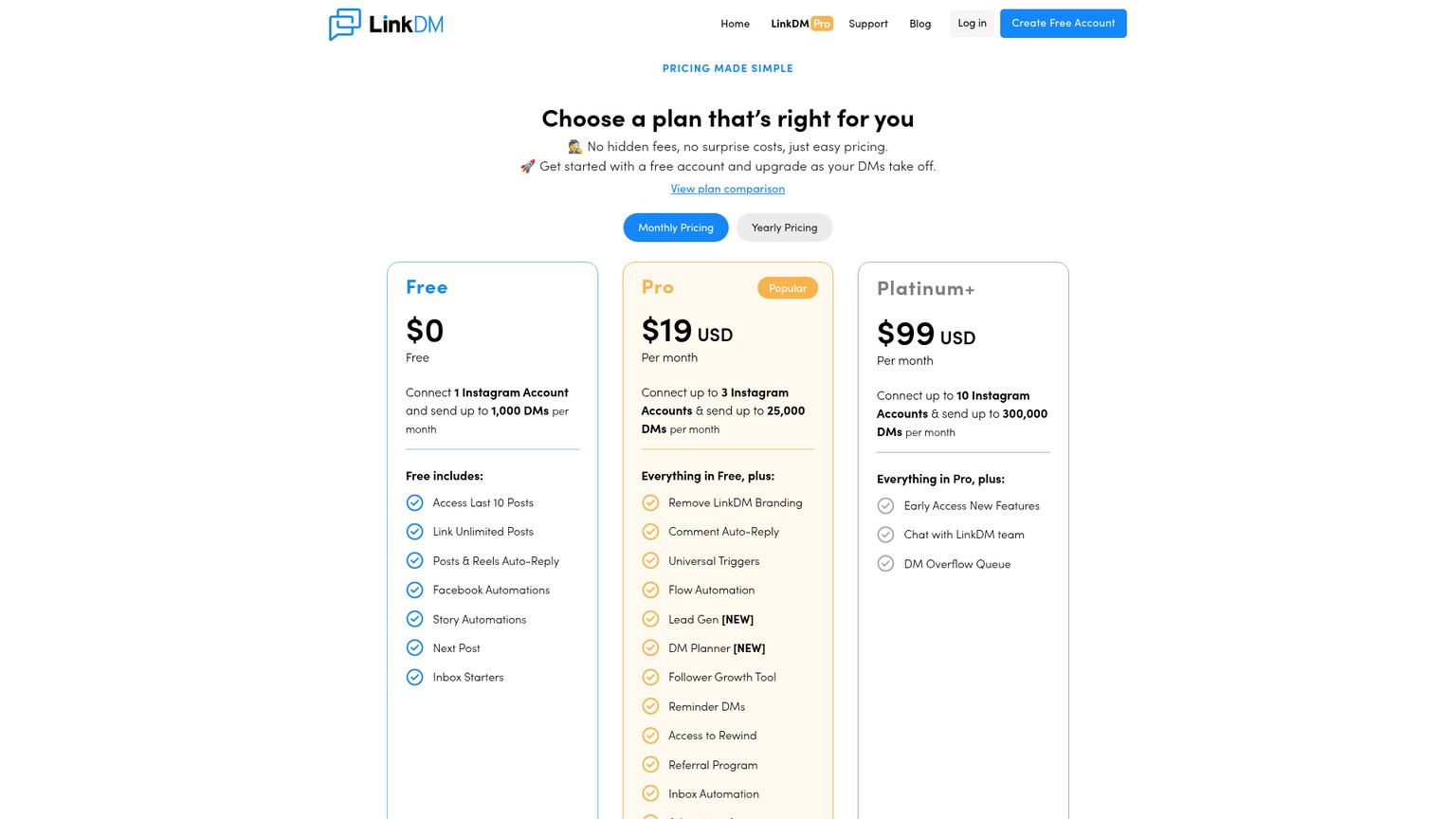
Choose LinkDM when the entire job is comment-to-DM and story automation on Instagram. Its Pro annual equivalent is lower than Manychat Pro's $29, and its allowance is easier to forecast for a DM-heavy creator. Choose Manychat when WhatsApp, SMS, Email, AI conversations, a broader flow builder, or a shared multichannel Inbox is part of the workflow. The meters are different, so comparing one LinkDM DM with one Manychat Active Contact would be false precision.
Chatfuel: a lower-predictability high-volume option
Chatfuel lists Light at $0 with no credit card and AI Pro at $49 per month, with 29% annual savings advertised. AI Pro covers Instagram, Facebook, and WhatsApp automation, a shared Inbox, an AI sales manager, broadcasts, and lead-qualification funnels.
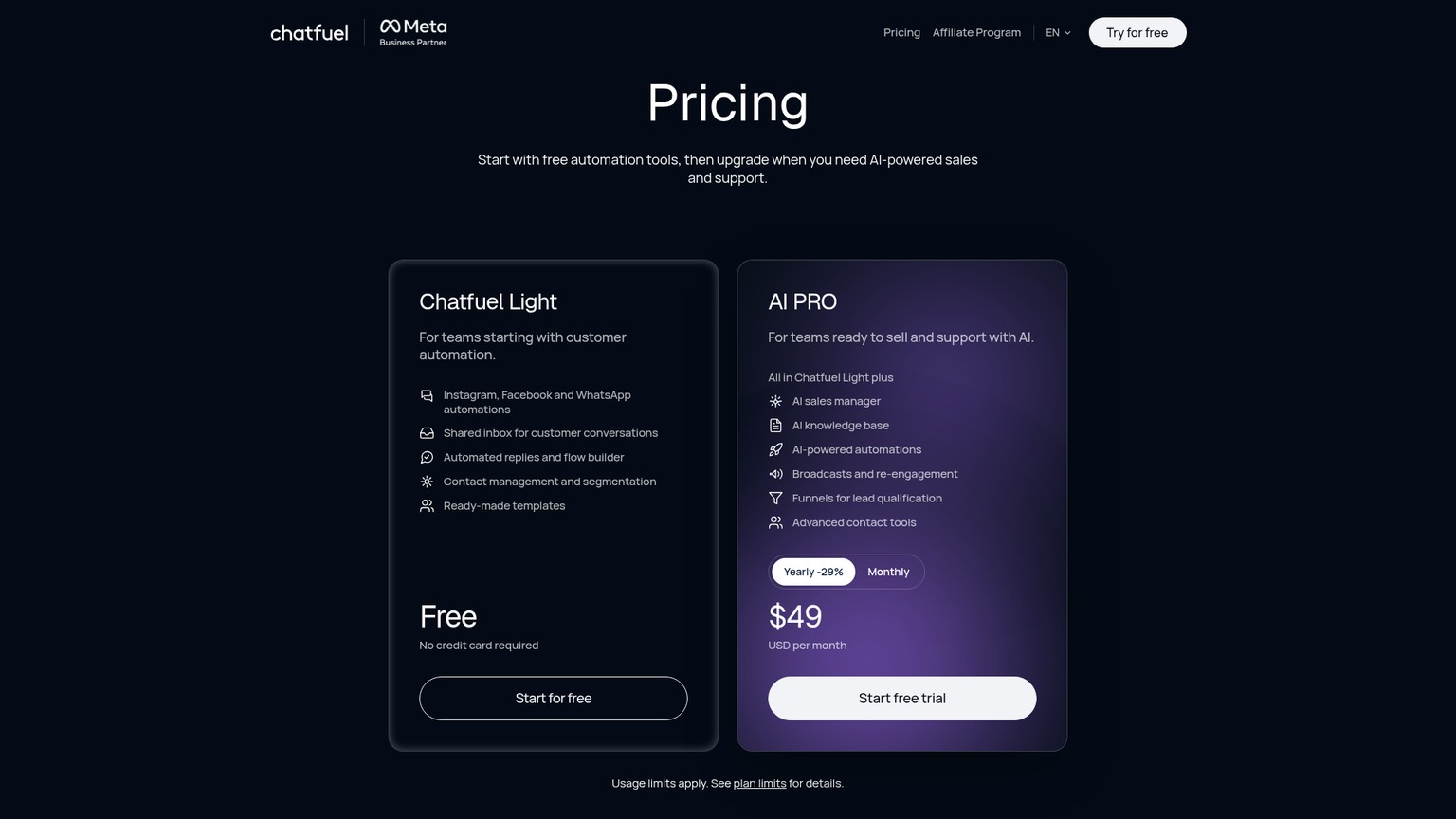
The pricing advantage is unlimited active contacts and unlimited messages. The wall is AI processing: Chatfuel applies a fair-use allowance based on the knowledge base, instructions, and conversation history, but its public limits page does not quantify that allowance. If the limit is reached, the bot pauses until renewal, the next billing period, or connection of the customer's own OpenAI key.
Choose Chatfuel when static flows and a potentially large contact pool matter more than a transparent AI allowance. Choose Manychat when a known contact meter, explicit overages, and continuity after exceeding the allowance are easier to operate. At the monthly entry, Manychat Pro is $39 versus Chatfuel AI Pro at $49, but the cheaper invoice is not the only risk variable.
respond.io: pay more for a team conversation platform
respond.io Starter costs $99 monthly or $79 per month on a $948 annual payment. The closer automation comparison is Growth at $199 monthly or $159 per month on a $1,908 annual payment. Growth includes ten users, starts with 1,000 Monthly Active Contacts, and adds workflows, broadcasts, AI Agents, advanced reports, Zapier, Make, and Developer API. WhatsApp fees remain separate.
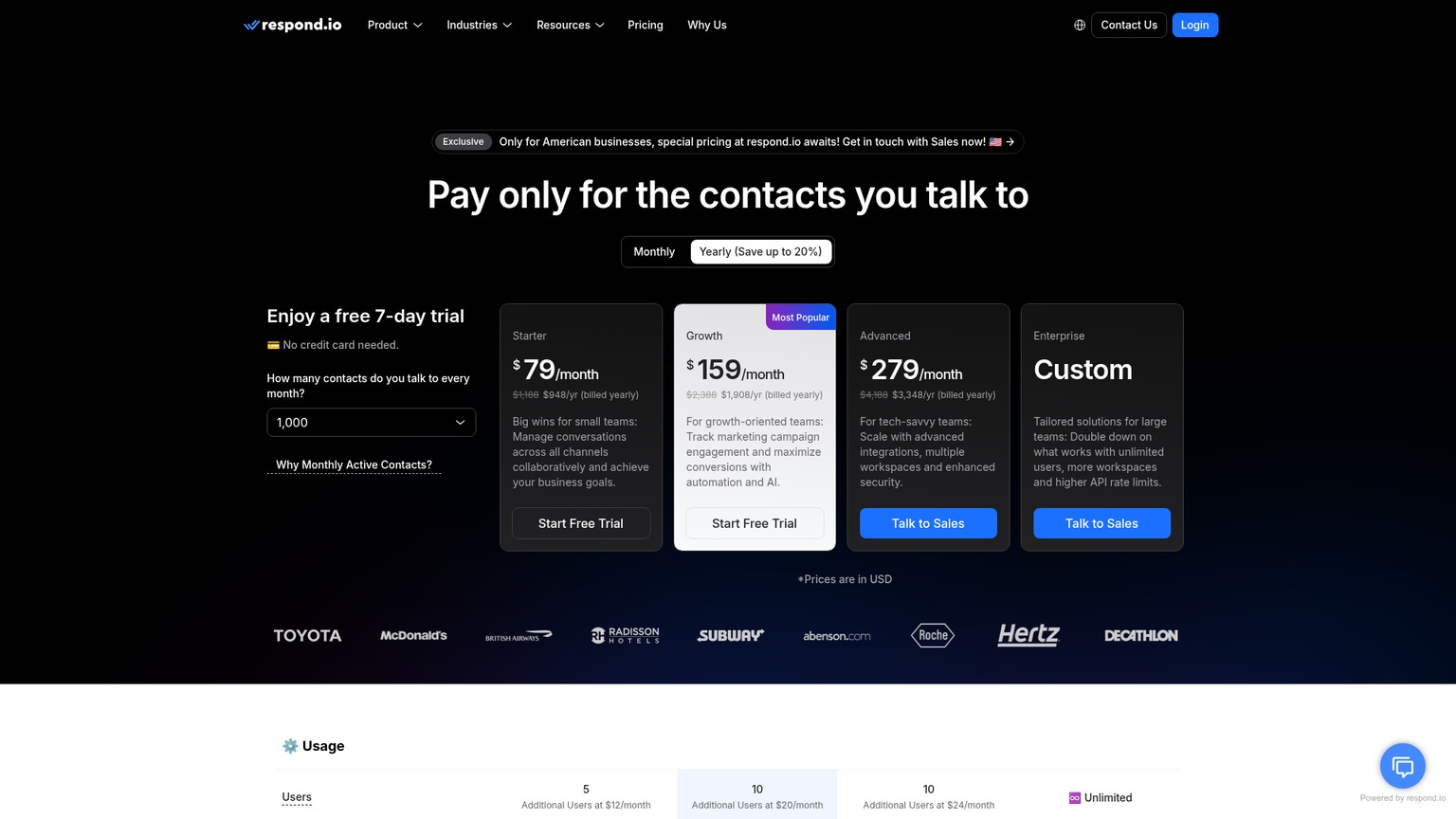
Choose respond.io when the main problem is an omnichannel sales or support team that needs a shared customer-conversation layer. Choose Manychat when the main problem is acquiring and nurturing leads from social comments, DMs, and broadcasts. A support-led buyer can use the broader AI customer service tools guide to compare that different category before paying for social-first automation.
The explicit decision rule is this: buy Manychat for social acquisition, LinkDM for Instagram-only volume, Chatfuel for unlimited static-flow volume with tolerable AI ambiguity, and respond.io for a larger omnichannel team operation.
Who should buy Manychat and who should skip it?
Manychat is worth paying for when social conversations already create measurable demand. A creator with regular comment volume can use Pro to turn replies into tagged leads. A DTC growth team can use Business when Instagram, WhatsApp, Email, and shared follow-up need one operating layer. An agency can use Advanced when high contact volume and API-dependent client workflows justify the separate account costs.
Skip Manychat when the business has no meaningful social engagement, when the workflow lives entirely inside Instagram and LinkDM covers it for less, or when the actual requirement is a support desk with complex omnichannel case management. Automation cannot create intent that the channel does not have.
- Five plans create clear capacity steps from a free sandbox to 25,000 included Active Contacts.
- Pro includes AI, broadcasts, WhatsApp, SMS, Email, integrations, and API access under one base subscription.
- Overage rates and upgrade break-even points are public and calculable.
- Automations continue after a contact overage, with user-controlled thresholds.
- The Free plan's 25-contact ceiling is too small for most active businesses.
- WhatsApp, Twilio, extra Inbox seats, taxes, and separate client accounts sit outside the headline price.
- Annual savings require a full upfront payment and restrict downgrades for the term.
- Legacy accounts may not yet match the public five-plan model.
The Monday move: price the workflow before choosing a tier
Do this next week before starting a trial, approving an annual renewal, or launching a campaign. The output should be one monthly cost, one upgrade threshold, and one business outcome.
Count active people, not followers
Use the last representative month to count people who sent or received a Manychat message. Add the expected lift from the next campaign. This is the billing denominator.
Set the channel floor
List the channels the workflow truly needs. WhatsApp, SMS, Email, AI, broadcasts, or three channels make Pro the minimum even when contact volume is small.
Run the overage comparison
Multiply expected contacts above the allowance by the plan's overage rate, then add the base fee. Compare that total with the next plan using the 470, 3,700, and 11,500 monthly break-even points, or the annual equivalents.
Add the external meters
Estimate WhatsApp templates, Twilio SMS segments, extra Inbox seats, taxes, and separate client accounts. Keep each line visible instead of hiding everything under "Manychat."
Name the outcome and holding period
Divide the full monthly cost by booked calls, qualified leads, purchases, or hours saved. Choose annual only when the owner expects at least 10 months on Essential or 9 months on Pro or above.
The final budget sentence should read: "This Manychat workflow costs us X per month, upgrades at Y active contacts, and must produce Z outcomes to earn its place." If any variable is blank, stay monthly until it is known.
Frequently asked questions
Does it cost money to use Manychat?
Manychat can cost $0 on Free, but paid plans range from $17 to $199 with monthly billing or $14 to $139 per month equivalent on annual billing. Contact overages, WhatsApp templates, Twilio SMS, extra Inbox seats, tax, and separate accounts can add to the base price.
Is there a free version of Manychat?
Yes. Manychat Free includes 25 Active Contacts per month, two eligible channels, four live automations, one user, and one Inbox seat. It excludes WhatsApp, SMS, and Email and adds Manychat branding to the first contact message.
Who never needs to pay for Manychat?
A tiny project can remain free indefinitely while it stays within 25 monthly Active Contacts, two eligible channels, and four live automations. Most active creators will cross the contact allowance quickly, so Free is better treated as a sandbox.
What is a cheaper alternative to Manychat?
LinkDM is cheaper for Instagram-only DM automation: Pro costs $19 monthly or $182 yearly. Chatfuel Light is free and AI Pro displays $49 monthly with unlimited contacts, but AI processing has an unquantified fair-use limit. The cheaper choice depends on the channel and meter, not one starting price.
Is Manychat Pro worth it?
Pro is worth it when the workflow needs WhatsApp, SMS, Email, AI, broadcasts, three channels, or more than roughly 433 to 470 Active Contacts. It costs $39 monthly or $29 per month on a $348 annual commitment and includes 2,500 Active Contacts.
Does Manychat offer a student discount?
Manychat did not advertise a student discount on its live pricing page or current subscription help page when verified on August 11, 2026. A student project can use Free while it remains within the 25-contact and four-automation limits.
What is Manychat's refund policy?
Manychat allows a refund request within 30 days of the first plan purchase. Upgrading later does not reset that 30-day window. Monthly downgrades begin at the next billing period, while annual downgrades must wait until the term ends.
Does Manychat offer an annual discount?
Yes. The advertised annual savings are 18% on Essential, 25% on Pro, and 30% on Business and Advanced. The full year is paid upfront, and annual billing becomes cheaper in month 10 for Essential or month 9 for the higher tiers.
Did Manychat pricing change in 2026?
Yes. Manychat introduced the current five-plan model on March 2, 2026 for accounts created on or after that date, subject to region. Some older accounts still cannot switch from legacy billing, so their in-app Subscription page can differ from the public offer.
Does Manychat charge separately for API use?
Manychat does not publish a separate per-call API price on its live public pricing page. The Pro help page lists API access within the plan, while Advanced is positioned for higher-volume API and custom-integration work. Contact, channel, and account billing still apply.
Use the AI Business Workflow Audit Checklist to decide which automation deserves a paid line item.
- Published
- Category
- Growth
- Language
Beehiiv Review
Beehiiv reviewed for business newsletters: current pricing, growth, monetization, AI, MCP, analytics and the costs that change the buying decision.Oct 10, 2026Growth
Trainual Review
Trainual review for SOPs and onboarding: AI drafting, knowledge search, read-only MCP, quote-only plans, implementation and who should skip it.Oct 10, 2026Growth
SocialBee Review
SocialBee review of evergreen scheduling, AI Copilot and client workspaces, with all six plans, add-on costs, and Buffer and Later comparisons.Oct 10, 2026Growth
SurveyMonkey Pricing: Plans, Response Caps and Annual Bills
SurveyMonkey prices, response caps and AI limits, with annual bills for one person and three-seat teams. See when overages change the best plan.Oct 10, 2026Growth
ActiveCampaign Alternatives: GetResponse, Kit and More
Compare ActiveCampaign alternatives at 2,500, 10,000 and 25,000 contacts, with vendor prices, workflow trade-offs and a migration checklist.Oct 9, 2026Growth
CallRail Alternatives: WhatConverts and More Compared
Compare six CallRail alternatives by vendor pricing, usage fees, AI and reporting. Includes WhatConverts cost math and a pre-switch checklist.Oct 9, 2026Growth
Monday.com Pricing: Seat Buckets and the Yearly Bill
Calculate monday.com Work Management costs for 5, 12 and 40 people, including seat buckets, annual vs monthly billing and AI credit charges.Oct 9, 2026Growth