Marblism Review
Marblism's seven AI employees, current plans, shared-hour costs, dated public reviews and the jobs that still need human approval.
Published
 By Omid Saffari


Marblism is worth considering for a small business that wants inbox triage, content drafts and routine intake in one subscription, provided an owner still checks the work. At $44 month to month, or $24 a month billed yearly, all seven AI employees share 50 monthly hours of AI work. This Marblism review recommends handing over preparation first, keeping outbound email and legal drafts under human review, and buying on net time saved rather than the employee names.
Pricing and capabilities were verified against Marblism's live pricing, feature and help pages on 9 October 2026. This is a review of the documented offer, its economics and dated public feedback. No paid account, dashboard workflow or generated output was exercised for this review, so there is no hands-on quality score or measured time-saving claim.
What Is Marblism AI?
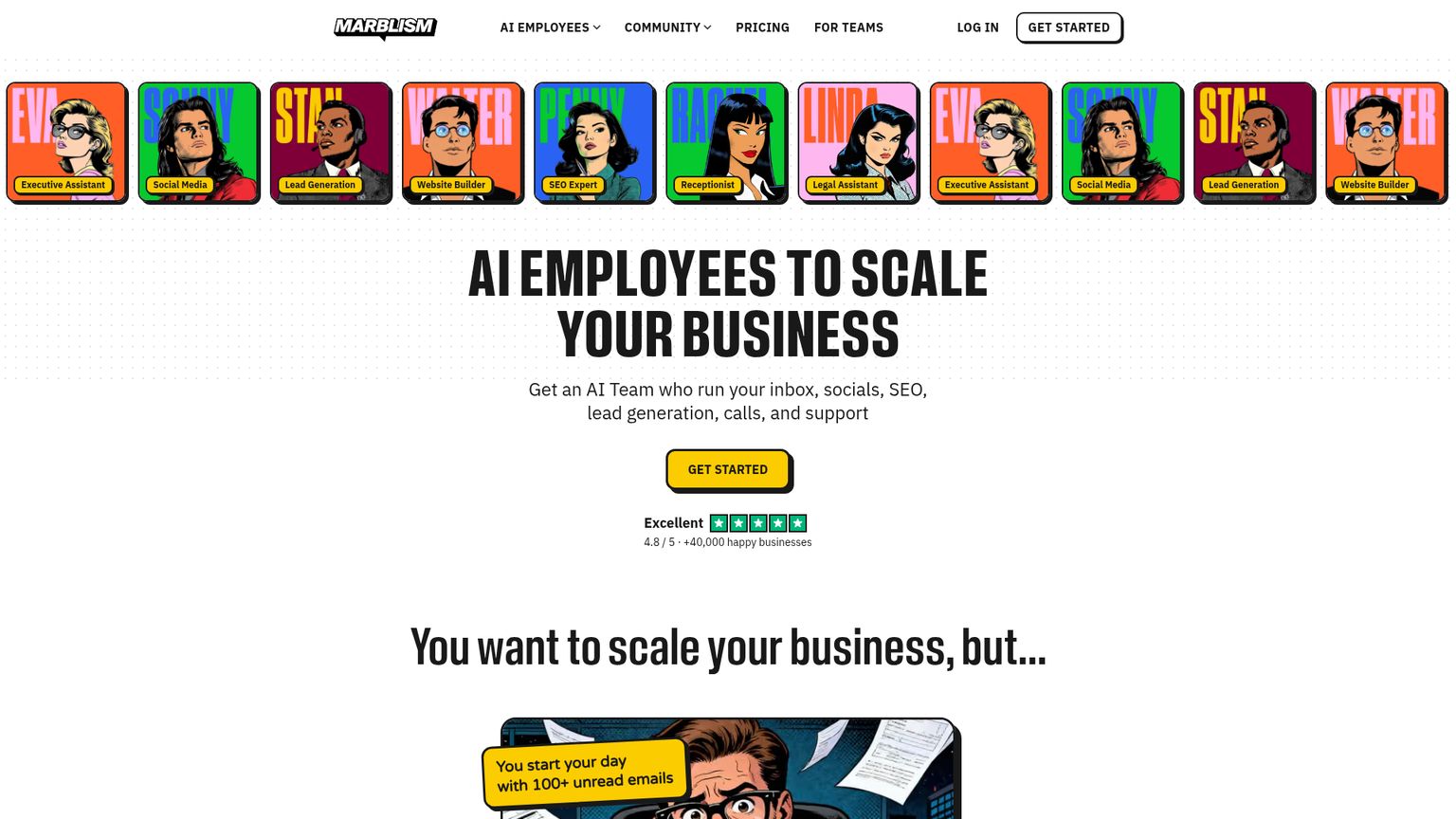
Marblism is a subscription that packages AI assistants around seven business jobs and connects them to the accounts where those jobs happen. Its own role labels are Eva, Executive Assistant; Sonny, Social Media Manager; Stan, Lead Generation; Penny, SEO Expert; Rachel, Receptionist; Walter, Website Builder; and Linda, Legal Assistant. You supply business information, connect the relevant tools and assign work; a shared allowance pays for the tasks. The employee names describe responsibilities, rather than seven people taking responsibility for your business. The useful distinction is how much preparation each role removes and what you still approve. The broader AI employee guide explains that delegation model. Marblism's homepage presents the current seven-role team.
Who It Fits, and When Marblism Competitors Fit Better
Marblism fits an owner with several recurring chores, clear business rules and time to supervise the outputs. Think of a small agency whose inbox, social calendar and appointment intake all need attention. A bundle has a reason to exist there: the owner can reuse the same business facts across jobs instead of buying a separate tool for every neglected task.
The fit weakens when one job dominates. An inbox-heavy consultant should compare an email specialist. A business that earns most new revenue through phone calls should compare a receptionist specialist before choosing a shared subscription that also funds blog posts and videos. Someone looking for a lawyer to take responsibility for a contract needs qualified advice, whatever the monthly software price.
These are different buying priorities, rather than an output-quality ranking. Prices below were checked on the vendors' live pages on 9 October 2026. Annual figures are monthly equivalents; the annual payment is larger.
Fyxer: When the Inbox Is the Whole Problem
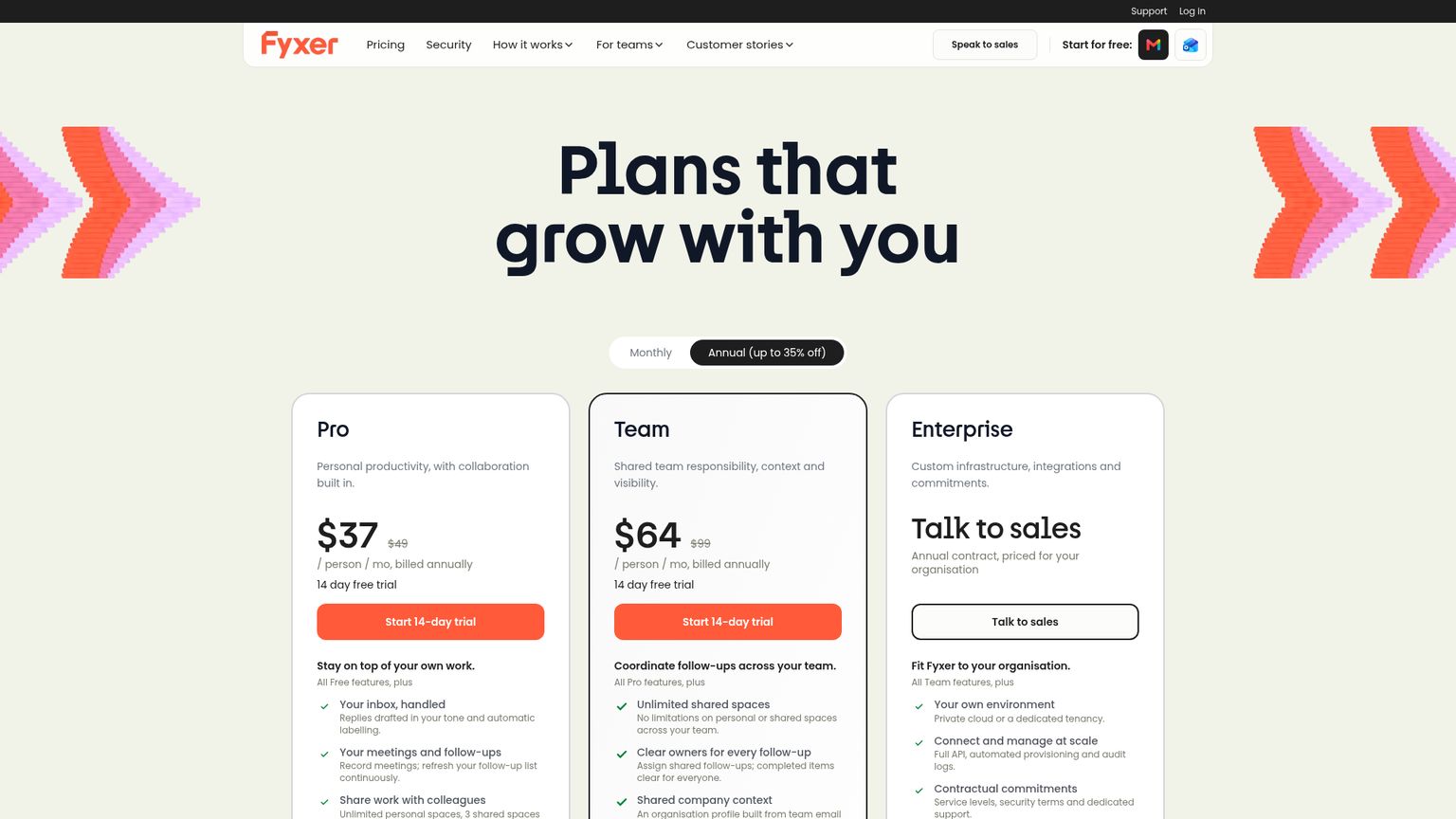
Fyxer is an email and meeting assistant whose Pro plan lists automatic inbox labelling, replies drafted in your tone, meeting recording and follow-ups. Its pricing FAQ explicitly says it cannot send emails on your behalf. That boundary is useful if your goal is to arrive at a prepared inbox and make the final decisions yourself. Fyxer Pro costs $37 per person per month with annual billing or $49 monthly, with a 14-day trial.
The trade-off is paying by person for a narrower purchase. Its current launch offer gives unlimited credits for the first three months, followed by 3,000 monthly credits per paid member. That is a different meter from Marblism's hours; comparing the raw allowance numbers tells you nothing about relative capacity. Choose Fyxer when inbox and meeting follow-ups explain nearly all the value you want. Skip it as a substitute for the entire seven-job bundle.
Smith.ai: When Missing Calls Is the Expensive Failure
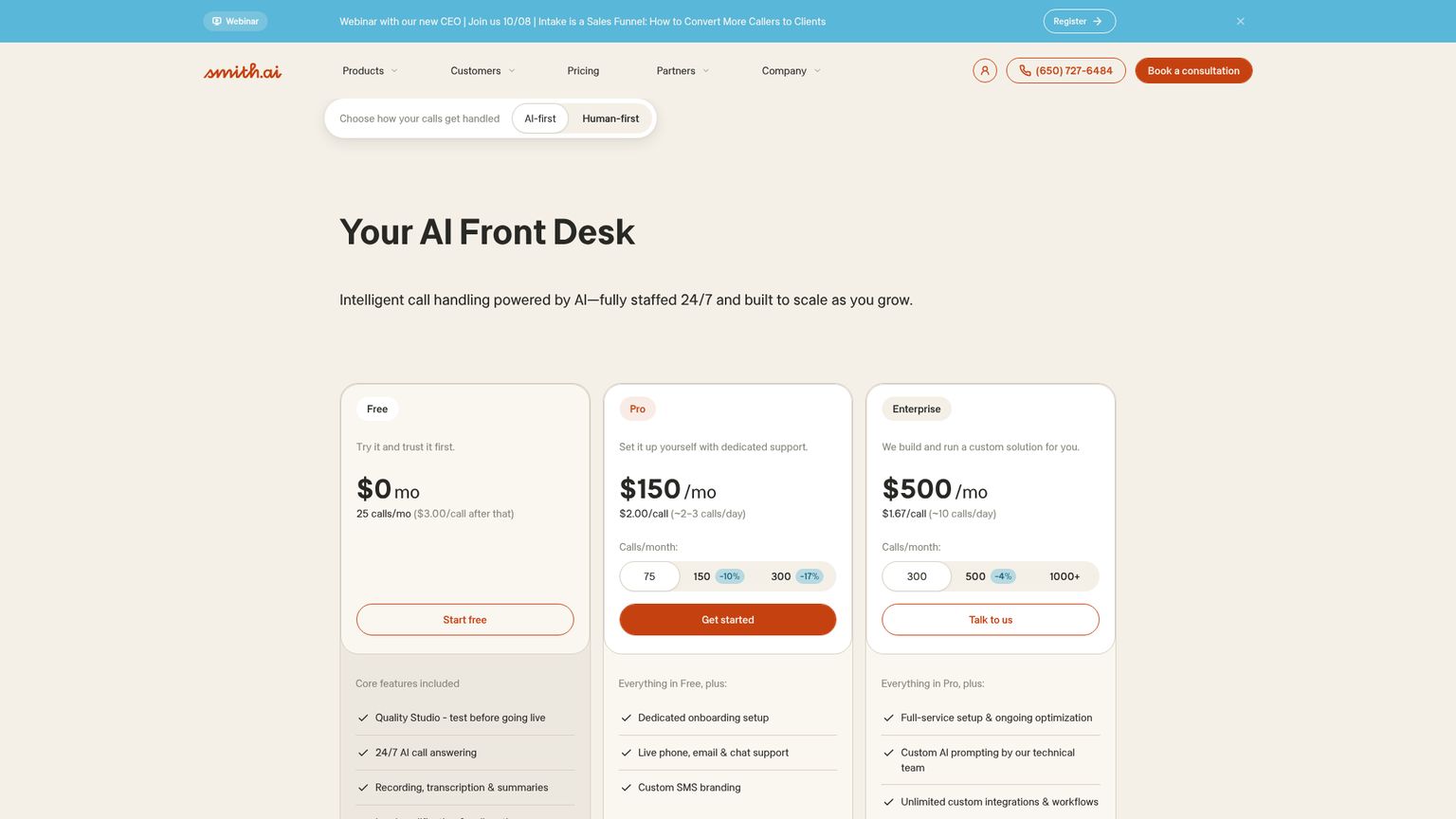
Smith.ai AI Receptionist is a phone specialist. Its live page lists Quality Studio for testing before launch, call recording, transcripts, summaries, lead qualification, routing and scheduling. Those features make a sensible shortlist for an owner who needs to inspect the phone workflow separately from content production. The Free plan includes 25 real calls a month, then charges $3 per additional call. Pro starts at $150 a month for 75 calls, with extra calls at $2.50 on that option.
The paid starting price is substantially above Marblism's base subscription. That premium only makes sense if phone intake deserves a dedicated budget and buying process. Free is also a limited call allowance, rather than unlimited coverage. Choose Smith.ai when the receptionist is the product you are buying; choose Marblism when calls are one useful part of a broader, supervised workload. The best AI receptionist comparison gives a fuller phone-specific shortlist.
Marblism vs Sintra AI: Choose the Jobs Before the Price
Sintra sells a bundle of 12 AI helpers, including data analyst, recruiter and ecommerce roles. Its Brain AI feature accepts business information such as websites and files for personalization. If those jobs match your workload better than Marblism's named phone, legal and website roles, the different catalogue is a reason to investigate it. A larger helper count alone is a poor reason to switch.
The live Sintra pricing page displayed promotional rates of $48.50 for one month, $23.60 a month on a three-month plan and $15.60 a month on a 12-month plan. It lists 250 monthly credits and a 14-day money-back guarantee. Treat those as the displayed sale, with renewal terms to confirm, rather than a permanent price promise. Sintra's credits and Marblism's hours measure different actions, so there is no honest conversion that makes one automatically more generous. Choose the bundle whose connected jobs you would use every week.

Admin and Calls: Eva and Rachel
Marblism's admin roles are the most natural place to begin because the work already arrives in an inbox or on a phone line. Eva prepares incoming communication; Rachel handles live intake. The important difference is that a mistaken label is usually easy to inspect later, while an inaccurate answer to a caller happens in the moment.
The workflows below are illustrations based on Marblism's documented capabilities. They describe how to evaluate adoption, without claiming these outcomes were observed in an account.
Eva, Executive Assistant: Start With Sorting and Drafts
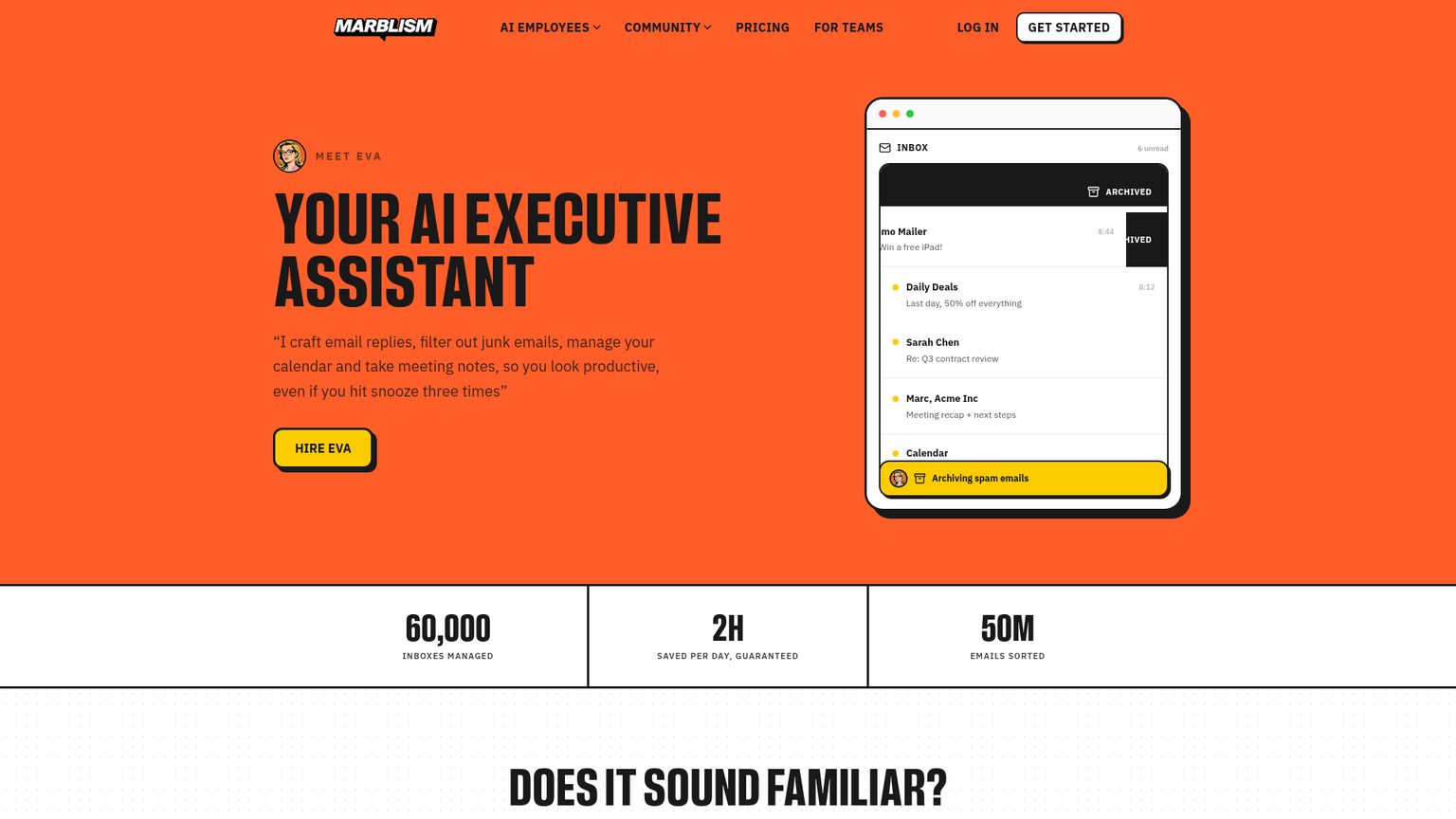
Marblism describes Eva as its Executive Assistant, handling email sorting, junk filtering, reply drafts, calendars and meeting notes. The Eva feature page names Gmail, Outlook and IMAP email connections, Google and Outlook calendars, and meeting notes for Google Meet, Zoom and Teams. Most consequentially, its FAQ says Eva cannot send your emails. She prepares drafts; you review and send them.
For a small agency, a sensible first assignment is separating existing-client requests from newsletters and unsolicited pitches, then drafting straightforward acknowledgments. Supply the current service list, office hours and examples of replies you have approved. Ask for drafts that acknowledge a request without inventing a delivery date or promising a discount. The owner can then read the important conversation and send an accurate response, instead of beginning with a blank page.
Calendar work needs equally specific boundaries. Define which meetings belong in which calendar, the time zone and the periods reserved for actual client work. A technically available slot is not automatically a slot you want someone to book. A meeting summary is also preparation: the owner still checks commitments before turning them into promised deliverables.
Verdict for Eva: try inbox triage first, with a regular check that urgent messages remain visible. Reply drafting is another sensible early job, but read every outgoing reply. The cannot-send boundary reduces the risk of an unattended draft becoming a customer promise; it does not make the draft correct.
Rachel, Receptionist: Validate the Call Path Before Relying on It
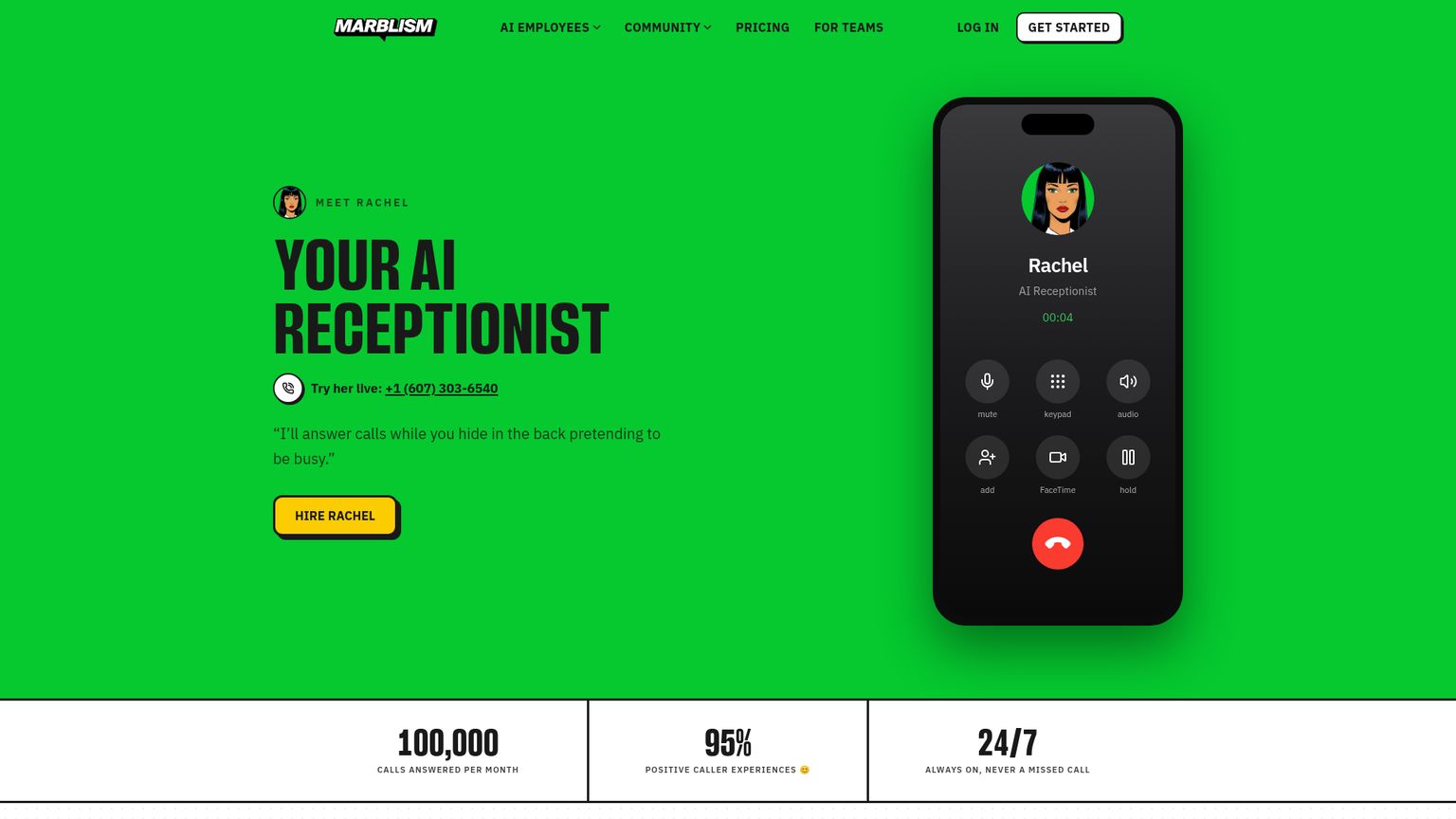
Marblism calls Rachel its Receptionist. The Rachel page describes answering calls, booking and rescheduling through Google or Outlook calendars, sending summaries and transcripts, and transferring calls to you or a colleague. Rachel receives her own phone number; Marblism lists local-number availability in the US, Canada, UK, Mexico and Australia.
For a local repair business, the first workflow should be limited intake: caller name, callback number, service requested and appointment request. Provide the actual service area, operating hours and escalation instructions. Keep diagnostic advice, unusual pricing and promises about arrival times outside the initial brief. A caller who asks for a service you do not offer should get a useful handoff, rather than a plausible answer made from an incomplete description.
Receiving a separate number does not establish that your existing business line reaches it. Before changing the public contact route, check how calls enter, where transfers go and which calendar receives bookings. Call with ordinary and awkward requests: a reschedule, an address outside the service area, an unclear name and a request that should reach the owner. These are recommended checks for the buyer, not tests performed for this review.
Verdict for Rachel: pilot a narrow script and inspect call summaries before making her the primary front desk. Capacity also matters: the documented zero-balance behavior pauses Rachel and either transfers callers to you or asks them to call back. A subscription with phone answering still needs a continuity plan.
Content: Sonny and Penny
Marblism's content roles are most useful as a preparation system with a publishing check. Sonny fills a social calendar; Penny prepares search-focused articles. The owner supplies the business knowledge that distinguishes the material and approves what customers will read. A growing queue of drafts has little value if reviewing it becomes another backlog.
Sonny, Social Media Manager: Hand Over the Blank Calendar
Marblism labels Sonny its Social Media Manager. The Sonny page describes creating captions, photos and short videos, planning content and publishing to Instagram, LinkedIn, X and Facebook. It says brand photos, a logo and previous posts can guide the work. Publishing can run automatically or wait for your review.
For a bookkeeping practice, a useful brief would specify the audience, services offered, approved wording and current offer. Give Sonny real examples of questions clients ask and actual photos you have permission to use. Ask for a calendar built around those questions, with each draft serving a recognizable purpose: explain a service, answer a common objection or invite an inquiry.
A weak brief asks for engaging posts about bookkeeping. A useful brief explains that the practice serves independent retailers, does not offer tax filing, and wants inquiries about monthly bookkeeping. That difference gives the owner a concrete acceptance test. A polished caption that advertises tax preparation fails even if the tone feels right.
Keep review before publishing during adoption. Check prices, dates, contact details, image rights and factual claims, then assess whether the post sounds like your business. Marblism says ordinary social-post revisions are included in the task charge; new video takes follow different billing rules. The buyer should decide whether an asset is needed before using the more expensive generation path.
Verdict for Sonny: delegate topic preparation, caption drafts and calendar organization early. Approve each public asset while you establish the brief. Judge the drafts against your acceptance rule before increasing the workload.

Penny, SEO Expert: Supply the Expertise Before Publishing
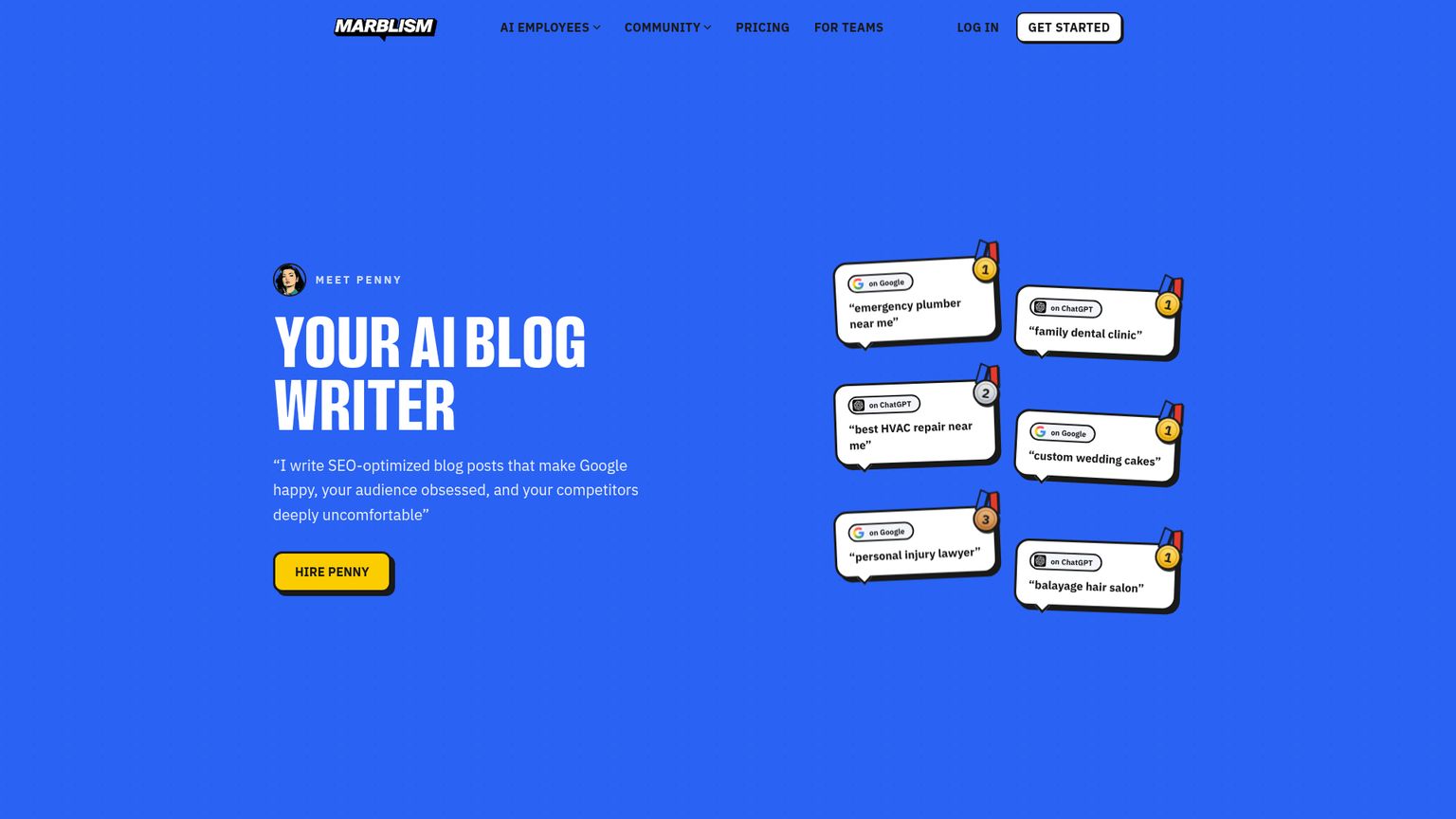
Marblism presents Penny as its SEO Expert, describing keyword research, topic suggestions, blog drafting, internal links and publishing to connected websites. SEO means improving how a page answers the searches prospective customers make. The Penny feature page names WordPress, Webflow, Shopify and Wix connections and says drafts are reviewed and approved before going live.
For a plumber, a useful article brief might answer how homeowners can prepare for a routine service visit. Supply the actual service process, what the business can quote in advance, the geographical area and examples from the owner's experience. Penny can prepare the structure and draft around the topic; the owner supplies the factual detail that a generic article cannot know.
Review the advice and the commercial details together. An article can read smoothly while recommending a service the business does not provide, claiming qualifications it does not hold, or promising a price that depends on an inspection. Check that internal links point to relevant live pages and that the article gives a customer a sensible next step.
Publishing volume is not evidence of search performance. Marblism's descriptions of improved rankings and visibility are vendor claims; this review did not inspect traffic data or generated articles. A business evaluating Penny should judge accepted drafts first, then track whether the published pages bring relevant inquiries over time. The refund period is long enough to inspect workflow fit, not to establish lasting search results.
Verdict for Penny: hand over research and first drafts after providing original business information. Keep human approval on every article, especially advice in a regulated or specialist subject. If you have no time to contribute expertise or check accuracy, automatic content production is an extra publishing liability.
Acquisition: Stan and Walter
Marblism's Stan and Walter cover prospecting and the website destination. Stan prepares and contacts prospects; Walter builds and changes the site they might visit. Both touch your public reputation. Give them a defined offer and preserve a human decision before outreach goes out or consequential site changes go live.
Stan, Lead Generation: Research First, Review Every Message
Marblism's own role label for Stan is Lead Generation. The Stan page describes finding prospects by industry, job title and region, obtaining contact information, writing personalized email from your inbox, following up, sending LinkedIn invitations and messages, and booking conversations. Its FAQ allows either reviewing messages before sending or letting outreach run automatically. That is a different boundary from Eva, who cannot send.
For a small B2B agency, begin with a narrow customer definition and a reviewed list. Specify the type of company, the role that buys your service, the location and why the offer would matter. Exclude existing customers and prospects you have already declined to contact. The first useful deliverable is a list whose fit you can explain, rather than a large count of names.
Check each message against evidence. A sentence claiming that a company is hiring, struggling with a particular problem or using a certain system needs a reliable basis. Personalization that guesses about the recipient can make the outreach less credible. Also inspect sender identity, the offer, the follow-up context and whether a previous reply should stop the sequence.
The email is sent under your business's name even when software wrote it. Keep human review on every outbound email, including follow-ups. Use Stan for the research, preparation and reminder work; do not interpret an automatic-send option as a recommendation to use it. The same judgment applies to LinkedIn messages that represent your company.
Verdict for Stan: lead research and draft outreach can be delegated before sending. Automatic outreach is a poor starting assignment for an owner who has no time to inspect recipients and claims. The documented ability to find contacts does not establish that a particular lead list is accurate or commercially valuable.

Walter, Website Builder: Start With a Controlled Brochure Site
Marblism describes Walter as its Website Builder, creating a site from a business description and accepting changes through chat. The Walter page describes custom-domain support, mobile layouts and ongoing tests of headlines, photos and buttons against visitor behavior. It also describes owner approval options for changes. Those are vendor-described functions, rather than conversion improvements observed for this review.
For a new local business, the first reasonable brief is a brochure site: services, service area, contact information and a clear inquiry route. Supply the actual offer and assets. Ask Walter to prepare the pages, then inspect the facts and the customer's path before attaching the site to the business's public domain.
Check the contact route rather than stopping at appearance. Does the phone number reach the intended person? Does a form submission arrive where you will see it? Does the mobile page show the service area and opening hours clearly? These are buyer acceptance checks; a screenshot of a vendor feature page cannot establish them for your future site.
An established site needs a more cautious scope. Preserve a record of approved copy and changes, and ask for review before modifying a page that already brings inquiries. Testing a headline is only useful if it still describes an offer you want to make. Treat the vendor's optimization claim as a workflow to evaluate against your own traffic and accepted leads.
Verdict for Walter: delegate a first site draft or a bounded copy change, then approve the result. Avoid a large migration as the first experiment. The initial site build is included, but subsequent edits are metered, so ongoing website work should have its own allowance in the shared budget.

Legal Preparation: Linda
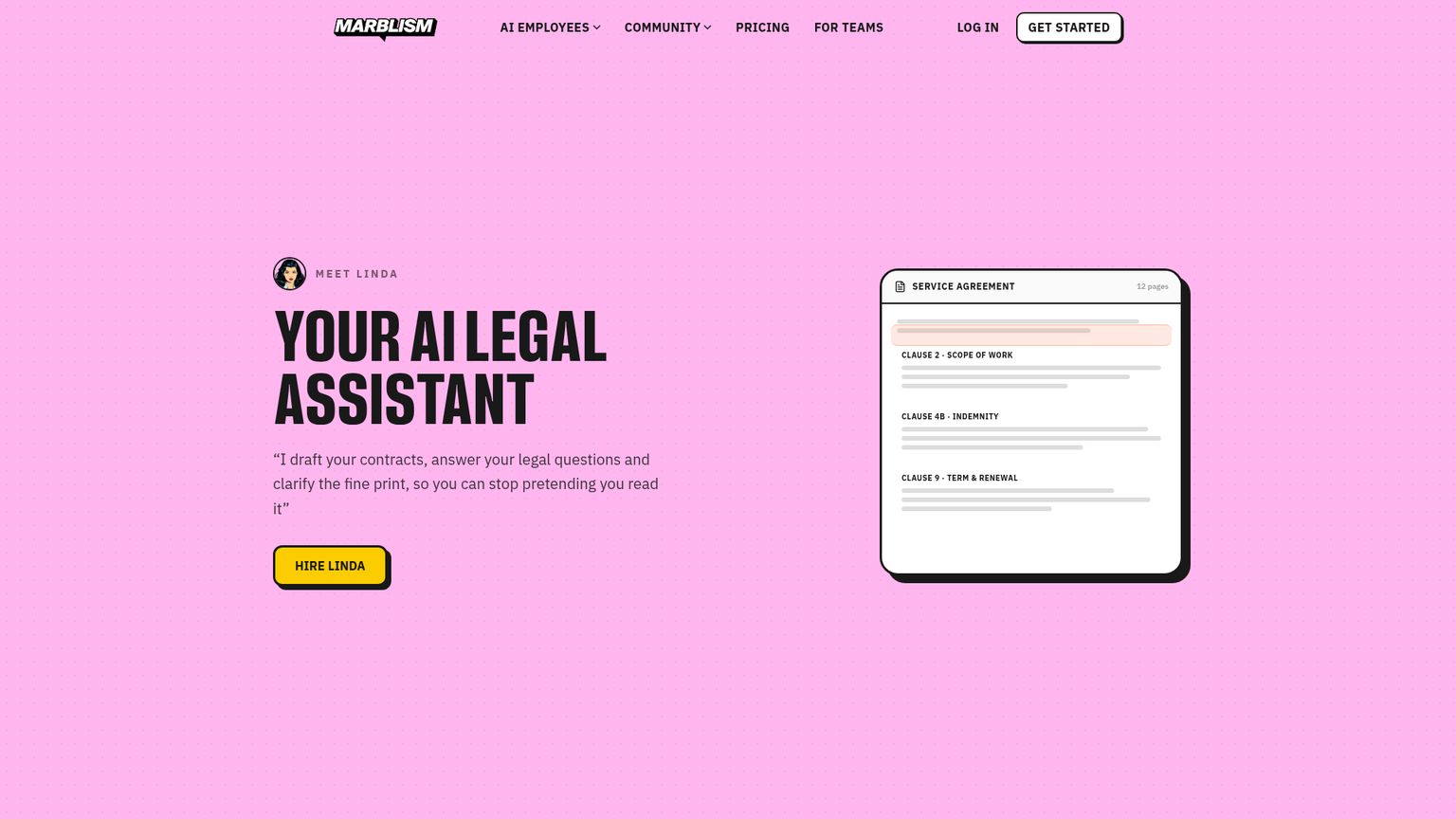
Marblism's Linda should be used for draft preparation and understanding documents, with human review every time. Marblism labels her Legal Assistant, and the Linda page describes drafting NDAs, service agreements, client and vendor contracts, explaining clauses and flagging risks. It explicitly says Linda is not a replacement for a lawyer and never signs anything for you.
A useful agency workflow begins with gathering the commercial facts: the parties, services, payment arrangement, delivery expectations and issues that need a decision. Linda can prepare a draft and explain sections in plain language. The owner can then identify unanswered questions and take a more organized document to qualified counsel when the agreement's stakes require it.
The acceptance standard is different from a social caption. A clause can sound clear while allocating risk in a way you did not intend. Check names, obligations, payment triggers, termination, renewal and the relationship between the document and the actual deal. A confident explanation is still a draft explanation. The vendor's legal-assistant role does not establish that advice is correct for your jurisdiction or transaction.
Do not send a generated agreement simply because the assistant says it is ready. Keep a responsible person in the approval path for every legal draft, and use a qualified lawyer for consequential, unfamiliar or disputed terms. An existing lawyer-approved template can also be a better starting point than asking software to invent the arrangement from scratch.
For a business owner who only occasionally needs a contract, Linda alone is a weak reason to buy the bundle. Her more credible value is reducing the blank-page work and organizing questions within a subscription you already use for other jobs. If the purchase is meant to replace legal responsibility, skip that premise and pay for the appropriate professional advice.
Verdict for Linda: delegate preparation and plain-language questions, retain review on every document, and never treat the subscription as a substitute for counsel. The approval decision stays with the person responsible for the agreement.
Marblism Pricing: Every Current Hours Tier
Marblism's public pricing page, checked on 9 October 2026, advertises $24 a month billed yearly or $44 month to month, with all seven employees on every plan and 50 hours of AI work a month. It also advertises unlimited team members and businesses, unlimited chat and quick tasks, hour top-ups and a 7-day money-back guarantee. Those statements need to be read beside the detailed billing guide, because some wording conflicts.

The Public FAQ and Billing Guide Do Not Fully Agree
Marblism's marketing FAQ says chat and quick tasks do not use hours and describes flexible hour top-ups. The current billing guide says chatting, configuring agents and reviewing work are free, but work requested through chat is metered. Its example is a reply draft, charged the same five minutes as a draft requested elsewhere. It also says there is no one-off top-up: adding hours means moving to a bigger subscription tier.
For budgeting, use the specific task charges and tier ladder below. Confirm the account offer before paying, particularly if your decision depends on buying a small occasional top-up or treating a quick task as free. This review cannot resolve a discrepancy in Marblism's own live pages by assuming an undocumented checkout entitlement.
All Listed Tiers, With Billing Cadences Kept Separate
Marblism's detailed help page publishes the following hours-plan ladder. Each tier includes the same seven employees; the allowance changes. The quarterly and yearly columns show monthly equivalent prices, not monthly charges on those cadences.
At the base rate, that means $99 for a quarter or $288 for a year, calculated from the listed monthly equivalents. Twelve $44 monthly payments total $528, so the annual rate saves $240 over that period before taxes. The lower annual equivalent earns its value only if the product remains useful; it also puts more money into the initial purchase. Allowances arrive monthly even on quarterly and yearly billing. The full Marblism pricing breakdown covers the cost cluster in more detail.
What the 50 Hours Buy
Marblism's hours are fixed task debits, rather than a stopwatch recording how long software ran or a measurement of time you personally recovered. According to the billing guide, sorting an email uses 20 seconds; drafting a reply uses five minutes; enriching a lead uses five minutes; contacting a lead uses one minute per email, LinkedIn invitation or message. A handled call uses ten minutes, a social post 30 minutes, a blog post one hour and a legal document 30 minutes. A lead search or file import uses five minutes.
Here is a hypothetical mixed month, calculated from those published values:
- Eva sorts 600 emails and prepares 60 replies: 8 hours 20 minutes.
- Sonny creates 16 social posts and Penny creates four articles: 12 hours.
- Rachel handles 30 calls: 5 hours.
- Stan runs two searches, enriches 60 leads and makes 60 contacts: 6 hours 10 minutes.
- Linda prepares two legal documents: 1 hour.
That adds up to 32 hours 30 minutes, leaving 17 hours 30 minutes from the base allowance. It excludes website edits, videos and integration actions, and says nothing about whether the outputs are good enough to accept. Follow-up contacts also consume units; a prospect contacted repeatedly is not just one contact for billing purposes.
The hours guide describes one pool shared across employees and workspaces belonging to the paying owner. It resets monthly, and ordinary unused hours do not roll over. Seven employees therefore do not mean seven separate 50-hour allowances. More businesses can be added without a per-business subscription fee, but their tasks still spend the owner's shared capacity.
Cost Per Accepted Output Is the Useful Calculation
Marblism's subscription price only becomes informative when attached to accepted work. Suppose the subscription is used solely to produce 12 social posts you approve in a month. Those posts consume six plan hours under the published debit. Assigning the whole fee to that job gives a subscription-only cost of $3.67 per accepted post on $44 monthly billing, or $2 per post at the $24 annual equivalent. Human review time is additional. These are illustrative calculations, not measured production results.
If only six posts are usable, the monthly-fee allocation becomes $7.33 per accepted post, even if creating or revising the others was easy. Conversely, accepted work from other roles spreads the subscription cost. Count the useful outcomes, rather than praising a full allowance or a busy dashboard.
For the owner's time, use a separate calculation. At an assumed $40 value per working hour, a $44 monthly fee needs 66 net minutes saved to cover itself; the $24 annual equivalent needs 36 minutes. If the tool removes five hours of manual work but requires two hours of checking, three net hours are worth $120 at that assumed rate, leaving $76 after the monthly fee. If correcting the work takes longer than doing it yourself, a cheap subscription still fails the adoption test.

The Seven-Day Guarantee Requires Payment First
Marblism's trial clarification, dated 21 July 2026, says the chosen subscription is charged in full and the customer is eligible for a full refund within the first seven days if the platform is unsuitable. The offer is a money-back period after purchase. An annual choice therefore means paying the annual amount upfront, rather than being charged only $24 to begin a free trial.
For an owner still evaluating workflow fit, monthly billing limits the initial outlay despite the higher equivalent rate. Inspect the plan, payment and refund terms before checkout, then spend the first week on a defined job rather than connecting everything and hoping usefulness emerges.
Limitations That Change the Buying Decision
Marblism's largest limitation is that several useful jobs depend on the same budget and the same owner's attention. The bundle can remove preparation across a business, but it can also concentrate failures. These restrictions are specific enough to affect how you adopt it.
Shared Capacity Can Interrupt the Receptionist
Marblism's capacity help page says work already in progress finishes when the allowance runs out, but scheduled tasks coming due are cancelled. Eva stops sorting new mail. Stan stops daily outreach and searches, although messages already queued that day can still go out. Rachel's line pauses: enabled call transfer routes the caller to you; otherwise she asks them to call back.
That makes a content experiment relevant to phone continuity. An owner using Rachel as the main receptionist should leave headroom and check the pool before assigning a large batch of other work. The guide also says cancelled tasks and skipped emails are not replayed after an upgrade or reset. Restored capacity requires a backlog check; it does not silently repair the missed work.
Video Has Its Own Ceiling Inside the Shared Pool
Marblism's video guide describes an additional monthly video limit. On the 50-hour plan, video can use at most ten hours of that shared allowance. Paid SD generation uses 16 plan minutes per second of video; HD uses 36 minutes per second.
A ten-second SD take therefore costs two hours 40 minutes of plan capacity. A ten-second HD take costs six hours. Two paid HD takes of that length would need 12 hours, exceeding the base plan's ten-hour video ceiling even with plenty of general hours left. That makes the base plan a poor choice if repeated HD video generation is the main job.
The first two videos are free once per owner account, across workspaces, and provider-failed generation is not charged. A new take is charged; disliking a successfully generated result is a different issue from a provider failure. The guide also says the owner must click Generate video, so Sonny cannot start that generation alone. Treat the free starter videos as an onboarding allowance, not recurring monthly video capacity.
Website Changes and Human Checking Remain Ongoing Work
Marblism includes Walter's first site build, but the billing guide meters later edits at ten seconds per line of code, with a maximum of eight plan hours per edit. A short natural-language request is therefore a poor way to estimate the debit. Ordinary social, blog and legal-document revisions are included; repeated website edits and new video takes are exceptions.
Context also needs maintenance. Your offer, calendar, prices and business rules change, and the owner remains responsible for telling the assistants what is current. The same subscription supports different approval behaviors: Eva cannot send, while Stan can run automatic outreach. Check the control for each role instead of assuming the entire bundle waits for the same final sign-off.
The pricing FAQ conflicts are another practical limitation. A business relying on unlimited quick tasks or occasional one-off top-ups should resolve that wording with Marblism before buying. The documented metering rules are specific; broad unlimited language is an unreliable budget assumption.
Marblism Reviews and Complaints: Dated Public Feedback
Marblism's public feedback praises convenience, content preparation and help with setup, while also describing correction work, context problems and billing frustration. The examples below identify the platform, date and review title or username. They are a small selection of individual reports, not a representative survey or independently reproduced tests.
Marblism AI Reviews on Trustpilot: Praise and Friction Coexist
Marblism's Trustpilot review titled The 'agents' are fantastic!, dated 6 October 2026, praises website changes through prompts, the ability to tailor the experience, and quick, helpful customer support. The relevant buying signal is the appeal of asking for a change without managing a conventional developer exchange. It remains the reviewer's experience; this review did not inspect the website or verify the claimed turnaround.
Another Trustpilot review, Marblism is Truly Amazing, dated 2 October 2026, praises Sonny adapting to the reviewer's approach. That supports asking whether your own approved examples give the social assistant enough direction. It does not establish that every business will get the same voice or that the reviewer's time-saving estimate applies to your workload.
The Trustpilot review As a business owner with ADHD, dated 5 October 2026, is mixed rather than a simple rejection. The reviewer wants to keep using the platform, but complains about hours spent on unsatisfactory video regenerations, a slow support response and assistants forgetting information saved for them. Those reports put a price on correction and supervision. They do not prove a current reproducible defect, and the billing documentation distinguishes included ordinary revisions from charged new video takes.
Finally, the Trustpilot review For me, dated 28 September 2026, complains about the limited time available for video creation. Here there is a documented restriction to compare with the anecdote: video has a monthly ceiling inside the overall plan allowance. A buyer who expects a social-content subscription to fund repeated video experiments should examine that ceiling first.
These dates are the dates displayed on the public reviews. The support accounts also differ: one praises fast help, another complains about waiting. That variation is a reason to evaluate the support needed for your own setup, rather than declare uniformly good or bad service from a handful of posts. Marblism's own advertised customer totals and aggregate ratings are vendor claims, not evidence used to score this review.
Reddit: Convenience Versus the Cost of Corrections
Marblism receives a positive account from AgitatedHelp4658 in Reddit's r/AI_Agents, in the thread What AI Agents Are You Actually Paying For and Why?, in a comment dated 13 July 2026. The user describes value in inbox work, follow-ups and repeated admin, preferring that convenience to maintaining a collection of self-built workflows. The buyer lesson is about operating burden: a connected bundle may be attractive to someone who wants a repeatable routine without becoming its technical maintainer.
A more critical account comes from Most-Investment7430 in Reddit's r/TopAutomationTools, in the thread Marblism Review: AI Employees Who Work for Me, in a comment dated 13 May 2026. The commenter reports Sonny forgetting context and spending substantial effort correcting social content, while finding some value in lead scraping and blog work. It is an earlier product-period report, so it should not be treated as proof of current pricing or current defects. The useful warning is that correction time can consume the benefit of delegated preparation.
Reddit identities and the circumstances behind these comments are not independently verified. Neither praise nor complaints replace inspecting your own outputs. Put the two themes into your evaluation: does the bundle simplify routine work, and does reviewing it take less time than the work it replaces? That question is more useful than counting enthusiastic or angry comments.
Marblism Review Verdict: What to Delegate First
Marblism earns a shortlist place when several small, recurring jobs need preparation and the owner will keep the approval decisions. The subscription is difficult to justify as seven autonomous replacements for staff, or as a single-job purchase made only because the annual monthly equivalent looks low.
Delegate Eva's inbox triage first, with spot checks for missed urgent messages and correct categories. Let her prepare replies, but read every outgoing draft. Add Sonny's social preparation and Penny's article drafts next if you can supply accurate business information and approve the public content. Their value should be measured in accepted work and a smaller content backlog.
Use Walter for a bounded site draft or change, followed by a check of the published offer and inquiry path. Adopt Rachel after validating intake, calendar and transfer behavior, then monitor her call summaries and the shared allowance. Phone coverage deserves more care than a reversible draft because callers experience the decision immediately.
Give Stan research and preparation before sending authority, and keep human review on every outbound email and follow-up. Use Linda for preparation and questions, with review on every legal draft and qualified advice where the stakes require it. These are different levels of delegation within one plan, rather than a single switch that makes the entire business autonomous.

The decision rule is straightforward: keep Marblism if recurring accepted work saves more owner time than setup, checking and corrections consume, the smallest suitable tier covers that work with headroom, and the price is lower than the value of the net time recovered. If only the inbox qualifies, compare Fyxer. If phone intake is the central business requirement, compare Smith.ai. If different helper jobs matter more, compare Sintra. If no one can review outbound or legal work, keep those jobs with a responsible person.
The First-Week Move
Marblism's seven-day money-back window rewards a focused evaluation. Choose a job you already perform repeatedly and can inspect quickly. An owner can learn more from a narrow, accurate inbox routine than from activating every role without a clear acceptance standard.
Define one job and its acceptance rule
Choose inbox sorting or content preparation. Write down what a usable result must contain, what it must never promise and which decisions stay with you. Keep an example of work you would approve.
Provide current business facts and retain approval
Supply the offer, contact details, business hours and relevant examples. Connect only the tools needed for that job. For any outbound email or legal document, review every draft before it is used.
Record the task debit and your checking time
Marblism's billing guide directs owners to My Account, then Usage and billing. Use Show breakdown to see consumption by workspace, member and employee. Separately record time avoided, time spent checking and accepted outputs; the plan meter cannot calculate your personal benefit.
Decide within the refund window
Apply the keep-or-skip rule to actual accepted work. If the workflow fails your needs, follow the current refund instructions within the stated seven-day period. If it succeeds, add another job gradually and reserve capacity for time-sensitive intake.
FAQ
How Does Marblism Work?
You provide business information, connect relevant accounts, assign work and inspect the results. Completed tasks use fixed amounts of shared plan capacity. Eva prepares email drafts without sending them; other roles have their own approval and automation settings, so inspect each workflow separately.
Is Marblism Free?
The public offer checked on 9 October 2026 is paid: $44 monthly or $24 a month billed yearly for the base plan. The seven-day money-back guarantee requires payment first. Unlimited chat does not make every task requested through chat free under the detailed billing guide.
Is Marblism Legit?
Marblism has a live subscription offer, published feature and billing documentation, and public feedback on Trustpilot and Reddit. Those establish a product to evaluate, not proof that every output is correct or that it suits your business. Judge the connected workflow and accepted results within the refund window, and keep human review where mistakes would matter.
Marblism Trial: What Do You Pay?
The help-center clarification says the chosen subscription is charged in full, with eligibility for a full refund in the first seven days if it is unsuitable. At the checked base annual rate, the initial subscription amount is $288 before taxes. The $24 figure is its monthly equivalent.
Get the AI Tools Map for Business Owners to shortlist tools by the job you need done.
- Published
- Category
- AI
- Language

Claude Haiku vs Sonnet
Haiku 5.5 vs Sonnet 5.5 for ticket classification, long summaries and coding subagents, with current API rates and three monthly budgets.Oct 8, 2026AI
Claude Haiku 5.5: Pricing and When to Switch
Claude Haiku 5.5 pricing, the 100K prompt threshold, and a monthly bill versus Haiku 4.5 and Sonnet 5.5. Which work should you move?Oct 8, 2026AI
Otter AI Alternatives: Granola, Krisp, MeetGeek, Circleback and Claap
Choose Granola, Krisp, MeetGeek, Circleback or Claap by the job. Compare live prices, free limits, bot-free capture and CRM handoffs.Oct 8, 2026AI
Mistral Large 4: Pricing, Open Weights, and When to Use It
Mistral Large 4: verified API prices, the launch offer, claimed benchmarks, and when to test the preview or wait for self-hosting.Oct 7, 2026AI
Lindy AI Review (Verified October 2026)
Lindy AI review: current plans, credit costs, email and meeting setup, integration limits, and when Gumloop, n8n or Marblism fits better.Oct 7, 2026AI
Mistral Pricing (2026): API Costs and Vibe Seats
Mistral API rates, Le Chat and Vibe plans, free limits, EU hosting costs and a worked monthly bill. Verified October 2026.Oct 6, 2026AI
Claude Skills
Use Claude Skills across the apps, Claude Code and API. Build a weekly client-report skill file by file, then install and share it.Oct 6, 2026AI