Nano Banana 2.1 Explained: Pricing, Changes, and When to Switch
Nano Banana 2.1 cuts 1K and 2K image costs about in half. Compare monthly budgets, verify the migration, and decide when Pro earns its premium.
Published
 By Omid Saffari


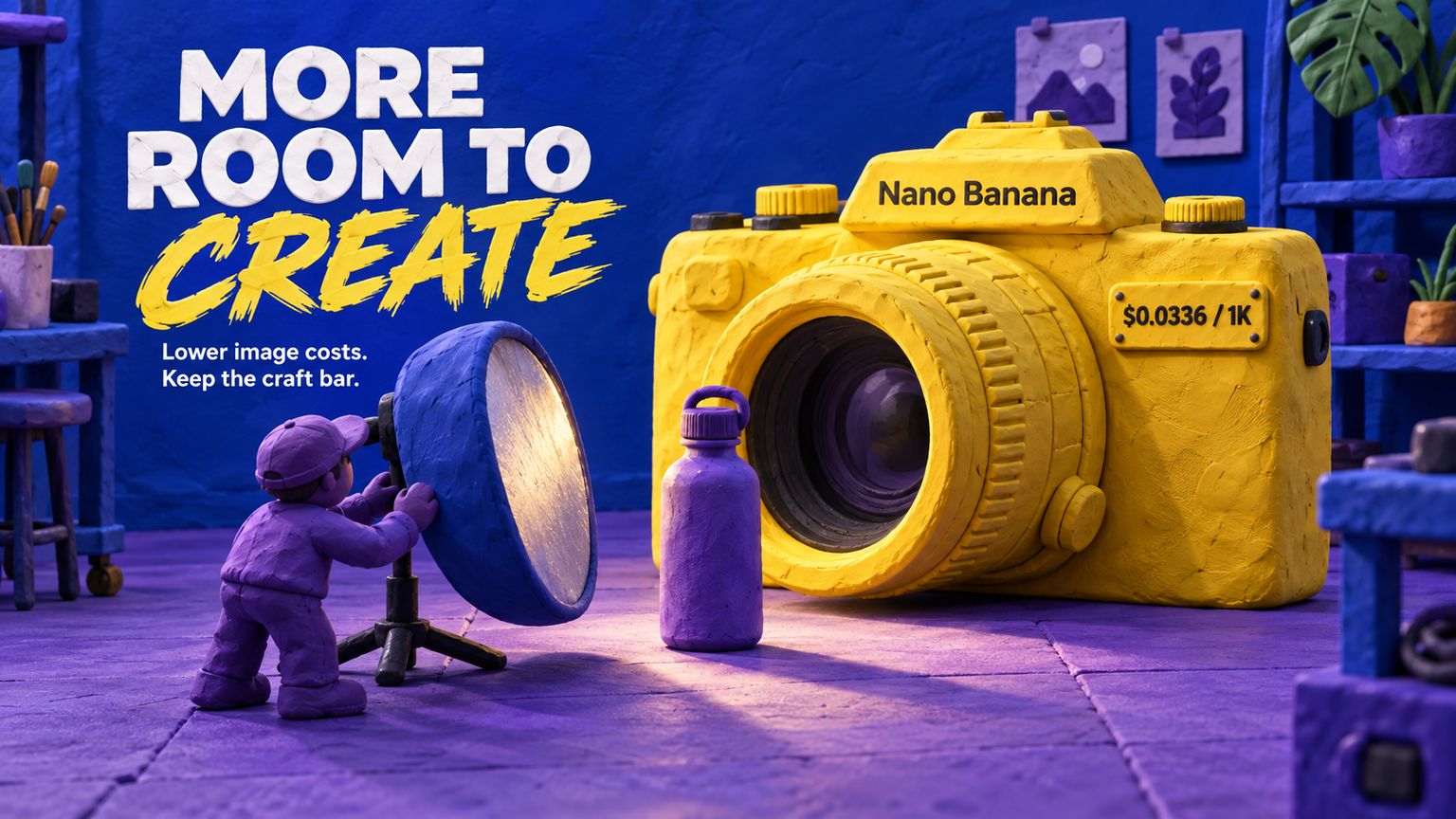
Google's Nano Banana 2.1, an image generation and editing model, cuts a 1K image to $0.0336 and a 2K image to $0.0504, about half Nano Banana 2's image-output price. It is the sensible replacement to evaluate for product, ad and social production at volume. Keep Nano Banana Pro for briefs where its extra precision earns back the premium through fewer rejected images or less finishing work.
Pricing and model status verified against Google's live documentation on 8 October 2026. The budgets below use Gemini Developer API prices in US dollars. They count generated images, including discarded candidates, and exclude input tokens, text/thinking output, optional search charges and human finishing.
What Changed in Nano Banana 2.1
Nano Banana 2.1 became generally available on 6 October 2026, meaning Google released a stable production model rather than another preview. Its exact Gemini API model ID is gemini-nano-banana-2.1. It updates Nano Banana 2, Google's previous model for fast image production, identified as gemini-3.1-flash-image. Google's Gemini API changelog.
Google names five gains: visual quality, prompt adherence, multi-turn character consistency, text rendering, and wide or panoramic generation. Prompt adherence means following the brief; multi-turn consistency means keeping the subject recognizable as you revise an image in the same conversation. The practical targets are cleaner product details, fewer ignored placement instructions, steadier campaign characters, more readable copy and better banner compositions.
The changelog specifically names 1:4, 4:1, 1:8 and 8:1 shapes across 1K, 2K and 4K. An aspect ratio is the frame's width relative to its height. Google's model page also says it fixed tiling artifacts, visible repetitions or seams, in wide and panoramic 2K and 4K images. These are Google's release claims, rather than measured improvements on a particular brand's brief. Google's Nano Banana 2.1 model documentation.
For the wider family and its naming, the Nano Banana explainer provides the background. The decision here is narrower: whether this version should replace the model already producing your campaign assets.
Nano Banana 2.1 Pricing: What an Image Costs
Nano Banana 2.1 makes the largest budget difference at 1K and 2K. 4K becomes about 25% cheaper, so a blanket promise of half-price images overstates the saving for teams producing large final files.
These are Google's Standard image-output equivalents, read on 8 October 2026. Nano Banana Pro, Google's model for demanding professional image work, uses gemini-3-pro-image. All three models' prices come from the Gemini API pricing page, rather than reseller credits or aggregator estimates.
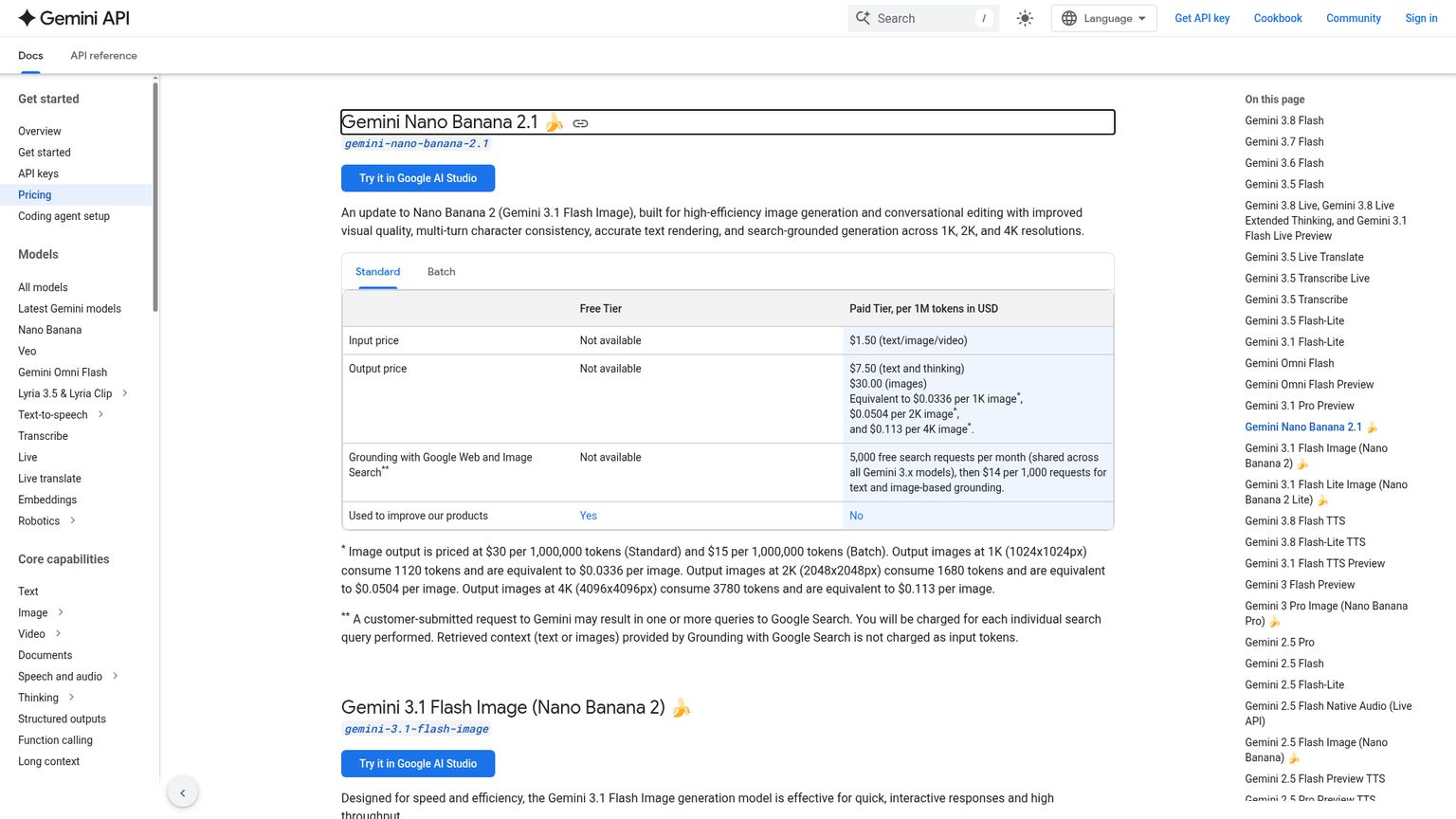
For square images, 1K means 1024 × 1024 pixels, 2K means 2048 × 2048, and 4K means 4096 × 4096. Different aspect ratios change the shape. Choose the smallest output that survives the intended placement; buying 4K for every discarded concept spends money before the composition has earned it.
Nano Banana 2.1 Batch costs $0.0168 at 1K, $0.0252 at 2K and $0.0567 at 4K. Batch submits work to a queue and retrieves the results later, rather than returning each image interactively. Google describes a target turnaround of 24 hours, often faster. That fits scheduled catalog variations and next week's ad candidates; it is a poor fit for a designer waiting for the next revision during a client call. Google's Batch API documentation.
The image price is only one component of the bill. Nano Banana 2.1 Standard charges $1.50 per million input tokens and $7.50 per million text/thinking output tokens, compared with Nano Banana 2's $0.50 and $3. Tokens are the units the API uses to meter content and model output. Reference-heavy conversations and repeated revisions therefore deserve a full invoice comparison. Optional search grounding, which supplies information from Google Search, can add search charges. Google's pricing details.
Monthly Cost for 100, 1,000 and 10,000 Images
At 10,000 generated images a month, replacing Nano Banana 2 Standard with 2.1 Standard saves $334 at 1K or $506 at 2K in image output. That is enough to justify a migration check for a busy creative operation, while a small studio should weigh the smaller saving against the effort of changing a working setup.
The table multiplies Google's published price by the number of generated images. Each row assumes every image uses the stated resolution; it does not assume that every candidate gets approved.
Calculated here from Google's pricing page. Standard and Batch are shown separately because the ability to wait is part of the purchasing decision. Pro also offers Batch at $0.067 per 1K/2K image and $0.12 at 4K; compare Batch with Batch when both models can meet the delivery schedule.
When Nano Banana Pro Still Earns Its Premium
Nano Banana Pro earns its place when a difficult brief costs less to finish on Pro, even after paying more for the generation. Google's Pro documentation positions it for complex graphic design, detailed product mockups and factual visualizations with accurate text. That is a reason to evaluate it on those jobs, not a guarantee that it beats 2.1 on every image. Google's Nano Banana Pro documentation.
The useful measure is cost per approved image: total generation and finishing cost divided by the number of usable deliverables. A cheaper candidate that needs repeated attempts or manual repair can lose its advantage.
At Standard rates, four 1K attempts on 2.1 cost $0.1344, essentially the same as one Pro image listed at $0.134. Google rounds Pro's displayed per-image equivalent. At 2K, three 2.1 attempts cost $0.1512, above the same $0.134 Pro image. These are calculated crossover examples. They do not claim that Pro succeeds in one attempt or that 2.1 needs three or four.
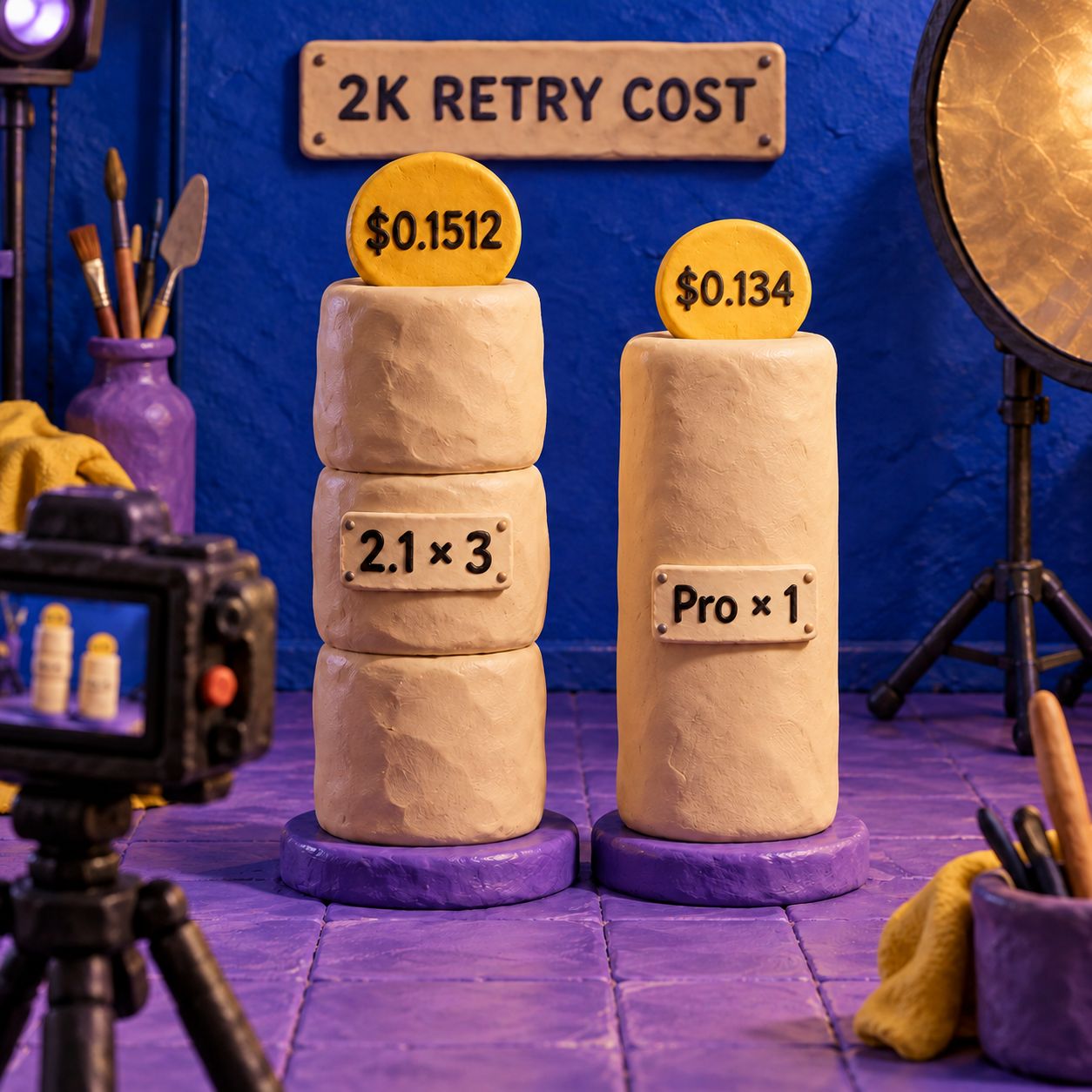
That suggests a practical escalation rule: when repeated attempts preserve the same defect, try Pro or change the production method. Another cheap render is useful only if the change has a reason to fix the problem. For precise product geometry, an approved photograph with a generated setting may be a better route than asking either model to reconstruct the product perfectly.
Selective routing is inexpensive. A hypothetical month of 900 2.1 images and 100 Pro images at 2K costs $58.76 in Standard image output. All 1,000 on 2.1 would cost $50.40; all on Pro would cost $134. You can retain a Pro route for demanding work without paying its rate for every routine variation.
The Nano Banana 2 vs Nano Banana Pro comparison covers the broader tier decision. The Nano Banana Pro pricing guide covers its access options. Use the dated Google rates above for this version's budget.
Where Nano Banana 2.1 Runs
Nano Banana 2.1 has confirmed developer access and confirmed Gemini app access, but those are different products with different billing arrangements.
Gemini API: select the stable ID gemini-nano-banana-2.1 for programmatic generation and editing. Google's pricing page lists Standard and Batch, with no free API tier for this model. This is the route the monthly cost table describes. Google's model page.
Google AI Studio: Google's browser workspace links directly to the new model. It is the convenient place to inspect a prompt and references before deciding how to automate the work. Its availability does not mean API generation is free. Open the model in Google AI Studio.
Google Cloud: Google's Vertex AI documentation URL redirects to a model page currently labeled Gemini Enterprise Agent Platform. That page lists gemini-nano-banana-2.1 as GA, with Standard PayGo, Batch inference, Agent Studio and Model Garden access. Its deployment and pricing documentation is the relevant source for a Cloud workload; the Developer API table above should not substitute for a Cloud quote. Google's Cloud model documentation.
Gemini app: Google's image-generation page explicitly names 2.1 for Google AI Plus, Pro and Ultra users. It directs users to Create images in the tools menu and says they can regenerate with Nano Banana Pro through the three-dot menu's Redo with Pro option. App subscriptions and limits are separate from per-image API billing. Google's Gemini image-generation page.
What the Update Means for Marketers, Designers and Developers
The update changes the default model worth evaluating; your deliverable still determines whether a result is usable.
Marketers and Creative Operators
A marketer preparing paid-social variations can use 2.1 to explore more compositions within the same image-output budget. Keep the approved product reference and copy fixed while varying background, framing or format. Otherwise the batch becomes a collection of different briefs, making both quality review and campaign comparison harder.
Track approved assets rather than downloads. If a hypothetical 2K workflow approves 80% of candidates, producing 1,000 approved images takes an expected 1,250 attempts and $63 of 2.1 Standard image output, rather than $50.40. That assumed acceptance rate is an example, not measured model performance.
Designers and Art Directors
A designer gains a cheaper model for revising compositions, plus Google's claimed improvements to text and continuity. The craft bar remains exact copy, convincing product details and a composition that survives the final crop.
Treat the documented PNG or JPEG export as a raster image, a fixed grid of pixels. It does not provide editable type or layout layers. Keep required typography in your design file when exact spacing, later copy changes or multiple sizes matter. A generated logo direction still needs an editable production asset before it becomes a brand deliverable.
Developers Building Image Workflows
A developer should replace a hard-coded model ID only after checking output handling and settings. Nano Banana 2.1 supports 1K, 2K and 4K, but drops Nano Banana 2's 512px option. A thumbnail workflow requesting that smaller size needs a revised generation setting or a downstream resize. Google's image-generation guide.
Also make the thinking setting explicit when comparing runs. Thinking is the model's deliberation before its answer. Google's guide lists 2.1's minimal, medium and high settings, with medium as the default; old Nano Banana 2 defaults to minimal. A changed default can affect the workload you are comparing even when the prompt is identical.
Buyers Approving the Switch
A buyer should approve a route based on the final deliverable's cost and acceptance criteria. Request a comparison using existing briefs, the same references and the same delivery resolution, with finishing time included. For routine assets, 2.1 is the strong starting candidate. For an unchanged, already approved campaign due immediately, switching models creates review work that a small price saving may not cover.
A Repeatable Recipe for Product, Ad and Social Images
Keep the brief constant and change one variable per revision. That makes an improvement attributable to the edit and makes a regression easier to catch.
Google's own multi-turn example starts with an English photosynthesis infographic, then revises the same graphic into Spanish while preserving its other elements. The first version's language is the mismatch for the next audience; the follow-up addresses that specific mismatch through the existing conversation. This is an attributed vendor example of a bounded edit, rather than a comparison test of 2.1 and Pro.
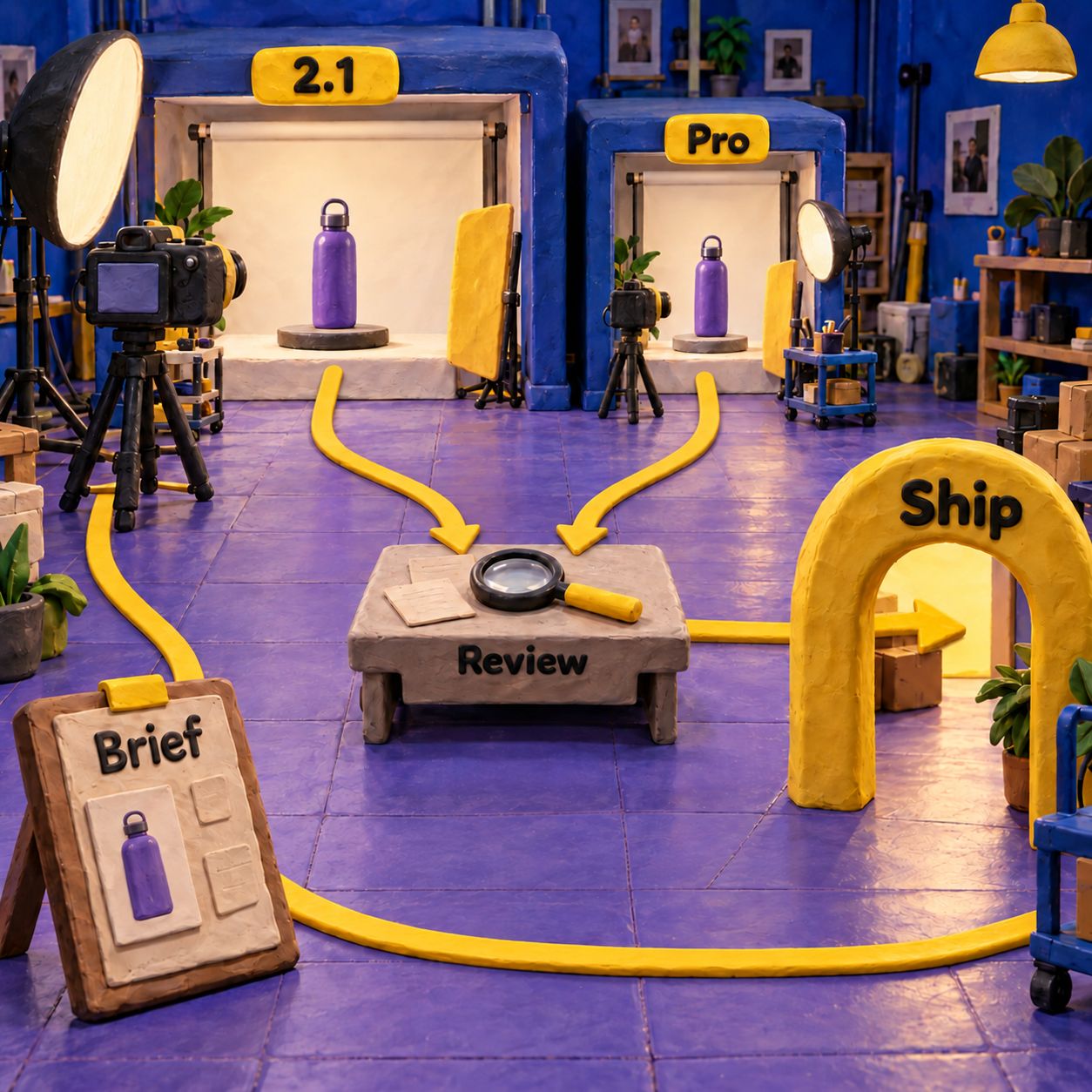
For a product campaign, apply the same discipline to a refillable-bottle brief:
Lock the model, reference and destination
Select
gemini-nano-banana-2.1. Attach the approved product reference and state which details must remain unchanged. Start with a 1:1 image at 1K for the square concept, usingmediumthinking as a declared baseline. In an API workflow, record the model,aspect_ratio,image_sizeand thinking setting alongside the prompt; Google's guide requires an uppercase K in image sizes.Write a brief with visible acceptance criteria
Use this structure: purpose, subject, reference constraints, composition, lighting, exact copy and output shape. For example: “Create a square ad concept for the refillable bottle in the attached reference. Preserve the cap shape, bottle proportions and label. Place the bottle on the right with clear space on the left for a headline. Use soft daylight and a clean background.” Add approved text only when it needs to be part of the image.
Correct the specific failure
If the first pass changes the cap, request that correction while keeping the composition and lighting. If it changes the copy, supply the approved wording and ask for a text-only revision. Google recommends preparing the text before requesting an image that contains it. Repeatedly changing the whole brief makes consistency harder to assess.
Adapt the approved direction to the placement
Request a 4:1 banner at 2K from the approved direction, with the subject and copy positions specified again. For localization, supply the approved translated wording and keep the subject and scene constant. Review the new version independently; a clean square concept does not prove that a wide or translated version is ready.
Export, inspect and escalate
Save the returned image file, preserve the prompt and references, and inspect text and product details at 100%. Put editable copy in the final design document where needed. Ship a picture only after it meets the brief; retain unapproved frames as concepts. If the same defect survives targeted revisions, compare Pro on that brief or finish with an approved product photograph.
What's Overhyped About Nano Banana 2.1
The price cut is a strong reason to evaluate 2.1, but it does not settle every creative decision.
“Half price” needs a resolution and a billing mode. The reduction is about half for 1K and 2K image output, about a quarter for 4K, and separate from the increased input and text/thinking rates. A Standard-versus-Batch comparison also changes how long you can wait.
Better text is a capability improvement, not copy approval. Brand names, offers and product descriptions still need inspection. The verdict here rests on Google's specifications and prices plus the calculations above; acceptance on your own briefs determines what ships.
The bigger version number does not retire Pro. Google continues to position Pro for demanding work. Its documented reference guidance also allows up to five character images, compared with up to four for 2.1. A campaign built around five recurring people deserves a separate evaluation rather than an assumption that the cheaper model preserves the old workflow. Google's reference-image guidance.
Deprecated does not mean an announced shutdown deadline. As checked on 8 October, Google's changelog and deprecations table both give no shutdown date announced for gemini-3.1-flash-image. Plan the migration, but do not schedule it around a third-party date. Google's deprecations page.
What to Do Differently Next Week
Move routine production toward 2.1 after it clears your existing acceptance checks, and retain a selective Pro route.
For a marketer or designer, take twenty existing briefs covering a product shot, text-bearing ad, recurring character, localized asset and wide banner. Run the same references and requested resolution through the candidate route. Record accepted outputs, attempts, API charges and finishing time. Change the default when the approved result costs less overall and meets the same craft bar.
For a developer, update the model configuration, replace any 512px request and record the thinking level explicitly. Use Batch for work that can arrive later, while keeping interactive revisions on Standard. For a buyer, review the accepted-image cost rather than purchasing a model-wide quality claim.
Wait on changing an imminent approved campaign or a workload whose required reference pattern has not been checked. An app-only user gets a separate decision: verify the named model and plan access in Gemini instead of applying API savings to a subscription bill.
For current creative-tool costs and practical workflow decisions, subscribe to the newsletter.
- Published
- Category
- Design
- Language
ElevenLabs Alternatives: Murf, MAI-Voice-2, OpenAI TTS and Cartesia (Verified October 2026)
Compare ElevenLabs, Murf, MAI-Voice-2, OpenAI, Cartesia, Google and Speechify by studio or API job, with verified prices and switching costs.Oct 4, 2026Design
Higgsfield API Pricing
Price Higgsfield API video and image jobs, separate API dollars from app credits, and check top-ups, expiry and cashback before scaling.Sep 27, 2026Design
Is Gemini Live Avatar Free
Check Gemini Live Avatar access, Enterprise API charges and custom-avatar limits before budgeting a customer-facing video agent.Sep 27, 2026Design
Gemini 3.8 Flash TTS Pricing
Price Gemini 3.8 Flash TTS by audio minute, compare Flash-Lite and service tiers, and budget the January 2027 increase.Sep 24, 2026Design
ngram vs Demosmith
Compare ngram and Demosmith for product videos, browser capture, revisions and usable exports, with costs matched to the same job.Sep 19, 2026Design
ArtPatt Pricing
ArtPatt pricing explained: Free limits, Pro exports, saved patterns, AI-image allowances, and when a paid plan earns its place.Sep 15, 2026Design
Cutsio Video Indexing Cost
Decode Cutsio's indexed minutes, stored hours, seats, and overages to choose a plan for a growing video library.Sep 13, 2026Design