ngram vs Demosmith
Compare ngram and Demosmith for product videos, browser capture, revisions and usable exports, with costs matched to the same job.
Published
 By Omid Saffari
ngram vs Demosmith is a source-of-truth decision: choose ngram when approved documents, screenshots, and recordings should become a controlled story; choose Demosmith when a live web app should be captured by an agent. For one qualifying month, Demosmith starts $19 lower at $40 versus ngram Premium at $59, but that price lead flips when an 11th demo forces Demosmith onto its $99 Pro plan.
ngram vs Demosmith: Which Should You Pick?
Pick ngram for a story assembled from supplied material. Pick Demosmith for a recurring demo of a live web product. Demosmith is the stronger default for the narrow job both names imply, a current product walkthrough, because its agent performs the browser flow before editing it. ngram is the better creative workspace when the approved message, not the live click path, must control the result.
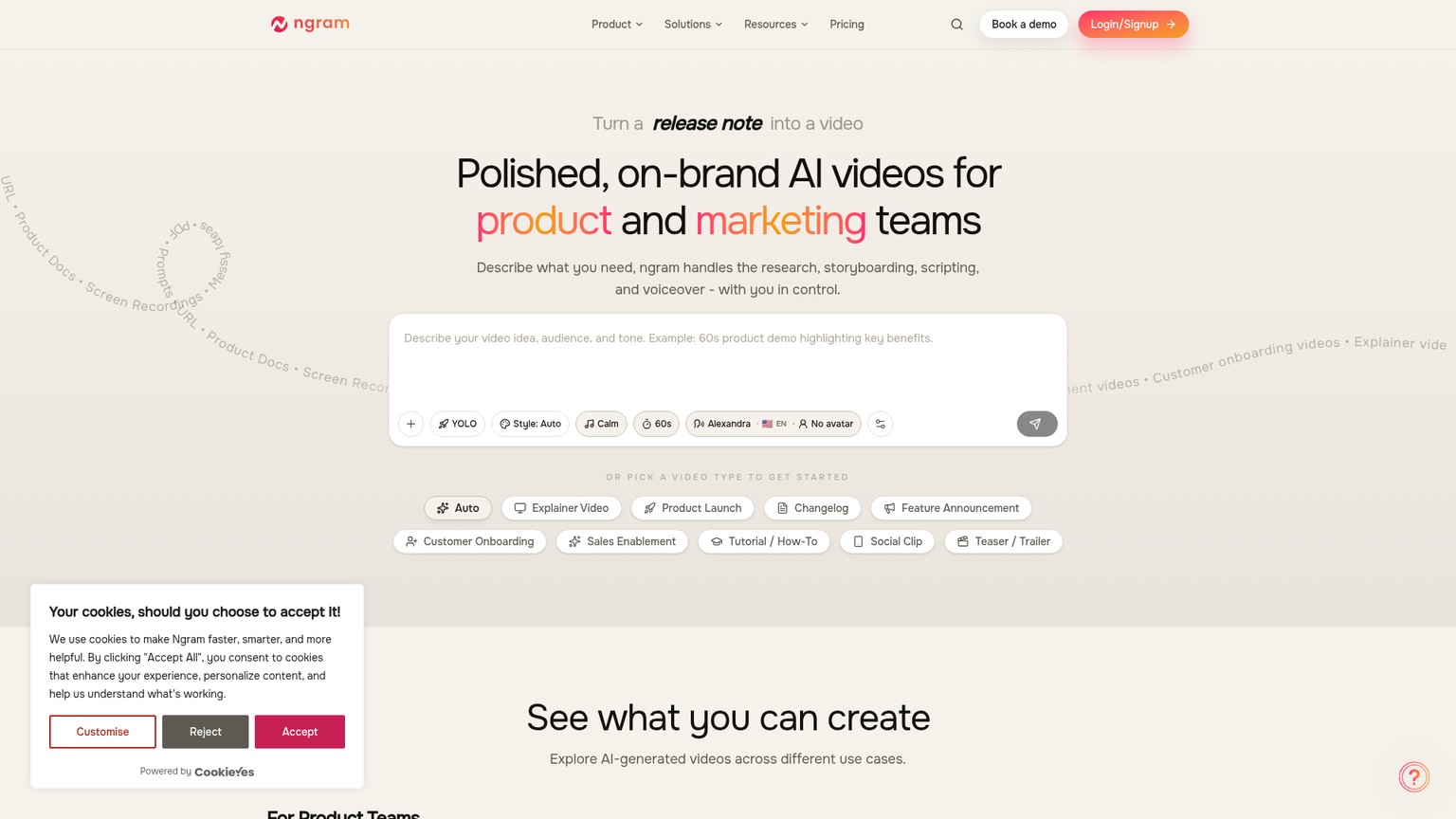
ngram is a source-led AI video workspace. It can take text, images, PDFs, URLs, product documents, and screen recordings, then turn them into a script, storyboard, voiceover, captions, music, and branded video. Its advantage is not autonomous browser navigation. It is the editorial checkpoint before expensive visual work begins.
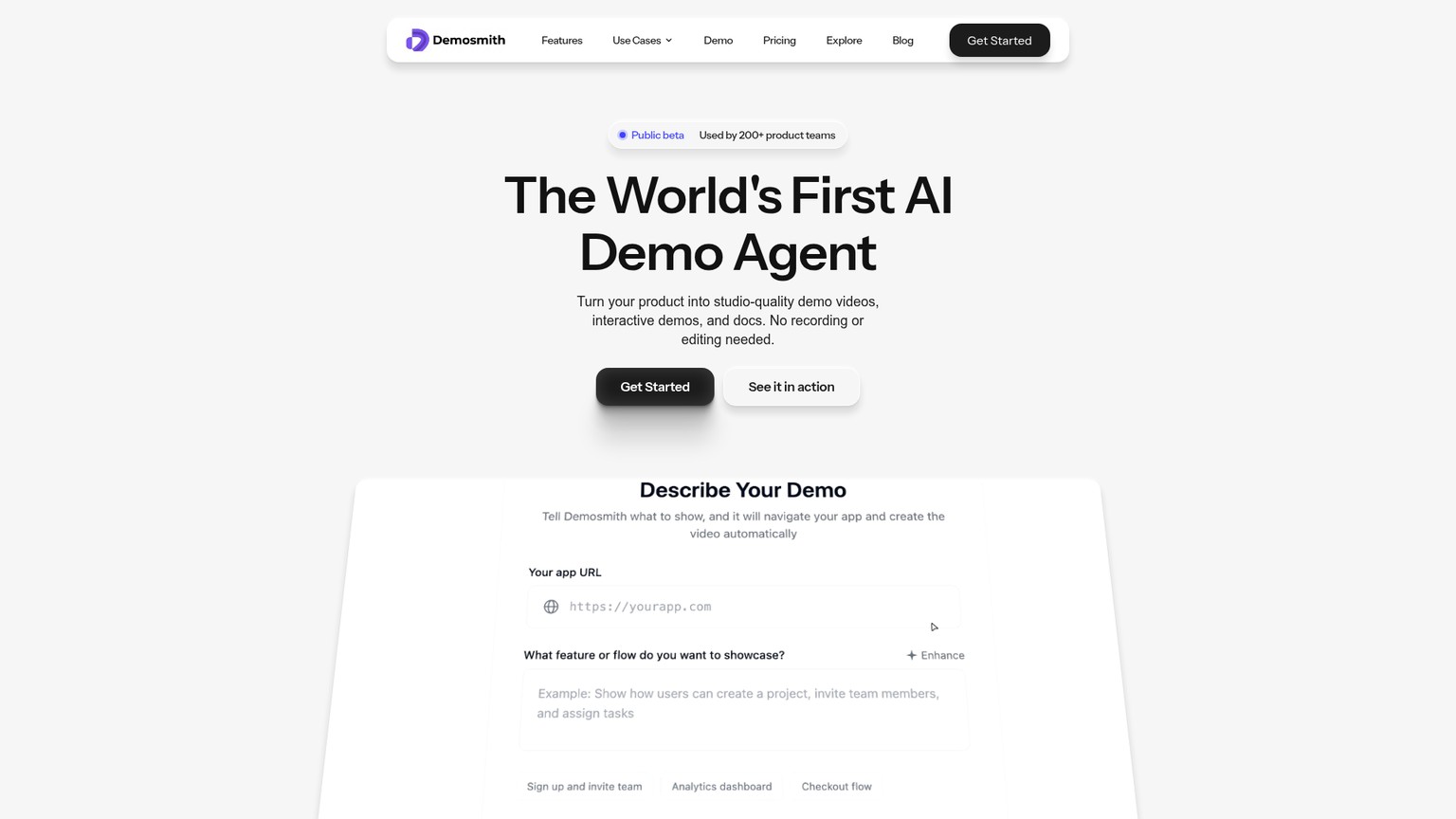
Demosmith is a web-product demo agent. It opens an accessible product in a cloud browser, follows a prompted flow, records the interface, and produces a narrated, captioned output. Its advantage is that the current product supplies the visible truth instead of an editor rebuilding that truth from screenshots.
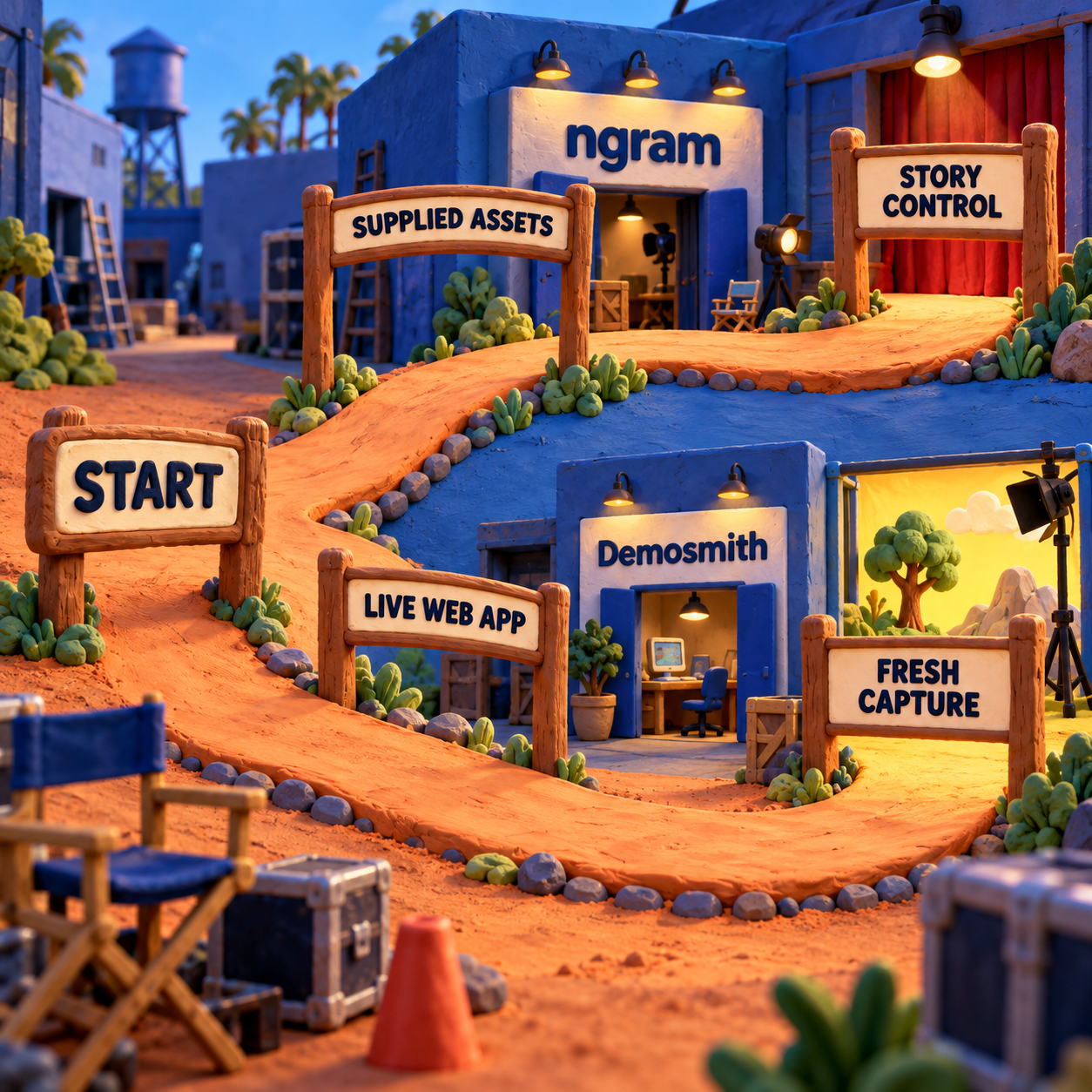
The decision rule is simple: if a product marketer can hand over the approved source package without granting app access, ngram creates the shorter path. If the workflow itself changes every sprint and a safe web account exists, Demosmith creates the shorter path.
Price the Same 60-Second Product Demo
Demosmith costs less for up to 10 qualifying demos, while ngram becomes cheaper at demo 11 under the published plan ceilings. Prices and limits in this comparison were verified against both vendors' live pages on September 19, 2026.
The normalized job is one 60-second, branded, English-language product demo at 1080p and 16:9, with voiceover, captions, a downloadable MP4, and one minor interface-label revision. That is a comparison control, not a claim that every product video should last 60 seconds. It makes the output constant while the production route changes.
ngram Premium costs $59 per month and includes 10,000 credits, 1080p, one BrandKit, one custom voice, and unlimited manual edits and exports. Premium AI-generated footage starts at 10 credits per second, so an entirely generated 60-second job uses 600 credits at the base rate. Ten such jobs use 6,000 credits, 11 use 6,600, and 16 use 9,600. At full use, 16 whole jobs allocate the $59 subscription to $3.69 per output.
That $3.69 is not a promise. ngram explicitly says generated seconds are not finished-video length, and a source-heavy product demo may mix supplied footage, agentic editing at 1 credit per second, and generated scenes. The in-product estimate is the number to buy against.
Demosmith Starter costs $40 per month and includes 20 AI minutes, 10 demos, two versions per video, 1080p, custom branding, and 29-language support. Its two ceilings meet at 2 AI minutes per demo: 20 minutes divided by 10 demos. At that assumed consumption, the plan yields 10 demos at $4 each. At 5 AI minutes per completed job, it yields four at $10 each. Demosmith does not publish a conversion from AI minutes to finished video length, so both are workload models, not measured bills.
For one through 10 qualifying jobs, monthly plan spend is therefore $40 on Demosmith Starter and $59 on ngram Premium. At job 11, Demosmith's demo cap requires the $99 Pro plan, while the all-generated ngram model has used 6,600 of 10,000 Premium credits. The tier crossover makes ngram $40 cheaper at that point. Demosmith can force the upgrade earlier if AI minutes bind; ngram can require top-ups earlier if the credit estimate exceeds this base-rate model.
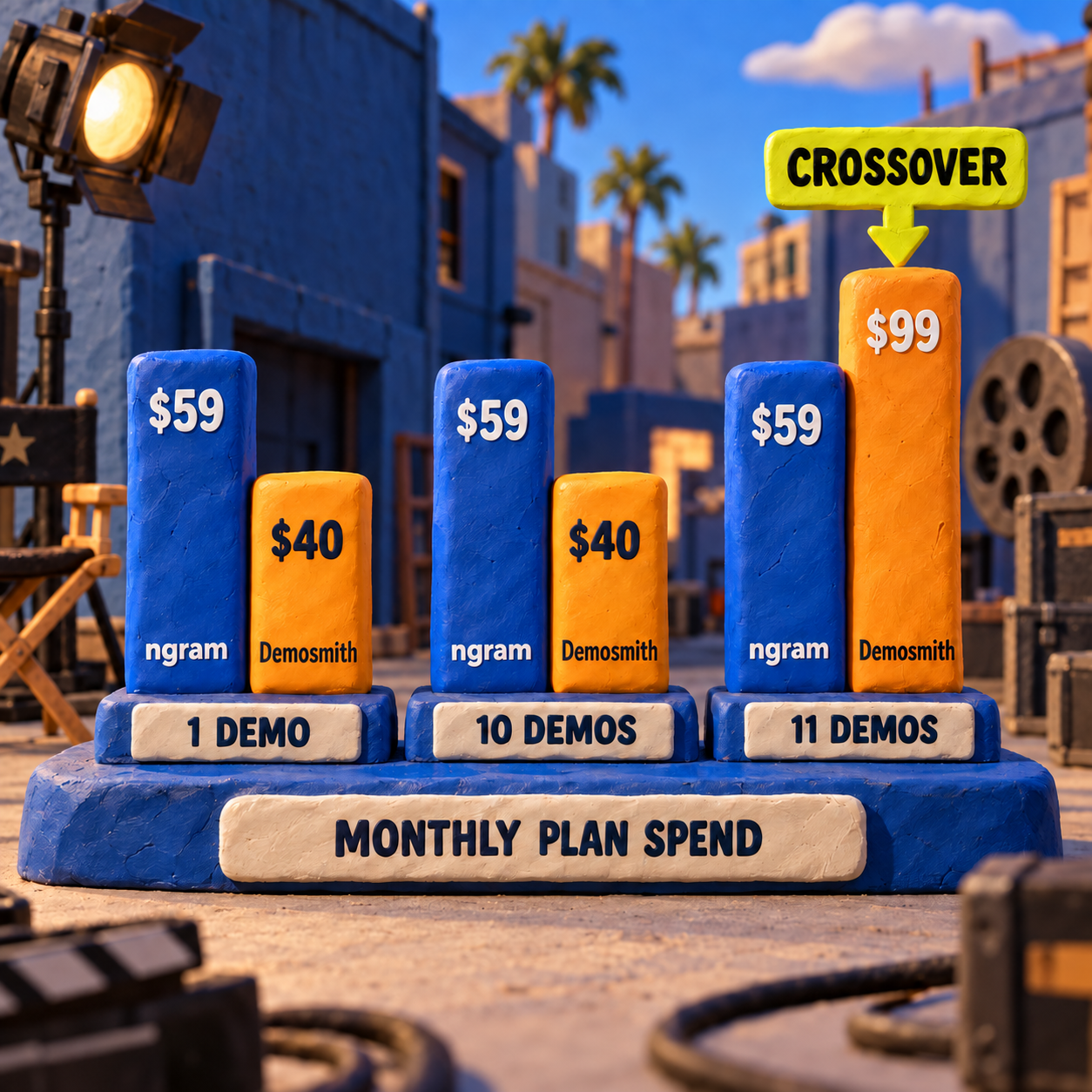
The full Demosmith pricing analysis covers its other tiers, version ceilings, and AI-minute uncertainty. Repeating that tier guide here would hide the only price question that matters in this comparison: what happens to the same job when volume and revision work change.
Winner on entry cost: Demosmith. Winner at the published 11-demo tier boundary: ngram.
Starting Material and Capture
ngram wins when the source package is the authority; Demosmith wins when the live browser flow is the authority. That distinction decides more revision work than the feature count.
Winner for a Supplied Brief: ngram
ngram lets a product marketer combine a feature brief, current screenshots, a public URL, a screen recording, approved claims, and brand assets. PRO mode pauses after planning so the opening, scene order, narration, claims, source use, pacing, and CTA can be corrected before visual generation. A storyboard is a scene-by-scene plan, and here it acts as a procurement checkpoint: the owner can reject the story before credits turn it into footage.
Consider a launch video whose opening must describe the customer's problem before the interface appears. A literal screen capture begins with navigation because that is what the operator did. ngram can put the approved business problem first, compress the workflow into one proof scene, and finish on a CTA without pretending the click path is the story.
This is the same source-material distinction behind the adjacent ngram versus Guidde comparison. ngram earns its keep when narrative hierarchy matters more than preserving every performed step.
Winner for a Live Browser Flow: Demosmith
Demosmith starts with the deployed web product, a prompt, and access. Its agent clicks, types, scrolls, and records in a cloud browser, so the captured interface comes from the current application rather than a folder of approved images. A customer-success lead can point it at a safe staging account and ask for the current onboarding flow without manually rehearsing and recording every action.
The limit is material: Demosmith supports web-based products, not native mobile apps or desktop-only apps in the current version. A product behind login also needs a staging URL and test credentials. If security policy will not allow that access, the flagship autonomous workflow is unavailable, while ngram can still work from a sanitized recording and approved assets.
Winner on source breadth: ngram. Winner on autonomous web capture: Demosmith. For the representative browser demo, capture wins because it removes the manual transfer between a changing interface and the video source.
The Same UI Change Reveals the Revision Work
Demosmith leaves less revision work when the live flow changes; ngram leaves less when the message changes but the accepted visuals can stay. A small interface update makes that boundary visible.
The representative demo shows a user opening a reporting dashboard, choosing a report template, and selecting Create report. The release then renames that control New report and moves it within the same screen. The business outcome and the 60-second delivery requirement do not change.
Before the Change
In the ngram route, the owner supplies the release note, approved narration, screenshots or a clean recording, and the brand kit. PRO mode exposes the script and storyboard before generation. The craft check asks whether the approved phrase appears in narration, whether the visible control matches it, and whether the scene arrives early enough to keep the story moving.
In the Demosmith route, the owner supplies the safe product URL, account access, and a prompt naming the reporting flow. The agent performs the current path, then the editor can adjust narration, captions, voiceover, zoom points, blur effects, images, and background sound. The craft check asks whether the correct control received focus, whether captions and narration match the visible state, and whether realistic test data reveals anything private.
After the Change
ngram supports a narrow narration correction. In a finished video, Apply changes can re-voice an affected scene while keeping its visuals. If the new line changes timing too much, Regenerate scene is the documented fallback. The visible control still has to be replaced through the applicable scene, frame, editor, or updated recording. That is efficient when the sentence changes and the visual does not. It is less automatic when the live interface itself moved.
Demosmith can re-run the same prompt against the current product, so the new capture follows the current placement of New report. Afterward, the owner fine-tunes the narration, captions, zoom, and sound instead of splicing a fresh interaction into an old recording. Each re-render or language spin becomes its own version, and Starter allows two versions per video. A routine correction can therefore consume version capacity even when it saves editing labor.
For this UI change, Demosmith wins because recapture is the product. If legal replaces one approved sentence while the interface stays fixed, ngram wins because it can re-voice the scene and preserve accepted visuals.
The correct revision question is not "Can I edit it?" Both products can. It is "What is the smallest unit I must rebuild when the product changes?" Choose the unit your release process changes most often.
Shipped Editing, Roadmap Claims, and the Craft Bar
Demosmith has the clearer shipped promise for autonomous capture and polish, but neither vendor's success claim replaces a revision drill. ngram's current product needs a more careful reading than a binary "editing exists" or "editing is coming."
ngram ships a Screen Recorder today. Its documentation says a tab, window, or screen can become source video, and qualifying Screencast or Screencast + Avatar recordings can expose controls for filler-word removal, pause tightening, voice isolation, narrator changes, and visible screencast enhancement. The same documentation describes requests for narration, captions, pacing, zoom, click emphasis, trimmed pauses, and transitions.
At the same time, ngram's live homepage still labels the complete Raw recordings to polished walkthroughs bundle Coming Soon, including automatic dead-air and mistake cuts, smart zoom, cursor emphasis, callouts, and step labels. The defensible interpretation is narrow: recording and assisted editing ship, while the full one-operation automatic bundle is not safe to put in a purchase order yet.
Demosmith presents autonomous navigation, dead-time cuts, UI-aware zoom, pacing, captions, narration, and an in-app fine-tuning editor as current features. Its homepage also says the system gets a first pass right 95% of the time. That percentage is a vendor claim, not a measured comparison, so it does not affect the verdict.
The available independent signal is asymmetric. G2 has an ngram review surface, but it does not provide a measured ngram-versus-Demosmith benchmark. Its review-summary language about ease of use and output that may need more editing is directional evidence only. Demosmith's own success percentage is equally unfit for a head-to-head verdict.
Use this craft bar for either route:
- The visible UI state and narration make the same claim.
- Zoom and cursor emphasis land on the intended control, not a nearby decorative element.
- Captions remain accurate and readable at the final embed size.
- Safe sample data replaces customer, employee, and credential information.
- The 1080p MP4 survives the landing page, sales deck, or help-center placement without illegible interface text.
- The ordinary correction cycle stays inside the plan's credits, AI minutes, and version allowance.
Winner for autonomous first-pass capture: Demosmith. Winner for pre-generation story approval: ngram. The output is ship-ready only after it clears the same craft bar, whichever route produced it.
Usable Exports and Coverage Limits
ngram wins reusable video variants; Demosmith wins the broader web-demo package. Pick the deliverables before the tool because an interactive walkthrough and an editable project do not travel inside a flat MP4.
ngram downloads the finished video as MP4. Its homepage says one project can produce 16:9, 9:16, and 1:1, which covers a landing-page master, a vertical social cut, and a square feed asset without rebuilding the story. Premium exports at up to 1080p, while Ultimate lists 4K.
Demosmith Starter delivers a downloadable 1080p MP4 at 16:9 plus up to five published interactive demos per month. Pro raises video export to 1440p, adds Docusmith exports in Markdown, HTML, plain text, or PDF, and raises interactive capacity. That package is valuable when one captured flow must support a website, help center, and sales follow-up.
The roadmap boundary matters: Demosmith's homepage marks the 9:16 vertical cut soon, so it should not be treated as a shipped social-video deliverable. Demosmith also has no public API in the current version. A high-volume operator cannot yet assume that demo creation plugs into a programmatic release pipeline.
Winner for multi-aspect video delivery: ngram. Winner for video plus interactive plus documentation: Demosmith Pro or above. Demosmith should be skipped for a native mobile or desktop-only capture; ngram should be skipped when a current web workflow must be recorded without a human capture pass.
Switching Costs and Who Should Not Switch
Switch only when the other product removes the kind of rework you repeatedly pay for. Moving an MP4 is easy. Moving the production logic behind it is not.
Moving From ngram to Demosmith
Brand colors, fonts, logos, final MP4 files, and the high-level story can travel. The ngram storyboard, scene logic, source hierarchy, and editable project do not become a Demosmith flow. You must create a safe web account, grant access to the relevant path, rewrite the request as an action prompt, rebuild brand defaults, and regenerate persona or language variants.
Do not switch if the videos routinely combine documents, interviews, release notes, stock or generated scenes, and carefully staged claims. Demosmith's strength is the web product doing something, not a campaign story assembled from many approved sources.
Moving From Demosmith to ngram
Final MP4 files, scripts, brand assets, screenshots, and exported docs can become references. The hosted interactive demo, step analytics, autonomous browser path, and Demosmith version history do not transfer as editable ngram structures. Someone must record the live flow or package the correct screenshots, then rebuild the story and validate that supplied material still matches production.
Do not switch if every release changes the same browser workflow and the current URL is the fastest reliable specification. In that situation, ngram may add editorial control by adding a manual source-maintenance job.
The lock-in is workflow-shaped, not file-shaped. Preserve final MP4 masters and source assets outside either platform, document the prompt and acceptance criteria, and keep a safe demo account that is not tied to one vendor.
Run One Revision Drill Before You Buy
Use one ordinary product change to measure revision work before committing to either annual plan. A polished reveal is less useful than a repeatable correction cycle.
Lock one acceptance brief
Require one 60-second, 1080p, 16:9 MP4 with branded narration, captions, safe sample data, and a clear final action. Write the exact claim and visible control that must match.
Prepare both source routes
For ngram, assemble the current release note, approved script, screenshots, and clean recording. For Demosmith, prepare a staging URL, test credentials, and a prompt that names the same path and exclusions.
Grade the first acceptable export
Count manual interventions, incorrect clicks, narration corrections, zoom corrections, privacy fixes, and plan usage. Do not score the vendor's sample or its stated success rate.
Introduce one real change
Rename or move one control without changing the outcome. In ngram, update the smallest source, scene, or script unit available. In Demosmith, re-run the prompt against the current product and fine-tune the new version.
Price the correction, not the draft
Record credits, AI minutes, versions, elapsed review work, and whether the accepted MP4 preserved everything that did not change. The winner is the route with less rebuild work at the required craft bar.
The Monday move is to run this drill on the next feature update, then keep the monthly plan whose revision boundary matches the way your product changes. Delay annual billing until the same route wins both the first export and the correction.
Frequently Asked Questions
Is Demosmith better than ngram for product demo videos?
Demosmith is better when a current web app should be navigated and captured autonomously. ngram is better when documents, screenshots, recordings, and approved messaging should control a more editorial product story.
Can ngram do Demosmith's live product capture?
ngram ships a Screen Recorder and assisted screencast editing, but it does not offer Demosmith's cloud-browser agent as the core workflow. Its homepage also labels the complete automatic raw-recording polish bundle Coming Soon, so buyers should verify the exact enhancement controls in their account.
What is the price difference between ngram and Demosmith?
The matched monthly starting plans are ngram Premium at $59 and Demosmith Starter at $40, a $19 Demosmith advantage. Under the 60-second model used here, Demosmith's 10-demo cap forces its $99 Pro tier at job 11 while ngram Premium remains at $59, making ngram $40 cheaper at that boundary.
Get the AI Business Workflow Audit Checklist
Map the source, capture, revision, export, and handoff before your trial with the free AI Business Workflow Audit Checklist.
- Published
- Category
- Design
- Language
Nano Banana 2.1 Explained: Pricing, Changes, and When to Switch
Nano Banana 2.1 cuts 1K and 2K image costs about in half. Compare monthly budgets, verify the migration, and decide when Pro earns its premium.Oct 8, 2026Design
ElevenLabs Alternatives: Murf, MAI-Voice-2, OpenAI TTS and Cartesia (Verified October 2026)
Compare ElevenLabs, Murf, MAI-Voice-2, OpenAI, Cartesia, Google and Speechify by studio or API job, with verified prices and switching costs.Oct 4, 2026Design
Higgsfield API Pricing
Price Higgsfield API video and image jobs, separate API dollars from app credits, and check top-ups, expiry and cashback before scaling.Sep 27, 2026Design
Is Gemini Live Avatar Free
Check Gemini Live Avatar access, Enterprise API charges and custom-avatar limits before budgeting a customer-facing video agent.Sep 27, 2026Design
Gemini 3.8 Flash TTS Pricing
Price Gemini 3.8 Flash TTS by audio minute, compare Flash-Lite and service tiers, and budget the January 2027 increase.Sep 24, 2026Design
ArtPatt Pricing
ArtPatt pricing explained: Free limits, Pro exports, saved patterns, AI-image allowances, and when a paid plan earns its place.Sep 15, 2026Design
Cutsio Video Indexing Cost
Decode Cutsio's indexed minutes, stored hours, seats, and overages to choose a plan for a growing video library.Sep 13, 2026Design