Semrush Pricing (2026): The $199 Plan Is Not the Team Bill
Semrush starts at $139, but seats and API units can change the bill. See every 2026 tier, annual cost, limit, and buying break point.
Published Updated
 By Omid Saffari

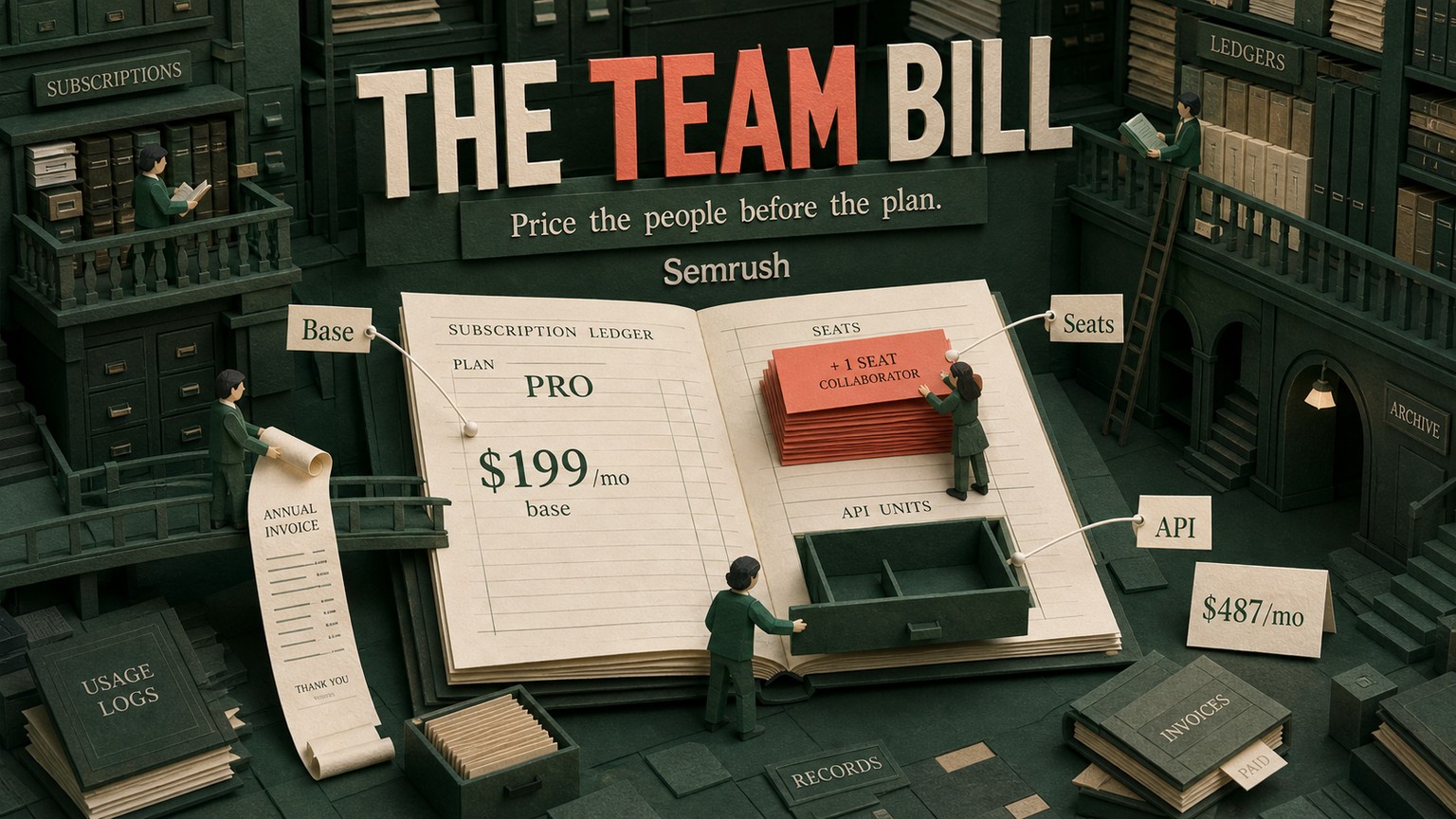
Semrush costs $139 a month for SEO or $199 for the first plan with published AI limits, while a three-person Starter team with full AI access costs $487. The plan card is only the beginning of the buying decision.
Semrush Pricing at a Glance
Semrush's live pricing page now presents a four-plan paid lineup that differs from the Pro, Guru, and Business structure still repeated in older guides. The prices and limits below were verified against Semrush's pricing page in August 2026.
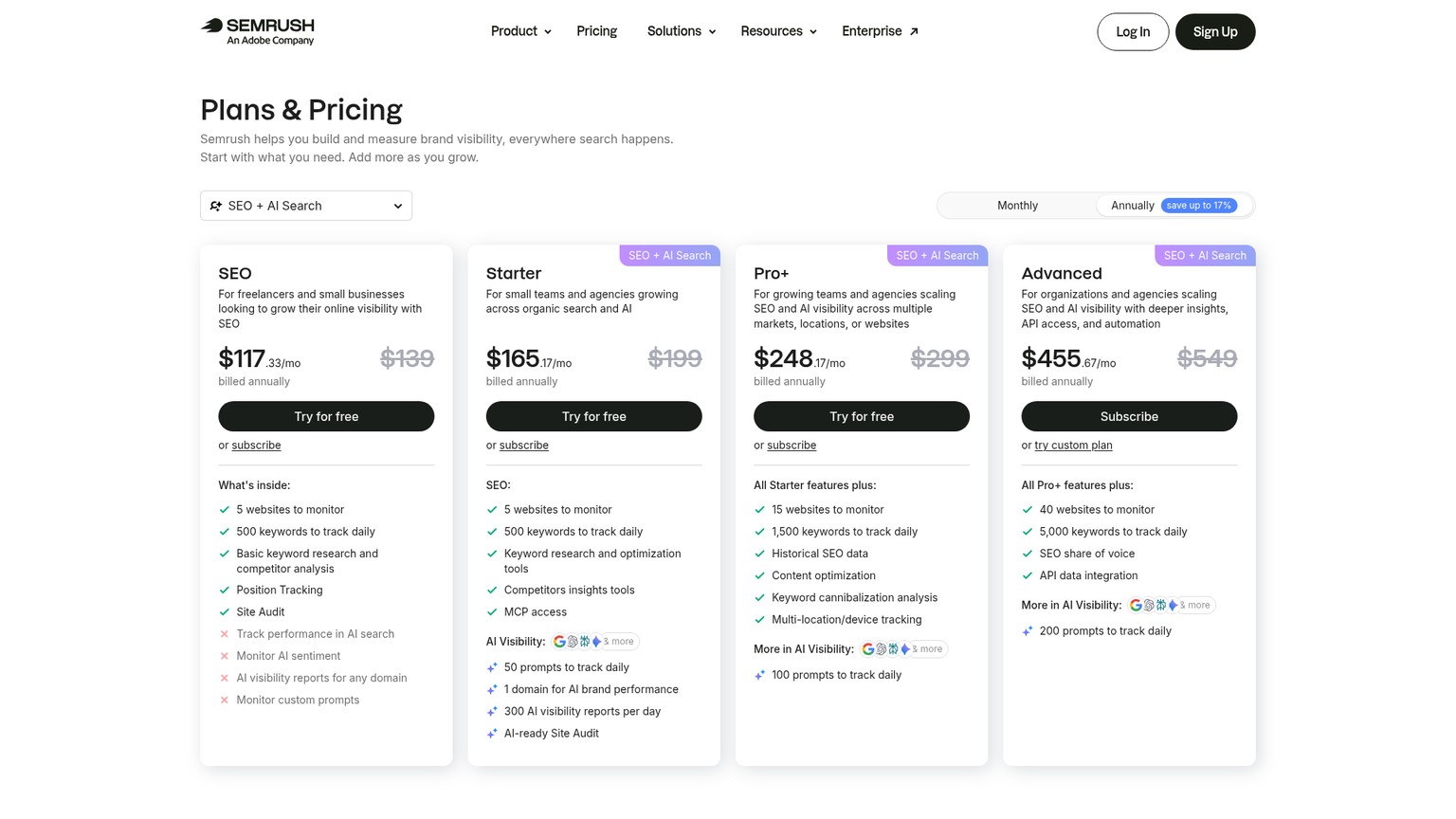
The annual column is not a monthly payment plan. It is the monthly equivalent of a full-year charge. That distinction turns a seemingly modest $117.33 entry point into a $1,407.96 invoice.
There is also a first-party naming conflict worth knowing before procurement. Semrush's SEO Toolkit limits page still lists Pro at $139.95, Guru at $249.95, and Business at $499.95. The current public sales page instead shows SEO at $139, followed by Starter, Pro+, and Advanced. This guide uses the live sales page for new-customer pricing. If an existing account shows a classic renewal plan, its checkout screen and contract control.
Which Semrush Plan Should You Buy?
The right Semrush plan is the cheapest one that clears your first hard constraint. Count active sites, daily tracked keywords, named users, and AI prompts before comparing feature lists.
Stay free when the work is occasional
Choose Free if you operate one small site, track no more than 10 priority keywords, audit no more than 100 URLs per month, and only need occasional lookups. The daily research allowances are 10 Domain Overview queries, 10 keyword queries, 10 competitor queries, and 10 backlink queries.
That is enough to check a small site's health and watch its few money terms. It is not enough for a weekly content operation, a large site, or a client portfolio. The free plan is discussed in detail below because it is a permanent account, not the same thing as a trial.
Buy SEO when you need the core workflow, not a measured AI program
SEO at $139 covers 5 sites and 500 keywords tracked daily. At the published ceiling, that is $27.80 per site-month or $0.278 per daily tracked-keyword slot.
The card also names AI-search performance, sentiment, reports, and custom-prompt monitoring, but it does not publish numeric AI limits. That makes SEO the sensible baseline for a solo operator whose buying case is keyword research, competitor research, rank tracking, and Site Audit. It is a weaker procurement choice when a manager needs a guaranteed prompt allowance written into the plan.
Buy Starter only when quantified AI tracking is worth the premium
Starter costs $199, which is $60 more than SEO. Both plans publish the same 5-site and 500-keyword ceilings. The extra spend buys MCP access plus explicit AI capacity: 50 prompts tracked daily, one AI brand-performance domain, 300 AI visibility reports per day, and an AI-ready Site Audit.
At the limit, Starter costs $39.80 per site-month, $0.398 per daily tracked-keyword slot, and $3.98 per daily tracked-prompt slot. Looking only at the premium, the extra $60 equals $1.20 per prompt slot before assigning any value to the brand domain or report allowance.
This is the clean break-even question: will the organization use the AI tracking enough to justify another $60 each month? If the answer is vague, buy SEO and keep the difference. If a named owner will review prompt visibility and sentiment every week, Starter creates a measurable operating lane.
For a deeper comparison of that specific workflow, see the Brand Radar versus Semrush AI-visibility cost breakdown.
Move to Pro+ at the sixth site, the 501st keyword, or a workflow need
Pro+ costs $299 and raises capacity to 15 sites, 1,500 daily tracked keywords, and 100 daily tracked prompts. It also adds historical SEO data, content optimization, keyword cannibalization analysis, and multi-location and device tracking.
At full published capacity, the price is $19.93 per site-month, $0.199 per keyword slot, and $2.99 per prompt slot. The $100 step up from Starter buys room for 10 more sites, 1,000 more tracked keywords, and 50 more prompts. The numeric break point is simple: a sixth site or 501st keyword no longer fits Starter.
Do not upgrade merely because Pro+ has a longer feature list. Upgrade when one of those limits binds, or when historical data and location or device segmentation are part of a recurring decision.
Move to Advanced when Pro+ capacity breaks or the API matters
Advanced costs $549 for 40 sites, 5,000 daily tracked keywords, and 200 daily tracked prompts. It adds SEO share of voice and API data integration.
At the ceiling, Advanced costs $13.73 per site-month, $0.110 per keyword slot, and $2.75 per prompt slot. The 16th site or 1,501st keyword is the clean capacity trigger. There is also a portfolio break point: two Pro+ subscriptions cost $598, while one Advanced subscription costs $549 and publishes capacity for 40 sites rather than 30. Advanced is $49 less and avoids splitting the portfolio across subscriptions.
API eligibility is a valid trigger, but the word eligibility matters. The base subscription does not include a usable unit balance. Price the API quote before treating Advanced as a finished automation budget.

The capacity ratios above are not promises about rankings, traffic, or leads. Semrush does not define a guaranteed business outcome, so cost per site-month and tracked slot are the defensible normalizers. Divide the bill by your own qualified leads only after you have your own attribution data.
Annual Billing Changes the Cash Decision
Annual Semrush pricing saves $260.04 on SEO, $405.96 on Starter, $609.96 on Pro+, and $1,119.96 on Advanced compared with twelve payments at the current monthly list prices. The trade is liquidity: the complete $1,407.96 to $5,468.04 commitment is due up front.
The SEO percentage looks lower than the advertised "up to 17%" because the live card rounds its monthly price to $139 while older documentation still shows $139.95. Use the dollar invoice, not the headline percentage, when seeking approval.
Annual billing is attractive once the workflow is stable, the owner is named, and the capacity is already being used. It is a poor first move when the team is still deciding between SEO and Starter or has not assigned anyone to the AI reports. In that case, one month at the higher rate can be cheaper than a discounted year of shelfware.
Cancellation stops the next renewal; it does not normally unwind the current committed term. Signed agreements can carry different terms, so an agency or enterprise buyer should read the order form rather than relying on the public policy.
The Hidden Costs Are Seats, Shared Limits, and API Units
Semrush includes one login by default. Added base users cost $45 on SEO or Starter, $80 on Pro+, and $100 on Advanced. Giving an added user AI Visibility access costs another $99, which makes each full AI user $144 on Starter, $179 on Pro+, or $199 on Advanced.
This is how a $199 Starter plan becomes the $487 team bill in the title. One base user is included, then two added full-AI users cost $144 each: $199 + $144 + $144 = $487 per month. The same three-user setup costs $657 on Pro+ and $947 on Advanced.
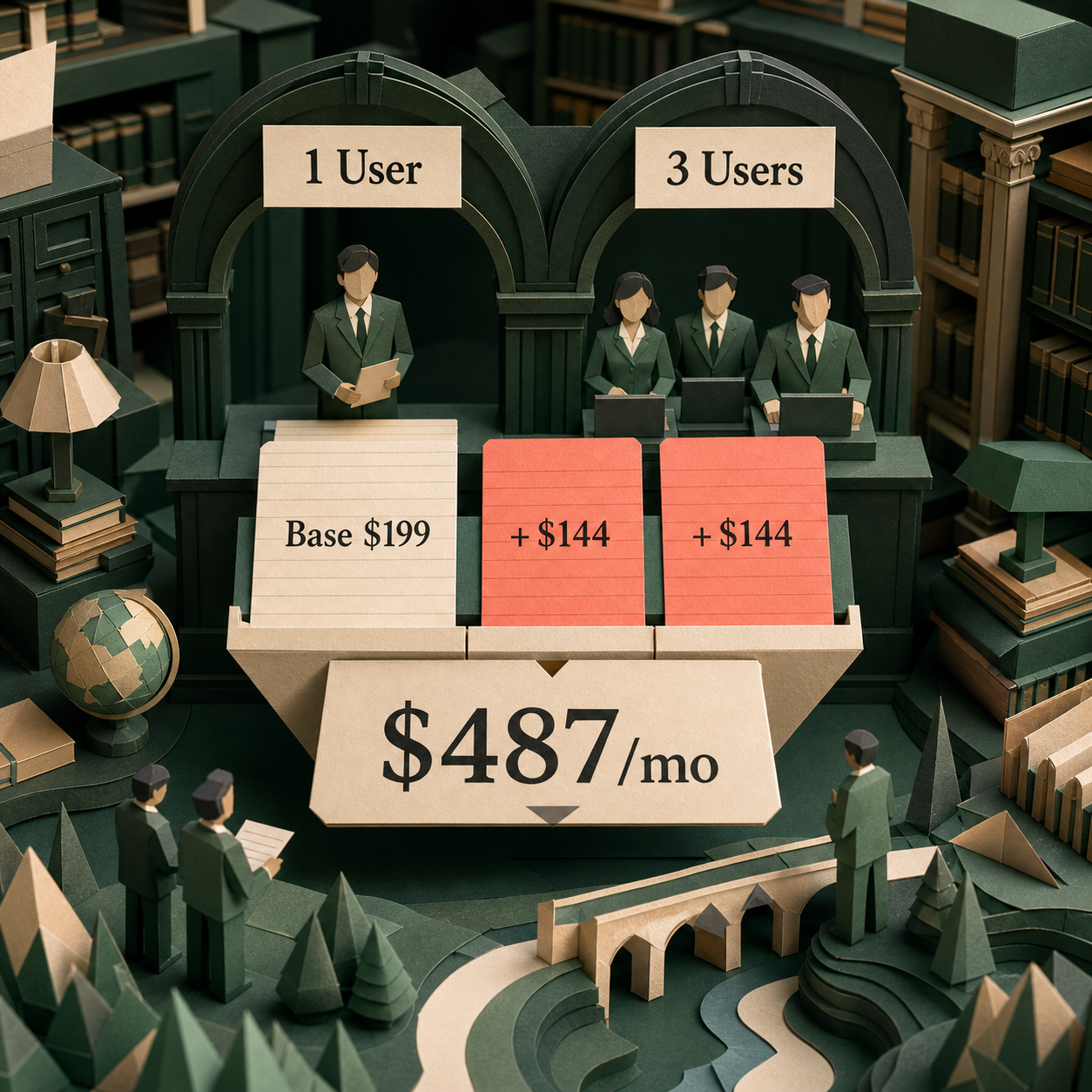
The more important limitation is that added users share the subscription's capacity. Three people on Starter still share 5 sites, 500 tracked keywords, and the plan's reports and crawl limits. Seats solve access and accountability. They do not triple the data allowance.
There is a lower-cost collaboration path. Semrush says view-only folder sharing is free, so a client or executive who only needs finished reports may not require a paid seat. Decide who must operate the tools, who needs AI Visibility, and who can remain a viewer before adding licenses.
The public pricing page also lists Lead Generation at $90 per month, Base Report at $10 per month, and Pro Report at $20 per month. These are separate budget lines, not capacity included by moving from Starter to Pro+.
The API split is the sharpest hidden cost. Semrush's API access documentation says Advanced or the still-documented Business plan makes an account eligible, but upgrading leaves the API balance at zero. Units require a separate custom-priced package. A live domain-keyword row consumes 10 units and a historical row consumes 50. The documentation's 1,000-keyword by 100-domain example requires 1,000,000 live units or 5,000,000 historical units.
There is no public API unit price or general overage tariff on the pricing page. The safe procurement assumption is a quote, not free usage. Ask Semrush to put the unit package, refresh pattern, and renewal terms on the same order form as Advanced.
The public plan page also does not present a prepaid app-credit wallet or a credit-expiry term. Do not import the expiry rules of image or copy tools into this budget. Semrush's documented split is subscription limits plus separately purchased API units.
The full Semrush review covers the broader product decision. The pricing-specific call is narrower: a paid plan is incomplete until every operator, add-on, shared limit, and API unit package is on the budget.
Who Can Stay on Semrush Free?
Semrush Free is enough for a solo owner, consultant, or creator with one small site who checks research occasionally, audits at most 100 URLs per month, and tracks 10 high-value keywords. That person may never need to pay if those limits remain comfortable and no client reporting or daily research cadence develops.
The free account requires no credit card. It includes 10 daily queries in each of Domain Overview, keyword research, competitor research, and backlink research, plus one campaign and basic AI visibility metrics in Domain Overview. Those are useful inspection limits, not an operating system for an agency.
Free and trial are different. Free is an ongoing restricted account. The 7-day trial opens a paid plan temporarily, requires a payment method, and converts to a paid subscription unless canceled.
Students do not have a public individual discount on the live pricing page. The Semrush Academy FAQ says participating accredited colleges and universities can give educators and students free access through Semrush for Education. Academy courses are also free, but free training does not include a commercial subscription unless the institution participates.
Semrush vs Current Alternatives on Price
Price comparisons only help when the unit is named. The figures below compare current public entry plans and capacity, not data quality, research depth, or a guaranteed marketing result.
Ahrefs: lower entry price, slower listed tracking cadence
Ahrefs Lite costs $129 per month for 5 projects, 750 tracked keywords, 5 AI prompts, 100,000 crawl credits, and one user. At the ceiling, that is $0.172 per tracked-keyword slot, but Ahrefs lists weekly rank updates, while Semrush's published keyword tracking is daily.
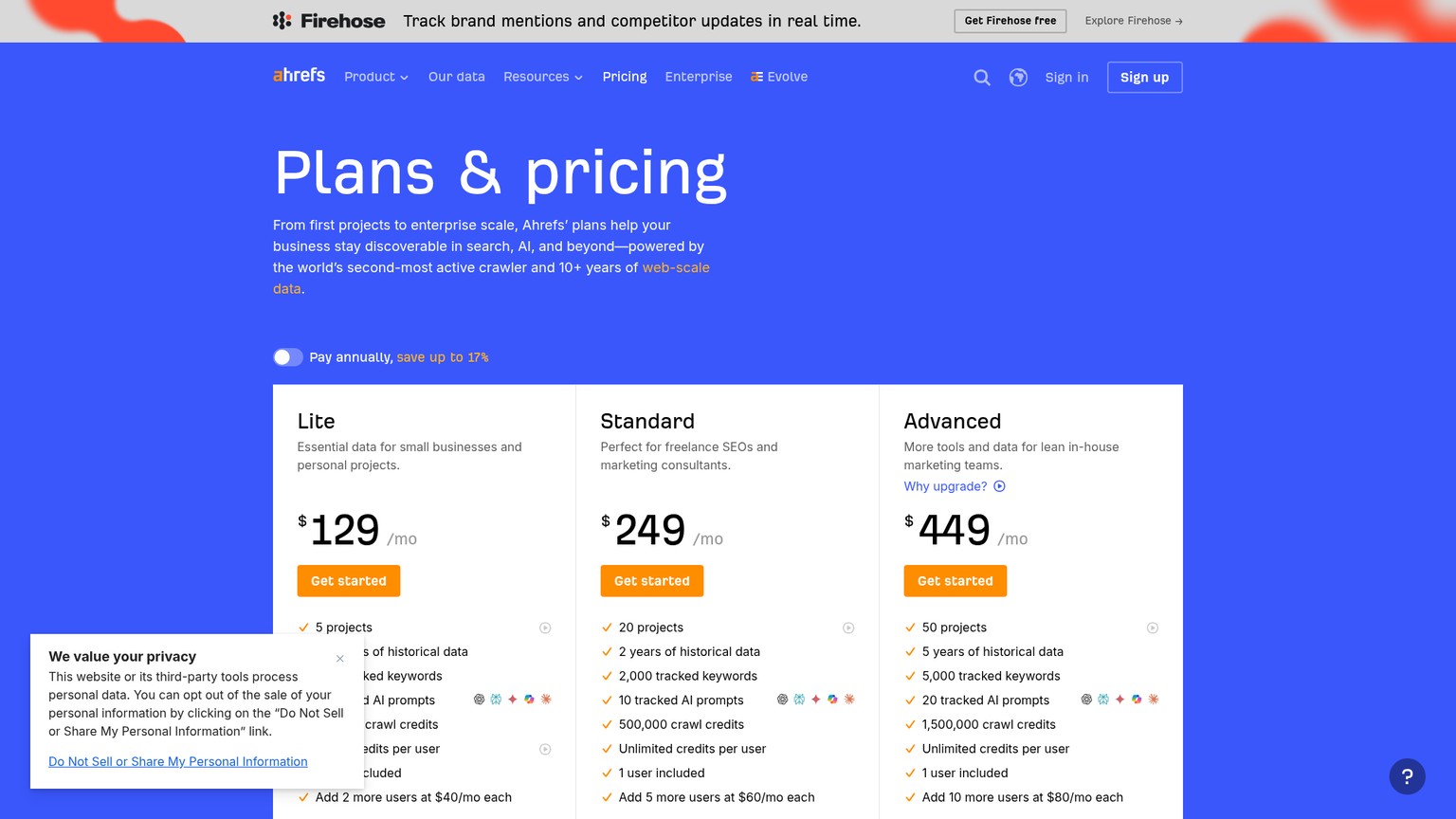
Ahrefs also charges $40 for an added Lite user and says it offers no paid trial or discount. Choose Lite when link research is the center of the job and weekly rank updates are sufficient. The lower normalized keyword price is not an equal-cadence comparison.
SE Ranking: the strongest capacity price in this shortlist
SE Ranking Core costs $129 monthly for 10 projects, one manager seat, 2,000 keywords tracked daily, 100 AI prompts tracked daily, 5 GEO domains, 250,000 audit pages, and 25,000 API credits. Its $0.0645 price per daily tracked-keyword slot is the lowest current figure among these entry plans.
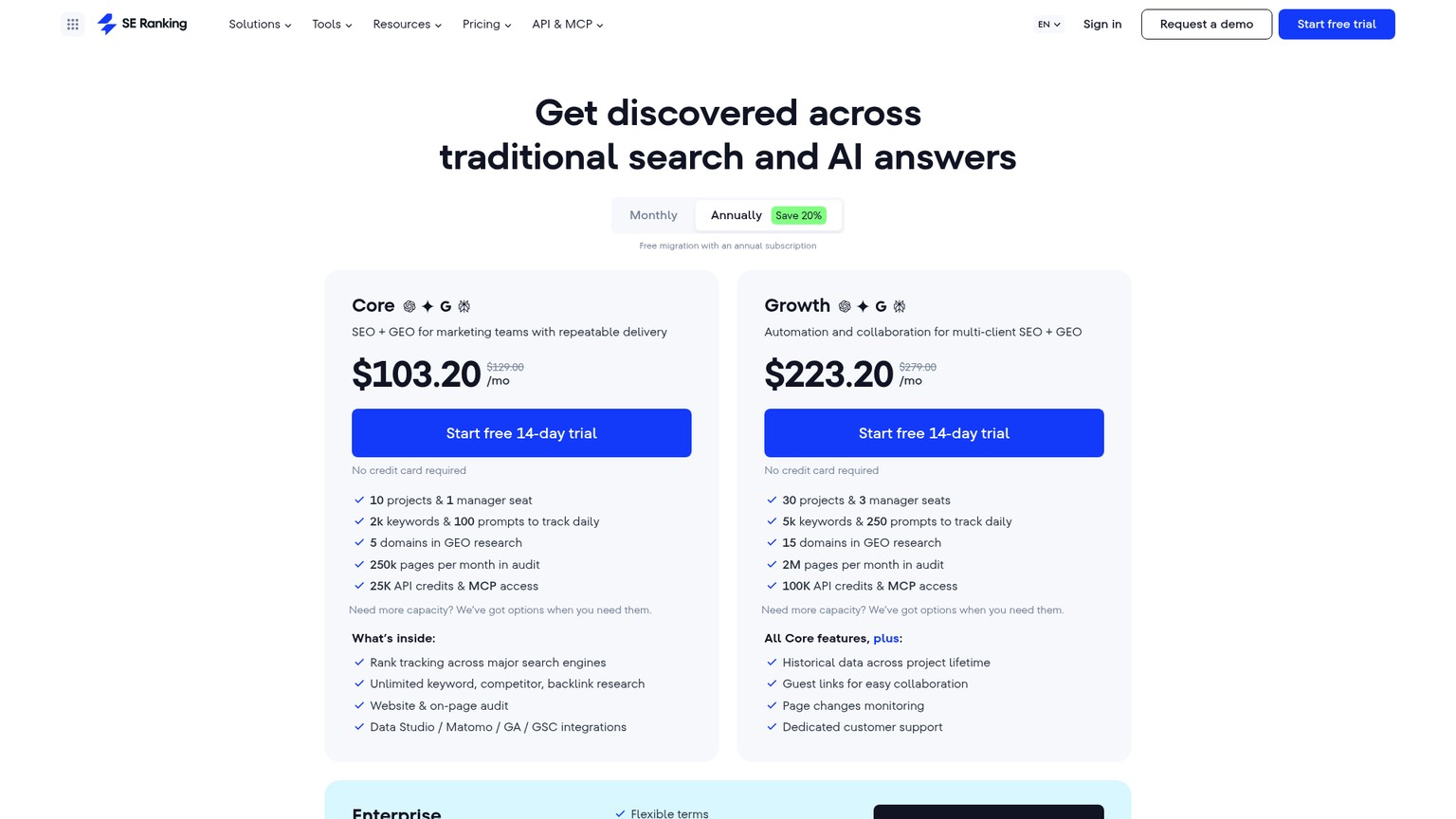
Annual billing lowers Core to a $103.20 monthly equivalent, paid up front, and the trial lasts 14 days without a credit card. Choose Core when tracked-keyword, prompt, and audit capacity dominate the decision. Choose Semrush when its specific research workflows and dataset justify the higher line item, not because capacity alone favors it.
Mangools: the smaller cash commitment
Mangools Basic costs $61 month to month or $37.70 per month equivalent on a $452.40 annual payment. It includes 200 tracked keywords, 100 keyword-research lookups per day, 100 SERP lookups per day, and 100,000 backlink rows per month, but no extra seats.
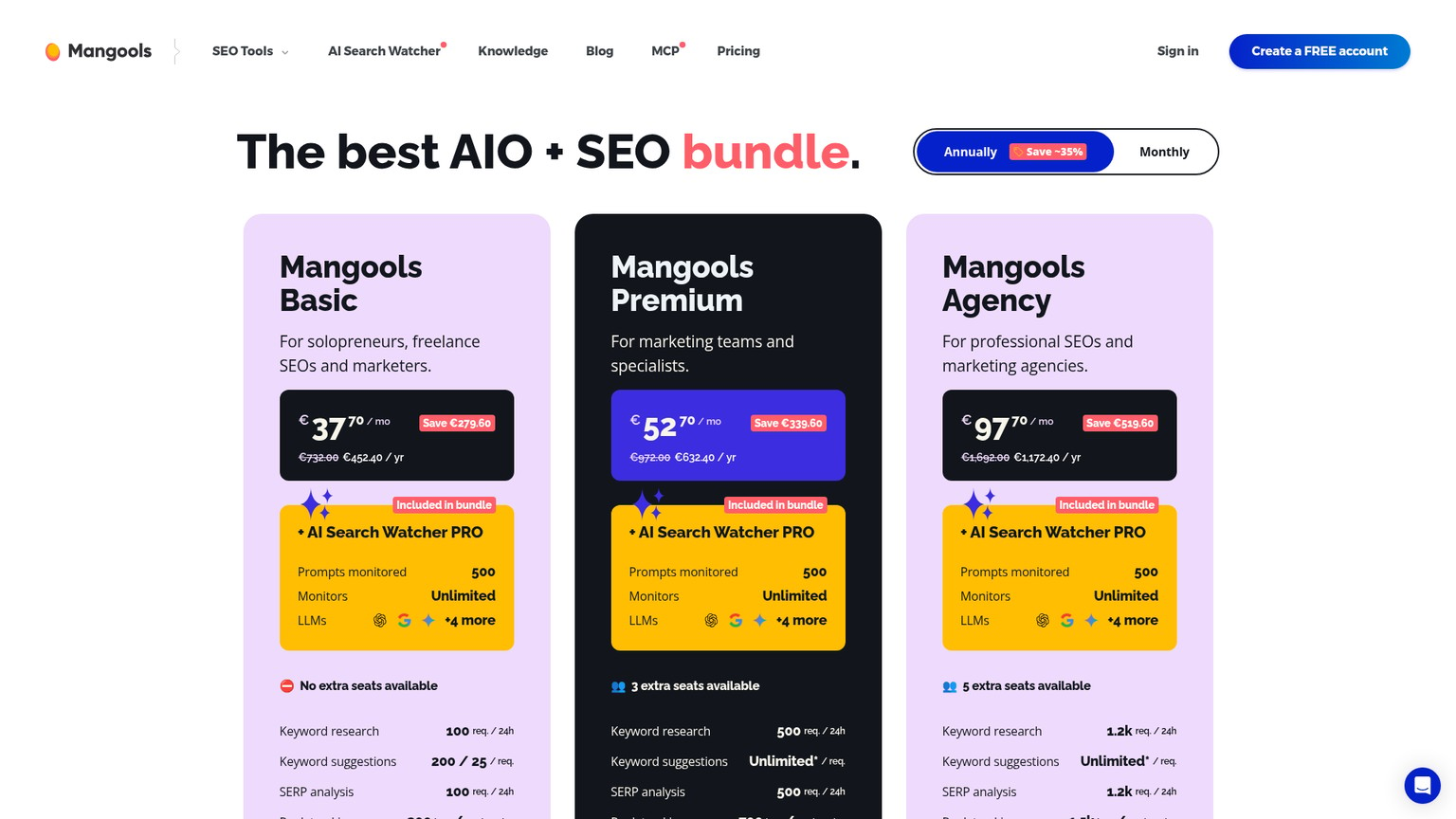
That works out to $0.305 per tracked-keyword slot monthly or $0.1885 with annual billing. Mangools is the practical low-cash choice for a solo operator who needs a narrower search toolkit. Its current pricing page also publishes a 48-hour money-back window.
The shortlist verdict is clean. SE Ranking wins on published daily-tracking capacity per dollar. Ahrefs Lite is the link-research alternative with weekly tracking at its entry tier. Mangools minimizes the cash commitment. Semrush earns its premium only when you will use the combined keyword, competitor, audit, tracking, reporting, and AI-search workflow enough to avoid paying for separate systems.
The Monday Buying Move
Start the approval sheet with sites and daily tracked keywords. If the account will stay within one campaign, 10 keywords, and 100 audited URLs, keep it free. If it needs up to 5 sites and 500 keywords, compare SEO and Starter on the $60 AI premium, not on their identical published site and keyword ceilings.
Next, name every person who must operate the account. Separate base access from AI Visibility, keep passive recipients on free view-only sharing, and calculate the full seat-month bill. A plan price with one included login is not a team budget.
Then write the first capacity date. The sixth site or 501st keyword points to Pro+. The 16th site, 1,501st keyword, share-of-voice requirement, or API requirement points to Advanced. If API work is in scope, attach the unit quote before approval.
Finally, choose annual billing only after those inputs are stable. The discount is valuable, but the cash leaves now and the public refund window is narrow. That is the Monday move: approve the operating bill, not the card headline.
Semrush Pricing FAQ
How much does Semrush cost per month?
Semrush's current public paid plans cost $139 for SEO, $199 for Starter, $299 for Pro+, and $549 for Advanced on month-to-month billing. Annual equivalents are $117.33, $165.17, $248.17, and $455.67 per month, but the full year is billed up front.
Is Semrush free or paid?
Semrush is both. The permanent free account includes one limited campaign, 10 tracked keywords, 100 audited URLs per month, and restricted daily research queries. Paid plans raise those limits and add team, historical, AI, and API-related capabilities.
Is there a cheaper version of Semrush?
The free account is the cheapest Semrush option. The lowest current public paid plan is SEO at $139 per month or $117.33 per month equivalent on annual billing. A buyer who needs a narrower toolkit can also compare Mangools Basic at $61 monthly, SE Ranking Core at $129, and Ahrefs Lite at $129.
What happened to Semrush Guru and Business?
Semrush still documents classic Pro, Guru, and Business plans in its knowledge base, but the live public pricing page verified in August 2026 shows SEO, Starter, Pro+, and Advanced. New buyers should use the live page; existing customers should use the price and terms in their account or renewal order.
Why is Semrush so expensive?
The price combines several research and monitoring workflows, but breadth only matters when those workflows are used. If the buying case is mainly daily keyword capacity, SE Ranking publishes much more at its entry price. If it is mainly a small solo search toolkit, Mangools requires less cash. Semrush's premium makes sense when consolidating those jobs creates more value than the price difference.
Does Semrush offer a student discount?
Semrush does not publish an individual student discount on its live pricing page. Qualifying students can receive free access when an accredited college or university participates directly in Semrush for Education.
What is the Semrush trial and refund policy?
The paid-plan trial lasts 7 days, requires a payment method, and converts to paid unless canceled. The public 7-day money-back policy applies to eligible initial purchases with a term of at least 12 months and eligible initial add-ons, not month-to-month subscriptions.
Did Semrush pricing change in 2026?
Semrush One launched on October 29, 2025 with a rounded introductory annual-billing entry price of $165 per month. The current Starter annual equivalent is $165.17. The visible packaging difference is more significant: the current page leads with SEO, Starter, Pro+, and Advanced while older Semrush documentation still names Pro, Guru, and Business.
If you want the same buying rubric for the rest of your growth stack, get the AI business workflow audit checklist.
- Last Updated
- Category
- Growth
- Language

Beehiiv Pricing: Annual Costs by List Size
Beehiiv pricing verified October 2026: annual bills at 1k, 10k, 50k and 100k subscribers, plan features, October changes and paid newsletter fees.Oct 9, 2026Growth
Pipedrive Pricing: Plans, Add-ons and Team Costs
Current Pipedrive seat and add-on prices, annual vs monthly budgets for 3 and 10 users, AI features, and when Premium costs less.Oct 8, 2026Growth
Lemlist Pricing: Seats, Credits and Sending Costs
Lemlist pricing by month, quarter and year, including credits, mailboxes and add-ons. See founder, sales team and agency bills plus alternatives.Oct 8, 2026Growth
Tidio Alternatives
Compare seven Tidio alternatives by support job, current pricing and billing unit. See who should switch, what migration costs and when Tidio wins.Oct 7, 2026Growth
Vista Social Pricing: What Your Profiles and Team Cost
Vista Social starts at $99/month. Compare annual prices, profile and user limits, AI features, add-ons, three bills and cheaper options.Oct 7, 2026Growth
Unbounce Pricing 2026: Plans, Visitor Limits and Testing
Unbounce starts at $29/month. Compare all six plans, annual rates, visitor and domain limits, A/B testing, Smart Traffic and the cheapest fit.Oct 7, 2026Growth
Best AI Ad Generator in 2026: AdCreative.ai, Atria, Creatify & Arcads (Compared)
Choose AI ad tools by job: static ads, UGC-style video or creative research. Compare current maker pricing, credit units and free entry.Oct 6, 2026Growth