Speechify Pricing (2026): Annual Pays Off in Month Five
Current Speechify prices, free-plan limits, 2026 word caps, trial and refund rules, student discounts, and cheaper alternatives.
Published
 By Omid Saffari




Speechify Premium costs $29 monthly or $139 yearly, so the annual plan becomes cheaper when your fifth paid month begins. The free plan is enough for occasional listening; Premium earns the $139 only when natural voices, OCR, cross-device continuity, and a personal reading workflow all matter.
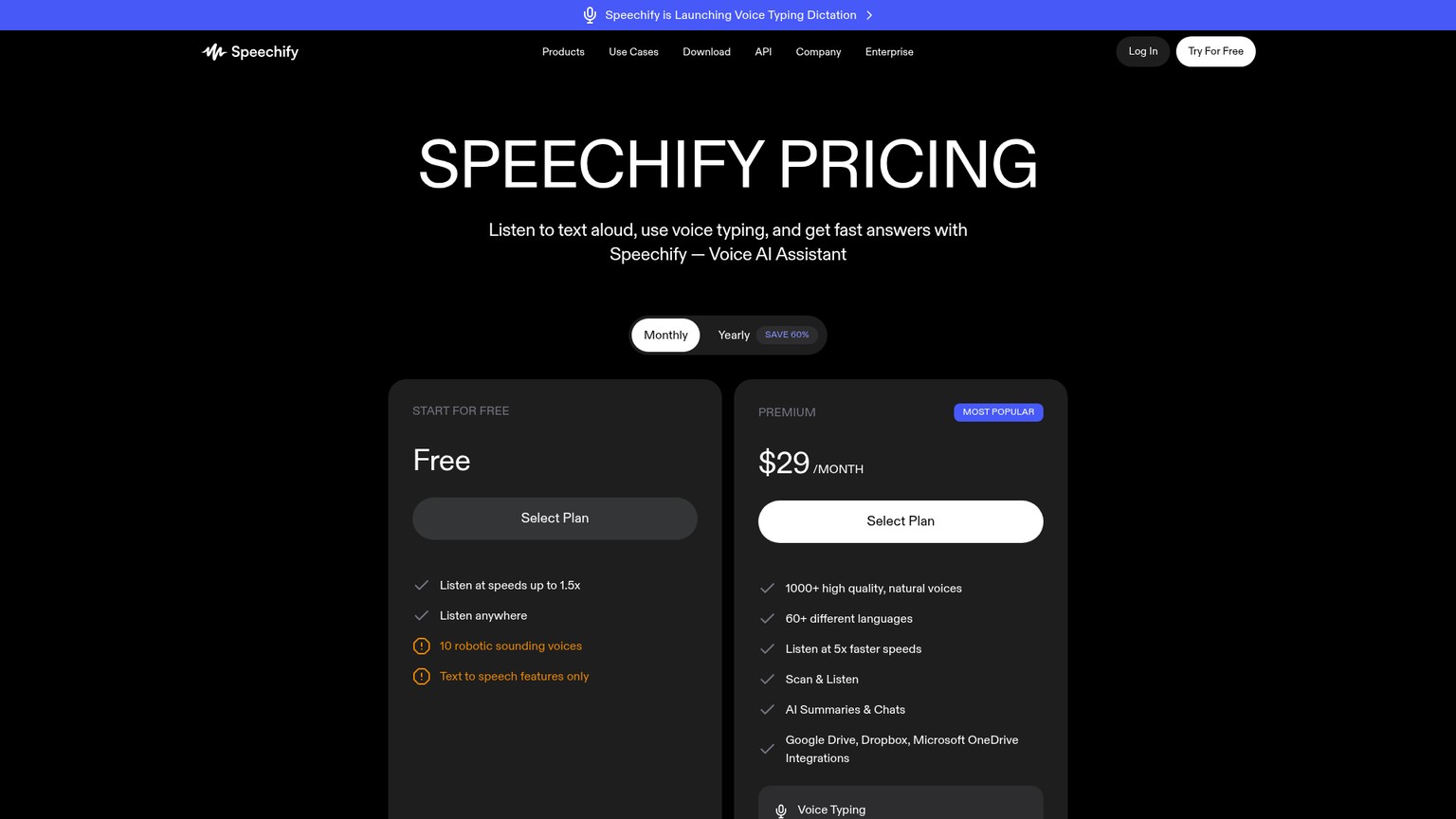
Speechify pricing at a glance
Speechify Reader has one free tier and one paid tier: Free costs $0, while Premium costs $29 month to month or $139 for a year. The yearly price works out to $11.58 per month, but the full $139 is paid upfront.
These prices and limits were verified against Speechify's live pricing page, usage policy, terms, refund policy, and student pricing page on August 12, 2026. The verification matters because Speechify's main pricing card shows SAVE 60% but does not print the annual total in its rendered price block. Speechify's own student pricing page supplies the missing number: $139 per year.
The verdict is simple. Use Free if a basic voice and 1.5x speed solve the job. Buy Premium monthly if the need will last no more than four paid months. Buy Premium annually only when the workflow has already proved it will survive into month five.
For the broader product decision, the Speechify review covers document capture, listening quality, workflow limits, and who should skip the product. The pricing decision turns on a narrower set of facts: commitment length, Premium word use, output rights, and whether the job belongs in Reader at all.
Annual billing wins in month five
Speechify's annual plan becomes the cheaper choice during paid month five, not at the end of a full year. Four monthly payments cost $116. A fifth raises the total to $145, which passes the $139 annual price.
Over a full year, twelve monthly payments cost $348. Annual billing saves $209, a 60.06% reduction. That is a substantial discount, but it compensates you for taking the cancellation and refund risk upfront.
The choice is especially clear for seasonal work. A student who needs Speechify for one semester could cross the break-even point. A creative director who needs it for a six-week research sprint should pay monthly and leave. A reader with an ongoing accessibility need should test the free experience first, then compare the annual plan with any education or accessibility support available to them.
The annual plan also needs a renewal reminder. Speechify's terms say subscriptions renew automatically for another term equal to the expiring term unless canceled. Canceling stops the next renewal, but it does not create a prorated refund for unused days in the current term.

Who never needs to pay for Speechify
An occasional listener who accepts basic voices may never need Speechify Premium. Free costs $0, requires no credit card, and does not turn into a paid subscription on a countdown. It includes 10 robotic-sounding voices, playback up to 1.5x, text-to-speech features, and a five-file library limit.
That is enough for a reader who wants a webpage, PDF, Google Doc, or photographed page spoken aloud from time to time and does not care about the natural-voice library. The free plan is also the correct starting point for anyone unsure whether listening will become a habit. A paid plan cannot rescue a workflow you do not return to.
Free stops being comfortable when voice quality affects comprehension over long sessions, the five-file limit creates constant housekeeping, or the job depends on the paid capture and continuity bundle. Premium adds 1,000+ natural voices, 60+ languages, Scan & Listen, AI Summaries & Chats, Google Drive, Dropbox, and Microsoft OneDrive integrations, plus Voice Typing, AI Podcasts, and Voice AI Assistant.
The feature count deserves restraint. Speechify's current pages disagree with one another: the main pricing page says 1,000+ Premium voices and up to 5x playback, while its Free-vs-Premium page says 200+ high-quality voices and up to 900 words per minute. Those conflicting claims make maximum speed and library size poor reasons to pay. The durable reasons are better voices, OCR, fewer storage constraints, integrations, and continuity across a recurring reading queue.
Students should check eligibility before spending. Speechify says verified students receive 25% off Premium through UNiDAYS, with similar offers through Student Beans. If 25% applies to the $139 annual checkout, the arithmetic is $104.25 per year, or $8.69 per month equivalent. Speechify also says US K-12 students can qualify for no-cost Premium through its education program with academic verification, while schools and districts can request institutional quotes.
What Premium costs at different usage levels
Speechify Premium is cheapest per outcome when it replaces a large amount of screen reading. Its 2026 usage policy guarantees up to 1,000,000 Premium Voice words per month, with the count resetting each monthly billing cycle.
At the full allowance, monthly billing costs $2.90 per 100,000 words. Annual billing costs $1.16 per 100,000 words when the $139 fee is spread across twelve months. Using a declared assumption of 150 spoken words per minute, 1,000,000 words is about 111.11 listening hours. That makes the full-cap cost about $0.26 per listening hour on monthly billing or $0.10 on annual billing.
Few people will consume the full cap. At 100,000 words, roughly 11.11 hours under the same assumption, the cost rises to $2.61 per listening hour monthly or $1.04 annually. This is the number a buyer should care about: not the theoretical lowest unit cost, but the unit cost at their likely reading load.
The million-word allowance is guaranteed only from January 1 through December 31, 2026. Speechify's contractual baseline is 150,000 Premium Voice words per month. If the temporary extension disappears after 2026, the guaranteed volume falls by a factor of 6.67 unless Speechify renews or replaces it.
Reader has no published overage rate or word top-up mechanism. Speechify publishes the allowance, monthly reset, and usage tracker, but no price for purchasing extra Reader words. A workflow that depends on more than the guarantee should not assume that a card charge can buy its way through the limit. Users with a documented accessibility need can request additional words at no extra cost through Speechify's accessibility-waiver process.
The hidden costs are commitment, rights, and checkout channel
Speechify's sticker price is only one part of the bill. The expensive mistakes come from starting the trial too early, buying through the wrong channel, or paying for Reader when the output needs commercial rights.
The trial can turn into a charge after three days
Speechify's current terms describe a three-day Free Trial unless signup shows a different period. It converts automatically to the selected paid plan unless canceled before it ends. Three days is too short for a casual evaluation spread across a weekend, so prepare the exact documents and devices before starting it.
The free tier is different. It needs no card and does not auto-convert. Start there. Move into the trial only when you have a Premium-only question to answer, such as whether a natural voice holds attention through a long PDF or whether Scan & Listen handles the physical material that matters.
Refund protection is narrow
Speechify's direct annual Text to Speech refund policy requires contact within seven days of payment and no more than 500 HD words of use. Monthly, quarterly, and discounted subscriptions are listed as non-refundable. Partial refunds are not offered for a used portion of a billing cycle.
Purchases through Apple or Google are stricter from Speechify's side. Speechify's policy treats those sales as final and directs subscription management through the original app-store channel. The practical move is to know where the purchase was made before looking for the cancel button.
Reader does not include commercial output rights
Speechify Reader is licensed for personal, non-commercial use. It is built to help you consume material, not to create a voiceover that will be published, sold, placed in an advertisement, or delivered to a client.
That boundary changes the budget line. A designer listening to research PDFs can use Reader. A studio creating narration for a client video needs Speechify Studio or another commercially licensed voice generator. The AI voice generator comparison is the relevant shortlist when the finished audio leaves your private listening workflow.
Reader, Studio, and API are three separate bills
Speechify Reader, Speechify Studio, and the Speechify API solve different jobs and do not share one consumer subscription. Reader is for personal listening. Studio creates commercial audio assets. The API puts text-to-speech and voice agents inside software.
Speechify Studio starts free, then moves to annual credits
Speechify Studio Free costs $0 and includes 600 Studio credits, but it excludes voice cloning and commercial usage rights. Studio Starter costs $100 per year with 86,400 credits. It adds voice cloning, stock assets, Voiceover Studio, Dubbing Studio, Voice Changer, and commercial usage rights. Studio Creator costs $300 per year with 345,600 credits and includes everything in Starter.
Credits are not equivalent across output types. Voiceover generation uses 1 credit per second, dubbing uses 3 credits per second, and avatar generation uses 30 credits per second. If every credit went to one format, Starter could generate up to 24 voiceover hours, 8 dubbing hours, or 48 avatar minutes. Creator could generate up to 96 voiceover hours, 32 dubbing hours, or 192 avatar minutes.
New speech generation consumes credits even when the script repeats. Changes to pitch, speed, or emotional delivery trigger a new generation and consume credits. Re-exporting unchanged speech and making volume-only adjustments do not. The live Studio pricing page does not state whether unused credits roll over or expire, so a production budget should get that answer from checkout or support before treating credits as a durable asset.
Speechify API pricing includes overages and auto top-up
Speechify API Free costs $0 per month and hard-caps use at 50,000 TTS characters and 60 voice-agent minutes. Starter costs $10 per month with 1 million TTS characters and 120 agent minutes, then charges $10 per extra million characters and $0.075 per extra agent minute.
Pro costs $99 per month with 3 million TTS characters and 1,200 agent minutes, followed by $8 per extra million characters and $0.07 per extra agent minute. Scale costs $499 per month with 10 million TTS characters and 6,000 agent minutes, followed by $6 per extra million characters and $0.068 per extra agent minute. Enterprise is custom-priced, with voice agents advertised from $0.06 per minute.
Paid overages draw from a prepaid balance, and optional auto top-up can refill it when the balance falls below a chosen threshold. Free stops at its hard cap instead. Starter, Pro, and Scale are month to month with no long-term commitment.
The split creates a clean decision. Pay for Reader when the outcome is understanding. Pay for Studio when the outcome is a finished audio asset. Pay for the API when the outcome is a feature inside a product. Buying the wrong surface is the largest hidden Speechify cost because none of the usage math transfers cleanly to another job.
ElevenReader and NaturalReader are cheaper for narrower jobs
ElevenReader is the strongest free alternative when natural voices matter more than OCR and commercial export. Its Free plan costs $0 and includes 10 hours of imported text-to-audio each month, 1,000+ natural voices, web-mobile sync, and playback up to 4x.
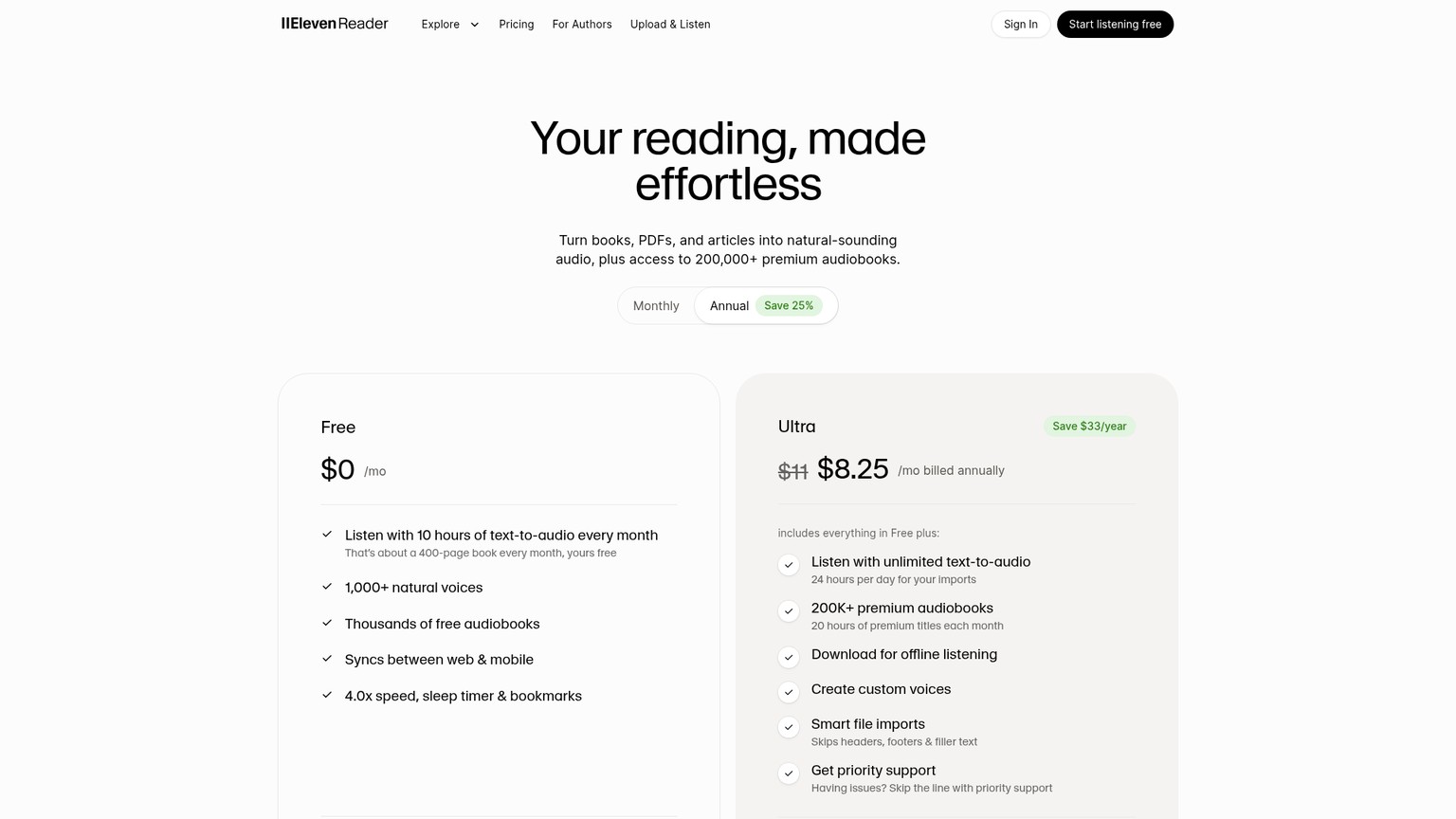
ElevenReader Ultra costs $11 monthly or $8.25 per month billed annually, which is $99 per year. That is $18 less than Speechify each month or $40 less each year. Ultra includes a three-day trial, a fair-use ceiling of 24 generated hours per calendar day for imported text, and 20 hours of premium audiobook titles each month.
The tradeoff is output and capture. ElevenReader does not export audio. Offline files remain inside the app. Free hours expire and reset monthly, while purchased and subscription hour packs can roll over for up to 12 months. Pick ElevenReader when the job is natural-voice listening and ten free monthly hours cover it. Skip it when OCR, more involved document capture, or an exportable asset decides the purchase.
NaturalReader Personal Lite is the lower-cost OCR alternative. It costs $13.90 monthly or $79 yearly and includes OCR, unlimited listening with Lite Voices, 1 million Lite Voice MP3 characters per month, Pronunciation Editor, Annotations, and an AI Smart Filter.
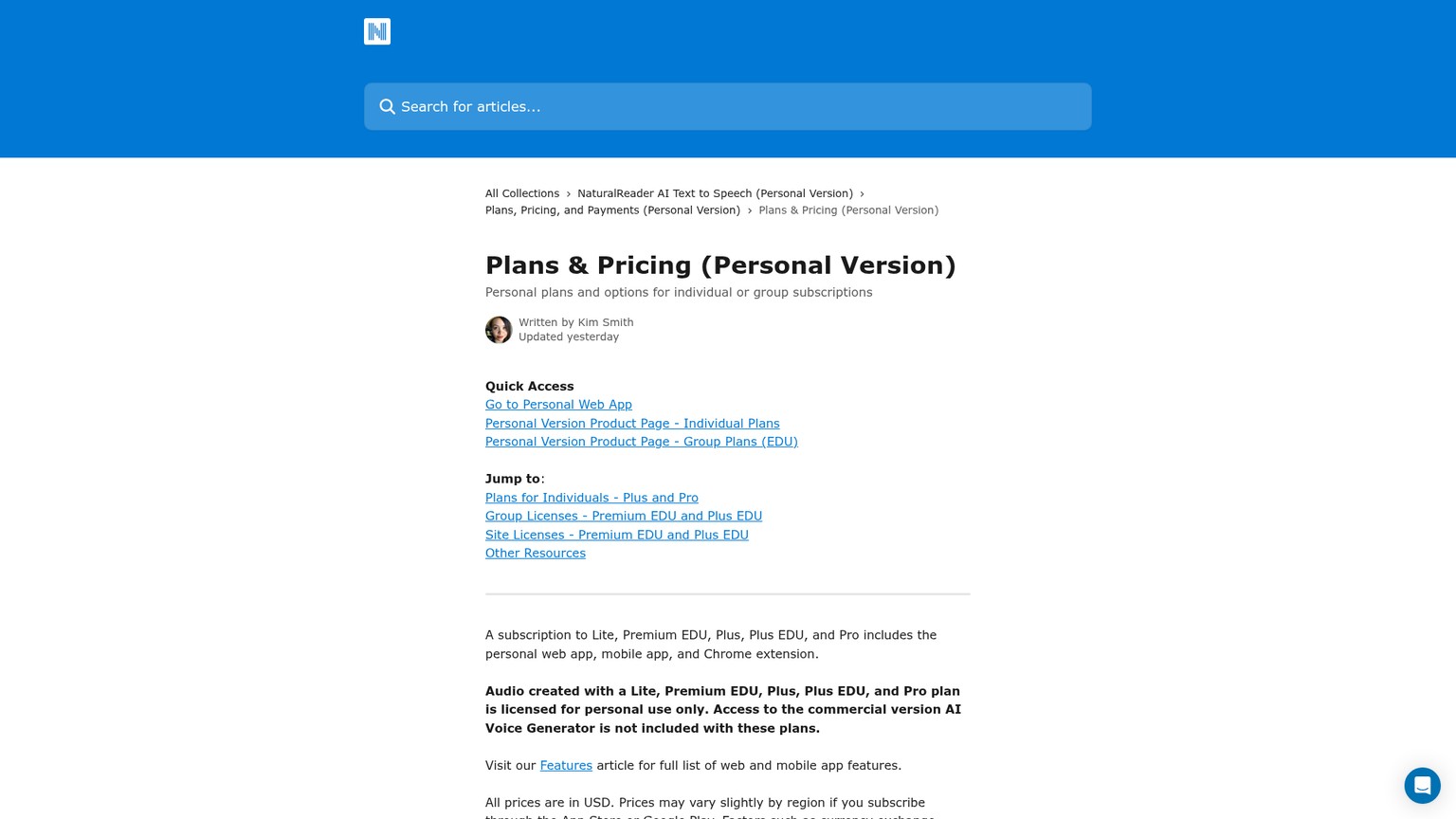
NaturalReader Lite saves $15.10 per month or $60 per year against Speechify. Its wall is voice access: Lite excludes Plus and Pro Voices and Voice Cloning. NaturalReader Plus costs $20.90 monthly or $119 yearly, adding Plus and Cloned Voice allowances and up to two cloned voices while remaining $20 cheaper than Speechify annually. Pro costs $25.90 monthly or $159 yearly, adding Pro Voices and Reading Styles but costing $20 more than Speechify annually.
All three NaturalReader Personal plans are licensed for personal use. Pick Lite when OCR matters and the Lite voice class is good enough. Pick Plus when cloned and Plus Voices justify $119 a year. Speechify earns its $139 only when its capture, integrations, and continuity bundle is worth the extra $20 to $60. The best text-to-speech tools comparison separates these personal readers from commercial generators and developer APIs.

Who should choose each Speechify plan
Choose Speechify Free when you listen occasionally, a five-file library is manageable, and basic voices at up to 1.5x are acceptable. This is also the safest way to learn whether listening changes your work before exposing a card to a three-day trial.
Choose Speechify Premium monthly when a defined project will last one to four paid months. A research sprint, temporary course load, or short accessibility evaluation fits the $29 option because flexibility is worth more than the annual discount.
Choose Speechify Premium annual when Premium has already proved useful and the job will last at least five paid months. The $139 plan is strongest for recurring personal reading that needs natural voices, OCR, integrations, and cross-device continuity.
Choose Speechify Studio when the result will be published or delivered. Choose Speechify API when speech belongs inside a product. Reader's lower sticker price does not make it a substitute for commercial rights or programmatic access.
Skip paid Speechify when ten natural-voice hours per month are enough, because ElevenReader Free covers that volume. Compare NaturalReader Lite when OCR matters but the Speechify bundle does not justify an extra $60 per year.
The Monday move: prove the budget line before buying it
The next step is a controlled free-plan test, not a subscription. Use one normal week of reading to expose the friction that a pricing page cannot price for you.
Load one real week
Put the PDFs, webpages, Google Docs, and photographed pages from a normal week into Speechify Free. Do not choose unusually clean material. The point is to test the sources that already consume your attention.
Mark every paid-only need
Record where the basic voices, 1.5x speed, five-file limit, capture workflow, or missing integrations slow you down. If none of those limits matters, remain on Free.
Choose by commitment length
If Premium solves a repeatable problem for one to four paid months, use $29 monthly. If the workflow will continue into month five, $139 annual is cheaper.
Protect the renewal
Start the three-day trial only when the evaluation is ready. Save the checkout price, note whether purchase happens on the web, Apple, or Google, and set cancellation and renewal reminders in the same sitting.
That sequence makes Speechify answer a budget question. The plan should buy back reading friction every week. If the test produces only a nicer voice, a free or cheaper reader is the better Monday decision.
Speechify pricing FAQ
How much does Speechify really cost?
Speechify Reader Free costs $0. Premium costs $29 monthly or $139 yearly, equal to $11.58 per month when the annual fee is spread across twelve months. The annual plan becomes cheaper when paid month five begins.
Can I use Speechify for free?
Yes. Speechify Reader Free requires no credit card and does not auto-convert to paid. It includes 10 robotic-sounding voices, playback up to 1.5x, text-to-speech features, and a five-file library limit.
Does Speechify have a student discount?
Yes. Speechify says verified students receive 25% off Premium through UNiDAYS, with similar offers through Student Beans. If the 25% applies to the $139 annual price, the result is $104.25; qualifying US K-12 students can also check Speechify's no-cost education program.
What is Speechify's refund policy?
For a direct annual Text to Speech purchase, contact Speechify within seven days and before using more than 500 HD words. Monthly, quarterly, and discounted subscriptions are listed as non-refundable, partial refunds are not offered, and Apple or Google purchases are handled under the original store's rules.
Does Speechify Premium include Studio or API access?
No. Reader, Studio, and API are separate products and bills. Reader is personal listening, Studio creates commercially usable audio, and the API embeds text-to-speech or voice agents inside software.
Is there a cheaper option than Speechify?
Yes. ElevenReader Ultra costs $99 per year and its Free plan includes 10 natural-voice hours monthly, but it does not export audio. NaturalReader Lite costs $79 per year and includes OCR, but it limits you to the Lite voice class.
Do I have to scan every page of a book for Speechify to read it?
A physical book needs each page you want read captured as an image for OCR. A digital PDF, EPUB, webpage, or supported document can be imported directly, so no page-by-page camera capture is needed for digital source material.
Use the AI Business Workflow Audit Checklist to decide whether Speechify deserves a recurring budget line.
- Published
- Category
- Design
- Language

Claude Design Is Now Free: Pricing and Business Uses
Claude Design is included on Free. See current plan prices, shared usage limits, exports, setup steps and where prototypes need engineering.Oct 10, 2026Design
Beautiful AI Review
Beautiful.ai review: Smart Slide guardrails, current pricing, Team seat ambiguity, AI features, export limits and when Gamma is the better fit.Oct 10, 2026Design
Nano Banana 2.1 Explained: Pricing, Changes, and When to Switch
Nano Banana 2.1 cuts 1K and 2K image costs about in half. Compare monthly budgets, verify the migration, and decide when Pro earns its premium.Oct 8, 2026Design
ElevenLabs Alternatives: Murf, MAI-Voice-2, OpenAI TTS and Cartesia (Verified October 2026)
Compare ElevenLabs, Murf, MAI-Voice-2, OpenAI, Cartesia, Google and Speechify by studio or API job, with verified prices and switching costs.Oct 4, 2026Design
Higgsfield API Pricing
Price Higgsfield API video and image jobs, separate API dollars from app credits, and check top-ups, expiry and cashback before scaling.Sep 27, 2026Design
Is Gemini Live Avatar Free
Check Gemini Live Avatar access, Enterprise API charges and custom-avatar limits before budgeting a customer-facing video agent.Sep 27, 2026Design
Gemini 3.8 Flash TTS Pricing
Price Gemini 3.8 Flash TTS by audio minute, compare Flash-Lite and service tiers, and budget the January 2027 increase.Sep 24, 2026Design