Zendesk Alternatives 2026: Tidio, Chatbase, CloudTalk and Helpdesks
Compare Zendesk alternatives by support model: Tidio, Chatbase, CloudTalk and leading helpdesks, with current prices, AI charges and switching advice.
Published
 By Omid Saffari




The best Zendesk alternatives depend on where your support work happens: Freshdesk for a conventional helpdesk, Tidio for chat with an AI agent, Chatbase for a docs-trained agent, and CloudTalk for phone support. Five Zendesk Suite Team seats cost $275/month on annual billing before additional AI usage; switching only helps if the replacement covers the work those seats do.
Prices and plan details verified on 10 October 2026. Prices are USD, excluding taxes. Annual prices below are monthly equivalents paid on an annual commitment. The five-seat Zendesk example is 5 × $55 from Zendesk's own pricing page.
Affiliate disclosure: Tidio, Chatbase and CloudTalk are partners of this site. A qualifying purchase through a partner link may earn a commission. Recommendations depend on the support model and product limits; the partners are not interchangeable replacements for Zendesk.
Zendesk Alternatives at a Glance
Shortlist by the work you need to replace. A helpdesk owns cases, assignments and customer history. A chat agent answers questions. A phone system handles calls. Some products combine these jobs, but their entry plans rarely combine everything.
These are entry points, not equivalent baskets. Each section below links the vendor's live price, explains the charging unit and names the upgrade or missing component that changes the decision.
Zendesk Pricing: Establish the Bill You Are Replacing
Zendesk is a customer-service platform, and its $19 entry plan is a different purchase from the Suite most multichannel teams compare against. Support Team covers email and ticketing; Suite Team adds messaging, live chat, telephony, a knowledge base and omnichannel routing, which assigns requests across those channels. Comparing every alternative with the Suite price exaggerates savings for an email-only business.
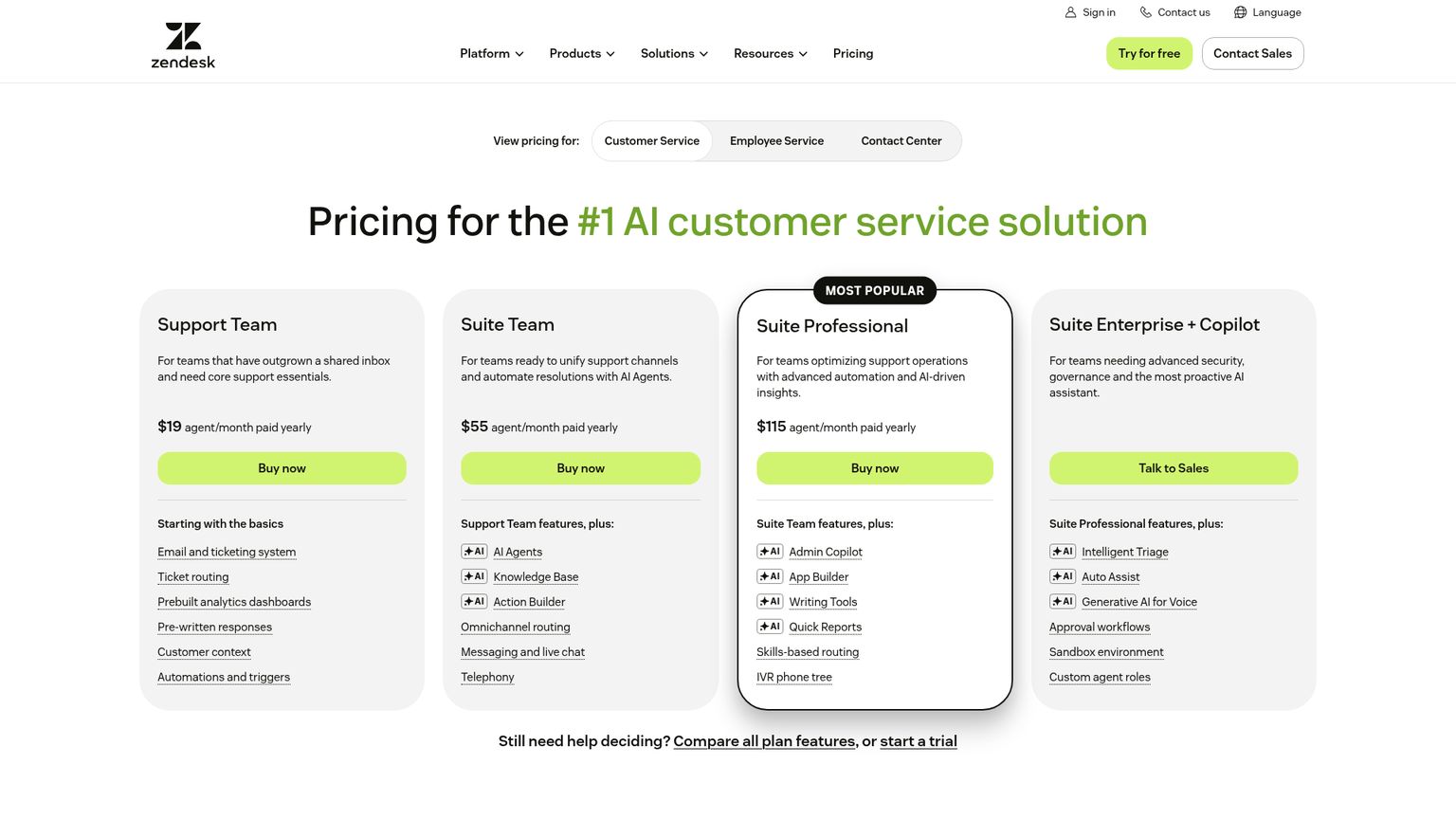
The current public plan ladder is:
- Support Team: $19/agent/month paid yearly, or $25 paid monthly.
- Suite Team: $55/agent/month paid yearly, or $69 paid monthly.
- Suite Professional: $115/agent/month paid yearly, or $149 paid monthly.
- Suite Enterprise + Copilot: sales quote.
The current main pricing cards do not give Suite Growth a public offer. An existing contract may have different names or negotiated terms; use the renewal order form for that comparison. Do not rebuild your budget from a historical tier ladder. Zendesk plan prices
AI creates another line on the invoice. Zendesk's own comparison table lists $1.50 per committed automated resolution and $2.00 per pay-as-you-go resolution. Support Team and Suite Team include 5 automated resolutions per agent/month; Suite Professional includes 10, with an overall included allowance cap of 10,000/year. An automated resolution is a request resolved without escalation to a human. Check how allowances are allocated across your subscription term before subtracting them from a forecast. Zendesk AI billing and allowances
For a hypothetical five-agent team, Suite Team is $275/month and Suite Professional is $575/month before excess AI usage. Five Suite Team agents nominally contribute 25 included automated resolutions per month. That allowance does not make a busy AI support operation free.
The featured annual add-ons are Copilot at $50/agent/month, Workforce Engagement Bundle at $50/agent/month and Contact Center at $83/agent/month. They are optional products, not charges to automatically add to every Zendesk quote. Zendesk add-ons
Choose the Support Model Before the Vendor
Choose a complete helpdesk when the problem is ownership of unresolved cases. Choose a specialist when the problem is concentrated in one channel and you already have a reliable place to keep customer history.
Chat-first: Start with Tidio when the same small group needs website chat, AI answers and human takeover. Start with Chatbase when your documentation is the asset you want to turn into an agent. Choose Intercom when the support experience inside your product, its inbox and its automation should operate together.
Email/helpdesk-first: Freshdesk is the default conventional shortlist. Help Scout fits an inbox-led operation; Front fits cases that require several colleagues to collaborate. Zoho Desk earns a look when budget and business-process configuration matter. Gorgias is the specialized choice when support revolves around ecommerce orders.
Phone-first: Start with CloudTalk if the operational problem is answering, routing and recording calls. Decide where follow-up email, unresolved cases and customer history will live before canceling Zendesk.
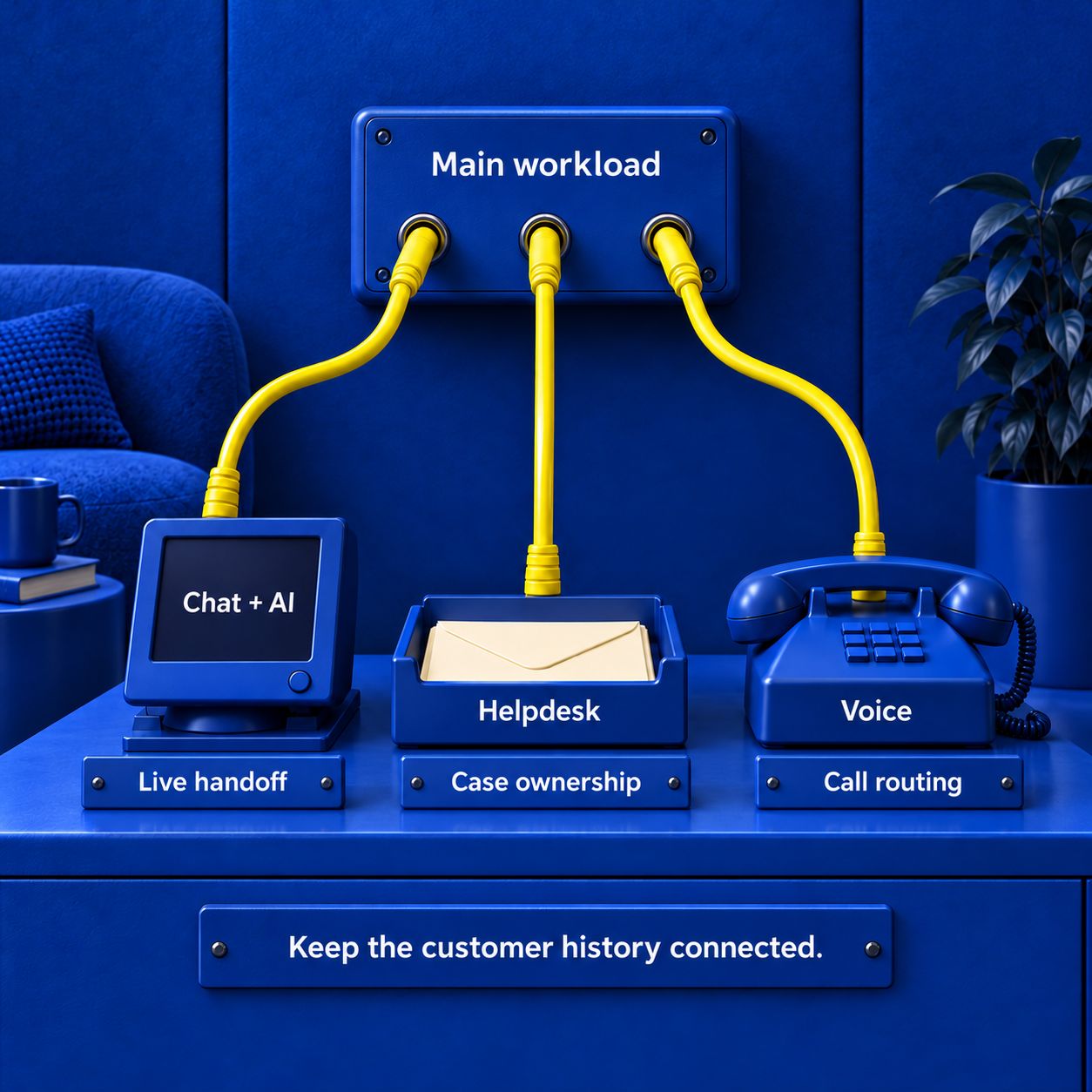
The rule that flips the choice: if a request routinely crosses channels and teams before it closes, prioritize the shared case record over the cheapest channel subscription. If most requests finish within one channel, a focused product may remove more cost and complexity.
Chat-First Alternatives: Tidio, Chatbase and Intercom
Tidio: Best for a Small Team Combining AI Chat and Human Support
Tidio is a chat and customer-service platform whose Lyro AI Agent answers from business knowledge and hands conversations to people. It fits a small store whose staff cover website questions and support messages together. The important limit is the separate allowance for human conversations and AI conversations: buying the helpdesk does not buy unlimited recurring AI. Choose Tidio when a compact chat operation is the goal, and price both halves of the workload.
Best for: A small support group that wants chat, ticketing and AI handoff together.
Standout: Conversation allowances with up to 10 human agents on self-serve plans.
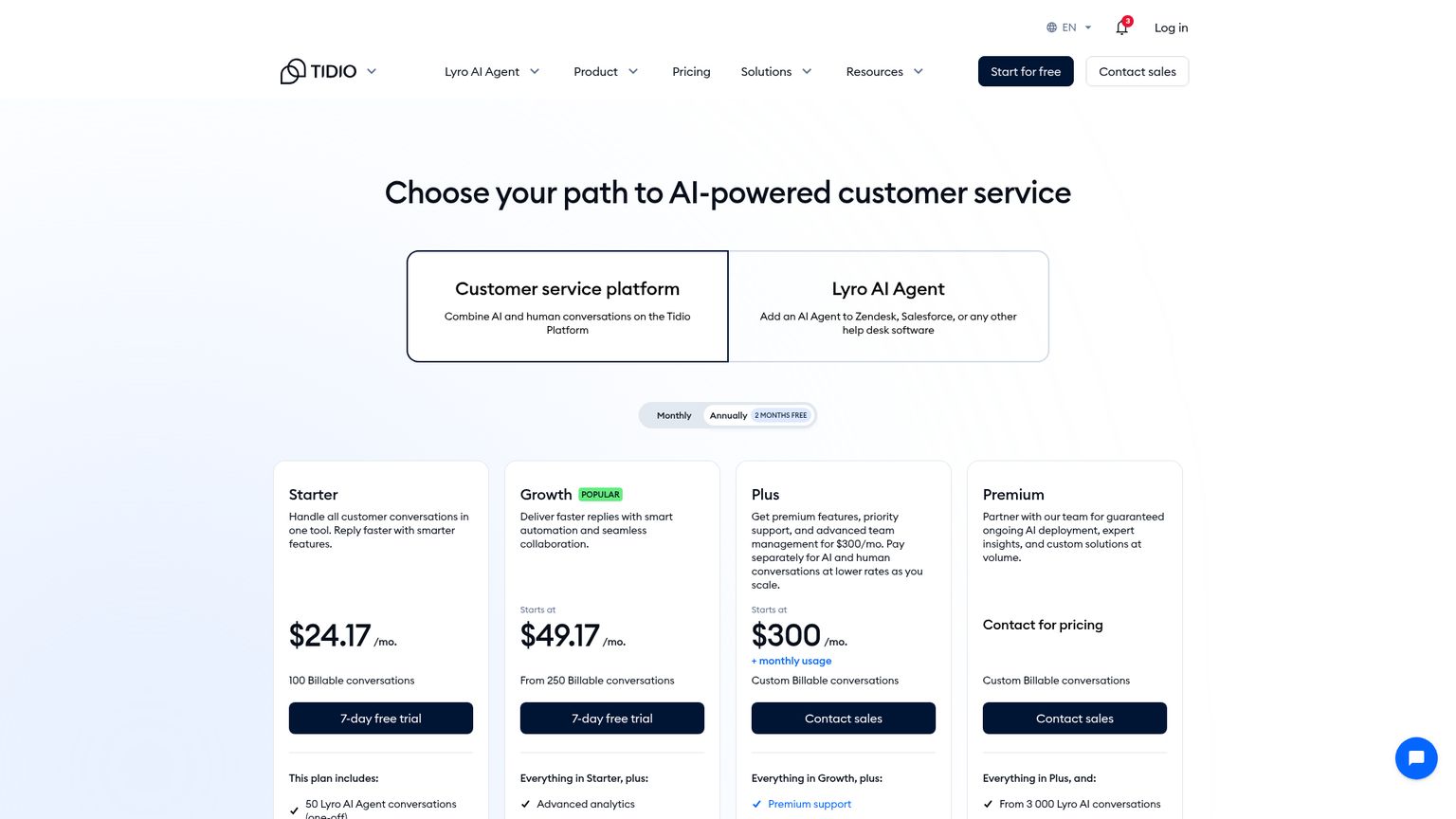
Pricing: Free $0; Starter $24.17/month annually; Growth from $49.17/month annually; Plus from $300/month plus usage; Premium quoted.
Free trial: 7 days without a credit card; a limited Free plan remains available.
Starter includes 100 human Billable conversations. Growth starts with 250 and adds automatic assignment, permissions, macros and advanced analytics. Plus adds departments, multiple projects, custom branding, ticketing automations and OpenAPI. Premium has a custom offer, including a pay-per-resolution option. These are meaningful boundaries for a growing operation, not just larger quotas. Tidio plans
Recurring Lyro starts at $32.50/month on annual billing for 50 AI conversations. The first 50 free Lyro conversations are a lifetime allowance, not a monthly renewal. Flows, Tidio's separate rules-based visitor automation, starts at $24.17/month annually for 2,000 visitors reached. Buy it only if that is a job you need. Lyro and Flows pricing
A human conversation counts when a person responds or initiates the thread. A Lyro conversation counts once the AI replies. Several replies in one thread do not create several conversations, but one thread handled by both AI and a person can use both allowances. Neither the AI conversation count nor the human count proves the issue was solved.
What it lacks against Zendesk: the entry plan does not replace a configured multidepartment operation. Departments and more substantial ticketing automation push you to Plus, while custom seat needs leave self-serve pricing. Audit the queues and reporting you depend on before reducing the purchase to a chat-widget comparison.
- Human support and a knowledge-based AI agent share the product.
- Conversation pricing can suit several staff sharing a modest queue.
- Ticketing includes email, chat and social conversations.
- Human and AI usage are metered separately.
- Free Lyro usage does not reset monthly.
- Departments and advanced operational needs can move the budget to Plus.
For a narrower comparison of chat and agent replacements, use the Tidio alternatives guide.
Chatbase: Best for an AI Agent Built Around Your Documentation
Chatbase is an AI-agent platform that connects your knowledge to customer answers and permitted actions. It fits a software business with useful setup guides, policy pages and recurring questions that should be answerable without a person rewriting the same explanation. Its current Standard plan includes a Helpdesk, so calling it merely a chatbot misses the product's scope. The decision is whether its agent and helpdesk cover your case workflow, not whether it can ingest a document.
Best for: Documentation-led support with a deliberately configured AI agent.
Standout: Knowledge sources include files, URLs, text, Q&A and Notion.
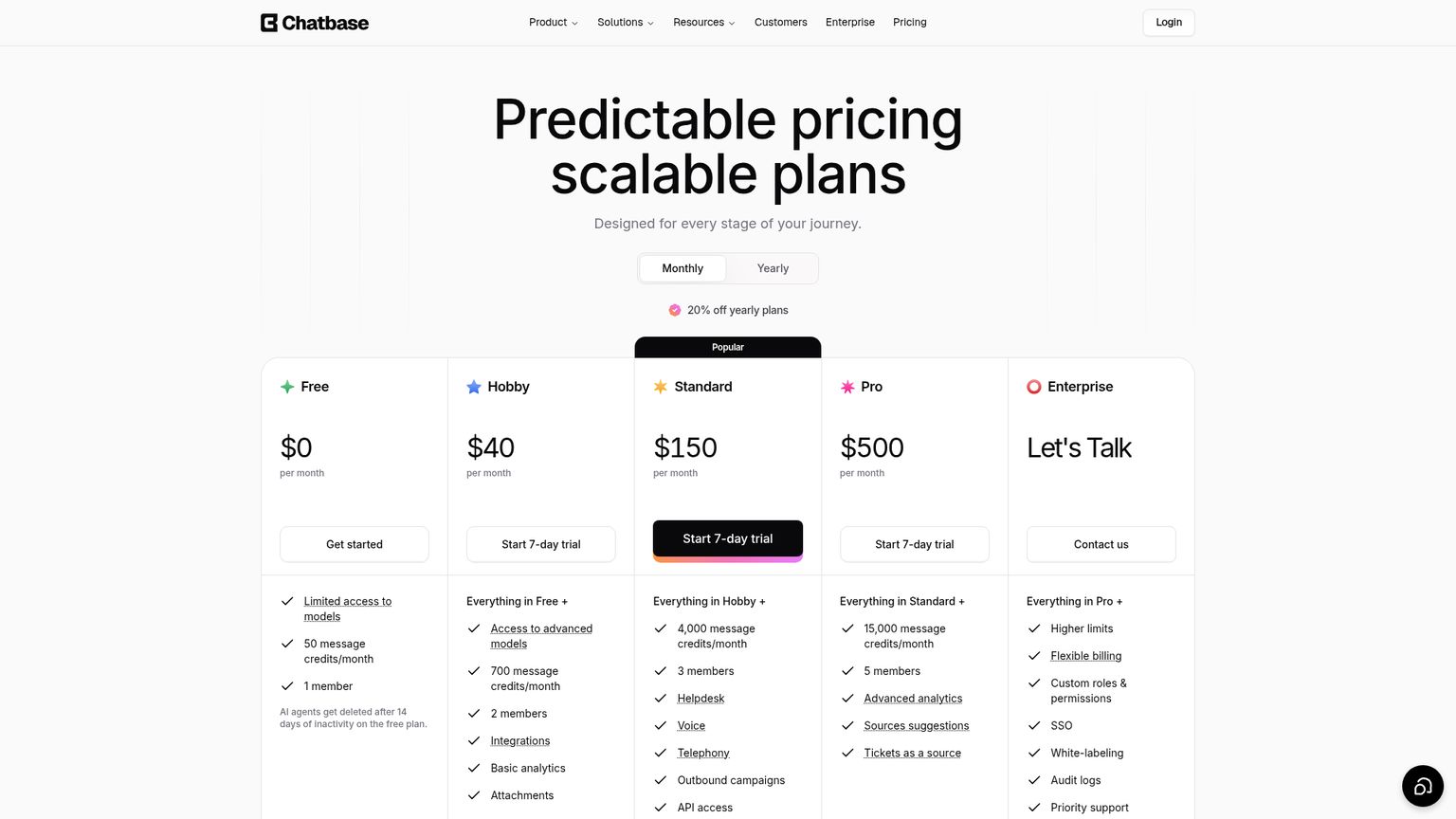
Pricing: Free $0; Hobby $40/month; Standard $150/month; Pro $500/month; Enterprise quoted.
Free trial: 7-day paid-plan trial; Free has a small recurring credit allowance.
Hobby includes 700 message credits/month and 2 members. Standard includes 4,000 credits and 3 members, adding Helpdesk, voice, telephony, API access, automatic source resync and advanced integrations. Pro includes 15,000 credits and 5 members, adding advanced analytics, source suggestions and tickets as a source. Enterprise adds controls such as custom roles, single sign-on (SSO) and audit logs. The page advertises a yearly discount; the figures here use its monthly offer. Chatbase pricing
Free includes 50 credits/month and 1 member, but an agent can be deleted after 14 days of inactivity. Optional auto-recharge costs $40 per 1,000 message credits; another AI agent costs $25/month, and removing the Chatbase branding costs $99/month. None of those prices is a per-resolution fee.
The knowledge workflow matters more than the upload button. Use approved sources, remove contradictory policies and define when the agent must hand off. Chatbase's product overview shows the source types and the instructions, procedures and helpdesk surfaces. A source that says refunds are allowed and another that says they are prohibited creates an operating problem whichever model answers the customer.
For a small B2B software company, Hobby can evaluate the knowledge agent. A plan to replace Zendesk's human case queue should start with Standard's Helpdesk scope instead. Test the actual escalation: can the receiving person see the original question, the answer already given and the unresolved action? Treat that as an acceptance test, not a capability this comparison claims to have exercised.
What it lacks against Zendesk: Hobby lacks the built-in Helpdesk, and Standard's included membership is small. Custom roles, SSO and audit logs sit in Enterprise. A business leaving a mature Zendesk setup needs to validate the case-management and governance requirements, not assume the $40 agent tier replaces them.
- Several practical source types for company knowledge.
- Standard combines the agent with a built-in Helpdesk.
- Higher tiers add source resync, integration and governance options.
- Credit quotas do not translate directly into customer outcomes.
- The $40 entry tier is below the built-in Helpdesk tier.
- Member allowances and optional branding removal can change the bill.
The Chatbase alternatives guide covers the narrower choice between knowledge-agent platforms.
Intercom Pricing: Fin Makes Sense When the Support Experience Is the Product
Intercom is a conversational helpdesk, and Fin AI Agent is its automated support agent. It is a strong fit for a SaaS company whose customers ask questions inside the product and need to move naturally from AI answers to a human inbox. Essential includes Messenger, ticketing, a shared inbox, reports and a public help center. Choose Intercom for that integrated workflow; do not choose it on the assumption that leaving Zendesk eliminates usage billing.
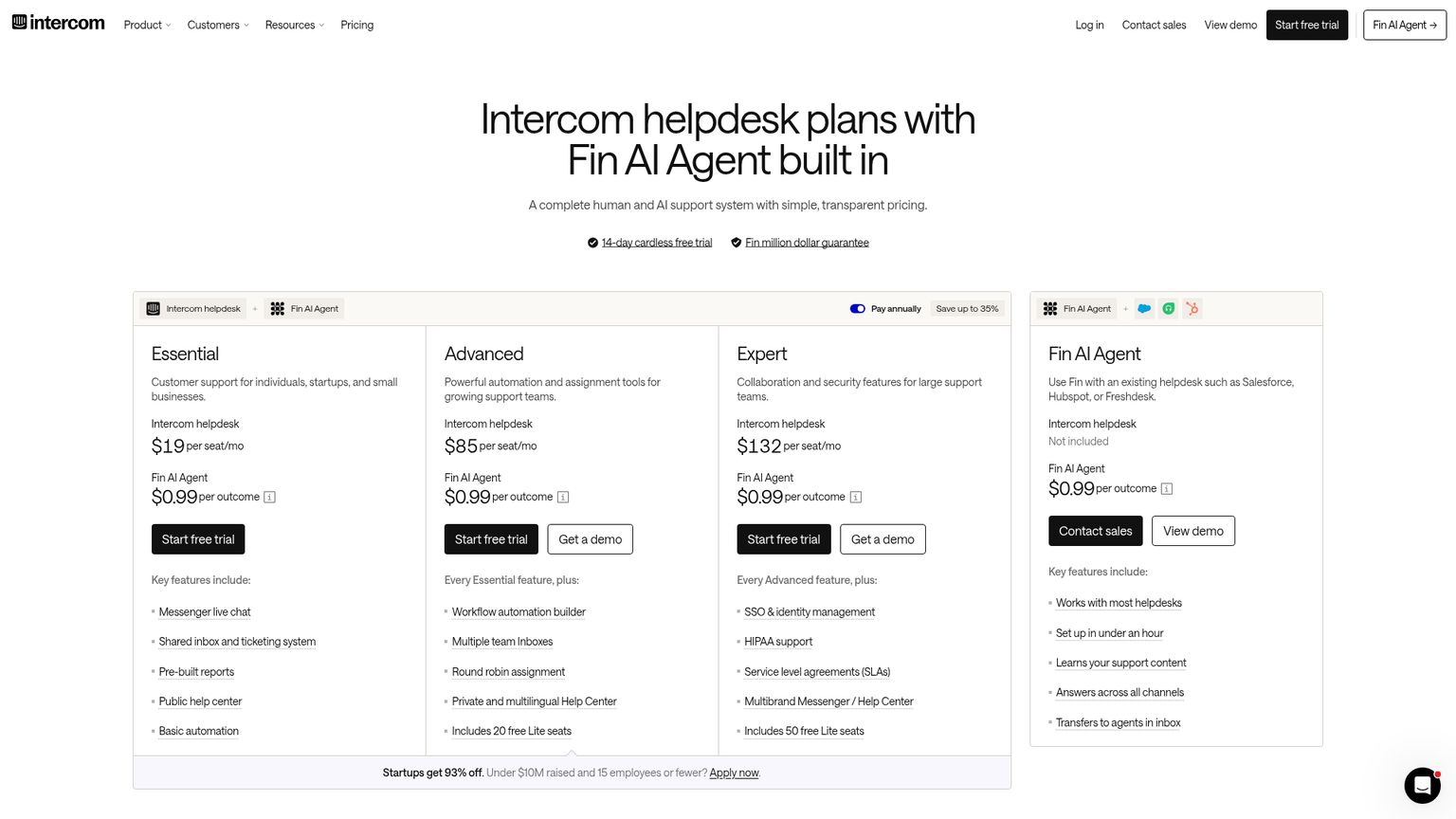
Best for: Product-led businesses combining in-app service and human support.
Standout: Fin and the customer-support inbox in one platform.
Pricing: Essential $29/seat/month annually or $39 monthly; Advanced $85 or $99; Expert $132 or $139, plus Fin usage.
Free trial: 14 days without a credit card.
Fin costs $0.99 per outcome. The current definition includes confirmed resolution, a customer not asking for more help after the answer, and a completed Procedure, including a handoff. A Procedure is a defined workflow the agent follows. That last billing condition is why “outcome” should not silently become “issue solved without any human involvement” in your spreadsheet. Intercom plans and outcome definition
Advanced adds multiple team inboxes, the workflow builder, round-robin assignment and private or multilingual help centers. Expert adds service level agreements, which are response or resolution commitments, along with SSO and multibrand support. These upgrades matter for a support lead running several customer groups with different escalation rules.
The optional Copilot assistant is $29/agent/month annually or $35 monthly. Pro starts at $100/month, while Proactive Support Plus is $99/month. Phone, SMS, WhatsApp and outbound campaigns can incur additional usage charges. Support email, live chat and in-app chat are included. Intercom pricing details
What it lacks against Zendesk: Essential does not include the multi-inbox, workflow and SLA scope a configured Zendesk organization may use. Some of that exists higher in Intercom's ladder rather than being absent altogether. Compare the usable tiers, including your phone and messaging needs.
There is also an augmentation route: Fin can run with a supported existing helpdesk without Intercom seat costs, subject to a minimum commitment. That can improve automation while leaving Zendesk in place. It does not remove the existing helpdesk bill.
- Integrated Messenger, AI agent, inbox and help center.
- Clear public seat tiers and a published outcome definition.
- An existing-helpdesk option can avoid a full migration.
- Seats and AI outcomes both contribute to the bill.
- Useful workflow features require Advanced or Expert.
- A billable outcome can include a procedural handoff.
Email and Helpdesk Alternatives
Freshdesk Pricing: The Default Conventional Helpdesk Shortlist
Freshdesk is a ticketing and shared-inbox helpdesk for businesses whose support work is primarily email-led. It is the first replacement to evaluate when you want familiar case ownership, a customer portal and a knowledge base with a lower starting commitment than Zendesk Suite. The crucial distinction is Freshdesk versus Freshdesk Omni, its omnichannel offer. Freshdesk is a credible cost reduction when you compare the right product, not when an email plan is priced as a whole Suite replacement.
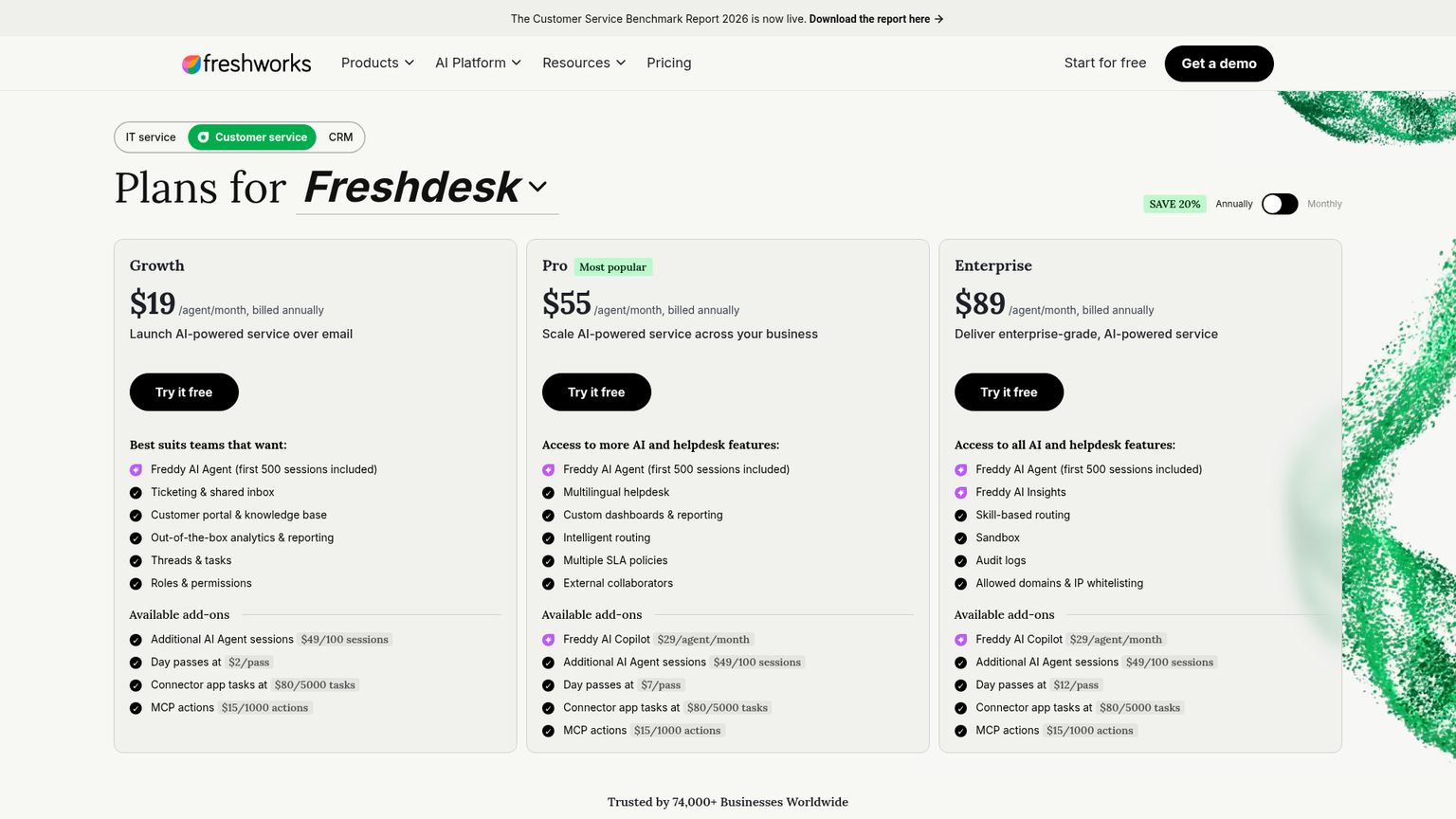
Best for: A small or mid-size business running a conventional ticket queue.
Standout: An accessible ticketing entry tier with a portal and knowledge base.
Pricing: Growth $19/agent/month, Pro $55, Enterprise $89, billed annually.
Free trial: 14-day Enterprise trial; the current page does not offer an ongoing free plan after that trial.
Growth includes the shared inbox, threads and tasks, reporting, roles and permissions. Pro adds intelligent routing, multiple SLA policies, multilingual support and custom reporting. Enterprise adds skill-based routing, a sandbox and audit logs. A sandbox is a separate place to test changes before they affect customer service. Freshdesk plans
For multichannel support, Freshdesk Omni lists Growth at $29/agent/month, Pro at $79 and Enterprise at $119, billed annually. Start there if you are trying to replace an omnichannel Zendesk operation. The $19 headline is for a different scope. Freshdesk Omni pricing
Freddy AI Agent costs $49 per 100 additional sessions. The first 500 sessions are a one-time account allowance, not 500 free sessions every month. An email AI session is a 72-hour window beginning with the customer's first email, irrespective of how many AI replies follow. Freddy AI Copilot, the assistant for human agents, is a separate $29/agent/month add-on on Pro and Enterprise. Freshdesk AI billing FAQ
For a five-person service business, Growth costs $95/month in annual equivalents. Omni Growth costs $145, versus $275 for five Zendesk Suite Team seats. The base difference is $130/month, or $1,560/year, before AI, telephony and implementation. That is useful, but it is not enough to ignore a costly migration.
What it lacks against Zendesk: the basic Freshdesk purchase does not reproduce Suite's channel scope. Growth also does not include Pro's routing, SLA and reporting depth or Enterprise's sandbox. A team currently relying on those features should price the corresponding tier before claiming a saving.
Pilot the smallest useful helpdesk replacement
Choose one support address or queue and list its required channels, assignments, response commitments and reports. Use those requirements to select Freshdesk or Omni before starting the trial.
Check the plan you intend to buy
The trial opens Enterprise features. Mark which pilot features belong to Growth, Pro or Enterprise so the working trial does not become an accidental promise of the lowest-tier price.
Replay representative cases
Use a recommended sample of 50 historical cases with customer details removed where appropriate. Include a reopened case, an escalation, a missing knowledge article and an action the agent must not take. Record correct ownership and usable handoff alongside reply quality.
Forecast the paid month
Count seats and Freddy sessions after the one-time allowance is gone. Compare that forecast and any remaining phone subscription with the Zendesk renewal bill.
- Clear conventional helpdesk structure.
- Portal and knowledge base included at Growth.
- A separate Omni offer makes multichannel scope priceable.
- Email-led Freshdesk and Omni have different prices.
- Advanced routing, reporting and controls require upgrades.
- The initial AI session allowance does not renew monthly.
Help Scout: Best for an Inbox-Led Team That Values Simpler Case Work
Help Scout is a shared-inbox customer-support platform with knowledge bases, messaging and AI Answers. It fits a small software or services company whose agents mostly read a request, consult a colleague and send a considered reply. Its current paid plans charge by user, so older descriptions of contact-based paid pricing are not the right basis for this purchase. Choose it when the inbox is the center of the job, while checking routing and security requirements against the tier ladder.
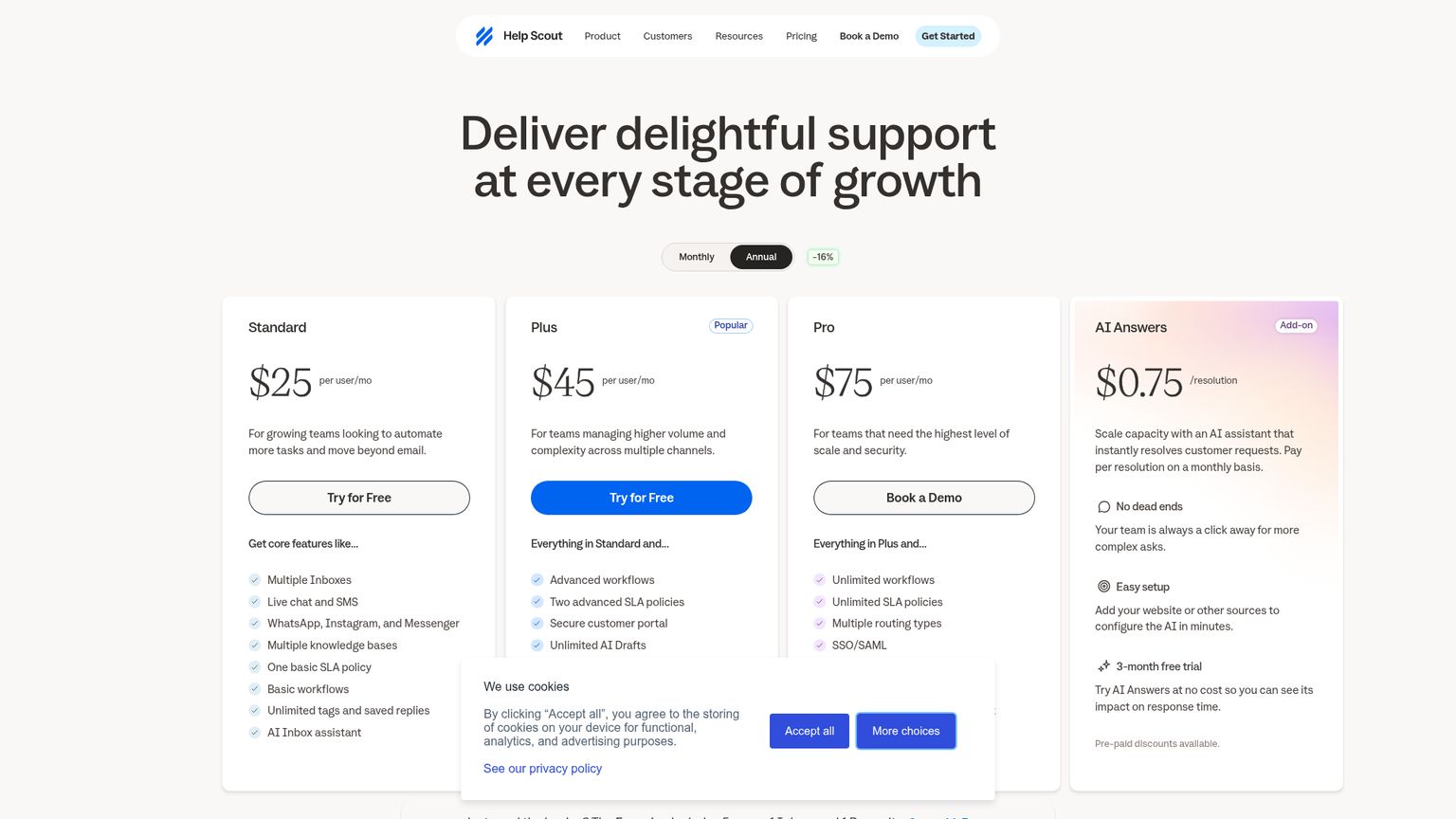
Best for: A small customer-service operation built around shared inboxes.
Standout: Inbox, knowledge and an AI Answers spending cap.
Pricing: Standard $25/user/month, Plus $45, Pro $75, billed annually; Free available.
Free trial: 15 days for Standard or Plus; AI Answers has a separate 3-month trial beginning at account creation.
Standard includes basic workflows, a basic SLA policy, live chat and supported messaging channels. Plus adds advanced workflows, round-robin routing, internal teams, company grouping and a secure customer portal. Pro adds unlimited workflows and SLA policies, more routing choices and SSO. Standard supports up to 25 users, Plus up to 50, and Pro has a 10-user minimum. Help Scout pricing
The Free plan has 5 users, 1 inbox, 1 Docs site and 100 contacts/month. A contact is a person who receives a team reply or an AI-resolved answer; several conversations with that person count once. That can be useful for a very small queue, but a five-person support team should not assume five free users means unlimited customer work.
AI Answers costs $0.75 per resolution. Its definition excludes conversations where the customer escalates, asks more questions, searches the knowledge base or indicates that more help is needed. You can set a monthly spending cap; hitting it disables AI Answers for the rest of that billing cycle. AI Answers definition and cap
What it lacks against Zendesk: the lower tiers do not reproduce all the routing, security and multiteam controls of a developed Zendesk setup. Pro's minimum is especially relevant to a small company that needs SSO but does not need many support seats. Keep phone requirements in the evaluation rather than assuming an inbox subscription replaces the existing voice system.
For a services firm, the useful pilot is a complex email thread that needs a colleague's input and later reopens. If the ownership stays clear and the customer history is easy to follow, the simpler operating model has value. Measure the reduction in administrative work instead of relying on an untested claim about setup speed.
- A coherent inbox and knowledge-base workflow.
- A limited Free plan for very small support volumes.
- Published AI resolution rules and a spending cap.
- Paid plans still scale with user count.
- Advanced routing and SSO require higher tiers.
- The Free contact cap and Pro user minimum can change the apparent fit.
Front: Best When Several People Must Work on One Customer Request
Front is a collaborative customer-service inbox with ticketing and automation. It fits a logistics provider, agency or B2B service company where solving a request requires account management, operations and support to coordinate. Assignments, internal comments and shared drafts are central to that model. Front earns its place when collaboration is the bottleneck; the cheapest tier is only attractive if its channel restriction matches your work.
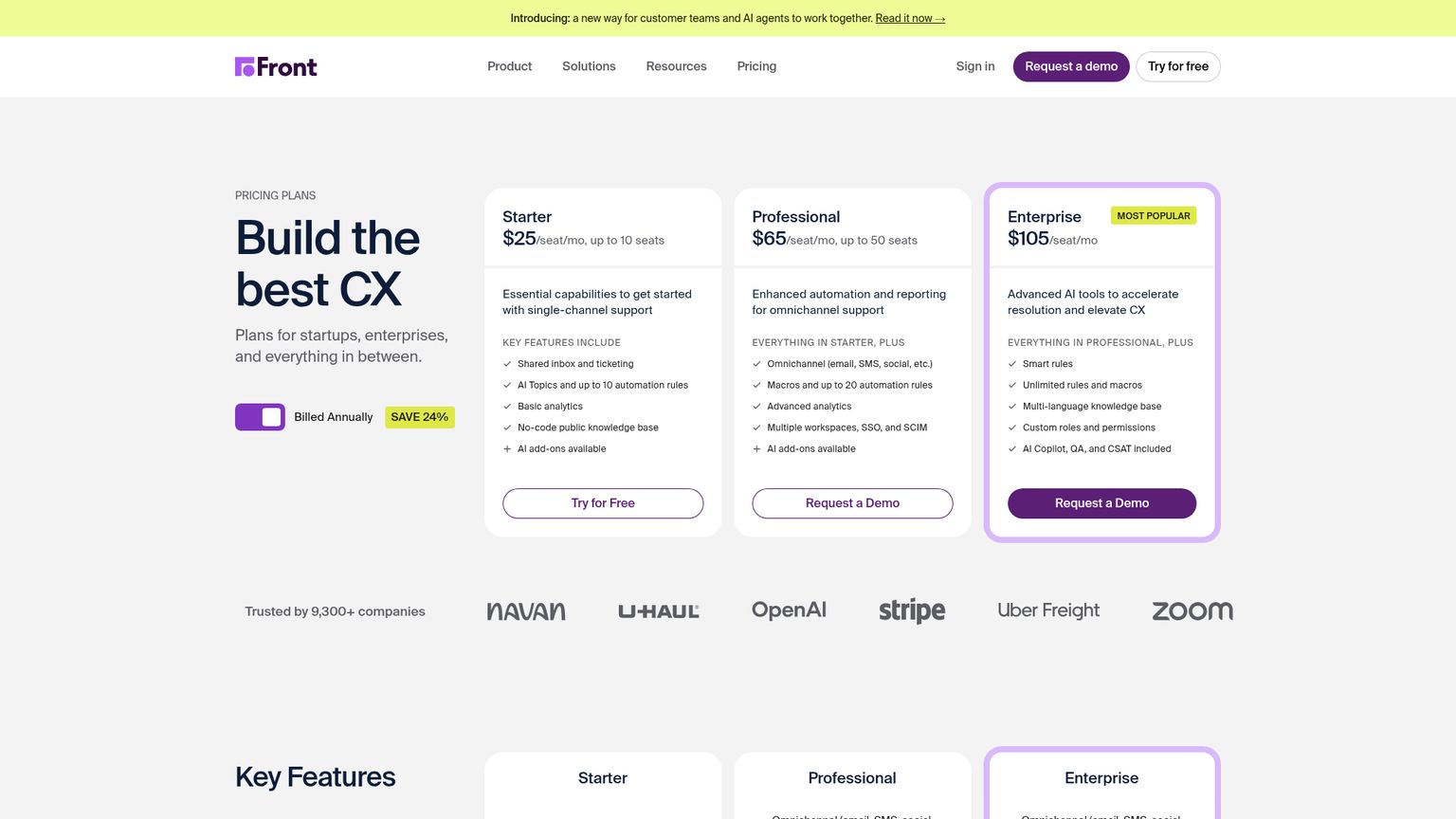
Best for: Customer cases that cross internal responsibilities.
Standout: Shared drafts, comments and ownership within the customer conversation.
Pricing: Starter $25/seat/month; Professional $65; Enterprise $105, billed annually.
Free trial: 14 days with Professional features, no credit card.
Starter supports one channel type, up to 10 seats and up to 10 automation rules. Professional adds omnichannel support, up to 50 seats, macros, up to 20 rules, advanced analytics and multiple workspaces. Enterprise includes unlimited rules and macros, custom roles and a multilingual knowledge base, plus AI Copilot, QA and CSAT features. Front plans
Autopilot, its AI agent, starts at $0.05 per conversation. That is a starting price to discuss with sales, not a universal flat rate for every workflow. Copilot is a $20/seat/month add-on on Starter and Professional and is included in Enterprise. Request the applicable conversation definition, workload price and commitment in the proposal.
For five paid seats, Starter is $125/month in annual equivalents, but Professional is $325. That $200/month jump is $2,400/year. If you need both email and other channels, use the Professional figure from the beginning. A low entry price does not help if the first genuine requirement makes the entry plan unusable.
What it lacks against Zendesk: Starter does not offer Suite-like omnichannel coverage, and its automation allowance is small. Front can cover more of that work through higher tiers, but it is not automatically a cheaper replacement for a Zendesk team with broad channel and automation requirements.
The buying test is a request that needs an operations specialist before the support agent can answer. Check whether a guest account is enough for that colleague's internal comments or whether a paid seat is needed for their job. Then verify what happens when the specialist is unavailable. Better collaboration should produce clear responsibility, not a conversation that everyone can see but nobody owns.
- Collaboration happens beside the customer conversation.
- Internal comments and shared drafts support complex replies.
- Guest accounts can support limited internal participation.
- Starter is restricted to one channel type.
- Omnichannel support creates a substantial seat-price increase.
- Autopilot's starting rate still needs a workload-specific quote.
Zoho Desk Pricing: The Budget Choice With Clear Upgrade Boundaries
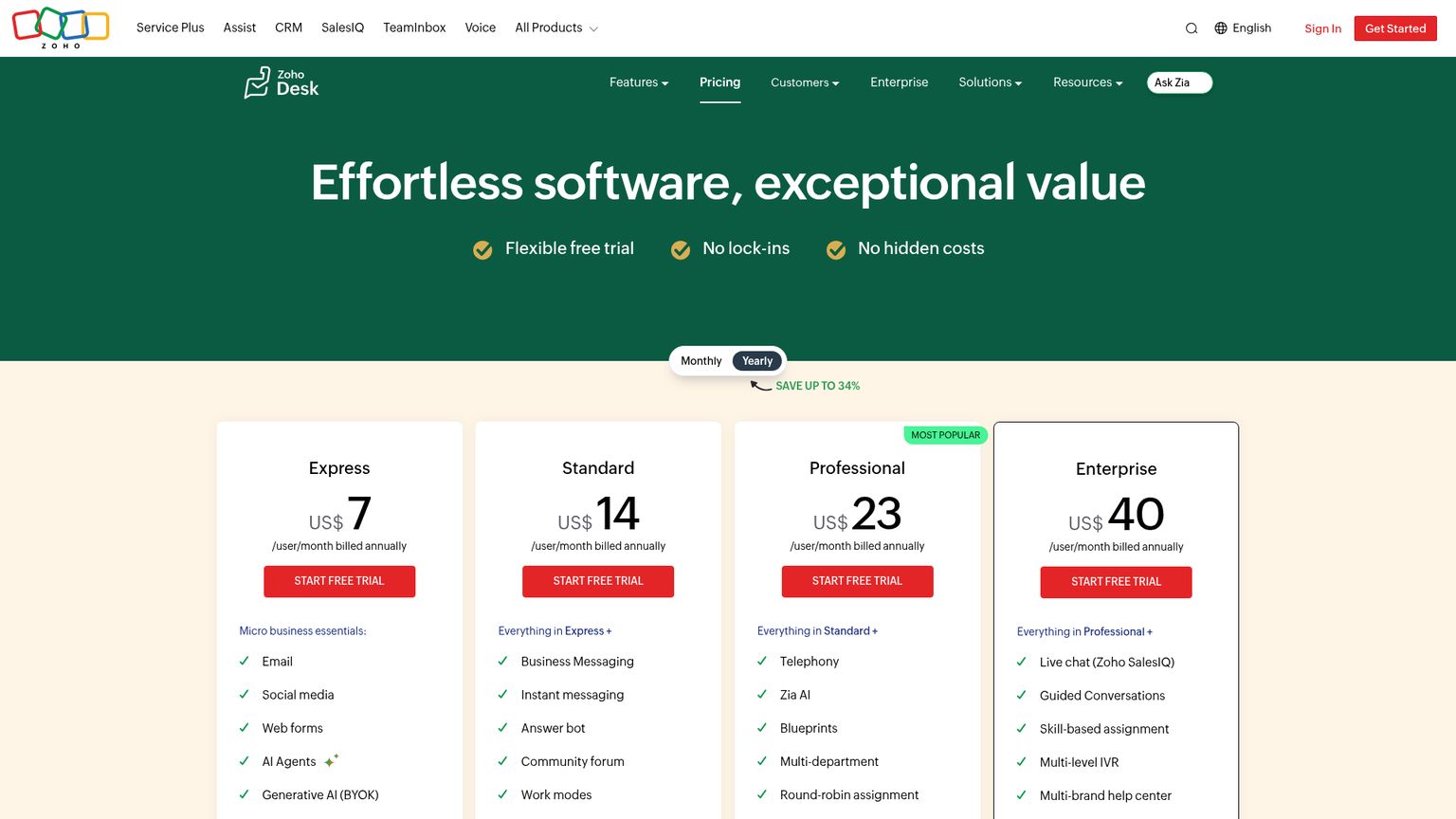
Zoho Desk is a configurable helpdesk with ticketing, process automation and customer self-service. It belongs on the shortlist for a cost-conscious business already comfortable configuring business software, especially one organized around Zoho applications. Express has a much lower entry price than Zendesk Suite, but it is not the full-featured version of Desk. Buy the tier containing your process, not the smallest number on the page.
Best for: Budget-minded teams willing to configure their ticket workflow.
Standout: A low entry price with progressively deeper process controls.
Pricing: Free $0; Express $7/user/month; Standard $14; Professional $23; Enterprise $40, billed annually.
Free trial: 15 days without a credit card; Free supports 3 users.
Express handles email, social requests, web forms, assignment and workflows. Standard adds a knowledge base, business messaging, instant messaging, a community forum and reports. Professional adds telephony integrations, multiple departments, round-robin assignment, parent-child tickets and Blueprints, a builder for ordered process steps. Enterprise adds skill-based assignment, multilevel IVR, a multibrand help center, custom modules and a sandbox. Zoho Desk pricing
A five-agent team pays $115/month for Professional or $200 for Enterprise in annual equivalents. That makes a substantial set of process controls worth investigating. It does not establish that your phone provider, integrations and AI consumption are included in those totals.
Zoho's AI offer also needs a different denominator. The page describes AI Agents using your own API key or Zoho's language model and advertises a token allowance. Tokens are pieces of text processed by a model; they are not conversations or resolutions. A bring-your-own-key configuration can create a separate model-provider bill. Do not convert the allowance into a promised number of solved tickets.
What it lacks against Zendesk: Express does not include Standard's knowledge-base and messaging scope or Professional's telephony integration and departmental process features. Enterprise-level routing and testing also sit higher in the ladder. Compared with an existing Zendesk deployment, the missing piece may be the configured process and integration behavior rather than a feature label.
For a distributor handling warranty requests, map the journey from initial email through product verification and approval. Check which tier can enforce the required handoff and keep related cases together. If the purchase requires several adjacent Zoho products or an outside phone provider, include them before approving the switch. The vendor's public paid-user-limit wording also deserves confirmation on the quote if your headcount is near a plan boundary.
- Low public entry price and a permanent Free edition.
- Professional adds useful departmental and process features.
- Enterprise offers sandbox and more advanced assignment controls.
- Express lacks several features a Suite buyer may assume are included.
- Telephony integration is not the same as an all-inclusive calling service.
- AI token or API-key billing needs separate forecasting.
Gorgias: Best for Ecommerce, With Ticket Volume Driving the Bill
Gorgias is an ecommerce-focused helpdesk and AI-agent platform built around customer orders and store support. It fits a Shopify-oriented brand whose queue is dominated by tracking, returns and order changes. Its main pricing driver is ticket volume rather than a conventional charge for every additional support agent. Choose Gorgias when the commerce workflow earns the specialization, and model the busy month before celebrating the seat savings.
Best for: Ecommerce brands whose agents need to resolve order-related requests.
Standout: Store-oriented support workflows with ticket-volume pricing.
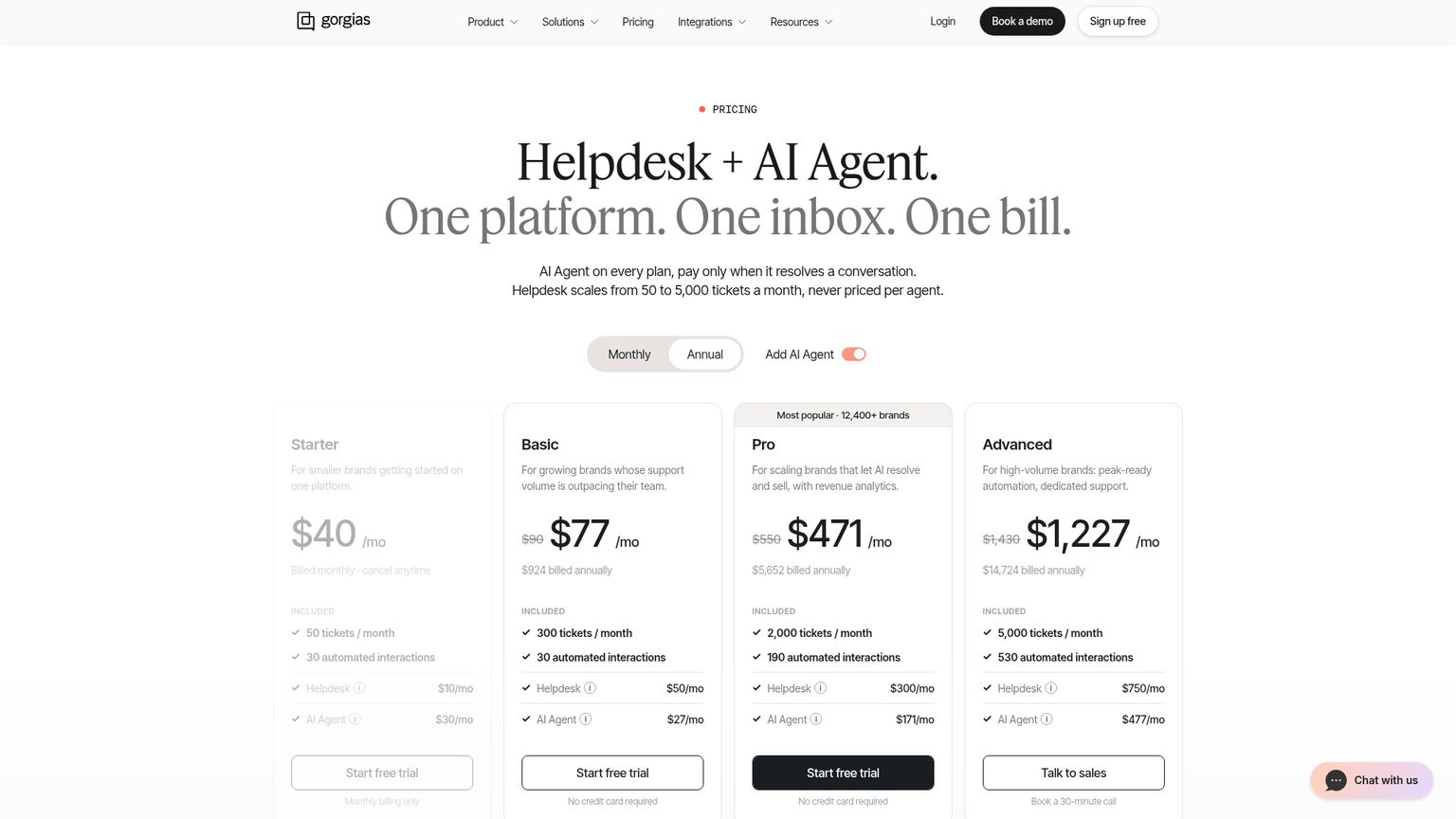
Pricing: Helpdesk-only Starter $10/month; Basic $50/month, Pro $300/month and Advanced $750/month billed annually; Custom quoted.
Free trial: Offered; the duration was not confirmed on the pricing page reviewed.
Starter includes 50 tickets/month and 3 seats. Basic includes 300 tickets, Pro 2,000 and Advanced 5,000; those larger public plans list 500 seats. Month-to-month helpdesk prices are $60 for Basic, $360 for Pro and $900 for Advanced. Starter is monthly-only. Gorgias helpdesk pricing
The pricing page also displays combined helpdesk-and-AI examples: Starter $40/month with 30 automated interactions; Basic $77/month billed annually or $90 month-to-month with 30; Pro $471/month billed annually or $550 month-to-month with 190; Advanced $1,227/month billed annually or $1,430 month-to-month with 530. Those examples retain the respective ticket allowances. They are bundles with specified volumes, not evidence that unlimited AI is included.
One detail needs a written quote: the Advanced bundle's AI subtotal and the comparison table imply different unit rates. The displayed bundle totals above are reproduced as bundles. A single Advanced per-interaction rate is deliberately not used in the calculations. Gorgias current bundle and comparison table
What it lacks against Zendesk: the entry plan is a small ecommerce package, not a general-purpose replacement for a complex service organization. AI actions such as cancellation are shown beyond Starter, while Voice and SMS are separate add-ons. A noncommerce business should be able to name the order-related advantage before adopting the specialization.
For a seasonal retailer, replay an ordinary month and the highest-volume sales month. Include tickets that reopen, AI activity and voice or SMS work according to the vendor's billing definitions. More agents may be inexpensive within the seat allowance, but a successful promotion can still increase support usage. This pricing changes which variable drives the bill; it does not remove variable cost.
- The product is centered on ecommerce support work.
- Larger public plans have broad seat allowances.
- Ticket tiers make seasonal volume an explicit planning input.
- Overages can bring a low tier close to the next plan's price.
- AI and channel add-ons need their own volume forecast.
- The Advanced AI rate discrepancy needs quote confirmation.
CloudTalk for Phone-First Support
CloudTalk is a cloud business-phone platform for answering, routing and managing calls. It belongs on the shortlist for a service business where missed calls, transfers and phone follow-up are the operational problem. It can replace the voice component of a support stack, but a telephone subscription does not establish a replacement for the email queue and help center. Choose CloudTalk for phone work and decide separately where the case record lives.
Best for: Support organizations whose main customer interaction is a call.
Standout: Phone numbers, recording, routing, monitoring and helpdesk integrations.
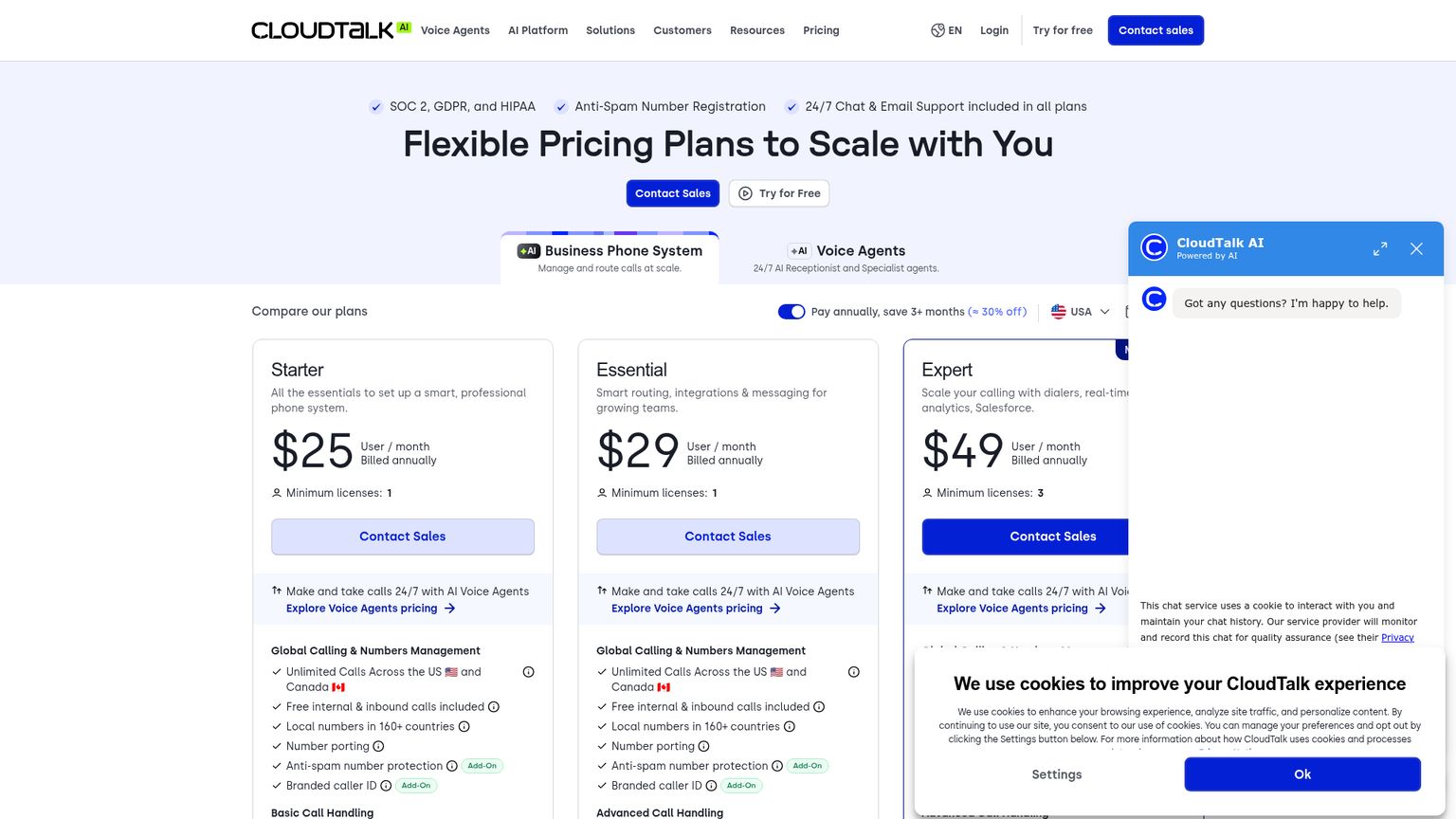
Pricing: Lite $19/user/month annually or $27 monthly; Starter $25 or $34; Essential $29 or $39; Expert $49 or $69; custom quotes available.
Free trial: 14 days without a credit card.
The public US pricing view puts standard integrations on Essential. Lite and Starter explicitly mark integrations as an upgrade. That means a support lead expecting calls to connect with an existing helpdesk should budget from Essential unless the vendor confirms a different arrangement. Expert requires at least 3 licenses; the basic plans start at 1. CloudTalk plans
For five agents, Lite is $95/month at annual rates and Essential is $145. If helpdesk integration is necessary, that extra $50 is part of the starting cost. Expert's minimum annual-equivalent base is 3 × $49 = $147/month even if only one or two people need the feature that prompted the upgrade.
The US/Canada unlimited-calling offer has fair-use conditions and destination exclusions. Number costs, international destinations and your specific traffic still belong in the quote. AI voice agents are sold separately with plan and minute-based pricing; the public page's voice section also displayed a different currency from its US phone section, so its figures are not silently folded into these dollar totals.
What it lacks against Zendesk: the phone-plan comparison does not supply the complete ticket, knowledge-base and cross-channel operating scope of Suite. Keeping a separate helpdesk may be the right design. It means the comparison is CloudTalk plus that helpdesk, with the cost of maintaining their connection.
For a home-services business, the pilot should include an unanswered call, a transfer, a callback and a customer who emails after speaking to an agent. Confirm that whoever receives the email can find the call context. A cheaper phone seat is useful only if the new process does not make the customer repeat the problem.
- A focused product for phone-heavy work.
- Published seat tiers and minimum-license rules.
- Standard helpdesk integrations offer a route to retaining your case system.
- Entry phone tiers do not include the standard integration tier.
- It is not a complete email/help-center replacement by itself.
- Calling exclusions and separate AI voice usage complicate the headline price.
Zendesk Alternatives Open Source: Chatwoot
Chatwoot is the open-source option to consider when control of infrastructure is an explicit requirement and someone can operate it. Its Community Edition covers a shared inbox, chat, email, social channels, automation and reports on your own servers. That is a different cost model from asking a vendor to run the service for you. Choose self-hosting for control with an accountable operator, not because a zero license price makes support infrastructure costless. Chatwoot Community Edition
Best for: A business with the technical capacity to own its support deployment.
Standout: A free Community Edition on infrastructure you control.
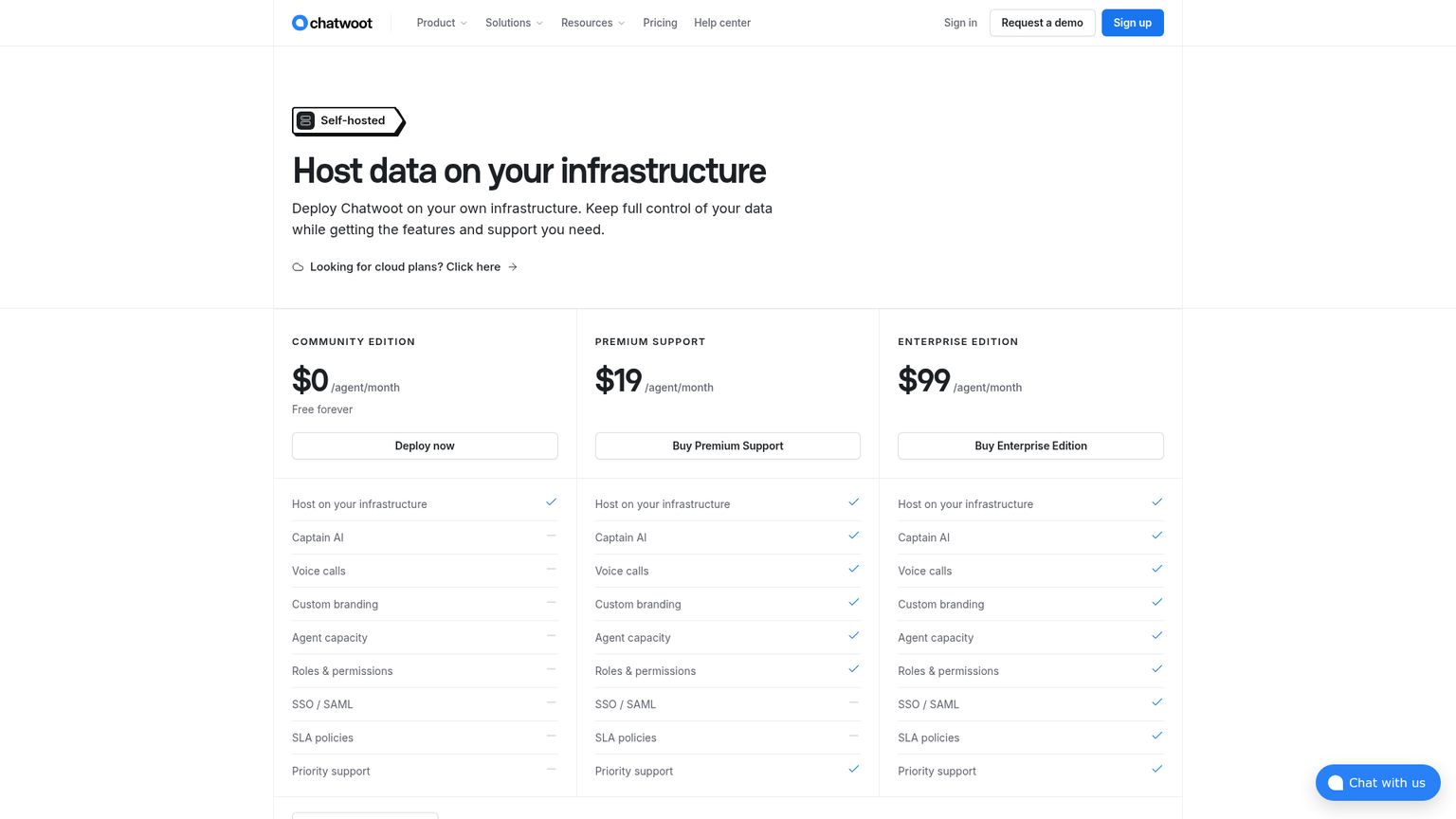
Pricing: Community $0 license; self-hosted Premium Support $19/agent/month and Enterprise Edition $99, billed annually.
Free trial: Cloud has a 15-day trial; Community has no recurring license fee.
Community does not include Captain AI, voice calls, advanced roles, SSO/SAML, SLA policies or priority support. Premium Support adds several capabilities, including Captain AI and voice; Enterprise adds SSO and SLA policies. Your infrastructure and operational work remain separate. The deployment requires services including Linux, PostgreSQL and Redis, plus storage for files. Self-hosted plan comparison
Cloud is a separate purchase. Hacker is free for up to 2 agents and 500 conversations/month, but only live chat, with 30-day retention and no Captain AI or help center. Startups is listed at $19/agent/month, Business at $39 and Enterprise at $99. The page reviewed did not label the commitment beside those cloud prices, so confirm it at checkout. Business adds teams, automation and voice; Enterprise adds SSO and audit logs. Captain AI credits are included on paid cloud plans, with additional credits at $20 per 1,000. Chatwoot cloud pricing
What it lacks against Zendesk: free Community lacks several governance and service-management features that may already be embedded in your Zendesk operation. It also transfers uptime, upgrades, backups and recovery responsibilities to your business. Paying for those responsibilities with employee time still counts as paying.
A technical founder may accept that trade because data control is essential. A support lead without infrastructure ownership should prefer a managed shortlist. Before choosing Community, assign a named owner for backups and a tested restore procedure; before choosing paid cloud, compare the same retention and access-control requirements you apply to Zendesk.
- An open-source path with no Community license charge.
- Infrastructure control for businesses that require it.
- Paid self-hosted and cloud options offer different operating choices.
- Free Community excludes AI, voice and important governance controls.
- Self-hosting introduces ongoing operational work.
- The free cloud plan is a restricted live-chat offer, not a full free helpdesk.
Free Zendesk Alternatives and Knowledge Bases
A free plan is useful when its operating limit fits the queue. Zoho Desk Free supports 3 users; Help Scout Free supports 5 but caps monthly contacts at 100. Tidio's Free human allowance and one-time Lyro allowance are separate. Chatbase Free is a small agent-credit allowance, and Chatwoot's free cloud plan is live-chat-only. None should be treated as an unlimited replacement for every Zendesk channel.
A support lead should forecast the first normal month after a trial, then the first busy month. That reveals whether the free offer is a durable fit or simply a convenient pilot.
Zendesk Guide Alternatives: Check the Knowledge Workflow
If the job is replacing Zendesk's help-center content, start with the publishing and access requirements. Freshdesk Growth includes a knowledge base; Help Scout offers Docs; Front offers a public knowledge base; Zoho Desk adds its knowledge base at Standard. Multilingual, private and multibrand requirements move the relevant products up their tier ladders.
A docs-trained agent is a different component. Chatbase can use knowledge sources to answer questions, but an agent subscription is not automatically a replacement for the public publishing workflow, article permissions and URLs your customers already use. Map those requirements separately.
Compare AI Bills Without Confusing the Units
An inexpensive AI unit can be charged more often than an expensive one. A credit, a session, a conversation and a resolution measure different events. The comparison below uses 500 separately billable units after any included allowances or trials to make the rate arithmetic visible. It does not claim that each row handles the same customer workload.
Seat fees, channel usage and other add-ons are excluded. Tidio, Chatbase, Front and Gorgias are not forced into this table because their quotas, credits, starting rates or bundled allowances need a workload-specific calculation.
The useful measurement is total support cost for correctly completed customer work, including escalations and human handling. If a bot produces an answer that triggers another contact, your financial outcome may worsen even when the vendor's AI unit looks cheap. During a pilot, record the billed event alongside whether the customer's issue stayed resolved.
The broader AI customer-service tools and resolution-pricing comparison covers that buying problem in more detail.
How These Were Picked
The shortlist prioritizes replacement scope, the minimum usable tier, the charging unit, human handoff and operational controls. Prices and published capabilities were checked against each vendor's own live pages on the date above. The calculations are explicit scenarios, not customer results. These products were researched and compared; no hands-on product trial or benchmark is claimed.
The main field covers chat-led, conventional helpdesk, collaboration, ecommerce and phone-led support. Chatwoot adds the infrastructure-ownership decision. Enterprise CRM transformations and internal IT service-management projects are outside this small-to-mid-size customer-support brief, so the list does not expand into every adjacent platform.
Partner status does not change the scope judgment: Tidio belongs in small-team chat, Chatbase in knowledge-led agents and CloudTalk in phone support. A partner earns a place where the workflow fits, not a universal first-place ranking.
Stay on Zendesk If
Stay when its configured operating model is worth more than the achievable saving. A low replacement seat price cannot compensate for losing dependable routing, an important integration or customer history that agents need throughout the day.
Stay if you rely on connected email, chat and phone cases and the candidate would split them across products without a proven handoff. Stay if skills-based routing, approvals, custom roles or a sandbox are essential and the candidate only supplies them at a similar total price. Stay if your current renewal terms beat the public list-price assumption used in a comparison.
Also consider keeping Zendesk while changing only the AI layer. An agent connected to the existing system may address the actual problem with less disruption. Require evidence that the connector preserves the case workflow and include both subscriptions in the budget.
Before migrating, remove unused seats and add-ons from the renewal comparison and assess whether a lower existing tier still covers the work. The objective is a better support operation at an acceptable cost, not a vendor change for its own sake.
The Ones to Avoid for Your Situation
- Avoid CloudTalk as a whole-helpdesk replacement when unresolved email cases and public knowledge content are central. Evaluate it as the phone component instead.
- Avoid Chatbase Hobby as the budget for a built-in human helpdesk. That requirement starts on Standard.
- Avoid Front Starter for an omnichannel plan. Its one-channel-type boundary makes Professional the relevant comparison.
- Avoid Gorgias Starter for a large seasonal queue. Its small ticket allowance and overage economics require a busy-month forecast.
- Avoid free Chatwoot Community without an infrastructure owner. License savings do not create backups, upgrades or incident coverage.
- Avoid assuming Intercom is an escape from seat-plus-AI billing. It can be the better workflow while keeping both cost drivers.
These are mismatches between a plan and a job. They are not claims that the products are universally poor choices.
Move One Queue Before Moving the Company
A successful migration preserves ownership and customer context before it changes the destination of every request. Start with a queue whose outcome you can verify, and keep a reversible route back until the new process works.

Export the operating requirements
Inventory open cases, customer records, attachments, knowledge articles, saved replies, routing rules, permissions and reports. Record which historical data must stay searchable and which can remain in a read-only archive. Agree on that requirement before buying migration services.
Pilot a bounded queue
Choose one address, product line or phone group. Confirm the destination plan supports its workflow after the trial ends. For AI, include unsupported questions and cases that need a person, not just the questions your knowledge base answers well.
Reconcile history and ownership
Check record counts, attachments, timestamps, assignees, reopened cases and escalation behavior. Follow a request across chat, email or phone where relevant. Record any duplicate notifications or cases with no owner and fix the cause before expanding.
Switch with a named rollback owner
Schedule the cutover, train the people covering the queue and retain the old system until reconciliation is complete. Set AI usage alerts or caps where available. Compare the first paid invoice with the pilot forecast before canceling overlapping services.
Your Monday move is to choose the support model, shortlist the two products that fit it and run the same bounded workload through both. The winner is the one that preserves the necessary case workflow at a defensible total cost.
Frequently Asked Questions
Which is better, Zendesk or Freshdesk?
Freshdesk is the stronger starting shortlist for a conventional email-led helpdesk when cost and simpler scope drive the decision. Zendesk can be the better choice when its existing cross-channel setup, routing and governance already do valuable work. Compare Freshdesk Omni with Zendesk Suite when the requirement is omnichannel, rather than using Freshdesk's email-led entry price.
Who does Zendesk compete with?
Direct helpdesk competitors include Freshdesk, Help Scout, Intercom, Front, Zoho Desk and Gorgias. Tidio, Chatbase and CloudTalk also compete for parts of the support budget, but they fit different chat, AI-agent and phone-led operating models. Chatwoot adds an open-source option for businesses able to operate their own deployment.
Is Zendesk a CRM or CMS?
Zendesk's support offering is a customer-service platform with customer records, ticket workflows and knowledge content. That overlaps with customer relationship management, or CRM, and help-center content management. It is not the same purchase as a general website content-management system. Select it for the service workflow you need, rather than the acronym. Zendesk's product scope
Is there a free version of Zendesk?
The current pricing page advertises a 14-day trial, not a permanent free customer-support plan. Qualifying programs can have separate terms. For ongoing free options, evaluate the specific user and workload limits of Zoho Desk, Help Scout, Tidio or Chatwoot. Zendesk trial details
How much does Zendesk cost per month?
Support Team is $19/agent/month paid yearly or $25 monthly. Suite Team is $55 yearly-equivalent or $69 monthly; Suite Professional is $115 or $149. Suite Enterprise + Copilot requires a quote. Additional AI resolutions, optional products and usage can increase the total. Zendesk prices
What are some common problems with Zendesk?
For the buyer in this comparison, the problems to examine are rising seat cost, additional AI usage, paid add-ons and the work needed to administer a configured helpdesk. Their impact depends on your setup; this is not a claim about how frequently every customer experiences them. An alternative should demonstrably improve one of those conditions without losing essential case handling.
Is Zendesk an Indian company?
Zendesk's own company page lists its headquarters in San Francisco. Its presence in a country does not by itself identify its headquarters or determine where your customer data will be stored. Zendesk company information
Can Zendesk be trusted?
Zendesk publishes security, privacy and compliance information in its Trust Center. Use those materials and the proposed contract to check your required access controls, data handling, retention and service commitments. A vendor's general trust claims do not establish suitability for every organization's requirements. Zendesk Trust Center
How is Zendesk doing financially?
Its acquisition announcement records that Zendesk became privately held in November 2022. The pricing and product evidence used here does not establish its current profitability or financial health. Old public-market figures are not a current assessment; request appropriate vendor-diligence information if financial continuity is part of procurement. Zendesk acquisition announcement
For help building the knowledge connections, migration and human handoff around your support operation, see AI customer service.
- Published
- Category
- Growth
- Language

Best CRM for Small Business in 2026: Pipedrive, Close, folk, Keap and More (Compared)
Compare nine small-business CRMs by how you sell, verified prices for five users, free-plan limits, setup effort and the upgrades that matter.Oct 10, 2026Growth
Later Pricing: Plans, Add-Ons and the Five-Client Bill
Later plans, social sets, users and add-ons priced for a solo brand and five-client agency. Compare annual and monthly bills with three alternatives.Oct 10, 2026Growth
Apollo Alternatives in 2026: Lusha, FullEnrich and Amplemarket Compared
Compare Apollo alternatives for contact data, sequencing or both, with current prices, credit costs and reasons to stay on Apollo.Oct 10, 2026Growth
9 Semrush Alternatives in 2026: SE Ranking, Ahrefs and DataForSEO
Compare nine Semrush alternatives by job, price and limits, including SE Ranking and DataForSEO. Know what you save and what you give up.Oct 10, 2026Growth
WhatConverts Pricing: Plans, Usage and Agency Bills
WhatConverts plans, usage credits and fees explained, with bills for one business and 20 clients, plus a fair CallRail cost comparison.Oct 10, 2026Growth
Beehiiv Review
Beehiiv reviewed for business newsletters: current pricing, growth, monetization, AI, MCP, analytics and the costs that change the buying decision.Oct 10, 2026Growth
Trainual Review
Trainual review for SOPs and onboarding: AI drafting, knowledge search, read-only MCP, quote-only plans, implementation and who should skip it.Oct 10, 2026Growth