Beehiiv Pricing: Annual Costs by List Size
Beehiiv pricing verified October 2026: annual bills at 1k, 10k, 50k and 100k subscribers, plan features, October changes and paid newsletter fees.
Published
 By Omid Saffari



beehiiv pricing is free up to 2,500 subscribers, but a 10,000-subscriber newsletter pays $1,428 a year for Lite or $2,388 for Pro on annual billing. The advertised $49 and $95 monthly prices apply to the 1,000-subscriber tier, not the plans' maximum list sizes. Paid subscriptions have a 0% beehiiv platform fee, with Stripe processing charged separately.
Verified against beehiiv's live pricing page on 9 October 2026, including the subscriber slider in both billing modes. Prices below are in U.S. dollars, before applicable taxes, promotions and payment processing. Annual totals are calculated from the displayed monthly equivalent.
beehiiv is a publishing platform for newsletters, websites and audience monetization. For a founder buying it, the decision has two parts: how large the whole audience is, and which paid features the business needs.
Disclosure: beehiiv and Kit are partners. Qualifying links may earn a commission; the comparisons use the vendors' published prices.
Beehiiv Pricing Plans at a Glance
Free costs nothing, Lite starts at $588 a year, and Pro starts at $1,140 a year. Those paid starting prices cover the 1,000-subscriber tier. The subscriber ceiling tells you how far a plan can grow, not how many subscribers its starting price buys.
Source: beehiiv pricing, checked 9 October 2026. All plans include unlimited email sends. Lite and Pro prices rise with the subscriber tier selected on the page.
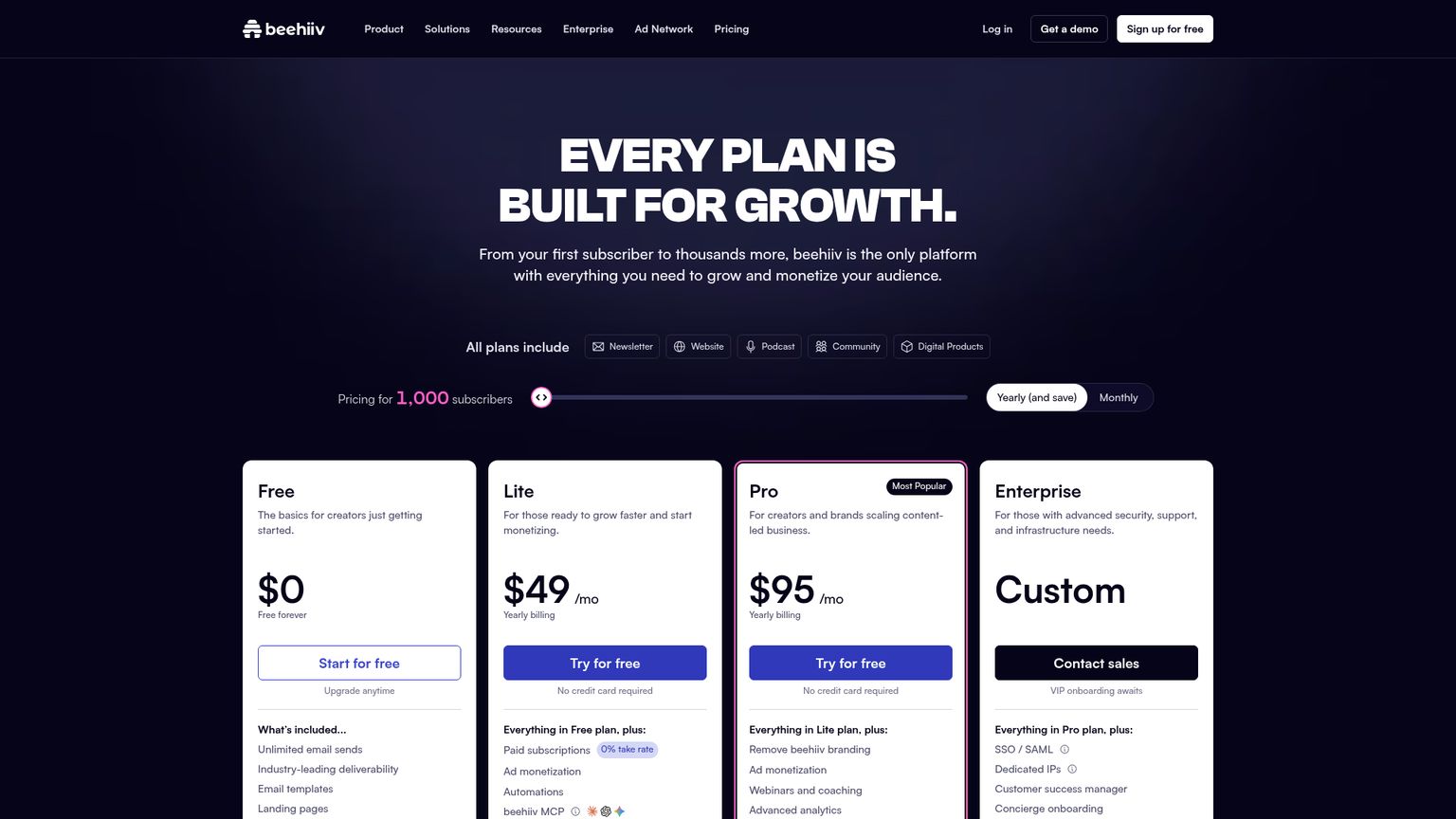
Lite is the default paid choice for a business newsletter. It includes paid subscriptions, the Ad Network and automations. Pro earns its higher bill when the business needs more seats, more advanced features or a list beyond Lite's ceiling. Enterprise can be appropriate at any list size when security or infrastructure requirements demand it.
Beehiiv Pricing Calculator: Your Bill at 1k, 10k, 50k and 100k
Your yearly beehiiv cost is the selected subscriber-tier price multiplied by the billing period, plus taxes and any separately incurred payment fees. The figures below assume the audience stays in the same tier throughout the year. A growing list can trigger another charge before renewal.
At 1,000 subscribers: Free, $588 Lite or $1,140 Pro annually
Free remains $0. At the same list size, Lite is $49 a month equivalent on annual billing, producing a $588 annual bill. Paying monthly costs $59 per month, or $708 across a full year. Annual billing saves $120.
Pro is $95 a month equivalent, or $1,140 annually. Its monthly option is $109, totaling $1,308 across the year. Annual billing saves $168. Enterprise is custom even at this small list size. These are the live 1,000-subscriber slider prices.
A solo founder sending a weekly business update can stay on Free. A small list does not make a paid feature free: a custom domain or an automated welcome sequence can justify Lite before the list reaches its free ceiling. Pro costs another $552 annually here, so buy it for a required feature or seat, rather than the size of the audience.
At 10,000 subscribers: $1,428 Lite or $2,388 Pro annually
Lite costs $119 a month equivalent, or $1,428 billed yearly. Month-to-month Lite is $139, totaling $1,668 across a year. The annual saving is $240. Free is unavailable at this list size.
Pro costs $199 a month equivalent, or $2,388 billed yearly. Its monthly price is $239, totaling $2,868 across the year. The annual saving is $480. Enterprise still requires a quote. Source: the live 10,000-subscriber slider.
For a B2B founder with an editor and a single paid subscription offering, Lite may cover the workflow. Pro adds $960 annually. That premium needs a reason, such as a third workspace user, removing beehiiv branding, more paid subscription tiers or an automation feature gated to Pro.
At 50,000 subscribers: $2,988 Lite or $4,788 Pro annually
Lite is $249 a month equivalent, or $2,988 billed yearly. Monthly billing is $299, totaling $3,588 over a year. Annual billing saves $600.
Pro is $399 a month equivalent, or $4,788 billed yearly. Monthly billing is $469, totaling $5,628 over a year. Annual billing saves $840. Free is unavailable and Enterprise is custom. These figures come from the 50,000-subscriber slider.
An advertising-supported publication should budget the software bill against revenue it can support. Access to the Ad Network is a feature; it is not a promise that ads will cover the invoice. Pro's additional $1,800 annually needs to pay back through the work it enables.
At 100,000 subscribers: $4,788 Lite or $7,188 Pro annually
Lite is $399 a month equivalent, or $4,788 billed yearly. Paying $469 monthly totals $5,628 over a full year, so annual billing saves $840.
Pro is $599 a month equivalent, or $7,188 billed yearly. Its $699 monthly option totals $8,388 over a year, making the annual saving $1,200. Free is unavailable and Enterprise remains custom. Source: the 100,000-subscriber slider.
This is Lite's subscriber ceiling. A publisher expecting to grow beyond it needs to budget for Pro's next applicable subscriber tier, not merely extend the $399 rate. Pro already costs $2,400 more annually at 100,000, before that further growth.
The other subscriber tiers on the pricing slider
The slider also publishes the following stops. In each line, the first monthly amount is the annual-billing equivalent, followed by the calculated yearly bill and the separate month-to-month price. beehiiv's pricing page is the source for every rate.
- 2,500 subscribers: Free $0. Lite $69 equivalent, $828/year, or $79 monthly. Pro $129 equivalent, $1,548/year, or $149 monthly.
- 5,000: Lite $95 equivalent, $1,140/year, or $109 monthly. Pro $169 equivalent, $2,028/year, or $199 monthly.
- 25,000: Lite $169 equivalent, $2,028/year, or $199 monthly. Pro $299 equivalent, $3,588/year, or $349 monthly.
- 75,000: Lite $329 equivalent, $3,948/year, or $389 monthly. Pro $499 equivalent, $5,988/year, or $589 monthly.
- 150,000: Pro $689 equivalent, $8,268/year, or $799 monthly. Lite is unavailable.
- 200,000: Pro $779 equivalent, $9,348/year, or $899 monthly. Lite is unavailable.
- 250,000: Pro $869 equivalent, $10,428/year, or $999 monthly. Lite is unavailable. Beyond Pro's ceiling, ask for Enterprise pricing.
Free stops at 2,500 throughout; Enterprise is available by custom quote at every audience size. These are stepped subscriber brackets. A list between published stops needs the tier that accommodates its count, rather than a price interpolated between two numbers.
Cost per 1,000 subscribers and per send
On annual Lite, the monthly software cost per 1,000 subscribers is $49 at 1,000 readers, $11.90 at 10,000, $4.98 at 50,000 and $3.99 at 100,000. The price rises in dollars while the cost per reader falls.
For a founder sending four full-list emails in a month to 10,000 subscribers, that is 40,000 email sends. Allocating the $119 annual-plan monthly equivalent across those sends gives $2.98 per 1,000 emails sent, rounded. This is a budgeting calculation, not a metered email charge: beehiiv includes unlimited sends.
Use that calculation when comparing tools that meter email volume. Use the full annual invoice when deciding whether the publication can afford the commitment.
Annual Billing Saves Up to 20%, With a Commitment
beehiiv advertises annual savings of up to 20%, not a universal 20% discount. At 1,000 subscribers, Lite's $49 versus $59 amounts to about 16.9%; Pro's $95 versus $109 amounts to about 12.8%. The saving depends on both plan and subscriber bracket. Pricing FAQ.
The annual amount is paid for the year. A $49 monthly equivalent is a $588 commitment, rather than a $49 cancel-any-month charge. At that Lite tier, ten monthly payments would total $590, almost the same as the annual bill. If the newsletter is a short experiment, a smaller monthly saving may not justify committing before the workflow proves useful.
Ordinary cancellation does not produce a prorated refund. You keep access through the current term, and downgrades take effect at its end. The refund help article describes subscriptions as final; the Terms of Use include a narrow unused-term refund remedy for qualifying material reductions in core functionality. That exception is not a general satisfaction guarantee.
Taxes are extra. Annual plans also cannot use the pause option available to eligible monthly accounts. A founder buying yearly should be comfortable with the total invoice and the features they will use, not just the discounted monthly display.
Did Beehiiv Change Its Prices in October 2026?
Yes. beehiiv officially announced new plans and pricing on October 1, 2026, with the new paid prices effective for new customers that day. This is confirmed by beehiiv's own announcement.
Existing customers move to the new pricing at their first renewal on or after November 1, 2026. Monthly customers receive at least 30 days' notice before their first bill at the new price. Annual customers keep their current price through the end of the existing annual term.
The change also extends Pro's self-serve subscriber ceiling to 250,000. An existing customer's current invoice can therefore differ from the new-customer prices on this page without either invoice being wrong.
For the operator managing the budget, the important date is the account's renewal. Put that date beside the new plan, subscriber bracket and full renewal amount. A current discounted or older invoice is not a promise of the same bill next year. The transition announcement also says existing discounts carry over, while discounts cannot be combined.
Is Beehiiv Free? When Free Is Enough
Free is enough for a single-person business newsletter with up to 2,500 subscribers that needs broadcasts and a basic publishing home. It includes unlimited email sends, email templates, a welcome email, the recommendation network and API access. It supports one workspace seat and one publication, with a 30-day analytics lookback window. Free-plan feature grid.
A founder writing a company update, or a consultant sending useful industry analysis to a small list, can use Free indefinitely while those requirements remain true. Sending more often does not itself force an upgrade.
The limits that matter arrive before or after the subscriber ceiling:
- Your own website or sending domain requires a paid plan.
- A welcome email is included, but a multi-step custom automation is paid.
- Paid newsletter subscriptions and the Ad Network begin on Lite.
- Another workspace user or another publication requires more capacity.
Free includes access to websites, podcasts, community and digital products, with plan-specific limits. In the current feature grid, Free can sell one digital product with one variant. A founder selling a single downloadable guide may therefore earn money without buying the paid-newsletter features. A recurring paid newsletter is a different requirement.
Do not confuse the free trial with the permanent Free plan. A new account can start a 14-day Pro feature trial without a credit card, while remaining a Free account with temporary access and some limits. Check the trial help page before designing a workflow around a feature that disappears afterward.
What Lite, Pro and Enterprise Put Behind the Paywall
The cheapest plan is the one that supports the required workflow, not necessarily the smallest audience. The live feature comparison draws these boundaries.
Custom domains: Lite and above
Lite supports a custom website domain and a custom email sending domain. Free uses a beehiiv subdomain. You still need to obtain the domain separately through a domain provider; connecting it is a beehiiv feature, domain ownership is a separate expense. The custom-domain help article confirms availability on paid plans.
For a consultancy publishing under its business name, that brand requirement can make Lite worthwhile at a small list size. Removing beehiiv's own branding is a separate gate: it requires Pro or Enterprise. Buying Lite for a domain does not also remove the platform branding.
Automations: 10 live workflows on Lite, unlimited on Pro
An automation is a sequence that runs after an event, such as someone joining the list. Lite includes 10 live custom automations; Pro and Enterprise include unlimited. Free has the welcome email but no live custom automations.
Lite supports sign-up triggers, email steps, delays, tags and conditional branches. The current grid puts click-triggered automations and advanced A/B branches on Pro and Enterprise. A founder needing a simple onboarding sequence can start with Lite; a growth lead building a workflow around clicks must check the required trigger before buying it.
Ad Network and subscriptions: Lite is the entry point
Lite includes the Ad Network, paid newsletter subscriptions and paid recommendations. Free's recommendation network is a way to recommend publications; it is not the same as getting access to paid recommendation revenue.
Lite supports one paid subscription tier. Pro and Enterprise allow unlimited tiers. A publication with one premium offer can use Lite. A publisher planning distinct paid membership levels has another reason to consider Pro. Neither access to ad offers nor the ability to charge readers is a revenue forecast: the fixed software bill still needs funding.
API: access on Free, sending through the API on Pro
An API lets software connect to beehiiv programmatically. API access is included on every plan. The pricing grid labels the rate limits Low on Free, Standard on Lite, High on Pro and Custom on Enterprise. Those labels are not numerical request allowances.
The Send API, which sends email programmatically, is available on Pro and Enterprise. Webhooks, notifications sent to another system when an event occurs, are absent on Free, limited to three on Lite, and unlimited on Pro and Enterprise.
For an operator connecting subscriber records to a business system, basic API access may be sufficient. For a builder planning programmatic sending, Free API access does not satisfy the requirement. The specific operation decides the plan.
Seats and publications: the owner counts
Free has one team seat and one publication. Lite has two seats and three publications. Pro has 10 seats and 10 publications. Enterprise has unlimited seats and custom publication limits. A team seat includes the workspace owner.
A founder and an editor fit Lite's two seats. Adding a third full workspace user moves that staffing requirement beyond Lite, even when the list is small. Guest authors have separate limits, so occasional contributions should not be treated as identical to full workspace access.
Pro also provides unlimited analytics history and brand removal, while Lite's analytics history is 12 months. Enterprise adds requirements such as SSO/SAML, which connects account access to a company login system, dedicated IPs and a customer success manager. A regulated business can need Enterprise for those requirements well before reaching the largest audience tier.
Beehiiv Review: The Rule for Choosing a Plan
Choose Free for a small broadcast list, Lite for the paid publishing workflow, and Pro when a specific feature, seat or subscriber limit forces the decision. Treat Enterprise as a quote for security, support or infrastructure requirements.
At 10,000 subscribers, the annual Lite-to-Pro difference is $80 a month equivalent, or $960 a year. Both have a 0% take on paid subscriptions. Upgrading to Pro does not improve that take rate. It purchases more capability and capacity.
If the paid newsletter charges $10 a month and uses the stated Stripe fee baseline, each reader contributes $9.41 before the software bill and other business expenses. Nine additional paying readers would cover the $80 monthly-equivalent upgrade. That is a break-even illustration, not a promise that a Pro feature will acquire those readers.

Skip a paid upgrade while Free meets the business's needs. Skip Pro while Lite covers the workflow. A founder trying to improve newsletter revenue should identify the missing capability before adding a recurring expense.
What a Paid Newsletter Keeps After Fees
beehiiv takes 0% of paid subscription revenue. Stripe still charges processing fees. beehiiv's pricing FAQ states 2.9% plus $0.30 per transaction, matching Stripe's U.S. domestic-card baseline. Rates can differ by country, payment method and currency.
Under that baseline, you keep 97.1% of each charge, minus $0.30, before the beehiiv plan bill. The fixed 30-cent fee is charged per transaction, not once across the whole newsletter.
A 10,000-person list with 500 readers paying $10 monthly
Suppose a founder has 10,000 total subscribers and 500 paying readers at $10 a month. This is an illustration, not a conversion forecast. The business bills $5,000 across 500 successful monthly payments.
- Percentage processing fee: $5,000 × 2.9% = $145.
- Fixed processing fees: 500 × $0.30 = $150.
- Total processing: $295, leaving $4,705.
- Annual Lite's monthly equivalent: $119, leaving $4,586.
On Pro at the same list size, the $199 monthly equivalent leaves $4,506. On month-to-month Lite, the $139 bill leaves $4,566.
These are amounts after the modeled fees and software expense, before content production, acquisition costs, refunds, tax and other business expenses. The annual-plan monthly equivalent is an accounting allocation: the actual annual software invoice is paid for the year.

If the modeled audience and payments remain steady for a year, the newsletter retains $56,460 after processing, then $55,032 after the $1,428 Lite annual bill. List growth or changes in paid readership alter that result.
How many paying readers cover the plan?
At $10 per monthly charge, the modeled contribution is $9.41 per reader. Thirteen paying readers cover Lite's $119 monthly equivalent at a 10,000-person list. Twenty-two cover Pro's $199 equivalent. Those thresholds only cover software and the modeled card fees; they do not pay the writer or fund list acquisition.
This is why the bill follows the whole audience, while the subscription contribution follows the paying audience. A large free list with few paying readers can carry a meaningful bill even with a 0% platform take.
Annual reader billing reduces repeated fixed fees
If the reader pays the same $120 yearly total in one charge rather than twelve $10 charges, the percentage fee stays the same and the fixed fee occurs once. Under the same baseline, the annual charge costs $3.78 in processing and retains $116.22. Twelve monthly charges cost $7.08 and retain $112.92.
That is $3.30 more retained per reader per year, or $1,650 across 500 readers. The calculation assumes the same gross price and successful payments. A discount on the annual reader offer can outweigh the processing saving, so compare the net annual price, not just the number of transactions.
Beehiiv Alternatives: Compare the Same Audience and Revenue
A 0% platform fee does not automatically make beehiiv the cheapest option. Compare the software invoice and payment charges at the same list size, rather than lining up unrelated starting prices. For the wider shortlist, see best newsletter platforms for creators.
Use a common example: 1,000 total subscribers, 100 readers paying $10 monthly, $1,000 gross revenue and 100 U.S. web card payments. Annual software prices are allocated monthly. Taxes, refunds, currency charges and ancillary services are excluded.
On beehiiv Lite, the modeled processing is $59 and the annual software equivalent is $49. That leaves $892 a month. The alternatives below use their live published prices and fees, with no assumption that their products are identical.
Kit: a larger free ceiling and inclusive payment fees
Kit is a creator email platform with a Free plan for up to 10,000 subscribers, including digital-product and subscription sales. Its published transaction fee is 3.5% plus $0.30, including credit card processing. Do not add another 2.9% on top. Kit pricing.
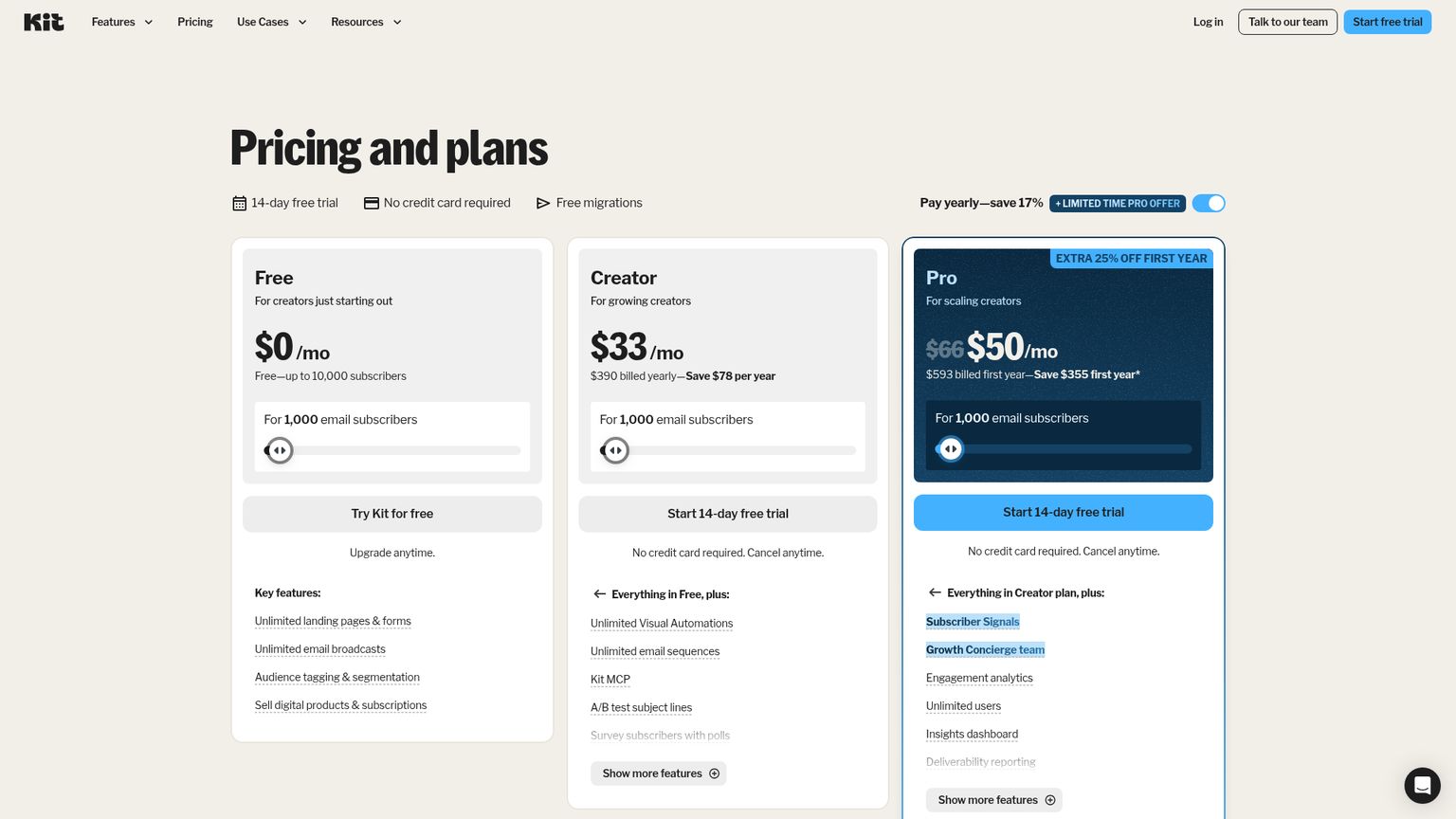
In the common example, Kit Free incurs $65 in payment fees and leaves $935, compared with beehiiv Lite's $892. For a small paid newsletter whose workflow fits Kit Free, the absence of a software bill can outweigh beehiiv's lower transaction rate.
If the business requires Kit Creator's unlimited visual automations and email sequences, the exact annual invoice at 1,000 subscribers is $390, or $32.50 allocated monthly. The page displays a rounded $33 monthly figure; multiplying that rounded figure by 12 would overstate the invoice. With the same $65 transaction fees, Creator leaves $902.50 in the modeled month.
Kit is worth shortlisting for a founder using email to sell products and organize customer sequences. Its limitation for the comparison is that a free-plan result only applies while its feature and subscriber limits fit. The paid list-size ladder is a separate budget decision covered in Kit pricing.
Beehiiv vs Substack: a fixed bill against revenue share
Substack is a publishing platform that charges no software subscription for free publishing, regardless of subscriber count. Once you charge readers, Substack takes 10%. Its help page also lists 2.9% plus $0.30 for U.S. card payments and 0.7% Stripe Billing for recurring payments. Substack's fee explanation.
In the common $1,000 revenue example, the costs are $100 platform share, $59 card processing and $7 recurring Billing. That leaves $834, versus beehiiv Lite's modeled $892. Those figures apply to the stated web-payment assumptions; in-app purchases and other methods can differ.
Looking only at the 10% platform share, annual Lite's monthly equivalent breaks even at $490 gross paid revenue at 1,000 total subscribers, $1,190 at 10,000, $2,490 at 50,000 and $3,990 at 100,000. Divide the applicable beehiiv monthly equivalent by 10% to reproduce that comparison. Extra billing fees, migration costs and feature differences belong in the final decision too.
Substack is attractive when avoiding a fixed software bill matters most. Its percentage cost grows directly with paid revenue, even when the list stops growing. For a newsletter whose revenue is already meaningful, price the fixed alternative before accepting that ongoing share. See beehiiv vs Substack for the wider comparison, using the current rates here for budgeting.
Beehiiv vs Ghost: compare a paid membership site
Ghost is a website and newsletter publishing system; Ghost(Pro) is its managed hosted service. At 1,000 members, the Publisher plan is $29 a month billed yearly, or $348 annually. It includes paid subscriptions, custom themes and three staff users, with a 0% platform transaction fee. Ghost(Pro) pricing.
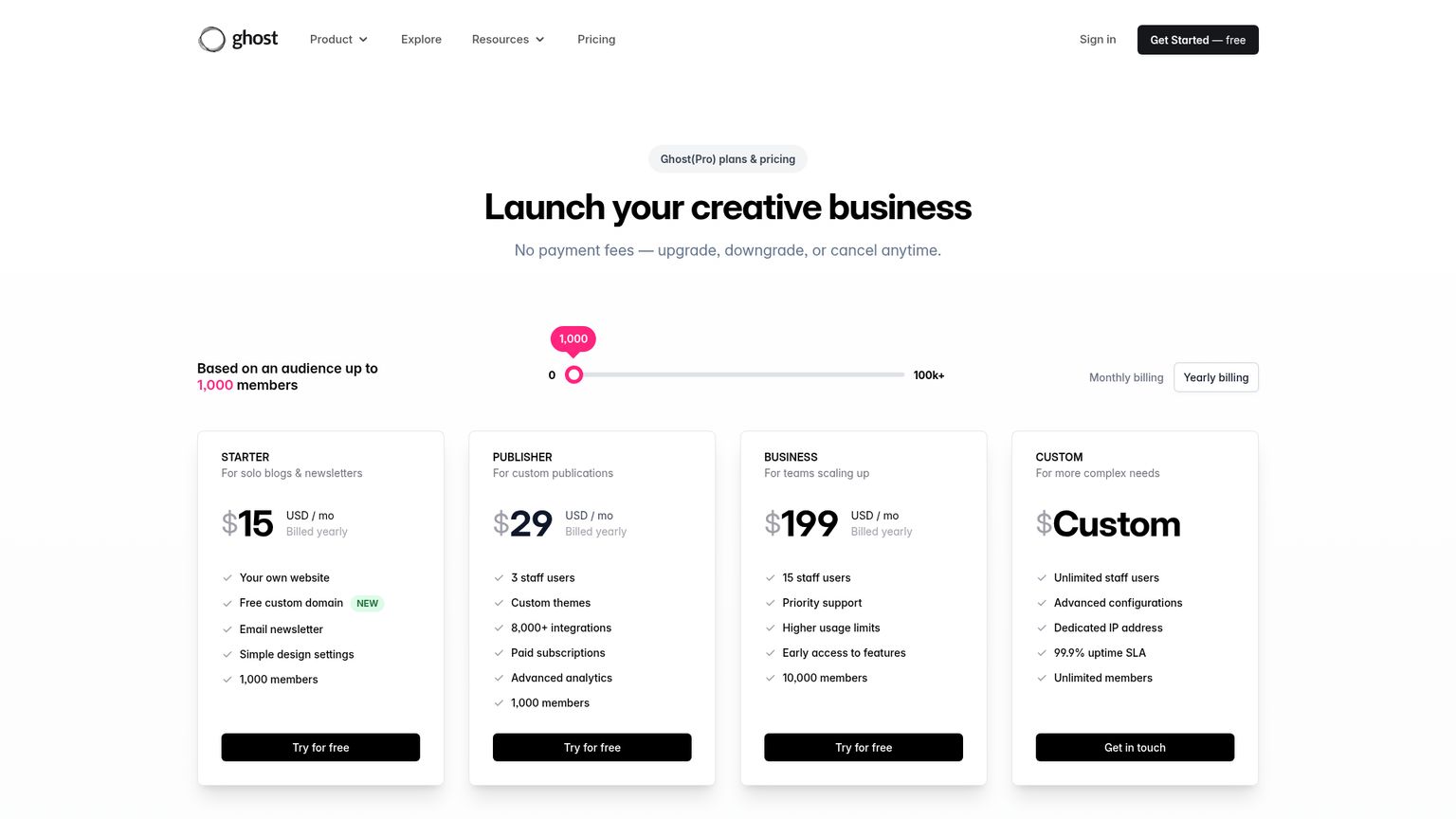
The verified software comparison is $348 a year for Ghost Publisher versus $588 for beehiiv Lite, a $240 annual difference at 1,000 members. Ghost's 0% platform fee still leaves payment-processor costs. Compare your account's processing and recurring-billing charges before treating the lower software invoice as a take-home revenue advantage.
Ghost is a sensible shortlist for an operator whose main product is a membership website with a newsletter attached. The limitation is the fit of that publishing workflow: the lower starting bill does not establish that it replaces the growth and monetization features you need from beehiiv. Its member pricing also needs to be rechecked as the audience grows.
Subscriber Growth Can Trigger Another Bill
The count applies across the workspace, not separately to each publication. beehiiv's plan-tier help article says it adds active subscribers across publications. Its example of 3,000 in one publication and 2,000 in another produces 5,000 billable active subscribers.
Adding a second newsletter is therefore a capacity decision as well as a content decision. Lite allowing three publications does not provide three separate 100,000-subscriber allowances.
You can enable automatic subscriber-tier upgrades. The billing help article says exceeding the current tier then produces a prorated charge for the next tier of the current plan. Opting out can delay sends when limits are exceeded. This is a stepped subscription increase, rather than a per-email overage fee.
Before a founder commits to the yearly invoice, the useful move is to review the account's count, expected growth and required features together.
Count the active audience across publications
Use the workspace total, including free and paying readers. Compare today's count with the next subscriber bracket and the plan ceiling.
Review the next invoice and billing cadence
Open Settings > Billing & Plan. Under Your Current Plan, choose Change to inspect plan, subscriber tier and monthly versus annual pricing. Existing customers should also check the renewal date affected by the October transition.
Choose the required plan and the upgrade behavior
Confirm domains, automations, payment tiers and seats. Review the Auto-upgrade my plan tier when I reach my subscriber limit setting. Budget for the next applicable bracket if a planned launch could cross it.
Frequently Asked Questions
Can I use beehiiv for free?
Yes. Free supports up to 2,500 subscribers and unlimited email sends, with one team seat and one publication. Custom domains, live custom automations, the Ad Network and paid newsletter subscriptions require a paid plan.
How does a newsletter make money?
The business can charge for premium readership, sell products, carry sponsorships or generate leads for its services. Choose the revenue model first: a paid newsletter needs different features from a free newsletter that brings consulting inquiries.
What is the best free newsletter platform?
For a simple business broadcast list up to 2,500, beehiiv Free can be enough. Kit has a larger free subscriber ceiling of 10,000, while Substack has no list-based software subscription for free publishing. Required features and later monetization fees decide which is best for your business.
Can you make money on beehiiv?
Yes. Free can sell a single digital product under its current limits. Lite and above add paid newsletter subscriptions, ad monetization and paid recommendations. Availability does not guarantee revenue, and payment processing remains separate.
Is beehiiv worth it?
Lite is worth considering when the business needs its paid publishing features or exceeds Free's cap. At a 10,000-person list, its $119 annual-plan monthly equivalent requires 13 readers paying $10 monthly to cover the plan under the stated card-fee model, before other business costs. Pro needs a specific added capability or limit to justify its premium.
Is beehiiv better than Substack?
beehiiv can cost less once paid subscription revenue makes Substack's percentage share larger than the applicable fixed bill. Substack avoids that fixed software commitment. Compare the whole audience, paid revenue, payment fees and required workflow before choosing.
Why is everyone leaving Substack?
Do not treat the question's premise as evidence of a migration wave. A business-specific reason to consider switching is that a revenue share has become more expensive than the alternative's software bill. A switch still needs a plan for payments, subscribers and the publishing workflow.
What is replacing Substack?
There is no single replacement for every business. beehiiv is a candidate for a newsletter-led growth business, Kit for email-led product selling, and Ghost for a membership publishing website. Compare the model your publication needs.
What are some good alternatives to beehiiv?
Kit, Substack and Ghost are the shortlist priced above. At the same small audience and paid revenue, Kit Free may keep more because it has no software bill, while paid plan costs and feature requirements change the comparison.
Does beehiiv offer a student discount?
The live pricing page checked on 9 October 2026 does not advertise a student discount. Budget using the published rate unless beehiiv confirms a specific offer for your account.
What is beehiiv's refund policy?
Ordinary subscriptions are non-refundable, and cancellation does not return an unused portion of the current term. The Terms contain a narrow remedy for a qualifying material reduction in core functionality; the refund help page does not promise that a support request will receive an exception.
Did beehiiv change its prices in October 2026?
Yes. beehiiv's official announcement dates the new-customer change to October 1, 2026. Existing customers transition on their first renewal on or after November 1, 2026, with annual customers retaining the current price through their existing term.
Use the AI Business Workflow Audit Checklist to identify the newsletter workflows that justify a paid plan before committing to the annual invoice.
- Published
- Category
- Growth
- Language

Pipedrive Pricing: Plans, Add-ons and Team Costs
Current Pipedrive seat and add-on prices, annual vs monthly budgets for 3 and 10 users, AI features, and when Premium costs less.Oct 8, 2026Growth
Lemlist Pricing: Seats, Credits and Sending Costs
Lemlist pricing by month, quarter and year, including credits, mailboxes and add-ons. See founder, sales team and agency bills plus alternatives.Oct 8, 2026Growth
Tidio Alternatives
Compare seven Tidio alternatives by support job, current pricing and billing unit. See who should switch, what migration costs and when Tidio wins.Oct 7, 2026Growth
Vista Social Pricing: What Your Profiles and Team Cost
Vista Social starts at $99/month. Compare annual prices, profile and user limits, AI features, add-ons, three bills and cheaper options.Oct 7, 2026Growth
Unbounce Pricing 2026: Plans, Visitor Limits and Testing
Unbounce starts at $29/month. Compare all six plans, annual rates, visitor and domain limits, A/B testing, Smart Traffic and the cheapest fit.Oct 7, 2026Growth
Best AI Ad Generator in 2026: AdCreative.ai, Atria, Creatify & Arcads (Compared)
Choose AI ad tools by job: static ads, UGC-style video or creative research. Compare current maker pricing, credit units and free entry.Oct 6, 2026Growth
Surfer SEO Alternatives: SE Ranking, Frase, Clearscope, NeuronWriter and MarketMuse (Verified October 2026)
Compare five Surfer SEO alternatives by content scoring, SEO suite fit and AI tracking, with current prices and workload costs.Oct 6, 2026Growth