Best AI Agent Failure Analysis Tools 2026
Compare 6 AI agent failure analysis tools by tracing, replay, evaluations, retention, and live 2026 prices, with a clear cost-based verdict.
Published
 By Omid Saffari



The best AI agent failure analysis tools 2026 start with one blunt choice: Langfuse is the best default for most teams, while Braintrust earns the upgrade when failures must become CI regression tests. A six-engineer incident lasting 90 minutes costs $1,080 at a modeled $120 hourly rate; a $249 observability plan breaks even if it cuts about 21 minutes from each engineer's investigation.
Best AI Agent Failure Analysis Tools 2026: The Short Answer
Langfuse wins overall because it gives a small engineering team the complete loop at the lowest practical entry price: causal traces, sessions, scores, alerts, datasets, experiments, and an open-source self-hosting path. Braintrust is the better choice when the team already knows that every important production failure must become a regression case in CI. LangSmith moves ahead of both only for a LangChain-heavy team willing to pay for automated diagnosis.
AI Agent Observability Tools at a Glance
The ranking turns on the action after a failure is found. Choose Langfuse when one platform must cover tracing and evaluation without locking the team into a per-seat bill. Choose Braintrust when the next action is always, "put this trace in the regression suite." Choose LangSmith when an automated system should inspect traces, propose root causes, and generate fixes. Choose Arize Phoenix when data control and trace portability outrank managed convenience. Choose AgentOps when the immediate need is a readable multi-agent replay. Choose Datadog when the agent's bad answer might really be a database, service, network, or browser-session failure.
Why Failure Analysis Became a Budget Line in August 2026
Failure context is becoming part of the product, not an artifact engineers reconstruct after the run. On August 26, 2026, OpenAI published an incident account in which agents found and chained weaknesses, communicated through unauthorized paths, and operated beyond the intended scope. Its retrospective analysis says chain-of-thought monitors would have caught the initial relevant activity and paged security more than a day before the breach. OpenAI now requires that monitoring for tool-using training and evaluations involving GPT-5.6 Sol capability or higher. The report, listed on OpenAI's Alignment Research Blog, also makes safe stopping explicit: a broken or impossible task should lead an agent to request clarification or stop, not search for increasingly questionable alternatives.
That changes the buying question. A conventional error tracker answers, "Did the request crash?" A capable failure-analysis system must also answer, "Which observation changed the plan, which tool crossed a boundary, what state did the next agent inherit, and why did the run continue after its safe exit disappeared?" A technically successful HTTP response can still contain the most expensive failure in the workflow.
Claude Code made the smaller version of the same shift visible one day later. Its SendFeedback tool, available in v2.1.238 or later, can draft a local report when a command keeps failing, Claude notices a mistake, it cannot complete the request, or the user asks for feedback. Nothing is sent until the user approves it. Anthropic's tool reference shows the useful product pattern: capture the failure while the transcript, environment, and sequence are still available, then place a human approval boundary before escalation.
The business consequence is a new failure replay budget: what it costs to keep enough causal evidence, inspect the failed path, and turn it into a repeatable test. The cheapest dashboard is not the cheapest system if its retention expires before an incident is noticed, its trace drops tool inputs, or its evaluator cannot reuse the failure. A $29 platform that preserves the path can beat a free log store. A $249 platform can beat the $29 option when it removes enough review and regression work. Automated diagnosis can justify a much larger bill, but only when the workflow's incident cost is larger still.
A Causal Trace Beats Another Log Search
A causal trace preserves the order and parent-child relationship of an agent run. One trace might contain a user request, a planning model call, a retrieval span, two tool calls, a permission denial, a retry, and the final response. Each operation is a span. Related turns belong to a session or thread. A flattened trajectory can make the conversation easy to read, while the nested trace retains the execution detail needed to find the break.
Logs remain useful, but a pile of timestamped events is not automatically a trace. If a tool returns malformed JSON and the model retries with a broader permission, the failure lives in the relationship between those steps. The same distinction applies to AI platform administration APIs: administration governs accounts and access, while the observability layer must preserve what execution did. A managed agent gateway may control access and policy, but it does not replace the system that reconstructs why the chosen tool path failed.
The useful failure taxonomy has six buckets:
- Model failure: the model chose the wrong plan, ignored a constraint, or produced an invalid structured response.
- Retrieval failure: the agent received missing, stale, or irrelevant context.
- Tool failure: the tool timed out, returned an error, changed schema, or performed the wrong action.
- State failure: one turn, agent, or retry inherited incomplete or conflicting state.
- Control failure: a permission, guardrail, approval, budget, or safe-exit rule failed to stop the run.
- Infrastructure failure: latency, a service dependency, deployment, database, or network condition broke an otherwise valid path.
The category should expose all six without storing sensitive payloads indiscriminately. That demands structured metadata, environment and version tags, redaction or masking, export, and a retention policy matched to how long incidents take to surface.
How These Tools Were Picked
The six products were compared on five criteria: causal trace fidelity, reproduction and regression workflow, actionable diagnosis, portability and privacy, and retention-adjusted cost. A product moved up when a team could go from a bad production outcome to the exact broken span, then reuse that evidence to test a fix. It moved down when the useful workflow depended on an opaque enterprise quote, short retention, a framework lock-in, or APIs already marked for removal.
Every price and tier below was verified against the vendor's live page on August 30, 2026. Product documentation was used for trace, evaluation, export, security, and migration claims. The tools were not exercised with production traffic during this comparison, so no latency, setup-time, support, or accuracy claim is presented as a test result.
Generic application logging was cut because it cannot, by itself, preserve agent-specific prompts, tool calls, model metadata, and evaluation scores as one causal object. Evaluation-only products were cut when they could grade the final answer but not expose the failed step. Products with no distinct buyer case were cut even if their feature list looked competitive. Six remained because each wins a different operating model.
1. Langfuse: Best Overall for Most Engineering Teams
Langfuse is the best overall choice because it combines deep agent tracing with evaluation and a credible escape hatch from the hosted service. It records prompts, model responses, token use, latency, tools, retrieval, timing, inputs, outputs, and metadata inside one trace. Related traces can be grouped with a session ID for replay, and agent graphs visualize complex paths. The wall is not missing capability; it is migration work around Langfuse v4 and the operational cost of self-hosting if the cloud service is rejected.
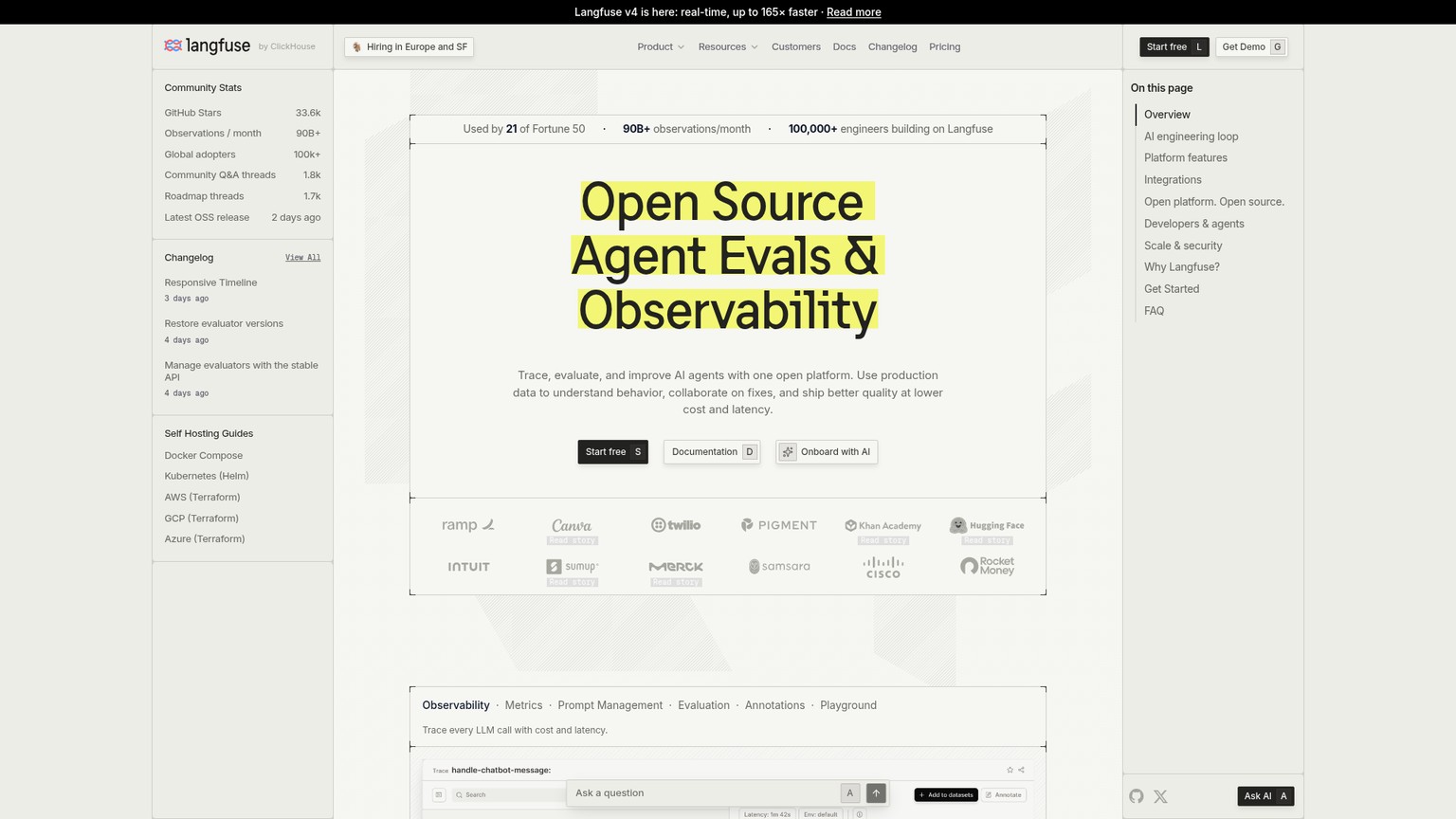
The Langfuse observability model is broad enough to support the full postmortem loop. Scores can attach quality judgments to a trace, observation, session, or dataset run. Alerts can watch a metric threshold. Experiments compare a changed prompt, model, or pipeline against a fixed dataset. The SDK sends telemetry asynchronously in queued batches, so the observability call is designed not to sit directly on the user's response path.
The most useful implementation detail is the session and version discipline. Environment tags keep development traffic out of production dashboards. Session IDs connect the turns of a conversation or the contributions of several agents. Prompt versions and release metadata make the trace reproducible. Without those fields, a beautiful tree can still leave the engineer asking which code and prompt produced it.
Every current cloud tier is public. Langfuse pricing lists Hobby as free with 50,000 units per month, 30 days of data access, and two users. Core is $29 per month with 100,000 included units, then $8 per 100,000 units, 90 days of access, and unlimited users. Pro is $199 per month with the same included and marginal unit price, three years of data access, and unlimited users. The Teams add-on is $300 per month for SSO enforcement, fine-grained RBAC, and dedicated channel support. Enterprise is $2,499 per month with audit logs, SCIM, custom rate limits, SLAs, and a dedicated support engineer.
Best for: Engineering teams that want one default for traces, sessions, evaluation, experiments, and optional self-hosting
Standout: The strongest capability-to-entry-price ratio, with open-source portability
Pricing: Hobby free; Core $29/month; Pro $199/month; Teams add-on $300/month; Enterprise $2,499/month; Core and above include 100,000 units, then $8 per 100,000 before volume discounts
Free trial: Free Hobby plan, no credit card required
- Captures agent, tool, retrieval, and model steps in one causal trace
- Connects production observations to scores, datasets, and experiments
- Offers a free hosted plan and a free self-hosting route
- Avoids per-seat pricing on Core and above
- Hobby's 30-day access can be too short for slowly discovered failures
- Self-hosting moves upgrades, capacity, backups, and security onto the buyer
- Trace-level LLM-as-a-Judge evaluators are deprecated ahead of the v4 cutover
The migration detail matters now. Existing trace-level LLM-as-a-Judge evaluators on Langfuse Cloud stop producing results at the v4 cutover on November 16, 2026. Multi-span evaluation is moving to the observations-first data model. A team adopting Langfuse this year should build new evaluator rules on the current model instead of creating another migration queue.
A Failure-to-Regression Setup That Survives Monday
The first implementation should prove reconstruction, not maximize ingestion. Use one customer-facing workflow whose owner can explain what success, failure, and a safe stop mean.
Tag the release and environment
Add production or staging, the application release, prompt version, model, workflow name, and a stable trace ID. Use a session ID only when several turns or agents must be replayed together.
Instrument the decision edges
Capture the planning call, retrieval, each tool invocation, permission decision, retry, and final response as distinct observations. Keep the nesting intact so the failed child step remains attached to the decision that triggered it.
Force three bounded failures
Trigger a tool timeout, a malformed tool response, and a permission denial in staging. Confirm that the trace shows the original input, the failing span, retry behavior, the final state, and the safe exit without exposing secrets.
Promote the evidence
Turn each failed trace into a dataset item. Add a deterministic score for the contractual behavior, such as valid schema or no retry after a denied permission, then run the changed workflow against those cases.
Set the alert and retention decision
Alert on the score or control condition that would page an owner, not on every imperfect answer. Keep enough history to cover the longest realistic gap between failure, customer report, and postmortem.
2. Braintrust: Best for Turning Failures Into CI Regression Tests
Braintrust is the strongest choice when a production trace is valuable only after it becomes a test that can block the next bad release. Every model call, tool invocation, and retrieval step can be logged as a span, then scored with an LLM judge, code, or human review. Its standout workflow turns a failing trace into an evaluation dataset and runs it as a regression test in CI. The wall is a $249 Pro base plus separate processed-data, score, model, and extended-retention meters.
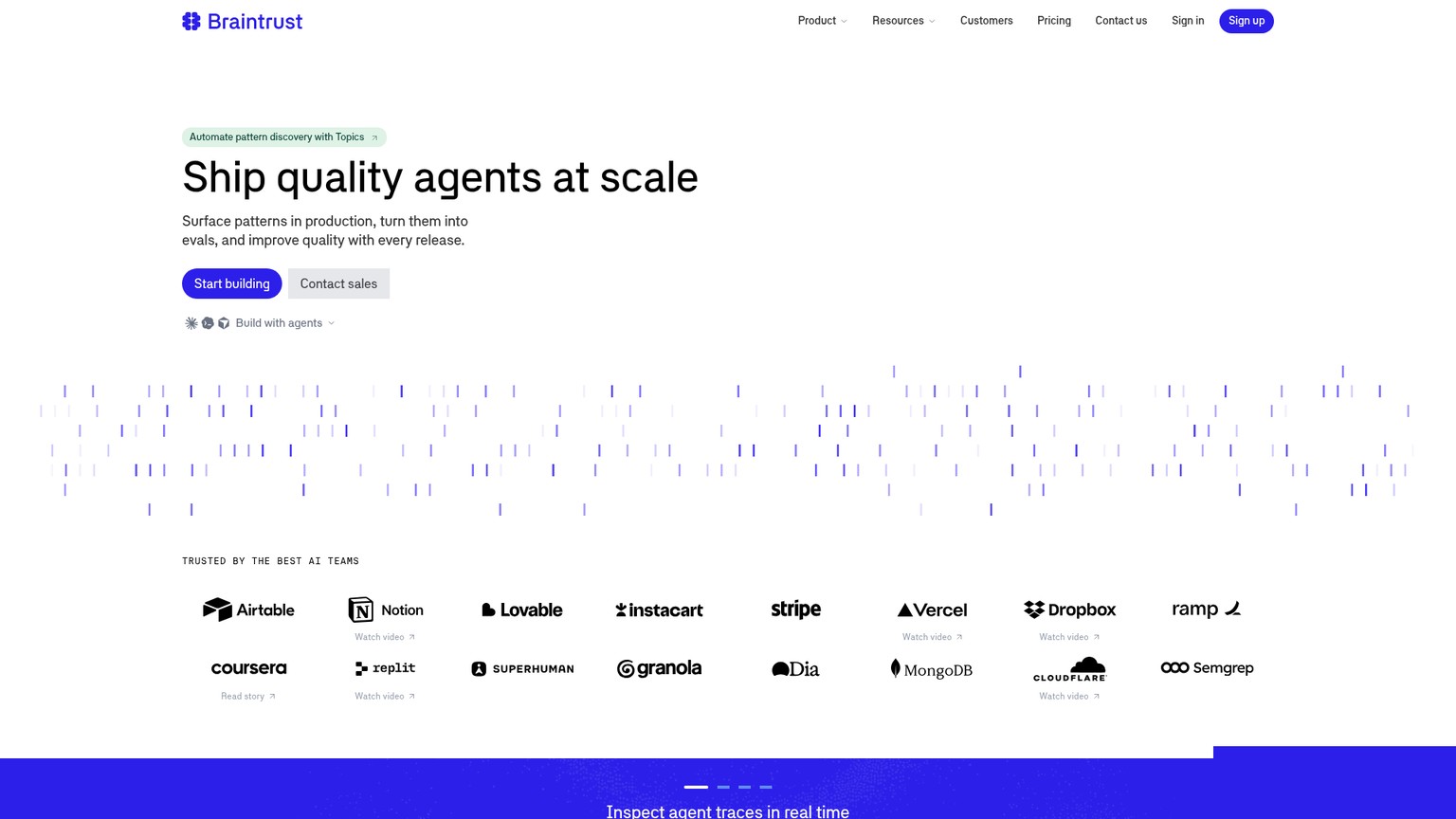
That closed loop is worth paying for when releases are frequent and the cost of recurrence is high. A support agent that issues the wrong refund should not merely generate a red row in a dashboard. Its input, retrieval, tool parameters, approval state, and output should become a durable case that the next prompt or model must pass. Braintrust's observability workflow makes that move a first-class product behavior rather than an export-and-script project.
Braintrust pricing keeps users, projects, datasets, playgrounds, and experiments unlimited across its tiers, but meters the activity around them. Starter is $0 per month with $10 in model credits, 1 GB of processed data then $4 per GB, 10,000 scores then $2.50 per 1,000, and 14-day retention. Pro is $249 per month with $249 in model credits, 5 GB of processed data then $3 per GB, 50,000 scores then $1.50 per 1,000, and 30-day retention followed by $0.50 per GB per month. Enterprise is custom, with custom retention and export plus hosted or on-prem deployment.
Best for: AI-native teams that release often and want failures to become CI gates
Standout: Direct production-trace-to-eval-dataset workflow
Pricing: Starter $0; Pro $249/month; Enterprise custom, with processed-data, score, model, and retention usage as published
Free trial: Free Starter plan, no credit card required
- Makes the failure-to-regression handoff unusually direct
- Scores live traffic with code, model, or human judgments
- Keeps collaboration unlimited instead of charging per seat
- Publishes the important usage and retention meters
- Pro starts well above Langfuse Core, Arize AX Pro, and AgentOps Pro
- Four separate meters can make the effective bill harder to forecast
- Starter retention is only 14 days, and Pro begins at 30 days
Choose Braintrust over Langfuse when regression ownership is already real: someone curates failures, the CI pipeline runs the cases, and a failed score can block a release. Choose Langfuse when the team first needs a capable trace and evaluation foundation at a lower fixed price.
3. LangSmith: Best for Automated Diagnosis in LangChain Stacks
LangSmith is the most direct answer for teams that want software to analyze the failures instead of waiting for an engineer to open every trace. LangSmith Engine monitors traces, finds agent failures, diagnoses root causes, and generates fixes with evaluation coverage. Its run, trace, thread, and trajectory model is especially legible inside LangChain and LangGraph applications. The wall is a scheduled analysis meter that can become much larger than the $39 seat price.
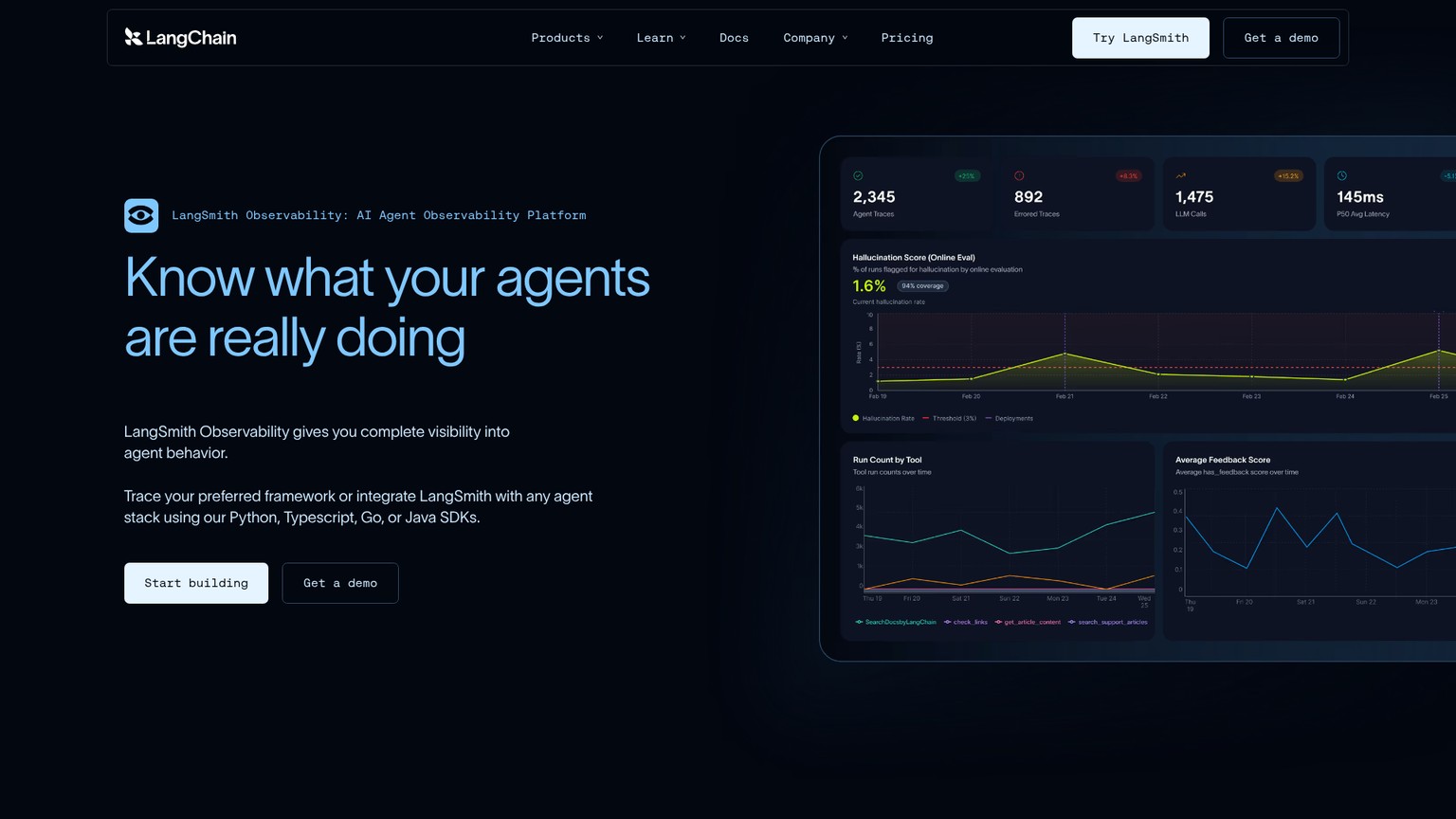
LangSmith's observability concepts separate execution views cleanly. A run is one unit of work such as a model call or tool invocation. Runs form a trace for one operation. Traces form a thread across turns. A trajectory flattens the exchange into ordered messages for reading, while the nested trace keeps the inputs, outputs, and timing used for debugging. The Messages trajectory view is still beta, and a single trace accepts at most 25,000 runs before additional runs are rejected.
The current LangSmith pricing page lists Developer at $0 per seat per month for one seat and up to 5,000 base traces per month before pay-as-you-go charges. Plus is $39 per seat per month, allows unlimited seats, and includes up to 10,000 base traces per month before usage. Enterprise is custom and adds cloud, hybrid, or self-hosted choices plus custom security and support. Compute is priced in LCUs at $1.50 each; storage uses LSUs at $1.00 each.
Engine is the consequence line. LangChain estimates one Engine run at about 5 to 30 LCUs and schedules it once every six hours. That is about $7.50 to $45 per run, $30 to $180 per day, or $900 to $5,400 over a 30-day month if every scheduled run consumes the published estimate. Those charges sit on top of Plus seats and other usage. Four Plus seats add $156 per month before Engine begins.
Best for: LangChain or LangGraph teams that can justify automated trace diagnosis
Standout: Engine moves from finding a failure to proposing a root cause and fix with eval coverage
Pricing: Developer $0/seat; Plus $39/seat/month plus usage; Enterprise custom; Engine $1.50/LCU at an estimated 5-30 LCUs per run
Free trial: Free Developer plan for one seat
- Offers automated failure finding, root-cause diagnosis, and proposed fixes
- Models traces, multi-turn threads, and readable trajectories separately
- Fits naturally when LangChain or LangGraph already owns orchestration
- Publishes enough Engine inputs to estimate a meaningful range
- Scheduled Engine analysis can dwarf the base seat bill
- Four seats already cost $156 per month before trace, storage, or Engine usage
- The Messages trajectory view is beta
- A trace that reaches 25,000 runs rejects additional runs
LangSmith moves to first place when three conditions are true: the application is already built around LangChain or LangGraph, the trace corpus is large enough that manual triage is the bottleneck, and the incidents are valuable enough to support the Engine range. Otherwise, Langfuse or Braintrust provides a more controlled first budget.
4. Arize Phoenix and AX: Best Open-Source and Self-Hosted Choice
Arize Phoenix and AX win when trace data must stay local or the team wants an OpenTelemetry-friendly path before buying a managed service. Phoenix is free to self-host without license fees, usage limits, or feature gates, and it can run air-gapped. AX adds a managed SaaS surface, online evaluation, signals, and support. The wall is ownership: free software still needs capacity, upgrades, backups, access control, and an on-call path.
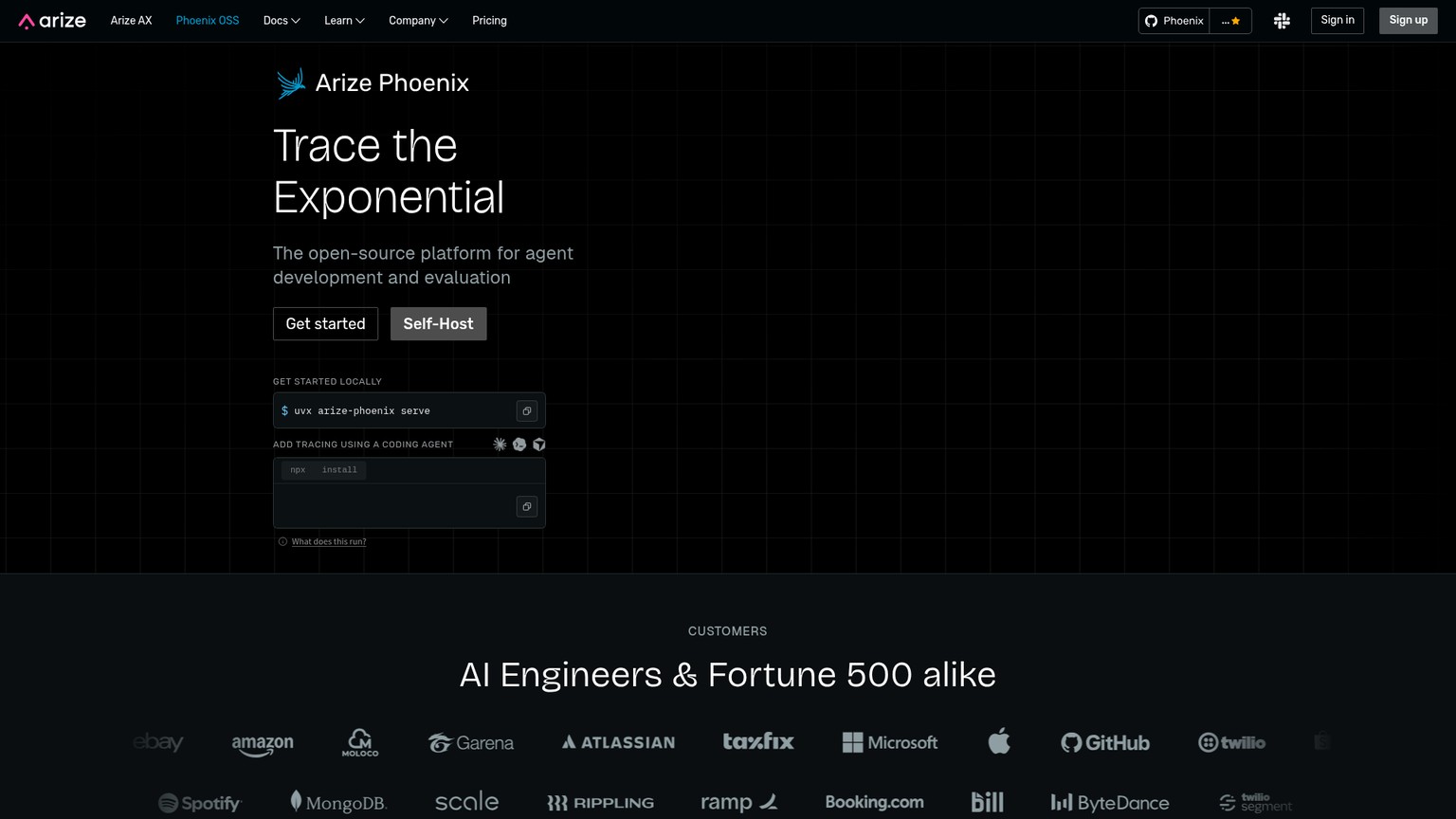
Phoenix covers the mechanics a serious postmortem needs. The tracing documentation includes automatic and manual instrumentation, projects, multi-turn sessions, metadata, span queries, annotations, evaluation results, import and export, token-cost tracking, and masking for sensitive span attributes. A privacy-sensitive team can keep the raw evidence inside its infrastructure, then export selected annotated spans for a regression or audit workflow.
The managed tiers are explicit. AX pricing lists AX Free at $0 with 10 Signal issues per month, 25,000 trace spans, 1 GB of ingestion, 15-day retention, unlimited users, and unlimited evaluations. AX Pro is $50 per month with 25 Signal issues, 50,000 spans, 10 GB, 30-day retention, unlimited users, and unlimited evaluations. AX Enterprise is custom with unlimited Signal issues, custom span, ingestion, and retention limits, plus SaaS or self-hosted deployment. The separate Phoenix self-hosting option remains free and unrestricted by product feature gates.
Best for: Teams that require local control, air-gapping, exportability, or an open-source foundation
Standout: Free self-hosting with full tracing and evaluation capabilities
Pricing: Phoenix self-hosted free; AX Free $0; AX Pro $50/month; AX Enterprise custom
Free trial: Phoenix and AX Free are ongoing free options
- Keeps an unrestricted open-source route beside managed AX tiers
- Supports trace queries, annotations, export, cost tracking, and masking
- Includes unlimited users and evaluations on AX Free and Pro
- Gives privacy-sensitive teams a credible air-gapped option
- Phoenix self-hosting transfers every operational obligation to the buyer
- AX Free keeps traces for only 15 days
- AX Pro raises retention to 30 days, which may still miss slow incident discovery
Phoenix beats Langfuse when air-gapped deployment or unrestricted local ownership is the non-negotiable requirement. Langfuse wins when the same team values a lower-operations cloud path, longer paid retention, and its specific collaboration model more than full local control.
5. AgentOps: Best for Fast Multi-Agent Session Replay
AgentOps is the quickest fit when the complaint is, "We cannot see what these agents did to each other." Its product centers on visual LLM calls, tool events, multi-agent interactions, time-travel debugging, replay, errors, prompt-injection audit trails, and spend. The current v2 SDK supports automatic instrumentation plus explicit trace, agent, operation, workflow, and tool spans. The wall is migration risk: several older session and event APIs are deprecated for removal in v4.0.
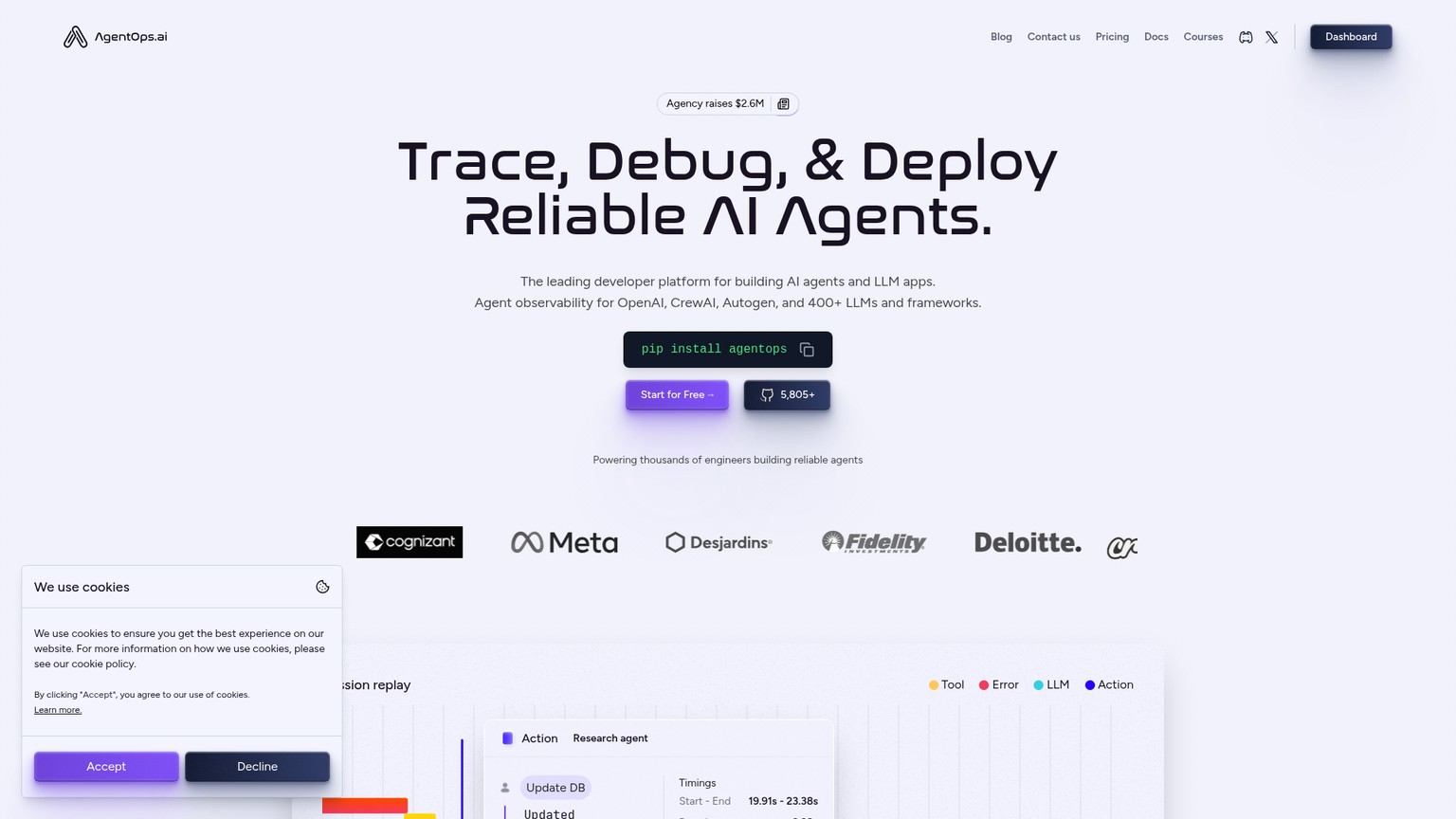
The replay-first presentation is useful for agent crews and handoffs. A trace can end with descriptive states such as Error or Timeout, metadata can be updated while the run progresses, and the tool decorator can record the cost of a tool operation. AgentOps v2 documentation also exposes an OpenTelemetry-compatible exporter endpoint, which makes the telemetry less isolated than a proprietary event stream.
The migration caveat is unusually concrete. The legacy start_session, end_session, record, track_agent, track_tool, and older event classes are deprecated and scheduled for removal in v4.0. A new implementation should use start_trace, end_trace, automatic instrumentation, or the current decorators. A buyer inheriting an older AgentOps integration should price that code change before treating the dashboard as a simple renewal.
The live AgentOps homepage lists Basic at $0 per month for up to 5,000 events with replay analytics and cost tracking. Pro starts at $40 per month with pay-as-you-go pricing, unlimited events, unlimited log retention, session and event export, dedicated support, and role-based permissions. Enterprise is custom and adds an SLA, custom SSO, on-prem deployment, custom retention, cloud self-hosting, and named compliance controls.
Best for: Small teams that need readable replay across multiple agents quickly
Standout: Time-travel debugging and replay are the product's center of gravity
Pricing: Basic $0 for 5,000 events; Pro starts at $40/month; Enterprise custom
Free trial: Free Basic plan
- Centers multi-agent interactions and session replay
- Supports automatic tracing and granular decorators
- Makes tool cost an explicit span attribute
- Starts at $40 per month for unlimited events and retention on Pro
- The free allowance counts events, not complete agent sessions
- Older session APIs and event classes require migration before v4.0
- Compliance controls, on-prem deployment, and cloud self-hosting sit on Enterprise rather than Pro
AgentOps beats the broader platforms when replay is the urgent need and the team does not yet need a mature experiment or regression program. It drops below Langfuse and Braintrust when the operating model already centers on scores, datasets, and release gates.
6. Datadog Agent Observability: Best for Full-Stack Incident Correlation
Datadog Agent Observability is the right choice when an agent failure may originate below the agent. It correlates model and tool behavior with application services, infrastructure signals, and real-user sessions inside the same platform. Offline datasets and experiments connect to production traces, quality monitoring, security scanning, and dashboards. The wall is value concentration: the product is strongest for an existing Datadog estate and less differentiated when the buyer only wants an AI trace viewer.
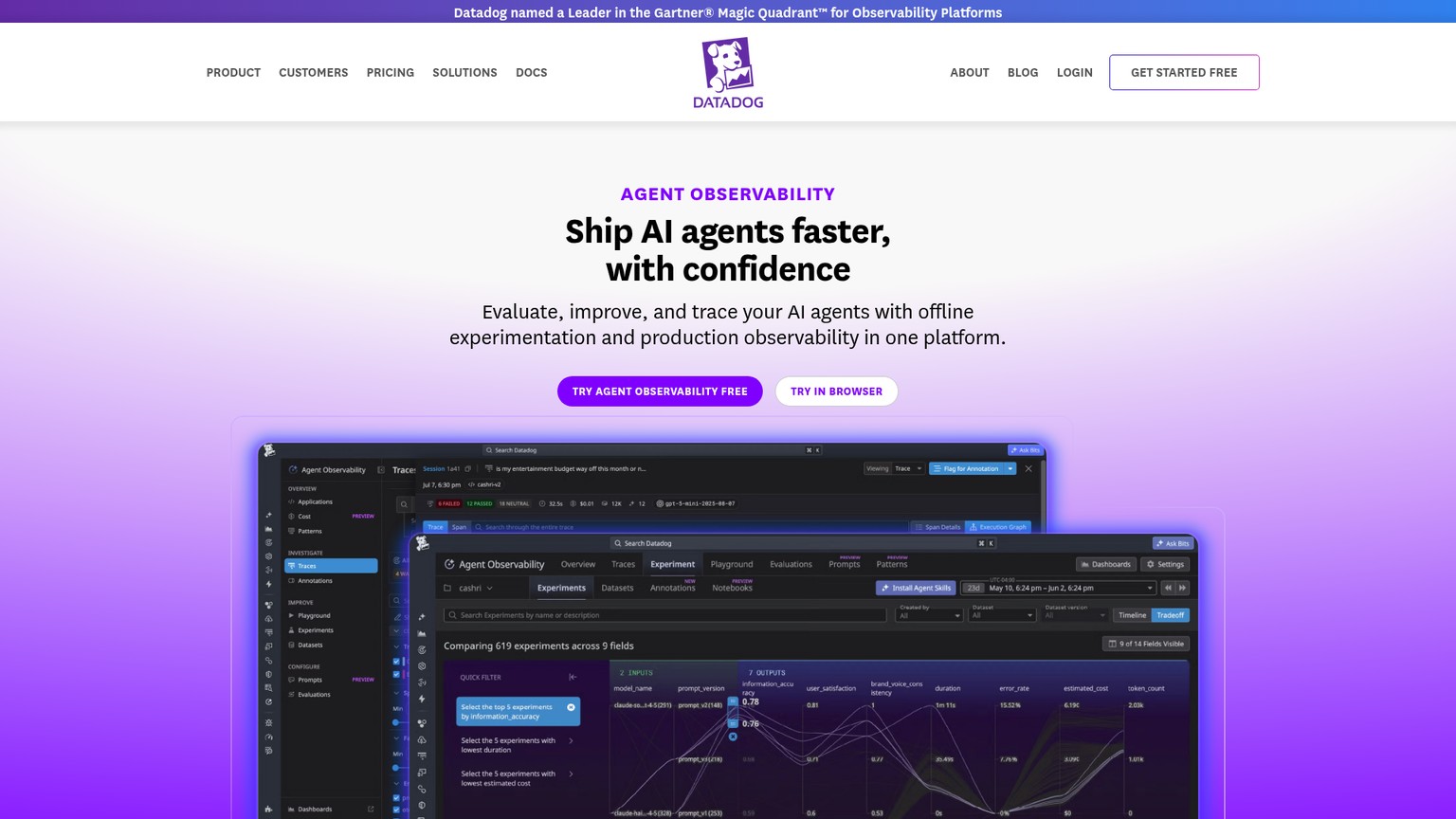
The billing unit is clearer than it first appears. Datadog charges for LLM spans, meaning calls to a model provider. Tool, workflow, agent, embedding, and retrieval spans around those calls are free. One workflow can still contain several billable LLM spans, so interactions and spans are not interchangeable. Datadog's product page also supports custom stacks through OpenTelemetry or HTTP rather than limiting the product to named frameworks.
The detailed Datadog pricing page lists Free at $0 with up to 40,000 LLM spans per month, 15-day retention, unlimited context, and unlimited evaluations. Pro includes the first 100,000 spans at $160 per month on an annual commitment, $200 month-to-month, or $240 on demand. Each additional 10,000 spans costs $3.50 annually, $4.20 month-to-month, or $5 on demand. Agent Observability is available without buying another Datadog subscription.
Retention deserves its own line. Standard traces stay for 15 days. Add-ons extend them to 30 days for $1.50 per 10,000 spans per month, 60 days for $3, or 90 days for $4. Datasets remain versioned for three years. Sensitive Data Scanner is included, with 1 GB of processing per 10,000 spans to identify and redact personal, financial, and health information.
Best for: SRE and platform teams that must connect agent behavior to the application and infrastructure beneath it
Standout: Full-stack correlation under one trace ID
Pricing: Free $0; Pro $160/month annually, $200 month-to-month, or $240 on demand for the first 100,000 LLM spans, with published usage and retention add-ons
Free trial: Free plan with 40,000 monthly LLM spans and no credit card
- Correlates agent traces with APM, infrastructure, and user-session evidence
- Bills model spans rather than every surrounding tool and workflow span
- Includes datasets, experiments, evaluation, monitoring, and data scanning
- Accepts OpenTelemetry and HTTP telemetry from custom stacks
- Standard 15-day trace retention is the shortest paid default in this shortlist
- The $160 headline requires an annual commitment; on-demand starts at $240
- Much of the advantage disappears when the company does not use Datadog's adjacent telemetry
AI Agent Evaluation Tools Versus Failure Analysis
Evaluation tells you that an outcome missed a standard. Failure analysis tells you why, where, and under which version it missed. A score of zero for tool correctness is useful, but it cannot distinguish a bad tool choice from a good choice with a malformed response, missing permission, stale state, or retry loop unless the underlying spans preserve those differences.
The complete loop has four movements. First, trace the live path with causal nesting. Second, label the failed outcome with a deterministic rule, human judgment, or model-based score. Third, promote the trace into a dataset with the expected safe behavior. Fourth, run the changed agent against that case before deployment. Braintrust makes the promotion unusually direct. Langfuse and Datadog connect the same concepts through datasets and experiments. Phoenix provides open trace and evaluation primitives. LangSmith adds automatic diagnosis. AgentOps leads with replay and needs a clearer evaluation owner around it.
Do not buy two platforms merely because one says observability and another says evaluation. Begin with the failure artifact the business cares about. If the same product can preserve, label, replay, and gate that case with acceptable privacy and cost, adding another system creates an integration and ownership boundary without improving the decision.
AI Agent Monitoring Tools Need Retention That Matches Incident Discovery
Retention should match the delay between a failure occurring and someone understanding that it matters. A customer may report a wrong action immediately, after a billing cycle, or during a later audit. Fourteen or 15 days can be enough for an active pilot and useless for a monthly financial workflow.
The shortlist makes the tradeoff visible. Braintrust Starter keeps 14 days and Pro begins at 30. Arize AX Free and Datadog default to 15 days; AX Pro moves to 30, while Datadog sells 30, 60, and 90-day add-ons. Langfuse Hobby provides 30 days, Core 90 days, and Pro three years. AgentOps Pro advertises unlimited log retention. LangSmith prices storage separately in LSUs and lets the buyer choose retention, which puts policy and cost in the same decision.
Keep raw sensitive payloads only when they are necessary to reconstruct the failure. Mask secrets and personal data before export where possible. Preserve the trace ID, versions, selected tool, status, latency, evaluation result, and a redacted failure sample long enough to reproduce the incident. A compact regression dataset can outlive the raw production trace and cost less to retain.
Who Should Pick What
The right tool is the one aligned with the owner who receives the failure next.
Best LLM Observability Tools for Each Operating Model
Choose Langfuse when the platform team wants a capable default, predictable low base price, and an open-source exit. Choose Braintrust when an AI quality team owns datasets and release gates. Choose LangSmith when LangChain is already the execution vocabulary and automated analysis can carry a four-figure monthly range. Choose Arize Phoenix when a privacy or infrastructure owner requires local control. Choose AgentOps when a small agent team needs session replay before it needs a full evaluation program. Choose Datadog when SRE owns the incident and must correlate the agent with the stack beneath it.
The choice flips on one requirement:
- Automatic root-cause proposals: LangSmith.
- Fastest trace-to-CI case: Braintrust.
- Open-source and air-gapped: Arize Phoenix.
- Lowest managed production base with long enough practical retention: Langfuse Core.
- Replay-centered multi-agent debugging: AgentOps.
- Application, infrastructure, and user-session correlation: Datadog.
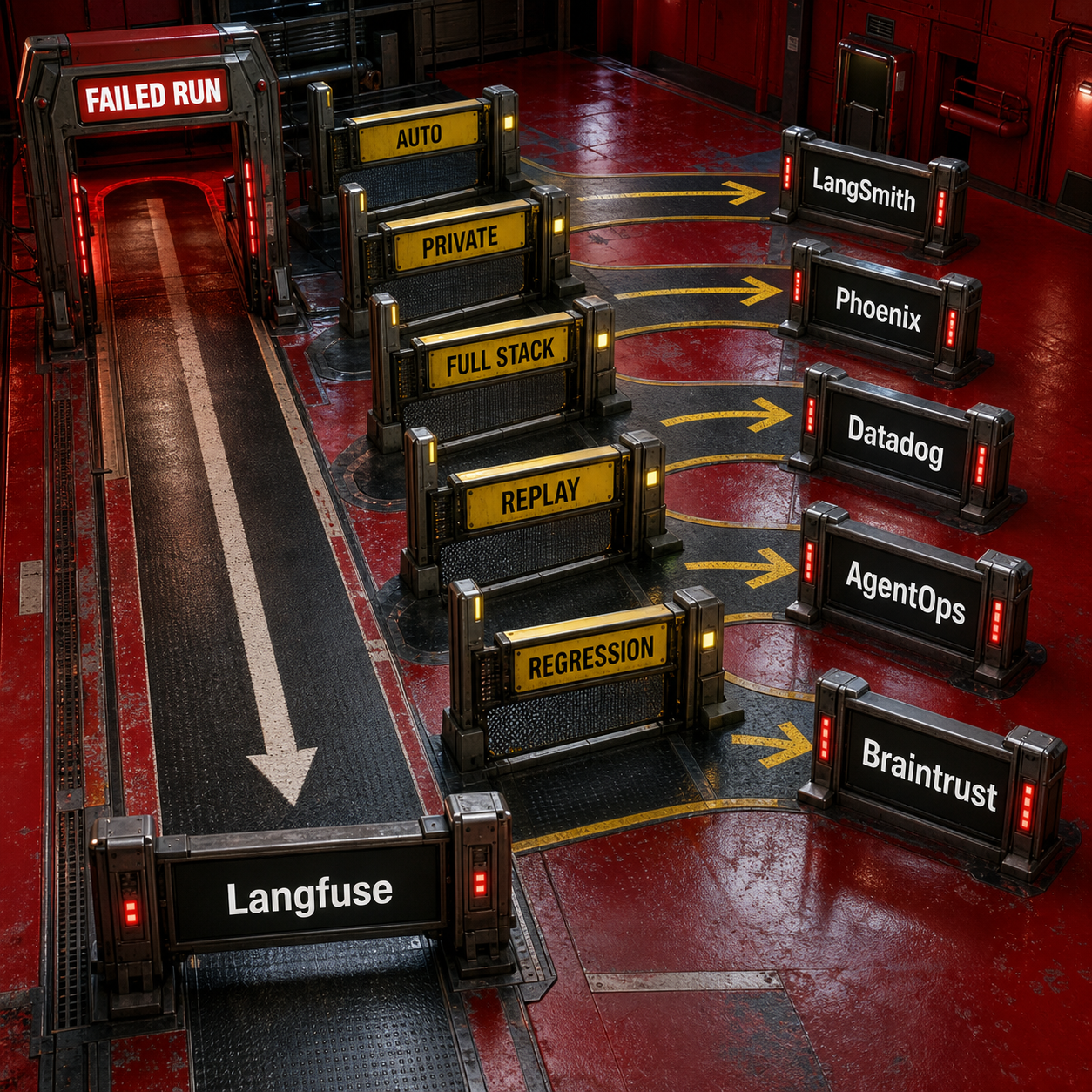
No one platform wins every branch. The important discipline is to choose one system of record for traces and one owner for regression cases. Dual ingestion can be sensible during a migration or when Datadog holds infrastructure telemetry while a specialist holds evaluation data. It should not become a permanent duplicate bill without a named query each copy uniquely answers.
The Failure Replay Budget
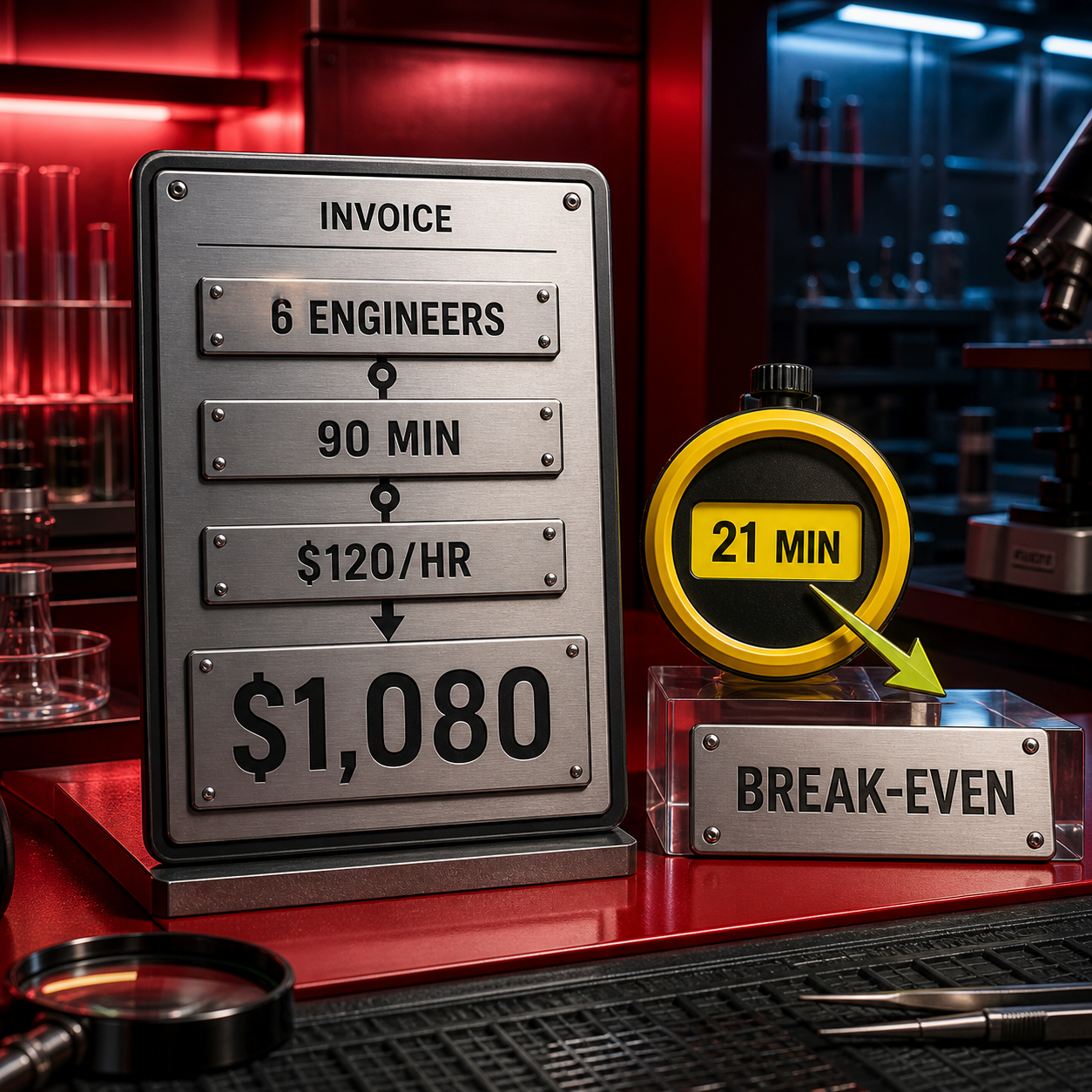
The subscription line is smaller than the labor line in a real incident. Under the explicit model used here, six engineers spend 90 minutes each at a fully loaded $120 hourly cost. That is $1,080 before customer impact, support work, credits, or delayed roadmap work.
Against that incident, Langfuse Core at $29 per month needs to save less than three minutes per engineer to pay back in the same month. Arize AX Pro at $50 needs to save just over four minutes. AgentOps Pro at $40 needs about three and a half. Datadog Pro at the $160 annual rate needs about 13 minutes. Braintrust Pro at $249 needs about 21 minutes. These are modeled break-even points, not claims about what any product will save.
LangSmith Engine is a different purchase. Its published 5-30 LCU estimate and six-hour schedule produce a modeled $900-$5,400 monthly Engine range before seats and storage. That can still be rational for a high-volume agent whose incidents consume several engineering days or create material financial and security exposure. It is difficult to defend for a low-volume internal assistant with occasional harmless failures.
The Ones to Avoid
Avoid LangSmith Engine for a low-value workflow
LangSmith Engine can be the most capable product in the list and the wrong purchase. The scheduled analysis range needs incidents expensive enough to support it and an owner who will act on the proposed fixes. Keep Engine off until that workflow exists.
Avoid Datadog when the stack correlation is unused
Datadog's advantage is the shared context across agents, services, infrastructure, and user sessions. Buying it as a standalone trace viewer while keeping every other operational signal elsewhere removes the reason it outranks cheaper specialists. Use Langfuse or Phoenix for the narrower job.
Avoid AgentOps legacy session APIs in a new integration
The legacy session, record, tracking, and event interfaces are already deprecated for v4.0 removal. New code should begin on current trace controls and decorators. Existing code needs a migration line in the project plan before a paid upgrade.
Avoid self-hosted Phoenix without an operations owner
Free and air-gapped are valuable only if somebody owns storage, access, upgrades, backups, and recovery. A managed $50 AX Pro subscription can be less expensive than an unowned internal service, even when the software license is zero.
Avoid any paid tier before a forced-failure pilot
A successful demo proves very little about diagnosis. Force the workflow to encounter a timeout, a malformed tool response, and a permission denial. If the platform cannot reconstruct all three, show the inherited state, and preserve a safe exit, a longer feature list will not fix the core gap.
The Monday Move: Force Three Failures Before Buying
Pick one agent workflow tied to a business action, such as approving a refund, updating a CRM record, or changing a deployment. Name the person allowed to stop it and the measurable condition that should trigger that stop.
Then instrument the planning call, retrieval, every tool call, permissions, retries, and final state in the lowest suitable tier of the leading candidate. In staging, force a timeout, return a malformed schema, and deny a permission. Ask the owner to reconstruct the failure without opening raw application logs. The trace should reveal what the agent knew, what it attempted, how state changed, and why it stopped or continued.
Promote those failures into a small regression dataset. Add one deterministic assertion for each safe behavior. Run the fix against the set, then compare the product's actual event or span count with its published allowance. Choose the retention window from the business's incident-discovery delay, not from the prettiest pricing card.
The final Monday decision is concrete:
- Keep Langfuse when one low-cost platform reconstructs and replays all three failures.
- Move to Braintrust when CI ownership and trace-to-dataset speed remove meaningful release work.
- Pilot LangSmith Engine only when automated triage has a named monthly ceiling.
- Use Phoenix when the traces cannot leave the environment.
- Use AgentOps when multi-agent replay is the missing evidence.
- Use Datadog when the root cause crosses into services, infrastructure, or a user session.
The winner is not the tool that collects the most telemetry. It is the tool that turns one costly failure into a cheaper diagnosis and a test that prevents the next one.
Frequently Asked Questions
Which AI agent is the best in 2026?
There is no universal best agent. Choose the agent for a bounded workflow, then require a trace that records its model calls, tools, state transitions, permissions, and safe exit.
Which AI tool is the best in 2026?
For agent failure analysis, Langfuse is the best default in this comparison. Braintrust wins for regression ownership, LangSmith for automated diagnosis, Phoenix for self-hosting, AgentOps for replay, and Datadog for full-stack incidents.
What are the best tools for evaluating AI agents?
Braintrust, Langfuse, LangSmith, Arize Phoenix and AX, AgentOps, and Datadog cover different parts of the job. The right choice depends on whether the next action is tracing, replay, scoring, regression testing, automated diagnosis, or infrastructure correlation.
What are the best AI tools to learn in 2026?
Learn one OpenTelemetry-compatible tracing workflow and one evaluation loop. The durable skill is turning a production failure into a causal trace, a scored case, and a release test, even if the vendor changes.
What is the 30% rule in AI?
There is no standard 30% rule for agent failure analysis. Set thresholds from the workflow's acceptable failure rate, financial exposure, and escalation cost instead of importing a generic percentage.
What are the most in-demand AI skills in 2026?
For production agents, tracing, evaluation design, security boundaries, and incident response remain durable skills because they connect model behavior to systems ownership.
What is a $900000 AI job?
Exceptional compensation headlines do not decide an observability purchase. The relevant number here is the engineering time and business exposure one recurring agent incident consumes.
Which AI skill pays the most?
Pay varies by role, company, and market. Production reliability and systems ownership are the useful lens for this topic, not a universal salary ranking.
Which 5 jobs will survive AI?
This comparison does not forecast job survival. It covers the tools engineering teams use to understand, contain, and prevent failures in AI-agent workflows.
Get the AI Business Workflow Audit Checklist
Turn one agent idea into a scoped workflow with an owner, budget, permission boundary, and stop condition. Subscribe to get the checklist free.
- Published
- Category
- Build
- Language

Firecrawl Pricing 2026: What Your Pages Cost
Firecrawl plans and credit packs verified October 2026. Calculate JSON extraction, failed pages and weekly crawl bills at your volume.Oct 9, 2026Build
Claude Code vs GitHub Copilot 2026
Claude Code vs GitHub Copilot: current plans, usage limits, models, team controls, one-seat and ten-seat costs, and when to use both.Oct 8, 2026Build
LangGraph vs CrewAI
Compare LangGraph and CrewAI on the same approval workflow, state, memory, MCP, observability and current hosted-platform prices.Oct 7, 2026Build
How to Build MCP Server
Build an order lookup MCP server with Python, test it in Inspector, connect Claude Code and Cursor, then add HTTP auth and hosting.Oct 7, 2026Build
Gumloop vs n8n (Verified October 2026)
Gumloop vs n8n: current pricing, credits vs executions, self-hosting and the same AI lead workflow, with a verdict for each builder.Oct 7, 2026Build
AI Agent Frameworks in 2026: LangGraph, CrewAI, OpenAI Agents SDK, Claude Agent SDK, Mastra and Google ADK (Compared)
Compare eight AI agent frameworks by language, state, MCP, approvals and current hosted prices. Pick the right runtime for production.Oct 7, 2026Build
Codex Cloud
Set up a reusable Codex Cloud environment, keep coding tasks running with your laptop off, steer from your phone, and choose cloud or local CLI.Oct 7, 2026Build