Best AI Platform Administration APIs 2026
Compare OpenAI, Anthropic, Hugging Face, and OpenRouter admin APIs on identity, keys, budgets, audit evidence, limits, and live 2026 pricing.
Published Updated
 By Omid Saffari




OpenAI has the broadest AI administration control plane in 2026, while Anthropic is the best operational move for a Claude-first stack after its Admin API landed in seven SDKs plus the ant CLI on August 26. The practical choice is not whose model wins a benchmark; it is which platform lets you automate identity, project boundaries, keys, spend, and audit evidence without stitching together a second cloud platform.
The short answer: which administration API wins which job?
OpenAI Administration API ranks first overall because it connects the most governance decisions in one documented surface. It covers users, invitations, projects, API keys, audit logs, project spend limits, model permissions, hosted-tool permissions, data retention, service accounts, and cost reporting. That breadth matters when a platform team needs one policy loop from onboarding through budget enforcement and evidence.
Anthropic Admin API ranks second and is the strongest choice for a Claude-first organization. Its August 26 release put organization administration into Python, TypeScript, C#, Go, Java, PHP, Ruby, and the ant CLI. A team that had wrapped raw HTTP calls can now use typed clients and built-in pagination for most of the control plane.
Hugging Face Hub API ranks third for governing model assets, repositories, and compute by resource group. OpenRouter Management API ranks fourth for issuing and controlling keys across a multi-model inference layer. They are excellent at narrower jobs, but neither matches OpenAI or Anthropic as a general organization lifecycle surface.
All prices, plan boundaries, limits, and API capabilities below were verified against live vendor documentation on August 28, 2026.
What counts as an AI platform administration API?
An administration API controls who may use the platform, where they may work, what credentials and models they may touch, how much they may spend, and what evidence survives afterward. An inference API sends work to a model. An API gateway governs traffic between applications and endpoints. These are adjacent layers, not substitutes.
A useful administration surface needs to cover most of six operating jobs:
- Identity lifecycle: invite, list, change, and remove members or service identities.
- Isolation: create or govern projects, workspaces, groups, or resource groups.
- Credential control: inventory, issue, scope, expire, deactivate, or rotate keys.
- Policy: restrict models, tools, roles, data retention, or other platform capabilities.
- Financial boundaries: report usage, alert on spend, or stop requests at a limit.
- Evidence: preserve audit events with enough actor and request context to investigate a change.
The distinction becomes concrete during offboarding. Removing a person from an identity provider is only the first step. Their project roles, workspace memberships, personal keys, service identities, and active workloads may live in the AI platform. A complete workflow needs to find those objects, revoke access, preserve an audit record, and confirm that spend and inference have stopped.
Google Cloud, AWS, and Microsoft can all automate that workflow, but not through one AI-native administration API. Google separates projects and IAM under Cloud Resource Manager from its Billing Budget API. AWS separates the Bedrock control plane from AWS Organizations, IAM, Service Quotas, Budgets, and CloudTrail. Microsoft Foundry exposes project-scoped resources while Azure Resource Manager, Entra ID, and Consumption Budgets own other parts of the lifecycle.
That cloud split can be the correct architecture when the company already governs every workload through its cloud platform. It is a poor fit when a small platform team is specifically buying one direct control plane for the AI service.
How these were picked
The ranking rewards completed operating loops, not endpoint count. A platform moved up when one automation could connect identity, isolation, credentials, financial control, and evidence without handing the next step to a different product.
Seven criteria decided the order:
- Can the API manage organization members or service identities?
- Can it isolate teams or workloads into projects, workspaces, or resource groups?
- Can it govern credentials without exposing plaintext secrets after creation?
- Can it enforce spend rather than only report it?
- Can it restrict models, tools, resources, or data handling at the same boundary?
- Can it return evidence that identifies who changed what?
- Are the price and account prerequisites clear enough to budget?
Four products cleared enough of that rubric to deserve a full section. General API-management vendors were cut because they govern published APIs or network traffic, not the vendor account behind an AI platform. Cloud hyperscalers were cut from the ranking because their administration story is intentionally distributed across general cloud services. Products without a documented organization control surface were not padded into the list.
The result is four deep buyer profiles rather than a directory. Each one names the workflow it can own, the wall it hits, the current bill, and the condition that changes the recommendation.
1. OpenAI Administration API: best overall control plane
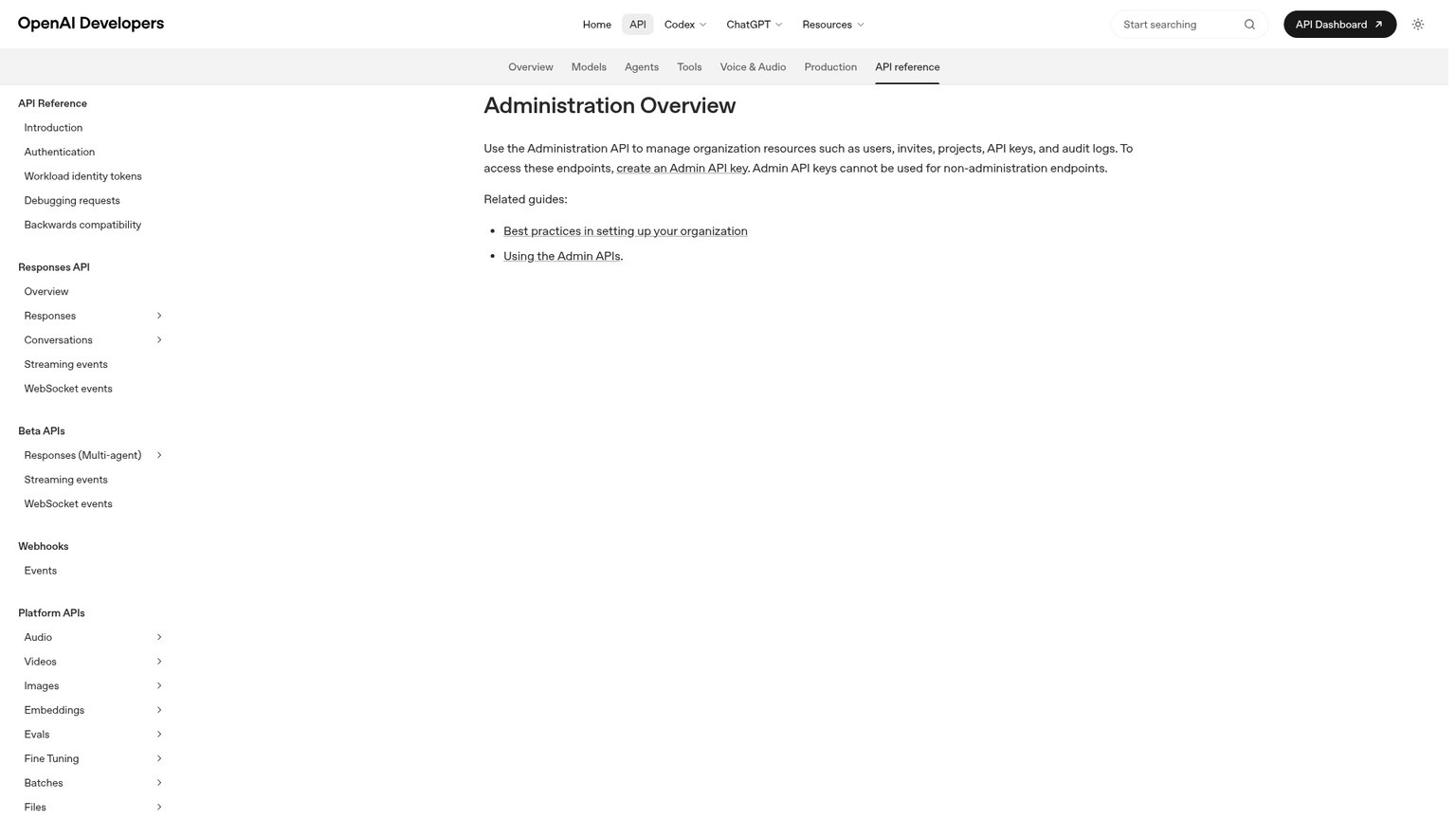
OpenAI Administration API is the best overall choice because its project boundary can connect people, permissions, spend, retention, and audit evidence. The Administration overview starts with users, invites, projects, API keys, and audit logs, while the current reference extends into groups, roles, certificates, data retention, model permissions, hosted-tool permissions, rate limits, service accounts, spend alerts, hard spend limits, usage, and costs. A mid-market platform team can use one resource model for both day-one provisioning and day-two control.
The strongest capability is not the long list. It is the ability to bind different controls to a project. A project can carry users and service accounts, a model policy, a hosted-tool policy, data-retention settings, spend alerts, and a hard monthly spend limit. The audit-log endpoint then records user actions and configuration changes with actor, API-key or session context, and an IP address where available.
That makes OpenAI the cleanest fit for a funded founder or CTO who needs to delegate AI work without delegating the entire organization. Put production support, internal research, and a customer-facing agent in separate projects. Give each project the smallest model and tool policy it needs. Give each a monthly ceiling. The project becomes both a technical blast radius and a finance line.
Best for: Platform teams that need broad organization and project governance in one direct AI provider
Standout: Project-level hard spend limits plus model, hosted-tool, retention, role, and audit controls
Pricing: No separate Administration API fee is listed. Current GPT-5.6 prices are Sol $4 input / $20 output, Terra $2 / $12, and Luna $0.20 / $1.20 per MTok
Free trial: No administration-specific trial is listed; model usage is billed separately
- Broadest documented control plane in this comparison
- Hard monthly project spend limits, not only alerts
- Project policies cover models, hosted tools, data retention, users, roles, and service accounts
- Audit logs connect configuration changes to an actor and request context
- Organization cost endpoints support programmatic financial reporting
- An Admin API key is highly privileged and cannot be treated like an ordinary inference key
- The large surface creates more policy states to design and review
- A project hard limit evaluates monthly spend only; it does not replace request-level safety or application fallbacks
- Separating every workload into its own project adds management overhead when the estate is still tiny
Why the hard limit changes the operating model
A hard project limit turns cost governance from notification into enforcement. The current endpoint describes a monthly threshold in cents and reports whether enforcement is active. When a customer-facing agent needs a financial ceiling of its own, the clean design is one project for that agent, one project-owned credential path, and one hard limit at the same boundary.
The limit is not a graceful degradation strategy. A blocked request still reaches the application as a failure, so the product needs a defined response: queue the task, route to a cheaper approved model, show a maintenance state, or ask a human to raise the cap. A finance control without an application response simply changes an unbounded bill into an outage.
The deeper guide to OpenAI budget controls explains the difference between API-key attribution and project enforcement. The short version is that a key can identify spend, while the project is the enforceable boundary. Do not promise a per-key circuit breaker when the documented hard limit belongs to the project.
The wall: privileged automation needs its own controls
OpenAI's breadth also creates the largest credential blast radius in this list. The Administration overview is explicit that an Admin API key is required and cannot be used for non-administration endpoints. That separation is useful, but it does not make the key safe by itself.
Treat write access as a production system. Keep the credential out of developer laptops, separate inventory jobs from mutation jobs, require approval for destructive changes, and preserve a break-glass owner path outside the automation. The API can archive projects and remove access. A malformed identity mapping can therefore disable the wrong workload faster than a person clicking through a console.
A practical first automation for OpenAI
The top pick should begin with a read-only inventory, then earn write access one boundary at a time.
Inventory the organization
List users, invitations, projects, project users, service accounts, project keys, permissions, spend settings, and recent audit events. Store resource IDs beside the source-of-truth identity, team, owner, and cost center. Do not mutate anything in the first run.
Choose one project boundary
Select a reversible pilot such as a non-production internal agent. Confirm that its people, service accounts, model access, hosted tools, retention setting, and current costs can all be attributed to that project.
Apply policy before budget
Set the approved models and hosted tools first. Confirm the data-retention setting and project roles. A cheaper model is not a safe fallback if the project policy never approved it.
Add alerts and a hard limit
Put alerts below the monthly hard ceiling so a human can investigate before enforcement. Document the application behavior for a blocked request and verify that the on-call owner can distinguish a spend stop from another API error.
Prove the evidence loop
Run one approved configuration change, retrieve the matching audit event, and confirm that finance can retrieve the resulting project cost. Rotate the automation credential only after the replacement path has been verified.
2. Anthropic Admin API: best for Claude-first automation
Anthropic Admin API is the best choice when Claude is already the provider and the immediate work is organization, workspace, key, or rate-limit administration. On August 26, 2026, Anthropic added the Admin API to the ant CLI and seven client SDKs under client.beta.organization. That turns a REST-only integration into a native surface for Python, TypeScript, C#, Go, Java, PHP, and Ruby.
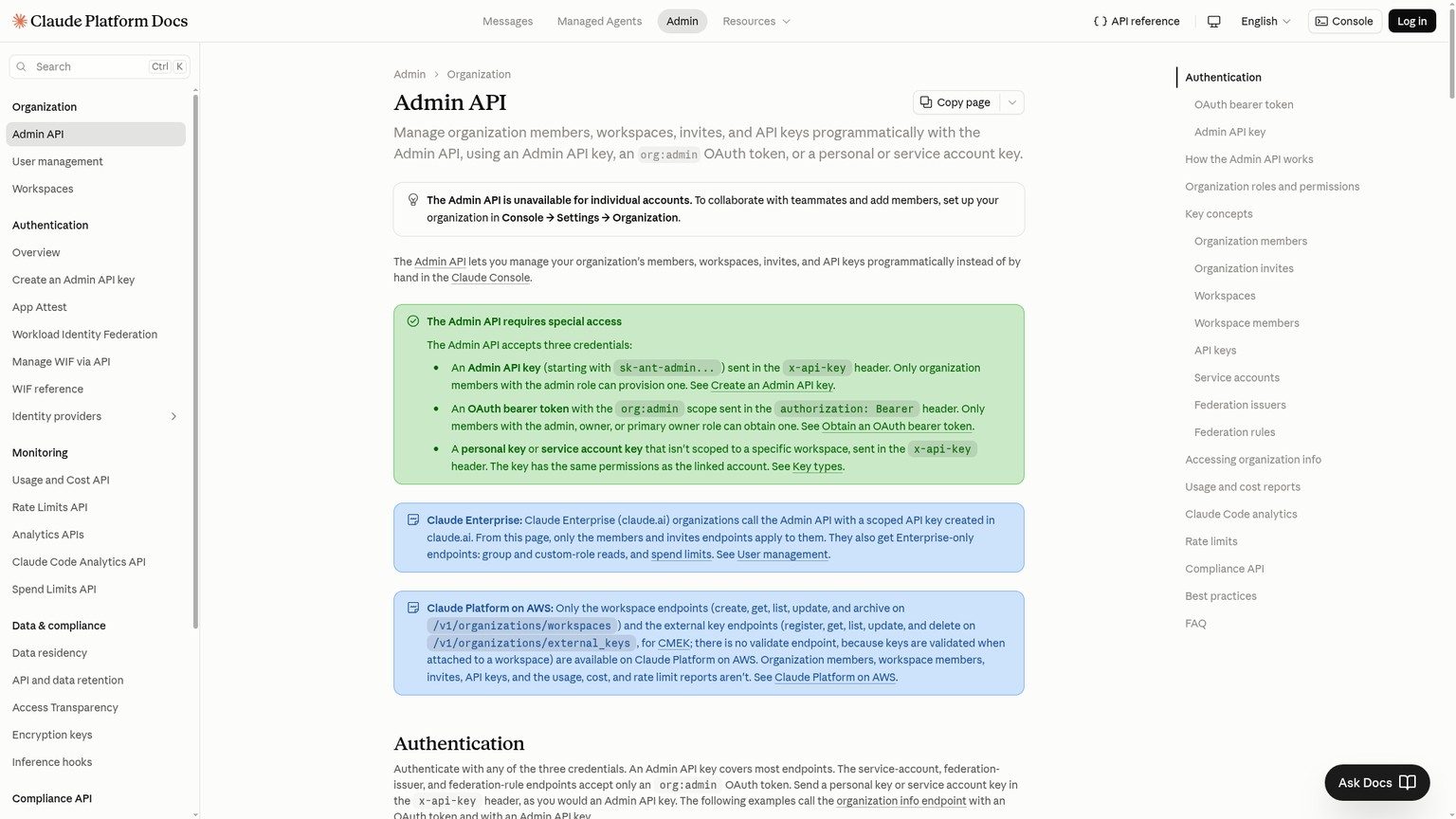
The Admin API guide covers organization members, invitations, workspaces, workspace members, API keys, service accounts, workload identity federation, organization information, rate limits, usage and cost reporting, Claude Code analytics, and an adjacent Compliance API. For a Claude-first platform team, those are the objects behind onboarding, offboarding, workload isolation, credential review, and capacity planning.
The workflow consequence of the August release is lower integration friction. Python, TypeScript, C#, Go, and Java list methods can fetch later pages on demand, while PHP, Ruby, and curl still return one page. Teams no longer need to hand-build every request and pagination loop for the supported resources.
Best for: Organizations standardizing on Claude that want typed administration in their existing language or shell workflow
Standout: Seven SDK languages and the ant CLI cover the core organization surface under one beta namespace
Pricing: No separate Admin API fee is listed. Current base input/output prices per MTok are Haiku 4.5 $1/$5, Sonnet 5 $2/$10, Opus 5 $5/$25, and Fable 5 or limited-availability Mythos 5 $10/$50
Free trial: No administration-specific trial is listed
- Native support in seven SDK languages plus a first-party CLI
- Strong member, invitation, workspace, workspace-member, and key inventory coverage
- API-key records expose expiration, principal identity, and organization or workspace scope
- Workload identity federation and service-account resources support non-human administration
- Usage, cost, rate-limit, Claude Code analytics, and compliance surfaces sit nearby
- Usage and cost reports plus Claude Enterprise user-management and analytics endpoints remain curl-only after the SDK release
- Service-account and federation administration requires an org OAuth token, not only a normal Admin API key
- Full compliance access uses a separate setup; an Admin API key can read only the Activity Feed
- The SDK namespace is still labeled beta
What changed for the Monday workflow
A Claude-first team can now write the common joiner and workspace loop in the same SDK it already uses for inference. An identity event can trigger an organization lookup, invitation review, workspace membership update, key inventory check, and rate-limit read without dropping into a separate curl wrapper for each supported object.
That does not mean every administration job is unified. Anthropic explicitly says usage and cost reports remain curl-only, as do Claude Enterprise user-management and analytics endpoints. A production automation therefore needs two client paths if it combines resource changes with those reports. The release removes a meaningful amount of glue, but it does not remove the need for capability mapping.
The credential boundary also matters. An Admin API key covers most endpoints. Service accounts, federation issuers, and federation rules require an org:admin OAuth token. That is a sensible security distinction, but it means a team cannot hand one static admin key to every automation and call the control plane complete.
Key inventory is stronger than key creation theater
Anthropic's key records make periodic access review practical. The API exposes expiration, the principal identity behind a key, and whether the scope belongs to one workspace or the organization. The older top-level workspace_id field is deprecated for this decision, so automation should use the newer scope object.
For an operator, that enables three useful checks:
- Flag active keys with no expiration or an expiration outside policy.
- Flag user-owned keys after the person leaves the relevant team.
- Flag organization-scoped keys where a workspace scope would be sufficient.
The goal is not to rotate every key on an arbitrary calendar. It is to shorten the life and scope of credentials that can affect more workloads than their owner needs.
Pricing and capacity boundaries
The Admin API carries no separate published charge, while inference remains usage-based. Anthropic's current model page lists Haiku 4.5 at $1 input and $5 output per MTok, Sonnet 5 at $2 and $10, Opus 5 at $5 and $25, and Fable 5 plus limited-availability Mythos 5 at $10 and $50.
The usage tiers impose separate monthly spend caps: Start $500, Build $1,000, Scale $200,000, and Custom uses limits arranged with the account team. At the cap, API usage pauses until 00:00 UTC on the first day of the next month unless the limit is raised, and affected requests return HTTP 429.
Those are organization capacity boundaries, not a substitute for workload-level budgeting. If five production agents share one organization, one agent can consume capacity needed by the others. Use workspaces for ownership and reporting, then place application-side budgets around individual workloads until the provider exposes the exact enforcement boundary you need.
3. Hugging Face Hub API: best for model and repository governance
Hugging Face Hub API is the best fit when the governed objects are models, datasets, repositories, inference access, and compute owned by resource groups. Its programmatic access-control guide exposes organization roles, resource-group assignments, auto-join, and monthly compute spend limits. That makes it more useful to an ML platform team than to a company that only buys hosted model tokens.
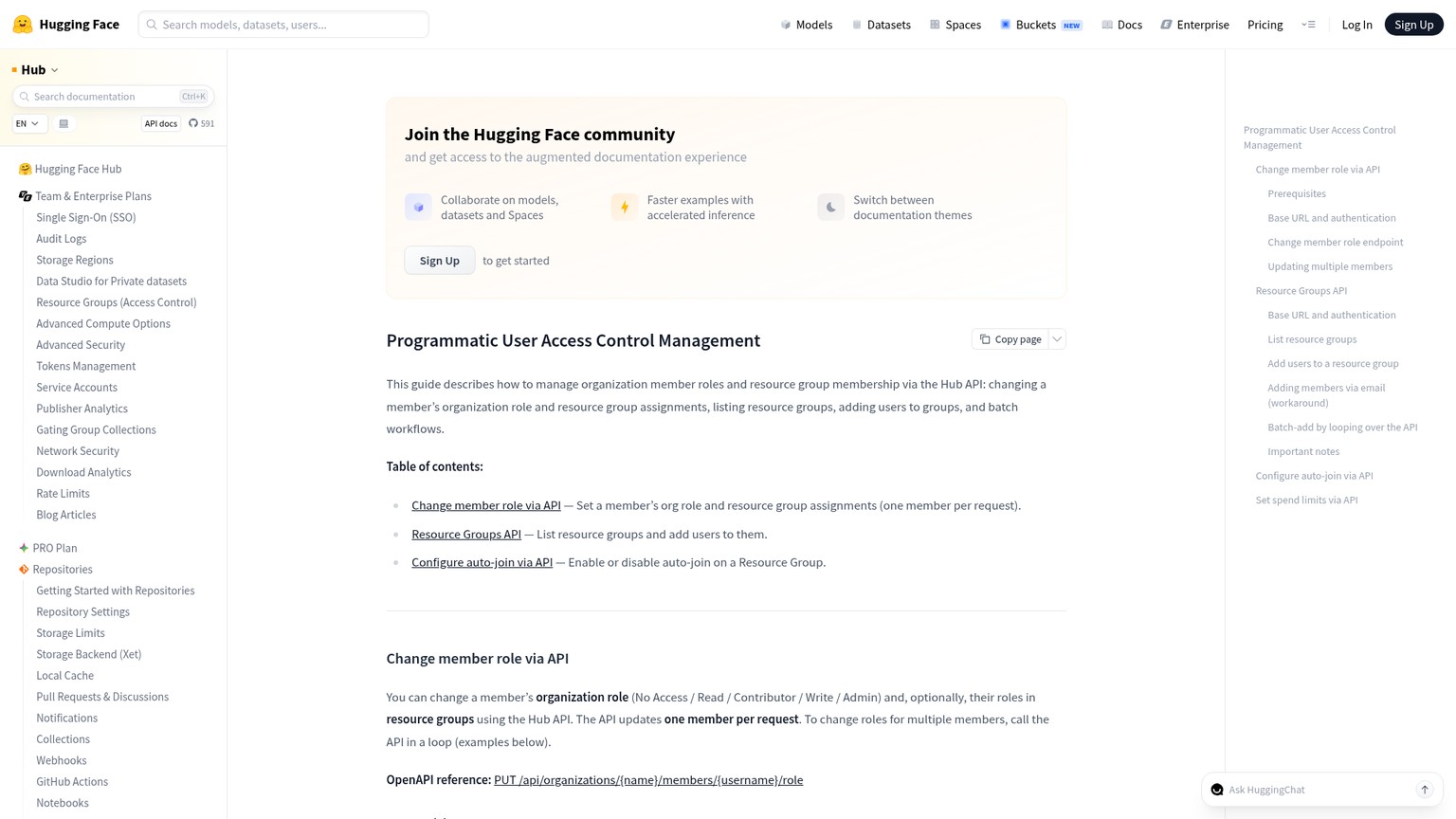
A member can be assigned No Access, Read, Contributor, Write, or Admin at the organization level, with additional roles inside resource groups. Resource groups can isolate repositories and attribute compute to a team or initiative. Auto-join can add matching organization members and backfill current members when enabled.
The candid limitation is identity ergonomics. The member-role endpoint updates one person per request and has no bulk variant. It accepts a Hugging Face username rather than an email address, and the person must already belong to the organization. Email lookup works only when an organization email domain or SSO allowed domain is configured and matches the address. Otherwise, the automation needs its own email-to-username map.
Best for: ML platform teams governing access to models, datasets, repositories, and resource-group compute
Standout: Resource groups combine granular asset access with cost attribution and monthly spend controls
Pricing: PRO is $9 per month for individuals, Team is $20 per user per month, and the general pricing page lists Enterprise at $50 per user per month; the separate enterprise comparison calls Enterprise custom pricing
Free trial: No functional free trial for the ranked member-role workflow; the endpoint returns HTTP 402 without a paid subscription
- Organization and resource-group roles match the way ML assets are actually shared
- Auto-join can backfill current members and handle future membership
- Resource-group spend limits connect access boundaries to compute accountability
- Token policies, audit logs, SSO, and enterprise controls sit in the same Hub governance model
- Team pricing is public and starts at $20 per user per month
- Member-role changes are one member per request with no bulk endpoint
- The API uses usernames, creating directory-mapping work for email-based HR systems
- Members must already be in the organization before role automation can act
- The live pricing and enterprise comparison pages disagree on whether Enterprise is $50 per user or custom
The workflow it owns
Hugging Face is strongest when a resource group is both an authorization boundary and a cost center. Imagine an ML organization with separate foundation-model, evaluation, and customer-adaptation teams. Each group needs different repositories, different ability to publish or deploy, and a separate monthly compute ceiling.
The API can set the member's organization role, add that username to resource groups, configure auto-join, and set resource-group spend limits. The governance object is not merely a folder. It decides which assets a person can change and which compute spend belongs to the group.
Auto-join needs a removal plan. Enabling it on an existing group immediately adds matching current members. Disabling it later stops future additions but does not remove members who were already added. A team that treats the toggle as a reversible membership switch will leave access behind.
The price boundary is a procurement question
Team at 20 seats is $400 per month before storage and compute. The general pricing page lists Enterprise at $50 per user per month, which would be $1,000 for the same 20 seats and a $600 monthly difference. The enterprise comparison page simultaneously describes Enterprise as custom pricing.
That conflict should change the buying process. Use $20 per user as the verified Team baseline. Treat $50 per user as a public reference, not a guaranteed enterprise quote. Ask sales to bind the actual per-seat price, included storage, API rate limits, support, and the specific governance capabilities in the order form.
The role endpoint itself requires a subscription plan and returns HTTP 402 otherwise. A free organization can demonstrate the Hub, but it cannot validate the complete administration workflow described here.
4. OpenRouter Management API: best for multi-model key budgets
OpenRouter Management API is the best choice when the controlled unit is an inference key across a multi-model platform. Its Management API keys are administrative credentials that cannot call completion endpoints. They can list, create, retrieve, update, and delete inference keys while tracking usage and applying credit limits.
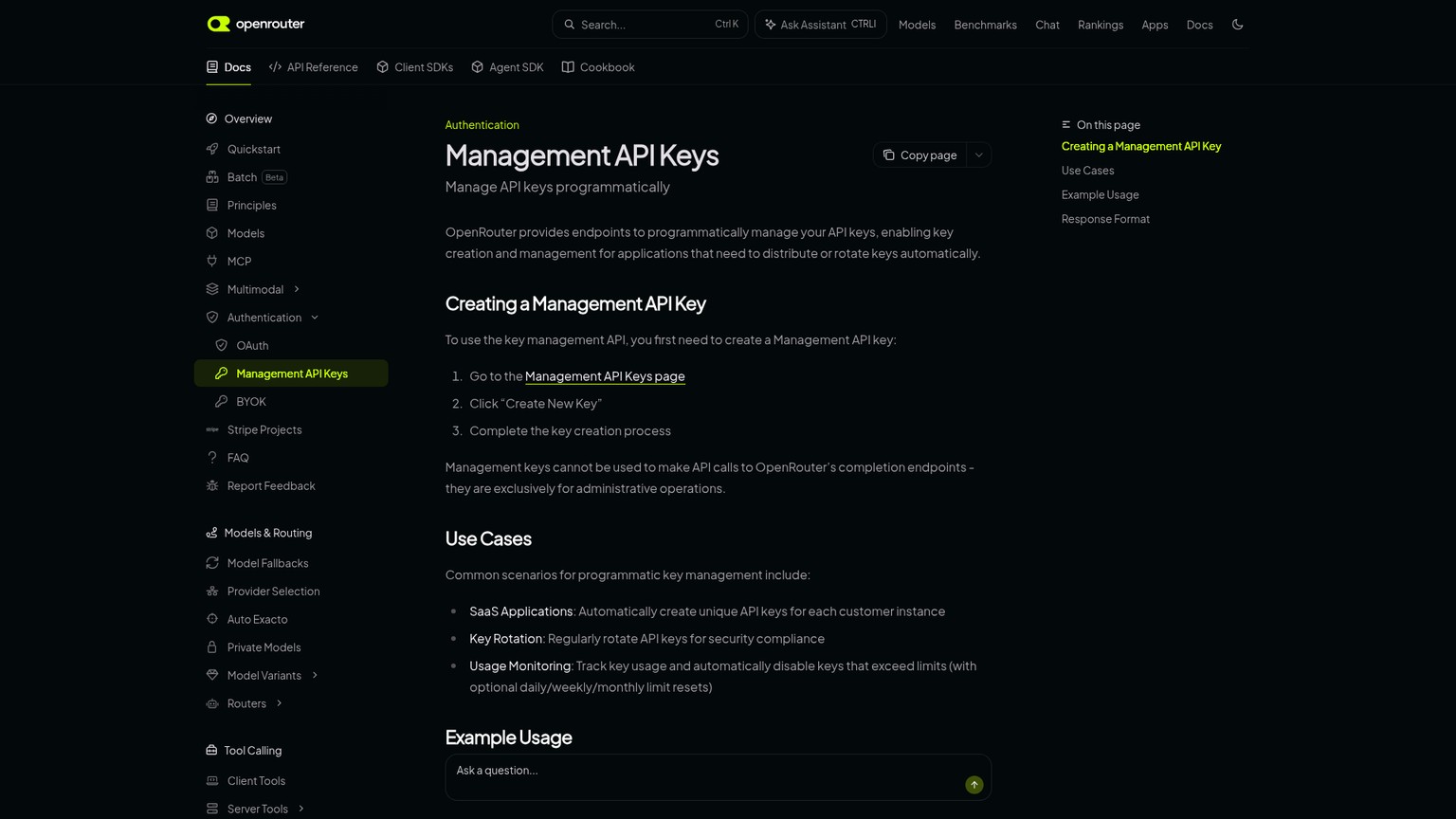
That separation is excellent for SaaS platforms issuing one key per customer, environment, or internal service. A key can carry a credit limit, a disabled state, a switch for whether BYOK usage counts, and a daily, weekly, or monthly reset. The response exposes total, daily, weekly, and monthly usage, so a control job can disable a credential before the shared account becomes the only line of defense.
Enterprise customers can add workspace budgets. Each workspace supports up to four intervals: daily, weekly, monthly, and lifetime. When any budget is reached, the next blocked request returns HTTP 403. Already-dispatched requests can complete, so the recorded total may slightly exceed the limit.
Best for: Multi-model products that issue many inference keys and need per-key or workspace cost controls
Standout: Dedicated non-inference management credentials plus key limits and Enterprise workspace budgets
Pricing: Free has no platform fee; Pay-as-you-go charges 5.5% with no minimum spend; Enterprise offers negotiated fee discounts and volume commitments
Free trial: Free is a permanent plan with 25+ free models, four free providers, and 50 requests per day
- Management credentials are separated from inference credentials
- Keys can be created, rotated, disabled, metered, and assigned resettable credit limits
- One routing layer can govern keys across 500+ models and 80+ providers on paid plans
- Enterprise workspace budgets support daily, weekly, monthly, and lifetime ceilings
- BYOK spend can be included in budget calculations when explicitly enabled
- This is not a full member invitation, role, and offboarding control plane
- Workspace budgets require Enterprise, not the Free or Pay-as-you-go plan
- Budget limits must strictly decrease from lifetime to monthly to weekly to daily
- BYOK spend is excluded from workspace budgets by default
- In-flight requests can push recorded spend slightly above a configured budget
Key limits are the product, not an accessory
OpenRouter earns its place because key administration is unusually concrete. The documented list example returns the most recent 100 keys before offset pagination. Each record can expose remaining limit, reset interval, current usage, and BYOK usage. That is enough to build a customer key console without giving the application the administrative credential.
For a B2B product, create one key per customer environment rather than sharing a global key. Attach a monthly limit that matches the customer's plan, track remaining usage, and disable the key when the customer churns or the environment is retired. Keep the Management API key in the control service, not in the product runtime.
Enterprise workspace budgets add a higher boundary. The limits must be strictly decreasing as the interval narrows: lifetime greater than monthly, monthly greater than weekly, and weekly greater than daily. This prevents a daily ceiling from exceeding the weekly allocation, but it also means a budget update can fail if the surrounding intervals are inconsistent.
BYOK needs an explicit decision. By default, workspace budgets count OpenRouter credit spend and omit usage routed through the customer's provider key. Set include_byok_in_budgets only if the organization wants the budget to count the list-price equivalent of those calls. Otherwise, a workspace can appear within budget while the underlying provider bill keeps growing.
The fee line becomes material before the admin API does
At $10,000 in Pay-as-you-go credit purchases, the 5.5% platform fee adds $550. The platform passes through model pricing, but the credit-purchase fee is still a budget line. Free carries no platform fee but is limited to free models and 50 requests per day.
The current paid catalog lists 500+ models and 80+ providers. Pay-as-you-go has no minimum spend. Enterprise offers fee discounts, volume commitments, optional dedicated limits, invoicing, and a support SLA, but workspace budgets themselves are Enterprise-only.
BYOK has a separate allowance. Pay-as-you-go includes $25,000 of list-price inference per month without the BYOK fee and charges 5% above that. Enterprise raises the no-fee allowance to $200,000 before the same 5% rate. Compare the avoided fee with the enterprise contract rather than assuming a larger allowance is free money.
Who should pick what?
Pick the API that owns the first irreversible boundary in your workflow. Brand preference should only break a tie after that boundary is clear.
Pick OpenAI when the platform team needs at least two of these at one project boundary: hard monthly spend, model restrictions, hosted-tool restrictions, data retention, service accounts, detailed audit logs, and programmatic cost reporting. It stays first when the goal is a broad governance product rather than one automation script.
Pick Anthropic when Claude is already the model standard and the immediate queue is member, invitation, workspace, key, or rate-limit work. The August SDK and CLI release makes it the fastest route for a team that can keep curl for the remaining usage, cost, and Enterprise analytics endpoints.
Pick Hugging Face when the protected assets are model repositories, datasets, Spaces, endpoints, or compute attributed to resource groups. It moves above Anthropic when repository access and ML asset governance matter more than hosted-model project budgets.
Pick OpenRouter when a product needs to issue many customer or environment keys across multiple model providers. It moves above Hugging Face when per-key usage limits and vendor-independent routing are the primary control, but it falls behind whenever member lifecycle is required.
The ranking changes entirely for an organization with mature AWS, Google Cloud, or Azure governance. If every identity, resource, budget, and audit event must already flow through that cloud, the extra services are existing infrastructure rather than new fragmentation. In that case, consistency with the cloud estate can be more valuable than a direct provider's simpler API.

The administration payback model
Automation is worth funding when the recurring change volume can repay the build before the control surface changes again. Call this the 40-change test: price one month of access, key, project, or workspace changes, then compare that value with the cost of a narrow first integration.
Use an explicit scenario rather than a universal savings claim:
- 40 administration changes per month
- 10 minutes of manual work removed per change
- $90 loaded labor cost per hour
- 24 hours to build, review, and document the first automation
Forty changes at 10 minutes each remove 400 minutes, or about 6.67 hours. At $90 per hour, that is approximately $600 of monthly labor value. A 24-hour build at the same rate costs $2,160. Dividing $2,160 by $600 gives a 3.6-month payback.

The scenario is deliberately incomplete. It excludes maintenance, approval time, exceptions, vendor contracts, and the cost of a bad automated write. It also excludes incident avoidance, faster onboarding, and easier audit evidence. Those omissions keep the decision honest: $600 per month is a labor model, not an observed return.
The 40-change test supports three decisions:
- Build now when the same bounded change repeats, the source of truth is reliable, and a rollback exists.
- Keep it read-only when inventory and drift detection create value but identity mappings still produce exceptions.
- Wait when the team cannot name the authoritative system, the approval owner, or the recovery path.
The new Anthropic SDK coverage can lower implementation friction, but it does not change those prerequisites. A typed method can make the wrong write more reliably.
The ones to avoid for this specific job
Avoid a hyperscaler when one AI-native surface is the requirement
Google Cloud, AWS, and Microsoft are strong governance platforms and weak answers to a request for one direct AI administration API. Google divides organization and project management from billing budgets. AWS divides Bedrock model operations from Organizations, IAM, Budgets, Service Quotas, and CloudTrail. Microsoft Foundry is project-scoped while Resource Manager, Entra, and Consumption Budgets own adjacent controls.
Use the cloud route when those services are already the company's policy backbone. Avoid introducing it solely to automate four direct-provider objects. The integration and permission surface will be larger than the job.
Avoid an API gateway for employee lifecycle
A gateway can govern requests without knowing whether a departed employee still owns a provider key. Routing, retries, caching, token budgets, and tool policy are valuable, but they do not replace provider membership and credential administration. Use the gateway for traffic and the provider administration API for the account behind it.
Avoid SCIM-only automation for keys and spend
SCIM can provision identities while leaving service accounts, API keys, project limits, and orphaned workloads untouched. It is an input to the lifecycle, not proof that the lifecycle completed. The reconciliation job must compare the identity system with the AI platform's own resources.
Avoid a write-first rollout
The fastest way to lose trust is to automate removal before proving inventory. Begin with read-only drift reports. Measure unresolved identities, duplicate accounts, ownerless projects, and keys without a clear principal. Promote one reversible mutation only after the exception queue has an owner.
Avoid forcing an affiliate into the ranking
No active partner in the site's current partner pool sells a comparable AI-platform organization administration API. A password manager or workflow product can support the implementation, but it does not belong above a direct control plane. The ranking stays independent because a misplaced partner would make the advice less useful and less credible.
The Monday move
On Monday, inventory one provider and automate one reversible workflow. Do not begin with a multi-provider control tower.
Start by listing members, projects or workspaces, service identities, keys, current spend controls, and the latest audit evidence. Join those records to the identity source, cost center, business owner, environment, and recovery owner. Anything that cannot be joined becomes an exception, not an automatic delete.
Then choose one bounded workflow:
- OpenAI: reconcile one non-production project's users, model permissions, spend settings, and audit events.
- Anthropic: reconcile one workspace's members, key scopes, expirations, and rate limits through the new SDK or ant CLI.
- Hugging Face: reconcile one resource group's usernames, roles, auto-join policy, and monthly compute limit.
- OpenRouter: reconcile one customer environment's key status, credit limit, reset interval, and usage.
Keep the first write reversible. Adding or narrowing access is easier to recover than deleting a key or removing the last owner. Require a human approval for destructive changes, preserve a break-glass owner credential outside the automation, and record the provider response beside the originating request.
Review the pilot after one week. Count successful changes, exceptions, rollbacks, and minutes of human handling. Put those observed values into the 40-change test. Expand only when the control loop closes with a source event, provider change, matching audit evidence, and a tested recovery path.
The Monday decision is concrete: one provider, one boundary, one owner, one write, one rollback. Everything else can wait.
Frequently asked questions
Which API platform is best?
For AI platform administration, OpenAI is the broadest overall. Anthropic is the better operational choice for a Claude-first stack, Hugging Face for model and repository governance, and OpenRouter for multi-model key limits and workspace budgets.
What are the best API management platforms?
API-management platforms such as gateways govern traffic, authentication, policies, and published APIs. They solve a different problem from AI-platform administration, which governs vendor-account members, projects or workspaces, keys, spend, permissions, and audit evidence.
Are there free AI platform administration APIs?
OpenRouter has a permanent Free plan with 25+ free models, four free providers, and 50 requests per day. OpenAI and Anthropic do not list a separate Admin API fee, but model use is billed separately. Hugging Face's member-role endpoint requires a paid Team or Enterprise subscription and returns HTTP 402 without one.
Get the AI Business Workflow Audit Checklist
Turn one administration workflow into a scoped control loop with an owner, budget, permission boundary, evidence check, and rollback. Subscribe to get the checklist free.
- Last Updated
- Category
- Build
- Language

Gumloop vs n8n (Verified October 2026)
Gumloop vs n8n: current pricing, credits vs executions, self-hosting and the same AI lead workflow, with a verdict for each builder.Oct 7, 2026Build
AI Agent Frameworks in 2026: LangGraph, CrewAI, OpenAI Agents SDK, Claude Agent SDK, Mastra and Google ADK (Compared)
Compare eight AI agent frameworks by language, state, MCP, approvals and current hosted prices. Pick the right runtime for production.Oct 7, 2026Build
Codex Cloud
Set up a reusable Codex Cloud environment, keep coding tasks running with your laptop off, steer from your phone, and choose cloud or local CLI.Oct 7, 2026Build
GitHub Copilot Pricing (2026): The Seat Is the Floor, Credits Are the Bill
GitHub Copilot plans, AI Credits, model rates, and three worked monthly bills. Choose Pro, Pro+, Max, Business, or Enterprise with spending limits.Oct 6, 2026Build
GitHub Copilot CLI
Install GitHub Copilot CLI, sign in, fix tests and open a PR. Current GitHub plans, AI credits, models, permissions, MCP and instructions.Oct 6, 2026Build
Best Web Scraping Tools in 2026: Firecrawl, Bright Data, Browse AI, and Context.dev (Compared)
Choose web scraping tools by the job: agent-ready pages, no-code monitoring, or collection at scale. Eight tools with verified prices and billing units.Oct 6, 2026Build
Agent Memory Explained: Context, Sessions, Stores and Costs
Agent memory explained for builders: context, sessions, long-term stores, files and skills, provider costs, and fixes for stale facts and user leaks.Oct 5, 2026Build