Best Browsers for AI Agents
Compare Browserbase, Steel, Kernel, Browser Use, Kitesurf, and five more agent browsers by price, control, auth, and production limits.
Published
 By Omid Saffari



Browserbase is the best browser for most production AI agents, Steel is the best open option, and Kernel wins when authenticated sessions must stay alive. Pricing verified on 8 August 2026 starts at $0.02 per browser-hour on Browser Use, while Browserbase's managed self-serve plans start at $20 a month.
The short answer
Choose Browserbase if the agent will touch a real customer workflow and you want the browser, state, debugger, replay, and logs under one managed contract. Choose Steel if deployment control and an open-source path matter more than having every cloud feature available locally. Choose Kernel if the hard part is keeping an authenticated, headful browser alive for hours rather than opening cheap disposable tabs.
The cheapest runtime is not automatically the cheapest system. A $0.02 browser-hour saves almost nothing if a failed run leaves no replay, if a login expires between tasks, or if your team has to build the session-control plane around it. Conversely, paying a platform premium is wasteful when the job is simply to open a known page, extract one field, and close.
These are developer browser runtimes and agent-control products, not desktop browsers with a chat sidebar. If you want a browser for your own daily browsing, the separate guide to the best consumer AI browser compares Atlas, Comet, Dia, and their peers. If you are assembling the wider orchestration layer around these runtimes, see the best AI agent platforms.
An agent browser is three products, not one
The phrase agent browser hides three different jobs. Comparing them as one category is like comparing a rental car, a driver, and a courier service because all three can deliver a parcel.
- The browser runtime is the isolated Chromium, Firefox, or WebKit process. It owns session creation, lifecycle, CPU, memory, cookies, storage, network identity, and the remote connection.
- The agent-control layer turns a goal into browser actions. Stagehand, Browser Use's agent, OpenAI Agents SDK computer tools, Vercel Agent Browser, and Playwright MCP sit here. Some use deterministic selectors, some let a model reason over the page, and some blend both.
- The content path fetches, searches, or extracts a page without paying to operate an interactive browser. It is the right lane when an agent only needs readable content, not a click, login, upload, or visual state.
Playwright is a control library, not a hosted browser. A hosted Playwright provider gives your code a remote CDP endpoint, which is the socket through which Playwright drives a cloud browser. Browserbase, Steel, Kernel, Hyperbrowser, Browserless, Bright Data, and Browser Run all cover some version of that runtime job. Vercel Agent Browser is also a control tool: it can launch locally or connect to hosted providers, but it does not become a managed browser fleet by itself.
OpenAI Agents SDK computer tools solve a related but different problem. They provide the action interface and model loop for computer use. You still decide where the browser lives, how it authenticates, what evidence gets retained, and how a failed session is resumed. Playwright MCP similarly makes browser actions available to an MCP client; it does not supply production isolation or a cloud control plane.
For a stable checkout, CRM form, or admin workflow, keep deterministic Playwright actions as the backbone. Use an LLM-driven layer such as Stagehand where labels, layout, or content change enough to defeat fixed selectors. Giving the model every click increases cost and variance without creating value. Giving it only the ambiguous steps makes the system easier to test.
The 10 best browsers for AI agents
1. Browserbase: best overall for production agents
Browserbase is a managed cloud browser platform built around isolated Chromium sessions, reusable identity, and operator evidence.
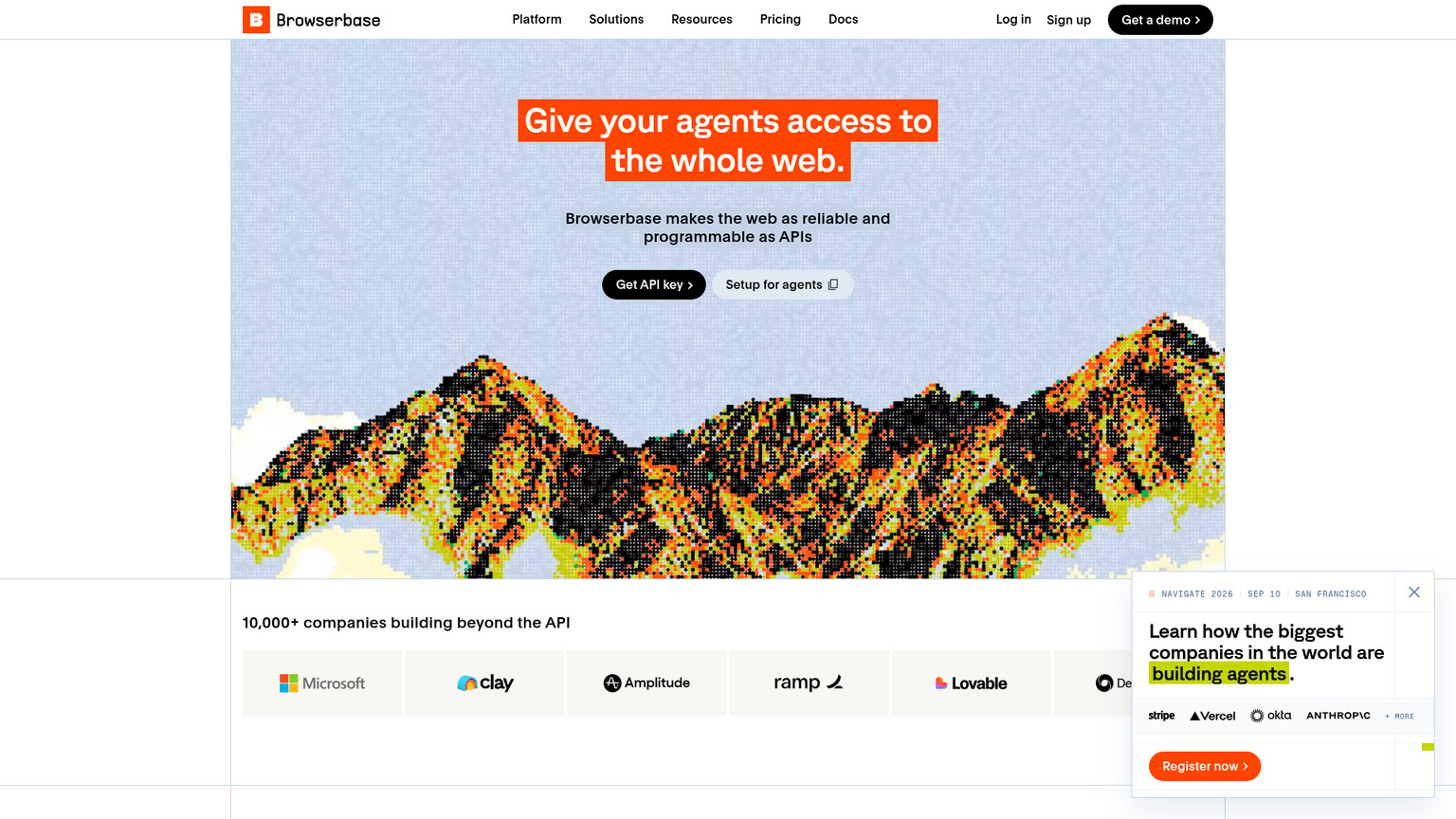
Its advantage is not merely that Playwright, Puppeteer, Selenium, Stagehand, or another CDP client can connect. The useful bundle is the browser plus the things a production incident demands: Live View, full session replay, structured console and network logs, a debugger, and reusable Contexts that preserve cookies and storage. If an onboarding agent fails while uploading an identity document, a replay gives an operator something concrete to inspect. If the same user returns tomorrow, a Context can restore the authenticated state without turning credentials into prompt text.
That makes Browserbase the strongest default for customer-facing work such as account provisioning, procurement submissions, form completion, and back-office updates. The agent can use deterministic Playwright for the stable route, hand one ambiguous screen to Stagehand, and leave a trace that engineering can audit. The isolation boundary also includes a user-data directory, fingerprint, network identity, and session lifecycle, which are easy to underestimate when a local prototype uses one shared Chrome profile.
The wall is deployment control. Browserbase is managed cloud only. Enterprise customers can discuss private cloud, VPC, residency, and compliance controls, but there is no on-prem package to run as your own ordinary browser service. Teams with a contractual self-hosting requirement should start with Steel or Browserless instead. Browserbase also stops being the obvious economic choice for clean, disposable browsing where replay and persistent state do not matter.
All Browserbase prices below were verified on 8 August 2026. Free is $0/month with 1 browser hour, 3 concurrent browsers, 15-minute sessions, 3 Agent runs, 1,000 Search calls, 1,000 Fetch calls, 7-day retention, and $5 of model tokens. Developer is $20/month with 100 browser hours, 25 concurrent browsers, 15 Agent runs, 1,000 Search calls, 1,000 Fetch calls, and 1 GB of proxy traffic; overages include $0.12/browser-hour, $7 per 1,000 Search calls, and $12/GB of proxy traffic. Startup is $99/month with 500 browser hours, 100 concurrent browsers, 50 Agent runs, 10,000 Fetch calls, 5 GB of proxy traffic, and 30-day retention; browser overage is $0.10/hour and proxy overage is $10/GB. Scale is custom, starting from an envelope of 250 concurrent browsers, 500 browser hours, 10,000 Search calls, 10,000 Fetch calls, 5 GB of proxy traffic, advanced stealth, HIPAA BAA/DPA support, and optional SSO.
One current pricing-page detail is deliberately absent: the page gives two different retention values for Developer in different sections. Until those agree, do not design a compliance policy around an assumed Developer retention window.
Best for: Production agents where state, debugging evidence, and fast operational handoff matter.
Standout: Reusable Contexts plus replay, structured logs, Live View, and a live debugger in one managed system.
Pricing: Free $0; Developer $20/month; Startup $99/month; Scale custom, verified 8 August 2026.
Free trial: A permanent Free plan with 1 browser hour and 3 concurrent browsers.
- Reusable authenticated contexts keep cookies and storage separate from prompts.
- Replay, network logs, console logs, and Live View shorten incident diagnosis.
- Works with Playwright, Puppeteer, Selenium, Stagehand, and generic CDP clients.
- Developer includes exactly 100 browser hours for a predictable $20 baseline.
- No ordinary self-hosted or on-prem deployment.
- Clean disposable jobs pay for an operations layer they may not need.
- Some usage categories, including proxies and agent runs, meter separately.
2. Steel: best open-source and hybrid option
Steel is an open-source browser API with a managed cloud service and a Docker path for local or self-hosted operation.
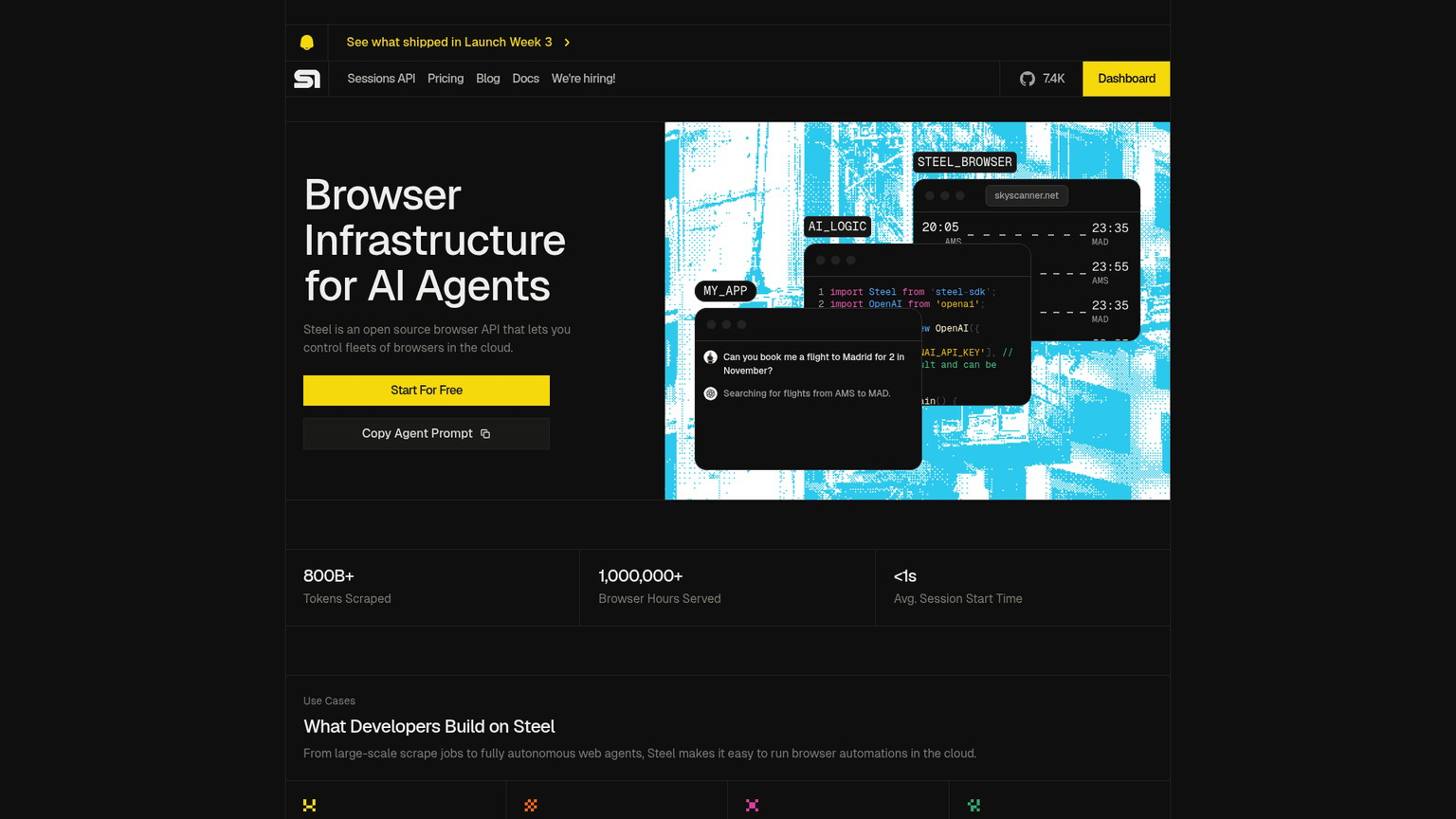
Steel is the right answer when portability is a product requirement rather than a preference. A team can develop against the same broad API shape while choosing Steel Cloud for managed sessions or Steel Local for infrastructure it controls. Playwright, Puppeteer, and Selenium are supported, and the cloud adds the operational pieces most teams eventually need: proxies, fingerprinting, CAPTCHA handling, live and recorded viewing, reusable browser context, and automatic sign-in.
A concrete fit is an internal finance agent that operates in a regulated environment. Use local or self-hosted Steel while the workflow is narrow and infrastructure ownership is mandatory, then evaluate cloud features for public-web jobs that need proxies and CAPTCHA solving. Steel says cloud sessions start in under one second on average when the client runs in the same region, which helps short workflows where startup latency is a large share of the total run.
The important wall is that self-hosted Steel is not feature-equivalent to Steel Cloud. Steel Local is effectively a single-session runner, while Credentials API, Files API, CAPTCHA solving, and the dedicated Stealth Browser are cloud-only. The open-source label therefore answers deployment control, but it does not magically reproduce a managed browser fleet. Self-hosting transfers scheduling, scaling, patching, observability storage, and network reputation to your team.
Steel prices verified on 8 August 2026 are Launch at $0/month plus usage, Scale at $250/month plus usage, and Enterprise at custom pricing plus usage. Launch includes a one-time $30 usage credit valid for 90 days, 10 concurrent sessions, 15-minute maximum sessions, up to 3 seats, 60 requests/minute, and 7-day retention. Its browser rate is $0.10/hour, charged by the minute. Scale includes $100 in monthly usage credit, 100 concurrent sessions, one-hour maximum sessions, unlimited seats, 600 requests/minute, 14-day retention, dedicated support, Enterprise SSO, and dedicated IPs at $5 per IP. Its browser rate is $0.08/hour. Enterprise supports 1,000 or more concurrent sessions, sessions up to 24 hours, reserved pools, Stealth Browser, custom dedicated-IP pricing, and support and uptime SLAs. Proxy bandwidth ranges from $10 to $6/GB and CAPTCHA solving from $3 to $1 per 1,000 successful solves across paid tiers.
Best for: Teams that need an open-source browser API, a self-host path, or freedom to move between local and managed deployment.
Standout: One product family spans a Docker-based local runner and a cloud fleet with state, viewing, proxies, and automation support.
Pricing: Launch $0 plus usage; Scale $250/month plus usage; Enterprise custom plus usage, verified 8 August 2026.
Free trial: Launch includes a one-time $30 credit valid for 90 days.
- Open-source code and a Docker path reduce infrastructure lock-in.
- Cloud browser time is plainly metered at $0.10/hour or $0.08/hour.
- Supports Playwright, Puppeteer, and Selenium.
- Managed cloud covers reusable context, recordings, proxies, and CAPTCHA handling.
- Local mode is effectively single-session and lacks several cloud APIs.
- Launch sessions stop at 15 minutes and Scale sessions at one hour.
- Self-hosting makes fleet reliability and browser patching your responsibility.
3. Kernel: best for long-lived authenticated sessions
Kernel is a cloud browser and full-VM runtime designed for persistent profiles, managed authentication, and sessions lasting up to 72 hours.
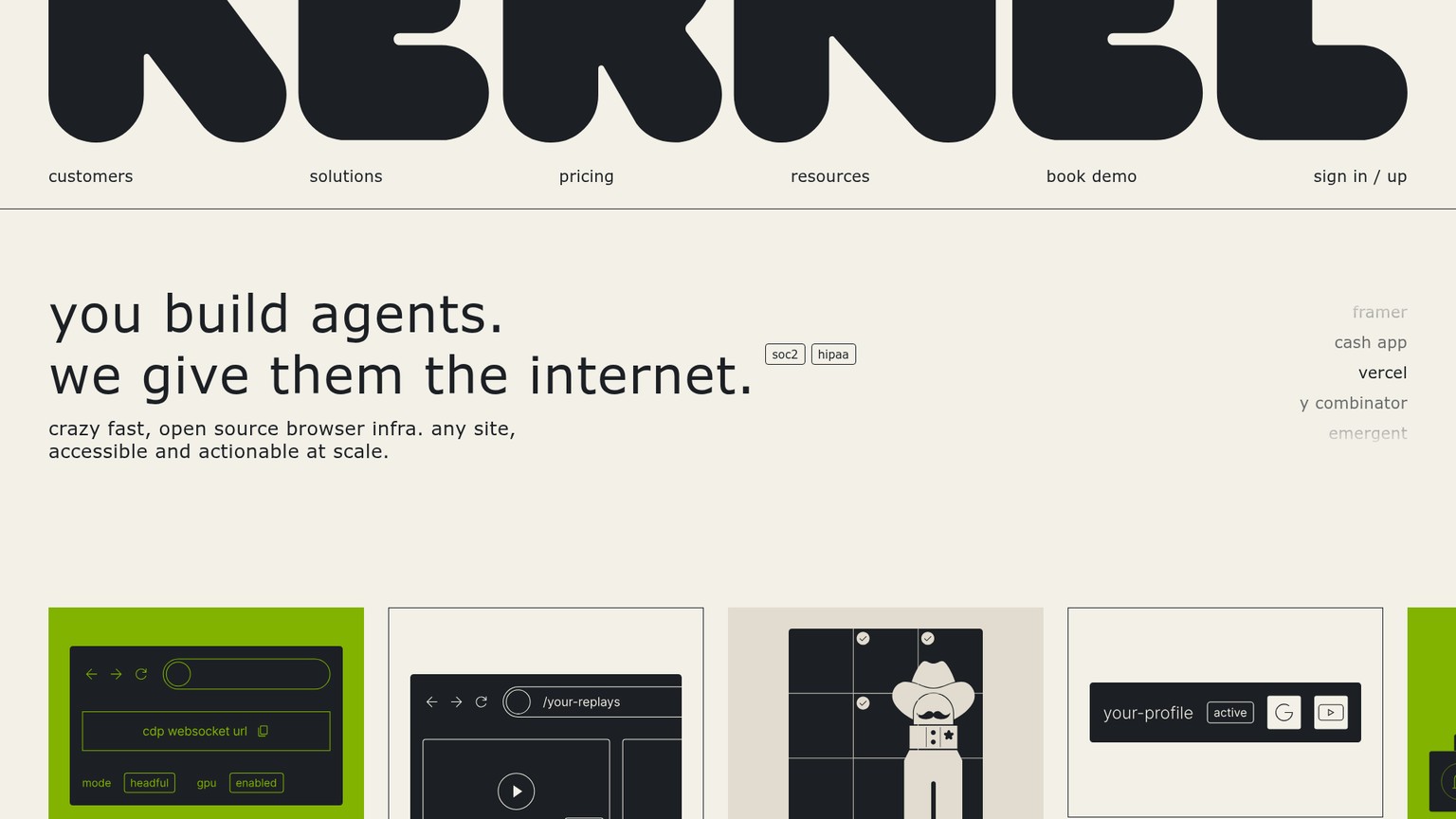
Kernel deserves its own lane because a long-lived authenticated browser is a different workload from a disposable scraping tab. Consider an accounts-payable agent that checks a vendor portal, waits for a human approval, and returns later without losing its session. Kernel profiles preserve the browser identity, Standby Mode avoids browser usage charges while a browser is idle, and Managed Auth can refresh logins. Credentials can come from stored records or a 1Password connection, which is a cleaner boundary than pasting passwords into an agent prompt.
The platform offers Live View, replay, VM isolation, and the ability to scale from a few sessions to large fleets. Its per-second pricing also makes short headless runs legible. The headless rate is $0.0000166667 per second, which is $0.06/hour. The headful rate is $0.0001333336 per second, about $0.48/hour, and headful GPU is $0.0008000016 per second, about $2.88/hour. That pricing spread is the central decision: Kernel can be extremely inexpensive for headless work, but a visual or GPU-heavy workflow is a different budget.
The wall is therefore not session capability but mode selection. One hundred headless hours cost $6 before included monthly credits; one hundred headful hours cost about $48; one hundred headful GPU hours cost about $288. A team that quotes only the $0.06 figure can understate its actual bill by 8x or 48x. Managed Auth has no separate per-connection fee on paid plans, but login-refresh sessions still consume browser usage and concurrency.
Kernel prices verified on 8 August 2026 are Free at $0/month plus usage with $5 monthly credit and 5 concurrent browsers; Hobbyist at $30/month plus usage with $10 credit and 10 concurrent browsers; Start-Up at $200/month plus usage with $50 credit and 150 concurrent browsers; and Enterprise at custom pricing. Idle browsers in Standby Mode and idle browser pools do not incur browser usage, and Kernel does not charge for proxies. The live marketing page and detailed pricing documentation disagree on a few Free-plan feature boundaries, so the safe Free assumptions are limited to the published price, credit, concurrency, Live View/logs, and stealth entries.
Best for: Agents that must preserve login state, pause, resume, or remain active across a long human-in-the-loop process.
Standout: Up to 72-hour browsers, persistent profiles, Standby Mode, and Managed Auth with stored credentials or 1Password.
Pricing: Free $0 plus usage; Hobbyist $30 plus usage; Start-Up $200 plus usage; Enterprise custom, verified 8 August 2026.
Free trial: Free includes $5 of monthly usage credit and 5 concurrent browsers.
- Sessions can run for up to 72 hours.
- Headless browser time is only $0.06/hour before credits.
- Standby Mode avoids paying browser time while supported sessions are idle.
- Managed Auth and 1Password integration keep credentials outside the model prompt.
- Headful mode costs about 8x the headless rate, and GPU mode about 48x.
- Login refreshes still consume browser time and concurrency.
- Conflicting Free feature descriptions require conservative planning.
4. Browser Use Cloud: best bundled autonomous agent
Browser Use Cloud combines remote browser infrastructure with a hosted autonomous browser agent and an open-source agent library.
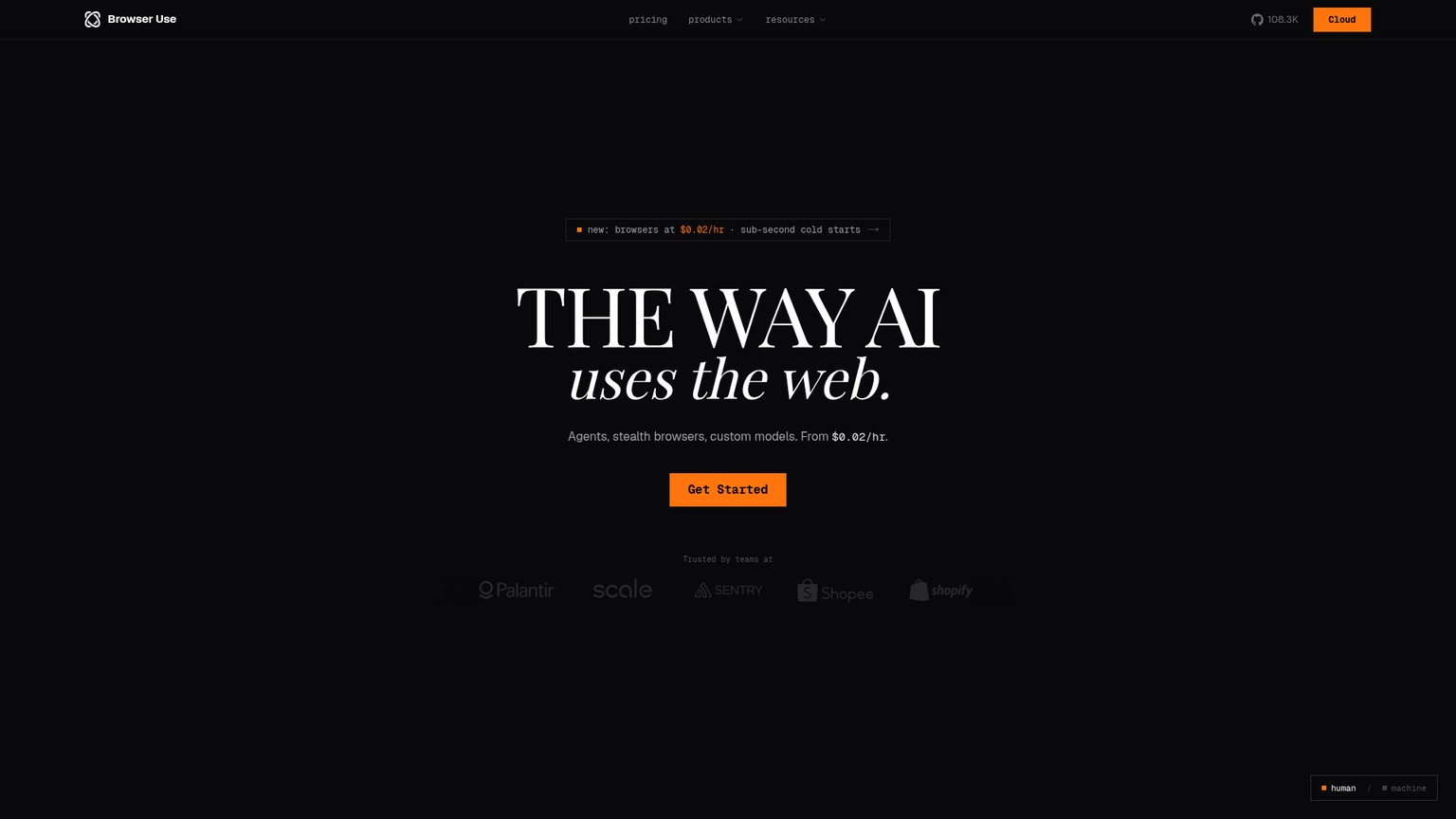
Browser Use is the fastest conceptual path from a goal such as "find the next available appointment and collect the options" to an agent that navigates pages. The buyer can use its hosted Agents API, bring a model key, or use the open-source Browser Use library against another runtime. That is useful for teams that do not want to assemble an action loop, browser service, and model integration separately.
Its raw infrastructure price is unusually low: $0.02 per browser-hour. But the browser is only one line in an autonomous run. Hosted Agents API V4 charges 1.2 times provider model rates. Bring-your-own-key charges the provider cost plus a 0.2 times orchestration fee. Managed proxy traffic costs $5/GB, or $4/GB on Scaleup, while proxyless or bring-your-own-proxy egress costs $0.20/GB. Legacy API V2 starts at $0.006 per LLM step plus $0.01 for task initialization. A long, indecisive model loop can therefore cost far more than its browser.
The best fit is a changing workflow where autonomy is the feature: cross-site research, appointment discovery, lead qualification, or a task whose exact next page cannot be known in advance. The wrong fit is a stable five-field form that Playwright can complete deterministically. In that case the agent layer adds model latency, token spend, and behavioral variance to a solved control problem.
Browser Use Cloud prices verified on 8 August 2026 are Pay As You Go at $0/month, Dev at $29/month, Business at $299/month, Scaleup at $999/month, and Enterprise at custom pricing. The service includes 10 free agent tasks each month and 3 concurrent sessions before top-up, while PAYG supports 10 concurrent sessions. Dev, Business, and Scaleup include $29, $299, and $999 in monthly credits and allow 25, 200, and 500 concurrent sessions respectively. Annual plans give two months free and make the credits available up front.
Best for: Teams that want a hosted autonomous browser agent, not just a CDP endpoint.
Standout: The same product family offers agent orchestration, a remote browser, and an open-source library that can use other runtimes.
Pricing: PAYG $0; Dev $29/month; Business $299/month; Scaleup $999/month; Enterprise custom, verified 8 August 2026.
Free trial: 10 free agent tasks each month, with PAYG available without a subscription.
- Raw browser time costs $0.02/hour.
- Hosted agent and browser infrastructure can be purchased together.
- Open-source library keeps the agent layer portable to another runtime.
- Concurrency rises to 500 sessions on Scaleup.
- Model and orchestration charges can dominate the browser bill.
- Autonomous control is unnecessary variance for a fully deterministic flow.
- Proxy traffic is metered separately at up to $5/GB.
5. Browserless: best multi-engine and licensed self-hosting option
Browserless is a managed and enterprise self-hosted browser platform that supports Chrome, Firefox, and WebKit through familiar automation clients.
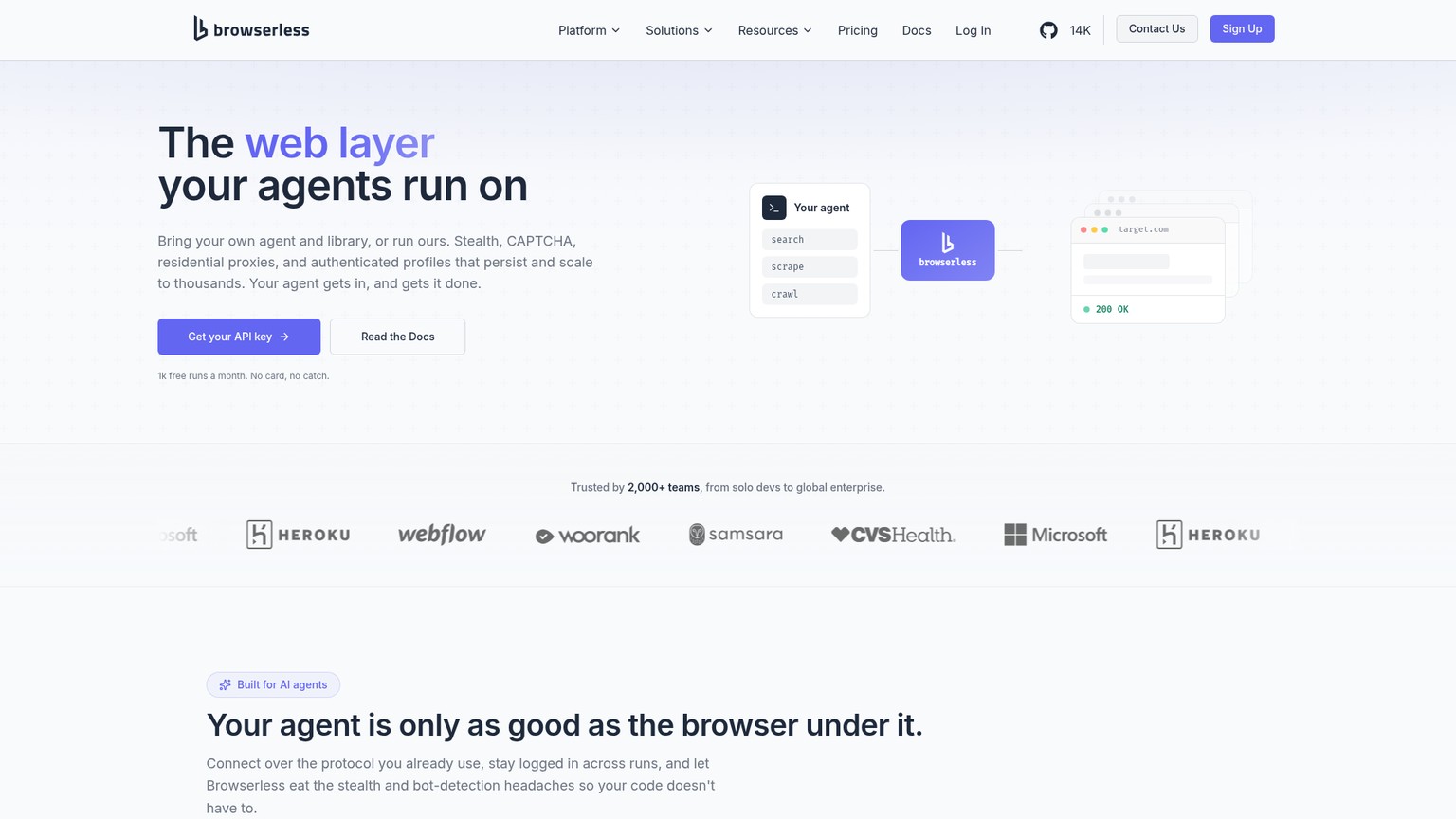
Browserless is the strongest specialist here when engine coverage matters. A test or compatibility agent can run Playwright against WebKit and Firefox instead of quietly treating Chromium as the whole web. The same stack can be bought as a managed service or licensed for private deployment at enterprise scale, which suits organizations that need the vendor's browser service without sending sessions to a shared public cloud.
The product uses units rather than a simple browser-hour rate. One unit covers up to 30 seconds of browser connection, and reconnecting consumes another unit. Residential proxy traffic uses 6 units/MB, datacenter traffic uses 2 units/MB, and a successful CAPTCHA solve uses 10 units. That meter is workable once modeled, but it makes a casual price comparison misleading. One hundred connected hours consume 12,000 base units before proxy and CAPTCHA use.
Session ceilings are the practical wall on self-serve plans. Free sessions and reconnects stop after one minute. Prototyping allows 15 minutes, Starter 30 minutes, and Scale 60 minutes. This is fine for isolated navigation and extraction jobs, but not for a browser that must stay with a user through a long approval loop. Enterprise is the route for custom persistence, concurrency, proxy limits, and licensed self-hosting.
Browserless prices verified on 8 August 2026 are Free at $0 with 1,000 units/month, 2 concurrent browsers, 1-minute sessions, 1-day persisted sessions/replays, CAPTCHA solving, extensions, and three browser engines. Prototyping is $25/month billed annually with 20,000 units, 10 concurrent browsers, 15-minute sessions, $0.0020/unit overage, 7-day persistence, and screen recording. Starter is $140/month billed annually with 180,000 units, 40 concurrent browsers, 30-minute sessions, $0.0017/unit overage, and 30-day persistence. Scale is $350/month billed annually with 500,000 units, 100 concurrent browsers, 60-minute sessions, $0.0015/unit overage, and 90-day persistence. Enterprise is custom for private or licensed self-hosting, hundreds or thousands of concurrent browsers, custom limits, SSO, roles, and compliance needs.
Best for: Cross-browser agents, low-level Playwright/Puppeteer control, or enterprises that need licensed private deployment.
Standout: Chrome, Firefox, and WebKit plus both managed and enterprise self-hosted delivery.
Pricing: Free $0; Prototyping $25/month annually; Starter $140/month annually; Scale $350/month annually; Enterprise custom, verified 8 August 2026.
Free trial: Free includes 1,000 units and 2 concurrent browsers.
- Only ranked option with explicit Chrome, Firefox, and WebKit support on the Free plan.
- Enterprise can license the same stack for private deployment.
- Supports familiar Playwright and Puppeteer clients.
- Persisted sessions, replay, extensions, and CAPTCHA solving are included by tier.
- Unit billing requires conversion before costs are comparable.
- Self-serve session caps range from 1 to 60 minutes.
- Reconnects and network services consume additional units.
6. Anchor Browser: best for managed authentication and enterprise controls
Anchor Browser is a remote browser platform that pairs low raw infrastructure rates with authenticated sessions, embedded agents, and enterprise control gates.
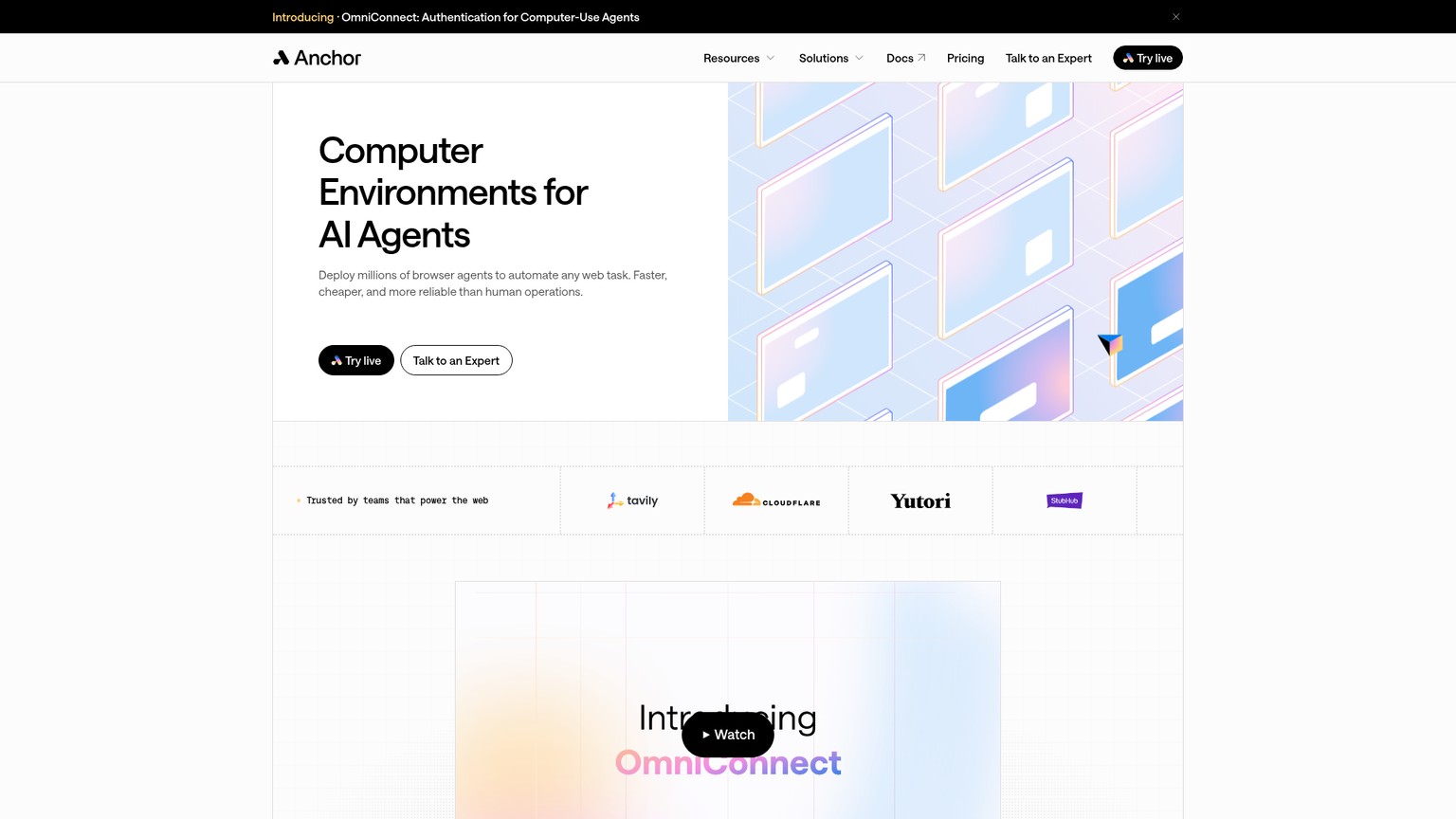
Anchor fits workflows where logging in is not a setup detail but the center of the product. A customer-success agent that updates several SaaS admin panels needs a repeatable way to create authenticated browsers, handle CAPTCHA, choose geolocation, and let a human take control when required. Anchor begins authenticated browsers, automatic CAPTCHA bypass, and any-geolocation sessions on Starter, then moves Cloudflare-verified agents, full stealth, bring-your-own-proxy, compliance, and multi-region support to Growth.
Its raw infrastructure meter is easy to explain: $0.01 per browser creation, $0.05 per browser-hour, $8/GB of Anchor proxy traffic, and $0.20/GB of egress when using your own proxy or no proxy. One hundred one-hour sessions therefore cost $6 before proxy or agent spend: $5 of browser time plus $1 for 100 creations. That is a useful baseline, but authenticated automation often pays more for network traffic and agent decisions than for keeping Chromium open.
The wall is the jump between self-serve tiers. Starter is $50/month, while Growth is $2,000/month. A team that needs SOC 2 Type 2, ISO 27001, GDPR controls, full stealth, multi-region support, or Cloudflare-verified browser agents crosses that gap. Growth can still make sense for a revenue workflow where assurance and success rate matter more than the monthly base, but the difference should be planned before a prototype depends on a gated feature.
Anchor prices verified on 8 August 2026 are Free with $5 in monthly credits, up to 5 concurrent browsers, 5 session creations/minute, an embedded browser agent, and 45-day retention. Starter is $50/month with 25 concurrent browsers and 25 creations/minute, plus authenticated browsers, automatic CAPTCHA bypass, and geolocation sessions. Growth is $2,000/month with 200 concurrent browsers and 100 creations/minute, plus full stealth, bring-your-own-proxy, Cloudflare-verified agents, SOC 2 Type 2, ISO 27001, GDPR, and multi-region support. Enterprise is custom with 500 or more concurrent browsers, 200 or more creations/minute, custom retention, and customizable zero-data-retention. Anchor also publishes agent-step pricing of $0.01 to $0.10 per step, including $0.01 per step with a customer model key, but that price takes effect on 21 August 2026 and is not a current charge on this article's verification date.
Best for: Authenticated browser workflows that will grow into formal enterprise controls.
Standout: Authenticated sessions, CAPTCHA handling, geolocation, and an embedded agent share one platform and one usage ledger.
Pricing: Free with $5 credits; Starter $50/month; Growth $2,000/month; Enterprise custom, verified 8 August 2026.
Free trial: Free includes $5 in monthly credits and up to 5 concurrent browsers.
- Raw browser infrastructure is $0.05/hour plus $0.01 per creation.
- Authenticated browsers and automatic CAPTCHA bypass start on Starter.
- Growth provides a clear compliance and multi-region expansion path.
- Retention ranges from 45 days to customizable zero-data-retention.
- The jump from $50 Starter to $2,000 Growth is steep.
- Full stealth and Cloudflare-verified agents are Growth-only.
- Proxy, browser, creation, and future agent-step meters need separate modeling.
7. Hyperbrowser: best simple self-serve meter
Hyperbrowser is a managed cloud browser service with a single credit system for sessions and proxy bandwidth.
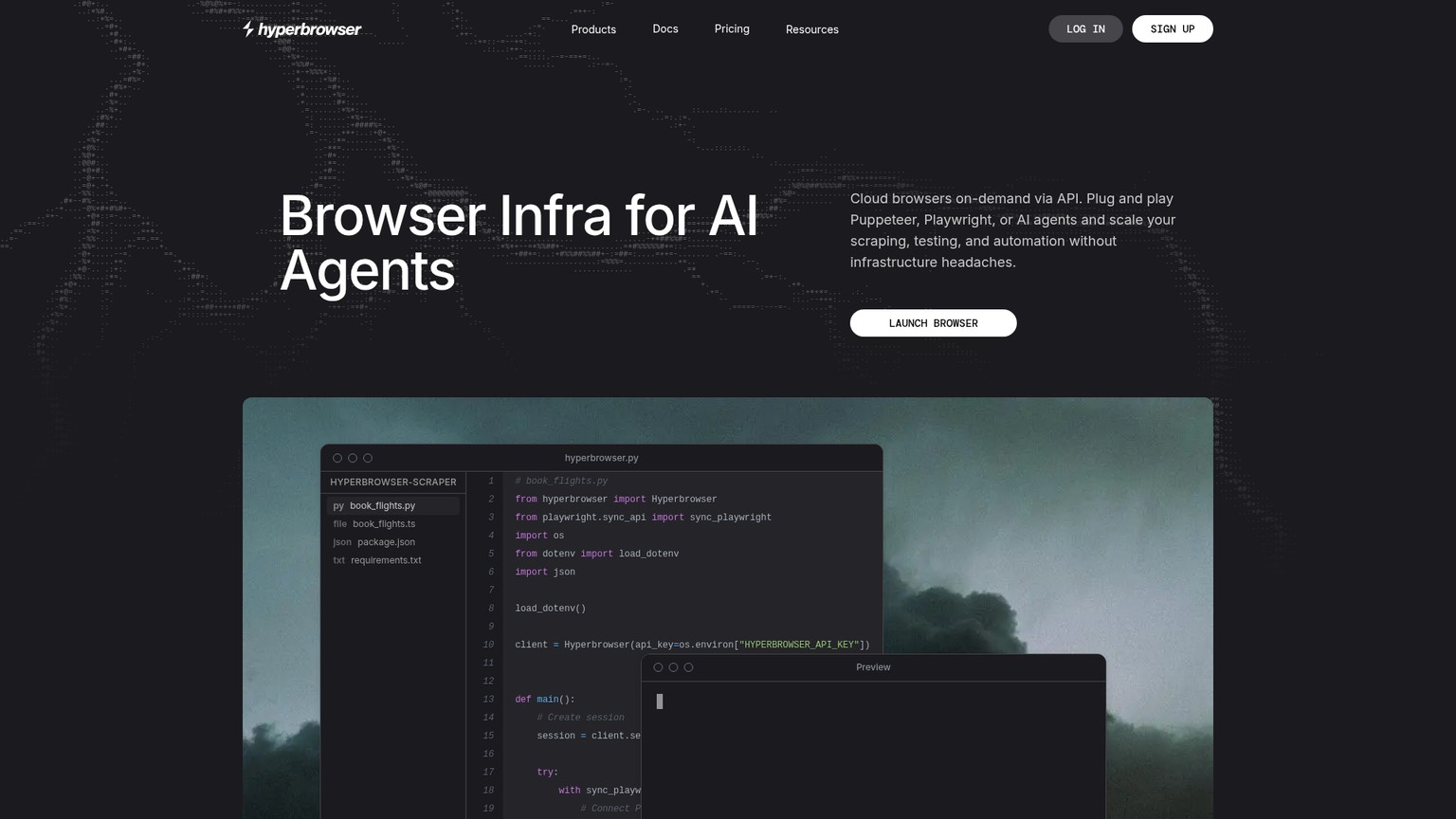
Hyperbrowser is easy to budget because one credit is $0.001, a browser uses 100 credits/hour, and proxy traffic uses 10,000 credits/GB. In ordinary money, that is $0.10 per browser-hour and $10/GB. API requests are free, and paid plans do not impose an API rate limit. Teams that want Playwright, Puppeteer, or generic CDP without an elaborate product bundle can understand the base meter in one minute.
A sensible use case is parallel product-catalog monitoring across regional pages. Startup gives 25 concurrent browsers, residential proxies, automatic CAPTCHA solving, and basic stealth; Scale raises concurrency to 100 and moves to premium residential proxies. Sticky sessions preserve a network identity when a multi-step visit needs consistency. The vendor advertises isolated sessions and a path beyond 1,000 simultaneous browsers for Enterprise.
The wall is stealth segmentation. Basic stealth is included on Startup and Scale, but ultra stealth is reserved for Enterprise. If the workflow depends on hostile-site success rather than ordinary browser availability, the apparent $0.10/hour is not the whole purchase. Proxy data can dominate: a 5 GB job costs $50 of proxy credits before browser time. Hyperbrowser is transparent about that arithmetic, but it cannot make heavy pages cheap.
Hyperbrowser prices verified on 8 August 2026 are Free at $0 with 5,000 credits, 1 concurrent browser, and 7-day retention. Startup is $30/month plus usage with 30,000 credits, 25 concurrent browsers, 30-day retention, CAPTCHA solving, basic stealth, and residential proxies. Scale is $100/month plus usage with 100,000 credits, 100 concurrent browsers, 30-day retention, CAPTCHA solving, basic stealth, and premium residential proxies. Enterprise is custom with unlimited credits, 1,000 or more concurrent browsers, HIPAA and SOC 2 support, 180 or more days of retention, ultra stealth, and premium residential proxies.
Best for: Teams that want a straightforward managed CDP service with transparent time and bandwidth conversion.
Standout: One credit has a fixed $0.001 value, making browser time and proxy use easy to model.
Pricing: Free $0; Startup $30/month plus usage; Scale $100/month plus usage; Enterprise custom, verified 8 August 2026.
Free trial: Free includes 5,000 credits, enough for 50 browser-hours before any proxy use.
- Browser time converts cleanly to $0.10/hour.
- Paid plans have no API request charge or API rate limit.
- Playwright, Puppeteer, and CDP are supported.
- Self-serve concurrency reaches 100 browsers on Scale.
- Proxy traffic costs $10/GB and can eclipse browser time.
- Ultra stealth is Enterprise-only.
- The Free plan allows only one concurrent browser.
8. Bright Data Agent Browser: best for protected and geo-sensitive sites
Bright Data Agent Browser is serverless browser infrastructure built around website unlocking, geolocation, IP rotation, and bandwidth-based billing.
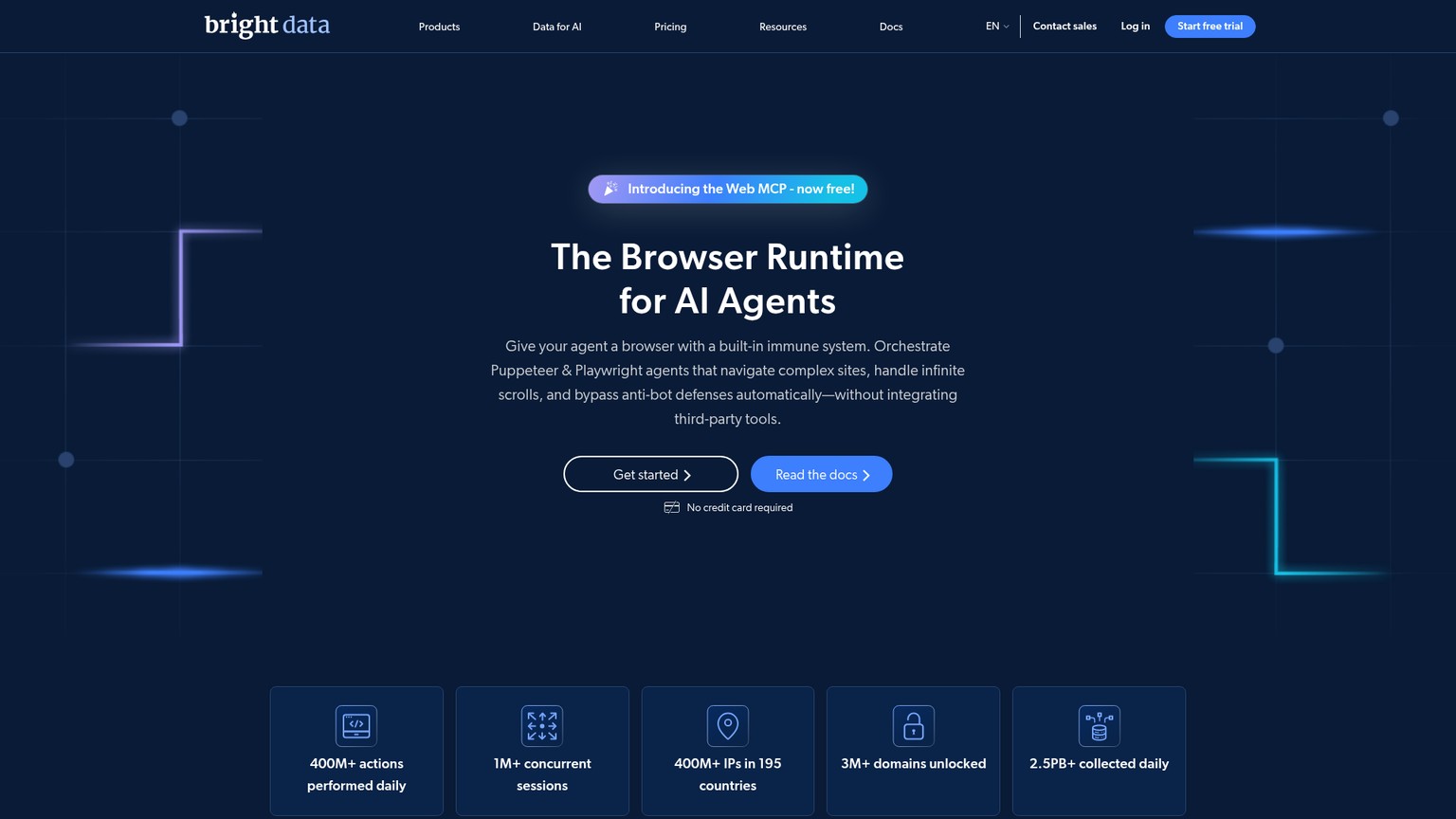
Bright Data belongs high on the shortlist when the page itself is the adversary. Its browser includes CAPTCHA solving, browser fingerprinting, retries, header and cookie management, IP rotation, JavaScript rendering, and country, city, state, or ASN targeting. Playwright, Puppeteer, and Selenium can drive it, while a headless API and MCP surface cover other integration styles. The vendor advertises support for more than one million concurrent sessions, a scale claim far beyond the needs of most product teams but relevant to data operations.
The concrete fit is a travel or commerce agent that must check localized inventory on protected sites. A cheap generic browser with the wrong IP reputation can spend most of its time failing before the first useful action. Bright Data sells the network and unlocking layer with the browser, so success on those pages is the product rather than an add-on afterthought.
The wall is bandwidth billing. There is no honest conversion from $8/GB to a browser-hour without knowing page weight, retries, and resource filtering. At the PAYG rate, roughly 1,000 pages averaging 1 MB each cost about $8. The same 1,000 pages at 5 MB each cost about $40, before model spend. Video, image-heavy commerce pages, and repeated navigation can turn a small task count into a large data bill. For an unprotected internal dashboard, a normal time-metered runtime is easier and often cheaper.
Bright Data Agent Browser prices verified on 8 August 2026 are Pay As You Go at $8/GB; 71 GB at $499/month, equivalent to $7/GB; 166 GB at $999/month, equivalent to $6/GB; 399 GB at $1,999/month, equivalent to $5/GB; and Enterprise at custom pricing. Every tier should be evaluated on actual transferred bytes, not the number of tasks in an agent demo.
Best for: Public-web agents facing bot defenses, localization requirements, or network-identity constraints.
Standout: Browser execution, unlocking, CAPTCHA handling, retries, IP rotation, and granular geotargeting arrive as one service.
Pricing: PAYG $8/GB; 71 GB $499/month; 166 GB $999/month; 399 GB $1,999/month; Enterprise custom, verified 8 August 2026.
Free trial: None listed; Pay As You Go is metered at $8/GB from first use.
- Protected-site access is the central product, not a secondary proxy option.
- Supports country, city, state, and ASN targeting.
- Works with Playwright, Puppeteer, Selenium, headless API, and MCP clients.
- Built-in retries and IP rotation reduce the infrastructure a data team must assemble.
- Bandwidth billing makes costs workload-specific.
- Heavy pages can cost many times more than text-oriented pages.
- It is excessive for clean internal tools and ordinary unprotected sites.
9. Firecrawl Interact: best for content-first research agents
Firecrawl Interact is a browser sandbox inside a broader search, scrape, crawl, and extraction platform.
Firecrawl wins a different decision: most research agents should not open a browser for every URL. They should search or scrape first, then create an interactive sandbox only when a page requires a click, dynamic interaction, login, or custom code. That content-first architecture can remove entire browser sessions from the cost and failure surface. Interact supports isolated disposable or persistent sandboxes, preinstalled Playwright and Vercel Agent Browser, CDP access, view-only and interactive live views, and Python, JavaScript, or bash execution.
A market-research agent can scrape 200 product pages through the content API, then open Interact for the five configurators that require choosing options before a price appears. This is more efficient than teaching a general browser agent to read every page visually. Persistent profiles preserve cookies and localStorage between sessions, so repeated research behind a permitted login can keep state.
The walls are lifecycle and profile semantics. Sessions can last 30 to 3,600 seconds, with a 600-second default. A persistent profile permits only one saving session at a time, and state is written when that session closes. The sandbox filesystem is ephemeral, so downloaded files do not persist with the profile. These constraints are manageable for research tasks but poor for long parallel processes sharing one identity.
Firecrawl prices verified on 8 August 2026 are Free at $0 with 1,000 credits and 2 concurrent API requests; Hobby at $19/month or $16/month annually with 5,000 credits and 5 concurrent API requests; Standard at $99/month or $83/month annually with 100,000 credits and 50 concurrent requests; Growth at $399/month or $333/month annually with 500,000 credits and 100 concurrent requests; Scale at $749/month or $599/month annually with 1,000,000 credits and 150 concurrent requests; and Enterprise at custom pricing. Interact costs 2 credits per browser minute. Free browser users receive 5 browser hours, and browser plans initially allow up to 20 concurrent sessions. One hundred browser hours require 12,000 credits, so Standard is the least expensive self-serve tier that contains that workload, at $99 monthly or $83/month billed annually.
Best for: Research and retrieval agents that mostly need content but sometimes need a real interactive browser.
Standout: Search, scrape, crawl, extract, and browser interaction can be routed within one data platform.
Pricing: Free $0; Hobby $19 or $16 annually; Standard $99 or $83 annually; Growth $399 or $333 annually; Scale $749 or $599 annually; Enterprise custom, verified 8 August 2026.
Free trial: Free includes 5 browser hours and 1,000 general platform credits.
- Lets content APIs replace expensive browser work when interaction is unnecessary.
- Includes Playwright, Vercel Agent Browser, CDP, live view, and code execution.
- Persistent profiles preserve cookies and localStorage.
- Free users receive 5 browser hours.
- Browser sessions stop at one hour.
- Only one session can save to a persistent profile at a time.
- Downloaded files disappear because the sandbox filesystem is ephemeral.
10. Cloudflare Browser Run with Kitesurf: best efficiency experiment
Cloudflare Kitesurf is a new browser engine for agents that runs on Workers and exposes a subset of CDP through Browser Run.
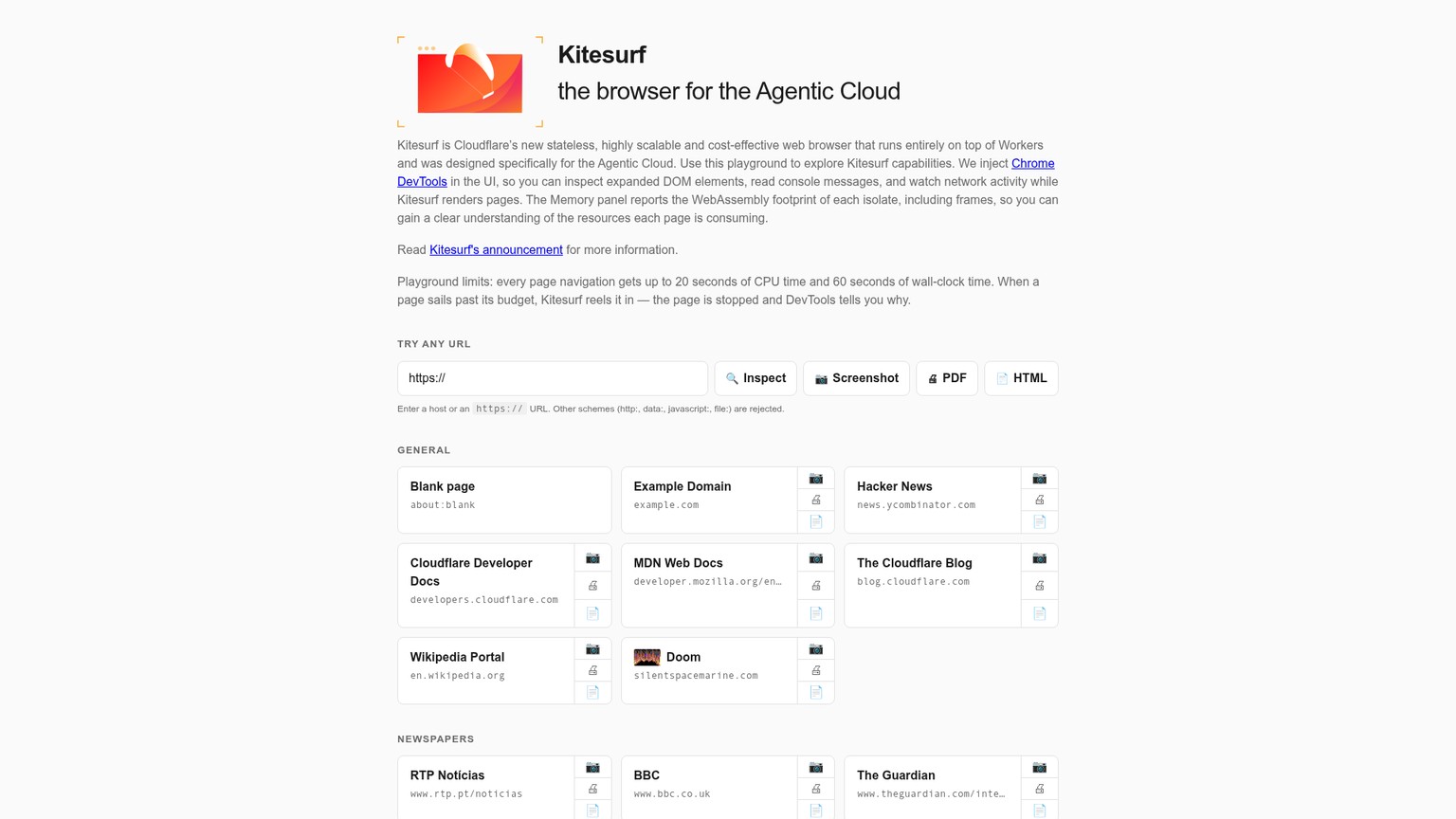
Kitesurf is the most interesting technical bet in this list and the easiest one to over-rank. Cloudflare announced it on 7 August 2026 after 12 weeks of development. It passes more than 215,000 Web Platform Tests and can work with Puppeteer, Playwright, chrome-remote-interface, and CDP or MCP agents. Instead of packaging full Chromium, it implements the web platform and enough CDP for agent workloads directly on Workers.
The efficiency result is substantial but specific. Across five runs over a 14-URL corpus, Cloudflare measured 3.1x less CPU for screenshots, 3.8x less CPU for HTML extraction, 4.7x less memory for screenshots, and 7.0x less memory for HTML extraction than warm Chromium. The tradeoff was slower completion: 1.8x slower screenshot wall time and 1.7x slower HTML-extraction wall time. Those are vendor benchmark results, not a universal claim about every website or workflow.
Kitesurf makes sense today for stateless, one-shot actions against compatible pages: open, inspect, screenshot or extract, then discard. It is not suitable for video, WebGL, bot challenges that depend on a real TLS fingerprint, or a ten-minute authenticated session that requires persistent browser state. Cloudflare explicitly says it is not production-ready and recommends Browser Run's default Chromium for incompatible sites. This is why Kitesurf ranks tenth even though its architecture may shape what agent browsers become.
Pricing verified on 8 August 2026 has two layers. Kitesurf beta is free inside Browser Run. Workers Free includes 10 browser minutes/day and 3 concurrent sessions. Workers Paid has a $5/month account minimum and includes 10 Browser Run hours/month plus 10 average concurrent browsers; additional browser time is $0.09/hour and additional average concurrency is $2 per browser. Quick Actions charge browser hours only, while Playwright, Puppeteer, and CDP Browser Sessions charge both browser hours and monthly-average concurrency. One hundred browser hours within the included concurrency cost $13.10: the $5 minimum plus 90 overage hours at $0.09.
Best for: Developers exploring low-resource, stateless browser actions on compatible pages.
Standout: A browser engine implemented for Workers rather than a repackaged full Chromium process.
Pricing: Kitesurf free in beta; Workers Free $0; Workers Paid from a $5/month minimum with $0.09/hour overage, verified 8 August 2026.
Free trial: The Kitesurf beta is free, and Workers Free includes 10 browser minutes/day.
- Free beta makes the architecture easy to evaluate.
- Cloudflare reports sharply lower CPU and memory use on its published corpus.
- Supports a subset of CDP compatible with common browser-control clients.
- Browser Run can fall back to default Chromium for incompatible work.
- Cloudflare says Kitesurf is not production-ready.
- No persistent authenticated sessions, video, or WebGL today.
- Real-TLS-fingerprint bot challenges are outside its current fit.
- Published benchmark wall time is slower than warm Chromium.
What 100 browser hours cost on the same workload
Price tables disguise different units, so the cleanest common denominator is a deliberately plain workload: 100 one-hour headless sessions, kept within each entry tier's concurrency, with no proxies, CAPTCHA solves, LLM calls, storage add-ons, or retries. It is not a forecast for every agent. It is a way to expose which vendors charge for time, which wrap time inside a plan, and which cannot be honestly compared by the hour.
On that workload, Browser Use raw browser time is $2. Kernel is $6 before its monthly credits. Anchor is $6 before proxy or agent spend, from $5 of browser time plus $1 for 100 creations. Steel Launch is $10, with its one-time $30 credit covering the introductory workload. Hyperbrowser is $10. Cloudflare Browser Run is $13.10 on Workers Paid if included average concurrency is not exceeded. Browserbase Developer is $20 and includes exactly 100 hours. Browserless Prototyping is $25/month billed annually and includes enough units. Firecrawl requires Standard at $99/month or $83/month annually because 100 hours consumes 12,000 Interact credits.

Bright Data is excluded from the bar because it charges by transferred bandwidth, not browser time. Kitesurf is excluded because the engine is free in beta and lacks the compatibility needed to treat 100 production hours as interchangeable with Chromium. Including either as a normal hourly bar would create a cleaner picture and a worse decision.
The more useful cost equation is:
Monthly browser cost = active browser time + session creation + network data + CAPTCHA/unlocking + model actions + retained evidence + engineering ownership.
For a deterministic internal form, active time can dominate and the cheapest meter wins. For a customer-facing agent, one preventable incident can outweigh months of runtime savings. For a protected public site, reach rate can matter more than either.
Who should pick what
Start from the source of uncertainty, not the tool's feature count.
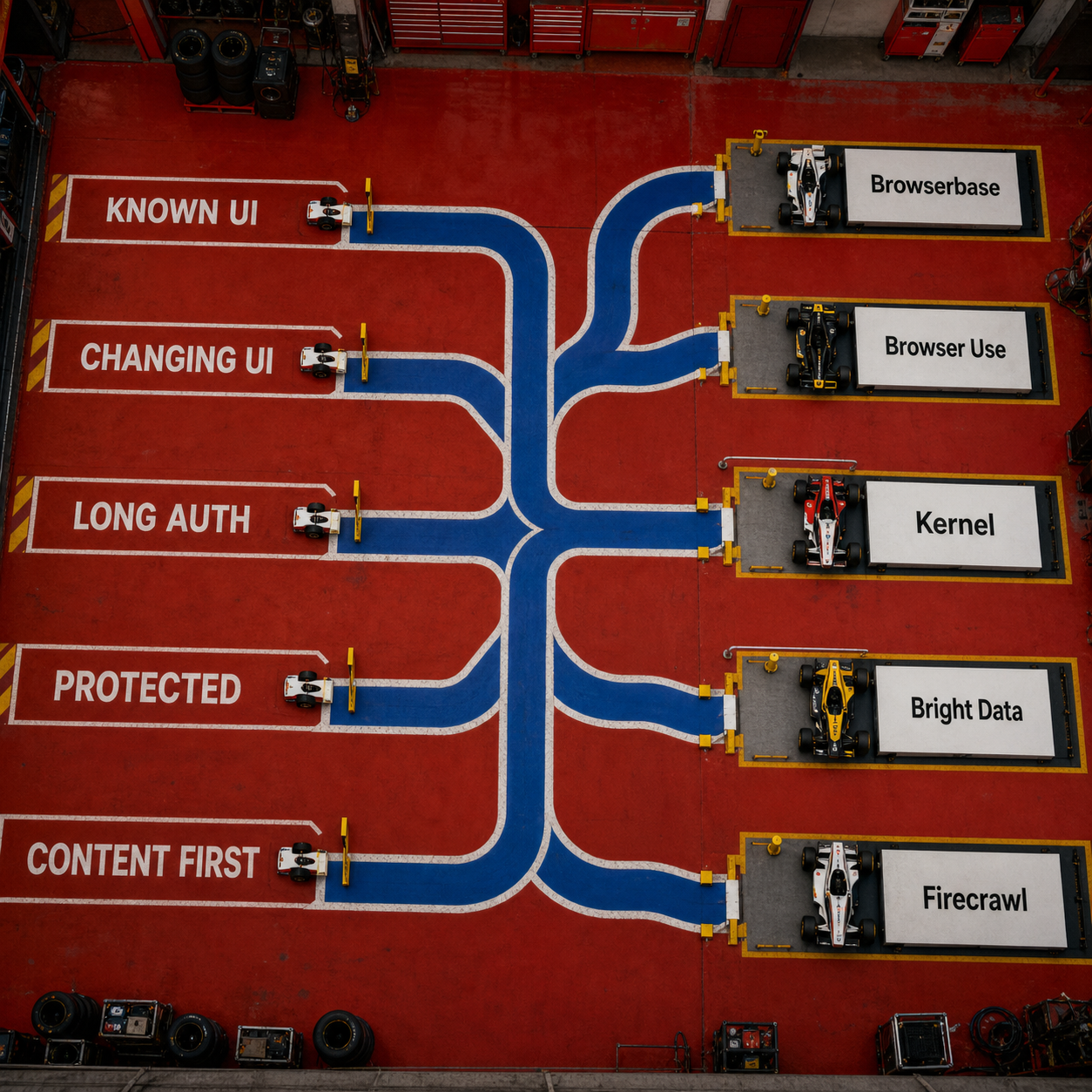
If the UI is known and stable
Use Playwright against a low-level hosted runtime. Browserbase is the safe operational default when replay matters. Steel or Hyperbrowser can be cheaper and simpler when your team already owns observability. Browserless is attractive when you need Firefox or WebKit. Do not add a general autonomous agent to five selectors that rarely change.
If the UI changes or the path is not known in advance
Use Browser Use Cloud when you want the autonomous loop included. Use Stagehand with Browserbase when most of the workflow is deterministic but a few screens need model judgment. Skyvern belongs in this conversation as a higher-level workflow automation platform, but it should be compared as orchestration, not confused with the underlying browser runtime.
If authentication must survive for hours or days
Choose Kernel for long-lived sessions, persistent profiles, Standby Mode, and Managed Auth. Browserbase is a strong alternative when reusable context and replay matter more than a 72-hour ceiling. Anchor is compelling when authenticated sessions must grow into geolocation and formal enterprise controls.
If the target site is protected or location-sensitive
Start with Bright Data. Its $8/GB rate may look expensive beside a $0.10 browser-hour, but the cheap browser has no value if it cannot reach the page. Anchor and managed Steel Cloud deserve a pilot when their network and stealth options match the sites involved.
If the agent mostly reads content
Start with Firecrawl search, scrape, crawl, or extract, then invoke Interact only for the pages that require interaction. A content API gives the model cleaner text and avoids browser state, rendering time, and visual-action errors. Browserbase Search and Fetch can support a similar browser-last pattern inside a Browserbase stack.
If the environment must be self-hosted
Start with Steel for an open-source path. Evaluate Browserless Enterprise when licensed self-hosting, multi-engine coverage, and vendor support matter. Be explicit about the features the managed clouds add, because a Docker image is not a browser operations team.
How to evaluate Browserbase before production
A polished demo proves that a browser can complete the happy path once. A useful evaluation proves that the system can repeat the path, explain a failure, recover state, and stay inside a known cost envelope.
Choose one valuable workflow
Pick a task with a clear finish state, such as creating a sandbox account and recording its confirmation ID. Avoid a toy search task. Write down the allowed duration, whether login state must survive, and what evidence an operator needs after failure.
Build the stable path in Playwright
Use deterministic selectors for known controls and explicit assertions after important transitions. Connect Playwright to a Browserbase session through its remote endpoint. Keep navigation, data entry, and completion checks separate so one failure has a name.
Add model control only at ambiguity
Introduce Stagehand for the step whose wording or layout varies, not for the whole run. Record the goal, action count, model cost, and fallback. If the same model action is stable after repeated runs, consider replacing it with a deterministic selector.
Create a reusable context
Move cookies and storage into a dedicated Context for the test identity. Confirm that a second session resumes correctly without placing secrets in the prompt. Define when the context should be invalidated and who may access it.
Force three failures
Expire the login, change a selector, and interrupt the run after a form submission. Use Live View, replay, console logs, and network logs to identify each failure. An observability feature only has value if the on-call operator can use it under pressure.
Run a repeated scorecard
Execute at least 30 representative runs. Track successful completion, median and worst-case duration, browser hours, proxy GB, model spend, human takeovers, and failures with no actionable trace. Promote only when the failure budget and monthly cost both fit the product promise.
The same scorecard works for every product here. Change the runtime, preserve the workflow and success definition, and compare the total system. A tool that is cheaper only because the evaluation ignored its missing recovery path is not cheaper.
How these browsers were picked
These products were compared, priced, and analyzed, not represented as hands-on tested. Pricing and limits were verified against live vendor pages on 8 August 2026. Ten products are included because every entry supports a distinct production decision and discloses a specific wall; products that could not clear that standard were left out.
Six criteria determined the order:
- Runtime control: support for Playwright, Puppeteer, Selenium, CDP, or a usable agent API.
- State and authentication: profiles, reusable contexts, managed login, session length, and human takeover.
- Evidence: Live View, replay, logs, debugger access, and retention boundaries.
- Reach: proxies, geolocation, CAPTCHA handling, stealth, and protected-site specialization.
- Deployment: managed cloud, open source, licensed self-hosting, private options, and portability.
- True cost: all current tiers, included usage, overages, network and model meters, plus a normalized 100-hour workload where the billing unit allowed it.
Browserbase ranks first because it covers the widest production loop for a typical product team, from isolated browser through persistent state to incident evidence. Steel ranks second because it offers the strongest open and hybrid answer, not because its local mode has feature parity with cloud. Kernel ranks third because long-lived auth is a critical but narrower need. Browser Use, Browserless, Anchor, Hyperbrowser, Bright Data, Firecrawl, and Kitesurf follow according to the specific job each does better than the generalists.
Products were cut when they could only be described with category adjectives, lacked a current first-party price or limit, or were primarily consumer browsers. Control libraries remain in the decision guide instead of being padded into the runtime ranking.
The ones to avoid for the wrong job
Good infrastructure becomes a bad purchase when its strength does not match the bottleneck.
- Avoid Kitesurf for persistent authenticated work. It cannot yet handle the ten-minute stateful session, video, WebGL, and TLS-fingerprint cases Cloudflare itself names. Use Browser Run's default Chromium while Kitesurf is a beta experiment.
- Avoid Bright Data for a clean internal dashboard. Its unlocking network is the reason to buy it. A bandwidth meter adds needless uncertainty when an ordinary browser endpoint can reach the page reliably.
- Avoid Browserless if your team does not want to own orchestration. It provides excellent browser infrastructure, but a CDP connection is not an autonomous action policy, recovery system, or business workflow by itself.
- Avoid Browser Use's autonomous layer for a fixed form. If Playwright can express the task in a few stable steps, an LLM loop adds expense and variance. The Browser Use open-source library or cloud runtime can still be useful in a different stack.
- Avoid self-hosted Steel when the real need is managed operations. Open source answers control and portability. It does not remove the need to patch browsers, schedule capacity, manage proxies, retain evidence, and respond to outages.
- Avoid Kernel GPU mode unless the page truly requires it. The published rate is about $2.88/hour, compared with $0.06/hour headless. That 48x gap deserves an explicit technical reason.
- Avoid Anchor Growth until a Growth-only control is part of the requirement. The jump from $50 to $2,000/month is sensible only when full stealth, compliance, multi-region support, or verified agents create business value.
Do not buy Vercel Agent Browser as though it were hosted infrastructure. It is an open-source CLI and control layer that can launch locally or connect to Browserbase, Browserless, Browser Use, Kernel, and other remote providers. That portability is useful, but you still buy or operate the browser underneath it.
Do not buy Playwright as though it were a cloud. Playwright controls a browser process. A cloud provider supplies remote browser processes, isolated sessions, networking, capacity, state, and evidence. Playwright MCP exposes those controls to an MCP client, but the infrastructure boundary remains.
Do not compare Skyvern only on browser-hour price. It is a workflow automation layer that can own more of the task plan. Compare its completed business outcome and operator model with other orchestration products, then inspect the browser infrastructure separately.
Frequently asked questions
What are the best browsers for AI agents that are free?
Steel has the largest introductory browser credit in this group: a one-time $30 credit valid for 90 days on Launch. Kitesurf is free in beta for compatible stateless tasks, but Cloudflare says it is not production-ready. Kernel includes $5 in monthly usage credit, Browserbase includes 1 browser hour, Hyperbrowser includes 5,000 credits, and Firecrawl includes 5 browser hours. The best free choice depends on what you are proving: Steel for a cloud or local runtime path, Kernel for session continuity, Firecrawl for content-first research, and Kitesurf for engine experimentation.
What is an agentic browser?
An agentic browser is a browser runtime paired with a control layer that lets a model observe a page, choose actions, and execute them. The runtime and controller do not have to come from the same company. For example, Playwright or Stagehand can control a Browserbase browser, while Browser Use can supply both an agent layer and remote browser. Production systems also need lifecycle, authentication, evidence, and recovery, even though those functions are not visible in a simple demo.
Can I use Playwright with a cloud browser for AI agents?
Yes. Most hosted browser providers create a session and return a CDP endpoint. Playwright connects to that endpoint and controls the remote browser much like it controls local Chromium. Browserbase, Steel, Kernel, Hyperbrowser, Browserless, Bright Data, and Cloudflare Browser Run all support relevant remote-control patterns. Check engine support, session ceiling, context persistence, and reconnect semantics before treating providers as interchangeable.
Is Vercel Agent Browser a hosted browser?
No. Vercel Agent Browser is an open-source CLI and agent-control tool. It can start a local browser or connect to hosted providers including Browserbase, Browserless, Browser Use, and Kernel. The hosted provider still supplies the remote browser capacity, isolation, state, network, and operational controls.
Do AI agent browser extensions work for production agents?
Browser extensions are useful for supervised desktop tasks where a person is present and the extension acts inside that person's browser. An unattended production agent usually needs isolated server sessions, explicit lifecycle controls, credential boundaries, replay or logs, concurrency, and a remote API. Treat an extension as a human-assist surface, not a substitute for production browser infrastructure.
Should an AI agent use OpenAI computer tools, Stagehand, Browser Use, or Playwright?
Use Playwright for stable, deterministic steps. Add Stagehand when only part of a page needs model interpretation. Use Browser Use when you want a packaged autonomous browser loop. Use OpenAI Agents SDK computer tools when your wider agent is built around that action interface, while supplying a suitable browser or computer environment underneath. A mature workflow often combines deterministic control for the known path with model control at ambiguity.
What is the difference between a hosted Playwright browser and Playwright MCP?
A hosted Playwright browser is remote compute: an isolated browser process, session lifecycle, networking, and often state and observability. Playwright MCP is an interface that exposes browser-control actions to an MCP client. MCP can drive a local or hosted browser, but it does not by itself provide fleet capacity, proxy reputation, retention, or production support.
The bottom line
Get the AI Business Workflow Audit Checklist and the next evidence-led build breakdown by joining the newsletter.
- Published
- Category
- Build
- Language

LangGraph vs CrewAI
Compare LangGraph and CrewAI on the same approval workflow, state, memory, MCP, observability and current hosted-platform prices.Oct 7, 2026Build
How to Build MCP Server
Build an order lookup MCP server with Python, test it in Inspector, connect Claude Code and Cursor, then add HTTP auth and hosting.Oct 7, 2026Build
Gumloop vs n8n (Verified October 2026)
Gumloop vs n8n: current pricing, credits vs executions, self-hosting and the same AI lead workflow, with a verdict for each builder.Oct 7, 2026Build
AI Agent Frameworks in 2026: LangGraph, CrewAI, OpenAI Agents SDK, Claude Agent SDK, Mastra and Google ADK (Compared)
Compare eight AI agent frameworks by language, state, MCP, approvals and current hosted prices. Pick the right runtime for production.Oct 7, 2026Build
Codex Cloud
Set up a reusable Codex Cloud environment, keep coding tasks running with your laptop off, steer from your phone, and choose cloud or local CLI.Oct 7, 2026Build
GitHub Copilot Pricing (2026): The Seat Is the Floor, Credits Are the Bill
GitHub Copilot plans, AI Credits, model rates, and three worked monthly bills. Choose Pro, Pro+, Max, Business, or Enterprise with spending limits.Oct 6, 2026Build
GitHub Copilot CLI
Install GitHub Copilot CLI, sign in, fix tests and open a PR. Current GitHub plans, AI credits, models, permissions, MCP and instructions.Oct 6, 2026Build