Best Controllable AI Video Models for Production Teams 2026
Six controllable AI video models ranked for continuity, revisions, delivery formats, and the cost of getting a shot approved in 2026.
Published
 By Omid Saffari



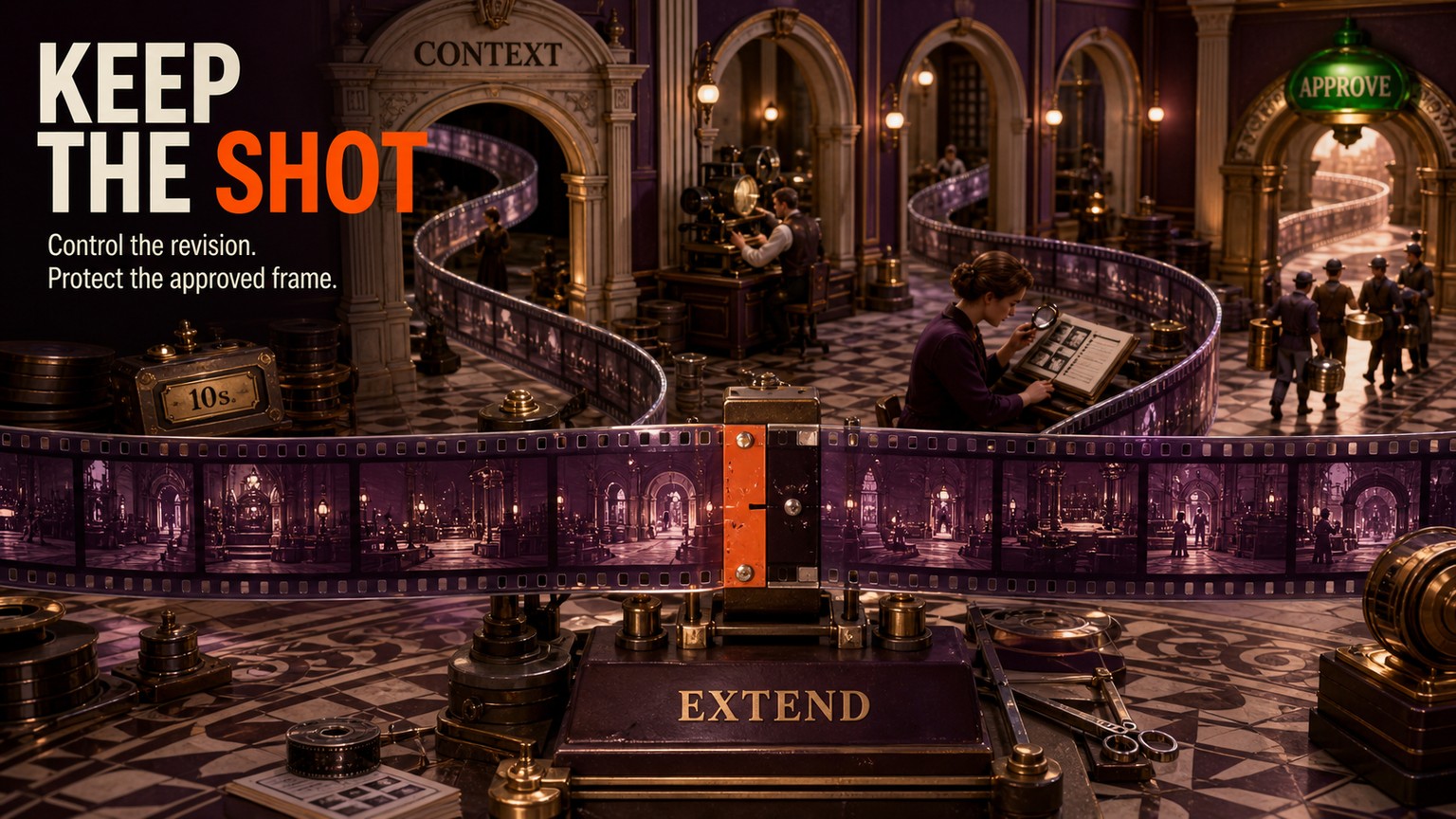
Gemini Omni 1.1 Flash is the best controllable AI video model for most production teams in 2026 because it can read 10 seconds of prior scene context before extending a shot. That one change matters more than another quality bump: it turns continuity from a last-frame guess into a workflow you can budget, review, and hand off.
The short answer: which controllable AI video model is best?
The best model is the one that preserves the part of the shot your reviewer has already approved. For a continuation, that means the previous scene. For a VFX restyle, it may mean exact frames and source motion. For an edit, it is the source clip. For a dialogue sequence, it is the cast, voices, and shot plan.
That definition puts Gemini Omni 1.1 Flash first overall, Luma Ray3.2 first for frame-level art direction, Runway Aleph 2.0 first for edits to existing footage, Adobe Firefly Video Model first for Adobe-centered production, Kling VIDEO 3.0 Omni first for multi-shot scenes with bound voices, and Google Veo 3.1 first for short hero shots with native audio.
All prices, model versions, limits, and availability below were verified against live vendor pages on 29 August 2026.
The order changes when the preservation target changes. Gemini's 10-second scene context does not replace Luma's exact-frame anchors. Luma's keyframes do not replace Aleph's ability to start with the footage you intend to keep. Adobe's integrated timeline does not remove its control conflicts. Kling's storyboard and voice controls do not solve a procurement team's need for a public dollar conversion. Veo's polished native-audio output does not make a 720p-only extension suitable for every delivery.
How these models were picked
Controllability is not the number of sliders in a product page. It is the scope of a revision you can make without breaking work that is already approved.
Four criteria decide the ranking:
- Revision scope: Can the model change one property, shot, frame, object, or camera move while preserving the rest?
- Temporal continuity: Does it understand enough of the preceding action to maintain identity, movement, lighting, and story state?
- Delivery fit: Can the result enter the editor, grade, composite, aspect ratio, and resolution the production requires?
- Cost per approved shot: How many paid attempts are likely to happen before a clip survives review, and are rough passes priced differently from finals?
The last measure is more useful than cost per second on its own. A $0.05-per-second model is expensive if the seventh attempt still loses the product label. A $0.28-per-second edit can be cheap if it preserves a paid performance and resolves the note in one bounded pass.
This is a verified comparison, not a claimed hands-on test. The evidence is current model documentation, current pricing, transparent calculations, real vendor-page screenshots, and a repeatable brief any production team can run. No result below is presented as if it were generated in this review.
Six models earned full sections because each exposes a distinct production control surface and enough current documentation to make a buying decision. Broad creation suites without a distinct control model were cut. So were thin wrappers whose main difference is a new interface over somebody else's model. If raw visual quality is the only criterion, the wider AI video generator comparison covers that broader question. Here, the winning unit is the approved shot.
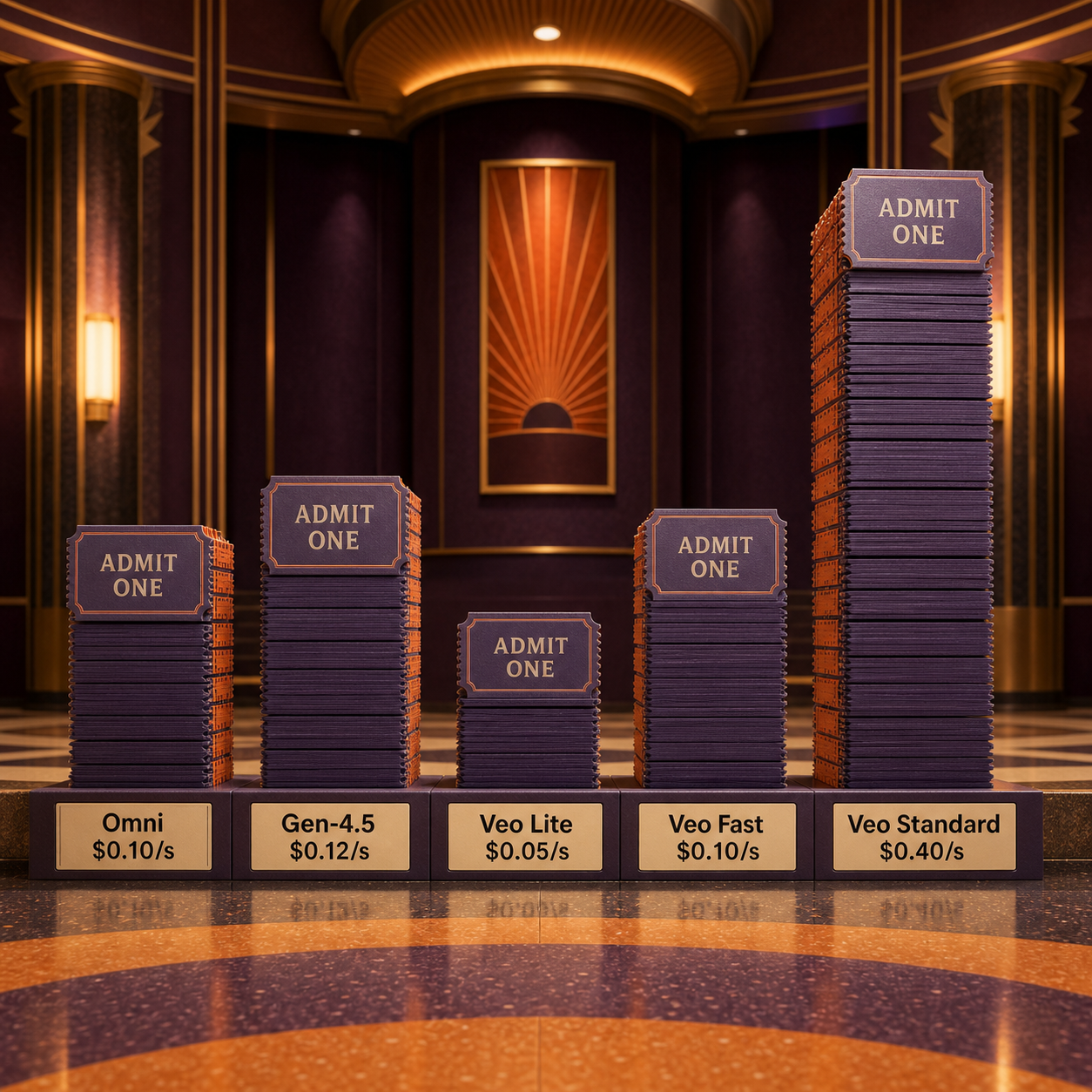
Public API dollar rates also need separation from subscription credits. The following figure compares only modes with a clean first-party per-second dollar price. Luma, Adobe, and Kling stay out because their public pricing uses credits or plan allowances that do not normalize honestly to the same axis.
1. Gemini Omni 1.1 Flash: best overall for continuity-led production
Gemini Omni 1.1 Flash is Google's current production-oriented video model and the best default when one shot must remember the scene before it. The model accepts text, images, and up to 10 seconds of video for editing or extension, then outputs 3 to 10 seconds at 24 FPS in 360p, 720p, 1080p, or 4K. It also supports first and last frames, camera direction, and scene extensions in 10-second increments up to a cumulative 40 seconds.
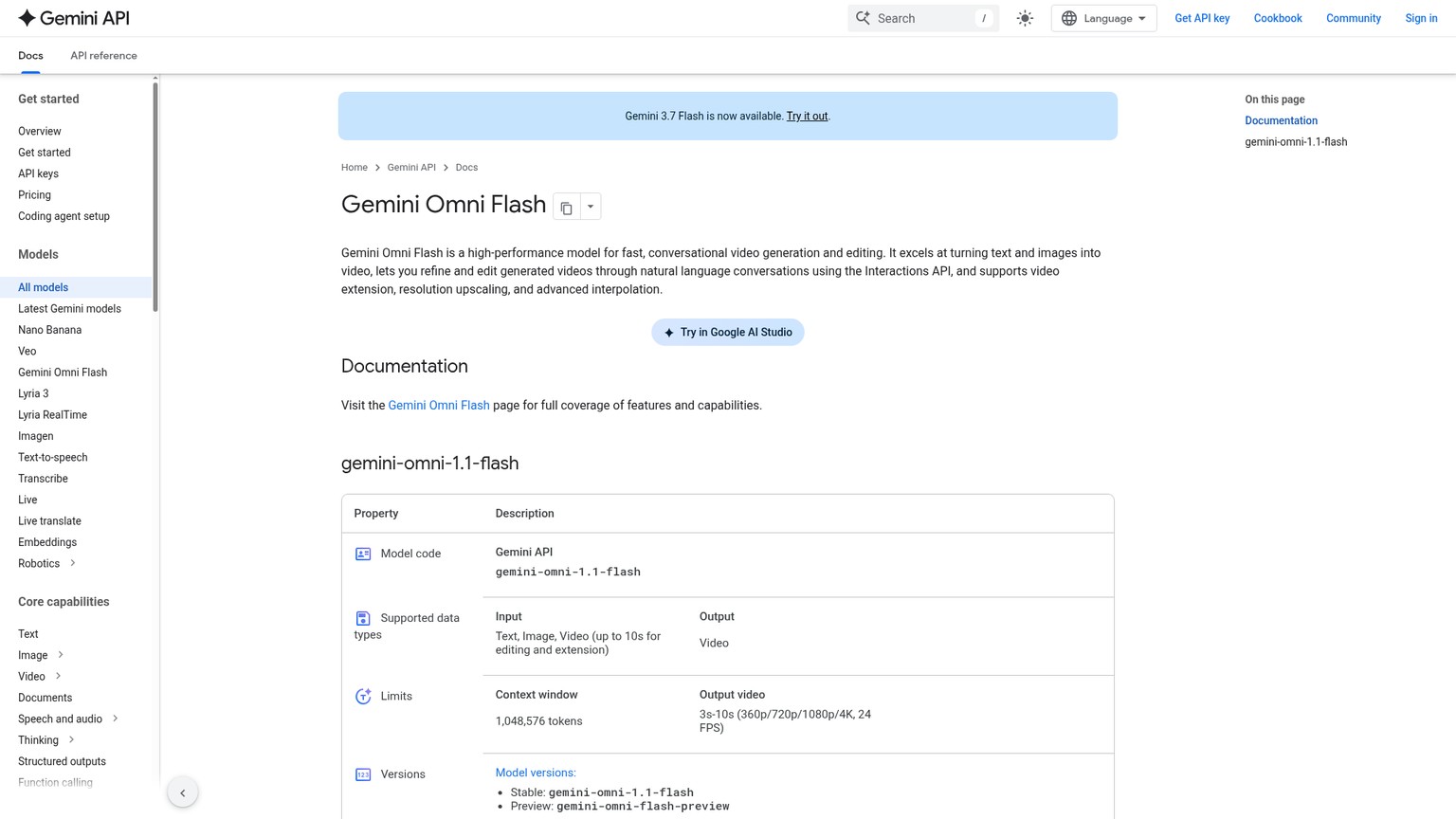
Google's consequential change is not the 4K badge. According to its 27 August release note, Omni 1.1 can analyze up to 10 seconds of prior context, while previous models referenced only the final second. A final frame tells a model where the actor and camera ended. Ten seconds tells it how they arrived there. That larger temporal window gives an extension more evidence about motion, rhythm, lighting changes, and narrative direction.
Best for: Production teams extending a sequence, branching an approved direction, or iterating through cheap previews before high-resolution delivery.
Standout: Up to 10 seconds of prior scene context, plus 360p drafts that cost one-third as much as 720p.
Pricing: Paid API only. Input is $1.50 per 1 million tokens, text output is $9 per 1 million tokens, and video output is $17.50 per 1 million tokens. Google bills 720p video at 5,792 tokens per second, approximately $0.10 per second.
Free trial: No free API tier.
- Ten seconds of prior context gives extensions more continuity evidence than a final-frame handoff
- 360p provides a deliberately cheaper approval layer before 1080p or 4K delivery
- First and last frames can constrain transitions
- One model covers generation, editing, extension, and camera direction
- API use is paid from the first generation
- Extension is limited to 10-second increments and 40 seconds cumulatively
- Video references are limited to 3 seconds
- Better context reduces drift but does not guarantee product, face, or text consistency
Why 10 seconds changes the review loop
Picture a 10-second product shot that starts close on a matte-black bottle, orbits clockwise, and ends as condensation reaches the label. The director approves the camera rhythm and product silhouette, then asks for another 10 seconds in which the bottle moves into a colder environment.
A last-frame continuation sees the bottle's final position. It does not see the orbit speed, the way the light travelled across the cap, or when condensation appeared. Omni 1.1 can use the preceding 10 seconds as context. The note can therefore describe the new action while the input carries the approved movement that should continue.
That does not make continuity automatic. The prompt still needs invariants, which are the details that may not change: cap shape, label placement, bottle proportions, clockwise camera direction, and the refrigeration-light color. It does make the review more bounded. A rejection can name the invariant that drifted instead of restarting the entire visual idea.
The earlier Gemini Omni Flash editing analysis covers the model's editing baseline. Omni 1.1 changes the production call because the previous scene, not merely its last image, can now become evidence for the next shot.
A production recipe for Gemini Omni 1.1 Flash
The prompt should separate what stays fixed from what changes. A useful structure is: subject identity, source-scene facts, camera path, new action, prohibited changes, duration, aspect ratio, and sound direction. Do not spend a paragraph re-describing scenery the input already shows. Spend those words on the change and the invariants.
Draft, approve, extend, and finish with Gemini Omni 1.1 Flash
Lock the invariant brief
Name the product geometry, cast identity, wardrobe, direction of travel, camera move, lighting state, duration, and anything the model must not add. These remain unchanged across every draft.
Generate the decision in 360p
Use
gemini-omni-1.1-flash, choose a 10-second 360p output, and generate three or four versions that vary one decision at a time. Google says 360p is up to 60% faster and costs one-third as much as 720p.Approve motion before surface detail
Review camera path, action timing, silhouette, and composition at draft resolution. Reject text fidelity or fine texture only if it changes the direction, since those details belong in the finishing pass.
Extend from the approved scene
Feed the approved sequence back as context and describe only the next action. Extensions happen in 10-second increments and can reach a cumulative 40 seconds, so plan the narrative in those units.
Promote the selected direction
Render the final approved direction at 1080p or 4K. Check the handoff in the target edit and color pipeline before generating every remaining shot.
The before-to-after here is a change in the note, not a claimed model result. A weak first note says, "make the next shot colder and more cinematic." A controlled revision says, "continue the clockwise orbit at the same speed; preserve cap shape, label position, and bottle scale; cool the background from plum to blue over the final 4 seconds; add no new props." The second version gives production a pass or fail test.
The craft bar remains the same: a ship-ready clip must preserve identity, spatial logic, and approved motion when watched at speed, not just as selected stills. Omni 1.1 is the strongest general choice for that loop. Choose Luma instead when a note must land on exact frames, and choose Runway when the real invariant is an existing performance.
2. Luma Ray3.2: best for frame-level art direction and VFX delivery
Luma Ray3.2 is the best choice when the director can point to exact frames and say what each one should become. Its defining control is multi-keyframe guidance: a keyframe is a still image tied to a specific frame in the source video, giving the model an approved visual anchor at that moment. Ray3.2 can work from a prompt, keyframes, or both, while separate Adherence controls protect motion and structure.
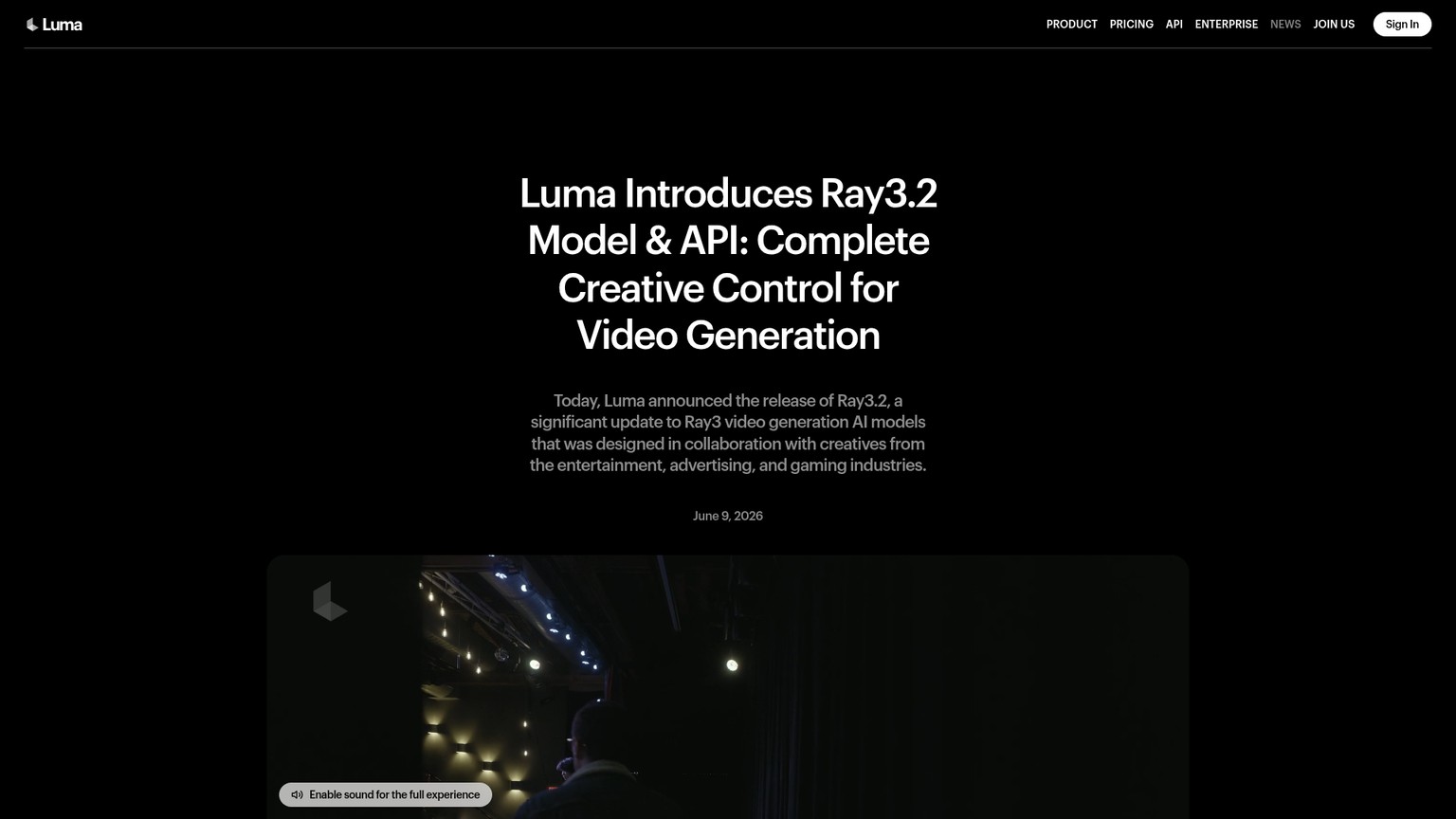
That makes Ray3.2 less like asking for another take and more like giving a VFX artist annotated frames. A team can export source frames, change a product material or environment in an image editor, place those frames back at their original indexes, and let the model interpolate the appearance between them. The source camera, body motion, layout, and duration can remain the skeleton.
Best for: Art-directed video-to-video, planned transformations, exact visual beats, and shots destined for color grading or compositing.
Standout: Multi-keyframe guidance with separate Motion and Structure adherence, plus HDR and 16-bit EXR delivery.
Pricing: Plus is $30 monthly or $300 yearly with 10,000 credits. Pro is $90 monthly or $900 yearly with 40,000 credits. Ultra is $300 monthly or $3,000 yearly with 150,000 credits. Team and Enterprise are custom-priced; Team adds shared credits, usage analytics, team management, projects, sharing, and SSO. Ray3.2 SDR costs 300 credits for 10 seconds at 720p or 1,200 credits at 1080p. HDR is 2 times the SDR rate, and HDR plus EXR is 3 times.
Free trial: No free trial is listed on Luma's current pricing page.
- Keyframes anchor approved looks to exact source moments
- Motion and Structure adherence separate two things reviewers often need to protect
- Video-to-video preserves the source duration
- HDR and 16-bit EXR fit serious grading and compositing workflows
- 1080p costs four times as many credits as 720p for a 10-second SDR generation
- HDR and EXR multiply the base credit cost
- Luma's own current pages disagree on the maximum number of keyframes
- The workflow assumes a useful source clip and carefully prepared visual anchors
The same brief, directed frame by frame
Return to the matte-black bottle orbit. The broad first pass changes the material successfully but lets the label swell as it crosses the middle of frame. In a Ray3.2 workflow, the revision does not need another paragraph of adjectives. Export the source frame just before the label turns, the front-facing frame, and the frame after it passes. Correct the label and bottle geometry on those stills, assign them to the same source indexes, then raise Structure adherence enough to preserve the product and set Motion adherence to keep the orbit.
The exact Adherence value is not universal. A higher setting protects the source but gives the new style less room. A lower setting invites a stronger transformation but increases the chance that product position or movement changes. The right review is a short bracket: one pass favoring preservation, one balanced pass, and one favoring transformation. Do not vary the prompt and both adherence dimensions at once, or the team will not know which change fixed the shot.
Luma's current learning-center guide says Ray3.2 accepts up to 64 keyframes. Its Ray3.2 launch page says up to 16. Those are first-party pages, and they conflict. Production planning should therefore use "multi-keyframe" as the dependable capability and verify the current interface or account limit before promising a 17th anchor to a client.
What the plan buys in finished seconds
At the SDR base rate, Plus's 10,000 credits cover 33 complete 10-second clips at 720p with 100 credits remaining, or 8 at 1080p with 400 remaining. Pro's 40,000 credits cover 133 at 720p with 100 remaining, or 33 at 1080p with 400 remaining. Ultra's 150,000 credits cover 500 at 720p or 125 at 1080p.
Those counts are capacity, not approved-shot forecasts. A shot that takes four attempts cuts them by four. HDR halves the base capacity, and HDR plus EXR cuts it to one-third. The production consequence is straightforward: use 720p SDR to settle the transformation and adherence, then reserve HDR or EXR for shots already likely to survive the edit.
Ray3.2 is ship-ready when the brief starts from a deliberate source, keyframes are treated as art-direction assets, and the delivery pipeline needs HDR or EXR. It is mood-board-only when the team has no source motion worth preserving and no plan for which moments need anchors. In that case, Gemini or Veo is the cleaner blank-canvas start.
3. Runway Aleph 2.0: best for controlled edits to existing footage
Runway Aleph 2.0 is the strongest choice when the production already owns the performance, timing, camera move, and framing, but needs a controlled visual change. The model accepts text, image, and video, matches the input resolution and aspect ratio, and can edit up to 30 seconds. That makes its starting point fundamentally different from a text-to-video model: the source clip is not a reference on the side, it is the thing being transformed.
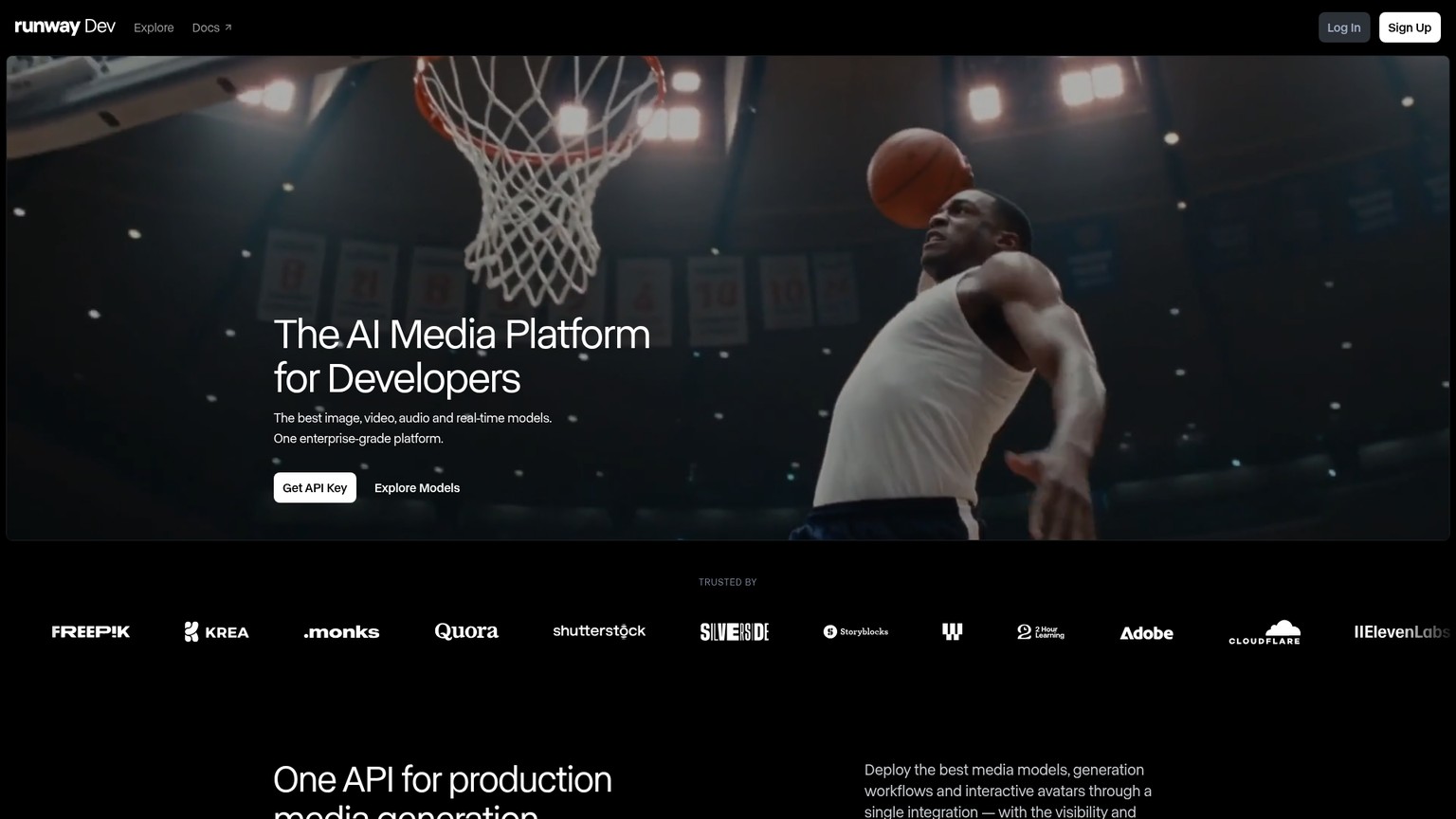
Aleph belongs beside Runway Gen-4.5, not in place of it. Gen-4.5 is the cheaper 720p generation layer for a new shot, supporting text or image input for up to 10 seconds at $0.12 per second. Aleph is the $0.28-per-second edit layer for footage whose underlying action deserves to stay. A production team can generate or shoot a motion plate, approve it, then use Aleph to change wardrobe, environment, weather, materials, or other visual properties without surrendering the source timing.
Best for: Existing footage with approved motion or performance that needs a bounded visual transformation.
Standout: Up to 30-second video edits that preserve the input resolution and aspect ratio.
Pricing: Developer credits cost $0.01 each. Aleph 2.0 uses 28 credits per second with a 56-credit minimum, or $0.28 per second. Gen-4.5 uses 12 credits, or $0.12, per second. The Runway app has Free at $0 with 125 one-time credits and 5GB storage; Standard at $15 monthly or $12 per month billed annually with 625 monthly credits; Pro at $35 monthly or $28 per month billed annually with 2,250 credits and 500GB; Max at $95 monthly or $76 per month billed annually with 9,500 credits, professional formats, and HDR; Enterprise is custom.
Free trial: Runway has a free plan with 125 one-time credits.
- Starts from the footage the team intends to preserve
- Matches the source resolution and aspect ratio
- Supports substantially longer edits than the 10-second generation models here
- Professional delivery options include ProRes, image sequences, 10-bit, and HDR profiles
- Aleph costs more per second than Runway's Gen-4.5 generation model
- A weak source performance remains a weak foundation
- Professional output formats add a per-second surcharge
- Standard and Pro monthly credits expire at the billing reset
When an edit model saves the shot
In the bottle brief, suppose the orbit, condensation timing, and hand performance are already approved, but the location must change from a retail shelf to a cold-room set. A blank-canvas regeneration asks the model to recreate all four approved properties while changing the fifth. An Aleph edit asks it to transform the environment around an existing plate.
The controlled note should identify the edit region and the invariants: replace the retail background with a cold-room interior; retain the bottle silhouette, cap, label, condensation timing, hand motion, camera path, duration, and crop. If the first edit spills frost onto the label, the next note can prohibit changes within the product surface rather than rebuilding the shot.
A 10-second Aleph edit costs $2.80 by API. A 10-second Gen-4.5 generation costs $1.20. The $1.60 difference is easy to defend when the source contains a performance, product movement, or camera move that would cost more to rediscover. It is hard to defend when the source itself is disposable.
Delivery choices need their own budget line. ProRes or a PNG sequence adds 5 credits, or $0.05, per output second, so 10 seconds adds $0.50. A 10-bit or HDR profile adds $2.00 for 10 seconds below 4 megapixels and $4.00 above 4 megapixels. These are not decorative upgrades. They buy a file that can survive a professional grade or composite, and they should be applied after the edit is approved.
Runway's app credit policy can also force a scheduling decision. Standard and Pro credits do not roll over. Max carries up to one month of unused credits, and separately purchased credits never expire. A team with bursty campaign work should compare the Max premium against the credits it routinely loses at quieter month-end resets.
Aleph is the right control model when the note begins with "keep the footage." It is the wrong first move when the team has no source worth protecting or when continuity with an earlier generated scene matters more than fidelity to one clip.
4. Adobe Firefly Video Model: best for Adobe-centered and rights-sensitive teams
Adobe Firefly Video Model is the practical pick when generated footage must move directly into an Adobe editing workflow and the buyer cares about the provenance posture of the model. Firefly can generate from text or an image inside the Firefly video editor, add the result to the timeline, and expose first and last frames, composition and motion references, shot size, camera angle, camera motion, style, transparent output, and seed controls.
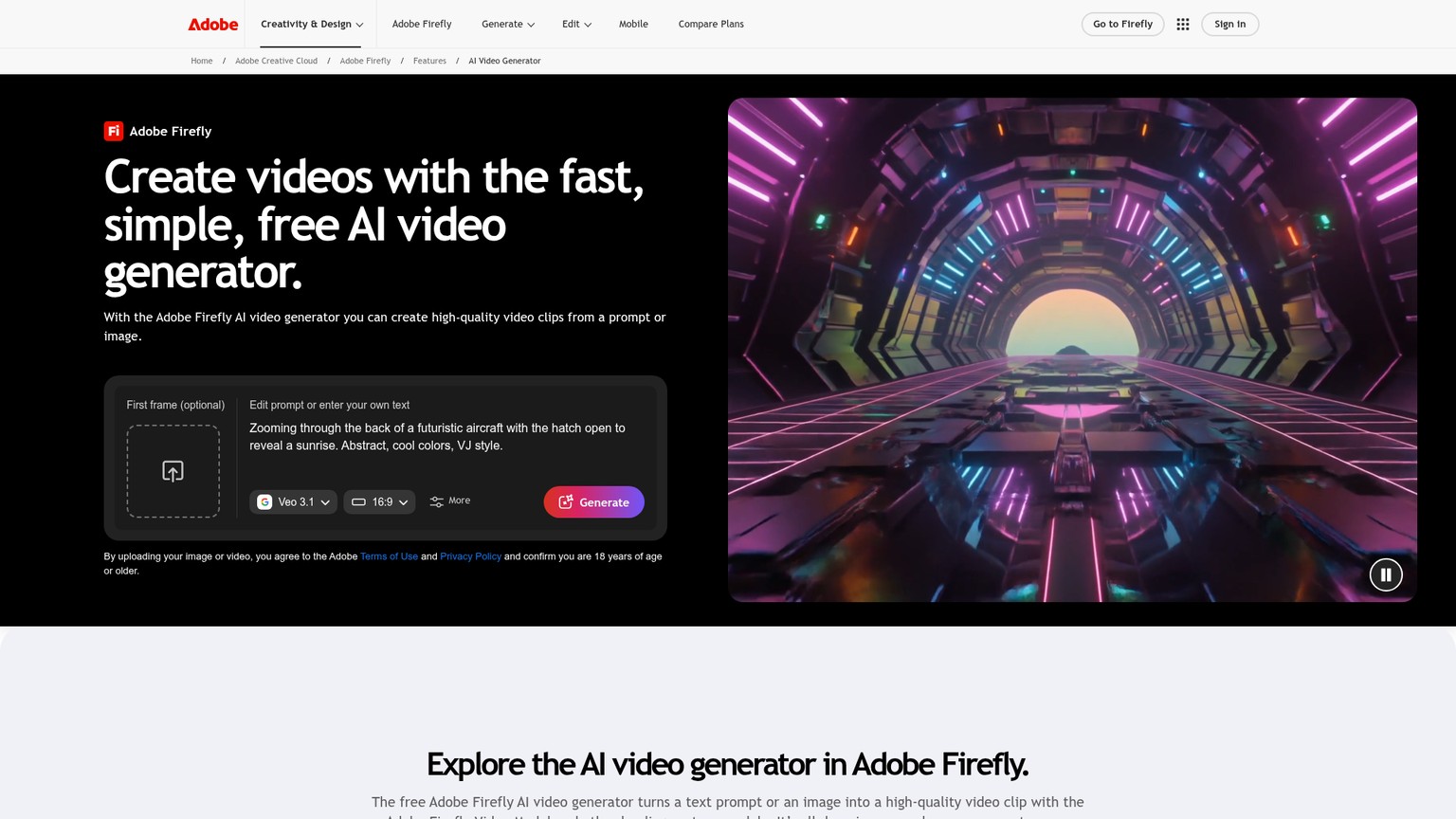
Adobe describes Firefly as designed for commercial use and places Adobe and partner models in one workspace. That is useful procurement context, not a legal warranty for every asset. A rights-sensitive production still needs its normal clearance process for trademarks, likenesses, source media, music, and the final edit.
Best for: Teams already cutting in Adobe, brands with a cautious provenance review, and shots that need transparent output or motion-reference controls.
Standout: Timeline integration plus a broad control menu and Adobe's commercial-use positioning.
Pricing: Free daily generations with limits that refresh daily. Standard is $9.99 monthly with 2,000 credits and up to 20 five-second videos. Pro is $19.99 monthly with 4,000 credits and up to 40. Pro Plus is regularly $49.99 monthly, currently $34.97 for the first year through 21 October, with 10,000 credits and up to 100. Premium is regularly $199.99 monthly, currently $139.91 for the first year through 21 October, with 50,000 credits and unlimited access to the Firefly Video Model in Generate Video.
Free trial: Yes for Standard, Pro, and Pro Plus, plus free daily generations without a paid plan.
- Generated clips can enter the Firefly editor timeline without a separate handoff
- Motion reference can borrow pans, zooms, tilts, and a motion path from a source clip
- Transparent-background output supports compositing
- A seed helps produce similar clips when prompt and controls stay the same
- Default Firefly Video output is only 5 seconds at 24 FPS
- First or last frames disable several other useful controls
- The motion-reference file may be 5 to 10 seconds, but only its first 5 seconds are used
- Adobe's two current first-party pages disagree on plan video allowances
The control collision Adobe buyers need to know
Firefly's long feature list is accurate, but the controls are not all available at once. Adobe's current help page says that adding a first or last frame automatically disables composition reference, motion reference, shot size, camera angle, and style. Selecting a style also disables first and last frames.
That conflict changes the recipe. If the bottle brief needs an exact start and end composition, use first and last frames and put the camera instruction in the prompt. If the camera path is the non-negotiable part, use a motion reference and let go of the frame locks for that pass. If the layout is the invariant, use a composition reference. Trying to combine all three in one generation is not a sophisticated workflow; the interface will prevent it.
A motion-reference clip must be 5 to 10 seconds and under 200MB, but Adobe uses only the first 5 seconds when the upload is longer. That makes reference preparation part of direction. Trim the source so the decisive pan, tilt, zoom, or path happens in those first 5 seconds, rather than assuming Firefly will sample the most useful movement.
The before-to-after note should therefore change control strategy, not pile on more language. Before: a first-frame lock, last-frame lock, motion reference, style, and camera angle all requested together. After: first and last frames only for a precise transition, followed by a separate motion-reference pass if the camera still needs work. The smaller control set is more reproducible.
Adobe's pricing-page mismatch
Adobe's canonical Firefly plans page lists up to 20, 40, and 100 five-second videos for Standard, Pro, and Pro Plus. Its live AI video feature page states 40, 80, and 200 for the same tiers. This comparison uses the lower canonical-plan figures because a buyer should budget against the conservative current entitlement until Adobe reconciles its pages.
At those lower allowances, Standard, Pro, and regular-price Pro Plus each work out to roughly $0.50 per listed five-second generation when fully used. The current Pro Plus promotion lowers that ratio to about $0.35. Those are subscription-price allocations, not universal marginal generation costs, because the plans also include image, audio, and other model access.
Firefly is ship-ready when the edit already lives in Adobe and the team chooses one control branch per pass. It is a frustrating choice when the brief assumes every reference, frame, camera, and style control can operate simultaneously.
5. Kling VIDEO 3.0 Omni: best for multi-shot scenes with bound voices
Kling VIDEO 3.0 Omni is the most interesting choice here for a scene that needs multiple planned shots, recurring characters, and voice continuity inside one generation system. VIDEO 3.0 supports text-to-video, image-to-video, start and end frames, native audio, multi-shot generation, and reference Elements. Its Custom Multi-Shot mode lets the user define the content and duration of individual shots instead of leaving the sequence entirely to automatic planning.
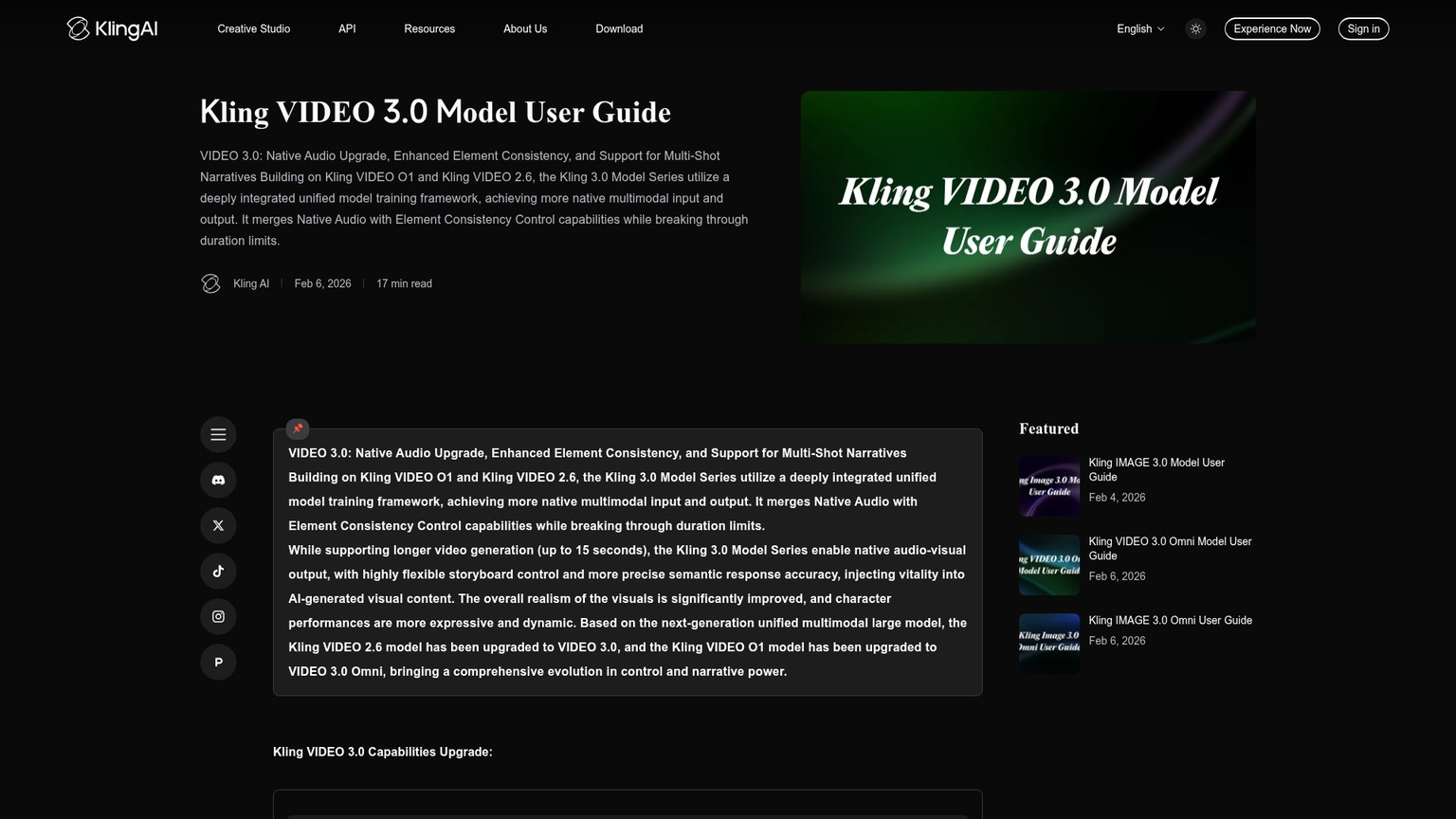
An Element can be built from multiple reference images or a video, then used to lock a character or object. For characters, Kling can also bind a voice tone. The model supports coreference for three or more characters and dialogue in Chinese, English, Japanese, Korean, and Spanish, including language switching within a scene.
Best for: Storyboarded 3-to-15-second sequences with recurring subjects, native dialogue, and controlled shot changes.
Standout: Custom Multi-Shot plus element locking and bound voice tone in the same model family.
Pricing: At 720p, VIDEO 3.0 costs 6 credits per second without native audio or 9 with it. At 1080p, it costs 8 credits per second without native audio or 12 with it. Voice control adds 2 credits per second at either resolution. Kling's official model guide does not publish a clean USD-per-credit conversion or subscription-plan price.
Free trial: Not verified on the official model guide.
- Custom Multi-Shot turns a long prompt into an explicit shot plan
- Elements can preserve subject appearance across camera changes
- Voice tone can stay bound to a character
- Native audio and multilingual dialogue reduce separate assembly steps
- No public dollar conversion in the official model guide makes budgeting harder
- More controls create more dependencies to review across image, voice, and edit rhythm
- A single multi-shot generation can fail one shot while getting the others right
- Output tops out at 15 seconds per generation
Where Kling's control pays off
The bottle brief becomes a three-shot launch sequence: a wide establishing shot of the cold room, a close orbit around the bottle, then a spokesperson lift with one line of dialogue. Standard Multi-Shot can plan that coverage automatically. Custom Multi-Shot lets the director allocate time and content to each shot, bind the bottle as an Element, bind the spokesperson and voice tone, and state the transition behavior.
The craft risk moves from single-shot drift to sequence dependency. The bottle may stay consistent while the second cut lands too late, or the voice may stay consistent while the third shot changes wardrobe. Review each shot against its own invariant and the whole sequence against continuity. If one segment fails, check whether the current interface lets the team revise that segment economically before committing to a long batch.
The credit math is transparent even though the dollar math is not. A 15-second clip costs 90 credits at 720p without native audio, 135 with native audio, 120 at 1080p without audio, or 180 with native audio. Voice control adds 30 credits to any 15-second version.
That missing USD conversion is not a small pricing-page annoyance for a production company. It blocks a clean estimate of cost per approved shot until the account's current purchase rate is known. Before choosing Kling for a client pipeline, record the actual dollars paid, credits received, regional price, tax, expiration rules, and whether failed generations consume credits. The official model guide does not settle those procurement questions.
Kling is the best creative fit for multi-shot dialogue here. It is not the cleanest finance fit. Choose it when the saved assembly and voice-continuity work matters more than having a public API dollar line on the estimate.
6. Google Veo 3.1: best for short hero shots with native audio
Google Veo 3.1 is the strongest choice for a short, high-value hero shot that needs image references, deliberate camera language, native audio, and high-resolution delivery. It supports reference images for scenes, characters, and objects, plus first and last frames, camera controls, motion controls, outpainting, and object insertion. Output can reach 1080p or 4K.
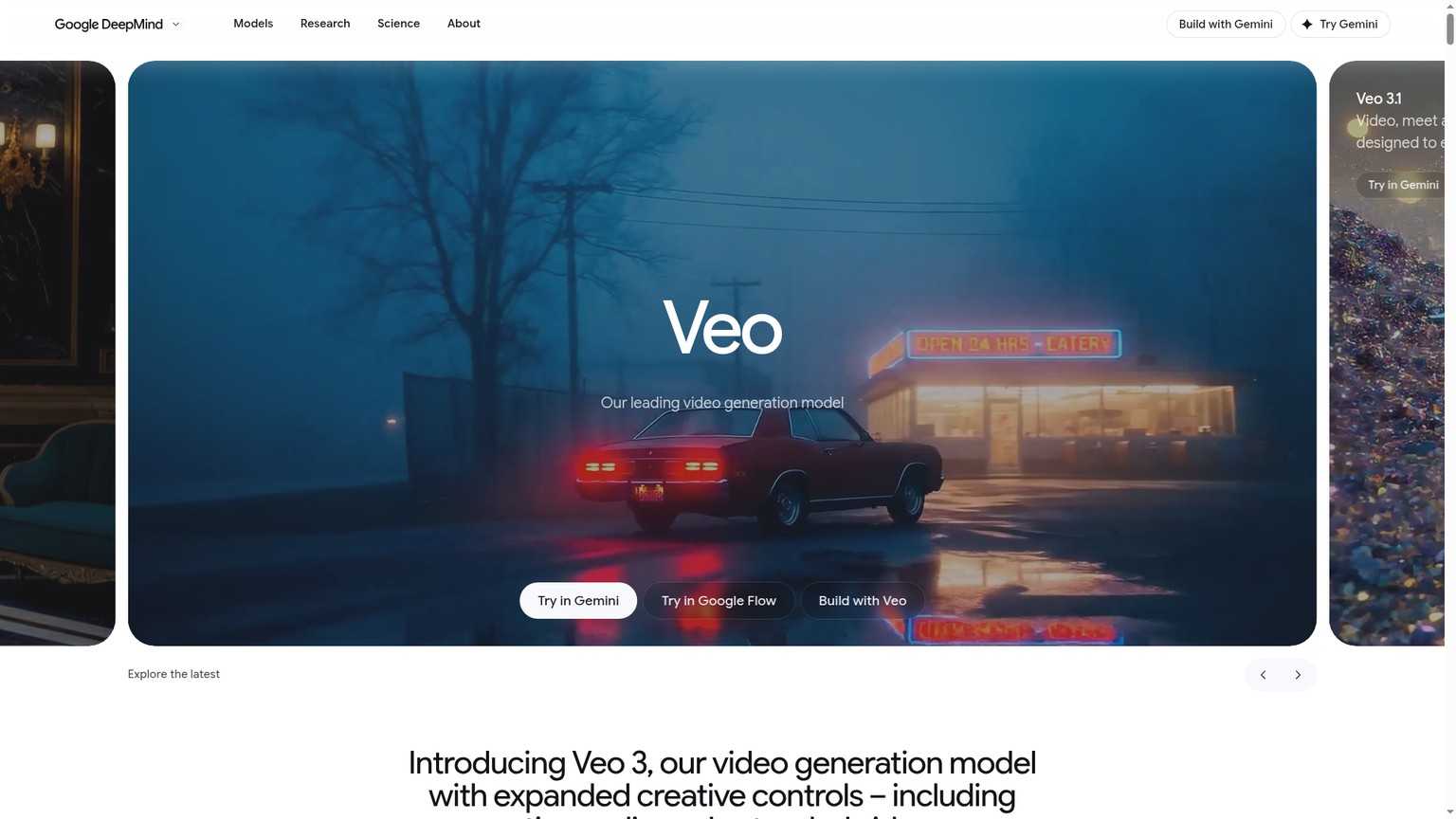
Veo is highly controllable inside a compact shot. The limits appear when a team tries to turn that shot into a longer continuity system. The API supports 4, 6, or 8 seconds, and 8 seconds is required for 1080p, 4K, reference-image generation, and extension. Extensions output at 720p only.
Best for: Premium 4-to-8-second inserts, product hero shots, and cinematic moments where native audio belongs in the first approval.
Standout: Native audio with reference, frame, camera, motion, and object controls, plus 4K delivery.
Pricing: Paid API only. Veo 3.1 Lite with audio is $0.05 per second at 720p or $0.08 at 1080p, with no 4K. Fast is $0.10 at 720p, $0.12 at 1080p, or $0.30 at 4K. Standard is $0.40 at 720p or 1080p and $0.60 at 4K.
Free trial: No free API tier.
- Native audio can enter the first creative review with the picture
- Up to three reference images can anchor scene, character, or object details
- First and last frames, camera direction, and motion controls make short shots directable
- 1080p and 4K modes support hero delivery
- Output duration is limited to 4, 6, or 8 seconds
- Reference images, extension, 1080p, and 4K require an 8-second generation
- Extensions are limited to 720p
- Standard 4K costs $0.60 per second before retries
Price the hero shot, not the demo
An 8-second Veo Lite clip costs $0.40 at 720p or $0.64 at 1080p. Veo Fast costs $0.80 at 720p, $0.96 at 1080p, or $2.40 at 4K. Veo Standard costs $3.20 at 720p or 1080p and $4.80 at 4K.
The cheapest tier is not automatically the cheapest approved shot. A product launch may justify Standard for the final hero if it reduces high-resolution retries, but the team should prove that with its own acceptance log. Start with the least expensive mode that can answer the current creative question. If the question is timing and composition, 720p may be enough. If the question is final surface detail, test the intended resolution on one representative shot before scaling.
For the bottle brief, Veo's strength is a self-contained 8-second film: first frame establishes the product, reference images protect its appearance, camera instructions define the orbit, native audio carries the refrigeration hum, and the last frame locks the pack shot. The same model is less attractive when the director wants four linked 10-second continuations and a 4K extended master. Gemini Omni's 10-second context and cumulative 40-second path are better aligned with that sequence, even though Veo may remain the finishing choice for an isolated hero.
Veo is ship-ready when the production thinks in short, complete shots and prices native audio as part of the asset. It is a poor fit when extension resolution or longer scene continuity is the deciding constraint.
Who should pick what? The production decision guide
Start with the thing the next revision is forbidden to destroy.
Choose Gemini Omni 1.1 Flash when it is the preceding scene. Its 10-second context is the most consequential control advantage in this set for extensions and branching. Choose Luma Ray3.2 when the invariant is an exact visual beat on an exact source frame. The decision flips from Gemini to Luma when a director can identify the frame that must change but does not need a new continuation.
Choose Runway Aleph 2.0 when it is the source performance, motion, duration, crop, or camera path. Choose Adobe Firefly Video Model when the workflow itself is the invariant and the clip needs to remain in an Adobe timeline, use transparent output, or pass a conservative provenance review. The decision flips from Runway to Adobe when integrated editing and Adobe controls save more handoff work than Aleph's broader source transformation.
Choose Kling VIDEO 3.0 Omni when it is the cast, bound voices, and multi-shot plan. Choose Google Veo 3.1 when it is a compact hero moment with native audio and high-resolution delivery. The decision flips from Kling to Veo when one 8-second shot matters more than a planned sequence.
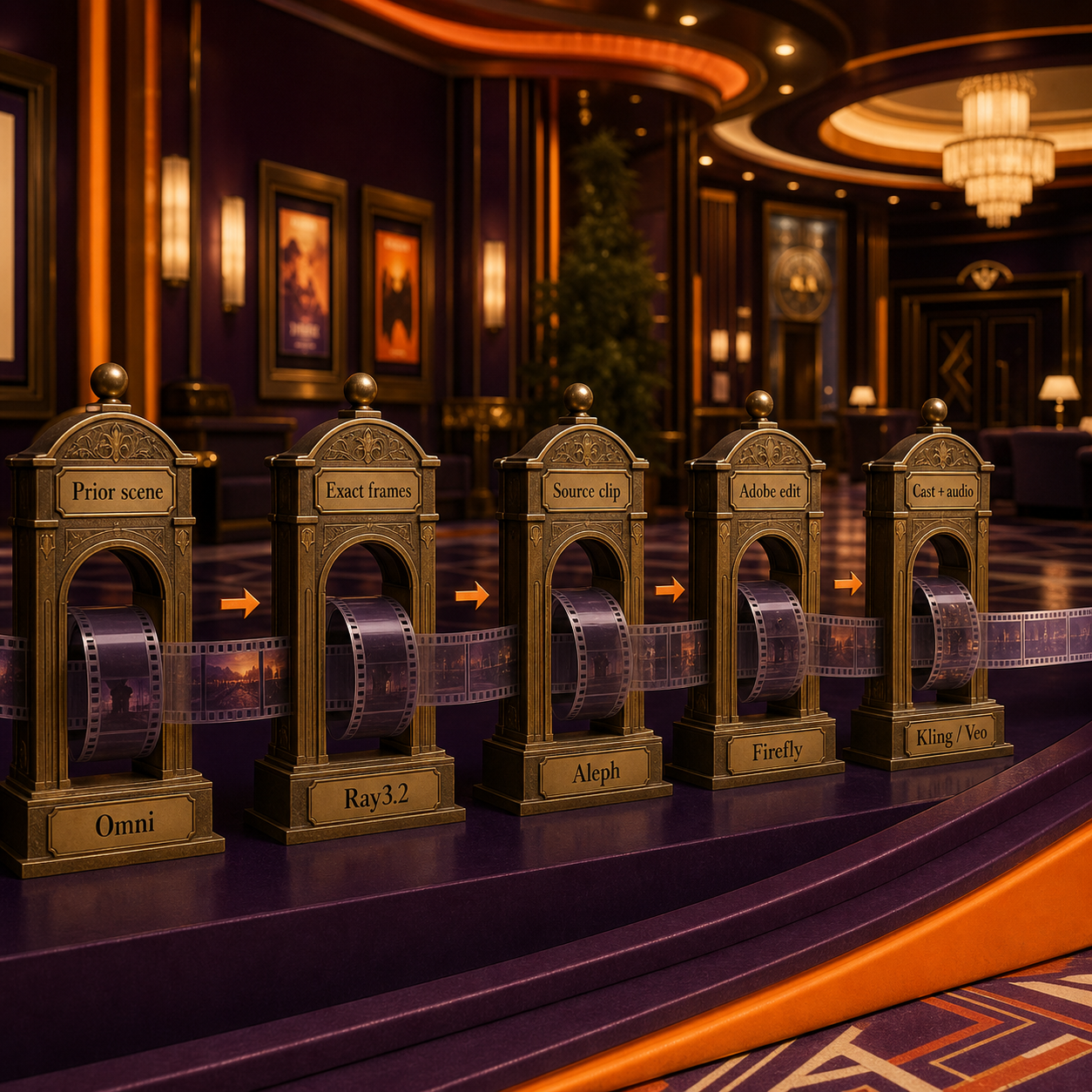
There is also a portfolio answer. A production team does not need one model for every stage. Gemini can explore continuity in 360p. Luma can lock an exact visual transformation. Runway can alter an approved plate. Adobe can place a generated asset in the existing edit. Kling can solve a multi-shot dialogue unit. Veo can finish the hero insert. The cost of a multi-model stack is justified only when the handoffs are named and the same shot is not being rebuilt in every tool.
The ones to avoid for specific production jobs
Avoiding the wrong fit is more valuable than naming a universal winner.
- Avoid Gemini Omni 1.1 Flash for a frame-indexed VFX restyle when the director expects prepared visual anchors at precise moments. Its wider scene context is useful, but Ray3.2 is built around that frame-level instruction.
- Avoid Luma Ray3.2 for cheap 1080p exploration when the shot has no useful source or keyframe plan. A 10-second 1080p SDR generation costs 1,200 credits, four times its 720p cost, before HDR or EXR multipliers.
- Avoid Runway Aleph 2.0 when there is no footage worth preserving. Paying $0.28 per second for an edit layer makes little sense if Gen-4.5 at $0.12 per second or another generator can answer the blank-canvas question.
- Avoid Adobe Firefly Video Model when the brief requires first and last frames, motion reference, composition reference, camera angle, and style in one pass. Adobe disables several of those combinations. Split the control problem or choose another model.
- Avoid Kling VIDEO 3.0 Omni for a fixed-dollar procurement estimate until the account's credit conversion is documented. The official guide publishes credit burn, not a public USD conversion.
- Avoid Google Veo 3.1 for a long high-resolution extension workflow. Its extensions are 720p, and the API's clip structure stops at 8 seconds per generation.
Also avoid any wrapper that refuses to name the underlying model, version, credit markup, export resolution, watermark rule, and failure-credit policy. A cleaner interface can be worth paying for. Hidden model economics cannot be evaluated, and a production team should not discover the real constraint after client approval.
The Monday move: run a controlled shot bake-off
Do not begin by asking six models for six unrelated beautiful clips. Choose one representative shot, define its invariants, and test the smallest revision that resembles a paid note.
Use this neutral brief:
Create a 10-second 16:9 product shot of a matte-black insulated bottle on an aubergine plinth. Begin in a close three-quarter view, orbit slowly clockwise, and finish front-on as condensation reaches the label. Preserve the cap, silhouette, label placement, plinth color, camera direction, and bottle scale. Add a quiet refrigeration hum, with no music and no dialogue.
This is a test brief, not a claimed generation. Its value is that every rejection can be named: label drift, changed cap, incomplete orbit, wrong plinth, altered scale, or unwanted audio.
Run a capped production bake-off
Pick the preservation target
Choose one: preceding scene, exact frames, source footage, Adobe timeline, cast and voice, or short hero audio. That choice narrows the field before any credit is spent.
Set the acceptance sheet
Score product geometry, identity, camera path, timing, continuity, audio, resolution, and delivery format as pass or fail. Record one rejection reason per attempt.
Change one variable
Keep the base brief fixed. Change only the camera note, transformation, reference frame, shot allocation, or audio instruction. Multiple simultaneous changes hide the cause of improvement.
Cap the rough pass
For Gemini Omni, 12 ten-second drafts at 360p cost about $4 before input tokens. For Runway, one 10-second Gen-4.5 generation is $1.20 and one 10-second Aleph edit is $2.80. For Veo Fast, one 8-second 720p shot is $0.80. Keep durations and modes visible when comparing totals.
Promote one direction
Move only the selected direction to 1080p, 4K, HDR, EXR, ProRes, or a longer extension. Then put that file through the intended edit, grade, composite, and approval path.
The metric to keep is generations per approved shot, segmented by shot type and model. Add generation spend, finishing surcharge, and the human review time your team already tracks. After ten representative shots, the cheapest approved-shot path will be clearer than any public leaderboard.
If the system will generate video inside a product rather than a creative workstation, the real-time AI video API comparison covers latency, queueing, and architecture decisions that this production ranking deliberately leaves out.
FAQ
What is the best AI video generator in 2026?
For production control, Gemini Omni 1.1 Flash is the best overall choice because it can use 10 seconds of prior scene context and supports a cheap 360p approval layer. Luma Ray3.2 is better for exact-frame direction, Runway Aleph 2.0 for source-footage edits, Adobe Firefly for Adobe-centered work, Kling VIDEO 3.0 Omni for multi-shot voices, and Veo 3.1 for short native-audio hero shots.
What is the best free AI video generator?
Adobe lists free daily generations with limits that refresh each day, while Runway offers 125 one-time credits on its free plan. Neither is an unlimited production tier, and Google lists no free API tier for Gemini Omni 1.1 Flash or Veo 3.1.
What is the best AI video generator for YouTube?
For generated inserts inside a longer YouTube edit, choose Runway or Adobe for the editorial handoff. Choose Kling for a short multi-shot spoken sequence, Veo for an 8-second native-audio hero, and Gemini Omni when several generated shots must continue one scene.
What should an AI video generator benchmark measure?
Measure generations per approved shot, the percentage of revision notes resolved without breaking approved elements, continuity across extensions, delivery-format fit, and total approval cost. Aesthetic preference belongs in the scorecard, but it should not hide repeated continuity or export failures.
Get the AI business workflow audit checklist
Audit where AI belongs in your workflow, what it should preserve, and which cost line to measure before you buy.
- Published
- Category
- Design
- Language
Nano Banana 2.1 Explained: Pricing, Changes, and When to Switch
Nano Banana 2.1 cuts 1K and 2K image costs about in half. Compare monthly budgets, verify the migration, and decide when Pro earns its premium.Oct 8, 2026Design
ElevenLabs Alternatives: Murf, MAI-Voice-2, OpenAI TTS and Cartesia (Verified October 2026)
Compare ElevenLabs, Murf, MAI-Voice-2, OpenAI, Cartesia, Google and Speechify by studio or API job, with verified prices and switching costs.Oct 4, 2026Design
Higgsfield API Pricing
Price Higgsfield API video and image jobs, separate API dollars from app credits, and check top-ups, expiry and cashback before scaling.Sep 27, 2026Design
Is Gemini Live Avatar Free
Check Gemini Live Avatar access, Enterprise API charges and custom-avatar limits before budgeting a customer-facing video agent.Sep 27, 2026Design
Gemini 3.8 Flash TTS Pricing
Price Gemini 3.8 Flash TTS by audio minute, compare Flash-Lite and service tiers, and budget the January 2027 increase.Sep 24, 2026Design
ngram vs Demosmith
Compare ngram and Demosmith for product videos, browser capture, revisions and usable exports, with costs matched to the same job.Sep 19, 2026Design
ArtPatt Pricing
ArtPatt pricing explained: Free limits, Pro exports, saved patterns, AI-image allowances, and when a paid plan earns its place.Sep 15, 2026Design