Calendly Alternatives in 2026: Cal.com, TidyCal, Acuity & More
Compare Calendly alternatives by need: Cal.com, TidyCal, Acuity, Bookings and more. Verified prices, routing, branding and reasons to stay.
Published
 By Omid Saffari


Cal.com is the strongest starting point among Calendly alternatives for free solo booking and affordable team routing: five Teams seats cost $720 a year, versus $960 for Calendly Teams. Choose Acuity Scheduling for a service business taking payments, TidyCal for a low subscription bill, and Microsoft Bookings or Google Calendar appointment schedules when your existing suite already covers the job. For open-source self-hosting, the option is now Cal.diy, a separate community product without Cal.com's team routing.
Prices and plan boundaries verified against the vendors' own pages on October 11, 2026. Prices below are in US dollars. Annual rates are monthly equivalents with an annual commitment; monthly billing is identified separately. Taxes, payment processing, implementation and optional extras are outside the subscription comparisons. The opening calculation uses Cal.com's pricing and Calendly's pricing.
Disclosure: Cal.com is a commercial partner of omidsaffari.com. Partner links may earn a commission. The recommendations below turn on the booking job, including cases where another product is a better buy.
Calendly alternatives at a glance
Start with the reason you want to leave. A lower solo bill, a branded booking page, a paid appointment and a lead assigned to its account owner are different purchases.
These are ten alternatives, not ten interchangeable Calendly clones. Cal.diy is separate from hosted Cal.com. Reclaim solves a broader calendar-management problem. Chili Piper's inexpensive-looking standalone ChiliCal rate has a large seat minimum and does not include routing. Each distinction changes the bill you should compare.
How these were picked
The selection favors a specific replacement reason over the longest feature list: usable free booking, team distribution, CRM ownership, service payments, brand control, or fewer subscriptions. A CRM is the customer database that records who owns an account; routing means sending an inquiry to the right person before the appointment is booked. Round robin is simpler: distributing bookings across a pool of available hosts.
This is a source-verified comparison, not a hands-on product test. The verification covered live pricing pages, feature matrices and vendor documentation. The cost examples below were calculated from those prices. Hypothetical businesses are labeled as examples, not customer results.
The field deliberately excludes employee shift planners and room-resource systems. Those can be good scheduling products without replacing a Calendly link. General task managers also do not qualify simply because they display a calendar. For the broader category, use the best scheduling app comparison.
The decisive test is whether the cheapest qualifying plan can complete your actual booking: select a host, check the right calendars, ask the required questions, collect any payment, send the right confirmation and write the result where your business needs it. A cheap plan that fails one required step is not the price of your solution.
The best alternatives to Calendly by need
1. Cal.com: the best starting point for free solo booking and team routing
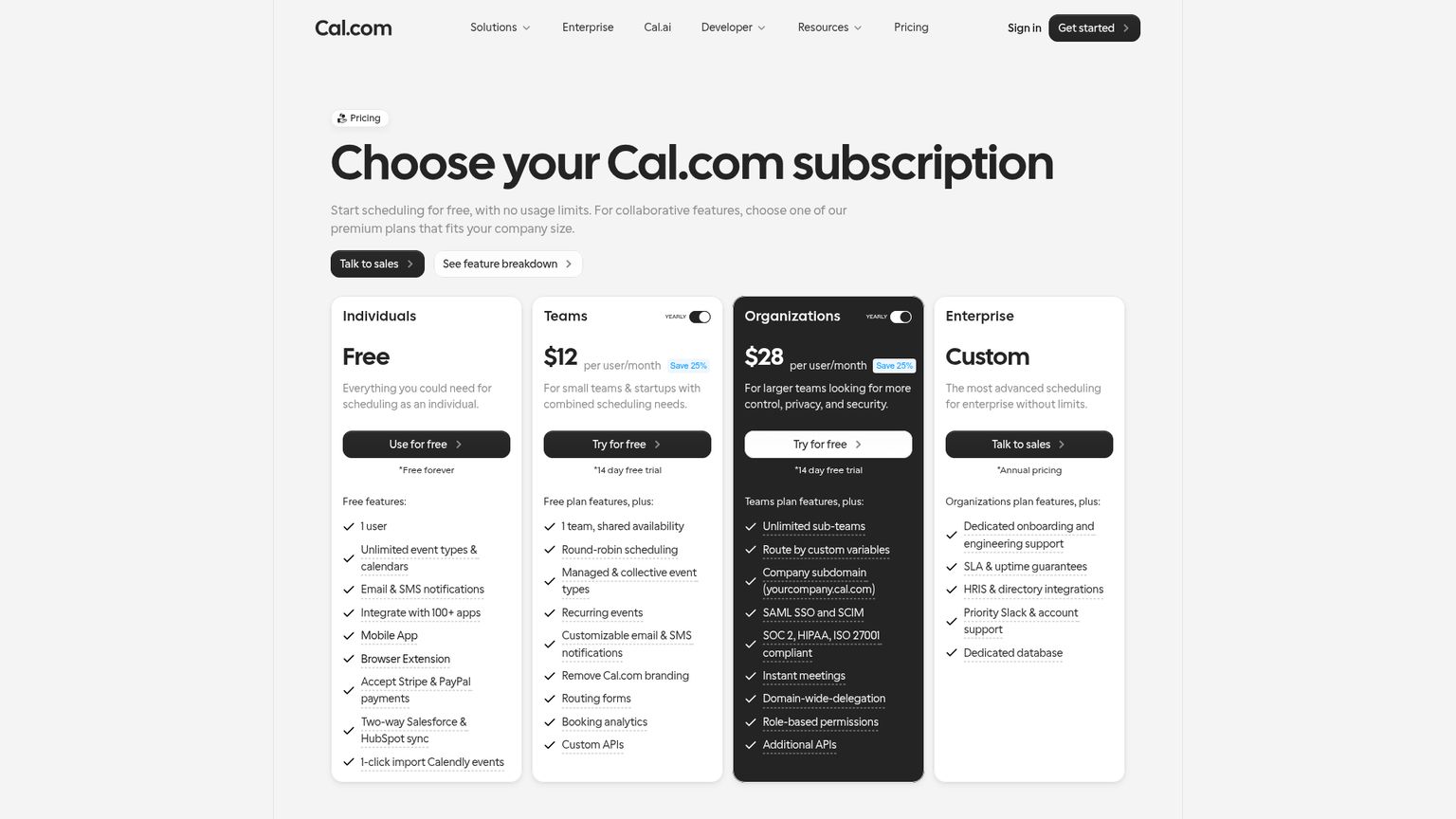
Cal.com is a hosted scheduling platform that offers a generous free individual plan and a relatively inexpensive upgrade to team booking. A consultant can separate discovery calls, paid advice and existing-client check-ins without paying just to create more event types. A sales team gets a different reason to upgrade: round robin, shared availability and routing forms on Teams. Choose Cal.com for those capabilities; choose Cal.diy separately if source access is the requirement.
Best for: A solo founder with several booking types, or a small team distributing inbound appointments.
Standout: Unlimited event types and calendar connections on Individuals; routing forms and brand removal on Teams.
Pricing: Individuals $0; Teams $12/user/month annually; Organizations $28/user/month annually; Enterprise custom annual pricing.
Free trial: Individuals is a permanent free plan; Teams and Organizations offer 14 days. Cal.com pricing.
For the solo consultant, the free plan's value is concrete. You can keep different conversations on different links and check several connected calendars. Stripe and PayPal payments are included, as is a Calendly event importer. Payment processing still has its own economics; an included connection does not make the processor free.
Teams adds one shared team, round-robin scheduling, managed and collective events, customizable booking messages, analytics and removal of Cal.com branding. A collective event finds availability when several colleagues must attend; it is not the same as rotating one host from a pool. Organizations is the next boundary when you need unlimited sub-teams, custom-variable routing, a company subdomain or centralized identity controls. Current feature breakdown.
That distinction matters for a growing sales organization. Routing a form to an available representative is one requirement; maintaining several departments with their own permissions is another. Write the rule you need in plain language before assuming the first paid tier handles the entire organization.
Use this small rollout to find the boundary before replacing every link:
Start with the booking that earns the subscription
Connect the calendars that must block availability. Create or import one event type, then set its duration, availability, location and booking questions. For a consultant, start with the paid consultation or discovery call that clients already recognize.
Add the team rule only when you need it
During the Teams trial, create the team and a round-robin event for the relevant hosts. If inquiries need qualification, configure a routing form and identify what should happen to an inquiry that matches no route.
Book from outside the account
Make a sample booking, reschedule it and cancel it. Check calendar conflicts, host assignment, confirmation text and the destination of any CRM record. These are recommended checks, not tests performed for this article.
Upgrade for a named requirement
Keep Individuals if the workflow stays solo. Pay for Teams when shared booking, routing or brand removal is needed. Evaluate Organizations when the requirement is multiple sub-teams or more advanced organizational controls.
- Several individual booking types and calendars without a subscription.
- Payments and a Calendly event importer on the free plan.
- Team distribution, routing forms and brand removal in the same paid tier.
- A clear Organizations upgrade for multiple sub-teams and identity controls.
- Team scheduling and brand removal require payment.
- Teams includes one team; more elaborate organizational needs move up a tier.
- The hosted commercial product is no longer the open-source self-hosted product.
The Cal.com pricing breakdown covers its billing detail. If these are your final two candidates, the Cal.com vs Calendly comparison handles the head-to-head without making you read it again here.
2. Cal.diy: the open-source option, with a significant production boundary
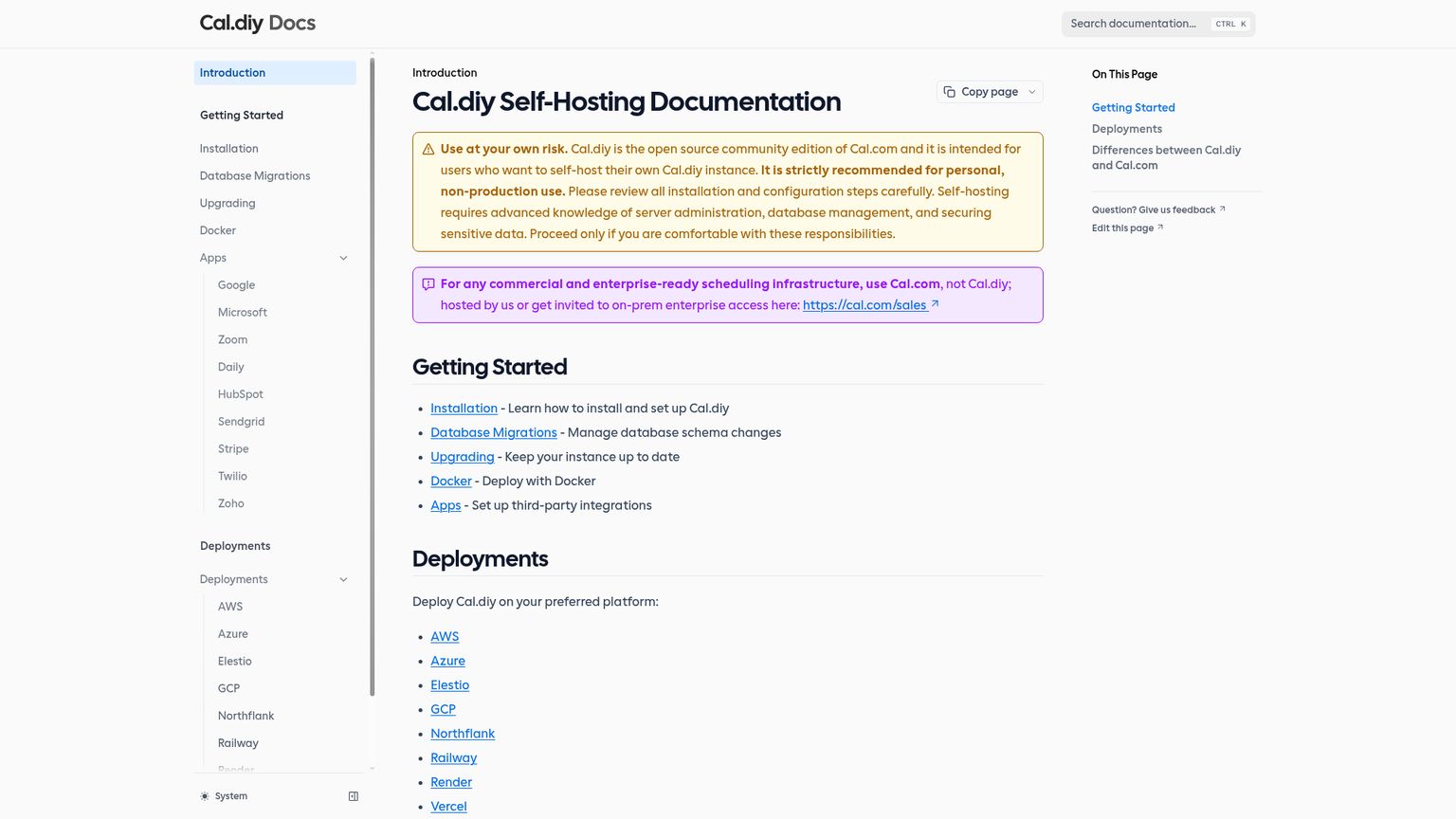
Cal.diy is the MIT-licensed, self-hostable community scheduling project created from Cal.com's public code. It is appropriate to evaluate when controlling and modifying the source is the point. It is a poor recommendation for a nontechnical sales team trying to remove a subscription: the current documentation recommends it for personal, non-production use, and the commercial team features have been removed. Self-hosting gives you operating responsibility; it does not give you free Cal.com Teams.
Best for: A technical individual exploring personal scheduling with source access.
Standout: A community codebase you can inspect and host yourself.
Pricing: No software subscription for the MIT-licensed project; infrastructure and operating work are additional. Commercial on-premises Cal.com access requires a sales discussion.
Free trial: Not applicable; this is a source project, not a hosted trial. Cal.diy documentation.
The source distinction is current, not semantic. Cal.com announced its move to closed source in April 2026. Its technical explanation identifies the public project as Cal.diy and lists removed capabilities, including Teams and Organizations, routing forms, automated workflows, SAML/SSO and Insights. Core scheduling, the app framework, booking flows and API v2 remain. Cal.com's technical explanation.
For a founder with an engineering background, that can still be useful. You can study the booking engine, build a personal instance and decide whether owning the system serves a concrete purpose. The work includes server administration, database management, upgrades and security. The project's own documentation makes that operating commitment explicit and points commercial users toward Cal.com or its enterprise on-premises route.
For a consultancy with several billable staff, the decision flips. If the requirement is “the next available consultant receives this paid lead,” the missing team layer is central to the job. A free software license cannot compensate for having to build and maintain a feature your hosted subscription already provides.
- MIT-licensed community source available to inspect and modify.
- Core booking functionality and API access remain.
- Hosting control for a technical personal project.
- Its own documentation recommends personal, non-production use.
- No commercial team booking, routing forms or workflow engine.
- You operate the infrastructure and ongoing maintenance.
3. Google Calendar appointment schedules: best for a simple booking page you may already have
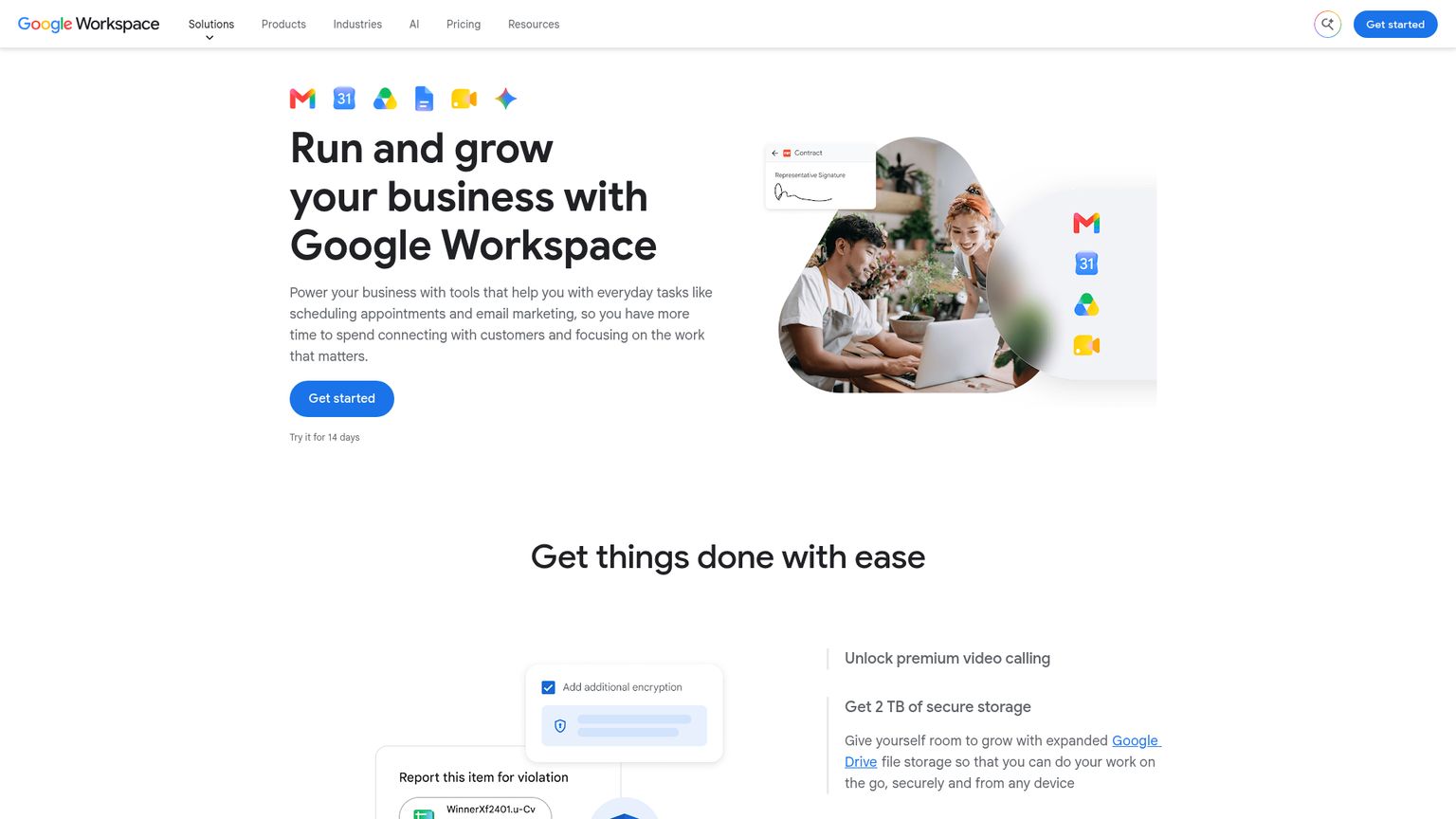
Google Calendar appointment schedules lets people book available time directly into Google Calendar. It is the first alternative a Google-based consultant should inspect before adding another subscription. A personal account can create one booking page, while eligible paid subscriptions expand appointment functionality. It wins when your booking requirements fit your existing Google subscription; buying a larger suite solely for a link is a different decision.
Best for: A founder or consultant whose schedule already lives in Google Calendar.
Standout: A booking page inside the calendar rather than another scheduling account.
Pricing: One personal booking page at no subscription cost. Regular US Workspace business rates are Starter $7, Standard $14 and Plus $22/user/month with a one-year commitment; Enterprise is quoted. Standard is $16.80/user/month on monthly billing. Google localizes pricing by region; these are the US rates verified for this comparison, with Standard also confirmed on its product offer page.
Free trial: Basic personal scheduling is available without a paid plan; Workspace offers 14 days. Sources: appointment eligibility, business pricing, Standard offer.
The free page is a strong fit for an independent advisor who offers one kind of call. Google handles the booking page, availability and calendar event. If that is the entire workflow, retaining a second scheduler needs a specific reason.
The first wall is the free entitlement. A personal Google Account and Business Starter get a single booking page. Multiple appointment schedules, automatic reminders and checking availability across multiple calendars require an eligible paid subscription. Business Standard and Plus also include appointment payments, email verification, secondary-calendar scheduling and co-hosts. Google's feature matrix.
Do not treat every paid Google account as equivalent. The eligibility matrix distinguishes Google One subscriptions from Workspace business plans; payment collection and co-hosting are not common to every column. For a business taking deposits, verify the payment feature on the account you will use, not merely whether it has a Google subscription.
For example, a consultant already paying for Business Standard can investigate its Stripe-based appointments without adding a separate booking subscription. A consultant on a personal account who needs several paid services should compare the full Workspace upgrade with a specialist scheduler. The incremental price is zero only when the required entitlement is already included.
- A basic booking page for personal-account users.
- Availability and appointments live inside Google Calendar.
- Advanced appointment functions may already be included in your Workspace subscription.
- Personal and Business Starter accounts have the single-page boundary.
- Reminders, multiple schedules and payment eligibility depend on the plan.
- The documented appointment feature set is not a substitute for a demonstrated CRM ownership-routing workflow.
4. Microsoft Bookings: best for a Microsoft 365 business that schedules staff
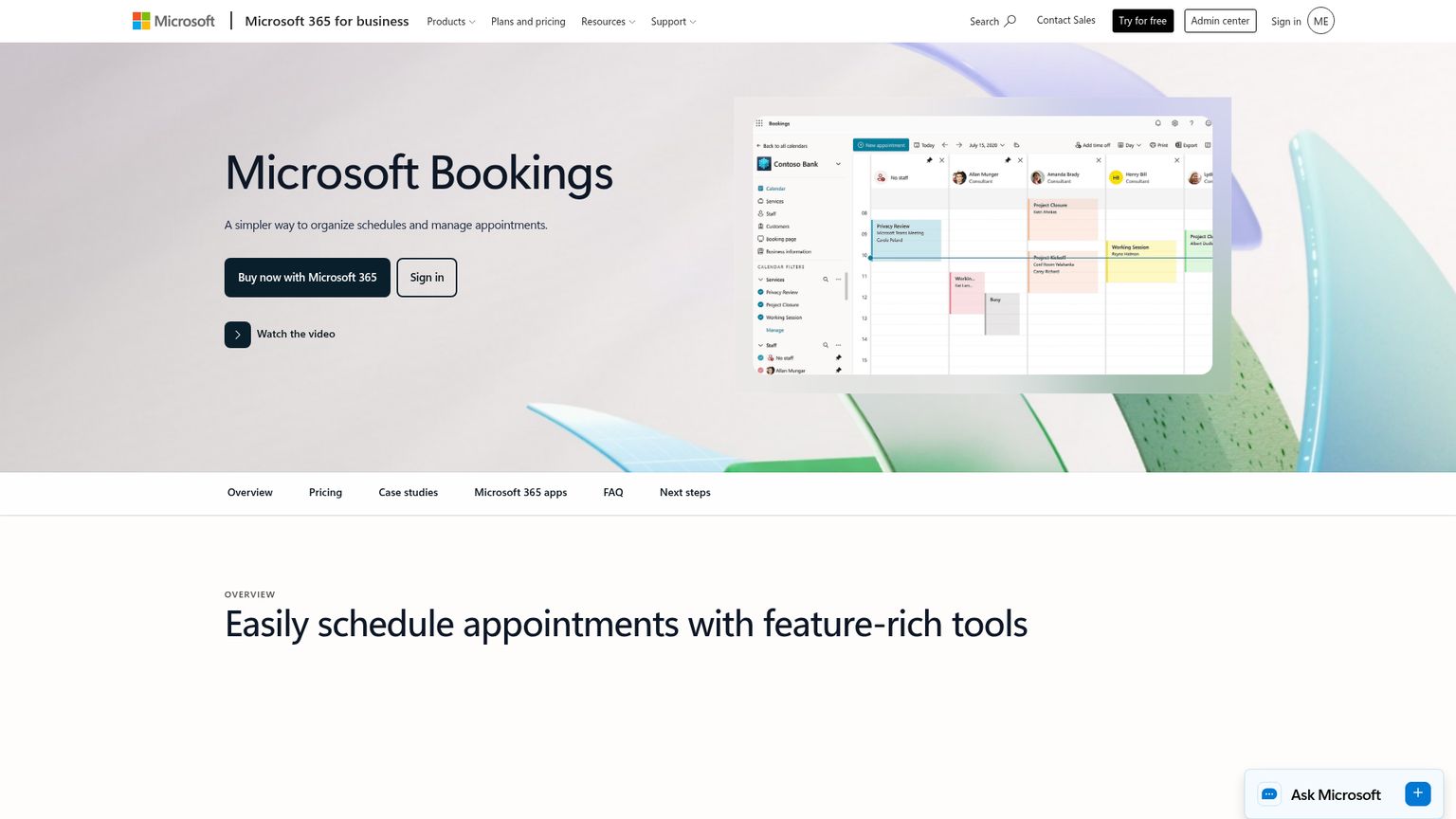
Microsoft Bookings is Microsoft's appointment scheduler for organizations, with staff, services and Outlook availability in one workflow. An advisory firm already using an eligible Microsoft 365 plan should check it before renewing separate Calendly seats. It can publish service availability and support virtual appointments through Teams on the appropriate subscription. The strongest reason to choose it is existing entitlement; the clearest reason to reject it is a requirement to collect payment during booking.
Best for: A Microsoft-based consultancy, recruiting function or customer-service office scheduling staff appointments.
Standout: Included scheduling with Outlook and Microsoft 365 administration.
Pricing: $0 additional scheduler subscription with an eligible license. Business Basic without Teams starts at $5.40/user/month annually or $6.48 monthly. Business plans with Teams cost Basic $7/$8.40, Standard $14/$16.80, and Premium $22/$26.40 per user/month, annual equivalent/monthly respectively.
Free trial: Microsoft 365 offers a one-month trial, with payment details and automatic conversion terms. Sources: Basic options, business plans with Teams.
The lowest Microsoft figure is a bundle price, not a separate Bookings plan. A no-Teams license also must not be presented as though it includes Teams video meetings. Microsoft's Bookings FAQ lists eligible subscriptions and says Bookings is not available as a standalone app. Outlook on the web must be enabled.
For a local consulting office, model services rather than individual links first. Define the appointment, assign the relevant staff, set the scheduling policy and publish the availability. The practical benefit is giving clients one place to find a suitable appointment while using the calendars staff already maintain.
The limit is unusually clear: Microsoft says there is no payment support in Bookings. If confirming the appointment must also collect a deposit, another checkout step becomes part of your process. For a paid consultation business, compare that extra handoff against Acuity or a scheduler with included payment connections. A tool already paid for is not automatically the cheapest complete workflow.
- No additional booking subscription for eligible existing customers.
- Staff and service scheduling connected to Outlook.
- Customizable service information, policies and notifications.
- No native payment support, according to Microsoft's FAQ.
- Requires an eligible subscription and enabled Outlook web access.
- The cheapest no-Teams bundle should not be confused with a Teams-inclusive license.
5. SavvyCal: best for the experience of choosing a time
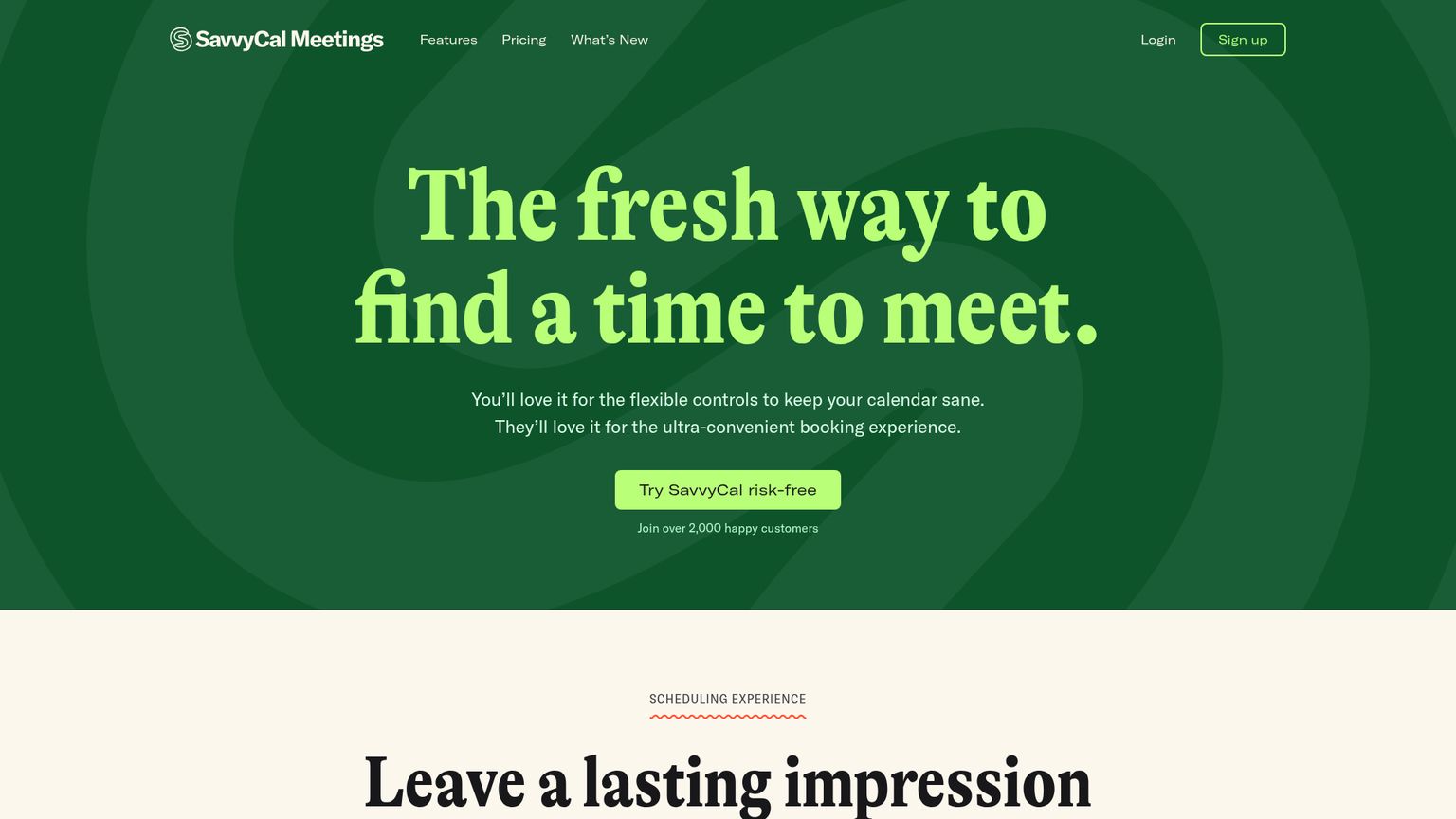
SavvyCal is a booking-link service built around making availability easier for the invitee to navigate. Its calendar overlay lets the recipient compare their own calendar against yours, and its availability controls help you shape which times are offered. For a consultant selling a high-consideration service, that interaction can matter more than saving a small amount on the booking link. Choose it for the booking experience and simple team scheduling; budget Premium when brand removal or a custom domain is mandatory.
Best for: Consultants, agency partners and small teams that care about the invitee's experience.
Standout: Calendar overlay, preferred availability and team scheduling.
Pricing: Basic displays $10/user/month and Premium $17/user/month on annual billing.
Free trial: Free setup before paid activation; a 30-day money-back guarantee is advertised. That guarantee is not a 30-day free trial. SavvyCal pricing.
Basic includes unlimited links and calendar connections, collective and round-robin scheduling, reminders and workflows. This makes it a credible budget comparison for a small booking pool, not merely a premium solo product. Five Basic seats at the published annual rate are $600 a year, below the $720 Cal.com Teams example. The savings matter only if Basic contains your required features. Plan comparison.
Premium is where custom domains, assistant delegation and paid bookings enter. Removing SavvyCal branding also sits beyond Basic. The brand requirement therefore changes the appropriate comparison: a firm buying Basic for its low rate and then requiring a clean custom domain has selected the wrong price card.
Imagine an agency partner scheduling a discussion with a client and a specialist. Collective scheduling answers “when can everyone attend?” A round-robin pool answers “which available partner should host?” Both are listed, but neither phrase alone proves that a complex account-ownership rule is covered. If your sales operation needs that rule, evaluate it explicitly against Cal.com, HubSpot or Chili Piper.
- Invitees can overlay their calendars on the booking link.
- Basic includes team scheduling and unlimited links/calendars.
- Controls for preferred slots and protecting availability.
- Activating booking links requires a paid plan.
- Brand removal and custom domains require Premium.
- Paid bookings and assistant delegation also require Premium.
6. Chili Piper: best for a sales-routing problem large enough to justify the contract
Chili Piper is an inbound sales platform that qualifies, routes and schedules inquiries from web forms and other touchpoints. It belongs on the shortlist when a booking must follow CRM ownership, distribution rules or a sales handoff. It does not belong on a solo founder's shortlist for a cheaper calendar link. Buy it to improve an expensive lead-handling process, not to reduce the price of Calendly seats.
Best for: An established sales operation with valuable inbound demand and someone responsible for routing rules.
Standout: Qualification, form-to-meeting routing, CRM assignment and sales handoffs.
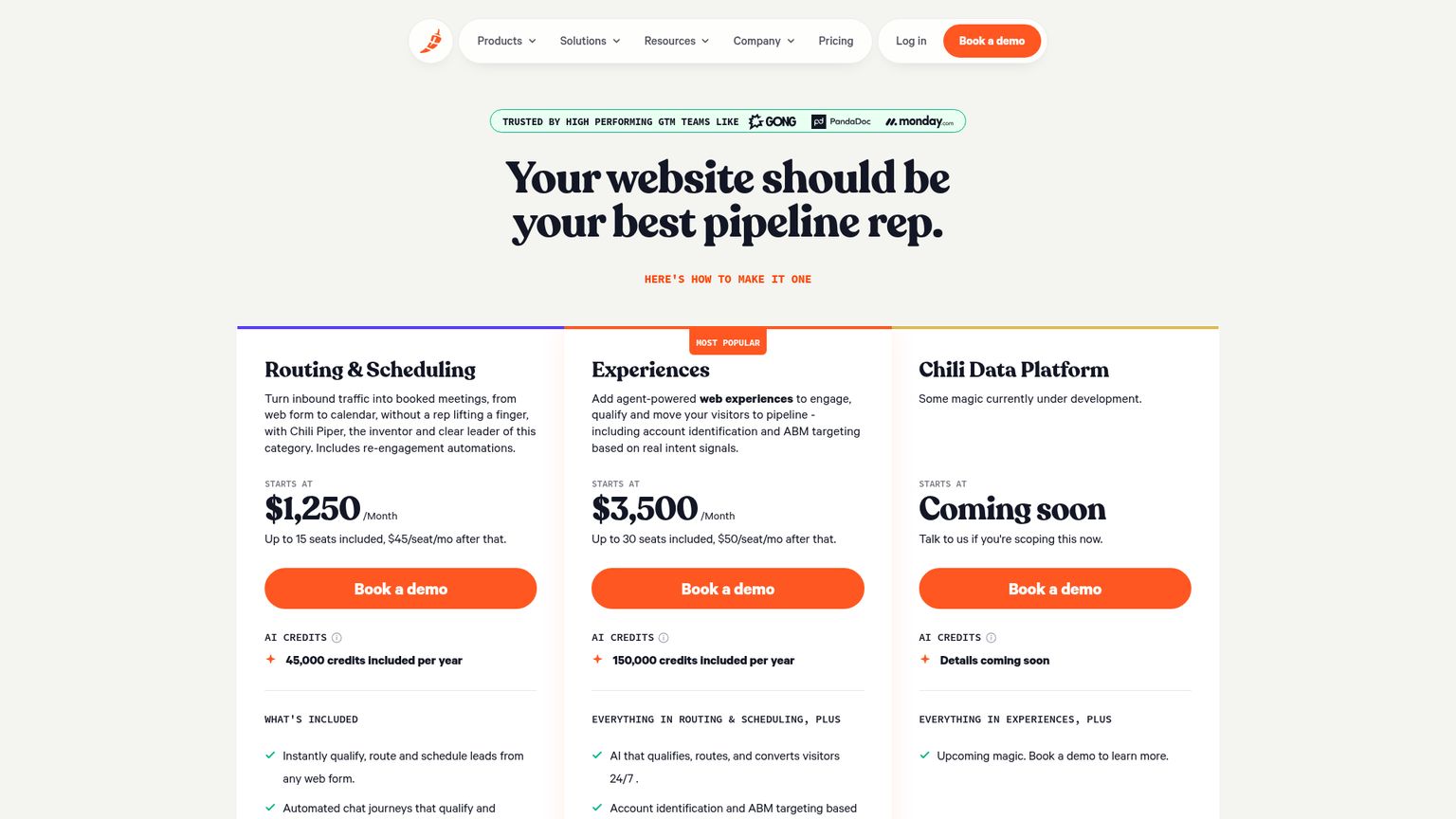
Pricing: Routing & Scheduling starts at $15,000/year, equivalent to $1,250/month, with 15 seats; additional seats are $45/seat/month. Experiences starts at $42,000/year, equivalent to $3,500/month, with 30 seats; additional seats are $50/seat/month. Chili Data Platform is listed as coming soon without a price.
Free trial: The pricing page offers a demo, not an advertised self-serve free trial. Its Fire plans are billed annually. Chili Piper pricing.
The base package describes qualification and scheduling from web forms, inbound distribution, Salesforce object routing, live connections, sales-development-to-account-executive handoffs, analytics and re-engagement. That is a materially larger system than a representative's public booking link. Experiences adds broader AI-driven website engagement and account-based targeting. Current package details.
A practical evaluation should follow the messy cases. An existing customer's inquiry should reach its owner. An unowned account should enter the correct pool. An unavailable owner needs the fallback your business has agreed on. An inquiry that should not reach sales needs another destination. These are acceptance scenarios to demonstrate, not promised conversion improvements.
The standalone ChiliCal offer needs special attention. It advertises $12/user/month, but with a 200-seat minimum and no routing or orchestration. That is $28,800 a year at the stated floor, not a $12 option for one consultant. Its commercial purpose is enterprise scheduling at scale. Do not compare that card against the routing package as if they buy the same workflow.
- Web-form qualification and scheduling in one sales process.
- CRM assignment and handoffs rather than only personal booking links.
- Re-engagement and funnel reporting in the routing package.
- A $15,000 annual starting commitment for routing.
- No monthly billing for the listed Fire packages.
- Standalone ChiliCal has a large seat minimum and excludes routing.
7. Acuity Scheduling: best for a service business selling appointments
Acuity Scheduling is an appointment-management product for businesses whose bookings are part of the service being sold. A tutor, coach or studio needs more than a time on a representative's calendar: intake, deposits, reminders and potentially packages or memberships. Acuity organizes those requirements around bookable calendars rather than simply selling a seat to every host. Choose it when the appointment is the transaction, and price the calendar capacity you need.
Best for: Coaches, tutors, studios and other businesses with paid services and client intake.
Standout: Appointment payments and forms, with packages and memberships on Standard.
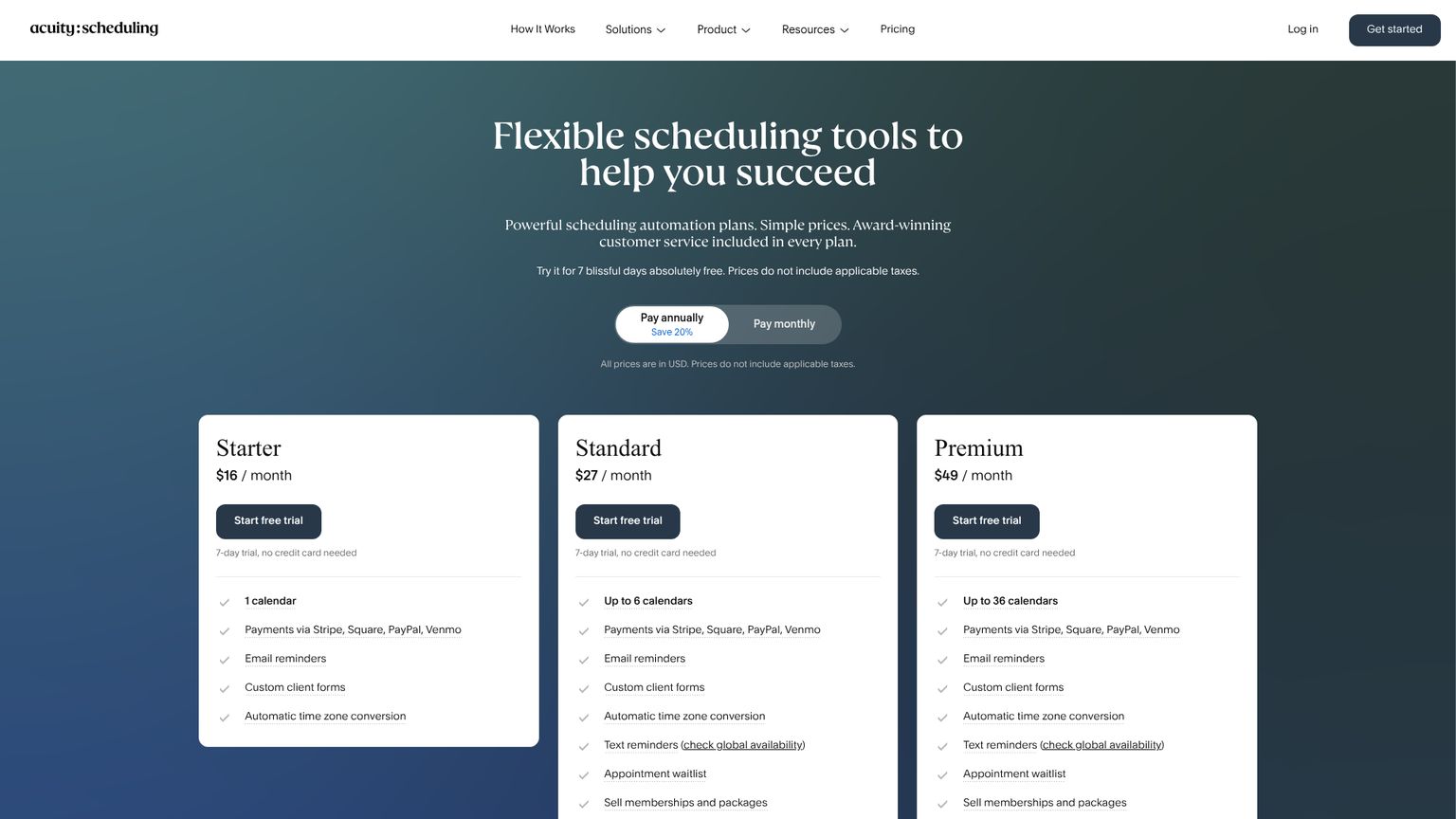
Pricing: Starter $16/month annually or $20 monthly, one calendar; Standard $27/month annually or $34 monthly with up to six calendars; Premium $49/month annually or $61 monthly with up to 36 calendars.
Free trial: Seven days, no credit card required; no ongoing free plan is listed. Acuity pricing.
Starter includes payment and deposit connections, intake forms, email reminders and unlimited services and appointments. A calendar can represent an employee or a location, depending on the business. Standard adds text reminders, a waitlist, memberships, packages and gift certificates. A business selling recurring sessions should therefore compare Standard, not assume the entry price includes its sales model.
Consider a tutoring practice with six bookable calendars. Standard costs $27 × 12 = $324 a year at the annual rate. Six Calendly Standard seats cost 6 × $10 × 12 = $720 a year. That $396 difference illustrates the billing-unit advantage; it does not make the products feature-identical. A practice should still verify how its staff, locations and booking rules map to those calendars. Sources: Acuity, Calendly.
Branding is the other important boundary. Hiding the Acuity logo, using custom API/CSS functionality and supporting different time zones for staff or locations are Premium features. A solo consultant who only wants an unbranded booking link may be paying for much more appointment infrastructure than they need.
The decision is straightforward: if you sell a service catalog with intake and repeat purchases, Acuity deserves an early evaluation. If you only schedule a discovery conversation before selling something elsewhere, Cal.com, TidyCal or your existing suite may be enough.
- Payment/deposit connections and client forms from Starter.
- Calendar capacity can be economical for a small service business.
- Standard adds packages, memberships, waitlists and text reminders.
- No permanent free plan.
- Packages and memberships require Standard.
- Removing the Acuity logo requires Premium.
8. TidyCal: best for a low subscription bill, with limits on the lifetime promise
TidyCal is a booking service with both free access and one-time lifetime plans. It is particularly attractive for a consultant who needs reliable booking types, calendar connections and meeting links without another annual renewal. Its low price is useful, but lifetime access does not mean every feature or every payment is free. Choose the lifetime plan when its branding and payment-fee terms fit; choose Pro when they do not.
Best for: A solo professional reducing recurring software costs, or a small team with straightforward booking distribution.
Standout: Individual and Agency lifetime purchases alongside a functional free plan.
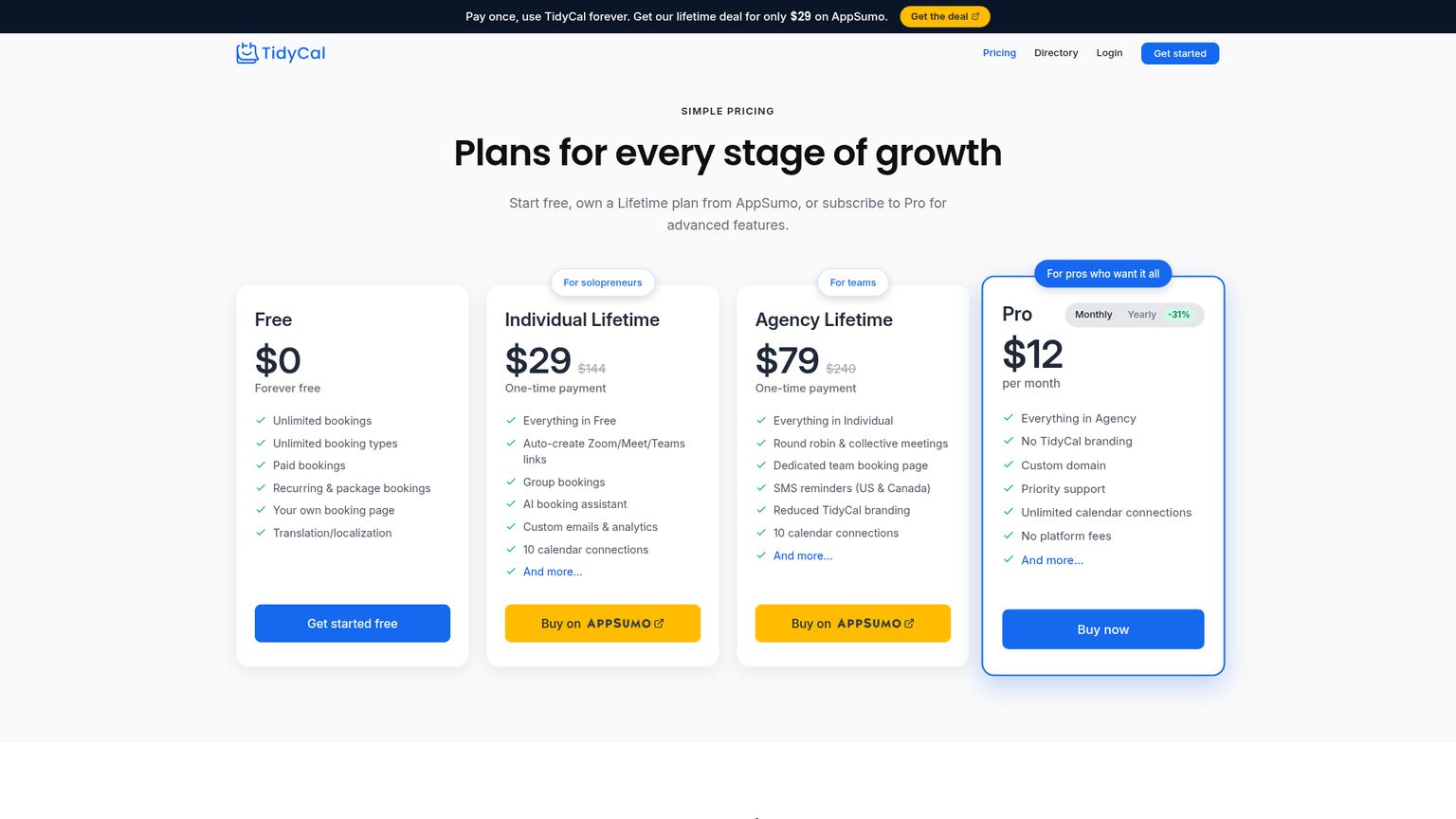
Pricing: Free $0; Individual Lifetime $29 once; Agency Lifetime $79 once; Pro $12/month or $99/year, equivalent to $8.25/month.
Free trial: The free plan is the ongoing entry option; the pricing page does not advertise a separate timed trial. TidyCal pricing.
Free includes unlimited bookings and booking types, paid bookings, recurring and package bookings, but only one connected calendar. Individual Lifetime expands to ten connections and adds automatically generated Zoom, Google Meet and Microsoft Teams links, group bookings, custom emails, booking limits and API access. Automatic conference links are an important practical boundary: the free plan should not be treated as though it includes every part of the paid remote-meeting workflow.
Agency Lifetime adds collective and round-robin meetings, a team page and a limited US/Canada SMS allowance. It still has reduced branding rather than no branding. Pro is the tier for a custom domain, complete removal of TidyCal branding, unlimited calendar connections, priority support and no TidyCal platform fee. Current feature matrix.
TidyCal vs Calendly: compare both the subscription and the payment volume
For one consultant, a $29 Individual Lifetime purchase is $91 less than a year of Calendly Standard at its $120 annual price. That is a subscription-only comparison. It assumes the lifetime plan's capabilities are enough and excludes taxes, payment fees and any cost of moving the workflow. Inputs: TidyCal, Calendly.
The important second calculation concerns paid bookings. TidyCal charges a 1% platform fee on payments processed through Stripe on Free and both lifetime plans, in addition to Stripe's processing fees. Pro removes TidyCal's platform fee. The statement is specific to Stripe-processed payments; do not automatically apply it to a different payment method.
For a consultant using the scheduler only for unpaid discovery calls, that fee calculation is irrelevant; the one-time purchase may remain a straightforward saving. For a coach collecting most revenue at booking, treating “lifetime” as the whole cost would give the wrong answer.
- Low one-time prices for Individual and Agency access.
- Unlimited booking types even on Free.
- Agency adds basic team distribution without a recurring plan charge.
- Built-in Calendly event-type import.
- Free and lifetime plans add a 1% fee to Stripe-processed bookings.
- Custom domains and full brand removal require Pro.
- Free lacks automatic conference-link creation and has one connected calendar.
9. Reclaim: best when availability itself is the problem
Reclaim is a calendar-management service that combines external scheduling links with tools for focus time, habits, buffers and recurring meetings. It is useful for a founder whose clients can book successfully but whose working day keeps fragmenting. A conventional booking link manages access to open time; Reclaim also helps organize the time around those bookings. Choose it to manage the calendar, not solely to acquire a cheaper link.
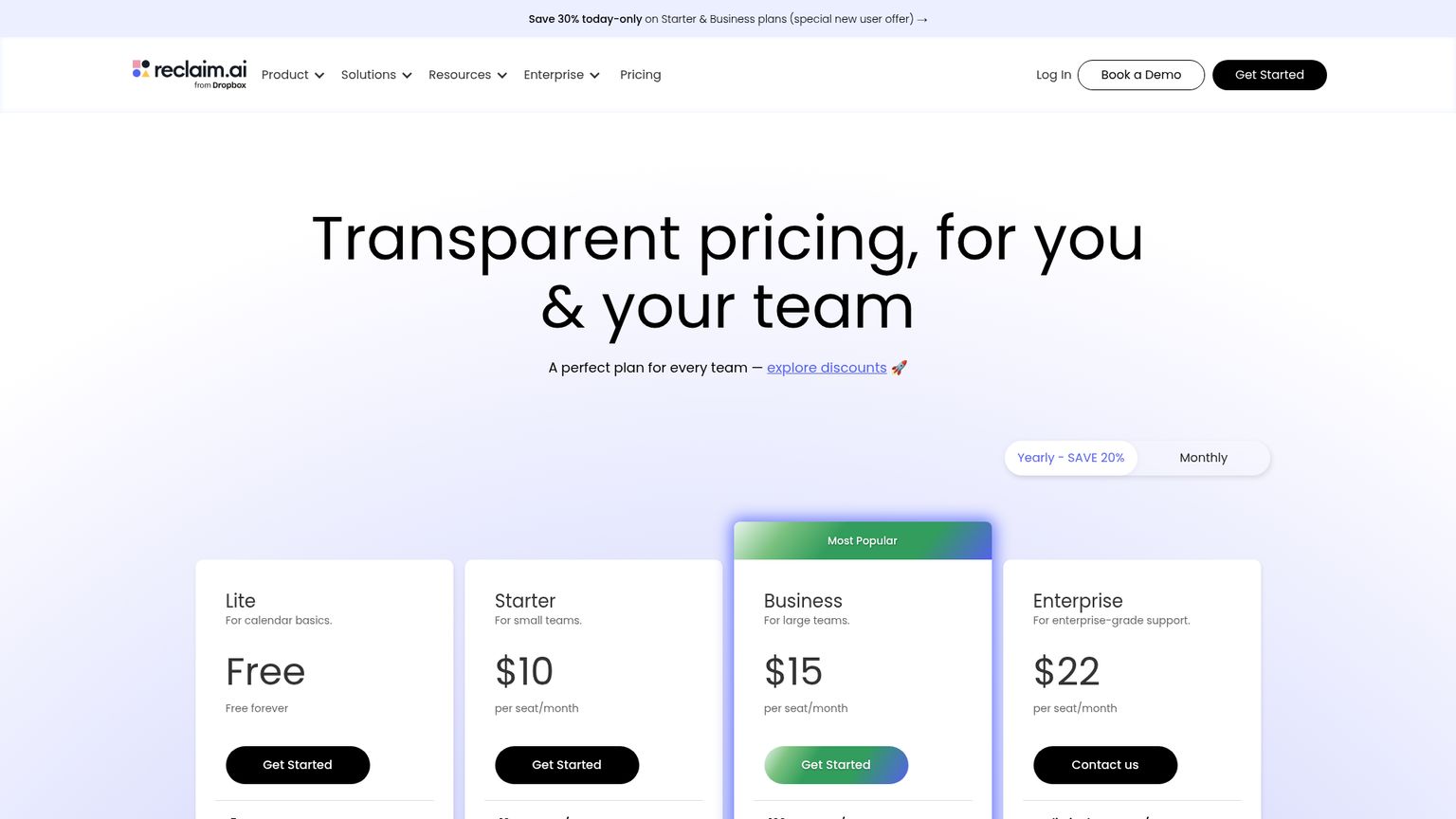
Best for: A founder or small team balancing external meetings with focused work.
Standout: Time-protection features and Scheduling Links in one product.
Pricing: Lite $0; Starter $10/seat/month annually or $12 monthly; Business $15/seat/month annually or $18 monthly; Enterprise $22/seat/month annually, with no monthly option listed.
Free trial: Fourteen days, plus an ongoing Lite tier. Reclaim pricing.
Lite includes one Scheduling Link and one Calendar Sync. Starter increases those allowances to three each and supports up to ten seats. Business has unlimited Scheduling Links and Calendar Syncs, supports up to 100 seats, and adds features including delegated access and webhooks. Enterprise is positioned above 100 seats. These current allowances are the useful buying boundaries, rather than a generic promise of AI scheduling.
A founder could use the product to keep room for writing proposals while still offering client calls. The evaluation should be practical: does it protect the work periods you value, and does the booking page still offer reasonable choices to a client? A calendar full of protected blocks is not useful if prospective customers cannot find a workable appointment.
For an external sales-routing project, start elsewhere. The published time-management features and team scheduling links are not, by themselves, evidence that an account-owner rule or territory assignment will work. Require a demonstration of that workflow before making Reclaim the replacement for a routed demo funnel.
There is also a reason to keep it off the shortlist: if one basic booking link is the entire requirement, you may be adding a calendar-optimization system you do not need. Cal.com Individuals, Google appointment schedules or an existing Microsoft license can be simpler decisions.
- Focus time, habits and buffers alongside booking links.
- A free tier for evaluating a single-link workflow.
- Higher tiers expand link capacity and administrative access.
- Lite has one Scheduling Link; Starter has three.
- Unlimited links require Business.
- A broader calendar-management product can be unnecessary for simple appointment booking.
10. HubSpot Meetings: best when the customer record already lives in HubSpot
HubSpot Meetings is the scheduling tool within HubSpot's CRM and sales software. It is a strong alternative when your representatives already work from HubSpot contacts and deals, because the appointment belongs beside the customer record. It is less compelling to adopt an entire CRM solely to avoid paying for a booking link. Choose it for an existing customer workflow, and verify the seats each participating host needs.
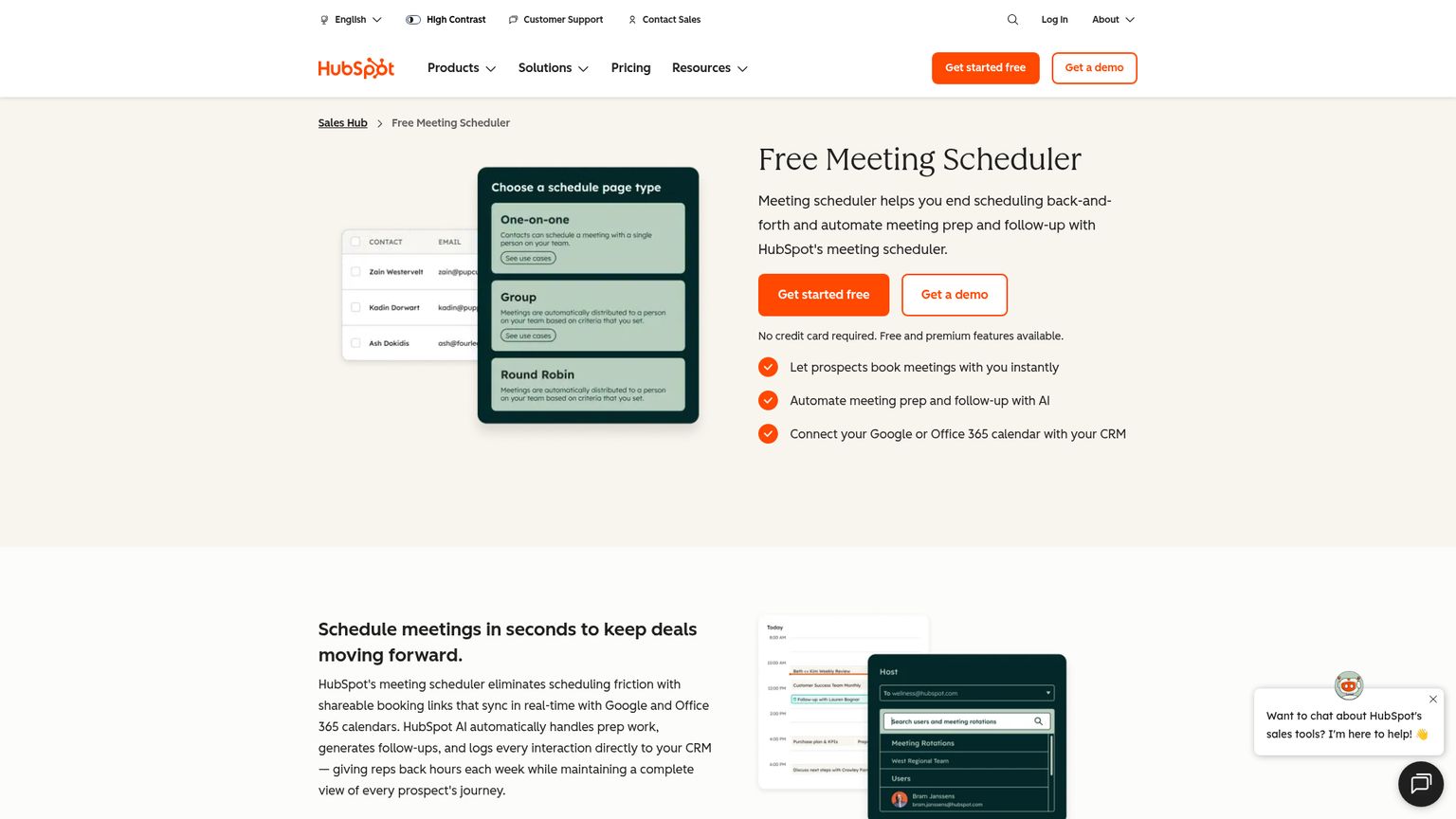
Best for: A sales team already using HubSpot, or a founder deliberately choosing HubSpot as the CRM.
Standout: Scheduling connected with contact records and existing sales processes.
Pricing: Free $0. The live Sales Hub page advertises Starter from $7/seat/month and also shows $20; the catalog lists Starter at $20/seat/month. Professional starts at $90/seat/month annually or $100 with monthly payments and an annual commitment, plus $1,500 onboarding. Enterprise starts at $150/seat/month annually, plus $3,500 onboarding.
Free trial: Free tools do not require a credit card; verify the terms of any paid evaluation. Sources: live pricing, list-price catalog.
Treat the advertised Starter entry as an offer to confirm, not a permanent renewal price. HubSpot's product packaging and seat types are part of the buying decision. A Core seat, a Sales seat and a Service seat should not be assumed to provide the same team-scheduling access.
The free meeting allowance is one personal link with HubSpot branding. The paid pricing matrix lists more personal and team links and brand removal from Starter. The operational documentation adds the important condition: group and round-robin scheduling require an eligible subscription, and users added to a team scheduling page need assigned Sales or Service seats. Scheduling-page requirements.
For existing contacts, HubSpot documents a “Prioritize contact owner” setting on round-robin pages. That is a useful starting point for a customer who should return to their representative. It is also different from sending every new inbound form through a sophisticated qualification process; the current Enterprise price card separately lists Lead Form Routing. Confirm which process you are buying instead of treating all “routing” as the same feature.
For a small sales team already licensed for the required seats, removing a separate scheduler can reduce both spend and the number of systems to administer. For a consultant who only needs an appointment page, moving customer data and learning a CRM is likely a larger project than the original scheduling problem.
- Booking connected with the HubSpot contact workflow.
- A free personal meeting link for a basic use case.
- Group, round-robin and contact-owner options for eligible paid users.
- Free access has one personal link and HubSpot branding.
- Team scheduling depends on subscription and assigned seat type.
- Higher Sales Hub tiers and onboarding are expensive purchases for scheduling alone.
- The advertised Starter offer should not be assumed to be the renewal price.
Free alternatives to Calendly: what survives the downgrade
Cal.com Individuals is the strongest free replacement here when one person needs several event types and connected calendars. Google appointment schedules is the simpler choice when one booking page inside Google Calendar is enough. TidyCal Free is useful for several booking types, but its single-calendar limit, missing automatic conference links and Stripe platform fee need to fit the workflow.
“Free” describes the subscription, not every surrounding cost. Microsoft Bookings is included with eligible paid subscriptions. Cal.diy has no software subscription but requires operation. HubSpot's free personal link does not grant the paid team's scheduling rights. Reclaim's Lite link is part of a broader calendar-management tool.
Calendly free alternatives for teams
Separate personal links do not create a shared team pool. If each consultant runs an independent practice, separate individual accounts may be enough. If clients must reach the next available qualified person, the team needs an actual distribution rule, shared availability and the right host entitlements.
For a Microsoft 365 business, inspect Bookings first because the needed subscription may already exist. For a HubSpot sales team, inspect its assigned seats. Otherwise, budget the team plan that supports the workflow. Calling several free accounts a team solution can leave a receptionist or founder doing the distribution manually.
Who should pick what
For a solo founder cutting the bill, start with Cal.com Individuals or the booking tool already included in the calendar suite. The rule that changes the choice is needing several event types, several connected calendars, or a paid feature such as brand removal.
For a consultant selling appointments, compare Acuity with TidyCal on the whole transaction. Acuity becomes more attractive when intake, multiple service calendars, memberships and packages are the business. TidyCal becomes more attractive when the required plan is inexpensive and its payment fees are acceptable. Stripe booking volume can move an existing lifetime user toward Pro.
For a small booking pool, compare Cal.com Teams with SavvyCal Basic before buying a larger sales platform. Cal.com's price includes routing forms and brand removal. SavvyCal Basic can be less expensive for a straightforward pool, but its Premium paywalls change the comparison when custom branding or payments matter.
For a sales team, start with the ownership rule and the current CRM. HubSpot deserves priority when the customer workflow and the required seats already exist there. Chili Piper deserves a demonstration when web-form qualification, CRM assignment and handoffs are valuable enough to justify its annual package. Calendar-link price is the wrong measure for that decision.
For source control, evaluate Cal.diy with its documented limits. For commercial self-hosting, talk to Cal.com about its on-premises offering. Do not plan a production team migration around the assumption that the community project contains hosted Teams.
Stay on Calendly if
Calendly is still the right purchase when it already completes the booking workflow and the proposed replacement creates more work than it removes. A functioning reminder sequence, connected CRM process and familiar administration can be worth more than a modest subscription saving.
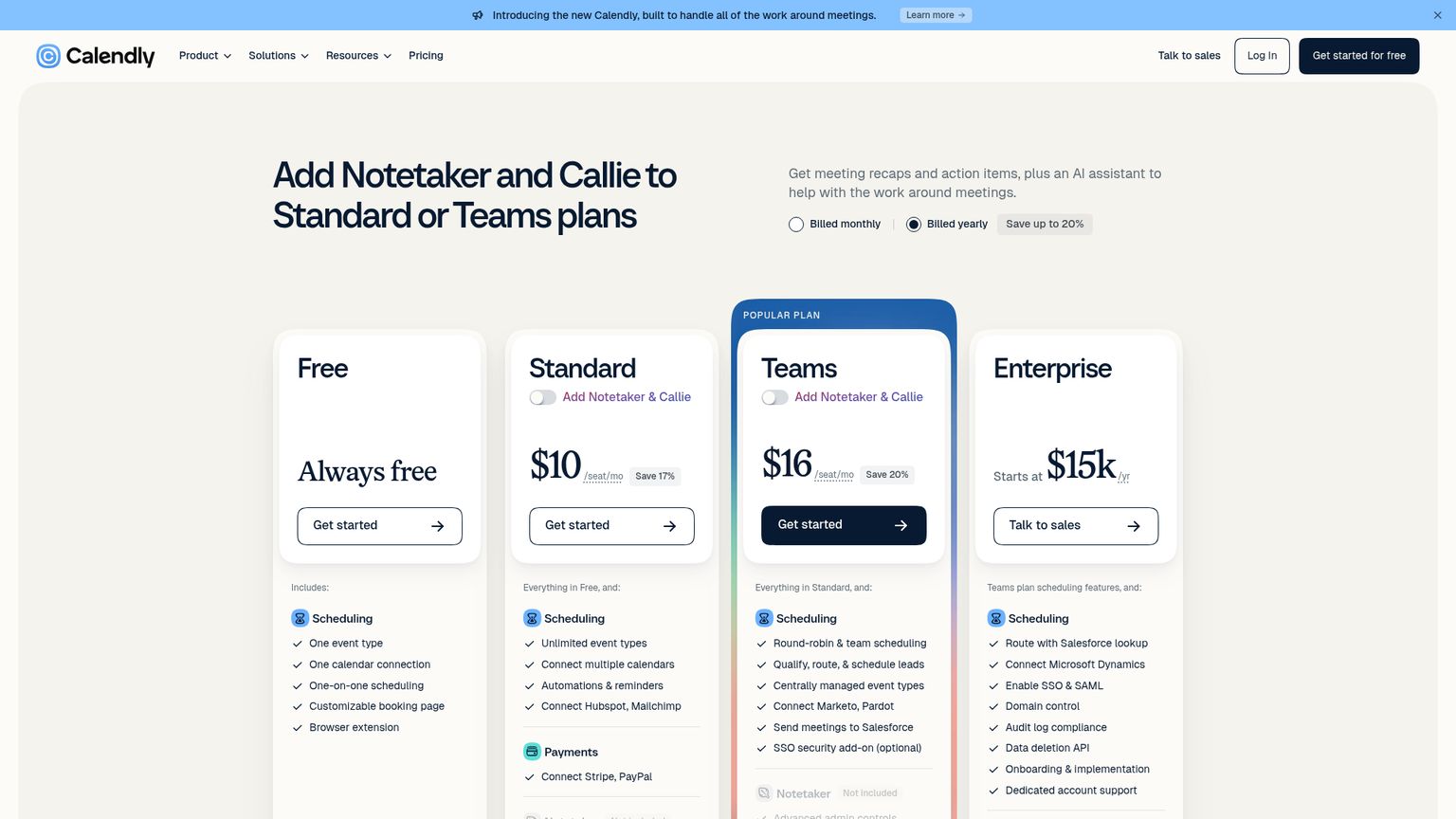
Calendly pricing: compare the plan you actually need
Calendly's own page lists Free at $0, Standard at $10/seat/month annually or $12 monthly, and Teams at $16/seat/month annually or $20 monthly. Enterprise starts at $15,000/year, with a 50-seat starting point. These figures come only from calendly.com.
Its optional Notetaker and Callie bundles are separate comparisons: Standard Plus is $18/seat/month annually or $24 monthly; Teams Plus is $24 annually or $32 monthly. The subscription examples in this article use the base scheduling plans, not those bundles. The same Calendly pricing page supplies the bundle prices.
Standard is the relevant baseline for a solo user needing unlimited event types, several calendars, reminders or payment connections. Teams adds round robin, lead qualification/routing and centrally managed events. Enterprise adds controls and integrations including Salesforce lookup routing and SSO/SAML. Staying makes sense when those particular capabilities are already part of a working process.
Brand removal alone is also not a reason to assume every alternative will be cheaper. Compare Calendly Standard against Cal.com Teams, SavvyCal Premium, TidyCal Pro or Acuity Premium, rather than their entry cards. Each product draws that boundary differently.
Is Calendly free enough for your work?
Yes, if one event type, one connected calendar and one-on-one scheduling cover the job. The free-plan limit is not automatically a reason to migrate. The is Calendly free guide covers the detailed boundary; the practical question here is whether another booking type or connection would solve a real problem.
Stay when the existing workflow is good, the saving is small and there is no capability you need to gain. Switch when you can name the missing job or show a meaningful ongoing cost reduction after migration.
The ones to avoid
Avoid Cal.diy as a drop-in production sales-team replacement. Its own documentation recommends personal, non-production use, and the missing team and routing layer is exactly what that buyer needs. That is a fit limitation, not a judgment against open source.
Avoid Chili Piper when the problem is a few expensive Calendly seats. Its routing package is a larger annual purchase, and standalone ChiliCal's seat minimum does not rescue the solo-user economics. Buy it only when the sales process supports the cost.
Avoid TidyCal Lifetime when the non-negotiable requirement is no vendor branding and your own domain. Those requirements point to Pro. Likewise, avoid treating its Stripe platform fee as zero just because the subscription was purchased once.
Avoid Microsoft Bookings for a workflow that must take payment during booking. Its documented lack of payment support leaves another step to build or administer. An included tool can still be the wrong tool.
Avoid paying for Reclaim or a higher HubSpot tier solely because the free booking link has a limit. First decide whether calendar management or the wider CRM capabilities are valuable to the business. If they are not, compare a dedicated scheduler's qualifying plan.
Move one booking flow before you cancel
Start with one appointment type and one place where customers find it. A small migration exposes the missing setting before it affects every prospect, client and existing booking.
Write down what a successful booking must do
Record the calendar checks, host-selection rule, intake questions, payment requirement, video location, reminders and destination customer record. Include the route for a returning customer and for someone who does not qualify.
Rebuild and check the exceptions
Create sample bookings from outside the account. Check another time zone, an already-busy period, a cancellation, a reschedule and an unavailable host. For paid appointments, verify the payment behavior and any platform fee before sending the link to customers.
Replace the links people can actually reach
Check the website, email signatures, automated messages and sales templates. Decide how existing appointments will be supported while new bookings move. An importer for event types is not proof that every integration, future booking or historical record has migrated.
Stop renewal after the replacement works
For a directly billed Calendly subscription, its cancellation guide directs an owner or admin to Billing, Change plan, Upgrade/Downgrade, then Free. The change takes effect at the end of the current billing cycle. Keep access long enough to handle existing meetings. Calendly cancellation instructions.
Frequently asked questions
Which is better, Zoom Scheduler or Calendly?
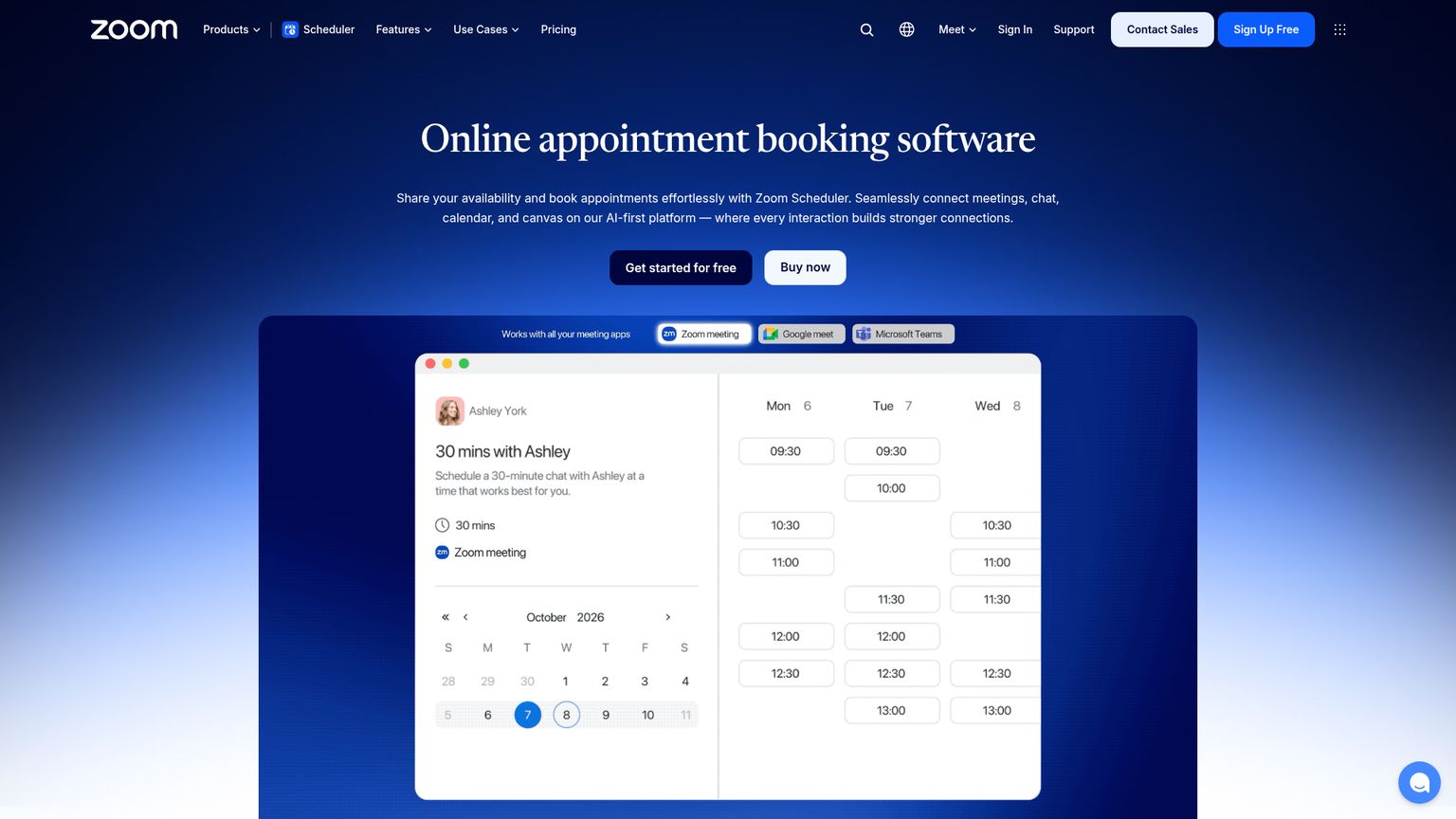
Zoom Scheduler is worth comparing if your workflow already centers on Zoom and you need straightforward appointment booking. Its own page lists $4.99/seat/month annually or $5.99 monthly, with group and round-robin scheduling and up to six connected calendars. Calendly is the stronger fit when its existing CRM routing, event administration and automations are the reason you pay. Compare those requirements, not the entry rate alone. Zoom Scheduler features and pricing, Calendly plans.
How do I cancel my Calendly subscription?
For a subscription billed directly by Calendly, an owner or admin can open Billing in the Admin Center, select Change plan, choose Upgrade/Downgrade, and select Free. Paid access continues until the current billing cycle ends. This is a plan cancellation, not account deletion. Calendly's cancellation guide.
Does Microsoft have a product like Calendly?
Yes. Microsoft Bookings schedules staff and service appointments using the Microsoft ecosystem. It is included with eligible subscriptions, including Microsoft 365 Business Basic, Standard and Premium. It is not a free standalone app, and Microsoft says it does not support payments. Microsoft Bookings FAQ.
What is the Google equivalent of Calendly?
Google Calendar appointment schedules. A personal account or Business Starter account can create one booking page. Additional schedules, reminders, payment collection and co-hosting have subscription-specific requirements. Google's appointment feature comparison.
Is there a better option than Calendly?
For specific needs, yes: Cal.com for generous free solo scheduling, Acuity for a service-appointment workflow, TidyCal for an inexpensive lifetime purchase, and an included Google or Microsoft tool when it already does the job. Calendly remains a good choice when its existing workflow is effective and the alternative's savings do not cover the work of switching.
What is the best free digital Calendar?
For the Google-based founder in this comparison, Google Calendar is a sensible starting point because it combines the existing calendar with a basic appointment page. A calendar stores your schedule; a booking service lets other people reserve available time. If the need is several public booking types rather than a new calendar, start with Cal.com Individuals.
What are the top 5 digital calendars?
There is no universal top-five ranking across personal calendars and appointment schedulers. For this business-booking decision, the useful five-product shortlist is Google Calendar appointment schedules, Microsoft Bookings, Cal.com, TidyCal and Acuity Scheduling. They cover an existing calendar suite, free solo booking, inexpensive lifetime access and paid service appointments. They are not five equivalent personal-calendar apps, and Acuity is paid; choose the underlying calendar separately from the appointment workflow.
Which is better for me, Calendly or Google Calendar?
Google Calendar appointment schedules is the better starting point when one booking page or your existing Workspace entitlement covers the requirement. Calendly is more appropriate when its dedicated booking workflows, team distribution or integrations are necessary. Price the required Google upgrade before assuming it will cost less.
What is the best free calendar app for 2026?
Google Calendar is the practical starting point here for someone who wants a calendar and one basic booking page. If you mean a free Calendly alternative with several event types and connected calendars, Cal.com Individuals is the stronger fit. The best choice depends on whether you are organizing your own time or letting customers book it.
Get the AI business workflow audit checklist to map the booking handoffs, software costs and manual work before choosing a replacement.
- Published
- Category
- Growth
- Language

Mailchimp Alternatives in 2026: Kit, beehiiv, ActiveCampaign and GetResponse Compared
Compare Mailchimp alternatives for newsletters, automation and ecommerce, with verified prices at 1,000 and 10,000 contacts and reasons to stay.Oct 11, 2026Growth
Zendesk Alternatives 2026: Tidio, Chatbase, CloudTalk and Helpdesks
Compare Zendesk alternatives by support model: Tidio, Chatbase, CloudTalk and leading helpdesks, with current prices, AI charges and switching advice.Oct 10, 2026Growth
Best CRM for Small Business in 2026: Pipedrive, Close, folk, Keap and More (Compared)
Compare nine small-business CRMs by how you sell, verified prices for five users, free-plan limits, setup effort and the upgrades that matter.Oct 10, 2026Growth
Later Pricing: Plans, Add-Ons and the Five-Client Bill
Later plans, social sets, users and add-ons priced for a solo brand and five-client agency. Compare annual and monthly bills with three alternatives.Oct 10, 2026Growth
Apollo Alternatives in 2026: Lusha, FullEnrich and Amplemarket Compared
Compare Apollo alternatives for contact data, sequencing or both, with current prices, credit costs and reasons to stay on Apollo.Oct 10, 2026Growth
9 Semrush Alternatives in 2026: SE Ranking, Ahrefs and DataForSEO
Compare nine Semrush alternatives by job, price and limits, including SE Ranking and DataForSEO. Know what you save and what you give up.Oct 10, 2026Growth
WhatConverts Pricing: Plans, Usage and Agency Bills
WhatConverts plans, usage credits and fees explained, with bills for one business and 20 clients, plus a fair CallRail cost comparison.Oct 10, 2026Growth