Claude Design Is Now Free: Pricing and Business Uses
Claude Design is included on Free. See current plan prices, shared usage limits, exports, setup steps and where prototypes need engineering.
Published
 By Omid Saffari
Yes, Claude Design is free on Claude's $0 Free plan, subject to that plan's usage limits. Anthropic lists it on every Claude plan, verified against its live pricing page on 10 October 2026. Start with a prototype, slide deck or sales one-pager; pay for more capacity or specific paid features when your work requires them.
What changed on 8 October 2026
Claude Design left beta and became available on every plan, including Free. Anthropic announced the change alongside Claude Docs and Claude Slides in its 8 October release. For a founder considering a subscription just to explore an idea visually, the entry price is now $0.
The move into ordinary Claude conversations happened earlier, on 16 September. The October change makes that integrated experience a generally available starting point. You can develop the argument in chat, turn it into a visual, then revise the result without rebuilding the brief elsewhere.
Two distinctions matter before you reorganize work around it. Included does not mean unlimited: Design uses your Claude allowance. And Design access is different from the design-system feature, which Anthropic's separate setup guide still lists as a paid-plan beta. A design system is the reusable collection of colors, fonts, components and layout rules behind a brand or product. Free access does not establish that every surrounding capability is free.
Claude AI Design: what you can make
Claude Design turns a written brief and reference material into visual work you can refine. It is Anthropic's design workspace inside Claude, with a conversation beside an editable canvas. The result becomes an artifact: a saved piece of work you can revisit and share. Anthropic's product page positions it around tasks such as turning a proposal into a one-pager or a rough product idea into a clickable flow.
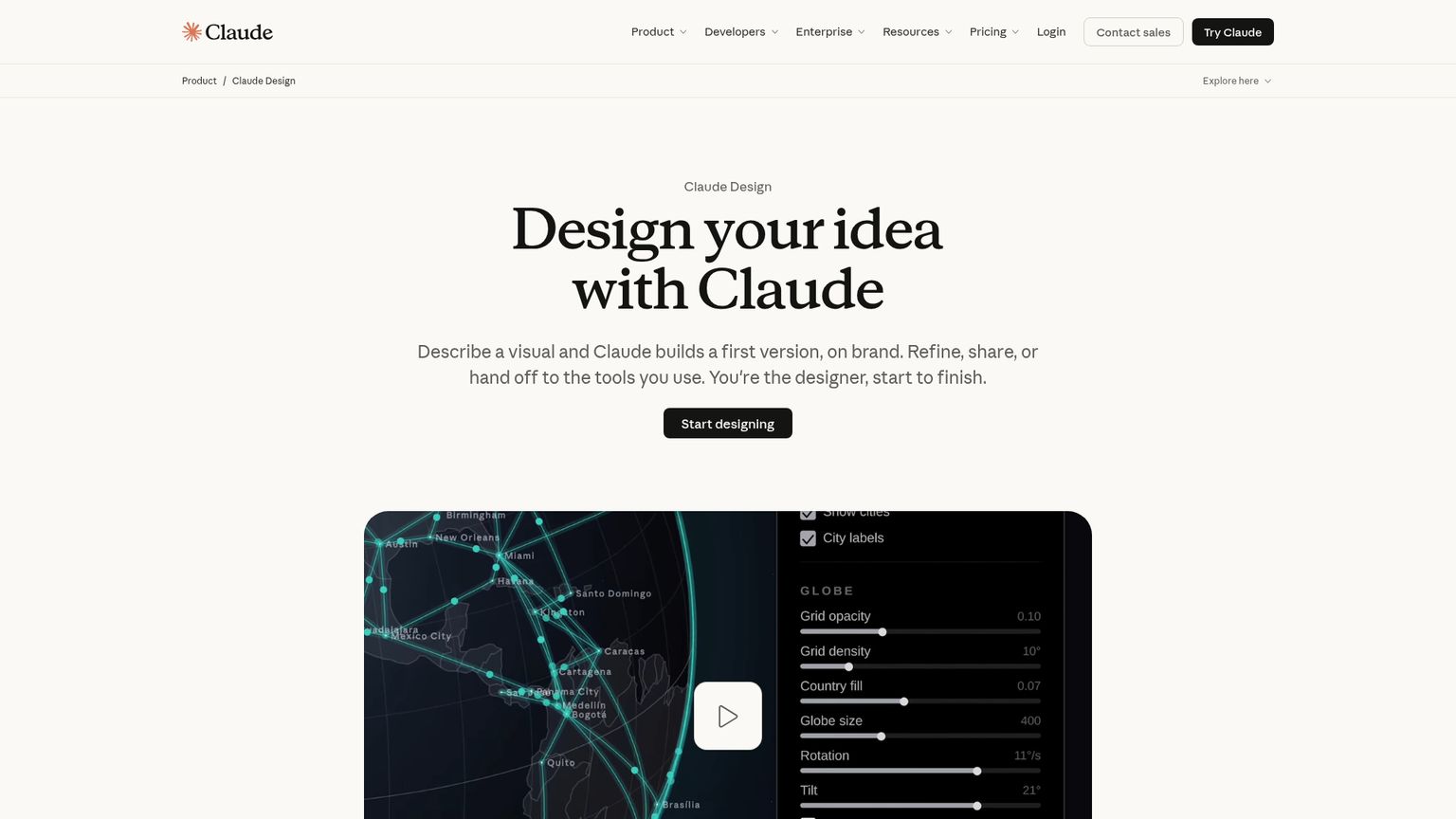
Its useful business role is making an idea concrete enough to inspect. A founder can show an onboarding concept to a customer. A marketer can see whether a sales message fits on a page. An operator can make a confusing approval process visible before requesting development time.
Judge it on three criteria: whether the draft communicates the intended decision, how much correction it needs, and whether the export fits the next person's work. An attractive first image answers only part of that test.
Is Claude Design free? Plans and prices
Yes. You do not need Pro simply to start using Claude Design. These are the US dollar prices shown on claude.com/pricing, checked on 10 October 2026, before applicable tax.
Team Premium and Enterprise also include Design. Enterprise's billing combines a seat price with usage, so evaluate the organization's agreement rather than treating it as an unlimited design subscription.
For an existing subscriber, the additional Design subscription cost is $0. The tradeoff is capacity consumed from an allowance you may already use for other work. For someone who would otherwise buy monthly Pro solely to try Design, starting on Free avoids that $20 monthly purchase.
What annual billing saves
Pro's displayed $17 annual rate is rounded. The actual annual bill listed is $200, versus $20 × 12 = $240 on monthly billing, a $40 yearly saving. Multiplying the rounded $17 by 12 would give the wrong invoice total.
For a hypothetical business keeping 10 Team Standard seats throughout the year, monthly billing costs 10 × $25 = $250 a month, or $3,000 a year. Annual billing is equivalent to $200 a month, or $2,400 a year. That is $600 less per year, before taxes or additional usage. These are calculations from the published subscription rates, not a forecast of design output.
Start monthly if the workflow is unproven. An annual discount is useful after the work earns its place. The broader Claude Free and paid-plan guide covers subscription choices beyond this Design-specific update.
How usage counts against your Claude plan
A design session draws from the same allowance as your other Claude work, including Claude Code. There is no separate Design quota to preserve or spend first. More complex projects, larger codebases and repeated revisions consume more usage. At the limit, Design stops until reset, unless eligible paid usage credits are enabled. Anthropic's Design usage guidance explicitly replaces the old separate weekly allowance with shared limits.
The general limits guide describes five-hour session resets and weekly limits for paid plans. Those are time windows, not promises of a certain number of slides, designs or generations. The pricing page does not offer usage credits on Free.
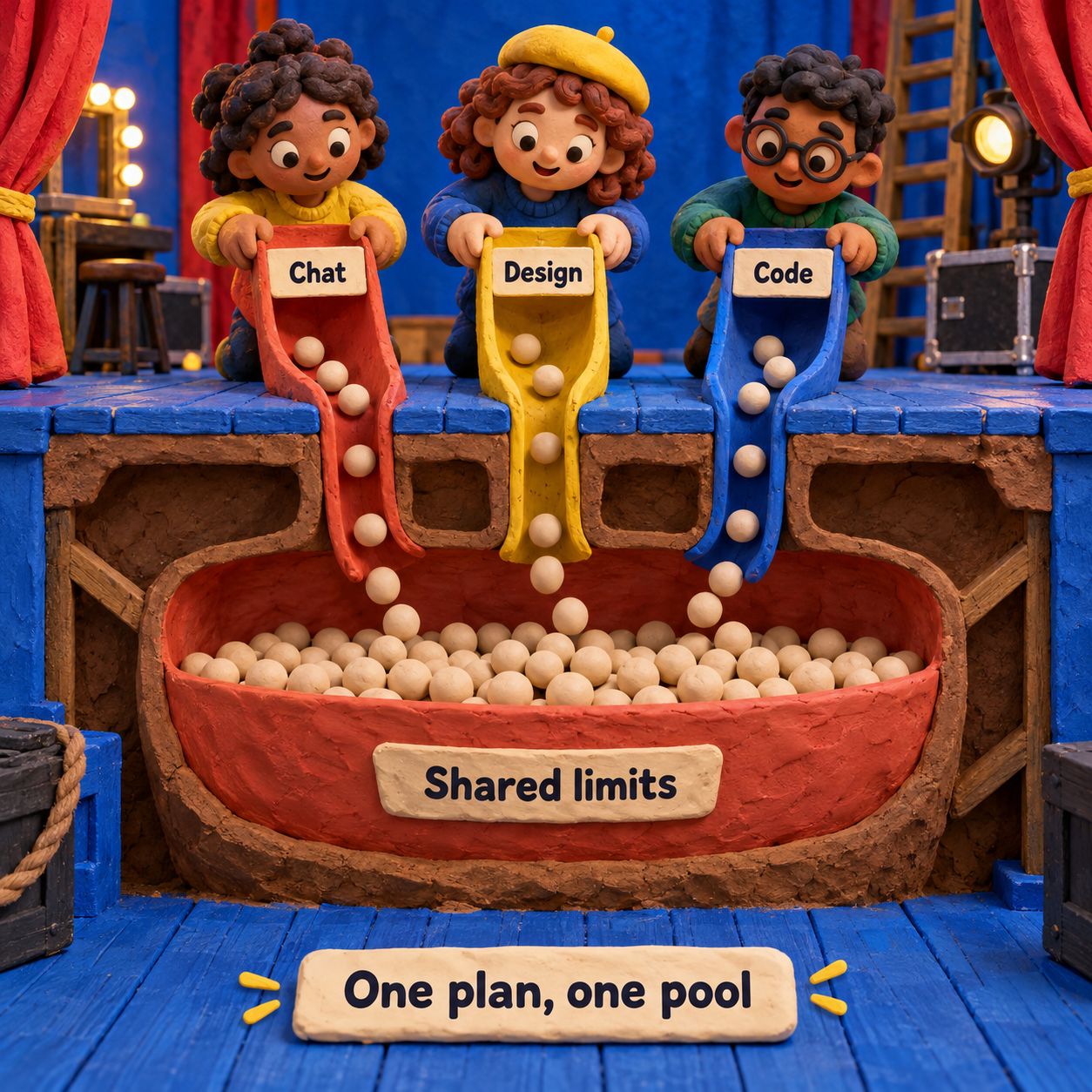
For an operator, the consequence is scheduling: extensive visual iteration can leave less capacity for the analysis or coding planned afterward. Keep a short record of completed deliverables, interruptions and correction time during your evaluation. Do not convert a subscription price into a guessed generation allowance.
An upgrade needs a measurable reason. Moving from monthly Pro at $20 to starting Max at $100 adds $80 a month. If you value recovered working time at an assumed $60 an hour, the upgrade must recover 80 minutes a month to cover that difference. This is a decision threshold, not a claim that Max saves that time or completes a guaranteed workload.
Claude Design examples for business work
Use it where a visible draft resolves uncertainty before expensive execution. These are proposed business workflows, grounded in Anthropic's documented output types, rather than results from a hands-on test.
Builders and founders: show the interaction before commissioning it
A founder evaluating a customer onboarding flow needs to learn whether people understand the sequence. A clickable prototype can expose an unclear choice or unnecessary step while changes are still cheap. Give the brief the actual user, the task and the information available at each stage.
The acceptance question is whether the person can explain what happens next. If the conversation turns to accounts, billing, permissions or stored data, the work has reached the implementation stage. Bring an engineer into that review; a convincing walkthrough does not prove those systems exist.
Marketers: turn approved content into a usable sales asset
A marketer can start with a proposal and ask for a one-pager that a prospect can forward internally. Anthropic uses this proposal-to-one-pager task as a product example. Supply the approved claims, evidence, offer and next action before asking for polish.
The valuable change is information hierarchy: the order and prominence of the message. A page that puts the buyer's problem and supporting evidence ahead of the company biography can be more useful without adding any content. For a pitch deck, use the Slides template and inspect the exported presentation in the destination where it will be delivered.
Operators: make the disputed process visible
An operations lead could mock up an intake or approval screen so colleagues can discuss missing fields, exceptions and ownership. Ask reviewers to walk through an ordinary request and a request that should be rejected. The prototype earns its place if it turns vague feedback into specific requirements.
Keep sample data clearly separate from live operational records. Deciding what the screen should communicate and connecting it to a working system are different jobs with different owners.
Buyers and brand owners: measure correction effort
A buyer choosing tools should evaluate a recurring deliverable, such as a partner brief, rather than a spectacular demo. Record what had to be corrected: facts, spacing, brand choices, export formatting or interaction states. If fixing the draft takes longer than adapting an existing approved template, keep that template. Free access removes the subscription barrier to this comparison; it does not remove review labor.
How to use Claude Design on a real brief
Start inside Claude with content and a definition of done. Anthropic documents Output > Design in the message box, or a Design template in the Artifacts tab. You can also ask for a design directly in a conversation. Artifacts require Cloud code execution and file creation to be enabled in personal or organization capabilities settings. The artifacts guide explains those entry points and prerequisites.
Here is a reproducible recipe using the proposal-to-one-pager example. The prompts below are suggested instructions, not a claim that these drafts were generated for this article.
Choose a deliverable and its reader
Open a chat, choose Output > Design, and attach an approved proposal plus a representative brand asset. Name the reader and the decision: a prospective customer deciding whether to book a discovery call. For a presentation, choose Slides instead.
Give Claude a bounded brief
Try: “Create a sales one-pager for the buyer described in this proposal. Use only the attached offer, facts and proof. Lead with the buyer's problem, then the outcome, evidence, scope and next action. Keep it readable as a PDF and on a laptop. Flag missing information instead of inventing it.”
Review the first pass against the same brief
Check whether the buyer's problem is visible first, whether the evidence supports the claim, and whether the next action is obvious. Look for crowded paragraphs, tiny footnotes, stretched logos and decorative elements that push the useful content down. These are review criteria, not asserted defects in every generated draft.
Revise the specific failure
If the draft leads with a large company logo and buries the offer, ask: “Keep the approved copy and brand colors. Move the buyer outcome above the company description, place its evidence beside it, shorten the introduction without adding claims, and give the next action its own clear area.” Use a comment for a local correction and chat for a structural change.
Check the exported result
Export a PDF, then open that file and inspect page breaks, clipped content, links, logo proportions and readability. Approve the file the prospect will receive. For a prototype, walk through the intended interactions and hand the reviewed direction to the person responsible for implementation.
The before-to-after goal is specific: a company-centered layout becomes a buyer-centered argument while the approved facts stay fixed. That gives you something more useful to judge than “make it modern.”
For repeat work, establish a small review sheet: approved wording, intended audience, brand references, destination format and the person who signs off. Reuse that sheet across briefs. It helps reveal whether the tool is reducing work or simply moving it into revisions.
What Claude Design exports
Choose the export around the next task. Anthropic's current export documentation lists these options:
- PDF: a portable document for review or distribution.
- PPTX and Google Slides: presentation handoff; check the destination file before presenting.
- Standalone HTML: a browser-based deliverable that still needs review of its behavior.
- ZIP: a downloadable package of project files.
- Claude Code handoff: send to a local coding agent or Claude Code Web.
Its listed app destinations are Adobe Experience Manager, Adobe for Creativity, Adobe Journey Optimizer, Base44, Canva, Gamma, HubSpot, Hyperframes, Lovable, Miro, Netlify, Replit, v0, Vercel and Wix. Treat that list as supported destinations, not a promise that every recipient reproduces every editing feature or is included free with Claude.
Claude Code is Anthropic's coding agent. The supported /design and /design-sync commands connect design work and an existing codebase or design system. Free Design access does not include a Claude Code subscription: Anthropic's pricing matrix puts Code on paid plans.
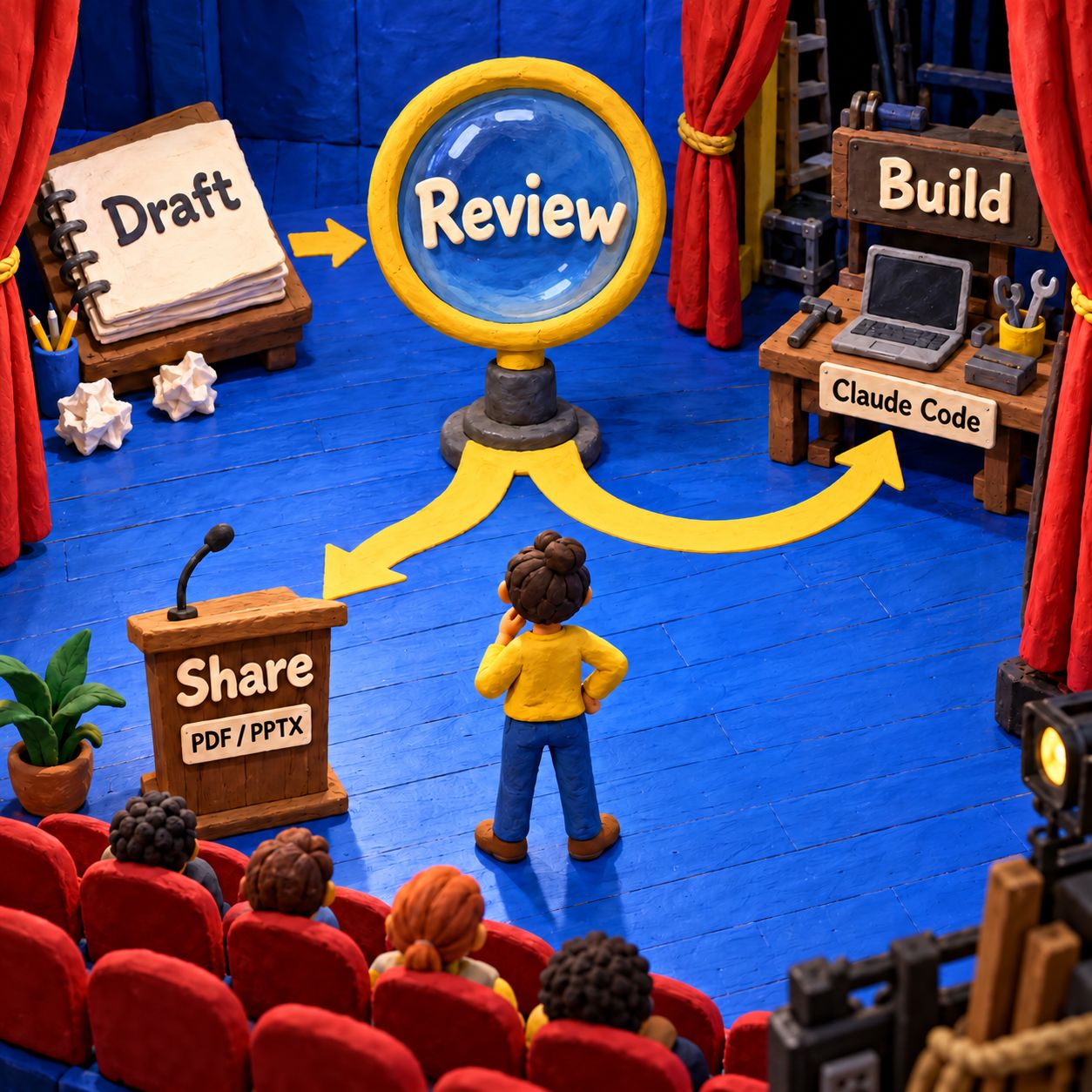
For a sales sheet, export may be the finish line. For an app, export is a handoff. Give the developer the selected direction, required states, content, component references and unresolved decisions, rather than only the attractive opening screen.
What's overhyped, and where Claude Design stops
The strongest use case is an editable draft with a clear review path. General availability removes the beta label from Design; it does not certify a business claim, guarantee brand quality or validate application behavior.
Production code still needs an implementation owner
Claude Design can work with code and hand work to development tools. The boundary is responsibility: someone still has to verify authentication, data access, error handling, accessibility, analytics and deployment. A prototype that shows a successful payment has not demonstrated a safe payment integration.
If the deliverable must become maintained software, involve that owner before polishing every screen. The Claude Design vs v0 comparison examines that workflow choice. Its earlier access details predate this release; use the prices and entitlements verified above for the current Design decision.
Design systems remain a separate paid feature
Anthropic's design-system setup guide still lists design systems in beta on Pro, Max, Team and Enterprise. They capture reusable brand and component rules from supplied material. That is a narrower entitlement than free access to the Design canvas.
For a marketer making an occasional asset, reference material and careful review may be enough. For a brand owner coordinating repeated work, the quality and maintenance of the source system become central. Have a designer validate the imported rules before making them the organizational default. Incomplete brand files cannot resolve contradictory brand decisions.
Claude Design vs Figma: preserve your source of truth
Do not replace an established Figma workflow solely because another canvas is now free. Decide where the approved design, reusable components and changes will be maintained. If that remains Figma, use Claude Design for a defined exploration task and budget for returning the result to the maintained file.
There are concrete reasons to keep that boundary. Anthropic's current limitations list says Design has no version history yet, simultaneous editing can be unreliable, and design-system imports depend on the quality of their sources. Those are material constraints when several people maintain an approved product, even if a solo prototype is straightforward.
Claude Design to Figma: check the handoff before starting
The checked official export list does not name a native Figma file export. Do not promise an editable Figma handoff merely because you can download HTML or a PDF. If a client requires that deliverable, establish and verify the conversion or rebuilding process before committing to the workflow.
Moving from the standalone Claude Design site
The standalone site at claude.ai/design closes on 14 December 2026. Anthropic states that date in its migration guide, checked on 10 October. It is a closure deadline, not a claim that every project can already migrate automatically.
Move design systems now from Artifacts > Migrate team design systems. One migration covers the organization's systems; check the results for failures. Projects remain in the standalone experience, with more project-migration details still to come. Save needed chats and comments separately: those do not carry over, and public links to standalone projects stop working after closure.
For a downloadable backup, open each standalone project and use Share > Project HTML > Project archive > Export. For a slide deck, Project HTML sits under More formats and apps. Anthropic says these individual archive downloads are free and do not consume usage limits.
Enterprise buyers should also check rollout settings. Design turns on by default on 15 October 2026, with earlier activation available to owners; Anthropic's product FAQ excludes HIPAA-enabled organizations from that default rollout. The separate design-system setting still needs its own attention.
Who should act now, wait or keep their workflow
Act now if a visual draft would resolve a decision already on your calendar. Founders can try a customer-facing flow; marketers can try an approved sales one-pager; operators can try an internal process mockup. Use the current plan first and measure correction effort alongside the result.
Wait on replacing a design workflow if you require dependable simultaneous editing, recoverable design history or a native Figma deliverable. Keep the existing implementation workflow when the direction is settled and the remaining work is engineering. Free access does not change who owns that work.
Your Monday move: select one real brief, agree on the acceptance criteria, produce and revise the draft, and open the actual export with its next reviewer. Record whether it improved the decision, how much correction it required and whether shared limits interrupted other work. Buy more capacity only when that record supports it.
For practical guides to choosing and using AI at work, join the newsletter.
- Published
- Category
- Design
- Language

Beautiful AI Review
Beautiful.ai review: Smart Slide guardrails, current pricing, Team seat ambiguity, AI features, export limits and when Gamma is the better fit.Oct 10, 2026Design
Nano Banana 2.1 Explained: Pricing, Changes, and When to Switch
Nano Banana 2.1 cuts 1K and 2K image costs about in half. Compare monthly budgets, verify the migration, and decide when Pro earns its premium.Oct 8, 2026Design
ElevenLabs Alternatives: Murf, MAI-Voice-2, OpenAI TTS and Cartesia (Verified October 2026)
Compare ElevenLabs, Murf, MAI-Voice-2, OpenAI, Cartesia, Google and Speechify by studio or API job, with verified prices and switching costs.Oct 4, 2026Design
Higgsfield API Pricing
Price Higgsfield API video and image jobs, separate API dollars from app credits, and check top-ups, expiry and cashback before scaling.Sep 27, 2026Design
Is Gemini Live Avatar Free
Check Gemini Live Avatar access, Enterprise API charges and custom-avatar limits before budgeting a customer-facing video agent.Sep 27, 2026Design
Gemini 3.8 Flash TTS Pricing
Price Gemini 3.8 Flash TTS by audio minute, compare Flash-Lite and service tiers, and budget the January 2027 increase.Sep 24, 2026Design
ngram vs Demosmith
Compare ngram and Demosmith for product videos, browser capture, revisions and usable exports, with costs matched to the same job.Sep 19, 2026Design