Claude Haiku vs Sonnet
Haiku 5.5 vs Sonnet 5.5 for ticket classification, long summaries and coding subagents, with current API rates and three monthly budgets.
Published
 By Omid Saffari

Claude Haiku vs Sonnet is a job decision: use Claude Haiku 5.5, Anthropic's small model, for bounded classification and extraction; keep Claude Sonnet 5.5, its larger general-purpose model, for the coding lead and decisions that need broader judgment. In the stated ticket-classifier workload, the monthly token bill is $16 on Haiku or $320 on Sonnet. Above 100,000 prompt tokens, Haiku's price advantage narrows from 20 times to four.
Prices and specifications verified on 8 October 2026 against Anthropic's pricing documentation, models overview and claude.com/pricing. The budgets are calculated scenarios with stated token assumptions, not performance tests. Prices are USD.
Claude Haiku vs Sonnet: Which Should You Pick?
Pick Haiku for a narrow answer you can check; pick Sonnet for the lead that must interpret, coordinate and recover. The decision turns on accepted results, prompt length, reusable context and the cost of fixing a mistake.
- A founder routing support tickets: start with Haiku. A fixed queue label is inexpensive to generate and straightforward to score against labeled examples. Escalate unresolved cases instead of giving every ticket the larger-model bill.
- A mid-market CTO summarizing long documents: Haiku wins the token budget for faithful extraction and constrained summaries, provided it preserves the facts your users need. Make Sonnet the next candidate when the job requires reconciling conflicting passages or explaining consequences. Both models can accommodate long inputs; capacity alone no longer settles the choice.
- A solo builder or engineering lead running a coding agent: keep Sonnet in charge of the overall change. Assign Haiku small jobs such as finding relevant files, extracting failure messages or summarizing a bounded diff. The saving belongs to the workers, while the lead still reviews their evidence.
For a senior operator, the final question is whether the cheaper route increases correction work. Saving a fraction of a cent on a ticket is useful at volume. Creating another human handoff can consume that saving immediately.
The API comparison below uses Claude Haiku 5.5 and Claude Sonnet 5.5. MTok means one million tokens, the pieces of text a model processes. Input is material you send; output is material it generates.
Sources: current rate card and model specifications. Cache writes are additional billed input categories, explained below.
Haiku vs Sonnet Cost: The Rates Behind the Bill
Haiku wins the fresh-token price comparison at both prompt tiers. Sonnet needs to earn its higher bill through an accepted result, less correction or a better overall workflow.
Normalized to 1,000 fresh tokens, Haiku costs $0.00010 input and $0.00050 output at the short tier, or $0.00050 input and $0.00250 output at the long tier. Sonnet costs $0.002 input and $0.010 output. These are the published per-MTok rates divided by 1,000, not the price of a completed task.
The distinction matters because output can dominate a bill. A classifier that returns a label and an agent that writes a long explanation do not share the same token shape. Similarly, a coding session's history and tool results can make later requests larger than the original instruction.
The chart prices the three jobs worked through below. Each pair holds the assumed token counts constant. The coding pair retains a Sonnet lead in both workflows, so its lower bar is a hybrid rather than an all-Haiku agent.
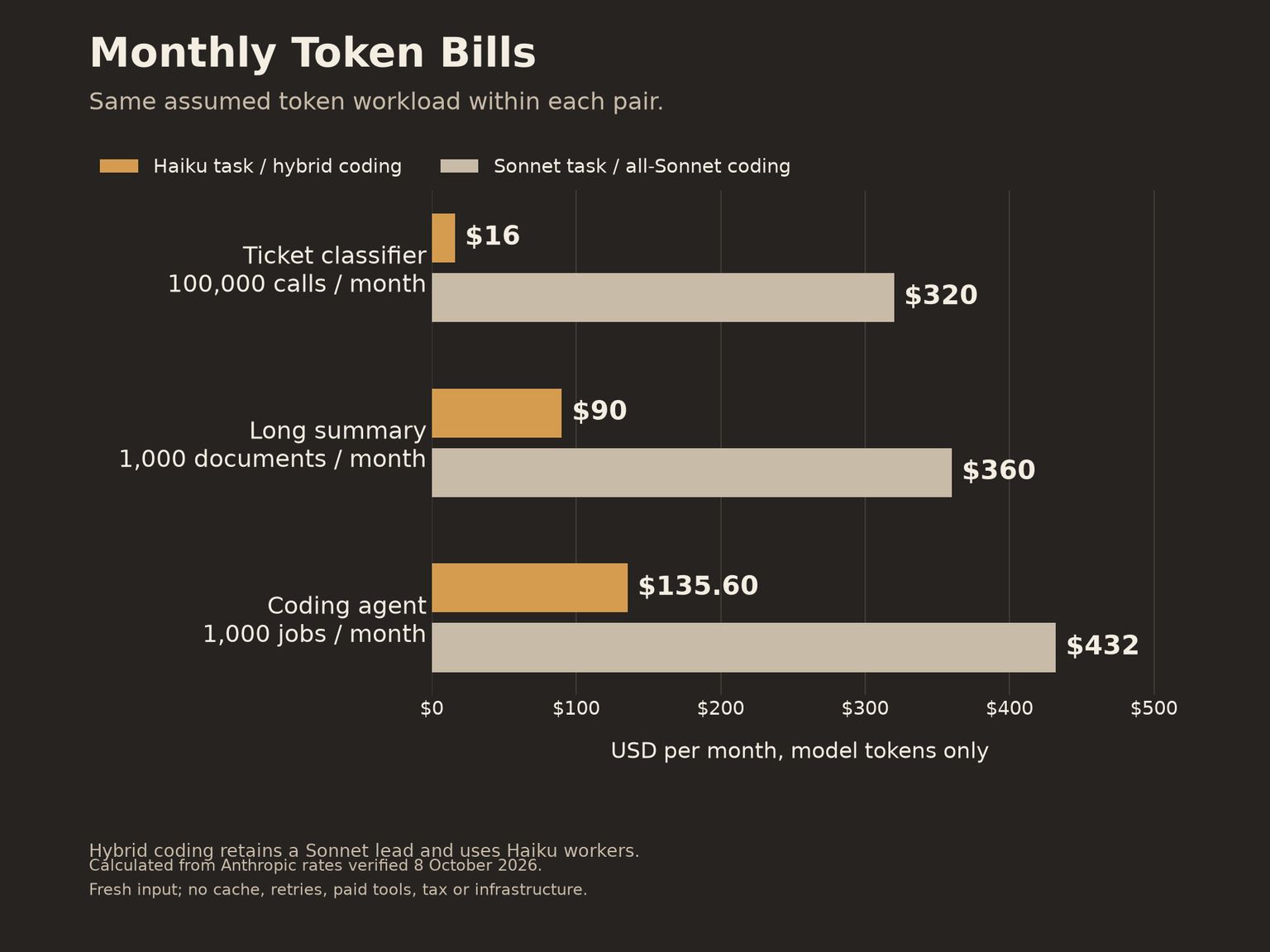
All three baselines assume standard first-party API pricing, fresh input and no retries or separately charged server tools. They exclude tax and application infrastructure. Output counts mean total billed output assumed in the budget, rather than a count inferred from the short answer your user sees. Replace these assumptions with each model's actual usage before setting a production budget.
For the wider model lineup and other billing meters, use the Claude API pricing guide.
Capacity and Thinking: Same Limits, Different Defaults
Capacity is a tie; Haiku wins Anthropic's relative speed label; the reasoning default differs. Neither model's specification proves that it will preserve the right detail in your documents or complete your repository change.
What Claude Haiku 5.5 Is For
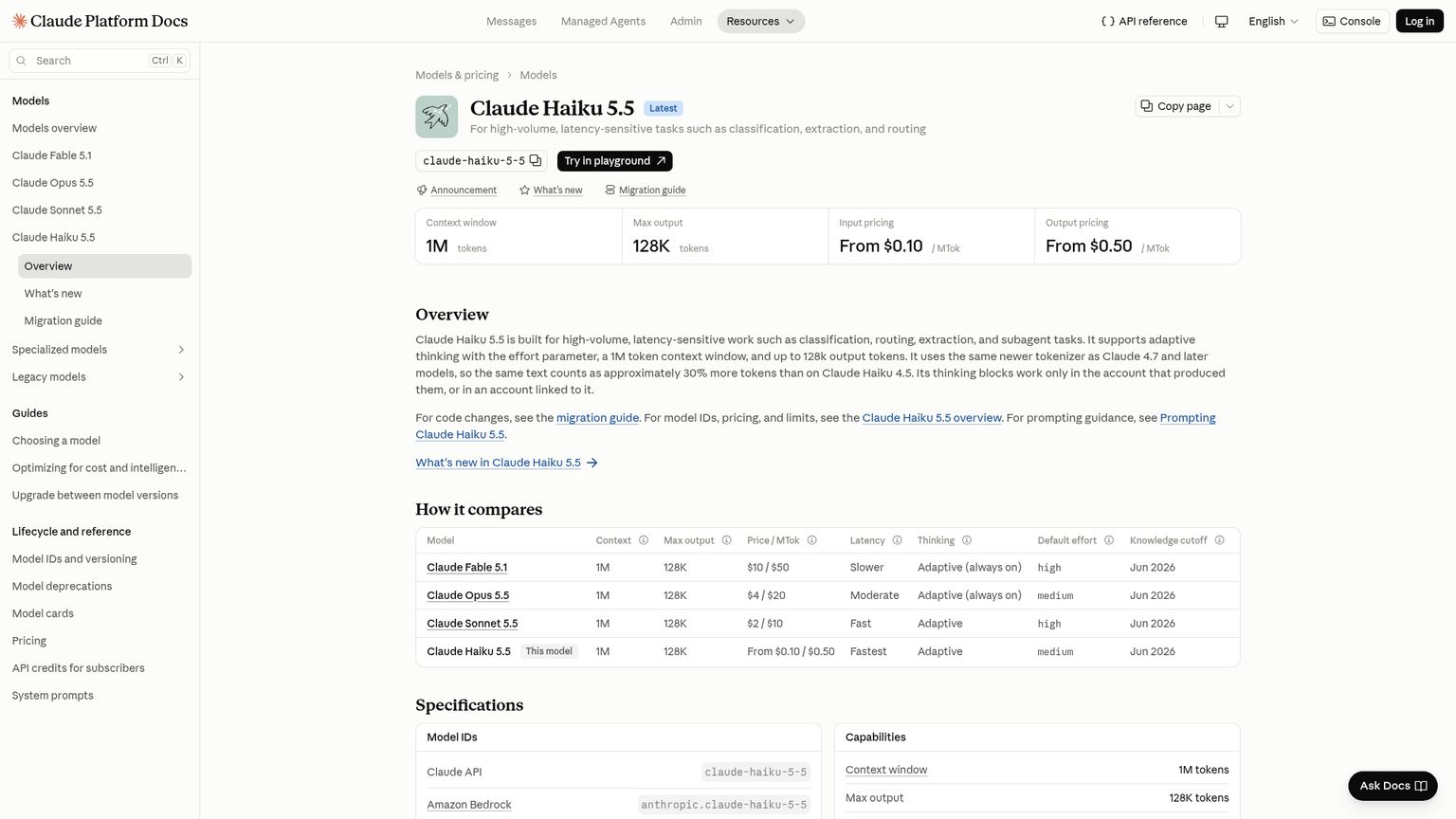
Claude Haiku 5.5 is the small-model candidate for frequent, tightly specified work. Anthropic describes its job as "For high-volume, latency-sensitive tasks such as classification, extraction, and routing." Its short-prompt rates are $0.10 input / $0.50 output per MTok, rising to $0.50 / $2.50 for longer prompts. Official positioning, rates.
Choose it for a support classifier with a fixed set of destinations, an extractor that returns named fields with supporting passages, or a worker that gathers evidence for another model. The practical wall is the acceptance check: a valid-looking answer sent to the wrong queue is still wrong. Skip Haiku for a job whose evaluation already shows that its mistakes require more correction than its price saves.
The Claude Haiku 5.5 guide covers the model-specific adoption decision. This comparison prices Haiku against Sonnet on the same jobs.
What Claude Sonnet 5.5 Is For
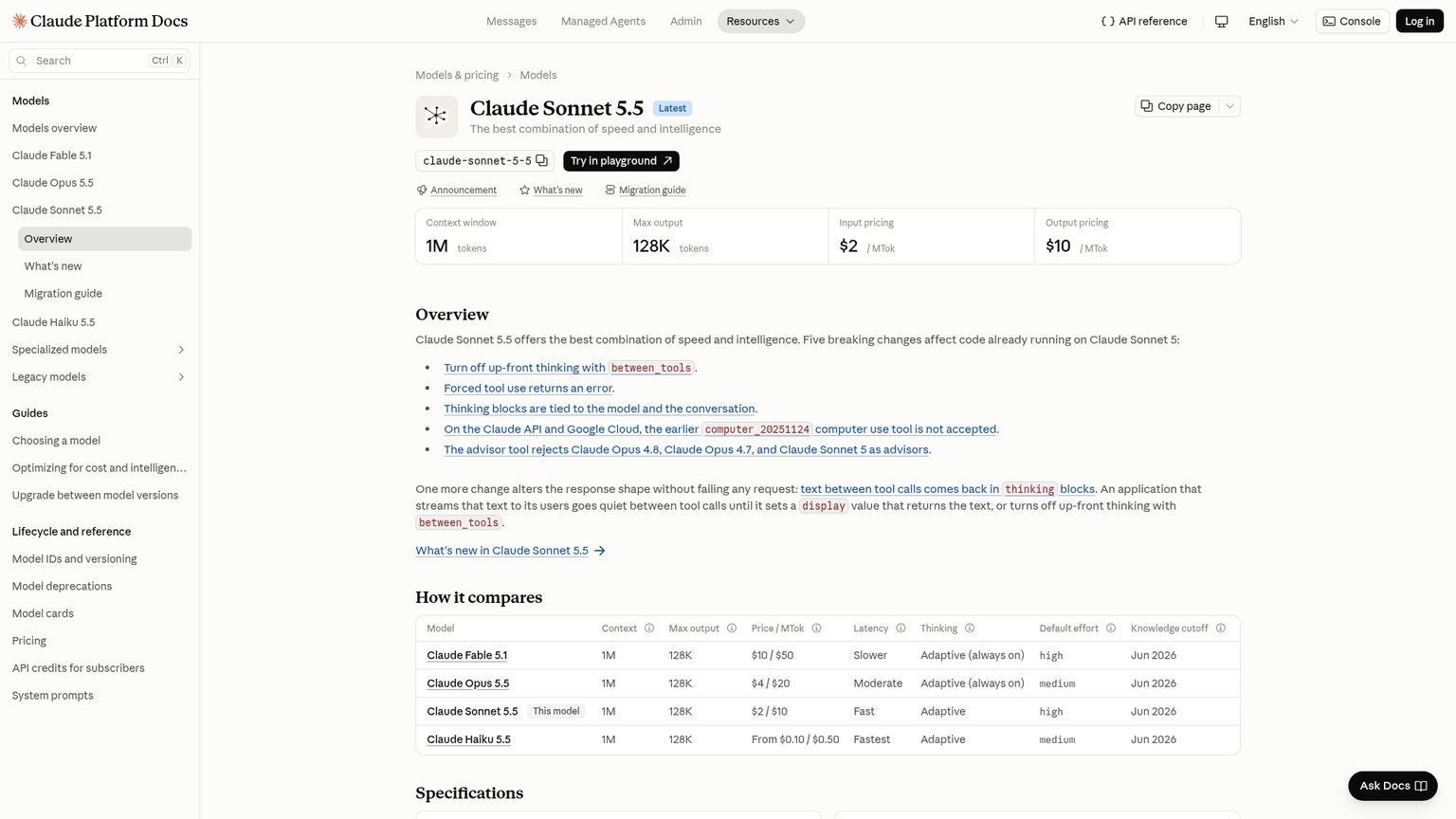
Claude Sonnet 5.5 is the general-purpose candidate for work that combines speed with broader judgment. Anthropic describes it as "The best combination of speed and intelligence." It costs $2 input / $10 output per MTok, with $0.10 cache hits for eligible reused input. Official positioning, rates.
For a coding lead, the job includes deciding what to change, integrating evidence and handling a failed step. That is a sensible place to evaluate Sonnet first in this two-model shortlist. Its candid disadvantage is the bill: using it for every easily checked label buys the higher rate whether that extra capability helps or not. Keep it where accepted outcomes justify the premium.
What the Shared Limits Do, and Do Not, Buy
Both models have 1M context, 128K maximum output and adaptive thinking. Context is the working space available for a request; maximum output caps generation. Adaptive thinking lets the model adjust its reasoning. Haiku's default API effort is medium, while Sonnet's is high. Both support image input and tool use. Models overview.
For a CTO evaluating a large policy collection, the common context limit removes a capacity difference. It does not remove the need to check omissions, contradictions and source support. The higher default effort also means that comparing model names without recording settings and billed usage leaves an uncontrolled difference in the budget.
These are vendor specifications and editorial selection rules. There is no measured benchmark winner asserted here. A leaderboard score would not establish the error rate for your ticket categories or the quality of your final code change.
Job 1: A Support-Ticket Classifier
Winner for checked queue labels: Haiku, at $16 versus $320 per month in this scenario. Give the model a bounded choice, validate the response and keep consequential actions behind your application's rules.
Assume a SaaS business processes 100,000 tickets per month. Every classification uses 1,200 fresh input tokens and 80 billed output tokens, including the instructions and ticket text. Each prompt remains below 100,000 tokens. The same billed counts are assumed separately for both models.
That is 120 million input tokens and 8 million output tokens monthly:
- Haiku: 120 × $0.10 + 8 × $0.50 = $12 + $4 = $16.
- Sonnet: 120 × $2 + 8 × $10 = $240 + $80 = $320.
The cost per 1,000 classifications is $0.16 on Haiku or $3.20 on Sonnet, calculated from the current rates. The monthly token saving is $304.
A useful classification contract names the permitted destinations and includes an unresolved destination. Validate that the response uses a permitted label, then score whether it selected the correct one on examples with known answers. The first check catches an invalid format; the second catches a plausible but wrong decision. Neither requires accepting the model's statement about its own confidence as proof.
Suppose 10% of tickets need one additional Sonnet call, at the same assumed token counts. The first Haiku attempt is still paid: $16 + $32 = $48 monthly, saving $272 versus Sonnet on every ticket. The escalation rate is an assumption, not a result observed in this run.

There is also a token-only escalation boundary. If every case starts on Haiku and a fraction e then receives the same-token Sonnet call, cost is H + e × S. It equals Sonnet-only cost at e = 1 - H/S: 95% escalation for these short-tier calls, or 75% for matched calls at Haiku's long tier. Larger escalation prompts, retries and human review can make the cheaper route lose earlier.
Job 2: A Long-Document Summary Above 100K
Winner for a faithful summary that passes your checks: Haiku on token cost, with a fourfold gap here. Sonnet is worth evaluating when the deliverable requires interpreting conflicts or making a broader judgment rather than reproducing the document's supported facts.
Assume 1,000 documents monthly, each request consuming 150,000 fresh input tokens and 6,000 billed output tokens. The input includes the document and instructions. Every request crosses Haiku's prompt threshold, so both its input and output use the higher tier.
Per document:
- Haiku: 0.15 × $0.50 + 0.006 × $2.50 = $0.075 + $0.015 = $0.09.
- Sonnet: 0.15 × $2 + 0.006 × $10 = $0.30 + $0.06 = $0.36.
Monthly totals are $90 and $360, a $270 saving, using the long-context rate rules. The twentieth-of-Sonnet claim does not apply to this job.
The threshold is a property of each prompt, not a monthly account allowance. A prompt of exactly 100,000 tokens qualifies for Haiku's lower rates; a longer prompt uses the higher rates for that request. Do not apply the higher input price only to the excess tokens or leave output at the short-tier price.
For an operator preparing an internal project brief, define the facts the summary must preserve: decisions, owners, deadlines, exceptions and supporting passages. Check those fields against the document. For a CTO comparing inconsistent requirements across multiple documents, add those conflict cases to the evaluation before choosing the lower-cost model.
Shortening the input can preserve the low tier if the necessary evidence still fits. Splitting a document indiscriminately can discard the relationship the summary must explain. The useful unit remains the accepted summary, with any repair or synthesis pass included in its bill.
Caching: When Sonnet Can Undercut an Uncached Haiku Job
Sonnet can beat an uncached Haiku budget when reused context dominates, but Haiku remains cheaper with the same cache pattern. A cache hit reuses previously processed input. It does not discount the newly generated answer, and storing the reusable material has a write cost.
Sonnet hits cost $0.10 per MTok, equal to Haiku's short-tier fresh-input rate. Haiku's own hits cost $0.01 at the short tier and $0.05 at the long tier. The five-minute write rates are $2.50 for Sonnet, or $0.125 / $0.625 for Haiku at its short/long tiers. Cache pricing.
The comparison must match the billing category. Reading Sonnet's cached input at $0.10 and Haiku's fresh long input at $0.50 can favor Sonnet on input while its output still costs more. Reading both from cache gives Haiku the lower input rate again.
Here is a write-inclusive crossover using the long-summary token shape. Assume 149,000 reusable prefix tokens, 1,000 new input tokens and 6,000 billed output tokens per request. A prefix is the unchanged beginning of a prompt, such as a document and common instructions, reused across different requests.
Assume one five-minute cache write followed by 27 successful cache hits in the same valid cache period:
- Sonnet's first request: 0.149 × $2.50 + 0.001 × $2 + 0.006 × $10 = $0.4345.
- Each following hit: 0.149 × $0.10 + 0.001 × $2 + 0.006 × $10 = $0.0769.
- Across 28 requests, the average is about $0.08967, just below uncached Haiku's $0.09 per request.
That is a conditional arithmetic crossover. It assumes the shared material is eligible for caching and actually reused, with no further writes. It is unsuitable for a budget where every document is new, requests arrive too far apart or the shared instructions keep changing.
Give Haiku the same cache pattern and its first long-tier request costs $0.108625, with subsequent hits at $0.02295. The fair comparison still favors Haiku on tokens. Caching can make Sonnet affordable where its judgment earns a premium; it does not turn the larger model into the universally cheaper choice.
For a recurring document assistant, measure cache writes and hits separately. A forecast that prices all input as hits misses the startup cost and the changing parts of the prompt. Keep generated output in the calculation even when the document itself is already cached.
Claude Haiku vs Sonnet for Coding: Keep a Sonnet Lead
Winner for the coding lead: Sonnet; winner for bounded, checked worker tasks: Haiku. A subagent is a model assigned a smaller task inside the larger job. Delegate a piece whose evidence the lead can review, rather than asking the worker to own an open-ended repository change.
Assume 1,000 coding jobs monthly. Each job has:
- A Sonnet lead totaling 30,000 fresh input tokens and 6,000 billed output tokens.
- Eight workers, each totaling 12,000 fresh input tokens and 1,500 billed output tokens.
These are total usage assumptions across each role's requests. Each constituent prompt stays below 100,000 tokens. Include tool descriptions, history, worker evidence and the lead's final review inside those totals. Assume equal lead usage for the all-Sonnet and hybrid workflows; additional handoff tokens or retries would change the comparison.
At the current API rates, the lead costs $0.12 per job. A Haiku worker costs $0.00195, so eight cost $0.01560. A Sonnet worker costs $0.039, so eight cost $0.312.
Hybrid: $0.12 + $0.01560 = $0.13560 per job, or $135.60 monthly.
Sonnet throughout: $0.12 + $0.312 = $0.432 per job, or $432 monthly.
The computed saving is $296.40 monthly, or 68.6%. The overall bill does not fall by 20 times because the Sonnet lead remains paid. This scenario does not establish equal code quality or a measured speedup.

A suitable worker contract might ask: find files that refer to one named function, return file paths and relevant excerpts, and flag uncertainty. Another could summarize the error output from a specified failing check. The lead uses the evidence to decide what to change. This is an application architecture recommendation, not a claim that this run exercised Claude Code's subagent implementation.
The handoff is the potential failure point. A compact summary can remove the exception the lead needed; an unchecked claim can turn a cheap worker into an expensive wrong edit. Preserve source references and give the lead enough original material to verify the worker's answer. Count any repeated work in the hybrid budget.
Avoid delegation when the supposed small task needs nearly the same repository context as the lead, or when reviewing the handoff costs more than doing the task directly. For a tightly coupled change, staying on Sonnet throughout can be the cheaper accepted outcome despite its higher token bill.
Switching From Sonnet to Haiku, or From Haiku to Sonnet
Switch the narrow task first, then compare the completed workflow. Staying within the Claude API can preserve much of your integration, but a model-name change does not prove equivalent output behavior.
The model IDs are claude-haiku-5-5 and claude-sonnet-5-5, listed in the models overview. Keep a reproducible copy of the prompt, validation rules, representative inputs and accepted answers. Record model, effort, token usage, prompt length, cache behavior and attempts per completed job.
Moving from Sonnet to Haiku is sensible for a classifier or worker with a clear contract. Check format, factual support and the costly failure cases before increasing traffic. Keep an easy way to return that task to Sonnet.
Moving from Haiku to Sonnet is sensible when repair or coordination costs already exceed the saving. Retain the same examples so you can establish whether the larger-model route fixes the failures that triggered the switch. Do not treat a more polished answer as evidence of correctness.
Budget the engineering work too. An illustrative four-hour migration at an assumed $100 per hour costs $400. Against the classifier's $304 monthly token saving, that takes about 1.3 months to recover before evaluation and incident costs. At only 100 classifications monthly, the same token shape saves $0.304 a month. There is little economic reason to rebuild a working route for that saving.
Do not switch solely for the rate card when your current job volume is small, acceptance depends on broader judgment, or the replacement forces another review stage. Keep prompts, evidence and checks portable so the decision remains reversible when a future rate or capability changes.
Which Models Do Claude Plans Offer?
Haiku and Sonnet are listed across the mainstream Claude plans; subscriber access is a different question from the API's per-token bill. Claude Opus and Claude Fable are other model families in Anthropic's lineup. They appear here to describe plan access, not to expand this two-model cost comparison. The claude.com plan comparison, checked on 8 October 2026, states:
- Free: Haiku and Sonnet; Opus and Fable are marked unavailable.
- Pro: Haiku, Sonnet and Opus; Fable is marked Usage credits.
- Max 5x and Max 20x: Haiku, Sonnet and Opus; Fable is marked 50% of weekly limits.
- Team: Haiku, Sonnet and Opus; Fable is marked 50% of weekly limits on premium seats.
- Enterprise, self-serve and sales-assisted: Haiku, Sonnet, Opus and Fable are marked available.
The plan table names model families. It does not guarantee that every account exposes the same specific 5.5 version or identical product settings. Its context row says up to 1M, varies by model. Keep that statement separate from the API specifications above.
For a builder choosing a production feature, budget metered API usage and any applicable credits separately from interactive subscription access. For a subscriber choosing a model in the app, decide by the task and the plan's allowance. An API token example cannot promise how many coding jobs a subscription will include.
Frequently Asked Questions
Claude Sonnet vs Haiku
Reversing the names does not change the choice. Evaluate Haiku for narrow tasks with checkable answers, and Sonnet for the lead or cases requiring broader judgment. Compare accepted outcomes and total billed attempts rather than model names alone.
Claude Haiku vs Sonnet vs Opus
Haiku is the low-cost candidate for bounded volume; Sonnet is the lead candidate in this shortlist. Anthropic positions Claude Opus 5.5 for long-running agentic coding and knowledge work. Evaluate it when the lead still misses your acceptance bar; that positioning is not a measured quality result for your application. Models overview.
Claude Sonnet vs Opus vs Haiku for Coding
Choose the lead separately from the workers. Sonnet is the lead recommendation here, Haiku is the candidate for bounded evidence-gathering tasks, and Opus is another lead candidate for harder long-running work. Score the final accepted change and include review, retries and handoff usage in the bill.
Haiku 4.5 vs Sonnet 5
That is a legacy-version comparison. This page's budgets and specifications refer to Claude Haiku 5.5 and Claude Sonnet 5.5. Do not use an older Haiku rate or context limit to decide the current 5.5 comparison.
Claude Haiku vs Sonnet Price
For identical fresh input and output counts, Sonnet 5.5 costs 20 times Haiku 5.5 at prompts up to 100,000 tokens, or four times at longer prompts. Cache hits have different rates, and paid writes must be included. Current pricing.
Is Claude Haiku good enough for business tasks?
It is a sensible starting candidate for classification, extraction and routing, the jobs named by Anthropic. Require checks for your costly failure cases before adopting it. The price gap is not evidence that any particular business task passes that bar. Official positioning.
Is Claude Haiku faster than Sonnet?
Anthropic labels Haiku 5.5 Fastest and Sonnet 5.5 Fast in its comparative latency row. Those are vendor labels. This run did not measure throughput, response time or completed-job speed. Models overview.
Does the Batch API discount apply to both Haiku and Sonnet?
Yes. Anthropic lists a 50% discount on eligible input and output tokens for both models. Batch is asynchronous, so use it for work that can wait. Haiku still has separate short- and long-prompt tiers. Batch pricing.
Your Move This Week
Move one bounded job after it passes a scored comparison. A founder can start with ticket labels; a CTO with a constrained document summary; a builder with a file-finding worker while retaining the Sonnet lead.
Write the acceptance contract
Name the required answer, supporting evidence and failures that trigger review. Include difficult examples, not just routine successes.
Price the complete job
Record each model's actual input, billed output, cache writes, hits and retries. Check Haiku's per-prompt threshold and include the lead's review in a delegated job.
Choose the route and keep a rollback
Adopt Haiku where acceptance and correction costs preserve its saving. Keep or escalate to Sonnet where the larger-model route earns the premium. Recheck the budget when the prompt, effort or workload changes.
Get the Claude Code and Codex Setup Checklist to plan the agent setup around your chosen roles.
- Published
- Category
- AI
- Language

Claude Haiku 5.5: Pricing and When to Switch
Claude Haiku 5.5 pricing, the 100K prompt threshold, and a monthly bill versus Haiku 4.5 and Sonnet 5.5. Which work should you move?Oct 8, 2026AI
Otter AI Alternatives: Granola, Krisp, MeetGeek, Circleback and Claap
Choose Granola, Krisp, MeetGeek, Circleback or Claap by the job. Compare live prices, free limits, bot-free capture and CRM handoffs.Oct 8, 2026AI
Mistral Large 4: Pricing, Open Weights, and When to Use It
Mistral Large 4: verified API prices, the launch offer, claimed benchmarks, and when to test the preview or wait for self-hosting.Oct 7, 2026AI
Lindy AI Review (Verified October 2026)
Lindy AI review: current plans, credit costs, email and meeting setup, integration limits, and when Gumloop, n8n or Marblism fits better.Oct 7, 2026AI
Mistral Pricing (2026): API Costs and Vibe Seats
Mistral API rates, Le Chat and Vibe plans, free limits, EU hosting costs and a worked monthly bill. Verified October 2026.Oct 6, 2026AI
Claude Skills
Use Claude Skills across the apps, Claude Code and API. Build a weekly client-report skill file by file, then install and share it.Oct 6, 2026AI
AI Employee: What It Does, Costs, and How to Start
What AI employees can do, current prices for six tools, and how to pick one role, keep human review and measure a 30-day pilot.Oct 6, 2026AI