Kit (ConvertKit) Alternatives in 2026: beehiiv, ActiveCampaign and GetResponse
Compare eight Kit (ConvertKit) alternatives by growth, automation, pricing at 1,000 and 10,000 subscribers, and migration effort.
Published
 By Omid Saffari







The best ConvertKit alternatives depend on what your newsletter must do next: beehiiv for audience growth and advertising, ActiveCampaign for deeper automation, GetResponse for courses and webinars, and MailerLite for lower-cost routine email. Kit (formerly ConvertKit) still offers a free plan for up to 10,000 subscribers, so leaving purely to cut costs can make your bill bigger. Switch when the missing capability or a verified saving pays for rebuilding the business around your list.
ConvertKit alternatives at a glance
Choose the business model first, then compare the bill. A local media publisher selling sponsorships needs different software from a coach selling a course through automated follow-up. The publisher should start with beehiiv; the coach should compare the actual sales journey in Kit, ActiveCampaign and GetResponse before exporting anything.
Prices and plan names were checked against the vendors' own pages on 11 October 2026. The table uses regular US dollar monthly billing where verified, with annual billing explicitly marked. It compares the same audience checkpoints, not the cheapest badge on each homepage. Taxes, payment processing and optional add-ons are extra unless stated otherwise.
Sources: beehiiv, ActiveCampaign, GetResponse, MailerLite, Ghost, Substack, Flodesk, Mailchimp.
The selected paid tier is the one relevant to the recommendation. ActiveCampaign Starter is cheaper than Plus but limits automation length. Flodesk Lite is cheaper than Pro but limits workflows. Those distinctions matter more than winning a starting-price comparison.
Two price gaps remain explicit: Kit's paid 10,000-subscriber quote could not be verified from its live public page, and GetResponse's 10,000-contact selector returned euros in the verification browser. Neither an old Kit price nor a converted GetResponse estimate appears as a current US quote. At 10,000 subscribers, Kit Free remains a verified $0 baseline.
Stay on Kit if the current business still fits
Kit, the creator email platform formerly called ConvertKit, remains a strong choice when your list sells your expertise and the existing sequences already work. Its Free plan supports up to 10,000 subscribers, unlimited broadcasts, landing pages and forms, audience tagging and segmentation, and selling digital products or subscriptions. For an essayist sending a weekly issue and occasionally selling a download, a paid move needs a clear reason.
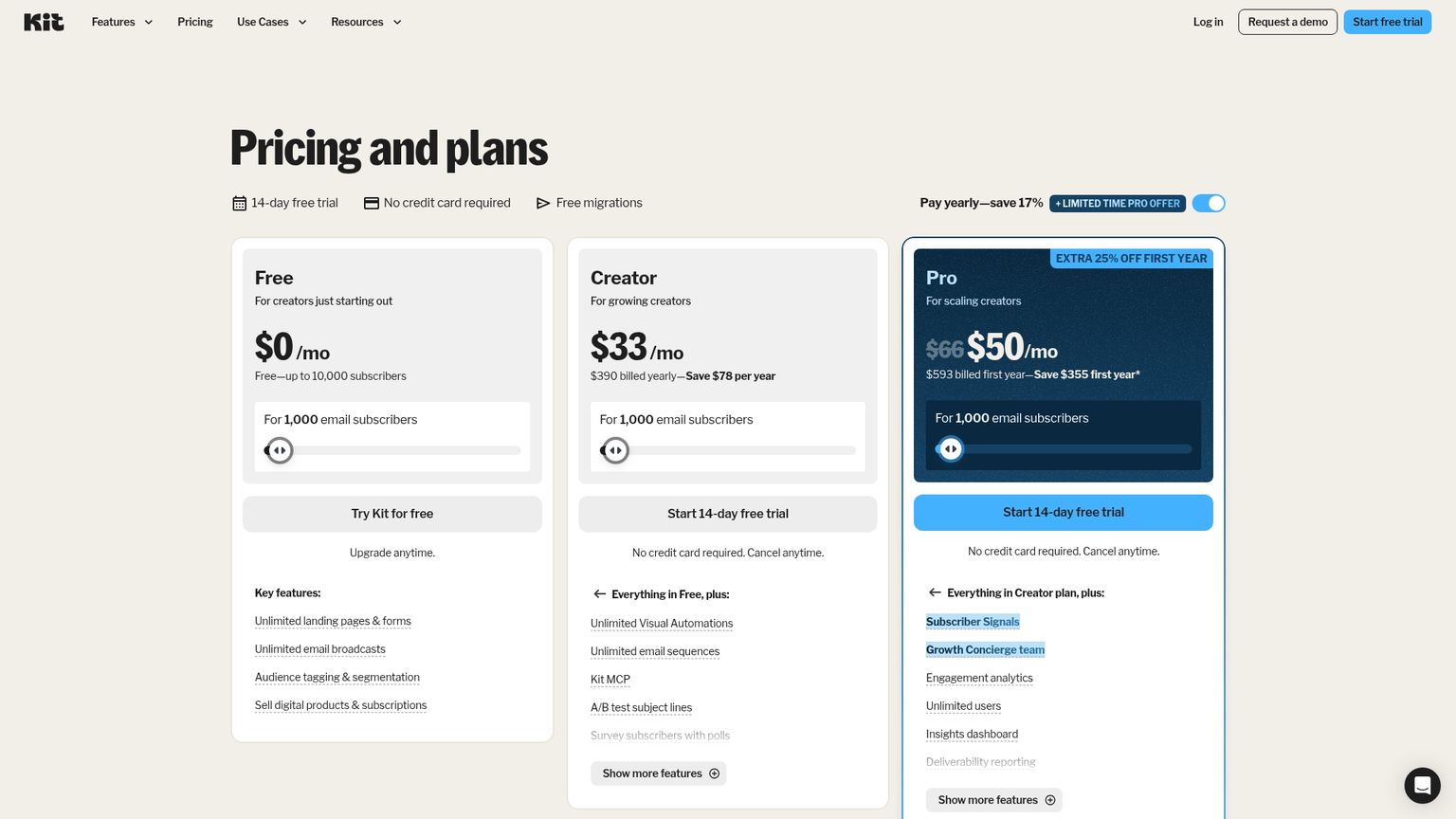
At 1,000 subscribers, Creator displays $33 per month with $390 billed yearly. That invoice works out to $32.50 per month; the displayed monthly figure is rounded. Creator adds unlimited Visual Automations, meaning rules that move subscribers through a journey, and unlimited email sequences. Pro displays $50 per month for the first year, with $593 billed, against a standard annual-equivalent display of $66 per month. The promotion applies to Pro's first year and renews at the standard rate. These are annual-billing displays, not month-to-month quotes. Kit pricing.
Stay if your main assets are the tags, purchase conditions and sequences already connecting your products. A consultant who knows which readers requested a pricing guide, bought a workshop or finished a welcome series has a working sales system. Recreating that system to save a small amount each month can consume the saving before the first new campaign goes out.
Also stay if the supposed missing feature is already available in your account or another Kit tier. Kit has a newsletter site, recommendations, paid recommendations and newsletter sponsorships; Pro includes a referral system. The reason to choose a publication-focused alternative is the fit of its whole workflow, not a claim that Kit cannot publish or monetize newsletters. Current Kit features.
Before switching, compare the invoice you actually pay, your next subscriber band and the cost of the Kit tier that solves the problem. The Kit pricing breakdown covers the plan mechanics in more detail. A grandfathered bill or a temporary discount is not interchangeable with a new-customer quote.
The best alternatives by what you need more of
Start with the job Kit no longer handles well: publication growth, automation depth or consolidating a creator business. MailerLite becomes the first choice to evaluate when the requirement is simply competent email at a lower bill. None is the universal replacement for every Kit account.
1. beehiiv newsletter growth: the publication-first choice
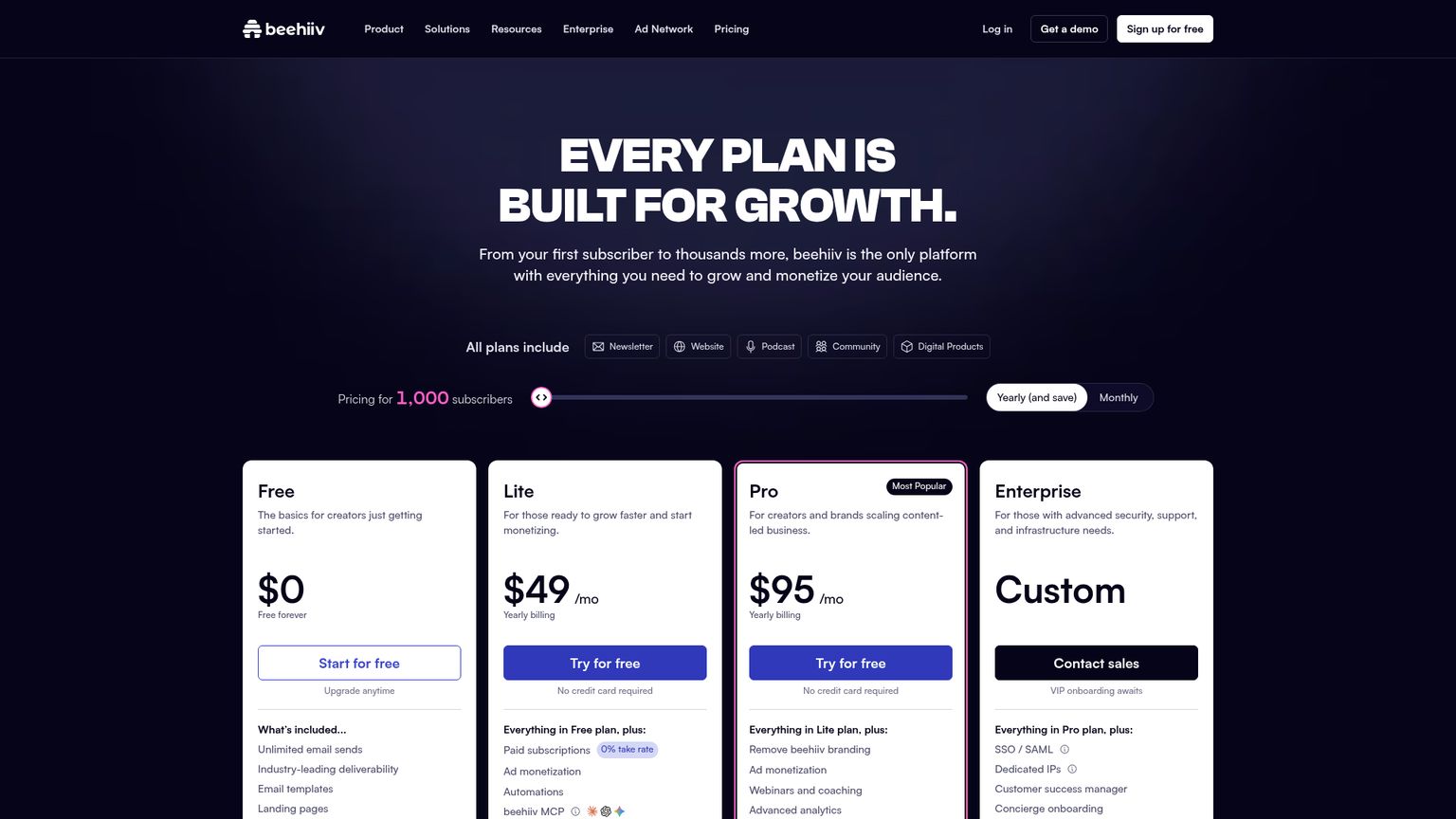
beehiiv is a publishing platform for creators who want the newsletter itself to become a media business. Its combination of a website, recommendations, referral rewards and advertising makes it the first shortlist for a neighborhood news publisher or a specialist industry briefing. Lite includes automations, paid subscriptions and ad monetization; Pro adds brand removal, advanced analytics, webhooks and dynamic content. Pick beehiiv when growing and monetizing readership is the product you are building. Plans, referral program.
Best for: A creator or small media business selling advertising, subscriptions or publication-related products.
Standout: Reader growth and monetization within the publishing workflow.
Pricing: At 1,000 subscribers, Lite is $59 and Pro $109 monthly; annual-billed equivalents are $49 and $95. At 10,000, Lite is $139 and Pro $239 monthly; annual equivalents are $119 and $199. Enterprise is custom.
Free trial: A paid-feature trial is offered without a credit card; Free supports up to 2,500 subscribers.
The benefit is organizational. A city newsletter can publish its issue, offer readers a referral reward and consider relevant advertising without treating each activity as a separate product decision. But a course seller should compare the behavior of its purchase-driven sequences before assuming that changing publishing tools preserves the funnel. Having an automation builder does not make two platforms' workflows interchangeable.
beehiiv reviews: judge revenue after costs
The Ad Network is available on Lite and above for publications actively sending. Offers and estimated payouts are not guaranteed income: payment depends on verified performance. A publisher should compare realized advertising contribution after the software bill and reward costs, not subtract the site's earnings illustration from the subscription price as though it were a credit.
What you give up against Kit: the exact creator-sales setup you already built. Tags, entry rules, product events and ongoing sequences need a mapping exercise. Pro's brand removal also costs more than Lite, so a publication that needs a fully unbranded experience must price that tier from the outset.
Migration effort: moderate for free readership; potentially high for paid subscriptions. beehiiv's current Kit migration guide supports subscriber CSV import and importing the newsletter archive from a Kit newsletter-site URL. Set the default post style first. Paywalls and recurring billing are separate checks; a content import is not proof that paid access or payments transferred.
- Lite combines automations, paid subscriptions and ad monetization.
- Referral rewards give existing readers a defined reason to recommend the publication.
- The current Kit guide includes both subscriber and archive-import paths.
- Free stops at 2,500 subscribers, well below Kit's free ceiling.
- Brand removal requires Pro.
- Kit subscriptions managed through Stripe Express cannot transfer directly to beehiiv.
For a straightforward free newsletter, use this migration sequence from the current vendor guide:
Export the audience with its meaning intact
In Kit, open Grow > Subscribers, select the intended subscribers and use Bulk Actions > Export. Confirm that the export includes the relevant tags and custom fields. Keep subscription exclusions separate from the sendable audience.
Map fields before importing
In beehiiv, open Settings > Publication > Import Subscribers and choose the CSV import. Map the fields deliberately. Decide whether existing readers should receive a welcome email or enter an automation; importing the whole audience should not accidentally restart everyone's onboarding.
Prepare the archive
Set the default post style, then use Settings > Content Import and select Kit. Review the vendor's requirements for paywalled posts before importing a private archive. Check representative posts, links and access after import.
Resolve payments before switching a paid publication
beehiiv says Kit's Stripe Express subscriptions cannot transfer directly. An external Standard Stripe setup may be transferable when the necessary customer and subscription details are available. Confirm your route with support before promising readers uninterrupted billing or canceling an existing product.
2. ActiveCampaign: the upgrade for demanding automation
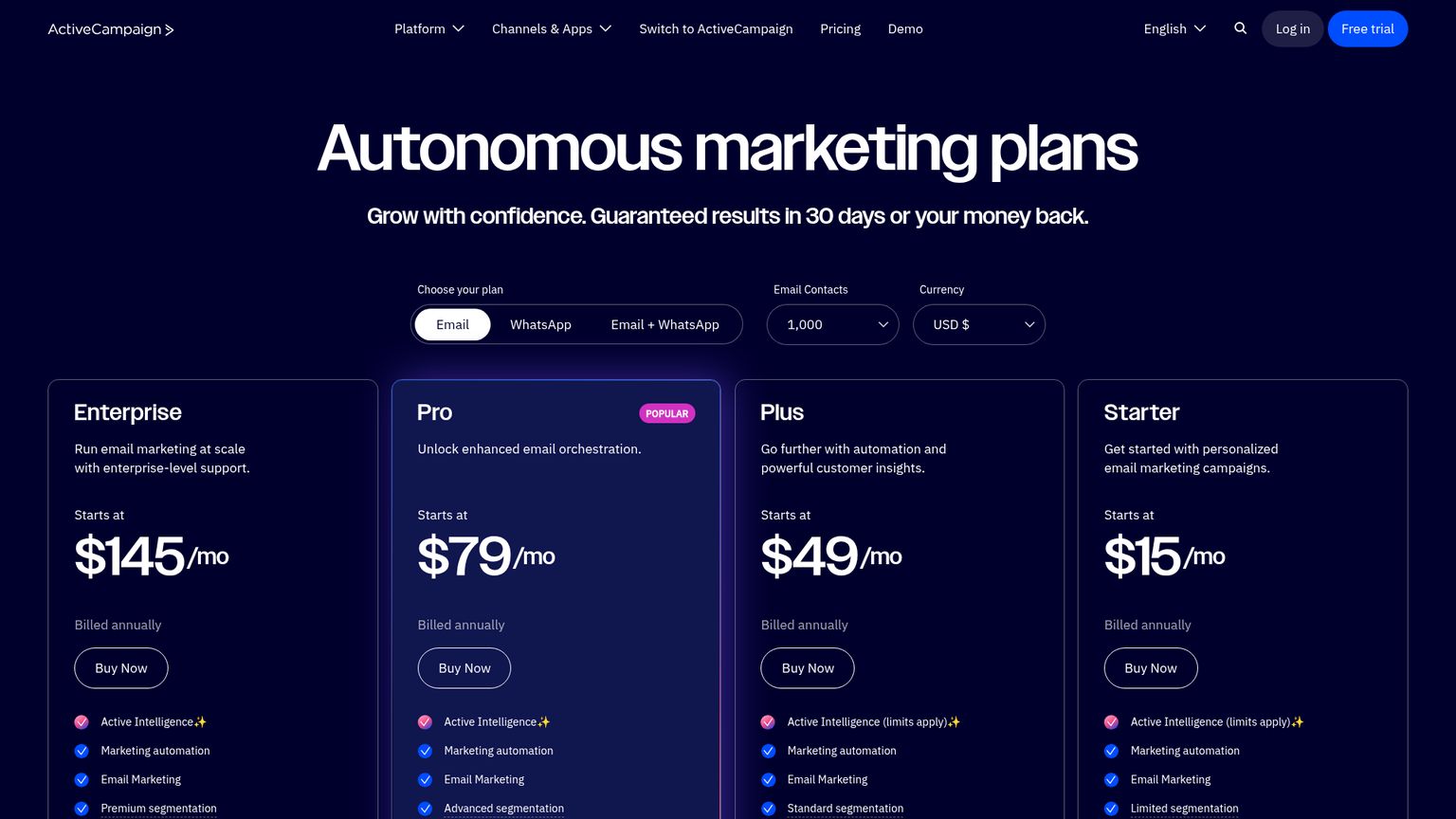
ActiveCampaign is a marketing automation platform for businesses that need follow-up to react to more than a newsletter signup. A coach with several lead sources, different offers and a long sales cycle should evaluate it when the required journey is becoming difficult to manage in Kit. Begin that evaluation at Plus: Starter permits only five actions per automation, while Plus permits unlimited automation actions. ActiveCampaign pricing.
Best for: A creator business with multiple offers or a small company coordinating detailed sales follow-up.
Standout: Longer automations, with higher tiers adding advanced segmentation and attribution.
Pricing: Email plans at 1,000 contacts, billed annually: Starter $15, Plus $49, Pro $79 and Enterprise $145 per month. At 10,000: $149, $189, $375 and $589 respectively.
Free trial: 14 days, without a credit card.
Consider a training business that wants to distinguish a new subscriber from someone who visited the course information, requested a consultation and already purchased. Write those rules down before the trial. The useful comparison is whether the required conditions, actions and reporting work on the quoted plan. A longer feature list has no value if no one will maintain the process.
Plus includes standard segmentation and landing pages. Pro adds advanced segmentation, predictive and conditional content, and attribution and conversion tracking. Enhanced CRM is an add-on: pipeline management and lead scoring should not be silently counted as part of the email-plan price. A CRM is the system for tracking sales relationships and opportunities; an email automation subscription is not necessarily the whole sales setup. Plan and add-on breakdown.
What you give up against Kit: the simplicity of a creator-focused setup whose products and sequences already fit together. You also exchange Kit's unlimited broadcast allowance for contact-based sending allowances. ActiveCampaign lists monthly sends at 10 times the contact limit on Starter and Plus, 12 times on Pro and 15 times on Enterprise.
Migration effort: moderate to high. ActiveCampaign lists contact migration among its included services and provides migration support. Confirm the scope for your forms and workflows. A contacts transfer is the beginning; the work that earns the upgrade is rebuilding and checking the sales logic.
- Plus removes Starter's five-action automation ceiling.
- Pro adds more detailed segmentation, content and attribution capabilities.
- Published contact bands make the annual commitment visible.
- Starter can be the wrong tier for the very workflow prompting the move.
- Enhanced CRM capabilities can add to the email subscription.
- Sending allowances and workflow maintenance need an owner.
3. GetResponse: consolidate webinars, courses and email
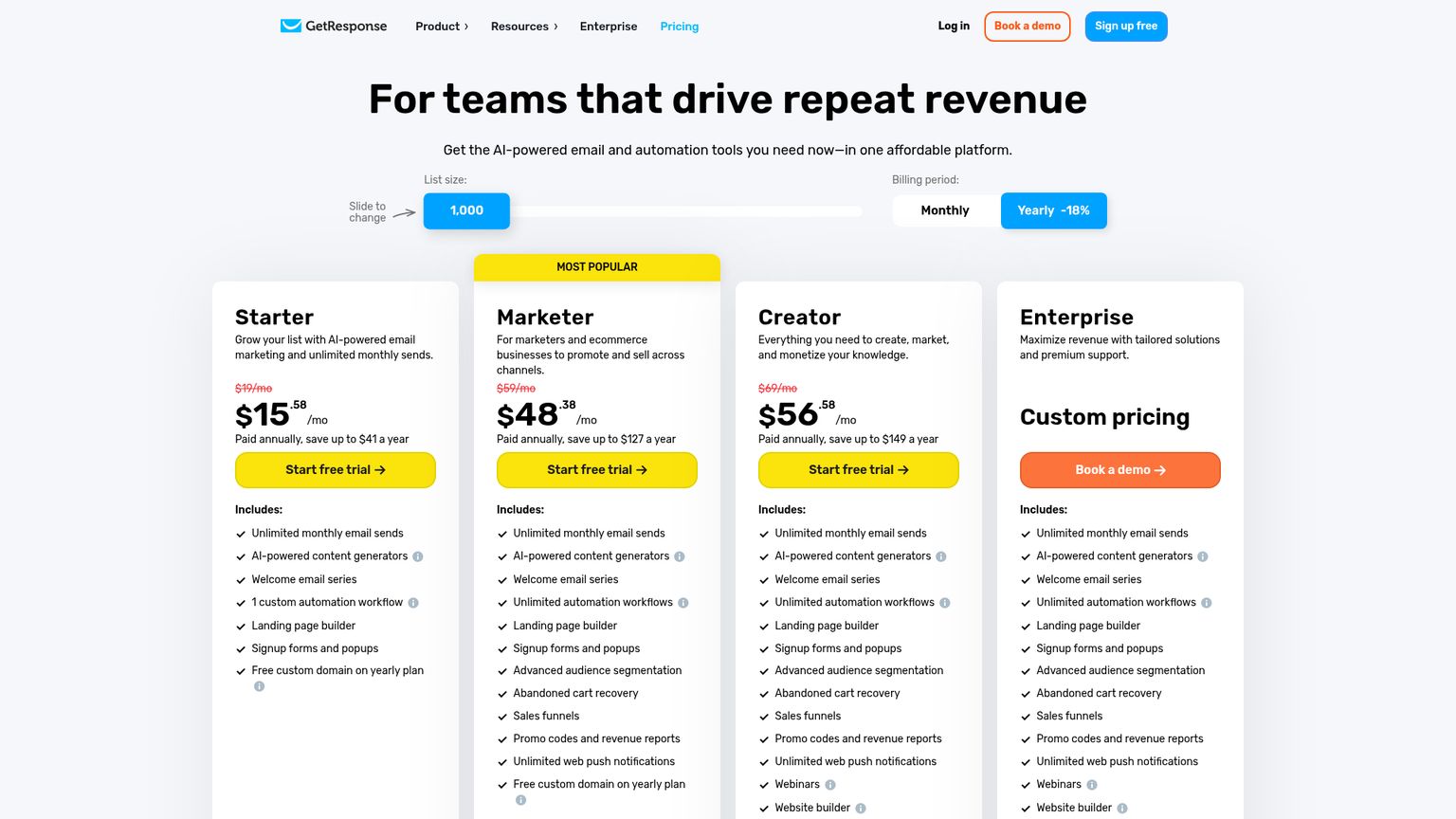
GetResponse is an email and marketing platform whose Creator plan combines automation, a website builder, webinars and course creation. It suits an educator who wants to register an audience, teach a session, sell a course and follow up within a broader shared platform. Creator is the relevant comparison for that business; Starter's lower price does not buy the same scope. GetResponse plans.
Best for: An educator or small training business paying for several parts of its registration-to-sale process.
Standout: Creator's webinars and course tools alongside email, funnels and a website.
Pricing: At 1,000 contacts, Starter $19, Marketer $59 and Creator $69 monthly; annual-billed equivalents $15.58, $48.38 and $56.58. Enterprise is custom.
Free trial: 14 days, without a credit card.
At 10,000 contacts, the live selector and vendor's pricing catalog returned EUR €69 for Starter, €99 for Marketer and €114 for Creator per month, or €56.58, €81.18 and €93.48 on annual billing. These are explicitly euro prices, not verified US dollar quotes. Get a USD quote for your account before comparing savings with another dollar-priced service; an exchange-rate conversion would not establish GetResponse's US price.
Starter includes unlimited monthly sends and one custom automation workflow. Marketer adds unlimited workflows, advanced segmentation, abandoned-cart recovery and sales funnels. Creator adds the teaching and publication tools. At 1,000 contacts, its course allowance is up to 500 students; at the verified 10,000-contact setting, the page shows up to 5,000 students. Email contacts and course students are different allowances, so a large list does not tell you how many enrolled students the plan supports. Plan details.
What you give up against Kit: a narrower, familiar creator-email workflow in exchange for a broader system to configure. If all you need is a lead magnet and a sales sequence, the course and webinar tools may contribute nothing. If those tools replace subscriptions you already use, the comparison becomes the total stack bill rather than GetResponse versus Kit alone.
Migration effort: moderate for email; high when consolidating teaching. Inventory the existing forms, event registrations, lesson content, paid access and purchase-triggered follow-up separately. Price the transition as several workflows, and verify the student and webinar requirements before retiring another service. Do not assume a subscriber import migrates course enrollment or purchases.
- Creator puts webinars, courses, a website and email under one plan.
- Marketer and Creator include unlimited automation workflows.
- The published plans include unlimited monthly email sends.
- Starter's single custom workflow can be too restrictive for an established creator funnel.
- Course student allowances need a separate check from the email contact band.
- A move that also replaces teaching tools has more work than an email-only switch.
At 1,000 contacts, Creator costs $10 more per month than Marketer on monthly billing. For an educator who will use the added teaching tools, that is the relevant incremental cost. The tools still need to meet the actual class format, and replacing an existing setup still has a labor cost.
4. MailerLite: the first cost comparison for routine email
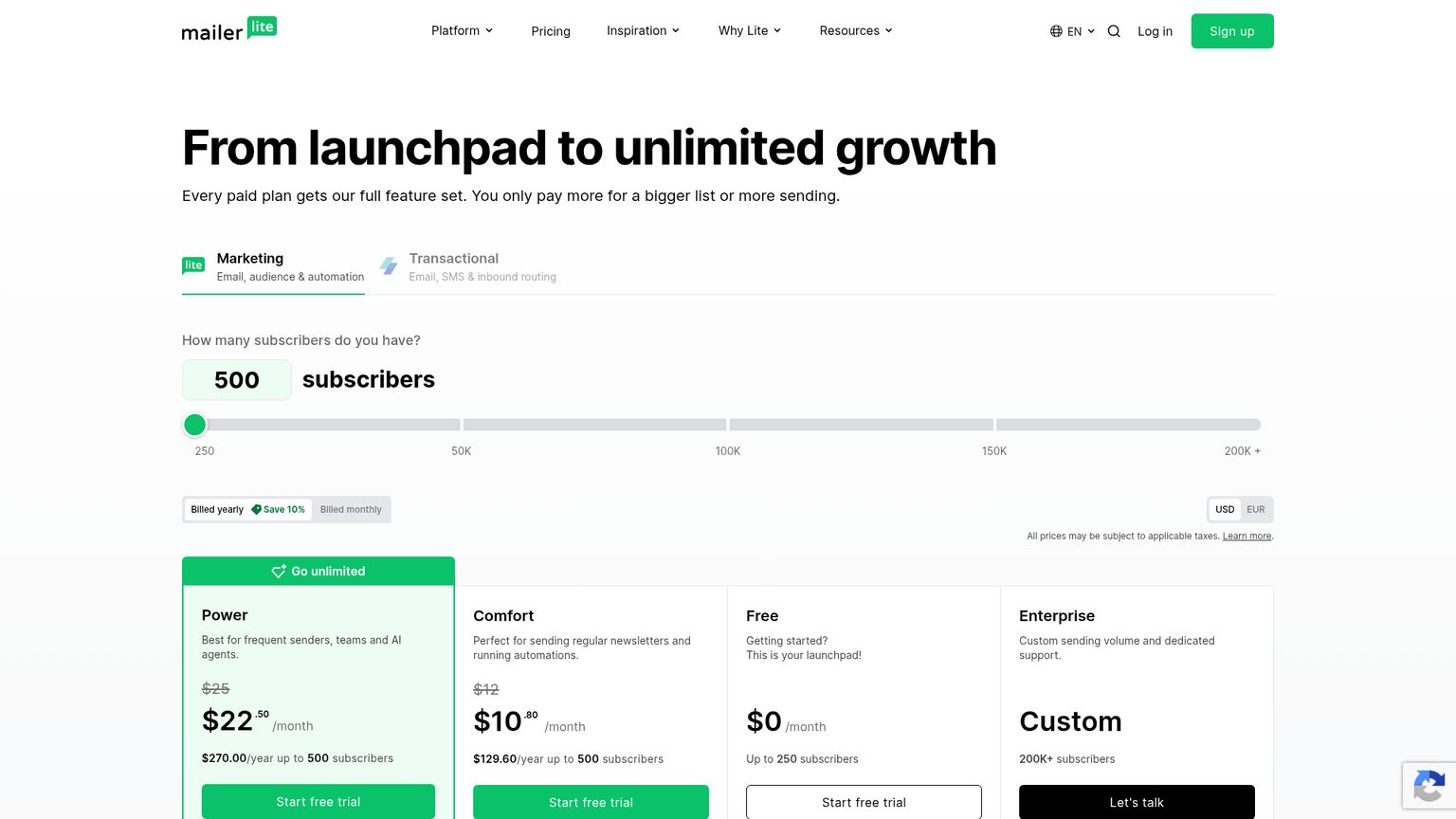
MailerLite is an email marketing platform with campaigns, automations, forms, landing pages and a website builder. It is the first alternative to price when a freelancer, small publisher or consultant needs reliable campaign mechanics and simpler follow-up without buying a media-growth package. Comfort is a useful cost baseline, provided its send allowance and workflow limits fit. MailerLite pricing.
Best for: An operator who needs regular campaigns and a manageable set of automated journeys.
Standout: A lower fixed bill for a defined set of email and website needs.
Pricing: At 1,000, Comfort $19 and Power $39 monthly, or $17.10 and $35.10 with annual billing. At 10,000, Comfort $89 and Power $129 monthly, or $80.10 and $116.10 annually. Enterprise is custom for larger requirements.
Free trial: 14-day premium trial; Free supports 250 subscribers and 2,500 monthly emails.
Comfort includes 50 active automations, up to 100 steps per automation, 10 signup forms and five digital products or bookings. Power increases the usage allowances, including unlimited automations, forms, products and user seats. Both have more to evaluate than a newsletter editor: the question is whether the available workflows and account limits match your business. Current comparison.
What you give up against Kit: Comfort's monthly sending allowance is finite. It is 10 times the ceiling of the subscriber tier, so 10,000 subscribers buys 100,000 sends. Four full-list issues use 40,000, leaving 60,000 for automation and other campaigns. Twelve full-list issues alone use 120,000, before welcome emails. A send means one email delivered to one recipient, not one campaign.
Power costs another $40 per month at that audience size and offers unlimited monthly sends subject to fair use. A frequent publisher should compare Power with Kit, not assume Comfort's price can support any cadence. MailerLite also supports paid newsletters, so it need not be dismissed if subscriptions are part of a small creator business. Sending and monetization details.
Migration effort: low to moderate for broadcasts; higher for a developed sales system. MailerLite provides a Kit migration route. Map Kit tags to the destination's groups and segment rules, recreate forms and verify the conditions behind follow-up. Keep unsubscriptions and bounces out of the active audience.
- Comfort costs $89 monthly at 10,000 subscribers.
- Website, form and automation features can cover a small operator's regular needs.
- Power provides a clear upgrade when sending volume or account usage grows.
- Comfort's sending allowance can become the limiting factor before subscriber count.
- Free only supports 250 subscribers.
- A feature match does not preserve existing Kit sequences automatically.
For a creator approaching or exceeding 10,000 subscribers, obtain the next relevant MailerLite band and compare it with the next Kit invoice. The verified 10,000 price is a checkpoint, not a promise that the bill stays $89 as the list grows.
5. Ghost: put the publication website first
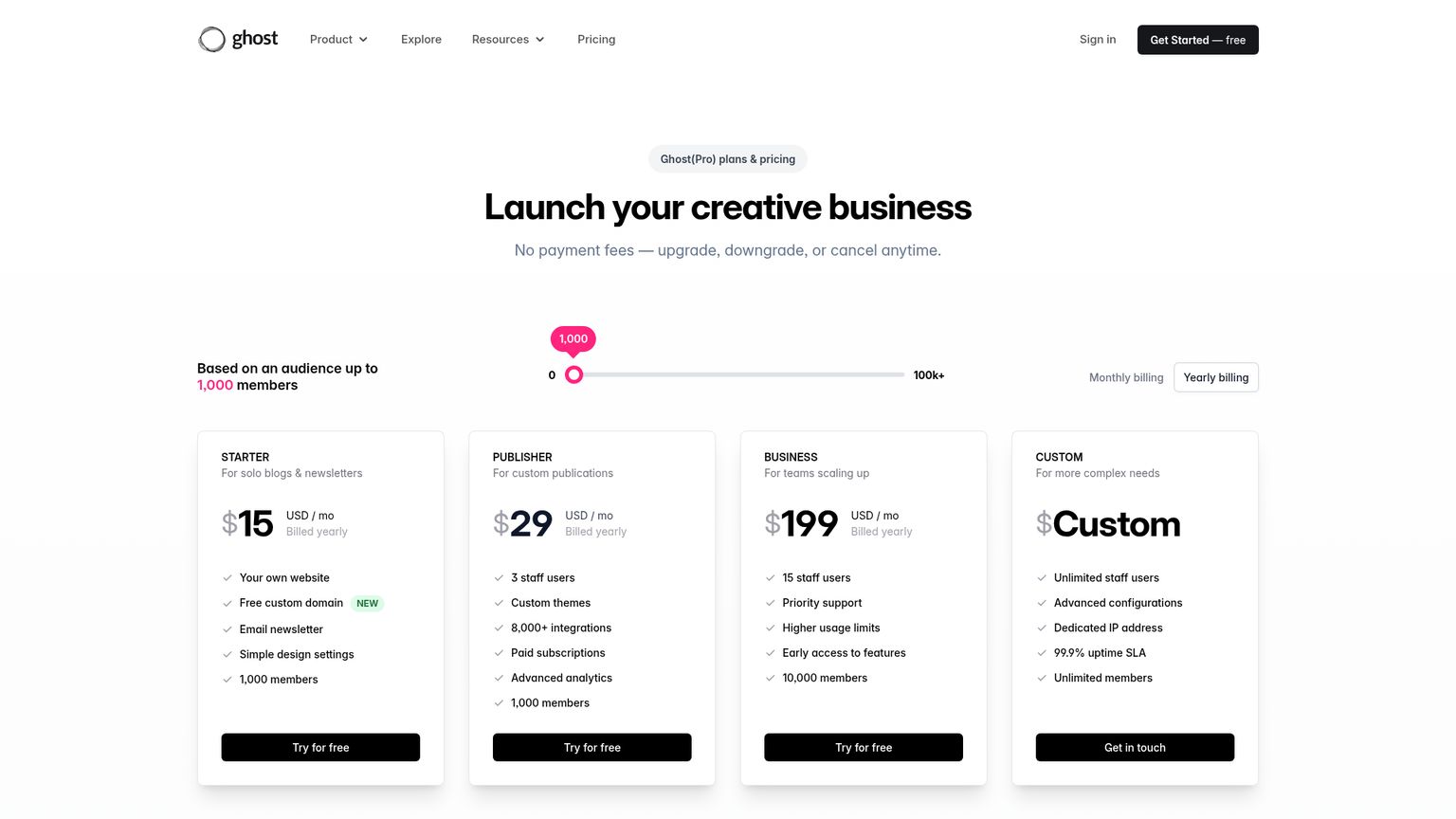
Ghost is a publishing and membership platform for a business whose website, archive and paid content are central assets. An independent magazine that wants a distinctive publication site should evaluate Ghost(Pro), the hosted service, before choosing another email-first platform. Publisher adds custom themes and paid subscriptions, with no Ghost transaction percentage. Choose it when the publication itself needs a stronger home. Ghost pricing.
Best for: An independent publisher prioritizing its website, archive and membership experience.
Standout: Custom publication design and paid memberships on Publisher and above.
Pricing: At 1,000 members, Starter $18, Publisher $35 and Business $239 monthly; annual equivalents $15, $29 and $199. Business includes a 10,000-member minimum allowance. At 10,000, Publisher is $105 monthly or $88 annually; Business remains $239 or $199. Custom is quoted. Starter stops at 1,000.
Free trial: A hosted-service trial is offered; there is no ongoing free Ghost(Pro) tier on the pricing page.
Count members, not just newsletter recipients, when budgeting. A registered reader can matter to the hosted plan even if the publication thinks of its audience mainly as an email list. Publisher includes three staff users, custom themes, paid subscriptions, a custom sending domain and unlimited email sends. Payment processing is separate from Ghost's zero platform transaction fee. Hosted plan comparison.
What you give up against Kit: the present automation depth. Ghost's current Automations beta provides free-member and paid-member welcome flows using Send email and Wait actions. The documentation says additional custom automations are not yet available. That can welcome readers to a publication; it is not a direct replacement for an elaborate Kit product funnel.
Migration effort: moderate to high. This can be a website move as well as an email move. Ghost's member-import documentation supports CSV fields including labels, subscription preferences and Stripe customer IDs. Plan the archive, navigation and access rules separately, and verify payment compatibility before treating a paid-member record as an active billing relationship.
- Publisher supports custom themes and a dedicated publication experience.
- Paid subscriptions carry no Ghost platform transaction percentage.
- Hosted plans include unlimited email sends.
- Current native automation is much narrower than a complex creator-sales funnel.
- Starter cannot serve a 10,000-member publication.
- A website-and-membership migration has more dependencies than a simple list transfer.
Self-hosting Ghost is a different operating decision. A software download is not the complete cost of hosting, updates, email infrastructure and someone maintaining it. Use Ghost(Pro)'s quote when comparing a managed service with Kit.
6. Substack: publish first, pay as subscriptions grow
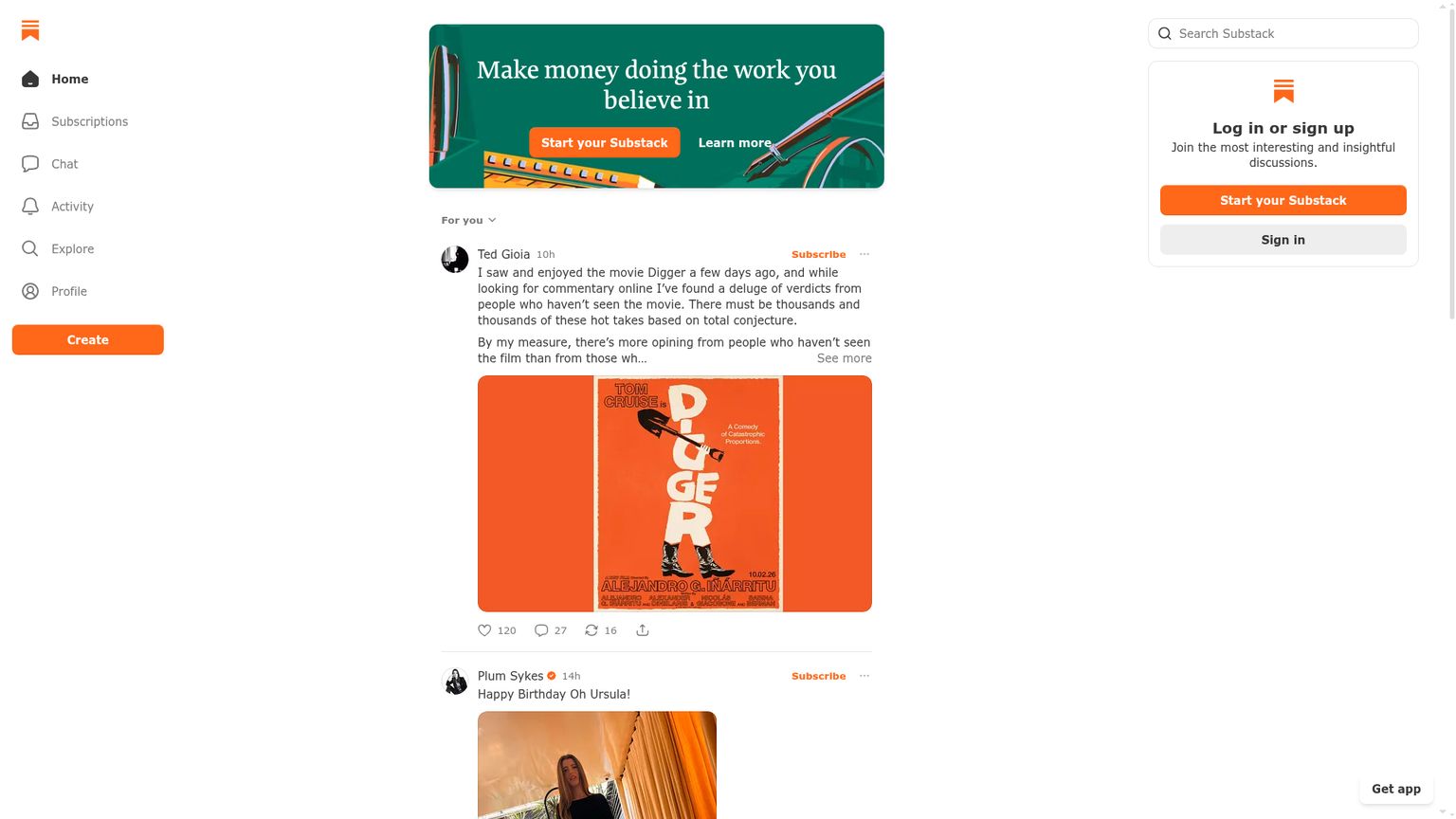
Substack is a subscription-publishing platform for writers who want to start publishing without a fixed software charge. It fits a commentator whose principal offer is the writing, particularly when participating in a publication network is part of the plan. The tradeoff is a revenue share once readers pay, rather than a subscriber-band subscription. Substack's fee explanation.
Best for: A writer selling access to a publication rather than managing several product funnels.
Standout: Free-to-start publishing with a paid-subscription model.
Pricing: $0 platform subscription at both 1,000 and 10,000 subscribers for free publishing. Paid subscriptions incur a 10% platform share plus Stripe fees; there is no separate fixed subscriber-tier plan to list.
Free trial: Free publishing is ongoing, not a timed trial.
At $1,000 in monthly paid-subscription revenue, the platform share is $100. At $4,000 it is $400, before processing. These are illustrations of the published percentage, not revenue forecasts. A free newsletter with a large audience can therefore have a lower software bill than a smaller paid publication. The business model, not list size alone, drives this comparison.
What you give up against Kit: the expectation of preserving a creator sales system around tags, product purchases and detailed sequences. Evaluate Substack as a publication business, not as an interchangeable container for Kit workflows. If selling courses and services is the primary job, model that journey explicitly before making it the destination.
Migration effort: low to moderate for a simple free publication; higher for paid billing and archives. Substack offers list and archive imports. Confirm the supported route for your Kit content and any paid subscriptions rather than assuming a general import promise covers every part of the move. Your audience export does not itself transfer a payment mandate.
- Free publishing has no subscriber-based platform bill.
- The paid-subscription model suits a writing-led business.
- Lists and writing archives have documented import options.
- The 10% share grows with subscription revenue.
- Payment processing is additional.
- A publication migration does not reproduce Kit's existing sales workflows.
beehiiv vs Substack: use revenue as the second axis
At the verified 10,000-subscriber monthly price, beehiiv Lite's $139 fee equals Substack's 10% share at $1,390 in paid monthly revenue. That is a platform-fee-only comparison: payment processing, discovery value and migration work are excluded. The fuller beehiiv versus Substack comparison covers the publishing tradeoff; the immediate question here is whether your business earns from readership or from products sold through email.
7. Flodesk: choose the email design, not an old pricing promise
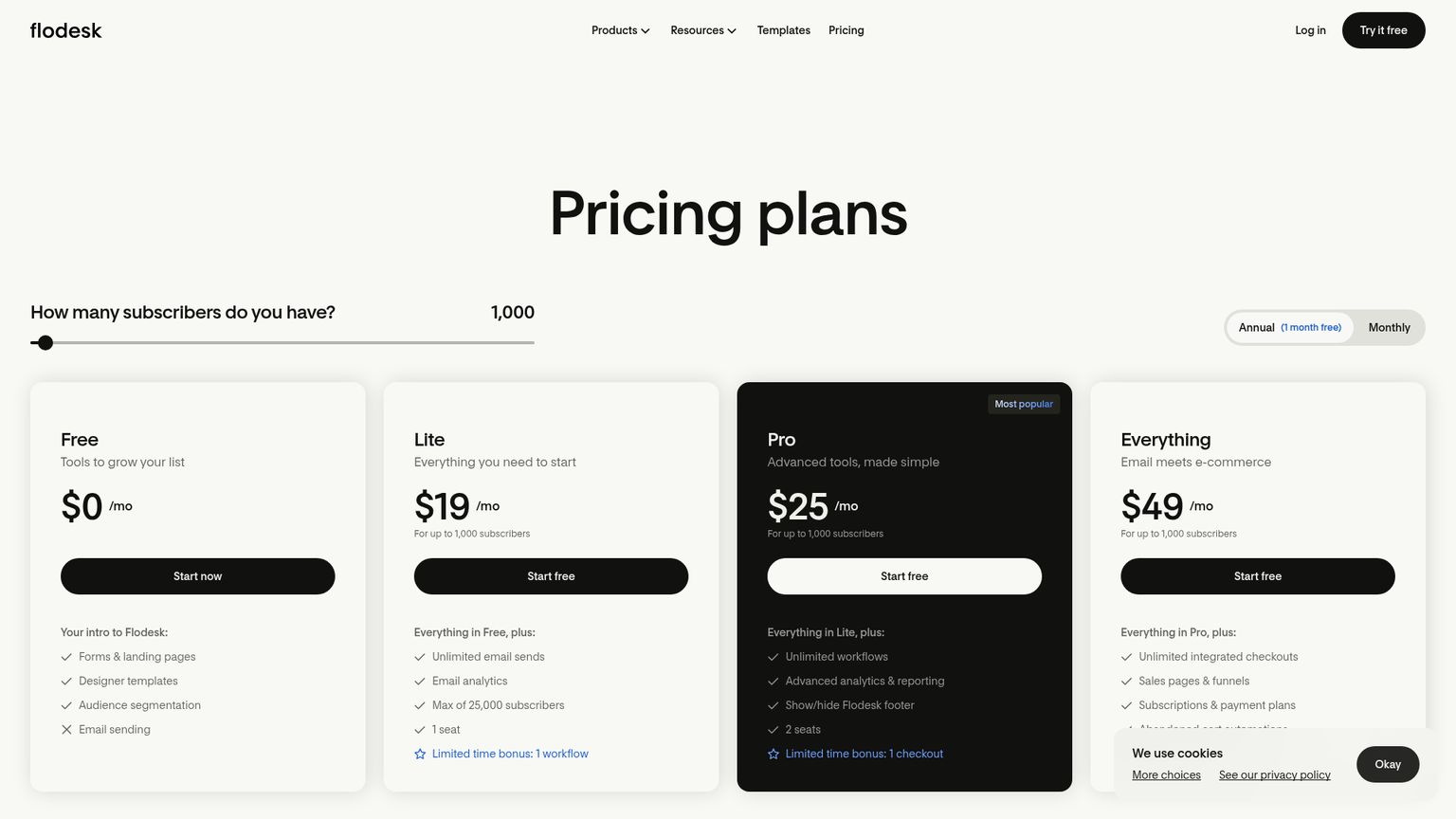
Flodesk is a design-focused email platform for creators who want visually distinctive campaigns and straightforward workflows. A photographer launching seasonal sessions or a designer selling a small product collection can reasonably prioritize the editor and templates. Pro is the relevant starting point when the business needs several workflows, while Lite fits a much simpler sending setup. Flodesk pricing.
Best for: A visually led creator business with clearly defined email journeys.
Standout: Designer templates alongside unlimited email sends on paid plans.
Pricing: At 1,000, Lite $25, Pro $28 and Everything $54 monthly; annual displayed equivalents $19, $25 and $49. At 10,000, Lite $72, Pro $79 and Everything $137 monthly; annual displays $66, $72 and $126.
Free trial: Paid-feature trial without a card. Free supports forms and list building, but does not send email.
Flodesk reviews: check which pricing generation they describe
Flodesk says its unlimited flat-rate plan closed to new members on 2 December 2025. Qualifying existing subscribers can retain their legacy plan while maintaining the subscription. A creator moving from Kit now should budget the current subscriber-based tiers, not an older unlimited-price claim. Current pricing FAQ.
Lite's ceiling is 25,000 active subscribers and its single workflow is marked as a limited-time bonus. Pro includes unlimited workflows and brand removal; Everything adds unlimited checkouts, sales pages, subscriptions, payment plans and abandoned-cart automations. At 10,000, Pro is only $7 more per month than Lite on monthly billing. If separate onboarding and sales journeys matter, that small tier difference can decide the shortlist.
What you give up against Kit: the exact behavior and organization of existing automations, plus the option to send free to Kit's larger free audience. Flodesk Free is a list-building product, not a free newsletter-sending replacement. Recreate a representative launch sequence before valuing the move primarily on how attractive the email looks.
Migration effort: low to moderate for simple campaigns; moderate when rebuilding sales. Inventory subscriber segments, embedded forms, templates and active workflows. A designer with a broadcast-only list has fewer moving parts than a course creator with overlapping launches. Treat any checkout or subscription move as a separate project.
- Paid plans include unlimited email sends.
- Pro includes unlimited workflows.
- Everything combines email with a wider set of checkout and sales-page tools.
- New customers pay by active-subscriber band.
- Free cannot send newsletters.
- Lite's workflow and subscriber ceilings can make the entry plan unsuitable.
8. Mailchimp: move for a specific fit, not familiarity
Mailchimp is a broad email marketing platform with campaign design, reporting and automation features. It belongs on the shortlist when a small business has a particular integration or campaign requirement that fits Mailchimp well. It is not the default cost-cutting escape from Kit: compare the actual contact band, automation tier and sending allowance. Mailchimp pricing.
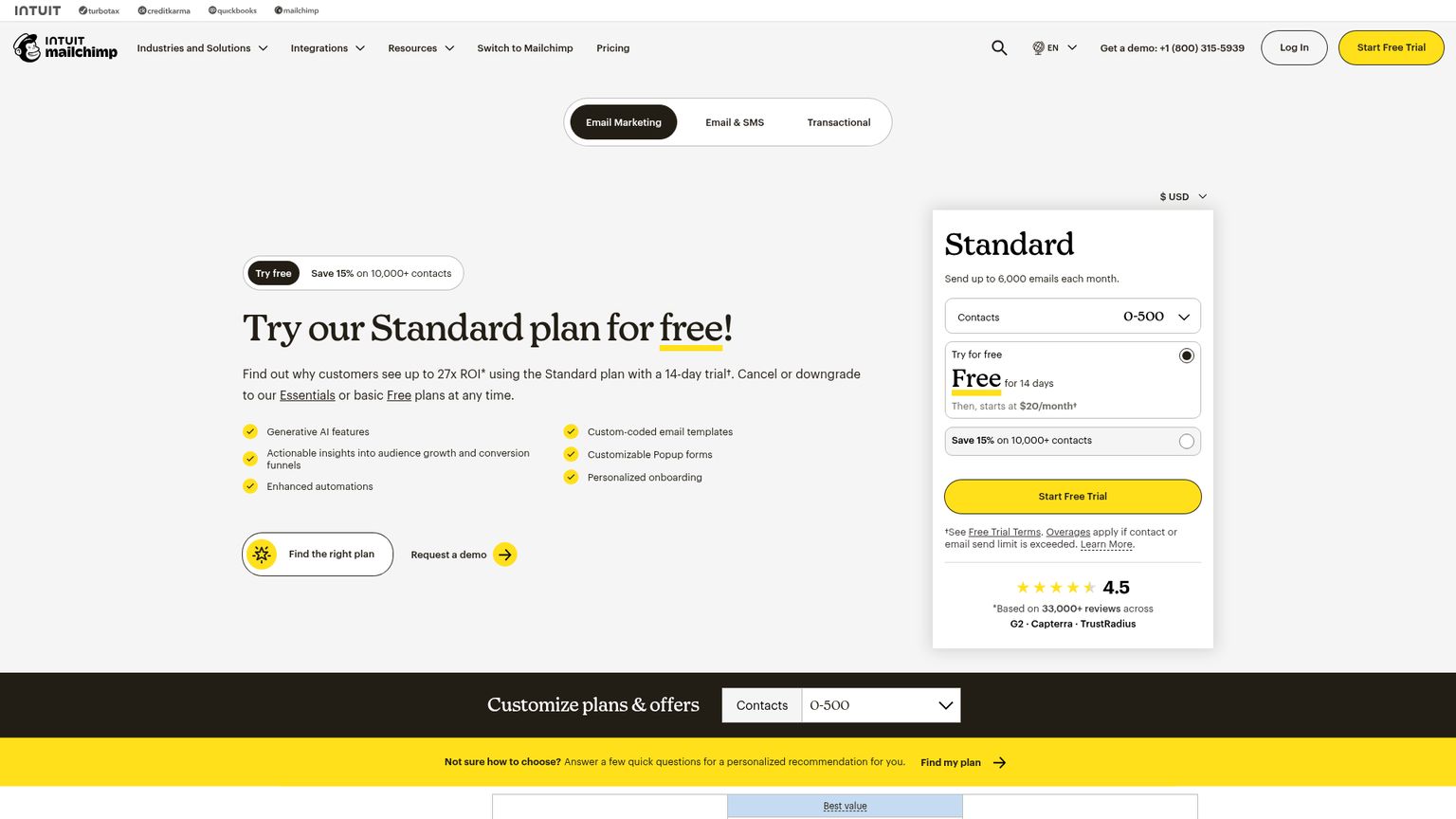
Best for: A business with a defined Mailchimp integration or marketing workflow requirement.
Standout: Standard's broader automation, reporting and campaign-customization tools.
Pricing: At 1,000 contacts, regular monthly Essentials $26.50 and Standard $45; Premium starts at $350 with a minimum 10,000-contact allowance. At 10,000, Essentials $110, Standard $135 and Premium $350. Free supports up to 250 contacts.
Free trial: 14 days for Standard and Essentials, subject to the published trial terms.
A 1,000-contact list sits in the 501-to-1,500 pricing band. That matters because neither the price nor the send allowance is a simple multiplication of exactly 1,000 contacts. Standard at that band allows 18,000 monthly sends; at 10,000 contacts it allows 120,000. Additional charges can apply when limits are exceeded. Current selector.
At 10,000, the page also displayed a 15% introductory discount for 12 months: Essentials $93.50, Standard $114.75 and Premium $297.50 monthly. The table uses the regular prices of $110, $135 and $350, so an initial promotion does not disguise the continuing bill.
What you give up against Kit: the current creator-focused arrangement and unlimited broadcast allowance. If the business mainly sends an editorial newsletter and runs familiar product sequences, changing to a broader marketing system can add work without improving the actual reader journey. Require a named capability or integration to justify it.
Migration effort: moderate. Mailchimp's import guide supports CSV/TXT files and field mapping, and imports one subscription status at a time. Keep consent and unsubscribe status intact, rebuild audience rules, then check the workflows connected to the import. A clean-looking audience total is not a complete migration test.
- Standard combines enhanced automations, reporting and template customization.
- Contact bands and send allowances can be priced explicitly.
- The import process supports mapping audience data and subscription status.
- Regular 10,000-contact prices are materially higher than entry badges.
- Send limits and potential overages need monitoring.
- Introductory discounts are not renewal prices.
How to choose alternatives to ConvertKit
Choose beehiiv when a bigger, better-monetized readership is the objective. A local publication that wants advertising and reader referrals should evaluate the complete publishing routine, then make the paid-tier decision from the features it will use. Stay on Kit if the real revenue engine is an established product funnel that already works.
Choose ActiveCampaign when a specific automation requirement exceeds the present setup. Write the trigger, conditions, actions and desired reporting in plain language. That list determines Plus versus Pro and whether a CRM add-on is needed. If the requirement is merely a welcome series, the extra system may be unnecessary.
Choose GetResponse when consolidation removes useful subscriptions and handoffs. An educator needs to compare the course, webinar and student requirements, not just the email price. A newsletter-only writer should not pay for consolidation of tools they do not use.
Choose MailerLite when the objective is a lower bill for routine email. At 10,000, Comfort is the $89 monthly checkpoint; send frequency decides whether Power is the proper comparison. Use your own Kit renewal invoice to calculate the saving. Past 10,000, price the next actual band on both sides before signing an annual contract.
Choose Ghost for the publication website and Substack for the free-to-start publishing model. Ghost's hosted cost and Substack's paid-revenue share answer different questions. Neither should be chosen on the assumption that a sales funnel transfers with the mailing list.
Flodesk vs Mailchimp: design preference or a required workflow?
A visual creator should first check Flodesk Pro's editor and workflows against a representative campaign. A business considering Mailchimp should name the integration, reporting or automation requirement that earns the move. If neither offers a concrete improvement over Kit, familiarity and attractive templates are weak reasons to rebuild. For a wider platform landscape, see the newsletter platforms for creators comparison.
Migration effort: move the list, rebuild the business
The difficulty is determined by what is connected to the list, not just its size. A large broadcast-only audience may be simpler to move than a small audience spread across several paid products and unfinished sequences. The effort labels above are editorial estimates of that scope, not measured completion times or vendor guarantees.

Start with an inventory a colleague could follow. For each signup form, record its destination, welcome message and any tags it applies. For each paid offer, record the payment system, access rule and emails triggered by purchase. For each sequence, identify who is already partway through it. This shows what must survive and what can be retired.
A suppression list is the set of addresses that must not receive marketing, including unsubscribed or bounced contacts. Preserve that information. Changing tools is not permission to reactivate people. The destination's audience count should reconcile with the sendable list and exclusions, rather than merely matching the biggest CSV you can export.
The practical acceptance check is a set of reader journeys: a new free signup, an existing reader, an unsubscribed address, a new buyer and a customer already inside a sequence. Use controlled test records to check who receives what. Confirm that an existing customer does not restart an irrelevant welcome series and that a purchase stops the sales reminders intended for non-buyers.
For a paid newsletter, verify billing before moving access. beehiiv's Kit-specific documentation distinguishes Kit's Stripe Express setup from an external Standard Stripe account. That distinction can change a move from a data transfer into a reader re-subscription campaign. Do not cancel the source product before the destination route and reader communication are settled.
When address verification is a useful extra
Bouncer is an email verification service, not another newsletter platform. It can be a sensible one-off check when an old, opted-in audience contains uncertain addresses. Its pay-as-you-go pricing is $8 for 1,000 credits or $60 for 10,000; purchased credits do not expire. Use it to investigate address quality, not to infer consent or replace the work of mapping fields and workflows.
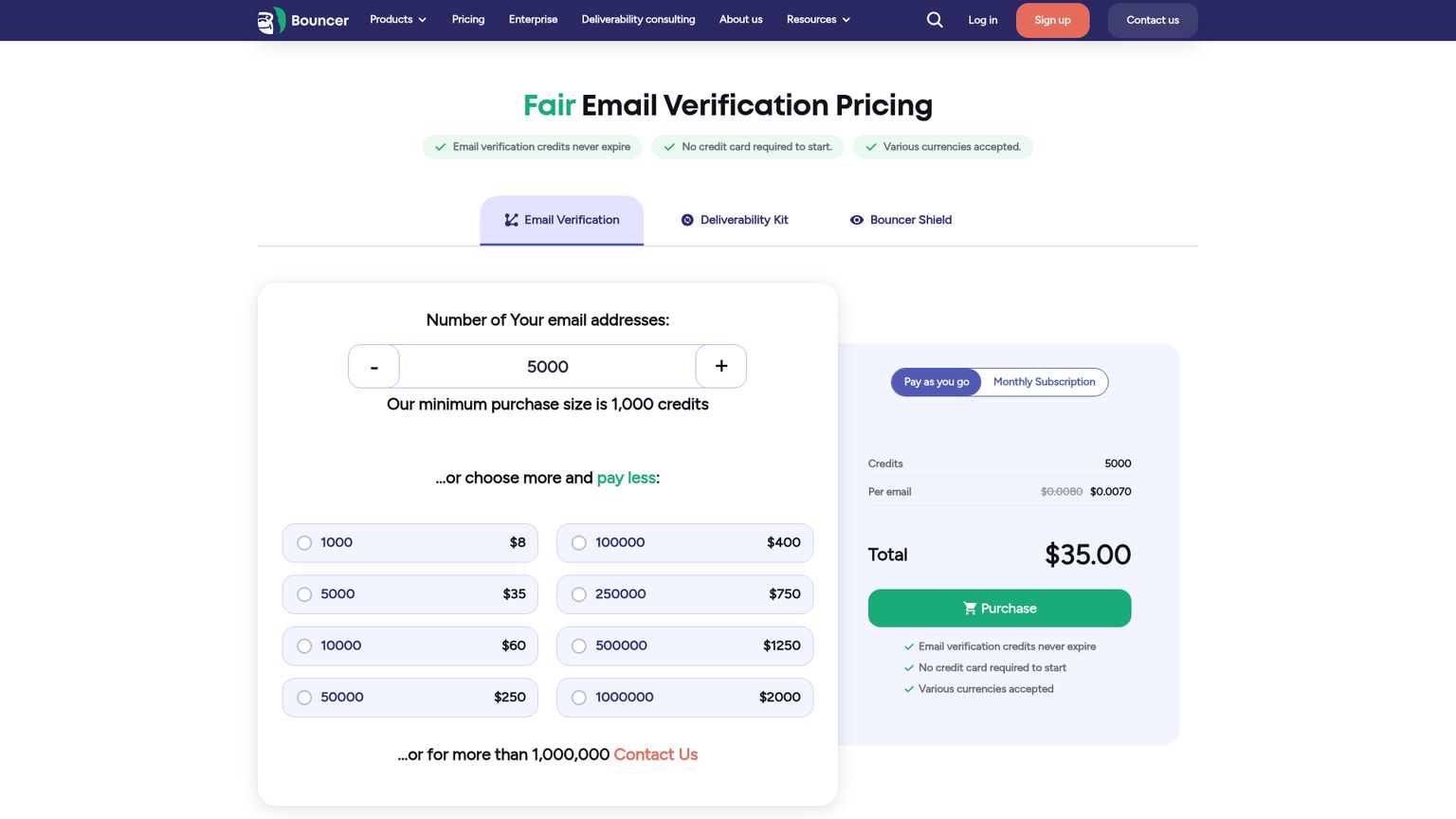
For a recently maintained, healthy list, verification may add little. Spend the migration budget on the actual uncertainty: questionable addresses, broken signup paths, missing product events or an unconfirmed billing transfer. Buying another tool without identifying the problem does not reduce migration effort.
Make the saving repay the move
A hypothetical creator spends eight hours rebuilding at an internal value of $75 an hour. That is $600 of labor. If the current invoice is an assumed $139 and the destination is MailerLite Comfort at the verified $89 monthly rate for 10,000 subscribers, the saving is $50 per month. Recovery takes 12 months, before overlapping subscriptions or lost sales. The assumed $139 invoice is an illustration, not a verified Kit quote. MailerLite price input.

The decision rule is simple: migration cost divided by monthly saving gives the recovery period. If the saving is small, a missing capability needs to carry the decision. If a working Kit funnel generates sales that the replacement cannot reproduce, the nominal saving can disappear entirely.
Next week, take your actual renewal invoice, the next subscriber band and one revenue-producing workflow into a trial. Rebuild that workflow with test records, price the tier it requires and reconcile the sending allowance. Move the full audience only after that small, concrete check succeeds.
How these were picked
These eight alternatives were selected for a creator or small media business already using Kit. The criteria are publication growth and monetization, automation requirements, website and teaching needs, ongoing price at the relevant audience band, and the work of preserving the current business.
The comparison uses vendor pricing pages, public feature documentation and live pricing selectors checked on 11 October 2026. It is a priced-and-analyzed comparison, not a claim of hands-on campaign testing or measured deliverability. Screenshots show the vendors' own pages; illustrative cost calculations state their assumptions.
beehiiv, ActiveCampaign and GetResponse each address a different reason to move. Bouncer appears only as optional migration support. Some product links are partner links and may earn a commission. Partnership does not determine suitability, and the cheaper or simpler choice can be staying on Kit.
Dedicated ecommerce and product-event platforms are outside this creator-focused field. If store purchases or software usage are the main triggers, begin with those requirements rather than treating a newsletter-platform list as a complete market ranking.
The ones to avoid
Avoid ActiveCampaign Starter for a workflow that needs more than five actions. Buying the low tier and discovering the limit during the rebuild is avoidable. Price Plus before calculating savings.
Avoid Flodesk Free as a replacement for free newsletter sending. It collects subscribers but does not send campaigns. Also avoid a purchase decision based on its retired new-customer flat-rate plan.
Avoid Ghost as a drop-in replacement for a complex Kit automation system. Its current welcome-flow beta has a narrower documented scope. The publication-site advantage may still justify the move, but it does not remove that gap.
Avoid Substack solely because it has no fixed bill. For a paid publication, apply the 10% share to expected subscription revenue. Then decide whether the publishing experience is worth that expense.
Avoid Mailchimp as the automatic familiar-brand choice. The relevant plan and audience band can cost more than expected. Require a specific workflow benefit.
Finally, avoid any move whose only justification is a small headline-price saving while the source already does the job. Downgrading or simplifying the current setup may have a better payoff than rebuilding it elsewhere.
Frequently asked questions
Is there a free version of Mailchimp or similar?
Yes. Mailchimp Free supports up to 250 contacts. For this creator comparison, Kit Free reaches 10,000 subscribers, beehiiv Free 2,500 and MailerLite Free 250. Substack has free publishing without a subscriber-based platform charge. Free-plan capability matters as much as the audience ceiling; Flodesk Free, for example, does not send email.
What are the top 3 email marketing tools?
For the needs covered here, the shortlist is beehiiv for publication growth and ads, ActiveCampaign for demanding automation, and GetResponse for email combined with webinars and courses. That is a use-case recommendation, not a universal market-share or deliverability ranking. MailerLite moves ahead when lower-cost routine email is the priority.
How much is ConvertKit per month?
Kit is free through 10,000 subscribers on its Free plan. At 1,000 subscribers, Creator displays $33 per month with $390 billed yearly. Pro displays $50 per month and a $593 first-year bill under its current promotion, against a standard annual-equivalent display of $66. The introductory Pro price is not the continuing rate. Kit pricing.
Is Mailchimp still a thing?
Yes. Mailchimp continues to offer Free, Essentials, Standard and Premium marketing plans. Whether it is the right destination from Kit depends on the specific campaign, integration and automation requirements, rather than the brand's familiarity.
Who is Mailchimp's biggest competitor?
There is no single competitor that is biggest across every relevant market and use case established by this comparison. For a creator, Kit, beehiiv and MailerLite are useful alternatives to evaluate; for more demanding automation, consider ActiveCampaign. Pick by the business requirement rather than an unsupported overall ranking.
What email is Gen Z using?
A reader's personal inbox provider is different from the platform a publisher uses to send newsletters. For a migration decision, examine your own audience and how the emails render for them. A generational label does not establish which sending platform your business needs.
How does Gen Z say "hi"?
Choose a greeting that fits your publication's voice and the relationship with its readers. Slang is not a reason to change email platforms, and age alone is a weak brief for writing a welcome email.
What is the most hacked email provider?
This comparison does not establish a comparable breach ranking for personal inbox providers. Do not substitute an unsupported security ranking for the task here: selecting and configuring a newsletter or email marketing platform.
Which generation has high IQ?
A generational IQ ranking is not a useful criterion for choosing newsletter software. Use readers' stated interests, subscription choices and the experience you need to deliver rather than assuming ability from age.
Use the AI Business Workflow Audit Checklist to map the email journeys worth moving before committing to a replacement.
- Published
- Category
- Growth
- Language

Apollo vs ZoomInfo
Apollo vs ZoomInfo for small sales teams: verified seat prices, quote-based cost math, regional coverage, credits, intent and switching costs.Oct 11, 2026Growth
GetResponse Pricing: Plans, List Sizes and Upgrade Costs
GetResponse prices from 1,000 to 100,000 contacts, feature upgrade triggers, annual bills, and comparisons with Kit, ActiveCampaign and Mailchimp.Oct 11, 2026Growth
Calendly Alternatives in 2026: Cal.com, TidyCal, Acuity & More
Compare Calendly alternatives by need: Cal.com, TidyCal, Acuity, Bookings and more. Verified prices, routing, branding and reasons to stay.Oct 11, 2026Growth
Mailchimp Alternatives in 2026: Kit, beehiiv, ActiveCampaign and GetResponse Compared
Compare Mailchimp alternatives for newsletters, automation and ecommerce, with verified prices at 1,000 and 10,000 contacts and reasons to stay.Oct 11, 2026Growth
Zendesk Alternatives 2026: Tidio, Chatbase, CloudTalk and Helpdesks
Compare Zendesk alternatives by support model: Tidio, Chatbase, CloudTalk and leading helpdesks, with current prices, AI charges and switching advice.Oct 10, 2026Growth
Best CRM for Small Business in 2026: Pipedrive, Close, folk, Keap and More (Compared)
Compare nine small-business CRMs by how you sell, verified prices for five users, free-plan limits, setup effort and the upgrades that matter.Oct 10, 2026Growth
Later Pricing: Plans, Add-Ons and the Five-Client Bill
Later plans, social sets, users and add-ons priced for a solo brand and five-client agency. Compare annual and monthly bills with three alternatives.Oct 10, 2026Growth