Can Fewer Tools Improve AI Agent Accuracy 2026
Why fx 0.0.7 removed eight tools, when smaller menus can improve agent accuracy, and three products worth building.
Published
 By Omid Saffari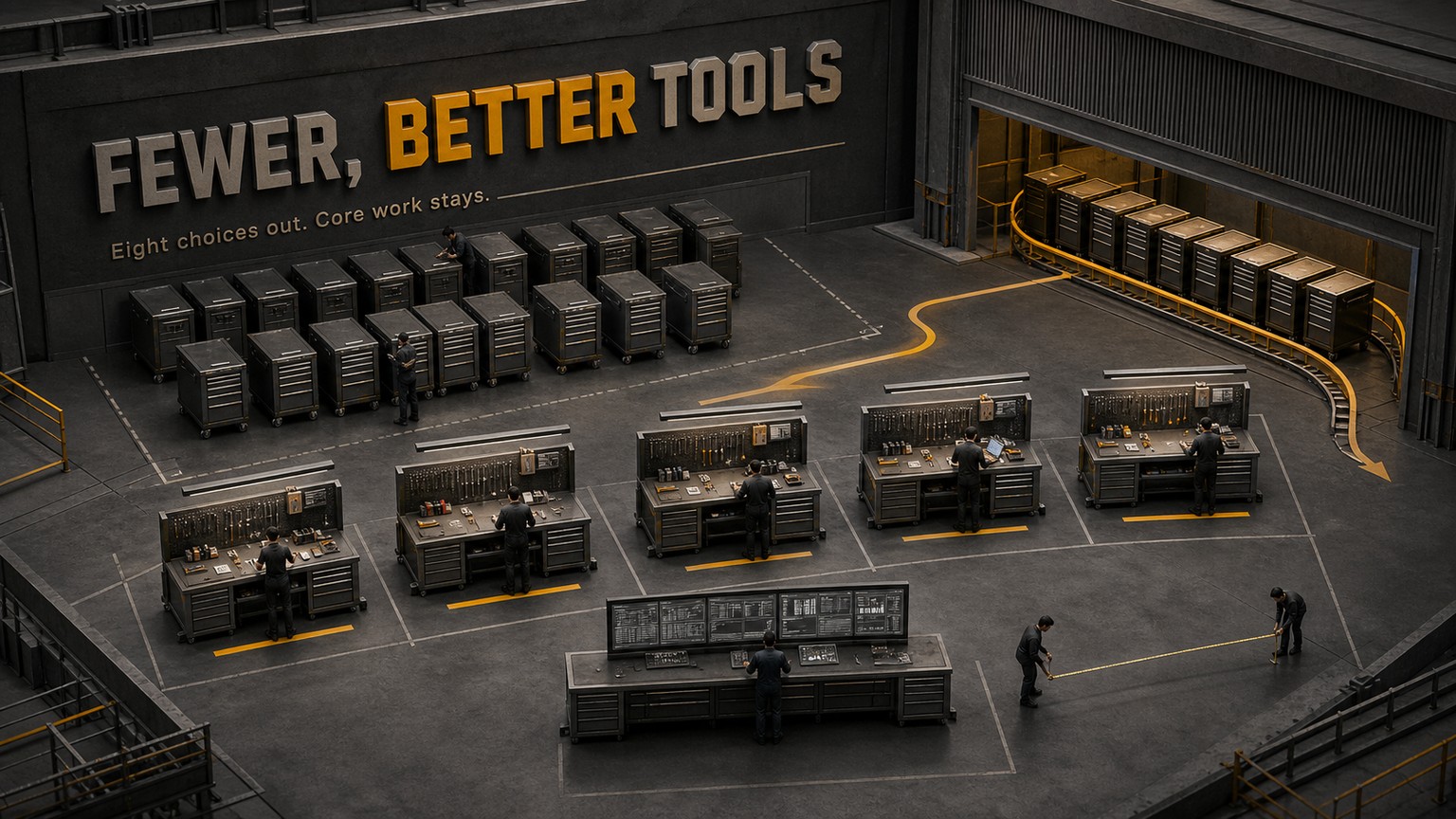
Yes. Fewer tools can improve an AI agent's accuracy when the tools you remove are redundant and the remaining set still covers the job. fx 0.0.7 makes that bet concrete: it stopped advertising eight dedicated filesystem tools and kept the core work available through five focused file tools plus its terminal. The business payoff is not a magical smarter model. It is a smaller menu, less context spent describing near-duplicate actions, and fewer ways to choose the wrong door.
The short answer: fewer choices help, missing choices hurt
An AI agent has to choose a tool before it can use one. Each tool arrives with a name, a description, and an input schema, which is the form that tells the model what arguments the tool accepts. Add enough overlapping tools and the model has to spend part of every turn distinguishing list_files from a terminal command, or rename_file from the same operation through mv.
That is like giving a new warehouse worker 13 keys, eight of which open rooms reachable through the master key. Removing the duplicates makes the choice easier. Throwing away the key to the loading dock makes the worker less capable. The right target is the smallest sufficient set, not the smallest set.
fx 0.0.7 removed eight advertised filesystem tools and says the change is for better accuracy and more context. Its source tree went from 13 filesystem tool implementations to five:
glob_files finds filenames that match a pattern. grep_files finds text inside files. Those two focused search jobs remain visible, while routine operations such as listing, copying, renaming, deleting, and creating folders can go through the terminal.

The distinction matters. fx did not remove the ability to work with files. It removed eight entries from the model's advertised menu.
Why the accuracy can improve
Three things change when an agent sees fewer redundant tools.
1. Tool selection becomes less ambiguous
Overlapping names and descriptions create extra comparison work. A model can understand every individual tool and still pick the wrong one when several appear to fit. Consolidation reduces the number of plausible but unnecessary choices.
2. Tool schemas stop occupying as much context
The context window is the working space sent to the model for a turn. Tool descriptions compete with your request, conversation history, project instructions, code, and earlier results for that space. fx already applies byte limits to external instructions and metadata, and its documentation recommends the smallest limit that preserves what the agent needs.
The release does not publish the exact number of tokens saved by removing eight tools. That number would also vary by model and schema. The useful calculation is straightforward:
monthly tool-context load = schema tokens shown per turn x model turns per month
Measure the full and reduced menus in your own traces. Do not attach a made-up savings percentage to the change.
3. One route gets more consistent practice
When file operations converge on the terminal, the agent uses one general interface for common shell actions instead of switching among many wrappers. Consistency can make policies, logs, and failure handling easier to reason about. It also concentrates authority in a broader tool, which makes terminal permissions more important, not less.
Independent research points in the same direction, with an important limit. A May 2026 preprint on adaptive tool shortlists reported 93.1% correct selection versus 87.1% for a fixed five-tool list. On medium-difficulty queries, the gap was 76.8% versus 60.9%. Yet that same fixed five-tool list found none of the hard cases where the right tool sat between ranks six and 20. Adaptive retrieval found 16.7% of them.

A July 2026 preprint reached a compatible result: its stopping method exposed agents to 37% fewer tools while maintaining comparable task success. Neither paper is an fx benchmark. Together they support the design principle behind the release, while warning against blind deletion.
How fx 0.0.7 applies the idea
fx uses three layers instead of putting every capability in front of the model at once.
- Keep focused primitives visible. Reading, writing, editing, filename search, and content search remain dedicated file tools.
- Route commodity operations through one workbench. The terminal covers core filesystem actions without eight separate schemas in the menu.
- Discover specialist tools only when needed. fx can search installed skills and configured MCP tools from a plain-language request, then load the exact match. MCP, or Model Context Protocol, is a standard way for an agent to connect to external tools and data. Lazy discovery means a large MCP catalog does not have to occupy the context window at once.
Large outputs get similar treatment. fx gives the model a bounded preview and a handle, then read_tool_result can retrieve the exact section needed later. This is the same philosophy applied to results: preserve access, reduce what must stay in immediate view.
The business math is a reliability budget, not a license upgrade
fx is open source under Apache-2.0, so the software license for this tool-pruning pattern is $0. Model usage still costs whatever your selected provider charges. The release gives no accuracy percentage, token saving, or cost reduction, so the financial case has to come from your workload.
Compare that configuration change with the products teams often buy after reliability problems appear. Live pricing results show Datadog Agent Observability Pro starting at $160 per month, Braintrust Pro at $249 per month, and LangSmith Plus at $39 per seat per month before usage charges. Five LangSmith Plus seats are $195 per month before pay-as-you-go fees.
Tool pruning does not replace tracing or evaluation. It is the cheaper first move. Use this formula to decide whether the problem deserves more software:
monthly recovery cost = agent runs x wrong-tool rate x human recovery minutes x loaded hourly cost / 60
Run the same representative tasks against the full and reduced tool menus. Record task success, wrong-tool calls, input tokens, latency, and human recovery time. If the reduced menu holds or improves success, the saved recovery cost is real. If success falls because a necessary tool disappeared, put it back or retrieve it only for the relevant task.
Seven use cases, ranked by who gains most
1. Coding-agent teams with overlapping file actions
A platform team running thousands of repository tasks is the clearest winner. It can keep read, write, edit, filename search, and content search as direct tools, then route copy, move, delete, inspect, and folder operations through a permissioned terminal. The payoff appears in fewer competing schemas per turn and one place to audit shell behavior. This is the exact workload fx 0.0.7 targets.
2. Customer-support agents with duplicate CRM connectors
A support team may expose find_customer, search_contacts, get_account, and vendor-specific lookup actions that all begin with the same job. The team can present one canonical customer lookup, then retrieve a specialist billing or refund tool only after the account is known. That reduces misroutes on high-volume tickets and makes escalation rules easier to test.
3. Internal operations agents spanning many SaaS apps
An operations agent connected to Notion, Slack, Google Drive, Linear, and a database can accumulate hundreds of MCP actions. A capability index can first identify the relevant server, then load only the chosen schema. The payoff is room for the actual policy and business context, not a wall of connector descriptions. If you are choosing the infrastructure for that layer, the related managed agent tools gateway comparison maps the broader market.
4. Finance agents where the wrong write is expensive
An accounts-payable agent should not receive five similar invoice-update tools plus a broad payment tool by default. Keep read-only lookup visible, expose one validated update path, and load payment only inside an approved workflow. The payoff is not just selection accuracy. It is a smaller permission surface and a cleaner audit trail. Sensitive actions should remain distinct even when their names overlap.
5. Sales-operations agents working across CRM records
A revenue-operations team can merge aliases for lead search, account lookup, and contact lookup behind one normalized search action, while keeping write actions such as stage changes separate. The agent spends less time guessing which read tool matches a request, and humans see fewer malformed updates to repair.
6. MCP platform teams serving several departments
A platform owner with a growing tool registry can rank tools by intent, show a short list for ordinary tasks, and search deeper when confidence is low. This is where adaptive selection beats a hard global cap. Marketing, finance, and engineering keep access to specialist tools without forcing every schema into every turn.
7. Teams using smaller or local models
A small local model may have a tighter context budget or weaker tool discrimination than a frontier model. Removing redundant tools can return context to project instructions and task evidence. The payoff can be lower input load and fewer decoy choices, but the reduced menu must be tested on the exact model. A menu that works for one model may fail on another.
Three products worth building
1. Best opportunity: a tool-budget auditor for agent teams
Build a service that ingests agent traces, groups overlapping tools, generates an ablation test, and recommends which tools to merge, hide, or retrieve on demand. The buyer is an AI product team that already knows its agent fails but cannot tell whether the model, prompt, or tool menu is responsible.
Demand is small but commercially sharp. About 260 US searches per month target ai agent observability, up 129% year over year, with a $67.35 CPC. Another 110 target ai agent observability tools, up 320%. Incumbent paid plans range from $39 per seat per month for LangSmith Plus to $249 per month for Braintrust Pro, while Datadog Agent Observability Pro starts at $160 per month.
The smallest sellable version needs trace import, tool-confusion clusters, a before-and-after eval runner, and one report showing success, wrong-tool rate, tokens, latency, and recovery cost. Do not build another generic trace viewer. The wedge is a decision: which tool should disappear from the model's menu, and what evidence supports that change?
The catch is access. Without representative traces and a reliable success grader, the recommendation becomes schema linting dressed up as intelligence. The product also sits near crowded observability suites, so it needs to export tests and recommendations into the tools teams already use. The adjacent agent failure analysis market shows why diagnosis alone is not enough.
2. An adaptive MCP capability router
Build a gateway that indexes MCP tools across a company, retrieves a small candidate set for each request, and expands the set only when confidence is low. Platform teams pay because a central registry grows faster than any one agent's context budget.
The broad job has about 1,000 US searches per month for ai workflow automation, up 48% year over year, with commercial intent and a $43.35 CPC. One of the live questions is, "What is the best AI workflow automation tool?" The product answer is not another canvas. It is the routing layer that lets existing workflows expose the right capability at the right moment.
An MVP needs MCP schema ingestion, embeddings or lexical retrieval, a configurable shortlist, confidence-based expansion, and an audit log. The catch is recall. If the router hides the correct tool, the model cannot recover. Evaluation must include rare tasks, not only the common happy path.
3. A regression suite for tool selection
Build a testing product that plants confusing near-duplicate tools, parameter traps, and missing-prerequisite cases into a safe sandbox, then scores whether an agent chooses and calls the right action. Agent framework vendors and internal platform teams pay before model, prompt, or schema changes ship.
About 90 US searches per month target ai agent testing, up 29% year over year, at a $20.42 CPC. The narrower ai agent testing tools query has only 20 monthly searches, but it is up 400% and carries commercial intent. That is early demand, not a mass market.
The MVP is a versioned test set, a runner for two tool menus, and a diff that separates selection errors from argument errors and execution errors. The catch is benchmark theater. Synthetic tests are useful only when production failures continuously become new cases.

Limits and the honest take
fx 0.0.7 is a strong design signal, not proof that its own accuracy improved. The release states the goal but publishes no before-and-after benchmark. Treat the eight-tool removal as a hypothesis worth testing on your tasks.
Fewer tools will not fix vague schemas, poor descriptions, missing permissions, bad state, weak planning, or an unsuitable model. Consolidating many narrow actions into a terminal can also widen the blast radius of one approved tool. Keep permissions, workspace scope, and destructive-action checks strict.
Do not prune by count alone. Remove aliases and redundant wrappers first. Keep genuinely different high-risk actions explicit. For a large catalog, use retrieval and adaptive depth instead of a fixed ceiling. The best tool menu is task-dependent.
The Monday move
Pick one production agent next Monday and export 30 representative tasks, including five failures and five rare edge cases. Run them once with the current menu and once with obvious aliases hidden. Keep the model, prompt, permissions, and test data fixed. Compare task success, wrong-tool calls, input tokens, latency, and recovery time. Ship the reduced menu only if the complete scorecard improves or holds steady.
How to increase AI accuracy?
For a tool-using agent, start by separating tool-selection errors from model-answer errors. Remove overlapping tool aliases, improve descriptions, keep necessary specialist actions retrievable, and run the same eval set before and after. A smaller sufficient menu can help. A smaller incomplete menu cannot.
How can I automate my workflows using AI?
Define one bounded workflow, give the agent only the tools needed for that workflow, set permissions around write actions, and test real examples before production. Add specialist tools through retrieval as new jobs appear instead of placing every connector in the default menu.
What is the best AI workflow automation tool?
The best fit is the one that covers your actual systems, exposes clear permission boundaries, and lets you evaluate tool choices. For agent accuracy, the number of integrations matters less than whether the agent sees a small relevant set for each task.
Is there a free AI workflow automation tool available?
fx itself is open source under Apache-2.0, so you can use it without a software license fee. Model inference, hosting, monitoring, and human recovery can still cost money, so measure the complete operating cost rather than the download price.
Can I start AI automation for free?
You can prototype with open-source software and provider free tiers. Start with a low-risk read-only workflow and a small eval set. Budget for model usage and for the human time needed to review failures before giving the agent write access.
If you want a smaller, testable tool surface built around your real workflows, AI agent development is the right place to start.
- Published
- Category
- Build
- Language

Claude Code Remote Control
Set up Claude Code Remote Control from CLI, VS Code or Desktop, connect your phone or browser, and fix documented login and connection failures.Oct 9, 2026Build
Cursor Remote Control
Set up Cursor Remote Control on iPhone, pair your laptop, keep local agents reachable, and compare cloud agents, Claude Code and Codex.Oct 9, 2026Build
Firecrawl Pricing 2026: What Your Pages Cost
Firecrawl plans and credit packs verified October 2026. Calculate JSON extraction, failed pages and weekly crawl bills at your volume.Oct 9, 2026Build
Claude Code vs GitHub Copilot 2026
Claude Code vs GitHub Copilot: current plans, usage limits, models, team controls, one-seat and ten-seat costs, and when to use both.Oct 8, 2026Build
LangGraph vs CrewAI
Compare LangGraph and CrewAI on the same approval workflow, state, memory, MCP, observability and current hosted-platform prices.Oct 7, 2026Build
How to Build MCP Server
Build an order lookup MCP server with Python, test it in Inspector, connect Claude Code and Cursor, then add HTTP auth and hosting.Oct 7, 2026Build
Gumloop vs n8n (Verified October 2026)
Gumloop vs n8n: current pricing, credits vs executions, self-hosting and the same AI lead workflow, with a verdict for each builder.Oct 7, 2026Build