Can AI Video Generators Support Live Audience Participation 2026
Infinite Slop shows AI video can take live prompts, rank them by crowd vote, and generate the next shared scene before the audience leaves.
Published Updated
 By Omid Saffari
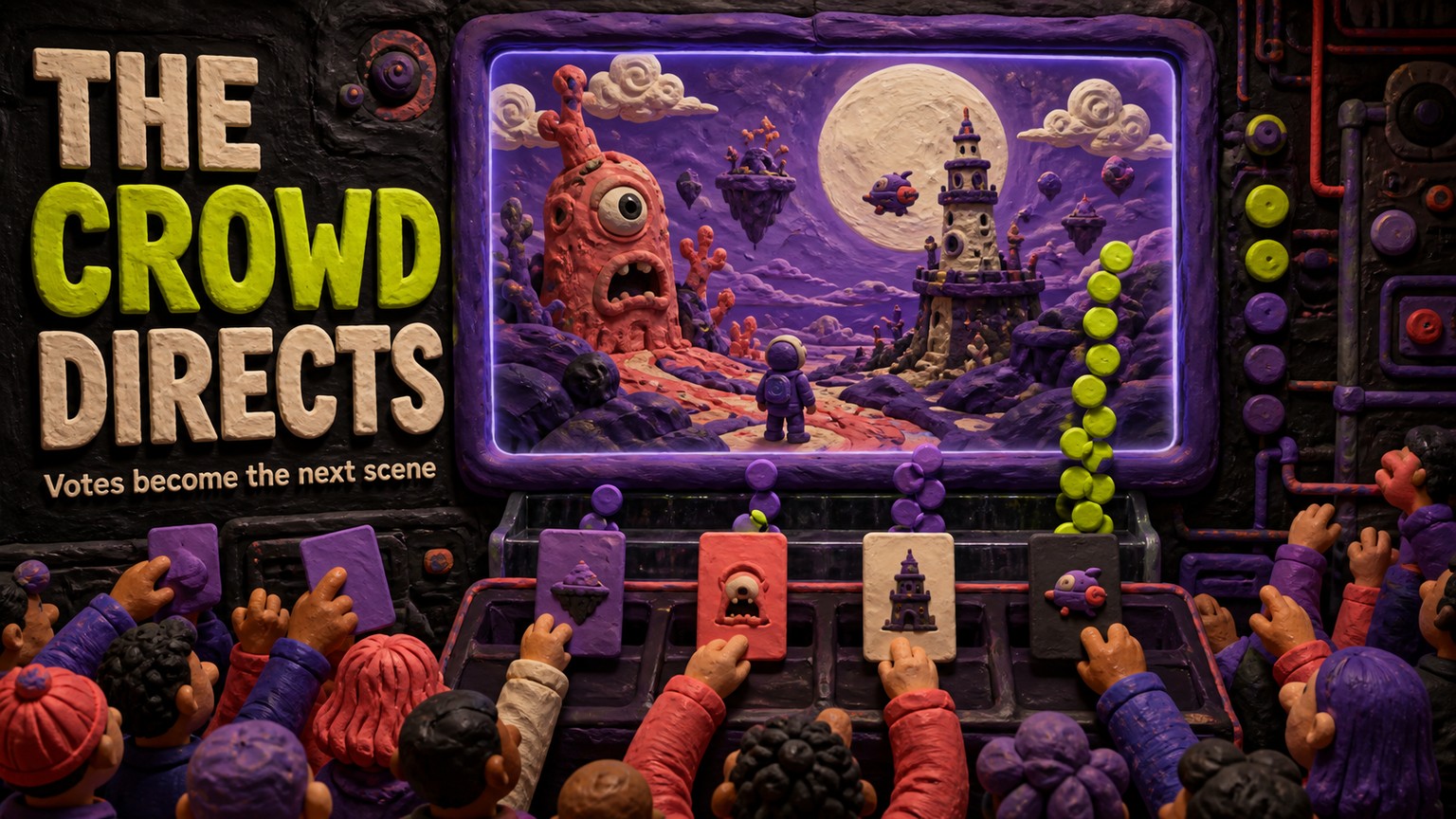
Yes. AI video generators can support live audience participation in 2026, but the workable format is not a private movie for every viewer. It is one shared channel where the crowd submits ideas, votes for what deserves airtime, and watches the winning prompt become the next scene. Infinite Slop has already carried that loop past 2,000 concurrent viewers. The important shift is simple: AI video is becoming fast enough to behave like live media, not just a file you wait to download.
Infinite Slop answers the question with a working format
Infinite Slop is an endless AI-generated TV channel built by Pieter Levels. A viewer types what they want to see, the idea enters a public queue, other viewers upvote it, and the highest-ranked prompt moves into generation. The completed clip then joins the shared broadcast. The official live interface makes that sequence visible through Queue, Now Generating, Playing Next, and On Air states.
Think of it as an improv theatre with a robotic cast. The audience keeps sliding scene cards onto the stage. Votes choose the next card, the cast performs it, and the result gives everyone fresh material for the following suggestion. The model matters, but the queue is what turns generation into a show.
That distinction is the whole answer. This is not instant, frame-by-frame control like a video game. It is queued participation: the audience steers a sequence of short clips quickly enough that the finished stream feels live.
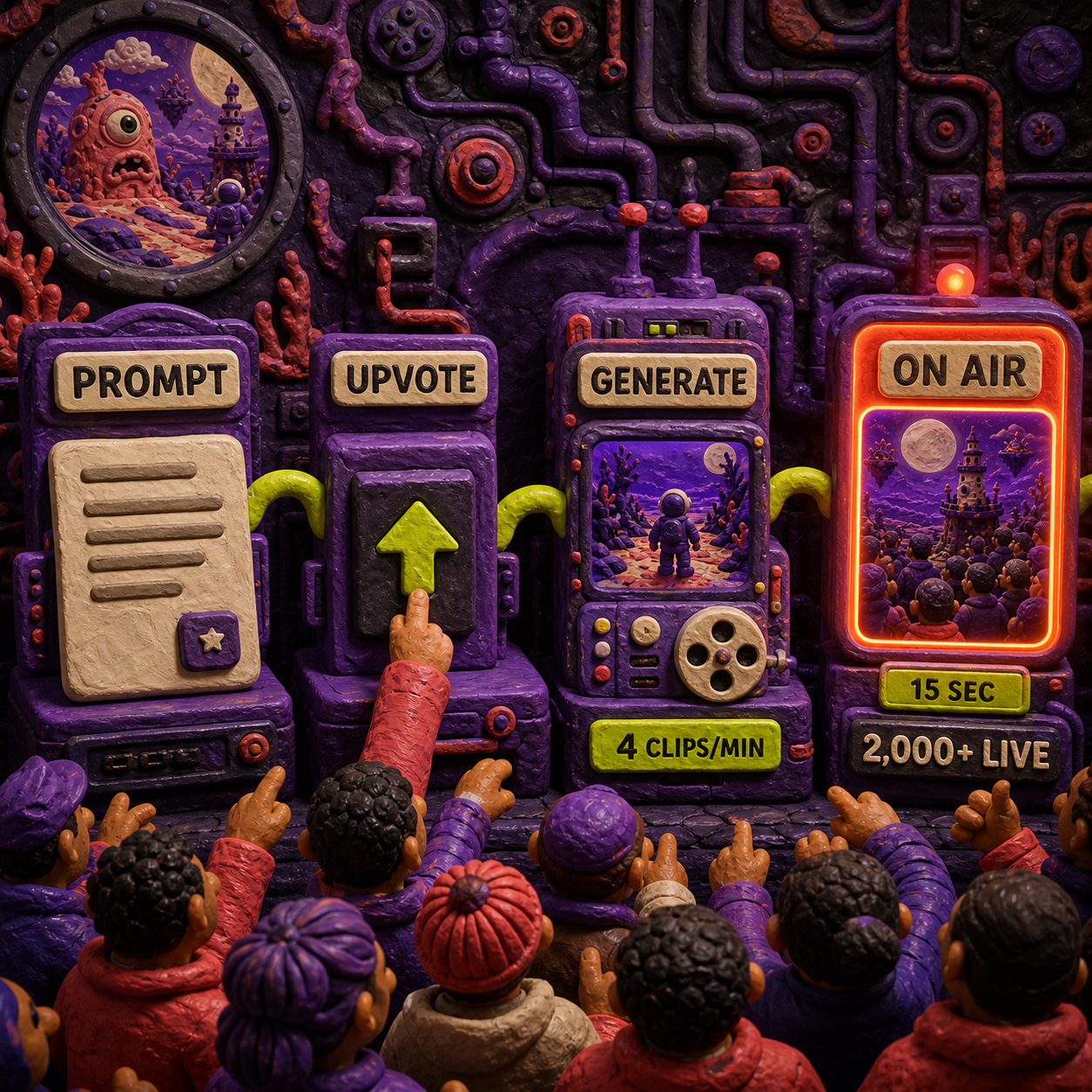
The proof is already meaningful. Levels reported more than 2,000 concurrent viewers after the project drew 37,000 viewers on its first day. The system can put out four 15-second clips per minute. When demand exceeds those four slots, the crowd decides who gets airtime.
The model is fast, the product is the loop
Infinite Slop runs on H3 Max, fal's post-trained version of MiniMax H3. fal says a five-second video can render in under three seconds, around 35 times the throughput of MiniMax's official H3 endpoint. It also generates synchronized audio with the image, so the next scene can arrive with ambience, effects, and music in the same output. fal's release explains the speed work, while the model page lists the current formats and controls.
H3 Max supports five-to-15-second clips at 480p or 768p. Text-to-video can produce 21:9, 16:9, 4:3, 1:1, 3:4, or 9:16. Infinite Slop moved to vertical 9:16 after most of its traffic arrived on mobile.
Here is the operating loop without the jargon:
- Collect: viewers submit short scene ideas in chat.
- Rank: a public vote turns too many ideas into an ordered queue.
- Generate: H3 Max renders the selected 15-second scene while another clip is on screen.
- Stage: the interface shows what is generating and what will play next.
- Broadcast: everyone sees the same result, reacts, and writes the next round of prompts.
The faster model removes the dead air. The visible queue creates anticipation. The shared result gives viewers a reason to react together. Remove any one of those pieces and the format gets weaker.
For a deeper comparison of the engines behind this shift, see the real-time AI video generator guide.
The business math is good for a crowd, bad for one-to-one video
Infinite Slop does not make continuous AI video cheap. It makes the cost shareable.
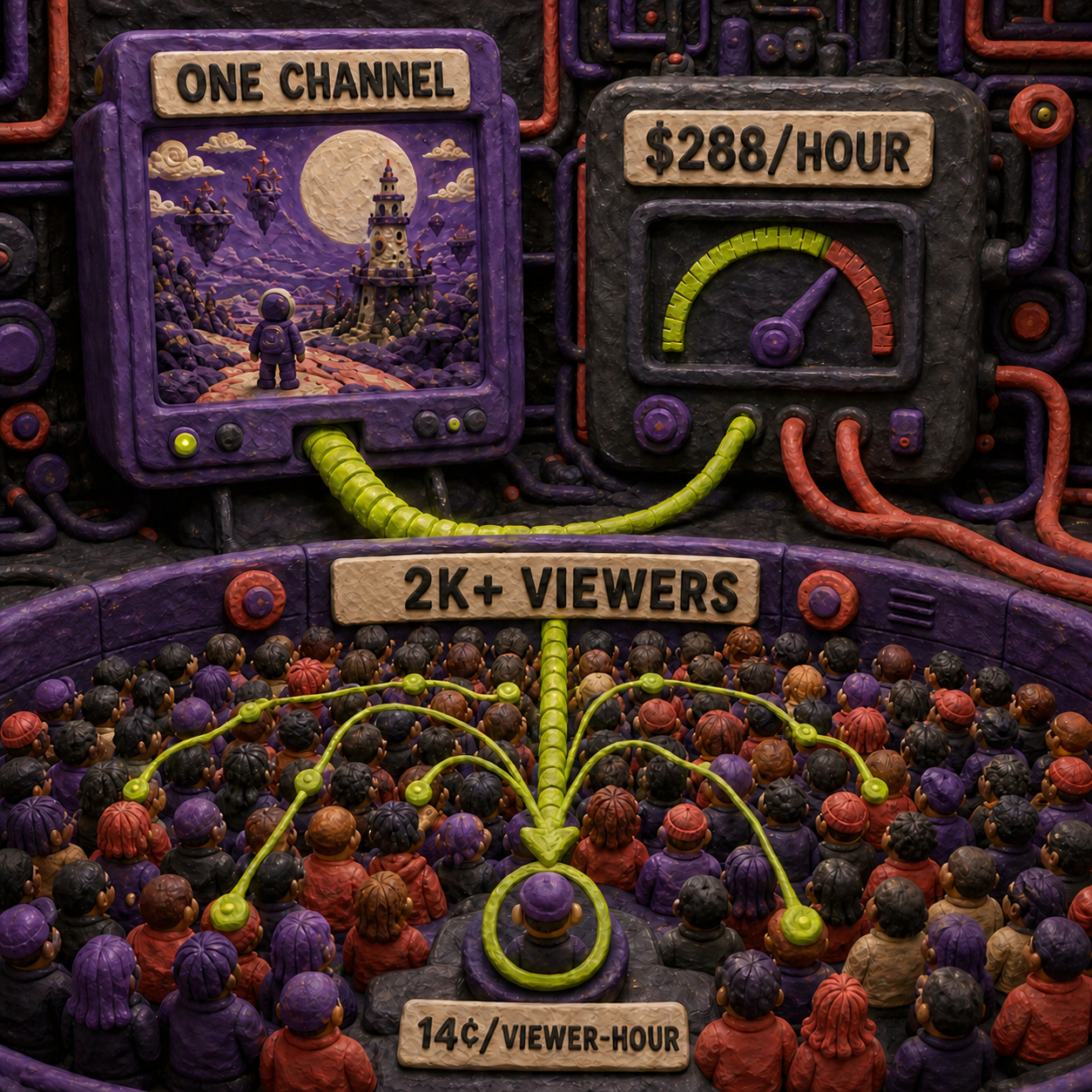
H3 Max's published 768p list rate is $0.08 per generated second. A 15-second clip therefore costs $1.20. Four clips per minute cost $4.80, or $288 for an hour of continuous generation. A full day at that pace reaches $6,912 before streaming delivery, storage, moderation, orchestration, or engineering. fal sponsors Infinite Slop because this workload is expensive.
At 2,000 concurrent viewers, however, that $288 generation hour works out to roughly $0.144 per viewer-hour. One communal channel can plausibly carry that cost through a sponsor, an event budget, or a media brand. Two thousand private generated channels would multiply the same inference bill by 2,000. That is not the product.
The software around the stream is comparatively cheap. StreamYard lists individual plans at $44.99 and $88.99 per month. Crowdpurr's audience-engagement tiers run from $49.99 to $499.99 per month. The generative layer flips the budget: the interface may be a normal software subscription, while the content becomes a metered operating expense.
You can control that expense by slowing the cadence. A 15-minute launch segment at Infinite Slop's full pace costs $72 in generation. One 15-second audience payoff every five minutes costs $14.40 per hour. The second format is less hypnotic, but far easier to sell into an event budget.
Seven use cases, ranked by who can profit first
1. A creator-owned prompt show
A streamer with an established community can run a recurring 45-minute world where viewers compete to direct the next scene. The creator defines the premise, approved characters, visual rules, and banned topics before going live. Audience prompts provide variation inside those boundaries. At one 15-second generation per minute, the model cost is $54 for the episode. The payoff is not replacing the creator. It is turning the audience from chatters into contestants, which creates clips, rivalries, and reasons to return.
2. A branded product-launch spectacle
A sneaker, game, or entertainment brand can let viewers vote on environments, camera moves, or plot twists around a controlled hero asset. A 15-minute activation at four clips per minute costs $72 in generation at list rate. The brand gets a participatory segment instead of another prerecorded reveal, while a moderator and a fixed prompt template keep the product inside approved territory.
3. A conference intermission people shape
An event producer can collect safe prompts during talks, run a vote, and show one generated scene between sessions. One clip every five minutes keeps a one-hour activation to $14.40 in model cost. The exact workflow fits a virtual, hybrid, or physical stage: QR code, prompt form, vote, host approval, generated payoff on the main screen. It gives attendees something to do together without asking them to install a new app.
4. A live shopping story engine
A commerce host can place a product inside a controlled set of audience-chosen situations: beach, subway, moon base, or game show. Viewers vote on the next setup, the host reacts to the result, and the product link stays outside the generated frame. The payoff is a repeatable participation mechanic around each SKU. The catch is strict asset control, because visual drift around packaging or product claims can turn a fun segment into a compliance problem.
5. A sports or esports companion channel
A team can run a separate, unofficial entertainment feed where fans vote on mascots, fictional commentary scenes, or post-match celebrations. It should never impersonate the real broadcast or fabricate plays. Kept in a clearly fictional lane, it can give sponsors interactive inventory during breaks and let fan communities create recurring jokes around a season.
6. A venue queue that changes with the room
A museum, festival, or theme-park queue can let visitors choose the next short scene on a shared display. The operator provides a narrow theme and age rating, while each group inherits what the previous group created. The payoff is practical: waiting becomes part of the attraction, and the same physical display keeps changing without a fixed playlist.
7. A closed classroom simulation
A teacher can invite a class to vote on the next turn in a historical scenario, science-fiction world, or visual storytelling exercise. The teacher approves every winning prompt before generation. This is less commercially attractive than the creator and event cases, but it is a strong controlled test because the group is known, the session is short, and success can be measured through participation rather than raw watch time.
Three products worth building
Best bet: the audience-directed show engine
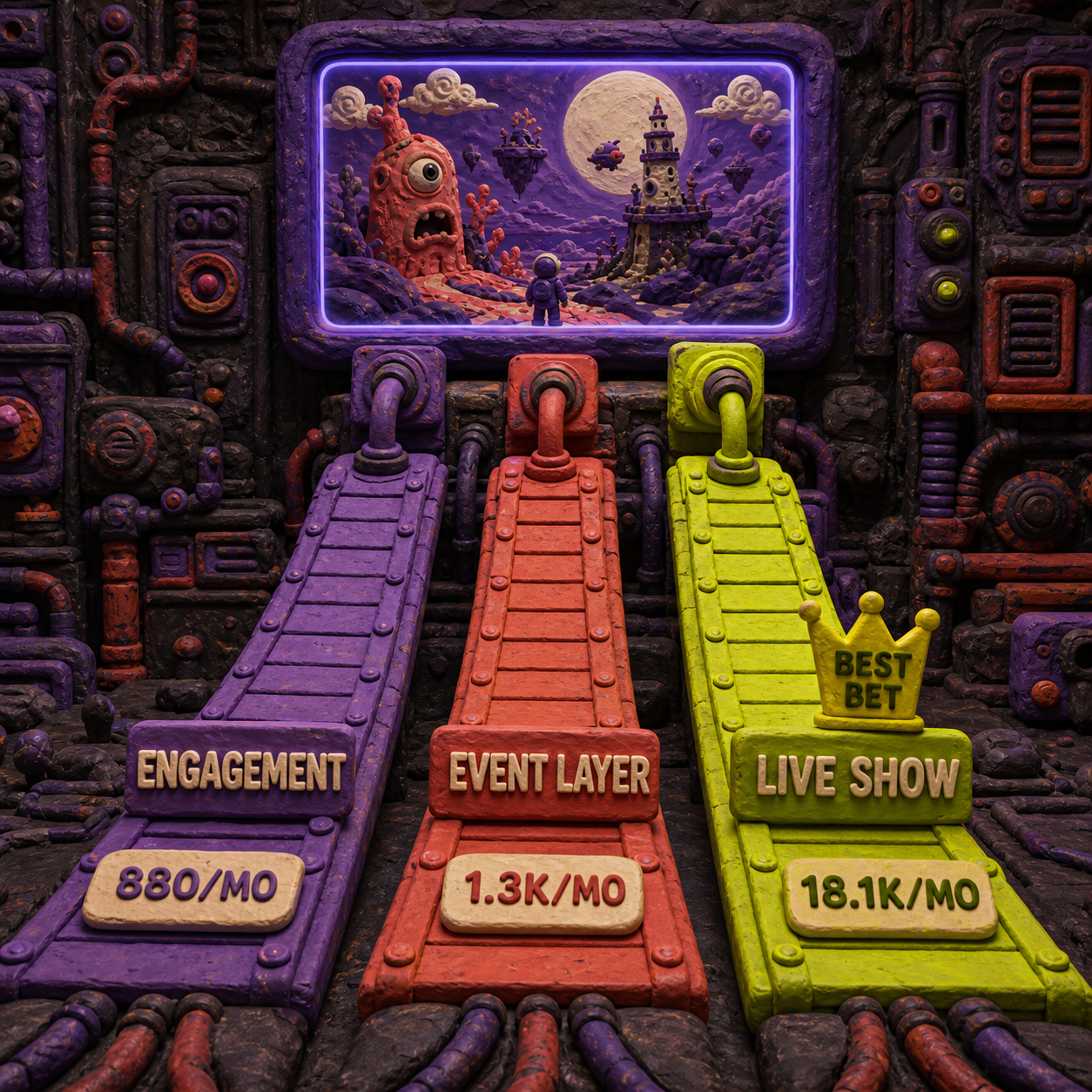
Build a hosted layer that gives creators and media brands a player, moderated prompt intake, voting, a visible generation queue, cost caps, replay clips, and a choice of video models. About 18,100 US searches a month target "live streaming platform," with commercial intent and a $9.70 CPC. Existing creator software already charges $44.99 to $88.99 a month, which proves there is a software budget around going live.
The smallest sellable version needs one vertical player, one model, prompt templates, word and image moderation, host approval, ranked voting, a generation buffer, and a hard hourly spend limit. Start with scheduled 30-minute shows, not a 24/7 channel.
The catch is brutal: the queue and API plumbing are copyable. The defensible part is a show format people recognize, creator distribution, reusable world rules, and moderation data that gets better with each community. This is the strongest opportunity because it sits on the largest demand pool and can own the audience relationship instead of becoming an event add-on.
A generative event-activation layer
Build an embeddable module for conference producers and brand-event agencies. Attendees submit ideas from their phones, vote during a timed window, and watch a host-approved 15-second scene appear on the venue screen. About 1,300 US searches a month target "virtual event platform," and the query carries a $67.96 CPC. Livestorm prices Pro at €2.50 per attendee, while its support table lists 400 annual attendee credits at $1,200. Buyers in this category already tolerate usage-based event budgets.
The MVP is a QR-code web app, three branded prompt templates, a vote timer, moderator approval, one video model, an RTMP or browser output, and a downloadable recap gallery. Charge per activation or bundle a fixed number of generated seconds.
The catch is reliability. A creator can laugh off a strange result. A conference producer with a sponsor on the screen cannot. Human approval, a fallback clip, and a kill switch are core product features, not enterprise polish.
A prompt-battle kit for communities
Build timed rounds where two or more audience prompts compete, the winner becomes a video, and the room scores the result. About 880 US searches a month target "audience engagement platform." Crowdpurr charges $49.99 to $499.99 monthly across tiers serving 100 to 5,000 participants, so the market already pays for live polls, trivia, and social play.
The MVP needs room codes, rounds, team voting, host moderation, one generated result per round, a leaderboard, and shareable replay cards. Sell it first to community managers, educators, and small event teams that want a complete format instead of an open-ended stream.
The catch is novelty decay. A prompt battle without stakes or recurring characters becomes a slow demo. Templates, seasons, teams, and host tools have to create a game people want to play twice.
What this still does not solve
Speed is no longer the only blocker, but it is not the same as control.
- Airtime remains scarce. Infinite Slop can make four 15-second clips per minute. At busy moments, most submitted prompts will not air.
- Continuity is fragile. The system tries to connect clips, but Levels says using the previous clip's last frame can fail when generation slows. A loose story is realistic. A dependable episode arc is not.
- Resolution and duration are bounded. H3 Max tops out at 768p and 15 seconds. Use standard MiniMax H3 when 2K output matters, but accept a different speed profile.
- Voting is not moderation. Popularity can rank safe ideas, harmful ideas, or legally risky ideas. Public shows need automated screening, human approval, rate limits, and a panic button.
- The launch numbers do not prove retention. More than 2,000 concurrent viewers and 37,000 first-day viewers prove curiosity and technical scale. They do not prove that people return after the novelty fades.
- The model is not the moat. fal's own evaluation ranks H3 Max first for quality, prompt understanding, and aesthetics, but other fast models will arrive. The durable value has to live in the format, audience, rules, and moderation system.
Do not use this format for a regulated announcement, an unsupervised children's stream, a brand-critical event with no fallback, or any show that promises each viewer a private result. The working shape is one controlled broadcast with shared participation.
The Monday move
Run a one-hour closed pilot with 20 invited viewers next week. Give them six safe prompt templates, generate one 15-second clip every five minutes, cap model spend at $14.40, and require host approval before anything airs. Track four numbers: the share of viewers who submit, the share who vote, average watch time after the first generated clip, and moderation interventions. If people keep steering after the novelty round, you have a format worth expanding. If they only watch once, faster video did its job and the show design did not.
How do I start a live stream?
Start with a normal shared player and add participation as a controlled layer. Collect prompts, rank them, approve one, generate the clip while existing content plays, then place the result in a visible next-up slot. Test one clip every five minutes before attempting a nonstop channel.
How much does a livestream cost?
The streaming software can start free or around $44.99 per month, but continuous AI generation is the larger cost. At H3 Max's published 768p list rate, four 15-second clips per minute cost $288 per hour in generation alone. A slower cadence of one 15-second clip every five minutes costs $14.40 per hour.
Do live streams make money?
They can earn through sponsorships, memberships, ads, commerce, tickets, or paid participation. An AI-directed stream still needs repeat viewing and a brand-safe format before any of those models work. Infinite Slop proves attention and participation, not a finished monetization system.
Which platform is best for live streaming?
Use the platform where your audience already watches, then own the prompt, voting, moderation, and generation layer yourself. Distribution and audience-directed generation are separate choices. The 2026 AI video generator ranking can help with the model side.
If you want one of these audience-directed video formats built for your business, see the production and design services.
- Last Updated
- Category
- Design
- Language

Claude Design Is Now Free: Pricing and Business Uses
Claude Design is included on Free. See current plan prices, shared usage limits, exports, setup steps and where prototypes need engineering.Oct 10, 2026Design
Beautiful AI Review
Beautiful.ai review: Smart Slide guardrails, current pricing, Team seat ambiguity, AI features, export limits and when Gamma is the better fit.Oct 10, 2026Design
Nano Banana 2.1 Explained: Pricing, Changes, and When to Switch
Nano Banana 2.1 cuts 1K and 2K image costs about in half. Compare monthly budgets, verify the migration, and decide when Pro earns its premium.Oct 8, 2026Design
ElevenLabs Alternatives: Murf, MAI-Voice-2, OpenAI TTS and Cartesia (Verified October 2026)
Compare ElevenLabs, Murf, MAI-Voice-2, OpenAI, Cartesia, Google and Speechify by studio or API job, with verified prices and switching costs.Oct 4, 2026Design
Higgsfield API Pricing
Price Higgsfield API video and image jobs, separate API dollars from app credits, and check top-ups, expiry and cashback before scaling.Sep 27, 2026Design
Is Gemini Live Avatar Free
Check Gemini Live Avatar access, Enterprise API charges and custom-avatar limits before budgeting a customer-facing video agent.Sep 27, 2026Design
Gemini 3.8 Flash TTS Pricing
Price Gemini 3.8 Flash TTS by audio minute, compare Flash-Lite and service tiers, and budget the January 2027 increase.Sep 24, 2026Design