Best Real Time AI Video Generators for Interactive Apps 2026
Four real-time AI video platforms compared by architecture, live prices, control, continuity, and what can ship inside an interactive app.
Published
 By Omid Saffari



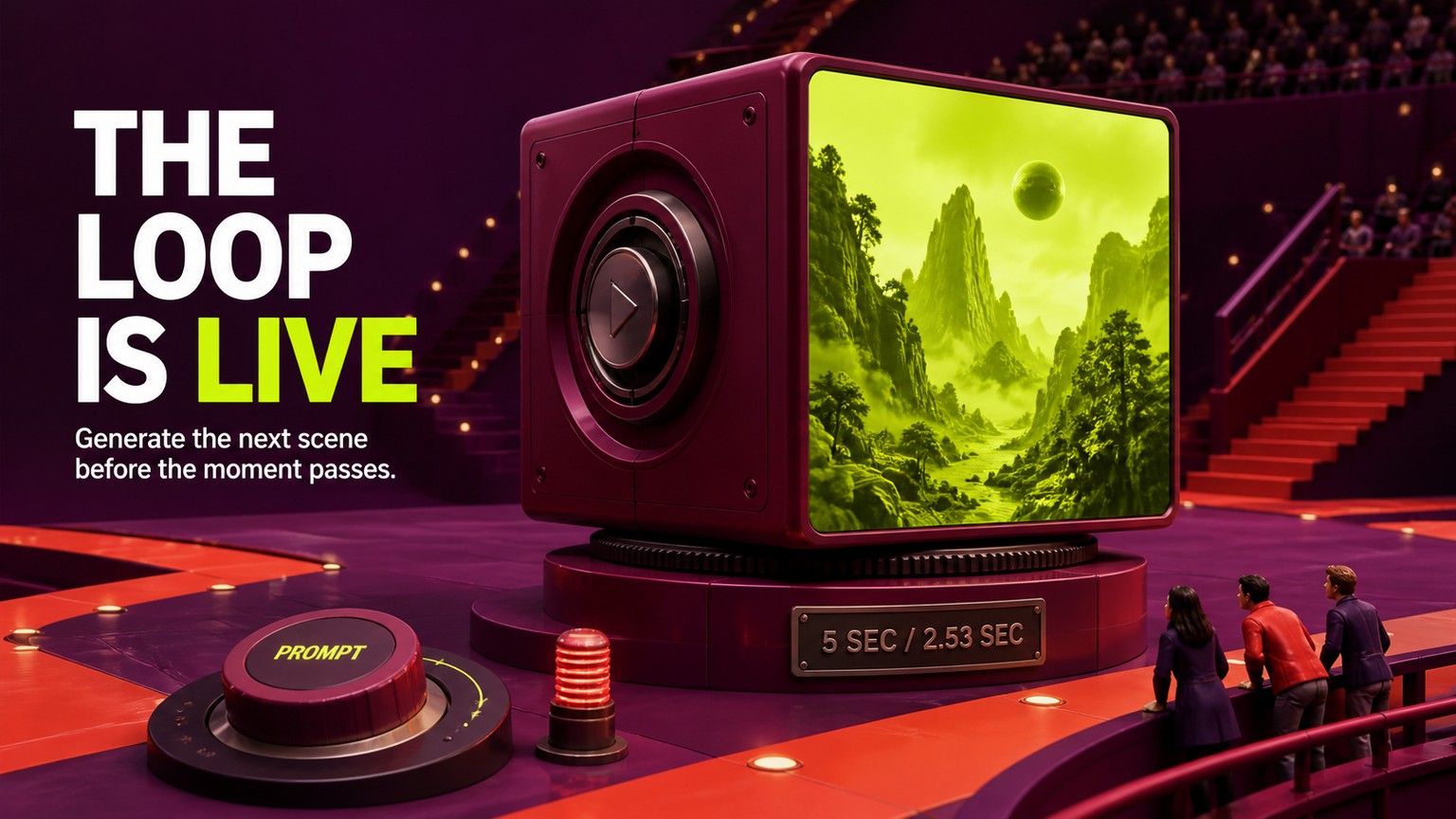
Best real time AI video generators for interactive apps 2026: fal MiniMax H3 Max is the top pick for generating each next scene from user input because its live example returns five seconds of 768p video in 2.53 seconds, at $0.20 before the promotion ends on September 1. Pick Decart when an existing camera stream must transform continuously, Runway Characters for a programmable face, and Tavus CVI for a complete visual agent.
Best Real Time AI Video Generators for Interactive Apps 2026 at a Glance
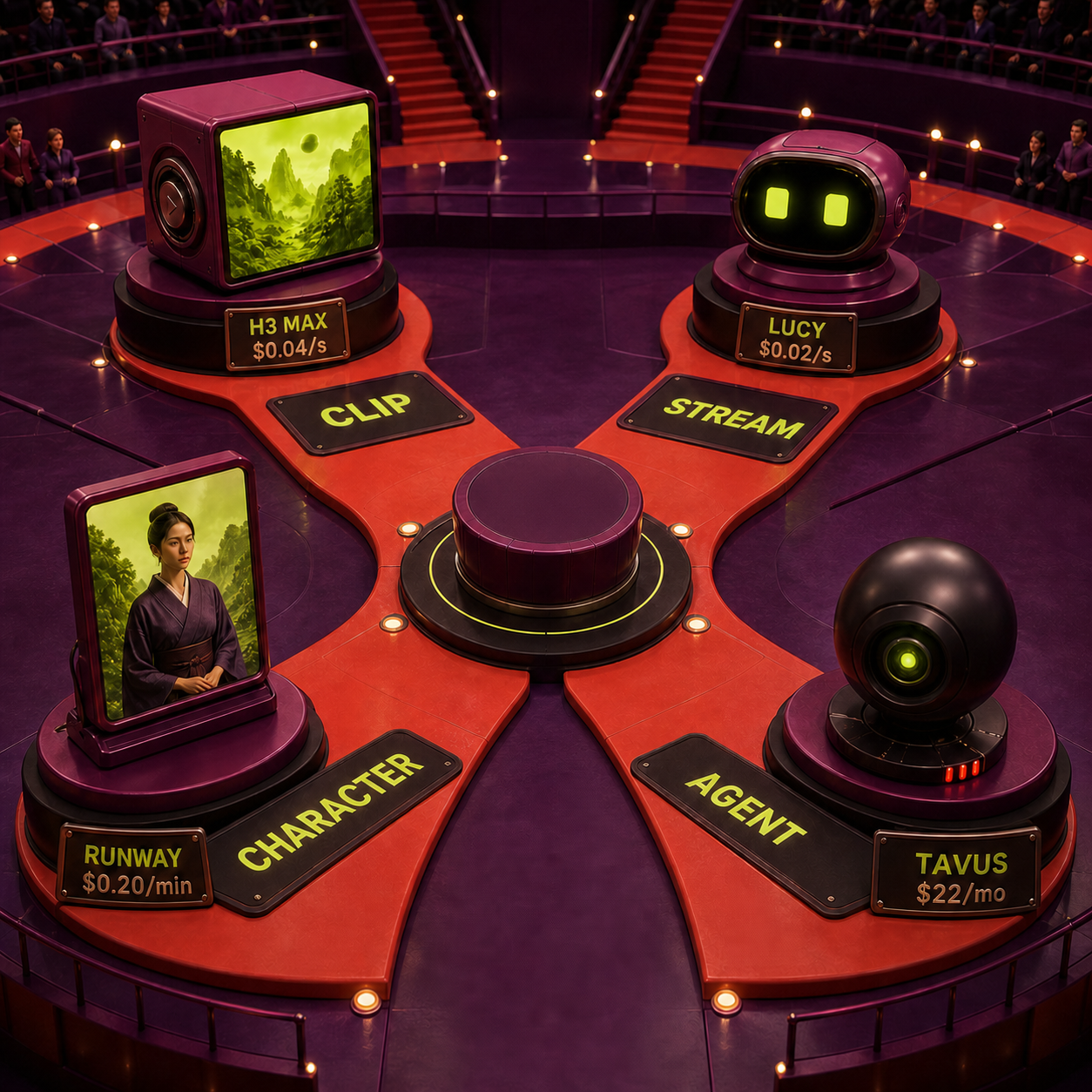
The best choice is determined by what the user is allowed to change. A prompt that creates the next complete scene, a camera stream that changes while it plays, a character that talks, and an agent that sees and remembers are four different products.
Every price and limit above was verified against the vendors' live pages on 31 August 2026. That date is part of the recommendation: fal's endpoint page says the H3 Max launch discount ends on September 1, so a product budgeted from today's price doubles tomorrow.
The decision rule is blunt:
- Choose fal MiniMax H3 Max when the next user action should produce a new five-to-fifteen-second scene.
- Choose Decart when an existing video stream should change without stopping.
- Choose Runway Characters when the visual object is a programmable character with knowledge and actions.
- Choose Tavus CVI when the app needs the character, speech, turn-taking, vision, memory, and transport as one system.
What Real Time Means Inside an Interactive App
Real time means the output arrives before the user stops believing the interface is responding to them. That standard is about the whole product loop, not one model benchmark.
There are four useful architectures.
Discrete generated scene. The app sends a prompt and receives a finished video file. H3 Max fits here. It can return a five-second clip faster than the clip plays, but the app still has to request, receive, decode, and start that file. A buffering layer can hide the gap by playing the current clip while the next one renders.
Continuous stream transformation. The app already has camera or video input. Decart applies a prompt or reference image to that live stream and returns transformed frames over WebRTC, the browser technology used for low-latency audio and video calls. The user does not wait for a separate MP4 after every instruction.
Programmable character. The app needs a face or stylized character that can speak, follow a personality, use knowledge, and take actions. Runway Characters generates that live audiovisual presence. It is not trying to invent a new cinematic environment every few seconds.
Packaged visual agent. The app needs to see the user, detect when they have finished talking, decide what to say, speak, animate a face, remember context, and enforce rules. Tavus CVI packages those layers into one session.
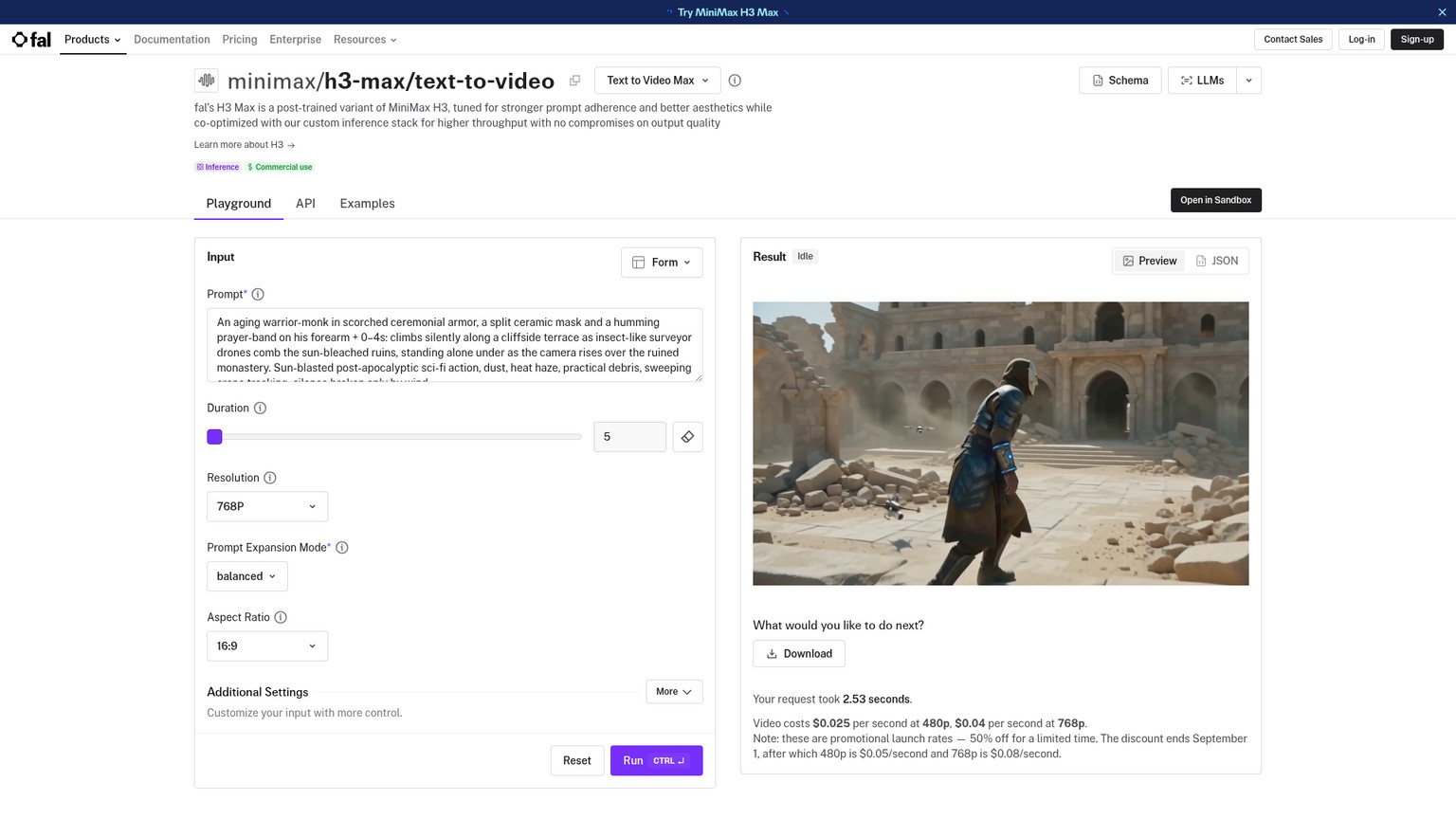
The 2.53-second number on fal's live example is inference time, not guaranteed tap-to-first-frame time. Authentication, safety checks, prompt expansion, queueing, file transfer, storage, decoding, and browser playback still sit around it. A product team should measure the user-visible clock from the input event to the first playable frame.
Temporal continuity is the craft term that matters here: the people, objects, lighting, and geography should remain coherent from one moment to the next. A model can be fast and still break the experience by changing a jacket, moving a door, rewriting a sign, or forgetting where a character stood. Speed makes another attempt cheaper. It does not make continuity automatic.
An interactive product also needs a failure state. If generation times out, the user should see a safe fallback clip, a held frame, or a clear retry state. Letting a blank player sit where a response should be is not graceful degradation. It is a broken product.
How These Were Picked
The four picks had to own a different interactive job and expose enough current information to budget a prototype.
- A developer path exists now. A research demo, consumer-only editor, or waitlist did not qualify.
- The price is visible. Each pick publishes a self-serve rate or plan. "Contact sales" can exist at the enterprise end, but it cannot be the only number.
- The user loop is documented. The model must accept a request, stream, conversation, or control change that an app can wire to a real interface.
- The wall is visible. Resolution, input requirements, continuity, concurrency, session metering, and missing agent layers all count.
- The architecture earns its place. Four deep, incompatible choices are more useful than a long list of batch generators with "Fast" in their names.
This is a priced-and-analyzed comparison, not a claim that the tools were exercised through paid accounts. The proof is the live documentation, dated pricing, normalized cost, and the product behavior each API exposes.
The broader inventory of portrait renderers and conversational-video vendors remains useful in the real-time AI video API roundup. This page answers the narrower app question: what can change while the user is still in the moment?
1. fal MiniMax H3 Max: Best for Audience-Controlled Generated Scenes
fal MiniMax H3 Max is the first choice when a user action should create the next complete scene, not merely alter an existing stream. The live endpoint example reports 2.53 seconds of inference for five seconds of 768p output, which is fast enough to generate the next segment while the current segment is still playing.
Best for: Audience-controlled stories, live creative review, prompt battles, game-show segments, and any bounded interaction where the next result is a complete clip.
Standout: A five-second 768p clip renders in under three seconds in fal's published example, with synchronized native audio in the same generation.
Pricing: Promotional rates are $0.025/output second at 480p and $0.04 at 768p through August 31; from September 1 they are $0.05 and $0.08 respectively.
Free trial: Five daily generations without sign-up plus five more after sign-in. fal's page conflicts on the no-sign-up resolution, so do not promise a free-tier resolution inside a product.
- Complete general-purpose scenes arrive faster than playback in fal's published five-second example.
- Native audio removes a separate synchronization step for ambience, effects, dialogue, or music.
- Text-to-video and image-to-video cover both blank-canvas prompts and a visually anchored starting point.
- Five-to-fifteen-second durations and six listed text-to-video aspect ratios fit many short interaction loops.
- The API returns clips, not a continuous WebRTC session.
- 768p is the ceiling; standard MiniMax H3 is the separate choice for 2K and deeper reference or editing control.
- Cross-clip character and world continuity still belong to the application workflow.
- The 768p list price doubles when the launch promotion ends on September 1.
Why the speed changes the product
A batch generator asks the user to submit and wait. H3 Max allows the app to keep something playing while it prepares what comes next. That turns video from a delivered asset into a possible interface response.
Pieter Levels's Infinite Slop announcement shows the format clearly: viewers write in chat, the selected input becomes the next generated scene, and the system tries to connect it to the previous clip. The announcement page showed 1,788,605 views when verified on August 31. That view counter does not prove conversion, retention, or concurrent capacity. It does prove that audience-directed generated video can be presented as a live product rather than a download page.
The architecture still needs a buffer. If clip A is playing, generate clip B before A ends. If B fails, play a deterministic bridge or extend the safe fallback rather than freezing the player. "Faster than playback" is the room that makes this possible, not permission to remove resilience.
The September 1 budget reset
At the promotional 768p rate, one five-second interaction costs $0.20. The same result costs $0.40 after September 1. One thousand interactions move from $200 to $400. A product handling one thousand such actions per day moves from $6,000 to $12,000 over a thirty-day month before storage, delivery, moderation, or retries.
The full pricing comparison, including higher-control MiniMax H3, sits in the real-time AI video API cost comparison. The practical shift created by the latency change is explored separately in Can AI Video Render Faster Than Playback 2026.
A bounded H3 Max prototype
Choose one five-second loop
Start with one action whose output can be judged quickly: pick the next room, change the weather, reveal a product variation, or vote on the next scene. Do not start with an endless world and undefined continuity.
Lock the visual invariants
Use an approved image when identity matters. Name the subject, wardrobe, product geometry, camera position, ending composition, aspect ratio, and sound conditions that must not change.
Generate one clip ahead
While the current segment plays, request the next segment. Keep a safe bridge clip ready in case the result misses the latency or safety threshold.
Gate before playback
Check the prompt before generation and the file before public display. Text safety does not guarantee visual safety, brand accuracy, or readable on-screen text.
Stop at a fixed budget
Cap the first run at 100 paid five-second interactions. That caps 768p generation at $20 on August 31 or $40 from September 1, before retries. Review latency, failure reasons, and accepted-output cost before adding more traffic.
The craft bar
H3 Max is ship-ready for a bounded experience when the app constrains subjects, keeps the duration short, carries fallback media, and can reject a bad result before it appears. It is mood-board-only when the experience depends on a character remaining exact across an uncontrolled chain of fresh generations.
Text inside generated scenes is another risk. Prompt adherence can be strong without every label, price, or logo remaining correct. Render product copy and interface text as deterministic HTML or video overlays after generation. Do not ask the model to redraw the part of the experience that must be legally or commercially exact.
2. Decart Realtime: Best for Transforming a Live Camera or World
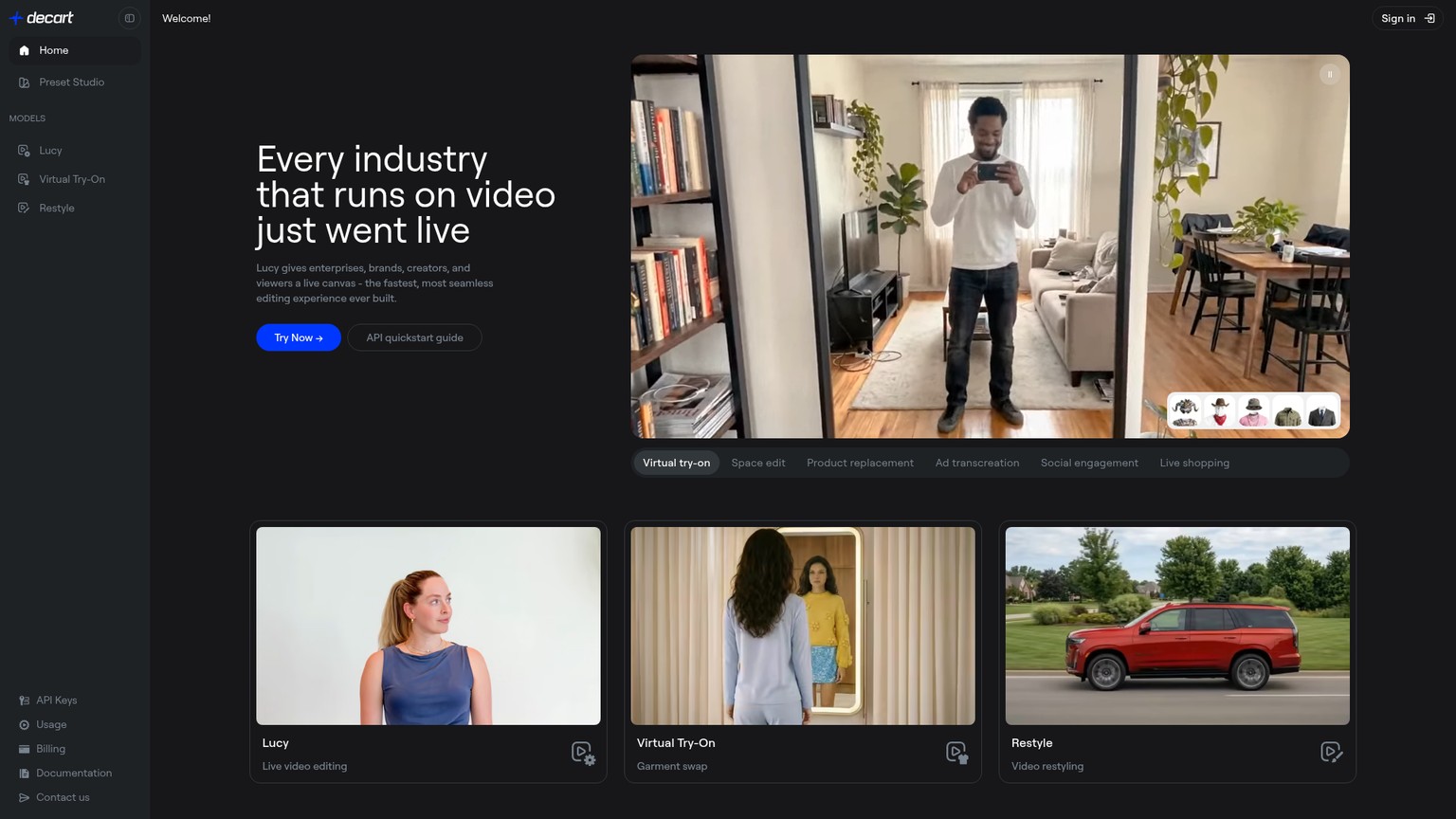
Decart Lucy 2.5 is the better choice when the app already has live video and the user wants to change it continuously. Its current model surface takes a required stream, a prompt, and an optional reference image, then returns edited video over WebRTC while the prompt can change during the session.
Best for: Live camera effects, virtual characters driven by a performer, interactive try-on, scene restyling, and realtime world or driving experiments.
Standout: The app can update the edit instruction while a stream remains active instead of requesting a new file for every change.
Pricing: Lucy Restyle 2 is $0.01/active second at 720p. Lucy 2.5, Lucy VTON 3.5, and Oasis 3 Preview are each $0.02/active second at 720p. Enterprise volume pricing is custom.
Free trial: New accounts receive unspecified evaluation credits. There is no continuing free production tier stated on the pricing page.
- WebRTC fits camera-led interactions and live playback.
- Lucy 2.5 can combine a text edit with a reference image in the same session.
- Separate editing, restyling, virtual try-on, and world-model routes make the product intent explicit.
- Usage pricing has no subscription or minimum spend.
- Lucy needs an input stream; it is not a blank-canvas scene generator.
- Current realtime output is listed at 720p.
- The vendor calls the experience zero latency but does not publish a comparable end-to-end number on the pricing page.
- Active-second billing scales with every private session, even when the user is looking rather than changing anything.
The distinction from H3 Max is simple. H3 Max invents the next clip. Lucy transforms the video that is already moving. If a shopper points a camera at themselves and changes a garment, Lucy's input-preserving design is the right shape. If the shopper asks to see that garment in a newly generated cinematic scene, H3 Max is the right shape.
Decart's live pricing page puts Lucy 2.5 and Oasis 3 Preview at $1.20 per active minute. Ten thousand active minutes cost $12,000 before delivery and any surrounding agent. Lucy Restyle 2 is $0.60 per active minute, or $6,000 for the same usage.
The craft wall is preservation. A useful live edit changes the requested property while keeping pose, motion, face, product shape, and background elements stable. Put the invariant in the acceptance check: if the prompt changes a shirt color, reject a result that also changes the logo, face, or room.
Lucy can be ship-ready for an entertainment filter, guided try-on, or performer-driven character when the source video is controlled and the app makes the synthetic nature obvious. It remains a prototype when a small visual drift could misrepresent product fit, regulated information, or a real person's identity.
3. Runway Characters: Best Programmable Visual Character
Runway Characters is the strongest pick when the app needs a persistent conversational character rather than a new scene on every turn. Runway's developer guide creates a character from one image and gives the app control over voice, personality, knowledge, and actions without a separate fine-tuning job.
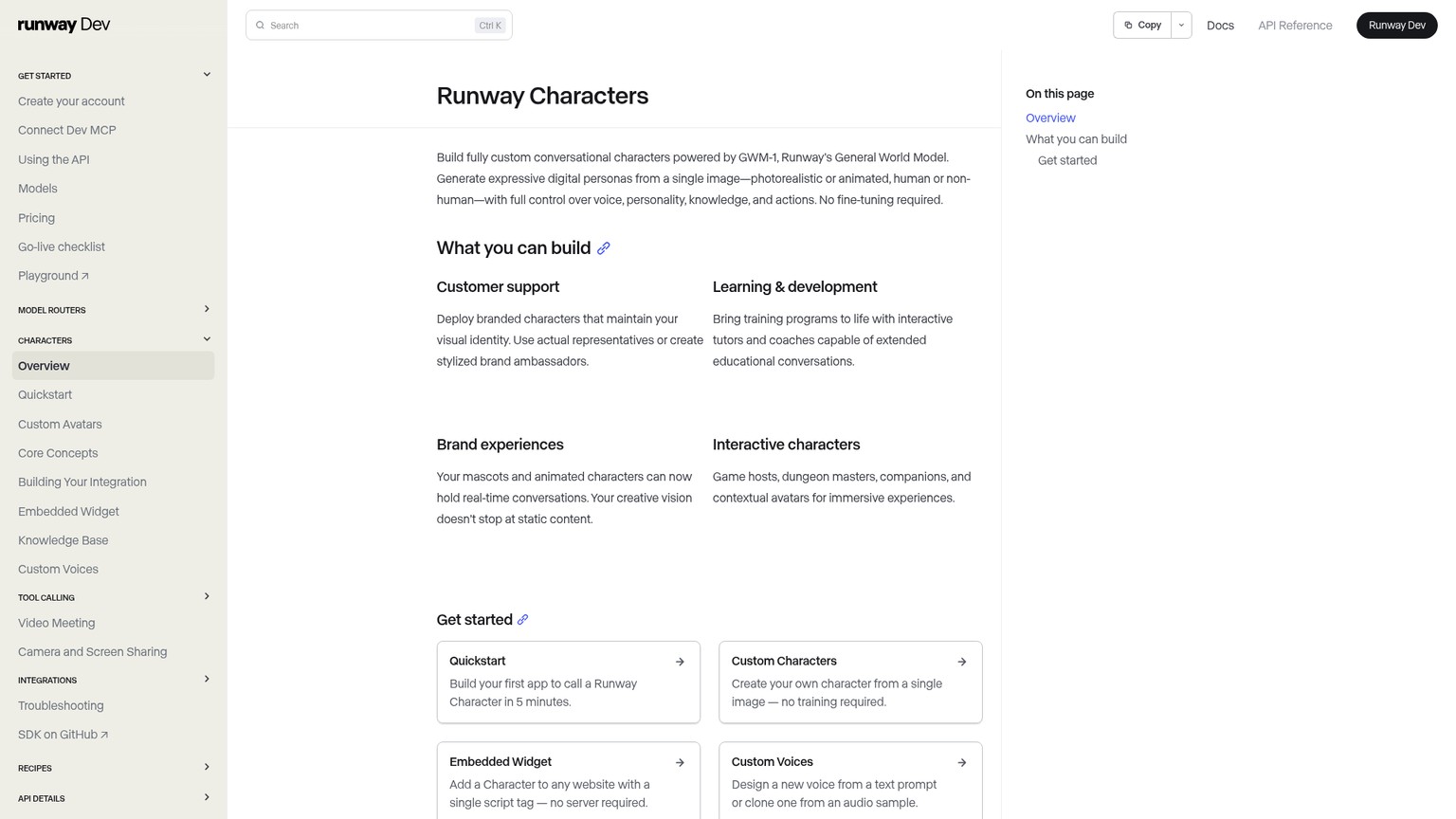
Best for: Tutors, support agents, game hosts, companions, mascots, and contextual characters that must speak and act inside an application.
Standout: One reference image can define a photorealistic, animated, human, or non-human character, while the app supplies knowledge and actions.
Pricing: Developer credits cost $0.01 each. GWM-1 Avatars costs 2 credits upfront plus 2 credits per 6 seconds, equal to $0.02/session plus about $0.20/streamed minute.
Free trial: Not stated on the live developer pricing page.
- A single image can establish a custom character without a training process.
- Personality, knowledge, actions, transcripts, and recordings support application behavior around the video layer.
- A website widget offers a shorter launch path, while LiveKit supports a bring-your-own-agent architecture.
- Runway documents a direct ElevenLabs Agents connection for teams already using ElevenLabs for the conversational layer.
- The product is a character renderer and interaction layer, not a full-scene world generator.
- The minute rate does not include every external model or service in a bring-your-own-agent stack.
- No free trial is stated on the current developer pricing page.
- Each live WebRTC session has a five-minute maximum, so longer experiences need an explicit session boundary.
The pricing is unusually easy to normalize. One maximum-length five-minute session costs $1.02 from Runway: $0.02 upfront and $1.00 for the streamed time. Ten thousand five-minute sessions cost $10,200 before any external language model, speech service, storage, or transport that the chosen architecture adds.
The documented ElevenLabs route is an honest fit for a team that already owns voice-agent behavior there: ElevenLabs handles the conversation and Runway renders the character. That can shorten migration work, but it also creates two metering surfaces and two failure domains. Log a shared session identifier across them so a support team can trace a delayed or broken response.
Runway is ship-ready when the experience is fundamentally a conversation with a character and the application owns the surrounding permissions, tools, knowledge, session handoff, and five-minute boundary. It is the wrong purchase when the user expects the room, weather, objects, and camera grammar to be regenerated as a fresh visual world on every turn.
4. Tavus CVI: Best Complete Visual-Agent Stack
Tavus CVI is the best choice when the buyer wants the whole visual conversation pipeline under one product boundary. Tavus's architecture combines visual perception, turn-taking, speech recognition, a language model, text-to-speech, a realtime Phoenix face, and WebRTC transport.
Best for: Visual support, onboarding, coaching, intake, training, and other conversations where the agent should see the participant and manage the full turn.
Standout: Raven handles perception, Sparrow handles conversational flow, and Phoenix renders the realtime face while the buyer can still replace selected pipeline layers.
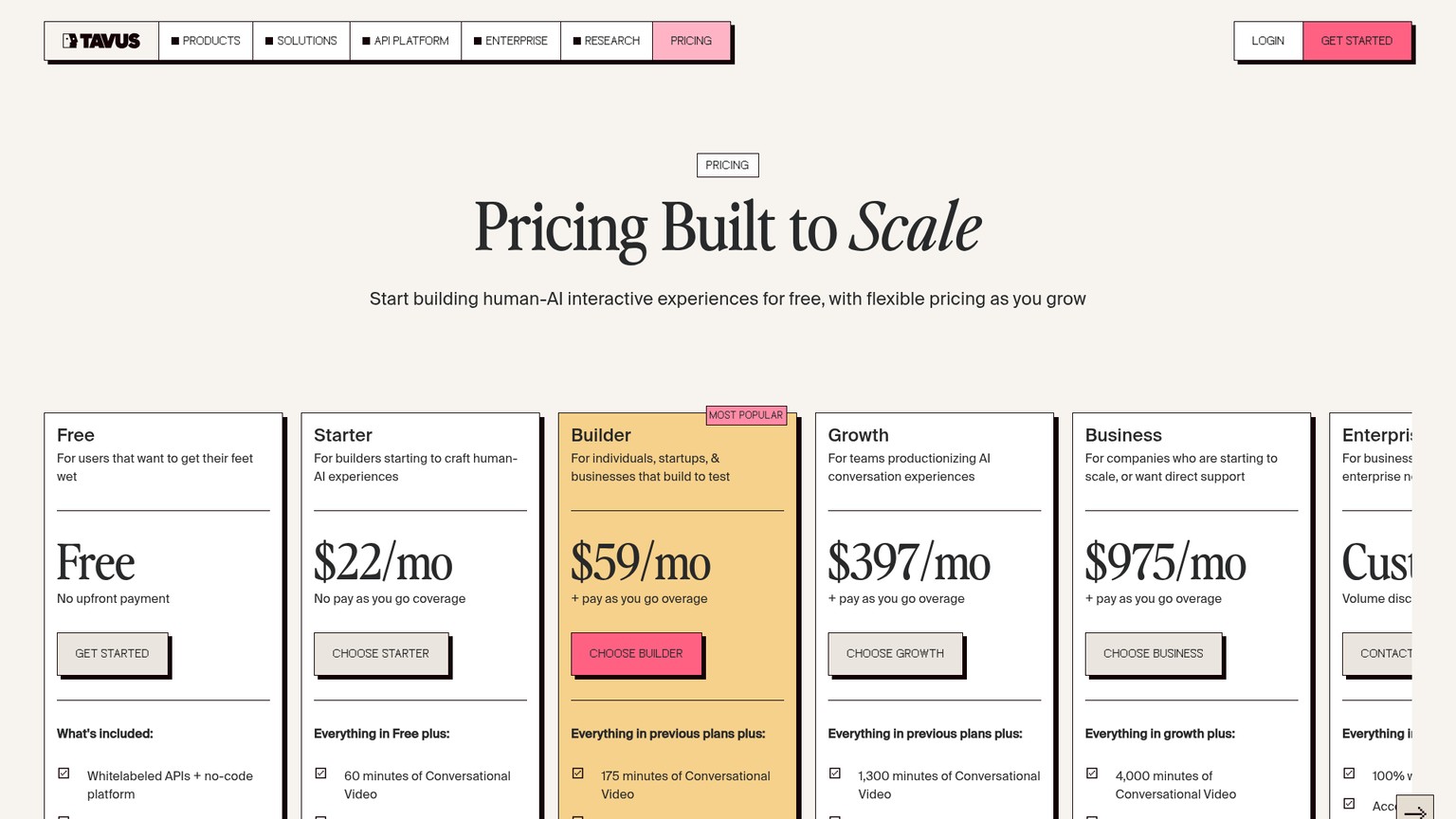
Pricing: Free is $0. Starter is $22/month. Builder is $59/month. Growth is $397/month. Business is $975/month. Enterprise is custom.
Free trial: Free includes 20 CVI minutes and 1 concurrent stream, with a 5-minute maximum conversation and no pay-as-you-go overage.
- The bundled price includes the language-model, speech, WebRTC, perception, turn-taking, and visual layers.
- Every tier publishes its included minutes and concurrency.
- The pipeline supports custom components, including ElevenLabs as a text-to-speech option.
- Objectives, guardrails, memory, tools, transcripts, and recordings reduce the amount of surrounding agent plumbing.
- The bundle sets the session model, metering rules, and many operating boundaries.
- A 30-second minimum applies to each conversation, and extra usage is rounded to 6-second increments.
- Concurrency can become the limiting resource before monthly minutes do.
- The price comparison is not apples-to-apples with a raw renderer because Tavus includes more of the stack.
The live pricing page lists six developer tiers. Free includes 20 CVI minutes and 1 stream; Starter includes 60 minutes and 1 stream for $22, but neither allows overage and each caps a conversation at 5 minutes. Builder includes 175 minutes, up to 3 streams, a 15-minute conversation limit, and $0.35-per-minute overage. Growth includes 1,300 minutes, up to 10 streams, and $0.31 overage. Business includes 4,000 minutes, up to 15 streams, and $0.26 overage. Growth and Business list no conversation-duration limit. Enterprise makes minutes, concurrency, discounts, white labeling, security, support, and service commitments custom. Every tier lists 1080p video.
At 10,000 CVI minutes in one month, Builder works out to $3,497.75: the $59 base plus 9,825 overage minutes at $0.35. Growth works out to $3,094: the $397 base plus 8,700 overage minutes at $0.31. Business works out to $2,535: the $975 base plus 6,000 overage minutes at $0.26. Business is the least expensive published tier at that volume and carries the most published concurrency. Starter cannot serve the workload because it does not allow overage.
Tavus is ship-ready when the product needs an agent that can observe, converse, and act, and the buyer values one integrated path over maximum component choice. It is too much product when the job is simply to generate the next five-second scene or restyle a camera feed.
Who Should Pick What
Pick fal MiniMax H3 Max for a shared story channel, prompt battle, branching product reveal, or audience-controlled scene. The flip condition is a complete new clip. If the product must preserve a continuous live performance frame by frame, move to Decart.
Pick Decart Lucy 2.5 for a live virtual try-on, performer-driven character, responsive camera filter, or scene edit. The flip condition is an existing input stream. If no input stream exists and the app must invent the whole scene, move to H3 Max.
Pick Runway Characters for a branded mascot, tutor, game host, or support character when the product team wants to own the agent logic or connect an existing agent. The flip condition is a persistent visual identity with programmable knowledge and actions. If the team does not want to assemble or operate the wider conversational stack, move to Tavus.
Pick Tavus CVI for a visual agent that should see, hear, remember, manage turns, use tools, and render a face inside one session. The flip condition is buying the complete conversation system. If the app only needs the rendering layer, the bundle creates unnecessary cost and lock-in.
Do not choose by a demo reel. A beautiful clip does not answer whether the endpoint streams, whether it requires an input video, whether it maintains a character, or whether it includes the agent that drives that character.
The Interaction Budget: Shared Stream or Private Generation
The interaction budget is the cost of keeping the user-visible loop alive, including paid failures and idle session time. It reveals why the same model can support one clever public experience and bankrupt a naive private one.
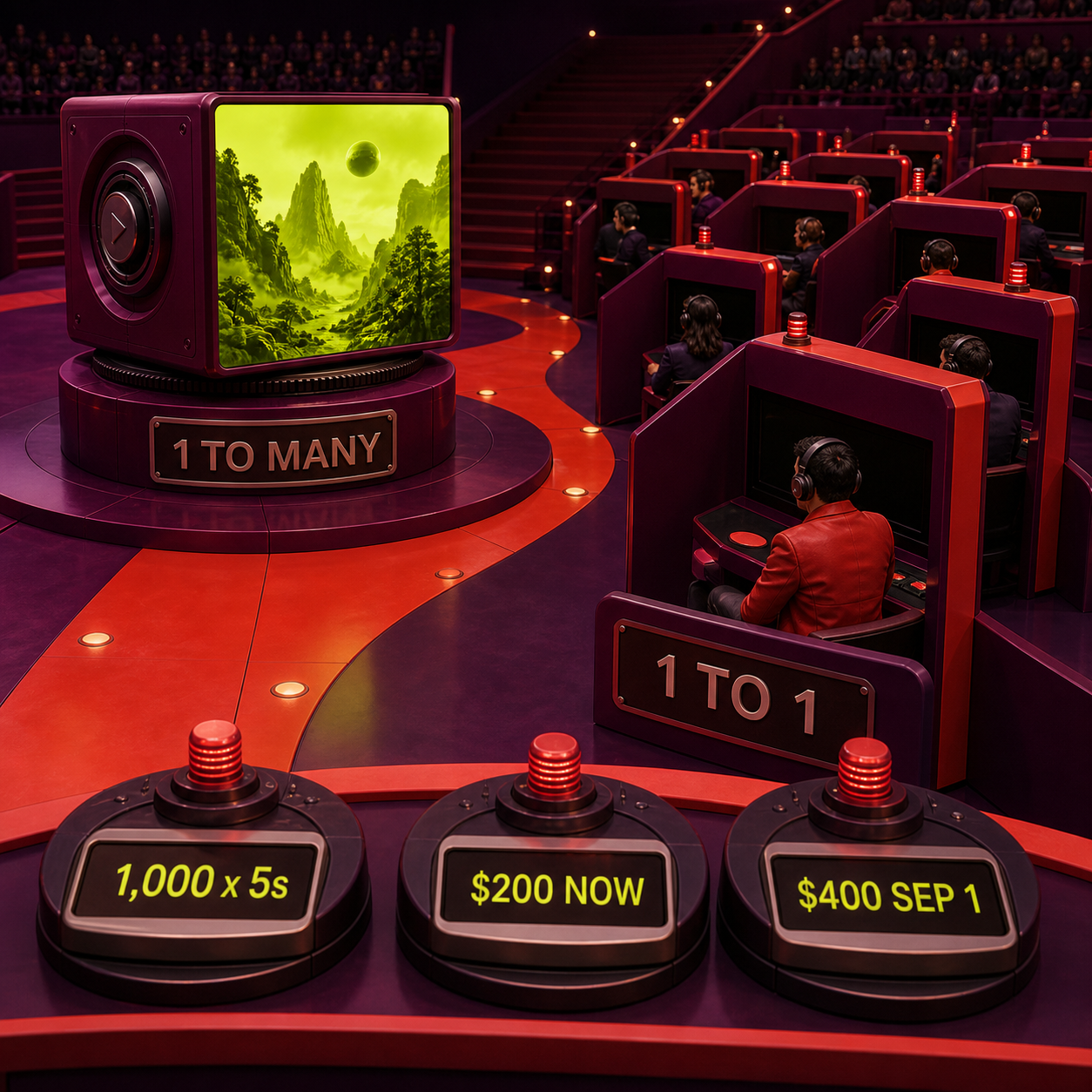
A shared channel generates one sequence and broadcasts it to many viewers. The video-generation bill follows the output sequence, while delivery bandwidth and moderation scale with the audience. Infinite Slop uses that one-to-many shape: a crowd influences one stream rather than receiving a private generation each.
At H3 Max's promotional 768p rate, continuous generation costs $2.40 per output minute or $144 per hour. From September 1 it is $4.80 per minute or $288 per hour. Kept live around the clock for a thirty-day month, the retail API total is $103,680 during the promotion or $207,360 after it. Sponsorship, negotiated rates, and internal infrastructure economics can change who pays, but the public rate shows why an endless stream needs a business model.
Private generation multiplies the unit by the number of actions. One thousand five-second H3 Max interactions cost $200 on August 31 and $400 from September 1. One thousand per day cost $6,000 or $12,000 across thirty days, before retries.
Decart bills the active stream instead. Lucy 2.5 costs $1.20 per active minute. Runway Characters costs about $0.20 per streamed minute plus the session start. Tavus bundles more of the agent and prices by included and overage CVI minutes. These rates are not a quality leaderboard. They are four different meters attached to four different products.
A Before-to-After Recipe for the Same Interactive Brief
The weak brief is the same for every tool:
Make an interactive AI video experience for our product launch. It should feel premium and respond to the user.
That brief hides the interaction, the state, the invariant, and the failure behavior. Each architecture needs a different production-shaped version.
For H3 Max:
Generate the next five-second 768p 16:9 scene after the viewer chooses one of three environments. Keep the approved product image, label position, camera height, and final centered composition unchanged. Change only the environment, background action, and native sound. If the result is unavailable before the current segment ends, play the approved bridge clip.
For Decart Lucy 2.5:
Transform the user's live camera stream at 720p. Preserve face, pose, room geometry, product silhouette, and label. Change only the selected surface treatment. Apply prompt updates inside the active WebRTC session. Disconnect when the preview closes or the app enters the background.
For Runway Characters:
Use the approved mascot image as the persistent character. Keep appearance and voice stable. Pass the visitor's product selection into session context, expose only the approved product-information tool, and escalate when the answer is outside that source. Store the transcript under the same session identifier used by the application.
For Tavus CVI:
Create a visual launch guide that can see the product card held to camera, wait for the participant to finish, answer from the approved catalog, and call the variant-selection tool. Preserve memory only for the active launch journey. End the conversation and clear transient context when the visitor exits.
The ship-ready craft bar has six parts: a bounded input, a visible output rule, an identity or product invariant, a safety gate, a deterministic fallback, and a cost ceiling. Add one logged accept-or-reject reason for every paid result. Without that record, a fast model produces a folder of clips but no evidence about what the product should do next.
The Ones to Avoid for This Job
Google Veo 3.1 is a strong batch-video choice, not the default live loop. Google positions it for native-audio generation, scene extension, last-frame control, and legacy integration needs. Choose it when control over a finished clip matters more than keeping the interaction continuous.
Runway Gen-4.5 is not Runway Characters. Runway's own model catalog places Gen-4.5 under Generate Video and GWM-1 Avatars under Real-time. Choose Gen-4.5 for a generated asset; choose Characters for a live persona. A shared brand does not make the endpoints interchangeable.
Standard MiniMax H3 is the wrong default when latency is the reason for the purchase. fal positions standard H3 for 2K output, while its wider H3 family adds multimodal references and editing and H3 Max is the 768p speed route. Move back to standard H3 when reference control or delivery resolution matters more than the live loop.
The avoid list is job-specific. None of these products is weak. They simply optimize a different constraint, and buying them for an interactive loop means paying for quality or control while the interface still waits.
The Monday Move
Pick one bounded interaction and run no more than 100 paid actions next week.
If it creates a new scene, use H3 Max with a $20 generation cap on August 31 or $40 from September 1. If it transforms a camera, run a timed Decart session and disconnect aggressively. If it talks through a persistent character, compare Runway's modular route with Tavus's bundled route using the same conversation script.
Log five fields: tap-to-first-frame, paid provider cost, whether the result played, whether a reviewer accepted it, and one failure reason. Keep approved fallback media in the interface from the first run.
The switch decision comes after that record exists. Adopt when the loop is fast enough, the accepted-result cost fits the product margin, and the fallback feels intentional. Wait when continuity or safety still requires a human to rescue most outputs.
Frequently Asked Questions
Which AI video generator is the best for 2026?
fal MiniMax H3 Max is the best pick for an interactive app that generates each next complete scene. Decart is better for transforming a live stream, Runway Characters for a programmable visual character, and Tavus CVI for a full visual-agent stack.
What is the most realistic AI video generator right now?
There is no single defensible realism winner across generated scenes, transformed camera streams, and avatars. For an interactive app, choose the architecture first, then judge realism on the exact subject, motion, identity, and continuity the product must preserve.
What are the best AI video generator apps?
The four strongest interactive-app choices are fal MiniMax H3 Max for generated scenes, Decart for live transformation, Runway Characters for a programmable persona, and Tavus CVI for a complete visual agent. They are complements, not four versions of the same app.
Is there any 100% free AI video generator?
fal offers daily free H3 Max generations, Tavus offers 20 free CVI minutes, and Decart offers new-account evaluation credits. None provides an unlimited free production service, so a shipped app still needs a paid-usage budget.
What is the best local AI video generator?
None of these four hosted services is a local-first recommendation. Local video generation requires a separate decision about model weights, GPU memory, inference optimization, safety, and operations; do not treat a serverless API price as evidence that the same product can run on a user's device.
Can ChatGPT make AI videos?
OpenAI's official Sora 2 documentation establishes that OpenAI offers a model that generates video with synchronized audio from text or image input. It does not establish that every ChatGPT account or chat surface includes Sora access, so check the product access shown on the specific account rather than assuming universal availability.
What's the most popular AI video?
There is no stable universal popularity measure for one AI-generated video. View counts vary by platform and moment, and popularity does not identify the right generator for an interactive product.
Are AI videos monetized on YouTube?
They can be, but generation alone does not qualify them. YouTube's current policy pages require original, authentic value and exclude generic, repetitive, mass-produced AI content; the creator also needs commercial rights to the visual and audio elements. YouTube's 2026 AI-label update says an AI disclosure label by itself does not remove monetization eligibility.
Can AI make real videos?
Yes, these systems return or stream playable audiovisual media. The output is synthetic, so an app still needs disclosure, identity controls, rights checks, safety review, and a fallback wherever viewers could mistake generated content for a verified recording.
Use the AI Business Workflow Audit Checklist to map the generation, review, fallback, and operating-cost steps before choosing a real-time video stack.
- Published
- Category
- Design
- Language

Claude Design Is Now Free: Pricing and Business Uses
Claude Design is included on Free. See current plan prices, shared usage limits, exports, setup steps and where prototypes need engineering.Oct 10, 2026Design
Beautiful AI Review
Beautiful.ai review: Smart Slide guardrails, current pricing, Team seat ambiguity, AI features, export limits and when Gamma is the better fit.Oct 10, 2026Design
Nano Banana 2.1 Explained: Pricing, Changes, and When to Switch
Nano Banana 2.1 cuts 1K and 2K image costs about in half. Compare monthly budgets, verify the migration, and decide when Pro earns its premium.Oct 8, 2026Design
ElevenLabs Alternatives: Murf, MAI-Voice-2, OpenAI TTS and Cartesia (Verified October 2026)
Compare ElevenLabs, Murf, MAI-Voice-2, OpenAI, Cartesia, Google and Speechify by studio or API job, with verified prices and switching costs.Oct 4, 2026Design
Higgsfield API Pricing
Price Higgsfield API video and image jobs, separate API dollars from app credits, and check top-ups, expiry and cashback before scaling.Sep 27, 2026Design
Is Gemini Live Avatar Free
Check Gemini Live Avatar access, Enterprise API charges and custom-avatar limits before budgeting a customer-facing video agent.Sep 27, 2026Design
Gemini 3.8 Flash TTS Pricing
Price Gemini 3.8 Flash TTS by audio minute, compare Flash-Lite and service tiers, and budget the January 2027 increase.Sep 24, 2026Design